Article

Turbulence in a Bend in the Presence of Emergent Vegetation and a 3D Pool Bedform

by
Alirahm Rahimpour
1,
Hossein Afzalimehr
1,*,
Saeid Okhravi
2,
Mohammad Nazari-Sharabian
3,* and
Moses Karakouzian
4
1
Natural Disasters Prevention Research Center, School of Civil Engineering, Iran University of Science and Technology, Tehran 16846-13114, Iran
2
Research Associate Institute of Hydrology (IH), Slovak Academy of Sciences (SAS), 841 04 Bratislava, Slovakia
3
Department of Engineering, Central Connecticut State University, New Britain, CT 06050, USA
4
Department of Civil and Environmental Engineering and Construction, University of Nevada, Las Vegas, NV 89154, USA
*
Authors to whom correspondence should be addressed.
Water 2026, 18(3), 431; https://doi.org/10.3390/w18030431
Submission received: 21 December 2025 / Revised: 30 January 2026 / Accepted: 3 February 2026 / Published: 6 February 2026

Abstract

The interaction of emergent vegetation and three-dimensional (3D) bedforms is essential for understanding turbulent flow dynamics in curved channels. A laboratory investigation can help to collect required data under controlled conditions. Experiments were conducted in a 9.5 m-long, 0.9 m-wide recirculating flume incorporating a 90° bend and a sculpted 3D pool bedform. Artificial rigid vegetation, designed to replicate the hydraulic behavior of natural emergent plants, was installed along both sidewalls. Instantaneous three-dimensional velocities were recorded using an acoustic Doppler velocimeter (ADV) across multiple cross-sections under both bare-bed and vegetated conditions. The results reveal that emergent vegetation markedly increases flow resistance, distorts mean velocity distributions, and suppresses the classical logarithmic velocity profile, particularly within the bend and pool regions. The combined presence of vegetation and the 3D pool bedform amplified turbulence intensity, elevated Reynolds shear stresses, and redistributed turbulent kinetic energy (TKE), which increased by up to sevenfold from the bend entrance to its exit. In vegetated pool sections, Reynolds stresses were approximately 12% greater than under bare-bed conditions, underscoring the synergistic effects of vegetation drag, secondary circulation, and flow separation in producing anisotropic turbulence. These findings highlight the importance of incorporating vegetation–bedform interactions in fluvial modeling frameworks, with significant implications for sediment transport prediction, channel stability evaluation, river restoration, and aquatic habitat design.

1. Introduction

Turbulent flow dynamics in gravel-bed rivers are profoundly influenced by the combined effects of emergent vegetation and three-dimensional (3D) pools, particularly within curved channels. These elements reshape velocity structures, energy dissipation, and sediment transport, thereby governing channel morphology and ecosystem function [1,2,3]. Emergent vegetation enhances flow resistance, modifies shear stress distribution, and intensifies turbulence, whereas 3D pools induce secondary currents and flow separation, further complicating turbulence structures. Understanding these coupled interactions is essential for effective river restoration, flood management, and habitat conservation.
Recent studies have demonstrated that vegetation substantially alters flow characteristics in curved channels [4,5,6,7,8]. Vegetated zones slow down the flow, promote sediment deposition, and increase energy dissipation, with stem density and thickness amplifying these effects. For example, increasing vegetation stem diameter can reduce flow velocity by more than 25% in vegetated regions [3]. Vegetation also enhances turbulent kinetic energy (TKE), turbulence intensity, and Reynolds shear stress, particularly near the water surface and outer bank [1]. These modifications influence sediment transport processes by promoting deposition along the convex bank while mitigating scour near the concave bank [2,5]. Flexible, leaf-like vegetation can exhibit the Monami phenomenon (synchronous waving at elevated flow velocities) which allows turbulent stresses to penetrate deeper into the canopy, altering momentum exchange near the vegetation boundary. The Monami phenomenon is associated with the instability of Kelvin–Helmholtz (K–H) vortices, whose frequency tends to decrease along the bend, thereby modifying the occurrence and nature of turbulent bursting events within the canopy [9]. Understanding these hydrodynamic variations is critical for accurate flood prediction, bank protection, sediment management, and ecological restoration. The present research builds on this foundation by offering insights applicable to channel design and vegetation management strategies aimed at improving hydraulic efficiency, reducing erosion, and enhancing habitat quality.
Natural rivers host diverse aquatic vegetation types that differ in stiffness, density, flexibility, and height [10]. Vegetation within channels and floodplains enhances flow resistance, decreases bed shear stress, and alters velocity distributions, ultimately reducing bed-load transport capacity [11]. Consequently, investigating hydrodynamic–vegetation interactions is essential for sustainable water resource management and ecological conservation. Numerous studies have examined flow behavior within vegetated zones using both rigid and flexible elements to analyze velocity profiles, Reynolds stresses, turbulence intensities, and lateral dispersion. For instance, Dunn and López (1996) reported that velocity profiles vary significantly with vegetation density [12]; Nepf (1999) demonstrated that turbulence scales within vegetated zones are governed by plant geometry, with turbulence intensity increasing as eddy diffusion declines [13]; and Järvelä (2002) showed that vegetation density markedly increases flow resistance through its effect on the friction factor [14]. Similarly, Folkard (2011) and Plew et al. (2008) identified the central role of vegetative drag in turbulence generation within canopies [15,16]. Canopy-scale transport and exchange flows (including gravity-current-like motions) within aquatic vegetation have also been documented [17]. Ahmad et al. (2018) further established that vegetation-induced resistance in open channels depends on plant density, spatial distribution, and physical properties [18].
Pools, particularly in riffle–pool sequences, introduce additional hydrodynamic complexity. Flow within pools exhibits strong vertical and horizontal variability, often displaying velocity reversals at high discharges consistent with the velocity-reversal hypothesis [19,20]. Experimental and numerical investigations have shown that emergent vegetation within pools enhances TKE, turbulence intensity, and Reynolds shear stress by generating wake regions and shear layers [21,22,23,24,25]. Vegetated pools are characterized by reduced within-canopy velocities, steep velocity gradients near canopy edges, and increased turbulence production, leading to complex three-dimensional eddy structures [23]. Recent findings also identify the vegetation submergence ratio as a key parameter controlling turbulence attenuation and flow–vegetation coupling [26,27]. Moreover, vegetated pools modify bursting events, momentum exchange, and sediment transport patterns, as jets interacting with vegetation patches generate localized turbulence structures [22,25]. These dynamics strongly influence sediment entrainment and deposition within pools [27]. Vertical eddies often form near the deepest pool sections, coinciding with jet impingement, whereas horizontal eddies develop along pool margins shaped by vegetation and channel geometry [22]. As high-velocity jets encounter dense vegetation patches, localized zones of jet concentration and dissipation emerge, producing turbulence structures that vary with discharge and bedform geometry [25].
Despite these advancements, significant knowledge gaps remain in investigating the combined influence of curvature, 3D bedforms, and emergent vegetation on turbulence flow structures. Most prior studies have focused on straight channels or idealized conditions, overlooking the interactive effects of curvature-induced secondary flow and bedform–vegetation coupling. Pools are dominant bedforms in gravel-bed rivers and can markedly alter flow resistance and shear stress. However, the joint turbulence characteristics arising from 3D pools and emergent vegetation within curved channels remain poorly understood.
To address this gap, the present study conducts a laboratory investigation in a curved flume simulated from a natural river bend in northern Iran. Artificial rigid vegetation is installed along the sidewalls in conjunction with a 3D pool bedform to examine their combined impact on velocity fields, Reynolds stresses, and TKE. Accordingly, this work aims to advance our understanding of vegetation–pool coupling in curved channels. The results of this study provide insights for velocity and turbulent flow distributions in curved channels.

2. Materials and Methods

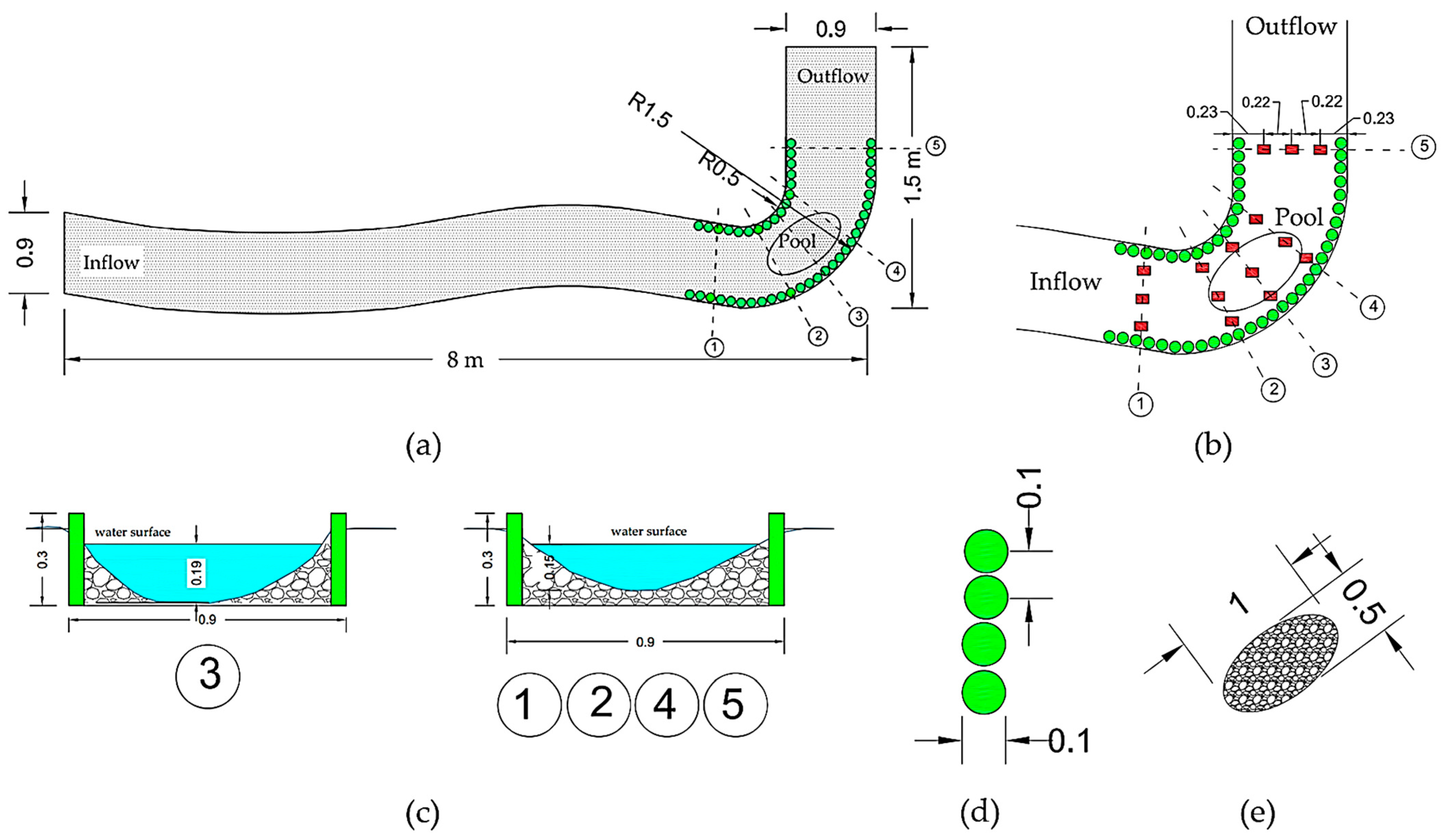
Experiments were carried out in a concrete, recirculating flume (9.5 m long, 0.9 m wide, and 0.25 m deep) located in the Hydraulic Laboratory of the School of Civil Engineering, Iran University of Science and Technology (IUST), Tehran, Iran. Unlike previous studies conducted in straight channels (Nosrati et al., 2024 [21]; Parvizi et al., 2023 [28]), this study measures velocities across five cross-sections within a bend along the central axis as well as the inner and outer regions to reveal how bend reach controls turbulence characteristics and shear-stress distributions. The flume comprises an 8 m meandering inflow reach, a 90° L-shaped bend with inner and outer radii of 0.5 m and 1.5 m, respectively, and a 1.5 m straight outflow reach. The channel bed has a uniform longitudinal slope of 0.02% upstream and downstream of the bend. A three-dimensional artificial pool bedform (1.0 m long and 0.5 m wide) with 8% approach and exit slopes was installed at the center of the bend. The elevation difference between the pool floor and the upstream riffle crest was 4 cm.
To ensure uniform approach flow and minimize large-scale disturbances, bricks and mesh screens were placed at the channel entrance, increasing bed roughness and accelerating the development of fully developed boundary layer conditions. A constant discharge of 20 L s−1 was supplied from a laboratory reservoir using a centrifugal pump. Flow depth was controlled by an adjustable tailgate at the downstream end, maintaining a steady water depth of 15 cm throughout all experiments.
Velocity measurements were obtained within the curved section of the flume under fully developed turbulent conditions. Five cross-sections were selected for detailed measurements, each containing 15 sampling points. Within each cross-section, velocities were recorded at three lateral positions (left, center, and right) located approximately 23 cm from the emergent vegetation zone along the sidewalls and spaced 22 cm apart. Instantaneous three-dimensional velocities were acquired using an acoustic Doppler velocimeter (ADV). This spatial sampling density enabled a detailed characterization of the three-dimensional turbulent flow, capturing variations in the velocity field, turbulence statistics, and secondary circulation patterns.
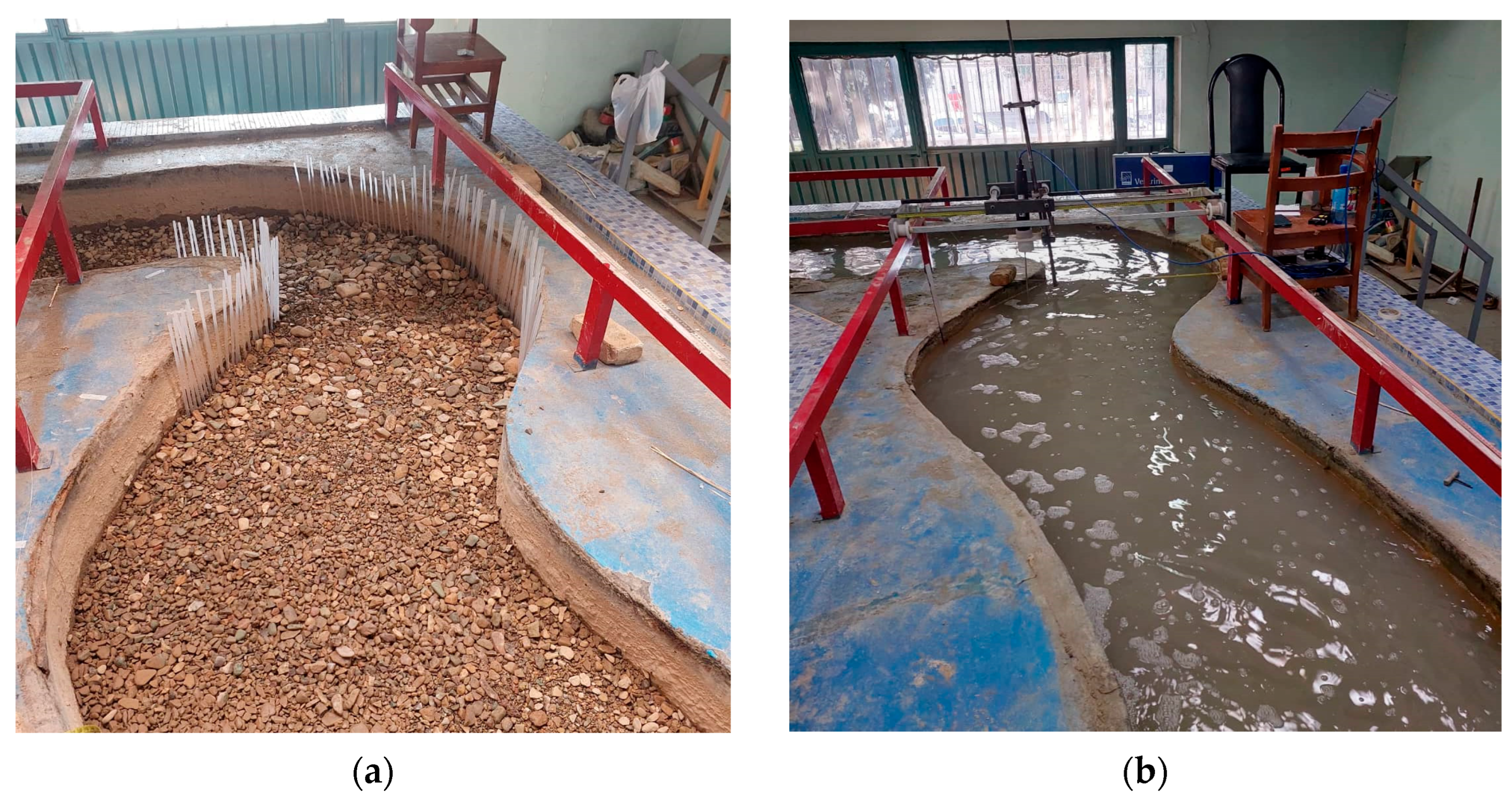
Rigid, cylindrical plastic rods (diameter = 0.01 m; height = 0.30 m) were used to simulate emergent vegetation, following the configuration adopted by Nosrati et al. (2024) for similar flow–vegetation studies [21].
Rigid elements were used to ensure repeatability and fixed geometry across runs and to isolate canopy-induced drag and turbulence from plant flexibility/reconfiguration. The rod height (0.30 m) exceeds the flow depths used here (15 cm in the riffle/bend and up to 19 cm at the pool center), guaranteeing emergent conditions throughout the experiments. The rod diameter (0.01 m) was selected to achieve the target solid volume fraction (φ = 2.61%) with the chosen spacing while avoiding excessive blockage at the laboratory scale.
The artificial vegetation was arranged in a linear, regularly spaced pattern along both sidewalls within the bend, with a longitudinal stem spacing of 0.01 m.
This configuration was selected to represent bank-attached emergent vegetation (e.g., riparian reed belts) and engineered bankline plantings commonly used in restoration practice, while keeping the central region unobstructed for repeatable ADV sampling and isolating the influence of bank vegetation on bend–pool hydraulics.
Vegetation density was characterized by the solid volume fraction (φ) [29], defined as φ = π / 4 a d , where a is the vegetation frontal area per unit volume and d is the stem diameter [29]. For natural aquatic species, φ typically ranges between 0.63% and 5.50% [13]. In the present experiments, φ was maintained at 2.61% on each side of the channel.
Figure 1 and Figure 2 provide a complete schematic documentation of the experimental channel layout, the 3D pool placement and geometry, the sidewall vegetation arrangement, and the ADV measurement grid used for all runs. The flume plan (Figure 2a) shows vegetated elements located on both sides of the 90-degree curve in the end section, with 72 elements on the right and 40 on the left. Velocity measurements were taken at 15 points across five sections (Figure 2b): upstream of the pool (Section 1), at the pool attack (Section 2), within the pool (Section 3), at the pool escape (Section 4), and downstream of the pool. These sections were spaced approximately 2.21 m apart. Due to the small bend radius (R = 1.4 m), the transverse flow depths are nearly uniform. However, the 3D pool causes an increased flow depth downstream. A down-looking Nortek Vectrino plus acoustic Doppler velocimeter probe measured three-dimensional instantaneous velocity components at a sampling location 5 cm below the probe, minimizing flow interference. Data were acquired at 200 Hz for 120 s and processed using Nortek’s software version 10003.9, and standard ADV post-processing procedures [30], filtering out data with average correlation coefficients below 70% or average Signal-to-Noise Ratios (SNR) less than 15 dB. Mean velocity was calculated from 15 to 20 points per velocity profile.
The ADV acquisition and quality control parameters were: sampling frequency 200 Hz; sampling duration 120 s at each point; sampling volume 4 mm located 5 cm below the probe tip; data screening thresholds correlation ≥ 70% and SNR ≥ 15 dB; and velocity noise 0.3 cm s−1 (measured in still water).
The flume bottom (Figure 2c) was covered with approximately 5 cm of gravel, reduced to 1 cm in Section 3 to simulate 3D pool. The 1 m-long and 0.5 m-wide pool (Figure 2e) had an inlet and outlet slope of 8%, consistent with field studies by Nosrati et al. (2022) [22]. The flow depth was maintained at 15 cm, increasing to 19 cm at the pool center (Figure 2c).
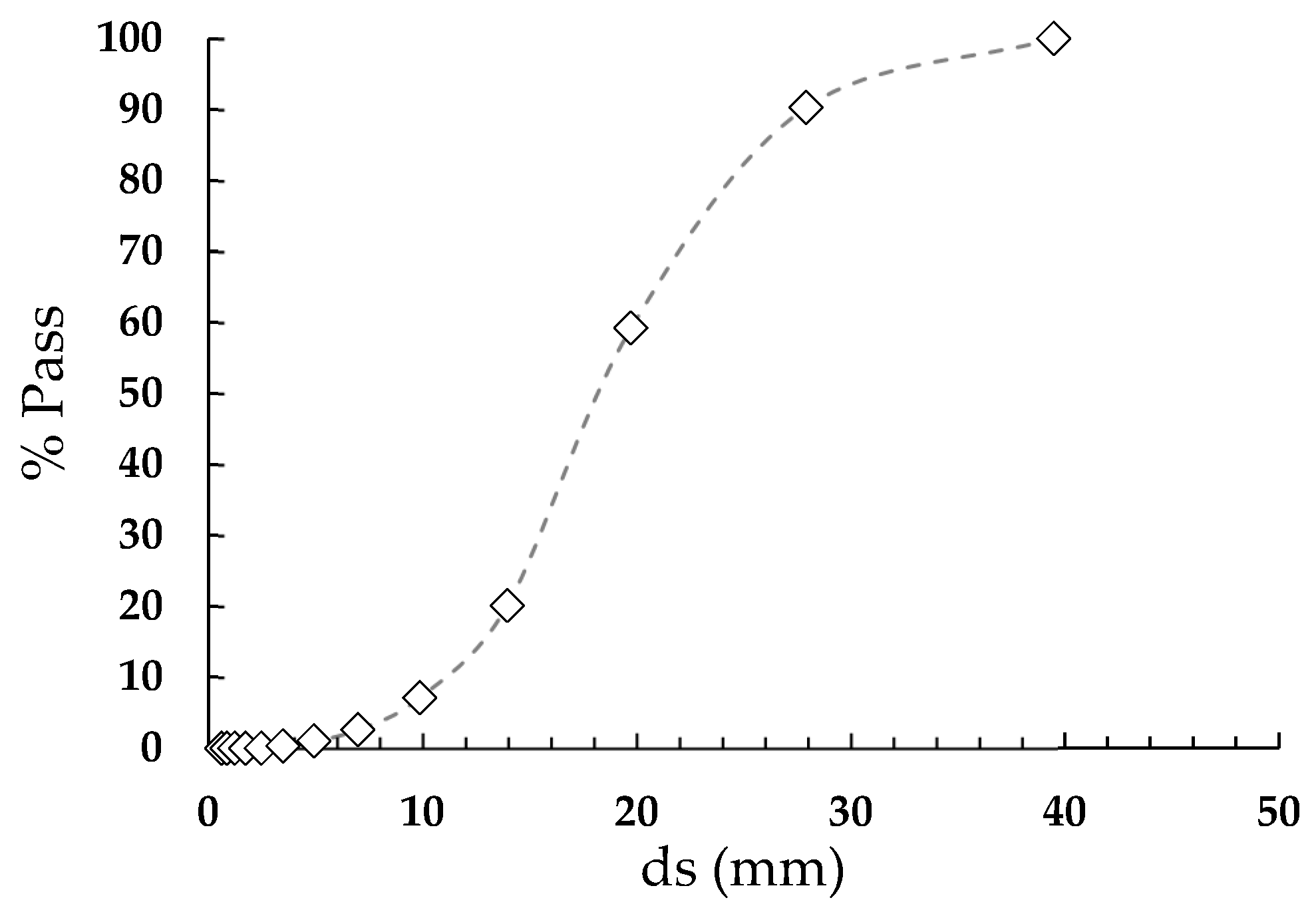
The Wolman Pebble Count method [31] was used to determine the grading curve of laboratory bed materials. The bed particle size distribution (Figure 3) and geometric standard deviation ( σ g = d 84 / d 16 ) exceeded 1.4 ( σ g = 1.46 ), indicating a non-uniform particle distribution [32].
This finding aligns with findings by Nosrati et al. (2022–2024), who observed geometric standard deviations ranging from 2.45 to 3.13 and average bed particle diameters of 15.2–29.8 mm in 3D pools with vegetation [21,22]. In this study, the average bed particle diameter in the laboratory channel was 18.38 mm (Figure 3), where ds (mm) represents the median particle diameter and the vertical axis indicates the percentage of passage.
Flow conditions in the experiments were characterized by the Reynolds number ( R e = 4 u m R h / ϑ m ) and Froude number ( F r = u m / ( g h w ) 0.5 ). These were calculated using the mean flow velocity ( u m ), hydraulic radius ( R h = ( b × h w ) / ( b + 2 h w ) ), channel width ( b = 0.9   m ), water depth ( h w ), kinematic viscosity of water ( ϑ m = 1 × 10 6   m 2 s 1 ) and gravitational acceleration ( g = 9.81   m s 2 ). Experimental parameters for Section 1, upstream of the bend, are detailed in Table 1 for both bare and vegetated cases. Experiments were conducted with (emergent vegetated case) and without (bare case) vegetation on the curve to facilitate comparative analysis. The calculated Reynolds numbers indicate turbulent flow conditions and Froude numbers (Fr < 1) show that the flow is subcritical. As previously noted, a downward-oriented Nortek Vectrino ADV captured three-dimensional flow velocities (u, v, w) along the longitudinal (x), transverse (y), and vertical (z) axes. The x and y axes were defined relative to the curved channel. The ADV’s measurement volume was 4 mm, positioned 5 cm below the probe tip. At each cross-section, the ADV beam (aligned with the x-axis) was oriented with the streamwise flow direction of the channel. As mentioned above, data were collected at 200 Hz for 120 s to ensure precision and consistency [2,24]. When comparing 120 s results of the measurements with 300 s ADV measurements, the differences in time-averaged velocities and turbulent kinetic energy ( T K E = 0.5 ( u 2 ¯ + v 2 ¯ + w 2 ¯ ) were not significant. Fluctuation velocities are defined as u = u u ¯ , v = v v ¯ , and w = w w ¯ . The 120s recording duration proved sufficient time for stable time-averaged and turbulent characteristic acquisition. Velocity measurement noise was determined to be 0.3 cm s−1 in still water. All data collection and processing settings are adjustable within the Vectrino+ version 1.31 software’s configuration sections [33].
Some setup limitations should be noted. The vegetation was represented using rigid, uniformly distributed elements, which cannot fully reproduce the flexibility and spatial heterogeneity of natural plant communities. In addition, the experiments were conducted under a single discharge and flow-depth setting and only two comparative cases (bare and vegetated) were tested. Therefore, the findings should be interpreted as a controlled paired comparison that isolates vegetation effects for the tested condition, rather than as a generalization across flow regimes or vegetation densities. Future work will examine flexible vegetation, multiple densities and patch configurations, and a wider range of discharges and submergence conditions.

3. Results and Discussion

3.1. Longitudinal Velocity Distribution

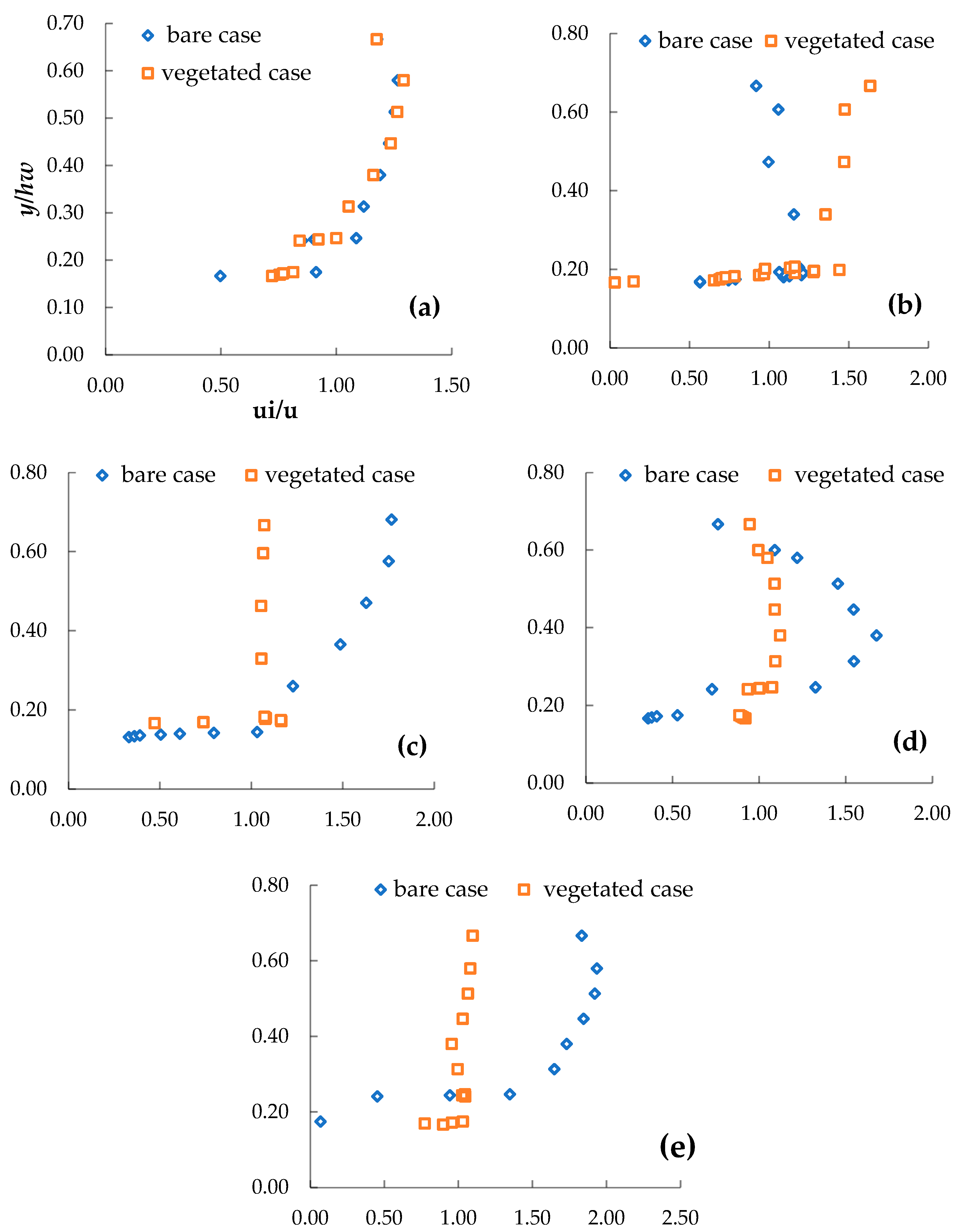
Figure 4 shows longitudinal velocity profiles across the depth of each section, comparing cases with and without artificial emergent vegetation on the flume wall, while maintaining constant flow rate, bed grain size and the 3D pool dimensions.
Velocity profile analysis focused on the channel center due to the similarity of other profiles. In the bare channel (Figure 4a), the longitudinal velocity at Section 1 follows a logarithmic distribution, consistent with straight open channels [34]. Approaching the 90-degree bend in the 3D pool, the velocity profile deviates from this logarithmic distribution for y/hw < 0.2 (Figure 4a), where hw is the local water depth and y is the vertical height from the bed. Downstream of the 3D pool and bend (Figure 4d), the flow remains affected by upstream disturbances (Figure 4c) and has not returned to the upstream velocity profile. Specifically, the velocity in the top region (y/hw > 0.2) is reduced, violating the logarithmic velocity law in the bend, as demonstrated by Nosrati et al. (2024) [21] and Parvizi (2023) for straight channels [28], and which has also been documented in meandering channels with complex bathymetry [1,2].
Vegetation reduces the logarithmic thickness of velocity due to flow resistance from vegetated elements and the 3D pool. Logarithmic velocity at the bend entrance (Figure 4b) was absent with vegetation. Similarly, it was not observed at the 3D pool entrance (Section 3, Figure 4b) or in the pool section (Section 4, Figure 4c), likely due to mass and momentum transfer from vegetated elements in the channel wall, and unfavorable pressure gradients caused by the 3D pool [21,28]. Upstream of the bend (Section 1, Figure 4c), grain distribution minimally affected velocity, while vegetation in the bend and the 3D pool significantly altered the velocity distribution throughout the water column. Within the 3D pool (Figure 4c), velocity near the bed increases slowly with flow depth (y/hw = 0.2), after which (y/hw > 0.2) the velocity distribution changes steadily towards the surface, indicating a greater influence from the 3D pool and vegetation than from the channel bend itself. This “two-layered” velocity distribution mirrors observations in vegetated pools where shear layers form at canopy edges, steepening vertical gradients [13,28,29].
In 3D pools with emergent vegetation (Figure 4e), negative flow velocity near the bed indicates localized recirculation, influencing the dip phenomenon (the maximum velocity below the water surface). These negative velocities arise from recirculation zones near the surface and vortices at the pool base or vegetation patches [35,36]. Vegetation increases drag, reducing flow velocity and increasing turbulence. In dense canopies, stem-scale turbulence dominates, creating small-scale recirculation and altering momentum distribution [13,29]. Vegetation amplifies lateral velocity gradients, promoting 3D recirculation, homogenizing vertical velocity profiles, and ultimately suppressing the typical logarithmic profile. Dense vegetation shifts the velocity maximum upward or distributes it uniformly, countering the dip. Pools introduce vertical and lateral velocity shear, creating jet-like flows and turbulence anisotropy. Consequently, the dip is attenuated in pools because high-velocity jets redistribute momentum, reducing velocity gradients. Vegetation in pools amplifies flow three-dimensionality, strengthening recirculation, and creating localized velocity minima/maxima. Therefore, in 3D pools and emergent vegetation, negative velocities reduce the dip phenomenon through vertical and lateral momentum redistribution. Vegetation homogenizes flow, and 3D pool turbulence increases mixing, which flattens velocity gradients. These effects influence sediment transport, habitat diversity, and river bend morphology.

3.2. Turbulent Kinetic Energy

The 3D flow in vegetated curved channels amplifies turbulent kinetic energy through complex interactions of vegetation-induced resistance, secondary flow structures, and velocity gradients. This leads to enhanced turbulence intensity, non-uniform TKE distribution, and significant effects on sediment dynamics and aquatic habitats [3,37].
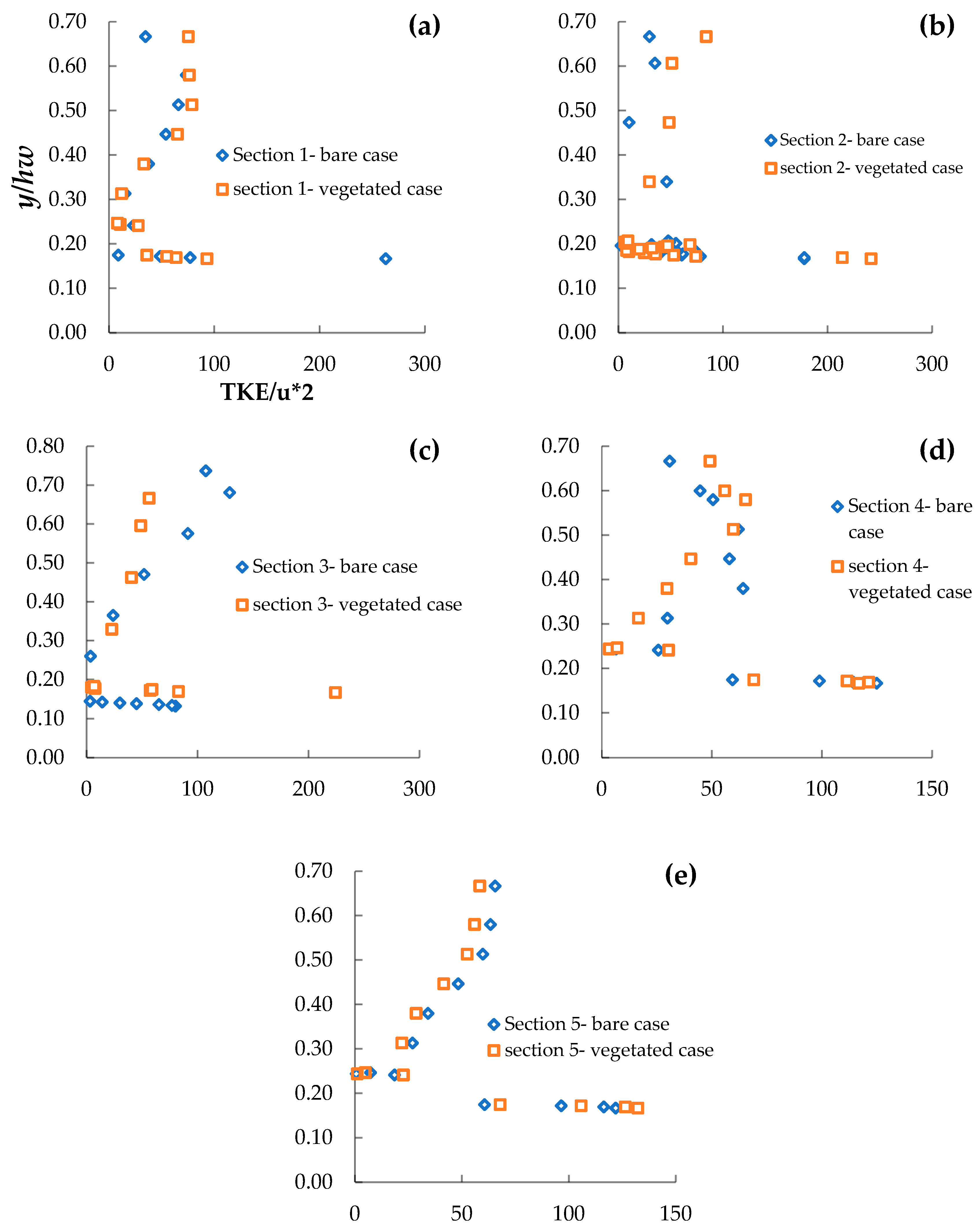
In general, the turbulence kinetic energy (TKE) increases toward the water surface in vegetated zones due to momentum exchange between slower near-bed flows and faster surface flows [38]. Figure 5 shows the turbulence kinetic energy distribution across all five sections. The friction velocity, u = u c ( δ θ ) / 4.4 δ [38], is derived from the kinematic bed stress, where u c is the maximum velocity, δ is the displacement thickness and θ is the momentum thickness of the boundary layer [39]. TKE distribution in curved channels with emergent vegetation and 3D pool features is influenced by the interaction of vegetation density, channel curvature, and flow turbulence. As depicted in Figure 5, TKE peaks near the bed, driven by large velocity gradients, and initially decreases with flow depth up to 0.2. Beyond this, TKE continues to increase with flow depth towards the surface, varying based on velocity profile measurement location. Near the bed, the presence of vegetation, channel bend, and the 3D pool have minimal impact on TKE distribution. Maximum TKE near the bed is observed in the non-vegetated channel at Section 1 (Figure 2a) and the vegetated channel at Section 2 (Figure 2b). Curvature extends the influence of high-momentum fluid descending in vegetated zones, increasing near-bed TKE [37]. The average turbulent kinetic energy (TKE) at the exit of the bend was approximately seven times higher than at the entrance, likely due to turbulence generated by the vegetation elements and the three-dimensional pool within the bend. While channel bends induce centrifugal forces and helical secondary currents that redistribute TKE, the vegetation plays a significant role in this increase. In a 90-degree bend, flow kinetic energy in a channel without vegetation is up to 57% higher than in a channel with vegetation, given a constant plant density on the channel wall (Figure 5c). This suggests that neither flow resistance from plants nor turbulence from the bend’s 3D pool increased kinetic energy. In a vegetated curved channel, a 3D pool intensifies turbulent kinetic energy transfer on the channel walls. This occurs by enhancing turbulence production via flow–vegetation interactions, altering secondary flow structures, and promoting energy exchange between dispersive and turbulent motions. Consequently, TKE levels near vegetated walls are increased and spatially variable, affecting flow resistance and habitat conditions.

3.3. Reynolds Stresses (RS)

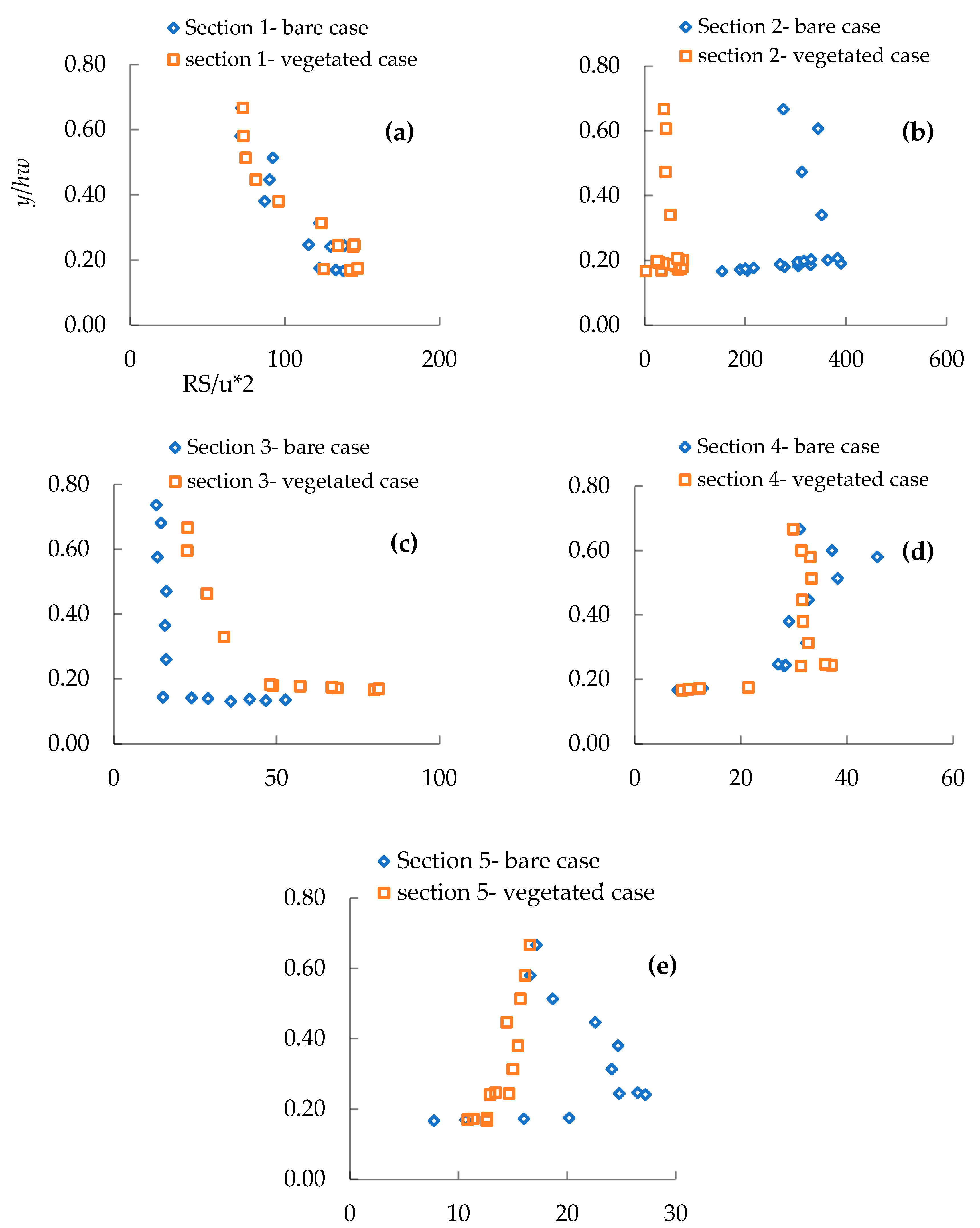
The 3D pools in vegetated curved channels intensify and redistribute Reynolds stresses (RS) on channel walls by altering secondary flows and increasing anisotropic turbulence. This interaction with vegetation resistance enhances momentum transport and turbulence production near the walls, influencing flow resistance, sediment transport, and habitat conditions. Figure 6 shows the Reynolds stress distribution along the 90-degree bend, comparing cases with and without vegetation.
A 3D artificial pool in a vegetated curved channel significantly alters Reynolds stress due to intricate flow–vegetation–curvature interactions. As shown in Figure 6a (Section 1), the Reynolds stress increases with flow depth to a maximum before decreasing towards the water surface, consistent with previous findings by Nosrati et al. (2022) for flows with 3D pools and vegetation [22]. In the bend (Figure 6b), the shear stress distribution deviates from the classical state due to the 3D pool and wall vegetation. At this section, the maximum Reynolds stress occurs at y/hw = 0.2, with a higher value in the channel without vegetation compared to the channel with vegetation. At the bend center (Figure 6c), the Reynolds stress distribution shifts from convex to concave. Upon exiting the bend (Figure 6d,e), the distribution tends towards a convex state, but remains influenced by emergent vegetation elements and the 3D pool, preventing a return to the classical convex state. The average Reynolds stress at the 3D pool section with vegetation is approximately 12% higher than at Section 1, indicating an increase compared with the bare condition. Turbulent flows over 3D pools with vegetation show anisotropic Reynolds stresses. Pool geometry and vegetation stems create organized turbulence and momentum exchange, causing directional dependence in turbulent fluctuations and shear stresses near walls, which intensifies momentum transport [40]. Channel curvature induces secondary flows (Dean vortices) that asymmetrically redistribute Reynolds stresses between convex and concave walls. A 3D pool alters these flows, increasing Reynolds shear stress on the convex bank via flow acceleration and on the concave bank via streamwise (Taylor–Görtler) vortices, resulting in heterogeneous Reynolds stress distributions [4,41]. Pools alter the bed shear stress via the flow separation and recirculation, boosting Reynolds shear stress and turbulence intensity near vegetated walls [42]. Vegetation in or near the 3D pool increases flow resistance and turbulence, amplifying Reynolds stresses and resulting in an increased capacity for sediment removal and transport [43]. This combined effect enhances vertical and spanwise Reynolds shear stresses, increasing momentum transfer and turbulent mixing near the walls [24]. A summary of the key quantitative contrasts between sections and between the bare and vegetated cases is provided in Table 2.

4. Discussion

The results confirm that bend curvature and the 3D pool generate strong spatial heterogeneity in the mean velocity and turbulence statistics, and that emergent vegetation along the banks further amplifies this heterogeneity through added drag and shear at the canopy edge. In combination, curvature-driven secondary circulation, local acceleration–deceleration over the pool topography, and vegetation-induced resistance modify momentum redistribution across the section and lead to departures from classical straight-channel behavior.
A key implication is that the turbulence response is controlled by coupled rather than isolated drivers. The 3D pool promotes localized separation, vortical structures, and enhanced exchange between near-bed and outer flow, while the vegetation increases shear production and alters the vertical structure of mean velocity in the near-bank region. These processes can interact constructively (e.g., intensified mixing and higher turbulence levels in the bend–pool region) and shift where peak Reynolds stresses occur, which is important for predicting near-bank forces and zones of potential erosion or deposition.
From an applied perspective, the findings suggest that using a single reach-averaged parameterization for turbulence or resistance in bends with pools and bank vegetation can be misleading. Restoration designs that include bank plantings or engineered roughness should therefore consider how vegetation location and density interact with bend geometry and bedforms to influence near-bank stresses, sediment transport pathways, and habitat-relevant hydraulic conditions.
This study used rigid, uniformly distributed emergent elements and a controlled laboratory configuration to isolate vegetation–bedform effects under steady flow. Future work should extend the analysis to flexible vegetation, additional densities and patch configurations (including staggered or discontinuous patches), and a broader range of discharges and submergence conditions. Field-scale measurements would also help assess transferability to natural channels with heterogeneous substrates and mixed roughness elements.

5. Conclusions

This study experimentally investigated turbulent flow in a curved, gravel-bed channel containing emergent vegetation along both sidewalls and a 3D pool bedform. Comparisons between bare and vegetated cases under the same discharge and depth show that emergent vegetation increases flow resistance and modifies the vertical structure of the mean velocity, including a departure from the classical logarithmic profile within the bend and pool region.
These conclusions are limited to the tested laboratory conditions (single discharge/flow depth and the two comparative cases) and are intended as a controlled paired comparison rather than a generalization across vegetation densities and flow regimes.
The 3D pool intensified three-dimensional flow structures (secondary circulation, vortices, and localized separation), producing strong spatial variability in turbulence. In particular, turbulent kinetic energy (TKE) increased markedly along the bend (up to approximately seven times from the bend entrance to the exit), and the average Reynolds shear stress within the vegetated pool section was about 12% higher than in the corresponding bare condition.
These results highlight that vegetation–bedform coupling can substantially modify turbulence production and momentum exchange in curved channels, with implications for sediment transport, channel stability, and ecohydraulic design. Future work should examine flexible or mixed vegetation types, a broader range of vegetation densities, and field-scale validation to improve transferability to natural river settings.

Author Contributions

Conceptualization, A.R., H.A. and S.O.; methodology, A.R., H.A. and S.O.; software, A.R.; validation, H.A. and S.O.; resources, A.R., H.A., S.O., M.N.-S. and M.K.; writing—original draft preparation, A.R. and H.A.; writing—review and editing, A.R. and M.N.-S.; supervision, H.A., M.N.-S. and M.K.; All authors have read and agreed to the published version of the manuscript.

Funding

This research received no external funding.

Data Availability Statement

The original contributions presented in this study are included in the article. Further inquiries can be directed to the corresponding authors.

Conflicts of Interest

The authors declare no conflicts of interest.

References

  1. Kumar, P.; Sharma, A. Impact of emergent vegetation on three-dimensional turbulent flow properties and bed morphology in a partially vegetated channel. Int. J. Sediment Res. 2025, 40, 286–311. [Google Scholar] [CrossRef]
  2. Raeisifar, H.; Rahimpour, A.R.; Afzalimehr, H.; Yagci, O.; Valyrakis, M. Experimental assessment of the turbulent flow field due to emergent vegetation at a sharply curved open channel. Water 2025, 17, 205. [Google Scholar] [CrossRef]
  3. Zhao, W.; Zhang, S.; Zhang, J.; Bilal, A. Numerical study of the effects of vegetation stem thickness on the flow characteristics of curved channels. Water Supply 2024, 24, 2218–2231. [Google Scholar] [CrossRef]
  4. Brethouwer, G. Turbulent flow in curved channels. J. Fluid Mech. 2022, 931, A21. [Google Scholar] [CrossRef]
  5. Anjum, N.; Iqbal, S.; Ali, M.; Pasha, G.A.; Ghumman, A.R. Investigation of flow behavior within staggered vegetation patches of various shapes in an open channel. J. Ecohydraulics 2025, 10, 319–337. [Google Scholar] [CrossRef]
  6. Rathod, L.V.; Timbadiya, P.V.; Barman, B. Turbulent flow structure in a symmetric compound channel with flexible emergent vegetation over floodplains. Ecohydrology 2025, 18, e2763. [Google Scholar] [CrossRef]
  7. Samadi Gharehveran, S.; Abbaspour, A.; Farsadizadeh, D.; Hosseinzadeh Dalir, A. Velocity distribution of open channel flow within submerged rigid vegetation with non-uniform height. ISH J. Hydraul. Eng. 2025, 31, 162–172. [Google Scholar] [CrossRef]
  8. Okhravi, S.; Sočuvka, V.; Schügerl, R.; Sokáč, M.; Dulovičová, R.; Velísková, Y. Vegetation effects on flow characteristics and sediment storage in a lowland river channel over time. In Proceedings of the 18th International Symposium on Water Management and Hydraulic Engineering, Štrbské Pleso, Slovakia, 10–14 September 2024. [Google Scholar]
  9. Tang, C.; Jia, H.; Zhang, S.; Yi, Y.; Dey, S. Hydrodynamics of turbulent flow in channels with submerged flexible vegetation canopy. Phys. Fluids 2025, 37, 032123. [Google Scholar] [CrossRef]
  10. Maji, S.; Hanmaiahgari, P.R.; Balachandar, R.; Pu, J.H.; Ricardo, A.M.; Ferreira, R.M. A review on hydrodynamics of free surface flows in emergent vegetated channels. Water 2020, 12, 1218. [Google Scholar] [CrossRef]
  11. Jordanova, A.A.; James, C.S. Experimental study of bed load transport through emergent vegetation. J. Hydraul. Eng. 2003, 129, 474–478. [Google Scholar] [CrossRef]
  12. Dunn, C.; Lopez, F.; Garcia, M.H. Mean Flow and Turbulence in a Laboratory Channel with Simulated Vegatation (HES 51); Hydraulic Engineering Series No. 51; University of Illinois: Urbana, IL, USA, 1996. [Google Scholar]
  13. Nepf, H.M. Drag, turbulence, and diffusion in flow through emergent vegetation. Water Resour. Res. 1999, 35, 479–489. [Google Scholar] [CrossRef]
  14. Järvelä, J. Flow resistance of flexible and stiff vegetation: A flume study with natural plants. J. Hydrol. 2002, 269, 44–54. [Google Scholar] [CrossRef]
  15. Folkard, A.M. Vegetated flows in their environmental context: A review. Proc. Inst. Civ. Eng.-Eng. Comput. Mech. 2011, 164, 3–24. [Google Scholar] [CrossRef]
  16. Plew, D.R.; Cooper, G.G.; Callaghan, F.M. Turbulence-induced forces in a freshwater macrophyte canopy. Water Resour. Res. 2008, 44, W02414. [Google Scholar] [CrossRef]
  17. Tanino, Y.; Nepf, H.M.; Kulis, P.S. Gravity currents in aquatic canopies. Water Resour. Res. 2005, 41, W12402. [Google Scholar] [CrossRef]
  18. Ahmad, N.A.; Ali, Z.; Arish, N.A.M.; Daud, A.M.M.; Alias, N.F.A. Determination of flow resistance coefficient for vegetation in open channel: Laboratory study. IOP Conf. Ser. Earth Environ. Sci. 2018, 140, 012019. [Google Scholar] [CrossRef]
  19. Shumilova, O.O.; Sukhodolov, A.N. Flow dynamics in rivers with riffle-pool morphology: A dataset from case studies and field experiments. Sci. Data 2023, 10, 494. [Google Scholar] [CrossRef] [PubMed]
  20. Sahoo, S.; Sharma, A. Turbulent flow mechanisms in meandering channels with sediment transport. Water Pract. Technol. 2023, 18, 484–500. [Google Scholar] [CrossRef]
  21. Nosrati, K.; Afzalimehr, H.; Raeisifar, H.; Nazari-Sharabian, M.; Karakouzian, M. Submerged rigid vegetation effects on flow hydrodynamics within the pool morphology. River 2024, 3, 260–271. [Google Scholar] [CrossRef]
  22. Nosrati, K.; Afzalimehr, H.; Sui, J. Interaction of irregular distribution of submerged rigid vegetation and flow within a straight pool. Water 2022, 14, 2036. [Google Scholar] [CrossRef]
  23. Kabiri, F.; Tabatabai, M.R.M.; Shayannejad, M. Effect of vegetative bed on flow structure through a pool-riffle morphology. Flow Meas. Instrum. 2022, 86, 102197. [Google Scholar] [CrossRef]
  24. Nosrati, K.; Rahm Rahimpour, A.; Afzalimehr, H.; Nazari-Sharabian, M.; Karakouzian, M. Experimental Investigation of Anisotropic Invariants in Streams with Rigid Vegetation and 3D Bedforms. Fluids 2024, 9, 282. [Google Scholar] [CrossRef]
  25. Xiao, Y.; Yang, Z.; Wang, F.; Liu, M. Large eddy simulation of the hydrodynamic behavior of horizontal side jets in compound open channels with vegetated floodplain. Environ. Sci. Pollut. Res. 2020, 27, 7967–7983. [Google Scholar] [CrossRef]
  26. Li, G.; Sui, J.; Sediqi, S. Hydrodynamic characteristics in pools with leafless vegetation under ice-covered flow conditions—An experimental study and numerical simulation. J. Hydrol. 2025, 657, 133135. [Google Scholar] [CrossRef]
  27. Wu, C.; Deng, J.; Zhou, X.; Gao, A.; Feng, K.; Zhu, C. Turbulence affected by submerged aquatic vegetation under wind-induced flow. Phys. Fluids 2025, 37, 015170. [Google Scholar] [CrossRef]
  28. Parvizi, P.; Afzalimehr, H.; Sui, J.; Raeisifar, H.R.; Eftekhari, A.R. Characteristics of Shallow Flows in a Vegetated Pool—An Experimental Study. Water 2023, 15, 205. [Google Scholar] [CrossRef]
  29. Nepf, H.M. Flow and transport in regions with aquatic vegetation. Annu. Rev. Fluid Mech. 2012, 44, 123–142. [Google Scholar] [CrossRef]
  30. Goring, D.G.; Nikora, V.I. Despiking acoustic Doppler velocimeter data. J. Hydraul. Eng. 2002, 128, 117–126. [Google Scholar] [CrossRef]
  31. Wolman, M.G. A method of sampling coarse river-bed material. EOS Trans. Am. Geophys. Union 1954, 35, 951–956. [Google Scholar] [CrossRef]
  32. Okhravi, S.; Gohari, S.; Alemi, M.; Maia, R. Effects of bed-material gradation on clear water scour at single and group of piles. J. Hydrol. Hydromech. 2022, 70, 114–127. [Google Scholar] [CrossRef]
  33. Craig, R.G.; Loadman, C.; Clement, B.; Rusello, P.J.; Siegel, E. Characterization and testing of a new bistatic profiling acoustic Doppler velocimeter: The Vectrino-II. In Proceedings of the 2011 IEEE/OES 10th Current 2011, Waves and Turbulence Measurements (CWTM), Monterey, CA, USA, 20–23 March 2011; pp. 246–252. [Google Scholar] [CrossRef]
  34. Keulegan, G.H. Laws of Turbulent Flow in Open Channels; National Bureau of Standards: Gaithersburg, MD, USA, 1938. [CrossRef]
  35. Yang, K.; Cao, S.; Knight, D.W. Flow patterns in compound channels with vegetated floodplains. J. Hydraul. Eng. 2007, 133, 148–159. [Google Scholar] [CrossRef]
  36. Artini, G.; Francalanci, S.; Solari, L.; Aberle, J. Effects of leafy flexible vegetation and bedforms on turbulent flow and sediment transport. J. Geophys. Res. Earth Surf. 2025, 130, e2024JF007920. [Google Scholar] [CrossRef]
  37. Yagci, O.; Özgur Kirca, V.S.; Kitsikoudis, V.; Wilson, C.A.; Celik, M.F.; Sertkan, C. Experimental study on influence of different patterns of an emergent vegetation patch on the flow field and scour/deposition processes in the wake region. Water Resour. Res. 2024, 60, e2023WR034978. [Google Scholar] [CrossRef]
  38. Zhang, C.; Xu, Y.; Hassan, M.A.; Xu, M.; He, P. Hybrid modeling on 3D hydraulic features of a step-pool unit. Earth Surf. Dyn. Discuss. 2022, 2022, 1253–1272. [Google Scholar] [CrossRef]
  39. Lin, Y.T.; Huang, T.; Ji, J. Hydrodynamic Characteristics of Flows over Submerged and Flexible Vegetation in Strongly Curved Channels; SSRN: Rochester, NY, USA, 2023. [Google Scholar] [CrossRef]
  40. Maji, S.; Pal, D.; Hanmaiahgari, P.R.; Gupta, U.P. Hydrodynamics and turbulence in emergent and sparsely vegetated open channel flow. Environ. Fluid Mech. 2017, 17, 853–877. [Google Scholar] [CrossRef]
  41. Afzalimehr, H.; Rennie, C.D. Determination of bed shear stress in gravel-bed rivers using boundary-layer parameters. Hydrol. Sci. J. 2009, 54, 147–159. [Google Scholar] [CrossRef]
  42. Soldati, G.; Orlandi, P.; Pirozzoli, S. Reynolds number effects on turbulent flow in curved channels. J. Fluid Mech. 2025, 1007, A28. [Google Scholar] [CrossRef]
  43. Deitrick, A.R.; Hovendon, E.H.; Ralston, D.K.; Nepf, H. The influence of vegetation-generated turbulence on deposition in emergent canopies. Front. Mar. Sci. 2023, 10, 1266241. [Google Scholar] [CrossRef]
Figure 1. Photographs of the experimental setup: (a) bed material and vegetation arrangement; (b) flow condition with the measurement system in place.
Water 18 00431 g001
Figure 2. Experimental configurations: (a) plan view of the 90° bend showing the vegetated sidewall zones and the locations of the five measurement cross-sections (Sections 1–5), (b) sampling-point layout within each cross-section (15 points; left, center, and right positions), (c) representative cross-sections showing the bed configuration and water depth variation, (d) vegetation element geometry and longitudinal spacing (d = 0.01 m; spacing = 0.01 m), and (e) three-dimensional (3D) pool geometry and location within the bend. Red squares indicate ADV velocity measurement locations; green circles represent emergent rigid vegetation elements.
Water 18 00431 g002
Figure 3. Gravel-bed distribution.
Water 18 00431 g003
Figure 4. Longitudinal velocity distributions in five cross-sections: (a) Section 1, (b) Section 2, (c) Section 3, (d) Section 4, and (e) Section 5. (Q = 20 L s−1, y/hw = relative height above bed).
Water 18 00431 g004
Figure 5. Turbulent kinetic energy (TKE) in five cross-sections: (a) Section 1, (b) Section 2, (c) Section 3, (d) Section 4, and (e) Section 5.
Water 18 00431 g005
Figure 6. Reynolds stresses (RS) distribution in five cross-sections: (a) Section 1, (b) Section 2, (c) Section 3, (d) Section 4, and (e) Section 5.
Water 18 00431 g006
Table 1. Experimental parameters.
CaseQ (lit/s)b (m)d50 (mm)Vegetation Density (%)ReFr
Bare case200.918.38044,5490.061
Vegetated case200.918.382.6144,8390.062
Table 2. Summary of key quantitative contrasts between sections and cases.
MetricLocation/ComparisonQuantitative Contrast
Turbulent kinetic energy (TKE)Bend entrance to bend exitApproximately seven times higher at the exit than at the entrance (vegetated case).
Reynolds shear stressPool section (vegetated) vs. corresponding bare conditionApproximately 12% higher in the vegetated pool section.
Mean velocity profileBend/pool region (vegetated)Departure from the classical logarithmic profile relative to the bare case.
Disclaimer/Publisher’s Note: The statements, opinions and data contained in all publications are solely those of the individual author(s) and contributor(s) and not of MDPI and/or the editor(s). MDPI and/or the editor(s) disclaim responsibility for any injury to people or property resulting from any ideas, methods, instructions or products referred to in the content.