1. Introduction
Traditional biological wastewater treatment technologies, including the activated sludge process (ASP), depend significantly on aeration, which is energy-demanding and may inadequately tackle increasing pollutants and nutritional disparities [
1]. Aeration is typically the largest single energy consumer in ASP and therefore a major contributor to operating expenditure ranging from 30 to 80% of total energy consumption [
2].
Microalgal–bacterial consortia (MBC) have evolved as a viable alternative, providing a more sustainable method through oxygenic photosynthesis, improved nutrient uptake, and organic matter decomposition [
3]. Numerous studies have illustrated the efficacy of microalgal systems in wastewater treatment; nevertheless, the majority of research has concentrated on microalgal systems in isolation from activated sludge (AS) integration or used synthetic wastewater [
4].
The establishment of an MBC by the integration of AS offers a distinctive benefit that improves treatment efficacy and system stability by introducing a diverse, pre-adapted microbial community (heterotrophs, nitrifiers, EPS-forming organisms) and an established floc/EPS matrix [
5]. This can buffer against influent variability through functional redundancy, improve settleability/biomass retention, reduce washout risks during operational changes, and stabilize carbon and nitrogen conversion by providing immediate bacterial capacity while the phototrophic fraction adjusts [
6]. There are studies that utilized AS to identify the performance, microbial co-occurrence patterns, microbiota dynamics, and function during the startup stage, which revealed that AS addition improved microalgal growth by increasing the proportion of symbiotic microorganisms, which enhances the effluent quality in terms of carbon and nitrogen [
7]. However, most of the experiments are in the startup stage, with a supply of external aeration/CO
2 that does not confirm the reliability of MBC for the long-term stability [
7,
8].
The main challenges of MBC processes are identifying the appropriate operating conditions that ensure long-term MBC stability, as well as efficient pollutant removal using microbial populations adapted to wastewater characteristics.
Hydraulic retention time (HRT) significantly influences nutrient removal performance, biomass productivity, and reactor stability, with shorter HRTs often posing challenges in maintaining sufficient biomass retention, treatment efficiency, and potentially dissolved oxygen (DO) by controlling volumetric loading rates, contact time, and extent of day–night physicochemical cycling [
9]. Shorter HRT increases the influent nutrient loading, and ultimately, microalgal productivity, but decreases effluent quality [
10]. Optimizing HRT continues to pose a significant research challenge in microalgal bacterial systems [
5,
11]. Short HRTs (2–4 d) in MBC led to poorer treatment—e.g., 39 mg/L NH
4+-N at 4 d versus 10 mg/L at 8 d—and reduced organic/nutrient removal and settling properties compared with longer HRTs (8–10 d) [
10,
12]. However, contrary observations were found in some other studies, where a lower HRT of 2 d resulted in good performance compared to 3 d HRT for pretreated municipal wastewater (MWW) in a sequential batch reactor.
Similarly, solid retention time (SRT) shapes microbial composition and loading balance in microalgal–bacterial reactors, where rising biomass induces self-shading that limits algal growth [
13]. Because algae and bacteria prefer different effective SRTs, cycle lengths, and inoculum ratios, community dynamics, their cooperation (O
2/CO
2 exchange and nutrient uptake) and competition (for light/substrates) are steered by these and thus the performance depends on both biomass and the evolving light field [
13]. Microalgae (and nitrifiers) often require longer SRTs to prevent washout because they grow more slowly under wastewater light conditions. In contrast, heterotrophic bacteria can maintain activity at shorter SRTs because they grow more rapidly on soluble organics [
14]. Consequently, batch duration governs pollutant removal by modulating biomass accumulation, self-shading, and guild dynamics [
13]. Light decreases approximately exponentially with distance as biomass increases (e.g., Beer–Lambert-type behaviour), thereby reducing the average light available to cells and lower photosynthetic growth [
15]. In general, a higher biomass concentration increases the optical density, causing a larger fraction of the culture to be light-limited; this can reduce net growth and shift competition toward organisms better adapted to low-light or surface-attached niches [
16]. Research on SRT optimization largely targets long SRTs (10–30 d) in industrial wastewater, with limited work examining its effects in MBC treating MWW [
13]. One study has focused on a lower range of SRT from 2 to 10 d for microalgae-activated sludge MWW treatment; however, the semi-continuous draw-and-fill setup made HRT = SRT, so SRT variation also changed loading/hydraulic retention time [
17].
On the other hand, inorganic carbon (IC) supplementation, crucial for enhancing microalgal photosynthesis and autotrophic growth, has been extensively studied using synthetic media, but its optimal dosage and utilization efficiency in real MWW remain unclear [
18,
19]. Furthermore, the carbon dynamics, including IC fixation pathways and CO
2 utilization in microalgal–bacterial systems, have not been fully elucidated, particularly in systems lacking mechanical aeration or operating under fluctuating light conditions [
19]. The carbon pathways, including the relative partitioning of influent COD carbon into biomass assimilation/storage (microalgal and bacterial), oxidation to CO
2 (heterotrophic respiration), release as dissolved organic carbon from algal exudates, and inorganic carbon dynamics (IC limitation and pH-driven speciation), remain unclear [
20]. We also noted that the role of the C/N ratio and carbon fixation stoichiometry in determining assimilation vs. oxidation remains insufficiently resolved for non-aerated MBC operation. Consequently, previous studies still lack a comprehensive understanding of how HRT, SRT, and IC collectively influence treatment performance, biomass productivity, and system stability under real municipal effluent conditions. In addition, the mechanistic resolution provided by mass balance analyses has often been insufficient to clearly distinguish algal nutrient assimilation from bacterial nitrification–denitrification processes. To address gaps identified in previous studies, this work evaluates the performance of a microalgae–bacteria system operated under varying HRTs, SRTs, and IC supplementation. This study investigates the effects of nutrient availability and operational conditions on treatment efficiency through mass balance analysis. A comparative assessment with the ASP is also conducted to evaluate the potential of the microalgae–bacteria system as a sustainable alternative for MWW treatment, providing insights for process optimization and scale-up.
2. Materials and Methods
2.1. Pretreatment of Municipal Wastewater
The MWW was obtained from the Olympic Park Wastewater Treatment Plant, Sydney, Australia, and pretreated by cloth filtration to remove solids to avoid self-shading by solids. The physicochemical characteristics of the resulting solid-removed wastewater (sMW) are presented in
Table S1.
2.2. Acclimatization of Microalgae into MWW and Activated Sludge Addition
The reactor was inoculated with a mixed biomass comprising
C. vulgaris culture (24 mg of mixed liquor volatile suspended solids (MLVSS);
Section S1) acclimated to MWW for 65 days (
Table S2) and AS (34.5 mg MLVSS). This step was taken to reduce shock by allowing the culture to stabilize physiologically under laboratory conditions, to reach a consistent growth state, and to improve viability and reproducibility at inoculation. The 400 mL reactor operated without mechanical aeration, resulting in an initial biomass concentration of 0.13 g VSS/L.
2.3. Reactor Operation
The reactor was operated for 40 days and divided into five phases (
Table 1). In Phase I, the reactor was run at an HRT of 6.67 d and an SRT of 10 d for 13 days. Two 5 W LED lights positioned on opposite sides provided an average light intensity of 50 µmol/m
2/s, and the reactor was continuously stirred at 250 rpm for homogeneous mixing. During Phase II (Days 14–15), 20 mL of NaHCO
3 stock solution (1000 mg C/L) was added to increase the influent IC concentration by 270 mg C/L, while the SRT was reduced to 6.67 d and maintained at that level thereafter. In Phase III (Day 22 onward), the HRT was decreased to 2 d. In Phase IV, IC supplementation was further increased by 60 mg C/L, and the light/dark cycle was adjusted from 14:10 to 12:12 h. During the dark phase, the reactor was placed inside a light-insulated enclosure (blackout box) to exclude ambient room light; residual light at the reactor surface during darkness was kept negligible. In Phase V, the HRT was reduced to 1.17 d. To maintain the target SRT, excess sludge was withdrawn during the mixed liquor stage.
2.4. Sampling and Water Quality Analysis
Sampling was performed daily at 11:00 AM before feeding to evaluate the impact of increased organic loading on reactor performance. Samples were preserved at 4 °C before analysis to minimize biological activity and chemical transformation between sampling and analysis.
Chemical oxygen demand (COD), total organic carbon (TOC), IC, and total and dissolved nutrient concentrations were analyzed as required. pH, dissolved oxygen (DO), and temperature were monitored daily. The average photosynthetically active radiation (PAR) was measured with a full-spectrum quantum meter with underwater sensor (model: MQ-510Apogee Instruments, UT, USA). Volatile suspended solids (VSS) and total suspended solids (TSS) concentrations were measured by the gravimetry method as per APHA. The sludge volume index (SVI) was calculated according to APHA [
21].
Dissolved nutrients were analyzed after filtering the liquid samples through 0.45 μm membrane filters, while non-filtered samples were digested for total phosphorus (TP) and total nitrogen (TN) measurements. All analyses were conducted following standard methods [
21]. Ammonium (NH
4+), nitrite (NO
2−), nitrate (NO
3−), phosphate (PO
43−), and TP concentrations in reactor samples were determined using a Gallery Discrete Analyzer (Thermo Fisher Scientific, Finland) based on standard colorimetric procedures. All measurements were automatically processed and calibrated using the built-in standard curves of the Gallery Discrete Analyzer (Thermo Fisher Scientific, Finland). Check standards were used to ensure high precision and reproducibility. The detection limits for each parameter were within the instrument’s specified range. Microalgal growth was monitored in terms of chlorophyll a (Chl-a) concentration. Chl-a was extracted with acetone at 4 °C for 24 h and determined spectrophotometrically using Equation (1) [
22].
The COD was measured using the Hach COD digestion method (Hach, CO, USA). A 200 µL sample was digested in Hach COD vials containing a dichromate oxidizing agent in sulfuric acid at 150 °C for 2 h in a DRB200 digestion block. After cooling to room temperature (20 ± 2 °C), COD concentrations were determined using a Hach DR3900 spectrophotometer (Hach, CO, USA). Calibration and quality control were performed with Hach COD standard solutions (20, 500, and 1500 mg/L), and blank samples were used to account for background interference.
To relate TOC to COD in both feed and effluent, linear correlations were established between the TOC of centrifuged samples and the COD of whole samples. For the feed, the TOC of the centrifuged sample was multiplied by 4 (correlation slope), while for the effluent, it was multiplied by 2.6 to estimate soluble COD. Centrifugation removed suspended solids, as confirmed by 1.5 μm filtration. The DO concentration was measured in situ and recorded continuously with a DO metre (Hach, USA), while pH and temperature were measured with a TPS multimeter (TPS, Australia). The samples were centrifuged at 4400× g rpm for 20 min and were used to quantify TOC, IC, and TN in the effluent using a Shimadzu TOC analyser (Shimadzu, Japan).
2.5. Analysis
Nutrient removal efficiencies (
REs) were calculated using Equation (2).
where C
in (mg/L) is the nutrient concentration of wastewater in the inlet, and C
out (mg/L) is the nutrient concentration in the reactor.
Total oxygen demand (TOD) in the reactor was calculated as the summation of oxygen demand for COD oxidation (OD
COD) and nitrification (OD
NOx). OD
NOx was computed using the available NOx concentration in the reactor. The denitrification fraction was not considered for the TOD calculation. The required oxygen production (ROP) by algae per hour was estimated, accounting for production occurring only during the light period.
The IC demand (ICD) for microalgae is calculated based on the oxygen demand. This was compared against the IC produced by the system through COD oxidation (IC
COD) (50% of degradation) and IC in the feed and supplemented externally (IC
R). Surplus IC in the reactor was calculated based on the difference between the available IC (IC fed to the reactor IC
F and IC produced) and the IC demand.
The substrate-related parameters were analyzed using the following equations.
where SSUR is the specific substrate utilization rate in kg COD/kg MLVSS/d, ΔS is the substrate utilized in mg/L, X is the biomass concentration in mg/L, and HRT is the hydraulic retention time in d.
where Y is the biomass yield coefficient in kg VSS/kg COD, Δx is the biomass growth per day in kg/d, and ΔS is the substrate utilized per day as COD in kg/d.
where F/M is the food-to-microorganism ratio in kg BOD/kg MLVSS/d, Q is the influent wastewater flow rate in L/d, S
o is the influent substrate concentration BOD in mg/L, X is the biomass concentration MLVSS in mg/L, and V is the volume of the reactor in L.
where SNPR is the specific NOx production rate in kg NOx/kg MLVSS/d, ΔN is the NOx remaining in the reactor in mg/L, X is the biomass concentration in mg/L, and HRT is the hydraulic retention time in d.
2.6. Microscopic Analysis
The morphology-based identification of microbial species was performed using an Olympus BX41 compound microscope at 20× magnification.
2.7. Data Analysis
The statistical analysis was performed using Microsoft Excel, including the degree of significance (p < 0.05) using one-way analysis of variance (ANOVA).
3. Results and Discussion
3.1. Phase-Wise Pollutant Removal
The initial microbial community used as an inoculum for this experiment performed effectively (
Tables S1 and S2) in COD removal and nitrification at an HRT and SRT of 10 d. Even with a decrease in HRT to 1.17 d (
Table 1) and an increase in influent COD to 270 mg/L (
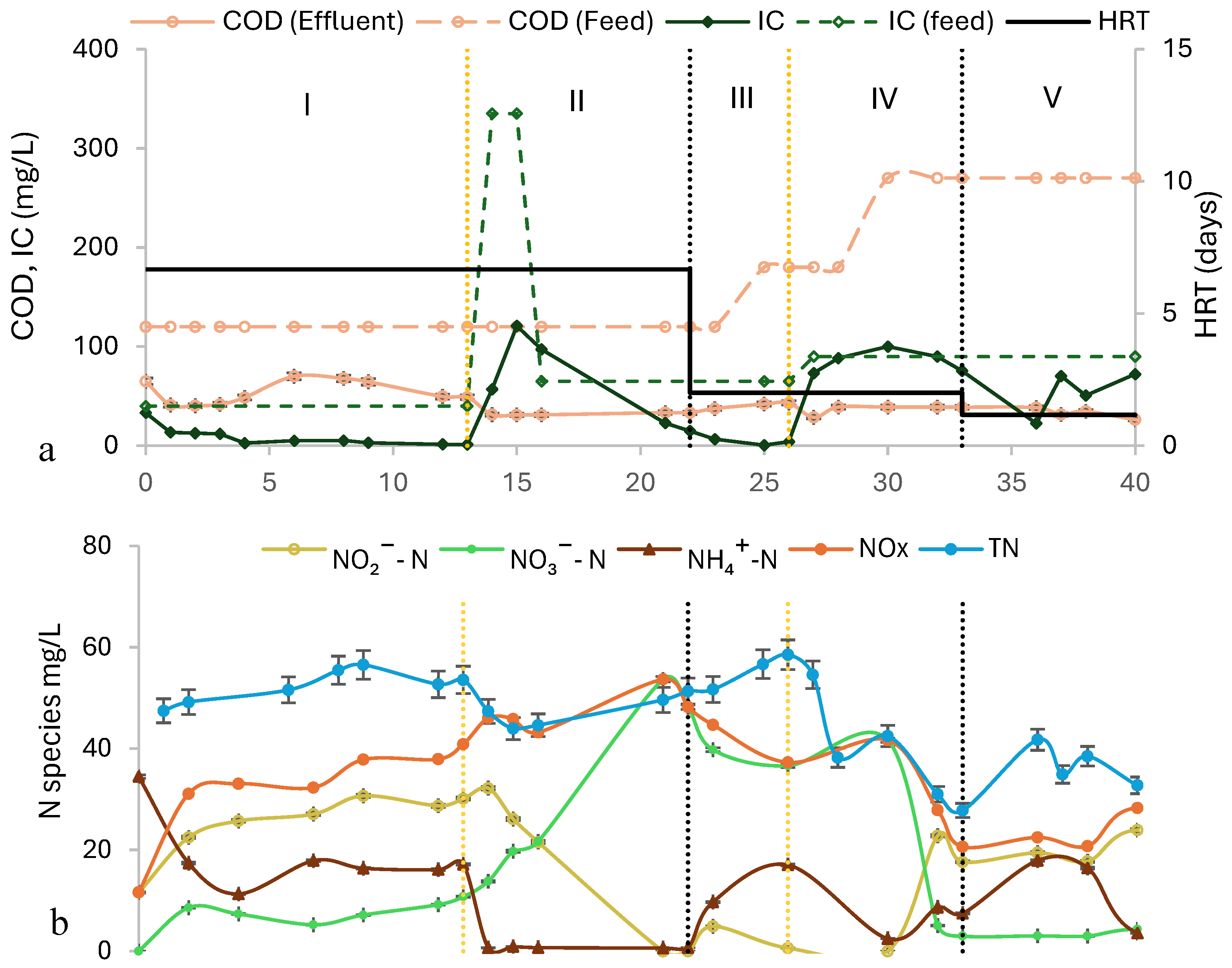
Figure 1a), effluent soluble COD (sCOD) decreased and remained stable at ~32 mg/L, corresponding to 88% removal. Over time, the microbial population likely adapted to the varying operational conditions, resulting in more active biomass (MLVSS in
Figure 1d). This performance is better than many other reported removal efficiencies of COD from MWW using a microalgae–bacteria consortium [
23]. Some studies using microalgal-activated sludge consortia reported similar effluent COD levels, but with a higher HRT of 3 d [
24].
Nitrogen removal and nitrification occurred in all phases. A minimal amount of nitrogen was removed up to Day 26. The exception was during Days 13 to 22, when pH was elevated (>8) following IC addition. This high removal is likely due to stripping of ammonia at a pH near the pKa of 9.3 for NH3/NH4+ and a long HRT (6.67 d). Similarly, high pH and associated high nitrogen removal were observed between Day 26 and Day 33 (HRT 2 d). Like the addition of IC, algal activity is known to increase pH [
25,
26] and thus, a high pH occasionally is plausible. From Day 33 onward, a lower pH suggests that nitrogen stripping was no longer significant, and removal likely occurred via denitrification or assimilation into biomass. These mechanisms align with previous studies reporting nitrification/partial nitrification in microalgae–bacteria reactors [
12,
23]. Longer HRT (7–8 d) has been shown to enhance nitrification rates, increasing effluent nitrate concentrations; however, elevated nitrification/denitrification can reduce ammonium availability for microalgal uptake, potentially impacting microalgal productivity [
27].
Whenever complete ammonia oxidation occurred, the TN in effluent matched with NOx measurements (
Figure 1). In most phases (e.g., I, III, and V), lower levels of IC corresponded to a lower NOx-to-TN ratio (or ammonia oxidation). These observations suggest that IC availability is a primary factor controlling nitrification, as it is essential for autotrophic nitrifying microorganisms [
28].
In Phase V, the average nitrogen removal was 35 mg N/L, while COD and IC removal were 238.0 and 36.0 mg/L, respectively. COD removed by heterotrophs corresponded to 91.4 mg C/L. IC available for autotrophs is considered as the summation of IC removed (36.0 mg/L) and 50% of TOC converted to IC (45.7 mg/L); thus, 81.7 mg C/L was removed. Considering the C:N assimilation ratio of 100:15 for bacteria (13.7 mg N/L) and that of 75:15 for microalgae (i.e., 16.4 mg N/L), the results show a total assimilation of 30.1 mg N/L, which is slightly lower than the estimated removal of 35 mg N/L. The remaining ~5 mg N/L was likely removed via denitrification, supported by low COD and prevailing nighttime low DO levels.
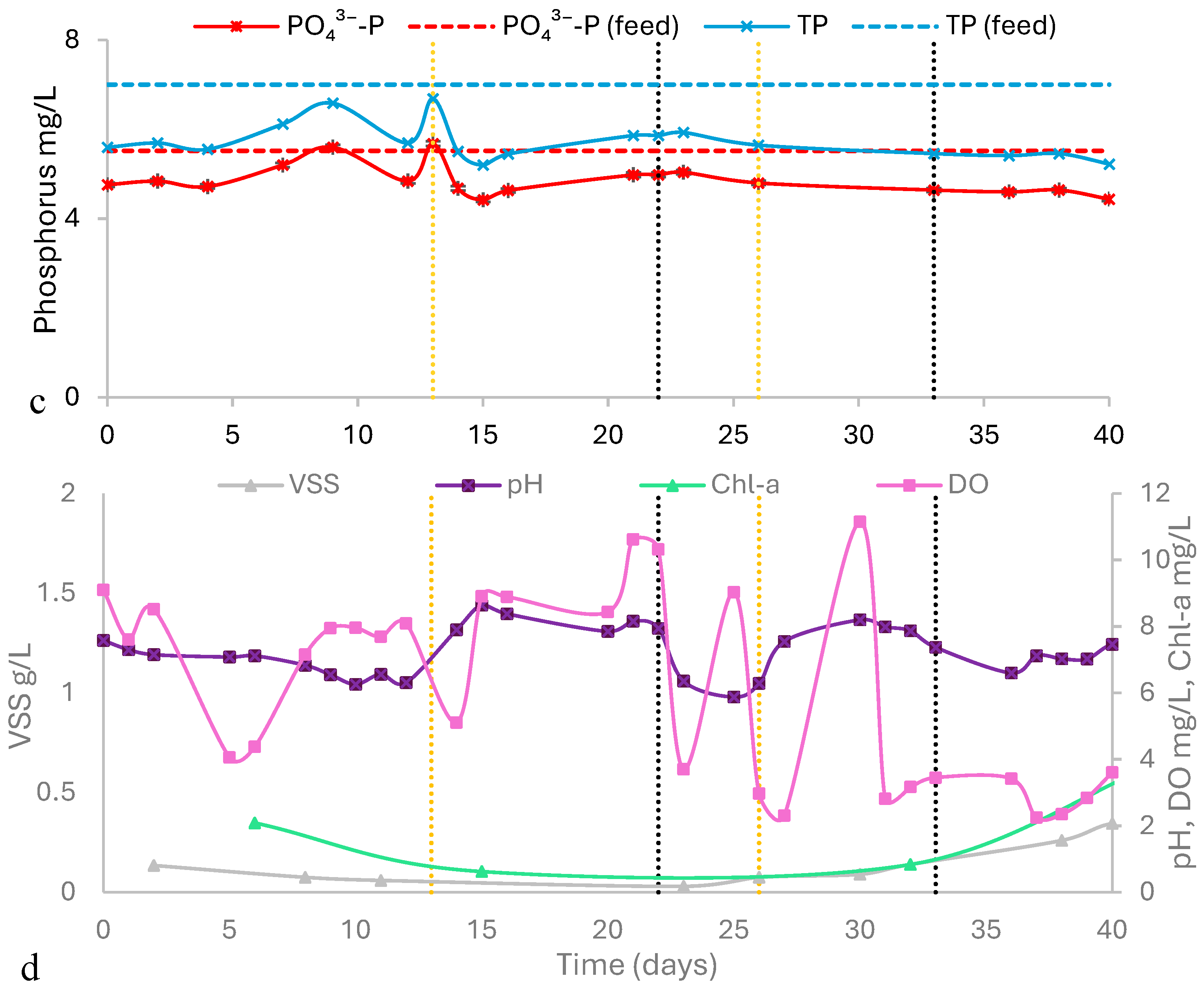
Assuming an N:P assimilation ratio of 15:1, the phosphorus required for assimilating 30.1 mg N/L is approximately 2 mg/L. The measured TP removal was 1.64 mg/L, indicating that the observed removal is consistent with cellular assimilation. The remaining nitrogen and phosphorus in the effluent would require further treatment. However, the fact that nitrogen has already been largely nitrified means that only denitrification and phosphorus removal are needed.
3.2. Microbial Interactions Among Nitrifiers, Heterotrophs, and Algae Under Variable HRT
To evaluate the interaction between microalgae and bacteria, the mass balance of key exchange compounds (IC and oxygen) was considered, as detailed in
Section 2.5, with the influence of pH discussed where necessary.
Table 2 summarizes the exchange of IC and oxygen with respect to COD removal and nitrogen oxidation. In Phase I, the average oxygen demand to oxidize the COD (OD
COD) was 4.2 mg/d, while the oxygen demand (OD
Nox) for NOx production was 7.1 mg/d (Equation (3)), resulting in a TOD of 11.3 mg/d. To meet the oxygen demand of 11.3 mg/d, algae required 4.2 mg IC/d (ICD
algae). The removed COD was 4.2 mg/d (TOC 1.6 mg-org-C/d), and assuming ~50% of the removed TOC was converted to IC [
29], IC production was 0.8 mg IC/d (Equation (8)), leaving 3.2 mg IC/d available for algal use. Additional IC demand for nitrifying bacteria was minimal and was not included in
Table 2, resulting in a deficit of 1 mg IC/d, consistent with near-zero IC measured in the reactor (
Figure 1). As the DO in the reactor was closer to or above the saturation during daytime, the reaeration possibility was neglected for Phases I–III in
Table 1. It should also be noted that having a low pH (<~7.35, pKa for H
2CO
3/HCO
3− is 6.35) (
Figure 1d) could also be another factor to decrease the IC further by stripping [
30].
IC supplementation briefly improved IC availability in Phase II, enabling enhanced algal oxygen production and supporting nitrification. Continuous supplementation from Phase IV onward ensured sufficient IC to meet algal demand, resulting in greater photosynthetic oxygen production. Maintaining an appropriate pH is pivotal to sustaining IC availability and a stable MBC in MWW reactors [
31]. The pH dictates carbonate speciation, shifting IC among CO
2(aq), HCO
3−, and CO
32−, thereby controlling microalgal carbon-uptake efficacy and photosynthetic productivity, while simultaneously governing nitrifier activity and the formation of inhibitory species (free ammonia at higher pH and free nitrous acid at lower pH). Since photosynthesis raises pH and nitrification consumes alkalinity, unmanaged diurnal shifts can reduce IC bioavailability and disrupt nitrification [
32]. Maintaining near-neutral to slightly alkaline conditions (≈pH 7.2–8.2), sufficient alkalinity (≥80–150 mg CaCO
3 L
−1), and controlled IC supplementation (CO
2 sparging or bicarbonate dosing) minimizes free NH
3/free nitrous acid risks, maintains bioavailable IC, and supports coupled O
2/CO
2 exchange between guilds. Minimizing aeration at high pH and jointly monitoring pH with ammonia, nitrite, and alkalinity provides a practical control framework to preserve consortium function and treatment performance.
As HRT decreased, organic and nitrogen loading increased, leading to an increase in oxygen demand and an IC deficit. Biomass (VSS) and microalgae (Chl-a) generally responded by rising in concentration (
Figure 1). The ratio (Chl-a/VSS), representing the relative abundance of microalgae to bacteria, has shown that microalgae have declined in concentration compared to bacteria from Phase I until Phase IV and then increased slightly, followed by stabilization in Phase V.
On Day 6, the day cycle (
Figure S1) showed that the DO remained relatively high during the day (>3.5 mg/L) and at night (>1.8 mg/L), likely due to the low organic loading rate (OLR), which provided sufficient oxygen for COD removal and nitrification.
Overall, IC supplementation and reduced HRT collectively enhanced algal activity (increased Chl-a), shifted the system towards the algal dominance, and contributed to improved reactor performance (including nitrification) with a low biomass (MLVSS) of approximately 0.4 g/L (
Figure 1d).
3.3. Biomass Growth and Characteristics
Reducing SRT from 10 to 6.67 d led to microbial washout as indicated by MLVSS (
Figure 1). However, increased organic loading towards the end of the study promoted microbial growth and improved COD removal. Biomass peaked at 0.345 ± 0.001 g VSS/L at the end of Phase V (
Figure 1d), with productivity of 0.024 g/L/day. Consistent with prior studies, CO
2 supplementation to control pH enhanced algal productivity, aligning with observations in high-rate algal ponds where IC augmentation improved biomass yield by up to 89% [
33].
SVI analysis showed sludge (MLVSS = 0.55 g/L in 400 mL) settled to 5 mL in 5 min and 9 mL at 30 min, giving an SVI of 41 mL/g, indicative of dense, fast-settling biomass. An SVI ≤ 80 mL/g indicates dense, rapidly settling sludge, with higher MLSS further reducing SVI. Further, the sludge volume index of the normal AS process is in the range of 100–300 mL/g, depending on the hydraulic considerations and the capacity and performance of the secondary clarifier [
34]. These results indicate that the reactor produced biomass with good settling properties, reducing energy requirements for dewatering and transportation. A similar SVI (43 mL/g) was reported in a pilot-scale sequential anaerobic–aerobic hybrid algal–bacterial reactor for domestic wastewater treatment [
35].
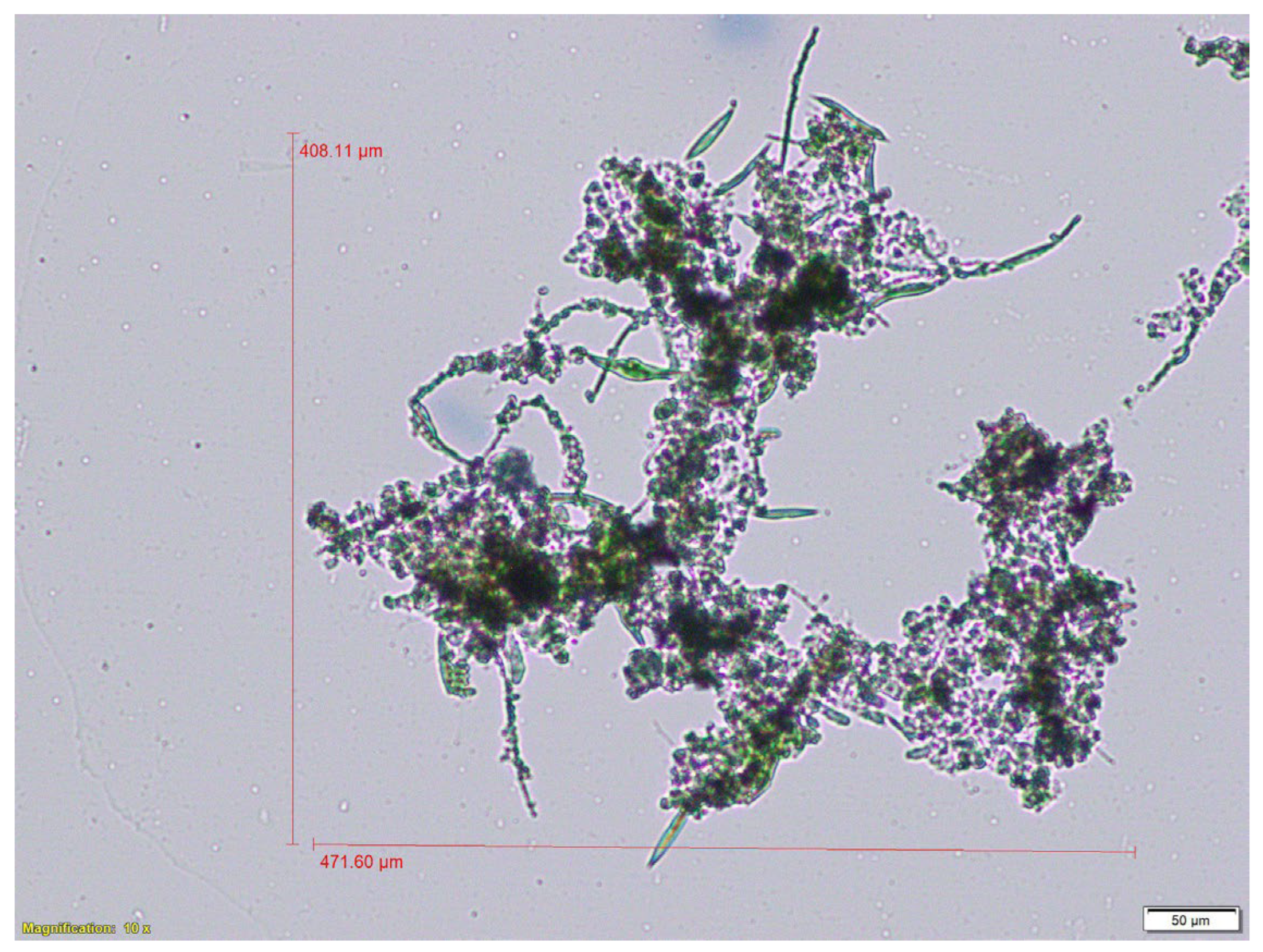
Biomass particle sizes ranged from 50 to 470 µm, observed using an Olympus BX41 microscope (Olympus, Japan). Floc shapes varied from spherical to elongated, and different microalgae and bacterial species were identified (
Figure 2), likely originating from the sMW or developed during reactor operation. Microalgae and unicellular algae primarily attach to sludge flocs via extracellular polymeric substances (EPSs), while filamentous algae and bacteria form stable aggregates. This combined structure minimizes algal loss in the effluent and promotes biomass retention in the MBC.
3.4. Comparing the Reactors with the Conventional Activated Sludge Process
Unlike an activated sludge process, which relies purely on externally supplied oxygen and bacterial degradation, the presence of microalgae contributed to the generation and use of photosynthetic oxygen and the processing of wastewater by both microalgae and bacteria.
The SSUR in the microalgal–bacterial system was governed by SU, HRT, and MLVSS. Higher SSURs observed under IC supplementation and reduced HRT indicated rapid microbial adaptation and enhanced metabolic activity.
The microalgal–bacterial reactor exhibited SSURs of 0.05–1.40 and 0.06–1.26 kg COD/kg MLVSS/day (
Figure S2), comparable to conventional activated sludge processes, which typically range from 0.3 to 1.95 kg COD/kg MLVSS/day (
Table 3) [
36]. Furthermore, the biomass yield ranged from 0.14 to 0.6 g VSS/g COD removed, lower than typical ASP yields of 0.4–0.8 g VSS/g COD removed (
Table 3) [
37], reflecting initially slower microbial growth rates and potentially reduced sludge production due to photosynthetic oxygen contribution. However, this system exhibited variable substrate utilization efficiency, requiring precise control of retention times and nutrient availability. The food-to-microorganism (F/M) ratio varied significantly (0.18–0.947 kg BOD/kg MLVSS/day), particularly after the feed rate increase on Day 41, whereas conventional ASP maintains a more stable F/M ratio range (0.2–0.5) [
38]. In a side-by-side comparison of MBC and conventional activated sludge (AS) systems, AS achieved higher total COD and TSS removal due to superior solids capture. In contrast, the MBC system matched AS in its removal of soluble organics. The MBC reactor achieved nitrification and higher total-N removal, attributed to large microalgal–bacterial flocs creating low-O
2 microenvironments that supported denitrification powered by photosynthetic O
2 rather than aeration. Phosphorus removal was weaker in the MBC system. Overall, efficient nitrification–denitrification and COD removal in MBC was achieved without external aeration, and longer HRT (48 h) favoured photosynthetic biomass accumulation [
39].
3.5. Limitations and Future Directions of MBC Systems
High and especially fluctuating organic loading (high/variable OLR or C/N) destabilizes MBC in several ways: (i) readily biodegradable COD drives heterotrophs to consume oxygen faster than in situ algal photosynthesis can replenish it, suppressing nitrifiers and shifting N pathways, especially at elevated C/N ratios in mixed algal–bacterial cultures; (ii) diurnal systems experience deeper nighttime DO and pH troughs under high organic loads, widening daily pH swings that disrupt ammonia speciation and process stability; (iii) higher OLRs increase turbidity, colour, and biomass accumulation, intensifying self-shading, limiting light, and reducing photosynthetic O
2 supply, as observed in high-rate algal ponds (HRAP) and algal–wastewater studies [
46,
47]; (iv) peaks in external organic carbon favour heterotrophs over algae, diminishing oxygenation capacity when demand is the highest. Together, these effects raise the risk of shock-load upsets and operational interventions, highlighting the need to maintain municipal-strength loads within the algal oxygenation capacity and use equalization or blending to smooth influent variability. Further reducing HRT will require solids retention via granulation or selective wasting; report effective SRT and critical washout thresholds for nitrifiers and slow-growing phototrophs. This should be confirmed in future studies.
Future systems should implement pH-based IC dosing (CO2 or bicarbonate) to track diurnal demand, preventing midday CO2 limitation and nighttime over-alkalinization; quantify control performance via time-weighted DIC, pH, and O2 setpoint tracking error; map how IC setpoints and pH windows shift the MBC (algae vs. heterotrophs vs. nitrifiers) granule architecture—particularly relevant at low COD, where photo-autotrophy provides most O2. Since light availability limits productivity, future designs should actively protect the photic budget under variable loads through pretreatments to reduce colour/turbidity, shallow/high-area HRAP geometries, and mixing regimes that manage light–dark cycling, while maintaining the C/N ratio in the “municipal” window where algal oxygenation can match heterotrophic demand. In intensified systems (e.g., membrane-coupled photobioreactors), fouling-aware control (balancing sustainable flux, photoperiod, and EPS management) is emerging as a critical design parameter. Soft sensors for biopolymer clusters combined with adaptive photoperiods can stabilize flux and effluent quality under fluctuating OLR.
Finally, long-duration outdoor pilots and hybrid configurations (e.g., oxylag + HRAP trains) are needed to codify operating envelopes under seasonal and real wastewater variability, translating laboratory advances into robust, climate-resilient municipal practice.
In scaling MBC reactors from laboratory to full-scale wastewater treatment, several deviations are expected that may influence performance and community structure. First, light availability becomes a dominant constraint at larger scales because increased optical path length and biomass-driven attenuation reduce average irradiance and intensify self-shading, potentially lowering photosynthetic oxygen production and shifting the system toward greater bacterial dominance. Second, hydrodynamics and mixing differ substantially: full-scale reactors often exhibit spatial heterogeneity (dead zones, stratification, and localized short-circuiting), which can create uneven distributions of substrates, CO2/IC, and DO compared with well-mixed lab units. Third, gas transfer (CO2 supply and O2 stripping) is scale-dependent due to lower surface-area-to-volume ratios and different turbulence regimes, affecting inorganic carbon availability, pH dynamics, and the balance between phototrophic growth and nitrification. Finally, full-scale implementation must consider practical biomass retention/solids separation (settling, flotation, membrane/clarifier design) to maintain an effective SRT independent of HRT. These scale-related factors should be addressed through design strategies, such as shallow photic zones (e.g., high surface area systems), robust SRT control, staged configurations, and targeted IC/alkalinity management, to preserve the intended MBC function under realistic conditions.