Review

Microplastics in Wastewater Systems of Kazakhstan and Central Asia: A Critical Review of Analytical Methods, Uncertainties, and Research Gaps


by
María-Elena Rodrigo-Clavero
1,*,
Javier Rodrigo-Ilarri
1,
Kulyash K. Alimova
2,
Natalya S. Salikova
2,
Lyudmila A. Makeyeva
3 and
Meiirman Berdali
2
1
Instituto de Ingeniería del Agua y del Medio Ambiente (IIAMA), Universitat Politècnica de València, 46022 Valencia, Spain
2
Department of Engineering Systems and Networks, Satbayev University, Almaty 050000, Kazakhstan
3
Department of Ecology, Life Safety and Environmental Protection, Abay Myrzakhmetov Kokshetau University, Kokshetau 020000, Kazakhstan
*
Author to whom correspondence should be addressed.
Water 2026, 18(1), 104; https://doi.org/10.3390/w18010104 (registering DOI)
Submission received: 6 November 2025 / Revised: 15 December 2025 / Accepted: 15 December 2025 / Published: 1 January 2026
(This article belongs to the Section Wastewater Treatment and Reuse)

Abstract

Microplastics are increasingly recognized as contaminants of emerging concern in wastewater systems, where treatment plants act both as sinks and as point sources. However, Central Asian wastewater infrastructures are under-represented in the literature, and global syntheses are hindered by strong methodological heterogeneity (sampling regimes, size cut-offs, QA/QC). This PRISMA-guided critical review compiles and harmonizes data from 63 WWTP studies worldwide (402 matrix-stage observations), including the few available case studies from Kazakhstan and neighboring countries, to benchmark Central Asian plants against a global envelope and identify methodological and infrastructure gaps. Globally, influent concentrations cluster around a median ≈65 particles/L, while final/tertiary effluents show a median ≈2.2 particles/L. Median removal efficiency is 85.5% for secondary and 95.0% for tertiary/advanced trains, with ≈103–105 particles/kg DW typically retained in sludge. Across influent, effluent and sludge, fibers and fragments of PE, PP and PET dominate polymer morphology patterns, with similar PET/PE/PP signatures also reported in downstream river water. Central Asian influents fall within global interquartile ranges, but secondary-only facilities tend to yield effluents in the upper half of the global distribution. Overall, the review provides a first integrated, methodologically explicit assessment of WWTP microplastics in Central Asia and underscores the need for protocol harmonization, longitudinal monitoring, and targeted upgrades of polishing steps and sludge management in arid hydrosystems.

1. Introduction

Microplastics (MPs), typically defined as plastic particles smaller than 5 mm, have become pervasive pollutants in aquatic systems due to their persistence, ubiquity, and capacity to adsorb and transport hazardous chemicals and microorganisms [1,2]. They are now considered a class of emerging contaminants of global concern, detected in surface waters, sediments, biota, and even in drinking water and atmospheric fallout. MPs originate from both primary sources (e.g., microbeads, industrial abrasives, textile fibers) and secondary sources generated by mechanical and photochemical fragmentation of macroplastics [3]. At the basin scale, much of the microplastic burden originates from the gradual breakdown of larger plastic items under physical, chemical and biological stressors (e.g., UV radiation, mechanical abrasion, thermal cycling and biofouling), ultimately yielding micro- and nanoplastics that can persist for years to decades in aquatic environments [3]. Within wastewater systems, additional fragmentation can occur during conveyance and treatment, for example, through pumping, aeration, shear and grit removal, which can transform part of the influent macro- and mesoplastic load into smaller plastic particles before discharge or sludge separation [4]. Once released, they exhibit complex environmental pathways, with wastewater treatment plants (WWTPs) serving as key nodes that both intercept and redistribute these materials.
WWTPs play a dual role in the urban plastic cycle. On one hand, they intercept large MP loads originating from domestic wastewater, industrial discharges, and urban runoff. On the other hand, they can act as secondary sources of MPs through their treated effluents and sinks through their sludge streams, which often contain the majority of retained particles [4,5]. Despite decades of progress in wastewater treatment, complete removal of microplastics is not achieved by conventional treatment trains. Meta-analyses report average removals of approximately 88% in secondary treatment and up to 94% with tertiary or advanced polishing steps [6,7]. At the plant scale, removal efficiencies span roughly 50% to >95%, depending on configuration, hydraulic conditions, and particle-size detection limits, as observed in multi-plant investigations comparing centralized and decentralized systems [8] and in year-long mass-balance studies [9]. Among tertiary or advanced technologies, membrane bioreactors (MBRs), rapid sand filtration, dissolved air flotation (DAF), and disc filtration have demonstrated the highest incremental removals, typically exceeding 95% in final effluents [10,11]. Most studies concur that a large fraction of the influent microplastic load (typically 65–90%) is retained in sewage sludge, as observed in full-scale monitoring campaigns and meta-analyses [6,11,12,13,14]. This accumulation introduces additional environmental risks, since sludge is often applied to agricultural soils or disposed of in landfills, leading to potential secondary emissions of MPs via runoff, leachates, or atmospheric dispersion [15,16,17]. Such technological and management limitations are particularly critical in regions dominated by secondary treatment infrastructure, where sludge stabilization and post-treatment processes are limited, as is the case across much of Central Asia [18]. On this basis, the following paragraphs first summarize global and regional patterns in WWTP microplastics and then narrow the focus to Kazakhstan and Central Asia, highlighting the specific evidence gaps that motivate this review.
While numerous regional and global reviews have assessed the occurrence and removal of MPs in WWTPs, the geographic distribution of studies remains highly uneven [6,7,19]. Most research has concentrated in Europe, East Asia, and North America, as shown by global bibliometric analyses and syntheses [19]. By contrast, data from developing regions—particularly in Central and South Asia, Africa, and Latin America—remain scarce, as highlighted by region-focused reviews and assessments [20,21,22,23,24,25].
In Asia, MP removal is frequently incomplete and influent/effluent concentrations vary widely, largely driven by treatment configuration, sampling design, and analytical detection limits [7,26,27]. This spatial and methodological heterogeneity underscores the need for standardized protocols and expanded regional monitoring networks. Within Central Asia, scientific evidence remains particularly scarce. Only in recent years have studies emerged in Kazakhstan, documenting MPs in surface waters and wastewater systems. The first systematic assessment at the Astana WWTP reported MPs within the 100–5000 µm range and revealed polymer heterogeneity and seasonal variability in removal efficiency [28]. Complementary monitoring in the Akmola region detected MPs in rivers and lakes receiving treated effluents [29], supporting the view that wastewater remains a dominant input pathway to inland freshwaters [30]. Nevertheless, the scarcity of studies, small sample sizes, and the lack of methodological consistency collectively undermine robust cross-study synthesis and regional mass-balance assessments.
Analytical characterization of MPs in wastewater poses additional technical challenges: the heterogeneity of influent, mixed liquor, effluent, and sludge requires matrix-specific pre-treatments (e.g., oxidative or enzymatic digestion and density separation) and each step may introduce biases (e.g., polymer degradation or embrittlement, loss of fine fractions, and variability in recovery rates) in the context of WWTPs [31,32,33,34]. Detection techniques (optical microscopy, focal plane array (FPA)-based micro-Fourier-transform infrared spectroscopy (µ-FTIR), micro-Raman spectroscopy (µ-Raman), and pyrolysis–gas chromatography–mass spectrometry (pyrolysis-GC/MS)) differ in detection limits, particle-size resolution, and analytical selectivity for wastewater matrices, which directly affects particle counts and polymer identification across influent, effluent, and sludge [32,33,35,36]. Methodological choices below 100 µm (especially <50–100 µm), together with spectral-matching criteria and Quality Assurance/Quality Control (QA/QC) procedures (e.g., field/lab blanks, spike-recovery tests), can yield order-of-magnitude differences in reported concentrations in WWTP studies [31,32,37]. The absence of harmonized protocols is therefore a major barrier to comparability, data reproducibility, and accurate modeling of MP behavior across different treatment systems. This limitation is especially relevant in resource-constrained regions such as Central Asia, where analytical capacity and funding for environmental monitoring remain limited.
The persistence of MPs in both WWTP effluents and sewage sludge exposes a critical governance gap: even where tertiary/advanced treatment is implemented, MP removal remains incomplete and non-negligible loads are still discharged to receiving waters [38,39], while a substantial fraction of the influent MP load partitions to sludge, creating downstream risks when biosolids are land-applied or otherwise managed [40,41,42,43].
Given the arid to semi-arid hydroclimate, episodic flows, and the predominance of legacy secondary treatment with limited tertiary polishing across Central Asia, WWTP discharges are likely among the most significant point sources of MPs to inland freshwaters in the region [20]. Moreover, the lack of standardized monitoring frameworks and still-developing regulatory systems—explicitly noted for Central Asian wastewater governance—means that the true magnitude of MP releases remains uncertain and difficult to benchmark across utilities [20,44]. Globally, the evolving policy landscape—exemplified by the recast EU Urban Wastewater Treatment Directive proposal (COM (2022) 541 final) and the ongoing UN plastics treaty negotiations (INC process)—highlights the increasing regulatory relevance of MPs in wastewater systems [45].
Taken together, these scientific, analytical, and governance gaps indicate that a regional synthesis is essential to consolidate scattered evidence and resolve methodological inconsistencies. This work adopts a comparative analytical perspective, building a harmonized study- and observation-level dataset from global WWTP microplastics studies and using stratified descriptive statistics to compare Central Asian records with methodologically comparable global subsets, in order to deliver a critical synthesis of the occurrence, analysis, and behavior of microplastics (MPs) in wastewater systems of Kazakhstan and Central Asia. Specifically, this review aims to:
  • Summarize MP occurrence in influent, effluent, and sludge from regional WWTPs and benchmark these values against global datasets.
  • Critically evaluate analytical methods and their uncertainties—covering sampling, pre-treatment, and detection—that limit cross-study comparability and hinder mass-balance modeling.
  • Propose a regional research agenda prioritizing protocol standardization, interlaboratory comparisons, and long-term monitoring to enable robust assessment and mitigation of MP pollution in developing contexts.
By consolidating fragmented evidence, benchmarking analytical approaches, and exposing key methodological limitations, this study establishes a transparent baseline to support model development, treatment optimization, and policy design for mitigating MP pollution in Central Asian wastewater systems. At the same time, the analytical framework and methodological lessons are relevant to wastewater microplastics assessments in other data-scarce, arid and continental regions, making the findings informative beyond the Central Asian context.

2. Methodology of the Review

This review was conducted following established best practices for environmental evidence synthesis, combining a systematic literature search, structured screening criteria, and a transparent data-extraction framework informed by the Preferred Reporting Items for Systematic Reviews and Meta-Analyses extension for Scoping Reviews (PRISMA-ScR) guidelines [46]. For emerging and methodologically heterogeneous topics such as wastewater microplastics, PRISMA-type workflows are particularly beneficial for mapping the breadth of available evidence, documenting key sources of methodological diversity (sampling, pre-treatment, detection, QA/QC), and making explicit where data are too inconsistent to support formal meta-analysis or robust global emission estimates. The objective was to ensure methodological transparency, reproducibility, and traceability of the search and selection process applied to studies on the occurrence and analysis of microplastics in wastewater treatment systems, with particular emphasis on Kazakhstan and Central Asia.
However, this work does not constitute a systematic review or a scoping review in the formal sense. It was designed as a critical review, guided by PRISMA-ScR principles as a good-practice reference, but adapted to the limited number, heterogeneity, and uneven quality of available studies for Central Asia. Consequently, several PRISMA-ScR components—such as protocol registration, quantitative meta-analysis, or standardized risk-of-bias assessment—were not applicable. In practice, PRISMA guidance was used to structure four main stages: (i) identification of records in multiple databases and regional repositories, (ii) screening of titles and abstracts, (iii) full-text eligibility assessment against predefined inclusion/exclusion criteria, and (iv) data-charting and qualitative appraisal of methodological quality and potential sources of bias. The complete list of the 63 studies retained after full-text screening is provided in the Supplementary Material.

2.1. Search Strategy and Data Sources

The literature search covered the period January 2010 to September 2025, encompassing the time frame during which MP research in wastewater treatment significantly expanded worldwide. The start year was chosen because systematic research on microplastics in wastewater treatment plants began to emerge after 2010, with broader methodological consolidation occurring during the subsequent decade. This window captures the full evolution of MP–WWTP research from its emergence to the most recent methodological advances.
The primary databases consulted were Scopus, Web of Science Core Collection, and ScienceDirect, complemented by Google Scholar and regional repositories (e.g., Kazakh National Electronic Library, eLIBRARY.ru) to capture relevant local publications that may not be indexed internationally.
Search strings combined Boolean operators and key terms related to MPs, wastewater, and treatment processes, such as: (“microplastics” OR “plastic particles” OR “microfibers”) AND (“wastewater” OR “sewage” OR “sludge” OR “wastewater treatment plant” OR “WWTP”) AND (“Central Asia” OR “Kazakhstan” OR “Uzbekistan” OR “Turkmenistan” OR “Kyrgyzstan” OR “Tajikistan”). Additional cross-searches using combinations such as “microplastics removal WWTP” and “analytical methods for microplastics in wastewater” were also performed to ensure the inclusion of methodological reviews and comparative studies.
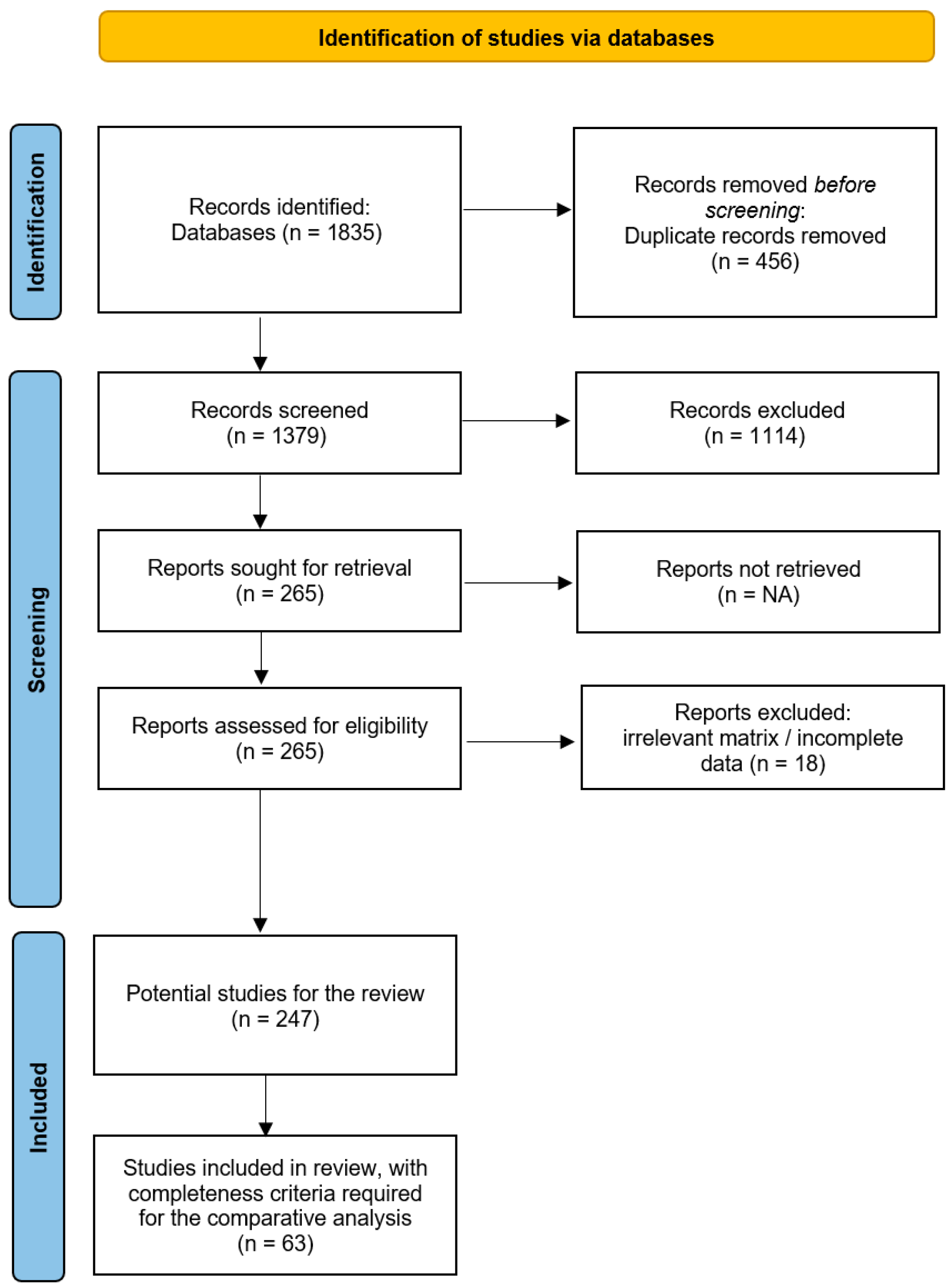
References cited within key papers and regional reports were screened manually to identify additional sources not retrieved in the database search (snowballing technique). Screening was restricted to English-language records; non-English articles were not included. Duplicate records from Scopus and Web of Science were identified and removed in reference-management software using a hierarchical match: DOI > normalized title > first author/year. The final database comprised 1355 unique publications globally and 24 region-specific studies from Central Asia (Figure 1).

2.2. Inclusion and Exclusion Criteria

Studies were selected based on relevance to the occurrence, quantification, or removal of microplastics in wastewater treatment systems. Inclusion required that records met all of the following:
  • Document type: peer-reviewed journal articles, conference papers, or institutional/agency reports with traceable methods; review papers were included when providing systematic synthesis of WWTP evidence.
  • Matrix/process scope: explicit focus on WWTP influent, effluent, sludge, or directly related process streams (e.g., primary/secondary clarifiers, tertiary/advanced polishing).
  • Methodological transparency: clear reporting of sampling (location, volume, dates), pre-treatment (e.g., digestion, density separation), and identification technique (microscopy, µ-FTIR, Raman, Py-GC/MS), including minimum size threshold.
  • Quantitative output: at least one quantitative metric, such as MP concentration (e.g., particles/L for liquids; particles/kg dry weight (DW) for sludge) and/or removal efficiency (%); when available, QA/QC indicators (blanks, spike recoveries, Limit of Detection/Limit of Quantification (LoD/LoQ)) were recorded.
Exclusion criteria comprised:
  • Studies dealing exclusively with marine or surface-water MPs, without linkage to wastewater sources.
  • Records with insufficient methodological detail (e.g., no size cutoff or no analytical method stated).
  • Publications focusing solely on modeling or ecotoxicological effects unrelated to WWTP matrices/streams.
  • Non-scientific particles (news, editorials, non-traceable gray literature).
Titles, keywords, abstracts and conclusions were screened manually to ensure relevance to wastewater treatment systems. Only studies directly addressing MP occurrence, removal or fate in influent/effluent/sludge (or adjacent WWTP process streams) were retained. This process reduced the dataset from 1355 to 241 global studies and from 24 to 6 regional records.
Of the six regional particles retained: two reports empirical WWTP evidence aligned with this study target scope; two are regional reviews (contextual, non-empirical; one for Central Asia and one specific to Kazakhstan); and two are Uzbekistan river studies documenting MPs in receiving waters impacted by WWTP effluents. The latter were included to represent connected pathways within Central Asian hydrosystems where WWTP discharges are a dominant input. No empirical WWTP evidence was found for Turkmenistan, Kyrgyzstan, or Tajikistan, evidencing a critical regional data gap.
To ensure transparency and reproducibility, the selection workflow followed PRISMA principles [46,47]: duplicates were removed using reference-management software (DOI > normalized title > author/year); potentially eligible full texts were retrieved and evaluated against inclusion/exclusion criteria; and retained records were manually validated for metadata consistency and correct assignment to thematic scope. The data-extraction template was therefore designed to reflect these PRISMA-inspired stages by explicitly coding elements along the full analytical chain—sampling regime (grab vs. composite/flow-weighted), size thresholds, pre-treatment, detection and identification techniques, QA/QC implementation, and concentration/morphology reporting—so that inconsistencies and contradictions in the literature could be systematically identified.
The final dataset (Figure 1) was organized into two analytical blocks: (i) global evidence and comparative analyses (occurrence, removal, analytical methods) (61 studies), and (ii) Central Asian evidence with emphasis on Kazakhstan (2 studies), integrating empirical findings and infrastructure/hydrological context to support the comparative objectives outlined in Section 1.

2.3. Data Extraction and Synthesis Variables

A standardized data-extraction template was applied to all eligible records to ensure consistency and comparability. From the 247 global and local studies screened in full text, 63 met the completeness criteria required for the comparative analysis (i.e., they reported most of the target variables listed below). Data were organized at two hierarchical levels:
  • Study level (n = 63 studies with 106 records). Each study corresponds to a unique publication–WWTP (or set of WWTPs) with a consistent methodological description. The following fields were extracted:
  • Study ID, Reference, Country, Region, Plant Name, Population served, Average flow, Treatment train (primary/secondary/tertiary/advanced).
  • Sampling period start, Sampling period end, Sampling method, Number of campaigns, Seasonality covered.
  • QA/QC reporting: Blanks reported (Y/N), Spike recovery reported (Y/N), Spike recovery (%), LoD/LoQ reported (Y/N).
  • Notes (e.g., particularities, deviations from standard protocols, ancillary controls).
2.
Observation level (n = 402 matrices observations). Each observation is a matrix-stage datum extracted from a study (possibly multiple per study). The following variables were recorded:
  • Observation ID, Study ID, Matrix (influent/effluent/sludge), Stage (e.g., primary clarifier, activated sludge, tertiary filtration, MBR, etc.).
  • Microscopy (for MP counting), Size range (µm), Mass (when reported), Concentration unit, Concentration mean, Removal efficiency (%).
  • Spectroscopy (for polymer ID), Dominant polymers, Polymer fractions (%), Dominant shape.
  • Comments (e.g., analytical caveats, sub-LoQ handling).
To enable harmonized comparison across studies and treatment configurations, concentrations were standardized to particles/L for liquid matrices and particles/kg DW for sludge; where necessary, explicit conversion factors were applied (e.g., particles/m3 to particles/L). Polymer taxonomy was harmonized (PE, PP, PET, PVC, PS, etc.), and treatment stages were mapped to an operational ontology (pre-treatment/primary/secondary/tertiary/advanced) to facilitate cross-study comparisons. Heterogeneous size thresholds were preserved via the Size range (µm) field and used qualitatively as a covariate in the synthesis; no forced rescaling of counts below disparate detection limits was performed. For global versus Central Asian comparisons (Section 5.1), “like-for-like” subsets were constructed by filtering the dataset on matrix, treatment class, concentration unit and lower size cut-off (e.g., ≥100 µm vs. <100 µm), so that regional values are benchmarked against methodologically comparable global records. Where removal efficiency (%) was not reported but comparable influent–effluent pairs existed, it was calculated directly and tagged as derived. QA/QC metadata (blanks, spike recoveries, LoD/LoQ) were coded both binary and quantitative to support quality appraisal and interpretation of inter-study discrepancies.
Within this PRISMA-informed framework, the most contradictory and potentially inaccurate information in the wastewater microplastics literature was observed in three areas. First, reported number-based concentrations, where inconsistent lower size cut-offs, volume normalization and unit conversions can yield order-of-magnitude differences between ostensibly similar studies. Second, morphology and polymer composition, particularly in datasets relying solely on visual classification without systematic spectroscopic confirmation, which increases the risk of misidentification. Third, sampling regime and volume reporting for grab versus composite samples, which is often incomplete and limits rigorous cross-study comparison of loads. By contrast, plant-level descriptors such as treatment configuration, average flow and population served were generally reported more consistently and showed fewer contradictions across studies.
The operational outcome of extraction and curation was a dataset comprising 63 study-level records and 402 observation-level records, which underpins the subsequent comparative analysis. This harmonized dataset operationalizes the comparative analytical perspective adopted in this review: all global and regional summaries are derived from stratified descriptive statistics applied to the observation-level records (by matrix, treatment class, size window and region), rather than from formal meta-analytic models with study-level weighting.

2.4. Quality Assessment and Potential Sources of Bias

Study quality was qualitatively appraised using criteria focusing on: (i) completeness of methodological reporting, (ii) implementation of QA/QC procedures (e.g., blanks, spike-recovery experiments), (iii) sampling representativeness (volume, replication, temporal coverage), and (iv) clarity and consistency of data presentation (units, statistical descriptors).
Potential biases were classified as analytical (e.g., under-detection of <100 µm MPs, contamination control, recovery variability), sampling (spatial/temporal under-representation), and publication/reporting (language or indexing limitations). The study prioritized journal articles but also included selected conference proceedings and book chapters when they provided unique methodological or regional insights not yet covered in the peer-reviewed literature.
Given the heterogeneity in sampling protocols, size thresholds and reporting metrics, a structured comparative synthesis was conducted rather than a formal meta-analysis. Accordingly, no numerical weights or exclusion rules based on a quantitative quality score were applied; all descriptive statistics use the full set of eligible observations that meet the inclusion criteria, and quality indicators are used qualitatively to interpret results and highlight uncertainties rather than to reweight or discard studies. This appraisal supports transparent interpretation of cross-study differences and informs the methodological uncertainties and regional research priorities identified in this review.

3. Global Evidence and Analytical Challenges

Methodological discrepancies in sampling, digestion, and detection often result in inconsistent data, complicating inter-study comparisons and global modeling. Moreover, the vast majority of studies originate from Europe, East Asia, and North America, whereas data from developing regions—including Central Asia—are almost absent. This asymmetry in research coverage introduces not only geographic bias but also uncertainty in estimating global MP fluxes from wastewater systems.
Table 1 provides a study-level summary of the WWTPs covered by the global comparative dataset (61 of the 63 included studies). The two remaining studies correspond to Central Asian case studies that are discussed in detail in the regional analysis (Section 5). Full methodological and observation-level details for all 63 studies are provided in the Supplementary Material.

3.1. Overview of Global Evidence

3.1.1. Geographical Variability and Plant Typologies

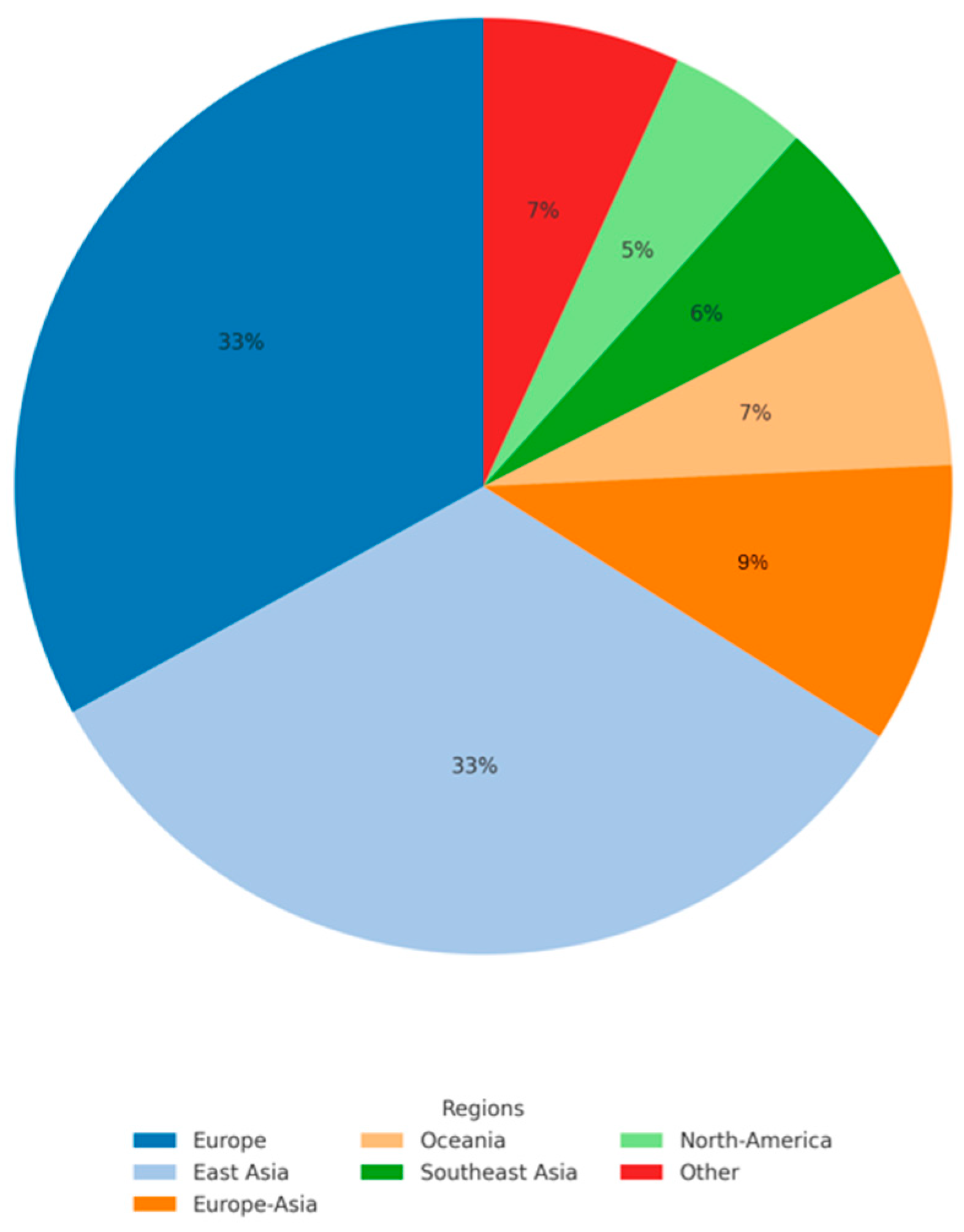
The study-level corpus comprises 104 WWTP records consolidated from 61 peer-reviewed works (including one study that analyzed nine WWTPs), totaling 396 observations across matrices and treatment stages. Records span multiple world regions and are led by Europe and East Asia, followed by cross-regional Europe–Asia, Oceania, and Southeast Asia, with smaller contributions from North America, Western/South/Southwest Asia, and Africa (Figure 2).
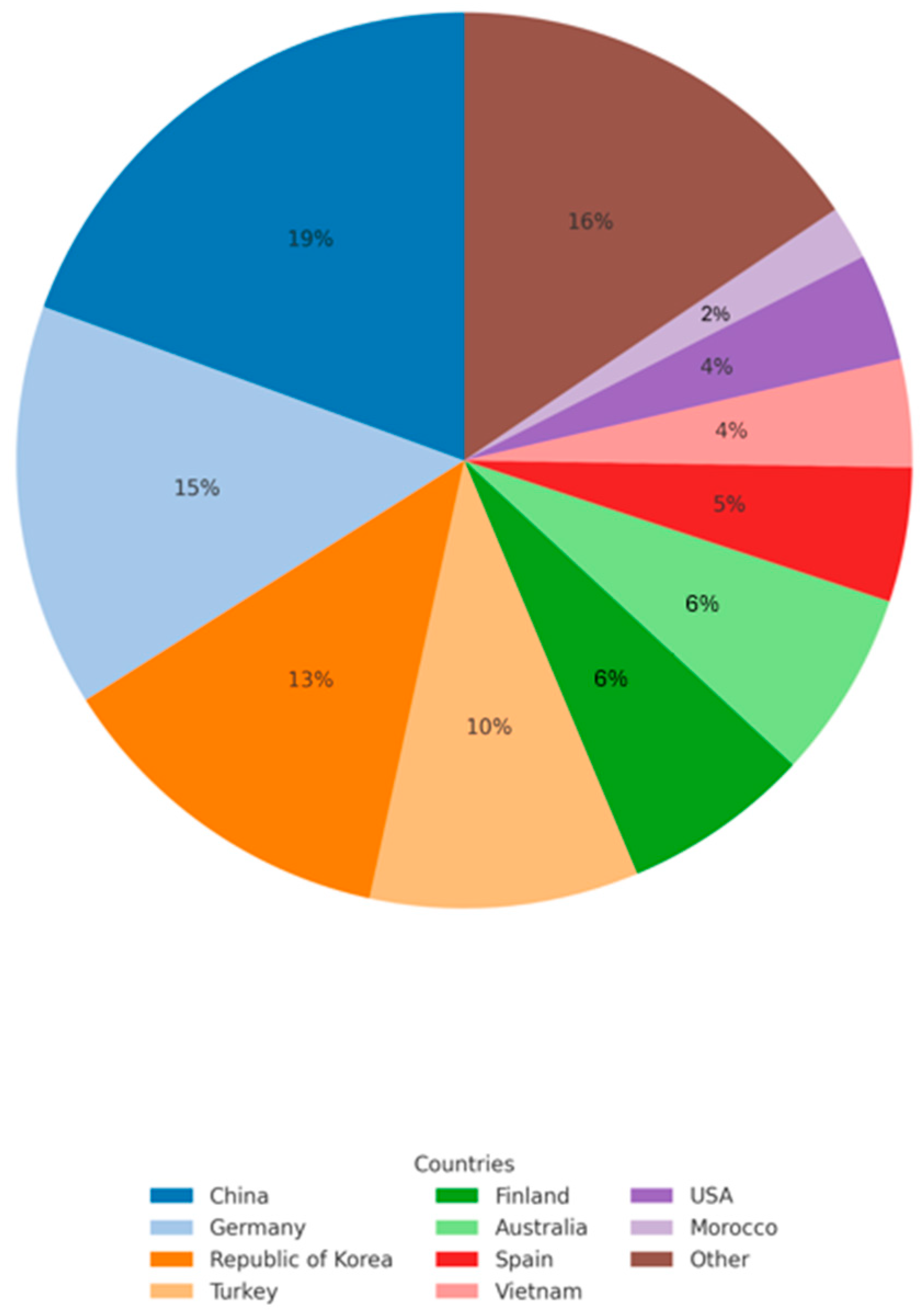
At the country level, a small group of research-active nations dominates the dataset, consistent with research capacity and the prevalence of centralized wastewater infrastructure (Figure 3).

3.1.2. Scale and Process Configurations

Reported average flows range from municipal (≈103–105 m3/day) to metropolitan (>106 m3/day), with medians and interquartile ranges compatible with both large urban catchments and medium-sized plants.
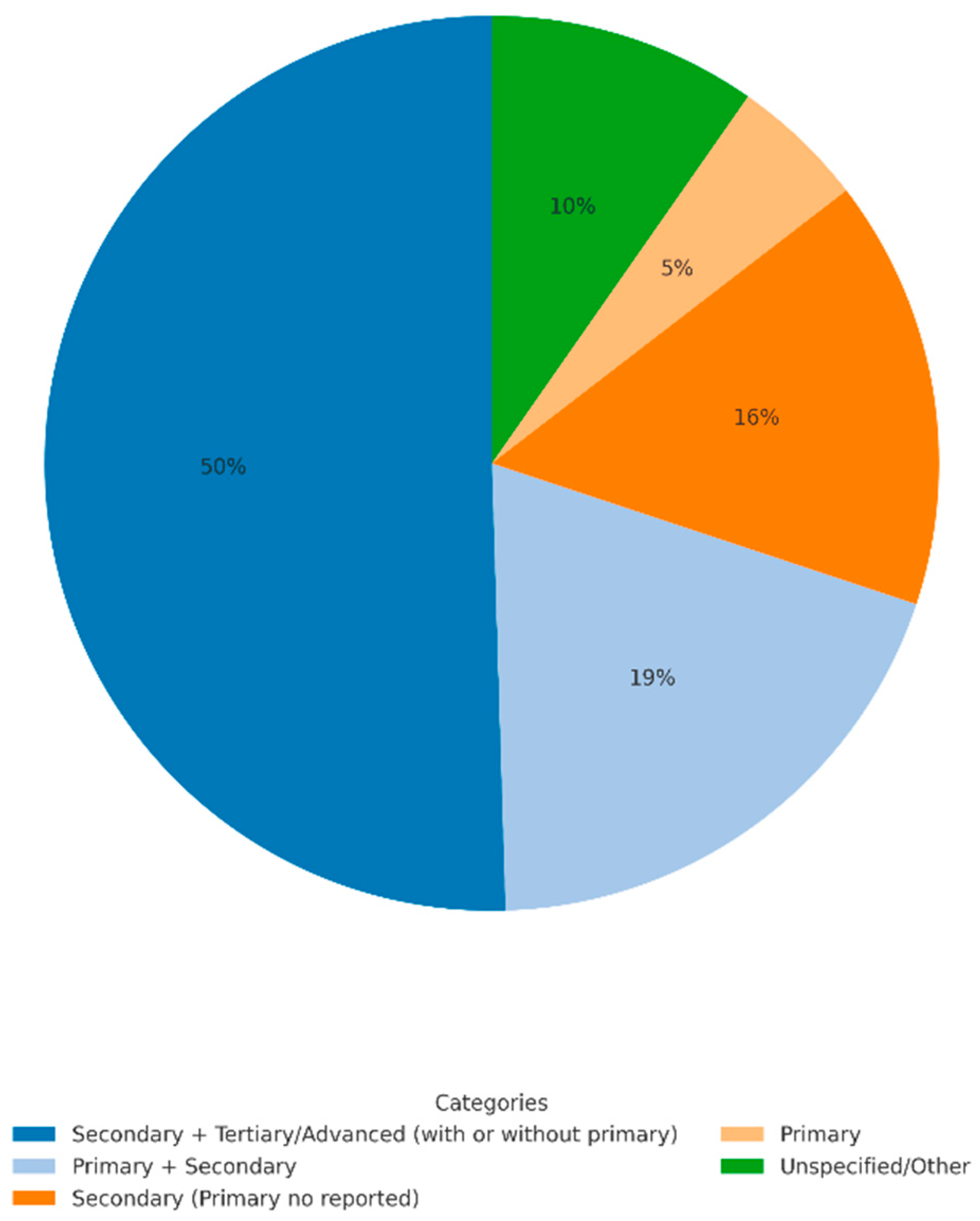
Reported served populations show a similarly wide span, enabling cross-system comparisons at utility scale. Process configurations were classified into five groups based on the available information: (i) Secondary + Tertiary/Advanced (with or without primary), (ii) Primary + Secondary, (iii) Secondary (primary not reported), (iv) Primary, and (v) Unspecified/Other (Figure 4).
Approximately 50% of records fall under Secondary + Tertiary/Advanced, followed by Primary + Secondary (≈19%), Secondary (≈16%), Primary (≈5%), and Unspecified/Other (≈10%). Category-level medians reflect the expected technological spread: Secondary + Tertiary/Advanced plants commonly operate at mid-to-large municipal scales; Primary + Secondary and Secondary (primary not reported) extend up to metropolitan values. Primary-only plants are few and, in this corpus, display relatively high median flows, a pattern that should be interpreted with caution due to the small sample size.

3.1.3. Global Occurrence Across Matrices

To describe highly skewed MP concentrations, medians are reported together with distribution quantiles (p10–p90) and min–max. The median is preferred over the arithmetic mean because MP data typically show long right tails (few very high values, method-dependent cut-offs, and occasional zeros in effluents). Under these conditions, the mean is unstable and overestimates the “typical” level, whereas the median is robust and better represents central tendency for environmental decision-making. All statistics are computed at the observation level and are not flow-weighted; for effluent, zeros explicitly reported in the source studies were retained rather than censored or imputed.
Restricting the analysis to raw-wastewater influent and final/tertiary effluent (particles/L) yields:
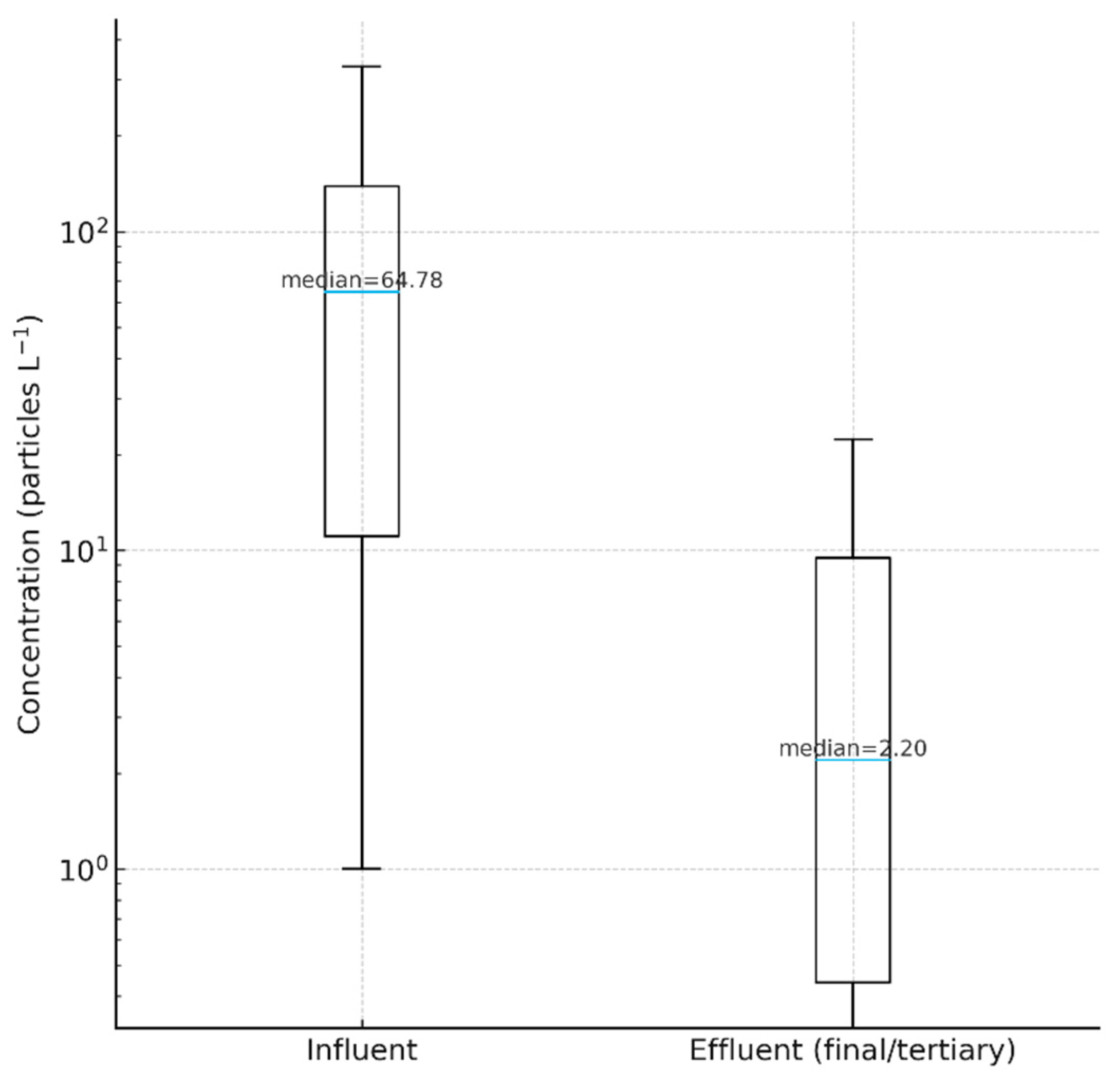
  • Influent (n = 75): p10–p90 = 2.8–338; median 64.8; min 1.0; max 8.6 × 10⁴.
  • Effluent (final/tertiary; n = 129): p10–p90 = 0.096–34.1; median 2.2; min 0; max 6.4 × 10³.
All summary statistics in this section were calculated directly from the observation-level dataset compiled in Supplementary Material, using standard descriptive measures (median, quantiles, min–max) without flow-weighting. These distributions confirm the expected orders of magnitude for municipal WWTPs. Across full-scale WWTPs, influent concentrations span roughly 1–10,044 particles/L and effluents 0–447 particles/L, with tertiary effluents typically 0–51 particles/L [29].
The long right-tails reflect a combination of source variability and analytical detection thresholds (Figure 5).

3.1.4. Polymer Distribution and Particle Types

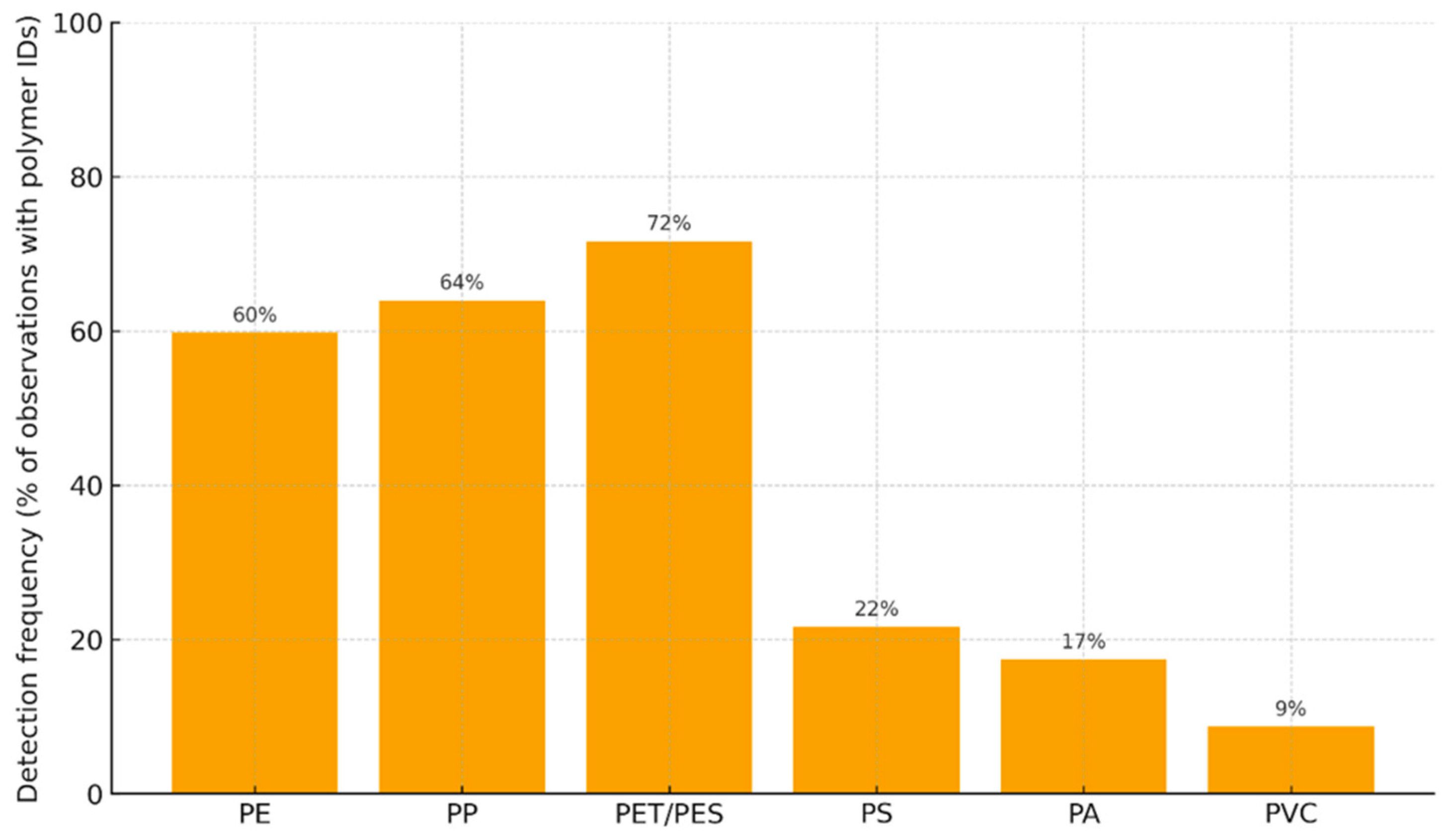
To compare polymer signals across heterogeneous studies, an observation-level detection frequency is first used (presence/absence in the reported spectroscopic list), which is robust to how fractions are reported and to incomplete compositional tables (Figure 6).
Across all observations with polymer IDs, three families dominate WWTP datasets: PET/PES, PP, and PE. Their detection frequencies are ≈72% (PET/PES), ≈64% (PP), and ≈60% (PE), followed by PS (≈22%), PA/nylon (≈17%), and PVC (≈9%); other polymers (e.g., acrylics, PU, PC, PMMA, EVA) appear only sporadically. This profile is consistent with urban sources—textiles (polyesters and nylons) and packaging (polyolefins, PS, PVC).
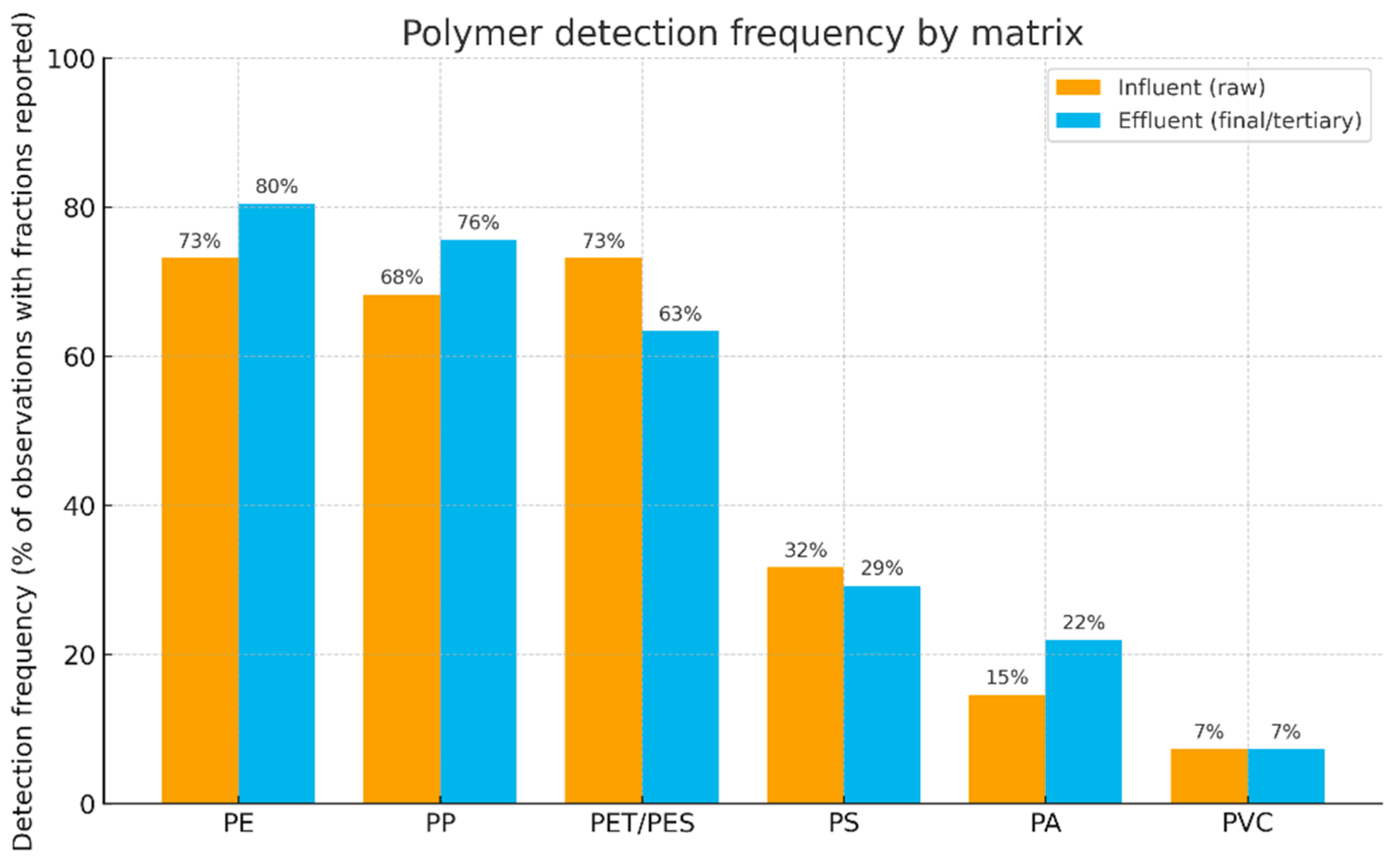
A matrix-resolved view shows similar dominance patterns in influent (raw) and final/tertiary effluent, with modest shifts within inter-study variability: PE rises from ≈73% (influent) to ≈80% (effluent), PP from ≈68% to ≈76%, while PET/PES decreases from ≈73% to ≈63%; PA increases slightly (from ≈15% to ≈22%), and PS and PVC remain around ≈30% and ≈7%, respectively (Figure 7). These changes plausibly reflect (i) preferential capture of fibrous PET/PES and PA by clarification/filtration steps, (ii) persistence of buoyant polyolefins (PE/PP) in the final effluent, and (iii) method-dependent biases (µ-FTIR vs. Raman, size cut-offs), as elaborated in Section 3.2.
Where studies reported polymer fractions, unweighted medians further support the PE–PP–PET/PES triad (influent medians ≈27%, 25%, and 20%, respectively; effluent ≈25%, 27%, and 17%), with PVC medians elevated in a few industrially influenced records. Because these medians are sensitive to reporting practices and are not flow-weighted, the detailed compositional tables are kept in the Supplementary Material.
Regarding particle types, fibers are the prevailing morphology (≈80% of observations), followed by fragments (≈14%) and a small remainder of films/beads/granules (≈6%). The predominance of fibers—together with the strong PET/PES–PA signal—corroborates the textile origin of a large share of WWTP microplastics and explains the persistence of fine fibrous MPs in some final effluents when analytical cut-offs are ≥50–100 µm.

3.1.5. Average Removal Efficiency (Secondary vs. Tertiary/Advanced)

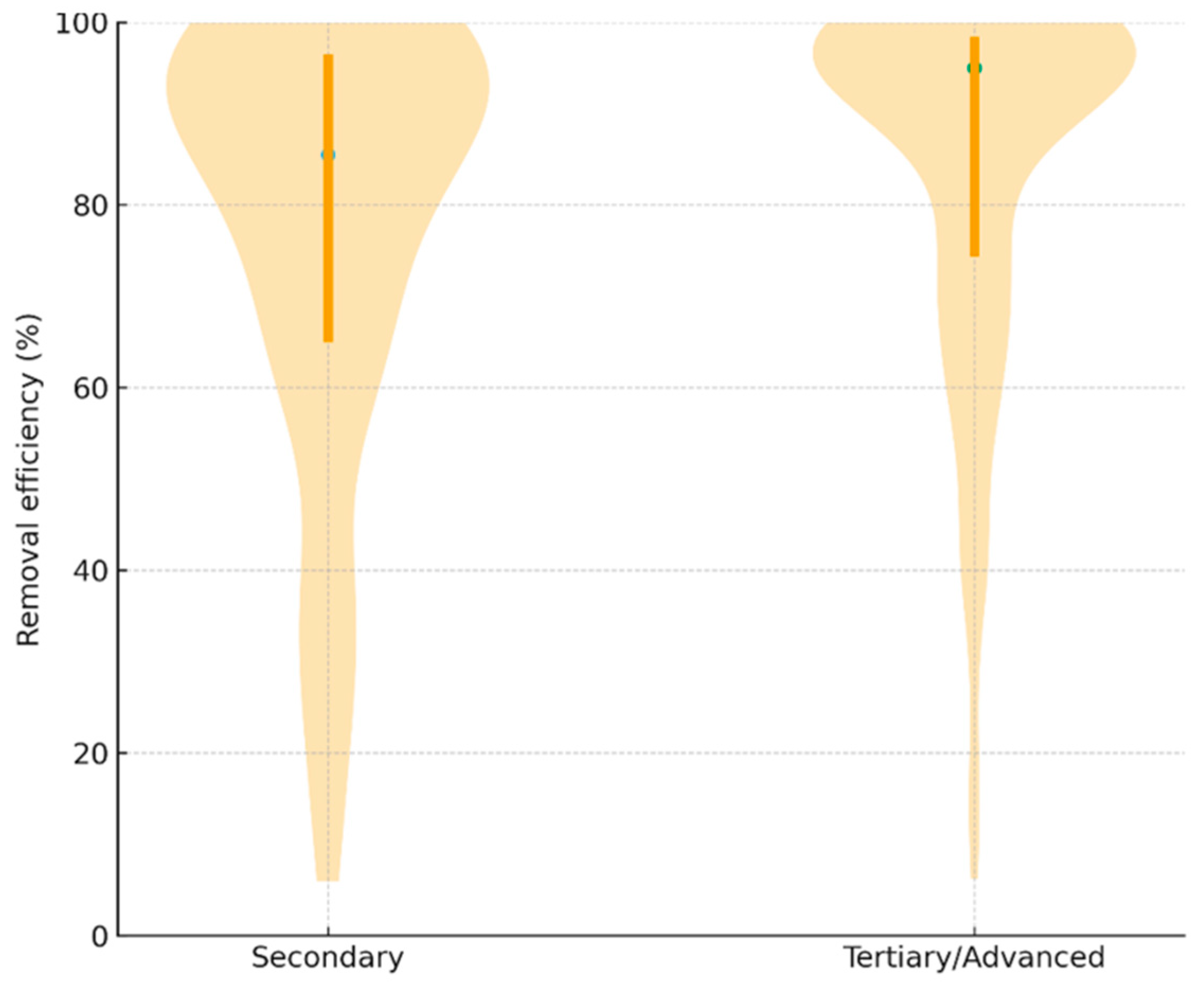
Using study-level treatment descriptors to classify processes, overall influent-to-final-effluent removal efficiency is summarized with medians and interquartile ranges (IQR). Removal efficiency values are summarized at the observation level and are not flow-weighted (Figure 8).
Medians are preferred over means because removal efficiency values are bounded (0–100%), heterogeneously reported across studies, and often cluster near upper bounds, making the mean sensitive to outliers and ceiling effects.
  • Secondary treatment: median 85.5%; IQR 65.0–96.5%.
  • Tertiary/advanced: median 95.0%; IQR 74.4–98.5%.
These medians are consistent with ≈88% for secondary and ≈94–95% for tertiary/advanced trains reported in prior syntheses [5,6,103]. Advanced solid–liquid separation (e.g., MBR, cloth/disk or rapid sand filtration, DAF/biological aerated filter (BAF)) frequently achieves >95%, yet fine MPs (<100 µm) may persist due to analytical and process limitations. In the dataset, the share of observations with removal efficiency ≥90% is 46% for secondary and 65% for tertiary/advanced; for ≥95%, 33% and 52%, respectively.

3.1.6. Sludges (Biosolids): Sink, Pathway, and Agronomic Trade-Offs

Restricting the analysis to sludge observations reported in particles/kg DW (n = 49, corresponding to WWTP sludge/biosolids data in the global dataset outside Central Asia), concentrations span 9.5–9.8 × 10⁵ particles/kg DW, with p10–p90 ≈ 9.66 × 10²–2.27 × 10⁵, an IQR ≈ 6.57 × 10³–5.12 × 10⁴, a median ≈2.48 × 10⁴, and a mean ≈9.39 × 10⁴ particles/kg DW. These global ranges do not include Central Asian WWTP sludge observations, which are analyzed separately in Section 5.1. Most entries correspond to final sludge (37/49), with fewer in secondary (6/49) and primary (5/49) (and 1/49 tertiary), so the percentiles are more representative of end-of-line solids than of intermediate sludges. Regarding morphology, fibers dominate (e.g., Fibers in 30/49; Fragments and fibers in 7/49; Fragments in 4/49). For polymers, the PET/PP/PE triad leads (PET = 28, PP = 28, PE = 25 of 49), followed by PES (12), PS (11) and PA (9); a pattern consistent with textiles (polyesters/nylon) y packaging (polyolefins, PS). Analytically, ≈84% (41/49) report spectroscopic confirmation (µ-FTIR/µ-Raman/Py-GC/MS). Size windows are heterogeneous; in 44/49 studies with an interpretable range, ≈68% (30/44) start below <100 µm, while the rest apply ≥100 µm cut-offs or multiband scales. This makes percentiles sensitive to the lower cut-off and they should therefore be reported alongside the statistics.
These distributional results align with plant-scale figures indicating that compiled sludge data sit orders of magnitude above liquid-phase medians (≈1.5 × 10³–1.7 × 10⁵ particles/kg DW) corroborating sludge as the primary internal sink [31]. Across WWTPs, reported MP concentrations reach up to ≈3.16 × 10³ particles/L in raw influent and ≈1.25 × 10² particles/L in treated effluents, while sludge attains ≈ 1.71 × 10⁵ particles/kg DW; overall removals efficiency spans 72–99.4%, primarily via primary/secondary steps with entrapment into biosolids [104]. Although conventional WWTPs often remove >90% of influent MPs, very large treated flows still make them major point sources to receiving waters, with ≈80–90% of the MP load sequestered in biosolids [105]. Broader syntheses and mass balances converge on ≈65–90% retention in the solids line, modulated by configuration and size window (secondary vs. tertiary/advanced; ≥50–100 µm vs. <100 µm) [6,11,12,13].
The fiber-dominant morphology and the PET/PP/PE triad in the Observation sheet agree with WWTP source signatures dominated by textiles (PET/PES/PA) and household/packaging flows (polyolefins, PS), reinforcing the consistency between empirical sludge profiles and the international literature cited [31,104]. The high rate of spectroscopic confirmation (≈84%) adds confidence to polymer-mix interpretation, while the heterogeneous size windows explain part of the spread and should be reported explicitly for like-for-like comparisons.
While sludge sequestration helps limit residuals in final effluents, it transfers the burden to solids management and any downstream reuse. When biosolids are land-applied, MPs can accumulate in agricultural soils, with runoff, leaching, and wind acting as secondary emission pathways; field and review studies document soil build-up near application sites, polymer signatures consistent with urban sources, and potential interactions with soil biota [15,17,42,43].
For Central Asia, the predominance of legacy secondary treatment and limited sludge stabilization/post-treatment increases the likelihood that sludge-retained MPs reach soil without further polishing [18]. In all configurations, most MPs are captured during primary and secondary clarification, i.e., before any tertiary or quaternary polishing steps, so higher-level treatment mainly reduces residual loads in the liquid stream rather than diverting additional particles into sludge. Regionally appropriate actions therefore include: (i) upgrading water-line barriers (disk/cloth filtration, DAF/BAF, membranes) to lower residual MP discharges in final effluents; (ii) strengthening QA/QC and polymer-resolved sludge monitoring; and (iii) assessing thermal/hydrothermal options (e.g., hydrothermal carbonization) while managing by-products to avoid risk shifting.

3.2. Analytical and Methodological Uncertainties

3.2.1. Sampling Design and Representativeness

Study-level metadata reveals substantial heterogeneity in field protocols. Most datasets in the compilation assembled for this review are built from grab samples collected at fixed times (coded as grab sampling in the metadata). A smaller subset of studies employs 24 h or flow-weighted composite samples (coded as composite/flow-weighted). A few studies instead use in situ cascade devices or other bespoke arrangements. Temporal coverage is typically partial. Diurnal variability and seasonality are only intermittently captured, so many records reflect short-term operating conditions (e.g., dry-weather weekdays) rather than long-term averages. In the comparative analysis, cross-study contrasts are therefore interpreted conditional on both lower size cut-off and sampling regime (grab vs. composite/flow-weighted), rather than treating all samples as equivalent.
Filtration practices are equally diverse. Workflows range from single-mesh screening to multi-stage cascade sieving (for example, coarse pre-screening followed by finer meshes). Studies use a wide set of filter media (stainless-steel sieves, nylon meshes, glass-fiber, cellulose-nitrate, or polycarbonate membranes) and different vacuum or pressure setups. Mesh or pore size, filter material, and hydraulic loading govern the effective cut-off, matrix retention, and fiber loss. These choices can introduce artifacts (e.g., filter shedding on polymeric media, clogging that preferentially removes fines, or variable recovery of elongated fibers).
Seasonality is typically partial (≥1 season captured in ≈77% of studies with any seasonal info), and year-round coverage is rare. These choices affect temporal representativeness and bias comparisons toward short-term conditions (e.g., dry-weather weekday loads vs. wet-weather peaks).
The lack of homogenization in sampling regime, filtration (mesh ladders, media, and operating conditions), and temporal coverage produces non-comparable capture windows across studies. This complicates inter-study synthesis and can bias global assessments. A harmonized minimum protocol—time-integrated sampling, standardized mesh ladders and filter materials, explicit reporting of volumes and flows, and routine field/lab blanks—would materially improve representativeness and comparability.

3.2.2. Minimum Detectable Size (Size Cut-Off)

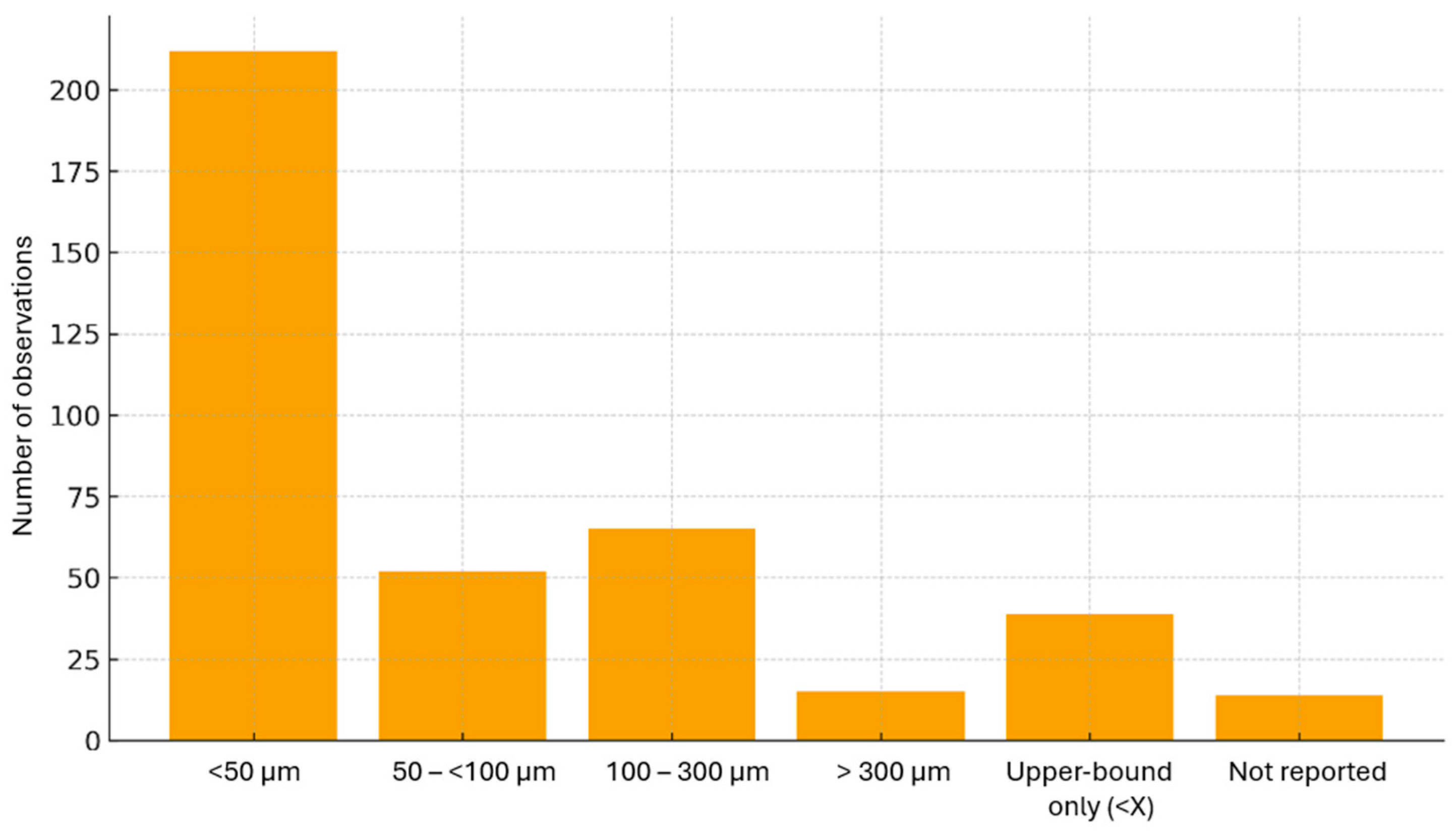
Reported size ranges reveal substantial heterogeneity in the minimum particle size considered at the observation level (Figure 9). This matters because microplastic number concentrations scale strongly with the lower cut-off: datasets that count down to tens of micrometers systematically report higher particle counts than those constrained at ≥100 µm, even for identical matrices and treatment trains. As a result, cross-study synthesis that ignores cut-offs can produce order-of-magnitude artifacts.
Two additional sources of ambiguity are recurrent:
  • Nominal vs. effective cut-off. Many papers report the mesh/pore size of sieves/filters (e.g., 50 or 100 µm), but the effective detection limit is often co-determined by spectral resolution/segmentation (µ-FTIR/Raman) and by filter loading/clogging, which can retain particles smaller than the nominal mesh; or, conversely, allow elongated fibers to align and pass through; both effects distort the true cut-off.
  • Processing cut-off vs. analytical cut-off. The sample-processing threshold (after sieving/digestion) may differ from the identification threshold (what the optical/µ-FTIR/Raman workflow can reliably classify). Studies rarely report both, making comparisons non-like-for-like.
Lower cut-offs inflate counts (especially fibers) and can overstate removal if influent and effluent are analyzed with mismatched windows. Conversely, higher or poorly specified cut-offs under-represent fine fractions (<100 µm) that may persist in final/tertiary effluents.

3.2.3. Analytical Identification

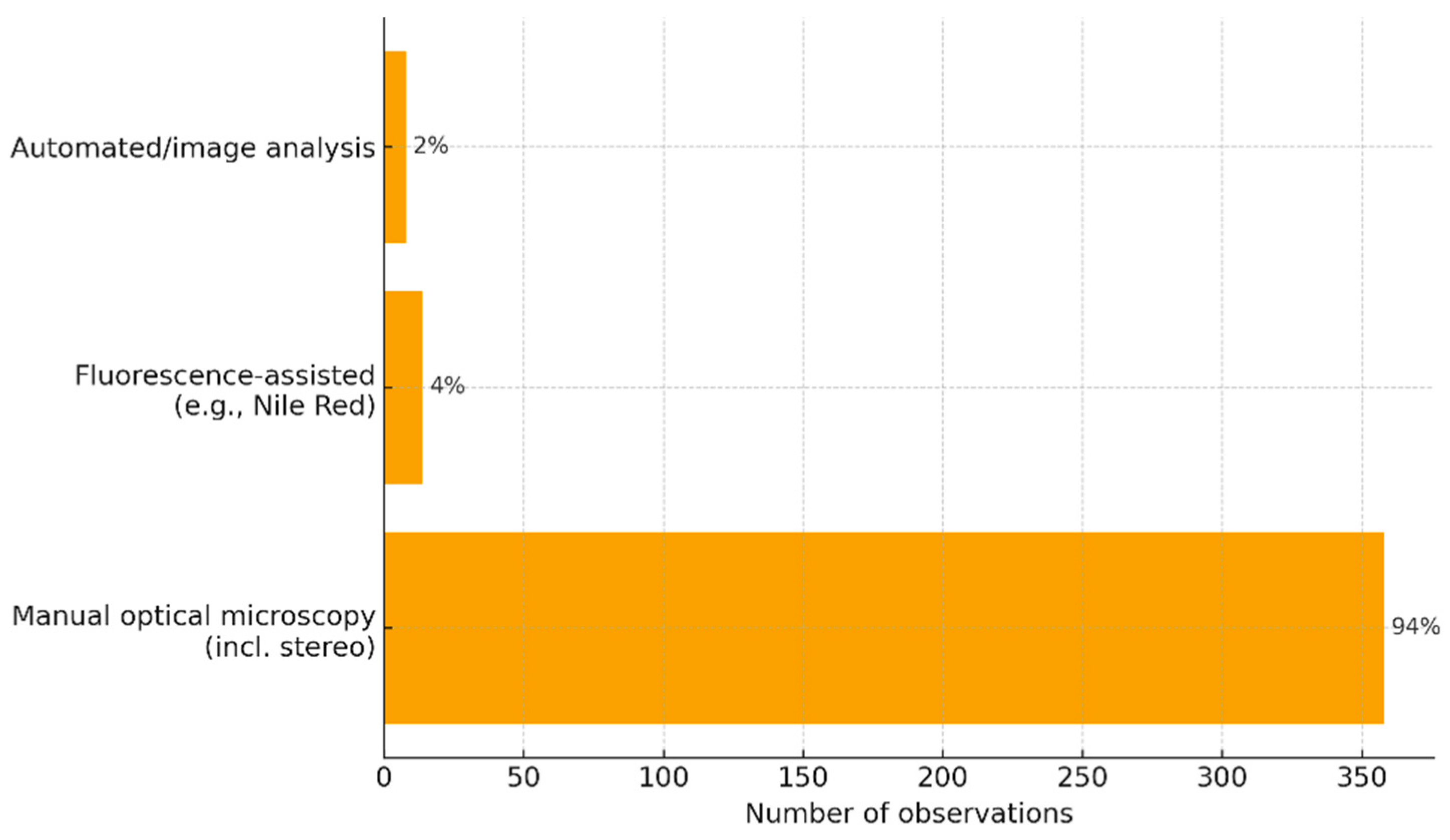
Across observations with explicit counting information, manual optical microscopy (including stereomicroscopy) is the dominant workflow (≈94%). Fluorescence-assisted counting, mostly Nile Red staining with epifluorescence, appears in a small fraction (≈3–4%), and automated/image-based analysis (e.g., ImageJ or classifier-assisted tallying) is rare (≈2%). Mentions of scanning electron microscopy (SEM) or confocal microscopy in the counting step are anecdotal (Figure 10).
This pattern indicates that the primary gatekeeper for number concentrations is still human-in-the-loop microscopy, with all its known trade-offs: limited throughput, subjective classification criteria, and size/morphology biases (e.g., undercounting fine fibers when contrast is low). Fluorescent staining can improve polymer/non-polymer discrimination and recovery of sub-100 µm particles, but it introduces selectivity (dye affinity varies by polymer and surface chemistry) and can promote false positives if mineral/organic residues fluoresce. Automated pipelines reduce operator variance but remain deployment-limited in the current literature [106,107].
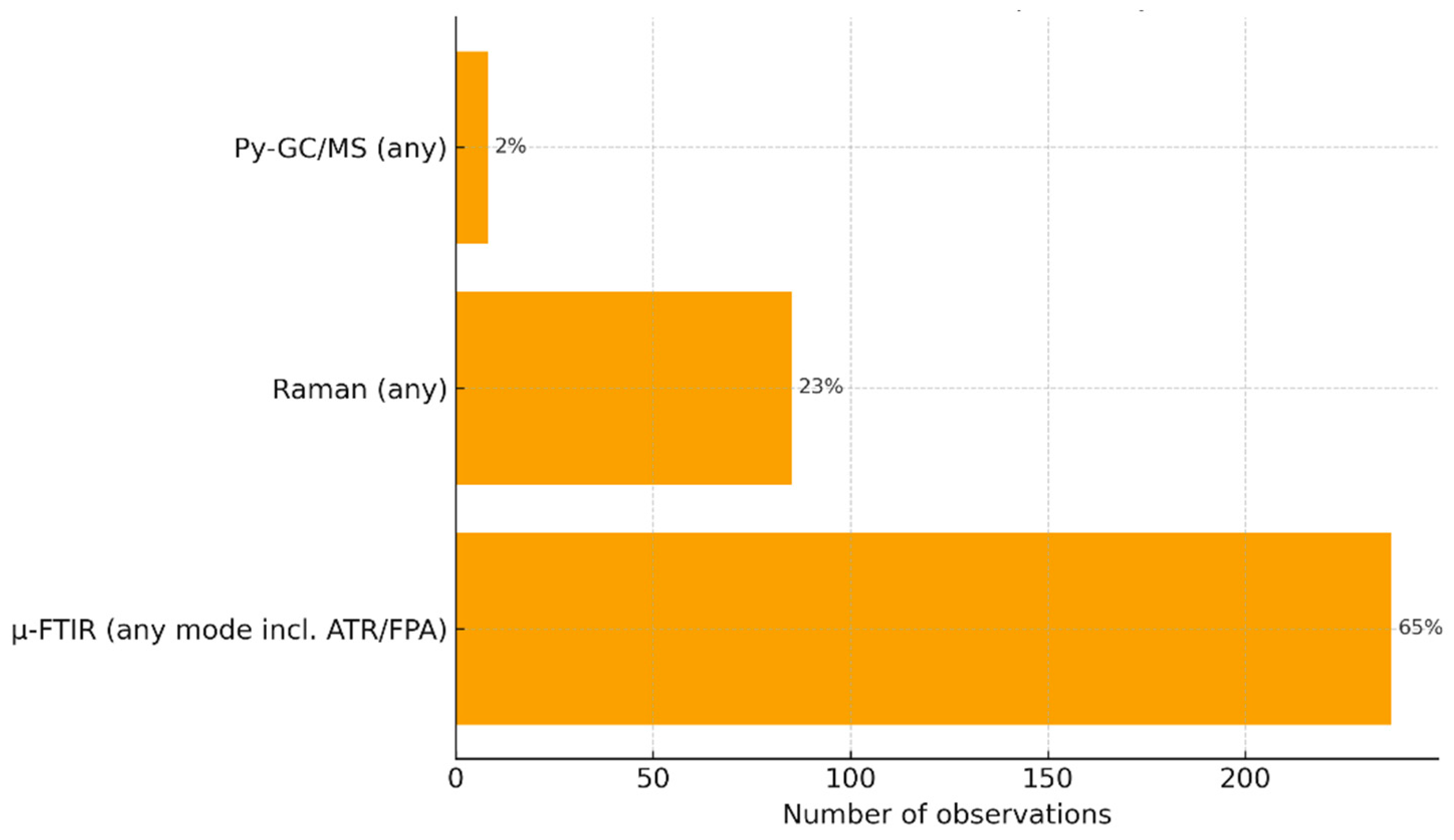
Within observations that report a polymer-ID method, µ-FTIR is the workhorse (≈66% of records), Raman provides complementary coverage (≈24%), and Py-GC/MS is used sparingly (≈2%). These categories are non-exclusive—a subset combines FTIR with Raman for validation (Figure 11).
Methodological implications are well aligned with expected detection envelopes. µ-FTIR (imaging/FPA, attenuated total reflectance (ATR) or transmission/reflectance) provides robust polymer-level confirmation at ≥50–100 µm with moderate throughput, but its spectral resolution and pixel size constrain the lower size bound. Raman extends into smaller particles and dark-colored polymers, albeit at higher acquisition times and susceptibility to fluorescence interference. Py-GC/MS yields mass-based polymer fingerprints and is valuable for targeted confirmation, yet it is not particle-resolved, so it cannot support number concentration or shape statistics.
Because these techniques interrogate different portions of the size–contrast space, the mix of µ-FTIR vs. Raman in a study directly influences observed polymer profiles and the tail of fine MPs. Cross-study comparisons must therefore control for identification method and size cut-off to avoid attributing analytical visibility to true environmental differences.

3.2.4. Recovery and QA/QC Practices

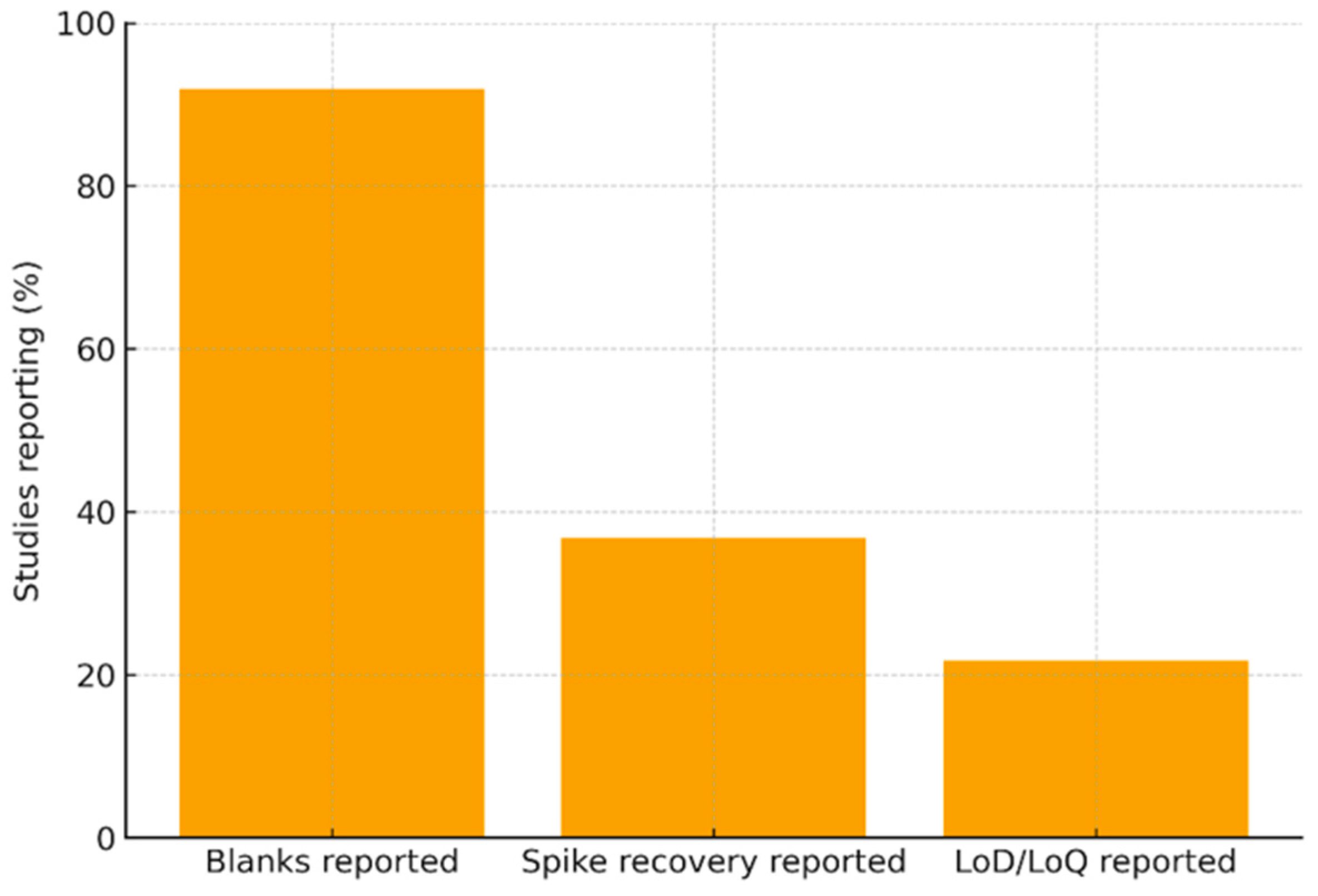
Robust QA/QC for WWTP microplastics comprises (i) contamination control and blanks, (ii) positive controls/spike-recovery tests, and (iii) reporting of detection limits (LoD/LoQ) and analytical performance. In the study-level compilation assembled for this review, blanks are reported in ≈92% of studies, spike recoveries in ≈37%, and LoD/LoQ in ≈22% (Figure 12). Where recoveries are reported, the median value is ≈97% (unweighted). These figures describe reporting frequency, not method performance; insufficient QA/QC transparency is a primary source of inter-study uncertainty.
Two short diagnostics from the database refine this picture:
  • Co-reporting structure. Only a small subset documents QA/QC comprehensively: 7 studies report all three elements (blanks + spikes + LoD/LoQ), 15 report two, 26 report only one, and 13 report none. Thus, most papers lack at least one critical QA/QC component.
  • Spectroscopy vs. QA/QC reporting. Comparing studies that used any spectroscopic identification (µ-FTIR/Raman/Py-GC/MS) with those that did not shows no clear advantage in QA/QC transparency: blanks are reported in ≈92% in both groups; spike-recovery reporting is ≈36% in both; LoD/LoQ remains low overall (≈15% with spectroscopy vs. 33% without), underscoring that LoD/LoQ is often framed around counting thresholds rather than spectral confirmation limits.
Where spike recoveries are quantified, values cluster high (median ≈96–97%, range 95–97%), but the evidence base is thin (very few studies report size-resolved recoveries), limiting transferability across workflows and size windows.

4. Regional Synthesis: Kazakhstan and Central Asia

4.1. Regional WWTP Infrastructure and Implications for MP Persistence

Across Central Asia, wastewater treatment remains dominated by legacy conventional activated sludge (CAS)/cyclic activated sludge technology (CAST) and extensive evaporation/stabilization ponds built during the Soviet period, with uneven deployment of tertiary or advanced polishing (e.g., filtration, membranes) [18,108]. This infrastructure mix (aging assets, operational instability, and arid, highly continental climates) limits fine-solids removal and the attenuation of contaminants of emerging concern; by extension, MPs, especially small fibers and fragments, are likely to escape capture unless fine-barrier steps are present [18,108]. Notably, according to [108], Kazakhstan operates more than 500 pond systems, underscoring structural reliance on natural/pond treatment where tertiary filtration is uncommon.
Recent regional reviews of the wastewater sector also document patchy modern upgrades (e.g., sequencing batch reactor (SBR)/MBR in a few urban hubs), persistent financing and operation and maintenance constraints, and reuse-driven effluent management that rarely includes post-filtration or membranes, conditions that align with global evidence that primary/secondary treatment trains alone are insufficient for robust MP removal [18,26,109]. Although WWTP-gate MP mass balances remain scarce in Central Asia, river and lake surveys consistently detect MPs downstream of municipal areas, with PET/PE/PP common, supporting the mechanistic expectation of MP persistence under current treatment configurations and solids-handling practices [29,30]. Finally, a Kazakhstan-focused life-cycle assessment indicates that MP releases from WWTPs can dominate aquatic ecotoxicity burdens in plant inventories, reinforcing the case that tertiary filtration or membrane barriers, and standardized MP monitoring, are critical for the region [110].

4.2. Evidence Beyond the Plant Fence Line (Rivers, Lakes) and Polymer Profiles

Direct WWTP-gate MP mass balances in Central Asia are scarce, but multiple environmental surveys show MPs in receiving waters consistent with municipal discharge pathways and urbanized river reaches. In Uzbekistan’s Syr Darya tributaries (Chirchiq, Kara Darya), MPs (0.15–5 mm; µ-Raman-confirmed) were reported in surface waters and sediments with PET as the dominant polymer, alongside other synthetics—an assemblage frequently associated with domestic wastewater sources [30]. Further downstream within the basin, stretches of the Zarafshan River across the Samarkand and Navoi regions also exhibit MP contamination, with recent reports noting increasing loads in populated corridors that host municipal outfalls [111,112].
In Kazakhstan’s Akmola Region, MPs have been detected in rivers and lakes draining urban areas on the steppe, further indicating inland exposures where effluents and sludge handling can influence surface-water quality [29]. Although these studies do not all quantify effluent-specific fluxes, their spatial co-occurrence with wastewater infrastructure, PET/PE/PP-rich polymer spectra, and detection across both water and sediment matrices collectively support the inference that, under the prevailing treatment configurations, WWTPs remain relevant MP sources to surface waters in the region. This pattern reinforces the need to pair environmental surveys with plant-level sampling to apportion loads, capture seasonal variability, and evaluate the effect of tertiary upgrades where introduced [18,30].

4.3. Treatment Trains, Upgrades, and Expected Removal

While selected urban facilities in Central Asia have piloted or installed improved configurations (SBR/MBR/moving bed biofilm reactor (MBBR)), the broader technology mix remains weighted toward conventional activated sludge (CAS/CAST) and pond systems, with limited tertiary polishing across the region [18]. Global syntheses consistently show that adding tertiary filtration (e.g., rapid/granular sand filters, disk filters, dissolved air flotation) or membrane processes (MBR, microfiltration (MF)/ultrafiltration (UF)) markedly increases MP removal efficiency compared with primary/secondary alone, often pushing total removals efficiency above 95% under well-operated conditions [5,7,26]. At full scale, one study reported effluent polishing removals efficiency of ≈97% for rapid sand filtration, ≈95% for dissolved air flotation, 40–98.5% for disk filters, and ≈99.9% for MBR treating primary effluent, illustrating the step-change that tertiary/membrane barriers can provide relative to secondary alone [10].
Despite substantial capture in primary/secondary (often 50–90%), secondary effluents can still deliver significant MP loads because of the very large discharge volumes; moreover, much of the captured MP burden partitions to sludge, shifting risk to solids management and reuse pathways [34,58]. In the Central Asian context, scattered upgrades exist—e.g., the Atyrau (Kazakhstan) MBR, but coverage remains patchy and operation and maintenance constraints are common, implying that, absent tertiary or membrane polishing and robust solids handling, WWTPs are likely to remain net MP contributors to receiving waters [18].
Beyond the tertiary filtration and membrane options emphasized above, other technological approaches for microplastic removal have been explored in the literature. These include coagulation–flocculation steps optimized for fine-particle capture (often combined with DAF), dynamic membranes, granular or powdered activated carbon contactors, advanced oxidation processes, and nature-based polishing units such as constructed wetlands downstream of secondary treatment. Recent reviews provide detailed assessments of these alternatives, their mechanisms and performance envelopes [5,6,7,10,11,26,31,100,102,104,105]. From a feasibility perspective in Central Asia, incremental retrofits that build on existing infrastructure—such as disk or cloth filters, rapid/granular sand filtration, DAF/BAF units, and, where resources and technical capacity permit, MBR or other membrane upgrades—are likely to be the most realistic near-term options, combining demonstrated high removal efficiencies with relatively mature operational experience.
A concise summary of the removal efficiencies discussed in this section is provided in Table 2.

4.4. Why Standardization and Longitudinal Data Are Essential

The current evidence base for Central Asia is fragmented across study types (reviews, river/lake surveys, plant case reports) and heterogeneous in key methodological choices, sampling devices, size cut-offs, density separation, polymer identification, which impedes cross-study comparability and trend detection [18]. These issues mirror global findings from quality-assessment and best-practice reviews that emphasize rigorous QA/QC (field/lab blanks, positive controls, recoveries) and spectroscopic confirmation (µFTIR/µ-Raman) to avoid false positives and size-biased undercounts [113,114,115]. Interlaboratory exercises [116,117] have further demonstrated substantial between-laboratory variability, underscoring the need for harmonized protocols and reference materials.
In response, emerging standards and guidance, such as ISO 24187:2023 (principles for MP analysis across matrices) [118], ISO 16094-2:2025 (vibrational-spectroscopy methods for low-turbidity waters) [119], and European Commission JRC technical guidance toward an EU methodology [120,121,122], provide actionable anchors for harmonization, including matrix-specific size windows and confirmatory analytics. In brief, ISO 24187:2023 sets out general principles for the analysis of plastics, including microplastics, across multiple environmental matrices (waters, sediments, soils, sludges and biota) and proposes harmonized microplastic size classes from the low-micrometer to millimeter scale. ISO 16094-2:2025 is part of the “Water quality—Analysis of microplastic in water” series and applies to low-turbidity waters (e.g., drinking water, bottled water, groundwater), defining vibrational-spectroscopy-based procedures to count, size and identify microplastics typically in the range ~1–5000 µm.
For the Central Asian context, the adoption of standardized WWTP MP protocols is therefore recommended (e.g., matrix-specific lower cut-offs < 100 µm; blanks and recovery checks; µ-FTIR/µ-Raman confirmation), and longitudinal sampling campaigns should be designed to resolve seasonality, operating states and upgrade effects, particularly where plants transition from CAS/ponds to tertiary or membrane-based polishing and where environmental surveys already indicate PET/PE/PP signals downstream [18,29,30].

5. Comparative Analysis

5.1. Central Asian WWTP Microplastics in a Global Context

In this section, the global occurrence and removal patterns synthesized in Section 3 are juxtaposed with the evidence available from the two Central Asian case studies identified in the literature review. Table 3 summarizes the study-level characteristics of these WWTP investigations, while all methodological and observation-level details are provided in the Supplementary Material.
With respect to matrices (influent, effluent, sludge), the Central Asian records place influent concentrations squarely within the worldwide dispersion synthesized in Section 3 (global median ≈ 65 particles/L, p10–p90 ≈ 3–338 particles/L), consistent with comparable household/textile sources. By contrast, at the plant outlet, secondary-only facilities tend to yield effluents in the upper half of the global envelope (vs. a global effluent median ≈ 2.2 particles/L, p10–p90 ≈ 0.096–34.1 particles/L), whereas plants equipped with tertiary filtration or MBR fall in the lower deciles, mirroring international performance gradients. As is typical elsewhere, the bulk of the MP load partitions to sludge (order 103–105 particles/kg DW), so exposure pathways depend not only on effluent polishing but also on biosolids handling and reuse.
In percentile terms, the Central Asian influent values map to the interquartile band of the global distribution when restricted to like-for-like size windows (i.e., excluding records with <100 µm lower cut-offs not matched locally). This alignment supports the interpretation that upstream household/textile source strength is broadly comparable to international settings, and that observed divergences downstream are driven primarily by treatment configuration and analytical windows rather than atypical regional inputs.
Turning to removal efficiency across treatment trains, the two local studies, and the broader regional subset, reproduce global patterns: secondary trains achieve high yet variable capture (on the order of ≈80–90%), whereas tertiary/advanced configurations (granular/disk filtration, DAF, membranes/MBR) commonly exceed ≈95% under stable operation. In practical terms, the presence or absence of post-secondary barriers is the main determinant of where a Central Asian plant sits relative to global benchmarks: MBR/tertiary cases converge to the low-effluent medians reported internationally, while secondary-only sites tend to underperform, especially during high-load or sub-optimal operating states characteristic of legacy assets in the region.
To make effect sizes explicit, the global observation-level medians are 85.5% removal efficiency for secondary treatment (IQR 65.0–96.5%) and 95.0% for tertiary/advanced trains (IQR 74.4–98.5%). Moreover, the share of observations achieving ≥90% is 46% for secondary versus 65% for tertiary/advanced; for ≥95%, the split is 33% versus 52%. Against these benchmarks, Central Asian plants equipped with filtration or membranes are expected to land in the lower deciles of effluent concentrations, whereas secondary-only sites will tend to cluster above the global median.
Table 4 distills these comparisons into a like-for-like snapshot by treatment class and methods, so the reader can see where Central Asian plants fall within the global envelope at a glance.
Table 4 shows where Central Asian WWTPs sit relative to a global benchmark, focusing on what most strongly moves percentile placement: the treatment class and the analytics used. Secondary-only plants typically land above the global median for effluents, because a post-secondary barrier is missing and fibers persist. When tertiary/advanced steps (e.g., disk/cloth filtration, DAF/BAF) are present, local effluent concentrations drop into the lower global deciles, matching or outperforming typical global outcomes. Membrane systems similarly place in the lower deciles, though very fine fibers (<100 µm) can remain unless they are both retained and measured.
Method matters: many local campaigns use ≥100 µm cut-offs and grab sampling, which can undercount fine fibers and increase variability. The global reference often relies on <100 µm and composite/flow-weighted sampling, yielding more representative and (usually) higher counts for fines. Once cut-offs and sampling are harmonized, differences between Central Asia and the world shrink, and process class (secondary vs. tertiary/MBR) becomes the main driver of performance.
As for polymer spectra and particle types, the PET/PES–PP–PE triad dominates both globally and in the regional dataset, with fibers as the prevailing morphology, signatures indicative of domestic wastewater and textile inputs. Methodologically speaking, where identification relied primarily on µ-FTIR at pixel sizes ≥ 50–100 µm without µ-Raman confirmation, fine/dark fibers are plausibly under-counted relative to studies operating with <100 µm cut-offs and Raman verification, an effect that helps explain residual differences in polymer mixing and absolute counts in some campaigns.
Practically, a PET/PES- and fiber-heavy signature indicates strong textile pathways, while the persistence of buoyant PE/PP in final effluents explains occasional polyolefin-dominated outliers even under high overall removal. Where identification relies on µ-FTIR pixel sizes ≥ 50–100 µm without Raman confirmation, dark/fine fibers are likely undercounted, biasing polymer mixes toward fragments and polyolefins. These analytical tendencies should be declared alongside concentration statistics to avoid misattributing process performance.
From a comparability standpoint, much of the apparent spread between Central Asian and global values is methodological rather than environmental. Several local campaigns used lower cut-offs ≥ 100 µm and grab samples. In contrast, many high-quality global studies report <100 µm windows and time-composite sampling. When comparisons are constrained to like-for-like size windows, Central Asian influent values sit within global interquartile ranges. Effluents then separate primarily along process lines (secondary-only vs. tertiary/membrane). Taken together, the analytical window and the treatment-train design jointly govern a plant’s position relative to global medians.
Beyond the lower cut-off itself, grab sampling amplifies short-term variance relative to time-composite or flow-weighted protocols commonly used in higher-quality global studies. Finer cut-offs inflate fiber counts, and composite designs dampen episodic spikes. As a result, unadjusted cross-study contrasts can be misleading. When both the size window and the sampling approach are harmonized, Central Asian influents sit within the global IQR, and effluents separate chiefly by process class (secondary vs. tertiary/MBR).
A consistent corollary of these comparisons is that 80–90% of the influent MP load partitions to biosolids, with compiled sludge levels on the order of ≈1.5 × 10³–1.7 × 10⁵ particles/kg DW. Consequently, risk management in Central Asia hinges not only on effluent polishing (e.g., cloth/disk filtration, DAF/BAF, MBR) but also on robust sludge handling and reuse controls, given the region’s reliance on conventional secondary trains and legacy pond systems.
In terms of implications, the gap between global and Central Asian figures reflects methodological and infrastructural constraints, not a genuinely lower environmental burden of MPs. Where tertiary/advanced steps are present, Central Asian plants perform on par with international peers; where they are absent, effluents remain elevated within the global envelope and the dominant MP pathway shifts to biosolids. These comparisons reinforce the priorities: harmonized protocols with <100 µm cut-offs, µ-FTIR/µ-Raman confirmation, and longitudinal sampling to resolve seasonality, operating states, and the impacts of staged upgrades.
For utilities, two levers dominate percentile placement against global peers: (i) add a post-secondary barrier to push residuals toward ≤2–5 particles/L under steady operation, and (ii) standardize analytics (<100 µm lower cut-off, µ-FTIR/µ-Raman, blanks/recoveries) to ensure that reported improvements reflect process performance rather than detection limits.
These comparisons highlight a structural deficit in the coverage of higher-level treatment across Central Asia. Legacy ponds and secondary-only WWTPs still dominate the regional infrastructure, while tertiary filtration and membrane-based processes are confined to a small number of urban facilities [18,108]. As long as this coverage gap persists, Central Asian plants will on average remain more microplastic-intensive—both in effluents and sludge pathways—than counterparts in regions where tertiary/advanced barriers are widely implemented, even if individual upgraded plants can match international performance benchmarks.

5.2. Rivers Receiving WWTP Effluents: Central Asia vs. Global Case Studies

Placed against global WWTP-impact studies, the Central Asian river records fall well within the international envelope for surface-water concentrations at comparable size windows (≥0.15–0.33 mm) and display closely matching source signatures. In Uzbekistan’s Syr Darya tributaries, mean abundances were 4.28 ± 0.09 particles/m3 (Kara Darya) and 0.95 ± 0.36 particles/m3 (Chirchiq), with fibers (89–95%) and PET as modal polymer—features consistent with municipal/WWTP pathways [30]. Along the Zarafshan mainstem, campaign means of 2.96 ± 0.78 (Samarkand) and 3.22 ± 1.64 particles/m3 (Navoi) were reported, again fiber-dominated; the Navoi reach additionally showed ≈31% fragments and a polymer mix including PP and poly(4-methyl-1-pentene), suggesting industrial/packaging contributions superimposed on a municipal signal [111]. These local results—obtained with 330 µm nets over 0.15–3/5 mm windows and µ-Raman confirmation—align methodologically with coarse-fraction river surveys but sit above the <100 µm cut-offs used in many high-resolution WWTP studies, a key consideration when juxtaposing absolute counts. In receiving waters internationally, fibers and fragments also dominate above and below outfalls while beads/pellets typically contribute <10% of observations, mirroring effluent signatures and textile/household pathways [61,123]. Critically, studies using <100 µm cut-offs and composite/flow-weighted sampling report higher fine-fiber abundances, whereas coarser cut-offs (≥100 µm) or grab sampling undercount these fractions—hence like-for-like comparisons should always declare lower size cut-off and sampling design alongside concentration metrics [123,124].
Global paired up-/downstream assessments around WWTP outfalls commonly observe measurable downstream increases, with effect sizes modulated by hydrology and dilution. For UK rivers sampled around six works, downstream/upstream ratios generally ranged ≈1–3 (event maxima much higher), and fibers/fragments predominated—clear evidence that WWTPs act as point sources even amid other sources [124]. In contrast, a multi-plant campaign in Flanders (size range 10 µm–5 mm) reported high average WWTP removal efficiency (97.5 ± 2.3%), with daily residual discharges on the order of 107 particles per plant but no statistically significant increase at several river sites, consistent with near-field plume confinement and/or dilution [125]. A recent North American case study likewise found the highest MP levels in sediments immediately downstream of a rural WWTP compared with upstream and hydraulic-control locations, reinforcing that effluent can structure local spatial patterns even where catchments are sparsely urbanized [126]. Beyond concentrations, daily loads highlight management relevance: even with ≈98% in-plant removal, a large secondary facility on the River Clyde (UK; ≈650,000 PE) still discharged ≈6.5 × 10⁷ particles/day to the receiving river [34]. For modern tertiary plants, average through-flowing loads on the order of 108–109 particles/day have been reported, depending on flow and season [39]. Riverine microplastic signals are also dynamic. High-flow events can redistribute bed contamination (“flushing”) and temporarily alter water-column concentrations. Work in northwest England (Irwell/Tame system) documented sharp post-event changes consistent with mobilization, deposition, and dilution around urban outfalls [127]. These dynamics mean single grab samples may misrepresent average downstream increments, further supporting composite or repeated-sample designs [127].
Taken together, the Central Asian rivers occupy the same concentration band (≈1–5 particles/m3 at ≥0.15–0.33 mm) and exhibit the PET- and fiber-heavy spectra typical of WWTP-influenced reaches reported internationally [30,124]. Where legacy secondary treatment prevails and tertiary barriers are scarce, downstream waters in Central Asia look comparable to global analogs; where tertiary or membrane polishing is present, international studies show that high removal can reduce near-field signals, though residual discharges and sludge pathways remain consequential [125]. Notably, a multi-plant campaign in Flanders (size range 10 µm–5 mm) reported high average WWTP removal efficiency (97.5 ± 2.3%), with daily residual discharges on the order of 107 particles per plant but no statistically significant increase at several river sites, consistent with near-field plume confinement and/or dilution under certain hydrological settings [125]. Finally, size-window harmonization remains critical: the Central Asian surveys used coarse lower cut-offs (≥330 µm nets), whereas many global WWTP studies quantify <100 µm fractions; when comparisons are restricted to like-for-like windows, the regional levels and polymer/morphology patterns are consistent with worldwide observations of WWTP-linked river contamination [124,125]. As utilities add post-secondary barriers (disc/cloth filtration, DAF/BAF, membranes) and standardize analytics (<100 µm, µ-FTIR/µ-Raman; composite/flow-weighted sampling), global case studies show effluents approaching background conditions in adjacent receiving waters—although without matched methods, such improvements can be underestimated [128].

6. Research Gaps and Regional Priorities (2025–2030)

In the global literature, wastewater microplastics research has evolved from proof-of-concept surveys to method harmonization, interlaboratory verification, and policy-relevant monitoring around effluent outfalls. International guidance (e.g., GESAMP, ISO) and technical syntheses (e.g., JRC) converge on a simple premise: comparability hinges on standardized protocols, spectroscopic confirmation, and transparent QA/QC [118,122,129]. As a result, many countries now link plant-level observations to reach-scale river assessments and to parsimonious fate/transport models, creating a line of sight from treatment upgrades to downstream improvements [130,131,132].
Against that backdrop, the emerging Central Asian evidence base is promising but not yet aligned with these global best practices. The region has established first measurements and clear source signatures; however, coarser analytical windows, uneven QA/QC reporting, and limited coverage of tertiary/advanced plants still constrain apples-to-apples comparison with international datasets. These are tractable gaps: they reflect infrastructure and analytics more than intrinsic differences in sources or river behavior. The agenda below is therefore pragmatic, closing the analytical divide, broadening plant coverage (especially tertiary/membrane trains), and integrating monitoring with hydrodynamics and fate modeling, so regional results can be interpreted on the same footing as global benchmarks [114,129].
With respect to interlaboratory standardization, ring trials in mature programs still reveal dispersion in counts and polymer assignment (particularly for small fractions) when common reference materials and shared decision rules are absent [129,133,134]. In Central Asia, recurring interlaboratory exercises are not yet institutionalized, which weakens confidence intervals on regional medians and percentiles relative to the global literature.
Regarding QA/QC and operator variance, global reviews highlight blanks, recoveries, and contamination control as minimum reporting elements; gaps in these items (present in parts of the regional record) limit cross-study synthesis and can bias effect-size estimates around outfalls [114,129]. Semi-automated and automated pipelines can reduce operator variance, yet their deployment remains limited and requires harmonization and validation datasets to ensure consistent performance [106,107,135].
In relation to treatment coverage, global syntheses increasingly include tertiary filtration, DAF/BAF, and membrane systems, documenting effluent medians in the lower global deciles and typical removals efficiency around ≈94–95%, compared with ≈88–90% for secondary treatment [6,7,129]. In Central Asia, legacy secondary trains predominate, so advanced barriers are under-represented in the evidence base, making it harder to quantify attainable regional gains against international benchmarks.
With respect to spectroscopic capacity and <100 µm coverage, confirmatory µ-FTIR/µ-Raman is time- and resource-intensive, especially below <100 µm, where fine fibers dominate and misclassification risks grow without curated libraries and robust QA [129,135,136]. This asymmetry with global datasets (many of which resolve fine fractions) constrains like-for-like comparison unless size windows and QA/QC are explicitly harmonized.
In terms of priorities for 2025–2030, the near-term focus is practical. First, protocol harmonization with <100 µm targets and explicit QA/QC should be adopted through ISO principles (ISO 24187) and the emerging ISO 16094 series, declaring lower size cut-offs, field/lab blanks, recoveries, and decision rules in every dataset [118,119,129]. Second, monitoring should shift from grab to composite/flow-weighted designs at plant outlets and along coordinated up-/downstream river transects, improving representativeness and comparability with international studies [122,129]. Third, a regional reference laboratory should coordinate SOPs, curate spectral libraries, and run periodic ring trials using emerging reference materials for number concentration in water [133,134]. Fourth, campaign coverage should expand to tertiary/advanced trains to quantify regional percentile shifts under matched methods, reflecting where global gains are typically realized [6,7,129]. Finally, routine monitoring should be paired with hydrodynamic and fate models to translate plant-level reductions into reach-scale load changes and scenario testing relevant to planning and policy [130,131,132].
In relation to scalable analytics and cautious automation, semi-automated image/spectral classification (e.g., Nile Red pipelines; full-filter µ-FTIR) offers time savings and reduced operator variance if deployed with robust QA, transparent algorithms, and shared benchmarks. Given current deployment limits and cross-tool discrepancies, adoption should proceed alongside validation datasets and interlaboratory checks to ensure reproducibility across the region [106,107,135].
By way of implementation milestones, an achievable roadmap would see, by 2026, a regional SOP (ISO-aligned) and at least two ring trials completed, plus composite monitoring with declared <100 µm cut-offs at five plants. By 2028, a fully operational reference lab, ≥12 plants in the dataset (≥5 with tertiary/MBR), and first model-linked assessments translating effluent improvements into reach-scale load reductions. By 2030, a region-wide dataset harmonized to global standards, percentile placement reported by process class, and decision support for targeted tertiary upgrades, including guidance on sludge pathways and reuse.
A coordinated Central Asian initiative on wastewater MPs, built on ISO/JRC-aligned methods, credible QA/QC, interlaboratory trials, cautious automation, and monitoring-model integration, will bridge the analytical divide with the global state of the art and deliver evidence robust enough to guide regional water-management policy.

7. Conclusions

This critical PRISMA-guided review shows that current evidence for Central Asia is still sparse and methodologically diverse, so the conclusions below should be read as regionally diagnostic rather than as a full global meta-assessment. This work synthesizes evidence on microplastics across wastewater treatment plants (WWTPs) and receiving rivers in Central Asia and situates these observations within the global literature. The analysis shows that WWTPs operate as both the primary interceptors and persistent point sources of MPs: even when overall removals approach typical values for secondary and tertiary/advanced treatment trains—median removal efficiencies of 85.5% and 95.0%, respectively—the magnitude of treated flows leads to non-trivial residual discharges. Within plants, sludge consistently emerges as the dominant internal sink, with compiled concentrations typically in the order of ≈103–105 particles/kg DW, lying orders of magnitude above liquid phases, shifting the management question from “Are WWTPs removing MPs?” to “Where do the removed MPs go, and with what consequences?”.
In that light, biosolids reuse is pivotal. Land application can relocate retained MPs to agricultural soils, where subsequent runoff, leaching, and wind erosion act as secondary emission pathways. The synthesis therefore frames water-line polishing and solids management as coupled levers: reducing residual MP loads in final effluents via post-secondary barriers such as disk/cloth filtration, DAF/BAF, or membranes, while tightening QA/QC and polymer-resolved monitoring in biosolids so that reuse decisions are evidence-based.
Placed against a global benchmark, regional influent levels in Central Asia fall within international interquartiles when size windows are aligned, i.e., around a global influent median ≈ 65 particles/L and a final/tertiary effluent median ≈ 2.2 particles/L. Effluent quality is governed chiefly by process class: secondary-only plants tend to occupy the upper half of the global effluent range, whereas tertiary and membrane systems align with the lower global deciles. River observations are consistent with a WWTP signal (fiber-heavy spectra dominated by PET/PES, PP, and PE, and measurable downstream increments modulated by hydrology and dilution), indicating that plant performance is reflected in near-field receiving waters.
To move from indicative patterns to decision-grade inference, the region would benefit from systematic expansion of monitoring sites, regular up-/downstream river transects, and year-round campaigns that capture hydrological variability. Equally important, protocolized methods (with <100 µm lower size cut-offs where feasible, composite/flow-weighted sampling, spectroscopic confirmation and explicit blanks/recoveries) are essential to produce like-for-like comparisons. Such standardization will not only reduce uncertainty and operator variance but also allow credible percentile placement against international datasets, clarify the magnitude of benefits from tertiary/MBR upgrades, and quantify the risk transfer to biosolids and agricultural soils.
Across the record, analytical choices remain the largest source of uncertainty and the main barrier to cross-study synthesis. Harmonized protocols and transparent QA/QC are therefore prerequisites for robust benchmarking, defensible fate/load modeling, and policy uptake.
Several limitations of this review should be acknowledged. First, the empirical base for Central Asia remains very limited and methodologically heterogeneous, so regional inferences are indicative rather than definitive. Second, the global benchmark is constructed from published WWTP case studies that are unevenly distributed geographically and may be affected by publication and reporting biases (e.g., missing flow data or incomplete QA/QC metadata). Third, the synthesis relies on unweighted, number-based observation-level statistics and does not implement formal meta-analytic models or quantitative risk-of-bias scoring, because the underlying data are not sufficiently homogeneous to support such approaches. Finally, the focus is on microplastics above typical size-detection thresholds in WWTP studies, and nanoplastics are not explicitly resolved.
Taken together, the weight of evidence supports a practical pathway for the region: expand the number and diversity of Central Asian studies, standardize analytics, and pair WWTP monitoring with river transects and sludge surveillance to verify reach-scale and land-application outcomes. Implemented in a staged manner, this agenda can close the evidence and performance gap with the global state of the art and provide a sound basis for targeted upgrades and regional water-management decisions.

Supplementary Materials

The following supporting information can be downloaded at: https://www.mdpi.com/article/10.3390/w18010104/s1. Dataset S1: Excel file (.xlsx) containing the database used in this review.

Author Contributions

Conceptualization, M.-E.R.-C., K.K.A. and N.S.S.; methodology, M.-E.R.-C. and N.S.S.; validation, K.K.A. and M.B.; formal analysis, M.-E.R.-C., N.S.S. and L.A.M.; investigation, M.-E.R.-C. and K.K.A.; data curation, M.-E.R.-C. and J.R.-I.; writing—original draft preparation, M.-E.R.-C., J.R.-I. and K.K.A.; writing—review and editing, M.-E.R.-C. and J.R.-I.; visualization, M.-E.R.-C., J.R.-I. and N.S.S.; supervision, K.K.A. and N.S.S.; project administration, K.K.A., N.S.S. and M.B. All authors have read and agreed to the published version of the manuscript.

Funding

This research was funded by the Committee of Science of the Ministry of Science and Higher Education of the Republic of Kazakhstan (Grant No. AP26104611, “Modeling the impact of microplastics on health and developing wastewater treatment methods to improve the quality of water systems”).

Data Availability Statement

Data are contained within the article and Supplementary Material.

Conflicts of Interest

The authors declare no conflicts of interest.

References

  1. Frias, J.P.G.L.; Nash, R. Microplastics: Finding a consensus on the definition. Mar. Pollut. Bull. 2019, 138, 145–147. [Google Scholar] [CrossRef]
  2. Horton, A.A.; Walton, A.; Spurgeon, D.J.; Lahive, E.; Svendsen, C. Microplastics in freshwater and terrestrial environments: Evaluating the current understanding to identify the knowledge gaps and future research priorities. Sci. Total Environ. 2017, 586, 127–141. [Google Scholar] [CrossRef]
  3. Andrady, A.L. The plastic in microplastics: A review. Mar. Pollut. Bull. 2017, 119, 12–22. [Google Scholar] [CrossRef]
  4. Carr, S.A.; Liu, J.; Tesoro, A.G. Transport and fate of microplastic particles in wastewater treatment plants. Water Res. 2016, 91, 174–182. [Google Scholar] [CrossRef]
  5. Miino, M.C.; Galafassi, S.; Zullo, R.; Torretta, V.; Rada, E.C. Microplastics removal in wastewater treatment plants: A review of the different approaches to limit their release in the environment. Sci. Total Environ. 2024, 930, 172675. [Google Scholar] [CrossRef]
  6. Iyare, P.U.; Ouki, S.K.; Bond, T. Microplastics removal in wastewater treatment plants: A critical review. Environ. Sci. Water Res. Technol. 2020, 6, 2664–2675. [Google Scholar] [CrossRef]
  7. Liu, W.; Liu, W.; Zhang, J.; Liu, H.; Guo, X.; Zhang, X.; Yao, X.; Cao, Z.; Zhang, T. A review of the removal of microplastics in global wastewater treatment plants: Characteristics and mechanisms. Environ. Int. 2021, 146, 106277. [Google Scholar] [CrossRef]
  8. Maw, M.M.; Boontanon, N.; Aung, H.K.Z.Z.; Jindal, R.; Fujii, S.; Visvanathan, C.; Boontanon, S.K. Microplastics in wastewater and sludge from centralized and decentralized wastewater treatment plants: Effects of treatment systems and microplastic characteristics. Chemosphere 2024, 361, 142536. [Google Scholar] [CrossRef] [PubMed]
  9. Conley, K.; Clum, A.; Deepe, J.; Lane, H.; Beckingham, B. Wastewater treatment plants as a source of microplastics to an urban estuary: Removal efficiencies and loading per capita over one year. Water Res. X 2019, 3, 100030. [Google Scholar] [CrossRef]
  10. Talvitie, J.; Mikola, A.; Koistinen, A.; Setälä, O. Solutions to microplastic pollution—Removal of microplastics from wastewater effluent with advanced wastewater treatment technologies. Water Res. 2017, 123, 401–407. [Google Scholar] [CrossRef] [PubMed]
  11. Lares, M.; Ncibi, M.C.; Sillanpää, M.; Sillanpää, M. Occurrence, identification and removal of microplastic particles and fibers in conventional activated sludge process and advanced MBR technology. Water Res. 2018, 133, 236–246. [Google Scholar] [CrossRef]
  12. Prus, Z.; Wilk, M. Microplastics in sewage sludge: Worldwide presence in biosolids, environmental impact, identification methods and possible routes of degradation, including the hydrothermal carbonization process. Energies 2024, 17, 4219. [Google Scholar] [CrossRef]
  13. Hatinoglu, D.; Sanin, F.D. Sewage sludge as a source of microplastics in the environment: A review of occurrence and fate during sludge treatment. J. Environ. Manag. 2021, 295, 113028. [Google Scholar] [CrossRef]
  14. Edo, C.; González-Pleiter, M.; Leganés, F.; Fernández-Piñas, F.; Rosal, R. Fate of microplastics in wastewater treatment plants and their environmental dispersion with effluent and sludge. Environ. Pollut. 2020, 259, 113837. [Google Scholar] [CrossRef] [PubMed]
  15. Corradini, F.; Meza, P.; Eguiluz, R.; Casado, F.; Huerta-Lwanga, E.; Geissen, V. Evidence of microplastic accumulation in agricultural soils from sewage sludge disposal. Sci. Total Environ. 2019, 671, 411–420. [Google Scholar] [CrossRef]
  16. Mallek, M.; Barceló, D. Sustainable analytical approaches for microplastics in wastewater, sludge, and landfills: Challenges, fate, and green chemistry perspectives. Adv. Sample Prep. 2025, 14, 100178. [Google Scholar] [CrossRef]
  17. Napper, I.E.; Parker-Jurd, F.N.F.; Wright, S.L.; Thompson, R.C. Examining the release of synthetic microfibres to the environment via two major pathways: Atmospheric deposition and treated wastewater effluent. Sci. Total Environ. 2023, 857, 159317. [Google Scholar] [CrossRef] [PubMed]
  18. Kalmakhanova, M.S.; Diaz de Tuesta, J.L.; Malakar, A.; Gomes, H.T.; Snow, D.D. Wastewater treatment in Central Asia: Treatment alternatives for safe water reuse. Sustainability 2023, 15, 14949. [Google Scholar] [CrossRef]
  19. Zhang, Y.; Pu, S.; Lv, X.; Gao, Y.; Ge, L. Global trends and prospects in microplastics research: A bibliometric analysis. J. Hazard. Mater. 2020, 400, 123110. [Google Scholar] [CrossRef]
  20. Orona-Návar, C.; García-Morales, R.; Loge, F.J.; Mahlknecht, J.; Aguilar-Hernández, I.; Ornelas-Soto, N. Microplastics in Latin America and the Caribbean: A review on current status and perspectives. J. Environ. Manag. 2022, 309, 114698. [Google Scholar] [CrossRef] [PubMed]
  21. Malematja, K.C.; Melato, F.A.; Mokgalaka-Fleischmann, N.S. The occurrence and fate of microplastics in wastewater treatment plants in South Africa and the degradation of microplastics in aquatic environments—A critical review. Sustainability 2023, 15, 16865. [Google Scholar] [CrossRef]
  22. Mokgalaka-Fleischmann, N.S.; Melato, F.A.; Netshiongolwe, K.; Izevbekhai, O.U.; Lepule, S.P.; Motsepe, K.; Edokpayi, J.N. Microplastic occurrence and fate in the South African environment: A review. Environ. Syst. Res. 2024, 13, 59. [Google Scholar] [CrossRef]
  23. GIZ. Baseline Study on Microplastics in ASEAN. 2024. Available online: https://www.giz.de/en/downloads/giz2024-en-baseline-study-on-microplastics.pdf (accessed on 15 September 2025).
  24. Nweke, N.D.; Agbasi, J.C.; Ayejoto, D.A.; Onuba, L.N.; Egbueri, J.C. Sources and Environmental Distribution of Microplastics in Nigeria. In Microplastics in African and Asian Environments: The Influencers, Challenges, and Solutions; Egbueri, J.C., Ighalo, J.O., Pande, C.B., Eds.; Springer: Cham, Switzerland, 2024; pp. 107–130. [Google Scholar] [CrossRef]
  25. Egbueri, J.C.; Agbasi, J.C.; Abba, S.I.; Al-Juboori, R.A.; Mirzayi, F.; Kirikkaleli, D.; Nweke, N.D.; Pande, C.B.; Ighalo, J.O. Microplastic Contamination in Nigerian Treated Waters and Packaged (Sachet, Bottled) Sources: Trends, Regional Disparities, and Policy Implications for Sustainable Practices. Anal. Lett. 2025, 1–37. [Google Scholar] [CrossRef]
  26. Reza, T.; Mohamad Riza, Z.H.; Abdullah, S.R.S.; Abu Hasan, H.; Ismail, N.; Othman, A.R. Microplastic removal in wastewater treatment plants (WWTPs) by natural coagulation: A literature review. Toxics 2024, 12, 12. [Google Scholar] [CrossRef]
  27. Institute for Global Environmental Strategies (IGES). Recommended Harmonized Protocol for Sampling, Analysis, and Monitoring of Microplastics in Sewage Treatment Plants and Riverine Environments in ASEAN; Institute for Global Environmental Strategies (IGES): Kanagawa, Japan, 2024. [Google Scholar]
  28. Zhaxylykova, D.; Alibekov, A.; Lee, W. Seasonal variation and removal of microplastics in a Central Asian urban wastewater treatment plant. Mar. Pollut. Bull. 2024, 205, 116597. [Google Scholar] [CrossRef] [PubMed]
  29. Salikova, N.S.; Rodrigo-Ilarri, J.; Makeyeva, L.A.; Rodrigo-Clavero, M.-E.; Tleuova, Z.O.; Makhmutova, A.D. Monitoring of microplastics in water and sediment samples of lakes and rivers of the Akmola Region (Kazakhstan). Water 2024, 16, 1051. [Google Scholar] [CrossRef]
  30. Frank, Y.; Khusanov, A.; Yuldashov, M.; Vorobiev, E.; Rakhmatullina, S.; Rednikin, A.; Tashbaev, S.; Mamatkarimova, S.; Ruchkina, K.; Namozov, S.; et al. Microplastics in the Syr Darya River tributaries, Uzbekistan. Water 2023, 15, 3698. [Google Scholar] [CrossRef]
  31. Sun, J.; Dai, X.; Wang, Q.L.; van Loosdrecht, M.C.M.; Ni, B.-J. Microplastics in wastewater treatment plants: Detection, occurrence and removal. Water Res. 2019, 152, 21–37. [Google Scholar] [CrossRef]
  32. Mintenig, S.M.; Int-Veen, I.; Löder, M.G.J.; Primpke, S.; Gerdts, G. Identification of microplastic in effluents of wastewater treatment plants using focal plane array-based micro-Fourier-transform infrared imaging. Water Res. 2017, 108, 365–372. [Google Scholar] [CrossRef]
  33. Tagg, A.S.; Sapp, M.; Harrison, J.P.; Ojeda, J.J. Identification and quantification of microplastics in wastewater using focal plane array-based reflectance micro-FT-IR imaging. Anal. Chem. 2015, 87, 6032–6040. [Google Scholar] [CrossRef]
  34. Murphy, F.; Ewins, C.; Carbonnier, F.; Quinn, B. Wastewater treatment works (WwTW) as a source of microplastics in the aquatic environment. Environ. Sci. Technol. 2016, 50, 5800–5808. [Google Scholar] [CrossRef]
  35. Fortin, S.; Song, B.; Burbage, C. Quantifying and identifying microplastics in the effluent of advanced wastewater treatment systems using Raman microspectroscopy. Mar. Pollut. Bull. 2019, 149, 110579. [Google Scholar] [CrossRef] [PubMed]
  36. Lykkemark, J.; Mattonai, M.; Vianello, A.; Gomiero, A.; Modugno, F.; Vollertsen, J. Py–GC–MS analysis for microplastics: Unlocking matrix challenges and sample recovery when analyzing wastewater for polypropylene and polystyrene. Water Res. 2024, 261, 122055. [Google Scholar] [CrossRef] [PubMed]
  37. Hurley, R.R.; Lusher, A.L.; Olsen, M.; Nizzetto, L. Validation of a method for extracting microplastics from complex, organic-rich, environmental matrices. Environ. Sci. Technol. 2018, 52, 7409–7417. [Google Scholar] [CrossRef] [PubMed]
  38. Iordachescu, L.; Papacharalampos, K.; Barritaud, L.; Denieul, M.-P.; Plessis, E.; Baratto, G.; Julien, V.; Vollertsen, J. Microplastics in an advanced wastewater treatment plant: Sustained and robust removal rates unfazed by seasonal variations. Microplast. Nanoplast. 2024, 4, 18. [Google Scholar] [CrossRef]
  39. Blair, R.M.; Waldron, S.; Gauchotte-Lindsay, C. Average daily flow of microplastics through a tertiary wastewater treatment plant over a ten-month period. Water Res. 2019, 163, 114909. [Google Scholar] [CrossRef]
  40. Mahon, A.M.; O’Connell, B.; Healy, M.G.; O’Connor, I.; Officer, R.; Nash, R.; Morrison, L. Microplastics in sewage sludge: Effects of treatment. Environ. Sci. Technol. 2016, 51, 810–818. [Google Scholar] [CrossRef]
  41. Hassan, F.; Prasetya, K.D.; Hanun, J.N.; Bui, H.M.; Rajendran, S.; Kataria, N.; Khoo, K.S.; Wang, Y.-F.; You, S.-J.; Jiang, J.-J. Microplastic contamination in sewage sludge: Abundance, characteristics, and impacts on the environment and human health. Environ. Technol. Innov. 2023, 31, 103176. [Google Scholar] [CrossRef]
  42. Christian, A.E.; Köper, I. Microplastics in biosolids: A review of ecological implications and methods for identification, enumeration, and characterization. Sci. Total Environ. 2023, 864, 161083. [Google Scholar] [CrossRef]
  43. Hooge, A.; Hauggaard-Nielsen, H.; Heinze, W.M.; Lyngsie, G.; Ramos, T.M.; Sandgaard, M.H.; Vollertsen, J.; Syberg, K. Fate of microplastics in sewage sludge and in agricultural soils. TrAC Trends Anal. Chem. 2023, 166, 117184. [Google Scholar] [CrossRef]
  44. UNECE. Environmental Performance Reviews: Kazakhstan, 3rd ed.; UNECE: Geneva, Switzerland, 2019; Available online: https://unece.org/ru/info/Environment-Policy/Environmental-Performance-Reviews/pub/2180 (accessed on 15 September 2025).
  45. European Commission. Proposal for a Directive of the European Parliament and of the Council concerning Urban Wastewater Treatment (Recast)—COM(2022) 541 Final, Brussels. 2022. Available online: https://eur-lex.europa.eu/legal-content/EN/TXT/?uri=celex:52022PC0541 (accessed on 15 September 2025).
  46. Tricco, A.C.; Lillie, E.; Zarin, W.; O’Brien, K.K.; Colquhoun, H.; Levac, D.; Moher, D.; Peters, M.D.J.; Horsley, T.; Weeks, L.; et al. PRISMA Extension for Scoping Reviews (PRISMA-ScR): Checklist and Explanation. Ann. Intern. Med. 2018, 169, 467–473. [Google Scholar] [CrossRef]
  47. Page, M.J.; McKenzie, J.E.; Bossuyt, P.M.; Boutron, I.; Hoffmann, T.C.; Mulrow, C.D.; Shamseer, L.; Tetzlaff, J.M.; Akl, E.A.; Brennan, S.E.; et al. The PRISMA 2020 statement: An updated guideline for reporting systematic reviews. BMJ 2021, 372, n71. [Google Scholar] [CrossRef] [PubMed]
  48. Talvitie, J.; Mikola, A.; Setälä, O.; Heinonen, M.; Koistinen, A. How well is microlitter purified from wastewater?—A detailed study on the stepwise removal of microlitter in a tertiary level wastewater treatment plant. Water Res. 2017, 109, 164–172. [Google Scholar] [CrossRef]
  49. Lv, X.; Dong, Q.; Zuo, Z.; Liu, Y.; Huang, X.; Wu, W.M. Microplastics in a municipal wastewater treatment plant: Fate, dynamic distribution, removal efficiencies, and control strategies. J. Clean. Prod. 2019, 225, 579–586. [Google Scholar] [CrossRef]
  50. Can, T.; Üstün, G.E.; Kaya, Y. Characteristics and seasonal variation of microplastics in the wastewater treatment plant: The case of Bursa deep sea discharge. Mar. Pollut. Bull. 2023, 194, 115281. [Google Scholar] [CrossRef]
  51. Kılıç, E.; Yücel, N.; Şahutoğlu, S.M. Microplastic composition, load and removal efficiency from wastewater treatment plants discharging into Orontes River. Int. J. Environ. Res. 2023, 17, 25. [Google Scholar] [CrossRef]
  52. Üstün, G.E.; Bozdaş, K.; Can, T. Abundance and characteristics of microplastics in an urban wastewater treatment plant in Turkey. Environ. Pollut. 2022, 310, 119890. [Google Scholar] [CrossRef] [PubMed]
  53. Vardar, S.; Onay, T.T.; Demirel, B.; Kideys, A.E. Evaluation of microplastics removal efficiency at a wastewater treatment plant discharging to the Sea of Marmara. Environ. Pollut. 2021, 289, 117862. [Google Scholar] [CrossRef]
  54. Bilgin, M.; Yurtsever, M.; Karadagli, F. Microplastic removal by aerated grit chambers versus settling tanks of a municipal wastewater treatment plant. J. Water Process Eng. 2020, 38, 101604. [Google Scholar] [CrossRef]
  55. Simon, M.; van Alst, N.; Vollertsen, J. Quantification of microplastic mass and removal rates at wastewater treatment plants applying focal plane array (FPA)-based Fourier transform infrared (FT-IR) imaging. Water Res. 2018, 142, 1–9. [Google Scholar] [CrossRef]
  56. Magni, S.; Binelli, A.; Pittura, L.; Avio, C.G.; Della Torre, C.; Parenti, C.C.; Gorbi, S.; Regoli, F. The fate of microplastics in an Italian wastewater treatment plant. Sci. Total Environ. 2019, 652, 602–610. [Google Scholar] [CrossRef] [PubMed]
  57. Ren, P.J.; Dou, M.; Wang, C.; Li, G.Q.; Jia, R. Abundance and removal characteristics of microplastics at a wastewater treatment plant in Zhengzhou. Environ. Sci. Pollut. Res. 2020, 27, 36295–36305. [Google Scholar] [CrossRef] [PubMed]
  58. Bayo, J.; Olmos, S.; López-Castellanos, J. Microplastics in an urban wastewater treatment plant: The influence of physicochemical parameters and environmental factors. Chemosphere 2020, 238, 124593. [Google Scholar] [CrossRef] [PubMed]
  59. Gies, E.A.; LeNoble, J.L.; Noël, M.; Etemadifar, A.; Bishay, F.; Hall, E.R.; Ross, P.S. Retention of microplastics in a major secondary wastewater treatment plant in Vancouver, Canada. Mar. Pollut. Bull. 2018, 133, 553–561. [Google Scholar] [CrossRef]
  60. Talvitie, J.; Heinonen, M.; Pääkkönen, J.-P.; Vahtera, E.; Mikola, A.; Setälä, O.; Vahala, R. Do wastewater treatment plants act as a potential point source of microplastics? Preliminary study in the coastal Gulf of Finland, Baltic Sea. Water Sci. Technol. 2015, 72, 1495–1504. [Google Scholar] [CrossRef]
  61. Dris, R.; Gasperi, J.; Rocher, V.; Saad, M.; Renault, N.; Tassin, B. Microplastic contamination in an urban area: A case study in Greater Paris. Environ. Chem. 2015, 12, 592–599. [Google Scholar] [CrossRef]
  62. Mason, S.A.; Garneau, D.; Sutton, R.; Chu, Y.; Ehmann, K.; Barnes, J.; Fink, P.; Papazissimos, D.; Rogers, D.L. Microplastic pollution is widely detected in US municipal wastewater treatment plant effluent. Environ. Pollut. 2016, 218, 1045–1054. [Google Scholar] [CrossRef]
  63. Petroody, S.S.A.; Hashemi, S.H.; van Gestel, C.A.M. Factors affecting microplastic retention and emission by a wastewater treatment plant on the southern coast of Caspian Sea. Chemosphere 2020, 261, 128179. [Google Scholar] [CrossRef]
  64. Akarsu, C.; Kumbur, H.; Gökdağ, K.; Kıdeyş, A.E.; Sanchez-Vidal, A. Microplastics composition and load from three wastewater treatment plants discharging into Mersin Bay, north eastern Mediterranean Sea. Mar. Pollut. Bull. 2020, 150, 110776. [Google Scholar] [CrossRef]
  65. Jiang, J.; Wang, X.; Ren, H.; Cao, G.; Xie, G.; Xing, D.; Liu, B. Investigation and fate of microplastics in wastewater and sludge filter cake from a wastewater treatment plant in China. Sci. Total Environ. 2020, 746, 141378. [Google Scholar] [CrossRef]
  66. Ren, S.Y.; Sun, Q.; Xia, S.Y.; Tong, D.; Ni, H.G. Microplastics in wastewater treatment plants and their contributions to surface water and farmland pollution in China. Chemosphere 2023, 343, 140239. [Google Scholar] [CrossRef]
  67. Lee, J.-H.; Kim, M.-J.; Kim, C.-S.; Cheon, S.-J.; Choi, K.-I.; Kim, J.; Jung, J.; Yoon, J.-K.; Lee, S.-H.; Jeong, D.-H. Detection of microplastic traces in four different types of municipal wastewater treatment plants through FT-IR and TED-GC-MS. Environ. Pollut. 2023, 333, 122017. [Google Scholar] [CrossRef]
  68. Saur, T.; Paillet, F.; Robert, S.; Alibar, J.C.; Loret, J.F.; Barillon, B. Fate of microplastic pollution along the water and sludge lines in municipal wastewater treatment plants. Microplastics 2025, 4, 19. [Google Scholar] [CrossRef]
  69. Naji, A.; Azadkhah, S.; Farahani, H.; Uddin, S.; Khan, F.R. Microplastics in wastewater outlets of Bandar Abbas city (Iran): A potential point source of microplastics into the Persian Gulf. Chemosphere 2021, 262, 128039. [Google Scholar] [CrossRef] [PubMed]
  70. Bretas Alvim, C.; Bes-Piá, M.A.; Mendoza-Roca, J.A. Separation and identification of microplastics from primary and secondary effluents and activated sludge from wastewater treatment plants. Chem. Eng. J. 2020, 402, 126293. [Google Scholar] [CrossRef]
  71. Ma, M.; Huo, M.; Coulon, F.; Ali, M.; Tang, Z.; Liu, X.; Ying, Z.; Wang, B.; Song, X. Understanding microplastic presence in different wastewater treatment processes: Removal efficiency and source identification. Sci. Total Environ. 2024, 929, 172680. [Google Scholar] [CrossRef] [PubMed]
  72. Ormaniec, P.; Mikosz, J. Circulation of microplastics in a municipal wastewater treatment plant with multiphase activated sludge. Desalination Water Treat. 2024, 317, 100265. [Google Scholar] [CrossRef]
  73. Wolff, S.; Kerpen, J.; Prediger, J.; Barkmann, L.; Müller, L. Determination of the microplastics emission in the effluent of a municipal waste water treatment plant using Raman microspectroscopy. Water Res. X 2019, 2, 100014. [Google Scholar] [CrossRef]
  74. Franco, A.A.; Arellano, J.M.; Albendín, G.; Rodríguez-Barroso, R.; Quiroga, J.M.; Coello, M.D. Microplastic pollution in wastewater treatment plants in the city of Cádiz: Abundance, removal efficiency and presence in receiving water body. Sci. Total Environ. 2021, 776, 145795. [Google Scholar] [CrossRef]
  75. Witzig, C.S.; Fiener, P.; Zumbülte, N. Long-term investigation on the daily variability of microplastic concentration and composition—Monitoring in the effluent of a wastewater treatment plant. Sci. Total Environ. 2024, 955, 177067. [Google Scholar] [CrossRef]
  76. Long, Z.; Pan, Z.; Wang, W.; Ren, J.; Yu, X.; Lin, L.; Lin, H.; Chen, H.; Jin, X. Microplastic abundance, characteristics, and removal in wastewater treatment plants in a coastal city of China. Water Res. 2019, 155, 255–265. [Google Scholar] [CrossRef]
  77. Al-Azzawi, M.S.M.; Funck, M.; Kunaschk, M.; Von der Esch, E.; Jacob, O.; Freier, K.P.; Schmidt, T.C.; Elsner, M.; Ivleva, N.P.; Tuerk, J.; et al. Microplastic sampling from wastewater treatment plant effluents: Best-practices and synergies between thermoanalytical and spectroscopic analysis. Water Res. 2022, 219, 118549. [Google Scholar] [CrossRef]
  78. Ziajahromi, S.; Neale, P.A.; Telles Silveira, I.; Chua, A.; Leusch, F.D.L. An audit of microplastic abundance throughout three Australian wastewater treatment plants. Chemosphere 2021, 263, 128294. [Google Scholar] [CrossRef]
  79. Cao, Y.; Wang, Q.; Ruan, Y.; Wu, R.; Chen, L.; Zhang, K.; Lam, P.K.S. Intra-day microplastic variations in wastewater: A case study of a sewage treatment plant in Hong Kong. Mar. Pollut. Bull. 2020, 160, 111535. [Google Scholar] [CrossRef]
  80. Maw, M.M.; Boontanon, S.K.; Jindal, R.; Boontanon, N.; Fujii, S. Occurrence and removal of microplastics in activated sludge treatment systems: A case study of a wastewater treatment plant in Thailand. Eng. Access 2022, 8, 106–111. [Google Scholar] [CrossRef]
  81. Parashar, N.; Hait, S. Occurrence and removal of microplastics in a hybrid growth sewage treatment plant from Bihar, India: A preliminary study. J. Clean. Prod. 2022, 376, 134295. [Google Scholar] [CrossRef]
  82. Hajji, S.; Ben-Haddad, M.; Abelouah, M.R.; De-la-Torre, G.E.; Alla, A.A. Occurrence, characteristics, and removal of microplastics in wastewater treatment plants located on the Moroccan Atlantic: The case of Agadir metropolis. Sci. Total Environ. 2023, 862, 160815. [Google Scholar] [CrossRef]
  83. Patil, S.; Kamdi, P.; Chakraborty, S.; Das, S.; Bafana, A.; Krishnamurthi, K.; Sivanesan, S. Characterization and removal of microplastics in a sewage treatment plant from urban Nagpur, India. Environ. Monit. Assess. 2023, 195, 47. [Google Scholar] [CrossRef]
  84. Kwon, H.J.; Hidayaturrahman, H.; Peera, S.G.; Lee, T.G. Elimination of microplastics at different stages in wastewater treatment plants. Water 2022, 14, 2404. [Google Scholar] [CrossRef]
  85. Raju, S.; Carbery, M.; Kuttykattil, A.; Senthirajah, K.; Lundmark, A.; Rogers, Z.; SCB, S.; Evans, G.; Palanisami, T. Improved methodology to determine the fate and transport of microplastics in a secondary wastewater treatment plant. Water Res. 2020, 173, 115549. [Google Scholar] [CrossRef]
  86. Xu, X.; Jian, Y.; Xue, Y.; Hou, Q.; Wang, L.P. Microplastics in the wastewater treatment plants (WWTPs): Occurrence and removal. Chemosphere 2019, 235, 1089–1096. [Google Scholar] [CrossRef]
  87. Lee, H.; Kim, Y. Treatment characteristics of microplastics at biological sewage treatment facilities in Korea. Mar. Pollut. Bull. 2018, 137, 1–8. [Google Scholar] [CrossRef]
  88. Liu, X.; Yuan, W.; Di, M.; Li, Z.; Wang, J. Transfer and fate of microplastics during the conventional activated sludge process in one wastewater treatment plant of China. Chem. Eng. J. 2019, 362, 176–182. [Google Scholar] [CrossRef]
  89. Tang, N.; Liu, X.; Xing, W. Microplastics in wastewater treatment plants of Wuhan, Central China: Abundance, removal, and potential source in household wastewater. Sci. Total Environ. 2020, 745, 141026. [Google Scholar] [CrossRef] [PubMed]
  90. Hidayaturrahman, H.; Lee, T.G. A study on characteristics of microplastic in wastewater of South Korea: Identification, quantification, and fate of microplastics during treatment process. Mar. Pollut. Bull. 2019, 146, 696–702. [Google Scholar] [CrossRef]
  91. Sturm, M.T.; Myers, E.; Korzin, A.; Schober, D.; Schuhen, K. Long-term monitoring of microplastics in a German municipal wastewater treatment plant. Microplastics 2024, 3, 492–502. [Google Scholar] [CrossRef]
  92. Lau, P.; Stein, J.; Reinhold, L.; Barjenbruch, M.; Fuhrmann, T.; Urban, I.; Bauerfeld, K.; Holte, A. Reduction in the input of microplastics into the aquatic environment via wastewater treatment plants in Germany. Microplastics 2024, 3, 276–292. [Google Scholar] [CrossRef]
  93. Menéndez-Manjón, A.; Martínez-Díez, R.; Sol, D.; Laca, A.; Laca, A.; Rancaño, A.; Díaz, M. Long-term occurrence and fate of microplastics in WWTPs: A case study in Southwest Europe. Appl. Sci. 2022, 12, 2133. [Google Scholar] [CrossRef]
  94. Ziajahromi, S.; Neale, P.A.; Rintoul, L.; Leusch, F.D.L. Wastewater treatment plants as a pathway for microplastics: Development of a new approach to sample wastewater-based microplastics. Water Res. 2017, 112, 93–99. [Google Scholar] [CrossRef]
  95. Jiang, L.; Chen, M.; Huang, Y.; Peng, J.; Zhao, J.; Chan, F.; Yu, X. Effects of different treatment processes in four municipal wastewater treatment plants on the transport and fate of microplastics. Sci. Total Environ. 2022, 831, 154946. [Google Scholar] [CrossRef]
  96. Altmann, K.; Goedecke, C.; Bannick, C.-G.; Abusafia, A.; Scheid, C.; Steinmetz, H.; Paul, A.; Beleites, C.; Braun, U. Identification of microplastic pathways within a typical European urban wastewater system. Appl. Res. 2023, 2, e202200078. [Google Scholar] [CrossRef]
  97. Vollertsen, J.; Hansen, A.A. Microplastic in Danish Wastewater: Sources, Occurrences and Fate; The Danish Environmental Protection Agency: Copenhagen, Denmark, 2017; Report No. 1906; Available online: https://www2.mst.dk/udgiv/publications/2017/03/978-87-93529-44-1.pdf (accessed on 13 September 2025).
  98. Xu, Y.; Ou, Q.; Wang, X.; Hou, F.; Li, P.; van der Hoek, J.P.; Liu, G. Assessing the mass concentration of microplastics and nanoplastics in wastewater treatment plants by pyrolysis gas chromatography–mass spectrometry. Environ. Sci. Technol. 2023, 57, 3114–3123. [Google Scholar] [CrossRef]
  99. Le, T.-M.-T.; Truong, T.-N.-S.; Nguyen, P.-D.; Le, Q.-D.-T.; Tran, Q.-V.; Le, T.-T.; Nguyen, Q.-H.; Kieu-Le, T.-C.; Strady, E. Evaluation of microplastic removal efficiency of wastewater-treatment plants in a developing country, Vietnam. Environ. Technol. Innov. 2023, 29, 102994. [Google Scholar] [CrossRef]
  100. Tadsuwan, K.; Babel, S. Microplastic abundance and removal via an ultrafiltration system coupled to a conventional municipal wastewater treatment plant in Thailand. J. Environ. Chem. Eng. 2022, 10, 107142. [Google Scholar] [CrossRef]
  101. Ben-David, E.A.; Habibi, M.; Haddad, E.; Hasanin, M.; Angel, D.L.; Booth, A.M.; Sabbah, I. Microplastic distributions in a domestic wastewater treatment plant: Removal efficiency, seasonal variation and influence of sampling technique. Sci. Total Environ. 2021, 752, 141880. [Google Scholar] [CrossRef]
  102. Yang, L.; Li, K.; Cui, S.; Kang, Y.; An, L.; Lei, K. Removal of microplastics in municipal sewage from China’s largest water reclamation plant. Water Res. 2019, 155, 175–181. [Google Scholar] [CrossRef]
  103. Liu, Y.; Cao, Y.; Li, H.; Liu, H.; Bi, L.; Chen, Q.; Peng, R. A systematic review of microplastics emissions in kitchens: Understanding the links with diseases in daily life. Environ. Int. 2024, 188, 108740. [Google Scholar] [CrossRef]
  104. Gatidou, G.; Arvaniti, O.S.; Stasinakis, A.S. Review on the occurrence and fate of microplastics in sewage treatment plants. J. Hazard. Mater. 2019, 367, 504–512. [Google Scholar] [CrossRef]
  105. Bretas Alvim, C.; Mendoza-Roca, J.A.; Bes-Piá, M.A. Wastewater treatment plant as microplastics release source—Quantification and identification techniques. J. Environ. Manag. 2020, 255, 109739. [Google Scholar] [CrossRef]
  106. Meyers, N.; Catarino, A.I.; Declercq, A.M.; Brenan, A.; Devriese, L.; Vandegehuchte, M.; De Witte, B.; Janssen, C.; Everaert, G. Microplastic detection and identification by Nile red staining: Towards a semi-automated, cost- and time-effective technique. Sci. Total Environ. 2022, 823, 153441. [Google Scholar] [CrossRef]
  107. Moses, S.R.; Roscher, L.; Primpke, S.; Hufnagl, B.; Löder, M.G.J.; Gerdts, G.; Laforsch, C. Comparison of two rapid automated analysis tools for large FTIR microplastic datasets. Anal. Bioanal. Chem. 2023, 415, 2975–2987. [Google Scholar] [CrossRef]
  108. Heaven, S.; Banks, C.J.; Pak, L.N.; Rspaev, M.K. Wastewater reuse in Central Asia: Implications for the design of pond systems. Water Sci. Technol. 2007, 55, 85–93. [Google Scholar] [CrossRef]
  109. Musirmonov, J.; Gafurova, L.; Ergasheva, O.; Saidova, M. Wastewater treatment in Central Asia: A review of papers from the Scopus database published in English of 2000–2020. E3S Web Conf. 2023, 386, 02005. [Google Scholar] [CrossRef]
  110. Alibekov, A.; Meirambayeva, M.; Yengsebek, S.; Aldyngurova, F.; Lee, W. Environmental impact of microplastic emissions from wastewater treatment plant through life cycle assessment. Sci. Total Environ. 2025, 962, 178378. [Google Scholar] [CrossRef]
  111. Khusanov, A.; Sabirov, O.; Frank, Y.; Vorobev, D.; Vorobev, E.; Rakhmatullina, S.; Tashbaev, S.; Mamatkarimova, S.; Yakhyoyev, A.; Juraev, M.; et al. Microplastic pollution of the Zrafshan river tributary in Samarkand and Navoi regions of the Republic of Uzbekistan. Green Anal. Chem. 2025, 12, 100200. [Google Scholar] [CrossRef]
  112. Gapporov, K.; Kulmatov, R.; Opp, C. Assessment of quantity and quality indicators of water resources in the Zarafshan river basin (within the territory of Uzbekistan). E3S Web Conf. 2025, 623, 01010. [Google Scholar] [CrossRef]
  113. Hermsen, E.; Mintenig, S.M.; Besseling, E.; Koelmans, A.A. Quality criteria for the analysis of microplastic in biota samples: A critical review. Environ. Sci. Technol. 2018, 52, 10230–10240. [Google Scholar] [CrossRef]
  114. Koelmans, A.A.; Mohamed Nor, N.H.; Hermsen, E.; Kooi, M.; Mintenig, S.M.; De France, J. Microplastics in freshwaters and drinking water: Critical review and assessment of data quality. Water Res. 2019, 155, 410–422. [Google Scholar] [CrossRef]
  115. Munno, K.; Lusher, A.L.; Minor, E.C.; Gray, A.; Ho, K.; Hankett, J.; Lee, C.-F.T.; Primpke, S.; McNeish, R.E.; Wong, C.S.; et al. Patterns of microparticles in blank samples: A study to inform best practices for microplastic analysis. Chemosphere 2023, 333, 138883. [Google Scholar] [CrossRef]
  116. QUASIMEME; NORMAN Network. Microplastics Interlaboratory Study (ILS)—Report 2020; QUASIMEME: Wageningen, The Netherlands; NORMAN: Amsterdam, The Netherlands, 2020; Available online: https://www.norman-network.net/sites/default/files/files/QA-QC%20Issues/Report%20Microplastics%20ILS%20study%20QUASIMEME%202020.pdf (accessed on 26 September 2025).
  117. EUROqCHARM. Analysis of Microplastics in Environmental Matrices: Results of the Interlaboratory Comparison Study—EUROqCHARM; EUROqCHARM: Oslo, Norway, 2025; Available online: https://www.euroqcharm.eu/en/news/analysis-of-microplastics-in-environmental-matrices-results-of-the-interlaboratory-comparison-study (accessed on 26 September 2025).
  118. ISO 24187:2023; Plastics—Microplastics—General Guidance on Sampling and Analysis. ISO: Geneva, Switzerland, 2023. Available online: https://cdn.standards.iteh.ai/samples/78033/ab8efdddef164bc0b1aff6b25bfb9669/ISO-24187-2023.pdf (accessed on 26 September 2025).
  119. ISO 16094-2:2025; Water Quality—Analysis of Microplastics Using Microscopy Coupled with Vibrational Spectroscopy—Part 2: Drinking Water and Low-Turbidity Waters. ISO: Geneva, Switzerland, 2025. Available online: https://www.iso.org/standard/84460.html (accessed on 26 September 2025).
  120. JRC. Analytical Methods to Measure Microplastics in Drinking Water; JRC Technical Report; Publications Office of the European Union: Luxembourg, 2023; Available online: https://publications.jrc.ec.europa.eu/repository/handle/JRC136859 (accessed on 26 September 2025).
  121. JRC. Analysing Microplastics in Drinking Water: Towards an EU Methodology; JRC Technical Report; Publications Office of the European Union: Luxembourg, 2024; Available online: https://publications.jrc.ec.europa.eu/repository/handle/JRC143205 (accessed on 26 September 2025).
  122. GESAMP. Guidelines for the Monitoring and Assessment of Plastic Litter and Microplastics in the Ocean; Kershaw, P.J., Turra, A., Galgani, F., Eds.; International Maritime Organization: London, UK, 2019; Available online: http://www.gesamp.org/publications/guidelines-for-the-monitoring-and-assessment-of-plastic-litter-in-the-ocean (accessed on 26 September 2025).
  123. McCormick, A.R.; Hoellein, T.J.; London, M.G.; Hittie, J.; Scott, J.W.; Kelly, J.J. Microplastic in surface waters of urban rivers: Concentration, sources, and associated bacterial assemblages. Ecosphere 2016, 7, e01556. [Google Scholar] [CrossRef]
  124. Kay, P.; Hiscoe, R.; Moberley, I.; Bajic, L.; McKenna, N. Wastewater treatment plants as a source of microplastics in river catchments. Environ. Sci. Pollut. Res. 2018, 25, 20264–20267. [Google Scholar] [CrossRef]
  125. Vercauteren, M.; Semmouri, I.; Van Acker, E.; Pequeur, E.; Janssen, C.R.; Asselman, J. Toward a better understanding of the contribution of wastewater treatment plants to microplastic pollution in receiving waterways. Environ. Toxicol. Chem. 2023, 42, 642–654. [Google Scholar] [CrossRef]
  126. Haque, A.; Holsen, T.M.; Baki, A.B.M. Distribution and risk assessment of microplastic pollution in a rural river system near a wastewater treatment plant, hydro-dam, and river confluence. Sci. Rep. 2024, 14, 6006. [Google Scholar] [CrossRef]
  127. Hurley, R.; Woodward, J.; Rothwell, J.J. Microplastic contamination of river beds significantly reduced by catchment-wide flooding. Nat. Geosci. 2018, 11, 251–257. [Google Scholar] [CrossRef]
  128. Chand, R.; Iordachescu, L.; Bäckbom, F.; Andreasson, A.; Bertholds, C.; Pollack, E.; Molazadeh, M.; Lorenz, C.; Nielsen, A.H.; Vollertsen, J. Treating wastewater for microplastics to a level on par with nearby marine waters. Water Res. 2024, 256, 121647. [Google Scholar] [CrossRef]
  129. Belz, S.; Cella, C.; Geiss, O.; Gilliland, D.; La Spina, R.; Mėhn, D.; Sokull-Kluettgen, B. Analytical Methods to Measure Microplastics in Drinking Water; Publications Office of the European Union: Luxembourg, 2024; p. JRC136859. [Google Scholar] [CrossRef]
  130. Kooi, M.; Besseling, E.; Kroeze, C.; van Wezel, A.P.; Koelmans, A.A. Erratum to: Modeling the Fate and Transport of Plastic Debris in Freshwaters: Review and Guidance. In Freshwater Microplastics; The Handbook of Environmental Chemistry; Wagner, M., Lambert, S., Eds.; Springer: Cham, Switzerland, 2018; Volume 58. [Google Scholar] [CrossRef]
  131. Besseling, E.; Quik, J.T.K.; Sun, M.; Koelmans, A.A. Fate of nano- and microplastic in freshwater systems: A modelling study. Environ. Pollut. 2017, 220, 540–548. [Google Scholar] [CrossRef]
  132. Portillo De Arbeloa, N.; Marzadri, A. Modeling the transport of microplastics along river networks. Sci. Total Environ. 2024, 911, 168227. [Google Scholar] [CrossRef] [PubMed]
  133. Ciornii, D.; Hodoroaba, V.-D.; Benismail, N.; Maltseva, A.; Ferrer, J.F.; Wang, J.; Parra, R.; Jézéquel, R.; Receveur, J.; Gabriel, D.; et al. Interlaboratory comparison reveals state of the art in microplastic detection and quantification methods. Anal. Chem. 2025, 97, 8719–8728. [Google Scholar] [CrossRef] [PubMed]
  134. Jacob, O.; Stefaniak, E.A.; Seghers, J.; La Spina, R.; Schirinzi, G.F.; Chatzipanagis, K.; Held, A.; Emteborg, H.; Koeber, R.; Elsner, M.; et al. Towards a reference material for microplastics’ number concentration—Case study of PET in water using Raman microspectroscopy. Anal. Bioanal. Chem. 2024, 416, 3045–3058. [Google Scholar] [CrossRef]
  135. Cowger, W.; Gray, A.; Christiansen, S.H.; DeFrond, H.; Deshpande, A.D.; Hemabessiere, L.; Lee, E.; Mill, L.; Munno, K.; Ossmann, B.E.; et al. Critical review of processing and classification techniques for images and spectra in microplastic research. Appl. Spectrosc. 2020, 74, 989–1010. [Google Scholar] [CrossRef] [PubMed]
  136. Song, Y.K.; Hong, S.; Eo, S.; Shim, W.J. A comparison of spectroscopic analysis methods for microplastics: Manual, semi-automated, and automated Fourier transform infrared and Raman techniques. Mar. Pollut. Bull. 2021, 173, 113101. [Google Scholar] [CrossRef] [PubMed]
Figure 1. PRISMA 2020 flow diagram [47].
Water 18 00104 g001
Figure 2. Geographic coverage of WWTP studies by region.
Water 18 00104 g002
Figure 3. Top countries contributing WWTP records.
Water 18 00104 g003
Figure 4. Process configurations represented across analyzed WWTPs.
Water 18 00104 g004
Figure 5. Boxplot (log-scale) of influent vs. final/tertiary effluent microplastic concentrations.
Water 18 00104 g005
Figure 6. Polymer detection frequency across all observations.
Water 18 00104 g006
Figure 7. Polymer detection frequency by matrix.
Water 18 00104 g007
Figure 8. Violin plots of overall microplastic removal efficiency by treatment category. Width reflects the density of observations; dots mark medians; vertical bars show interquartile ranges (IQR). Values are unweighted by flow. Tertiary/advanced trains cluster near >90% removal efficiency, whereas secondary shows wider variability.
Water 18 00104 g008
Figure 9. Minimum particle-size cut-offs in wastewater microplastic studies.
Water 18 00104 g009
Figure 10. Distribution of counting and identification techniques across the compiled studies.
Water 18 00104 g010
Figure 11. Identification techniques reported.
Water 18 00104 g011
Figure 12. Reporting frequency of key QA/QC elements in wastewater microplastic studies.
Water 18 00104 g012
Table 1. Study-level summary of wastewater treatment plants (WWTPs) analyzed.
Study IDReferenceCountryRegionWWTP NamePopulation ServedAverage Flow (m3·d−1)
S001[48]FinlandEuropeViikinmäki 800,000270,000
S002[49]ChinaEast AsiaWuxi 300,00050,000
S002[49]ChinaEast AsiaWuxi 400,00070,000
S003[10]FinlandEuropeViikinmäki
S003[10]FinlandEuropeKakolanmaki
S003[10]FinlandEuropeParoinen
S003[10]FinlandEuropeKenkaveronniemi
S004[34]United KingdomEurope650,000475,000
S005[50]TurkeyEurope–AsiaGemlik 150,00018,250
S006[51]TurkeyEurope–AsiaAntakya 214,00028,800
S006[51]TurkeyEurope–AsiaSerinyol 36,0003859
S006[51]TurkeyEurope–AsiaNarlıca 160,22021,264
S007[52]TurkeyEurope–AsiaNilüfer–Bursa 650,00061,800
S008[53]TurkeyEurope–AsiaAmbarlı 2,000,000360,000
S009[54]TurkeyEurope–AsiaKaraman 1,626,00083,000
S010[9]USANorth-AmericaPlum Island 180,00083,300
S010[9]USANorth-AmericaRifle Range Road 53,00018,900
S010[9]USANorth-AmericaCenter Street 32,00011,400
S011[55]DenmarkEuropeAnonymized multiple
S012[56]ItalyEuropeAnonymized 1,200,000400,000
S013[57]ChinaEast AsiaAnonymized Zhengzhou 300,000
S014[58]SpainEuropeCabezo Beaza 210,00035,000
S015[39]United KingdomEuropeAnonymized Scottish 184,500166,422
S016[59]CanadaNorth-AmericaMetro Vancouver 1,300,000493,000
S017[60]FinlandEuropeViikinmäki 800,000270,000
S018[61]FranceEuropeSeine-Centre 240,000240,000
S019[62]USANorth-AmericaAnonymized multiple
S020[63]IranWestern AsiaBabolsar 120,00027,000
S021[64]TurkeyEurope–AsiaKaraduvar 1,010,000 150,000
S021[64]TurkeyEurope–AsiaTarsus 340,00043,000
S021[64]TurkeyEurope–AsiaSilifke 120,00012,000
S022[65]ChinaEast AsiaHarbin 240,000
S023[66]ChinaEast AsiaAnonymized Shenzhen 20,00010,000
S023[66]ChinaEast AsiaAnonymized Shenzhen 50003000
S024[67]Republic of KoreaEast AsiaAnonymized 115,00050,000
S024[67]Republic of KoreaEast AsiaAnonymized 94,20032,000
S024[67]Republic of KoreaEast AsiaAnonymized 137,20043,000
S024[67]Republic of KoreaEast AsiaAnonymized 17,90058,000
S025[68]ChinaEast AsiaAnonymized 1,200,000400,000
S026[69]IranWestern AsiaBandar Abbas 680,00060,480
S027[70]SpainEuropeValencia 40,000
S028[71]ChinaEast AsiaChangchun 100,000
S028[71]ChinaEast AsiaChangchun 20,000
S029[72]PolandEuropeAnonymized 680,000165,000
S030[73]GermanyEuropeRüsselsheim/Raunheim 98,50010,000
S031[74]SpainEuropeCádiz 375,00052,329
S032[75]GermanyEuropeAnonymized Württemberg 15,0003204
S033[76]ChinaEast AsiaMultiple Xiamen 3,500,000
S034[77]GermanyEuropeAnonymized multiple
S035[78]AustraliaOceaniaAnonymized 130,000
S035[78]AustraliaOceaniaAnonymized 65,000
S035[78]AustraliaOceaniaAnonymized 150,000
S036[79]China East AsiaShek Wu Hui 300,00084,000
S037[80]ThailandSoutheast AsiaMahidol Salaya Campus 20,0003000
S038[81]IndiaSouth AsiaIIT Patna Campus 360
S039[82]MoroccoAfricaAourir 61,0007000
S039[82]MoroccoAfricaM’zar 421,84430,000
S040[83]IndiaSouth AsiaBhandewadi 2,800,000200,000
S041[84]Republic of KoreaEast AsiaAnonymized 52,000
S041[84]Republic of KoreaEast AsiaAnonymized 22,925
S041[84]Republic of KoreaEast AsiaAnonymized 8845
S042[14]SpainEuropeMadrid WWTP300,00028,400
S043[85]AustraliaOceaniaAnonymized 190,00048,000
S044[86]ChinaEast AsiaAnonymized multiple 150,000
S045[87]Republic of KoreaEast AsiaAnonymized 67,700
S045[87]Republic of KoreaEast AsiaAnonymized 235,711
S045[87]Republic of KoreaEast AsiaAnonymized 245,200
S046[88]ChinaEast AsiaAnonymized Wuhan 20,000
S047[89]ChinaEast AsiaAnonymized 70,000
S047[89]ChinaEast AsiaAnonymized 300,000
S048[32]GermanyEuropeMultiple
S049[90]Republic of KoreaEast AsiaAnonymized Daegu 26,545
S049[90]Republic of KoreaEast AsiaAnonymized Daegu 469,249
S049[90]Republic of KoreaEast AsiaAnonymized Daegu 20,840
S050[91]GermanyEuropeLandau-Mörlheim 55,00014,947
S051[92]GermanyEuropeAnonymized 428,00052,563
S051[92]GermanyEuropeAnonymized 400,00043,773
S051[92]GermanyEuropeAnonymized 350,00042,500
S051[92]GermanyEuropeAnonymized 275,00049,036
S051[92]GermanyEuropeAnonymized 70,00017,089
S051[92]GermanyEuropeAnonymized 93,0004900
S051[92]GermanyEuropeAnonymized 20,0001529
S051[92]GermanyEuropeAnonymized 100,0002773
S051[92]GermanyEuropeAnonymized 15,000
S052[93]SpainEuropeCaravaca de la Cruz 85,0008000
S053[94]AustraliaOceaniaAnonymized Sydney 1,227,150308,000
S053[94]AustraliaOceaniaAnonymized Sydney 67,13017,000
S053[94]AustraliaOceaniaAnonymized Sydney 150,87048,000
S054[95]ChinaEast AsiaAnonymized Ningbo 200,000
S054[95]ChinaEast AsiaAnonymized Ningbo 30,000
S054[95]ChinaEast AsiaAnonymized Ningbo 100,000
S054[95]ChinaEast AsiaAnonymized Ningbo 80,000
S055[96]GermanyEuropeAnonymized Kaiserslautern 100,000
S056[97]DenmarkEuropeAnonymized multiple
S057[98]ChinaEast AsiaAnonymized 500,000
S057[98]ChinaEast AsiaAnonymized 200,000
S058[99]VietnamSoutheast AsiaBinh Hung 425,000
S058[99]VietnamSoutheast AsiaThuan An 100,000
S058[99]VietnamSoutheast AsiaDi An 40,000
S058[99]VietnamSoutheast AsiaDa Lat 53,000
S059[100]ThailandSoutheast AsiaAnonymized Bangkok 227,660120,000
S060[101]IsraelSouthwest AsiaKarmiel 210,00030,000
S061[102]ChinaEast AsiaGaobeidian 2,400,0001,000,000
Table 2. Indicative microplastic removal efficiency by treatment configuration and tertiary/advanced process.
Treatment Configuration/ProcessTypical MP Removal Efficiency (%)Evidence Type/ContextReferences
Primary/secondary onlyOften 50–90%Global syntheses and WWTP case studies[5,7,26]
Secondary + tertiary filtration/membranesOften >95% under well-operated conditionsGlobal syntheses of tertiary/advanced barriers[5,7,26]
Rapid/granular sand filtration (tertiary polishing)≈97%Full-scale effluent polishing study[10]
DAF≈95%Full-scale effluent polishing study[10]
Disk filters40–98.5%Full-scale effluent polishing study[10]
MBR treating primary effluent≈99.9%Full-scale effluent polishing study[10]
Central Asian plants with scattered upgradesQuantitative % not systematically reported; expected to fall within ranges for MBR/advanced plants aboveRegional case reports and infrastructure reviews[18,34,58]
Table 3. Study-level summary of Central Asia wastewater treatment plants (WWTPs) analyzed.
Study IDReferenceCountryRegionWWTP NamePopulation ServedAverage Flow (m3·d−1)
S-CA001[28]KazakhstanCentral AsiaAstana Su Arnasy WWTP254,000
S-CA002[110]KazakhstanCentral AsiaAstana Su Arnasy WWTP254,000
Table 4. Central Asia vs. Global—like-for-like synthesis by treatment class, size window, and sampling design.
Treatment ClassLocal Methods (Cut-Off and Sampling)Central Asia Placement vs. GlobalGlobal Effluent Benchmark * (Particles/L)Typical global Removal Efficiency (Median, IQR)Practical Takeaway
Secondary only≥100 µm; often grabUpper half of global range (above global median)Median 2.2; p10–p90 0.096–34.185.5% (65.0–96.5%)Without a post-secondary barrier, residual fibers keep effluents comparatively high.
Secondary + Tertiary/Advanced (filters, DAF/BAF)≥100 µm; mixed grab/compositeLower deciles (better-than-typical globally)Median 2.2; p10–p90 0.096–34.195.0% (74.4–98.5%)Adding filtration shifts plants toward low global percentiles even with coarser analytics.
Membrane (MBR/MF/UF)≥100 µm; method-dependentLower deciles (aligned with best-in-class)Median 2.2; p10–p90 0.096–34.1Often ≥95%Membranes contain most MPs; fine fibers < 100 µm may persist or be under-detected if not measured.
Context (global high-resolution)<100 µm; composite/flow-weightedLimited local data at this windowInfluent median 64.8; Effluent median 2.2Secondary 85.5%; Tertiary 95.0%Harmonize cut-offs (<100 µm) and use composites for like-for-like comparisons.
Note: * The global benchmark refers specifically to observation-level statistics for final/tertiary effluents.
Disclaimer/Publisher’s Note: The statements, opinions and data contained in all publications are solely those of the individual author(s) and contributor(s) and not of MDPI and/or the editor(s). MDPI and/or the editor(s) disclaim responsibility for any injury to people or property resulting from any ideas, methods, instructions or products referred to in the content.