Investigation of Prothrombin G20210A and Factor V Leiden G1691A Variants in Patients with Acute Coronary Syndrome Presenting to the Emergency Department with Chest Pain


Abstract
1. Introduction
2. Materials and Methods
2.1. Study Design
2.2. Patient Selection
2.3. Sample Size
2.4. Data Collection
2.5. DNA Extraction and Amplification
2.6. Statistical Analysis
3. Results
3.1. Demographic, Clinical, and Biochemical Characteristics of the Study Groups
3.2. Genotype and Allele Distributions of rs1799963 and rs6025 Polymorphisms
3.3. Association of rs1799963 and rs6025 Genotypes with Clinical and Biochemical Parameters in the Control Group
3.4. Association of rs1799963 and rs6025 Genotypes with Clinical and Biochemical Parameters in the ACS Group
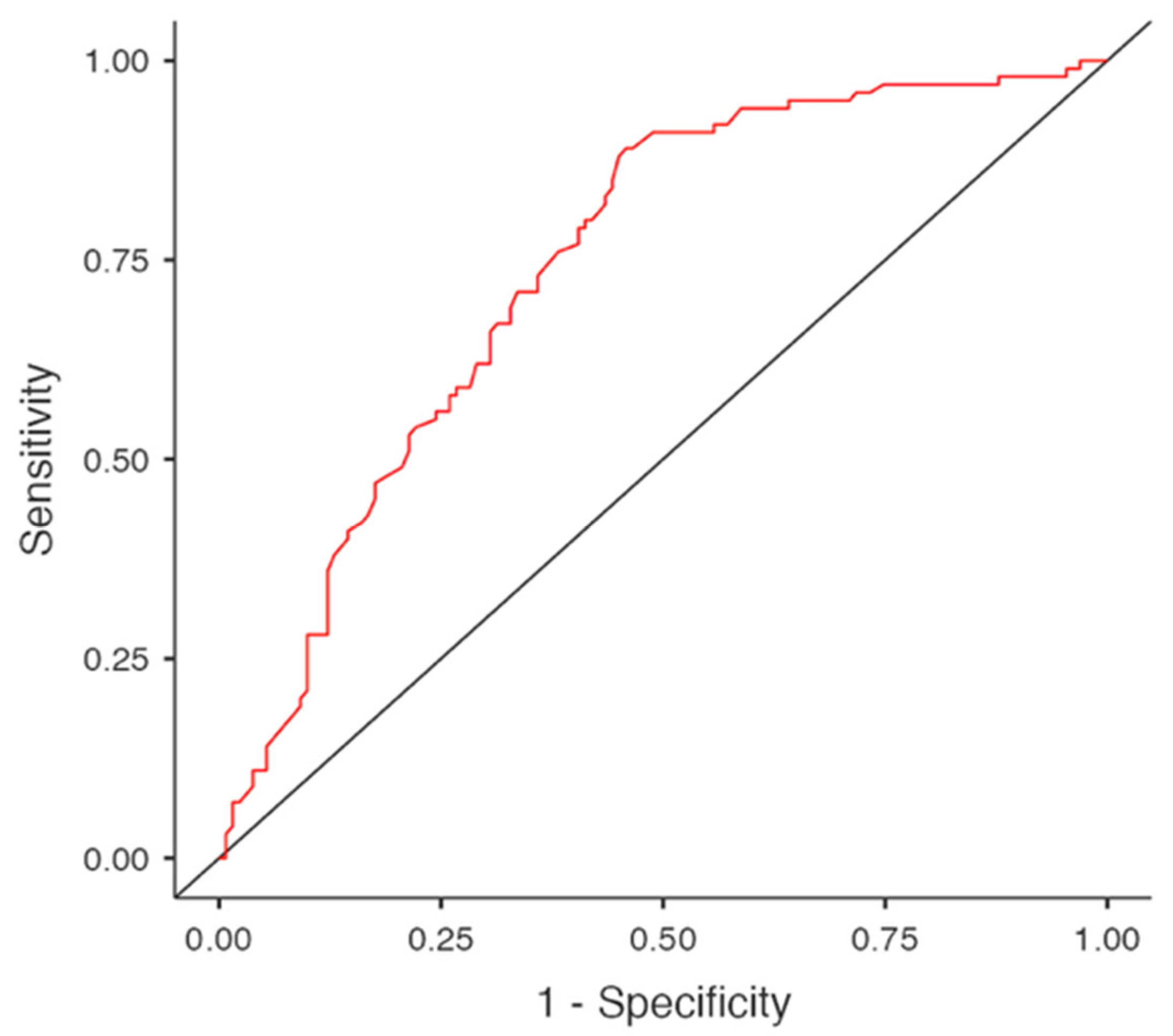
3.5. Logistic Regression Analysis of Independent Predictors for ACS
4. Discussion
5. Limitations
6. Conclusions
Supplementary Materials
Author Contributions
Funding
Institutional Review Board Statement
Informed Consent Statement
Data Availability Statement
Conflicts of Interest
Abbreviations
| ACS | Acute Coronary Syndrome |
| AHA | American Heart Association |
| ALT | Alanine Aminotransferase |
| AST | Aspartate Aminotransferase |
| AUC | Area Under the Curve |
| BMI | Body Mass Index |
| BUN | Blood Urea Nitrogen |
| CI | Confidence Interval |
| DNA | Deoxyribonucleic Acid |
| EDTA | Ethylenediaminetetraacetic Acid |
| ESC | European Society of Cardiology |
| F2 | Prothrombin Gene |
| F5 | Factor V Gene |
| HWE | Hardy–Weinberg Equilibrium |
| NSTEMI | Non-ST-Elevation Myocardial Infarction |
| OR | Odds Ratio |
| PCR-RFLP | Polymerase Chain Reaction-Restriction Fragment Length Polymorphism |
| ROC | Receiver Operating Characteristic |
| SBP | Systolic Blood Pressure |
| DBP | Diastolic Blood Pressure |
| SD | Standard Deviation |
| SNP | Single Nucleotide Polymorphism |
| SPSS | Statistical Package for the Social Sciences |
| STEMI | ST-Elevation Myocardial Infarction |
| USAP | Unstable Angina Pectoris |
| UV | Ultraviolet |
| VTE | Venous Thromboembolism |
References
- Collet, J.P.; Thiele, H.; Barbato, E.; Barthélémy, O.; Bauersachs, J.; Bhatt, D.L.; Dendale, P.; Dorobantu, M.; Edvardsen, T.; Folliguet, T.; et al. 2023 ESC Guidelines for the management of acute coronary syndromes. Eur. Heart J. 2023, 44, 3720–3820. [Google Scholar] [CrossRef]
- Thygesen, K.; Alpert, J.S.; Jaffe, A.S.; Chaitman, B.R.; Bax, J.J.; Morrow, D.A.; White, H.D.; Executive Group on behalf of the Joint European Society of Cardiology (ESC); American College of Cardiology (ACC); American Heart Association (AHA); et al. Fourth universal definition of myocardial infarction (2018). Circulation 2018, 138, e618–e651. [Google Scholar] [CrossRef] [PubMed]
- Gulati, M.; Levy, P.D.; Mukherjee, D.; Amsterdam, E.; Bhatt, D.L.; Birtcher, K.K.; Blankstein, R.; Boyd, J.; Bullock-Palmer, R.P.; Conejo, T.; et al. 2021 AHA/ACC/ASE/CHEST/SAEM/SCCT/SCMR guideline for the evaluation and diagnosis of chest pain: A report of the American College of Cardiology/American Heart Association Joint Committee on Clinical Practice Guidelines. Circulation 2021, 144, e368–e454. [Google Scholar] [CrossRef] [PubMed]
- Liu, X.; Xu, H.; Xu, H.; Li, Y.; Wu, Y.; Zhang, X.; Wang, C.; Chen, Z.; Liu, F.; Zhao, J.; et al. New genetic variants associated with major adverse cardiovascular events in patients with acute coronary syndromes treated with clopidogrel and aspirin. Pharmacogenomics J. 2021, 21, 664–672. [Google Scholar] [CrossRef] [PubMed]
- John-Olabode, S.O.; Okunade, K.S.; James, A.; Olorunfemi, G.; Ajie, O.I.; Osuntoki, A.A.; Akanmu, A.S. Prevalence of Factor V Leiden G1691A and Prothrombin G20210A gene mutations among pregnant women: Experience from a multi-center study in Nigeria. J. Blood Med. 2021, 12, 307–312. [Google Scholar] [CrossRef]
- Poort, S.R.; Rosendaal, F.R.; Reitsma, P.H.; Bertina, R.M. A common genetic variation in the 3′-untranslated region of the prothrombin gene is associated with elevated plasma prothrombin levels and an increased risk of venous thrombosis. Blood 1996, 88, 3698–3703. [Google Scholar] [CrossRef]
- Li, C.; Ren, H.; Chen, H.; Zhang, X.; Zhao, Y.; Wang, Q.; Liu, J.; Sun, T.; Yang, F.; Xu, P.; et al. Prothrombin G20210A (rs1799963) polymorphism increases myocardial infarction risk in an age-related manner: A systematic review and meta-analysis. Sci. Rep. 2017, 7, 13550. [Google Scholar] [CrossRef]
- Jiang, B.; Ryan, K.A.; Hamedani, A.; Cole, J.W.; Cramer, S.C.; Della-Morte, D.; Giles, W.H.; Juo, S.H.H.; Kittner, S.J.; Longstreth, W.T., Jr.; et al. Prothrombin G20210A mutation is associated with young-onset stroke: The genetics of early-onset stroke study and meta-analysis. Stroke 2014, 45, 961–967. [Google Scholar] [CrossRef]
- Lam, W.; Moosavi, L. Physiology, Factor V. In StatPearls; StatPearls Publishing: Treasure Island, FL, USA, 2023. [Google Scholar]
- Shibeeb, S.; Al-Rayashi, N.; Shams, N.; Hadvan, T.; Agbani, E.O.; Abdallah, A.M. Factor V Leiden (R506Q), Prothrombin G20210A, and MTHFR C677T variants and thrombophilia in Qatar Biobank participants: A case–control study. Pathophysiology 2024, 31, 608–620. [Google Scholar] [CrossRef]
- Bădescu, M.C.; Butnariu, L.I.; Costache, A.D.; Sandu, R.E.; Iancu, R.C.; Alexa, I.D.; Ungureanu, M.C.; Ciobanu, D.; Petrescu, G.E.D.; Rusu, C.M.; et al. Acute myocardial infarction in patients with hereditary thrombophilia—A focus on Factor V Leiden and Prothrombin G20210A. Life 2023, 13, 1371. [Google Scholar] [CrossRef]
- Isordia-Salas, I.; Santiago-Germán, D.; Jiménez-Alvarado, R.M.; Carrillo-Juárez, R.I.; Leaños-Miranda, A. ATR1 A1166C (rs5186), FII G20210A (rs1799963), FV G1691A (rs6025), FXIII 97G>T (rs11466016) and MTHFR A1298C (rs1801131) polymorphisms and the risk of ST-elevation myocardial infarction in young Mexican individuals. Mol. Biol. Rep. 2024, 51, 208. [Google Scholar] [CrossRef] [PubMed]
- Burzotta, F.; Paciaroni, K.; De Stefano, V.; Crea, F.; Maseri, A.; Leone, G.; Andreotti, F. G20210A Prothrombin gene polymorphism and coronary ischaemic syndromes: A phenotype-specific meta-analysis of 12,034 subjects. Heart 2004, 90, 82–86. [Google Scholar] [CrossRef] [PubMed]
- Damluji, A.A.; Forman, D.E.; Wang, T.Y.; Chikwe, J.; Kunadian, V.; Rich, M.W.; Young, B.A.; Page, R.L., 2nd; DeVon, H.A.; Alexander, K.P.; et al. Management of acute coronary syndrome in the older adult population: A scientific statement from the American Heart Association. Circulation 2023, 147, e32–e62. [Google Scholar] [CrossRef] [PubMed]
- Koksal, V.; Baris, I.; Etlik, O. Primer-engineered multiplex PCR-RFLP for detection of MTHFR C677T, Prothrombin G20210A and Factor V Leiden mutations. Exp. Mol. Pathol. 2007, 83, 1–3. [Google Scholar] [CrossRef]
- Gandrille, S.; Alhenc-Gelas, M.; Aiach, M. A rapid screening method for the Factor V Arg506→Gln mutation. Blood Coagul. Fibrinolysis 1995, 6, 245–248. [Google Scholar] [CrossRef]
- Franco, L.; Gallego, N.; Velarde, C.; Sierra, L.; Rodríguez, J.; Valencia, O.; Gómez, A.; Castaño, J.; Parra, E.; Martínez, P.; et al. Variants in candidate genes and their interactions with smoking on the risk of acute coronary syndrome. Biomedica 2025, 45, 107–117. [Google Scholar] [CrossRef]
- Wolk, R.; Berger, P.; Lennon, R.J.; Brilakis, E.S.; Somers, V.K. Body mass index: A risk factor for unstable angina and myocardial infarction in patients with angiographically confirmed coronary artery disease. Circulation 2003, 108, 2206–2211. [Google Scholar] [CrossRef]
- Kosiborod, M.; Rathore, S.S.; Inzucchi, S.E.; Masoudi, F.A.; Wang, Y.; Havranek, E.P.; Krumholz, H.M. Admission glucose and mortality in elderly patients hospitalized with acute myocardial infarction: Implications for patients with and without recognized diabetes. Circulation 2005, 111, 3078–3086. [Google Scholar] [CrossRef]
- Saygitov, R.T.; Glezer, M.G.; Semakina, S.V. Blood urea nitrogen and creatinine levels at admission for mortality risk assessment in patients with acute coronary syndromes. Emerg. Med. J. 2010, 27, 105–109. [Google Scholar] [CrossRef]
- Natae, S.; Merzah, M.; Sándor, J.; Ádány, R.; Bereczky, Z.; Fiatal, S. A Combination of Strongly Associated Prothrombotic Single Nucleotide Polymorphisms Could Efficiently Predict Venous Thrombosis Risk. Front. Cardiovasc. Med. 2023, 10, 1224462. [Google Scholar] [CrossRef]
- Kvasnička, T.; Cífková, R.; Zenáhlíková, Z.; Bobčíková, P.; Syruckova, A.; Ševčík, M.; Dušková, D.; Kvasnička, J. The Prevalence of the Thrombotic SNPs rs6025, rs1799963, rs2066865, rs2289252 and rs8176719 in Patients with Venous Thromboembolism in the Czech Population. Clin. Appl. Thromb. Hemost. 2025, 31, 10760296251324202. [Google Scholar] [CrossRef]
- Athar, M.; Abduljaleel, Z.; Ghita, I.; Albagenny, A.; Halawani, S.; Alkazmi, M.; Elbjeirami, W.; Alquthami, K.; Alkhuzae, M.; Ragab, F.; et al. Prevalence of the Factor V Leiden Mutation Arg534Gln in Western Region of Saudi Arabia: Functional Alteration and Association Study with Different Populations. Clin. Appl. Thromb. Hemost. 2021, 27, 1076029620978532. [Google Scholar] [CrossRef]
- Ryu, J.; Rämö, J.; Jurgens, S.; Niiranen, T.; Sanna-Cherchi, S.; Bauer, K.; Haj, A.; Choi, S.; Palotie, A.; Daly, M.; et al. Thrombosis Risk in Double Heterozygous Carriers of Factor V Leiden and Prothrombin G20210A in FinnGen and the UK Biobank. Blood 2024, 144, 2023023326. [Google Scholar] [CrossRef]
- Fedorova, S.; Kulagina, I.; Ryabov, V. Hemostatic Gene Polymorphisms in Acute Coronary Syndrome with Nonobstructive Coronary Atherosclerosis. Kardiologiia 2019, 59, 14–22. [Google Scholar] [CrossRef]
- Topoleanu, S.; Gales, L.; Padureanu, V.; Olaru, M.; Bumbea, A.M.; Serban, D.; Ungureanu, M.C.; Rusu, C.M.; Ilie, I.; Lupu, D.; et al. Genetic variants and biochemical parameters associated with the risk for venous thromboembolism in a Romanian cohort. Biointerface Res. Appl. Chem. 2023, 13, 134308. [Google Scholar] [CrossRef]
- Mahmoodi, B.K.; Eriksson, N.; Vos, G.J.A.; Algra, A.; Asselbergs, F.W.; Becker, R.C.; ten Berg, J.M.; Dorresteijn, J.A.N.; Husted, S.; Kastrati, A.; et al. Factor V Leiden does not modify the phenotype of acute coronary syndrome or the extent of myocardial necrosis. J. Am. Heart Assoc. 2021, 10, e020025. [Google Scholar] [CrossRef]
- Rallidis, L.S.; Gialeraki, A.; Tsirebolos, G.; Tsalavoutas, S.; Rallidi, M.; Iliodromitis, E. Prothrombotic genetic risk factors in patients with very early ST-segment elevation myocardial infarction. J. Thromb. Thrombolysis 2017, 44, 267–273. [Google Scholar] [CrossRef] [PubMed]
- Mannucci, P.M.; Asselta, R.; Duga, S.; Peyvandi, F.; Castaman, G.; Rodeghiero, F.; Martinelli, I.; Bucciarelli, P.; Rosendaal, F.R. The association of Factor V Leiden with myocardial infarction is replicated in 1880 patients with premature disease. J. Thromb. Haemost. 2010, 8, 2116–2121. [Google Scholar] [CrossRef] [PubMed]


| Genetic Variants | Prime Sequence (5′-3′) | Tm (°C) | PCR Product Size | Restriction Enzyme | Genotyping (bp) |
|---|---|---|---|---|---|
| Prothrombin G20210A (rs1799963) | F-ATG GGG TGA AGG CTG TGA CC R-AGC ACT GGG AGC ATT GAG CCT | 60 °C | 221 bp | MnII | GG: 221 GA: 221–192 AA: 192 |
| Factor V Leiden G1691A (rs6025) | F-TCA GGC AGG AAC AAC ACC AT R-GGT TAC TTC AAG GAC AAA ATA CCT GTA AAG CT | 58 °C | 241 bp | HindIII | GG: 241 GA: 241–209 AA: 209 |
| Characteristics | Groups | p-Value | |
|---|---|---|---|
| Control (n = 131) | ACS (n = 100) | ||
| Age | 50.2 ± 18.8 | 62.4 ± 13.7 | <0.001 a |
| Sex | |||
| Female [n (%)] | 49 (37.4%) | 39 (39.0%) | 0.805 b |
| Male [n (%)] | 82 (62.6%) | 61 (61.0%) | |
| SBP (mm/Hg) | 127.7 ± 21.7 | 125.7 ± 22.9 | 0.495 a |
| DBP (mm/Hg) | 79.1 ± 14.9 | 80.9 ± 14.8 | 0.359 a |
| Heart rate (per/min) | 91.3 ± 19.5 | 87.9 ± 14.3 | 0.143 a |
| BMI (kg/m2) | 25.7 ± 4.8 | 27.1 ± 5.1 | 0.040 a |
| Glucose (mg/dL) | 105 (90–127) | 134 (109–182) | <0.001 c |
| Urea (mg/dL) | 28.8 (23.6–39.1) | 34.6 (26.6–45.9) | 0.004 c |
| Creatinine (mg/dL) | 0.87 (0.71–1.06) | 0.93 (0.75–1.09) | 0.242 c |
| Sodium (mmol/L) | 139 (137–140) | 138 (136–140) | 0.063 c |
| Potasyum (mmol/L) | 4.20 (3.90–4.60) | 4.35 (4.00–4.73) | 0.041 c |
| ALT (U/L) | 17 (12–25) | 22 (15–33) | 0.002 c |
| AST (U/L) | 21 (17–28) | 31 (23–46) | <0.001 c |
| Troponin I (ng/L) | |||
| <100 [n (%)] | 112 (85.5%) | 29 (29%) | <0.001 b |
| >100 [n (%)] | 19 (14.5%) | 71 (71%) | |
| Genetic Variants | Genotype/Allele | Control (n = 131) | ACS (n = 100) | OR (95% CI) | p Value | HWE p (Control) |
|---|---|---|---|---|---|---|
| rs1799963 | GG | 119 (90.8%) | 98 (98.0%) | 4.52 (0.98–20.92) | 0.053 | — |
| GA | 11 (8.4%) | 2 (2.0%) | 1.00 (reference) | - | — | |
| AA | 1 (0.8%) | 0 (0.0%) | 1.53 (0.04–49.80) | 0.810 | — | |
| Dominant (AA + GA vs. GG) | 12 (9.2%) | 2 (2%) | 4.94 (1.08–22.60) | 0.039 | 0.209 | |
| G allele | 249 (95.0%) | 198 (99.0%) | 5.17 (1.15–23.17) | 0.032 | — | |
| A allele | 13 (5.0%) | 2 (1.0%) | 1.00 (reference) | — | — | |
| rs6025 | GG | 107 (81.7%) | 91 (91.0%) | 2.23 (0.94–5.28) | 0.068 | — |
| GA | 21 (16.0%) | 8 (8.0%) | 1.00 (reference) | - | — | |
| AA | 3 (2.3%) | 1 (1.0%) | 0.87 (0.08–9.69) | 0.913 | — | |
| Dominant (AA + GA vs. GG) | 24 (18.3%) | 9 (9.0%) | 2.26 (1.00–5.12) | 0.049 | 0.128 | |
| G allele | 235(89.7%) | 190 (95.0%) | 2.18 (1.03–4.62) | 0.041 | — | |
| A allele | 27 (10.3%) | 10 (5.0%) | 1.00 (reference) | — | — |
| Characteristic | rs1799963 Genotypes | p-Value | rs6025 Genotypes | p-Value | ||
|---|---|---|---|---|---|---|
| GG (119) | GA + AA(12) | GG(107) | GA + AA(24) | |||
| Age | 49.28 ± 18.34 | 58.91 ± 22.35 | 0.092 a | 49.76 ± 19.58 | 51.83 ± 15.42 | 0.632 a |
| Sex | ||||||
| Female [n (%)] | 44 (37.0%) | 5 (41.7%) | 0.749 b | 38 (35.5%) | 11 (45.8%) | 0.345 b |
| Male [n(%)] | 75 (63.0%) | 7 (58.3%) | 69 (64.5%) | 13 (54.2%) | ||
| SBP (mm/Hg) | 127.63 ± 21.77 | 128.75 ± 22.02 | 0.866 a | 127.48 ± 22.28 | 128.87 ± 19.37 | 0.777 a |
| DBP (mm/Hg) | 79.07 ± 14.94 | 79.0 ± 15.63 | 0.988 a | 78.07 ± 13.44 | 83.50 ± 20.13 | 0.108 a |
| Heart rate (per/min) | 91.10 ± 19.58 | 93.75 ± 19.20 | 0.655 a | 92.41 ± 19.60 | 86.58 ± 18.55 | 0.186 a |
| BMI (kg/m2) | 25.61 ± 4.84 | 26.50 ± 5.21 | 0.546 a | 25.57 ± 4.91 | 26.25 ± 4.68 | 0.534 a |
| Glucose (mg/dL) | 119.7 ± 59.95 | 168.33 ± 102.12 | 0.014 a | 124.20 ± 66.55 | 124.29 ± 64.28 | 0.995 a |
| Urea (mg/dL) | 35.16 ± 21.61 | 33.66 ± 12.73 | 0.814 a | 35.63 ± 21.74 | 32.32 ± 16.90 | 0.488 a |
| Creatinine (mg/dL) | 1.04 ± 0.86 | 0.79 ± 0.17 | 0.339 a | 1.03 ± 0.89 | 0.97 ± 0.41 | 0.804 a |
| Sodium (mmol/L) | 138.67 ± 2.21 | 137.83 ± 6.67 | 0.337 a | 138.56 ± 3.01 | 138.75 ± 2.17 | 0.772 a |
| Potassium (mmol/L) | 4.27 ± 0.52 | 4.28 ± 0.57 | 0.916 a | 4.23 ± 0.49 | 4.44 ± 0.65 | 0.074 a |
| ALT (U/L) | 17.0 (12.0–25.5) | 13.5 (9.8–20.3) | 0.248 c | 16.0 (11.5–24.0) | 19.0 (15.5–26.0) | 0.314 c |
| AST (U/L) | 21.0 (21.0–27.5) | 20.0 (14.8–28.0) | 0.573 c | 21.0 (21.0–27.0) | 21.0 (16.0–32.5) | 0.425 c |
| Troponin I (ng/L) | ||||||
| <100 [n (%)] | 101 (84.9%) | 11 (91.7%) | 1.00 b | 90 (84.1%) | 22 (91.7%) | 0.524 b |
| >100 [n (%)] | 18 (15.1%) | 1 (8.3%) | 17 (15.9%) | 2 (8.3%) | ||
| Characteristic | rs1799963 Genotypes | p-Value | rs6025 Genotypes | p-Value | ||
|---|---|---|---|---|---|---|
| GG (98) | GA + AA (2) | GG (91) | GA + AA (9) | |||
| Age | 62.45 ± 13.80 | 61.50 ± 7.78 | 0.923 a | 62.66 ± 13.22 | 60.11 ± 18.55 | 0.597 a |
| Sex | ||||||
| Female [n (%)] | 39 (39.8%) | 0 (0%) | 0.519 b | 34 (37.4%) | 5 (55.6%) | 0.306 b |
| Male [n (%)] | 59 (60.2%) | 2 (100%) | 57 (62.6%) | 4 (44.4%) | ||
| SBP (mm/Hg) | 125.47 ± 22.93 | 137.50 ± 30.41 | 0.466 a | 125.10 ± 22.80 | 131.89 ± 25.17 | 0.400 a |
| DBP (mm/Hg) | 80.90 ± 14.97 | 80.00 ± 4.24 | 0.933 a | 80.74 ± 14.51 | 82.33 ± 18.75 | 0.760 a |
| Heart rate (per/min) | 87.67 ± 14.23 | 101.0 ± 14.14 | 0.193 a | 88.53 ± 14.35 | 82.00 ± 12.57 | 0.192 a |
| BMI (kg/m2) | 27.09 ± 5.14 | 25.26 ± 5.07 | 0.620 a | 27.01 ± 5.16 | 27.47 ± 4.96 | 0.797 a |
| Glucose (mg/dL) | 158.69 ± 75.66 | 99.00 ± 29.69 | 0.270 a | 158.71 ± 78.35 | 145.22 ± 33.62 | 0.611 a |
| Urea (mg/dL) | 41.00 ± 24.58 | 33.25 ± 17.60 | 0.659 a | 41.89 ± 25.16 | 30.25 ± 10.73 | 0.174 a |
| Creatinine (mg/dL) | 1.03 ± 0.52 | 0.98 ± 0.15 | 0.891 a | 1.05 ± 0.54 | 0.84 ± 0.21 | 0.265 a |
| Sodium (mmol/L) | 135.58 ± 18.06 | 138.50 ± 2.12 | 0.821 a | 135.66 ± 18.73 | 135.44 ± 3.01 | 0.973 a |
| Potassium (mmol/L) | 4.43 ± 0.58 | 4.30 ± 0.14 | 0.761 a | 4.42 ± 0.54 | 4.46 ± 0.89 | 0.818 a |
| ALT (U/L) | 22.0 (15.0–32.8) | 52.5 (36.8–68.3) | 0.337 c | 22.0 (15.0–34.5) | 24.0 (13.0–30.0) | 0.695 c |
| AST (U/L) | 30.05 (22.3–47.3) | 33.5 (28.3–38.8) | 1.000 c | 31.0 (23.0–46.5) | 27.0 (21.0–31.0) | 0.332 c |
| Troponin I (ng/L) | ||||||
| <100 [n (%)] | 27 (27.6%) | 2 (100%) | 0.082 b | 27 (29.7%) | 2 (22.2%) | 0.239 b |
| >100 [n (%)] | 71 (72.4%) | 0 (0.0%) | 64 (70.3%) | 7 (77.8%) | ||
| Diagnosis | ||||||
| STEMI [n (%)] | 17 (17.3%) | 0(0%) | 0.001 b | 13 (14.3%) | 4 (44.4%) | 0.049 b |
| NSTEMI [n (%)] | 70 (71.4%) | 0(0%) | 66 (72.5%) | 4 (44.4%) | ||
| USAP [n (%)] | 11 (11.3) | 2 (100%) | 12 (13.2) | 1 (11.2%) | ||
| Predictor | B | SE | Z | p Value | OR (95% CI) |
|---|---|---|---|---|---|
| Intercept | −5.758 | 1.285 | −5.103 | <0.001 | 0.003 (3.46–0.02) |
| Age | 0.046 | 0.009 | 5.091 | <0.001 | 1.047 (1.029–1.066) |
| rs1799963 (GG/GA + AA) | 2.154 | 0.811 | 2.654 | 0.008 | 8.624 (1.757–42.345) |
| rs6025 (GG/GA + AA) | 0.969 | 0.443 | 2.183 | 0.029 | 2.635 (1.104–6.290) |
| Sex (Male–Female) | −0.067 | 0.301 | −0.225 | 0.822 | 0.934 (0.517–1.688) |
Disclaimer/Publisher’s Note: The statements, opinions and data contained in all publications are solely those of the individual author(s) and contributor(s) and not of MDPI and/or the editor(s). MDPI and/or the editor(s) disclaim responsibility for any injury to people or property resulting from any ideas, methods, instructions or products referred to in the content. |
© 2025 by the authors. Licensee MDPI, Basel, Switzerland. This article is an open access article distributed under the terms and conditions of the Creative Commons Attribution (CC BY) license (https://creativecommons.org/licenses/by/4.0/).
Share and Cite
Yukcu, F.; Kaya, M.; Can, F.; Yildirim, H. Investigation of Prothrombin G20210A and Factor V Leiden G1691A Variants in Patients with Acute Coronary Syndrome Presenting to the Emergency Department with Chest Pain. Genes 2025, 16, 1490. https://doi.org/10.3390/genes16121490
Yukcu F, Kaya M, Can F, Yildirim H. Investigation of Prothrombin G20210A and Factor V Leiden G1691A Variants in Patients with Acute Coronary Syndrome Presenting to the Emergency Department with Chest Pain. Genes. 2025; 16(12):1490. https://doi.org/10.3390/genes16121490
Chicago/Turabian StyleYukcu, Fulya, Murtaza Kaya, Fatmagul Can, and Harun Yildirim. 2025. "Investigation of Prothrombin G20210A and Factor V Leiden G1691A Variants in Patients with Acute Coronary Syndrome Presenting to the Emergency Department with Chest Pain" Genes 16, no. 12: 1490. https://doi.org/10.3390/genes16121490
APA StyleYukcu, F., Kaya, M., Can, F., & Yildirim, H. (2025). Investigation of Prothrombin G20210A and Factor V Leiden G1691A Variants in Patients with Acute Coronary Syndrome Presenting to the Emergency Department with Chest Pain. Genes, 16(12), 1490. https://doi.org/10.3390/genes16121490