Influence of Coffee Oil Epoxide as a Bio-Based Plasticizer on the Thermal, Mechanical, and Barrier Performance of PHBV/Natural Rubber Blends


Abstract
1. Introduction
2. Experimental Section
2.1. Materials
2.2. Melt Compounding
2.3. Characterization of PHBV and Its Blends
2.3.1. Thermal Transition Measurements-DSC Analysis
2.3.2. Mechanical Testing
2.3.3. Barrier Properties
2.3.4. Exudation and Volatility Resistance Testing
2.3.5. Surface Morphology Analysis
3. Results and Discussion
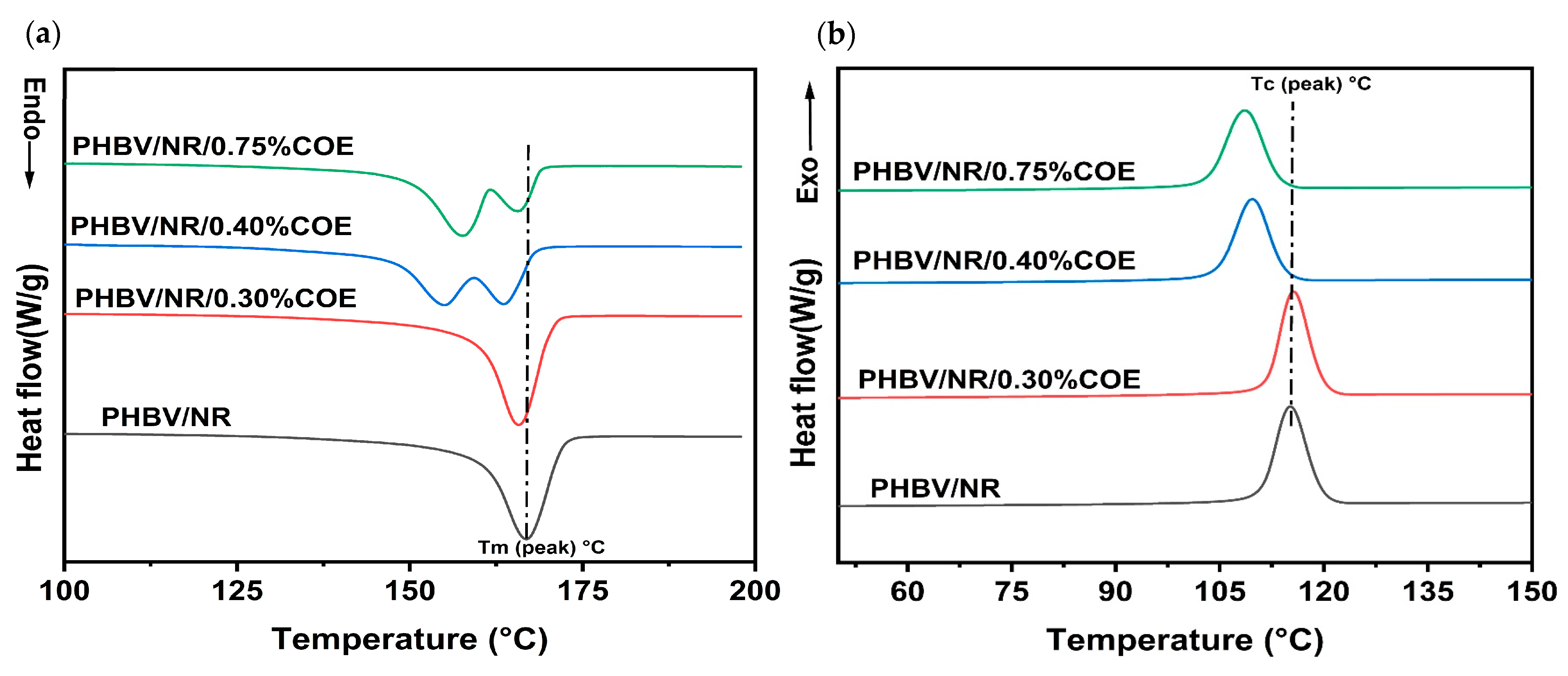
3.1. Effect of Plasticizer on Glass Transition and Melting Behaviors
3.2. Effect of COE on Mechanical Properties of PHBV/NR Blends
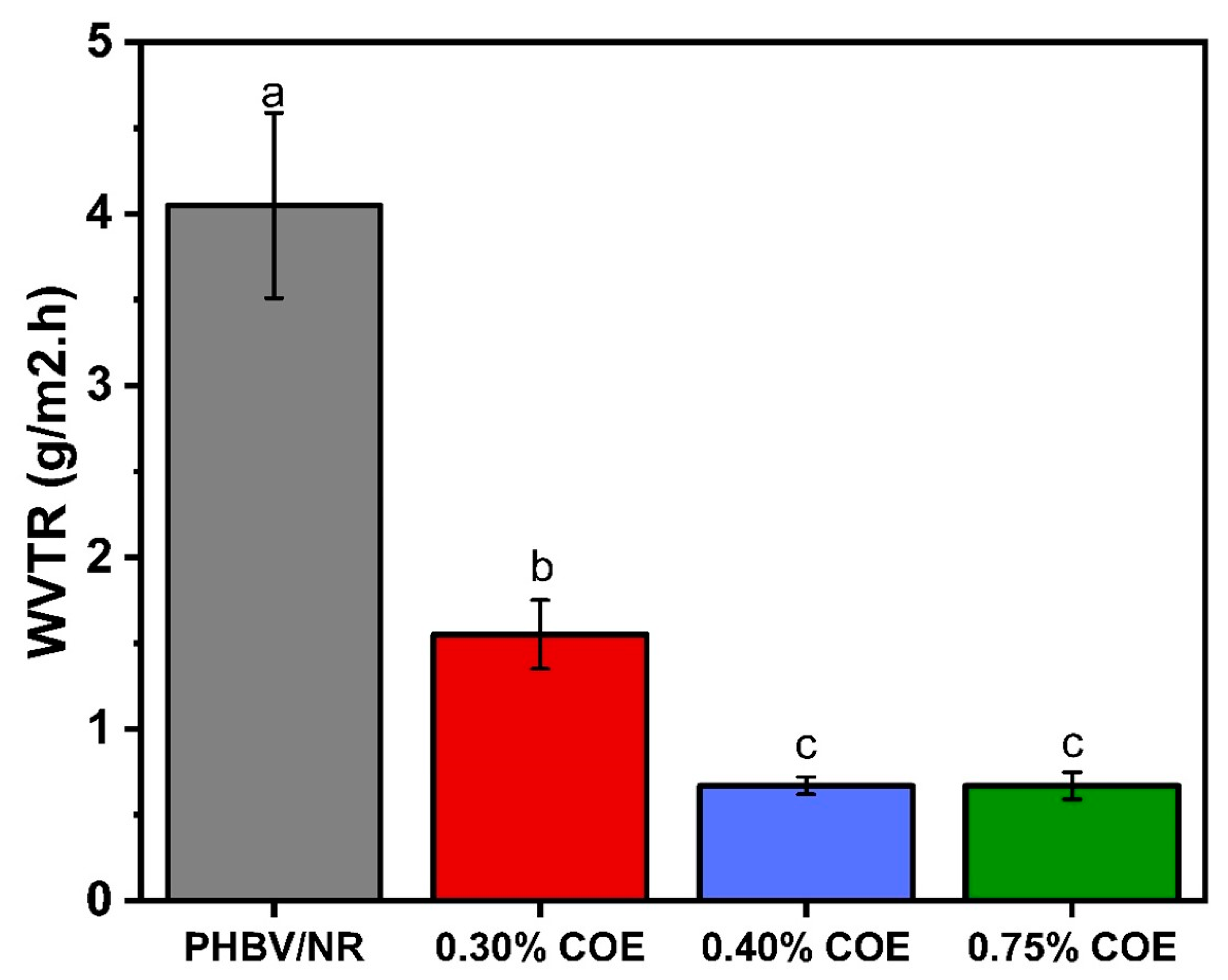
3.3. Effect of COE Content on Barrier Properties of PHBV/NR Blends
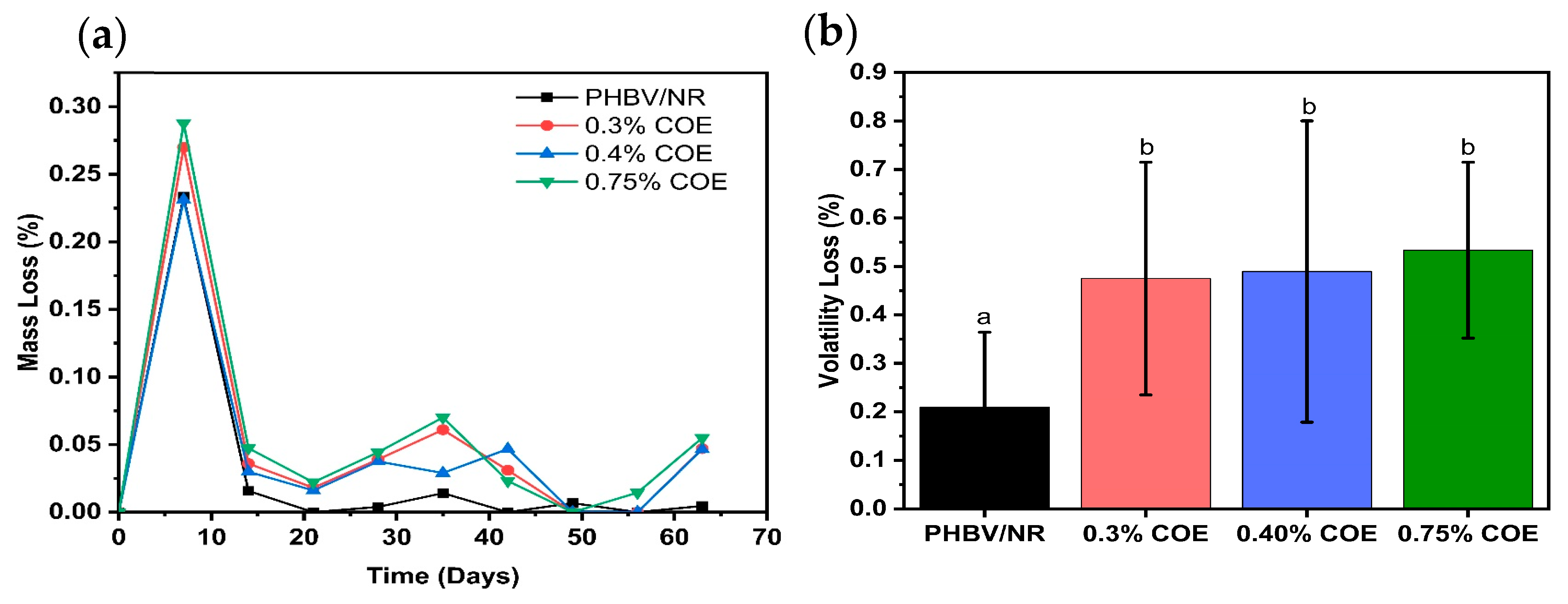
3.4. Effect of COE on Exudation and Volatility Resistance of PHBV/NR Blends
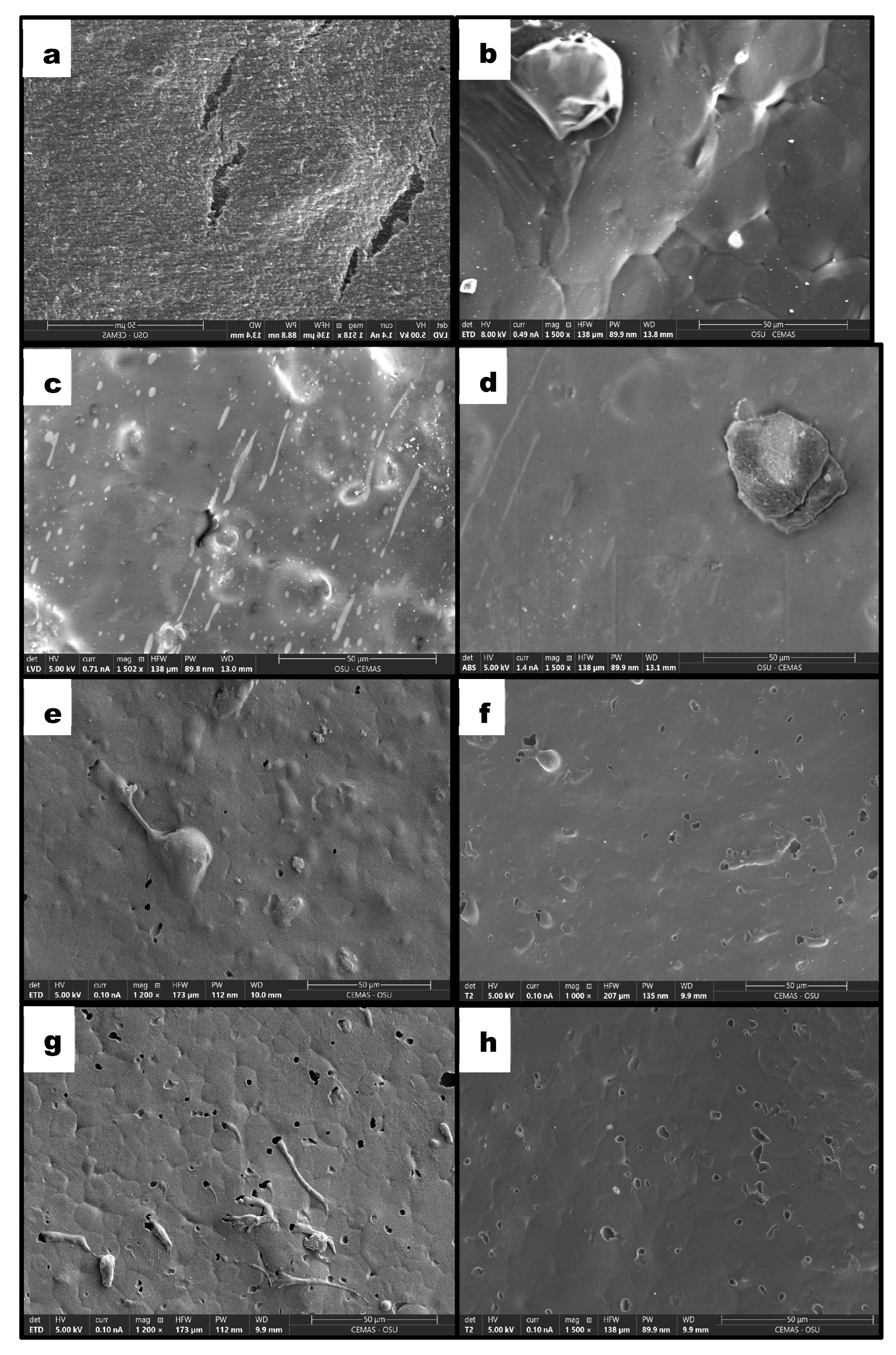
3.5. Effect of COE on Surface Morphology of PHBV/NR Blends
4. Conclusions
Author Contributions
Funding
Data Availability Statement
Acknowledgments
Conflicts of Interest
References
- Ling, C.; Clarke, R.W.; Rosetto, G.; Xu, S.; Cywar, R.M.; Kim, D.H.; Hamernik, L.J.; Haugen, S.J.; Michener, W.E.; Woodworth, S.P.; et al. Tunable and Degradable Dynamic Thermosets from Compatibilized Polyhydroxyalkanoate Blends. ACS Sustain. Chem. Eng. 2025, 13, 3817–3829. [Google Scholar] [CrossRef]
- Meereboer, K.W.; Misra, M.; Mohanty, A.K. Review of Recent Advances in the Biodegradability of Polyhydroxyalkanoate (PHA) Bioplastics and Their Composites. Green Chem. 2020, 22, 5519–5558. [Google Scholar] [CrossRef]
- Weng, Y.-X.; Wang, Y.; Wang, X.-L.; Wang, Y.-Z. Biodegradation Behavior of PHBV Films in a Pilot-Scale Composting Condition. Polym. Test. 2010, 29, 579–587. [Google Scholar] [CrossRef]
- Shang, L.; Fei, Q.; Zhang, Y.H.; Wang, X.Z.; Fan, D.-D.; Chang, H.N. Thermal Properties and Biodegradability Studies of Poly(3-Hydroxybutyrate-Co-3-Hydroxyvalerate). J. Polym. Environ. 2012, 20, 23–28. [Google Scholar] [CrossRef]
- Jahangiri, F.; Mohanty, A.K.; Pal, A.K.; Shankar, S.; Rodriguez-Uribe, A.; Clemmer, R.; Gregori, S.; Misra, M. PHBV Coating on Biodegradable Plastic Sheet: Effect of Coating on Morphological, Mechanical and Barrier Properties. Prog. Org. Coat. 2024, 189, 108270. [Google Scholar] [CrossRef]
- Jost, V. Packaging Related Properties of Commercially Available Biopolymers—An Overview of the Status Quo. Express Polym. Lett. 2018, 12, 429–435. [Google Scholar] [CrossRef]
- Rivera-Briso, A.L.; Serrano-Aroca, Á. Poly(3-Hydroxybutyrate-Co-3-Hydroxyvalerate): Enhancement Strategies for Advanced Applications. Polymers 2018, 10, 732. [Google Scholar] [CrossRef]
- Li, Z.; Yang, J.; Loh, X.J. Polyhydroxyalkanoates: Opening Doors for a Sustainable Future. NPG Asia Mater. 2016, 8, e265. [Google Scholar] [CrossRef]
- Tomano, N.; Osswald, T.A.; Potiyaraj, P.; Boondamnoen, O.; Aumnate, C. Toughened Poly(3-Hydroxybutyrate-Co-3-Hydroxyvalerate)/Epoxidized Natural Rubber Blends Fabricated by Dynamic Vulcanization and Interfacial Compatibilization. J. Polym. Environ. 2024, 32, 5666–5676. [Google Scholar] [CrossRef]
- Ghosh, R.; Zhao, X.; Vodovotz, Y. Rheological Behavior and Mechanical Performance of Poly(3-Hydroxybutyrate-Co-3-Hydroxyvalerate)/Natural Rubber Blends Modified with Coffee Oil Epoxide for Sustainable Packaging Applications. Polymers 2025, 17, 1324. [Google Scholar] [CrossRef]
- Erceg, M.; Kovačić, T.; Klarić, I. Thermal Degradation of Poly(3-Hydroxybutyrate) Plasticized with Acetyl Tributyl Citrate. Polym. Degrad. Stab. 2005, 90, 313–318. [Google Scholar] [CrossRef]
- Jaffur, B.N.; Kumar, G.; Khadoo, P. Production and Functionalization Strategies for Superior Polyhydroxybutyrate Blend Performance. Int. J. Biol. Macromol. 2024, 278, 134907. [Google Scholar] [CrossRef]
- Li, D.; Yang, Y.; Liu, R.; Wu, Y.; Guo, F. Review of Biopolymer Polyhydroxybutyrate (PHB) and Blends: Modification of Thermal and Mechanical Properties via Additive Manufacturing Processing. Polymers 2025, 17, 3083. [Google Scholar] [CrossRef]
- Huang, P.-C.; Chou, W.-C. Unveiling the Hidden Dangers of Plasticizers: A Call for Immediate Action. Toxics 2023, 11, 527. [Google Scholar] [CrossRef]
- Requena, R.; Jiménez, A.; Vargas, M.; Chiralt, A. Effect of Plasticizers on Thermal and Physical Properties of Compression-Moulded Poly[(3-Hydroxybutyrate)-Co-(3-Hydroxyvalerate)] Films. Polym. Test. 2016, 56, 45–53. [Google Scholar] [CrossRef]
- Ghosh, R.; Zhao, X.; Vodovotz, Y. Addition of Coffee Waste-Derived Plasticizer Improves Processability and Barrier Properties of Poly(3-Hydroxybutyrate-Co-3-Hydroxyvalerate)-Natural Rubber Bioplastic. Polymers 2024, 16, 2164. [Google Scholar] [CrossRef]
- Williamson, K.; Banker, T.; Zhao, X.; Ortega-Anaya, J.; Jimenez-Flores, R.; Vodovotz, Y.; Hatzakis, E. Spent Coffee Ground Oil as a Valuable Source of Epoxides and Epoxidation Derivatives: Quantitation and Characterization Using Low-Field NMR. LWT 2022, 165, 113719. [Google Scholar] [CrossRef]
- Jost, V.; Langowski, H.-C. Effect of Different Plasticisers on the Mechanical and Barrier Properties of Extruded Cast PHBV Films. Eur. Polym. J. 2015, 68, 302–312. [Google Scholar] [CrossRef]
- Slongo, M.D.; Brandolt, S.D.F.; Daitx, T.S.; Mauler, R.S.; Giovanela, M.; Crespo, J.S.; Carli, L.N. Comparison of the Effect of Plasticizers on PHBV—And Organoclay—Based Biodegradable Polymer Nanocomposites. J. Polym. Environ. 2018, 26, 2290–2299. [Google Scholar] [CrossRef]
- Daglia, M.; Racchi, M.; Papetti, A.; Lanni, C.; Govoni, S.; Gazzani, G. In Vitro and Ex Vivo Antihydroxyl Radical Activity of Green and Roasted Coffee. J. Agric. Food Chem. 2004, 52, 1700–1704. [Google Scholar] [CrossRef]
- Somnuk, K.; Eawlex, P.; Prateepchaikul, G. Optimization of Coffee Oil Extraction from Spent Coffee Grounds Using Four Solvents and Prototype-Scale Extraction Using Circulation Process. Agric. Nat. Resour. 2017, 51, 181–189. [Google Scholar] [CrossRef]
- Czekała, W.; Łukomska, A.; Pulka, J.; Bojarski, W.; Pochwatka, P.; Kowalczyk-Juśko, A.; Oniszczuk, A.; Dach, J. Waste-to-Energy: Biogas Potential of Waste from Coffee Production and Consumption. Energy 2023, 276, 127604. [Google Scholar] [CrossRef]
- Delgado, P.A.; Vignoli, J.A.; Siika-aho, M.; Franco, T.T. Sediments in Coffee Extracts: Composition and Control by Enzymatic Hydrolysis. Food Chem. 2008, 110, 168–176. [Google Scholar] [CrossRef]
- Zhao, X.; Cornish, K.; Vodovotz, Y. Synergistic Mechanisms Underlie the Peroxide and Coagent Improvement of Natural-Rubber-Toughened Poly(3-Hydroxybutyrate-Co-3-Hydroxyvalerate) Mechanical Performance. Polymers 2019, 11, 565. [Google Scholar] [CrossRef] [PubMed]
- ASTM D882-18; Test Method for Tensile Properties of Thin Plastic Sheeting. ASTM International: West Conshohocken, PA, USA, 2018. [CrossRef]
- ASTM E96/E96M-16; Test Methods for Water Vapor Transmission of Materials. ASTM International: West Conshohocken, PA, USA, 2021. [CrossRef]
- Carvalho, N.K.; Silva, A.P.B.; Lemes, A.P. Effects of Tributyrin as Plasticizer in Poly(3-hydroxybutyrate-Co-3-hydroxyvalerate) on Processability, Mechanical, and Thermal Properties. J. Appl. Polym. Sci. 2023, 140, e54249. [Google Scholar] [CrossRef]
- ISO 176:2005; Plastics-Determination of Loss of Plasticizers-Activated Carbon Method. International Organization for Standardization: Geneva, Switzerland, 2005. Available online: https://www.iso.org/standard/38743.html (accessed on 27 November 2025).
- Panaitescu, D.M.; Frone, A.N.; Chiulan, I.; Nicolae, C.A.; Trusca, R.; Ghiurea, M.; Gabor, A.R.; Mihailescu, M.; Casarica, A.; Lupescu, I. Role of Bacterial Cellulose and Poly (3-Hydroxyhexanoate-Co-3-Hydroxyoctanoate) in Poly (3-Hydroxybutyrate) Blends and Composites. Cellulose 2018, 25, 5569–5591. [Google Scholar] [CrossRef]
- Zini, E.; Focarete, M.L.; Noda, I.; Scandola, M. Bio-Composite of Bacterial Poly(3-Hydroxybutyrate-Co-3-Hydroxyhexanoate) Reinforced with Vegetable Fibers. Compos. Sci. Technol. 2007, 67, 2085–2094. [Google Scholar] [CrossRef]
- Duangphet, S.; Szegda, D.; Song, J.; Tarverdi, K. The Effect of Chain Extender on Poly(3-Hydroxybutyrate-Co-3-Hydroxyvalerate): Thermal Degradation, Crystallization, and Rheological Behaviours. J. Polym. Environ. 2014, 22, 1–8. [Google Scholar] [CrossRef]
- Baltieri, R.C.; Innocentini Mei, L.H.; Bartoli, J. Study of the Influence of Plasticizers on the Thermal and Mechanical Properties of Poly(3-hydroxybutyrate) Compounds. Macromol. Symp. 2003, 197, 33–44. [Google Scholar] [CrossRef]
- Panaitescu, D.M.; Nicolae, C.A.; Frone, A.N.; Chiulan, I.; Stanescu, P.O.; Draghici, C.; Iorga, M.; Mihailescu, M. Plasticized Poly(3-hydroxybutyrate) with Improved Melt Processing and Balanced Properties. J. Appl. Polym. Sci. 2017, 134, app.44810. [Google Scholar] [CrossRef]
- Seydibeyoğlu, M.Ö.; Misra, M.; Mohanty, A. Synergistic Improvements in the Impact Strength and % Elongation of Polyhydroxybutyrate-Co-Valerate Copolymers with Functionalized Soybean Oils and POSS. Int. J. Plast. Technol. 2010, 14, 1–16. [Google Scholar] [CrossRef]
- Aishah, R.S.; Norhayani, O.; Aznizam, A.B.; Azman, H. Plasticizing Effects of Epoxidized Palm Oil on Mechanical and Thermal Properties of Poly(3-Hydroxybutyrate-Co-Hydroxyvalerate)/Poly(Caprolactone) Blends. Chem. Eng. Trans. 2021, 83, 559–564. [Google Scholar] [CrossRef]
- Silverajah, V.S.G.; Ibrahim, N.A.; Yunus, W.M.Z.W.; Hassan, H.A.; Woei, C.B. A Comparative Study on the Mechanical, Thermal and Morphological Characterization of Poly(Lactic Acid)/Epoxidized Palm Oil Blend. Int. J. Mol. Sci. 2012, 13, 5878–5898. [Google Scholar] [CrossRef]
- Farrag, Y.; Barral, L.; Gualillo, O.; Moncada, D.; Montero, B.; Rico, M.; Bouza, R. Effect of Different Plasticizers on Thermal, Crystalline, and Permeability Properties of Poly(3–Hydroxybutyrate–Co−3–Hydroxyhexanoate) Films. Polymers 2022, 14, 3503. [Google Scholar] [CrossRef] [PubMed]
- Nájera, L.N.; Orjuela, Á.; Narvaez-Rincón, P.C.; Sanchez-Nacher, L.; Montanes, N.; Quiles-Carrillo, L. Assessment of Epoxidized Isobutyl Fatty Esters from Soybean Oil Distillates as Biobased Plasticizers. Ind. Eng. Chem. Res. 2024, 63, 22203–22219. [Google Scholar] [CrossRef]
- Najera-Losada, L.; Narváez-Rincón, P.C.; Orjuela, A.; Gomez-Caturla, J.; Fenollar, O.; Balart, R. Plasticization of Polylactide Using Biobased Epoxidized Isobutyl Esters Derived from Waste Soybean Oil Deodorizer Distillate. J. Polym. Environ. 2025, 33, 125–144. [Google Scholar] [CrossRef]



| Processing Parameter | Value/Setting |
|---|---|
| Extruder type | Davis Standard DS20 (24:1 L/D) |
| Die Configuration | Coat-hanger die |
| Barrel Zone 1 Temperature | 360 °F |
| Barrel Zone 2 Temperature | 360 °F |
| Barrel Zone 3 Temperature | 360 °F |
| Die Region Temperatures | 360 °F |
| Die gap | 0.38–0.42 mm |
| Screw speed | 22 rpm |
| Sample | ΔHm (J/g) | Tm Onset (°C) | Tm Peak (°C) 1 | Tm Peak (°C) 2 | ΔHc (J/g) | Tc Onset (°C) | Tc Peak (°C) | Xc (%) | Tg of PHBV | Tg of Rubber |
|---|---|---|---|---|---|---|---|---|---|---|
| PHBV/NR | 79.6 ± 1.2 | 160.8 ± 0.4 | 165.4 ± 0.2 | - | 78.3 ± 1.4 | 120.1 ± 0.2 | 116.4 ± 0.2 | 54.5 | 1.8 ± 0.3 | −62.6 ± 1.3 |
| PHBV/NR + 0.30% COE | 78.9 ± 1.0 | 160.7 ± 0.1 | 166.4 ± 0.2 | - | 77.3 ± 1.2 | 119.7 ± 0.1 | 115.9 ± 0.2 | 53.5 | 1.7 ± 0.3 | −63.6 ± 1.4 |
| PHBV/NR + 0.40% COE | 76.8 ± 0.8 | 151.1 ± 0.8 | 158.9 ± 0.5 | 166.4 ± 0.2 | 68.7 ± 0.6 | 114.1 ± 0.6 | 109.1 ± 0.9 | 52.6 | −4.3 ± 0.6 | −65.6 ± 0.6 |
| PHBV/NR + 0.75% COE | 75.9 ± 1.8 | 149.8 ± 0.7 | 157.3 ± 0.5 | 165.5 ± 0.4 | 70.5 ± 1.6 | 113.4 | 108.4 ± 0.1 | 51.9 | −5.6 ± 0.6 | −64.6 ± 0.1 |
| Sample | Tensile Strength (MPa) | Elongation at Break (%) | Young’s Modulus (MPa) |
|---|---|---|---|
| PHBV | 42.02 ± 3.14 a | 3.84 ± 1.07 ab | 2130.92 ± 163.99 a |
| PHBV/NR | 24.33 ± 1.15 c | 2.89 ± 0.35 b | 1421.28 ± 110.10 b |
| PHBV/NR/0.3%COE | 26.63 ± 1.10 b | 2.93 ± 0.25 b | 1538.79 ± 94.13 b |
| PHBV/NR/0.4%COE | 21.10 ± 1.58 d | 3.35 ± 0.75 ab | 1123.11 ± 73.11 c |
| PHBV/NR/0.75%COE | 20.39 ± 0.94 d | 3.97 ± 1.12 a | 1080.14 ± 62.95 c |
Disclaimer/Publisher’s Note: The statements, opinions and data contained in all publications are solely those of the individual author(s) and contributor(s) and not of MDPI and/or the editor(s). MDPI and/or the editor(s) disclaim responsibility for any injury to people or property resulting from any ideas, methods, instructions or products referred to in the content. |
© 2026 by the authors. Licensee MDPI, Basel, Switzerland. This article is an open access article distributed under the terms and conditions of the Creative Commons Attribution (CC BY) license.
Share and Cite
Ghosh, R.; Zhao, X.; Boushelle, M.G.; Vodovotz, Y. Influence of Coffee Oil Epoxide as a Bio-Based Plasticizer on the Thermal, Mechanical, and Barrier Performance of PHBV/Natural Rubber Blends. Polymers 2026, 18, 240. https://doi.org/10.3390/polym18020240
Ghosh R, Zhao X, Boushelle MG, Vodovotz Y. Influence of Coffee Oil Epoxide as a Bio-Based Plasticizer on the Thermal, Mechanical, and Barrier Performance of PHBV/Natural Rubber Blends. Polymers. 2026; 18(2):240. https://doi.org/10.3390/polym18020240
Chicago/Turabian StyleGhosh, Rinky, Xiaoying Zhao, Marie Genevieve Boushelle, and Yael Vodovotz. 2026. "Influence of Coffee Oil Epoxide as a Bio-Based Plasticizer on the Thermal, Mechanical, and Barrier Performance of PHBV/Natural Rubber Blends" Polymers 18, no. 2: 240. https://doi.org/10.3390/polym18020240
APA StyleGhosh, R., Zhao, X., Boushelle, M. G., & Vodovotz, Y. (2026). Influence of Coffee Oil Epoxide as a Bio-Based Plasticizer on the Thermal, Mechanical, and Barrier Performance of PHBV/Natural Rubber Blends. Polymers, 18(2), 240. https://doi.org/10.3390/polym18020240