Article

Adsorption of Methylene Blue on PVDF Membrane and PVDF/TiO2 Hybrid Membrane: Batch and Cross-Flow Filtration Studies


1
Heilongjiang Academy of Black Soil Conservation and Utilization, Heilongjiang Academy of Agricultural Sciences, Harbin 150086, China
2
College of Civil Engineering, Heilongjiang University, Harbin 150080, China
3
Research and Development Centre, Shandong Aisen Water Industry Co., Ltd., Taian 271021, China
*
Author to whom correspondence should be addressed.
Polymers 2026, 18(2), 233; https://doi.org/10.3390/polym18020233
Submission received: 30 November 2025 / Revised: 7 January 2026 / Accepted: 9 January 2026 / Published: 16 January 2026
(This article belongs to the Section Polymer Membranes and Films)

Abstract

The adsorption of methylene blue (MB) on poly(vinylidene fluoride) (PVDF) and PVDF/titanium dioxide(TiO2) membranes with 1.5 wt% dosage was examined through batch adsorption and dynamic cross-flow filtration experiments. The effects of pH, temperature, and initial MB concentration on adsorption performance were evaluated via batch experiments. The Thomas model was applied to analyze the membrane filtration process, while kinetic, isothermal, and thermodynamic models were integrated to elucidate the adsorption mechanisms. Results demonstrated that low temperature and high initial MB concentration significantly improved MB adsorption on both membranes. Under neutral pH conditions (pH = 7), the maximum adsorption capacities of PVDF and PVDF/TiO2 membranes reached 1.518 ± 0.025 mg/g and 0.189 ± 0.008 mg/g, respectively. The adsorption processes on both membranes conformed to the pseudo-second-order kinetic model, with optimal fitting to the Langmuir isotherm model. Thermodynamic analysis revealed physical adsorption mechanisms, as evidenced by adsorption free energy (E) calculated via the Dubinin–Radushrevich model Notably, PVDF membrane exhibited a more pronounced mass transfer zone height (hZ = 2.3 ± 0.1 cm) and achieved higher adsorption capacity (2.1 ± 0.09 mg/g) than PVDF/TiO2 membranes (0.25 ± 0.01 mg/g). The TiO2 incorporation reduced hybrid membrane adsorption capacity and significantly mitigated membrane fouling caused by adsorption, with PVDF/TiO2 membranes showing a 32 ± 2.5% lower flux decline rate than PVDF membranes with less MB into the pores. This study provides fundamental data supporting the combined application of “adsorption–subsequent oxidation” using PVDF-based membranes in dye wastewater treatment.

1. Introduction

Wastewater containing dyes is difficult to degrade in aerobic treatment systems and toxic to microorganisms, due to the presence of functional groups such as phenyl, azo, and amino groups [1,2]. Among these compounds, methylene blue (MB), a typical aromatic cationic dye with a molecular weight of 319.85 Da, poses a significant threat to aquatic ecosystems and human health when present in excess [3]. A range of physical, chemical, and biological methods have been employed to address dye pollution [4]. Adsorption, with its simplicity, cost efficiency, high efficacy, and broad applicability [5], is viewed as a potentially effective solution for dye removal from wastewater. Recent research has largely focused on low-cost adsorbents such as biosorbents [6,7,8,9,10], biochar [11], carbon nanotubes [12], clay [12,13], Fe-Mn, Si, and Ti oxides [5,14,15], activated carbon [16,17,18,19,20], polymer membrane [21], and anaerobic granular sludge [22]. However, these options may present limitations including slower adsorption rates, reduced adsorption capacity, and suboptimal reusability [23,24]. Therefore, there is a pressing need to develop novel recyclable adsorbents or innovative technologies to navigate these challenges. Some studies have explored MB desorption by modulating solution pH values, but this approach has proven incomplete, necessitating further re-treatment or decomposition of the desorbed MB. A more promising strategy involves the oxidation and decomposition of MB molecules through ultraviolet (UV) treatment or advanced oxidation treatment paired with catalysts [25,26]. Photocatalytic oxidation via an aqueous nano-TiO2 suspension shows particular promise for MB photodegradation, although the need for nano-TiO2 particle recycling increases the costs [27,28,29,30].
A poly (vinylidene fluoride) (PVDF) membrane has several advantages including an open pore structure, high mechanical strength, and chemical stability which makes it a promising polymer carrier for incorporating TiO2 nanoparticles [31,32], but it suffers from fouling because of the hydrophobic nature of PVDF molecules. The integration of TiO2 nanoparticles into the polymeric membrane matrix could improve the anti-fouling performance and create superior photo-degradation properties [33]. The UV catalytic properties of PVDF/TiO2 hybrid membranes were discovered as having superior photocatalytic degradation ability in MB solution compared to a neat PVDF membrane [30]. However, despite their enhanced photo-catalytic properties, the catalytic degradation of MB took longer, limiting the technique’s application in membrane filtration. These catalytic mixed-matrix membranes were ultrafiltration membranes with a dense skin layer, resulting in lower adsorption capacities. In a previous study, we prepared an isotropic (no skin layer) PVDF/TiO2 membrane with higher porosity and strength using the thermally induced phase separation (TIPS) method, which is essential for the catalytic process and water treatment [34]. While investigating their photocatalytic performance during filtration, we observed the strong adsorption of MB by the membranes (accounting for >85% of total removal). Although this phenomenon interfered with photocatalysis experiments, it suggested a potential application strategy involving “adsorption enrichment followed by oxidative degradation”.
Existing studies have primarily focused on the photocatalytic performance of PVDF/TiO2 membranes, with limited systematic analysis of their adsorption mechanisms. These studies exhibit the following shortcomings: (1) the mechanism by which TiO2 affects the adsorption sites of PVDF remains unclear; (2) the mass transfer characteristics under dynamic filtration conditions have not been integrated with batch experiments; and (3) there is a lack of quantitative data regarding the synergistic relationship between adsorption and antifouling properties.
This study employs batch and cross-flow filtration experiments to compare the MB adsorption behavior of neat PVDF membranes and PVDF/TiO2 membranes, aiming to address the following key issues: (1) clarify the dominant mechanism of MB adsorption by PVDF (hydrophobic interactions vs. electrostatic interactions); (2) quantify the effects of TiO2 on membrane adsorption capacity, mass transfer efficiency, and antifouling properties; and (3) identify the critical factors enhancing the adsorption performance under dynamic filtration conditions, providing a scientific basis for the application of PVDF-based membranes in dye wastewater treatment.

2. Materials and Methods

2.1. Materials

The flat sheet neat PVDF and PVDF/TiO2 membranes were fabricated using the TIPS method, as detailed in our prior study [34]. The neat PVDF (PT-0) membrane was prepared with 30 wt% PVDF (FR904, M n ¯ = 380,000, Shanghai 3F New Materials Co., Ltd., Shanghai, China) and 70 wt% Dimethyl Phthalate (DMP, Shanghai Bio Life S&T. Co., Ltd., Shanghai, China). Conversely, the PVDF/TiO2 (PT-1.5) membrane was prepared with 28.5 wt% PVDF with 1.5 wt% TiO2 (Anatase, Meidilin Nanometer Material Co., Ltd., Zhongshan, China, average diameter 20 nm) and 70 wt% DMP. The basic parameters of the membranes are shown in Table S1 (Supplementary File S1), where the pure water flux of the PT-0 membrane was 63.4 ± 1.3 L·m−2·h−1 with a contact angle of 108 ± 2.4°; the pure water flux of the PT-1.5 membrane was 86.3 ± 3.2 L·m−2·h−1 with a contact angle of 119.5 ± 2.4°. Bovine Serum Albumin (BSA, Mw = 67,000 Da) was employed for the membrane fouling tests, while methylene blue (MB, or tetramethylthionine chloride) was sourced from Shanghai Bio Life Science & Technology Co., Ltd. (Shanghai, China).

2.2. Adsorption Studies

2.2.1. Batch Adsorption

The membrane samples with approximately the same weight for the same batch of trials were cut into approximately 1 mm × 1 mm pieces and then used as adsorbents. The initial MB concentration used in this study was determined according to the relevant literature [30]. At a high MB concentration, in order to shorten the test cycle, more adsorbents were used in the isothermal adsorption and pH effect tests, according to the equilibrium time results. Meanwhile, it was difficult to strictly keep the same thickness of membranes. So, the weight of membrane/hybrid membrane samples used in the experiment varied from 1.6 to 2.2 g/L for different MB concentrations. These pieces were placed into 250 mL glass flasks containing 100 mL of MB solution at varying concentrations, and the adsorption of MB by the glass containers was ignored during the experiment. The pH values of the MB solutions were adjusted using 0.1 mol/L HCl and/or NaOH solutions. Subsequently, the flasks were secured in a thermostatic orbital shaker at a speed of 30–40 r/min and shaken for a specified duration. Finally, the MB concentration in each flask was determined using a UV-spectrophotometer at a wavelength of 665 nm. All the experiments were performed 3 times. The experiments were conducted under the following conditions:
(1)
Determination of the equilibrium time: the dosage of the adsorbent (membrane/hybrid membrane samples) was set at 1.6 g·L−1; the initial MB concentration (MB0) was 3.68 mg·L−1; the pH was maintained at 7.0 ± 0.1; the shaking time varied from 0 to 180 min at different intervals (with shorter intervals at the onset of adsorption); the temperature was kept at 25 ± 0.1 °C.
(2)
Isotherm adsorption studies were conducted with an adsorbent dosage of 2.0 ± 0.1 g·L−1, an initial concentration of MB (MB0) ranging from 0 to 80 mg·L−1, a pH of 7.0 ± 0.1, and a shaking time of 120 min at a temperature of 25 ± 0.1 °C.
(3)
Effect of Temperature: the study was conducted with an adsorbent dosage of 1.7 ± 0.1 g·L−1, an initial concentration of MB (MB0) at 3.20 mg·L−1, a pH level of 7.0 ± 0.1, a shaking time of 120 min, and a temperature range of 10–40 °C.

2.2.2. Dynamic Adsorption

The PT-0 and PT-1.5 membranes were selected to investigate the dynamic adsorption of MB in a cross-flow filtration system (Figure S2, Supplementary File S3) using a circulating MB solution [35]. To prevent the accumulation of the retained solutes, the permeate solution was redirected to the initial solution via the outlet three-port valve. A portion of the solution in the bypass flow was collected every 10 min for analysis. As the common operating pressure of microfiltration membrane is 0.1 MPa, in order to simultaneously remove the MB in water during the filtration process, the operating pressure of the cross-flow filtration was maintained at 0.1 MPa in this study. The relationships between the filtrate concentration, retentate concentration, permeate flux, and adsorption capacity (q) with respect to the permeate volume (V) were determined for both membrane samples. The experiments were performed 3 times.

3. Results and Discussion

3.1. Kinetics Study

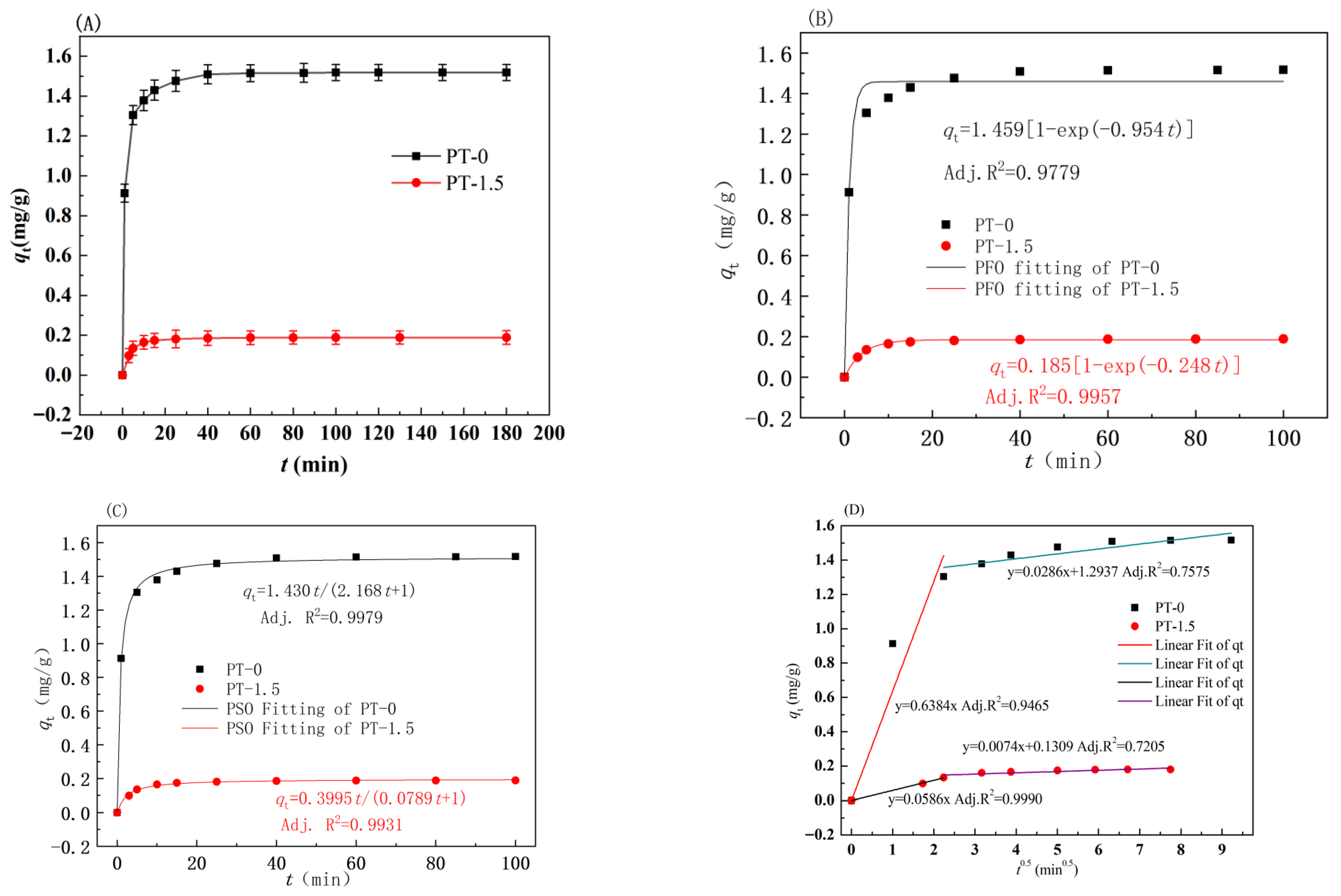
Figure 1A shows that the adsorption of MB by both membranes exhibited the fastest rate within the initial 10 min (the PT-0 reached an adsorption capacity of 1.37 ± 0.05 mg/g, accounting for 90.2% of the equilibrium amount; the PT-1.5 reached 0.17 ± 0.01 mg/g, accounting for 89.9% of the equilibrium amount), with an equilibrium time of 100 min for both (no significant change in adsorption capacity was observed when extended to 180 min; hence, 100 min was selected as the equilibrium time). The equilibrium adsorption capacity of the PT-0 membrane (1.518 ± 0.025 mg/g) was significantly higher than that of the PT-1.5 membrane (0.189 ± 0.008 mg/g), consistent with the photographs of the membranes after adsorbing MB (PT-0 appeared deep blue, and PT-1.5 appeared light blue; see Supplementary File S3, Figure S2). Among the common dyes, the anionic dye of methyl orange (MO, Mw = 327.33) and the cationic dye of MB (Mw = 319.85) have similar molecular weights. The adsorption capacity of MO by the PVDF composite membranes at 3 mg·L−1 of the initial concentration of MO was reported to be 3.5, 4.8, 2.2, and 4.7 mg·g−1 with 0, 0.13%, 13.33%, and 26.32% of TiO2 addition, respectively [36]. The 1-bromohexadecane-grafted glycidyl methacrylate PVDF membrane exhibited higher flux and could remove 99.25% of MB, 99.69% of MO, and 99.39% of neutral-red at the initial MB concentration of 100 mg·L−1 [37]. The possible reason is that the decrease in the active sites of the membranes resulted from the aggregation of inorganic nanoparticles or the interaction between inorganic nanoparticles and PVDF molecules, which prevented the adsorption of MO on the membranes [36,37]. The adsorption area of the PVDF/TiO2 membrane increased by 8.26%, according to the results calculated in Supplementary File S4. Assuming the adsorptive capacity of titanium dioxide for MB was negligible, the calculated equilibrium adsorption capacity of PVDF in the hybrid membrane was 0.20 mg·g−1. This value represents 13% of the actual equilibrium adsorption capacity of the pristine PVDF membrane, based on the mass ratio of PVDF to the hybrid membrane. Furthermore, it was observed that the adsorbed MB exhibited high stability within the membrane material and displayed resistance to desorption into water. This behavior underscores the strong binding affinity of MB to the membrane. There are adsorption activation sites within PVDF, which interact with MB molecules to a certain degree. The incorporation of nano-TiO2 into the membrane reduces the equilibrium adsorption capacity, suggesting that the nano-TiO2 particles may occupy the PVDF’s adsorption activation sites and inhibit the adsorption of MB on the membrane materials. Furthermore, the data suggest interactions between PVDF and TiO2. As detailed in Table S2 (Supplementary File S5), first-principles Molecular Dynamics (MD) calculations revealed interaction/binding energies between PVDF and TiO2, originating from electrostatic and van der Waals forces. These forces could also enhance the antifouling performance of novel hybrid membranes. The occupation of adsorption activation sites on the membranes by nanomaterials would reduce the irreversible adsorption of foulants.
Several kinetic models are typically employed to elucidate the governing mechanism of the adsorption process [38,39,40]. The pseudo-first-order (PFO) and pseudo-second-order (PSO) non-linear equations are often used to study the kinetic process and presented as Equation (1) and Equation (2), respectively [41,42,43]:
q t = q e · [ 1 exp ( k 1 · t ) ] ,
q t = q e 2 · k 2 · t [ k 2 · q e · t + 1 ] ,
where qe and qt are the amount of MB adsorbed (mg·g−1) at equilibrium and at t (min), respectively, k1 (min−1) is the adsorption rate constant of PFO adsorption, and k2(g·mg−1·min−1) is the correlation coefficient for the PSO kinetic equation.
The correlation coefficients for the PT-0 membrane, as determined in Figure 1B via the PFO kinetic model, are relatively low, with a significant deviation between the calculated qe(cal) and experimental qe(exp) values, as shown in Table 1. The adjusted R2 value of the PSO model for the PT-0 membrane (0.9979) was significantly higher than that of the PFO model (0.9779), and the calculated equilibrium adsorption capacity (qe,cal = 1.516 ± 0.009 mg/g) deviated from the experimental value (qe(exp) = 1.518 ± 0.025 mg/g) by only 0.1%. This indicates that the adsorption of MB onto the membrane may be governed by chemical processes, due to the negatively charged surface of the PVDF membrane [44]. For the PT-1.5 membrane, both the PFO and PSO models showed high adjusted R2 values (0.9957 and 0.9931, respectively), but the deviation between the qe,cal value of the PSO model (0.197 ± 0.003 mg/g) and the experimental value was smaller (4.2%). This indicates that the adsorption of MB on both membranes is controlled by the inter-molecular forces (such as the surface site binding caused by hydrophobic interactions [42]. Similar phenomena have been observed in the adsorption of MB on coir pith carbon [45], perlite [46], and wheat shells [47], as well as in dye adsorption on activated carbon [48,49]. The increase in the contact angle of PT-1.5 membrane was much higher than that of PT-0, which means more hydrophobicity and unfavorability for the adsorption of water-soluble substances, leading to lower a MB adsorption capacity than for the PT-0. At the same time, TiO2 in the surface of the membrane would interact with MB and PVDF, resulting in a different ratio of physical adsorption to chemical adsorption than that of PT-0 [50]. When the concentration of MB in the solution is constant, the adsorption process is controlled by the above factors; so, the adsorption process can be modeled by the PSO and PFO kinetic equations, and both have high correlation coefficients. The qe(cal) values obtained by the PSO model and PFO model are similar to the qe(exp) values of the PT-1.5 membrane.
The model for intra-particle diffusion is presented in Equation (3), serving to delineate the diffusion mechanism prevalent during the adsorption process [50].
q t = k p t 1 / 2 + M ,
where qt (mg·g−1) is the amount of MB adsorbed at time t (min), kp is the intra-particle diffusion rate constant (mg·g−1·h−0.5), and M is the intercept.
The intraparticle diffusion model fitting results (Figure 1D) indicate that the adsorption process can be divided into different stages: the transient surface adsorption of MB on the membrane surface (0–10 min) and the diffusion of MB into the membrane pores until adsorption equilibrium within the pores (10–100 min). The fitted curve is not a linear fit, indicating that intraparticle diffusion is not the sole rate-controlling step [51]. The suboptimal performance in the initial simulation of the PSO kinetic model and intra-particle diffusion model may be attributed to two factors: the excessively rapid adsorption rate of MB by the PT-0 membrane and the structural and performance differences between the PT-0 and PT-1.5 membranes that result in distinct interactions with the MB molecules.

3.2. Isotherm Adsorption

The Langmuir and Freundlich models are often used as isotherm adsorption models. The adsorption mechanisms of MB on the surfaces of PT-0 and PT-1.5 membranes are examined using the Langmuir and Freundlich isotherm models, represented as Equation (4) and Equation (5), respectively [39,40].
q e = Q 0 K L C e 1 + K L C e ,
q e = K f C e 1 / n ,
where, Q0 (mg·g−1) and KL (L·mg−1) are the Langmuir constants. Kf ((mg·g−1)(L·mg−1)1/n) and 1/n are the Freundlich constants. Figure S4 (Supplementary File S6) illustrates the isothermal adsorption of MB on both the PT-0 and PT-1.5 membranes at varying temperatures, while Table 2 displays the parameters derived from the isothermal models.
Figure S4 illustrates that as the MB concentration increases, the quantity of adsorbed MB molecules on the membrane surfaces also rises. This can be attributed to the increased driving force of the concentration gradient when the concentration of MB is elevated. Upon comparing the R2 values, it can be concluded that the Langmuir isotherm model provides a more accurate description of the adsorption behavior of MB on both PT-0 and PT-1.5 membranes. The Langmuir model fitting results (Figure S4A, Supplementary File S6) demonstrated that the maximum adsorption capacity (Q0 = 14.481 ± 3.994 mg/g) of the PT-0 membrane at 288 K (15 °C) was higher than that at 298 K (25 °C) (Q0 = 8.997 ± 0.284 mg/g). The active adsorption sites of the PT-0 membranes are more uniform than those of the PT-1.5 membranes, as indicated by the adj. R2 values. The PT-1.5 membrane exhibits a lower adsorption capacity than the neat PVDF membrane, suggesting that the incorporation of nano-TiO2 particles into the PVDF membrane diminishes the adsorption sites.
The FTIR analysis of both membranes is shown in Figure S5 (Supplementary File S7). The characteristic peak at 1186 cm−1 indicates the -CF2 stretching of PVDF [36,52]. The absorption peaks of the C=S stretching vibration (1730 cm−1) and the C=N stretching vibration in infrared absorption (1210 cm−1) all indicate the presence of the MB structure [53,54]. In the FTIR spectra of PT-0 MB and PT-1.5 MB, characteristic infrared peaks of C=N and C=S stretching vibration can be found, indicating that MB molecules are absorbed by both membranes. PT-0 and PT-0 MB have similar characteristics of peaks to PT-1.5 and PT-1.5 MB, respectively. No new peaks could be found in the FTIR diagram of the membranes before and after adsorption, indicating there is no chemical adsorption. It may be that the size exclusion effect of TiO2 will block the MB molecules into membrane pores and make the PVDF/TiO2 membrane have good anti-fouling performance [30].
The Dubinin–Radushrevich isotherm model provides insights into the adsorption mechanism and can be articulated as [55]:
ln X = ln X m K ε 2 ,
where X and Xm are the adsorption amount and adsorption capacity of MB adsorbed on adsorbent (g·g−1), respectively, K is the constant associated with the adsorption energy, C is the MB concentration at equilibrium (g·L−1), and R and T are the gas constant (kJ·K−1·mol−1) and the absolute temperature (K), respectively.
The average adsorption free energy (E) is employed to ascertain the type of adsorption and is represented as
E = 2 K 0.5 .
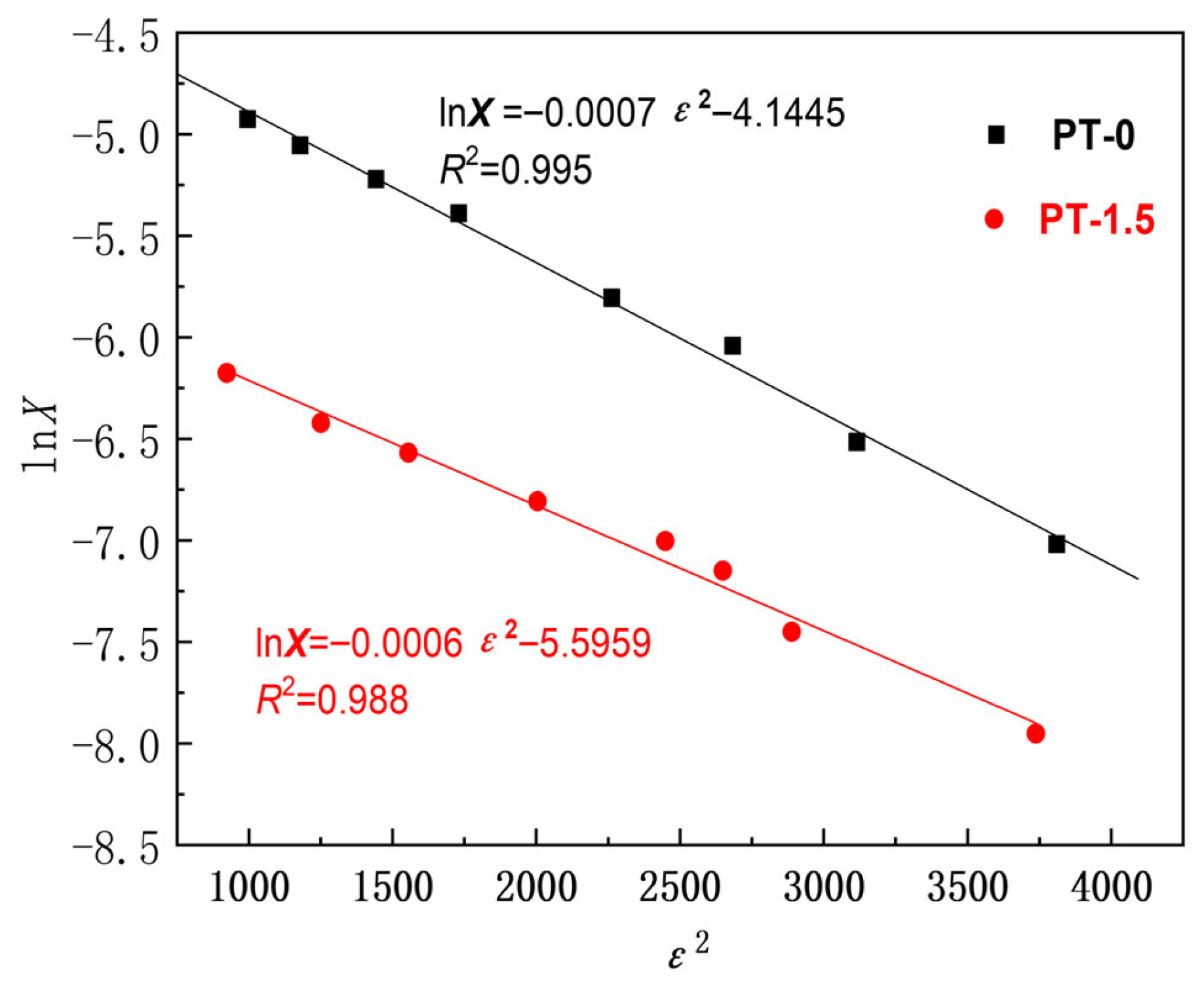
The graphical representation of lnX in relation to ε2 is depicted in Figure 2, with parameters such as K, Xm, and E, as detailed in Table 3. The adsorption free energy E (Table 3) calculated by the DR model in Figure 2 (PT-0: 26.73 ± 0.52 kJ/mol, PT-1.5: 28.87 ± 0.61 kJ/mol) exceeds the conventional physical adsorption threshold of E < 8 kJ/mol [56,57]. The organic membrane adsorbing dye molecules may be due to the H-bonding, π-π stacking interactions, electrostatic interactions, ionic interactions, hydrophobic interactions, van der Waals’s interactions, and pore-filling [58,59]. The adsorption mechanism is much more complex than the interpretation of the Dubinin–Radushrevich isotherm model.
The introduction of TiO2 reduces the adsorption capacity of the PT-1.5 membranes due to three factors: (1) the addition of TiO2 changes the selectivity of the PT-1.5 membrane on MB molecules [50]; (2) the presence of TiO2 decreases the membrane pore size from 75 nm (PT-0) to 65 nm (PT-1.5), increasing the diffusion resistance of MB (Supplementary File S2, Figure S1); (3) the interactions between the PVDF matrix and TiO2. could affect the diffusion, adsorption, and blocking behavior of MB molecules [58].

3.3. Effect of pH Values

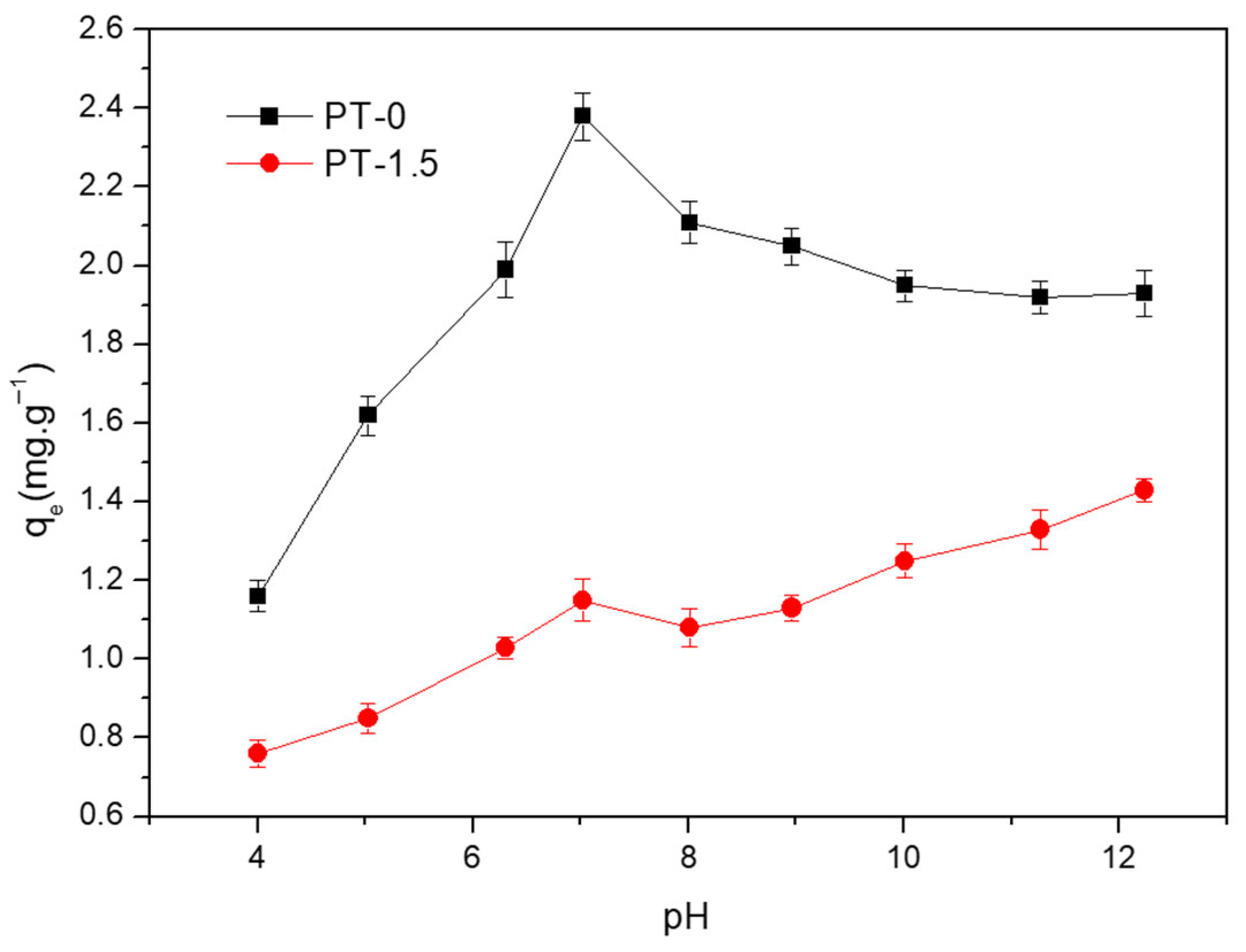
The pH value of the solution can affect the properties of the adsorbent and adsorbate, bringing about changes in the interactions between the adsorbent and adsorbate. Figure 3 shows that one peak of adsorption capacities for both membranes can be found at pH = 7, and the adsorption capacities of PT-1.5 are much less than that of PT-0. The adsorption capacity of the adsorbent varied with the pH value. It is reported that the pH can enhance or hinder the protonation process of dye and obtain different adsorption capacities [59]. When pH < 7, the high concentration of H+ in solution competed with MB+ for adsorption sites on the membrane surface, and the TiO2 underwent protonating, leading to a decreasing trend and difference in adsorption capacities; (2) when pH > 7, fewer MB molecules exist as the cation form of C16H18N3SCl+, which could be favorable to be absorb to the membrane. The deduction of these functions would lead to the MB+ undergoing hydrolysis to form neutral NOH groups (pKa = 7.2), reducing its hydrophobicity, while Ti-OH on the TiO2 surface converted to Ti-O, weakening the interaction with PVDF (zeta potential decreased from −8.2 mV to −15.6 mV shown in Supplementary File S8). However, the reduction in MB’s hydrophobicity dominated the change in the adsorption capacity of the PT-0 membrane, resulting in an overall decreasing trend [60]. The sustained increase in the adsorption capacity of the PT-1.5 membrane at pH values significantly above 8 is particularly noteworthy. The reasons should be studied further. The pH appears to modulate the electrostatic interactions between the PVDF or PVDF/titanium dioxide membranes and MB [61]. The reasons should be studied further. The results hint that it is better to undergo the adsorption or separation process under appropriate pH conditions.

3.4. Effect of Temperature

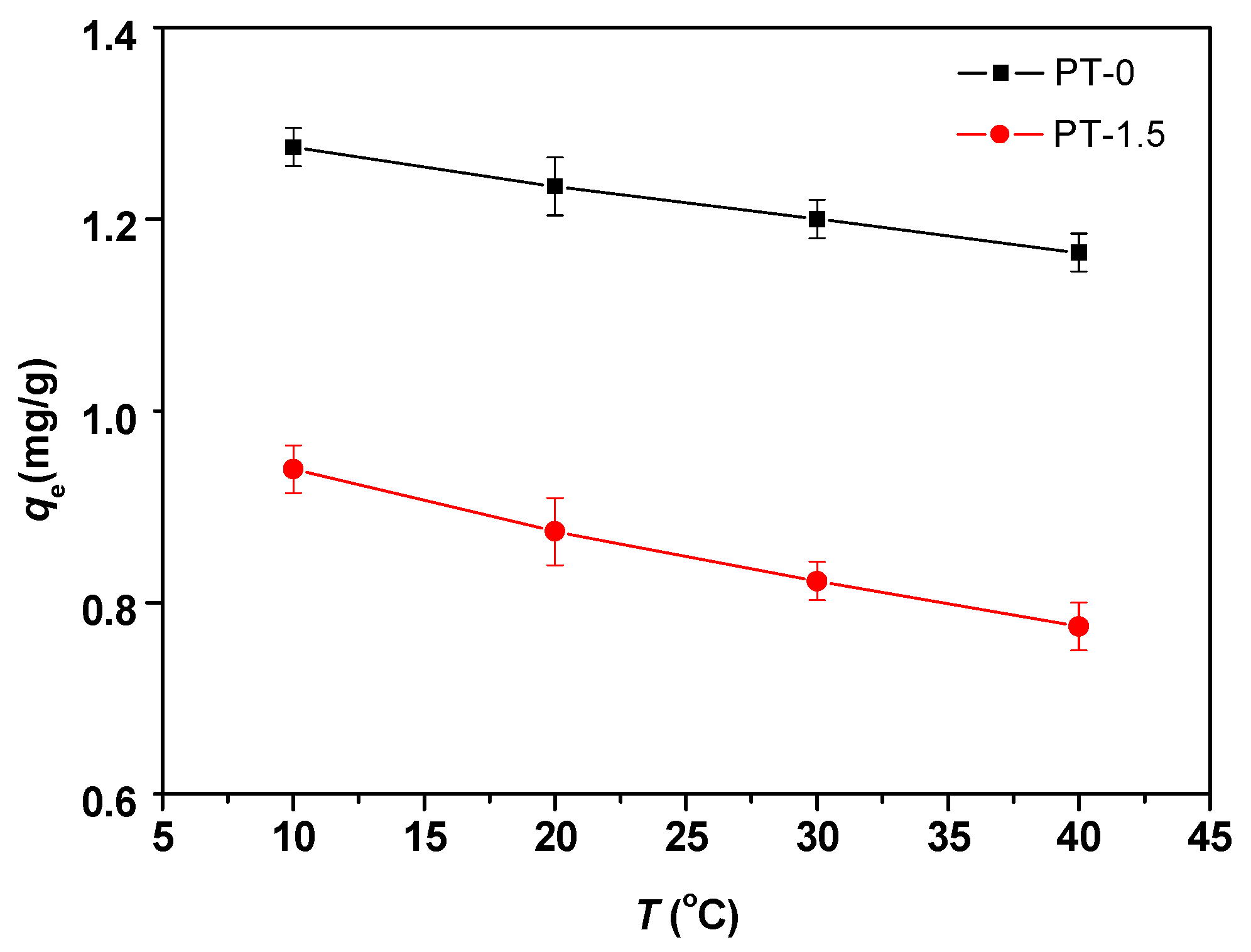
As depicted in Figure 4, a decrease in temperature elevates the equilibrium adsorption capacity. At higher temperatures, MB molecules exhibit increased mobility, enabling them to readily detach from the membrane pore surface.
The feasibility and favorability of adsorption are reflected in the thermodynamic parameters, including the free energy change (∆G), enthalpy change (∆H), and entropy change (∆S). These parameters can be estimated using Equation (8) (Supplementary File S9) [62,63,64].
lnKd = ∆S/R − ∆H/(RT)
The ∆G values are computed utilizing Equation (S4). The thermodynamic parameters’ values are displayed in Table 4. Negative ∆G values suggest that the adsorption process is both feasible and spontaneous under standard conditions.
The ∆H values for the PT-0 or PT-1.5 membranes at different temperatures are 188.0 kJ·mol−1 and 140.8 kJ·mol−1, respectively, indicating an endothermic adsorption process. These ∆H and ∆S values for both types of membranes surpass those reported for other adsorption processes. This could be attributed to the high porosity and large capillary pore structure of the membrane, which promotes capillary adsorption. The increased porosity and additional adsorption sites contribute to the superior adsorption capacity of the PT-0 membrane, thereby elevating ∆H and ∆S. However, when nano-TiO2 is dispersed within the membrane, the resulting decrease in membrane porosity and uniform pore size, coupled with the nano-TiO2 adsorption effect, reduces the adsorption capacity, leading to lower ∆H and ∆S values. The presence of potential surface hydroxyl groups and broken bonds elevates the atomic energy of the nanoparticle surface compared to that of internal atoms. This allows surface atoms of the particles to combine with other atoms, enhancing adsorption. The highly developed pore structure of the PT-0 membrane, characterized by its strong adsorption capacity and expansive surface area, facilitates comprehensive contact between the MB molecule and the capillary. This leads to the adsorption of the MB molecule by the fluorine atoms on the capillary wall due to their electronegativity. Once the MB molecule is adsorbed into the capillary, the mutual attraction between MB molecules attracts additional molecules until the capillary is saturated.
The ∆G values for both PT-0 and PT-1.5 membranes are negative, indicating that the adsorption process is thermodynamically favorable and spontaneous [63]. The temperature increase is beneficial to the spontaneity of the adsorption process, but according to the results of the adsorption experiment, the adsorption capacity is reduced at the same time. This could be attributed to the increased temperature of the solution enhancing the tendency of MB molecules to escape from the solid phase to the bulk liquid phase [63]. MB molecules are adsorbed on the surface of capillary pores of the membrane. The mobility of MB molecules is low at low temperature; so, the adsorption capacity is high. Generally, the ∆G for physisorption and chemisorption is between −20 ~ 0 kJ/mol and −80 ~ −400 kJ/mol, respectively [65,66]. The ∆G of the MB adsorption on either PT-0 or PT-1.5 membranes falls within the range of −30 to −15 kJ·mol−1, suggesting that the adsorption process is strong physical adsorption, which is consistent with the results of the DR model [66].

3.5. Dynamic MB Adsorption in a Cross-Flow Filtration

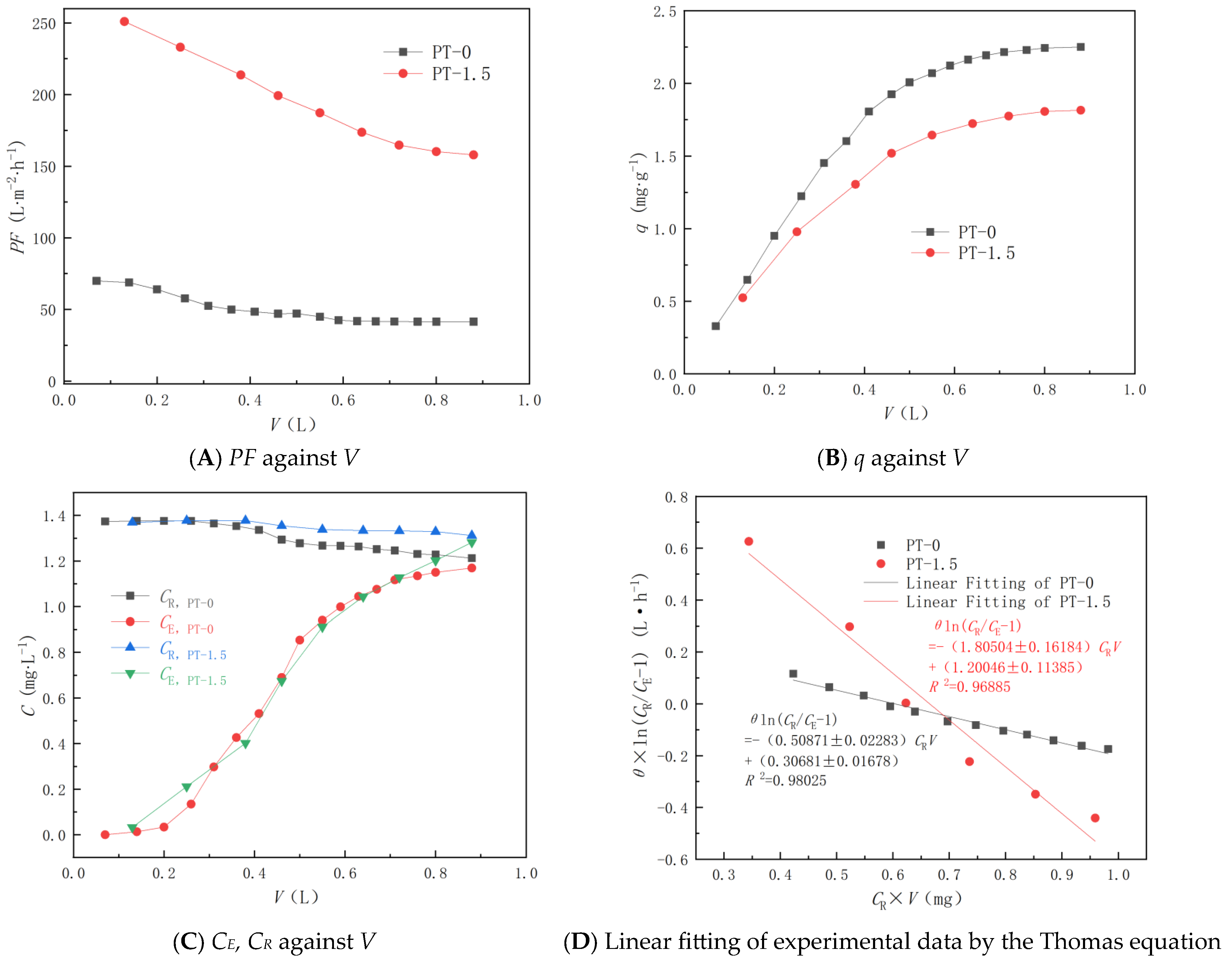
Figure 5 depicts the changes in filtrate concentration (CE), retentate concentration (CR), permeate flux (PF), and adsorption capacity (q), as they relate to the permeate volume (V) for two membrane samples during the filtration experiment of an MB solution under a trans-membrane pressure of 0.1 MPa.
Figure 5A demonstrates that the permeation flux of the PT-1.5 membrane surpasses that of the PT-0 membrane under equivalent operational trans-membrane pressure. This superior performance is attributed to the enhanced hydrophilicity and anti-compaction capabilities [30]. As filtration progresses, the adsorption of additional MB molecules obstructs membrane pore channels, consequently diminishing the permeation flux. For the PT-0 membrane, the MB fouling layer forms, and the pure water flux becomes stable much faster than PT-1.5 does before the water flux is measured. Hence, the water flux of PT-1.5 decreases faster than that of PT-0. With the increase in the residence time, more MB molecules will diffuse to the membrane surface to form a contamination layer and block the membrane pores until the thickness of the contamination layer remains unchanged. Figure 5B illustrates that MB adsorption capacity escalates in tandem with the permeate volume, with the PT-0 membrane exhibiting superior adsorption capacity compared to the PT-1.5 membrane. This is due to the PT-0 membrane offering a larger number of active adsorption sites. Consequently, as filtration continues, more MB molecules are retained at the PVDF adsorption sites, thereby augmenting the MB adsorption capacity. Figure 5C depicts a gradual reduction in CR over time, attributable to the dilution of the recycled permeate solution. The CR for the PT-0 membrane declines more rapidly, reflecting its enhanced adsorption capacity. Furthermore, the CE for both membranes escalates with an increase in the permeate volume. The relationship between CE and V resembles an S-curve, akin to a breakthrough curve observed in column adsorption experiments, and the data can be analyzed using the linear form of the Thomas equation [67].
θ   l n ( C R C E 1 ) = k T q T m k T C R V ,
where CR and CE are the retentate concentration and the permeate concentration (mg·L−1), respectively, kT is the rate constant (L·mg−1·h−1), θ is the filtration rate (L·h−1), qT is the total adsorption capacity (mg·g−1), V is the permeate volume (L), and m is the mass of the membrane (g).The height of the mass transfer zone (hZ) can be calculated by the following equation [68].
h Z = H V E V B V E 1 f V E V B ,
where H is the membrane thickness (cm), and f is the fraction of membrane still able to remove MB. The f can be defined as
f = 0 1 1 C C R d V V B V E V B = V B V E C R C d V C R ( V E V B ) ,
where VB is the permeate volume at breakthrough point(L), and the other variables have been defined previously.
Figure 5D illustrates the linear fit of the experimental data, specifically utilizing the data from between the breakthrough point at CE = 5% CR and the exhaustion point at CE = 95% CR, to the Thomas equation. The PT-0 membrane exhibits a sharper breakthrough S-curve due to its shorter hZ in filtration and decreasing filtration velocity. Conversely, the curve for the PT-1.5 membrane is less pronounced, as the membrane’s thickness is less than the hZ in filtration. The PT-1.5 membrane displays a higher kT value, suggesting that the mass transport resistance within the membrane is reduced. This can be attributed to the enhanced hydrophilicity of the membrane pore surface facilitated by nano-TiO2.
The adsorption capacity of MB in the PT-0 membrane is notably higher than that of the PT-1.5 membrane, a finding that aligns with the outcomes of the previously discussed batch adsorption. The cross-flow filtration process demonstrates a superior MB adsorption capacity compared to the batch adsorption process. This enhancement can be attributed to the operative pressure on the permeation flow, which aids in the mass transfer process of MB molecules, thereby enabling their ready diffusion to the inner pore surface of the membrane. Hence, although PT-0 membrane has higher porosity and lower CA than the PT-1.5 membrane, its flux is much lower than that of PT-1.5 because less MB is adsorbed on the PT-1.5 membrane surface, which blocks the pores. Furthermore, the experiment suggests that the incorporation of TiO2 can mitigate membrane fouling due to adsorption. Compared with the adsorption capacity of composite membranes in the other studies (Table S3 in Supplementary File S10), the adsorption capacity of the PVDF/TiO2 membrane is much lower, which has good antifouling properties and indicates the prospective applications of these PVDF/TiO2 composite membranes in the purification of dye wastewater.

3.6. Proposed Adsorption Mechanism

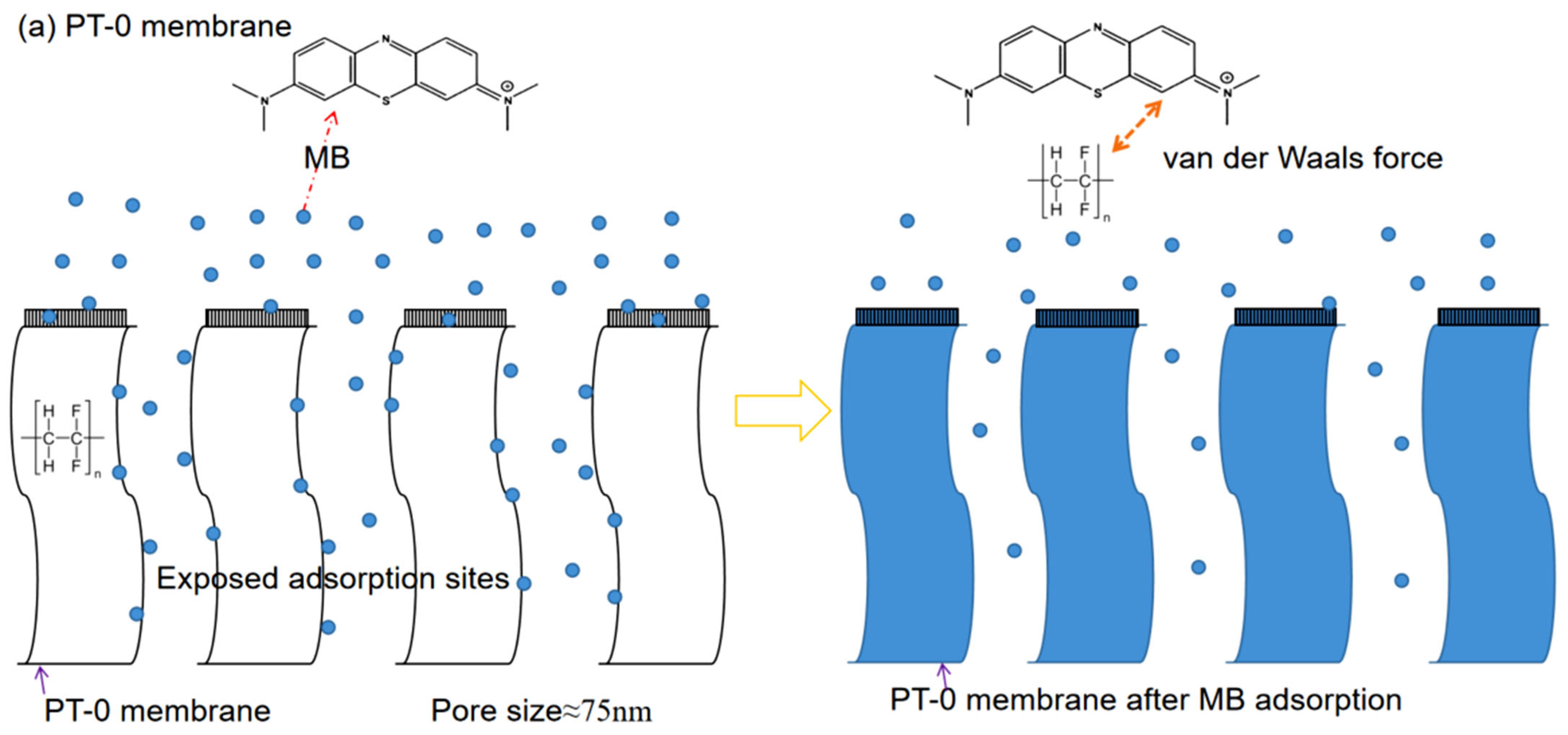
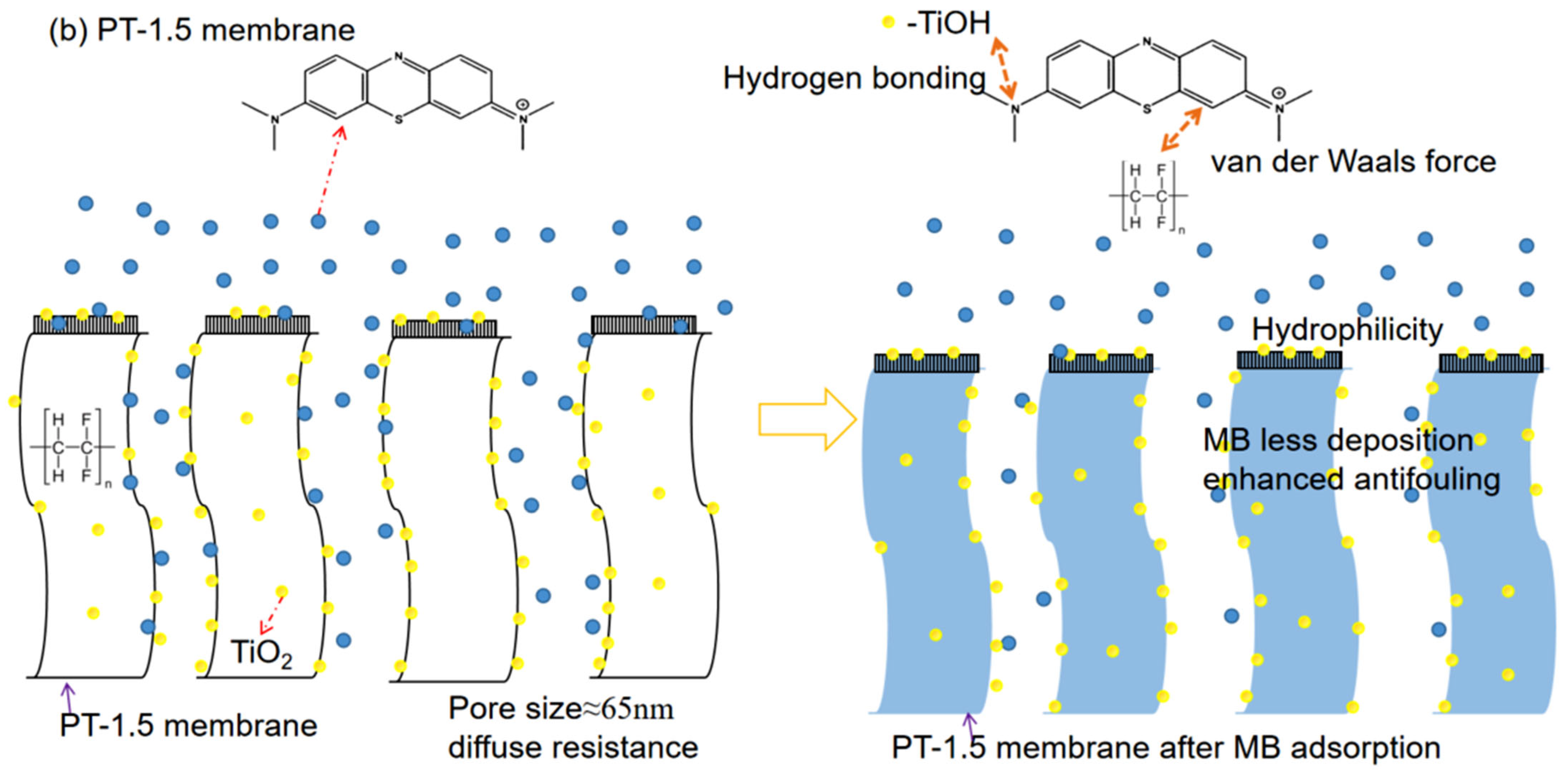
Based on the aforementioned results, the adsorption mechanism of MB on the PVDF substrate membrane is illustrated in Figure 6. For the neat PVDF membrane (PT-0), the hydrophobic aromatic rings of MB interact with the PVDF through van der Waals forces. The high porosity of the membrane (58.8 ± 0.6%) provides abundant adsorption sites, enabling monolayer adsorption of MB within the pores. For the PVDF/TiO2 membrane (PT-1.5), TiO2 interacts with functional groups of PVDF, occupying some adsorption sites. Additionally, the presence of TiO2 reduces the membrane pore size and increases the diffusion resistance of MB, leading to decreased adsorption capacity. However, the addition of TiO2 enhances the preferential adsorption of the membrane, reducing MB deposition on its surface and the behavior of the dye molecular through the membrane pores. Anti-fouling performance tests (Figure S7, Supplementary File S11) demonstrate that the irreversible fouling ratio of the PT-1.5 membrane (27.8%) is lower than that of the PT-0 membrane (35.3%), while the flux recovery rate of PT-1.5 (72.2%) exceeds that of PT-0 (64.7%). These results confirm that the incorporation of TiO2 effectively mitigates the membrane fouling caused by adsorption.

4. Conclusions

A low temperature, high initial MB concentration, and neutral pH (pH = 7) favor the adsorption of MB by PVDF-based membranes. The equilibrium adsorption capacity of the neat PVDF membrane (1.518 ± 0.025 mg/g) is significantly higher than that of the PVDF/TiO2 membrane (0.189 ± 0.008 mg/g).
The adsorption of MB on both membranes conforms to the pseudo-second-order kinetic model and Langmuir isotherm model. TiO2 reduces the adsorption capacity of the hybrid membrane by changing the PVDF hybrid membranes properties and decreasing the membrane pore size.
Under cross-flow filtration conditions (0.1 MPa), enhanced mass transfer increases the adsorption capacities of both membranes by (15–20)% compared to batch experiments. The neat PVDF membrane exhibits a higher mass transfer zone height (2.3 ± 0.1 cm) and adsorption capacity (2.1 ± 0.09 mg/g), while the PVDF/TiO2 membrane demonstrates superior antifouling properties (irreversible fouling rate: 18 ± 1.5%).
PVDF-based membranes can treat dye wastewater through a combined process of “adsorptive enrichment of MB followed by subsequent oxidative degradation”. The neat PVDF membrane is suitable for the rapid adsorption of wastewater with high MB concentrations, whereas the PVDF/TiO2 membrane is ideal for scenarios requiring long-term operation and high antifouling performance. Future research should focus on MB desorption and membrane regeneration technologies to enable membrane recycling.

Supplementary Materials

The following supporting information can be downloaded at https://www.mdpi.com/article/10.3390/polym18020233/s1, Figure S1: Schematic diagram of UF cross flow filtration experimental setup; Figure S2: Pictures of PT-0 and PT-1.5 after adsorption of MB; Figure S3: Structure of PVDF, TiO2 and TiO2 /PVDF composite; Figure S4: Isothermal adsorption of MB on PT-0 membrane and PT-1.5 hybrid membrane at different temperatures and modelled by of Langmuir isotherm (A) and Freundlich isotherm(B); Figure S5: Normolized FTIR spectra of membranes before and after adsorption of MB; Figure S6: Zeta potential of PT-0 and PT-1.5 hybrid membrane at different pH; Figure S7: Different filtration resistance of PT-0 and PT-1.5 membranes for BSA solution; Table S1: The parameters about neat PVDF (PT-0) and PVDF/TiO2 (PT-1.5) membranes; Table S2: System energy for PVDF, TiO2 and TiO2/PVDF composite models, van der Waals and electrostatic and interaction energies obtained after geometry optimization; Table S3: The adsorption capacity of dyes including MB in the present works.

Author Contributions

Y.M. and F.S.: Conceptualization, methodology, writing—original draft. Y.M. and F.S.: Investigation, sampling, and reviewing and editing. Y.M., F.S., B.F., S.M., H.L., C.L., J.M. and W.J.: Investigation, sampling, and experimental and data analysis. All authors have read and agreed to the published version of the manuscript.

Funding

This work was supported by the National Natural Scientific Foundation of China (U21A20162), the Basic Research Project of Scientific Research Funds for Universities in Heilongjiang Province (2024-KYYWF-0098), the Heilongjiang Province Science and Technology Research Project (2022ZXJ08B02), and the National undergraduate innovation and entrepreneurship training program (202510212171S, 202410212095S).

Institutional Review Board Statement

Not applicable.

Data Availability Statement

All data generated or analyzed during this study are included in this published article.

Conflicts of Interest

Authors Jin Ma Wei Jiang and Yuxin Ma were employed by the company Research and Development Centre, Shandong Aisen Water Industry Co., Ltd. The remaining authors declare that the research was conducted in the absence of any commercial or financial relationships that could be construed as a potential conflict of interest.

Abbreviations and Nomenclatures

The following abbreviations and nomenclatures are used in this manuscript:
Abbreviation
PVDFpolyvinylidene fluoride
MBmethylene blue
UVultraviolet
TIPSthermally induced phase separation
DMPdimethyl phthalate
MOmethyl orange
UVultraviolet
PFOpseudo-first-order
PSOpseudo-second-order
PT-0 neat PVDF membrane
PT-1.5 PVDF/TiO2 (28.5/1.5) membrane
PFpermeate flow
Nomenclatures
bLangmuir isotherm constant, L/mg
Cthe effluent MB concentration, mg/L (g/L for DR equation)
C0the initial MB concentration or the influent MB concentration (column), mg/L
CBthe effluent MB concentration at the breakthrough point, mg/L
CEthe effluent MB concentration at the exhaustion point, mg/L
Cethe MB concentration at equilibrium or the effluent MB concentration (column), mg/L
Ethe mean free energy of adsorption, kJ/mol
fa parameter measuring the symmetry of the breakthrough curve
F0flow rate of MB solution, mL/min
Hthe bed depth, cm
hZthe height of the mass transfer zone, cm
Kthe constant of the DR equation related to the adsorption energy
kF, nFreundlich isotherm constant
KR, aR, βRedlich–Peterson isotherm constant
kTthe rate constant of the Thomas model, L·mg–1·h–1
k1the adsorption rate constant of first–order adsorption, L/min
k2the rate constant of pseudo-second-order chemisorption, g/(mg·min).
mthe adsorbent dosage or the mass of the sorbent, g
Mwmolecular weight
qBthe capacity at the breakthrough point, mg/g
qEthe capacity at the exhaustion point, mg/g
qethe amounts of MB adsorbed at equilibrium, mg/g
qtthe amounts of MB adsorbed at time t (min), mg/g
qTthe total sorption capacity, mg/g
Qthe MB adsorbed, mg/g
Q0Langmuir constant related to the capacity and energy of adsorption, mg/g
Rthe gas constant, kJ/(K·mol)
Tthe temperature, K
Vthe solution volume or the effluent volume (column), L
VBthe volume of solution passed up to the breakthrough point, L
VEthe volume of solution passed up to the exhaustion point, L
Xthe amount of MB adsorbed per unit weight of adsorbent, g/g
Xmthe adsorption capacity per unit weight of adsorbent, g/g
θthe flow rate, L/h
εPolanyi potential = RTln(1 + (1/C))

References

  1. Forgacs, E.; Cserhati, T.; Oros, G. Removal of Synthetic Dyes from Wastewaters: A Review. Environ. Int. 2004, 30, 953–971. [Google Scholar] [CrossRef] [PubMed]
  2. Dutta, D.; Arya, S.; Kumar, S. Industrial Wastewater Treatment: Current Trends, Bottlenecks, and Best Practices. Chemosphere 2021, 28, 131245. [Google Scholar] [CrossRef] [PubMed]
  3. Pang, J.; Fu, F.; Ding, Z.; Lu, J.; Li, N.; Tang, B. Adsorption Behaviors of Methylene Blue from Aqueous Solution on Mesoporous Birnessite. J. Taiwan Inst. Chem. Eng. 2017, 77, 168–176. [Google Scholar] [CrossRef]
  4. Solayman, H.M.; Hossen, M.A.; Aziz, A.A.; Yahya, N.Y.; Leong, K.H.; Sim, L.C.; Monir, M.U.; Zoh, K.-D. Performance Evaluation of Dye Wastewater Treatment Technologies: A Review. J. Environ. Chem. Eng. 2023, 11, 109610. [Google Scholar] [CrossRef]
  5. Lu, K.; Wang, T.; Zhai, L.; Wu, W.; Dong, S.; Gao, S.; Mao, L. Adsorption Behavior and Mechanism of Fe-Mn Binary Oxide Nanoparticles: Adsorption of Methylene Blue. J. Colloid Interface Sci. 2019, 539, 553–562. [Google Scholar] [CrossRef]
  6. Zhao, C.; Zheng, H.; Sun, Y.; Zhang, S.; Liang, J.; Liu, Y.; An, Y. Evaluation of a Novel Dextran-Based Flocculant on Treatment of Dye Wastewater: Effect of Kaolin Particles. Sci. Total Environ. 2018, 640, 243–254. [Google Scholar] [CrossRef]
  7. Ertas, M.B.; Acemioğlu, B.; Alma, M.H.; Usta, M. Removal of Methylene Blue from Aqueous Solution Using Cotton Stalk, Cotton Waste, and Cotton Dust. J. Hazard. Mater. 2010, 183, 421–427. [Google Scholar] [CrossRef]
  8. Deng, H.; Lu, J.; Li, G.; Zhang, G.; Wang, X. Adsorption of Methylene Blue on Adsorbent Materials Produced from Cotton Stalk. Chem. Eng. J. 2011, 172, 326–334. [Google Scholar] [CrossRef]
  9. Vilar, V.J.P.; Botelho, C.M.S.; Boaventura, R.A.R. Methylene Blue Adsorption by Algal Biomass-Based Materials: Biosorbents Characterization and Process Behavior. J. Hazard. Mater. 2007, 147, 120–132. [Google Scholar] [CrossRef]
  10. Omwoyo, F.O.; Otieno, G. Optimization of Methylene Blue Dye Adsorption onto Coconut Husk Cellulose Using Response Surface Methodology: Adsorption Kinetics, Isotherms, and Reusability Studies. J. Mater. Sci. Chem. Eng. 2024, 12, 1–18. [Google Scholar] [CrossRef]
  11. Li, P.; Su, Y.; Hu, Z.; Zheng, Y.; Zhou, Q.; Ouyang, X. Adsorption of Methylene Blue by Bismuth Impregnated Biochar of Different Biomass Materials: Pore Structure and Surface Chemistry Characteristics. J. Chem. Technol. Biotechnol. 2022, 97, 2871–2880. [Google Scholar] [CrossRef]
  12. Yao, Y.; Xu, F.; Chen, M.; Xu, Z.; Zhu, Z. Adsorption Behavior of Methylene Blue on Carbon Nanotubes. Bioresour. Technol. 2010, 101, 3040–3046. [Google Scholar] [CrossRef] [PubMed]
  13. Weng, C.-H.; Pan, Y.-F. Adsorption of a Cationic Dye (Methylene Blue) onto Spent Activated Clay. J. Hazard. Mater. 2007, 144, 355–362. [Google Scholar] [CrossRef] [PubMed]
  14. Liu, S.; Zhang, Y.; Ma, R.; Wang, X.; Li, J. A New Method to Prepare Mesoporous Silica from Coal Gasification Fine Slag and Its Application in Methylene Blue Adsorption. J. Clean. Prod. 2019, 212, 1062–1071. [Google Scholar] [CrossRef]
  15. Zhao, X.; Chen, X.; Ai, W.; Wei, C. Preparation of Titanium Peroxide and Its Selective Adsorption Property on Cationic Dyes. Appl. Surf. Sci. 2014, 292, 576–582. [Google Scholar] [CrossRef]
  16. Hameed, B.H.; Ahmad, A.L.; Latiff, K.N.A. Adsorption of Basic Dye (Methylene Blue) onto Activated Carbon Prepared from Rattan Sawdust. Dyes Pigments 2007, 75, 143–149. [Google Scholar] [CrossRef]
  17. Vargas, A.M.M.; Cazetta, A.L.; Kunita, M.H.; Silva, T.L.; Almeida, V.C. Adsorption of Methylene Blue on Activated Carbon Produced from Flamboyant Pods (Delonix regia): Study of Adsorption Isotherms and Kinetic Models. Chem. Eng. J. 2011, 168, 722–730. [Google Scholar] [CrossRef]
  18. Theyda, S.K.; Ahmed, M.J. Adsorption of Methylene Blue onto Biomass-Based Activated Carbon by FeCl3 Activation: Equilibrium, Kinetics, and Thermodynamic Studies. J. Anal. Appl. Pyrolysis 2012, 97, 116–122. [Google Scholar] [CrossRef]
  19. Yener, J.; Kopac, T.; Dogu, G.; Dogu, T. Dynamic Analysis of Sorption of Methylene Blue Dye on Granular and Powdered Activated Carbon. Chem. Eng. J. 2008, 144, 400–406. [Google Scholar] [CrossRef]
  20. Yang, J.; Qiu, K. Preparation of Activated Carbons from Walnut Shells via Vacuum Chemical Activation and Their Application for Methylene Blue Removal. Chem. Eng. J. 2010, 165, 209–217. [Google Scholar] [CrossRef]
  21. Zangeneh, Z.; Mohammadi, T.; Zarghami, S.; Tofighy, M.A. Fabrication Optimization of Polyethersulfone Adsorptive Mixed Matrix Membrane for Enhanced Dynamic Methylene Blue Removal: Response Surface Methodology Approach. Polym. Eng. Sci. 2024, 64, 1858–1876. [Google Scholar] [CrossRef]
  22. Liu, F.; Teng, S.; Song, R.; Wang, S. Adsorption of Methylene Blue on Anaerobic Granular Sludge: Effect of Functional Groups. Desalination 2010, 263, 11–17. [Google Scholar] [CrossRef]
  23. Yuan, X.; Zhuo, S.P.; Xing, W.; Cui, H.Y.; Dai, X.D.; Liu, X.M.; Yan, Z.F. Aqueous Dye Adsorption on Ordered Mesoporous Carbons. J. Colloid Interface Sci. 2007, 310, 83–89. [Google Scholar] [CrossRef] [PubMed]
  24. Song, Y.; Duan, Y.; Zhou, L. Multi-Carboxylic Magnetic Gel from Hyperbranched Polyglycerol Formed by Thiol-ene Photopolymerization for Efficient and Selective Adsorption of Methylene Blue and Methyl Violet Dyes. J. Colloid Interface Sci. 2018, 529, 139–149. [Google Scholar] [PubMed]
  25. Luo, Y.; Guo, W.; Ngo, H.H.; Nghiem, L.D.; Hai, F.I.; Zhang, J.; Liang, S.; Wang, X.C. A Review on the Occurrence of Micropollutants in the Aquatic Environment and Their Fate and Removal During Wastewater Treatment. Sci. Total Environ. 2014, 473–474, 619–641. [Google Scholar] [CrossRef]
  26. Choi, J.; Lee, H.; Choi, Y.; Kim, S.; Lee, S.; Lee, S.; Choi, W.; Lee, J. Heterogeneous Photocatalytic Treatment of Pharmaceutical Micropollutants: Effects of Wastewater Effluent Matrix and Catalyst Modifications. Appl. Catal. B 2014, 147, 8–16. [Google Scholar] [CrossRef]
  27. Lakshmi, S.; Renganathan, R.; Fujita, S. Study on TiO2-Mediated Photocatalytic Degradation of Methylene Blue. J. Photochem. Photobiol. A 1995, 88, 163–167. [Google Scholar] [CrossRef]
  28. Tayade, R.J.; Surolia, P.K.; Kulkarni, R.G.; Jasra, R.V. Photocatalytic Degradation of Dyes and Organic Contaminants in Water Using Nanocrystalline Anatase and Rutile TiO2. Sci. Technol. Adv. Mater. 2007, 8, 455–462. [Google Scholar] [CrossRef]
  29. Yu, Z.; Chuang, S.S.C. The Effect of Pt on the Photocatalytic Degradation Pathway of Methylene Blue over TiO2under Ambient Conditions. Appl. Catal. B 2008, 83, 277–285. [Google Scholar]
  30. Ngang, H.P.; Ooi, B.S.; Ahmad, A.L.; Lai, S.O. Preparation of PVDF-TiO2Mixed-Matrix Membrane and Its Evaluation on Dye Adsorption and UV-Cleaning Properties. Chem. Eng. J. 2012, 197, 359–367. [Google Scholar] [CrossRef]
  31. Chin, S.S.; Chiang, K.; Fane, A.G. The Stability of Polymeric Membranes in a TiO2 Photocatalysis Process. J. Membr. Sci. 2006, 275, 202–211. [Google Scholar] [CrossRef]
  32. Dzinun, H.; Othman, M.H.D.; Ismail, A.F.; Puteh, M.H.; Rahman, M.A.; Jaafar, J. Morphological Study of Co-Extruded Dual-Layer Hollow Fiber Membranes Incorporated with Different TiO2 Loadings. J. Membr. Sci. 2015, 479, 123–131. [Google Scholar] [CrossRef]
  33. Paredes, L.; Murgolo, S.; Dzinun, H.; Othman, M.H.D.; Ismail, A.F.; Carballa, M.; Mascolo, G. Application of Immobilized TiO2 on PVDF Dual Layer Hollow Fibre Membrane to Improve the Photocatalytic Removal of Pharmaceuticals in Different Water Matrices. Appl. Catal. B 2019, 240, 9–18. [Google Scholar] [CrossRef]
  34. Shi, F.; Ma, Y.; Ma, J.; Wang, P.; Sun, W. Preparation and Characterization of PVDF/TiO2 Hybrid Membranes with Different Content of Nano-TiO2. J. Membr. Sci. 2012, 389, 522–531. [Google Scholar] [CrossRef]
  35. Ma, Y.; Shi, F.; Ma, J.; Wu, M.; Zhang, J.; Gao, C. Effect of PEG Additive on the Morphology and Performance of Polysulfone Ultrafiltration Membranes. Desalination 2011, 272, 51–58. [Google Scholar] [CrossRef]
  36. Wang, J.; Pi, H.; Zhao, P.; Zhou, N. Efficient Removal of Methyl Orange and Ciprofloxacin by Reusable Eu–TiO2/PVDF Membranes with Adsorption and Photocatalysis Methods. RSC Adv. 2024, 14, 18432. [Google Scholar] [CrossRef]
  37. Patel, R.V.; Chaubey, S.; Yadav, A.; Vyas, B.G.; Shahi, V.K. Carbon Chain Grafted Polyvinylidene Fluoride Membranes for Textile Water Remediation: Experimental and Computational Studies. Chem. Eng. J. 2025, 509, 160965. [Google Scholar] [CrossRef]
  38. Pelekani, C.; Snoeyink, V.L. Competitive Adsorption Between Atrazine and Methylene Blue on Activated Carbon: The Importance of Pore Size Distribution. Carbon 2000, 38, 1423–1436. [Google Scholar] [CrossRef]
  39. Langmuir, I. The Constitution and Fundamental Properties of Solids and Liquids. J. Am. Chem. Soc. 1916, 38, 2221–2295. [Google Scholar] [CrossRef]
  40. Freundlich, H.M.F. Über die Adsorption in Lösungen. Z. Phys. Chem. 1906, 57, 385–470. [Google Scholar] [CrossRef]
  41. Ogino, C.; Dadjour, M.F.; Iida, Y.; Shimizu, N. Decolorization of Methylene Blue in Aqueous Suspensions of Titanium Peroxide. J. Hazard. Mater. 2008, 153, 551–556. [Google Scholar] [CrossRef] [PubMed]
  42. Ho, Y.S.; McKay, G. Pseudo-Second Order Model for Sorption Processes. Process Biochem. 1999, 34, 451–465. [Google Scholar] [CrossRef]
  43. Lima, E.C.; Sher, F.; Guleria, A.; Saeb, M.R.; Anastopoulos, I.; Tran, H.N.; Hosseini-Bandegharaei, A. Is One Performing the Treatment Data of Adsorption Kinetics Correctly? J. Environ. Chem. Eng. 2021, 9, 104813. [Google Scholar] [CrossRef]
  44. Zhu, W.; Jiang, X.; Jiang, K.; Liu, F.; You, F.; Yao, C. Fabrication of Reusable Carboxymethyl Cellulose/Graphene Oxide Composite Aerogel with Large Surface Area for Adsorption of Methylene Blue. Nanomaterials 2021, 11, 1609. [Google Scholar] [CrossRef]
  45. Kavitha, D.; Namasivayam, C. Experimental and Kinetic Studies on Methylene Blue Adsorption by Coir Pith Carbon. Bioresour. Technol. 2007, 98, 14–21. [Google Scholar] [CrossRef]
  46. Doğan, M.; Alkan, M.; Türkyilmaz, A.; Özdemir, Y. Kinetics and Mechanism of Removal of Methylene Blue by Adsorption onto Perlite. J. Hazard. Mater. 2004, 109, 141–148. [Google Scholar] [CrossRef]
  47. Bulut, Y.; Aydın, H. A Kinetics and Thermodynamics Study of Methylene Blue Adsorption on Wheat Shells. Desalination 2006, 194, 259–267. [Google Scholar] [CrossRef]
  48. Malik, P.K. Dye Removal from Wastewater Using Activated Carbon Developed from Sawdust: Adsorption Equilibrium and Kinetics. J. Hazard. Mater. 2004, 113, 81–88. [Google Scholar] [CrossRef]
  49. Namasivayam, C.; Kavitha, D. Removal of Congo Red from Water by Adsorption onto Activated Carbon Prepared from Coir Pith, an Agricultural Solid Waste. Dyes Pigments 2002, 54, 47–58. [Google Scholar] [CrossRef]
  50. Ma, T.; Chang, P.R.; Zheng, P.; Zhao, F.; Ma, X. Fabrication of Ultra-Light Graphene-Based Gels and Their Adsorption of Methylene Blue. Chem. Eng. J. 2014, 240, 595–600. [Google Scholar] [CrossRef]
  51. Simonetti, E.A.N.; Cividanes, L.S.; Campos, T.M.B.; Menezes, B.R.C.; Brito, F.S.; Thim, G.P. Carbon and TiO2 Synergistic Effect on Methylene Blue Adsorption. Mater. Chem. Phys. 2016, 177, 330–338. [Google Scholar] [CrossRef]
  52. Sueraya, A.Z.; Rahman, M.R.; Said, K.A.B.; Namakka, M.; Kanakaraju, D.; Al-Humaidi, J.Y.; Al-Baqami, S.M.; Rahman, M.M.; Khandaker, M.U. Impact of Titanium Dioxide/Graphene in Polyvinylidene Fluoride Nanocomposite Membrane to Intensify Methylene Blue Dye Removal, Antifouling Performance, and Reusability. J. Appl. Polym. Sci. 2024, 141, e56257. [Google Scholar] [CrossRef]
  53. Chen, J.Y.; Peng, Q.; Jodl, H.-J. Infrared Spectral Comparison of 5-Aminolevulinic Acid and Its Hexyl Ester. Spectrochim. Acta Part A 2003, 59, 2571–2576. [Google Scholar] [CrossRef] [PubMed]
  54. Bangari, R.S.; Yadav, A.; Bharadwaj, J.; Sinha, N. Boron Nitride Nanosheets Incorporated Polyvinylidene Fluoride Mixed Matrix Membranes for Removal of Methylene Blue from Aqueous Stream. J. Environ. Chem. Eng. 2022, 10, 107052. [Google Scholar] [CrossRef]
  55. Qadeer, R.; Hanif, J.; Khan, M.; Salem, M. Uptake of Uranium Ions by Molecular-Sieve. Radiochim. Acta 1995, 68, 197–201. [Google Scholar] [CrossRef]
  56. Chen, A.-H.; Chen, S.-M. Biosorption of azo dyes from aqueous solution by glutaraldehyde-crosslinked chitosans. J. Hazard. Mater. 2009, 172, 1111–1121. [Google Scholar] [CrossRef]
  57. Rouquerol, F.; Rouquerol, J.; Sing, K.; Llewellyn, P.; Maurin, G. Adsorption by Powders and Porous Solids; Academic Press: San Diego, CA, USA, 2012. [Google Scholar]
  58. Varol, H.S.; Kaya, D.; Contini, E.; Gualandi, C.; Genovese, D. Fluorescence methods to probe mass transport and sensing in solid-state nanoporous membranes. Mater. Adv. 2024, 5, 8351–8383. [Google Scholar] [CrossRef]
  59. Dissanayake, N.S.L.; Pathirana, M.A.; Wanasekara, N.D.; Mahltig, B.; Nandasiri, G.K. Removal of Methylene Blue and Congo Red Using a Chitosan–Graphene Oxide-Electrosprayed Functionalized Polymeric Nanofiber Membrane. Nanomaterials 2023, 13, 1350. [Google Scholar] [CrossRef]
  60. Yan, H.; Tao, X.; Yang, Z.; Li, K.; Yang, H.; Li, A.M.; Cheng, R.S. Effects of the oxidation degree of graphene oxide on the adsorption of methylene blue. J. Hazard. Mater. 2014, 268, 191–198. [Google Scholar] [CrossRef]
  61. Varol, H.S.; Cingolani, M.; Casnati, F.; Genovese, D. Modulating Electrostatic Interactions to Control the Analyte Transport in Nanochannels. ACS Appl. Mater. Interfaces 2025, 17, 57667–57677. [Google Scholar] [CrossRef]
  62. Yan, T.; Wang, P.; Wang, L. Utilization of Oxalic Acid-Modified Spent Mushroom Substrate for Removal of Methylene Blue from Aqueous Solution. Desal. Water Treat. 2015, 55, 1007–1017. [Google Scholar] [CrossRef]
  63. Tan, K.A.; Morad, N.; Teng, T.T.; Norli, I. Synthesis of Magnetic Nanocomposites (AMMC-Fe3O4) for Cationic Dye Removal: Optimization, Kinetic, Isotherm, and Thermodynamics Analysis. J. Taiwan Inst. Chem. Eng. 2015, 54, 96–108. [Google Scholar] [CrossRef]
  64. Natarajan, T.S.; Bajaj, H.C.; Tayade, R.J. Preferential Adsorption Behavior of Methylene Blue Dye onto Surface Hydroxyl Group Enriched TiO2 Nanotube and Its Photocatalytic Regeneration. J. Colloid Interface Sci. 2014, 433, 104–114. [Google Scholar] [CrossRef] [PubMed]
  65. Hassan, A.F.; Elhadidy, H. Production of Activated Carbons from Waste Carpets and Its Application in Methylene Blue Adsorption: Kinetic and Thermodynamic Studies. J. Environ. Chem. Eng. 2017, 5, 955–963. [Google Scholar] [CrossRef]
  66. Baseri, J.R.; Palanisamy, P.N.; Kumar, P.S. Adsorption of Basic Dyes from Synthetic Textile Effluent by Activated Carbon Prepared from Thevetia peruviana. Indian J. Chem. Technol. 2012, 19, 311–321. [Google Scholar]
  67. Medvidovic, N.V.; Peric, J.; Trgo, M.; Muzek, M.N. Removal of Lead Ions by Fixed Bed of Clinoptilolite—The Effect of Flowrate. Sep. Purif. Technol. 2006, 49, 298–304. [Google Scholar]
  68. Lagergren, S. About the theory of so called adsorption of soluble substances. K. Sven. Vetenskapsakademiens Handl. 1898, 24, 147–156. [Google Scholar]
Figure 1. Effect of contact time on MB adsorption (A), the PFO kinetic model (B), the PSO kinetic model (C), and intra-particle diffusion model (D) for batch adsorption (T = 25 °C, adsorbent dosage: 1.6 g·L−1, C0 = 3.68 mg·L−1).
Polymers 18 00233 g001
Figure 2. Analysis of Dubinin–Radushrevich kinetic model.
Polymers 18 00233 g002
Figure 3. Effect of pH value on the adsorption capacities of MB.
Polymers 18 00233 g003
Figure 4. Effect of temperature on the adsorption capacities of MB for the PT-0 membrane and PT-1.5 membrane.
Polymers 18 00233 g004
Figure 5. Filtration experiment of MB solution under the trans-membrane pressure of 0.1 MPa.
Polymers 18 00233 g005
Figure 6. The adsorption mechanism of MB on the PT-0 membrane (a) and the PT-1.5 membrane (b).
Polymers 18 00233 g006aPolymers 18 00233 g006b
Table 1. Kinetic parameters of PT membranes obtained from MB adsorption experiments.
Kinetic ModelParametersMembrane Samples
PT-0PT-1.5
PFOqe(exp) (mg·g−1)1.5180.189
k1 (min−1)0.954 ± 0.1300.248 ± 0.011
qe(cal) (mg·g−1)1.459 ± 0.0250.185 ± 0.002
Adj. R20.97790.9957
PSOk2 (g/(mg·min))0.943 ± 0.0612.024 ± 0.199
qe(cal) (mg·g−1)1.516 ± 0.0090.197 ± 0.003
Adj. R20.99790.9931
Table 2. Parameters of isothermal adsorption according to Langmuir and Freundlich equations.
SamplesTemperature
(K)
Langmuir ParametersFreundlich Parameters
Q0 (mg·g−1)KL (L·mg−1)R2Kf (mg·g−1) (L·mg−1)1/nnR2
PT-02988.997 ± 0.2840.1575 ± 0.0130.99601.660 ± 0.1252.071 ± 0.1250.9875
28814.481 ± 3.9940.0113 ± 0.00180.99490.254 ± 0.0951.313 ± 0.1660.9486
PT-1.52982.265 ± 0.1180.2257 ± 0.03240.98050.563 ± 0.0322.480 ± 0.1380.9871
2836.726 ± 2.3350.0111 ± 0.00600.94630.116 ± 0.0581.316 ± 0.2170.9225
Table 3. Kinetic parameters obtained from Dubinin–Rasdushrevich model analysis.
ParametersMembrane Samples
PT-0PT-1.5
Xm (g·g−1)0.015850.00371
K0.00070.0006
R20.9950.988
E (kJ·mol−1)26.7328.87
Table 4. Thermodynamic parameters of PT-0 membrane and PT-1.5 membrane.
SamplesG (kJ·mol−1)H
(kJ·mol−1)
S
(J·mol−1·K−1)
283 K288 K293 K298 K
PT-0−16.00−19.60−23.21−26.81188720.84
PT-1.5−19.24−22.07−24.89−27.72140.8565.51
Disclaimer/Publisher’s Note: The statements, opinions and data contained in all publications are solely those of the individual author(s) and contributor(s) and not of MDPI and/or the editor(s). MDPI and/or the editor(s) disclaim responsibility for any injury to people or property resulting from any ideas, methods, instructions or products referred to in the content.