This is an early access version, the complete PDF, HTML, and XML versions will be available soon.
Open AccessArticle
Geopolymerization of Kaolin Clay with Hemp Fibers for Sustainable Soil Stabilization
by
Bilge Aksu Alcan
 Bilge Aksu Alcan
 ,
,
Halil Oğuzhan Kara
Halil Oğuzhan Kara
Mehmet Uğur Yılmazoğlu
Mehmet Uğur Yılmazoğlu
1
Department of Civil Engineering, Kafkas University, Kars 36100, Türkiye
2
Department of Civil Engineering, Kastamonu University, Kastamonu 37150, Türkiye
*
Author to whom correspondence should be addressed.
Polymers 2025, 17(23), 3216; https://doi.org/10.3390/polym17233216 (registering DOI)
Submission received: 6 November 2025
/
Revised: 27 November 2025
/
Accepted: 1 December 2025
/
Published: 2 December 2025
Abstract
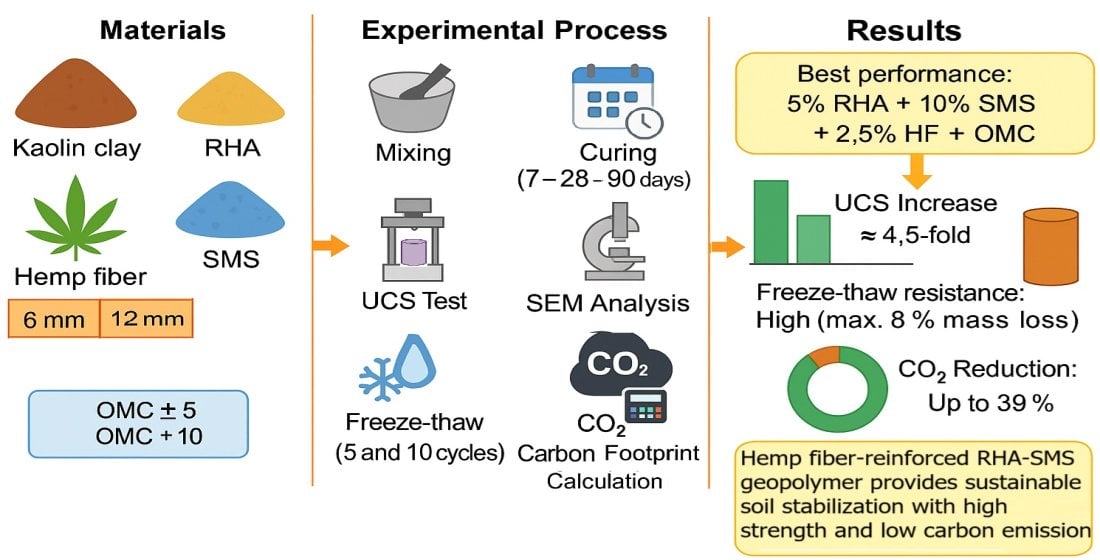
In this study, the aim was to improve the mechanical and durability properties of kaolin clay (KC)-based soil by stabilizing it with geopolymer and natural fiber. In the production of the geopolymer, rice husk ash (RHA) was used as a binder, sodium metasilicate (SMS) as an activator, and another hemp fiber (HF)was used for soil stabilization. Within the scope of the presented study, RHA and SMS were used at three different rates (5%, 7.5%, and 10%), while HF was used in six different volumes (0.5%, 1%, 1.5%, 2%, 2.5%, and 3%) and two different lengths (6 and 12 mm). The study also examined how much water was in the combinations, which was measured at the optimum level and at −5, +5, and +10 compared to the optimum level. The unconfined compressive strength (UCS) was used to check the mechanical qualities of the test specimens and 5- and 10-cycle freeze–thaw (F-T) tests to check the durability properties. The test results indicated that the mixed formulation with 5% RHA, 10% SMS, 2.5% HF, and the optimum water content resulted in the best results for both the UCS and F-T tests. The SEM investigation for this mix found that the microstructural properties for the specimen were directly related to the dense gel phases and the strong fiber–matrix bonding. According to the carbon emissions (CO2-e) and carbon index (CI) analysis from the mix component analyses, it was found that the HF-strengthened geopolymer is a sustainable solution for soil stabilization. The optimum mixture achieved a UCS of 1202 kPa (4.5 times higher than untreated soil), while the strength losses after 10 freeze–thaw cycles were reduced to below 10% in optimized compositions. The carbon index (CI) decreased by up to 65%, demonstrating the strong sustainability benefits of the proposed system. The novelty of this study lies in the combined use of hemp fiber (HF) and rice husk ash (RHA)–sodium metasilicate (SMS)-based geopolymer for kaolin clay stabilization, which has not been comprehensively investigated in previous research. Unlike traditional studies focusing on either geopolymer or natural fiber reinforcement alone, this work simultaneously evaluates the mechanical performance, freeze–thaw durability, microstructural evolution, and carbon footprint to develop a fully sustainable soil improvement framework.
Share and Cite
MDPI and ACS Style
Aksu Alcan, B.; Kara, H.O.; Yılmazoğlu, M.U.
Geopolymerization of Kaolin Clay with Hemp Fibers for Sustainable Soil Stabilization. Polymers 2025, 17, 3216.
https://doi.org/10.3390/polym17233216
AMA Style
Aksu Alcan B, Kara HO, Yılmazoğlu MU.
Geopolymerization of Kaolin Clay with Hemp Fibers for Sustainable Soil Stabilization. Polymers. 2025; 17(23):3216.
https://doi.org/10.3390/polym17233216
Chicago/Turabian Style
Aksu Alcan, Bilge, Halil Oğuzhan Kara, and Mehmet Uğur Yılmazoğlu.
2025. "Geopolymerization of Kaolin Clay with Hemp Fibers for Sustainable Soil Stabilization" Polymers 17, no. 23: 3216.
https://doi.org/10.3390/polym17233216
APA Style
Aksu Alcan, B., Kara, H. O., & Yılmazoğlu, M. U.
(2025). Geopolymerization of Kaolin Clay with Hemp Fibers for Sustainable Soil Stabilization. Polymers, 17(23), 3216.
https://doi.org/10.3390/polym17233216
Note that from the first issue of 2016, this journal uses article numbers instead of page numbers. See further details
here.
Article Metrics
Article Access Statistics
For more information on the journal statistics, click
here.
Multiple requests from the same IP address are counted as one view.