The Effect of Openings’ Size and Location on Selected Dynamical Properties of Typical Wood Frame Walls



Abstract
1. Introduction
2. Methodology
2.1. Wall Geometries and Material Properties
2.2. Numerical Models of Wooden Walls
3. Modal Analysis
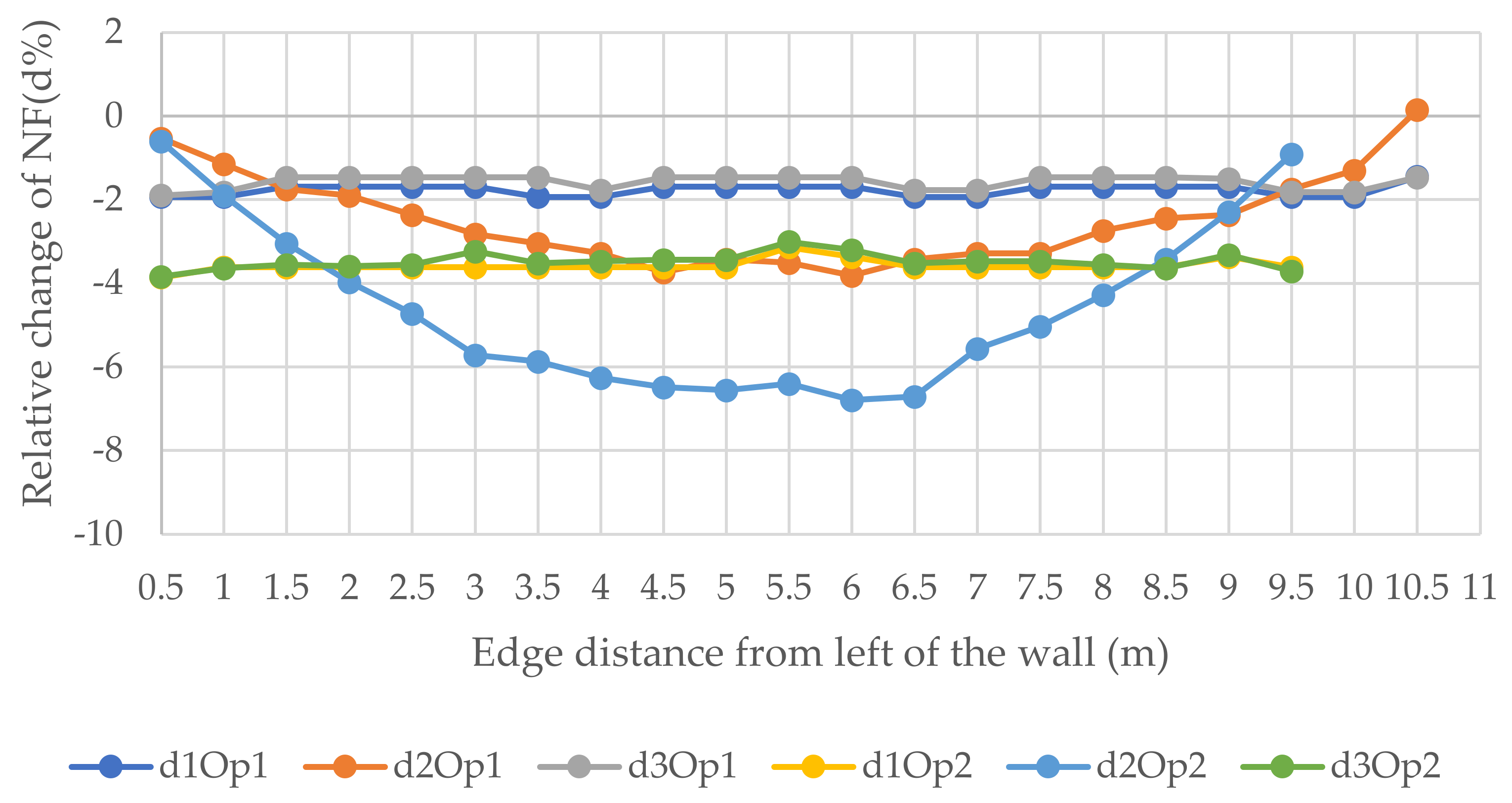
4. Relative Change of Natural Frequencies
5. Conclusions
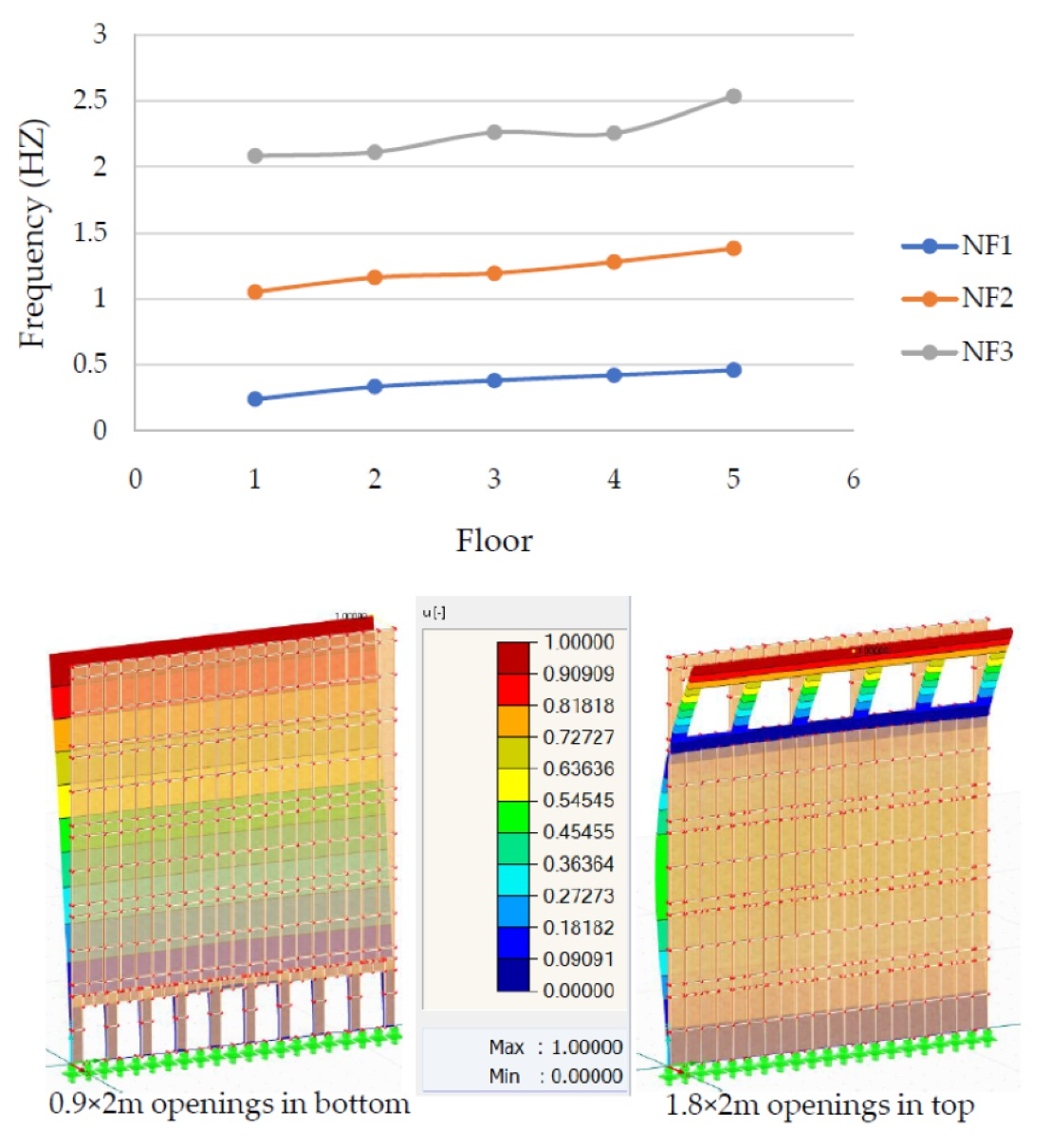
- Designing new openings with different sizes and locations can significantly affect the change of the values of the natural frequencies.
- ○
- Small openings give better results than the big openings.
- ○
- Vertical openings are the most unfavorable system of openings.
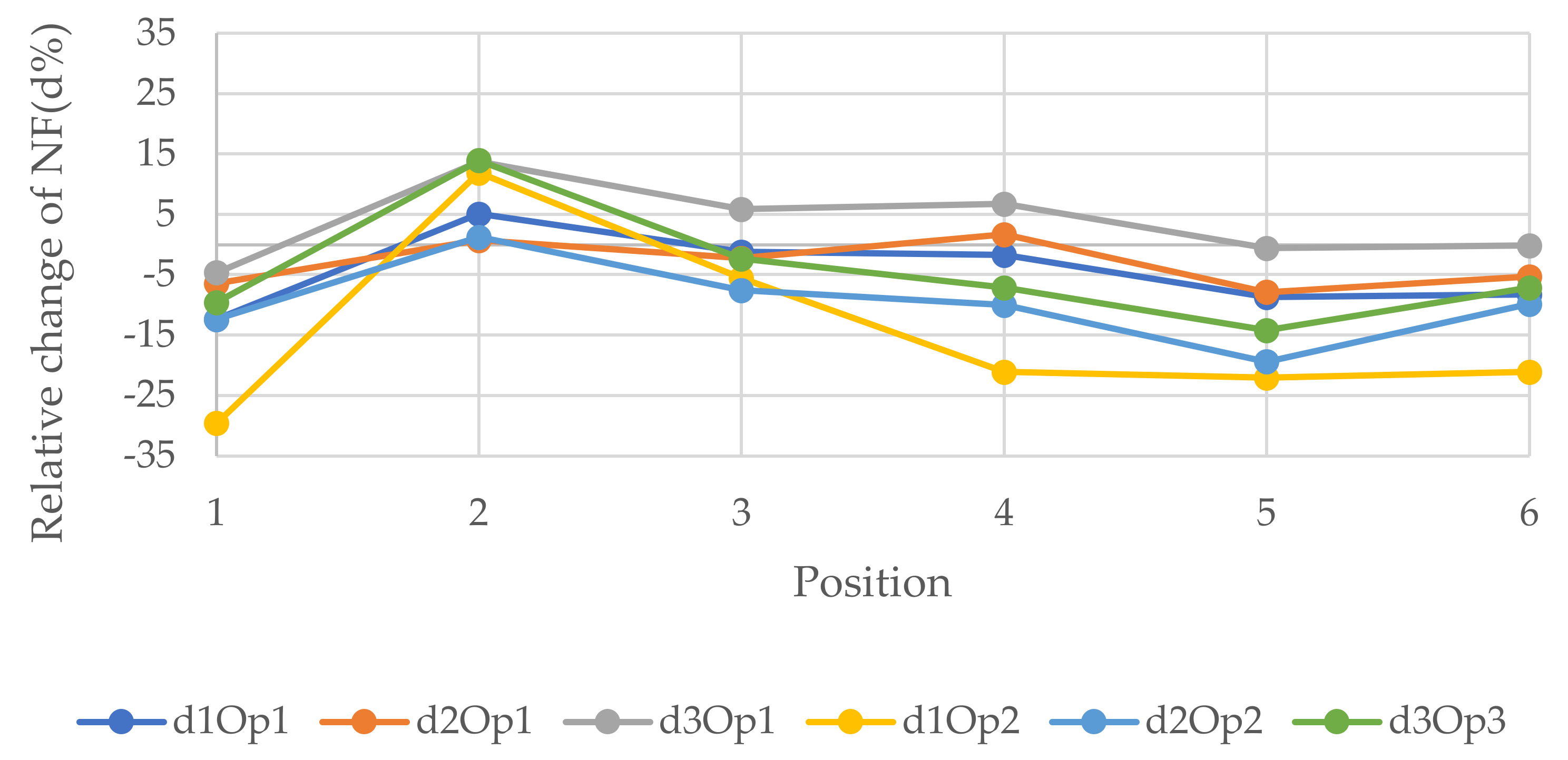
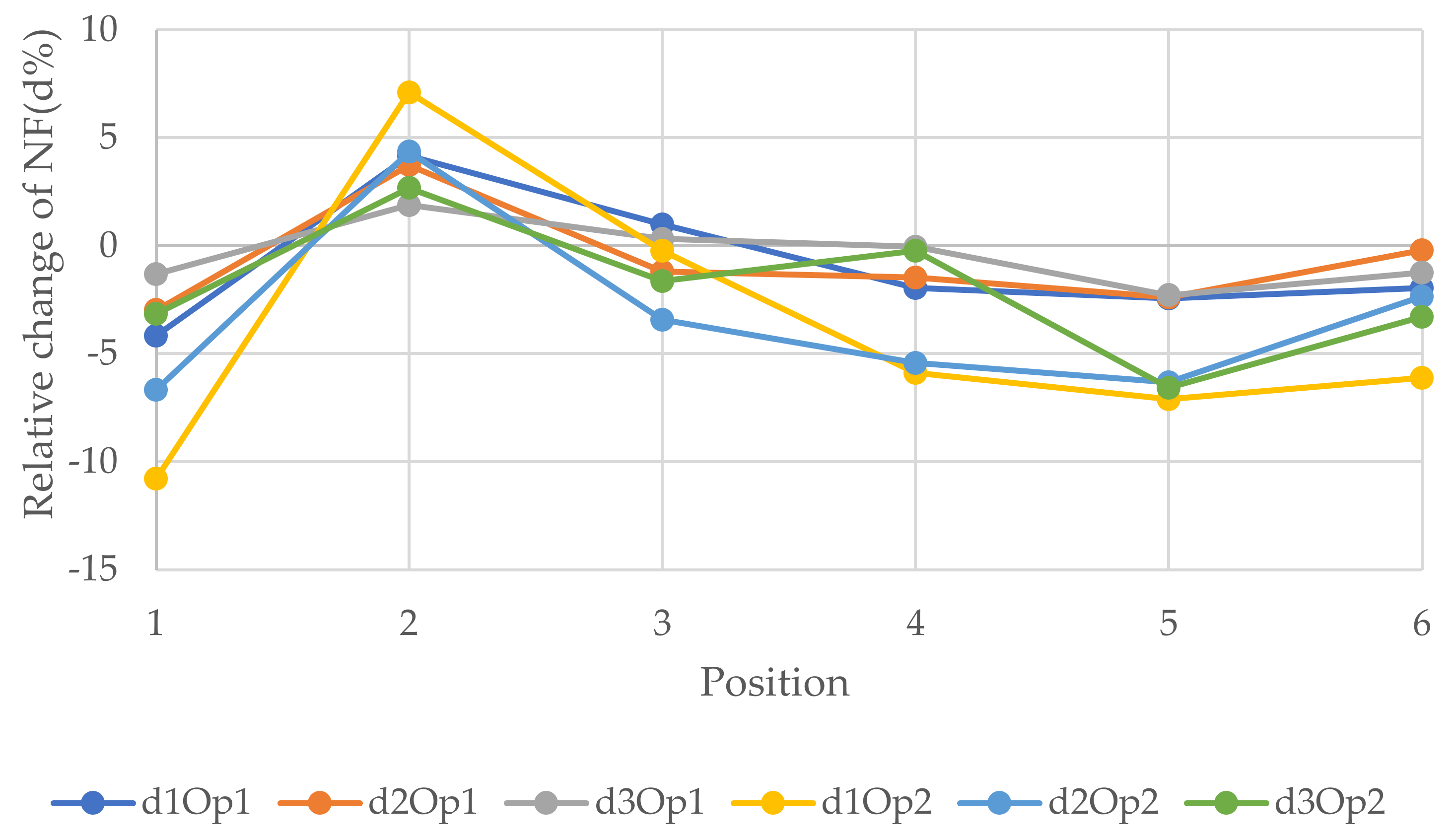
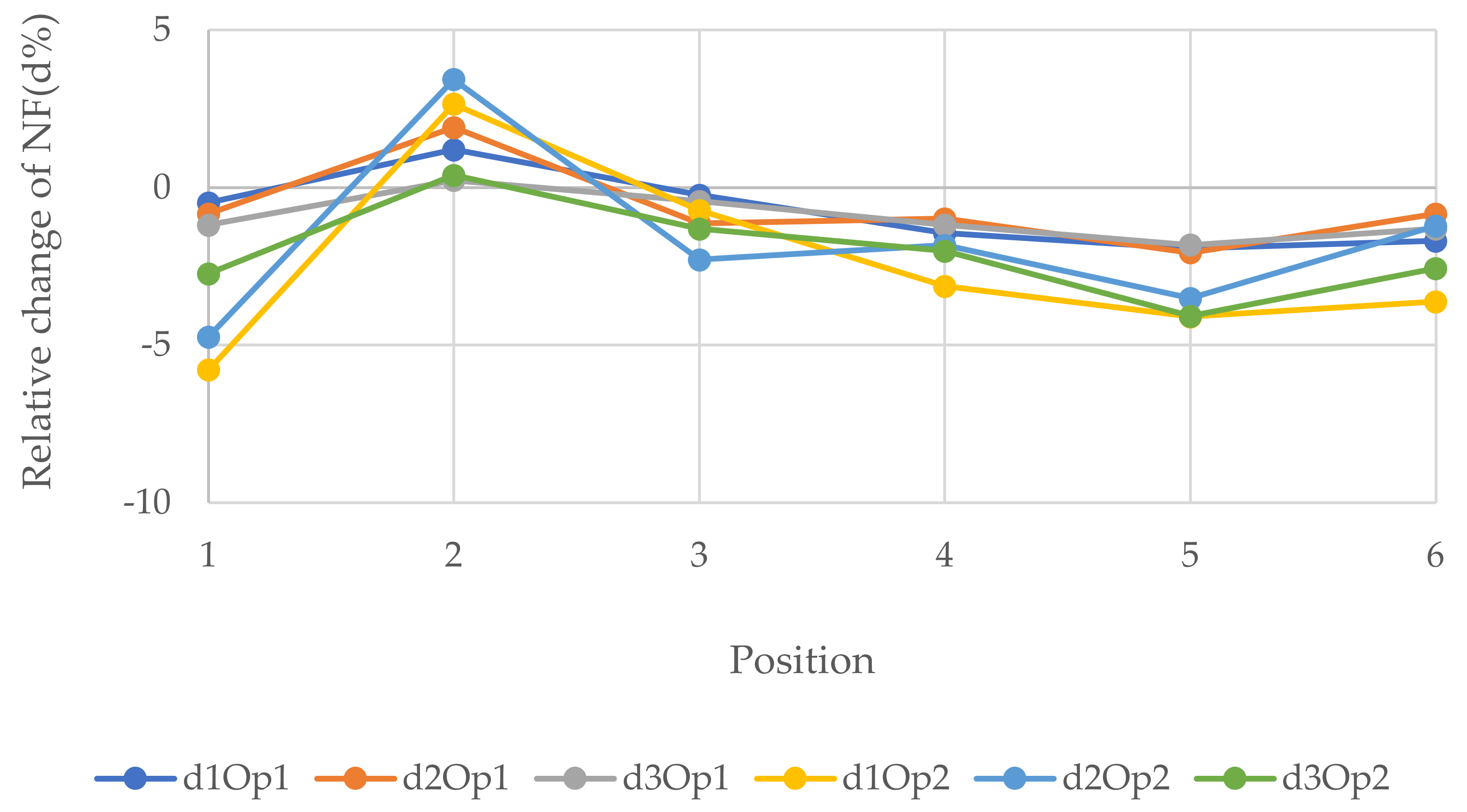
- For the 1st six positions of openings, the highest and lowest natural frequencies were recorded when the openings were located in the top right and bottom right of the walls, respectively. The relative change of the natural frequencies also gave the same outcomes.
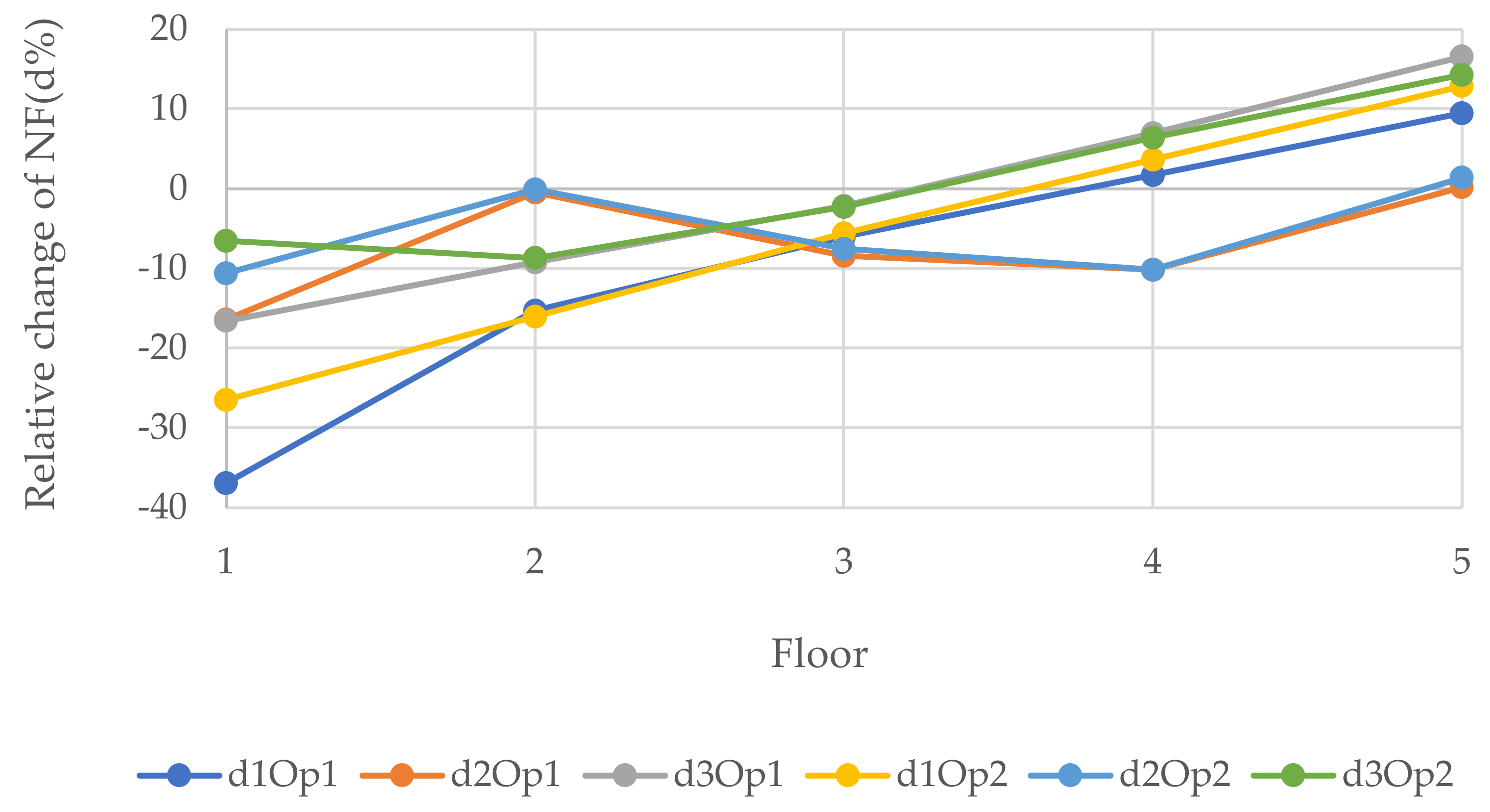
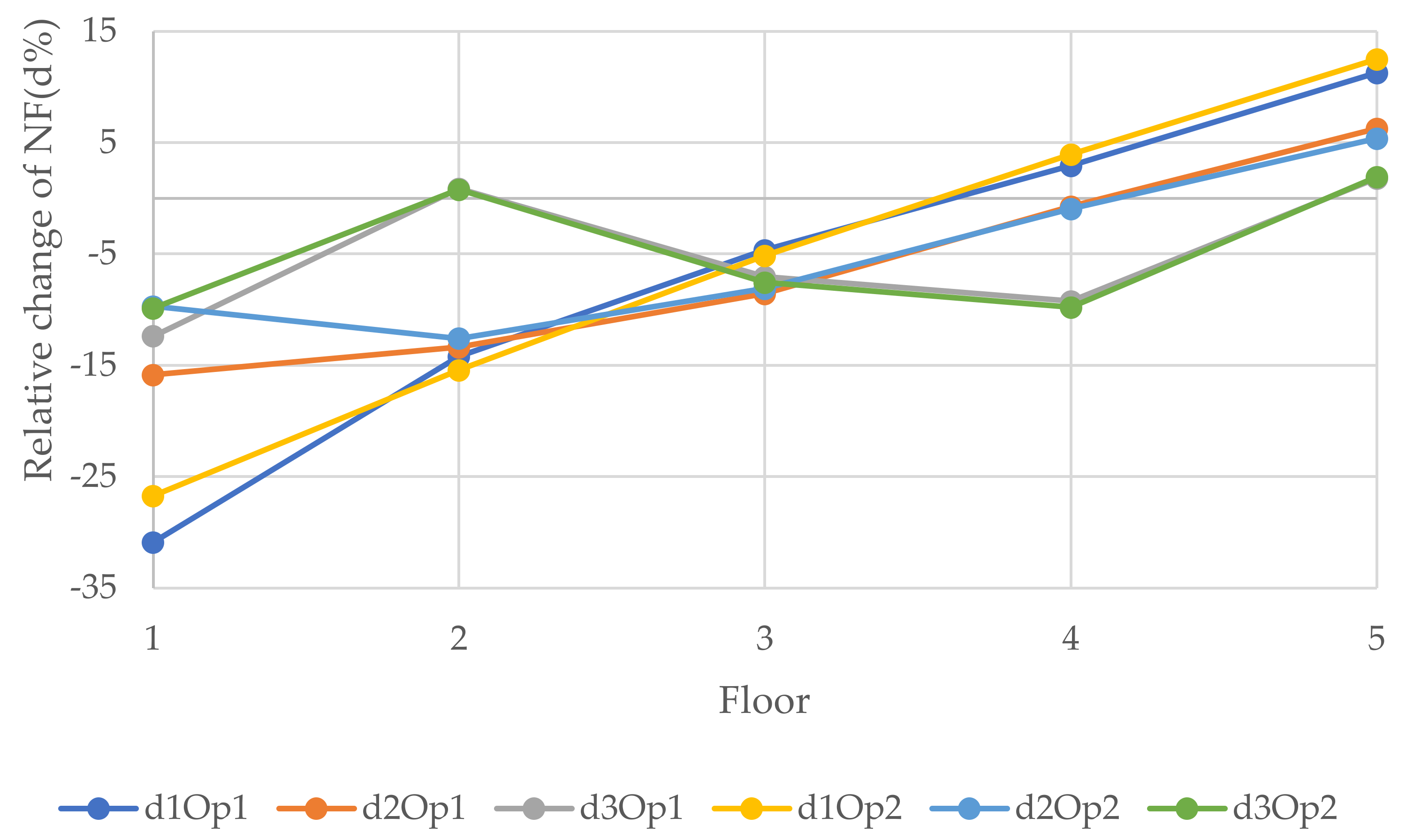
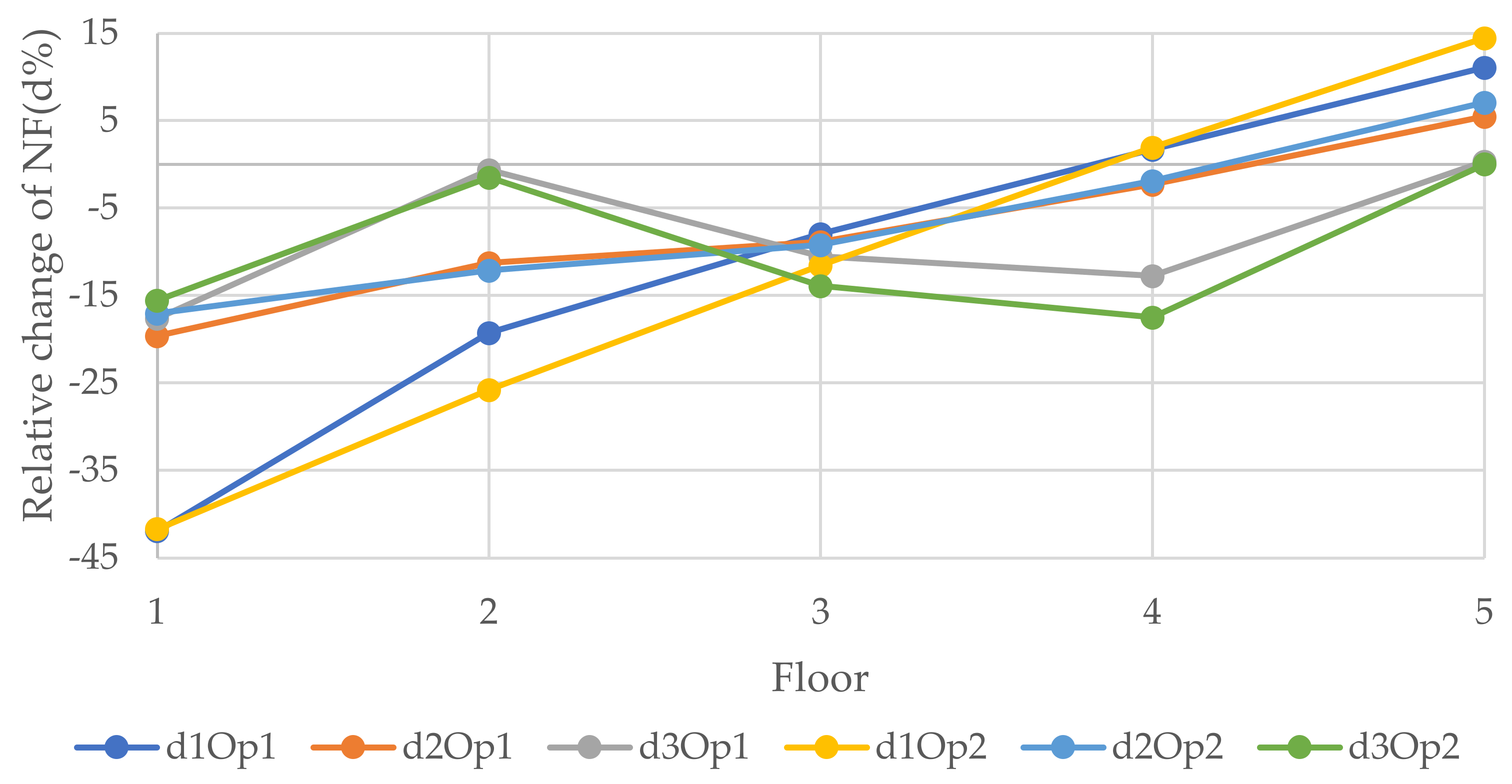
- For the horizontal system of openings, the most suitable position for performing the openings is the top floor, while the 1st floor is considered as the worst scenario.
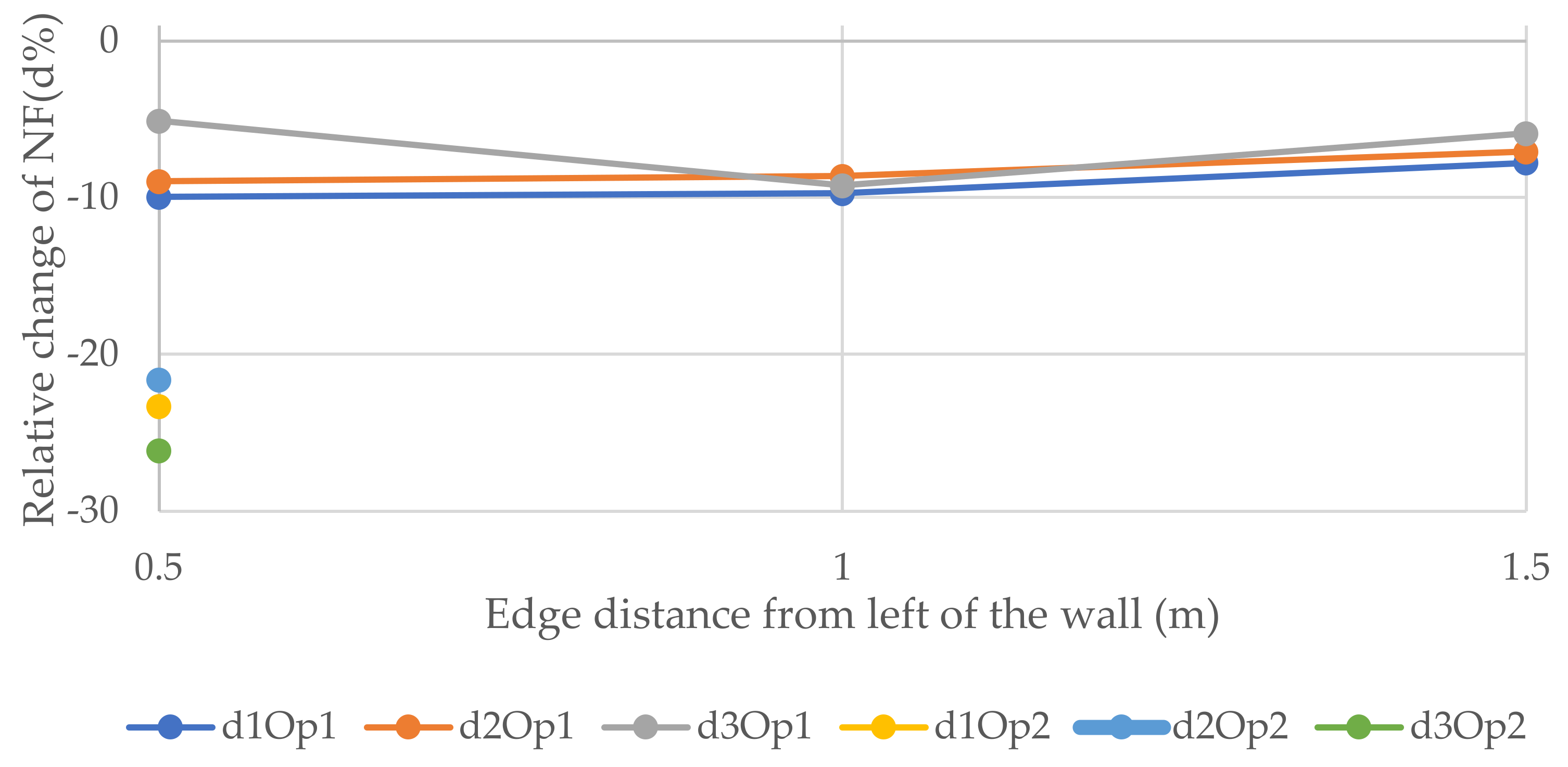
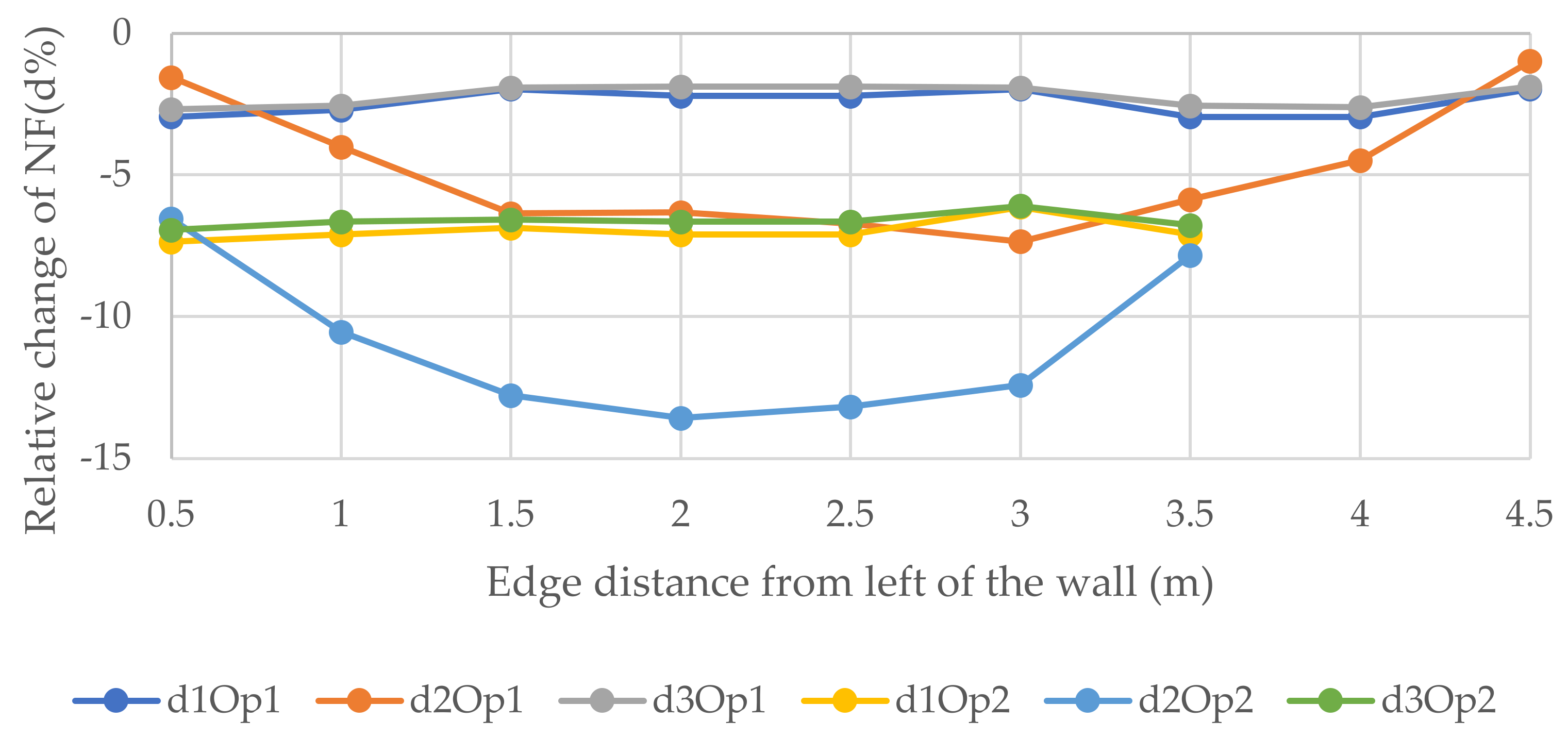
- Regarding the vertical openings, the appropriate case is when the openings are located at the edges, while the inappropriate case scenario has openings in the middle wall.
- According to the research, the appropriate size and location of the openings mitigate the impact of the seismic excitations to the timber frame walls.
- Further study can be conducted through dealing with the effect of the openings on a whole structure.
Author Contributions
Funding
Institutional Review Board Statement
Informed Consent Statement
Data Availability Statement
Conflicts of Interest
References
- Sandanayake, M.; Lokuge, W.; Zhang, G.; Setunge, S.; Thushar, Q. Greenhouse gas emissions during timber and concrete building construction—A scenario based comparative case study. Sustain. Cities Soc. 2018, 38, 91–97. [Google Scholar] [CrossRef]
- Vilčeková, S.; Harčárová, K.; Moňoková, A.; Burdová, E.K. Life Cycle Assessment and indoor environmental quality of wooden family houses. Sustainability 2020, 12, 10557. [Google Scholar] [CrossRef]
- Boardman, C.R.; Glass, S.V. Improving the accuracy of a hygrothermal model for wood-frame walls: A cold-climate study. Buildings 2020, 10, 236. [Google Scholar] [CrossRef]
- Burawska-Kupniewska, I.; Krzosek, S.; Mańkowski, P. Efficiency of visual and machine strength grading of sawn timber with respect to log type. Forests 2021, 12, 1467. [Google Scholar] [CrossRef]
- Lunguleasa, A.; Dumitrascu, A.-E.; Ciobanu, V.-D. Comparative studies on two types of osb boards obtained from mixed resinous and fast-growing hard wood. Appl. Sci. 2020, 10, 6634. [Google Scholar] [CrossRef]
- Igaz, R.; Krišťák, Ľ.; Ružiak, I.; Gajtanska, M.; Kučerka, M. Thermophysical properties of OSB boards versus equilibrium moisture content. Bioresources 2017, 12, 8106–8118. [Google Scholar] [CrossRef]
- Di, J.; Zuo, H. Experimental and numerical investigation of light-wood-framed shear walls strengthened with parallel strand bamboo panels. Coatings 2021, 11, 1447. [Google Scholar] [CrossRef]
- Ailenei, E.C.; Ionesi, S.D.; Dulgheriu, I.; Loghin, M.C.; Isopescu, D.N.; Maxineasa, S.G.; Baciu, I.-R. New waste-based composite material for construction applications. Materials 2021, 14, 6079. [Google Scholar] [CrossRef] [PubMed]
- Jivkov, V.; Simeonova, R.; Antov, P.; Marinova, A.; Petrova, B.; Kristak, L. Structural application of lightweight panels made of waste cardboard and beech veneer. Materials 2021, 14, 5064. [Google Scholar] [CrossRef]
- Sudoł, E.; Kozikowska, E. Mechanical properties of polyurethane adhesive bonds in a mineral wool-based external thermal insulation composite system for timber frame buildings. Materials 2021, 14, 2527. [Google Scholar] [CrossRef]
- Antov, P.; Savov, V.; Neykov, N. Possibilities for manufacturing insulation boards with participation of recycled lignocellulosic fibres. Manag. Sustain. Dev. 2019, 75, 72–76. [Google Scholar]
- Tudor, E.M.; Dettendorfer, A.; Kain, G.; Barbu, M.C.; Réh, R.; Krišťák, Ľ. Sound-absorption coefficient of bark-based insulation panels. Polymers 2020, 12, 1012. [Google Scholar] [CrossRef] [PubMed]
- Migda, W.; Szczepański, M.; Jankowski, R. Increasing the seismic resistance of wood-frame buildings by applying PU foam as thermal insulation. Period. Polytech. Civ. Eng. 2019, 63, 480–488. [Google Scholar] [CrossRef]
- Szczepański, M.; Migda, W.J.S. Analysis of validation and simplification of timber-frame structure design stage with PU-foam insulation. Sustainability 2020, 12, 5990. [Google Scholar] [CrossRef]
- Szczepański, M.; Migda, W.; Jankowski, R. Modal analysis of real timber frame houses with different insulation materials. Adv. Sci. Technol. Res. J. 2016, 10, 215–221. [Google Scholar] [CrossRef][Green Version]
- Mohammadabadi, M.; Yadama, V.; Dolan, J.D. Evaluation of wood composite sandwich panels as a promising renewable building material. Materials 2021, 14, 2083. [Google Scholar] [CrossRef]
- Latif, E.; Ciupala, M.A.; Tucker, S.; Wijeyesekera, D.C.; Newport, D.J.J.B. Hygrothermal performance of wood-hemp insulation in timber frame wall panels with and without a vapour barrier. Build. Environ. 2015, 92, 122–134. [Google Scholar] [CrossRef]
- Filiatrault, A. Static and dynamic analysis of timber shear walls. Can. J. Civ. Eng. 1990, 17, 643–651. [Google Scholar] [CrossRef]
- Porcu, M.C.; Bosu, C.; Gavrić, I. Non-linear dynamic analysis to assess the seismic performance of cross-laminated timber structures. J. Build. Eng. 2018, 19, 480–493. [Google Scholar] [CrossRef]
- Popovski, M.; Schneider, J.; Schweinsteiger, M. Lateral load resistance of cross-laminated wood panels. In Proceedings of the World Conference on Timber Engineering, Trento, Italy, 20–24 June 2010; p. 24. [Google Scholar]
- Schieweck, A. Very volatile organic compounds (VVOC) as emissions from wooden materials and in indoor air of new prefabricated wooden houses. Build. Environ. 2021, 190, 107537. [Google Scholar] [CrossRef]
- He, M.; Lam, F.; Foschi, R.O. Modeling three-dimensional timber light-frame buildings. J. Str. Eng. 2001, 127, 901–913. [Google Scholar] [CrossRef]
- Šušteršič, I.; Dujič, B. Simplified cross-laminated timber wall modelling for linear-elastic seismic analysis. CIB-W18 2012, 45, 45-15. [Google Scholar]
- Yasumura, M.; Sugiyama, H. Shear properties of plywood-sheathed wall panels with opening. Trans. Archit. Instit. Jpn. 1984, 338, 88–98. [Google Scholar] [CrossRef]
- Dujič, B.; Klobčar, S.; Žarnić, R. Influence of openings on shear capacity of wooden walls. N. Z. Timber Des. J. 2008, 16, 5–17. [Google Scholar]
- Dujič, B.; Klobčar, S.; Žarnić, R. Shear capacity of cross-laminated wooden walls. In Proceedings of the 10th World Conference on Timber Engineering, Miyazaki, Japan, 2–5 June 2008. [Google Scholar]
- EN 338. Timber Structures—Strength Classes; European Committee for Standarization (CEN): Brussels, Belgium, 2016. [Google Scholar]
- Isopescu, D.; Stanila, O.; Astanei, I. Analysis of wood bending properties on standardized samples and structural size beams tests. Bul. Instit. Politeh. Iasi. Sectia Constr. Arhit. 2012, 58, 65. [Google Scholar]
- Szczepański, M.; Migda, W.; Jankowski, R. Experimental study on dynamics of wooden house wall panels with different thermal isolation. Appl. Sci. 2019, 9, 4387. [Google Scholar] [CrossRef]
- European Committee for Standardization (CEN). Eurocode 5—Design of Timber Structures—Part 1-1: General Rules and Rules for Buildings; European Committee for Standardization: Brussels, Belgium, 2004. [Google Scholar]
- Ciesielski, R.; Kuźniar, K.; Maciąg, E.; Tatara, T. Empirical formulae for fundamental natural periods of buildings with load bearing walls. Arch. Civ. Eng. 1992, 38, 291–299. [Google Scholar]
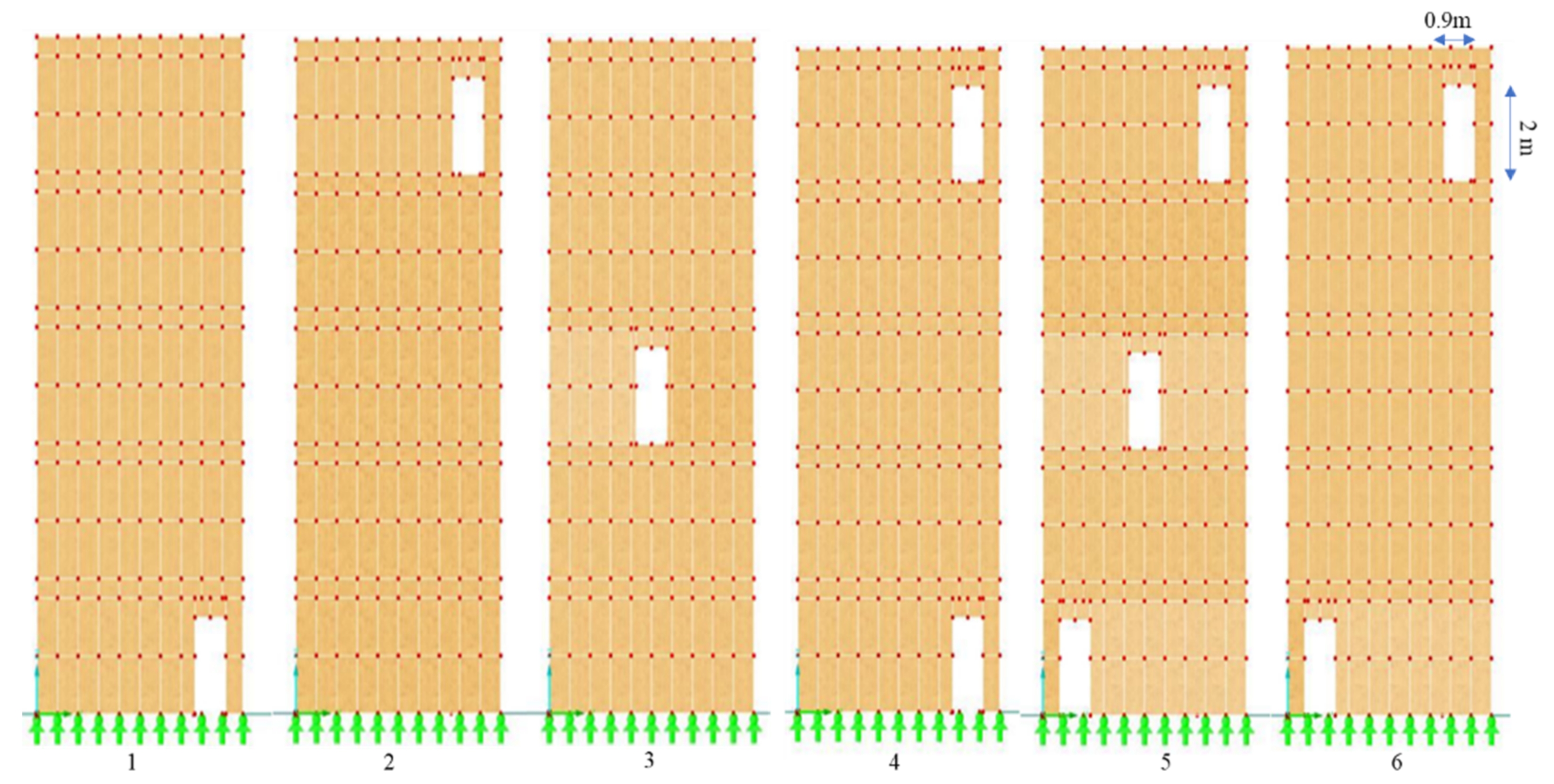
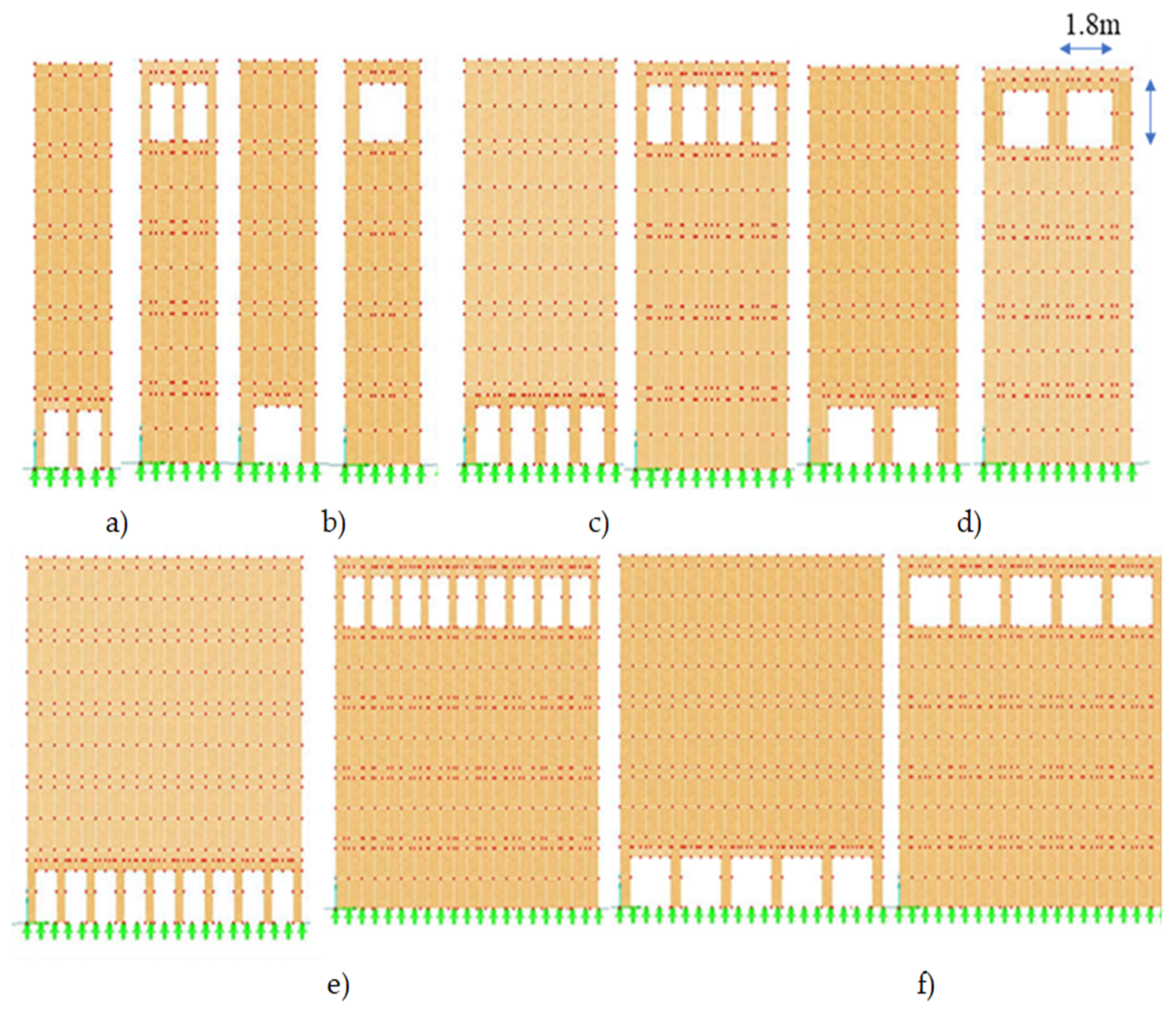
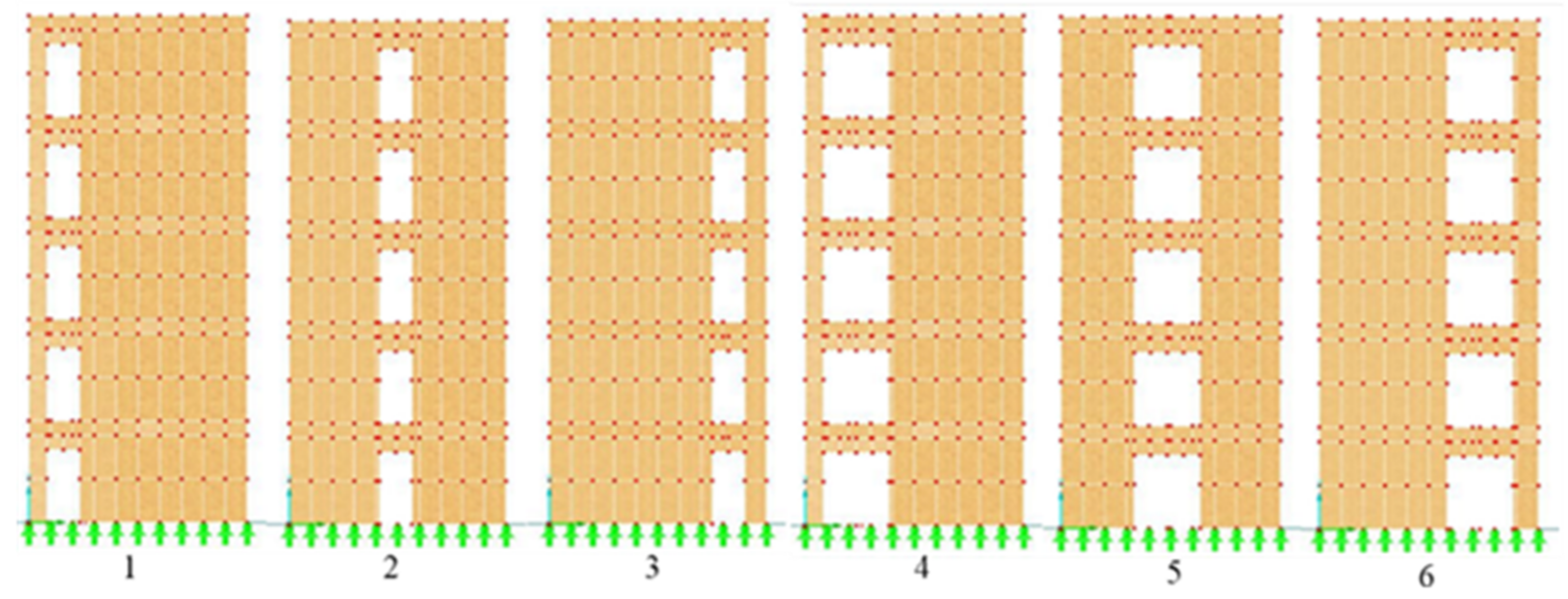
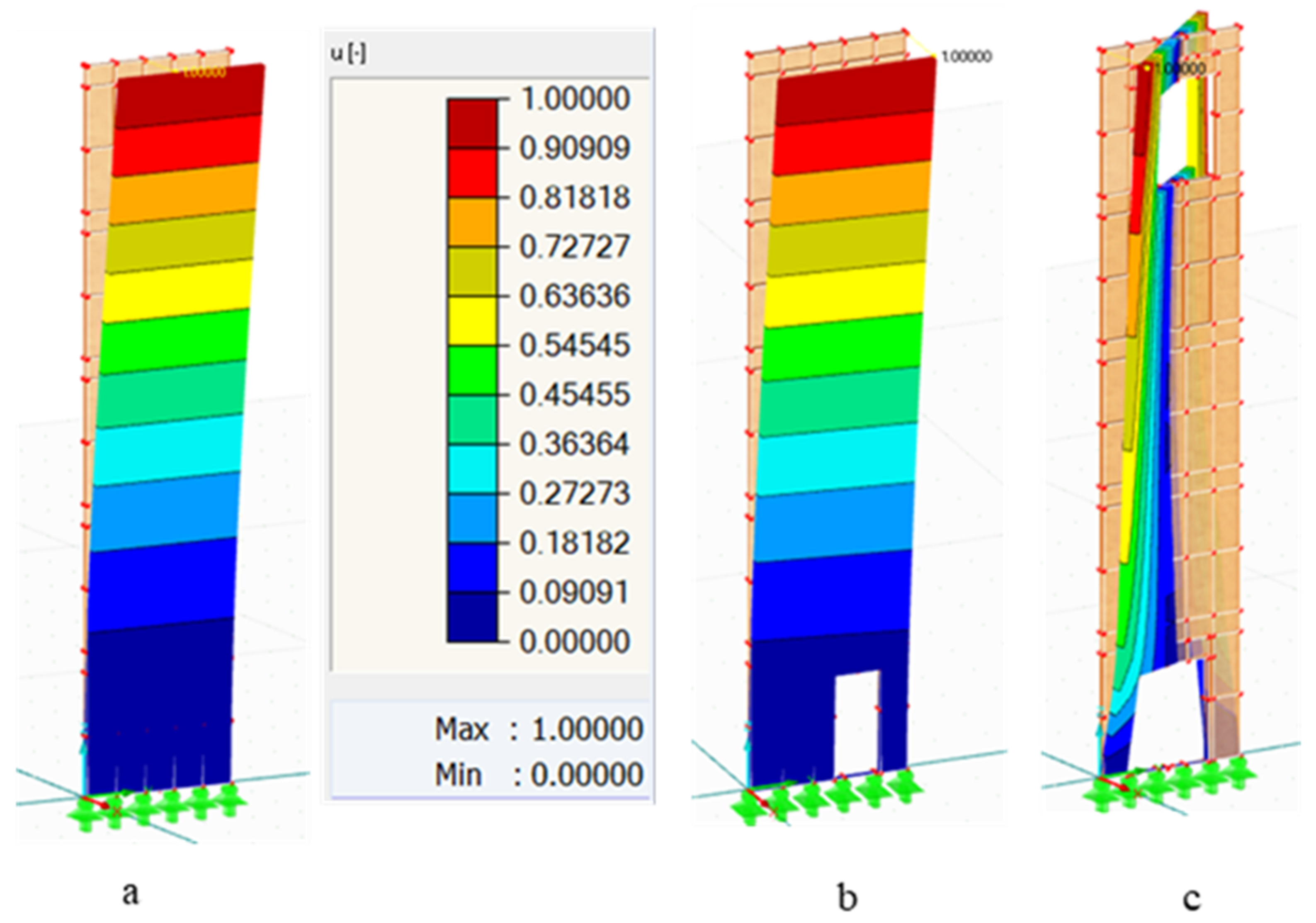

| Element | Material | Density (kg/m3) | Elasticity Modulus (GPa) |
|---|---|---|---|
| Frame | Pine Wood of class C18 | 430 | 9.0-along fibers 0.3-across fibers |
| Sheathing | OSB 3 | 713.8 | 4.93-along fibers 1.98-across fibers |
| Wall Width (m) | Frequency (Hz) | ||
|---|---|---|---|
| Form 1 | Form 2 | Form 3 | |
| 3 | 0.412 | 2.525 | 3.552 |
| 6 | 0.408 | 2.248 | 2.496 |
| 12 | 0.415 | 1.311 | 2.530 |
| Position | Frequency (Hz) | |||||||||||||||||
|---|---|---|---|---|---|---|---|---|---|---|---|---|---|---|---|---|---|---|
| 3 m Wall | 6 m Wall | 12 m Wall | ||||||||||||||||
| Opening Sizes | ||||||||||||||||||
| 0.9 × 2 m | 1.8 × 2 m | 0.9 × 2 m | 1.8 × 2 m | 0.9 × 2 m | 1.8 × 2 m | |||||||||||||
| Forms | ||||||||||||||||||
| 1 | 2 | 3 | 1 | 2 | 3 | 1 | 2 | 3 | 1 | 2 | 3 | 1 | 2 | 3 | 1 | 2 | 3 | |
| 1 | 0.361 | 2.363 | 3.387 | 0.290 | 2.213 | 3.211 | 0.391 | 2.181 | 2.463 | 0.364 | 2.098 | 2.417 | 0.413 | 1.301 | 2.501 | 0.391 | 1.249 | 2.461 |
| 2 | 0.433 | 2.543 | 4.039 | 0.461 | 2.557 | 4.048 | 0.425 | 2.332 | 2.543 | 0.437 | 2.346 | 2.563 | 0.420 | 1.336 | 2.536 | 0.426 | 1.356 | 2.540 |
| 3 | 0.407 | 2.468 | 3.760 | 0.389 | 2.334 | 3.467 | 0.412 | 2.221 | 2.504 | 0.407 | 2.171 | 2.455 | 0.414 | 1.296 | 2.519 | 0.412 | 1.281 | 2.497 |
| 4 | 0.405 | 2.567 | 3.792 | 0.325 | 2.271 | 3.297 | 0.4 | 2.215 | 2.495 | 0.384 | 2.126 | 2.49 | 0.409 | 1.298 | 2.500 | 0.402 | 1.287 | 2.479 |
| 5 | 0.376 | 2.326 | 3.531 | 0.321 | 2.035 | 3.048 | 0.398 | 2.194 | 2.439 | 0.379 | 2.106 | 2.332 | 0.407 | 1.284 | 2.484 | 0.398 | 1.265 | 2.427 |
| 6 | 0.378 | 2.39 | 3.547 | 0.325 | 2.276 | 3.297 | 0.4 | 2.243 | 2.465 | 0.383 | 2.195 | 2.414 | 0.408 | 1.300 | 2.497 | 0.400 | 1.295 | 2.465 |
| Floor | Frequency (Hz) | |||||||||||||||||
|---|---|---|---|---|---|---|---|---|---|---|---|---|---|---|---|---|---|---|
| 3 m Wall | 6 m Wall | 12 m Wall | ||||||||||||||||
| Opening Sizes | ||||||||||||||||||
| 0.9 × 2 m | 1.8 × 2 m | 0.9 × 2 m | 1.8 × 2 m | 0.9 × 2 m | 1.8 × 2 m | |||||||||||||
| Forms | ||||||||||||||||||
| 1 | 2 | 3 | 1 | 2 | 3 | 1 | 2 | 3 | 1 | 2 | 3 | 1 | 2 | 3 | 1 | 2 | 3 | |
| 1 | 0.260 | 2.111 | 2.964 | 0.303 | 2.258 | 3.319 | 0.282 | 1.892 | 2.187 | 0.299 | 2.030 | 2.250 | 0.241 | 1.054 | 2.085 | 0.242 | 1.088 | 2.136 |
| 2 | 0.349 | 2.513 | 3.225 | 0.346 | 2.522 | 3.244 | 0.350 | 1.947 | 2.518 | 0.345 | 1.965 | 2.516 | 0.335 | 1.163 | 2.514 | 0.308 | 1.152 | 2.493 |
| 3 | 0.387 | 2.312 | 3.476 | 0.389 | 2.335 | 3.470 | 0.389 | 2.055 | 2.320 | 0.387 | 2.066 | 2.307 | 0.382 | 1.195 | 2.264 | 0.367 | 1.190 | 2.178 |
| 4 | 0.419 | 2.268 | 3.799 | 0.427 | 2.269 | 3.779 | 0.420 | 2.231 | 2.265 | 0.424 | 2.227 | 2.252 | 0.422 | 1.281 | 2.207 | 0.423 | 1.286 | 2.088 |
| 5 | 0.451 | 2.530 | 4.140 | 0.465 | 2.560 | 4.059 | 0.454 | 2.389 | 2.541 | 0.459 | 2.369 | 2.544 | 0.461 | 1.383 | 2.539 | 0.475 | 1.404 | 2.531 |
| Edge Distance (m) | Frequency (Hz) | |||||||||||||||||
|---|---|---|---|---|---|---|---|---|---|---|---|---|---|---|---|---|---|---|
| 3 m Wall | 6 m Wall | 12 m Wall | ||||||||||||||||
| Opening Size | ||||||||||||||||||
| 0.9 × 2 m | 1.8 × 2 m | 0.9 × 2 m | 1.8 × 2 m | 0.9 × 2m | 1.8 × 2 m | |||||||||||||
| Forms | ||||||||||||||||||
| 1 | 2 | 3 | 1 | 2 | 3 | 1 | 2 | 3 | 1 | 2 | 3 | 1 | 2 | 3 | 1 | 2 | 3 | |
| 0.5 | 0.371 | 2.299 | 3.371 | 0.316 | 1.979 | 2.624 | 0.396 | 2.213 | 2.429 | 0.378 | 2.101 | 2.323 | 0.407 | 1.304 | 2.482 | 0.399 | 1.303 | 2.433 |
| 1 | 0.372 | 2.307 | 3.225 | - | - | - | 0.397 | 2.158 | 2.432 | 0.379 | 2.011 | 2.330 | 0.407 | 1.296 | 2.484 | 0.400 | 1.286 | 2.438 |
| 1.5 | 0.380 | 2.347 | 3.342 | - | - | - | 0.400 | 2.105 | 2.448 | 0.380 | 1.961 | 2.332 | 0.408 | 1.288 | 2.493 | 0.400 | 1.271 | 2.440 |
| 2 | - | - | - | - | - | - | 0.399 | 2.106 | 2.449 | 0.379 | 1.943 | 2.330 | 0.408 | 1.286 | 2.493 | 0.400 | 1.259 | 2.439 |
| 2.5 | - | - | - | - | - | - | 0.399 | 2.097 | 2.449 | 0.379 | 1.952 | 2.330 | 0.408 | 1.280 | 2.493 | 0.400 | 1.249 | 2.440 |
| 3 | - | - | - | - | - | - | 0.400 | 2.083 | 2.448 | 0.383 | 1.969 | 2.344 | 0.408 | 1.274 | 2.493 | 0.400 | 1.236 | 2.448 |
| 3.5 | - | - | - | - | - | - | 0.396 | 2.116 | 2.432 | 0.379 | 2.072 | 2.327 | 0.407 | 1.271 | 2.493 | 0.400 | 1.234 | 2.441 |
| 4 | - | - | - | - | - | - | 0.396 | 2.147 | 2.431 | - | - | - | 0.407 | 1.268 | 2.485 | 0.400 | 1.229 | 2.442 |
| 4.5 | - | - | - | - | - | - | 0.400 | 2.226 | 2.449 | - | - | - | 0.408 | 1.262 | 2.493 | 0.400 | 1.226 | 2.443 |
| 5 | - | - | - | - | - | - | - | - | - | - | - | - | 0.408 | 1.266 | 2.493 | 0.400 | 1.225 | 2.443 |
| 5.5 | - | - | - | - | - | - | - | - | - | - | - | - | 0.408 | 1.265 | 2.493 | 0.402 | 1.227 | 2.454 |
| 6 | - | - | - | - | - | - | - | - | - | - | - | - | 0.408 | 1.261 | 2.493 | 0.401 | 1.222 | 2.449 |
| 6.5 | - | - | - | - | - | - | - | - | - | - | - | - | 0.407 | 1.266 | 2.485 | 0.400 | 1.223 | 2.441 |
| 7 | - | - | - | - | - | - | - | - | - | - | - | - | 0.407 | 1.268 | 2.485 | 0.400 | 1.238 | 2.442 |
| 7.5 | - | - | - | - | - | - | - | - | - | - | - | - | 0.408 | 1.268 | 2.493 | 0.400 | 1.245 | 2.442 |
| 8 | - | - | - | - | - | - | - | - | - | - | - | - | 0.408 | 1.275 | 2.493 | 0.400 | 1.255 | 2.440 |
| 8.5 | - | - | - | - | - | - | - | - | - | - | - | - | 0.408 | 1.279 | 2.493 | 0.400 | 1.266 | 2.438 |
| 9 | - | - | - | - | - | - | - | - | - | - | - | - | 0.408 | 1.280 | 2.492 | 0.401 | 1.281 | 2.446 |
| 9.5 | - | - | - | - | - | - | - | - | - | - | - | - | 0.407 | 1.288 | 2.484 | 0.400 | 1.299 | 2.436 |
| 10 | - | - | - | - | - | - | - | - | - | - | - | - | 0.407 | 1.294 | 2.484 | - | - | - |
| 10.5 | - | - | - | - | - | - | - | - | - | - | - | - | 0.409 | 1.313 | 2.493 | - | - | - |
Publisher’s Note: MDPI stays neutral with regard to jurisdictional claims in published maps and institutional affiliations. |
© 2022 by the authors. Licensee MDPI, Basel, Switzerland. This article is an open access article distributed under the terms and conditions of the Creative Commons Attribution (CC BY) license (https://creativecommons.org/licenses/by/4.0/).
Share and Cite
Szczepanski, M.; Manguri, A.; Saeed, N.; Chuchala, D. The Effect of Openings’ Size and Location on Selected Dynamical Properties of Typical Wood Frame Walls. Polymers 2022, 14, 497. https://doi.org/10.3390/polym14030497
Szczepanski M, Manguri A, Saeed N, Chuchala D. The Effect of Openings’ Size and Location on Selected Dynamical Properties of Typical Wood Frame Walls. Polymers. 2022; 14(3):497. https://doi.org/10.3390/polym14030497
Chicago/Turabian StyleSzczepanski, Marcin, Ahmed Manguri, Najmadeen Saeed, and Daniel Chuchala. 2022. "The Effect of Openings’ Size and Location on Selected Dynamical Properties of Typical Wood Frame Walls" Polymers 14, no. 3: 497. https://doi.org/10.3390/polym14030497
APA StyleSzczepanski, M., Manguri, A., Saeed, N., & Chuchala, D. (2022). The Effect of Openings’ Size and Location on Selected Dynamical Properties of Typical Wood Frame Walls. Polymers, 14(3), 497. https://doi.org/10.3390/polym14030497