Article

Adjustable Cryogenic Near-Zero Thermal Expansion and Magnetic Properties in Antiperovskite Mn3Cu0.5Ge0.5N0.78C0.22


1
School of Mechanical Engineering, Tianjin University of Technology and Education, Tianjin 300222, China
2
Hangzhou Guillaume Technology Service Co., Ltd., Hangzhou 311107, China
*
Authors to whom correspondence should be addressed.
Crystals 2026, 16(1), 41; https://doi.org/10.3390/cryst16010041
Submission received: 6 December 2025 / Revised: 23 December 2025 / Accepted: 26 December 2025 / Published: 4 January 2026
(This article belongs to the Section Inorganic Crystalline Materials)

Abstract

An attractive cryogenic near-zero thermal expansion (ZTE) behavior was achieved in the Mn3Cu0.5Ge0.5N0.78C0.22 compound, spanning a broad temperature window of 120 K (5 K to 125 K) with an average coefficient of thermal expansion (CTE) of α = 0.68 × 10⁻⁶ K−1. Furthermore, the effect of sintering temperature and holding time on thermal expansion and magnetic properties were investigated. Two distinct magnetic phase transitions are evident in the magnetization–temperature (M-T) curve of Mn3Cu0.5Ge0.5N0.78C0.22, which precede the near-ZTE behavior. These two antiferromagnetic (AFM)-like ordering transitions are hypothesized to play a pivotal role in governing the ZTE behavior, as they induce two episodes of negative thermal expansion (NTE). The realization of ZTE behavior is thus attributed to the counterbalance of these two NTE contributions, which can be effectively tuned by varying the carbon content or optimizing the sintering process parameters. Collectively, these results demonstrate significant potential for the design of diverse cryogenic functional materials.

1. Introduction

Materials exhibiting zero thermal expansion (ZTE) behavior are highly desirable and have attracted significant attention in condensed matter physics, owing to their crucial role in advanced industrial application such as high-precision optical components and thermoelectric converters [1]. Pure-phase materials with intrinsic ZTE are exceptionally rare. Typically, ZTE is engineered in composites by combining a positive thermal expansion (PTE) matrix with negative thermal expansion (NTE) constituents [2,3]. However, the markedly different thermal expansion behaviors of the components in such composites inevitably generate interfacial thermal stress [4]. Consequently, the exploration of pure-phase materials exhibiting ZTE behavior with excellent structural stability over a wide temperature range remains a growing research focus [5,6,7,8].
Unlike well-documented single-phase ZTE materials—such as GeNb18O47 crystals [9], NiPt(CN)6 [10], Cs2W3O10 [11], RbMgInMo3O12 [7], ZrMgMo3O12 [5], PbTiO3-based ferroelectrics [12], La(Fe,Si)13-type materials [13], and certain two-dimensional materials [14]—antiperovskite Mn3AN-based materials (where A represents transition metal and/or semiconductor elements) have garnered considerable interest. This interest stems not only from their isotropic ZTE characteristics in pure form but also from their rich array of physical phenomena, including diverse magnetic properties (magnetostriction, magnetoresistance, and magnetocaloric effects [15,16,17,18]), electrocatalytic hydrogen evolution capability [19], intriguing electronic properties [20,21,22,23], and excellent mechanical properties [24]. To date, several strategies have proven effective in achieving pure-phase ZTE in antiperovskite compounds, including chemical substitution at the A site [6,15,17,18,23], introduction of vacancies [25,26,27], nanocrystallization [25], and high-entropy component design [6]. Notably, through complex processes like nanocrystallization or high-entropy design, compounds such as Mn3Cu0.5Ge0.5N and Mn3Fe0.2Co0.2Ni0.2Mn0.2Cu0.2N have demonstrated extended ZTE temperature windows of approximately 230 K and 170 K, respectively. It is important to note, however, that these superior ZTE performances are primarily achieved through optimization of the A-site chemical composition.
Several experimental studies have attempted carbon-for-nitrogen substitution in antiperovskite Mn3AN, such as in Mn3Ga0.5Ge0.4Mn0.1N0.9C0.1, Mn3Zn0.4Sn0.6(N0.8C0.2), and Mn3(Cu0.4Sn0.5Mn0.1)(N0.9C0.1) compounds, all of which exhibit near-ZTE over narrow temperature ranges [28]. However, these studies often lack detailed fabrication procedures and mechanistic explanations for the observed phenomena. For instance, Mn3Sn0.5Zn0.5C shows a ZTE range (ΔT) of 152 K, attributed to the strong competition between nearest-neighbor antiferromagnetic (AFM) direct exchange and ferromagnetic superexchange interactions, which can be effectively modulated by carbon occupancy [17].
In this work, we aim to elucidate the effects of carbon substitution at nitrogen sites and the fabrication processes of the antiperovskite Mn3Cu0.5Ge0.5N0.78C0.22 compound on its near-zero thermal expansion behavior, and magnetic properties. As a result, an enhanced ZTE behavior spanning a temperature range of 5–125 K (ΔT = 120 K) has been achieved. The findings are expected to contribute to the development of novel materials with extended ZTE operational windows, as well as multifunctional smart materials possessing superior mechanical properties and rich functional characteristics.

2. Materials and Methods

2.1. Materials Preparation

Polycrystalline samples of Mn3Cu0.5Ge0.5N1−xCx (where x = 0.1, 0.15, 0.2, 0.22, and 0.3) were fabricated via a solid-state reaction method. The purity of the starting materials (Mn, Cu, Ge, C powders, and N2 gas) was at least 99.9%. First, the Mn2N0.86 powder was synthesized as an intermediate compound [29,30,31]. Subsequently, stoichiometric amount of Cu, Ge, C, and Mn2N0.86 powders, corresponding to the designed Mn3Cu0.5Ge0.5N1−xCx compositions, were homogenized by ball milling at 80 rpm for 5 h with a 10:1 ball-to-powder weight ratio. The as-milled powders were pressed into pellets under a pressure of 30 MPa at ambient temperature; the pellets were sealed in a quartz tube, and sintered at a predetermined temperature under a 99.9% nitrogen atmosphere for a specified dwell time.

2.2. Materials Characterization

X-ray diffraction (XRD) patterns of compound powders at room temperature and variable temperature were obtained from the Cu Kα radiation on a BRUKER D8-Discover diffractometer. Rietveld refinement of samples’ XRD patterns was performed using the GSAS-II software package (v5.6.0). Linear thermal expansion curves (ΔL/L300 K) were obtained using a thermo-dilatometer (L75PT Vertical, LINSEIS Messgeräte GmbH, Germany). Magnetization as a function of temperature was measured via the physical property measurement system (PPMS) in Vibrating Sample Magnetometer (VSM) mode under an external magnetic field of 500 Oe. The room temperature microhardness of Mn3Cu0.5Ge0.5N0.78C0.22 compound was tested by T2500 with 9.8 N load. The carbon content of samples was analyzed by the carbon sulfur analyzer, and Table 1 lists the designed and measured carbon contents. Considering the influence of the preparation process on chemical composition (especially the nitrogen element), the actual prepared composition is basically consistent with the designed one. Therefore, all compositional expressions in this paper are based on the designed compositions.

3. Results

3.1. Phase Analysis

The room-temperature XRD patterns of Mn3Cu0.5Ge0.5N1−xCx (x = 0.1, 0.15, 0.22, and 0.3) compounds, along with the Rietveld refinement results of XRD patterns of Mn3Cu0.5Ge0.5N0.78C0.22, are presented in Figure 1. All the predominant diffraction peaks are in accordance with the antiperovskite Mn3CuN-type crystal structure (space group: Pm-3m), where Mn atoms are at the face centers, N(C) atoms reside at the body center, and Cu or Ge atoms are located at the corners of the cubic unit cell. A small amount of MnO impurity, marked by the symbol “●”, was detected. The inset of Figure 1a shows the lattice constant as a function of carbon content. As carbon doping increases, the lattice constant decreases from 3.9092Å (x = 0.1) to 3.3893 Å (x = 0.22). This experimental phenomenon is consistent with the results reported for Mn3Cu0.6Ge0.4N1−xCx [32], as well as the lattice constants of Mn3SnN (4.06 Å [33]) and Mn3SnC (3.983 Å [34]). However, it is opposite to that of Mn3ZnN1−xCx [35], Mn3Sn0.5Zn0.5Cx [17] and Mn3CuN1−xCx [36].

3.2. Thermal Expansion

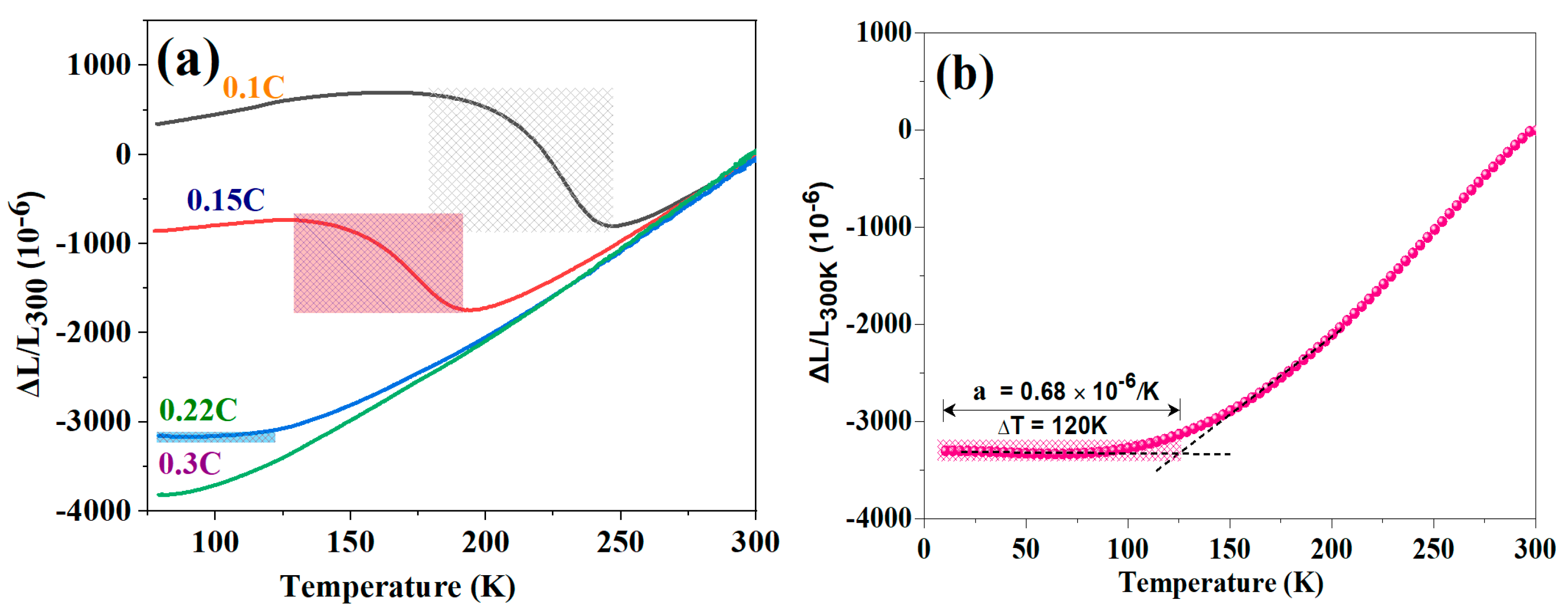
The linear thermal expansion (ΔL/L300 K) of Mn3Cu0.5Ge0.5N1−xCx (x = 0.1, 0.15, 0.22, and 0.3) compounds as a function of temperature are shown in Figure 2a. These compounds exhibit different thermal expansion behaviors. Notably, as the carbon content increases from 0.1 to 0.22, carbon doping gradually shifts the NTE behavior toward lower temperature regions. For the Mn3Cu0.5Ge0.5N0.9C0.1 compound (x = 0.10), the linear expansion coefficient (α) is −18.50 × 10⁻⁶ K−1 over a temperature range of 166–247 K (ΔT = 81 K). Furthermore, the NTE behavior is weakened when the carbon content increases to 0.15. The Mn3Cu0.5Ge0.5N0.85C0.15 compound (x = 0.15) has a linear expansion coefficient of α = −15.57 × 10⁻⁶ K−1 in the range of 125–195 K. When the carbon content reaches 0.3, the Mn3Cu0.5Ge0.5N0.7C0.3 compound completely transforms into a positive thermal expansion (PTE) material.
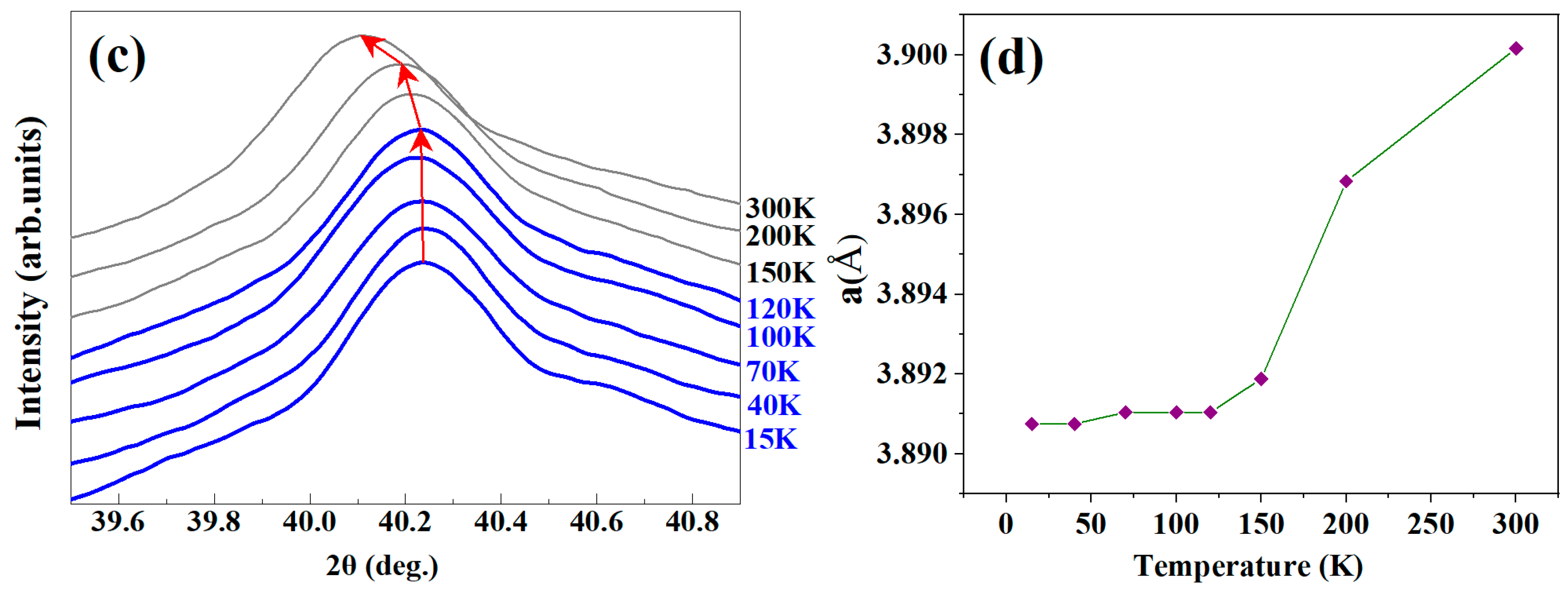
The full-range thermal expansion curve of Mn3Cu0.5Ge0.5N0.78C0.22, measured over the temperature range of 5 K to 300 K, is displayed in Figure 2b. As observed, the thermal expansion coefficient is nearly independent of temperature over a broad range. Specifically, Mn3Cu0.5Ge0.5N0.78C0.22 exhibits a negligible linear expansion variation within a substantially wide temperature range of ΔT = 120 K (5–125 K), with an average coefficient of thermal expansion (CTE) of α = 0.68 × 10⁻⁶ K−1. In addition, to determine the intrinsic thermal expansion behavior, a group of in situ variable-temperature X-ray diffraction patterns for the (111) crystallographic plane were collected over the temperature range of 15 K to 300 K, as shown in Figure 2c. The diffraction peaks remain almost constant as the temperature increases from 15 K to 120 K, indicative of a ZTE behavior, and then continuously shift to lower angles as the temperature increases, indicating the recovery of PTE. Figure 2d presents the lattice parameters at different temperature. The lattice parameters of Mn3Cu0.5Ge0.5N0.78C0.22 exhibit minimal variation over the temperature range of 15 K to 120 K. This confirms that an attractive near-zero thermal expansion (ZTE) behavior can be achieved by optimizing the carbon content in Mn3Cu0.5Ge0.5N1-xCx compounds. Based on the NTE behaviors of Mn3Cu0.5Ge0.5N1−xCx (x = 0.1, 0.15, 0.22, and 0.3) compounds with respect to temperatures, it can be concluded that carbon doping plays an essential role in tuning the thermal expansion behavior of Mn3Cu0.5Ge0.5N compound, driving it from NTE through ZTE to PTE with increasing carbon content. The present results demonstrate an economical approach to achieving a desirable cryogenic near-ZTE temperature range by adjusting the carbon content, which holds significant potential for application in the design of various cryogenic devices.

3.3. Zero Thermal Expansion Behavior and Mechanical Properties

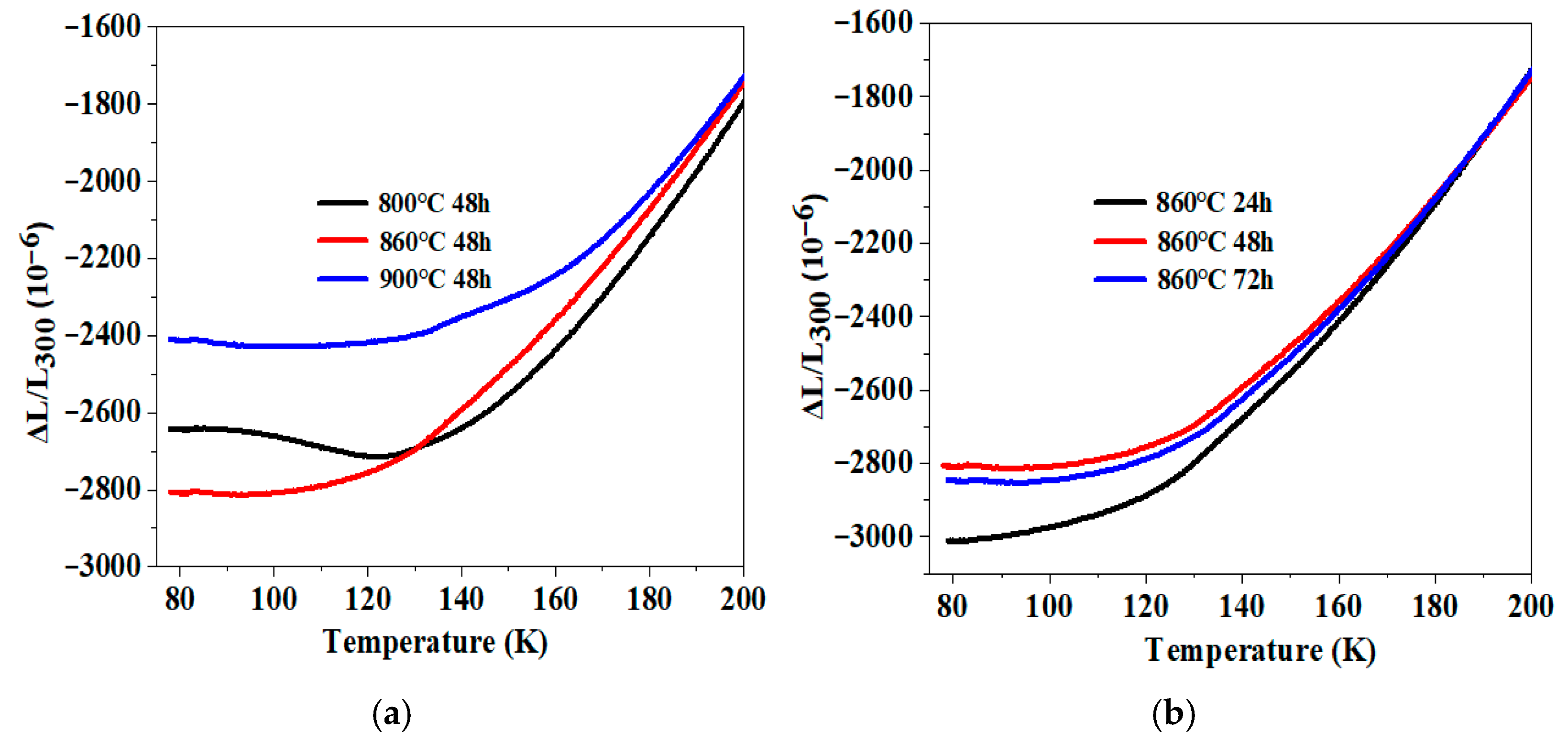
Sintering experiments of Mn3Cu0.5Ge0.5N0.78C0.22 were carried out under different conditions: sintering temperatures of 800 °C, 860 °C, and 900 °C with a fixed holding time of 48 h, and a fixed sintering temperature of 860 °C with holding times of 24 h, 48 h, and 72 h. The experimental results are shown in Figure 3. As presented in Figure 3a, when the solid-state sintering temperature is 800 °C, the material exhibits obvious negative thermal expansion (NTE) behavior, and the expansion curve shows a distinct downward trend, without zero thermal expansion (ZTE) behavior. When the sintering temperature increases to 900 °C, the initial segment (low temperature side) of the expansion curve begins to rise, resulting in an expansion coefficient of α = −1.23 × 10⁻⁶ K−1. Notably, it was unexpectedly found that when the sintering temperature was 900 °C, the temperature range of anomalous thermal expansion expanded by nearly 15 K, compared to sintering at 860 °C. The thermal expansion behaviors for different holding times at 860 °C are displayed in Figure 3b. When the holding time is 24 h, the material exhibits positive thermal expansion (PTE) behavior below the temperature range of 77–125 K, but its expansion coefficient was significantly lower than that above 140 K. When the holding time is extended to 72 h, the negative thermal expansion (NTE) coefficient of the material is α = −1.34 × 10⁻⁶ K−1, failing to achieve zero expansion. To explore the influence of the preparation processes on thermal expansion properties, the actual carbon content of the samples was tested (Table 1). At the same sintering temperature (860 °C), the actual carbon content increases from 1.1040% for 24 h to 1.1245% for 48 h with the extension of holding time. Under the same 48 h holding time, the actual carbon content increases from 1.1245% at 860 °C to 1.1521% at 800 °C as the sintering temperature decreases. The effect of sintering temperature on the anomalous thermal expansion properties of the antiperovskite material is related to the deficiency of nitrogen during sintering.
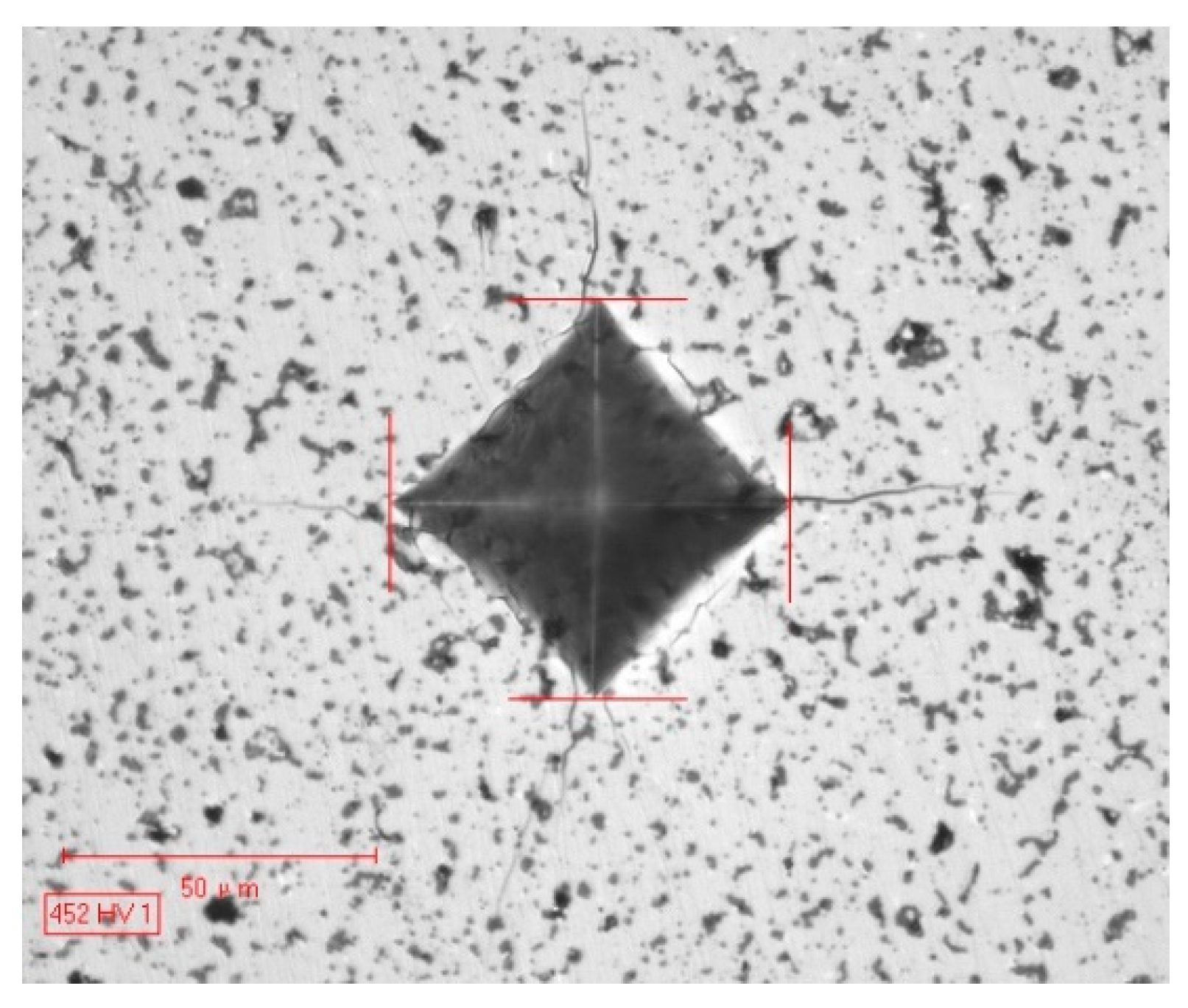
The mechanical properties of Mn3Cu0.5Ge0.5N0.78C0.22 compound were evaluated through Vickers hardness and nano-indentation experiments. The indentation morphology of micro-Vickers hardness test on the sintered sample is shown in Figure 4. The measured micro-Vickers hardness of this compound ranges from 450 to 480 HV, with cracks spreading outward around the indentation, as previously reported in sintered samples of Mn3Cu0.5Ge0.5N [28]. The introduction of a small amount of carbon into the matrix modulates the hardness of the material. The elastic modulus of Mn3Cu0.5Ge0.5N0.78C0.22 sintered at 860 °C for 48 h was 166.3 ± 51.7 GPa, which is lower than that of Mn3Cu0.5Ge0.5N [28]. These results indicate that the Mn3Cu0.5Ge0.5N0.78C0.22 is a hard and brittle ceramic material.

3.4. Magnetic Properties

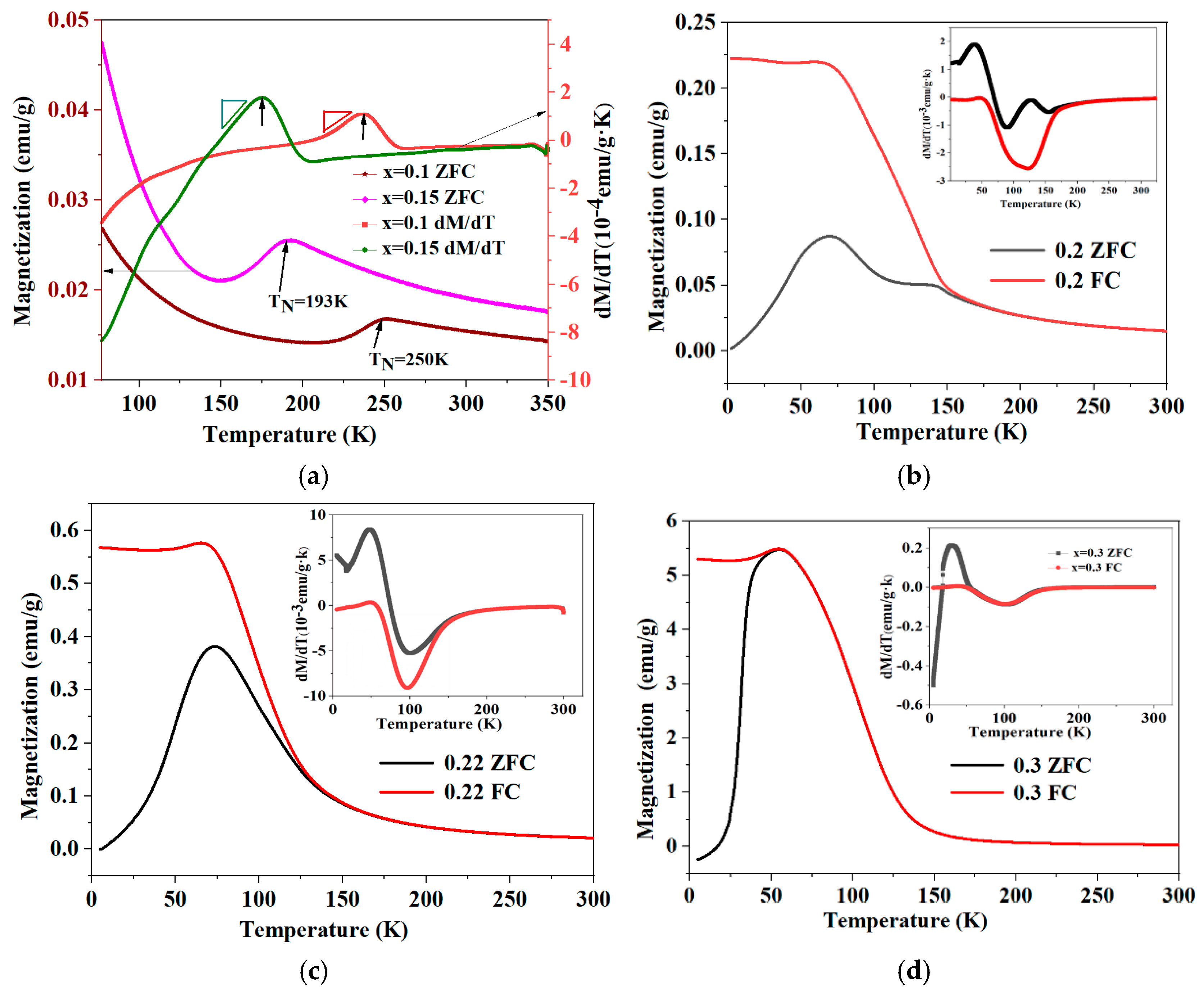
The zero-field-cooled (ZFC) magnetizations as a function of temperature for all samples in a 500 Oe magnetic field are illustrated in Figure 5. The host material Mn3Cu0.5Ge0.5N undergoes an antiferromagnetic (AFM) to paramagnetic (PM) phase transition at around 320 K [37]. With increasing carbon content from 0.1 to 0.15, the Néel temperature (TN) derived from the ZFC curves decreases from 250 K to 193 K. This trend is according to the observed negative thermal expansion (NTE) behavior. The temperature-dependent magnetization change rate (dM/dT) of Mn3Cu0.5Ge0.5N1−xCx (x = 0.1, 0.15) was examined, with the results depicted in Figure 5a. As indicated by the slope markers within the NTE temperature range, the average absolute values of the dM/dT increase with the elevation of carbon content. Specifically, the values are 0.77 and 1.17 corresponding to carbon contents of 0.1 and 0.15, respectively. Consequently, as shown in Figure 2a, the NTE behavior is gradually attenuated, and near zero thermal expansion (near-ZTE) behavior emerges when the carbon content reaches 0.22. The experimental findings reveal that the NTE performance of Mn3Cu0.5Ge0.5N1−xCx is significantly regulated by the dM/dT, which is essentially associated with the carbon doping.
Two magnetic transitions are observed in the magnetization-temperature (M-T) curve of Mn3Cu0.5Ge0.5N0.8C0.2 (in Figure 5b) occurring approximately at 150 K and 75 K, respectively. The high-temperature transition is consistent with the onset of negative thermal expansion. The low temperature transition is only 20 K for Mn3Cu0.5Ge0.5N [37]. Compared to the sample with x = 0.2, carbon doping increases the low-temperature transition temperature whereas it decreases the high-temperature one. As shown in Figure 5c, no high-temperature transition peak is visible in ZFC curves for x = 0.22 and 0.3, indicating that the AFM interactions diminish while ferromagnetic (FM) order gradually strengthens with increasing carbon content. Therefore, carbon doping in the Mn3Cu0.5Ge0.5N1−xCx causes the magnetic orders to gradually evolve from short-range to long-range.
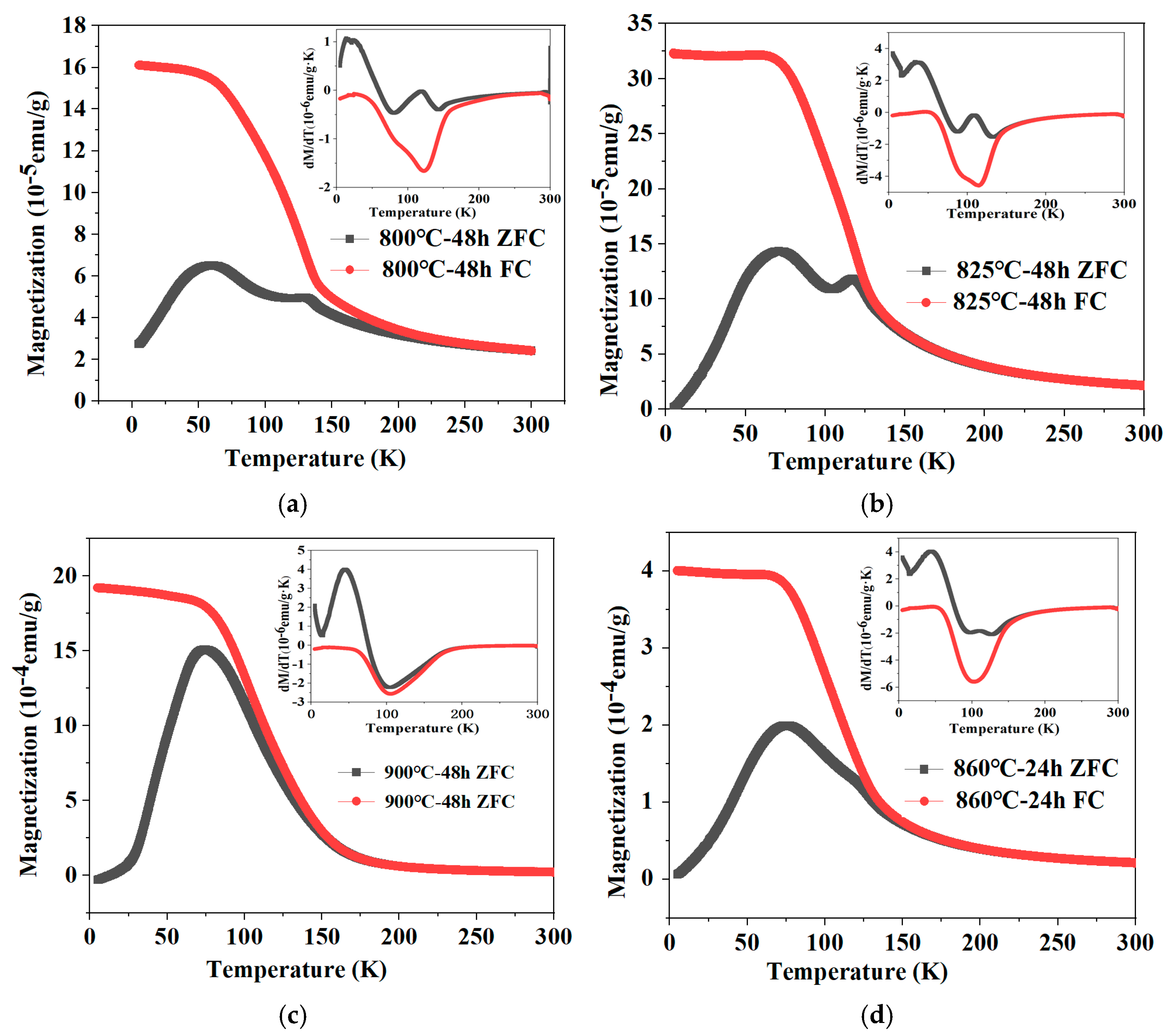
Figure 6 displays the temperature-dependence of the magnetization of the Mn3Cu0.5Ge0.5N0.78C0.22 compounds sintered under different conditions (500 Oe applied field). Two magnetic transitions are observed prior to the emergency of ZTE behavior from the magnetization–temperature (M-T) curve of Mn3Cu0.5Ge0.5N0.78C0.22. Their variation with sintering temperature resembles the effect of carbon content. It is inferred that these two magnetic transitions may be responsible for the ZTE behavior. Two AFM-like ordering transitions induce two episodes of negative thermal expansion (NTE). When these two NTE effects reach a balance, ZTE behavior is achieved. This balance can be tuned by adjusting carbon content or sintering parameters.
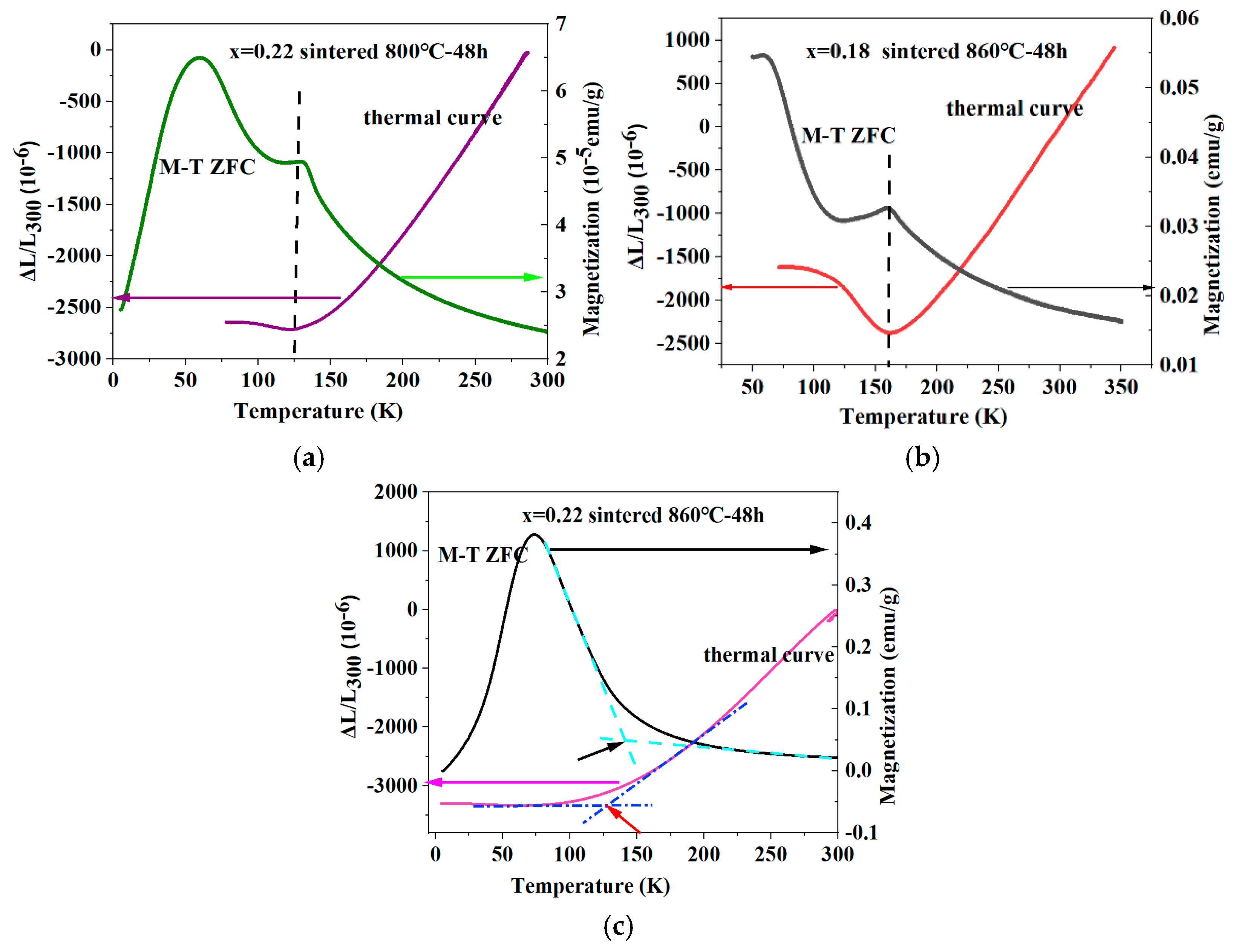
The data in Figure 7a indicate that the onset of a change in expansion behavior corresponds to the magnetic phase transition point at high temperature. For the compound in Figure 7c, this transition point matches its Curie temperature, thereby revealing a strong coupling between thermal expansion and magnetic properties in the C-doped Mn3Cu0.5Ge0.5N1−xCx system.

4. Discussion

The magnetic phase transition activation energy of Mn3(Cu1−x Gex)N compounds is relatively low (on a few tens of kJ/mol), making it highly susceptible to external perturbations such as magnetic fields and thermal fluctuations [38]. Therefore, carbon content and sintering process can effectively tune both magnetic transition and thermal expansion behavior. Below the Néel temperature, the AFM state in Mn3(Cu1−xGex)N compounds contains a minor fraction of canted weak ferromagnetic (Canted FM) components, implying a competitive interaction between antiferromagnetism and canted ferromagnetism [39]. Carbon doping can efficiently adjust magnetic order, driving it from AFM + canted FM toward pure AFM and further to FM at the cryogenic regime, namely, the carbon substitution for N induces ferromagnetic ordering. Further verification of this process will require more detailed magnetic measurements.
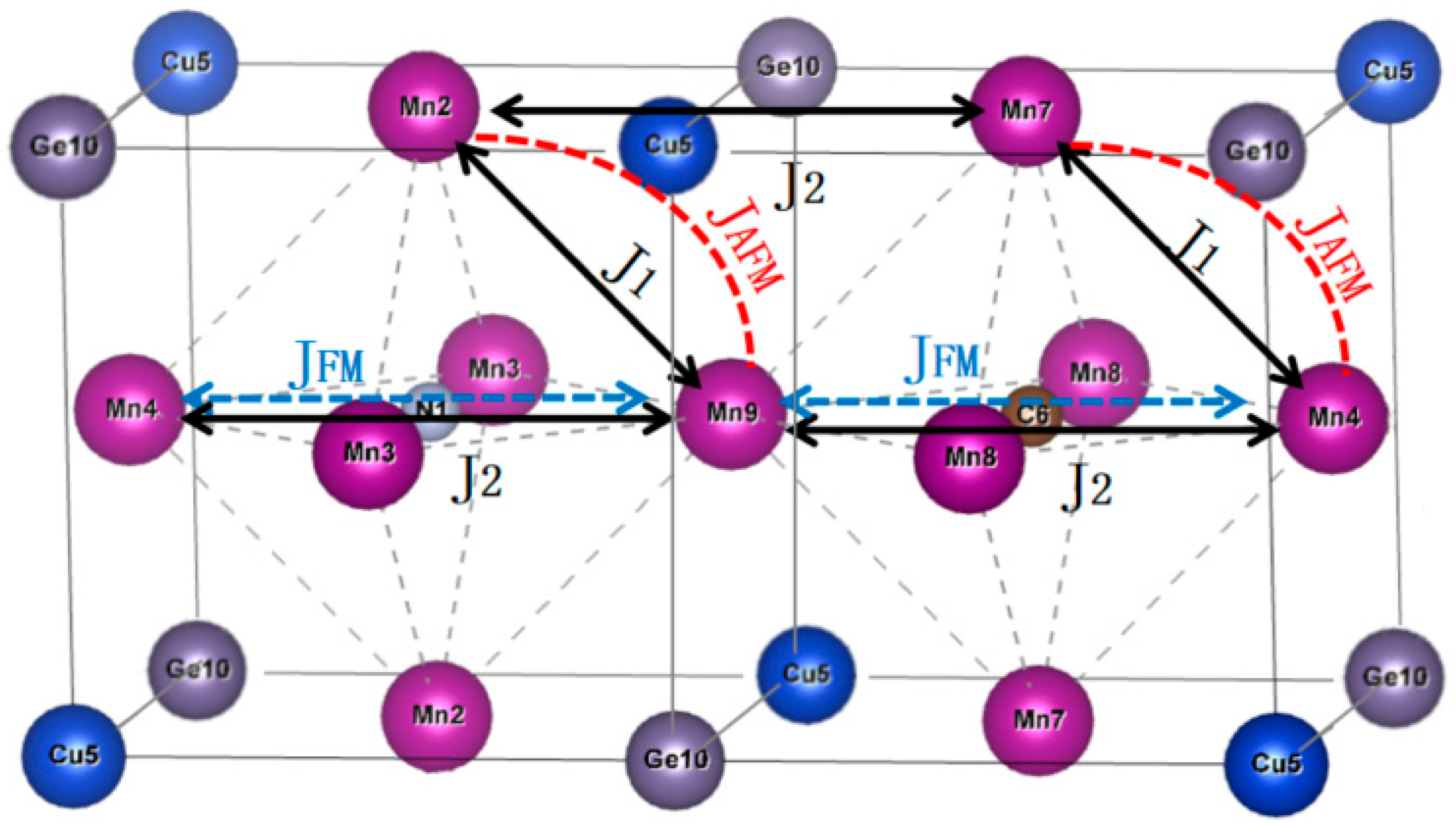
As shown in Figure 1, the lattice constant decreases with increasing carbon doping, despite the larger atomic radius of N compared to C. Owing to the influence of magnetic order on crystal structure, the lattice parameter of FM phase in Mn3AlN is larger than that of PM phase. This indicates a coupling between magnetic order and structure. Neutron diffraction studies reveal that Mn3(Cu1−xGex)N compounds adopt an antiferromagnetic triangular Γ5g spin structure, where nearest-neighbor Mn atoms exhibit antiferromagnetic interactions while the next-nearest-neighbor Mn atoms show ferromagnetic interactions (Figure 8). The magnetism of this antiferromagnetic Γ5g spin structure is unstable under the influence of external conditions. As carbon doping reduces the lattice parameter, as displayed in Figure 8, the interaction between next-nearest-neighbor Mn atoms (e.g., Mn4–C–Mn9) is enhanced, which is consistent with their ferromagnetic coupling nature. With increasing carbon doping concentration, the ferromagnetic interactions between next-nearest-neighbor Mn atoms strengthen further.
In antiperovskite Mn3AN compounds, the 2p orbitals of the central location N atoms and the neighboring 3d orbitals of the corner-site Mn atoms hybridize to come into Mn3d-N2p bonds. Compared to N atoms (three 2p electrons), C atom (only two 2p electrons), supplies fewer electrons to the Mn3d-N2p hybridization. According to the hole-carrier-doping effect, this weakens the strength of paired Mn3d-N2p hybridization. The decrease in Néel temperatures may thus be ascribed to the reduction in the number of valence electrons upon partial replacement of N by C.
Mn3Cu0.5Ge0.5N compound achieves giant NTE by substituting Ge for Cu in Mn3CuN, acting as a “relaxant” to the sharp volume change associated with the magnetic transition. Compared to the ZTE property for Mn3Cu0.5Ge0.5N0.8 [18], Mn3Cu0.5Ge0.5N0.78C0.22 compound exhibits a broader operational temperature window (120 K) spanning a lower temperature range (5 K to 125 K). This distinction is primarily ascribed to carbon doping at the N site. These results confirm that N-site modifications (carbon doping or nitrogen deficiency) promote volume-change broadening in compounds such as Mn3Cu0.5Ge0.5N0.8, Mn3Cu0.5Ge0.5N0.78C0.22, Mn3Ga0.5Ge0.4Mn0.1N0.9C0.1, Mn3Zn0.4Sn0.6(N0.8C0.2), and Mn3(Cu0.4Sn0.5Mn0.1)(N0.9C0.1) compounds. In contrast, similar modifications do not affect the sharp volume change in Ge-free and Sn-free system like Mn3GaN1−x [18] and Mn3ZnN1−xCx [24]. Carbon doping at the N site can also tune the TCR in Mn3CuN1−xCx by inducing magnetic changes. In both Mn3ZnN1−xCx and Mn3CuN1−xCx, carbon doping induces magnetic changes [24,28] and alters crystal parameters with increasing carbon concentration. However, as shown in Figure 1, lattice parameters of Mn3Cu0.5Ge0.5N1−xCx decrease with carbon concentration increases, a trend also appears in the Mn3Cu0.6Ge0.4N1−xCx compound [27]. These contrasting effect of carbon doping at the N site on lattice parameters are similar to its impact on thermal expansion behaviors.
The above results demonstrate that Ge and Sn can “relax” the volume change without N-site assistance. Local lattice distortions associated with thermal expansion may be tailored by trace carbon doping. While N-site doping induce magnetic changes in Mn3ZnN1−xCx, Mn3CuN1−xCx, and Mn3GaN1−x compounds, it cannot effectively tune the thermal expansion temperature range in the absence of A-site dopants like Ge or Sn. Therefore, it is rational that the broadening of the ZTE temperature range in the antiperovskite Mn3Cu0.5Ge0.5N0.78C0.22 compound can be reasonably attributed to local structural instability induced by the co-doping of Ge and C.5. Conclusions
In summary, we synthesized antiperovskite Mn3Cu0.5Ge0.5N1−xCx compounds and investigated their crystal structure, thermal expansion, magnetic, and mechanical properties.In summary, The Mn3Cu0.5Ge0.5N0.78C0.22 compound exhibits valuable low-temperature near-ZTE behavior over a 120 K temperature range, accompanied by good mechanical properties. Two magnetic transitions are observed in its magnetization-temperature (M-T) curve prior to the emergency of near-ZTE behavior. These two magnetic transitions likely drive the ZTE behavior. Specifically, two AFM-like ordering events induce two episodes of NTE. When these two NTE effects reach a balance, ZTE behavior is achieved. This balance can be tuned by carbon content or sintering parameters. The decrease in Néel temperatures may be ascribed to the reduction in the number of valence electrons count upon partial substitution of N by C. It is rational to suggest that the broadening of the ZTE temperature range in the antiperovskite Mn3Cu0.5Ge0.5N0.78C0.22 compound is related to the help of A-site chemical elementsMeanwhile, carbon, occupying only two 2p electrons, lowers the NTE or ZTE onset temperature. Doping at the N site proves effective in tailoring the properties of antiperovskite Mn3AX materials for potential future applications.

Author Contributions

Conceptualization, Y.D. and Z.S.; methodology, Y.D. and C.H.; software, H.Z.; validation, C.H., Z.S. and Z.H.; formal analysis, Y.D.; investigation, Z.H.; resources, Y.D.; data curation, Z.H.; writing—original draft preparation, Z.H.; writing—review and editing, Y.D. and Z.S.; visualization, C.H. and H.Z.; supervision, Y.D.; project administration, Z.S.; funding acquisition, Y.D. All authors have read and agreed to the published version of the manuscript.

Funding

This work was supported by the Tianjin Natural Science Foundation Project (22JCYBJC01660) and the Key Projects of the Tianjin Education Commission’s Research Program (2022ZD028).

Data Availability Statement

The data used to support the findings of this study are available from the corresponding author upon request. The datasets presented in this article as they are part of ongoing studies which have not yet been published. Requests for access to the datasets should be directed to the corresponding author. Each request will be considered on a case-by-case basis after evaluating all relevant factors, including the status of related research works and any applicable restrictions.

Conflicts of Interest

Author Z. Sun was employed by Hangzhou Guillaume Technology Service Co., Ltd. The remaining authors declare that the research was conducted in the absence of any commercial or financial relationships that could be construed as a potential conflict of interest.

References

  1. Sleight, A.J.N. Zero-expansion plan. Nature 2003, 425, 674–676. [Google Scholar] [CrossRef]
  2. Dong, B.K.; Wei, C.L.; Lin, J.C.; Xie, L.L.; Liu, K.K.; Xiong, T.J.; Song, W.H.; Tong, P.; Sun, Y.P. Technology, A biomimetic aluminum composite exhibiting gradient-distributed thermal expansion, high thermal conductivity, and highly directional toughness. Mater. Sci. Technol. 2025, 213, 90–97. [Google Scholar] [CrossRef]
  3. Zhou, Y.; Zhang, L.; Qian, J.; Qian, Z.; Hao, B.; Cong, Q.; Zhou, C. Sintering Temperature Effect of Near-Zero Thermal Expansion Mn3Zn0.8Sn0.2N/Ti Composites. Materials 2023, 16, 5919. [Google Scholar] [CrossRef]
  4. Zhou, Y.; Wu, Y.; Wang, L.; Qian, J.; Fu, L.; Pei, Y.; Zhong, S.; Zhou, C.; Zhang, Q. Residual stress regulation optimization of plastic and near-zero thermal expansion composite. Acta Mater. 2025, 288, 120881. [Google Scholar] [CrossRef]
  5. Yu, C.; Lin, K.; Zhang, Q.; Zhu, H.; An, K.; Chen, Y.; Yu, D.; Li, T.; Fu, X.; Yu, Q.; et al. An isotropic zero thermal expansion alloy with super-high toughness. Nat. Commun. 2024, 15, 2252. [Google Scholar] [CrossRef]
  6. Luo, J.; Zou, K.; Wang, B.; Yuan, X.; An, S.; Ma, Z.; Shi, K.; Deng, S.; Xu, J.; Yin, W.; et al. Zero Thermal Expansion Behavior in High-Entropy Anti-Perovskite Mn3Fe0.2Co0.2Ni0.2Mn0.2Cu0.2N. Adv. Funct. Mater. 2024, 34, 2410608. [Google Scholar] [CrossRef]
  7. Hu, T.; Qiao, Y.; Li, M.; Fan, W.; Guo, J.; Xu, M.; Gao, Q. Tunable thermal expansion from positive, zero to negative in RbMgInMo3O12 with NASICON structure. Appl. Phys. Lett. 2025, 126, 202201. [Google Scholar] [CrossRef]
  8. Wang, Q.; Qiao, Y.; Zhao, K.; Zhang, P.; Zhao, H.; Guo, J.; Shi, X.; Liang, E.; Gao, Q. Zero thermal expansion in KxMnxIn2-x (MoO4)3 based materials. Acta Mater. 2024, 281, 120358. [Google Scholar] [CrossRef]
  9. Hu, T.; Qiao, Y.; Hu, Y.; Su, Z.; Guo, J.; Shi, X.; Chao, M.; Guo, J.; Wei, B.; Gao, Q. Near-zero thermal expansion of GeNb18O47 ceramic. Ceram. Int. 2024, 50, 15702–15708. [Google Scholar] [CrossRef]
  10. Chen, Z.; Jiao, Y.; Zhao, K.; Zhao, S.; Wang, J.; Sun, Q.; Gao, Q. Zero Thermal Expansion in NiPt(CN)6. Prog. Nat. Sci. Mater. Int. 2024, 34, 643–647. [Google Scholar] [CrossRef]
  11. Guo, J.; Fang, M.; Liu, Q.; Ren, X.; Qiao, Y.; Chao, M.; Liang, E.; Gao, Q. Zero thermal expansion in Cs2W3O10. Chin. Chem. Lett. 2024, 35, 108957. [Google Scholar] [CrossRef]
  12. Yu, C.; Lin, K.; Chen, X.; Jiang, S.; Cao, Y.; Li, W.; Chen, L.; An, K.; Chen, Y.; Yu, D. Superior zero thermal expansion dual-phase alloy via boron-migration mediated solid-state reaction. Chin. Chem. Lett. 2023, 14, 3135. [Google Scholar] [CrossRef]
  13. Li, S.; Huang, R.; Zhao, Y.; Wang, W.; Han, Y.; Li, L. Zero thermal expansion achieved by an electrolytic hydriding method in La (Fe, Si)13 compounds. Adv. Funct. Mater. 2017, 27, 1604195. [Google Scholar] [CrossRef]
  14. Zhao, C.; Wang, J.; Sun, Q.; Gao, Q. Negative thermal expansion of two-dimensional materials: A review. Nano Res. 2025, 18, 94908155. [Google Scholar] [CrossRef]
  15. Hu, D.; Shi, K.; Sun, Y.; Colin, C.V.; Deng, S.; An, S.; Ma, Z.; Bordet, P.; Wang, C. Effect of Fe-doping on magnetic structures and “spin-lattice-charge” strong correlation properties in Mn3Sn1-xFexC compounds. J. Alloys Compd. 2025, 1010, 177489. [Google Scholar] [CrossRef]
  16. Sobukawa, Y.; Yasuda, T.; Amemiya, K.; Suemasu, T. Magnetic compensation and preferential substitution site for Ag in Mn4−xAgxN epitaxial thin films. Phys. Rev. Mater. 2025, 9, 064408. [Google Scholar] [CrossRef]
  17. Ma, Z.; Sun, Y.; Lu, H.; Shi, K.; Deng, S.; Yuan, X.; Hao, W.; Du, Y.; Xia, Y.; Fang, L.; et al. Noncoplanar antiferromagnetism induced zero thermal expansion behavior in the antiperovskite Mn3Sn0.5Zn0.5Cx. Phycical Rev. 2023, 107, 094412. [Google Scholar] [CrossRef]
  18. Zeng, M.; MacLaren, D.; Boldrin, D. Improving barocaloric properties by tailoring transition hysteresis in Mn3Cu1−uSnxN Antiperovskites. J. Phys. Energy 2023, 5, 024018. [Google Scholar]
  19. Yan, Y.; Cao, Y.; Wang, Z.; Wang, K.; Ren, H.; Zhang, S.; Wang, Y.; Chen, J.; Zhou, Y.; Liu, L.; et al. Asymmetric orbital hybridization in Zn-doped antiperovskite Cu1−xZnxNMn3 enables highly efficient electrocatalytic hydrogen production. J. Energy Chem. 2024, 89, 304–312. [Google Scholar] [CrossRef]
  20. Torres-Amaris, D.; Bautista-Hernandez, A.; González-Hernández, R.; Romero, A.H.; Garcia-Castro, A.C. Anomalous Hall conductivity control in Mn3NiN antiperovskite by epitaxial strain along the kagome plane. Phys. Rev. B 2022, 106, 195113. [Google Scholar] [CrossRef]
  21. Miao, Z.; Guo, X.; Yang, G.; Wang, N.; Li, J. The spin-glass-like behavior in antiperovskite Mn3AgN. J. Appl. Phys. 2024, 136, 055104. [Google Scholar] [CrossRef]
  22. You, Y.; Bai, H.; Chen, X.; Zhou, Y.; Zhou, X.; Pan, F.; Song, C. Room temperature anomalous Hall effect in antiferromagnetic Mn3SnN films. Appl. Phys. Lett. 2020, 117, 222404. [Google Scholar] [CrossRef]
  23. Kong, H.; Guo, Y.; Yao, Y.; Liu, W.; Yang, Z. Temperature-Dependent Valence Electron Structures and Properties of the Antiperovskite Compound Mn3Ni1−xAgxN. Phys. B Condens. Matter 2025, 718, 417937. [Google Scholar] [CrossRef]
  24. Nakamura, Y.; Takenaka, K.; Kishimoto, A.; Takagi, H. Mechanical Properties of Metallic Perovskite Mn3Cu0.5Ge0.5N: High-Stiffness Isotropic Negative Thermal Expansion Material. J. Am. Ceram. Soc. 2009, 92, 2999–3003. [Google Scholar] [CrossRef]
  25. Song, X.; Sun, Z.; Huang, Q.; Rettenmayr, M.; Liu, X.; Seyring, M.; Li, G.; Rao, G.; Yin, F. Adjustable zero thermal expansion in antiperovskite manganese nitride. Adv. Mater. 2011, 23, 4690. [Google Scholar] [CrossRef]
  26. Tan, J.; Huang, R.; Wang, W.; Li, W.; Zhao, Y.; Li, S.; Han, Y.; Huang, C.; Li, L. Broad negative thermal expansion operation-temperature window in antiperovskite manganese nitride with small crystallites. Nano Res. 2015, 8, 2302–2307. [Google Scholar] [CrossRef]
  27. Lin, J.C.; Tong, P.; Zhou, X.J.; Lin, H.; Ding, Y.W.; Bai, Y.X.; Chen, L.; Guo, X.G.; Yang, C.; Song, B.; et al. Giant negative thermal expansion covering room temperature in nanocrystalline GaNxMn3. Appl. Phys. Lett. 2015, 107, 131902. [Google Scholar] [CrossRef]
  28. Takenaka, K.; Takagi, H. Zero thermal expansion in a pure-form antiperovskite manganese nitride. Appl. Phys. Lett. 2009, 94, 131904. [Google Scholar] [CrossRef]
  29. Dai, Y.; Song, X.; Huang, R.; Li, L.; Sun, Z. Effect of Si doping on structure, thermal expansion and magnetism of antiperovskite manganese nitrides Mn3Cu1−xSixN. Mater. Lett. 2015, 139, 409–413. [Google Scholar] [CrossRef]
  30. Dai, Y.; Huang, R.; Wang, W.; Li, L.; Sun, Z. Near zero thermal expansion in Ge-doped Mn3GaN compounds. Ceram. Int. 2017, 43, 1608–1611. [Google Scholar] [CrossRef]
  31. Dai, Y.; Li, C.; Zhang, X.; Peng, H.; Sun, Z. Effect of Sn doping on the structure, magnetism and thermal expansion of Mn3Ga1−xSnxN (x = 0.1, 0.3, 0.5 and 0.7) compounds. Appl. Phys. A 2017, 123, 743. [Google Scholar] [CrossRef]
  32. Huang, R.J. Studies on the Thermophysical Properties of Doped Manganese Nitride Negative Thermal Expansion Materials at Cryogenic Temperature. Ph.D. Thesis, Institute of Physics and Chemistry, Chinese Academy of Sciences, Beijing, China, 2009. [Google Scholar]
  33. Cherrad, D.; Maouche, D.; Louail, L.; Maamache, M. Ab initio comparative study of the structural, elastic and electronic properties of SnAMn3 (A = N, C) antiperovskite cubic compounds. Solid State Commun. 2010, 150, 782–787. [Google Scholar] [CrossRef]
  34. Kaneko, T.; Kanomata, T.; Shirakawa, K. Pressure effect on the magnetic transition temperatures in the intermetallic compounds Mn3MC (M = Ga, Zn and Sn). J. Phys. Soc. Jpn. 1987, 56, 4047–4055. [Google Scholar] [CrossRef]
  35. Sun, Y.; Guo, Y.; Tsujimoto, Y.; Yang, J.; Shen, B.; Yi, W.; Matsushita, Y.; Wang, C.; Wang, X.; Li, J.; et al. Carbon-induced ferromagnetism in the antiferromagnetic metallic host material Mn3ZnN. Inorg. Chem. 2013, 52, 800–806. [Google Scholar] [CrossRef]
  36. Lin, J.C.; Tong, P.; Lin, S.; Wang, B.S.; Song, W.H.; Sun, Y.P. Continuously tunable temperature coefficient of resistivity in antiperovskite AgN1−xCxMn3 (0 ≤ x ≤ 0.15). Appl. Phys. 2014, 116, 213912. [Google Scholar] [CrossRef]
  37. Takenaka, K.; Takagi, H. Giant negative thermal expansion in Ge-doped anti-perovskite manganese nitrides. Appl. Phys. Lett. 2005, 87, 261902. [Google Scholar] [CrossRef]
  38. Zhang, C.Y. Fabrication and Physical Properties of Antiperovskite Mn3(Cu1−xGex)N Negative Thermal Expansion Compounds. Ph.D. Thesis, University of Science and Technology Beijing, Beijing, China, 2010. [Google Scholar]
  39. Iikubo, S.; Kodama, K.; Takenaka, K.; Takagi, H.; Shamoto, S. Magnetovolume effect in Mn3Cu1−xGexN related to the magnetic structure:Neutron powder diffraction measurements. Phys. Rev. B 2008, 77, R020409. [Google Scholar] [CrossRef]
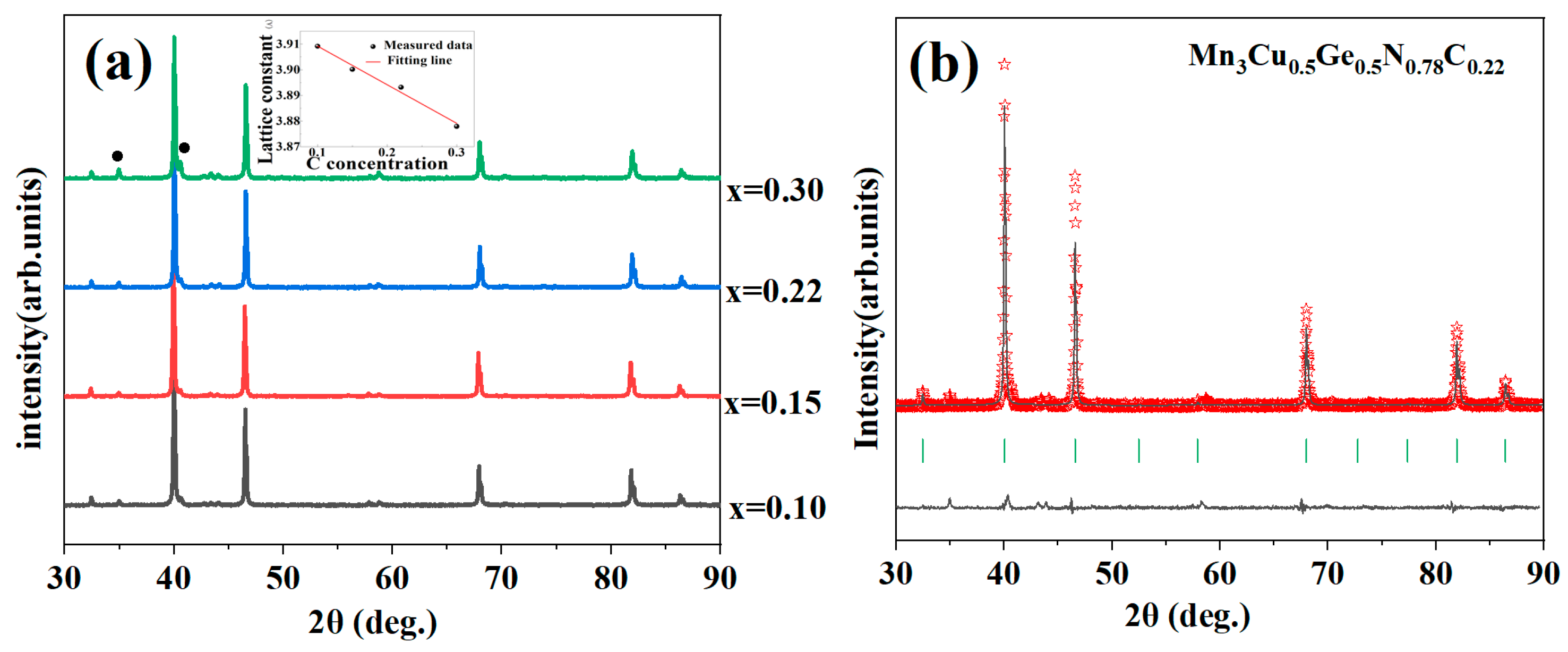
Figure 1. The crystal structure of Mn3Cu0.5Ge0.5N1−xCx (x = 0.1, 0.15, 0.22, and 0.3): (a) Room-temperature X-ray diffraction patterns of Mn3Cu0.5Ge0.5N1−xCx (x = 0.1, 0.15, 0.22 and 0.3), the inset illustrates the lattice constant as a function of C content; (b) Rietveld refinement of Mn3Cu0.5Ge0.5N0.78C0.22 XRD pattern. The red asterisks are the experimental data points, the gray line is the calculated fit, the black line is the difference curve, and the green lines are the Bragg positions.
Crystals 16 00041 g001
Figure 2. Thermal expansion properties of Mn3Cu0.5Ge0.5N1−xCx compounds: (a) Linear thermal expansion of Mn3Cu0.5Ge0.5N1−xCx (x = 0.1, 0.15, 0.22, and 0.3) as a function of temperature. The gray, pink, and blue shaded areas represent the NTE temperatures for x = 0.1, x = 0.15, x = 0.22, respectively); (b) Thermal expansion curve of Mn3Cu0.5Ge0.5N0.78C0.22 over the temperature range of 5 K to 300 K. The intersection point of the dashed line corresponds to the onset temperature of near-ZTE; (c) Variable-temperature XRD patterns, focusing on the (111) crystallographic plane. The red arrow denotes the change in lattice parameters by pointing to the highest peaks; (d) Lattice parameters as a function of temperature.
Crystals 16 00041 g002aCrystals 16 00041 g002b
Figure 3. Linear thermal expansion of Mn3Cu0.5Ge0.5N0.78C0.22 as a function of temperature: (a) Effect of sintering temperature (800 °C, 860 °C, 900 °C) with a fixed holding time of 48 h. (b) Effect of holding time (24 h, 48 h, 72 h) at a fixed sintering temperature of 860 °C.
Crystals 16 00041 g003
Figure 4. Top view of the Vickers indentation trace of near-ZTE Mn3Cu0.5Ge0.5N0.78C0.22. The indentation load was fixed at 9.8 N.
Crystals 16 00041 g004
Figure 5. Temperature dependence of the magnetization of the Mn3Cu0.5Ge0.5N1−xCx compounds measured in an applied magnetic field of 500 Oe. (a) Magnetization curves for Mn3Cu0.5Ge0.5N1−xCx with x = 0.1 and 0.15. The hypotenuse of the right-angled triangle represents the rate of change in the magnetization on the side with negative thermal expansion, indicating the magnitude of its change; (b) Magnetization for x = 0.2; (c) Magnetization for x = 0.22; (d) Magnetization for x = 0.3. Panels (bd) contain insets depicting the temperature dependence of dM/dT.
Crystals 16 00041 g005
Figure 6. Temperature dependence of the magnetization of Mn3Cu0.5Ge0.5N0.78C0.22 compounds sintered under different conditions in an applied magnetic field of 500 Oe. (a) 800 °C for 48 h; (b) 825 °C for 48 h (c) 900 °C for 48 h; (d) 860 °C for 24 h.
Crystals 16 00041 g006
Figure 7. Correlation between magnetic transitions and thermal expansion properties: (a) x = 0.22, sintered at 800 °C for 48 h; (b) x = 0.18, sintered at 860 °C for 48 h; (c) x = 0.22, sintered at 860 °C for 48 h. The intersection point of the dark blue dashed line indicates the onset temperature of near-zero thermal expansion (ZTE), while the intersection point of the light blue dashed line indicates the Curie temperature (TC).
Crystals 16 00041 g007
Figure 8. Schematic illustration of magnetic orders in the Mn3Cu0.5Ge0.5N1−xCx.
Crystals 16 00041 g008
Table 1. The carbon content in the Mn3Cu0.5Ge0.5N1−xCx compound.
Designed CompositionActual Number of Carbon AtomsWt%Preparation Process
Mn3Cu0.5Ge0.5N0.9C0.10.13070.6350%860 °C + 48 h
Mn3Cu0.5Ge0.5N0.78C0.220.23011.1245%860 °C + 48 h
Mn3Cu0.5Ge0.5N0.78C0.220.22671.1040%860 °C + 24 h
Mn3Cu0.5Ge0.5N0.78C0.220.23671.1529%800 °C + 48 h
Mn3Cu0.5Ge0.5N0.7C0.30.33011.5904%860 °C + 48 h
Disclaimer/Publisher’s Note: The statements, opinions and data contained in all publications are solely those of the individual author(s) and contributor(s) and not of MDPI and/or the editor(s). MDPI and/or the editor(s) disclaim responsibility for any injury to people or property resulting from any ideas, methods, instructions or products referred to in the content.