Article

The Modulated Hot Spot Formation of Void Defects During Laser Initiation in RDX Energetic Crystals


1
School of Integrated Circuits, Chongqing University of Posts and Telecommunications, Chongqing 400065, China
2
School of Electronic Science and Engineering, Chongqing University of Posts and Telecommunications, Chongqing 400065, China
3
School of Physics, University of Electronic Science and Technology of China, Chengdu 611731, China
4
Institute of Chemical Materials, China Academy of Engineering Physics, Mianyang 621900, China
5
Research Center of Laser Fusion, China Academy of Engineering Physics, Mianyang 621900, China
6
Key Laboratory of Big Data Intelligent Computing, Chongqing University of Posts and Telecommunications, Chongqing 400065, China
*
Authors to whom correspondence should be addressed.
Crystals 2026, 16(1), 27; https://doi.org/10.3390/cryst16010027 (registering DOI)
Submission received: 23 November 2025 / Revised: 21 December 2025 / Accepted: 26 December 2025 / Published: 30 December 2025
(This article belongs to the Section Inorganic Crystalline Materials)

Abstract

The interaction between laser irradiation and energetic materials is critically influenced by microstructural void defects that determine local energy deposition and initiation sensitivity. In this work, a three-dimensional finite-difference time-domain (3D-FDTD) method was employed to investigate the modulation effects of void defects on optical field distributions and hot spot formation in RDX energetic crystals. The influences of void geometry, spatial position, and void number on the modulation of the incident laser beam were systematically analyzed. It reveals that void defects exhibit strong focusing and scattering behavior, leading to localized high-intensity regions both inside RDX bulk crystals and in void defects. For a single void defect, increasing either the width or depth can significantly enhance the peak electric field and thus the laser sensitivity of RDX crystals. When two voids are present, the number of high-intensity spots first increases and then decreases with increasing separation distance, and the strongest modulation effects are obtained at separations of 0.75λ–3λ. Furthermore, as the number of void defects increases, the modulation effect intensifies, promoting the formation of more hot spots. These findings provide quantitative insight into how void structures govern laser–matter interactions in energetic crystals, offering guidance for understanding and controlling laser initiation behavior.

1. Introduction

Energetic materials [1,2,3], serving as the power and energy source for weapons and equipment, are fundamental to advancing the national defense industry and play a crucial role in accelerating the modernization of national defense and military technology. Hot spot theory [4], first introduced by F. P. Bowden and A. D. Yoffe, has been extensively adopted and is considered fundamental to understanding the initiation mechanisms of condensed-phase energetic materials under external stimuli [5,6,7]. Generally, a hot spot [8,9] is characterized as a localized zone in which elevated temperatures are effectively concentrated to accelerate the local exothermic decomposition reaction and ultimately lead to the widespread deflagration and detonation of energetic materials. Although small relative to macroscopic scales, hot spots are still much larger than molecular dimensions, typically exhibiting dimensions of 0.1 to 10 μm, lifetimes on the order of 10−5–10−3 seconds, and peak temperatures exceeding 700 K [10,11].
Currently, extensive research has been conducted on the generation of hot spots in energetic materials to elucidate their influence on initiation sensitivity. It is widely recognized that the initiation or detonation of energetic materials typically originates at sites containing microdefects, such as pores [12], voids [13,14,15], cracks [16], scratches [17], and internal defects [18], where energy localization facilitates the formation of hot spots. For example, H. S. Udaykumar et al. investigated the effect of microstructures, including voids and pores, on energy localization in pressed HMX by using direct numerical simulations and molecular dynamics simulations. It is found that void morphology, particularly in terms of orientation and aspect ratio, has a significant influence on hot spot characteristics during shock initiation. Parameterizing complex void morphologies yields a favorable agreement on reaction rates between direct numerical simulations and meso-informed ignition and growth models. Furthermore, the intricate details of highly complex void shapes substantially impact hotspot characteristics. The molecular dynamics-guided modified Johnson–Cook strength model can capture key aspects of the physics of shock-induced localization in HMX, including the pore collapse mechanism and rate; shear band formation in the collapse zone; and temperature, strain, and stress fields in the hotspot zone and the surrounding material [14,19]. C. Coffelt et al. explored the effect of void positioning on the detonation sensitivity of PETN heterogeneous energetic materials by using three-dimensional mesoscale simulations. It indicated that voids exclusively within the grains cause the PBX to be more sensitive than voids in the polymer binder [13]. B. W. Hamilton et al. used molecular dynamics simulations to characterize shock-induced pore collapse and the subsequent formation of hot spots in TATB for various defect shapes, shock strengths, and crystallographic orientations. It also reveals the underlying molecular process that governs the effect of orientation and pore shape on the resulting hot spots [5]. These studies have indicated that microstructural features, including porosity, void size and shape, spatial distribution, and crystallographic orientation, significantly influence the formation and evolution of hot spots.
However, most existing research has primarily focused on shock wave initiation, whereas laser initiation [20,21,22] has recently emerged as one of the most promising approaches for inducing combustion, deflagration, or detonation in energetic materials. This growing interest arises from several inherent advantages of the laser initiation, including high safety, precise timing control, feasibility of multipoint initiation, and enhanced energy coupling efficiency. Consequently, laser initiation technology has been increasingly applied in both military and civilian domains. Understanding the formation of hot spots during laser interaction with energetic materials is thus essential for revealing the underlying initiation mechanisms. In this context, M. -W. Chen et al. investigated laser-induced hot spot formation in RDX single crystals irradiated by long-wavelength infrared (LWIR) lasers, employing thermal imaging microscopy to visualize the temperature evolution. Their results showed that hot spots preferentially developed beneath crystal planes oriented at oblique angles to the incident laser beam. Furthermore, under long-duration, low-intensity LWIR pulses, weakly absorbed wavelengths were found to generate hot spots more efficiently than strongly absorbed ones [23,24]. This study provided valuable insight into how laser energy propagates through energetic material crystals and leads to localized heating and initiation. Nevertheless, their work did not further examine the influence of microdefects, such as voids, dislocations, or inclusions, on the interaction between the incident laser and the crystal, nor on the subsequent hot spot formation. In fact, it is well established that defects play a crucial role in determining the initiation sensitivity of energetic materials by enhancing local energy deposition and thermal accumulation.
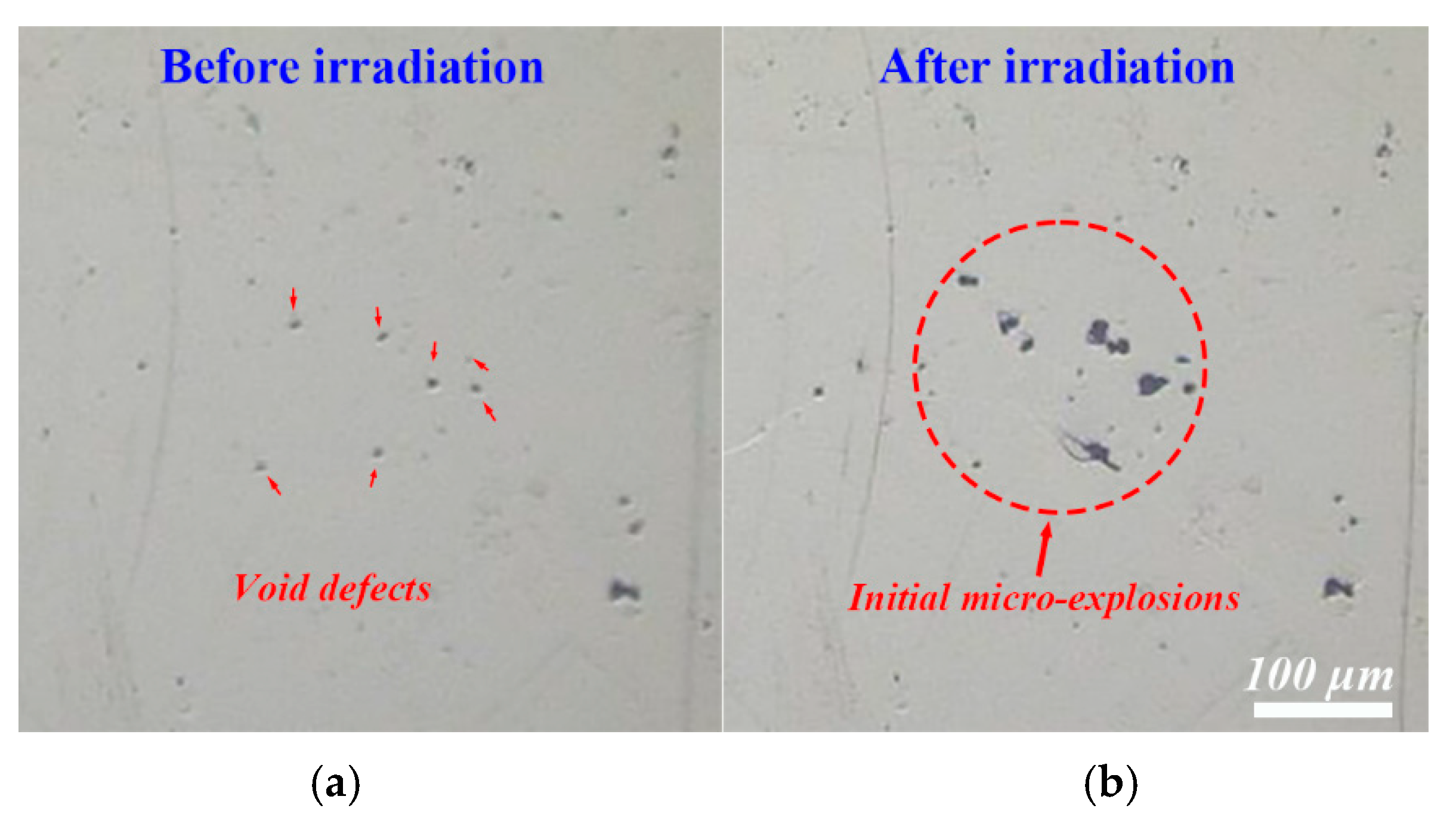
The finite-difference time-domain (FDTD) method [25,26] has become one of the important numerical methods of the electromagnetic field in complex media and for detailed geometries. Its applications span various fields, including biomedical engineering [27,28], geophysics [29,30], metamaterials [31,32], quantum technologies [33,34], plasmonics [35,36], and optics [37,38]. In our previous work, we demonstrated that scratch defects significantly influence the initiation of energetic materials. We systematically examined how their morphology and size affect laser modulation, hot spot formation, and initiation sensitivity by using the three-dimensional finite-difference time-domain (3D FDTD) method [17,39]. Beyond scratch defects, void defects represent another critical type of microdefect. Our recent experimental observations further reveal that void defects have a pronounced impact on laser initiation. As shown in Figure 1a, the arrows indicate the locations of void defects. After laser irradiation, laser-induced damage features [40], resulting from initial micro-explosions during the initiation process, are observed in the corresponding regions (Figure 1b). These results clearly indicate that initial micro-explosions frequently originate at or near void defect sites on the surfaces of energetic crystals when exposed to an incident laser beam. These findings underscore the need to further investigate the modulation effects of void defects on the incident laser and their impact on hot spot formation and laser sensitivity, which is central to understanding the interaction mechanisms between laser and energetic materials.
In this study, the hot spot formation of RDX crystals modulated by void defects during laser irradiation was explored by 3D FDTD simulation. The three-dimensional models of void defects with specific geometries were established based on the experimental atomic force microscopy (AFM, XE-100,Park Systems, Suwon, Republic of Korea) characterizations. The interaction between laser and RDX energetic crystal explosives containing void defects was analyzed using the 3D FDTD method, focusing on the electric-field modulation mechanism. This approach enables direct visualization of hot spot distributions within the RDX energetic materials.

2. Models and Simulation Methods

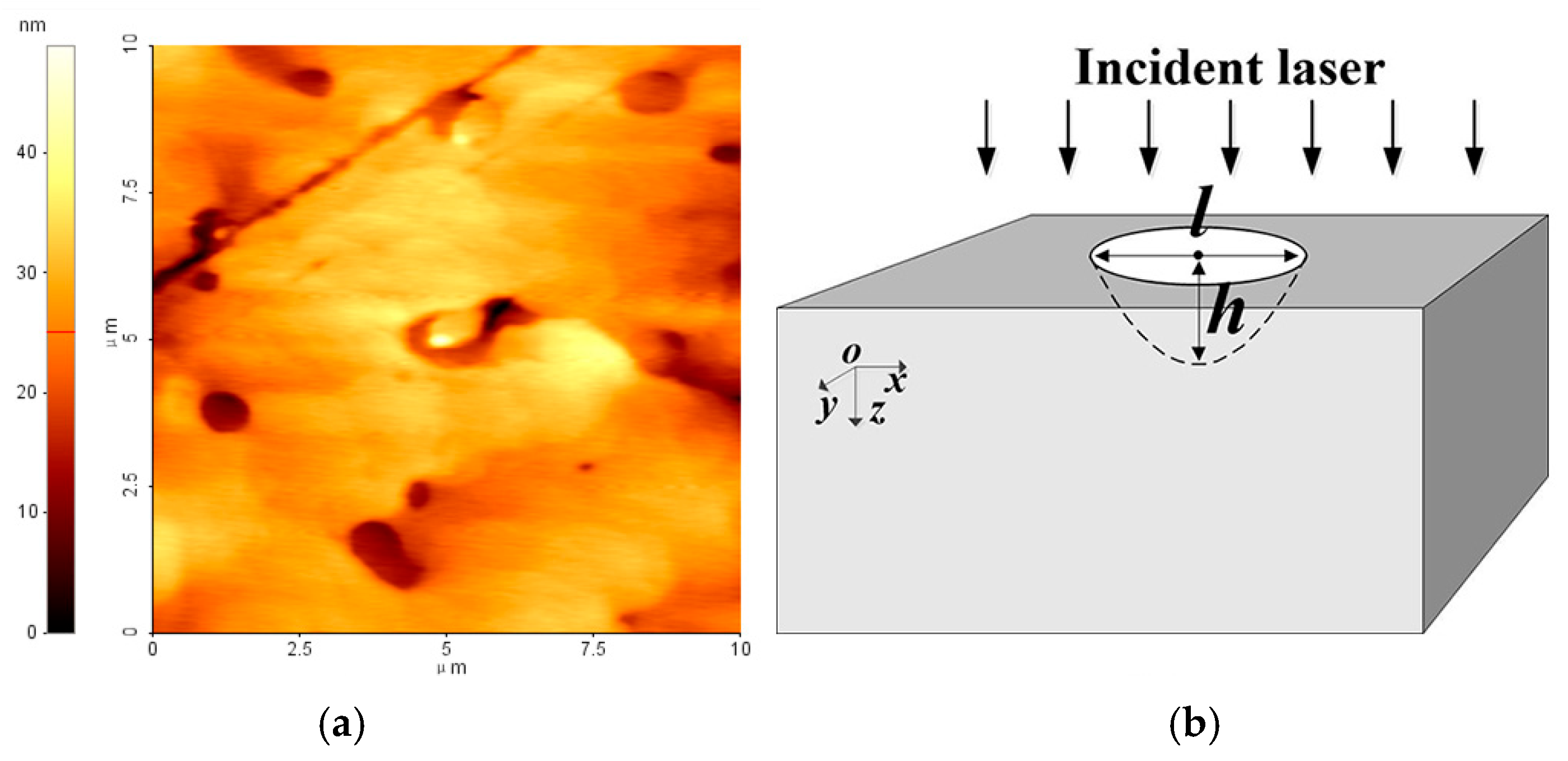
During the growth of energetic crystals, due to the changes of experimental conditions, such as the supersaturation of the solution and its destabilization, scratches and voids may be generated on the surface of the energetic materials. It will affect the surface smoothness of the explosives. Figure 2 shows the AFM images of RDX crystal surface morphologies. It is obvious that the sizes of defects are in the range of micron or submicron scales. The defects include the semi-closed voids. Based on the pictures in Figure 2a, the three-dimensional model of the void defect (Figure 2b) was constructed, and the equations in Cartesian coordinates are described as follows:
z     4 h l 2 [ ( x     x 0 ) 2   +   ( y     y 0 ) 2 ]   +   z 0   +   h z z 0
where (x0, y0, z0) is the coordinate of the symmetrical center of the input surface, l and h are the width and depth of the void defect, respectively. These void defects are located on the front surface of RDX crystal, as shown in Figure 2b.
The three-dimensional finite-difference time-domain (3D FDTD) method is employed to solve Maxwell’s curl equations by discretizing them in both the spatial and temporal domains using the difference scheme on the edges of a “Yee cell” [25]. This approach involves partitioning space and time into a regular grid, wherein the field values at the current time step are iteratively updated from those at previous time steps through a recursive time-marching algorithm.
In this work, the RDX crystal is modeled within a uniformly discretized cuboidal simulation domain of dimensions 200δ × 200δ × 215δ, where the grid spacing is defined as δ = λ/12 = 29.58 nm. This choice of discretization, being finer than λ/10, effectively mitigates numerical dispersion associated with differencing in the 3D FDTD scheme, thereby ensuring the accuracy of the simulation. The incident wavelength is λ = 355 nm, with relative dielectric constants (εr) of 4.7 for RDX [41] and 1.0 for the void defect (air). A continuous-wave plane wave laser source with a normalized amplitude of 1 V/m is introduced along the +z direction, normal to the crystal surface. To properly terminate the computational domain, Berenger’s perfectly matched layer (PML) absorbing boundary conditions [42] are imposed on the x–y transverse planes (vertical direction), while periodic boundary conditions are applied along the x–z and y–z transverse planes (horizontal directions). For a plane wave, the light intensity is proportional to the square of the electric field amplitude (|E|2), which is directly related to the electromagnetic energy density, expressed as 1/2ε0εr|E|2. Determining the spatial distribution of the electric field is therefore of critical importance, and the degree of light intensification can be quantitatively characterized by the light intensity enhancement factor (LIEF).

3. Results and Discussion

3.1. Single Void Defect

3.1.1. Effects of Void Defect Size

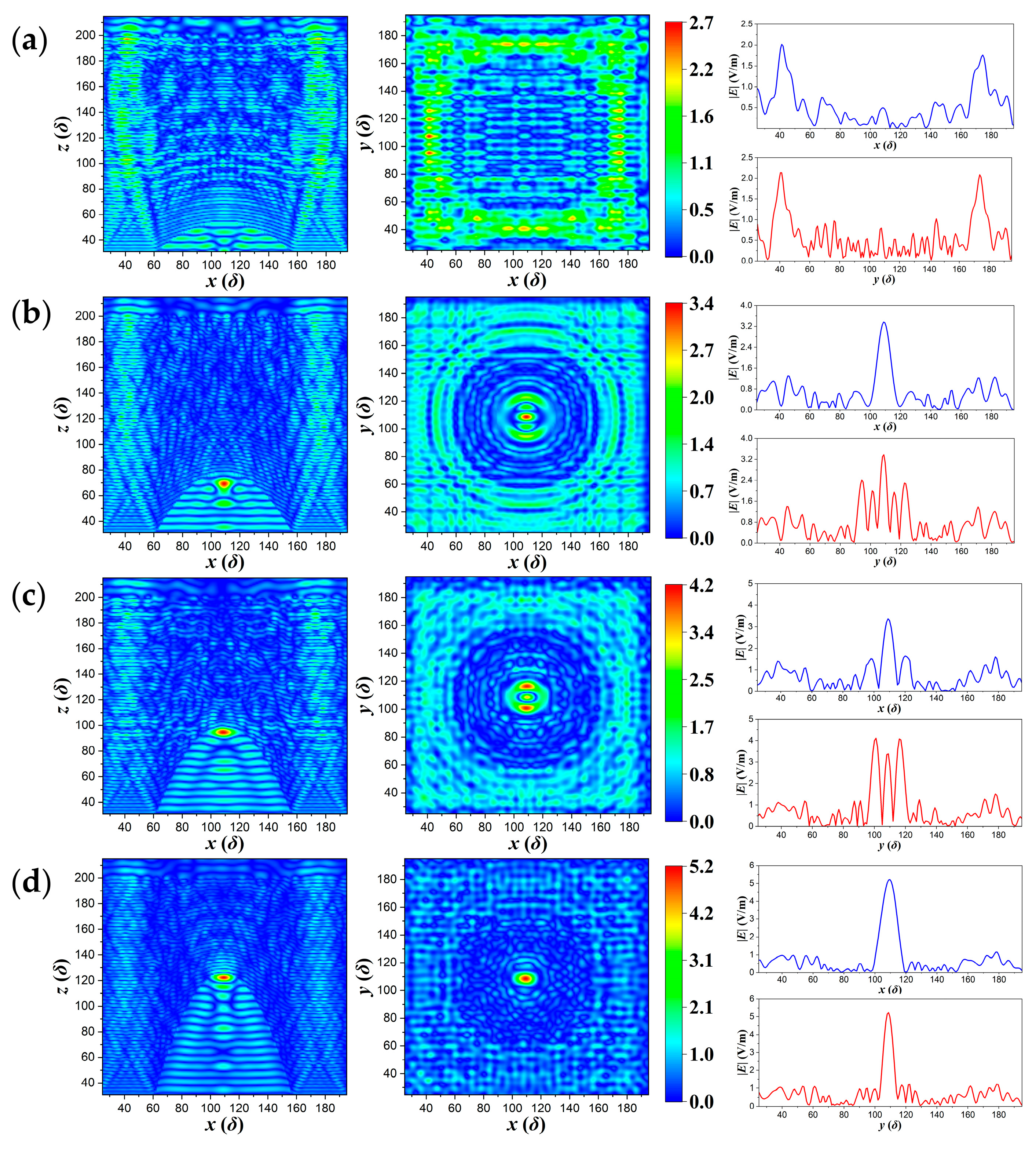
Figure 3 depicts the electric field amplitude distribution within the simulation domain induced by a single void defect of varying depths (h = 2λ, 4λ, 6λ, and 8λ) at a fixed width of l = 8λ on the front surface of the RDX energetic crystals. These images present the electric field distributions on the x–z (left column) and x–y (middle column) cross-sections, highlighting the location of the maximum electric field amplitude (|E|max) within the simulation domain. The color mapping illustrates the variation of the field intensity, with values increasing from blue to red as indicated by the corresponding color bar. The right column displays the cross-sectional profiles of the electric field amplitude along the x–direction at y = 109δ and the y–direction at x = 109δ extracted from the x–y plane shown in the middle column. The electric field distribution exhibits an approximately symmetrical pattern with distinctly pronounced modulation effects. The void defect embedded in the RDX crystal acts as an aperture for the incident laser, causing the transmitted light to scatter and deviate from its initial propagation direction. The diffraction and interference will occur at the interface between the void defect and the RDX crystal, which leads to light intensification in local areas, namely, the hot spot.
As illustrated in Figure 3, for a fixed void width (l = 8λ), the maximum electric field amplitude within the simulation domain increases as the void depth increases. Specifically, the |E|max values corresponding to depths of 2λ, 4λ, 6λ, and 8λ are 2.7, 3.4, 4.2, and 5.3 V/m, with the light intensity enhancement factor of 7.3, 11.6, 17.6, and 28.1, respectively. In addition, the term “high-intensity spot” is used to denote a grid point where the electric field amplitude satisfies |E| ≥ 2.0 V/m. The number of these high-intensity spots (HSN) across the entire domain was calculated and exported using a computer program.
Figure 3a shows electric field distributions modulated by a single void defect with the defect depth of h = 2λ. It can be seen that the |E|max (2.7 V/m) is obtained on the x–y cross-section at the location of (41δ, 107δ) in the plane of z = 197δ, near the rear surface of the RDX crystals. Meanwhile, as illustrated in the x–y plane of Figure 3a, numerous additional high-intensity spots emerge in the same plane, primarily distributed within the material, with none observed inside the defect region. From the electric field amplitude profiles, it is evident that the high-intensity spots are primarily concentrated within the ranges of 40δ−50δ and 170δ−180δ along both x and y directions, indicating that the hot spots are mainly distributed within the RDX crystal at locations relatively distant from the defects.
However, as the depth of the void defect increases, the location of the maximum electric field amplitude gradually shifts from the bulk region of the RDX crystal toward the void. As shown in Figure 3b–d, the |E|max for void depths of h = 4λ, 6λ, and 8λ are located at the planes of z = 69δ, 95δ, and 122δ, respectively. With increasing depth, the |E|max position progressively converges toward the bottom of the defect. At the depth of h = 8λ, it is located almost at the interface between the void defect and the surrounding RDX crystal, though still confined in the void defect.
This behavior contrasts markedly with the findings reported in Reference [17], where the modulation enhancement regions associated with scratch defects were predominantly situated within the bulk RDX crystal. The underlying mechanism can be attributed to the synergistic interaction between the incident and reflected laser beams within the defect. For a scratch defect, modulation enhancement occurs only at two symmetric points along the interface. In contrast, for a void defect, the enhancement extends along the entire circular rim, enabling a greater number of reflected beams to converge at a single point. Therefore, a stronger localized optical enhancement is more readily generated within the void defect.
From Equation (1), the interface between the void defect and the RDX crystal can be described by
  z = 4 h l 2   [ ( x     x 0 ) 2 +   ( y     y 0 ) 2 ] + z 0 + h
For ease of understanding, we consider the case on the x–z plane (i.e., y = y0), for which the equation becomes
z = 4 h l 2   [ ( x     x 0 ) 2 ] + z 0 + h
Thus, the slope, k, of the tangent lines to the interface between the RDX crystal and the void defect can be written as
| k | =   tan θ = 8 h l 2 | x     x 0 |
where θ denotes the incident angle of the laser beam relative to the interface between the RDX material and the defect. As shown in Equation (4), θ increases with the defect depth h. When h increases from 4λ to 8λ, the value of θ correspondingly becomes larger. Since the angle between the incident and reflected beams equals 2θ, the reflected beam deviates further from the incident direction, causing the optical enhancement point to appear closer to the bottom of the defect.
Specifically, as illustrated in Figure 3b, when the defect depth reaches 4λ, the maximum electric field amplitude appears on the plane of z = 69δ (as shown in the x–z plane), approximately 9δ away from the crystal–defect interface. The field distribution on the x–y plane exhibits a well-defined interference pattern characterized by concentric high-intensity rings. This pattern originates from the constructive interference between the incident and reflected laser waves confined within the void region. The strongest enhancement occurs near the defect center, where the |E|max values are concentrated within x = 100–120δ, while the field along the y–direction extends more broadly over y = 90–130δ.
As the defect depth increases to 6λ (Figure 3c), the |E|max shifts to the plane of z = 95δ, approximately 7δ from the interface. The enhanced curvature of the interface increases the local reflection angle, leading to stronger field confinement and a more complex interference pattern. Two distinct high-intensity spots appear along the y–direction at x = 101δ and x = 116δ, corresponding to the interference maxima formed by the overlapping reflected waves.
When the defect depth reaches 8λ (Figure 3d), the |E|max further shifts to the plane of z = 122δ, only 4δ from the interface. At this depth, the reflection angles become sufficiently large to focus most of the reflected energy toward the void center. Consequently, the high-intensity regions in both x and y directions converge at the defect center, indicating a highly localized optical focusing effect. The modulation becomes significantly stronger, suggesting that deeper voids promote more efficient light convergence and enhanced field localization within the defect region.
As discussed above, the void defect exerts a significant modulation effect on the incident laser beam, leading to the formation of light enhancement points both inside RDX crystals and in void defects. For RDX energetic crystals, however, laser-induced hot spots that govern initiation sensitivity are predominantly generated in the crystal bulk. Therefore, it is necessary to separately examine the modulation effects inside the crystal and within the defect, and to further clarify how the presence of the void influences the formation of hot spots in the RDX crystals.
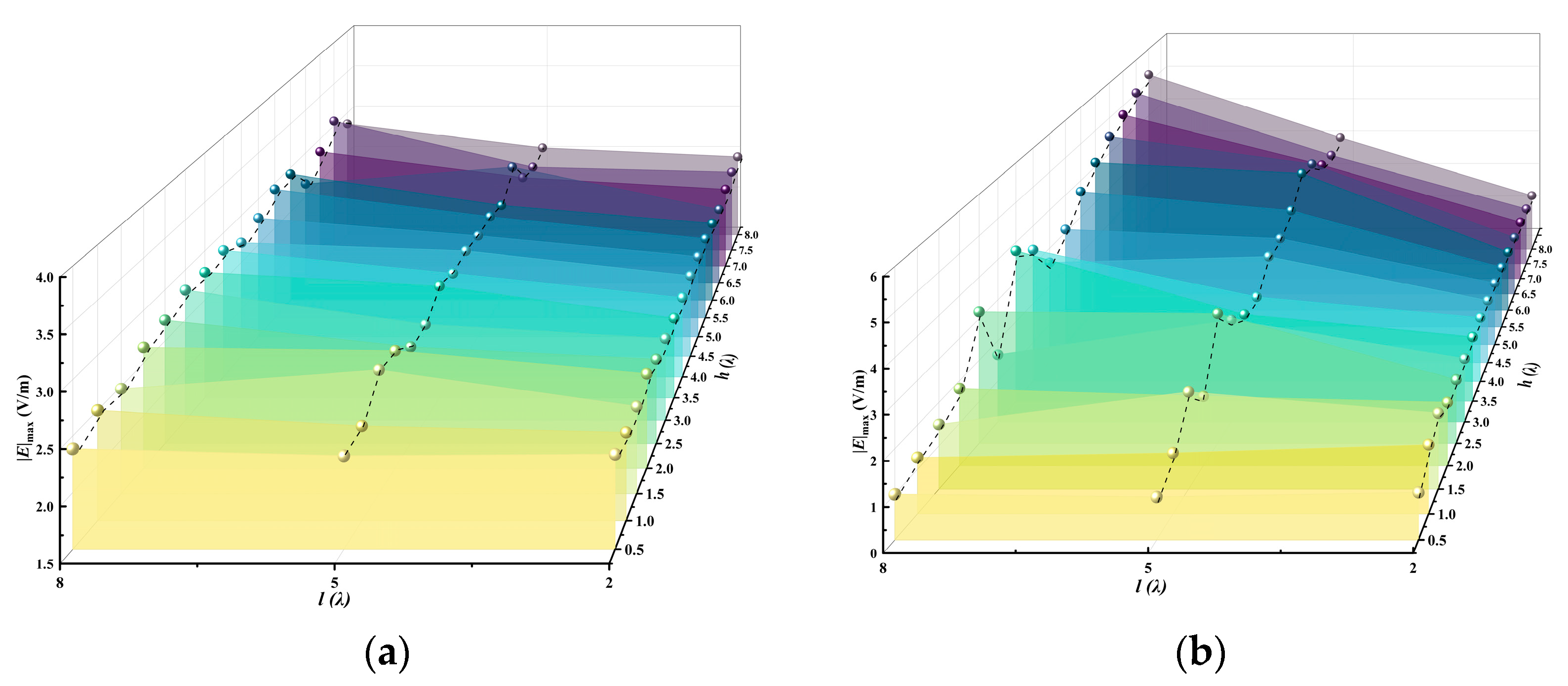
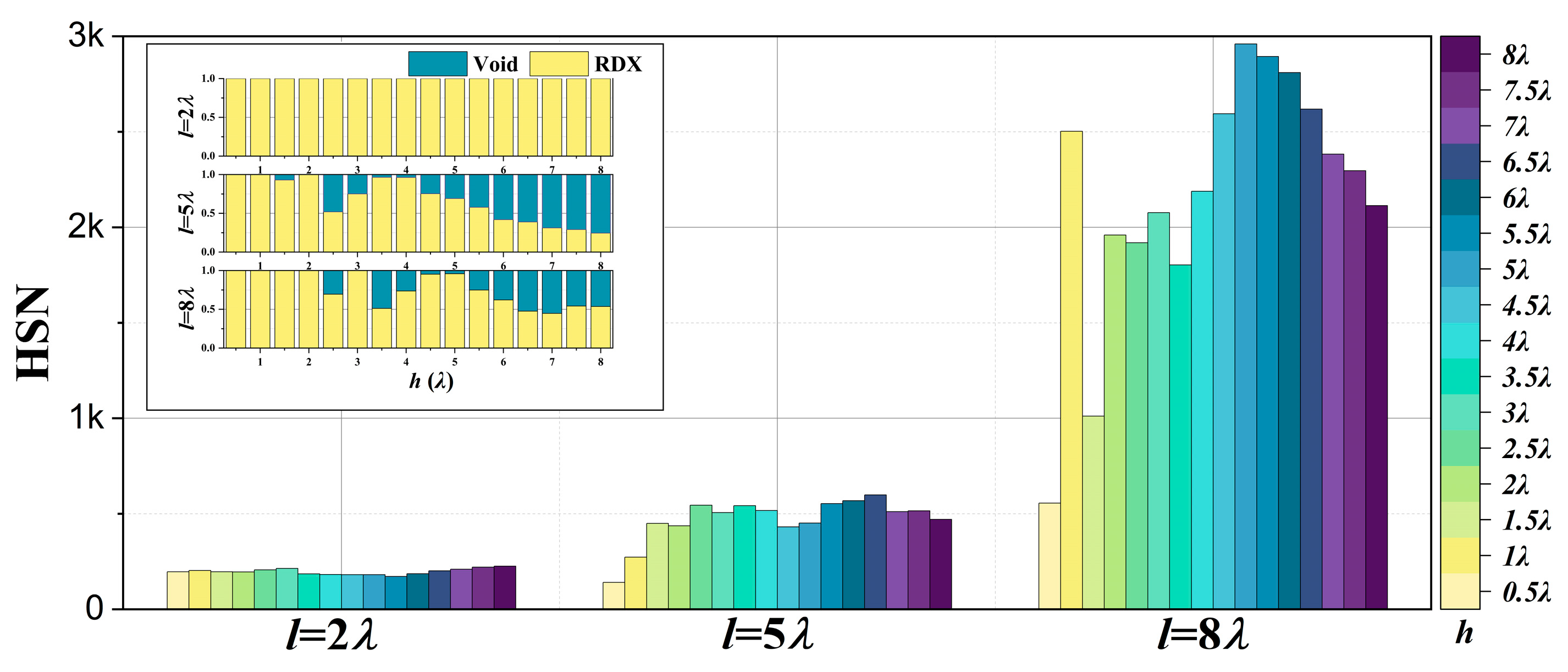
Figure 4 illustrates the modulation of the incident laser field induced by void defects, showing the spatial distribution of the maximum electric field amplitude, |E|max, inside the RDX crystal (Figure 4a) and in the void defect (Figure 4b). Figure 5 further presents the number of high-intensity spots (HSN) generated within the RDX crystal for varying defect widths and depths. The inset of Figure 5 shows the relative proportion of HSN located in the RDX crystal and in the void defect, where the blue and yellow bars represent the ratios in the defect and the crystal, respectively. As shown in Figure 4, the widths l of void defects are 2λ, 5λ, and 8λ, and the void depth h changes from 0.5λ to 8λ. It is obvious that the |E|max modulated in RDX crystals changes in the range of 2.3–3.1 V/m, with the light intensity enhancement factor of 5.3–9.6. Moreover, as the width and depth of the defect increase, the modulated maximum electric field amplitude, |E|max, both in the RDX crystals and in the void defect increase.
When the void width is small (l = 2λ), the maximum electric field amplitude within the simulation domain, ranging from 2.3 to 2.5 V/m, occurs entirely in the RDX crystal, while the electric field amplitude in the void defect region remains below 2.0 V/m. Consequently, the proportion of high-intensity spots in the RDX crystal is 100% (inset of Figure 5). As the width increases to l = 5λ, |E|max in the RDX crystal varies from 2.3 to 2.8 V/m, while it ranges from 0.9 to 3.8 V/m in the defects. For shallow defects (h = 0.5–2λ), high-intensity spots predominantly appear within the RDX crystals. As the defect depth increases to 2–5.5λ, a significant number of hot spots begin to appear in the void defect region, although the majority remain in the RDX crystal. For deeper defects (h = 6–8λ), the HSN in the defect exceeds that in the RDX crystal (inset of Figure 5). For a larger width (l = 8λ), when h is less than 3λ, |E|max is primarily located within the RDX crystal. However, once the depth exceeds 3.5λ, |E|max shifts predominantly into the void defect. Notably, even for large defects, |E|max in the defect region (up to 5 V/m) is considerably higher than in the RDX crystal, which generally remains below 3 V/m.
As the initiation sensitivity of energetic materials after laser irradiation is mainly located in the light-enhanced area in the RDX crystals, the HSN modulated within the RDX crystals should be discussed in detail. As shown in Figure 5, a clear quantitative growth trend is observed as the void width increases from 2λ to 5λ and 8λ. For relatively small defects (l = 2λ), only a limited number (around 200) of modulation points are generated, and it remains nearly constant with increasing defect depth. When the width increases to 5λ, the number of modulation points first rises with depth and then fluctuates around 500 once the depth exceeds h = 2.5λ. In contrast, for a larger width of 8λ, the number of modulation points increases gradually from above 500 and reaches a maximum of nearly 3000 at the depth of h = 5λ, followed by a reduction to around 2000 as the depth continues to increase. These results demonstrate that increasing either the width or the depth of a surface void defect leads to a higher density of hot spots, thereby enhancing the laser sensitivity of the energetic materials and increasing the likelihood of laser-induced initiation in RDX energetic crystals.

3.1.2. Effects of Front and Rear Void Defect

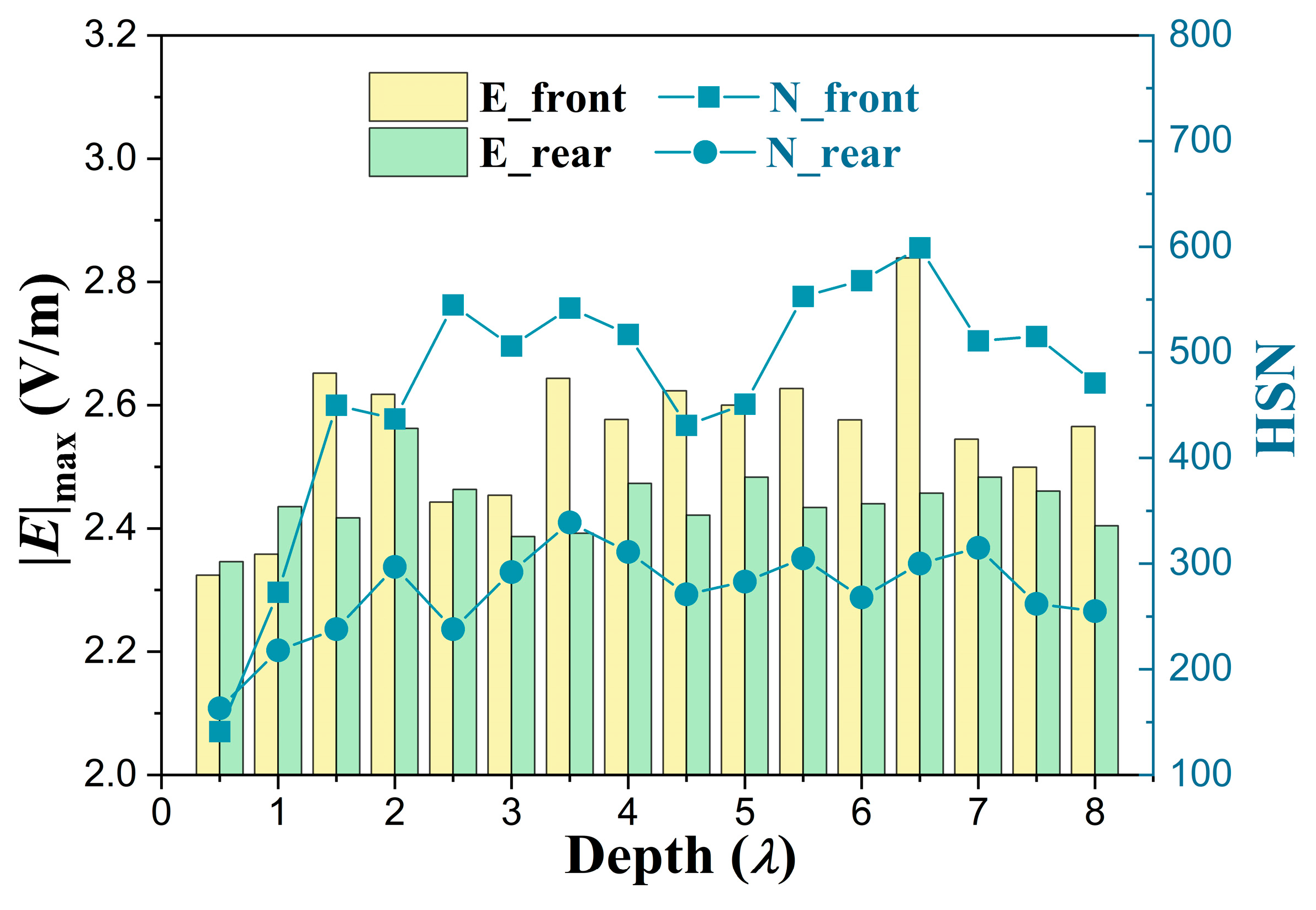
The above discussion focused on the effects of defect size on the modulation of the incident laser beam and hot spot formation. To further compare the influences of front and rear void defects, the modulation induced by rear void defects on the laser sensitivity was also investigated. As shown in Figure 6, the modulation of the incident laser beam by void defects on the front and rear surfaces of RDX Crystals varies with defect depth for a fixed defect width (l = 5λ). The yellow bars represent the modulation of the maximum electric field amplitude by front surface defects, while the green bars correspond to rear surface defects. For both cases, |E|max ranges from 2.3 to 2.9 V/m. Although the |E|max values for the two cases are relatively close, the modulation induced by front surface defects is generally slightly stronger than that of rear surface defects. Statistical analysis of the high-intensity spots shows that, for both front and rear surface defects, the number of high-intensity spots initially increases with defect depth and then saturates. For shallow defects, the number of high-intensity spots is nearly identical for front and rear defects. However, as the defect depth increases, front surface defects produce significantly more high-intensity spots (500–600) compared to rear surface defects (approximately 300).
Therefore, void defects on the front surface of the RDX crystal exert a stronger modulation effect on the incident laser than those on the rear surface. It indicates that when the laser is incident on the crystal surface containing void defects, more hot spots will be generated, and the RDX energetic crystal is more susceptible to initiation.

3.2. Multiple Void Defects

The preceding discussion focused on how the size of a single defect and its location on the front or rear surface of the RDX crystal affect laser sensitivity. However, as illustrated in Figure 1, defects are often not isolated but appear in clusters. Therefore, it is important to further explore the influence of multiple defects on the modulation of the incident laser. In this section, we first investigate how the spacing between two defects affects the modulation of the incident laser beam, and then, we analyze the impact of multiple defects on laser sensitivity and hot spot formation.

3.2.1. Effects of Separation Distance

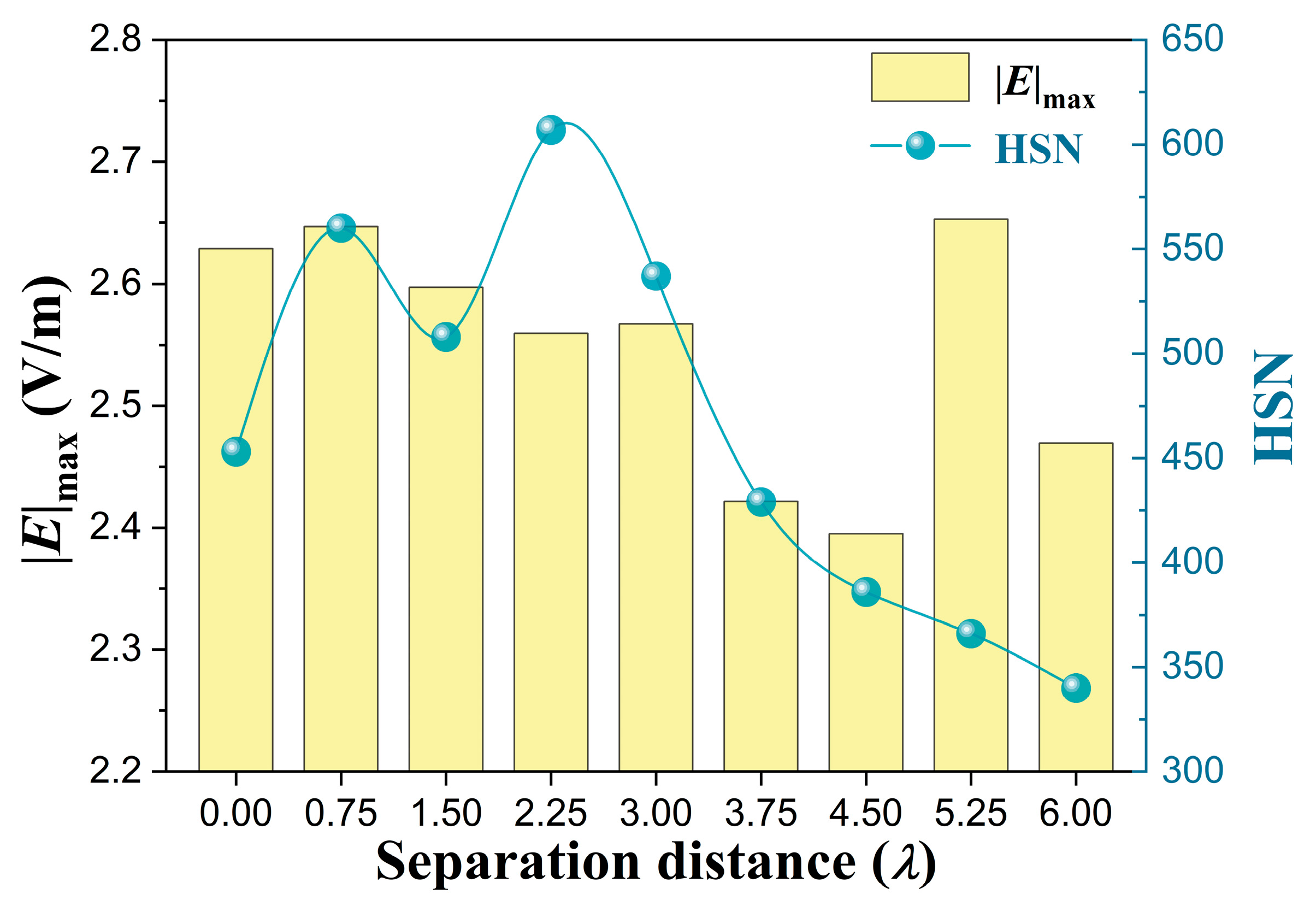
Figure 7 shows the relationship between the separation distance and the modulation effect of the two void defects with the same size (l = h = 3λ) on the incident laser beam. As the distance increases, the number of high-intensity spots increases first and then decreases. Specifically, as the separation distance increases, the number of high-intensity spots gradually increases from the initial 453 and reaches the maximum value (607) when the separation distance is 2.25λ. After that, the number of high-intensity spots gradually decreases as the separation distance increases and finally drops to 340 at the distance of 6λ. This trend reflects the underlying near-field optical interaction between the two voids. At small separations, the scattered and diffracted fields from each defect overlap strongly, producing constructive interference and enhanced local field confinement. However, as the separation distance increases, the coupling effect between the two void defects induced fields weakens, resulting in fewer localized intensity maxima. As shown with the yellow bar, the maximum electric field amplitude |E|max also exhibits an overall decreasing trend with separation distance, aside from a local fluctuation at 5.25λ. This further indicates that strong defect–defect interaction occurs primarily in the range of 0.75–3λ, where cooperative interference significantly enhances modulation of the incident laser beam.

3.2.2. Effects of the Number of Void Defects

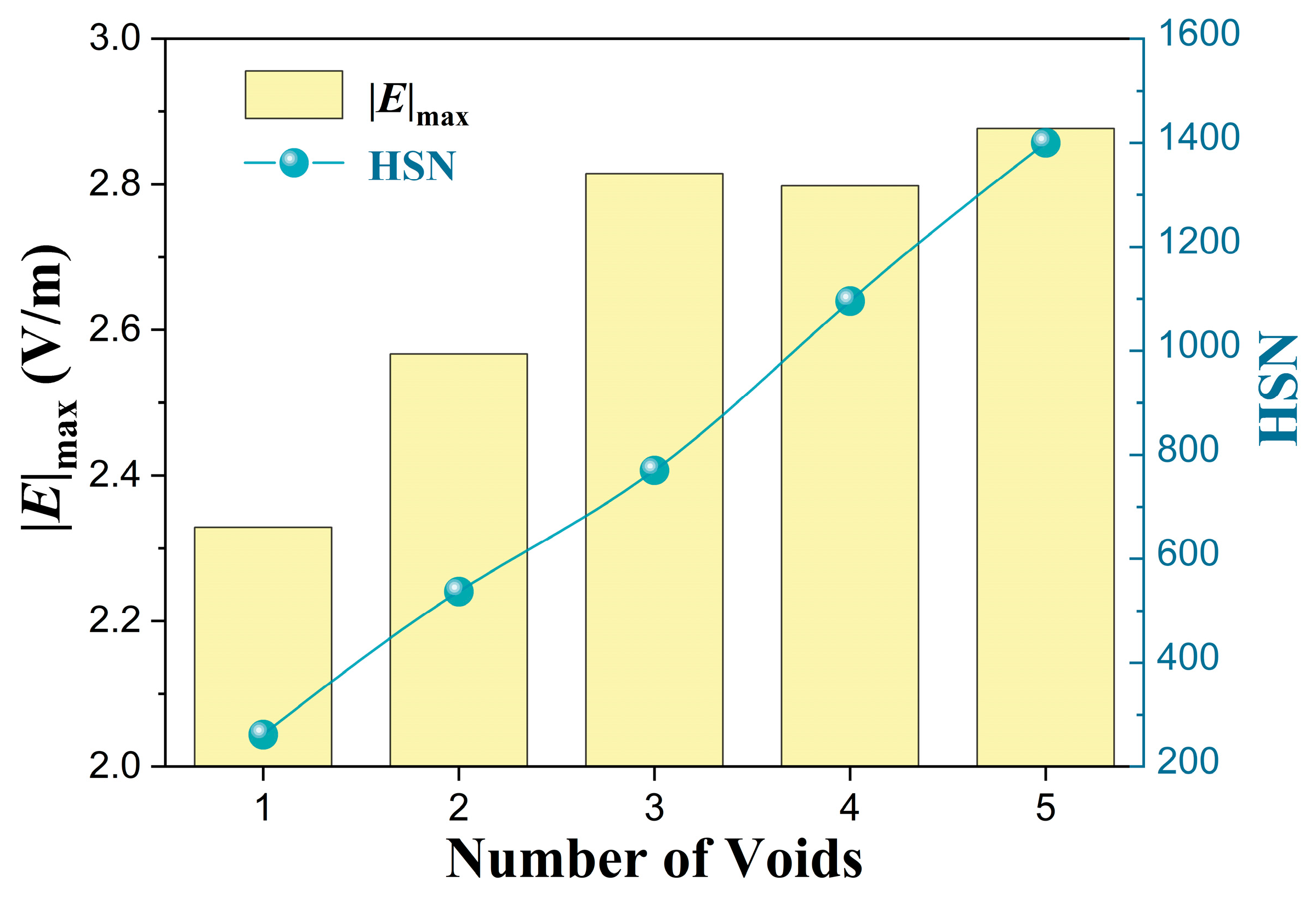
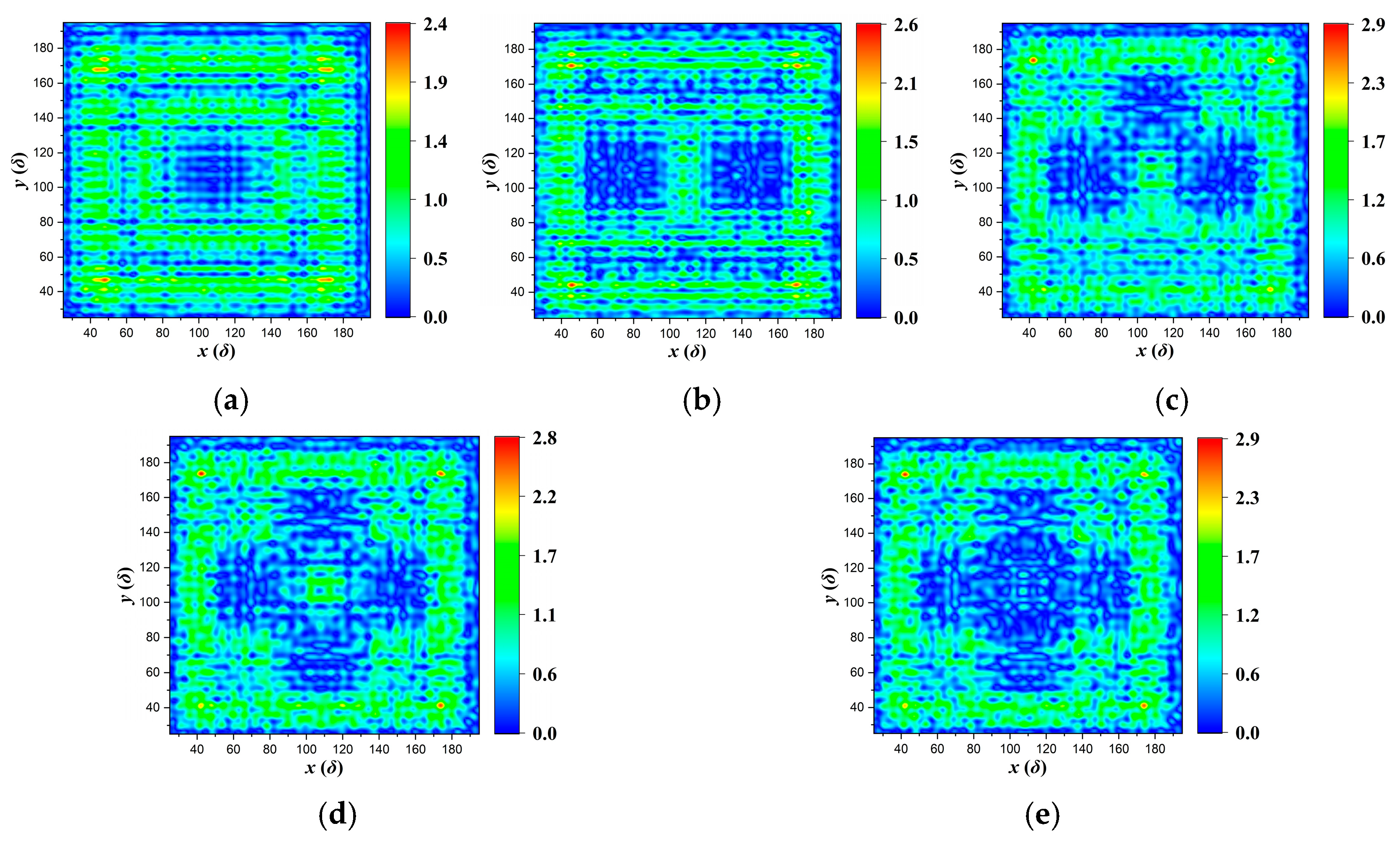
To further investigate the cooperative modulation effect, the incident laser field is analyzed for configurations containing different numbers of void defects, all with the same geometry (l = h = 3λ). As shown in Figure 8 and Figure 9, the maximum electric field amplitude, |E|max, increases with the number of voids, though the rate of increase becomes less pronounced once the number exceeds three. For four or five defects, |E|max gradually approaches a saturation level near 3.0 V/m, suggesting that the superposition of scattered fields reaches a limit beyond which additional defects contribute only marginal enhancement. However, the number of high-intensity spots grows almost linearly with the number of voids. This indicates that each additional defect introduces new scattering centers and creates more constructive interference regions, thereby increasing the density of hot spots inside the crystal. These results demonstrate that defect clusters provide a substantially stronger modulation effect than isolated defects. An increased number of void defects enhances both the spatial complexity of the modulated field and the probability of forming laser-induced hot spots, thereby significantly increasing the laser initiation sensitivity of RDX energetic crystals.

4. Conclusions

We investigated the interaction between laser and RDX single crystals containing void defects using a three-dimensional finite-difference time-domain (3D-FDTD) approach to quantify the influences of void geometry, separation distance, and void number on the hot spot formation and initiation sensitivity during laser irradiation. The results show that void defects strongly modulate the incident laser beams, producing high-intensity regions both inside RDX bulk crystals and in void defects. For a single void defect, increasing either the width or depth of the void defect will raise the laser sensitivity of RDX energetic materials. A comparison of front and rear voids indicates that more initiation hot spots will be generated when the laser beam is incident from the front surface, which contains the void defects. For two void defects, the number of high-intensity spots first increases and then decreases with void defect spacing, and the strongest modulation effects are obtained at separations of 0.75λ–3λ. For multiple void defects, the modulation effect and laser sensitivity grow with the void defect number. This study reveals the influence of void defects on the formation of hot spots and laser sensitivity in RDX crystals, providing a deeper understanding of the interaction mechanism between laser and energetic materials. These findings offer synthetic chemists a means to regulate the size and density of microdefects through tailored chemical synthesis, thereby allowing precise control over laser initiation sensitivity. The methodology can be extended to other energetic materials such as HMX and PETN, offering valuable guidance for future crystal preparation and the advancement of laser initiation technologies.

Author Contributions

Conceptualization, Z.Y. and J.Y.; methodology, X.X. and B.T.; formal analysis, S.Z. and J.Z.; data curation, W.L. and N.P.; writing, Z.Y., J.Y., and S.Z.; supervision, X.Z. and X.Y.; project administration, X.C. and R.F.; funding acquisition, Z.Y. All authors have read and agreed to the published version of the manuscript.

Funding

This research was funded by the National Natural Science Foundation of China (Grant No. 12204082, 62375033, 12402295, 11802047), the Research Fund for International Senior Scientists (RFIS-III) of the National Natural Science Foundation of China (Grant No. W2531043), the Natural Science Foundation of Chongqing (Grant No. CSTB2024NSCQ-MSX1253, CSTB2025NSCQ-GPX1307), and the Science and Technology Research Program of Chongqing Municipal Education Commission (Grant No. KJQN202300645, KJQN202500643, KJQN201800623).

Data Availability Statement

The raw data supporting the conclusions of this article will be made available by the authors on request.

Conflicts of Interest

The authors declare no conflicts of interest.

References

  1. Zhong, K.; Bu, R.P.; Jiao, F.B.; Liu, G.R.; Zhang, C.Y. Toward the defect engineering of energetic materials: A review of the effect of crystal defects on the sensitivity. Chem. Eng. J. 2022, 429, 132310. [Google Scholar] [CrossRef]
  2. Zhang, T.; Gao, X.; Li, J.; Xiao, L.; Gao, H.; Zhao, F.; Ma, H. Progress on the application of graphene-based composites toward energetic materials: A review. Def. Technol. 2024, 31, 95–116. [Google Scholar] [CrossRef]
  3. Qin, Z.; Li, D.; Ou, Y.; Du, S.; Jiao, Q.; Peng, J.; Liu, P. Recent Advances in Polydopamine for Surface Modification and Enhancement of Energetic Materials: A Mini-Review. Crystals 2023, 13, 976. [Google Scholar] [CrossRef]
  4. Bowden, F.P.; Yoffe, A.D. Fast Reactions in Solids; Butterworths Scientific Publications: London, UK, 1958; pp. 123–128. [Google Scholar]
  5. Hamilton, B.W.; Kroonblawd, M.P.; Strachan, A. The Potential Energy Hotspot: Effects of Impact Velocity, Defect Geometry, and Crystallographic Orientation. J. Phys. Chem. C 2022, 126, 3743–3755. [Google Scholar] [CrossRef]
  6. Rai, N.K.; Sen, O.; Udaykumar, H.S. Macro-scale sensitivity through meso-scale hotspot dynamics in porous energetic materials: Comparing the shock response of 1,3,5-triamino-2,4,6-trinitrobenzene (TATB) and 1,3,5,7-tetranitro-1,3,5,7-tetrazoctane (HMX). J. Appl. Phys. 2020, 128, 085903. [Google Scholar] [CrossRef]
  7. Bassett, W.P.; Johnson, B.P.; Dlott, D.D. Hot Spot Chemistry in Several Polymer-Bound Explosives under Nanosecond Shock Conditions. Propellants Explos. Pyrotech. 2020, 45, 338–346. [Google Scholar] [CrossRef]
  8. Roy, S.; Johnson, B.P.; Zhou, X.; Nguyen, Y.T.; Dlott, D.D.; Udaykumar, H.S. Hot spot ignition and growth from tandem micro-scale simulations and experiments on plastic-bonded explosives. J. Appl. Phys. 2022, 131, 205901. [Google Scholar] [CrossRef]
  9. Akiki, M.; Menon, S. A model for hot spot formation in shocked energetic materials. Combust. Flame 2015, 162, 1759–1771. [Google Scholar] [CrossRef]
  10. Field, J.E. Hot spot ignition mechanisms for explosives. Acc. Chem. Res. 1992, 25, 489–496. [Google Scholar] [CrossRef]
  11. Johnson, B.P.; Zhou, X.; Ihara, H.; Dlott, D.D. Observing Hot Spot Formation in Individual Explosive Crystals Under Shock Compression. J. Phys. Chem. A 2020, 124, 4646–4653. [Google Scholar] [CrossRef]
  12. Okafor, C.; Nguyen, Y.T.; Zhao, P.; Perera, D.; Kruse, L.E.; Sewell, T.; Udaykumar, H.S. Shock-induced collapse of elongated pores: Comparison of all-atom molecular dynamics and atomistics-consistent continuum simulations. J. Appl. Phys. 2025, 137, 145901. [Google Scholar] [CrossRef]
  13. Coffelt, C.; Olsen, D.; Miller, C.; Zhou, M. Effect of void positioning on the detonation sensitivity of a heterogeneous energetic material. J. Appl. Phys. 2022, 131, 065101. [Google Scholar] [CrossRef]
  14. Nguyen, Y.; Seshadri, P.; Sen, O.; Hardin, D.B.; Molek, C.D.; Udaykumar, H.S. Multi-scale modeling of shock initiation of a pressed energetic material I: The effect of void shapes on energy localization. J. Appl. Phys. 2022, 131, 055906. [Google Scholar] [CrossRef]
  15. Huang, L.; Li, Y.; Wang, Y.; Liu, R.; Chen, P.; Xia, Y. Understanding the Deformation and Fracture Behavior of β−HMX Crystal and Its Polymer−Bonded Explosives with Void Defects on the Atomic Scale. Crystals 2025, 15, 376. [Google Scholar] [CrossRef]
  16. Bai, W.C.; Qin, W.Z.; Tang, D.; Ji, F.M.; Chen, H.S.; Yang, F.; Qiao, Z.Q.; Duan, T.; Lin, D.; He, R.; et al. Constructing interparticle hotspots through cracking silver nanoplates for laser initiation of explosives. Opt. Laser Technol. 2021, 139, 106989. [Google Scholar] [CrossRef]
  17. Yan, Z.; Liu, W.; Zhang, C.; Li, J.; Xiang, X.; Huang, M.; Liao, W.; Yang, Z.; Tan, B.; Li, Z.; et al. Scratch defects modulated hot spots generation in laser irradiated RDX crystals: A 3D FDTD simulation. J. Mater. Sci. 2016, 51, 8812–8823. [Google Scholar] [CrossRef]
  18. Yan, P.; Zhao, X.; Rui, J.; Zhao, J.; Xu, M.; Zhai, L. Molecular Dynamics Simulation of the Influence of RDX Internal Defects on Sensitivity. Crystals 2021, 11, 329. [Google Scholar] [CrossRef]
  19. Nguyen, Y.T.; Okafor, C.; Zhao, P.; Sen, O.; Picu, C.R.; Sewell, T.; Udaykumar, H. Continuum models for meso-scale simulations of HMX (1,3,5,7-tetranitro-1,3,5,7-tetrazocane) guided by molecular dynamics: Pore collapse, shear bands, and hotspot temperature. J. Appl. Phys. 2024, 136, 114902. [Google Scholar] [CrossRef]
  20. Fang, X.; Walton, A.J. Optical sensitising of insensitive energetic material for laser ignition. Opt. Laser Technol. 2023, 158, 108767. [Google Scholar] [CrossRef]
  21. Cui, M.; Yan, Y.-F.; Qian, R.-X.; Fan, B.-W.; Bian, H.-Y.; Wen, F.; Xu, J.-G.; Zheng, F.-K.; Guo, G.-C. Structure-Induced Energetic Coordination Compounds as Additives for Laser Initiation Primary Explosives. Adv. Mater. 2025, 37, 2414886. [Google Scholar] [CrossRef]
  22. He, Y.; Wang, X.; Ren, Y.; Chen, P.; Yao, Y.; Liu, R.; Liu, R. Initial response and combustion behavior of microscale Al/PTFE energetic material by nanosecond laser ignition. Combust. Flame 2023, 254, 112838. [Google Scholar] [CrossRef]
  23. Chen, M.-W.; You, S.; Suslick, K.S.; Dlott, D.D. Hot spots in energetic materials generated by infrared and ultrasound, detected by thermal imaging microscopy. Rev. Sci. Instrum. 2014, 85, 023705. [Google Scholar] [CrossRef] [PubMed]
  24. Chen, M.-W.; You, S.; Suslick, K.S.; Dlott, D.D. Hot spot generation in energetic materials created by long-wavelength infrared radiation. Appl. Phys. Lett. 2014, 104, 061907. [Google Scholar] [CrossRef]
  25. Yee, K. Numerical solution of initial boundary value problems involving Maxwell’s equations in isotropic media. IEEE Trans. Antennas Propag. 1966, 14, 302–307. [Google Scholar]
  26. Teixeira, F.L.; Sarris, C.; Zhang, Y.; Na, D.Y.; Berenger, J.P.; Su, Y.; Okoniewski, M.; Chew, W.C.; Backman, V.; Simpson, J.J. Finite-difference time-domain methods. Nat. Rev. Methods Primers 2023, 3, 75. [Google Scholar] [CrossRef]
  27. Khani, S.; Hayati, M. Optical biosensors using plasmonic and photonic crystal band-gap structures for the detection of basal cell cancer. Sci. Rep. 2022, 12, 5246. [Google Scholar] [CrossRef]
  28. Chacko, N.; Motiei, M.; Dar, N.; Ankri, R. Cyanine-Conjugated Gold Nanospheres for Near-Infrared Fluorescence-Based Biomedical Imaging. ACS Appl. Nano Mater. 2025, 8, 10104–10115. [Google Scholar] [CrossRef]
  29. Gronnemose, W.; Rabus, B.T. 3-D FDTD Framework for Simulating SAR Imagery of Realistic Near Earth Surface Volumes (Soil, Snow, and Vegetation). IEEE Trans. Geosci. Remote Sens. 2024, 62, 2004211. [Google Scholar] [CrossRef]
  30. Burns, S.; Gasdia, F.; Simpson, J.J.; Marshall, R.A. 3-D FDTD Modeling of Long-Distance VLF Propagation in the Earth-Ionosphere Waveguide. IEEE Trans. Antennas Propag. 2021, 69, 7743–7752. [Google Scholar] [CrossRef]
  31. Ren, Y.; Cui, W.; Yang, Z.; Xiong, B.; Zhang, L.; Li, Z.; Lu, S.; Huo, Y.; Wu, X.; Li, G.; et al. Ultra-broadband and wide-angle solar absorber for the All-MXene grating metamaterial. Opt. Mater. 2024, 149, 115073. [Google Scholar] [CrossRef]
  32. Matei, A.T.; Vișan, A.I.; Popescu-Pelin, G.F. Design and Processing of Metamaterials. Crystals 2025, 15, 374. [Google Scholar] [CrossRef]
  33. Na, D.-Y.; Chew, W.C. Quantum Electromagnetic Finite-Difference Time-Domain Solver. Quantum Rep. 2020, 2, 253–265. [Google Scholar] [CrossRef]
  34. Firoozi, A.; Mohammadi, A.; Khordad, R.; Jalali, T. Q-BOR–FDTD method for solving Schrödinger equation for rotationally symmetric nanostructures with hydrogenic impurity. Phys. Scr. 2022, 97, 025802. [Google Scholar] [CrossRef]
  35. Zeng, Z.; Venuthurumilli, P.K.; Xu, X. Inverse Design of Plasmonic Structures with FDTD. ACS Photonics 2021, 8, 1489–1496. [Google Scholar] [CrossRef]
  36. Zyubin, A.Y.; Kon, I.I.; Poltorabatko, D.A.; Samusev, I.G. FDTD Simulations for Rhodium and Platinum Nanoparticles for UV Plasmonics. Nanomaterials 2023, 13, 897. [Google Scholar] [CrossRef]
  37. Cheng, L.; Zhu, G.; Liu, G.; Zhu, L. FDTD simulation of the optical properties for gold nanoparticles. Mater. Res. Express 2020, 7, 125009. [Google Scholar] [CrossRef]
  38. Zyubin, A.; Kon, I.; Tcibulnikova, A.; Matveeva, K.; Khankaev, A.; Myslitskaya, N.; Lipnevich, L.; Demishkevich, E.; Medvedskaya, P.; Samusev, I.; et al. Numerical FDTD-based simulations and Raman experiments of femtosecond LIPSS. Opt. Express 2021, 29, 4547–4558. [Google Scholar] [CrossRef] [PubMed]
  39. Yan, Z.; Liu, W.; Zhang, C.; Wang, X.; Li, J.; Yang, Z.; Xiang, X.; Huang, M.; Tan, B.; Zhou, G.; et al. Quantitative correlation between facets defects of RDX crystals and their laser sensitivity. J. Hazard. Mater. 2016, 313, 103–111. [Google Scholar] [CrossRef]
  40. Yan, Z.; Liu, W.; Jiang, Y.; Xie, Y.; Zhang, C.; Wang, J.; Zhou, G.; Yang, L.; Xiang, X.; Li, X.; et al. Laser initiation of RDX crystal slice under ultraviolet and near-infrared irradiations. Combust. Flame 2018, 190, 112–118. [Google Scholar] [CrossRef]
  41. Raha, K.; Chhabra, J.S. Static charge development and impact sensitivity of high explosives. J. Hazard. Mater. 1993, 34, 385–391. [Google Scholar] [CrossRef]
  42. Berenger, J.P. A perfectly matched layer for the absorption of electromagnetic waves. J. Comput. Phys. 1994, 114, 185–200. [Google Scholar] [CrossRef]
Figure 1. In situ observations of RDX crystals before and after laser irradiation: (a) the surface morphology before laser irradiation, where the arrows indicate the locations of void defects; (b) laser-induced damage features (highlighted by the dotted circle), which are generated by initial micro-explosions during the laser initiation process.
Crystals 16 00027 g001
Figure 2. (a) The AFM characterization of RDX surface morphology with void defects and (b) the corresponding simulation model. The arrows indicate the direction of the incident laser.
Crystals 16 00027 g002
Figure 3. Electric field distributions modulated by void defects of varying depths at a fixed width of l = 8λ: (a) h = 2λ; (b) h = 4λ; (c) h = 6λ; (d) h = 8λ. The left and middle columns show the normalized electric field intensity distributions in the x–z and x–y planes, respectively. The color scale represents the normalized field amplitude, with blue corresponding to low intensity and red to high intensity. The right column presents cross-sectional electric field amplitude profiles along the x direction at y = 109δ (blue curves) and along the y direction at x = 109δ (red curves), extracted from the x–y plane.
Crystals 16 00027 g003
Figure 4. The maximum electric field amplitude modulated by void defects with varying widths and depths: (a) inside RDX crystals; (b) in void defects.
Crystals 16 00027 g004
Figure 5. The number of high-intensity spots (HSN) at varied void width and depth in RDX crystals. The inset shows the relative proportion of HSN located inside the RDX crystal and in the void defect, respectively.
Crystals 16 00027 g005
Figure 6. The maximum electric field amplitude (|E|max) and the number of high-intensity spots (HSN) modulated by void defects on the front and rear surfaces of RDX energetic crystals (l = 5λ).
Crystals 16 00027 g006
Figure 7. Modulation effects caused by two void defects (l = h = 3λ) as a function of separation distance.
Crystals 16 00027 g007
Figure 8. Modulation effects caused by a various number of void defects (l = h = 3λ).
Crystals 16 00027 g008
Figure 9. Electric field distributions modulated by multiple void defects (l = h = 3λ): (a) one void; (b) two voids; (c) three voids; (d) four voids; (e) five voids.
Crystals 16 00027 g009
Disclaimer/Publisher’s Note: The statements, opinions and data contained in all publications are solely those of the individual author(s) and contributor(s) and not of MDPI and/or the editor(s). MDPI and/or the editor(s) disclaim responsibility for any injury to people or property resulting from any ideas, methods, instructions or products referred to in the content.