Synthesis and Crystal Structure of 9-(4,6-dichloro-1,3,5-triazin-2-yl)-9H-carbazole


Abstract
: A carbazole-triazine hybrid was prepared by addition-elimination between carbazole and 2,4,6-trichlorotriazine in the presence of base. The compound shows intensely blue fluorescence both in solution and solid state when irradiated with UV-radiation. The structure of (3) was supported by the spectroscopic data and unambiguously confirmed by the single crystal X-ray diffraction data. It was crystallized in the monoclinic space group C2/c with unit cell dimensions a = 20.280(3), b = 8.0726(14), c = 16.005(3) Å, α = γ = 90°, β = 98.947(3)°, V = 2588.3(8) A3, Z = 8.1. Introduction
Extensively π–conjugated materials have attracted much interest in the recent past due to their excellent semiconducting properties [1,2]. In fact, such materials are responsible for the emergence of the new science of organic semiconductors and organic electronics that promises fulfilling the future electronics challenges with respect to the low cost, easy tenability of properties of the materials by functionalization of materials, ease of fabrication of devices due to solution phase processability of the materials, large area flat panel displays, compressed memory devices, etc. Carbazole-based materials are important candidates in this respect due to their excellent redox and luminescent properties and good thermal and environmental stability. The carbazole nucleus can be functionalized at 3-, 6- and 9- positions [3]. A lot of literature is available on carbazole based materials for organic electronic applications and many of the materials have gained commercial utility in this respect [4]. On the other hand, 1,3,5-triazines are another important class of π–conjugated heterocycles with nitrogen atoms in the six-membered ring each with a lone-pair of electrons pointing outside the ring. 1,3,5-Triazine derivatives are of great interest due to their importance as drug precursors and additives for stabilizing light emission in OLEDs [5-8]. Carbazole-triazine hybrids have gained special importance in the field of organic electronics as electroluminescent materials [9,10].
2. Results and Discussion
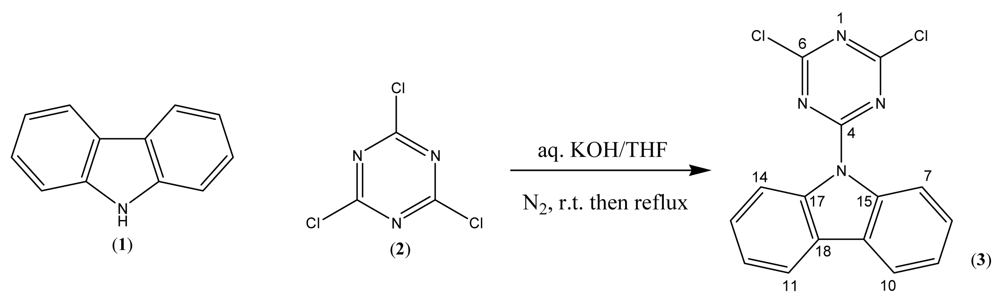
The title compound was synthesized by modification of a reported method [11] according to the route depicted in Figure 1. Thus, carbazole (1) was converted into corresponding salt in the presence of aqueous KOH. Treatment of carbazole with cyanuric chloride (2) afforded 9-(4,6-dichloro-1,3,5- triazin-2-yl)-9H-carbazole (3) by addition elimination mechanism.
The compound (3) in solid state as well as in THF and chloroform solution exhibits intense blue fluorescence when irradiated with 253 nm UV-radiation.
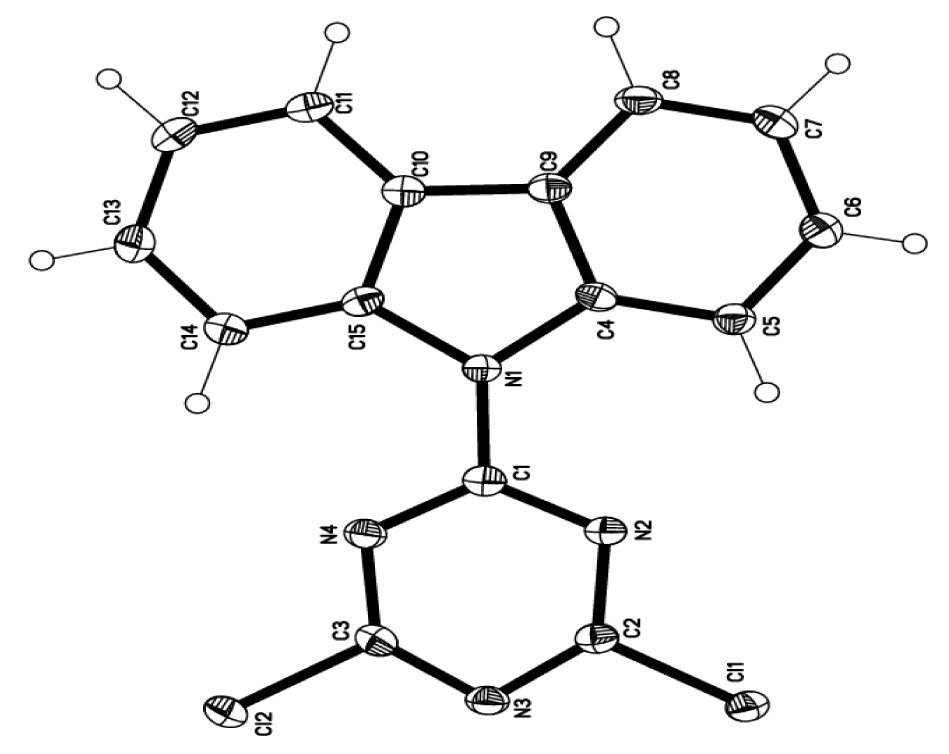
The molecular structure (Figure 2) shows almost planar geometry. Aromatic rings C4 to C9 and C10 to C15 make a dihedral angle of 3.6(1)°, the relevant angles with the triazine ring are 3.5(1)° and 4.3(1)°, respectively. Corresponding torsion angles C4-N1-C1-N2 and C15-N1-C1-N4 are 0.4(2)° and -1.3(2)°. Bond lengths and angles lie in expected ranges.
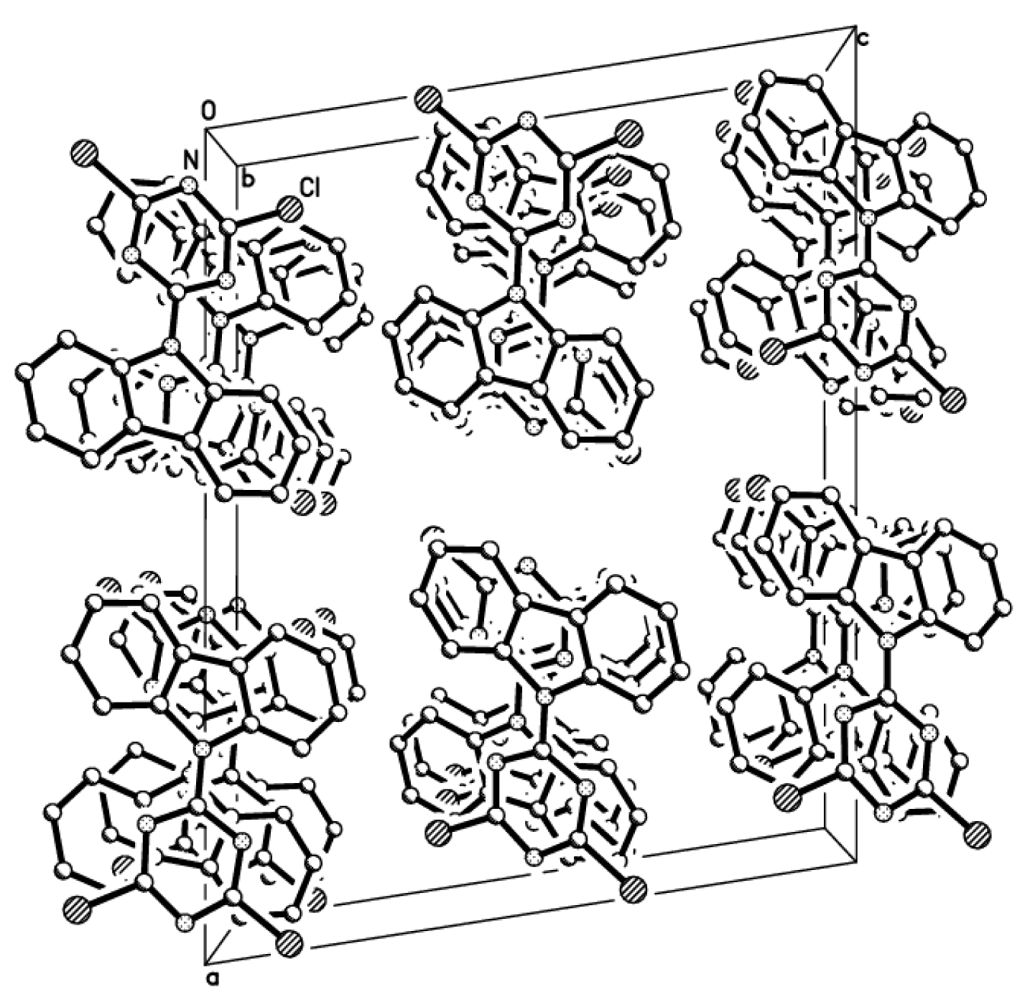
The crystal packing exhibits no marked intermolecular D-H…A contacts, but orientation of mean planes of molecules may well be described as π-stacked columns along [010] (Figure 3). Stacking distance is about 3.4 Å and the molecule planes alternate in a head-to-tail manner.
Crystal Structure Determination
Data were collected at 120(2) K on a Bruker AXS SMART APEX CCD diffractometer using MoKα radiation. Multi-scan absorption correction was with SADABS [11]. The structure was solved by direct methods [12], full-matrix least-squares refinement [12] on F2 and 190 parameters, all but H atoms refined anisotropically, H atoms from difference Fourier maps refined with riding model on idealized positions with Uiso = 1.2 Ueq(C) and C-H distances of 0.95 Å. Experimental data are listed in Table 1.
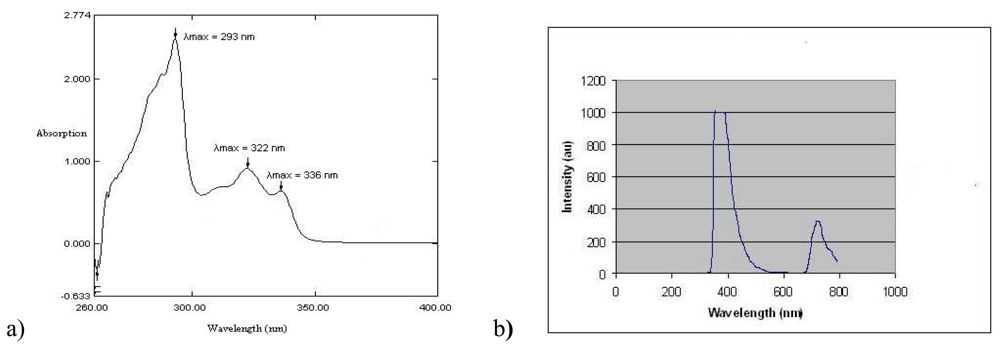
The UV spectrum of (3) in THF (Figure 4a) depicts the double band pattern characteristic of the fluorescent compounds at λmax 322 nm and 336 nm, respectively. The higher λmax at 293 nm is due to the nitrogen's influence on triazine functionality. The photoluminescence spectrum (Figure 4b) indicates fluorescence at 400 nm due to the presence of the carbazole moiety. The band at 750 nm is due to the solvent THF.
3. Experimental Section
Melting points were recorded using a digital Gallenkamp (SANYO) model MPD BM 3.5 apparatus and are uncorrected. 1H NMR spectra were determined as CDCl3 solutions at 300 MHz using a Bruker AM-300 spectrophotometer. FT IR spectra were recorded using an FTS 3000 MX spectrophotometer, Mass Spectra (EI, 70 eV) on a GC-MS instrument. UV-vis and fluorescence spectra were recorded on a Perkin Elmer Lambda 20 UV/Visible Spectrophotometer and a Perkin Elmer LS 55 Fluorescence Spectrophotometer, respectively.
Synthesis of 9-(4,6-dichloro-1,3,5-triazin-2-yl)-9H-carbazole (3)
1.67 g (1 mmol) of carbazole was dissolved in 10 mL of THF and to the clear solution was added 1 mL of 1M aq. KOH (1 mmol). The reaction mixture was stirred for 12 h at room temperature and the brown colored potassium salt of carbazole was obtained after removing the solvent which was dried in vacuo. The salt was dissolved in 10 mL of dry THF and 1.83 g (1 mmol) of cyanuric chloride was added in small portions under a nitrogen atmosphere. During the addition of cyanuric chloride the color of the salt solution gradually disappeared. The reaction mixture was stirred at room temperature for 1 h and then refluxed for 6 h. The solvent was removed to leave a solid. Single crystal of the title compound was grown by slow evaporation of a chloroform solution of the compound for 5 days. Yield 93%, m.p. 214 °C. 1H NMR (300 MHz, DMSO-d6), δ 8.12 (d, 2HAr), 7.51 (d, 2HAr), 7.40 (dd, 2HAr), 7.19 (d, 2HAr), 13C NMR (75.4 MHz, DMSO-d6), δ 140.09 (C-4), 125.53 (C-2), 123.06 (C-15), 120.00 (C-9), 118.7 (C-8), 110.82 (C-16).
4. Conclusions
A carbazole-triazine hybrid compound was synthesized which shows intensely blue fluorescence and is an intermediate towards a variety of carbazole-based heterocycles.



| Empirical formula | C15H8Cl2N4 | |
| Formula weight | 315.15 | |
| Temperature | 120(2)K | |
| Wavelength | 0.71073 Å | |
| Crystal system | Monoclinic | |
| Space group | C2/c | |
| Unit cell dimensions | a = 20.280(3) Å b = 8.0726(14) Å c = 16.005(3) Å | α = 90°. β = 98.947(3)°. γ = 90°. |
| Volume | 2588.3(8) Å 3 | |
| Z | 8 | |
| Density (calculated) | 1.618 mg/m3 | |
| Absorption coefficient | 0.498 mm−1 | |
| F(000) | 1280 | |
| Crystal size | 0.49 × 0.18 × 0.15 mm3 | |
| Theta range for data collection | 2.03 to 27.88°. | |
| Index ranges | −26 ≤ h ≤ 18, −10 ≤ k ≤ 10, −20 ≤ l ≤ 21 | |
| Reflections collected | 9398 | |
| Independent reflections | 3075 [R(int) = 0.0324] | |
| Completeness to theta = 27.88° | 99.4% | |
| Absorption correction | Semi-empirical from equivalents | |
| Max. and min. transmission | 0.9290 and 0.7923 | |
| Refinement method | Full-matrix least-squares on F2 | |
| Data / restraints / parameters | 3075 / 0 / 190 | |
| Goodness-of-fit on F2 | 1.053 | |
| Final R indices [I > 2sigma(I)] | R1 = 0.0367, wR2 = 0.0896 | |
| R indices (all data) | R1 = 0.0476, wR2 = 0.0951 | |
| Largest diff. peak and hole | 0.410 and -0.286 e. Å−3 |
Acknowledgments
The author gratefully acknowledges a research grant from the Higher Education Commission of Pakistan under project No. 4-279/PAK-US/HEC 2010-917.
References and Notes
- Ling, M.M.; Bao, Z.N. Thin Film Deposition, Patterning, and Printing in Organic Thin Film Transistors. Chem. Mater. 2004, 16, 4824–4840. [Google Scholar]
- Katz, H.E. Synthesis, Characterization, and Transistor Response of Semiconducting Silole Polymers with Substantial Hole Mobility and Air Stability. Experiment and Theory. Chem. Mater. 2004, 16, 4748–4756. [Google Scholar]
- Zhang, K.; Tao, Y.; Yang, C.; You, H.; Zou, Y.; Qin, J.; Ma, D. Synthesis and Properties of Carbazole Main Chain Copolymers with Oxadiazole Pendant toward Bipolar Polymer Host: Tuning the HOMO/LUMO Level and Triplet Energy. Chem. Mater. 2008, 20, 7324–7331. [Google Scholar]
- Shirota, Y.; Kageyama, H. Charge carrier transporting molecular materials and their applications in devices. Chem. Rev. 2007, 107, 953–1010. [Google Scholar]
- Gamez, P.; Reedijk, J. 1,3,5-Triazine-Based Synthons in Supramolecular Chemistry. Eur. J. Inorg. Chem. 2006, 1, 29–42. [Google Scholar]
- Azev, Y.A.; Dulcks, T.; Gabel, D. Cyanuric and thiocyanuric esters as carriers of boron-containing fragments and their fragmentation in mass spectrometry. Tetrahedron Lett. 2003, 44, 8689–8691. [Google Scholar]
- Zeng, T.; Dong, C.-M.; Shu, X.-G. N-(4,6-Dichloro-1,3,5-triazin-2-yl)aniline. Acta Cryst. 2005, E61, o2334. [Google Scholar]
- Liu, C.-L.; Xue, G.; Cui, Y.-Z.; Li, T.-D.; Ng, S.W. 9-{4-[(E)-2-(4,6-Dimethyl-1,3,5-triazin-2- yl)ethenyl]phenyl}-9H-carbazole. Acta Cryst. 2009, E65, o2095. [Google Scholar]
- Rothmann, M.M.; Haneder, S.; Como, E.D.; Lennartz, C.; Schildknekht, C.; Strohriegl, P. Donor-Substituted 1,3,5-Triazines as Host Materials for Blue Phosphorescent Organic Light-Emitting Diodes. Chem. Mater. 2010, 22, 2403–2410. [Google Scholar]
- Qu, B.; Chen, Z.; Xu, F.; Cao, H.; Lan, Z.; Wang, Z.; Gong, Q. Color stable white organic light-emitting diode based on a novel triazine derivative. Org. Electr. 2007, 8, 529–534. [Google Scholar]
- Bai, R.; Li, S.; Zou, Y.; Pan, C.; Xie, P.; Kong, B.; Zhou, X.; Zhang, R. Synthesis and characterization of a trefoil-shaped liquid crystal based on 1,3,5-triazine with carbazole groups. 2001, 28, 1873–1876. [Google Scholar]
- Sheldrick, G.M. SADABS; University of Göttingen: Göttingen, Germany, 2004. [Google Scholar]
- Sheldrick, G.M. A short history of SHELX. Acta Cryst. 2008, A64, 112–122. [Google Scholar]
© 2011 by the authors, licensee MDPI, Basel, Switzerland. This article is an open access article distributed under the terms and conditions of the Creative Commons Attribution license (http://creativecommons.org/licenses/by/3.0/).
Share and Cite
Saeed, A.; Kazmi, M.; Samra, S.A.; Flörke, U. Synthesis and Crystal Structure of 9-(4,6-dichloro-1,3,5-triazin-2-yl)-9H-carbazole. Crystals 2011, 1, 28-33. https://doi.org/10.3390/cryst1020028
Saeed A, Kazmi M, Samra SA, Flörke U. Synthesis and Crystal Structure of 9-(4,6-dichloro-1,3,5-triazin-2-yl)-9H-carbazole. Crystals. 2011; 1(2):28-33. https://doi.org/10.3390/cryst1020028
Chicago/Turabian StyleSaeed, Aamer, Madiha Kazmi, Shahid Ameen Samra, and Ulrich Flörke. 2011. "Synthesis and Crystal Structure of 9-(4,6-dichloro-1,3,5-triazin-2-yl)-9H-carbazole" Crystals 1, no. 2: 28-33. https://doi.org/10.3390/cryst1020028
APA StyleSaeed, A., Kazmi, M., Samra, S. A., & Flörke, U. (2011). Synthesis and Crystal Structure of 9-(4,6-dichloro-1,3,5-triazin-2-yl)-9H-carbazole. Crystals, 1(2), 28-33. https://doi.org/10.3390/cryst1020028