


Abstract
When a technology provider (entrant) enters an emerging end market, he may outsource critical components from a competing conventional manufacturer (incumbent) or insource critical components. Under the outsourcing strategy, brand reputation spills over from the incumbent to the entrant—a phenomenon termed brand spillover. This paper investigates the sourcing strategy (insourcing or outsourcing) and contract choice (wholesale price contract or revenue share contract) in markets subject to brand spillover. We develop a game theoretic model consisting of one entrant with a new technology and one incumbent who sells the traditional product in the end market and the critical component to the entrant. We find that the entrant adopts the insourcing strategy only if his optimal quantity, including original market power and brand spillover, is intermediate. Otherwise, the outsourcing strategy with wholesale price contract is selected when his optimal quantity is low, while revenue-sharing contracts dominate at high quantity. Interestingly, when brand spillover intensity exceeds a threshold, both parties benefit from a higher level of brand spillover under the wholesale price contract.
1. Introduction
Autonomous vehicles (AVs) represent a transformative trend with the potential to enhance affordability, sustainability, and accessibility in mobility (Mithas et al., 2022). From “Electrical and Electronics” (EE) to “Computer and Communication” (CC), vehicle architecture in the driverless era has changed significantly. As we can see, the traditional automotive industry relies on mechanical and material critical components, whereas contemporary autonomous systems enable intelligent vehicles to support software-centric features and services. Such vehicles are termed software-defined vehicles (SDVs) because they allow feature activation/deactivation via software updates (Jiacheng et al., 2016). For instance, Tesla’s SDV alternatives achieved over 300,000 unit deliveries in 2019 (Statista, 2023).
Faced with new consumer trends, firms are incentivized to enter the emerging market, especially software/technology developers (referred to as “technology” throughout this work). For example, Huawei is an autonomous vehicle solutions developer and set up a vehicle networking laboratory to provide AVs ICT (i.e., information communications technology) solutions in 2014. Subsequently, Huawei established cooperative relationships with Audi, Volvo, and other conventional vehicle firms and jointly developed SDVs. Cooperating with the traditional vehicle firms which possess strong brand reputation helps the entrant to gain access to new markets (Bengtsson & Servais, 2005), signal unobservable quality (Rao et al., 1999), and add new value (Farquhar, 1989). In other words, brand reputation from a conventional vehicle firm spills over to the entrant because of the disclosure that their products adopt the same critical components, and we refer to this phenomenon as brand spillover. The brand spillover phenomenon has been observed in the vehicle industry and other industries, such as consumer electronics. For example, Chinese tech firm Smartisan highlighted its adoption of Samsung-tier components when launching a new generation of smartphones. The above discussion leads to our first research question: How does brand spillover affect the entrant’s sourcing strategy?
Contract selection poses a critical challenge in co-opetitive supply chains—where competing firms simultaneously collaborate through resource sharing (e.g., component procurement) while competing in end markets. In a traditional supply chain, the products are often sold under a wholesale price contract, where the buyer purchases one product/component at a wholesale price from the manufacturer. The wholesale price contract is commonly observed in practice due to its ease of implementation and administration (El Ouardighi & Kim, 2010). Alternatively, the firms can implement a revenue share contract to share the entrant’s revenue, and this approach could mitigate channel conflict and better align supply chain behaviors. Revenue share contracts are now commonly used in many industries, e.g., agriculture, manufacturing, pharmaceuticals (Heese & Kemahlioglu-Ziya, 2014). The above discussion leads to our second research question: Is it beneficial for the entrant to cooperate with the incumbent? And if so, which kind of contracts will the two firms choose?
In this study, we consider a decentralized supply chain that consists of one technology provider (the entrant) who possesses a new technology and one manufacturer (the incumbent) who sells the traditional product in the end market and sells the critical component to the entrant. We investigate the aforementioned research questions by considering the following three scenarios: (i) The entrant insources a critical component. (ii) The entrant outsources a critical component via a wholesale price contract. (iii) The entrant outsources a critical component through a revenue share contract. Specifically, the entrant or the incumbent may have the pricing power to set the commission rate. We develop a stylized model to investigate the incentives of the strategic decision of each player.
The results can be summarized as follows. First, the entrant adopts the insourcing strategy only if his optimal quantity is intermediate; the outsourcing strategy with the wholesale price contract prevails at low optimal quantity levels and the revenue share contract is selected otherwise. Second, under the wholesale price contract, when brand spillover intensity exceeds a threshold both firms benefit from stronger spillovers. This result implies that the incumbent need not systematically resist spillover enhancement to the entrant. Third, under the revenue share contract, it is no doubt that the firm’s profit with pricing power is always no lower than that without pricing power. Specifically, once the incumbent possesses pricing power, she will set an optimal commission rate to induce outsourcing over an insourcing strategy in order to obtain more profit in the case of a relatively small brand spillover. Interestingly, even if the incumbent has pricing power, her commission rate may decrease as brand spillover increases.
The remainder of this paper is organized as follows. Section 2 reviews the related literature, and Section 3 develops the game-theoretic model. We derive the equilibrium outcomes and analyze the equilibrium strategies in Section 4. In Section 5, we extend the baseline model by introducing positive production costs. This study concludes with managerial implications and future research directions. All the proofs appear in Appendix A.
2. Literature Review
Our research question bridges two distinct streams of academic literature. The first is the brand spillover in operations management, and the second is the literature on supply chain contract choice.
Marketing literature has empirically documented the effect of brand spillover within a single firm. For example, by leveraging the equity in established brands a firm can proliferate brand extensions relatively easily (Balachander & Ghose, 2003; Swaminathan et al., 2012; Thorbjørnsen et al., 2016; Zhong et al., 2025; Chowdhury et al., 2025). Brand spillovers between two firms have been investigated when they are presented as a brand alliance to consumers, for example, an airline company and a bank jointly branding a credit card (Simonin & Ruth, 1998; Y. Yang et al., 2009; Cobbs et al., 2015). Research indicates that although brand spillover strategy incurs no cost, the weak firm should avoid adopting this approach when the spillover effect is low (Zhong et al., 2025). Brand spillover between competing firms has also been verified. For example, a brand scandal, a product recall, or a bankruptcy filing will spill over and negatively affect competing brands (Roehm & Tybout, 2006; Borah & Tellis, 2016; Ozturk et al., 2019; Xu et al., 2025). The reputation mechanism of a firm is consistent with the theory of asymmetric information game (Kreps & Wilson, 1982; Milgrom & Roberts, 1982). However, only a few papers study the implications of these spillover effects. Fazli and Shulman (2018) and X. Wu et al. (2022a) find negative market spillover benefits rivals, while positive spillover harms them. Furthermore, H. Wu et al. (2022) show that brand spillover can enhance the manufacturer’s incentive to construct a direct-selling channel compared with non-brand spillover. M. Liu et al. (2025) demonstrate that when contract manufacturers (CMs) have limited brand influence, original brand manufacturers (OBMs) tend to an outsourcing strategy, conversely, as CMs’ brand influence grows, OBMs switch to an insourcing strategy. In this paper, motivated by the phenomenon that some firms leverage brand spillover via sourcing critical components from conventional firms, we study a positive spillover from a strong brand (i.e., the incumbent) to the entrant and investigate the impacts of brand spillover on the two competing brands’ sourcing strategy and contract choice.
Various studies have intensively investigated the issue of contract choice. Some studies have explained the advantages and disadvantages of the contracts and analyzed the reasons why the channel members prefer one contract type over the other (Cachon & Kök, 2010; B. X. Li et al., 2013; J. Wang & Shin, 2015; Jin et al., 2015; Xing et al., 2022; Cao et al., 2023; Tao et al., 2025). In practice, the wholesale price contract has always been considered one of the most important contracts because of its implementation convenience and traditional adoption (S. Gupta & Loulou, 1998; El Ouardighi & Kim, 2010; Sluis & De Giovanni, 2016). Matsui (2024) points out that suppliers are more likely to choose wholesale price contracts under equilibrium conditions. Moreover, the commission rate is recognized as an effective tool for coordinating a supply chain and arbitrarily allocating the channel’s profit (Cachon & Lariviere, 2005; Oh et al., 2025). Hereafter, massive papers concentrate on coordinating commission rate designing issues in various settings. For example, Heese and Kemahlioglu-Ziya (2014); Avinadav et al. (2015); Chakraborty et al. (2015); Lim et al. (2015); Arani et al. (2016); Hu et al. (2016); J. Cai et al. (2017); Xie et al. (2017); J. Li et al. (2022); Chernonog and Levy (2023); C. Liu et al. (2023); W. Zhang et al. (2023); etc. In addition, some researchers make a comparison between the commission rate and other contracts, e.g., Palsule-Desai (2013); Jin et al. (2015); J. Wang and Shin (2015); Kouvelis and Zhao (2016); Y. Zhang et al. (2016); Yenipazarli (2017); Choi et al. (2022); Kandil et al. (2022); Rong and Wang (2023). Furthermore, many researchers have attempted to study the effect of commission rate on aligning firms’ strategic behaviors, e.g., G. Cai et al. (2012); Kong et al. (2013); H. Yang et al. (2017, 2018); Moon et al. (2020); Zheng et al. (2024).
To systematically position our contribution, we have categorized related research into four dimensions and compared them with our work in Table 1. As we can see, existing literature on brand spillover effects has investigated their implications for operations strategies—such as pricing and sourcing decisions. However, these studies predominantly focus on singular contractual forms (e.g., wholesale pricing) without incorporating alternative mechanisms. To address this gap, our paper employs both wholesale pricing and revenue-sharing (via commission rate adjustment) to coordinate firm behaviors considering brand spillovers.
Table 1.
Comparison of our work with the relevant literature.
3. Model Setup
Consider two firms (indexed by k ∈ {e, i}) competing in the two substitute markets, i.e., the traditional market and the emerging market. The incumbent can produce critical components, which are then used to manufacture the end products for the consumers in the traditional market for many years. The entrant with new technology must decide to manufacture the critical component using insourced production or outsourced production if he enters the emerging market. Specifically, the new technology represents the performance of a new process, know-how, chip/processor design, architecture, or a combined system that results in a new version of the manufactured end product. Moreover, the critical component is used to manufacture a traditional product (e.g., traditional vehicles); and the critical component employing the new technology is used to manufacture an emerging product (e.g., AVs). Similarly to Y. Wang et al. (2014) and X. Wu et al. (2022b), we consider the entrant as a firm that insources or outsources a component and then finalizes a new product adopting this technology with his brand name. Throughout this study, we use the pronoun “he” to represent the entrant and “she” to represent the incumbent.
Without loss of generality, we assume that both the entrant and the incumbent employ one unit of the component to assemble one unit of the end product. In practice, manufacturers need to order the critical component in advance, and the retail prices are mainly determined by the critical component’s supply quantities (Goyal & Netessine, 2007; Z. Yang et al., 2009; Ang et al., 2017; Z. Yang et al., 2018; Vedantam & Iyer, 2021; A. Gupta et al., 2024; Kay, 2024). Therefore, firms typically influence the market price of products indirectly by adjusting quantity (Tirole, 1988) rather than engaging in direct price competition. Compared to Bertrand competition, we believe that quantity competition better aligns with the context of our study. Thus, we follow the literature to model competition between the two firms. Specifically, we adopt the following variation of the Cournot competition model:
where and , }, are the selling price and quantity of Firm , respectively. Following Kuo and Yang (2013) and X. Wu et al. (2022b), we assume that the total market potential is 1, and the two firms have their private market potential. Specifically, the entrant’s original market potential is ; thus, the incumbent’s original market power is . This inverse demand function can be derived based on utility functions that are quadratic in product quantities (Singh & Vives, 1984), and this has been widely used in the literature (Anand & Girotra, 2007; Feng & Lu, 2012; Z. Yang et al., 2018; Vedantam & Iyer, 2021; Guan et al., 2022). Table 2 contains the notations and model parameters used in this study.
Table 2.
Summary of notation and sensible scenario of sourcing strategy.
The incumbent has been operating with good product quality for many years in the traditional market. If the entrant outsources from the incumbent, the market potential of the entrant will increase , and that of the incumbent will decrease due to the incumbent’s brand spillover, where represents the level of brand spillover.
If the entrant outsources from the incumbent, there are two outsourcing contracts: (1) the wholesale price contract, indicating the incumbent charges the entrant per unit of component; (2) the revenue share contract, indicating that, the entrant remits fraction of its total revenue per unit sold to the incumbent as commission. Under the revenue share contract, the commission rate may be set by the entrant or the incumbent. We will discuss these two cases separately. For analytical transparency, the unit production costs are normalized to zero. Although the firms have a positive production cost, whether the entrant should insource or outsource production is not a trivial question because of strategic considerations. Moreover, in Section 5, we develop models of cost differentiation and demonstrate that all qualitative results are preserved.
The model has three subgames: (1) the entrant insources critical components; (2) the entrant outsources critical components from the incumbent, adopting the wholesale price contract; (3) the entrant outsources critical components from the incumbent. adopting the revenue share contract. These are represented as , , and , respectively. To differentiate the cases with different pricing power under , we denote the strategy with the entrant’s pricing power as and with the incumbent’s pricing power as . Moreover, we use superscripts , , and to refer to these sourcing strategies, respectively. The sensible scenarios for the four sourcing strategies are shown in Table 2.
If the entrant’s original market power, , is sufficiently low (significant), the entrant (incumbent) will be driven out of the market, and then the competition will never occur. To exclude these trivial situations, we assume in our model that is not too high or too low, that is, , so that each firm’s quantity is positive. The derivations of and are available in Appendix B.
4. Equilibrium Analysis
4.1. Results Under
In this section, we first consider the scenario where the entrant chooses to insource production. The event sequence is described as follows: First, the entrant and the incumbent determine their quantities. Second, products are sold to consumers at market-clearing prices. The entrant’s and the incumbent’s profit functions are given as follows:
The results are summarized in Lemma 1.
Lemma 1.
Under the insourcing strategy , the production quantities are , , and supply chain parties’ profits are , .
4.2. Results Under
In this scenario the entrant outsources from the incumbent, adopting the wholesale price contract. The event sequence is described as follows: First, the incumbent determines the unit wholesale price . Second, the entrant places an order with the incumbent, who also determines the production quantity for her end product. Third, the entrant receives the components of the end products. Finally, the products are sold to consumers at market-clearing prices. The entrant’s and the incumbent’s profit functions are given as follows:
The incumbent’s profit comes from the following two sources: (i) self-branded business; (ii) component-selling business. Supposing the incumbent competes with the entrant intensively in the downstream market, she will not only squeeze the entrant’s selling quantity but also reduces her revenue from the component-selling business. Hence, the incumbent needs to balance her profit from these two sources. The results are summarized in Lemma 2.
Lemma 2.
Under the outsourcing strategy with the wholesale price contract
, the equilibrium wholesale price is , the production quantities are , , and the supply chain parties’ profits are , .
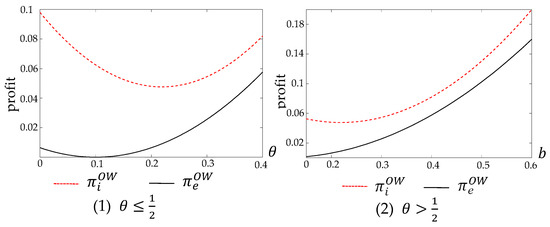
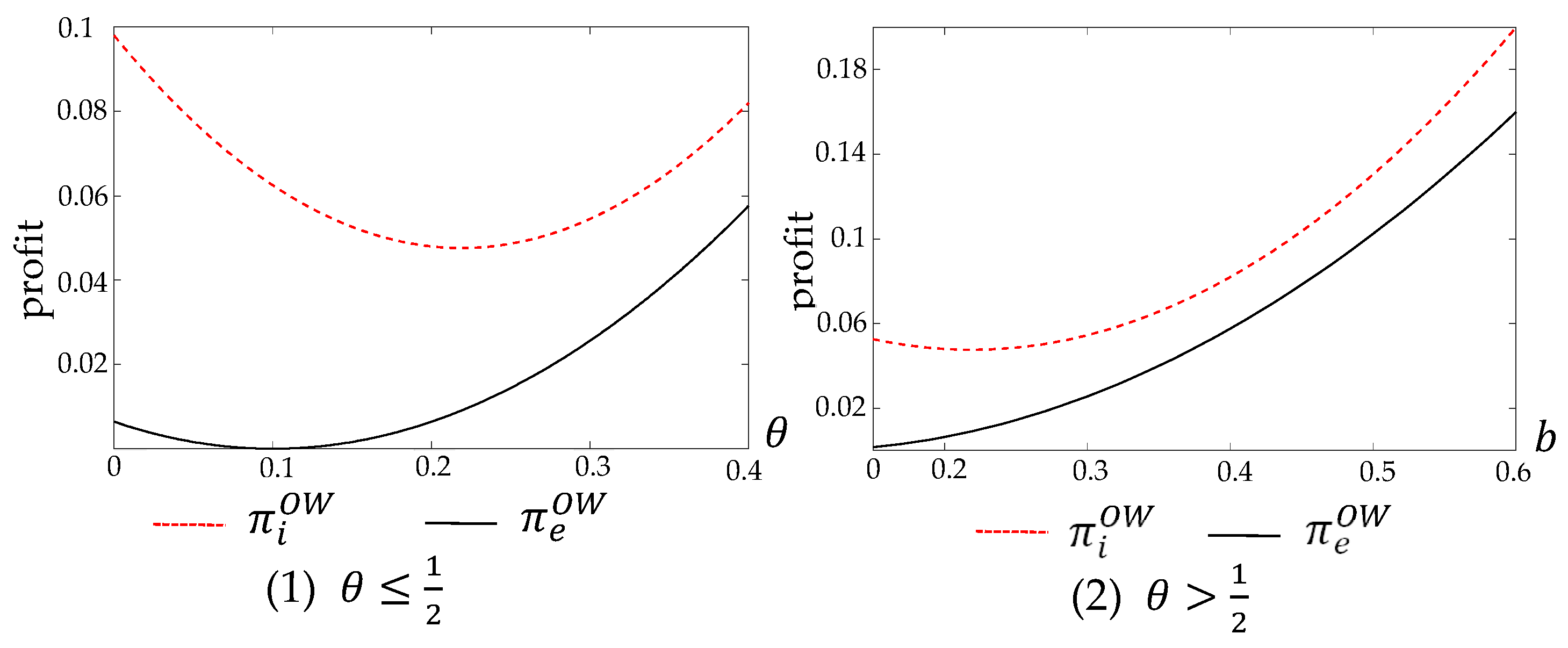
Next, we make the sensitivity analysis, leading to the interesting results in Proposition 1. The results are also illustrated in Figure 1.
Figure 1.
Impact of on profits under .
Proposition 1.
Under the outsourcing strategy with the wholesale price contract .
(i) is decreasing in if and only if and .
(ii) is decreasing in if and only if .
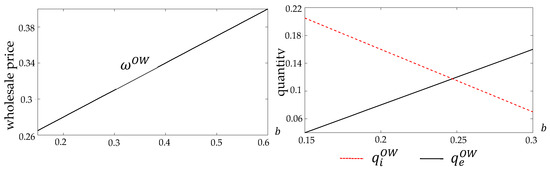
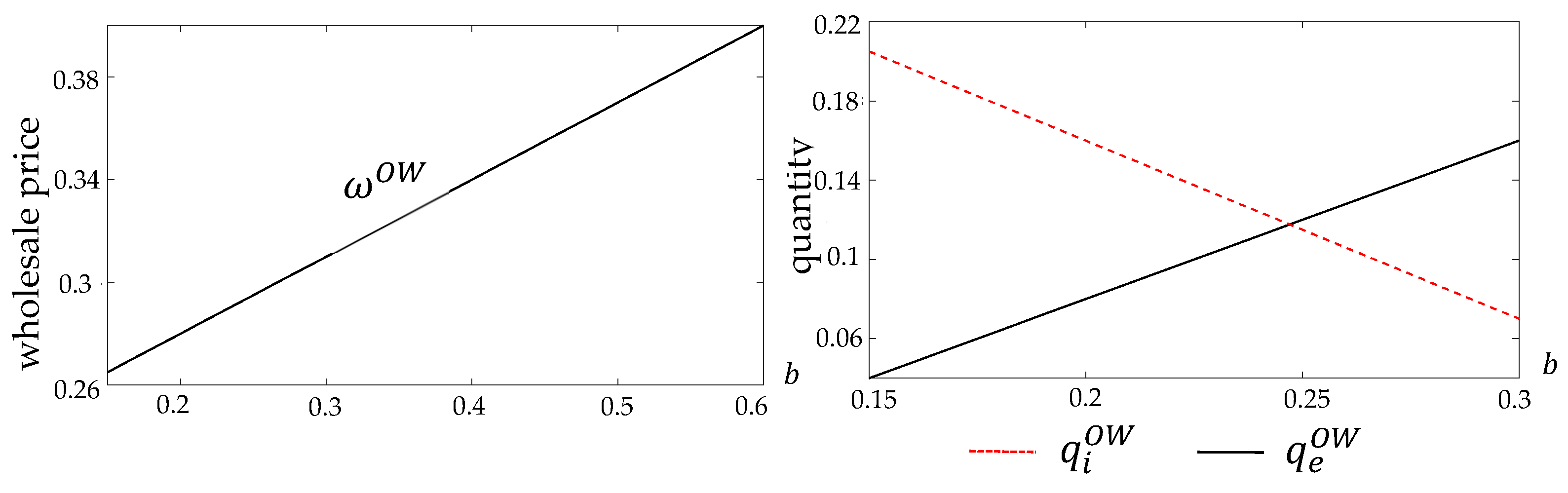
First, taking a closer look at the wholesale price and quantities we have the following comparative statics, which are also illustrated in Figure 2:
Figure 2.
Impact of on wholesale price and quantity.
Clearly, the entrant’s production quantity (i.e., ) is increasing in , while the incumbent’s (i.e., ) is decreasing in . This result is intuitive because brand spillover helps the entrant’s products differentiate from the competitive incumbent’s products. We also find that the equilibrium wholesale price is increasing in , but the entrant’s profit still increases in except for the case where both the entrant’s original market power and brand spillover are small (i.e., and ). This is because the entrant’s profit margin increases. That is, the positive effect (i.e., larger selling quantity) due to the increase of outweighs the negative effect (i.e., higher wholesale price). However, in the special case of and , the negative effect dominates, hence his profit decreases in .
Stronger brand spillover imposes two opposing effects on the incumbent’s profit. On the one hand, it allows the incumbent to set a higher wholesale price for the entrant and then to earn more profit from the component-selling business, which is the positive effect; on the other hand, it results in a lower quantity for the incumbent and leads them to earn less profit from the self-branded business, which is the negative effect. As a result, the incumbent’s profit could be either increasing or decreasing in , contingent on the two firms’ optimal quantity responses. When the entrant’s optimal quantity is larger, it is more likely that the positive effect dominates, and the incumbent’s profit increases in . In other words, if brand spillover is larger than the threshold , the incumbent’s profit loss from self-branded business is compensated by her profit gain from component-selling business. On the contrary, if the incumbent’s component has little brand spillover toward the entrant’s products, that is, , then the incumbent gains limited profit from component-selling business, which is less than the loss from self-branded business.
Interestingly, when the strength of brand spillover exceeds a threshold, that is, when , the two firms benefit from a higher level of brand spillover, which implies that the incumbent does not always have to fight against the increasing brand spillover to the entrant.
4.3. Results Under
In this scenario, the entrant sources critical components from the incumbent, adopting a revenue share contract. Moreover, the commission rate (denoted as in this scenario) is set by the entrant. The event sequence is described as follows: First, the entrant determines the commission rate . Second, the entrant places an order on the incumbent, who also determines the production quantity for her end product. Third, the entrant receives the critical components of the end product. Finally, products are sold to consumers at market-clearing prices. The entrant’s and the incumbent’s profit functions are given as follows:
The results are summarized in Lemma 3.
Lemma 3.
(i) The incumbent accepts the commission rate set by the entrant if and only if (i) and ; (ii) and ; (iii) .
(ii) If and , and , the commission rate set by the entrant is , the production quantities are , , and the supply chain parties’ profits are , .
(iii) Otherwise, the commission rate set by the entrant is , the production quantities are and , and the supply chain parties’ profits are and .1
The expressions of , , , and are defined in Appendix A.
Lemma 3 indicates that only when the entrant’s optimal quantity, including original market power and brand spillover, is not small is the revenue share contract with the entrant’s pricing power established. This is because if the entrant has a small optimal quantity he cannot afford the incumbent’s commission rate to develop the cooperation.
Specifically, when the entrant’s optimal quantity is at an intermediate level (i.e., and , and ), the positive effect of the component-selling business for the incumbent dominates. As a result, the incumbent will accept the entrant’s revenue share contract (i.e., ) only if her profit is higher than that under . When the entrant’s optimal quantity is at a large level (i.e., and , and , ), the negative effect of self-branded business for the incumbent dominates. And hence, the commission rate (i.e., ) should let the incumbent’s profit be higher than that under .
Proposition 2.
Under the outsourcing strategy with the revenue share contract , is increasing in .
As Lemma 3 shows, the entrant offers an acceptable commission rate only if his optimal quantity is relatively large. In this case, the entrant originally is a severe threat to the incumbent and takes market share from the incumbent. Hence, the component-selling business plays a vital role in the incumbent’s profit, and the incumbent is worst off with the insourcing strategy. As a result, the entrant needs to provide a commission rate to guarantee that both the entrant’s and the incumbent’s profits are higher than {OW}. As brand spillover increases, the entrant’s quantity and profit increase. Subsequently, the cooperation constraint of the incumbent can be met even if the commission rate decreases, and the entrant can profit as much as possible.
4.4. Results Under
In this scenario, the entrant sources critical components from the incumbent, adopting the revenue share contract. Specifically, commission rate (denoted as in this scenario) is set by the incumbent. The event sequence is described as follows: First, the incumbent determines the commission rate . Second, the entrant places an order on the incumbent, who also determines the production quantity for her end product. Third, the entrant receives the critical component of the end products. Finally, products are sold to consumers at market-clearing prices. The entrant’s and the incumbent’s profit functions are given as follows:
The results are summarized in Lemma 4.
Lemma 4.
(i) The entrant accepts the commission rate set by the incumbent except when and .
(ii) Under the outsourcing structure with the revenue share contract:
(i) If , the commission rate which is set by the incumbent is , the production quantities are and , and the supply chain parties’ profits are and .2
(ii) Otherwise, the commission rate which is set by the incumbent is , the production quantities are and , and the supply chain parties’ profits are and .3
The expressions of , , and are defined in Appendix A.
Compared with scenario, the incumbent can leverage pricing power to induce the outsourcing strategy with the revenue share contract (i.e., ) in more cases. The reason is that, on the one hand, the entrant’s acceptable constraints can be more easily satisfied than the incumbent’s acceptable constraints. On the other hand, the incumbent can extract the most benefit from the brand attractiveness in the outsourcing strategy.
Proposition 3.
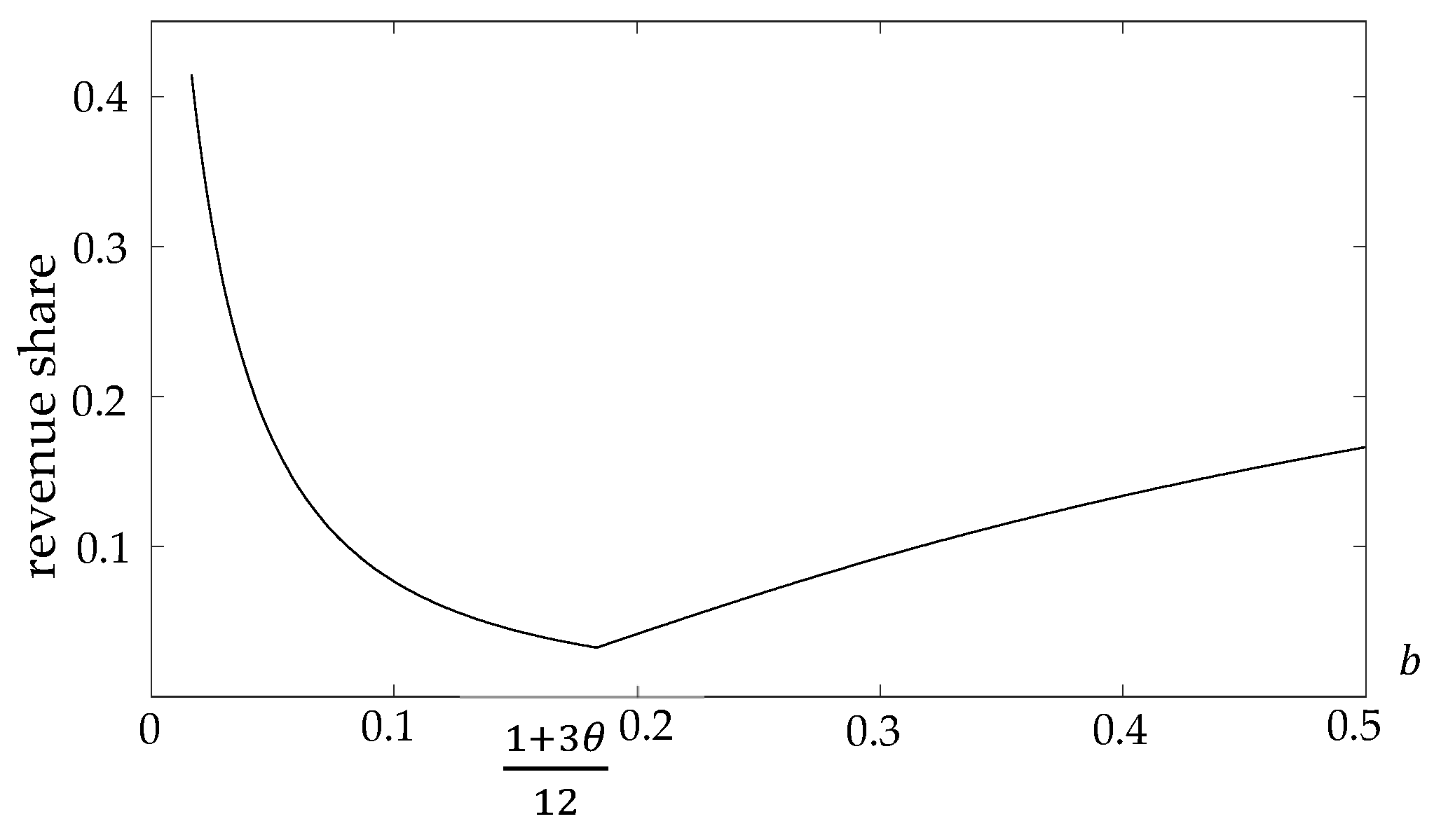
Under the outsourcing strategy with the revenue share contract (), is decreasing in if and only if .
Proposition 3 is illustrated in Figure 3. In the case of weak brand spillover (i.e., ), the entrant earns more profit adopting the insourcing strategy than the outsourcing strategy with the wholesale price contract. Thus, the entrant will accept the incumbent’s revenue share contract only if his profit is higher than that under which is not related to . Moreover, the entrant’s quantity increases in brand spillover in the case of . Hence, the incumbent can induce the entrant to choose the outsourcing strategy with the revenue share contract even if the commission rate decreases in .
Figure 3.
Impact of on revenue share under .
As brand spillover increases (i.e., ), the entrant will accept the incumbent’s revenue share contract only if his profit is higher than that under . As we have mentioned in Proposition 1, the entrant’s profit increases in in the case of . As a result, the commission rate should increase in so that the entrant will accept the contract.
4.5. Equilibrium Sourcing Strategy
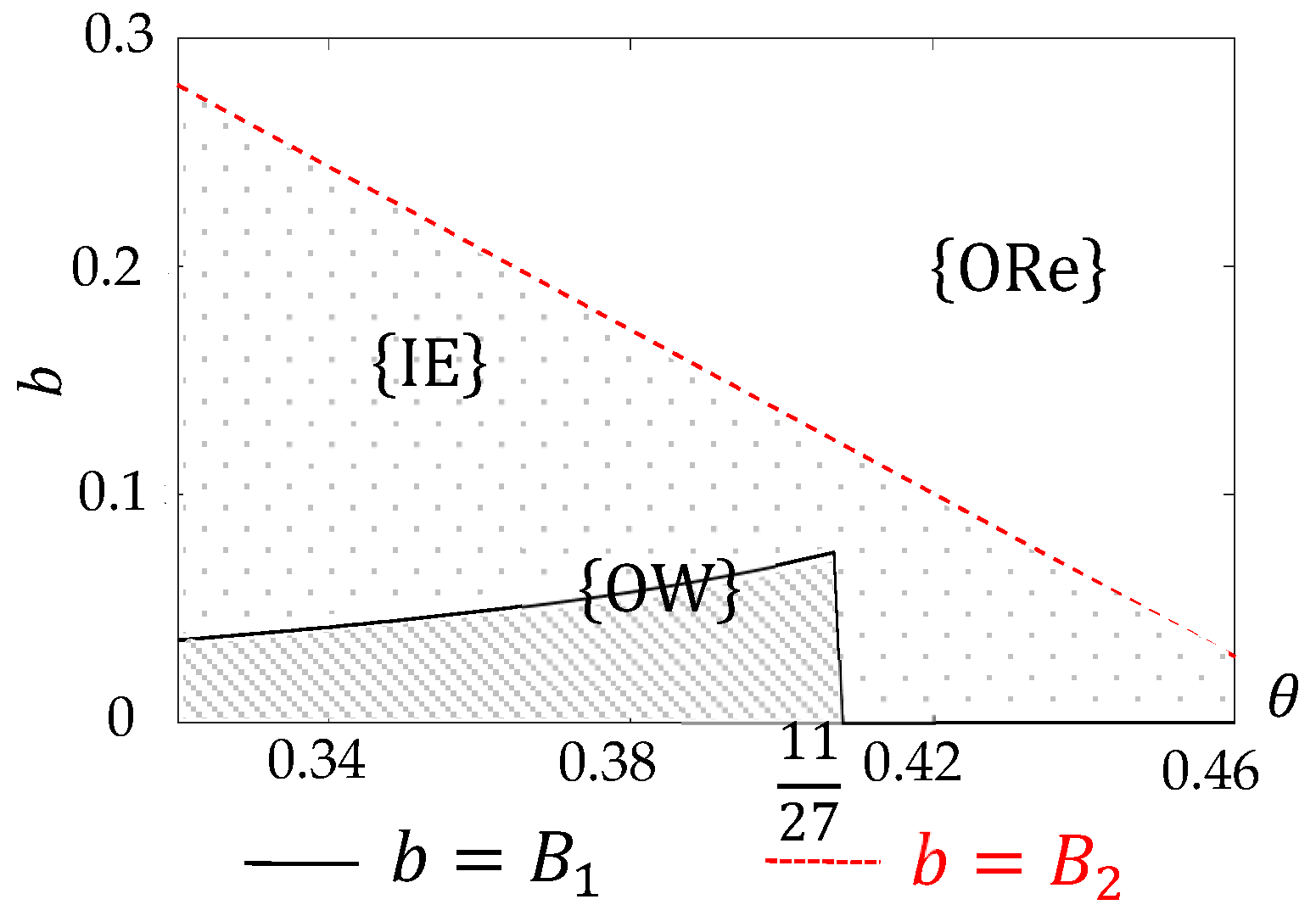
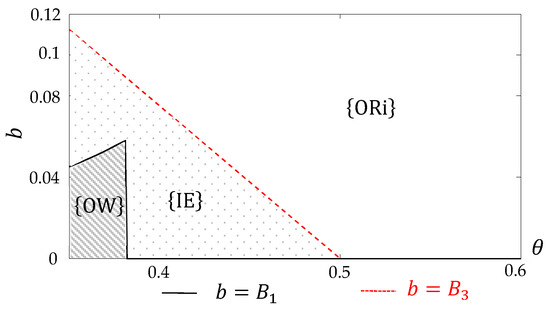
In this section, we first derive the equilibrium sourcing strategy in the case where the commission rate is set by the entrant and is illustrated in Figure 4.
Figure 4.
Equilibrium sourcing strategy with entrant’s pricing power.
Proposition 4.
The commission rate is set by the entrant:
(i) , is the equilibrium sourcing strategy when ; is the equilibrium sourcing strategy when ; and is the equilibrium sourcing strategy when .
(ii) If , is the equilibrium sourcing strategy when ; and is the equilibrium sourcing strategy when .
The expressions of and are defined in Appendix A.
For small (i.e., ), it is costly for the entrant to satisfy the incumbent’s cooperation constraint under . Therefore, the equilibrium sourcing strategy will be either or . Specifically, in the case of and , brand spillover has little effect on firms’ optimal quantities. That is, brand spillover has little negative effect on the incumbent’s self-branded business. On the contrary, the incumbent can charge a relatively low wholesale price to secure the order from the entrant, earning more profit. Consequently, the entrant can be better off under and thus should adopt . As the entrant’s optimal quantity, including original market power and brand spillover, increases (i.e., and , and ), the incumbent’s profit loss of self-branded business increases. An increased wholesale price follows this decline in profit. Consequently, the entrant will adopt the insourcing strategy (i.e., ) because of the relatively high wholesale price.
As exceeds the specific value , brand spillover plays a vital role in the entrant’s profit because of the high optimal quantity, and the entrant will outsource from the incumbent. Considering high wholesale price, it is wise for the entrant to set an optimal commission rate to allow both the entrant and the incumbent to earn more profit than in other scenarios (i.e., and ).
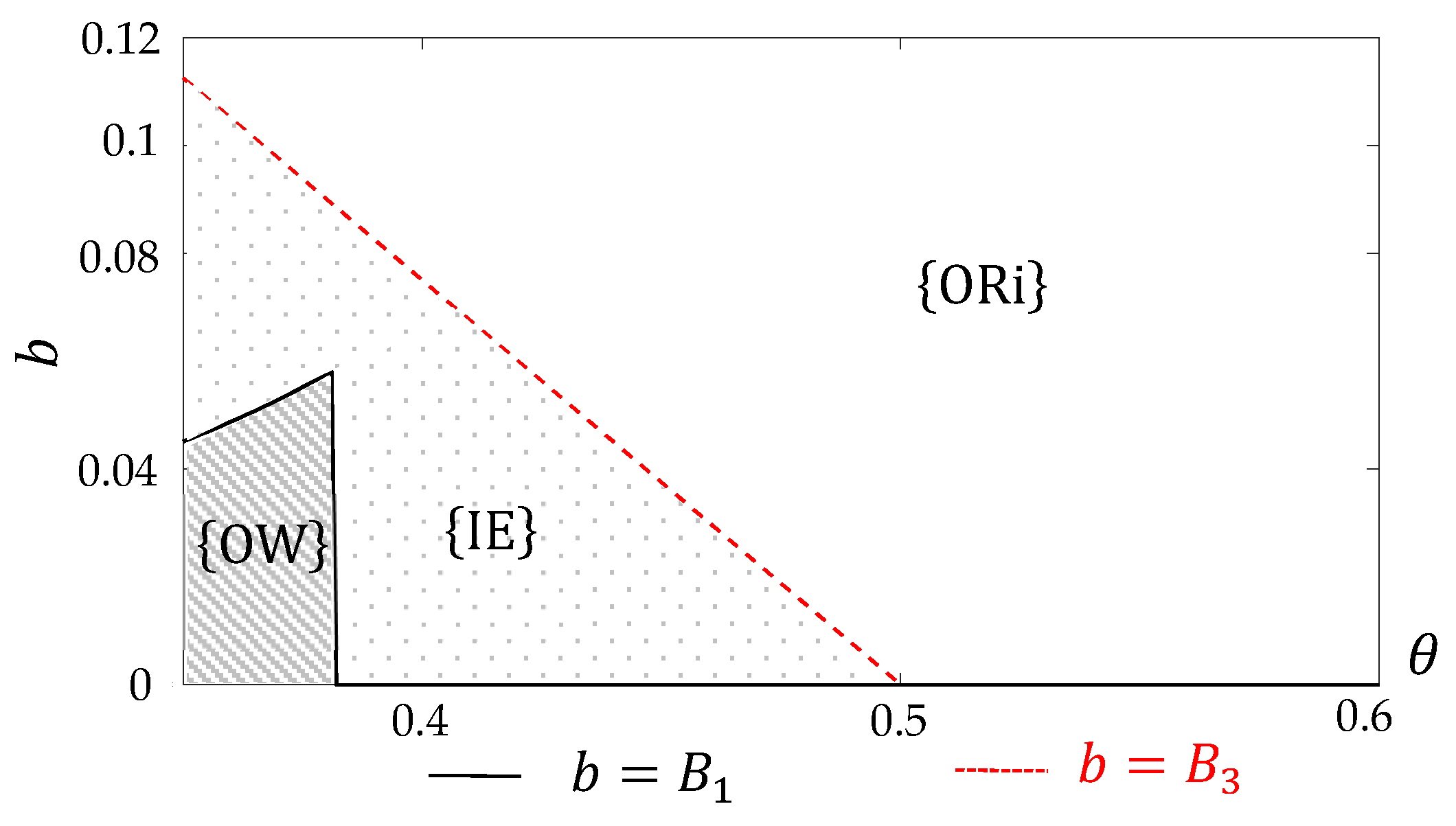
Next, we derive the equilibrium sourcing strategy in the case where the commission rate is set by the incumbent, and this is illustrated in Figure 5.
Figure 5.
Equilibrium sourcing strategy with incumbent’s pricing power.
Proposition 5.
The commission rate is set by the incumbent:
(i) , is the equilibrium sourcing strategy when ; is the equilibrium sourcing strategy when ; and is the equilibrium sourcing strategy when .
(ii) If , is the equilibrium sourcing strategy when ; and is the equilibrium sourcing strategy when .
(iii) If , is always the equilibrium sourcing strategy.
The expressions of is defined in Appendix A.
Undoubtedly, the profit of firms with pricing power is always no lower than that without pricing power. Specifically, compared with the entrant’s pricing power, the equilibrium sourcing strategy switches from to when brand spillover is relatively small (i.e., 4 and , and ) with the incumbent’s pricing power. As we have discussed, in these cases the entrant prefers to . Once the incumbent possesses pricing power, she will set an optimal commission rate to induce the outsourcing strategy rather than the insourcing strategy to obtain more profit. Although, we can see that the incumbent will earn the most profit by inducing the wholesale price contract.
5. Extensions: Positive Production Costs
In this section, we relax the zero-production cost assumption by assuming a positive unit production cost and for the entrant and the incumbent, respectively. Specifically, according to reality either the entrant or the incumbent may have the cost advantage. Hence, Section 5.1 and Section 5.2 study the entrant’s and incumbent’s cost advantage, respectively. Although all equilibriums can be obtained in closed-form, additional analysis becomes intractable. Therefore, we resort to numerical analysis to derive the findings here.
5.1. Incumbent’s Cost Advantage
The cost of the entrant’s production can be higher than the incumbent’s. That is, . Due to the complexity of the problem when firms have positive costs, we cannot obtain comprehensive closed-form solutions for the sourcing strategy. Accordingly, we perform numerical experiments to further investigate this aspect. Specifically, we vary over the range , over the range , over the range , and over the range . All parameters are in the step of 0.01. We will run the experiments under thousands of different parameter settings and find that the results are robust to the changes in parameters. Further, we will contextualize our results based on practical use cases. For example, Audi provides batteries to NIO and has a strong cost advantage. According to our result (Observation 1(ii)), NIO should outsource from Audi, which is consistent with reality. Observations 1 and 2 conclude the numerical results.
Observation 1.
Suppose that and the commission rate is set by the entrant:
(i) If .
(i) If , is the equilibrium sourcing strategy when ; and is the equilibrium sourcing strategy when , where .
(ii) If , is the equilibrium sourcing strategy when ; is the equilibrium sourcing strategy when ; and is the equilibrium sourcing strategy when .
(ii) If , is the equilibrium sourcing strategy when ; and is the equilibrium sourcing strategy when .
(iii) If , is always the equilibrium sourcing strategy.
Observation 2.
Suppose that and the commission rate is set by the incumbent:
(i) If .
(i) If , is always the equilibrium sourcing strategy, where .
(ii) If , is the equilibrium sourcing strategy when ; and is the equilibrium sourcing strategy when , where .
(iii) If , is the equilibrium sourcing strategy when ; is the equilibrium sourcing strategy when ; and is the equilibrium sourcing strategy when .
(ii) If , is the equilibrium sourcing strategy when ; and is the equilibrium sourcing strategy when .
(iii) If , is always the equilibrium sourcing strategy.
Observations 1 and 2 indicate that Propositions 4 and 5 still hold when the incumbent has a cost advantage, except for the following cases: (i) when the entrant’s original market power (i.e., θ) is small, the incumbent’s cost advantage (i.e., ) is significant, and brand spillover (i.e., b) is intermediate; (ii) when the entrant’s original market power is substantial in the case of the incumbent’s pricing power (intermediate in the case of the entrant’s pricing power), and brand spillover is small. In these two cases outsourcing {OR} remains the optimal sourcing strategy even when the entrant has weak market power or experiences limited brand spillover, rather than insourcing ({IE}). This outcome is surprising, as conventional wisdom would expect the entrant to prefer insourcing due to its cost disadvantage. The reason is that, in the two cases, on the one hand, brand spillover allows the entrant’s optimal quantity to be not too small; on the other hand, the cost advantage enables the incumbent to charge a smaller commission rate while still being profitable. As a result, the entrant and the incumbent can agree on a relatively large commission rate to induce the outsourcing strategy while maximizing their profits.
This implies that when formulating cooperative or sourcing strategies, firms evaluate not only cost advantages but also weigh multiple strategic factors such as market power and brand spillover effects. Consequently, they can optimize their outsourcing versus insourcing decisions. Managers should recognize that outsourcing is not exclusively the domain of the advantaged firm. Under certain conditions, the disadvantaged firm can also strategically design their sourcing strategies to maximize profit.
5.2. Entrant’s Cost Advantage
The cost of the entrant’s production can be lower than the incumbent’s. That is, . Similarly to Section 5.1, we perform numerical experiments to investigate the sourcing strategy. Specifically, we vary over the range , over the range , over the range , and over the range . All parameters are in the step of 0.01. We run experiments under thousands of different parameter settings and find that the results are robust to the changes in parameters. Further, we will contextualize our results based on practical use cases. For example, Huawei provides a smart cockpit system to Audi and has a strong cost advantage. According to our result (Observation 4(i)), Audi should insource from Huawei, which is consistent with reality. Observations 3 and 4 conclude the numerical results.
Observation 3.
Suppose that and the commission rate is set by the entrant:
(i) If .
(i) If , is the equilibrium sourcing strategy when ; and is the equilibrium sourcing strategy when , where .
(ii) If , is the equilibrium sourcing strategy when ; is the equilibrium sourcing strategy when ; and is the equilibrium sourcing strategy when .
(ii) If , is the equilibrium sourcing strategy when ; and is the equilibrium sourcing strategy when .
Observation 4.
Suppose that and the commission rate is set by the incumbent:
(i) If .
(i) If , is the equilibrium sourcing strategy when ; and is the equilibrium sourcing strategy when , where .
(ii) If , is the equilibrium sourcing strategy when ; is the equilibrium sourcing strategy when ; and is the equilibrium sourcing strategy when .
(ii) If , is the equilibrium sourcing strategy when ; and is the equilibrium sourcing strategy when .
(iii) If , is always the equilibrium sourcing strategy.
Observations 3 and 4 indicate that Propositions 4 and 5 still hold when the entrant has a cost advantage, except when the entrant’s optimal quantity (the original market power and brand spillover) is small and the entrant’s cost advantage is significant. In this case, it is more profitable for the entrant to insource critical components (i.e., {IE}) instead of outsourcing with wholesale price (i.e., {OW}) due to the significant cost advantage. Specifically, due to significant cost advantages, the entrant will choose to insource components to maximize its profit rather than choose to outsource with a wholesale price contract. This provides an important managerial insight: when a firm has a significant cost advantage but limited market power it should prioritize an insourcing strategy. In other words, under certain conditions cost advantage can become the key factor for the firm to maximize its profits.
6. Conclusions
Huawei’s entry as an ICT solutions provider into the autonomous vehicle sector motivates strategic sourcing decisions: whether to insource or outsource critical components and whether to adopt wholesale or revenue share contracts. In this study, we develop a game theoretic model with one entrant and one incumbent with a strong brand (the entrant serves the emerging market and the incumbent serves the traditional market) to investigate how these decisions depend on the firm’s original market power and the level of brand spillover.
First, we found that strong brand spillover discourages two firms from agreeing on an optimal commission rate for the outsourcing strategy. When brand spillover is not too small or too large the insourcing strategy is preferred, except for the case where the entrant has strong original market power and the incumbent has pricing power. Under this particular case, it is more profitable for the incumbent to induce an outsourcing strategy with the revenue share contract than an insourcing strategy. With weak brand spillover, the profit loss of self-branded business can be offset by the profit benefit from component-selling business only when the incumbent’s original market power is considerable. Hence the outsourcing strategy with the wholesale price contract is the equilibrium choice. Otherwise, the insourcing strategy is the equilibrium choice.
Then, contrary to conventional wisdom, we found that under the wholesale price contract both parties benefited from a higher level of brand spillover if the strength of brand spillover was above a certain level. This result implies that the incumbent does not always have to fight against increasing brand spillover to the entrant. This strategic paradox provides a critical managerial insight: brand openness holds greater value-creation potential than protectionism. For example, despite the potential brand control risks posed by Audi as an internationally renowned brand, its collaboration with Huawei in co-developing smart cockpit systems brought significant benefits. This partnership not only elevated Huawei’s global automotive profile through the premium brand association, but also accelerated Audi’s advancement in intelligentization.
Finally, we also found that under the revenue share contract, even if the incumbent possesses pricing power, her commission rate may decrease as brand spillover increases. In conclusion, brand spillover effects provide a novel strategic perspective. Firms should flexibly adjust their brand strategies based on their own circumstances and market environment, ultimately achieving mutual benefit and a win-win outcome.
This study can be extended in several directions. First, this paper focuses on a supply chain consisting of an incumbent and a single entrant, whereas real markets typically involve multiple competing manufacturing firms (e.g., Tesla, BYD, and NIO in the electric vehicle sector). Subsequent work could extend this framework by incorporating competition between incumbents. Second, our model adopts a single-period game-theoretic structure, which inherently limits the incorporation of firms’ intertemporal learning behaviors, such as dynamic reputation accumulation. Future investigations could address this limitation by employing a two-stage model. Third, the assumption of deterministic brand spillover effects overlooks the stochastic fluctuations arising from technological iterations or public relations events (e.g., social media crises impacting brand equity). Future research could study the effects of random brand spillovers on firms’ sourcing and contract decisions.
Author Contributions
This article has been composed by F.J. and J.D. All authors have read and agreed to the published version of the manuscript.
Funding
This research received no external funding.
Data Availability Statement
The original contributions presented in the study are included in the article, further inquiries can be directed to the corresponding author.
Conflicts of Interest
The authors declare no conflicts of interest.
Appendix A. Proofs
Proof of Lemma 1.
The entrant solves the following problem to maximize his profit: , which yields . The incumbent’s optimal production quantity is given by solving , which yields . Solving and simultaneously yields: ; . Bringing them back to the equations of profits, we can derive the optimums. □
Proof of Proposition 1.
, we can obtain that when , ; and when , . □
Proof of Lemma 2.
The entrant solves the following problem to maximize his profit: , which yields . The incumbent’s optimal production quantity is given by solving , which yields . Solving and simultaneously yields ; and .
Substituting them into the incumbent’s profit function and then solving for optimality with respect to , we have the optimal wholesale price: .
We can derive the optimums by bringing this back to the equations of quantities and profits. □
Proof of Lemmas 3 and 4.
The entrant solves the following problem to maximize his profit: , which yields . The incumbent’s optimal production quantity is given by solving , which yields . Solving and simultaneously yields: ; and . Substituting them into the firms’ profit function: ; and .
(1) If the commission rate is set by the entrant, the incumbent will accept the contract only if:
We can obtain this if , ; and if , . Further, when and ; and , ; and and , . When and ; , . Where .
For the entrant, his commission rate is : when and ; and and , . When and ; and ; and , .
For convenience, we define new variables and , which leads to Lemma 3.
(2) If the commission rate is set by the incumbent, the entrant will accept the contract only if:
We can obtain this if , ; and if , . Further, , establish except for one case: when and , . Where .
For the incumbent, her commission rate is : when , . When and ; and and , .
For convenience, we define new variables and , which leads to Lemma 4. □
Proof of Proposition 4.
(1) If ;
(a) When , the incumbent does not accept the commission rate (i.e., ). Comparing with , when , ; hence is the equilibrium strategy. When , ; hence is the equilibrium strategy.
(b) When , the incumbent accepts the commission rate (i.e., ). From the entrant’s perspective, it is the most profitable only:
which is denoted as Constraint (i). When , . That is, Constraint (i) is not met. Further, we need to compare with . We find that ; hence is the equilibrium strategy. When , . That is, Constraint (i) is met. Hence, is the equilibrium strategy, where .
(c) When , the incumbent accepts the commission rate (i.e., ). From the entrant’s perspective, . That is, Constraint (i) is met. Hence, is the equilibrium strategy, where .
(2) If ;
(a) When , the incumbent does not accept the commission rate (i.e., ). Comparing with , when and ; when and , ; hence is the equilibrium strategy. When and ; when and ; when and , ; hence is the equilibrium strategy.
(b) When , the incumbent accepts the commission rate (i.e., ). From the entrant’s perspective, when , . That is, Constraint (i) is not met. Further, we need to compare with . We find that ; hence is the equilibrium strategy. When , . That is, Constraint (i) is met. Hence, is the equilibrium strategy, where .
(c) When , the incumbent accepts the commission rate (i.e., ). From the entrant’s perspective, . That is, Constraint (i) is met. Hence, is the equilibrium strategy, where .
(3) If ;
(a) When , the incumbent does not accept the commission rate (i.e., ). Comparing with , ; hence is the equilibrium strategy.
(b) When , the incumbent accepts the commission rate (i.e., ). From the entrant’s perspective, . That is, Constraint (i) is not met. Further, we need to compare with . We find that ; hence is the equilibrium strategy.
(c) When , the incumbent accepts the commission rate (i.e., ). From the entrant’s perspective, when , . That is, Constraint (i) is not met. Further, we need to compare with . We find that ; hence is the equilibrium strategy. When , . That is, Constraint (i) is met. Hence, is the equilibrium strategy, where .
(d) When , the incumbent accepts the commission rate (i.e., ). From the entrant’s perspective, . That is, Constraint (i) is met. Hence, is the equilibrium strategy, where .
(e) When , the incumbent accepts the commission rate (i.e., ). From the entrant’s perspective, . That is, Constraint (i) is met. Hence, is the equilibrium strategy, where .
(4) If ;
(a) When , the incumbent does not accept the commission rate (i.e., ). Comparing with , ; hence is the equilibrium strategy.
(b) When , the incumbent accepts the commission rate (i.e., ). From the entrant’s perspective, . That is, Constraint (i) is not met. Further, we need to compare with . We find that ; hence is the equilibrium strategy.
(c) When , the incumbent accepts the commission rate (i.e., ). From the entrant’s perspective, when , . That is, Constraint (i) is not met. Further, we need to compare with . We find that ; hence is the equilibrium strategy. When , . That is, Constraint (i) is met. Hence, is the equilibrium strategy, where .
(d) When , the incumbent accepts the commission rate (i.e., ). From the entrant’s perspective, . That is, Constraint (i) is met. Hence, is the equilibrium strategy, where .
(e) When , the incumbent accepts the commission rate (i.e., ). From the entrant’s perspective, . That is, Constraint (i) is met. Hence, is the equilibrium strategy, where .
(5) If ;
(a) When , the incumbent does not accept the commission rate (i.e., ). Comparing with , ; hence is the equilibrium strategy.
(b) When , the incumbent accepts the commission rate (i.e., ). From the entrant’s perspective, when , . That is, Constraint (i) is not met. Further, we need to compare with . We find that ; hence is the equilibrium strategy. When , . That is, Constraint (i) is met. Hence, is the equilibrium strategy, where .
(c) When , the incumbent accepts the commission rate (i.e., ). From the entrant’s perspective, . That is, Constraint (i) is met. Hence, is the equilibrium strategy, where .
(6) If ;
(a) When , the incumbent accepts the commission rate (i.e., ). From the entrant’s perspective, when , . That is, Constraint (i) is not met. Further, we need to compare with . We find that ; hence is the equilibrium strategy. When , . That is, Constraint (i) is met. Hence, is the equilibrium strategy, where .
(b) When , the incumbent accepts the commission rate (i.e., ). From the entrant’s perspective, . That is, Constraint (i) is met. Hence, is the equilibrium strategy, where .
For convenience, we define new variables , 5, which lead to proposition 4. □
Proof of Proposition 5.
(1) If ;
(a) When , the entrant does not accept the commission rate (i.e., ). Comparing with , when , ; hence is the equilibrium strategy. When , ; hence is the equilibrium strategy.
(b) When , the entrant accepts the commission rate (i.e., ). From the incumbent’s perspective, it is the most profitable only:
which is denoted as Constraint (ii). When , . That is, Constraint (ii) is not met. Further, we need to compare with . We find that ; hence is the equilibrium strategy. When , . That is, Constraint (ii) is met. Hence, is the equilibrium strategy, where .
(c) When , the entrant accepts the commission rate (i.e., ). From the incumbent’s perspective, . That is, Constraint (ii) is met. Hence, is the equilibrium strategy, where .
(2) If ;
(a) When , the entrant does not accept the commission rate (i.e., ). Comparing with , when and ; when and , ; hence is the equilibrium strategy. When and ; when and ; when and , ; hence is the equilibrium strategy.
(b) When , the entrant accepts the commission rate (i.e., ). From the incumbent’s perspective, when , . That is, Constraint (ii) is not met. Further, we need to compare with . We find that ; hence is the equilibrium strategy. When , . That is, Constraint (ii) is met. Hence, is the equilibrium strategy, where .
(c) When , the entrant accepts the commission rate (i.e., ). From the incumbent’s perspective, . That is, Constraint (ii) is met. Hence, is the equilibrium strategy, where .
(3) If ;
(a) When , the entrant does not accept the commission rate (i.e., ). Comparing with , ; hence, is the equilibrium strategy.
(b) When , the entrant accepts the commission rate (i.e., ). From the incumbent’s perspective, . That is, Constraint (ii) is not met. Further, we need to compare with . We find that ; hence is the equilibrium strategy.
(c) When , the entrant accepts the commission rate (i.e., ). From the incumbent’s perspective, when , . That is, Constraint (ii) is not met. Further, we need to compare with . We find that ; hence is the equilibrium strategy. When , . That is, Constraint (ii) is met. Hence, is the equilibrium strategy, where .
(d) When , the entrant accepts the commission rate (i.e., ). From the incumbent’s perspective, . That is, Constraint (ii) is met. Hence, is the equilibrium strategy, where .
(e) When , the entrant accepts the commission rate (i.e., ). From the incumbent’s perspective, . That is, Constraint (ii) is met. Hence, is the equilibrium strategy, where .
(4) If ;
(a) When , the entrant does not accept the commission rate (i.e., ). Comparing with , ; hence is the equilibrium strategy.
(b) When , the entrant accepts the commission rate (i.e., ). From the incumbent’s perspective, . That is, Constraint (ii) is not met. Further, we need to compare with . We find that ; hence is the equilibrium strategy.
(c) When , the entrant accepts the commission rate (i.e., ). From the incumbent’s perspective, when , . That is, Constraint (ii) is not met. Further, we need to compare with . We find that ; hence is the equilibrium strategy. When , . That is, Constraint (ii) is met. Hence, is the equilibrium strategy, where .
(d) When , the entrant accepts the commission rate (i.e., ). From the incumbent’s perspective, . That is, Constraint (ii) is met. Hence, is the equilibrium strategy, where .
(e) When , the entrant accepts the commission rate (i.e., ). From the incumbent’s perspective, . That is, Constraint (ii) is met. Hence, is the equilibrium strategy, where .
(5) If ;
(a) When , the entrant does not accept the commission rate (i.e., ). Comparing with , ; hence is the equilibrium strategy.
(b) When , the entrant accepts the commission rate (i.e., ). From the incumbent’s perspective, when , . That is, Constraint (ii) is not met. Further, we need to compare with . We find that . However, in this case, we can find that . That is, can allow the incumbent’s profit to be higher than but to be lower than . Hence, is the equilibrium strategy, where .When , . That is, Constraint (ii) is met. Hence, is the equilibrium strategy, where .
(c) When , the entrant accepts the commission rate (i.e., ). From the entrant’s perspective, . That is, Constraint (ii) is met. Hence, is the equilibrium strategy, where .
(6) If ;
(a) When , the entrant accepts the commission rate (i.e., ). From the entrant’s perspective, when , . Similarly to (5) (b), we can find that . Hence, is the equilibrium strategy, where . When , . That is, Constraint (ii) is met. Hence, is the equilibrium strategy, where .
(b) When , the entrant accepts the commission rate (i.e., ). From the incumbent’s perspective, . That is, Constraint (ii) is met. Hence, is the equilibrium strategy, where .
For convenience, we define new variables , which lead to Proposition 5. □
Appendix B. The Derivation of
As long as the optimal and are higher than zero, the entrant and incumbent will not be driven out of the market. Under , we have: and ; clearly, requires , and requires .
Under , we have: and ; clearly, requires , and requires .
Under , we have: ; clearly, requires . If , then ; if , then ; we always have .
Further, we have: . Hence, ; .
Appendix C. The Formulas
Notes
| 1 | The formula is available in Appendix C due to its complexity. |
| 2 | The formula is available in Appendix C due to its complexity. |
| 3 | The formula is available in Appendix C due to its complexity. |
| 4 | is the intersection of and . |
| 5 | is the intersection of and ; is the intersection of and . |
References
- Anand, K. S., & Girotra, K. (2007). The strategic perils of delayed differentiation. Management Science, 53(5), 697–712. [Google Scholar] [CrossRef] [Scilit]
- Ang, E., Iancu, D. A., & Swinney, R. (2017). Disruption risk and optimal sourcing in multitier supply networks. Management Science, 63(8), 2397–2419. [Google Scholar] [CrossRef] [Scilit]
- Arani, H. V., Rabbani, M., & Rafiei, H. (2016). A revenue-sharing option contract toward coordination of supply chains. International Journal of Production Economics, 178, 42–56. [Google Scholar] [CrossRef] [Scilit]
- Avinadav, T., Chernonog, T., & Perlman, Y. (2015). Consignment contract for mobile apps between a single retailer and competitive developers with different risk attitudes. European Journal of Operational Research, 246(3), 949–957. [Google Scholar] [CrossRef] [Scilit]
- Balachander, S., & Ghose, S. (2003). Reciprocal spillover effects: A strategic benefit of brand extensions. Journal of Marketing, 67(1), 4–13. [Google Scholar] [CrossRef] [Scilit]
- Bengtsson, A., & Servais, P. (2005). Co-branding on industrial markets. Industrial Marketing Management, 34(7), 706–713. [Google Scholar] [CrossRef] [Scilit]
- Borah, A., & Tellis, G. J. (2016). Halo (spillover) effects in social media: Do product recalls of one brand hurt or help rival brands? Journal of Marketing Research, 53(2), 143–160. [Google Scholar] [CrossRef] [Scilit]
- Cachon, G. P., & Kök, A. G. (2010). Competing manufacturers in a retail supply chain: On contractual form and coordination. Management Science, 56(3), 571–589. [Google Scholar] [CrossRef] [Scilit]
- Cachon, G. P., & Lariviere, M. A. (2005). Supply chain coordination with revenue-sharing contracts: Strengths and limitations. Management Science, 51(1), 30–44. [Google Scholar] [CrossRef] [Scilit]
- Cai, G., Dai, Y., & Zhou, S. X. (2012). Exclusive channels and revenue sharing in a complementary goods market. Marketing Science, 31(1), 172–187. [Google Scholar] [CrossRef] [Scilit]
- Cai, J., Hu, X., Tadikamalla, P. R., & Shang, J. (2017). Flexible contract design for VMI supply chain with service-sensitive demand: Revenue-sharing and supplier subsidy. European Journal of Operational Research, 261(1), 143–153. [Google Scholar]
- Cao, G., Wang, Y., Gao, H., Liu, H., Liu, H., Song, Z., & Fan, Y. (2023). Coordination decision-making for intelligent transformation of logistics services under capital constraint. Sustainability, 15(6), 5421. [Google Scholar] [CrossRef] [Scilit]
- Chakraborty, T., Chauhan, S. S., & Vidyarthi, N. (2015). Coordination and competition in a common retailer channel: Wholesale price versus revenue-sharing mechanisms. International Journal of Production Economics, 166, 103–118. [Google Scholar] [CrossRef] [Scilit]
- Chernonog, T., & Levy, P. (2023). Co-creation of mobile app quality in a two-platform supply chain when platforms are asymmetric. European Journal of Operational Research, 308(1), 183–200. [Google Scholar] [CrossRef] [Scilit]
- Choi, T. M., Wang, Y., & Shen, B. (2022). Selling to Profit-Target-Oriented retailers: Optimal supply chain contracting with bargaining. International Journal of Production Economics, 250, 108617. [Google Scholar]
- Chowdhury, T. G., Khare, A., & Coulter, R. A. (2025). Spillover effects of sensory stimulation. European Journal of Marketing, 59(3), 501–527. [Google Scholar] [CrossRef] [Scilit]
- Cobbs, J., Groza, M., & Rich, G. (2015). Brand spillover effects within a sponsor portfolio: The interaction of image congruence and portfolio size. Marketing Management Journal, 25(2), 107–122. [Google Scholar]
- El Ouardighi, F., & Kim, B. (2010). Supply quality management with wholesale price and revenue-sharing contracts under horizontal competition. European Journal of Operational Research, 206(2), 329–340. [Google Scholar] [CrossRef] [Scilit]
- Farquhar, P. H. (1989). Managing brand equity. Marketing Research, 1(3), 24–33. [Google Scholar]
- Fazli, A., & Shulman, J. D. (2018). Implications of market spillovers. Management Science, 64(11), 4996–5013. [Google Scholar] [CrossRef] [Scilit]
- Feng, Q., & Lu, L. X. (2012). The strategic perils of low cost outsourcing. Management Science, 58(6), 1196–1210. [Google Scholar] [CrossRef] [Scilit]
- Goyal, M., & Netessine, S. (2007). Strategic technology choice and capacity investment under demand uncertainty. Management Science, 53(2), 192–207. [Google Scholar] [CrossRef] [Scilit]
- Guan, H., Yang, Z., & Gurnani, H. (2022). Value of information with manufacturer encroachment. Production and Operations Management, 32(3), 780–793. [Google Scholar] [CrossRef] [Scilit]
- Gupta, A., Jayaswal, S., & Mantin, B. (2024). Who benefits from supplier encroachment in the presence of manufacturing cost learning? Production and Operations Management, 33(8), 1700–1718. [Google Scholar] [CrossRef] [Scilit]
- Gupta, S., & Loulou, R. (1998). Process innovation, product differentiation, and channel structure: Strategic incentives in a duopoly. Marketing Science, 17(4), 301–316. [Google Scholar] [CrossRef] [Scilit]
- Heese, H. S., & Kemahlioglu-Ziya, E. (2014). Enabling opportunism: Revenue sharing when sales revenues are unobservable. Production and Operations Management, 23(9), 1634–1645. [Google Scholar] [CrossRef] [Scilit]
- Hu, B., Meng, C., Xu, D., & Son, Y. (2016). Three-echelon supply chain coordination with a loss-averse retailer and revenue sharing contracts. International Journal of Production Economics, 179, 192–202. [Google Scholar] [CrossRef] [Scilit]
- Jiacheng, C., Haibo, Z., Ning, Z., Peng, Y., Lin, G., & Xuemin, S. (2016). Software defined internet of vehicles: Architecture, challenges and solutions. Journal of Communications and Information Networks, 1(1), 14–26. [Google Scholar] [CrossRef] [Scilit]
- Jin, Y., Wang, S., & Hu, Q. (2015). Contract type and decision right of sales promotion in supply chain management with a capital constrained retailer. European Journal of Operational Research, 240(2), 415–424. [Google Scholar] [CrossRef] [Scilit]
- Kandil, N., Hammami, R., & Battaïa, O. (2022). Insourcing versus outsourcing decision under environmental considerations and different contract arrangements. International Journal of Production Economics, 253, 108589. [Google Scholar] [CrossRef] [Scilit]
- Kay, O. (2024). Cournot duopoly with cost asymmetry and balanced budget specific taxes and subsidies. Games, 15(4), 29. [Google Scholar] [CrossRef] [Scilit]
- Kong, G., Rajagopalan, S., & Zhang, H. (2013). Revenue sharing and information leakage in a supply chain. Management Science, 59(3), 556–572. [Google Scholar] [CrossRef] [Scilit]
- Kouvelis, P., & Zhao, W. (2016). Supply chain contract design under financial constraints and bankruptcy costs. Management Science, 62(8), 2341–2357. [Google Scholar] [CrossRef] [Scilit]
- Kreps, D. M., & Wilson, R. (1982). Reputation and imperfect information. Journal of Economic Theory, 27(2), 253–279. [Google Scholar] [CrossRef] [Scilit]
- Kuo, C. W., & Yang, S. J. S. (2013). The role of store brand positioning for appropriating supply chain profit under shelf space allocation. European Journal of Operational Research, 231(1), 88–97. [Google Scholar] [CrossRef] [Scilit]
- Li, B. X., Zhou, Y. W., Li, J., & Zhou, S. (2013). Contract choice game of supply chain competition at both manufacturer and retailer levels. International Journal of Production Economics, 143(1), 188–197. [Google Scholar] [CrossRef] [Scilit]
- Li, J., Zhang, R., & Liu, B. (2022). Encroachment strategy and revenue-sharing contract for product customization. RAIRO-Operations Research, 56(5), 3499–3524. [Google Scholar] [CrossRef] [Scilit]
- Lim, Y. F., Wang, Y., & Wu, Y. (2015). Consignment contracts with revenue sharing for a capacitated retailer and multiple manufacturers. Manufacturing & Service Operations Management, 17(4), 527–537. [Google Scholar] [CrossRef] [Scilit]
- Liu, C., Lv, J., Hou, P., & Lu, D. (2023). Disclosing products’ freshness level as a non-contractible quality: Optimal logistics service contracts in the fresh products supply chain. European Journal of Operational Research, 307(3), 1085–1102. [Google Scholar] [CrossRef] [Scilit]
- Liu, M., Li, G., & Zheng, H. (2025). Dose free brand spillover always benefit? Procurement outsourcing in co-opetitive supply chains. Transportation Research. Part E, Logistics and Transportation Review, 197, 104014. [Google Scholar] [CrossRef] [Scilit]
- Matsui, K. (2024). Should competing suppliers with dual-channel supply chains adopt agency selling in an e-commerce platform? European Journal of Operational Research, 312(2), 587–604. [Google Scholar] [CrossRef] [Scilit]
- Milgrom, P., & Roberts, J. (1982). Predation, reputation, and entry deterrence. Journal of Economic Theory, 27(2), 280–312. [Google Scholar] [CrossRef] [Scilit]
- Mithas, S., Chen, Z. L., Saldanha, T. J. V., & De Oliveira Silveira, A. (2022). How will artificial intelligence and Industry 4.0 emerging technologies transform operations management? Production and Operations Management, 31(12), 4475–4487. [Google Scholar] [CrossRef] [Scilit]
- Moon, I., Jeong, Y. J., & Saha, S. (2020). Investment and coordination decisions in a supply chain of fresh agricultural products. Operational Research, 20(4), 2307–2331. [Google Scholar] [CrossRef] [Scilit]
- Oh, J., Glaeser, C. K., & Su, X. (2025). Food ordering and delivery: How platforms and restaurants should split the pie. Management Science. [Google Scholar] [CrossRef] [Scilit]
- Ozturk, O. C., Chintagunta, P. K., & Venkataraman, S. (2019). Consumer response to chapter 11 bankruptcy: Negative demand spillover to competitors. Marketing Science, 38(2), 296–316. [Google Scholar] [CrossRef] [Scilit]
- Palsule-Desai, O. D. (2013). Supply chain coordination using revenue-dependent revenue sharing contracts. Omega, 41(4), 780–796. [Google Scholar] [CrossRef] [Scilit]
- Rao, A. R., Qu, L., & Ruekert, R. W. (1999). Signaling unobservable product quality through a brand ally. Journal of Marketing Research, 36(2), 258–268. [Google Scholar] [CrossRef] [Scilit]
- Roehm, M. L., & Tybout, A. M. (2006). When will a brand scandal spill over, and how should competitors respond? Journal of Marketing Research, 43(3), 366–373. [Google Scholar] [CrossRef] [Scilit]
- Rong, J., & Wang, D. (2023). Contracting in hierarchical platforms. Economics Letters, 226, 111079. [Google Scholar] [CrossRef] [Scilit]
- Simonin, B. L., & Ruth, J. A. (1998). Is a company known by the company it keeps? Assessing the spillover effects of brand alliances on consumer brand attitudes. Journal of Marketing Research, 35(1), 30–42. [Google Scholar] [CrossRef] [Scilit]
- Singh, N., & Vives, X. (1984). Price and quantity competition in a differentiated duopoly. The Rand Journal of Economics, 15(4), 546–554. [Google Scholar] [CrossRef] [Scilit]
- Sluis, S., & De Giovanni, P. (2016). The selection of contracts in supply chains: An empirical analysis. Journal of Operations Management, 41(1), 1–11. [Google Scholar] [CrossRef] [Scilit]
- Statista. (2023). Number of Tesla vehicles delivered worldwide from 1st quarter 2016 to 1st quarter 2025. Available online: https://www.statista.com/statistics/502208/tesla-quarterly-vehicle-deliveries/ (accessed on 1 June 2025).
- Swaminathan, V., Reddy, S. K., & Dommer, S. L. (2012). Spillover effects of ingredient branded strategies on brand choice: A field study. Marketing Letters, 23(1), 237–251. [Google Scholar] [CrossRef] [Scilit]
- Tao, Y., Yang, L., & Wang, M. (2025). Contract selection strategy for a multi-channel supply chain considering contract unobservability and channel spillover effect. Industrial Engineering and Management, 30(1), 169–181. [Google Scholar]
- Thorbjørnsen, H., Dahlén, M., & Lee, Y. H. (2016). The effect of new product preannouncements on the evaluation of other brand products. Journal of Product Innovation Management, 33(3), 342–355. [Google Scholar] [CrossRef] [Scilit]
- Tirole, J. (1988). The theory of industrial organization (pp. 250–270). MIT Press. [Google Scholar]
- Vedantam, A., & Iyer, A. (2021). Capacity investment under Bayesian information updates at reporting periods: Model and application. Production and Operations Management, 30(8), 2707–2725. [Google Scholar] [CrossRef] [Scilit]
- Wang, J., & Shin, H. (2015). The impact of contracts and competition on upstream innovation in a supply chain. Production and Operations Management, 24(1), 134–146. [Google Scholar] [CrossRef] [Scilit]
- Wang, Y., Xiao, Y., & Yang, N. (2014). Improving reliability of a shared supplier with competition and spillovers. European Journal of Operational Research, 236(2), 499–510. [Google Scholar] [CrossRef] [Scilit]
- Wu, H., Li, G., Zheng, H., & Zhang, X. (2022). Contingent channel strategies for combating brand spillover in a co-opetitive supply chain. Transportation Research. Part E, Logistics and Transportation Review, 164, 102830. [Google Scholar] [CrossRef] [Scilit]
- Wu, X., Zha, Y., Li, L., & Yu, Y. (2022a). Market entry strategy in the presence of market spillovers and efficiency differentiation. Naval Research Logistics (NRL), 69(1), 128–143. [Google Scholar] [CrossRef] [Scilit]
- Wu, X., Zhang, F., & Zhou, Y. (2022b). Brand spillover as a marketing strategy. Management Science, 68(7), 5348–5363. [Google Scholar] [CrossRef] [Scilit]
- Xie, J. P., Liang, L., Liu, L., & Ieromonachou, P. (2017). Coordination contracts of dual-channel with cooperation advertising in closed-loop supply chains. International Journal of Production Economics, 183, 528–538. [Google Scholar] [CrossRef] [Scilit]
- Xing, G., Xia, B., & Guo, J. (2022). Contract choice for upstream innovation in a finance-constrained supply chain. International Transactions in Operational Research, 29(3), 1897–1914. [Google Scholar] [CrossRef] [Scilit]
- Xu, J., Duan, H., & Deng, S. (2025). Managing social responsibility efforts with the consideration of violation probability. European Journal of Operational Research, 323(3), 852–867. [Google Scholar] [CrossRef] [Scilit]
- Yang, H., Luo, J., & Wang, H. (2017). The role of revenue sharing and first-mover advantage in emission abatement with carbon tax and consumer environmental awareness. International Journal of Production Economics, 193, 691–702. [Google Scholar] [CrossRef] [Scilit]
- Yang, H., Luo, J., & Zhang, Q. (2018). Supplier encroachment under nonlinear pricing with imperfect substitutes: Bargaining power versus revenue-sharing. European Journal of Operational Research, 267(3), 1089–1101. [Google Scholar] [CrossRef] [Scilit]
- Yang, Y., Shi, M., & Goldfarb, A. (2009). Estimating the value of brand alliances in professional team sports. Marketing Science, 28(6), 1095–1111. [Google Scholar] [CrossRef] [Scilit]
- Yang, Z., Aydın, G., Babich, V., & Beil, D. R. (2009). Supply disruptions, asymmetric information, and a backup production option. Management Science, 55(2), 192–209. [Google Scholar] [CrossRef] [Scilit]
- Yang, Z., Hu, X., Gurnani, H., & Guan, H. (2018). Multichannel distribution strategy: Selling to a competing buyer with limited supplier capacity. Management Science, 64(5), 2199–2218. [Google Scholar] [CrossRef] [Scilit]
- Yenipazarli, A. (2017). To collaborate or not to collaborate: Prompting upstream eco-efficient innovation in a supply chain. European Journal of Operational Research, 260(2), 571–587. [Google Scholar] [CrossRef] [Scilit]
- Zhang, W., Gao, L., Zolghadr, M., Jian, D., & ElHafsi, M. (2023). Dynamic incentives for sustainable contract farming. Production and Operations Management, 32(7), 2049–2067. [Google Scholar] [CrossRef] [Scilit]
- Zhang, Y., Donohue, K., & Cui, T. H. (2016). Contract preferences and performance for the loss-averse supplier: Buyback vs. revenue sharing. Management Science, 62(6), 1734–1754. [Google Scholar] [CrossRef] [Scilit]
- Zheng, Y., Liu, Y., & Wang, M. (2024). Study of differentiated platform sales channel selection considering price discounts. Price: Theory & Practice, 3, 163–168. [Google Scholar]
- Zhong, L., Nie, J., & Tan, Y. R. (2025). Game of brands: Managing brand spillover in a co-opetitive supply chain. Transportation Research. Part E, Logistics and Transportation Review, 199, 104100. [Google Scholar] [CrossRef] [Scilit]

Disclaimer/Publisher’s Note: The statements, opinions and data contained in all publications are solely those of the individual author(s) and contributor(s) and not of MDPI and/or the editor(s). MDPI and/or the editor(s) disclaim responsibility for any injury to people or property resulting from any ideas, methods, instructions or products referred to in the content. |
© 2025 by the authors. Licensee MDPI, Basel, Switzerland. This article is an open access article distributed under the terms and conditions of the Creative Commons Attribution (CC BY) license (https://creativecommons.org/licenses/by/4.0/).