Biochemical and Genetic Characterization of Ergot Alkaloid Biosynthesis in Aspergillus aspearensis


Abstract
1. Introduction
2. Results
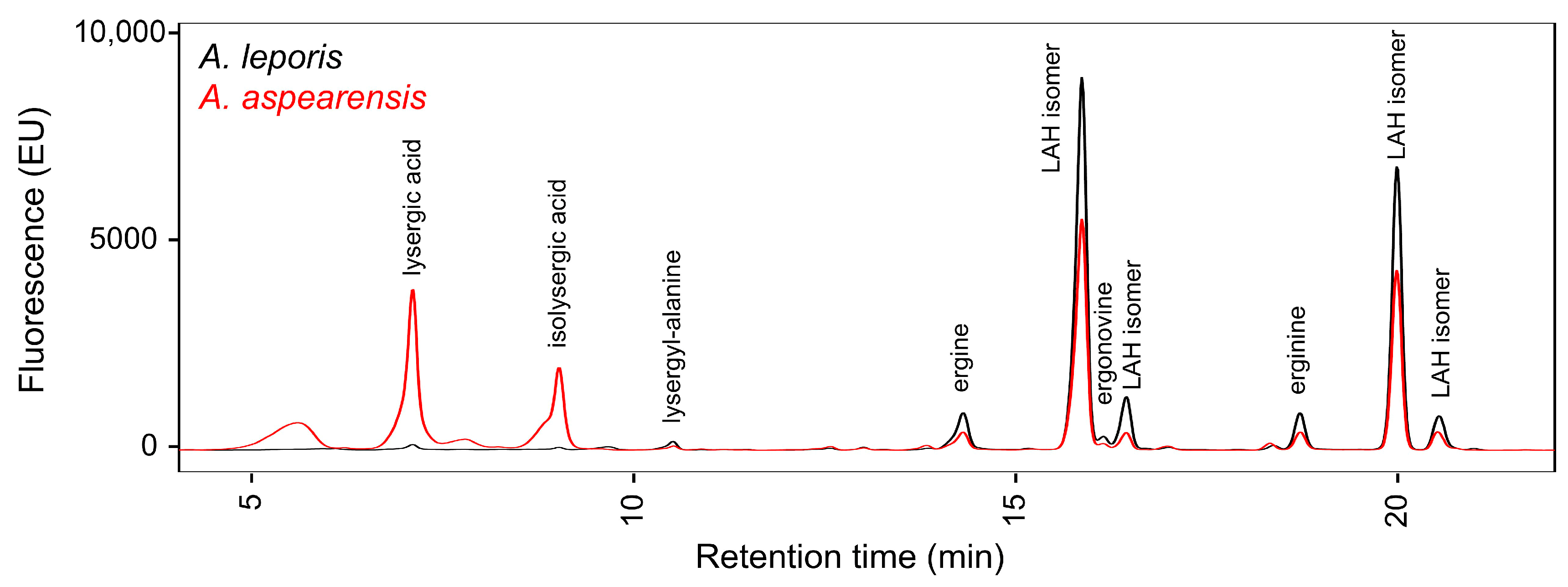
2.1. Accumulation of Lysergic Acid Amides in Cultures of A. aspearensis
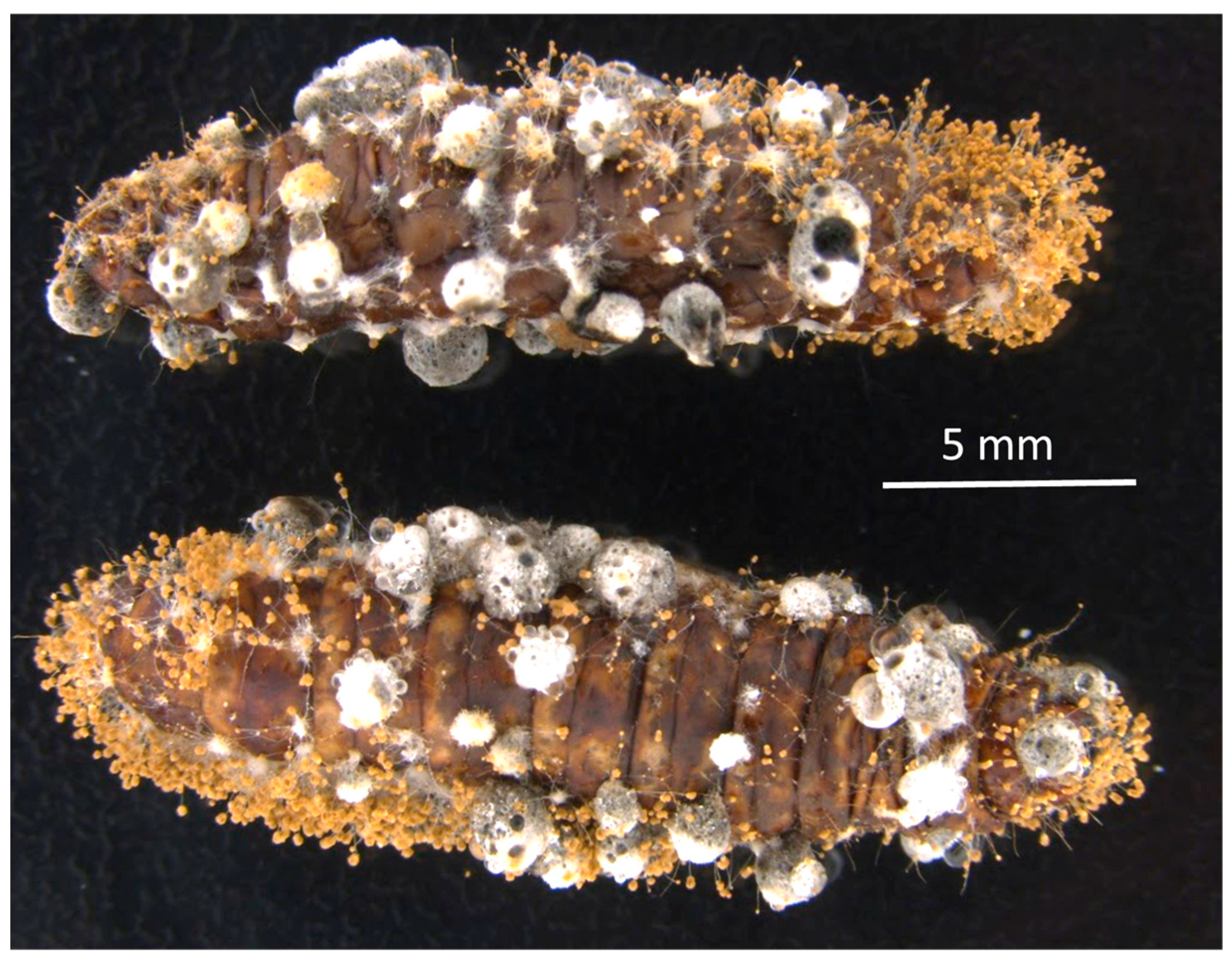
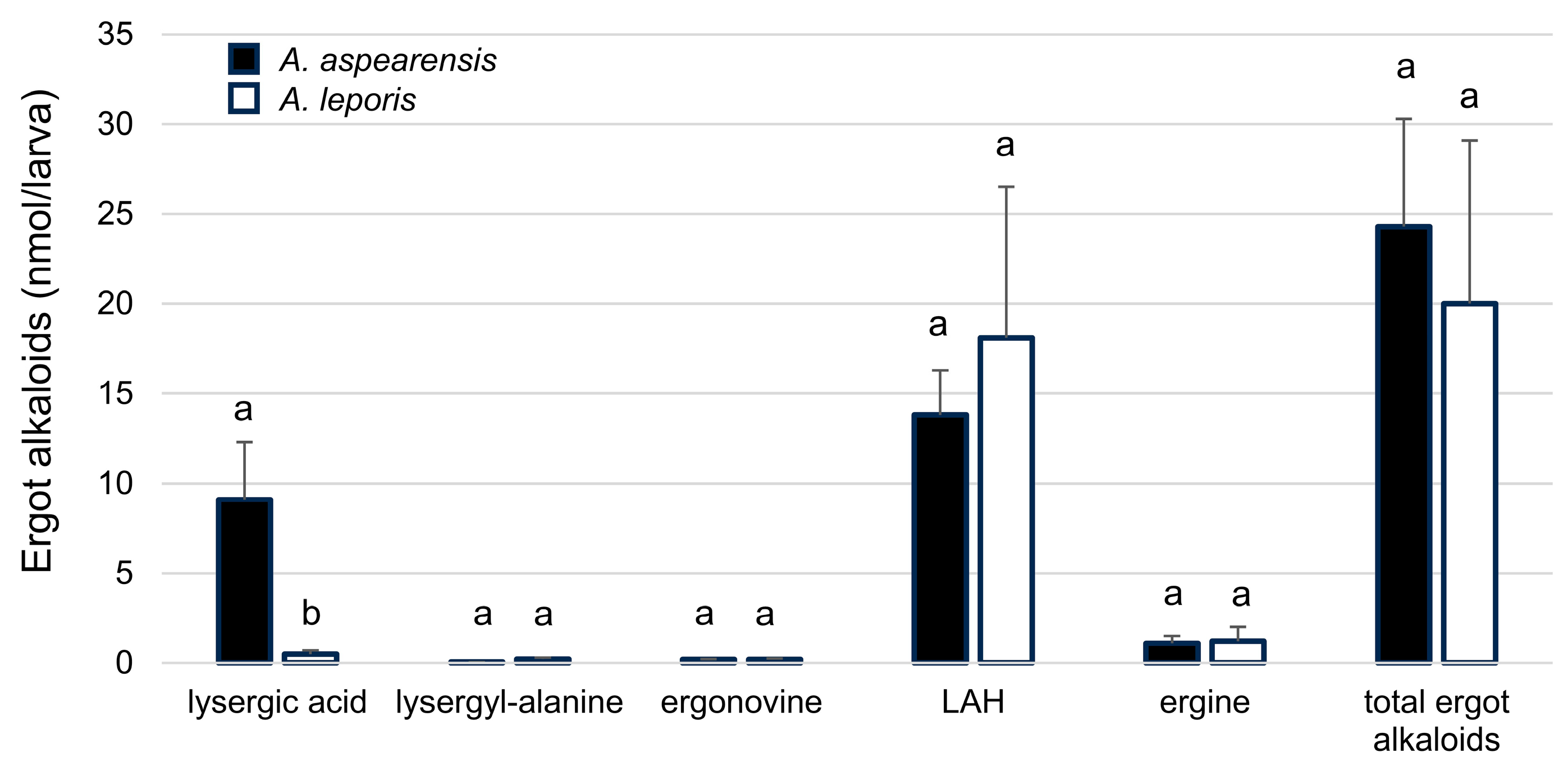
2.2. Infection of Galleria mellonella Larvae by A. aspearensis Is Associated with Lethality and the Accumulation of Lysergic Acid Amides
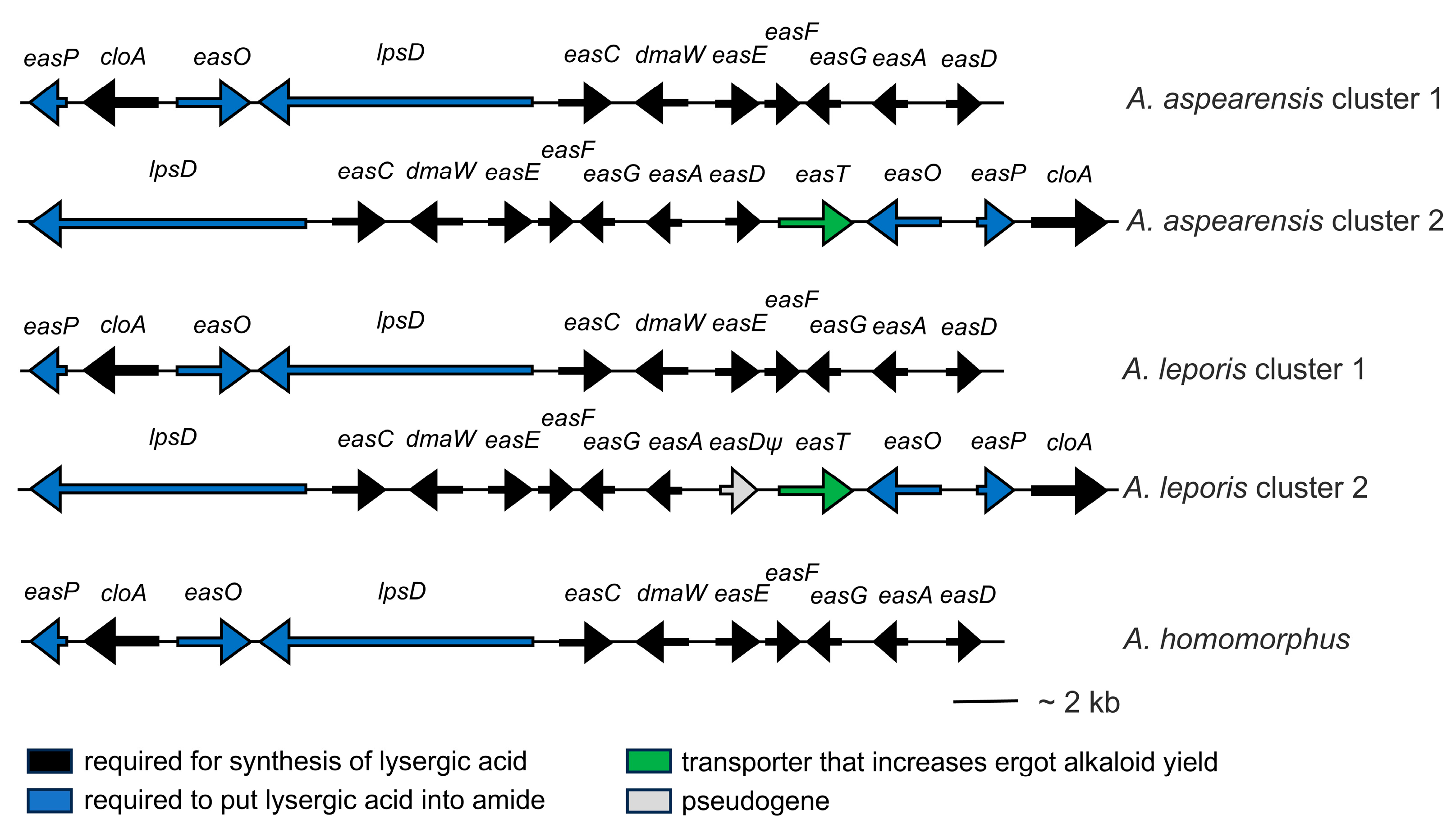
2.3. Ergot Alkaloid Synthesis Genes in A. aspearensis
3. Discussion
4. Materials and Methods
4.1. Fungi and Culture Conditions
4.2. Inoculation of Insects
4.3. Analysis of Ergot Alkaloids
4.4. Statistical Analysis of Results
4.5. Genomic Sequence Acquisition and Analysis
Supplementary Materials
Author Contributions
Funding
Institutional Review Board Statement
Informed Consent Statement
Data Availability Statement
Acknowledgments
Conflicts of Interest
Abbreviations
| LAH | Lysergic acid α-hydroxyethylamide |
| HPLC | High performance liquid chromatography |
| PBS | Phosphate-buffered saline |
| Lps | Lysergyl peptide synthetase |
| eas | Ergot alkaloid synthesis (as applied to genes or gene clusters) |
| clo | Clavine oxidase |
| dmaW | Dimethylallyl-tryptophan synthase |
| ANOVA | Analysis of variance |
References
- Matossian, M.K. Poisons of the Past: Molds, Epidemics, and History; Yale University Press: New Haven, CT, USA, 1989. [Google Scholar]
- Haarmann, T.; Rolke, Y.; Giesbart, S.; Tudzynski, P. Ergot: From witchcraft to biotechnology. Mol. Plant Pathol. 2009, 10, 563–577. [Google Scholar] [CrossRef] [PubMed]
- Caradus, J.R.; Card, S.D.; Finch, S.C.; Hume, D.E.; Johnson, L.J.; Mace, W.J.; Popay, A.J. Ergot alkaloids in New Zealand pastures and their impact. N. Z. J. Agri. Res. 2022, 65, 1–41. [Google Scholar] [CrossRef]
- Klotz, J.L. Activities and effects of ergot alkaloids on livestock physiology and production. Toxins 2015, 7, 2801–2821. [Google Scholar] [CrossRef] [PubMed]
- Potter, D.A.; Stokes, J.T.; Redmond, C.T.; Schardl, C.L.; Panaccione, D.G. Contribution of ergot alkaloids to suppression of a grass-feeding caterpillar assessed with gene-knockout endophytes in perennial ryegrass. Entomol. Exp. Appl. 2008, 126, 138–147. [Google Scholar]
- Hudson, D.; Mace, W.; Popay, A.; Jensen, J.; McKenzie, C.; Cameron, C.; Johnson, R. Genetic manipulation of the ergot alkaloid pathway in Epichloë festucae var. lolii and its effect on black beetle feeding deterrence. Toxins 2021, 13, 76. [Google Scholar] [CrossRef]
- St Leger, R.J.; Wang, J.B. Metarhizium: Jack of all trades, master of many. Open Biol. 2020, 10, 200307. [Google Scholar] [CrossRef] [PubMed]
- Steen, C.R.; Sampson, J.K.; Panaccione, D.G. A Baeyer-Villiger monooxygenase gene involved in the synthesis of lysergic acid amides affects the interaction of the fungus Metarhizium brunneum with insects. Appl. Environ. Microbiol. 2021, 87, e00748-21. [Google Scholar] [CrossRef]
- Schiff, P. Ergot and its alkaloids. Am. J. Pharm. Educ. 2006, 70, 98. [Google Scholar] [CrossRef]
- Tasker, N.R.; Wipf, P. Biosynthesis, total synthesis, and biological profiles of Ergot alkaloids. Alkaloids 2021, 85, 1–112. [Google Scholar]
- Panaccione, D.G. Derivation of the multiply-branched ergot alkaloid pathway of fungi. Microb. Biotechnol. 2023, 16, 742–756. [Google Scholar]
- Hofmann, A. LSD–My Problem Child; McGraw-Hill: New York, NY, USA, 1980. [Google Scholar]
- Lorenz, N.; Wilson, E.V.; Machado, C.; Schardl, C.L.; Tudzynski, P. Comparison of ergot alkaloid biosynthesis gene clusters in Claviceps species indicates loss of late pathway steps in evolution of C. fusiformis. Appl. Environ. Microbiol. 2007, 73, 7185–7191. [Google Scholar] [CrossRef]
- Jones, A.M.; Steen, C.R.; Panaccione, D.G. Independent evolution of a lysergic acid amide in Aspergillus species. Appl. Environ. Microbiol. 2021, 87, e01801-21. [Google Scholar] [CrossRef]
- Vázquez, M.J.; Roa, A.M.; Reyes, F.; Vega, A.; Rivera-Sagredo, A.; Thomas, D.R.; Díez, E.; Hueso-Rodríguez, J.A. A novel ergot alkaloid as a 5-HT1A inhibitor produced by Dicyma sp. J. Med. Chem. 2003, 46, 5117–5120. [Google Scholar] [CrossRef]
- States, J.S.; Christensen, M. Aspergillus leporis, a new species related to A. flavus. Mycologia 1966, 58, 738–742. [Google Scholar] [CrossRef]
- Wangeline, A.L.; Valdez, J.R.; Lindblom, S.D.; Bowling, K.L.; Reeves, F.B.; Pilon-Smits, E.A. Characterization of rhizosphere fungi from selenium hyperaccumulator and nonhyperaccumulator plants along the eastern Rocky Mountain Front Range. Am. J. Bot. 2011, 98, 1139–1147. [Google Scholar] [CrossRef]
- Pitt, J.I.; Lange, L.; Lacey, A.E.; Vuong, D.; Midgley, D.J.; Greenfield, P.; Bradbury, M.I.; Lacey, E.; Busk, P.K.; Pilgaard, B.; et al. Aspergillus hancockii sp. nov., a biosynthetically talented fungus endemic to southeastern Australian soils. PLoS ONE 2017, 12, e0170254. [Google Scholar] [CrossRef] [PubMed]
- Steiman, R.; Guiraud, P.; Sage, L.; Seigle-Murandi, F. New strains from Israel in the Aspergillus niger group. Syst. Appl. Microbiol. 1995, 17, 620–624. [Google Scholar] [CrossRef]
- Hussein, N.; Abdel-Hafez, S.I.; Abdel-Sater, M.A.; Ismail, M.A.; Eshraq, A.L. Aspergillus homomorphus, a first global record from millet grains. Curr. Res. Environ. Appl. Mycol. 2017, 7, 82–89. [Google Scholar] [CrossRef]
- Ortel, I.; Keller, U. Combinatorial assembly of simple and complex D-lysergic acid alkaloid peptide classes in the ergot fungus Claviceps purpurea. J. Biol. Chem. 2009, 284, 6650–6660. [Google Scholar] [CrossRef] [PubMed]
- Frisvad, J.C.; Hubka, V.; Ezekiel, C.N.; Hong, S.B.; Nováková, A.; Chen, A.J.; Arzanlou, M.; Larsen, T.O.; Sklenář, F.; Mahakarnchanakul, W.; et al. Taxonomy of Aspergillus section Flavi and their production of aflatoxins, ochratoxins and other mycotoxins. Stud. Mycol. 2019, 93, 1–63. [Google Scholar] [CrossRef]
- Kubodera, T.; Yamashita, N.; Nishimura, A. Pyrithiamine resistance gene (ptrA) of Aspergillus oryzae: Cloning, characterization and application as a dominant selectable marker for transformation. Biosci. Biotechnol. Biochem. 2000, 64, 1416–1421. [Google Scholar] [CrossRef] [PubMed]
- Panaccione, D.G.; Scott-Craig, J.S.; Pocard, J.A.; Walton, J.D. A cyclic peptide synthetase gene required for pathogenicity of the fungus Cochliobolus carbonum on maize. Proc. Natl. Acad. Sci. USA 1992, 89, 6590–6594. [Google Scholar] [CrossRef] [PubMed]
- Panaccione, D.G.; Coyle, C.M. Abundant respirable ergot alkaloids from the common airborne fungus Aspergillus fumigatus. Appl. Environ. Microbiol. 2005, 71, 3106–3111. [Google Scholar] [CrossRef]
- Jones, A.M.; Panaccione, D.G. Ergot alkaloids contribute to the pathogenic potential of the fungus Aspergillus leporis. Appl. Environ. Microbiol. 2023, 89, e00415-23. [Google Scholar] [CrossRef]
- Jones, A.M.; Davis, K.A.; Panaccione, D.G. A major facilitator superfamily transporter contributes to ergot alkaloid accumulation but not secretion in Aspergillus leporis. Appl. Microbiol. 2024, 4, 406–417. [Google Scholar] [CrossRef]
- Davis, K.A.; Jones, A.M.; Panaccione, D.G. Two satellite gene clusters enhance ergot alkaloid biosynthesis capacity of Aspergillus leporis. Appl. Environ. Microbiol. 2023, 89, e00793-23. [Google Scholar] [CrossRef]
- Leadmon, C.E.; Sampson, J.K.; Maust, M.D.; Macias, A.M.; Rehner, S.A.; Kasson, M.T.; Panaccione, D.G. Several Metarhizium species produce ergot alkaloids in a condition-specific manner. Appl. Environ. Microbiol. 2020, 86, e00373-20. [Google Scholar] [CrossRef]
- Hazel, C.M.; Panaccione, D.G. A new species of Periglandula symbiotic with the morning glory Ipomoea tricolor. Mycologia 2025, 117, 602–614. [Google Scholar] [CrossRef]
- Durden, L.; Wang, D.; Panaccione, D.G.; Clay, K. Decreased root-knot nematode gall formation in roots of the morning glory Ipomoea tricolor symbiotic with ergot alkaloid-producing fungal Periglandula sp. J. Chem. Ecol. 2019, 45, 879–887. [Google Scholar] [CrossRef]
- Durden, L.A.; Quach, Q.N.; Clay, K. Morning glory fungal endosymbiont can alter the impacts of belowground enemies on co-occurring crop species. Symbiosis 2025, 95, 195–203. [Google Scholar] [CrossRef]
- Panaccione, D.G.; Arnold, S.L. Ergot alkaloids contribute to virulence in an insect model of invasive aspergillosis. Sci. Rep. 2017, 7, 8930. [Google Scholar] [CrossRef] [PubMed]
- Blaney, B.J.; Maryam, R.; Murray, S.; Ryley, M.J. Alkaloids of the sorghum ergot pathogen (Claviceps africana): Assay methods for grain and feed and variation between sclerotia/sphacelia. Aust. J. Agric. Res. 2003, 54, 167–175. [Google Scholar] [CrossRef]
- Blaney, B.J.; Molloy, J.B.; Brock, I.J. Alkaloids in Australian rye ergot (Claviceps purpurea) sclerotia: Implications for food and stockfeed regulations. Aust. J. Exp. Agric. 2009, 49, 975–982. [Google Scholar] [CrossRef]
- Florea, S.; Jaromczyk, J.; Schardl, C.L. Non-transgenic CRISPR-mediated knockout of entire ergot alkaloid gene clusters in slow-growing asexual polyploid fungi. Toxins 2021, 13, 153. [Google Scholar] [CrossRef]
- Davis, K.A.; Sampson, J.K.; Panaccione, D.G. Genetic reprogramming of the ergot alkaloid pathway of Metarhizium brunneum. Appl. Environ. Microbiol. 2020, 86, e01251-20. [Google Scholar] [CrossRef] [PubMed]
- Lin, M.T.; Dianese, J.C. A coconut-agar medium for rapid detection of aflatoxin production by Aspergillus spp. Phytopathology 1976, 66, 1466–1469. [Google Scholar] [CrossRef]
- Baggerman, W.I. A modified Rose Bengal medium for the enumeration of yeasts and moulds from foods. Eur. J. Appl. Microbiol. Biotechnol. 1981, 12, 242–247. [Google Scholar]
- Tuite, J. Plant Pathological Methods: Fungi and Bacteria; Burgess: Minneapolis, MN, USA, 1969. [Google Scholar]
- Sambrook, J.; Fritsch, E.F.; Maniatis, T. Molecular Cloning: A Laboratory Manua; Cold Spring Harbor Laboratory Press: Cold Spring Harbor, NY, USA, 1989. [Google Scholar]
- Gamborg, O.L.; Miller, R.A.; Ojima, K. Nutrient requirements of suspension cultures of soybean root cells. Exp. Cell Res. 1968, 50, 151–158. [Google Scholar] [CrossRef]
- Bolger, A.M.; Lohse, M.; Usadel, B. Trimmomatic: A flexible trimmer for Illumina sequence data. Bioinformatics 2014, 30, 2114–2120. [Google Scholar] [CrossRef]
- Prjibelski, A.; Antipov, D.; Meleshko, D.; Lapidus, A.; Korobeynikov, A. Using SPAdes De Novo Assembler. Curr. Protoc. Bioinform. 2020, 70, e102. [Google Scholar] [CrossRef]
- Bushnell, B. BBMap: A Fast, Accurate, Splice-Aware Aligner; (LBNL Report #: LBNL-7065E); Lawrence Berkeley National Laboratory: Berkeley, CA, USA, 2014. Available online: https://escholarship.org/uc/item/1h3515gn (accessed on 5 March 2024).



| Tissue | Lysergic Acid | Ergonovine | LAH | Ergine | Total |
|---|---|---|---|---|---|
| sclerotia | 1.1 ± 0.3 | 0.1 ± 0.03 | 4.1 ± 1.6 | 2.4 ± 0.6 | 7.7 ± 2.2 |
| conidia | 85 ± 38 | 13 ± 5 | 2381 ± 610 | 728 ± 228 | 3206 ± 854 |
| Culture Phase/Secreted | Lysergic Acid | Ergonovine | LAH | Ergine | Total |
|---|---|---|---|---|---|
| Solid (pmol/tube) | 3 ± 0.3 | 0.5 ± 0.5 | 129 ± 12 | 8 ± 1 | 140 ± 13 |
| Liquid (pmol/tube) | 13 ± 6 | 6 ± 5 | 104 ± 19 | 3 ± 1 | 127 ± 27 |
| Percent secreted | 72 ± 14 | 81 ± 19 | 44 ± 2 | 30 ± 7 | 46 ± 3 |
Disclaimer/Publisher’s Note: The statements, opinions and data contained in all publications are solely those of the individual author(s) and contributor(s) and not of MDPI and/or the editor(s). MDPI and/or the editor(s) disclaim responsibility for any injury to people or property resulting from any ideas, methods, instructions or products referred to in the content. |
© 2026 by the authors. Licensee MDPI, Basel, Switzerland. This article is an open access article distributed under the terms and conditions of the Creative Commons Attribution (CC BY) license.
Share and Cite
Fuss, J.L.; Panaccione, D.G. Biochemical and Genetic Characterization of Ergot Alkaloid Biosynthesis in Aspergillus aspearensis. Toxins 2026, 18, 47. https://doi.org/10.3390/toxins18010047
Fuss JL, Panaccione DG. Biochemical and Genetic Characterization of Ergot Alkaloid Biosynthesis in Aspergillus aspearensis. Toxins. 2026; 18(1):47. https://doi.org/10.3390/toxins18010047
Chicago/Turabian StyleFuss, Jessica L., and Daniel G. Panaccione. 2026. "Biochemical and Genetic Characterization of Ergot Alkaloid Biosynthesis in Aspergillus aspearensis" Toxins 18, no. 1: 47. https://doi.org/10.3390/toxins18010047
APA StyleFuss, J. L., & Panaccione, D. G. (2026). Biochemical and Genetic Characterization of Ergot Alkaloid Biosynthesis in Aspergillus aspearensis. Toxins, 18(1), 47. https://doi.org/10.3390/toxins18010047