
Optimising Investment in Health Innovations in Europe
Abstract
1. Introduction
2. Trends in Europe’s Health Spending Relative to Population Needs
3. The Economic Imperative of Investing in Health
3.1. Disease Prevention
- Disease prevention yields high returns on investments. Research shows that 85% of potential health gains stem from preventing ill health associated with chronic diseases [16]. Every €1 invested in national public health prevention in high-income countries yields approximately €27 in benefits, while investments in protective interventions, such as vaccinations, yield about €34 [23]. In mental health, every €1 invested in interventions to prevent and treat adolescent mental disorders returns €24 in benefits [24]. Investing in disease prevention also drives economic growth. For example, in the UK, a 20% reduction in the incidence of 6 major disease categories, mainly NCDs, could raise GDP by an estimated 0.7% within 5 years—an annual boost of £19.8 billion [25].
- Vaccinations save lives, reduce disease burden and contribute to cost savings in healthcare. Globally, 4–5 million deaths are prevented each year due to vaccinations [26]. Adult vaccines can return up to 19 times their initial investment in benefits for population health, healthcare systems, and society [27]. For every €1 spent on childhood immunisations, nearly €11 is saved in societal costs [28]. Investing more to prevent vaccine-preventable cancers, such as human papillomavirus and hepatitis B, could have avoided up to €18 billion in productivity losses across Europe [29].
3.2. Early and Accurate Disease Diagnosis
- Screening enables early diagnosis and reduces mortality. In the UK, there was a 25% reduction in mortality (after 10 years of follow-up) in breast cancer patients diagnosed from screening [31]. Evidence shows an 18% reduction in mortality in lung cancer in Europe due to screening every 3 years, together with smoking cessation programmes [32].
- Early diagnosis of cancer averts significant treatment costs. Diagnosing cancer patients early not only ensures better survival rates, fewer complications, sustained quality of life and supports the financial sustainability of healthcare systems [33]. Indeed, treatment for patients diagnosed with cancer early has been shown to be 2–4 times less expensive than that for those diagnosed with more advanced disease [34].
- Next generation sequencing enables accurate diagnosis, improves treatment accuracy and reduces unnecessary healthcare costs. In France, an investment of less than €2 million in a genetic test to detect EGFR mutations in lung cancer patients to guide targeted therapy saved the health system a total of €459 million by testing for the EGFR biomarker [35]. Similarly, in Ireland, a study has shown that an investment of about €24,000 in pre-screening for genetic side effects in fluoropyrimidine chemotherapy saved the health system approximately 10 times the initial cost (€232,000) in hospitalisation expenses [36].
3.3. Treatment with Innovative Medicines
- Use of innovative treatments improves health outcomes, reduces preventable deaths and extends healthy lives [37]. In Europe, we have seen continuous improvements in 5-year survival rates for the most common cancer types—driven by multiple factors, including a step change in the availability of innovative treatments over the past 20 years [38,39]. Today, an HIV-positive adult receiving antiretroviral therapy can have a life expectancy approaching that of the general population [40]. Cure rates among hepatitis C (HCV) patients have increased from 41% to 96% within 16 years due to improved treatments [41].
- Innovative treatments can deliver significant savings in healthcare costs. Studies indicate that long-term estimated cost savings from launching 17 new drugs in Europe amount to €58 billion [42]. The use of monoclonal antibodies in the management of asthma has been found to significantly reduce exacerbations. It is associated with improvements in asthma symptoms and quality-of-life scores, and reductions in medication use, health resource utilisation, and hospital visits [43]. In Ireland, these led to cost savings of €894 per patient over a 6-month period [44,45].
- Innovative medicines can improve population productivity by enabling patients to return to work. For example, melanoma therapies in the EU27 increased productivity by 3.8 million hours and labour income by €391 million between 2011 and 2022 [46]. In Germany, each novel treatment launched was estimated to have saved approximately 200 working years per year during the observation period (1988–2004) [47].
4. Trends in Pharmaceutical Cost Containment in Europe
4.1. Evolution in Policy Motivations for Cost Containment
4.2. Evolution in Cost Containment Measures
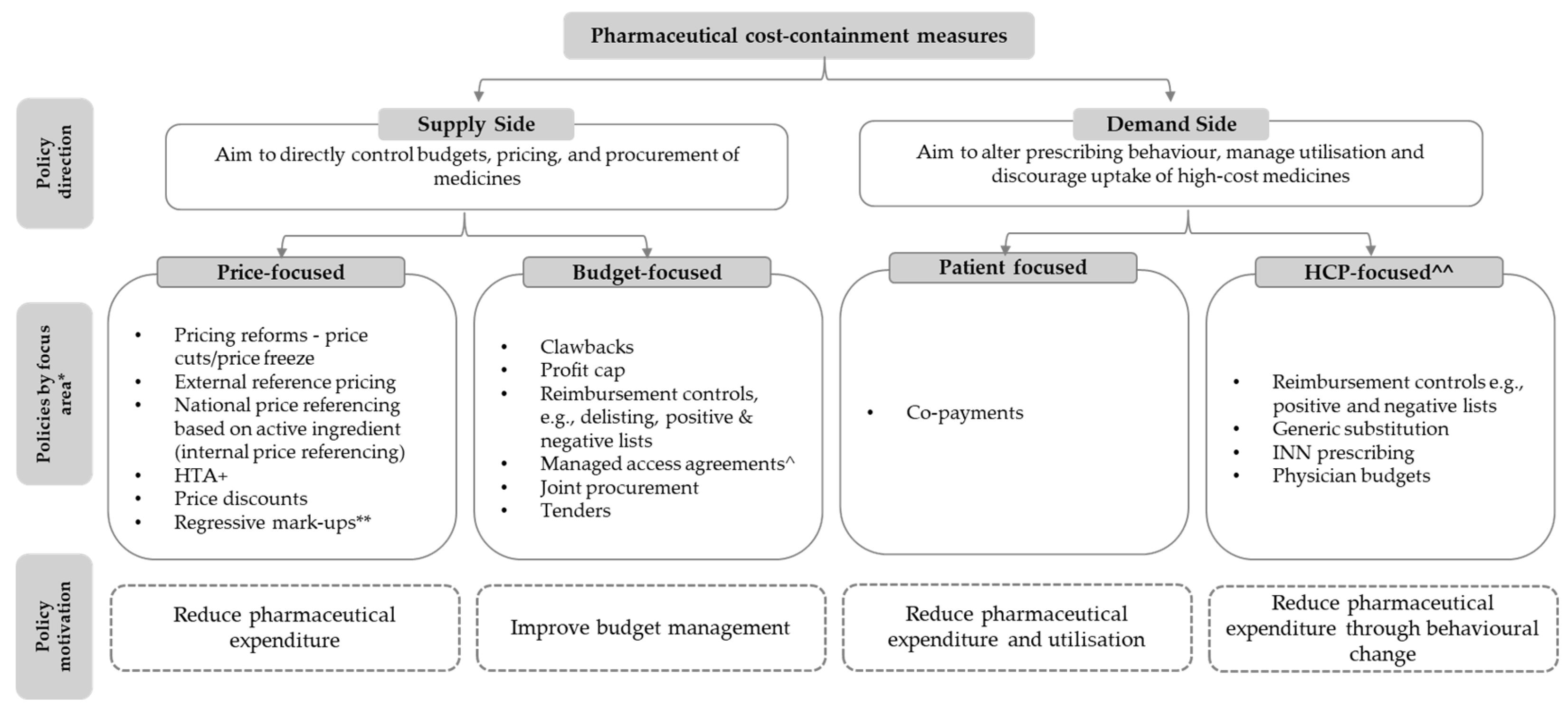
- Pricing restrictions are increasingly being used as a form of cost containment. For example, in Germany, the German Stabilisation Act, enacted in 2022, introduced a de facto reduction in the period of free pricing from 12 to 6 months to further contain costs as well as “guardrails” (i.e., pricing caps) into the process to curb rising pharmaceutical expenditures [58]. In Denmark and France, price cuts remain a key measure for containing pharmaceutical costs [59,60].
- Budget-control measures such as clawbacks are increasingly being used across Europe. There has been a marked increase in the impact of clawbacks on pharmaceutical sales in Europe over the last decade. A recent analysis of clawbacks in Europe, based on data on 24 medicines across six countries (France, Germany, Italy, Spain, Switzerland, and the United Kingdom), found that the growth rate of clawbacks (in absolute terms) currently exceeds the increase in sales by roughly 20% per year. If this continued, clawbacks would exceed 100% of all cohort’s sales by 2033 [61]. In France, clawback levels increased more than 20-fold over a 3-year period, from €0.1 billion in 2019 to more than €1.6 billion in 2023 [57]. In Greece, the value of clawbacks and rebates increased more than 4-fold between 2012 and 2019 [62]. A similar trend was observed in the UK, where clawback levels have increased 5-fold over 2 years (from £0.6 billion in 2021 to £3.3 billion in 2023) [63]. These unsustainable levels of clawbacks are unparalleled compared to other sectors.
- Restrictive reimbursement criteria are impacting the breadth of patient access. Regulatory agencies have evolved to enable timely authorisation of promising new health technologies, which may not align with the extensive evidence requirements for HTA. Combining this with budget-impact considerations being increasingly influential [64] can result in more restricted access to innovation in many countries, for example, by limiting the reimbursed patient population. An analysis of HTA outcomes in France, Germany, the Netherlands, and Sweden showed a decrease in the number of positive HTA recommendations in 2023 compared to the average between 2019 and 2022 [65]. In France, increasing stringency of its early access scheme (AAP) criteria has led to a decline in approval rates (for pre-marketing authorization) from 85% in 2021 to 49% in 2024 [66]. With the increasing stringency of reimbursement criteria, the use of managed entry agreements has grown at an average annual rate of 24% [67]. It is vital that MEAs are not misused in ways that unjustifiably restrict or delay patient access. While the recently enacted EU HTA regulation may help streamline clinical assessments across the region by avoiding duplication, decisions on pricing and reimbursement remain the prerogative of individual Member States [68].
- Policies to promote the use of generics and biosimilars are gaining prominence. In Denmark, the Medicine Council announced that it would no longer assess biosimilar medicines, and that they would be automatically included in tenders [69]. Automatic substitution policies for biosimilars are being implemented in at least five countries, including Czechia, Estonia, France, Latvia, and Poland [70].
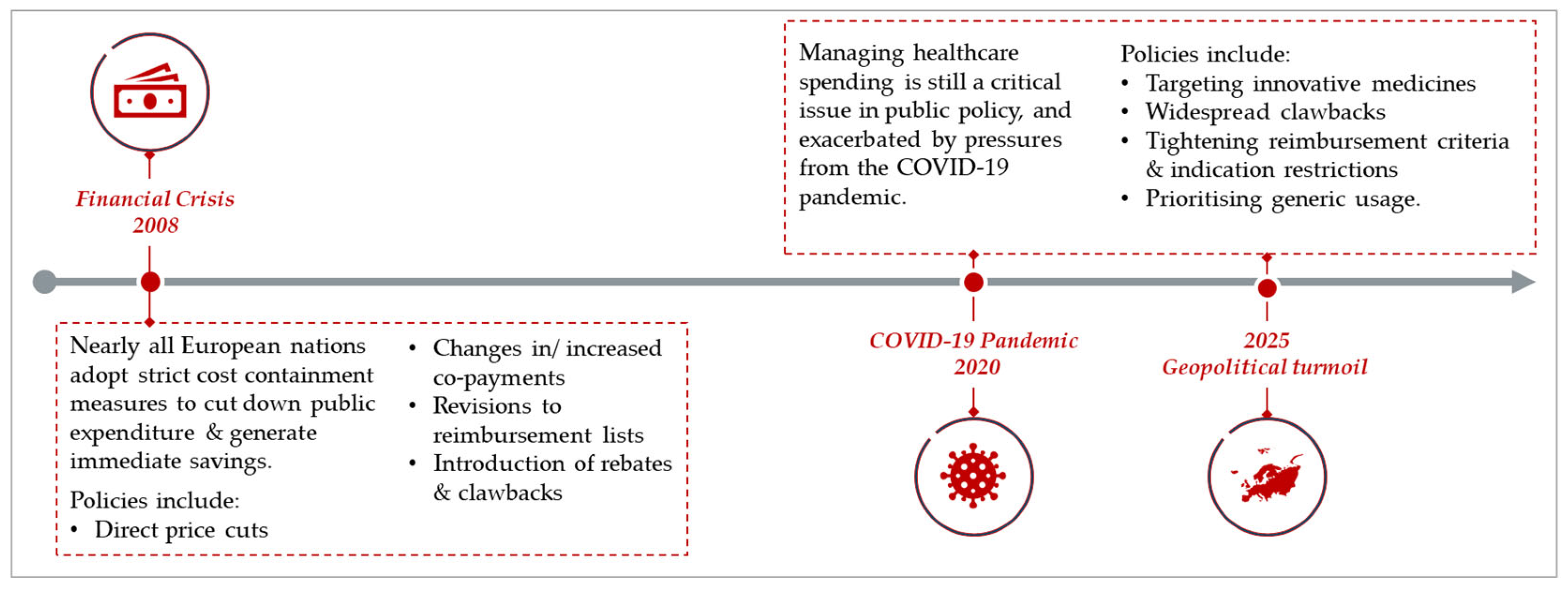
- Post-financial crisis period, nearly all European nations adopted strict cost-containment measures to cut down public expenditure and generate immediate savings. The most common policy changes applied were price cuts, changes in copayments, updates to reimbursement lists, and rebates/clawbacks. Countries most affected by the crisis (e.g., Greece, Portugal, Baltic countries) implemented the most policy changes [53,54].
- Today, managing healthcare spending is still a critical issue in public policy and healthcare reform, especially with increasing budgetary pressures. More targeted approaches focus on higher-cost innovative medicines now compared to prior periods of austerity, but politically challenging policies, such as co-payments, are less likely to be introduced. Tightening of reimbursement criteria continues thus making early access approaches increasingly important for patients. Finally, cost-containment policies are more likely to be included in a holistic package of measures than ad hoc rule changes.
5. Impact of Cost Containment Measures: Lessons from the Financial Crisis Period
- Does not address system inefficiencies. It is estimated that 20% of all health spending in Europe is waste [72]. Yet, there is no evidence that cost containment measures reduce waste and inefficiencies in health systems [73,74]. For example, in Italy, an analysis of the impact of the cost containment measures implemented between 2010 and 2013 (after the financial crisis) on efficiency and productivity of public hospitals shows that the cost containment measures led to a reduction in both spending and outputs (such as hospital discharges), but did not improve nor reduce hospital efficiency (i.e., did not achieve more output with less spending) [75].
- Leads to avoidable deaths. Persistent use of cost containment in healthcare has been linked to an increase in avoidable deaths [73,76]. A UK analysis of healthcare spending cuts between 2010 and 2015 showed that a 13.6% reduction in healthcare spending was associated with an additional 33,888 deaths [76]. In Italy, spending cuts implemented from 2007 to 2010 were associated with a 3% increase in avoidable deaths between 2007 and 2014 [77].
- Delays access to innovation (treatments). Time to market of new medicines is strongly inversely correlated to the size of a country’s healthcare budget per capita [4]. In countries with health expenditure above the EU27 average, more new medicines are made available to patients more quickly [78]. An analysis also found that a 10% drop in the price of medicines in the EU often led to an 8% increase in the delay of access to medicines [79].
- Discourages R&D of new medicines. Research shows that lifting pharmaceutical price regulations in 32 OECD countries (including 27 European countries) in 2018 would have increased the global pharmaceutical sales revenue by USD 254 billion, resulting in USD 56 billion in additional R&D expenditures and the development of 25 new drugs annually [42].
- Jeopardises competitiveness. A pharmaceutical competitiveness gap is emerging in the EU due to lower spending on innovation, longer regulatory timelines, and greater access challenges, as recently signposted in the Future of European Competitiveness Report by Mario Draghi [4]. Evidence shows that the EU is falling behind in most dynamic market segments. For example, only two of the top ten best-selling biological medicines in Europe in 2022 were marketed by EU companies, compared to six (including the top four) by U.S.-based companies, and none of the best-selling orphan medicines in the EU/EEA in 2022 were marketed by EU-based companies [4]. In the last two decades, Europe has seen a decline in its global share of pharmaceutical R&D investment, clinical trials, and manufacturing output. The situation is most acute for Advanced Therapies Medicinal Products (ATMPs)—tissue, gene and cell therapies—used to prevent, treat and cure rare conditions, including some cancers [80].
- Results in negative economic impact. Cost containment in healthcare can cause negative economic spillovers, loss of jobs and productivity. A recent analysis estimates that retaining high rates of clawbacks in the UK may result in a loss of over £50 billion in economic output, foregoing a further £90 billion of GDP and about £30 billion in associated tax revenues [81].
6. Delivering Optimal Healthcare Under Constrained Budgets
- Governments must adopt a long-term vision, move away from short-term thinking and value health appropriately to drive economic growth. The principle of discounting in economics reflects a preference for immediate financial returns over future gains. This short-term focus poses a challenge in policymaking, where short electoral cycles and the need for quick political wins often drive shortsighted decisions, such as those seen lately in healthcare. The evidence consistently demonstrates that long-term health and socioeconomic losses often exceed short-term savings achieved through cost containment. Policymakers should prioritise increasing strategic investments in healthcare to safeguard population health now and in the future. However, we acknowledge that there is wide variation across European countries in terms of their investment in new and innovative medicines, suggesting that some countries may wish to reconsider how their lower investment as a share of GDP impacts their patient, health and societal outcomes [82].
- Transformative policies that eliminate ineffective and wasteful spending can generate greater efficiency gains than traditional cost-control approaches. The OECD estimates that eliminating half of ineffective and wasteful health spending could yield savings compared to otherwise projected spend, equivalent to around 1.2 percentage points of GDP, placing health systems on a more moderated expenditure path, with total health spending reaching about 10.6% of GDP by 2040 under a transformative policy scenario (and 11.8% of GDP without such reforms) [74]. Such transformative policies include reducing medical errors and inappropriate antimicrobial use, fostering better use of health data, and improving the management of critical care resources. Savings generated from eliminating waste would create headroom to increase spending on value-based strategies and innovation.
- Value-based strategies are key to sustainably manage healthcare spend, improve access, and system efficiency. HTA frameworks must keep pace with scientific innovation and evolve to capture the breadth of value that new technologies bring to patients, carers, and society in a deliberative manner. Connecting spending on innovative technologies with the value they deliver could not only avoid wasteful and ineffective resource use but also help manage affordability and incentivise innovation. Value-based strategies include: (i) shifting perspective to reward the delivery of health outcomes and economic benefits; (ii) redefining value assessment to adopt a holistic view, capturing what matters most to patients and society; and (iii) optimising the integration of new technologies within the care pathway to benefit patient experience and system sustainability. We believe the EU HTA regulation has the potential to streamline processes and enable faster access decisions at the Member State level by harmonising clinical assessment across Europe; however, more needs to be done to ensure that value assessment frameworks capture the holistic benefit of innovative technologies, and to prevent local HTA from being misused as a cost-cutting measure.
- Incentives and rewards for innovation that address high unmet needs are critical. Research shows that current innovations could reduce the burden of poor health, yet further investment in new solutions is essential because, by 2040, 50% of future ill health in Europe will not be addressed by current innovations [16]. We must not forget that today’s innovative therapies will become tomorrow’s generics, and sustained investment in innovation is crucial to ensure their continued availability. Indeed, this product lifecycle provides the headroom for investment in future innovation to enable continued improvements in health outcomes.
- European countries must therefore strategically incentivise pharmaceutical R&D to meet the projected health needs. To do this, European and national policymakers need to prioritise and scale targeted investments to support R&D infrastructure, especially in expanding digital capabilities, such as artificial intelligence (AI), to allow for new innovations (in preventive and curative care, as well as in areas with high unmet needs) to be developed and ensure a stable, attractive and predictable Regulatory and IP framework [83,84,85]. Policymakers also need to maintain attractive markets by rewarding the value of innovations, thereby linking a country’s health investment to outcomes [86].
7. Conclusions
- Shift mindset away from short-term and siloed thinking and allow health budgets to rise relative to needs, recognising that returns may not be realised within the same sector, and may be long-term.
- Create headroom for innovation by implementing the transformative policies highlighted in this paper to eliminate waste. These would lead to greater efficiencies and improve affordability more than cost-control policies.
- Focus on value by adopting value-based approaches to link spending to outcomes, thereby maximising value for patients and society.
- Implement fiscal policies that recognises and rewards innovation by creating incentives that attract greater investments into Europe’s innovation ecosystem to strengthen the region’s competitiveness and safeguard Europe’s future.
Author Contributions
Funding
Institutional Review Board Statement
Informed Consent Statement
Data Availability Statement
Acknowledgments
Conflicts of Interest
References
- van Lerven, F.; Caddick, D.; Mang, S.; Suttor-Sorel, L. Europe’s Fiscal Framework—The People’s View? 2022. Available online: https://neweconomics.org/uploads/files/NEF_Europes-Fiscal-Framework.pdf (accessed on 29 May 2025).
- Stuckler, D.; Reeves, A.; Loopstra, R.; Karanikolos, M.; McKee, M. Austerity and Health: The Impact in the UK and Europe. Eur. J. Public Health 2017, 27, 18–21. [Google Scholar] [CrossRef]
- European Commission. Reform of the EU Pharmaceutical Legislation. 2025. Available online: https://health.ec.europa.eu/medicinal-products/legal-framework-governing-medicinal-products-human-use-eu/reform-eu-pharmaceutical-legislation_en (accessed on 29 May 2025).
- Draghi, M. The Future of European Competitiveness. 2024. Available online: https://commission.europa.eu/topics/eu-competitiveness/draghi-report_en (accessed on 11 June 2025).
- European Commission. Social Europe—April 2024—Eurobarometer Survey. Available online: https://europa.eu/eurobarometer/api/deliverable/download/file?deliverableId=92238 (accessed on 10 June 2025).
- Eurostat. Preventable and Treatable Mortality Statistics. 2025. Available online: https://ec.europa.eu/eurostat/statistics-explained/index.php?title=Preventable_and_treatable_mortality_statistics (accessed on 10 June 2025).
- Sheridan, P.E.; Mair, C.A.; Quiñones, A.R. Associations between prevalent multimorbidity combinations and prospective disability and self-rated health among older adults in Europe. BMC Geriatr. 2019, 19, 198. [Google Scholar] [CrossRef]
- Bray, F.; Laversanne, M.; Sung, H.; Ferlay, J.; Siegel, R.L.; Soerjomataram, I.; Jemal, A. Global Cancer Statistics 2022: GLOBOCAN Estimates of Incidence and Mortality Worldwide for 36 Cancers in 185 Countries. CA A Cancer J. Clin. 2024, 74, 229–263. [Google Scholar] [CrossRef] [PubMed]
- European Commission. Mental Health—October 2023—Eurobarometer Survey. Available online: https://europa.eu/eurobarometer/api/deliverable/download/file?deliverableId=88914 (accessed on 10 June 2025).
- World Health Organization. European Health Report 2024: Keeping Health High on the Agenda. Available online: https://iris.who.int/bitstream/handle/10665/380381/9789289061704-eng.pdf?sequence=2 (accessed on 10 June 2025).
- OECD. Health at a Glance: Europe 2024: State of Health in the EU Cycle. Available online: https://www.oecd.org/en/publications/health-at-a-glance-europe-2024_b3704e14-en.html (accessed on 10 June 2025).
- OECD. Health at a Glance 2025: OECD Indicators. 2025. Available online: https://www.oecd.org/en/publications/health-at-a-glance-2025_8f9e3f98-en.html (accessed on 22 October 2025).
- IQVIA. Drug Expenditure Dynamics 2000–2022. 2025. Available online: https://www.iqvia.com/insights/the-iqvia-institute/reports-and-publications/reports/drug-expenditure-dynamics-2000-2022 (accessed on 10 June 2025).
- IQVIA. Understanding Net Pharmaceutical Expenditure Dynamics in Europe. 2022. Available online: https://www.iqvia.com/-/media/iqvia/pdfs/library/white-papers/iqvia-understanding-net-pharmaceutical-expenditure-dynamics-in-europe.pdf (accessed on 10 June 2025).
- EFPIA and Vintura. Broadening the Perspective: Recommendations for Improving Pharmaceutical Affordability. 2023. Available online: https://www.efpia.eu/media/v04jfgjb/recommendations-for-improving-pharmaceutical-affordability.pdf (accessed on 16 June 2025).
- McKinsey Global Institute. How Keeping Health a Priority Is a Prescription for European Prosperity. 2021. Available online: https://www.mckinsey.com/industries/healthcare/our-insights/how-keeping-health-a-priority-is-a-prescription-for-european-prosperity (accessed on 16 June 2025).
- Bloom, D.E.; Canning, D.; Kotschy, R.; Prettner, K.; Schünemann, J. Health and Economic Growth: Reconciling the Micro and Macro Evidence. World Dev. 2024, 178, 106575. [Google Scholar] [CrossRef] [PubMed]
- Scott, A.; Ashwin, J.; Ellison, M.; Sinclair, D. International Gains to Achieving Healthy Longevity. Cold Spring Harb. Perspect. Med. 2023, 13, a041202. [Google Scholar] [CrossRef]
- Hofmarcher, T.; Lindgren, P.; Wilking, N.; Jönsson, B. The Cost of Cancer in Europe 2018. Eur. J. Cancer 2020, 129, 41–49. [Google Scholar] [CrossRef]
- Uyl-de Groot, C.A.; Heine, R.; Krol, M.; Verweij, J. Unequal Access to Newly Registered Cancer Drugs Leads to Potential Loss of Life-Years in Europe. Cancers 2020, 12, 2313. [Google Scholar] [CrossRef]
- OECD; OECD/European Union. Health at a Glance: Europe 2018: State of Health in the EU Cycle. 2018. Available online: https://www.oecd.org/content/dam/oecd/en/publications/reports/2018/11/health-at-a-glance-europe-2018_g1g91fe4/health_glance_eur-2018-en.pdf (accessed on 11 June 2025).
- Arias, D.; Saxena, S.; Verguet, S. Quantifying the Global Burden of Mental Disorders and Their Economic Value. eClinicalMedicine 2022, 54, 101675. [Google Scholar] [CrossRef]
- Masters, R.; Anwar, E.; Collins, B.; Cookson, R.; Capewell, S. Return on Investment of Public Health Interventions: A Systematic Review. J. Epidemiol. Community Health 2017, 71, 827–834. [Google Scholar] [CrossRef]
- Stelmach, R.; Kocher, E.L.; Kataria, I.; Jackson-Morris, A.M.; Saxena, S.; Nugent, R. The Global Return on Investment from Preventing and Treating Adolescent Mental Disorders and Suicide: A Modelling Study. BMJ Glob. Health 2022, 7, e007759. [Google Scholar] [CrossRef]
- Bell, J.; Berry, T.; Deanfield, J.; Hassan, I.; Joshi, R.; Schindler, Y.; Scott, A. Prosperity Through Health: The Macroeconomic Case for Investing in Preventative Health Care in the UK. 2024. Available online: https://institute.global/insights/economic-prosperity/the-macroeconomic-case-for-investing-in-preventative-health-care-UK (accessed on 11 June 2025).
- World Health Organization. Immunization. 2019. Available online: https://www.who.int/news-room/facts-in-pictures/detail/immunization (accessed on 11 June 2025).
- Banhawi, H.; Chowdhury, S.; Neri, M.; Radu, P.; Hodgson, S.; Bell, E.; Brassel, S. Steuten Socio-Economic Value of Adult Immunisation Programmes—OHE. 2024. Available online: https://www.ohe.org/publications/the-socio-economic-value-of-adult-immunisation-programmes/socio-economic-value-of-adult-immunisation/ (accessed on 11 June 2025).
- Zhou, F.; Jatlaoui, T.C.; Leidner, A.J.; Carter, R.J.; Dong, X.; Santoli, J.M.; Stokley, S.; Daskalakis, D.C.; Peacock, G. Health and Economic Benefits of Routine Childhood Immunizations in the Era of the Vaccines for Children Program—United States, 1994–2023. MMWR Morb. Mortal. Wkly. Rep. 2024, 73, 682–685. [Google Scholar] [CrossRef] [PubMed]
- Bencina, G.; Sabale, U.; Morais, E.; Ovcinnikova, O.; Oliver, E.; Shoel, H.; Meiwald, A.; Hughes, R.; Weston, G.; Sundström, K. Burden and Indirect Cost of Vaccine-Preventable Cancer Mortality in Europe. J. Med. Econ. 2024, 27, 30–40. [Google Scholar] [CrossRef] [PubMed]
- World Health Organization. Promoting Cancer Early Diagnosis. 2025. Available online: https://www.who.int/activities/promoting-cancer-early-diagnosis (accessed on 11 June 2025).
- Duffy, S.; Vulkan, D.; Cuckle, H.; Parmar, D.; Sheikh, S.; Smith, R.; Evans, A.; Blyuss, O.; Johns, L.; Ellis, I.; et al. Annual Mammographic Screening to Reduce Breast Cancer Mortality in Women from Age 40 Years: Long-Term Follow-up of the UK Age RCT. Health Technol. Assess. 2020, 24, 1–24. [Google Scholar] [CrossRef] [PubMed]
- Diaz, M.; Garcia, M.; Vidal, C.; Santiago, A.; Gnutti, G.; Gómez, D.; Trapero-Bertran, M.; Fu, M. Health and Economic Impact at a Population Level of Both Primary and Secondary Preventive Lung Cancer Interventions: A Model-Based Cost-Effectiveness Analysis. Lung Cancer 2021, 159, 153–161. [Google Scholar] [CrossRef]
- OECD. Beating Cancer Inequalities in the EU: Spotlight on Cancer Prevention and Early Detection. 2024. Available online: https://www.oecd.org/en/publications/beating-cancer-inequalities-in-the-eu_14fdc89a-en.html (accessed on 11 June 2025).
- World Health Organization. Early Cancer Diagnosis Saves Lives, Cuts Treatment Costs. 2017. Available online: https://www.who.int/news/item/03-02-2017-early-cancer-diagnosis-saves-lives-cuts-treatment-costs (accessed on 11 June 2025).
- Gill, J.; Fontrier, A.-M.; Miracolo, A.; Kanavos, P. Access to Personalised Oncology in Europe. 2020. Available online: https://www.lse.ac.uk/business/consulting/assets/documents/Personalised-Oncology-in-Europe.pdf (accessed on 11 June 2025).
- Murphy, C.; Byrne, S.; Ahmed, G.; Kenny, A.; Gallagher, J.; Harvey, H.; O’Farrell, E.; Bird, B. Cost Implications of Reactive Versus Prospective Testing for Dihydropyrimidine Dehydrogenase Deficiency in Patients with Colorectal Cancer: A Single-Institution Experience. Dose Response 2018, 16, 1559325818803042. [Google Scholar] [CrossRef]
- Lichtenberg, F.R. The Effect of Pharmaceutical Innovation on Longevity: Evidence from the U.S. and 26 High-Income Countries. Econ. Hum. Biol. 2022, 46, 101124. [Google Scholar] [CrossRef]
- Angelis, R.D.; Demuru, E.; Baili, P.; Troussard, X.; Katalinic, A.; Lopez, M.D.C.; Innos, K.; Santaquilani, M.; Blum, M.; Ventura, L.; et al. Complete Cancer Prevalence in Europe in 2020 by Disease Duration and Country (EUROCARE-6): A Population-Based Study. Lancet Oncol. 2024, 25, 293–307. [Google Scholar] [CrossRef]
- EFPIA. Cancer Survival. 2025. Available online: https://www.efpia.eu/publications/cancer-comparator-report-2025/survival/ (accessed on 11 June 2025).
- Trickey, A.; Sabin, C.A.; Burkholder, G.; Crane, H.; d’Arminio Monforte, A.; Egger, M.; Gill, M.J.; Grabar, S.; Guest, J.L.; Jarrin, I.; et al. Life Expectancy after 2015 of Adults with HIV on Long-Term Antiretroviral Therapy in Europe and North America: A Collaborative Analysis of Cohort Studies. Lancet HIV 2023, 10, e295–e307. [Google Scholar] [CrossRef]
- PhRMA. Prescription Medicines: International Costs in Context. 2017. Available online: https://phrma.org/resources/prescription-medicines-international-costs-in-context (accessed on 11 June 2025).
- Long, T.; Ezell, S. The Hidden Toll of Drug Price Controls: Fewer New Treatments and Higher Medical Costs for the World. 2023. Available online: https://itif.org/publications/2023/07/17/hidden-toll-of-drug-price-controls-fewer-new-treatments-higher-medical-costs-for-world/ (accessed on 11 June 2025).
- Chaplin, S. Monoclonal Antibodies for the Treatment of Severe Asthma. Prescriber 2020, 31, 23–28. [Google Scholar] [CrossRef]
- Zozaya, N.; Alcalá, B.; Galindo, J. The Offset Effect of Pharmaceutical Innovation: A Review Study. Glob. Reg. Health Technol. Assess. 2019, 2019, 2284240319875108. [Google Scholar] [CrossRef]
- Costello, R.W.; Long, D.A.; Gaine, S.; Mc Donnell, T.; Gilmartin, J.J.; Lane, S.J. Therapy with Omalizumab for Patients with Severe Allergic Asthma Improves Asthma Control and Reduces Overall Healthcare Costs. Ir. J. Med. Sci. 2011, 180, 637–641. [Google Scholar] [CrossRef] [PubMed]
- EFPIA. Demonstrating the Value of Medical Innovation in Europe. 2022. Available online: https://www.efpia.eu/media/676701/efpia-power-of-innovation.pdf (accessed on 11 June 2025).
- Bui, V.; Stolpe, M. The Impact of New Drug Launches on the Loss of Labor from Disease and Injury: Evidence from German Panel Data. Int. J. Health Care Financ. Econ. 2010, 10, 315–346. [Google Scholar] [CrossRef] [PubMed][Green Version]
- Stadhouders, N.; Koolman, X.; Tanke, M.; Maarse, H.; Jeurissen, P. Policy Options to Contain Healthcare Costs: A Review and Classification. Health Policy 2016, 120, 486–494. [Google Scholar] [CrossRef]
- Donato, A.A.; Pita, J.R.; Batel-Marques, F. Classification of Pharmaceutical Policy Measures During the Portuguese Financial Crisis. Inquiry 2022, 59, 00469580221093171. [Google Scholar] [CrossRef]
- Nguyen, T.A.; Knight, R.; Roughead, E.E.; Brooks, G.; Mant, A. Policy Options for Pharmaceutical Pricing and Purchasing: Issues for Low- and Middle-Income Countries. Health Policy Plan. 2015, 30, 267–280. [Google Scholar] [CrossRef] [PubMed]
- Carone, G.; Schwierz, C.; Xavier, A. Cost-Containment Policies in Public Pharmaceutical Spending in the EU. 2012. Available online: https://ssrn.com/abstract=2161803 (accessed on 11 June 2025).
- NHS. Commercial Framework for New Medicines. 2021. Available online: https://www.england.nhs.uk/long-read/nhs-commercial-framework-for-new-medicines/ (accessed on 11 June 2025).
- Vogler, S.; Zimmermann, N.; Leopold, C.; de Joncheere, K. Pharmaceutical Policies in European Countries in Response to the Global Financial Crisis. South Med. Rev. 2011, 4, 69–79. [Google Scholar] [CrossRef]
- Leopold, C.; Mantel-Teeuwisse, A.K.; Vogler, S.; Valkova, S.; de Joncheere, K.; Leufkens, H.G.; Wagner, A.K.; Ross-Degnan, D.; Laing, R. Effect of the Economic Recession on Pharmaceutical Policy and Medicine Sales in Eight European Countries. Bull. World Health Organ 2014, 92, 630–640D. [Google Scholar] [CrossRef]
- Mladovsky, P.; Srivastava, D.; Cylus, J.; Karanikolos, M.; Evetovits, T.; Thomson, S.; McKee, M. Health Policy Responses to the Financial Crisis in Europe. 2012. Available online: https://iris.who.int/handle/10665/108608 (accessed on 11 June 2025).
- Howey, W. EU Pharma Overhaul Favours Access over Innovation. 2023. Available online: https://www.eiu.com/n/eu-pharma-overhaul-favours-access-over-innovation/ (accessed on 11 June 2025).
- Smart Pharma Healthcare Costs Regulation in France. 2024. Available online: https://smart-pharma.com/wp-content/uploads/2025/01/Healthcare-Costs-Regulation-in-France-VF.pdf (accessed on 11 June 2025).
- Koyuncu, D.D.A. Germany Significantly Tightens Drug Pricing and Reimbursement Laws. 2022. Available online: https://www.insideeulifesciences.com/2022/10/26/germany-significantly-tightens-drug-pricing-and-reimbursement-laws/ (accessed on 11 June 2025).
- Denmark Announces Agreement to Reduce Hospital Medicine Prices by 5% Over Three Years. 2025. Available online: https://www.navlindaily.com/article/24375/denmark-announces-agreement-to-reduce-hospital-medicine-prices-by-5-over-three-years (accessed on 11 June 2025).
- Economic Committee for Health Products. Notice Relating to the Prices of Pharmaceutical Specialties. 2023. Available online: https://www.legifrance.gouv.fr/jorf/id/JORFTEXT000048572544# (accessed on 11 June 2025).
- Vital Transformation. The EU General Pharmaceutical Legislation & Clawbacks: Calculated Impacts—Both Designed and Unintended. 2024. Available online: https://vitaltransformation.com/wp-content/uploads/2024/04/EU_GPL_Clawbacks_Final_4.18.24-2.pdf (accessed on 11 June 2025).
- Letsios, A.N.; Mavridoglou, G.; Ladopoulou, D.; Tsourdini, D.; Dedes, N.; Polyzos, N.M. Exploring the Impact of Clawback on Pharmaceutical Expenditure: A Case Study of Public Hospitals in Greece. Int. J. Health Plan. Manag. 2023, 38, 1539–1554. [Google Scholar] [CrossRef]
- Cohen, J.P. U.K.’s Voluntary Scheme for Branded Medicines, Pricing, And Access (VPAS) Faces A Potential Crisis. 2023. Available online: https://www.forbes.com/sites/joshuacohen/2023/01/19/uks-voluntary-scheme-for-branded-medicines-pricing-and-access-vpas-faces-a-potential-crisis/ (accessed on 11 June 2025).
- Schaefer, R.; Hernández, D.; Bärnighausen, T.; Kolominsky-Rabas, P.; Schlander, M. Health Technology Assessment–Informed Decision Making by the Federal Joint Committee/Institute for Quality and Efficiency in Health Care in Germany and the National Institute for Health and Care Excellence in England: The Role of Budget Impact. Value Health 2023, 26, 1032–1044. [Google Scholar] [CrossRef]
- Centre for Innovation in Regulatory Science. Review of HTA Outcomes and Timelines in Australia, Canada, Europe and the UK 2019–2023. Available online: https://www.cirsci.org/publications/cirs-rd-briefing-95-review-of-hta-outcomes-and-timelines-in-australia-canada-europe-and-the-uk-2019-2023/ (accessed on 11 June 2025).
- APM. Health Europe IQVIA—Over Half of Requests for Pre-Approval Early-Stage Access Schemes Refused in France in 2024. Available online: https://www.apmmarketaccess.com/story.php?objet=92084 (accessed on 11 June 2025).
- Watt, A. Risk-Sharing Agreements Are Growing at a Rate of 24%. Available online: https://www.pharmaceutical-technology.com/pricing-and-market-access/risk-sharing-agreements/ (accessed on 29 July 2025).
- European Commission. Implementation of the Regulation on Health Technology Assessment—Public Health. Available online: https://health.ec.europa.eu/health-technology-assessment/implementation-regulation-health-technology-assessment_en (accessed on 19 December 2025).
- Danish Medicines Council. Medicinrådet Nedlægger Ansøgningsproces for Biosimilære Lægemidler. 2023. Available online: https://medicinraadet.dk/nyheder/2023/medicinradet-nedlaegger-ansogningsproces-for-biosimilaere-laegemidler (accessed on 11 June 2025).
- Jeremias, S. Review Highlights Most Popular European Policies to Boost Biosimilar Uptake. 2024. Available online: https://www.centerforbiosimilars.com/view/review-highlights-most-popular-european-policies-to-boost-biosimilar-uptake (accessed on 11 June 2025).
- Doetsch, J.N.; Schlösser, C.; Barros, H.; Shaw, D.; Krafft, T.; Pilot, E. A Scoping Review on the Impact of Austerity on Healthcare Access in the European Union: Rethinking Austerity for the Most Vulnerable. Int. J. Equity Health 2023, 22, 3. [Google Scholar] [CrossRef]
- Michalopoulos, S. OECD Official: 20% of All Health Spending in Europe Is Pure Waste. Available online: https://www.euractiv.com/section/health-consumers/interview/oecd-official-20-of-all-health-spending-in-europe-is-pure-waste/ (accessed on 29 July 2025).
- Guccio, C.; Pignataro, G.; Romeo, D.; Vidoli, F. Is Austerity Good for Efficiency, at Least? A Counterfactual Assessment for the Italian NHS. Socio-Econ. Plan. Sci. 2024, 92, 101798. [Google Scholar] [CrossRef]
- OECD. Fiscal Sustainability of Health Systems: How to Finance More Resilient Health Systems When Money Is Tight? 2024. Available online: https://www.oecd.org/content/dam/oecd/en/publications/reports/2024/01/fiscal-sustainability-of-health-systems_c2f837ac/880f3195-en.pdf (accessed on 10 June 2025).
- Giancotti, M.; Sülkü, S.; Pipitone, V.; Mauro, M. Do Recovery Plans Improve Public Hospitals Efficiency and Productivity? Evidence from Italy. Int. Rev. Bus. Res. Pap. 2020, 16, 77–98. Available online: https://www.researchgate.net/publication/340315418_Do_Recovery_Plans_Improve_Public_Hospitals_Efficiency_and_Productivity_Evidence_from_Italy.
- Martin, S.; Longo, F.; Lomas, J.; Claxton, K. Causal Impact of Social Care, Public Health and Healthcare Expenditure on Mortality in England: Cross-Sectional Evidence for 2013/2014. BMJ Open 2021, 11, e046417. [Google Scholar] [CrossRef]
- Arcà, E.; Principe, F.; Van Doorslaer, E. Death by Austerity? The Impact of Cost Containment on Avoidable Mortality in Italy. Health Econ. 2020, 29, 1500–1516. [Google Scholar] [CrossRef]
- EFPIA. New Data Shows No Shift in Access to Medicines for Millions of Europeans. 2025. Available online: https://www.efpia.eu/news-events/the-efpia-view/statements-press-releases/new-data-shows-no-shift-in-access-to-medicines-for-millions-of-europeans/ (accessed on 11 June 2025).
- Schulthess, D.; Bowen, H. The Historical Impact of Price Controls on the Biopharma Industry. 2021. Available online: https://vitaltransformation.com/2021/11/the-historical-impact-of-price-controls-on-the-biopharma-industry/ (accessed on 11 June 2025).
- Wilsdon, T.; Armstrong, H.; Sablek, A.; Cheng, P. Factors Affecting the Location of Biopharmaceutical Investments and Implications for European Policy Priorities. 2022. Available online: https://www.efpia.eu/media/676753/cra-efpia-investment-location-final-report.pdf (accessed on 11 June 2025).
- Hughes, S. False Economy: How NHS Medicine Procurement Threatens the UK’s Life Sciences Growth Engine. 2023. Available online: https://www.abpi.org.uk/media/1ebnqexr/false-economy-additional-analysis-231009.pdf (accessed on 11 June 2025).
- PhRMA. High-Income Country Spending on Innovative Medicines. 2025. Available online: https://www.phrma.org/resources/high-income-country-spending-on-innovative-medicines (accessed on 22 October 2025).
- European Observatory on Health Systems and Policies. Financing for Health System Transformation: Spending More or Spending Better (or Both)? 2023. Available online: https://eurohealthobservatory.who.int/publications/i/financing-for-health-system-transformation-spending-more-or-spending-better-(or-both) (accessed on 11 June 2025).
- Deloitte Insights. The Future of Health in Europe. 2024. Available online: https://www.deloitte.com/content/dam/assets-zone2/ch/en/docs/industries/life-sciences-health-care/2024/deloitte-ch-lshc-the-future-of-health-in-europe.pdf (accessed on 11 June 2025).
- United States Government Accountability Office. Artificial Intelligence in Health Care: Benefits and Challenges of Machine Learning in Drug Development. 2019. Available online: https://www.gao.gov/assets/gao-20-215sp.pdf (accessed on 22 October 2025).
- EFPIA. A Competitiveness Strategy for European Life Sciences. 2024. Available online: https://efpia.eu/media/fzkbhzoe/a-competitiveness-strategy-for-european-life-sciences.pdf (accessed on 11 June 2025).
- Böhm, S.; Grossmann, V.; Strulik, H. R&D-driven medical progress, health care costs, and the future of human longevity. J. Econ. Ageing 2021, 18, 100286. [Google Scholar] [CrossRef]
- European Policy Centre. Europe’s Competitiveness Challenge: Ensuring Patient Access to Transformative Therapies in Europe. 2025. Available online: https://www.epc.eu/publication/europes-competitiveness-challenge-ensuring-patient-access-to-transformative-therapies-in-europe/ (accessed on 22 October 2025).


Disclaimer/Publisher’s Note: The statements, opinions and data contained in all publications are solely those of the individual author(s) and contributor(s) and not of MDPI and/or the editor(s). MDPI and/or the editor(s) disclaim responsibility for any injury to people or property resulting from any ideas, methods, instructions or products referred to in the content. |
© 2026 by the authors. Published by MDPI on behalf of the Market Access Society. Licensee MDPI, Basel, Switzerland. This article is an open access article distributed under the terms and conditions of the Creative Commons Attribution (CC BY) license.
Share and Cite
Adeyemo, T.; Wilsdon, T.; Vandorou, C.; Davies, F.; Godet, A. Optimising Investment in Health Innovations in Europe. J. Mark. Access Health Policy 2026, 14, 11. https://doi.org/10.3390/jmahp14010011
Adeyemo T, Wilsdon T, Vandorou C, Davies F, Godet A. Optimising Investment in Health Innovations in Europe. Journal of Market Access & Health Policy. 2026; 14(1):11. https://doi.org/10.3390/jmahp14010011
Chicago/Turabian StyleAdeyemo, Tosin, Tim Wilsdon, Christina Vandorou, Fiona Davies, and Annabelle Godet. 2026. "Optimising Investment in Health Innovations in Europe" Journal of Market Access & Health Policy 14, no. 1: 11. https://doi.org/10.3390/jmahp14010011
APA StyleAdeyemo, T., Wilsdon, T., Vandorou, C., Davies, F., & Godet, A. (2026). Optimising Investment in Health Innovations in Europe. Journal of Market Access & Health Policy, 14(1), 11. https://doi.org/10.3390/jmahp14010011