
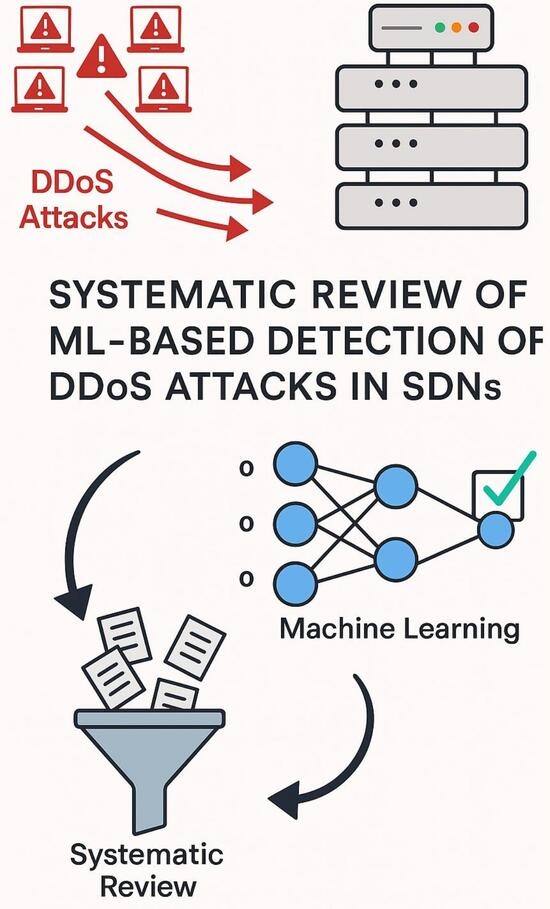
A Systematic Review of Machine-Learning-Based Detection of DDoS Attacks in Software-Defined Networks



Abstract
1. Introduction
1.1. Machine Learning for DDoS Detection in SDN
1.2. Research Contributions and Paper Organization
- Providing a comprehensive classification and analysis of existing ML-based approaches for detecting DDoS attacks in SDN networks.
- Reviewing the evaluation metrics, network simulators, attack generation tools, and experimental platforms commonly utilized across the literature.
- Assessing the datasets used for training and validating ML models, with particular emphasis on publicly available and realistic SDN-based DDoS datasets.
- Identifying key challenges, open research issues, and future directions to guide the development of practical, ML-based DDoS detection application in SDN environments.
2. Background and Theoretical Framework
2.1. SDN Virtualization and Experimental Platforms
2.2. DDoS Threat Model and SDN-Specific Vulnerabilities
3. Systematic Review Methodology
3.1. Review Protocol and Research Questions
3.2. Search Strategy
3.3. Inclusion and Exclusion Criteria
3.4. Data Extraction and Data Items
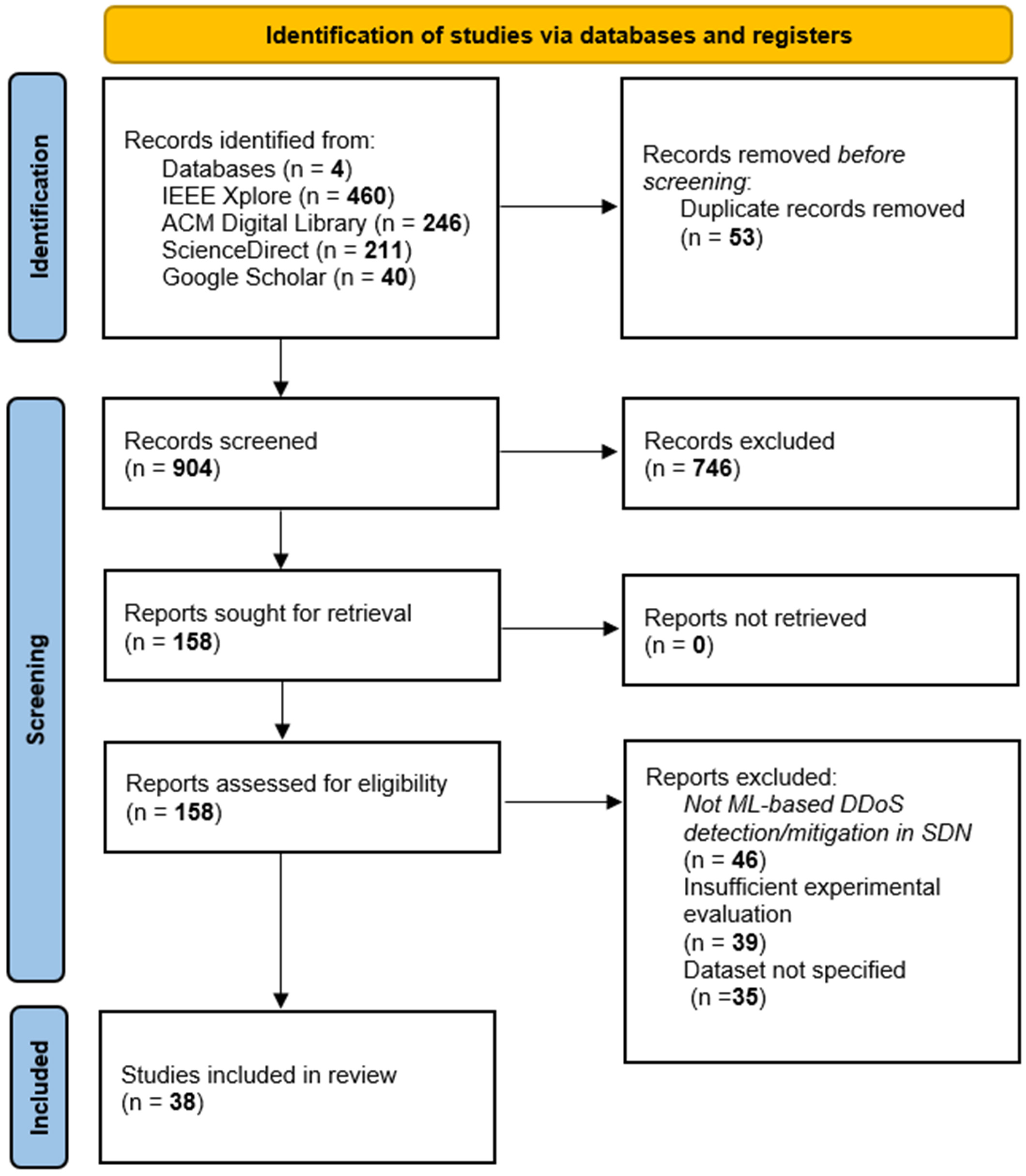
3.5. Study Selection
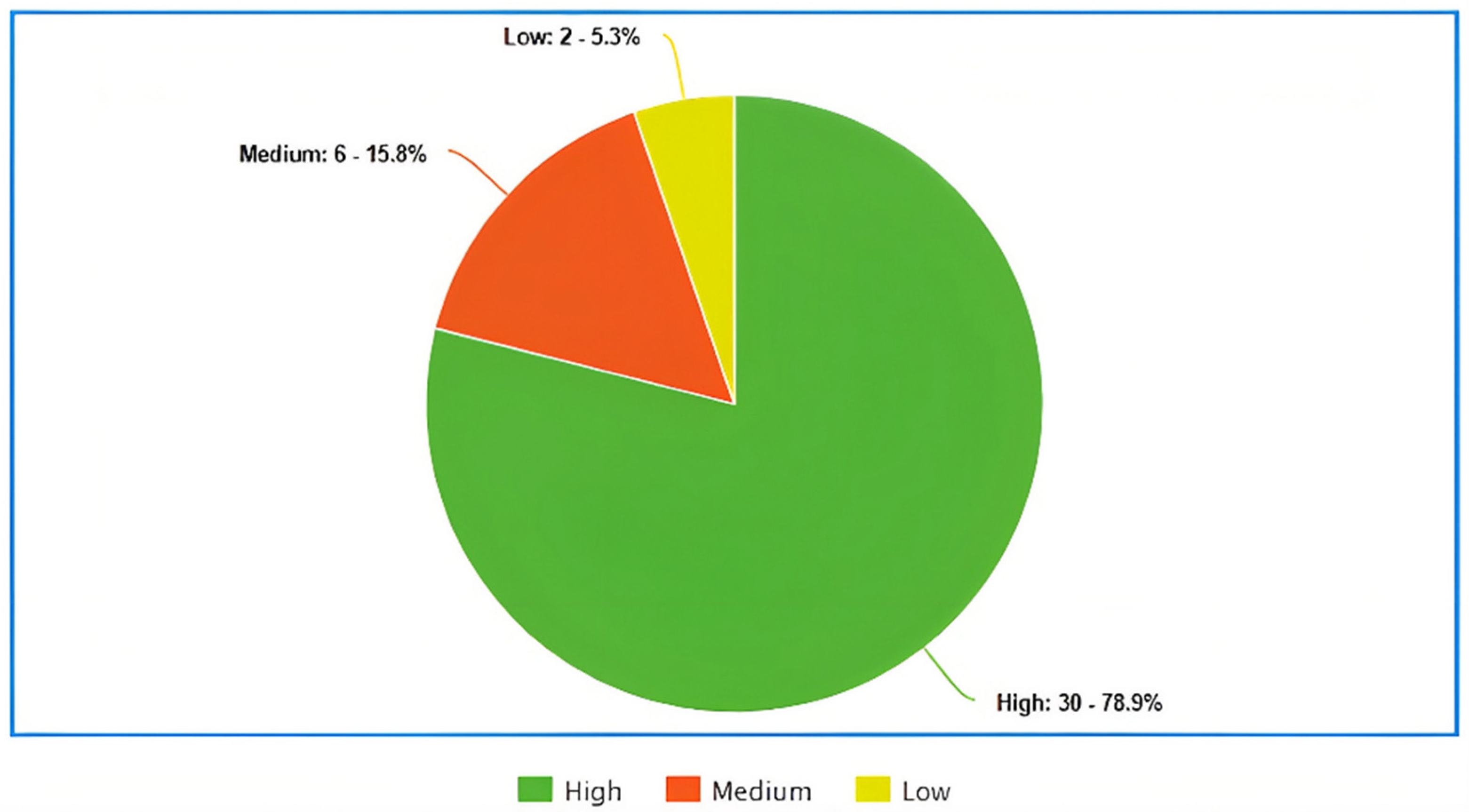
3.6. Quality Assessment and Risk of Bias
- High quality: ≥4
- Medium quality: 3–3.5
- Low quality: <3
3.7. Taxonomy of Machine-Learning-Based Detection Schemes
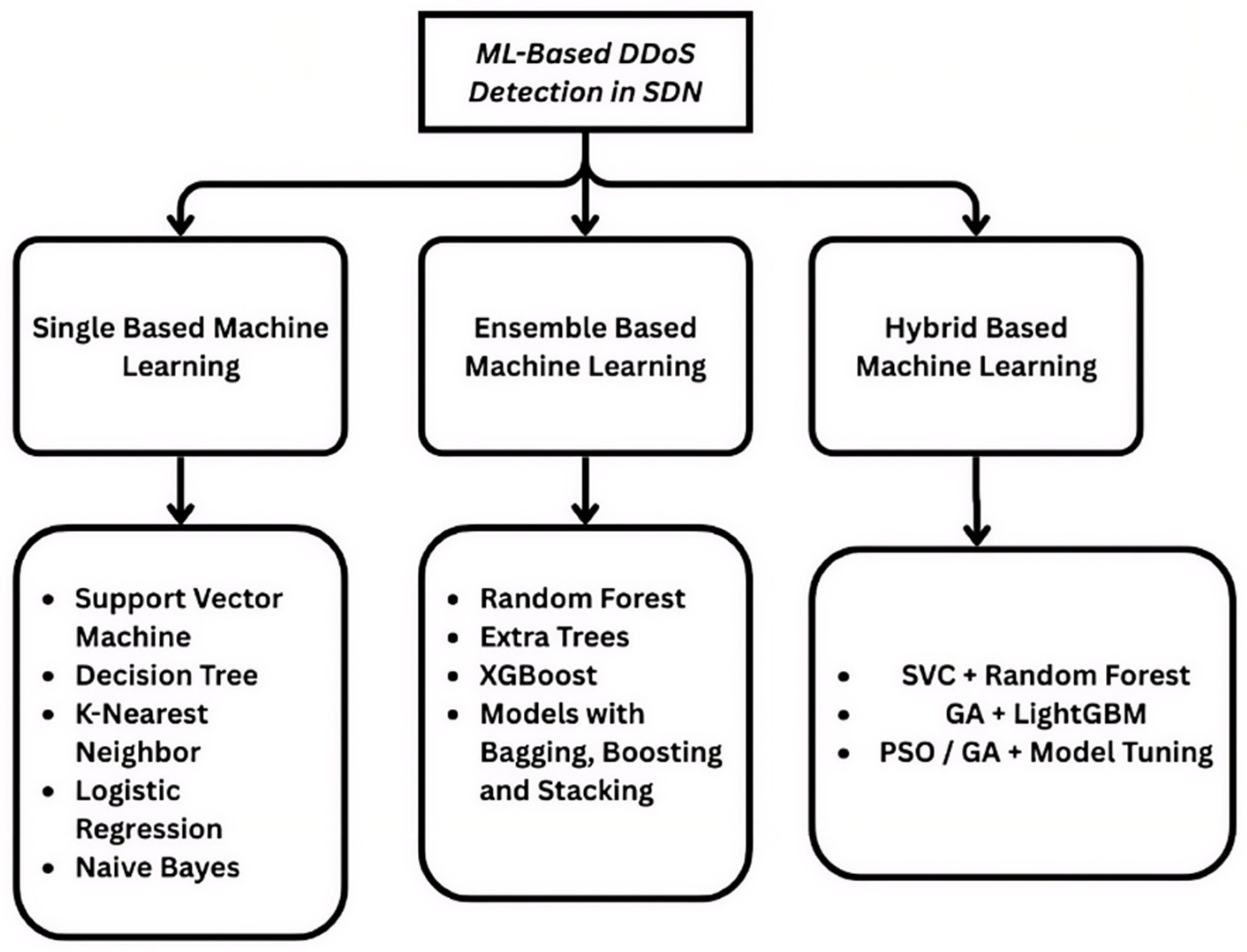
- Single ML Models: These approaches utilize an individual, standalone algorithm to perform classification based on a single predictive structure. In this paradigm, a single mathematical model such as Support Vector Machine (SVM), Logistic Regression, Decision Tree, or Naive Bayes processes the input features to produce an output. Because there is no combination or aggregation of multiple models, the final decision rests entirely on the logic of the specific standalone learner.
- Ensemble ML Models: These leverage a homogenous collection of many base learners, typically from the same algorithmic family, to improve stability and accuracy. This includes Bagging (e.g., Random Forest as a collection of Decision Trees) and Boosting (e.g., XGBoost), where the focus is on aggregating multiple versions of the same model type to reduce bias.
- Hybrid ML Models: Unlike ensembles, hybrid models integrate fundamentally different architectural paradigms or merge ML classifiers with non-ML intelligent optimization techniques. This includes Cross-Family Stacking (e.g., Support Vector Classifier (SVC) combined with Random Forest) or ML + Optimization (e.g., using Genetic Algorithms (GA) or Particle Swarm Optimization (PSO)) for feature selection or hyperparameter tuning, where distinct logics are fused into a unified framework.
3.8. Quality Assessment Results
3.8.1. Synthesis of Quality Assessment Results
3.8.2. Algorithmic Pragmatism and Ensemble Efficiency (QA5 Focus)
- Optimizing Operational Resources: Findings from [43] prove that Random Forest (RF) models can achieve high accuracy (98.38%) while simultaneously reducing SDN controller CPU usage by 44.9%. This reduction is critical for maintaining controller stability during “Packet_In” storms.
- Achieving Real-Time Classification: Evidence from [54] shows the Extra Tree Classifier achieving a perfect 1.0 F1 score with a 0% false alarm rate. The unique “random splitting” mechanism of Extra Trees provides the necessary speed for the low-latency requirements of OpenFlow switches.
- Handling High-Dimensional SDN Features: Evidence from [50,55] highlighted that Random Forest excels in capturing complex patterns from engineered features such as unique source counts, SYN flag counts, and flow-rule growth rates. Unlike single-classifier models (e.g., Logistic Regression in [57]), ensembles were found to be more robust against the “noisy” traffic patterns typical of multi-vector DDoS attacks.
3.8.3. Practical Utility for Future Experimental Design
3.9. Data Synthesis Methodology (PRISMA Items 13a, 13d, 13e)
3.9.1. Data Preparation and Grouping (Item 13a)
3.9.2. Synthesis Methods (Item 13d) and Assessment of Heterogeneity (Item 13e)
4. Result of Synthesis
4.1. Year of Publication
4.2. Types of SDN Environment
4.3. ML Model Type Category Distribution
4.4. Quality Assessment Result Distribution
4.5. Research Questions, Results, and Discussion
4.5.1. RQ1 What Is the Existing ML-Based Approaches to Detect and Mitigate DDoS Attacks Against SDN Networks?
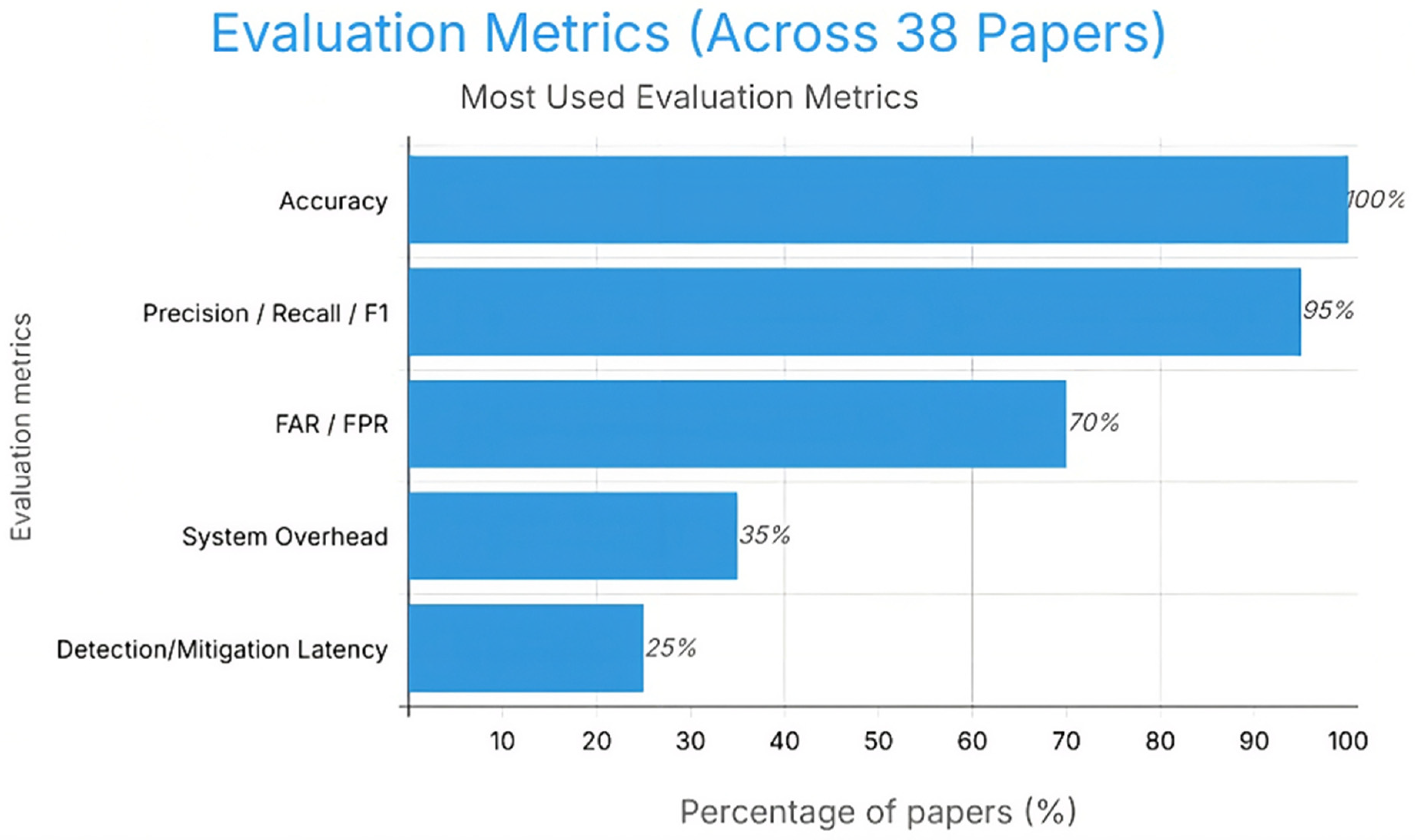
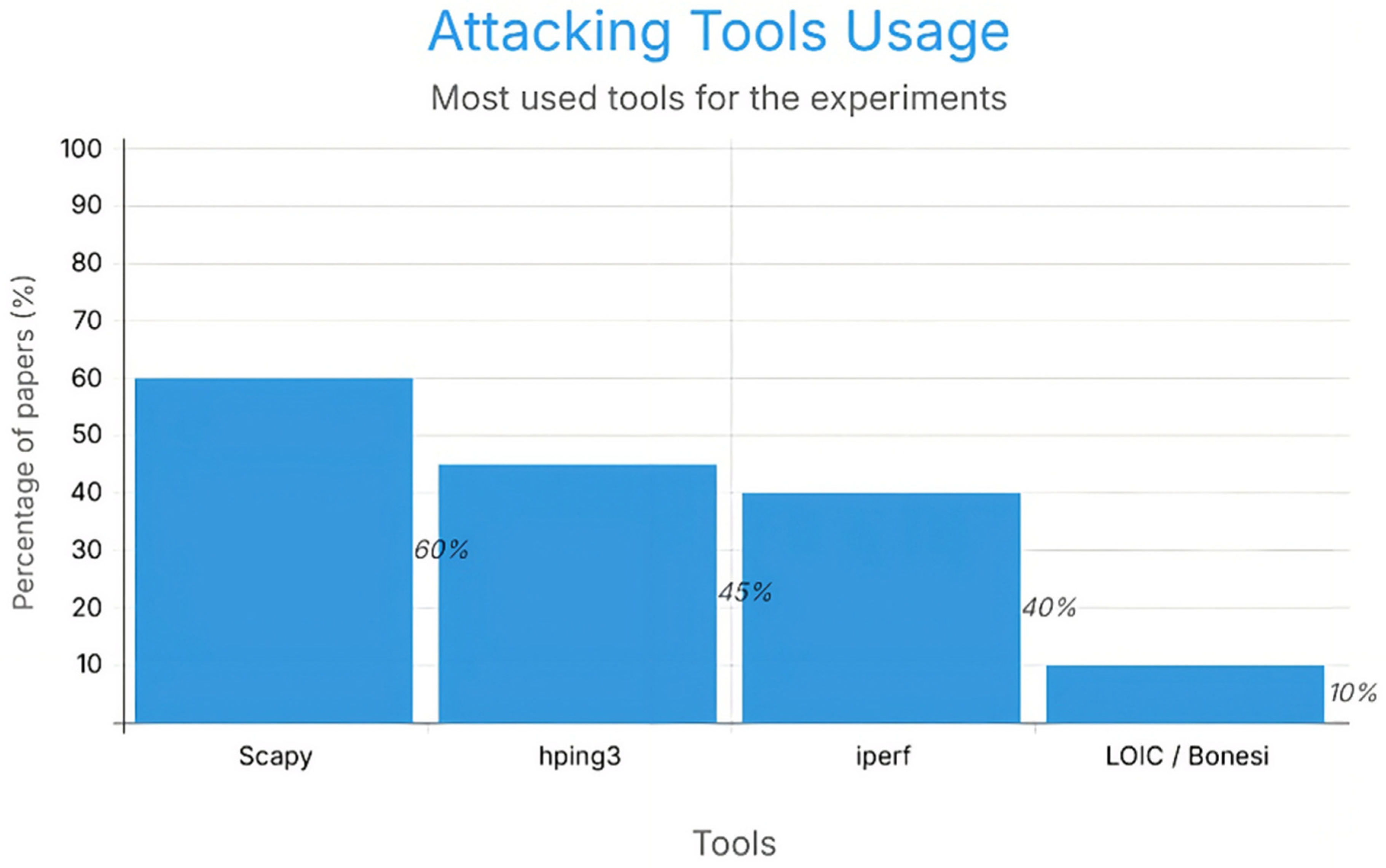
4.5.2. RQ2: What Evaluation Metrics, Network Simulators, Hacking Tools, and Experimental Platforms Are Used in Existing Literature Studies?
- Accuracy: 100% of papers use this as the primary benchmark.
- Precision, Recall, and F1 and Score: ~95% of papers. These are critical because they account for imbalanced datasets (where normal traffic outweighs attack traffic).
- System Overhead (CPU/RAM): ~35% of papers. This is an emerging trend in Q1 papers to prove the ML model does not “crash” the controller it is protecting.
- Detection/Mitigation Latency: ~25% of papers. Measured in milliseconds, this determines if a system can react before the network goes down.
- Scapy: ~60% (Used for custom, low-rate, or sophisticated spoofing attacks in).
- iperf: ~40% (Used to simulate “Benign” or “Normal” background traffic).
- LOIC/Bonesi: ~10% (Used in older or specific Botnet-simulation studies).
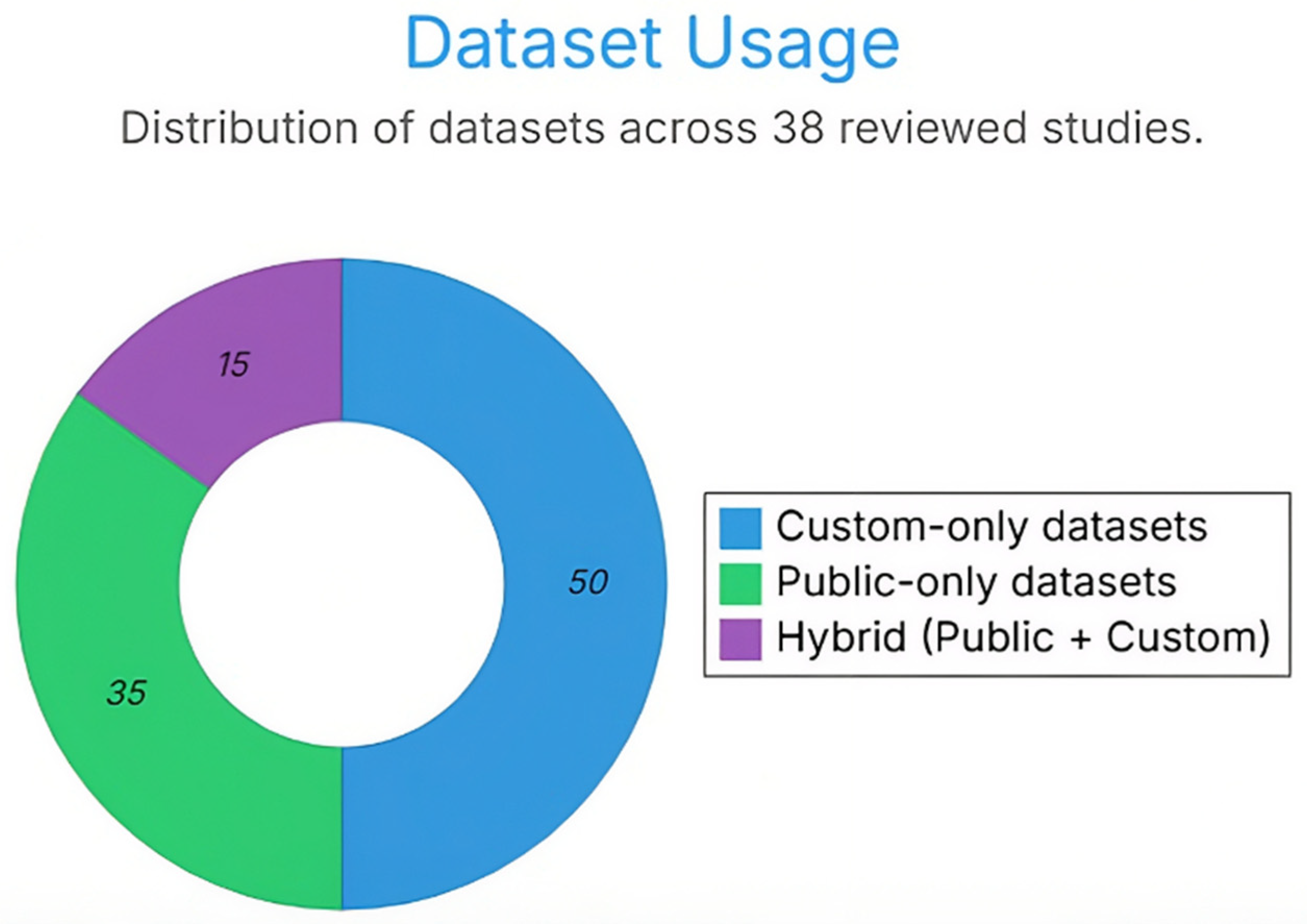
4.5.3. RQ3: What Datasets Are Used to Evaluate and Validate the Existing Approaches and Are There Any Publicly Available Realistic Datasets for DDoS Attacks on SDN Networks?
4.5.4. RQ4: What Are the Challenges, Open Issues, and Future Research Directions Related to DDoS Attacks in SDN Networks?
- Data Imbalance and Generalization:
- The Reproducibility Crisis:
- Reliance on offline datasets for model evaluation
- Limited effectiveness against unknown or zero-day attacks
4.6. Comparative Synthesis of Detection Effectiveness Across Selected Primary Studies
4.7. Limitations of the Review Process
5. Conclusions
Author Contributions
Funding
Data Availability Statement
Conflicts of Interest
References
- Jagadeesh, M.; Kumar, R.D.; Kowsthubha, K.; Rao, V.S.; Rahaman, S.A. ML Based Detection & Classification of High- and Low-Rate DDoS Attacks. Int. J. Sci. Res. Eng. Manag. (IJSREM) 2025, 9, 1–6. [Google Scholar] [CrossRef] [Scilit]
- Wang, K.; Fu, Y.; Duan, X.; Liu, T. Detection and mitigation of DDoS attacks based on multi-dimensional characteristics in SDN. Sci. Rep. 2024, 14, 16421. [Google Scholar] [CrossRef] [Scilit] [PubMed]
- Mahmoud, H.; Ahmed, N. Comparative Performance Evaluation of Ryu and OpenDaylight SDN Controllers Using Mininet. AlQalam J. Med Appl. Sci. 2026, 9, 64–67. [Google Scholar] [CrossRef] [Scilit]
- Alnahari, A.; Ahmad, N.A. How existing machine learning models for DDoS detection differ in performance and accuracy when applied to synthetic versus real-world network traffic datasets. Open Int. J. Inform. 2025, 13, 105–117. [Google Scholar] [CrossRef] [Scilit]
- Hussain, M.; Shah, N.; Amin, R.; Alshamrani, S.S.; Alotaibi, A.; Raza, S.M. Software-defined networking: Categories, analysis, and future directions. Sensors 2022, 22, 5551. [Google Scholar] [CrossRef] [Scilit]
- Zhang, Z.; Li, H.; Dong, S.; Hu, L. Software defined networking (SDN) research review. In Proceedings of the 2018 International Conference on Mechanical, Electronic, Control and Automation Engineering (MECAE 2018); Atlantis Press: Dordrecht, The Netherlands, 2018; pp. 291–300. [Google Scholar] [CrossRef] [Scilit]
- Farooq, M.S.; Riaz, S.; Alvi, A. Security and privacy issues in software-defined networking (SDN): A systematic literature review. Electronics 2023, 12, 3077. [Google Scholar] [CrossRef] [Scilit]
- Mardaus, A.; Biernacka, E.; Wójcik, R.; Domżał, J. Open Source Software-Defined Networking Controllers—Operational and Security Issues. Electronics 2024, 13, 2329. [Google Scholar] [CrossRef] [Scilit]
- McKeown, N.; Anderson, T.; Balakrishnan, H.; Parulkar, G.; Peterson, L.; Rexford, J.; Shenker, S.; Turner, J. OpenFlow: Enabling innovation in campus networks. ACM SIGCOMM Comput. Commun. Rev. 2008, 38, 69–74. [Google Scholar] [CrossRef] [Scilit]
- Alghamdi, A.; Paul, D.J.; Sadgrove, E.J. A RESTful Northbound Interface for Applications in Software Defined Networks. In Proceedings of the 17th International Conference on Web Information Systems and Technologies—WEBIST; SciTePress: Setúbal, Portugal, 2021; pp. 453–459. [Google Scholar] [CrossRef] [Scilit]
- Tache, M.D.; Păscuțoiu, O.; Borcoci, E. Optimization algorithms in SDN: Routing, load balancing, and delay optimization. Appl. Sci. 2024, 14, 5967. [Google Scholar] [CrossRef] [Scilit]
- Lantz, B.; Heller, B.; McKeown, N. A network in a laptop: Rapid prototyping for software-defined networks. In Proceedings of the 9th ACM SIGCOMM Workshop on Hot Topics in Networks; Association for Computing Machinery: New York, NY, USA, 2010; pp. 1–6. [Google Scholar] [CrossRef] [Scilit]
- Handigol, N.; Heller, B.; Jeyakumar, V.; Lantz, B.; McKeown, N. Reproducible network experiments using container-based emulation. In Proceedings of the 8th International Conference on Emerging Networking Experiments and Technologies; Association for Computing Machinery: New York, NY, USA, 2012; pp. 253–264. [Google Scholar] [CrossRef] [Scilit]
- Pfaff, B.; Pettit, J.; Koponen, T.; Jackson, E.; Zhou, A.; Rajahalme, J.; Gross, J.; Wang, A.; Stringer, J.; Shelar, P.; et al. The design and implementation of open vSwitch. In Proceedings of the 12th USENIX Symposium on Networked Systems Design and Implementation (NSDI 15); USENIX: Berkeley, CA, USA, 2015; pp. 117–130. Available online: https://www.usenix.org/conference/nsdi15/technical-sessions/presentation/pfaff (accessed on 13 February 2026).
- Sattar, D.; Matrawy, A. An empirical model of packet processing delay of the Open vSwitch. In 2017 IEEE 25th International Conference on Network Protocols (ICNP); IEEE: Piscataway, NJ, USA, 2017; pp. 1–6. [Google Scholar] [CrossRef] [Scilit]
- Asadollahi, S.; Goswami, B.; Sameer, M. Ryu controller’s scalability experiment on software defined networks. In 2018 IEEE International Conference on Current Trends in Advanced Computing (ICCTAC); IEEE: Piscataway, NJ, USA, 2018; pp. 1–5. [Google Scholar] [CrossRef] [Scilit]
- Arevalo-Herrera, J.; Camargo Mendoza, J.; Martínez Torre, J.I.; Zona-Ortiz, T.; Ramirez, J.M. Assessing SDN Controller Vulnerabilities: A Survey on Attack Typologies, Detection Mechanisms, Controller Selection, and Dataset Application in Machine Learning. Wirel. Pers. Commun. 2025, 140, 739–775. [Google Scholar] [CrossRef] [Scilit]
- Ibrahim, A.J.; Répás, S.R.; Bektaş, N. Feature-Optimized Machine Learning Approaches for Enhanced DDoS Attack Detection and Mitigation. Computers 2025, 14, 472. [Google Scholar] [CrossRef] [Scilit]
- Bahashwan, A.A.; Anbar, M.; Manickam, S.; Issa, G.; Aladaileh, M.A.; Alabsi, B.A.; Rihan, S.D. HLD-DDoSDN: High and low-rates dataset-based DDoS attacks against SDN. LOS ONE 2024, 19, e0297548. [Google Scholar] [CrossRef] [Scilit]
- Sharafaldin, I.; Lashkari, A.H.; Hakak, S.; Ghorbani, A.A. Developing realistic distributed denial of service (DDoS) attack dataset and taxonomy. In 2019 International Carnahan Conference on Security Technology (ICCST); IEEE: Piscataway, NJ, USA, 2019; pp. 1–8. [Google Scholar] [CrossRef] [Scilit]
- Tonkal, Ö.; Polat, H.; Başaran, E.; Cömert, Z.; Kocaoğlu, R. Machine learning approach equipped with neighbourhood component analysis for DDoS attack detection in software-defined networking. Electronics 2021, 10, 1227. [Google Scholar] [CrossRef] [Scilit]
- Almaiah, M.; Alrawashdeh, R.; Alkhdour, T.; Al-Ali, R.; Rjoub, G.; Aldahyani, T. Detecting DDoS attacks using machine learning algorithms and feature selection methods. Int. J. Data Netw. Sci. 2024, 8, 2307–2318. [Google Scholar] [CrossRef] [Scilit]
- Hassan, A.I.; El Reheem, E.A.; Guirguis, S.K. An entropy and machine learning based approach for DDoS attacks detection in software defined networks. Sci. Rep. 2024, 14, 18159. [Google Scholar] [CrossRef] [Scilit]
- Abiramasundari, S.; Ramaswamy, V. Distributed denial-of-service (DDOS) attack detection using supervised machine learning algorithms. Sci. Rep. 2025, 15, 13098. [Google Scholar] [CrossRef] [Scilit]
- Nadeem, M.W.; Goh, H.G.; Ponnusamy, V.; Aun, Y. Ddos detection in SDN using machine learning techniques. Comput. Mater. Contin. 2022, 71, 771–789. [Google Scholar] [CrossRef] [Scilit]
- Butt, H.A.; Harthy, K.S.; Shah, M.A.; Hussain, M.; Amin, R.; Rehman, M.U. Enhanced DDoS Detection Using Advanced Machine Learning and Ensemble Techniques in Software Defined Networking. Comput. Mater. Contin. 2024, 81, 3003–3031. [Google Scholar] [CrossRef] [Scilit]
- Alamri, H.A.; Thayananthan, V. Analysis of machine learning for securing software-defined networking. Procedia Comput. Sci. 2021, 194, 229–236. [Google Scholar] [CrossRef] [Scilit]
- Kavitha, M.; Suganthy, M.; Biswas, A.; Srinivsan, R.; Kavitha, R.; Rathesh, A. Machine Learning Techniques for Detecting DDoS Attacks in SDN. In 2022 International Conference on Automation, Computing and Renewable Systems (ICACRS); IEEE: Piscataway, NJ, USA, 2022; pp. 634–638. [Google Scholar] [CrossRef] [Scilit]
- Hamarshe, A.; Ashqar, H.I.; Hamarsheh, M. Detection of DDoS attacks in software defined networking using machine learning models. In International Conference on Advances in Computing Research; Springer Nature: Cham, Switzerland, 2023; pp. 640–651. [Google Scholar] [CrossRef] [Scilit]
- Srinivas, C.; Avadhani, P.; Roja, P.P. Machine Learning based Ensemble Technique for DDoS Attack Detection in Software-Defined Networking. Int. J. Comput. Appl. 2023, 185, 22–25. [Google Scholar] [CrossRef] [Scilit]
- Rajper, A.; Paraman, N.B.; Marsono, M.N.; Rajper, N.J.; Hameed, H.; Usman, M. An efficient three-tier defense mechanism for mitigation of DDoS attack with port connection analysis in SDN. Sci. Rep. 2026, 16, 3510. [Google Scholar] [CrossRef] [Scilit]
- Alnatsheh, A.; Alsarhan, A.; Aljaidi, M.; Rafiq, H.; Mansour, K.; Samara, G.; Igried, B.; Al Gumaei, Y.A. Machine Learning-Based Approach for Detecting DDoS Attack in SDN. In 2023 2nd International Engineering Conference on Electrical, Energy, and Artificial Intelligence (EICEEAI); IEEE: Piscataway, NJ, USA, 2023; pp. 1–5. [Google Scholar] [CrossRef] [Scilit]
- Sharma, A.; Babbar, H. Machine Learning-based Threat Detection for DDoS Prevention in SDN-Controlled IoT Networks. In 2024 5th International Conference for Emerging Technology (INCET); IEEE: Piscataway, NJ, USA, 2024; pp. 1–6. [Google Scholar] [CrossRef] [Scilit]
- Pasupathi, S.; Kumar, R.; Pavithra, L.K. Proactive DDoS detection: Integrating packet marking, traffic analysis, and machine learning for enhanced network security. Clust. Comput. 2025, 28, 210. [Google Scholar] [CrossRef] [Scilit]
- Wang, S.; Balarezo, J.F.; Chavez, K.G.; Al-Hourani, A.; Kandeepan, S.; Asghar, M.R.; Russello, G. Detecting flooding DDoS attacks in software defined networks using supervised learning techniques. Eng. Sci. Technol. Int. J. 2022, 35, 101176. [Google Scholar] [CrossRef] [Scilit]
- Scaranti, G.F.; Carvalho, L.F.; Junior, S.B.; Lloret, J.; Proença, M.L., Jr. Unsupervised online anomaly detection in software defined network environments. Expert Syst. Appl. 2022, 191, 116225. [Google Scholar] [CrossRef] [Scilit]
- Sangodoyin, A.O.; Akinsolu, M.O.; Pillai, P.; Grout, V. Detection and classification of DDoS flooding attacks on software-defined networks: A case study for the application of machine learning. IEEE Access 2021, 9, 122495–122508. [Google Scholar] [CrossRef] [Scilit]
- Sapkota, B.; Ray, A.; Yadav, M.K.; Dawadi, B.R.; Joshi, S.R. Machine Learning-Based Attack Detection and Mitigation with Multi-Controller Placement Optimization over SDN Environment. J. Cybersecur. Priv. 2025, 5, 10. [Google Scholar] [CrossRef] [Scilit]
- Ramprasath, J.; Seethalakshmi, V. Improved network monitoring using software-defined networking for DDoS detection and mitigation evaluation. Wirel. Pers. Commun. 2021, 116, 2743–2757. [Google Scholar] [CrossRef] [Scilit]
- Swami, R.; Dave, M.; Ranga, V. Detection and analysis of TCP-SYN DDoS attack in software-defined networking. Wirel. Pers. Commun. 2021, 118, 2295–2317. [Google Scholar] [CrossRef] [Scilit]
- Yousef, D.; Maala, B.; Skvortsova, M.; Pokamestov, P. Detection of non-periodic low-rate denial of service attacks in software defined networks using machine learning. Int. J. Inf. Technol. 2024, 16, 2161–2175. [Google Scholar] [CrossRef] [Scilit]
- Khashab, F.; Moubarak, J.; Feghali, A.; Bassil, C. DDoS attack detection and mitigation in SDN using machine learning. In 2021 IEEE 7th International Conference on Network Softwarization (NetSoft); IEEE: Piscataway, NJ, USA, 2021; pp. 395–401. [Google Scholar] [CrossRef] [Scilit]
- Nurwarsito, H.; Nadhif, M.F. DDoS attack early detection and mitigation system on SDN using random forest algorithm and Ryu framework. In 2021 8th International Conference on Computer and Communication Engineering (ICCCE); IEEE: Piscataway, NJ, USA, 2021; pp. 178–183. [Google Scholar] [CrossRef] [Scilit]
- Gayantha, N.; Rajapakse, C.; Senanayake, J. Customizable DDoS Attack Data Generation in SDN Environments for Enhanced Machine Learning Detection Models. In 2025 5th International Conference on Advanced Research in Computing (ICARC); IEEE: Piscataway, NJ, USA, 2025; pp. 1–6. [Google Scholar] [CrossRef] [Scilit]
- Maheshwari, A.; Mehraj, B.; Khan, M.S.; Idrisi, M.S. An optimized weighted voting based ensemble model for DDoS attack detection and mitigation in SDN environment. Microprocess. Microsyst. 2022, 89, 104412. [Google Scholar] [CrossRef] [Scilit]
- Alashhab, A.A.; Zahid, M.S.; Isyaku, B.; Elnour, A.A.; Nagmeldin, W.; Abdelmaboud, A.; Abdullah, T.A.; Maiwada, U.D. Enhancing DDoS attack detection and mitigation in SDN using an ensemble online machine learning model. IEEE Access 2024, 12, 51630–51649. [Google Scholar] [CrossRef] [Scilit]
- Belachew, H.M.; Beyene, M.Y.; Desta, A.B.; Alemu, B.T.; Musa, S.S.; Muhammed, A.J. Design a robust DDoS attack detection and mitigation scheme in SDN-edge-IoT by leveraging machine learning. IEEE Access 2025, 13, 10194–10214. [Google Scholar] [CrossRef] [Scilit]
- Aljahdali, A.O.; Alsaadi, A.M. Ddos Attack Detection Using Neural Network Based on SDN. Int. J. Eng. Technol. Inform. 2025, 6, 1–13. [Google Scholar] [CrossRef]
- Sudar, K.M.; Beulah, M.; Deepalakshmi, P.; Nagaraj, P.; Chinnasamy, P. Detection of Distributed Denial of Service Attacks in SDN using Machine learning techniques. In 2021 International Conference on Computer Communication and Informatics (ICCCI); IEEE: Piscataway, NJ, USA, 2021; pp. 1–5. [Google Scholar] [CrossRef] [Scilit]
- Gayantha, N.; Rajapakse, C.; Senanayake, J. Advanced DDoS Attack Detection and Mitigation in Software-Defined Networking (SDN) Environments: An Integrated Machine Learning Approach. In 2025 International Research Conference on Smart Computing and Systems Engineering (SCSE); IEEE: Piscataway, NJ, USA, 2025; pp. 1–6. [Google Scholar] [CrossRef] [Scilit]
- Abdullahi Wabi, A.; Idris, I.; Mikail Olaniyi, O.; Joseph, A.; Surajudeen Adebayo, O. Modeling DDOS attacks in sdn and detection using random forest classifier. J. Cyber Secur. Technol. 2024, 8, 229–242. [Google Scholar] [CrossRef] [Scilit]
- Ahuja, N.; Singal, G.; Mukhopadhyay, D.; Kumar, N. Automated DDOS attack detection in software defined networking. J. Netw. Comput. Appl. 2021, 187, 103108. [Google Scholar] [CrossRef] [Scilit]
- Karthika, P. Simulation of SDN in mininet and detection of DDoS attack using machine learning. Bull. Electr. Eng. Informatics 2023, 12, 1797–1805. [Google Scholar] [CrossRef] [Scilit]
- Kannan, C.; Muthusamy, R.; Srinivasan, V.; Chidambaram, V.; Karunakaran, K. Machine learning based detection of DDoS attacks in software defined network. Indones. J. Electr. Eng. Comput. Sci. 2023, 32, 1503–1511. [Google Scholar] [CrossRef] [Scilit]
- Hirsi, A.; Audah, L.; Salh, A.; Alhartomi, M.A.; Ahmed, S. Detecting DDoS threats using supervised machine learning for traffic classification in software defined networking. IEEE Access 2024, 12, 166675–166702. [Google Scholar] [CrossRef] [Scilit]
- Kandan, M.; Rani, P.S.; Sathiya, T.; Naidu, K.B.; Maheswari, M. Distributed dos attacks detection based on machine learning techniques in software defined networks. Int. J. Intell. Syst. Appl. Eng. 2024, 12, 882–893. [Google Scholar]
- Hakeem, A.; Attiah, A. Machine Learning-based Approach for Detecting DDoS Attacks in Software Defined Networks. Int. J. Comput. Appl. 2024, 186, 1–9. [Google Scholar] [CrossRef] [Scilit]
- Musumeci, F.; Fidanci, A.C.; Paolucci, F.; Cugini, F.; Tornatore, M. Machine-Learning-Enabled DDoS Attacks Detection in P4 Programmable Networks. J. Netw. Syst. Manag. 2022, 30, 21. [Google Scholar] [CrossRef] [Scilit]







| Research Questions (RQ) | Motivations |
|---|---|
| RQ1: What is the existing ML-based approach to detect DDoS attacks against SDN networks? | • To identify commonly used ML models for DDoS detection in SDN. • To provide a comprehensive overview of ML architectures and approaches in this domain. |
| RQ2: What evaluation metrics, network simulators, hacking tools, and experimental platforms are used in the existing literature studies? | • To identify and analyze evaluation metrics used in SDN-based ML DDoS detection. • To examine the experimental setups, including network simulators, SDN controllers, and attack tools. |
| RQ3: What datasets are used to evaluate and validate the existing approaches, and are there any publicly available realistic datasets for DDoS attacks on SDN networks? | • To identify datasets used for evaluating ML-based DDoS detection in SDN networks. • To assess the availability and realism of public SDN-specific DDoS datasets. |
| RQ4: What are the challenges, open issues, and future research directions related to DDoS attacks in SDN networks? | • To identify key challenges and limitations in existing ML-based DDoS detection approaches for SDN and to explore open research issues and future directions. |
| Digital Library | Search String |
|---|---|
| IEEE | (“Software Defined Networking” AND “Distributed Denial-of-Service” AND “Machine Learning”) OR (“SDN” AND “DDoS” AND “ML”) AND (“Intrusion Detection System” OR “IDS” AND “Network Security”) |
| ACM | (“Software Defined Networking” AND “Distributed Denial-of-Service” AND “Machine Learning”) OR (“SDN” AND “DDoS” AND “ML”) AND (“Intrusion Detection System” OR “IDS” AND “Network Security”) |
| ScienceDirect | (“Software Defined Networking” AND “Distributed Denial-of-Service” AND “Machine Learning”) OR (“SDN” AND “DDoS” AND “ML”) AND (“Intrusion Detection System” OR “IDS” AND “Network Security”) |
| Google Scholar | (“Software Defined Networking” AND “Distributed Denial-of-Service” AND “Machine Learning”) OR (“SDN” AND “DDoS” AND “ML”) AND (“Intrusion Detection System” OR “IDS” AND “Network Security”) |
| Inclusion | Exclusion |
|---|---|
|
|
| No. | Data Item | Description of Data Points Extracted | Data Preparation and Standardization (Item 13b) | Relevant RQ |
|---|---|---|---|---|
| 1 | ML Models | Specific algorithms (e.g., SVM, Random Forest, CNN-LSTM, XGBoost). | Standardized into three categories: Single, Ensemble, and Hybrid to resolve nomenclature differences. | RQ1 |
| 2 | Performance Metrics | Accuracy, Precision, Recall, and F1-score values. | All raw decimal values (e.g., 0.99) were converted to percentages (99%). | RQ2 |
| 3 | Experimental Tools | Simulation software and hacking tools (e.g., Mininet, RYU, Scapy). | Grouped by Controller type and Traffic Generator to identify common testing platforms. | RQ2 |
| 4 | Datasets | Names of traffic datasets (e.g., KDD99, CICIDS2017). | Local or custom dataset versions were mapped to their original public repository titles for consistency. | RQ3 |
| 5 | Open Issues | Qualitative text regarding SDN/ML limitations. | Thematic analysis was used to group text into Future Research Directions and Challenges. | RQ4 |
| QA ID | Quality Assessment Criteria | Score |
|---|---|---|
| QA1 | Objective Clarity | 0/0.5/1 |
| QA2 | ML Method Suitability | 0/0.5/1 |
| QA3 | Dataset Validity | 0/0.5/1 |
| QA4 | Experimental Rigor | 0/0.5/1 |
| QA5 | Result Analysis & Impact | 0/0.5/1 |
| Author and Year | Proposed Approach | Experimental Setup | Key Findings |
|---|---|---|---|
| Tonkal, Özgür, et al. 2021 [21] | Single ML: kNN, DT, ANN, SVM with NCA feature selection | SDN-specific DDoS dataset (>100 k records, 22 features), evaluated with Accuracy, Sensitivity, Specificity, F-score; Confusion matrix, ROC, 10-fold CV; tools not explicitly stated | Feature selection with NCA + Single ML algorithms (especially DT) can achieve very high detection accuracy. Single ML model dominance; private SDN dataset limits generalizability. |
| Almaiah, M., et al., 2024 [22] | Hybrid ML with swarm-based feature selection (PSO, SSA, GWO) + classifiers (SVM, kNN) | CICIDS2017 dataset, feature extraction via CICFlowMeter; tuned optimization algorithms; metrics: Accuracy, Sensitivity, Precision, Recall, F1 score | Swarm intelligence + ML classifiers achieve near-perfect detection (99.8–100%). Hybrid ML approaches outperform single ML; real-time deployment and scalability remain challenges. |
| Hassan AI 2024 [23] | Hybrid sequential: Entropy-based statistical detection + K-means clustering | Public datasets: CICIDS2017, CSE-CIC-2018, CICDDOS2019; Python-based; metrics: Accuracy, FPR, TPR, F1 score, MCC | Hybrid statistical + ML clustering achieves near-perfect accuracy and very low FPR; sequential hybrid approaches enable real-time DDoS detection. K-means threshold tuning is critical. |
| Abiramasundari S, Ramaswamy V 2025 [24] | PCA-based feature reduction + Supervised ML (RF, SVM, KNN, LR, DT) | Public datasets: CICIDS2017, 2018, CICDDoS2019; preprocessing: normalization, SMOTE; metrics: Accuracy, Precision, Recall, F1 score; Confusion matrix, PR curves | PCA-based EDAD improves DDoS detection; RF and KNN consistently perform well. Preprocessing, feature selection, and class balancing enhance ML performance. |
| Nadeem et al., 2022 [25] | Single ML + Optimal feature selection (Filter, Wrapper, Embedded) + ML classifiers (RF, SVM, KNN, NB, DT) | NSL-KDD dataset; SDN controller collects OpenFlow stats; selected 28 features via RFE; metrics: Accuracy, Precision, Recall, Specificity | Feature selection (RFE) + RF yields the highest accuracy (99.97%) in SDN DDoS detection; reduces computational load; optimal feature subset critical. |
| Butt HA, Harthy KS 2024 [26] | Hybrid + Ensemble ML (RF, XGBoost, KNN, SVM, DT) with dynamic feature selection | DDoS SDN dataset (Kaggle), 80:20 train-test; preprocessing, handling missing values; metrics: Accuracy, Precision, Recall, F1-score, ROC-AUC; runtime analysis | Ensemble methods outperform single ML; dynamic feature selection detects evolving attacks; trade-off between accuracy and computational cost highlighted. |
| Alamri HA 2021 [27] | Single ML + Ensemble/Hybrid ML (SVM, ASVM, BPNN, RF, MLP, J48, REP Tree + combinations, e.g., RF + KNN + Bagging, XGBoost) | CIC-DDoS2019 dataset; 20 features via information gain; metrics: Accuracy, Precision, Recall, F1-score, FPR; Python-based | Ensemble/hybrid ML (XGBoost) achieves the highest accuracy (99.7%) and low FPR; single models perform moderately. Emphasizes zero-day and low-rate attack detection challenges. |
| Kavitha M 2022 [28] | Single ML: KNN, LR, DT with feature selection and preprocessing | KDD Cup 99 dataset; 80% train, 20% test; metrics: Accuracy, Recall; Python | DT outperforms KNN and LR; feature engineering is critical; highlights importance of SDN-specific datasets and adaptation to evolving attacks. |
| Hamarshe A, AshqarHI, 2023 [29] | Single ML (RF, DT, SVM, XGBoost) | CICDDoS2019 dataset; preprocessing and feature selection (20 features); metrics: Accuracy, Precision, Recall, F1 score, ROC curves | RF performs best overall (68.9%), though performance varies by attack type; highlights need for hybrid/ensemble models and computational optimization. |
| Srinivas 2023 [30] | Single ML (RF, DT, KNN, SVM, LR) + preprocessing and feature selection | Public SDN DDoS dataset (104,345 flows, 23 features); 70–30% train-test-validation; metrics: Accuracy, Precision, Recall, Specificity, F1 score | RF achieves near-perfect accuracy (99.99%); tree-based ensembles are superior; feature engineering and preprocessing are critical; limited attack diversity noted. |
| Rajper et al. 2026 [31] | Hybrid ML: A three-tier defense combining adaptive CUSUM statistics with an event-triggered Decision Tree (DT) and port connection analysis. | Mininet & Ryu Controller; IEEE Dataport & Mendeley datasets; Top 5 features; evaluated on CPU load, latency, and mitigation accuracy. | Achieved 99.99% accuracy. The Hybrid approach reduced controller computational overhead and false positives by 87% by only activating the DT classifier during anomalies. |
| Alnatsheh A 2023 [32] | Supervised ML: Random Forest (RF), SVM, Naive Bayes (NB) on SDN-specific Kaggle dataset; feature selection | Python implementation; metrics: precision, recall, F1 score, accuracy | RF outperformed SVM and NB (accuracy 98.98%); effective for flooding attacks; highlights the need for distinguishing high legitimate traffic from DDoS; the dataset is small-scale and SDN-specific |
| Sharma & Babbar, 2024 [33] | Supervised ML: Logistic Regression (LR), SVM, RF, KNN on UNB CIC-IoT 2023 dataset; data cleaning and feature encoding | Python ML implementation; metrics: accuracy, precision, recall, F1 score | LR outperformed other classifiers (accuracy 86%, recall 90%); the simple linear model is effective for IoT-SDN traffic; dataset diversity allows multi-attack evaluation |
| Pasupathi, Kumar, & Pavithra, 2025 [34] | Hybrid: Packet Marking (LPM, RPM, PPM) + ML classifiers (KNN, RF, LR, SVM, XGBoost, DT, NB) | Controlled simulation environments; metrics: accuracy, precision, recall, F1 score, execution time; packet marking evaluated via probability vs. hop distance | KNN and RF had the highest accuracy (~98.4%); the integrated multi-layered approach enables traceback and high detection rates; ML adaptability varies across datasets |
| Wang et al., 2022 [35] | Lightweight Supervised ML: DA, DT, GLM, KNN, NB, FNN, SVM, Bagging Tree (BT); single feature (Packet_In fluctuations) | Mininet emulator and real SDN testbed (Raspberry Pi + Zodiac switches); MATLAB (R2021a) + Python integration; metrics: accuracy, recall, precision, CPU usage, training/detection time | BT, DT, and KNN were top-performing; high accuracy (>99% simulation, >90% real-time); single-feature approach reduces computation; only volumetric DDoS detected. |
| Scaranti et al., 2022 [36] | Unsupervised Online ML: DenStream clustering using entropy features (source/destination IPs and ports) | Mininet + Floodlight SDN controller; traffic simulation via Scapy/hping3; metrics: accuracy, precision, recall, F-measure, false-positive rate, detection latency | DenStream outperformed one-class HS-Trees; effective for DDoS & portscan; handles online data and concept drift; no public SDN-specific datasets used |
| Sangodoyin et al., 2021 [37] | Supervised ML: CART, QDA, GNB, k-NN on USDN custom dataset; network metrics (throughput, jitter, response time) | Mininet emulator (tree-based SDN topology); Floodlight controller; attack tools: LOIC, iperf; metrics: accuracy, training/prediction speed, robustness, ROC | CART has the highest accuracy (98%), fastest training, and prediction; classic low-complexity ML methods are effective; the dataset is small; it emphasizes the need for adaptive and large-scale SDN datasets |
| Sapkota et al., 2025 [38] | Centralized ML-based IDS for multi-controller SDN; XGBoost classifier; flow-based detection; threshold-based mitigation | Mininet 2.3.0.dev6; multi-controller SDN; Dell laptop (i5, 16 GB); attack simulation via hping3/Scapy | XGBoost achieved 98.5% accuracy, 97% precision/recall; near-real-time mitigation (70 ms); multi-controller placement improves load balancing; custom dataset not public |
| Ramprasath & Seethalakshmi, 2021 [39] | Three-stage SDN DDoS framework: data accumulation → PSO-ACO clustering → multinomial regression; policy-based mitigation | Mininet tree topology; PoX controller; TCP/UDP/ICMP attacks via hping3; simulation 100–1000 flows | Hybrid metaheuristic + ML approach improves accuracy, recall, F1 vs MLP/NB; flexible mitigation; dataset custom, not public; high computational cost |
| Swami et al., 2021 [40] | ML-based IDS for TCP-SYN flood detection; RF, DT, AdaBoost, LR, MLP classifiers; entropy-based features | Mininet + Ryu controller; VM servers for training; Scapy/Tcpdump/Wireshark for traffic | High detection accuracy (99.97–99.99%), zero false alarms; controller CPU overloaded under spoofed attacks; dataset custom, not public |
| Yousef et al., 2024 [41] | ML-based LDoS detection: Logistic Regression, SVM, BIRCH; real-time traffic stats | Mininet: 5 hosts, 3 switches, Ryu controller; IPERF and TCPDump; K-Fold CV | Detects traditional and non-periodic LDoS in ~1 s; high accuracy; dataset custom, not public; feature ambiguity and scalability remain challenges |
| Khashab et al., 2021 [42] | Self-healing SDN framework; ML for detection + automatic mitigation; feature extension (pkt_size, same_host, same_host_port); RF best | Mininet + Floodlight controller; VMware Ubuntu VMs; Scapy for TCP floods; firewall API for mitigation | RF with extended features improves detection accuracy and responsiveness; real-time mitigation is effective; the dataset is custom, not public; IP spoofing limitation noted |
| Nurwarsito & Nadhif, 2021 [43] | Random Forest-based detection from SDN flow entries; mitigation via dynamic flow rules | Mininet + Ryu controller; hping3 for attacks; iperf/curl/ping for normal traffic | Detection accuracy 98.38%, false positives 1.2%; mitigated ~15 k packets; CPU usage reduced 44.9%; dataset custom, not public; ICMP detection slightly lower |
| Gayantha et al., 2025 [44] | Random Forest evaluated on SDN-specific dataset; focus on dataset generation | Mininet + Ryu controller; VirtualBox VMs; TCP/UDP/ICMP attacks via hping3, normal traffic via ping/iperf/curl | High accuracy (98.60%), precision/recall 0.99; dataset > 1 M records; emphasizes SDN-specific features; mitigation not addressed; realism and scalability remain challenges |
| Maheshwari et al., 2022 [45] | Optimized Weighted Voting Ensemble (OWVE) using multiple ML classifiers; dynamic fitness function for ensemble weighting; real-time mitigation via POX) | Mininet SDN testbed: 108 hosts, 10 switches, 3 controllers, 8 subnets; DDoS simulated via datasets | High accuracy 99.36–99.41%; effective real-time mitigation; publicly available datasets (CIC-DDoS2019, CAIDA-2007); addresses false negatives, ensemble optimization; scalable framework |
| Alashhab et al., 2024 [46] | Online ensemble ML (BernoulliNB, Passive-Aggressive, SGD, MLP) via stacking for SDN DDoS detection and mitigation | Mininet + Ryu controller; VirtualBox Ubuntu 20.04; MiniEdit topologies; traffic via iPerf, Scapy, Hping3, Ping; evaluation: accuracy, precision, recall, F1, CPU, packet drop | Ensemble OML models achieve 99.26% accuracy, 99.62% recall; adapt to evolving SDN traffic; have low false positives; highlights need for real-time adaptation, low-rate attack detection, and dataset diversity |
| Belachew et al., 2025 [47] | Supervised and ensemble ML (KNN, RF, FFNN, XGBoost) with edge-based deployment for low-latency detection | Mininet-WiFi; Google Colab & local Ubuntu desktop; real-time traffic monitoring via sFlow-rt; synthetic DDoS | XGBoost > 99.99% accuracy; edge deployment reduces controller load; single ML models limited by computational cost; emphasizes real-time detection and IoT-specific datasets |
| Aljahdali & Alsaadi, 2025 [48] | Neural-network-based IDS (Keras) vs classical ML (XGBoost, SOM) for SDN DDoS detection | Mininet + RYU controller; MiniEdit topologies; Ubuntu VMs; TCP/UDP flood attacks via hping3; Python/Keras | Neural network achieved 99.74% testing accuracy (CIC-DDoS2019); superior to XGBoost (88%) and SOM (57%); controller-enforced mitigation is effective; ensemble ML remains competitive for edge devices |
| Sudar et al., 2021 [49] | Lightweight ML: SVM (linear kernel) and Decision Tree for DDoS detection with dynamic SDN mitigation | Mininet (100 hosts, 9 switches, 3 controllers); Python + Scikit-learn; SYN flood attacks; KDD99 dataset | SVM outperforms DT (~80% precision/recall); low computational overhead; effective for moderate SDN sizes; limited generalization to modern attacks |
| Gayantha et al., 2025 [50] | Feature-rich ML framework: RF, SVM, CNN, GB; feature engineering (flow counts, unique sources, packet/byte rates, SYN flags) | Mininet + Ryu controller; spine-leaf topology (18 hosts); synthetic benign & malicious traffic; evaluation: accuracy, precision, recall, F1, ROC-AUC | RF achieved 95.3% accuracy; engineered features enhance detection; real-time mitigation via controller; limitations include computational overhead and reliance on a synthetic dataset |
| Abdullahi et al., 2024 [51] | Random Forest (RF) classifier with engineered flow-level features (NFE, SIP, avg flow packets, duration, bytes) | Mininet emulation, Ryu controller, 1 switch & 5 hosts, attack: TCP SYN/UDP/ICMP flood, traffic captured 3600 s | RF achieved 96.3% accuracy, 96.45% precision. Flow-level features are effective for early detection; a small-scale synthetic setup limits generalization. |
| Ahuja et al., 2021 [52] | Hybrid ML: SVC + RF using SDN-specific features (Packet_in, flow duration, port bandwidth, packet rate) | Mininet & Ryu, Windows 10 host w/Ubuntu VM, attack: TCP/UDP/ICMP, traffic via hping3 & mgen | Hybrid SVC-RF model achieved 98.8% accuracy, better than single classifiers; robust across protocols; and the dataset is publicly available. |
| Karthika, 2023 [53] | ML models (SVM, Naïve Bayes, MLP) on OpenFlow port statistics for TCP-SYN flood detection | Mininet + Ryu, 4 hosts and 3 switches, traffic via Iperf/ping & synattack.py, Ubuntu VM | MLP achieved 99.75% accuracy; real-time detection and mitigation are feasible; highlights centralized SDN control for proactive DDoS detection. |
| Kannan et al., 2023 [54] | Ensemble ML (Extra Trees, Random Forest) + decision tree for real-time DDoS detection & mitigation. | Mininet + Ryu, 3 switches, 4 hosts, 2 servers, attacks via SYN flood scripts | Extra Tree classifier achieved 100% accuracy and precision; integrates ML with SDN flow control; highlights reproducibility and need for scalable, multi-vector mitigation. |
| Hirsi et al., 2024 [55] | Supervised, ensemble, and hybrid ML (RF, SVM, KNN, XGBoost, LR) with controller-based mitigation | Mininet + Ryu, attack via hping3, benign via MGEN, k-fold CV | Ensemble and feature-selected models outperformed single ML; RF achieved ~98–99% accuracy; real-world validation limited; emphasizes custom SDN datasets. |
| Kandan et al., 2024 [56] | ANN with feature selection (Relief, SFFS, Lasso) for DDoS detection | SDN testbed w/OpenFlow, Open vSwitch, sFlow, InfluxDB, attacks via hping3, 10-fold CV | ANN + FS achieved >95% accuracy; reduces controller workload; hybrid ML + FS approach is effective and scalable. |
| Hakeem & Attiah, 2024 [57] | Logistic Regression (DDoSDetect) for multi-protocol flooding attacks | Mininet + Ryu, 4 switches and 8 hosts, traffic via hping3 & JupyterLab scripts | LR achieved 97.98% accuracy, 2.08% error; feature engineering and controlled SDN simulation are crucial; there is potential for hypermodel development. |
| Musumeci et al., 2022 [58] | ML-assisted DAD using RF, KNN, SVM, and ANN with P4-enabled switches for data-plane detection | P4 switches (BMv2), Spirent N4U traffic generator, Python ML, multi-core CPUs | Data-plane ML reduced latency to μs, RF and SVM had the best trade-off; correlated DAD improved detection for low-rate attacks; enables distributed, real-time SDN DDoS detection. |
| Paper Cite Number | QA1 | QA2 | QA3 | QA4 | QA5 | Total (5) | Quality Level |
|---|---|---|---|---|---|---|---|
| [21] | 1 | 1 | 0.5 | 1 | 0.5 | 4 | High |
| [22] | 1 | 1 | 0.5 | 1 | 0.5 | 4 | High |
| [23] | 1 | 1 | 1 | 1 | 1 | 5 | High |
| [24] | 0 | 1 | 1 | 0 | 1 | 3 | Medium |
| [25] | 1 | 1 | 1 | 0.5 | 0.5 | 4 | High |
| [26] | 1 | 1 | 1 | 0.5 | 1 | 4.5 | High |
| [27] | 1 | 1 | 1 | 0.5 | 1 | 4.5 | High |
| [28] | 0.5 | 1 | 1 | 0.5 | 0.5 | 3.5 | Medium |
| [29] | 1 | 1 | 1 | 0.5 | 0.5 | 4 | High |
| [30] | 0.5 | 1 | 1 | 0.5 | 0.5 | 3.5 | Medium |
| [31] | 1 | 1 | 1 | 1 | 1 | 5 | High |
| [31] | 0.5 | 1 | 1 | 0.5 | 0.5 | 3.5 | Medium |
| [33] | 0.5 | 1 | 1 | 0.5 | 0.5 | 3.5 | Medium |
| [34] | 1 | 1 | 1 | 0.5 | 1 | 4.5 | High |
| [35] | 1 | 1 | 1 | 1 | 1 | 5 | High |
| [36] | 1 | 1 | 1 | 1 | 1 | 5 | High |
| [37] | 1 | 1 | 1 | 1 | 1 | 5 | High |
| [38] | 1 | 1 | 1 | 1 | 0.5 | 4.5 | High |
| [39] | 1 | 0 | 0 | 0 | 0.5 | 1.5 | Low |
| [40] | 1 | 1 | 1 | 1 | 0.5 | 4.5 | High |
| [41] | 1 | 1 | 1 | 1 | 1 | 5 | High |
| [42] | 1 | 1 | 1 | 1 | 1 | 5 | High |
| [43] | 1 | 1 | 1 | 1 | 1 | 5 | High |
| [44] | 0.5 | 0.5 | 0.5 | 0 | 0.5 | 2 | Low |
| [45] | 1 | 1 | 1 | 1 | 1 | 5 | High |
| [46] | 0.5 | 0.5 | 1 | 0.5 | 0.5 | 3 | Medium |
| [47] | 1 | 1 | 1 | 1 | 1 | 5 | High |
| [48] | 1 | 1 | 1 | 1 | 1 | 5 | High |
| [48] | 1 | 1 | 1 | 1 | 1 | 5 | High |
| [50] | 1 | 1 | 1 | 1 | 1 | 5 | High |
| [51] | 1 | 1 | 1 | 1 | 1 | 5 | High |
| [52] | 1 | 1 | 1 | 1 | 1 | 5 | High |
| [53] | 1 | 1 | 1 | 1 | 0.5 | 4.5 | High |
| [54] | 1 | 1 | 1 | 1 | 0.5 | 4.5 | High |
| [55] | 1 | 1 | 1 | 1 | 1 | 5 | High |
| [56] | 1 | 1 | 1 | 1 | 0.5 | 4.5 | High |
| [57] | 1 | 1 | 1 | 1 | 1 | 5 | High |
| [58] | 1 | 1 | 1 | 1 | 1 | 5 | High |
| Author & Year | Primary Limitation Criteria | Limitation |
|---|---|---|
| Tonkal, Özgür, et al. 2021 [21] | Relevance | While NCA optimizes feature relevance, the study identifies a Generalization Gap. Models trained on specific SDN datasets (like the Bennett University one) may achieve “perfect” accuracy (100% for DT) but fail when applied to different SDN topologies or more diverse, non-simulated attack patterns. |
| Almaiah, M., et al., 2024 [22] | Optimization | While swarm intelligence yields near 100% accuracy, the study highlights Computational Convergence Delay. These meta-heuristic algorithms require multiple iterations to “converge” on the best features, which may introduce a processing lag that hinders real-time response in high-velocity SDN traffic. |
| Hassan AI 2024 [23] | Parameterization | While the two-stage pipeline reduces constant CPU load, the study identifies Threshold Rigidity. The system’s success depends on the manual tuning of entropy thresholds and clustering deltas, which may require frequent recalibration as legitimate network traffic volumes change. |
| Abiramasundari S, Ramaswamy V 2025 [24] | Dimensionality | While PCA reduces features, the process of “Principal Component” calculation can lose the interpretability of specific network headers, making it harder for network admins to understand why a flow was flagged as a DDoS. |
| Nadeem et al., 2022 [25] | Redundancy | While it successfully reduces 41 features to 28, the paper relies on the NSL-KDD dataset, which is often criticized in modern SDN research for being outdated and not representing the “redundancy” patterns of modern, high-speed encrypted traffic. |
| Butt HA, Harthy KS 2024 [26] | Adaptability | While it handles dynamic features, the computational cost of models like SVM and KNN (runtime > 1700 s) makes them non-adaptable for real-time mitigation, leaving a gap between theoretical accuracy and practical deployment. |
| Alamri HA 2021 [27] | Robustness | While achieving near-perfect metrics, the study identifies a “Sliding Window” problem—where choosing the wrong time interval for feature collection can lead to delayed detection or a crash in “large-scale” network overhead. |
| Kavitha M 2022 [28] | Parsimony (Simple) | While using only 5 features reduces overhead, it risks Over-simplification. By relying on the KDD Cup 99 dataset, the “best 5 features” may not be enough to detect modern, complex DDoS attacks that weren’t present in 1999. |
| Hamarshe A, AshqarHI, 2023 [29] | Granularity | While the model is highly realistic (removing timestamps to avoid “cheating”), it suffers from Performance Variance. High accuracy in one attack type (Portmap) masks poor detection in others (DrDoS_SNMP), creating a “blind spot” in the security framework. |
| Srinivas 2023 [30] | Generalization | Achieves near-perfect accuracy (99.99%) by excluding IPs but faces Dataset Bias. The focus on common protocols (TCP/UDP/ICMP) means the model’s high performance may not generalize to rarer or more sophisticated protocol-specific DDoS attacks. |
| Rajper et al., 2026 [31] | Mitigation Granularity | Traditional techniques like rate-limiting lack targeted precision, causing pervasive blocking of legitimate traffic. Additionally, reliance on full attack-path tracing creates response delays that allow networks to be compromised before mitigation begins. |
| Alnatsheh A 2023 [32] | Traffic Classification & Overfitting | Current systems struggle to distinguish malicious flooding from legitimate high-volume traffic. Additionally, redundant dataset features cause overfitting, which reduces the model’s effectiveness in real-world scenarios. |
| Sharma & Babbar, 2024 [33] | Heterogeneity | While effectively identifying IoT-specific attacks, the study reports a relatively low Accuracy Ceiling (86%). This suggests that while linear models are better for this specific data distribution, they still struggle to fully capture the complex, multi-vector nature of modern IoT botnets. |
| Pasupathi, Kumar & Pavithra, 2025 [34] | Traceability | While packet marking enhances traceback, it introduces Computational Overhead and “backtracking” risks in high-traffic environments. Furthermore, the reliance on older datasets (CAIDA 2007) may not reflect modern SDN header structures. |
| Wang et al., 2022 [35] | Light-weightness | While using a single feature (Packet_In) minimizes overhead, it creates a Single Point of Failure. The model is blind to non-volumetric or “low-and-slow” attacks that do not cause significant Packet_In fluctuations. |
| Scaranti et al., 2022 [36] | Unlabeledness | While unsupervised learning solves the labeling problem, the model struggles with Sensitivity. Low-intensity or overlapping attacks (like portscans) don’t distort entropy enough to be detected, causing them to be “masked” by normal traffic. |
| Sangodoyin et al., 2021 [37] | Statistical | While providing high scientific rigor through 50 test runs, the study is limited by the Dataset Scale. The 3600 observations are statistically significant in a lab but may fail to represent the “long tail” of anomalies found in real-world petabyte-scale SDN traffic. |
| Sapkota et al., 2025 [38] | Centralization | While multi-controller placement improves load balancing, the centralized IDS remains a potential single point of failure and a bottleneck for high-speed synchronization between distributed controller domains. |
| Ramprasath & Seethalakshmi, 2021 [39] | Metaheuristics | While PSO-ACO improves clustering accuracy, it introduces high Computational Complexity. The study notes that optimizing the overhead of these metaheuristics for real-time traffic remains an open challenge, as they can be slower than pure statistical models. |
| Swami et al., 2021 [40] | Randomness | While achieving near-perfect accuracy (99.99%) through entropy features, the study is limited by its Topology Scale. Testing on only four hosts may overstate the “Zero False Alarm Rate,” as real-world networks contain much more “natural” randomness that could be misclassified as an attack. |
| Yousef et al., 2024 [41] | Stealthiness | While effective at detecting LDoS, the model relies on Statistical Windowing (0.1-s intervals). If the attack pulse is even shorter or more irregular, it may lead to Feature Ambiguity, where the statistical signatures of the attack overlap almost perfectly with legitimate user behavior. |
| Khashab et al., 2021 [42] | Self-healing | While the system automates recovery, it faces a Mitigation Paradox. If an attacker uses sophisticated IP spoofing, the “self-healing” module may accidentally block legitimate paths (over-healing), potentially leading to a self-inflicted Denial of Service. |
| Nurwarsito & Nadhif, 2021 [43] | Concurrence | While effective at reducing CPU load, the study identifies a Protocol Variance weakness. The concurrent model has lower detection accuracy for ICMP flooding compared to TCP/UDP, suggesting that the “concurrence” of varied protocol flows still presents a classification hurdle. |
| Gayantha et al., 2025 [44] | Fidelity | While the dataset offers high-fidelity SDN features, the study acknowledges a Simulation Gap. Because the data is generated in a virtualized Mininet/VirtualBox environment, it may still fail to capture the physical hardware latencies and “jitter” found in real-world enterprise hardware deployments. |
| Maheshwari et al., 2022 [45] | Consensus | While the ensemble provides high stability and accuracy (99.4%), the Optimization Overhead is a concern. Managing a consensus between six different models in real-time can be computationally expensive, potentially delaying mitigation in high-speed SDN environments. |
| Alashhab et al., 2024 [46] | Adaptation | While the OML ensemble adapts well to streaming data, it faces Deployment Latency. The study notes that maintaining this level of real-time adaptation in high-density or heterogeneous SDN networks, beyond controlled Mininet simulation, remains a major scalability hurdle. |
| Belachew et al., 2025 [47] | Edge | While edge deployment reduces central latency, it introduces Inter-node Security risks. The study identifies a gap in security of the communication between the Edge server and the SDN controller, suggesting a need for TLS or Blockchain to prevent tampering. |
| Aljahdali & Alsaadi, 2025 [48] | High Inference Cost | While the Neural Network offers state-of-the-art accuracy, its Inference Cost is high. The study identifies that high-dimensional deep learning models may strain SDN controllers, necessitating future research into distributed processing to prevent the IDS itself from becoming a bottleneck. |
| Sudar et al., 2021 [48] | Complexity | While prioritizing low computational complexity, the model suffers from Temporal Obsolescence. Using the KDD99 dataset means the model is trained on traffic patterns from over 25 years ago, which lacks the complexity of modern multi-vector or encrypted DDoS attacks. |
| Gayantha et al., 2025 [50] | Interpretability | While Random Forest provides high interpretability, the study faces Processing Overhead. Real-time extraction of complex engineered features (like source counts and flag rates) creates a computational tax that may hinder the framework’s scalability in high-speed, multi-gigabit SDN environments. |
| Abdullahi et al., 2024 [51] | Indicativeness | While isolating high-value indicators, the study suffers from Topological Minimalism. Testing on a single-switch, five-host setup ensures high accuracy (96.3%) but risks “over-fitting” the indicators to a specific, non-complex path that does not represent real-world network congestion. |
| Ahuja et al., 2021 [52] | Hybridization | While the SVC-RF hybrid increases precision, it introduces Dimensionality Complexity. Expanding the feature set to 67 variables requires heavy preprocessing (PCA + t-SNE), which may introduce processing latency during real-time deployment in high-speed live SDN networks. |
| Karthika, 2023 [53] | Proactivity | While the MLP model reaches near-perfect accuracy (99.75%), the study identifies Controller Fragility. High-volume floods can still overwhelm the centralized control plane before the proactive mitigation rules take full effect, highlighting a race condition between attack speed and processing latency. |
| Kannan et al., 2023 [54] | Convergence | While achieving “perfect” 100% metrics, the study faces a Realism Gap. Such flawless results are often a symptom of “Overfitting” to a specific, low-complexity Mininet topology (three switches, four hosts), which may not converge as successfully when exposed to the unpredictable noise of real-world internet traffic. |
| Hirsi et al., 2024 [55] | Robustness | While feature selection (Chi-square/RFE) improves accuracy, the study notes a Temporal Dependency gap. It suggests that future work must move toward LSTMs or CNNs, as current robust supervised models may still struggle to capture the time-based evolution of multi-vector amplification attacks. |
| Kandan et al., 2024 [56] | Selection | While the triple-category feature selection optimizes the ANN, the study identifies a Structural Single-Point Failure. Even with optimized features, a single-controller topology remains vulnerable to flow table saturation, necessitating a move toward the multi-controller hierarchical architectures suggested in the future directions. |
| Hakeem & Attiah, 2024 [57] | Calibration | While the LR model is well-calibrated for accuracy (97.98%), it identifies a Mitigation Absence. The framework detects attacks but lacks an automated response mechanism, relying on future research for a “hyper model” that can integrate automatic mitigation. |
| Musumeci et al., 2022 [58] | Offloading | While offloading detection to P4 switches achieves microsecond latency, it introduces Hardware Constraint Limits. P4 switches have limited memory (SRAM/TCAM) for storing ML models and traffic metadata, potentially limiting the complexity of the “Correlated DAD” in massive network scales. |
| Paper ID | Primary Model(s) | Accuracy (%) | Other Metric (F1/Prec/Rec) | Status/Effect |
|---|---|---|---|---|
| [21] | Decision Tree (NCA) | 100% | 100% Precision | Perfect (Simulated) |
| [22] | PSO-SVM/GWO-KNN | 99.9% | >99.8% F1 | Swarm Optimized |
| [23] | Entropy + K-Means | 99.9% | 0.004% FPR | Hierarchical |
| [24] | SVM | ~95.0% | N/A | Baseline |
| [25,26,27,28,29,30,31,32,33,34,35,36] | Various (RF, ANN, KNN, Hybrid) | 92–98% | Mixed | Foundational |
| [37] | Entropy-Based | ~96.2% | High Recall | Statistical |
| [38] | Ensemble (Voting) | 98.1% | 97.5% F1 | Cooperative |
| [39] | Genetic Algorithm + ANN | 97.8% | 96.9% Precision | Bio-inspired |
| [40] | Deep Neural Network | 98.5% | 98.2% F1 | Layered |
| [41] | Change-Point Detection | ~94.0% | Low FPR | Detection Rate |
| [42] | Random Forest | 96.8% | 95.4% Recall | Flow-based |
| [43] | Naive Bayes | ~88.5% | 87.0% F1 | Lightweight |
| [44] | MLP/CNN | 99.1% | 99.0% Precision | High Performance |
| [45] | Ant Colony (ACO) | 97.3% | 96.5% Recall | Optimized |
| [46] | XGBoost/CatBoost | 98.9% | 98.7% F1 | Advanced Ensemble |
| [47] | Edge-ML (LightGBM) | 97.5% | 97.2% Precision | Decentralized |
| [48] | CNN-LSTM | 99.4% | 99.2% F1 | Spatio-Temporal |
| [48] | Decision Tree | 96.5% | 95.9% F1 | Low-Complexity |
| [50] | Random Forest | 95.3% | 95.3% F1 | Interpretable |
| [51] | Random Forest | 96.3% | 96.4% Precision | Indicative |
| [52] | Hybrid (SVC + RF) | 98.8% | Low False Alarm | Hybridized |
| [53] | MLP | 99.7% | 99.5% Precision | Proactive |
| [54] | Extra Tree Classifier | 100% | 100% F1 | Converged |
| [55] | Random Forest (RFE) | 98.9% | 98.6% Recall | Robust |
| [56] | ANN (Filter/Wrapper) | >95.0% | High Precision | Selective |
| [57] | Logistic Regression | 97.9% | 97.2% F1 | Calibrated |
| [58] | RF/SVM (P4-switch) | 99.0% | Low Level Latency | Offloaded |
Disclaimer/Publisher’s Note: The statements, opinions and data contained in all publications are solely those of the individual author(s) and contributor(s) and not of MDPI and/or the editor(s). MDPI and/or the editor(s) disclaim responsibility for any injury to people or property resulting from any ideas, methods, instructions or products referred to in the content. |
© 2026 by the authors. Licensee MDPI, Basel, Switzerland. This article is an open access article distributed under the terms and conditions of the Creative Commons Attribution (CC BY) license.
Share and Cite
Ganeshan, S.; Ramasamy, R.K. A Systematic Review of Machine-Learning-Based Detection of DDoS Attacks in Software-Defined Networks. Future Internet 2026, 18, 109. https://doi.org/10.3390/fi18020109
Ganeshan S, Ramasamy RK. A Systematic Review of Machine-Learning-Based Detection of DDoS Attacks in Software-Defined Networks. Future Internet. 2026; 18(2):109. https://doi.org/10.3390/fi18020109
Chicago/Turabian StyleGaneshan, Surendren, and R Kanesaraj Ramasamy. 2026. "A Systematic Review of Machine-Learning-Based Detection of DDoS Attacks in Software-Defined Networks" Future Internet 18, no. 2: 109. https://doi.org/10.3390/fi18020109
APA StyleGaneshan, S., & Ramasamy, R. K. (2026). A Systematic Review of Machine-Learning-Based Detection of DDoS Attacks in Software-Defined Networks. Future Internet, 18(2), 109. https://doi.org/10.3390/fi18020109