


Abstract
Anomalous IP packet fragmentation, whether caused by evasion attacks, misconfigurations, or network policy interference, presents a measurable threat to network integrity and intrusion detection systems. This paper introduces a lightweight, rule-based framework for detecting and classifying fragmented IP traffic. Unlike complex machine learning models that operate as “black boxes,” our model leverages the deterministic semantics of RFC 791 to inspect structural packet characteristics—such as offset alignment, Time-to-Live (TTL) consistency, and payload regularity—and classifies traffic into three transparent categories: normal (NONE), misconfigured (MISCONFIG), and adversarial (ATTACK). We generate an open-source and synthetic dataset of 10,000 packets, meticulously engineered to simulate a wide spectrum of benign and malicious fragmentation scenarios. Evaluation demonstrates high accuracy (99.23% overall) on this controlled dataset. Crucially, validation on the CIC-IDS-2017 real-world dataset confirms the model’s practical utility, showing a low false-positive rate (0.8%) on normal traffic and a significant increase in detectable anomalies during attack periods. This work provides a reproducible, interpretable, and efficient tool for forensic analysis and intrusion detection, enabling the precise diagnostics of packet-level fragmentation anomalies in operational networks.
1. Introduction
The global Internet was designed as a unified, interoperable system. However, increasing political, economic, and security-driven fragmentation has begun to erode this ideal. Beyond high-level policy divergences, technical fragmentation can now be observed directly within network traffic flows, manifesting as inconsistencies in protocol behavior, packet structuring, and data delivery. This work focuses on detecting these packet-level anomalies as one potential technical signature of the broader, multifaceted Internet fragmentation phenomenon.
Packet-level fragmentation, where large IP datagrams are broken into smaller units, can occur naturally due to Maximum Transmission Unit (MTU) constraints. However, malicious actors often exploit this mechanism to evade detection by Intrusion Detection Systems (IDSs), disrupt reassembly, or trigger vulnerabilities in endpoint systems. For example, overlapping fragments or inconsistent Time-to-Live (TTL) values may indicate intrusion attempts or stealth scanning activity. Furthermore, as discussed in Section 2, macro-level fragmentation—such as sovereign firewalls or incompatible standards—leaves a technical imprint in the form of packet drops, header alterations, and inconsistent reassembly behaviors. In response, network analysts and cybersecurity practitioners need practical, reliable tools to detect, classify, and mitigate these packet-level anomalies.
The security challenges of IP fragmentation are multifaceted and impact core network integrity. Malicious actors routinely exploit fragmentation to evade Intrusion Detection Systems (IDSs) by crafting packets that violate reassembly logic—such as using tiny or overlapping fragments—to conceal payloads, bypass signature checks, and trigger vulnerabilities in endpoint stacks. Furthermore, the broader trend of Internet fragmentation, driven by geopolitical and technical divergence, exacerbates these issues by introducing widespread misconfigurations, inconsistent middleware behavior, and policy-driven packet alteration. These anomalies disrupt communication, hinder forensic analysis, and create blind spots for defenders. In resource-constrained environments like Wireless Sensor Networks (WSNs), where standard security suites are often impractical, such fragmentation-based attacks pose a severe threat to data integrity and network availability. The core security challenge, therefore, is to reliably distinguish between benign fragmentation artifacts, misconfigurations arising from a fragmented Internet ecosystem, and deliberate adversarial attacks—all while maintaining operational efficiency and interpretability.
While machine learning (ML) models offer powerful pattern recognition for threat detection, they often function as ‘black boxes,’ making it difficult to understand why a particular packet was flagged. This lack of interpretability is a critical drawback in forensic investigations, security audits, and legal contexts where the rationale behind an alert must be transparent and defensible [1]. Furthermore, ML models require extensive, labeled datasets for training, which are scarce for specific anomalies like fragmentation, and may struggle with generalization to novel, adversarial evasion tactics specifically designed to fool statistical models [2]. In terms of efficiency, even lightweight ML models incur overhead for feature extraction and matrix operations, making them less suitable for resource-constrained, high-throughput edge devices compared to simple rule-based logic [3]. Our rule-based approach addresses these limitations by prioritizing transparency, deterministic reproducibility, and low computational cost.
To address these challenges, this paper presents a deterministic, rule-based framework to identify and categorize fragmented IP/UDP traffic. Our approach is grounded in the formal semantics of RFC 791, ensuring that every classification decision is directly traceable to a specific, documented protocol violation. This design achieves its core benefits in the following ways:
- Transparency and Interpretability: Each label (NONE, MISCONFIG, ATTACK) is generated by a set of logical rules applied to header fields (offset, TTL, flags). An analyst can inspect the packet and precisely identify which rule was triggered (e.g., “Offset 150 overlaps with previous fragment end 148”), providing immediate insight into the nature of the anomaly.
- Determinism and Reproducibility: Unlike probabilistic ML models, our framework will always produce the same output for the same input packet trace. This is essential for forensic evidence and for validating the model’s behavior across different environments.
- Low Computational Overhead: The model relies on logical checks and simple arithmetic, avoiding the costly feature extraction and inference steps of complex ML models. This makes it suitable for resource-constrained environments or as a high-speed, first-pass filter in an IDS pipeline.
The model inspects IP header fields to detect misconfiguration artifacts or signs of attack and assigns a diagnostic label per fragment group, thereby bridging the gap between theoretical Internet governance discussions and operational network security.
Our contributions are as follows:
- We propose a deterministic, rule-based framework for detecting packet-level fragmentation anomalies. Unlike “black-box” machine learning models, our approach guarantees full interpretability by mapping every classification directly to verifiable RFC 791 violations, making it uniquely suitable for forensic and regulatory applications where auditability is paramount.
- We generate an open-source and novel, labeled synthetic dataset of 10,000 packets, meticulously engineered to simulate a wide spectrum of benign and malicious fragmentation scenarios. This resource addresses a clear gap in existing public benchmarks and provides a controlled, reproducible testbed for evaluating fragmentation detection methods.
- We rigorously validate the framework’s practical utility through a two-stage evaluation. High accuracy (99.23%) on our synthetic dataset confirms correct rule implementation, while validation on the CIC-IDS-2017 real-world traffic demonstrates operational viability—maintaining a low false-positive rate (0.8%) on normal traffic while showing a significant, interpretable increase in anomalies during attack periods.
- We provide a clear path to operational deployment by outlining concrete use cases and integration strategies for packet analyzers (e.g., Zeek) and intrusion detection systems (e.g., Suricata). This moves the work beyond a theoretical exercise, offering network defenders a practical tool to diagnose the tangible impacts of fragmentation on their infrastructure.
This work bridges theoretical discussions of Internet fragmentation with real-world cybersecurity diagnostics, highlighting how governance-level trends manifest as measurable, classifiable anomalies in network infrastructure.
2. Types of Internet Fragmentation
Internet fragmentation manifests in five primary forms, each stemming from distinct drivers yet often intersecting in practice:
2.1. Political/Sovereign Fragmentation
Political or sovereign fragmentation refers to the assertion of state control over digital information flows and network infrastructures within national borders. Governments implement national firewalls, filtering systems, and data-localization mandates to regulate traffic and content exchange. China’s Great Firewall [4], Russia’s RuNet [5], and Iran’s National Information Network [6] exemplified large-scale sovereign architectures that separate domestic traffic from the global Internet. These measures are often justified on grounds of cybersecurity, digital sovereignty, or ideological control [7,8,9,10], but they result in isolated routing domains and inconsistent packet-handling behaviors across jurisdictions.
At the operational level, such filtering and re-routing can introduce observable packet-level effects. For example, Deep Packet Inspection (DPI) systems or national DNS resolvers may truncate packets, modify headers, or drop fragments that match policy rules [9]. Studies by Ensafi et al. [10] and Crandall et al. [11] demonstrate that sovereign filtering frequently alters TTL values, MTU behavior, and reassembly consistency—conditions directly related to fragmentation anomalies. Hence, while “political fragmentation” is often framed as a governance issue, it can manifest as a measurable packet-level fragmentation artifacts, detectable through protocol analysis.
Such state-level filtering and routing controls frequently alter packet paths and sizes, indirectly influencing fragmentation behavior governed by MTU constraints defined in RFC 791.
2.2. Technical Fragmentation
Technical fragmentation arises from the use of incompatible standards, protocols, or architectures. Dual-stack environments (IPv4 and IPv6), national proposals for alternative protocols (such as China’s “New IP”), and divergent encryption standards result in non-uniform behavior between networks. DNS tampering and the use of non-standard address mappings further complicate inter-domain communication. This fragmentation also affects reliability and performance, making interoperability more difficult in multi-vendor or multi-jurisdictional environments.
Divergent protocol stacks and inconsistent MTU handling across networks manifest directly as packet-level fragmentation anomalies observed in IP traces.
2.3. Commercial/Platform Fragmentation
Dominant technology firms build and maintain closed ecosystems so-called “walled gardens”, which limit interoperability across services and protocols. Examples include Apple’s proprietary messaging ecosystem, Meta’s API access restrictions, and Amazon’s exclusive data services. These platforms often restrict cross-communication with other systems, fragmenting the Internet at the application layer. For cybersecurity analysts, this introduces blind spots in data visibility and inconsistency in traffic fingerprinting. Application-layer isolation by dominant platforms can propagate downward through proprietary transport stacks, resulting in heterogeneous packetization and fragmentation policies.
2.4. Economic and Infrastructure Fragmentation
This fragmentation also arises from control over the physical infrastructure of the Internet, such as submarine cables, IXPs, and DNS root mirrors. Countries or coalitions may restrict traffic flows, influence routing policies, or create parallel infrastructures to bypass adversaries. Economic sanctions and supplier bans have resulted in the segmentation of hardware and protocol stacks, with alternative certification regimes (e.g., domestic PKI hierarchies) complicating trust and validation processes.
Infrastructure-driven segmentation, such as alternate IXPs or routing policies, produces variable MTU paths and inconsistent fragment reassembly behaviors between regions.
2.5. Cybersecurity-Driven Fragmentation
A growing category, this type of fragmentation emerges from national cybersecurity laws, infrastructure protection mandates, and sovereign Internet doctrines. Data localization, encryption backdoors, and traffic inspection regimes create internal networks that are only partially connected to the global Internet. While intended to secure national digital assets, these measures introduce protocol-level asymmetries and routing anomalies. They also exacerbate the difficulty of detecting globally coordinated cyber threats.
Each type of fragmentation not only hinders interoperability but also complicates packet-level diagnostics. For instance, packet drops or malformed fragments observed in transit may originate from sovereign filtering policies, incompatible standards, or proprietary middleware. Understanding these types is essential to design detection systems that can distinguish between benign policy effects and adversarial manipulation.
Aggressive inspection and traffic-filtering rules often rewrite or drop fragments, creating measurable deviations in offset alignment and TTL consistency detectable at the packet level.
2.6. Bridging Governance and Packet-Level Fragmentation
Although the categories above describe fragmentation at policy, economic, and infrastructural levels, they ultimately influence how packets are routed and processed. Network-layer irregularities—such as inconsistent Maximum Transmission Units (MTUs), path-dependent Time-to-Live (TTL) degradation, or dropped fragments—represent the technical imprint of broader governance divides [12,13]. Understanding these links provides the conceptual bridge between Internet-governance fragmentation and the rule-based detection of packet-level fragmentation developed in later sections of this paper.
These cross-layer interactions demonstrate that political and technical fragmentation are not separate phenomena but part of a continuum. Sovereign policies and infrastructure control shape the topology and packet dynamics of the Internet, while packet-level analysis provides the empirical means to measure and verify such effects. By grounding macro-level fragmentation in observable packet behavior, our framework operationalizes these theoretical constructs into a measurable, rule-driven detection model.
3. Related Work
The topic of Internet fragmentation has been explored across multiple dimensions, including political, technical, and economic domains. Much of the foundational literature on fragmentation centers on governance issues such as sovereign control, content censorship, and data localization laws. Works by DeNardis [14] and Mueller [15] emphasize how these geopolitical measures contribute to a splintered Internet architecture, resulting in regionally isolated and policy-constrained networks. These macro-level dynamics inevitably give rise to micro-level anomalies observable in network traffic—manifesting as protocol divergence, DNS interference, and inconsistent IP routing behaviors.
This body of work establishes the macro-level causes of fragmentation but stops short of providing tools to diagnose their technical manifestations in network traffic.
In terms of detection, signature-based intrusion detection systems (IDSs) like Snort [16] and Suricata have long included modules for spotting fragmented IP packets. While these systems excel at known attack patterns, their static rule sets are less effective against adversarial crafted fragmentation designed to evade detection. To address this limitation, researchers like Ensafi, R et al. [17] have examined evasion tactics involving overlapping fragment offsets, highlighting the susceptibility of traditional IDS mechanisms. Unlike probabilistic models, our approach relies on RFC 791-compliant rule logic, enhancing explainability and robustness without requiring extensive training data.
Thus, while existing systems and studies effectively catalog known attacks and weaknesses, they highlight a need for a deterministic, protocol-compliant detection logic that is inherently explainable.
The structural implications of fragmentation were explored in Paxson’s pioneering work on end-to-end Internet behavior [18], which illustrated how packet loss, reordering, and fragmentation complicate performance analysis and protocol reliability. More recently, the challenges of IPv6 fragmentation have garnered attention due to its reliance on extension headers and altered reassembly semantics. The work of Gont and Liu [19] emphasizes vulnerabilities associated with IPv6 fragment handling in firewalls and middleboxes findings that align with our goal to eventually extend detection to IPv6 traffic.
Benchmark datasets are a vital component of network anomaly research. Notable contributions such as the CICIDS2017 dataset [20] and UNSW-NB15 [21] offer broad coverage of attack behaviors including DoS, brute force, and infiltration. However, their representation of IP fragmentation is either minimal or undefined. Our custom dataset addresses this gap by systematically injecting fragmentation anomalies into generated traffic, enabling targeted evaluation of detection models.
This reveals a critical methodological gap: the absence of a controlled, labeled benchmark for fragmentation-specific anomaly detection, which our dataset aims to provide.
The use of fragmentation to support covert communication and evade detection has been analyzed in several studies. Zander et al. [22] conducted a comprehensive survey of covert channels in networking protocols, many of which exploit fragmentation to embed hidden information. Similarly, Yadav et al. [23] presented techniques for identifying algorithmically generated domain names used in malicious infrastructures—an issue often compounded by fragmented traffic that obscures payload content. While these studies leverage machine learning and statistical models for threat detection, our rule-based design offers a complementary strategy that favors transparency and low resource consumption.
Recent efforts have also focused on adversarial evasion and packet-level tactics that target IDS weaknesses. Wang et al. [24] present a detailed survey of evasion attacks on machine learning models in cyber-physical systems, discussing how fragmented traffic and adversarial packet crafting are leveraged to bypass anomaly detection systems. Their findings underscore the critical need for transparent, rule-driven detection in security-critical domains. Similarly, Negera et al. [25] examine the vulnerabilities of Software Defined Networks (SDNs) to fragmented packet injection and propose a lightweight model tailored for botnet detection in IoT-enabled SDN environments. These contributions reinforce our emphasis on interpretable, deterministic approaches as alternatives to black-box models. Collectively, these studies validate the ongoing threat of fragmentation-based evasion and underscore the growing demand for transparent detection in complex, adversarial environments—a core motivation for our rule-based approach.
Recent publications after 2022 have introduced important advancements in fragmentation-related detection and mitigation strategies. Ammar et al. [2] present a comprehensive 2024 survey in the IEEE Open Journal of the Communications Society, covering contemporary threats that exploit packet fragmentation in complex communication infrastructures. Their work underlines the necessity of dynamic, scalable defenses that accommodate both legacy and emerging fragmentation patterns.
Alyami et al. [26], in their 2022 paper published in Sensors, focus on fragmentation attacks targeting 6LoWPAN-based IoT networks. Through simulation-based validation, they demonstrate how resource-constrained protocols are particularly vulnerable to fragmentation manipulation, and they explore several countermeasure frameworks aimed at mitigating the threat in lightweight environments. Kenyon et al. [27] contribute to the field by investigating payload entropy as a signal for detecting fragmented or anomalous traffic patterns. Published in Future Internet in 2024, their research proposes a baseline entropy analysis model for packet flows and supports the detection of encrypted fragmentation artifacts that typically evade signature-based systems. Alshomrani et al. [28] provide a 2024 survey in Electronics that analyzes transformer-based detection systems for cybersecurity applications. Their study, while centered on malware, highlights the adaptability of transformer models for recognizing evasive, fragmented data sequences, making a compelling case for future hybrid detection systems that combine traditional rules with neural sequence analysis.
Recent additions to the literature also extend our understanding of how traffic fragmentation interacts with modern threat landscapes. Du et al. [29] introduce HyperTTC, a hypergraph-based clustering approach specifically designed to identify tactic-specific traffic traces associated with Advanced Persistent Threats (APTs). Their method emphasizes how fragmentation contributes to traffic atomization, complicating correlation in traditional systems and demanding novel clustering logic to reassemble threat patterns.
Akibis et al. [30] investigate ransomware propagation through automated network traffic analysis. Their 2024 study outlines techniques for profiling the spread of ransomware via subtle traffic shifts, some of which involve fragmentation-like obfuscation to evade detection. These works affirm that fragmentation is increasingly weaponized not only to bypass defenses but also to conceal lateral movement and payload staging. Liu et al. [31] contribute a perspective from the field of lightweight object detection by optimizing YOLOv5 for traffic sign recognition. Although their work is focused on image-based traffic classification, the methodology for reducing detection latency in constrained environments can inspire similar performance-driven considerations in packet fragmentation detection. Chai et al. [32] examine protection schemes against multiple network-layer threats, including DDoS, ARP spoofing, and IP fragmentation in smart factory contexts. Their study reinforces the fact that fragmentation is a relevant concern in industrial environments where legacy protocols and heterogeneous devices introduce diverse fragmentation behaviors.
Our contribution expands upon this body of work by operationalizing fragmentation detection into a reproducible, interpretable framework. It not only maps fragmentation anomalies to higher-level typologies but also bridges the gap between conceptual governance debates and observable network-layer artifacts.
In synthesis, the related work spans from macro-level geopolitical analyses to micro-level studies of evasion tactics and ML-based detection. A consistent theme is the challenge of balancing detection accuracy with operational practicality and interpretability. Recent surveys of threat landscapes, such as those in Wireless LAN environments, reinforce the necessity for security frameworks that are both adaptive and comprehensible for effective risk management [33,34]. Our work addresses a specific gap within this landscape: the lack of a deterministic, protocol-grounded, and explainable tool dedicated to classifying the packet-level anomalies that manifest from both adversarial attacks and the broader phenomenon of Internet fragmentation. By forgoing data-intensive training for transparent rule-based logic, this framework complements statistical ML approaches and is tailored for scenarios where their complexity or opacity is a liability.
To synthesize the scope and contributions of the literature reviewed above, Table 1 provides a structured summary categorizing key works by their primary focus, methodology, and the specific research gaps they leave unaddressed, gaps which our framework is designed to fill.
Table 1.
Summary of Related Work on Fragmentation, Anomaly Detection, and Associated Gaps.
4. The Identification Model of Internet Fragmentation and Its Classification
4.1. Motivation and Design Philosophy
The core motivation of this work is to develop a network diagnostic tool that can detect the tangible, packet-level manifestations of Internet fragmentation. As discussed in Section 2, fragmentation is not merely a policy issue but one that materializes as measurable protocol-level anomalies. While machine learning-based intrusion detection systems (IDS) are powerful, they often function as “black boxes” that lack the interpretability required for forensic analysis and trustworthy automation in high-stakes environments.
Our goal is to create a framework that fulfills three key requirements:
Transparency: Every classification decision must be directly traceable to a specific, documented protocol violation.
Reproducibility: The analysis must yield identical results for the same input, which is crucial for forensic evidence and scientific validation.
Efficiency: The system must be computationally lightweight enough for real-time analysis or deployment on constrained hardware.
To meet these requirements, we propose a deterministic, rule-based model grounded in the formal specifications of RFC 791. The design is based on the premise that both malicious evasion techniques and benign misconfigurations introduce structural inconsistencies in fragment groups that violate the standard IP reassembly logic. By systematically identifying and codifying these violations into a set of logical rules, we can accurately classify traffic without relying on statistical inference or extensive training data.
We anchor our inspection logic to RFC 791, the foundational standard defining IPv4 fragmentation and reassembly semantics. This choice is critical for three reasons: (1) Authority: It provides an objective, vendor-neutral ground truth against which to define anomalies, any deviation is a protocol violation, not a statistical outlier. (2) Determinism: The RFC’s specifications are unambiguous, enabling the creation of transparent, reproducible rules (e.g., ‘offsets must be multiples of 8 bytes’). (3) Diagnostic Clarity: By tying every alert to a specific RFC norm, the framework offers intrinsic explainability, telling an analyst not just that a packet is anomalous, but why it violates the Internet’s core packet-delivery contract.
4.2. Classification Algorithm
The core of our framework is a grouping and classification algorithm that processes a packet trace and assigns a security label to each packet. Algorithm 1 formalizes this process.
| Algorithm 1 Packet Fragment Grouping and Security Label Assignment |
| Input: A list of packets P, where each packet p has fields: p.src_ip, p.dst_ip, p.protocol, p.ip_id, p.src_port, p.dst_port, p.timestamp p.frag_offset, p.length, p.MF_flag, p.TTL p.is_fragmented (a Boolean indicating if the packet is a fragment) Output: A list of labels L, where each L[i] is one of {NONE, MISCONFIG, ATTACK} for each packet p_i Steps: 1. Initialize a list L with all values set to "NONE". 2. Create an empty dictionary Groups. 3. Define MAX_TIME_WINDOW = 60 seconds // tunable parameter for fragment reassembly timeout 4. For each packet p in P: If p.is_fragmented is True: // Enhanced grouping key: include ports for transport-layer protocols if p.protocol in {6, 17}: // TCP (6) or UDP (17) key = (p.src_ip, p.dst_ip, p.protocol, p.src_port, p.dst_port, p.ip_id) else: key = (p.src_ip, p.dst_ip, p.protocol, p.ip_id) // Apply temporal grouping: only add if within time window of existing group if key not in Groups: Groups[key] = [] else: // Check if this fragment is within the reassembly time window first_fragment_time = Groups[key](0].timestamp if p.timestamp - first_fragment_time > MAX_TIME_WINDOW: // Treat as a new flow: create a new group with a modified key (e.g., append sequence) key = key + (p.timestamp,) // disambiguate by timestamp Append p to Groups[key] 5. For each group G in Groups.values(): If the size of G is 1: Continue to the next group (leaves label as "NONE") Else: Sort the fragments in G by frag_offset in ascending order. Compute the rule predicates for G (as defined in Section 4.3): S = Presence of first fragment (offset 0) E = Presence of last fragment (MF = 0) O = Presence of overlapping offsets H = Presence of gaps between fragments V_ttl = TTL variation across fragments π = Fraction of tiny fragments (payload < τ_min) If (S is True) AND (E is True) AND (O is False) AND (H is False) AND (V_ttl ≤ τ_ttl): label = "NONE" Else If (O is True) OR (π > 0.5 AND V_ttl > τ_ttl): label = "ATTACK" Else: label = "MISCONFIG" For each packet p in group G: Set L[p] = label 6. Return the labeled list L. |
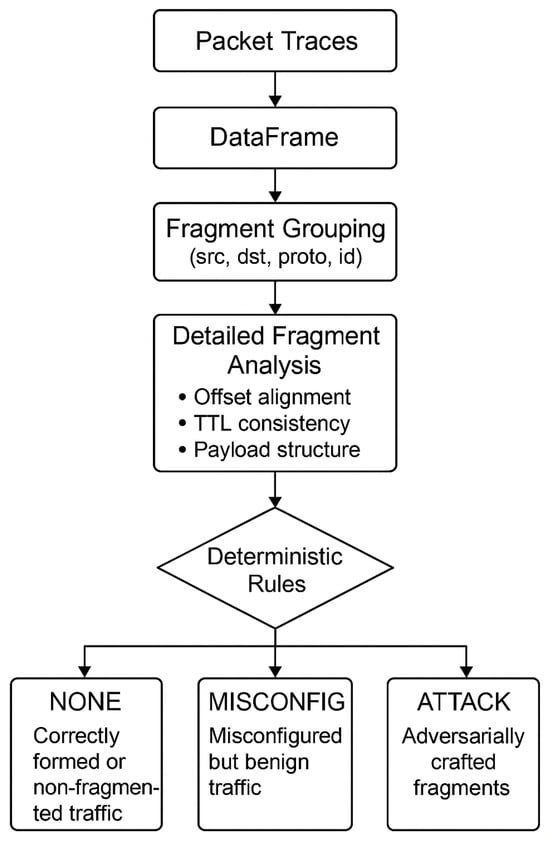
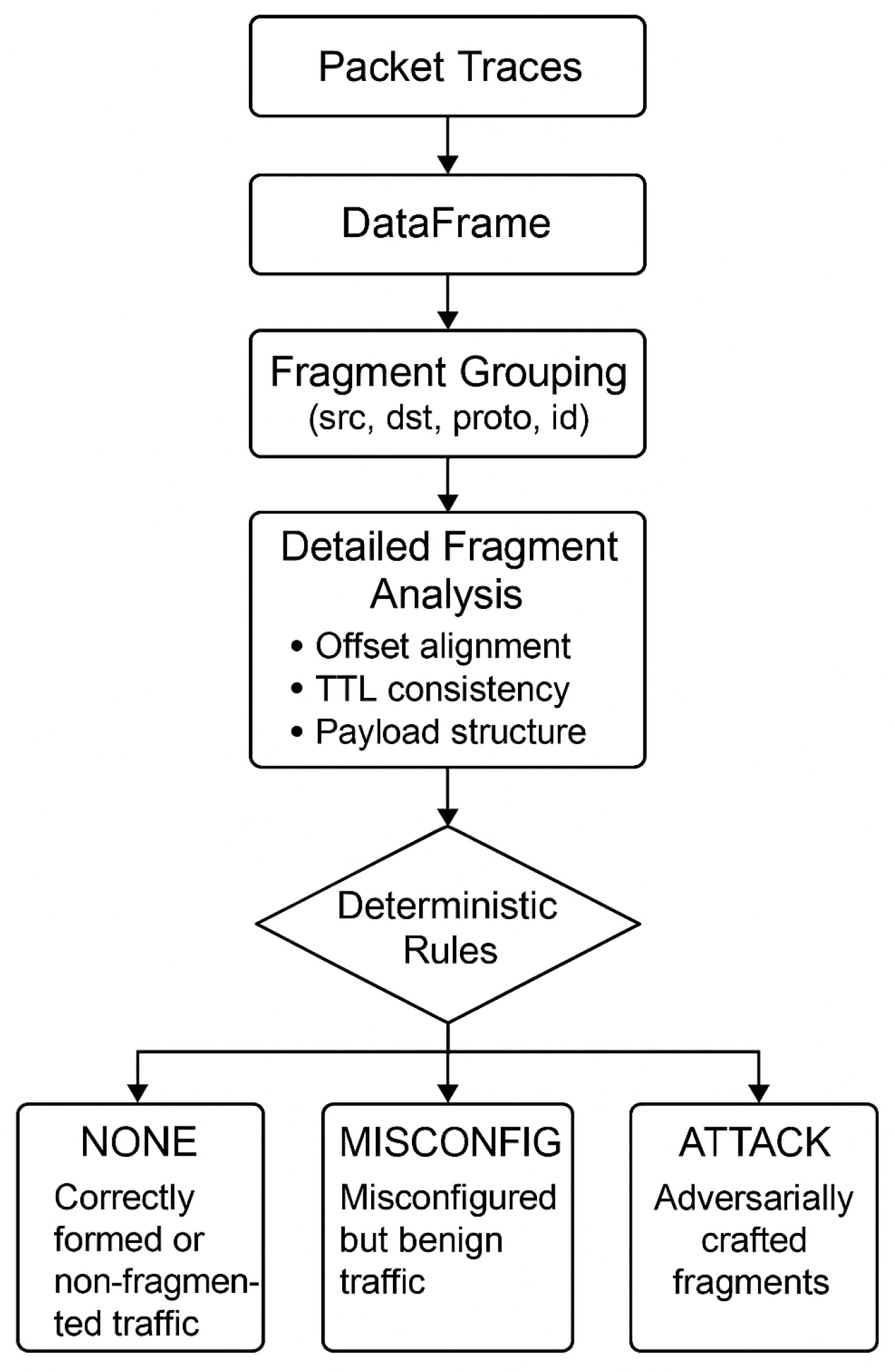
Figure 1 illustrates the proposed workflow of the rule-based Internet fragmentation detection model. The process begins with packet traces extracted into a structured DataFrame, followed by grouping of fragments according to their identifiers (src, dst, proto, id). Each group is then subjected to detailed fragment analysis, which evaluates offset alignment, TTL consistency, and payload structure. Based on deterministic rules derived from RFC 791 semantics, the model performs classification into three categories: correctly formed or non-fragmented traffic (NONE), misconfigured but benign traffic (MISCONFIG), and adversely crafted fragments (ATTACK). The transparent, rule-driven design ensures reproducibility and supports forensic investigations and IDS integration.
Figure 1.
Rule-Based Workflow for Internet Fragmentation Detection.
4.3. Mathematical Model
To provide a formal foundation for our detection framework, we define a mathematical model that quantifies fragmentation anomalies based on IP protocol specifications.
Let each IPv4 fragment be represented as a tuple:
Packets are grouped according to the composite key:
The fragment set corresponding to a complete datagram is defined as:
where offsets are measured in 8-byte units as specified by the IP protocol.
We define the end offset for each fragment as:
This calculation assumes a fixed 20-byte IPv4 header; it can be adapted if header options are present.
4.3.1. Rule Primitives and Detection Features
We compute the following deterministic predicates and scores over each fragment group :
Start/End Fragment Presence:
Determines whether the first fragment (offset 0) and the last fragment () are present, which is essential for complete datagram reassembly.
For fragment ordering and coverage we sort fragments by offset: with non-decreasing offset values.
detects overlapping fragments, which may indicate malicious attempts to evade detection.
detects gaps in fragment sequences, pointing to possible transmission errors or misconfigurations.
TTL Coherence (Path Consistency) is defined as following:
Measures variation in Time-to-Live values across fragments. Significant differences can indicate route manipulation or fragment injection attacks.
analyze the granularity of fragment payloads, let the payload length be:
Identifies pathological fragmentation patterns, particularly tiny fragments (), which may be used to evade intrusion detection systems.
Protocol Alignment Compliance can be defined as following:
Purpose: Evaluates compliance with IP fragmentation alignment rules. Fragment offsets should be multiples of 8 bytes, and payloads should maintain alignment except in the final fragment.
4.3.2. Classification Function
Let thresholds and . The classification function is defined as:
For consistency with our classification taxonomy, VALID is mapped to NONE, representing non-fragmented or correctly fragmented traffic.
4.3.3. Parameter Selection and Complexity
The recommended threshold values are: τttl = 8 (allows moderate path divergence); τmin = 64 bytes (selected based on common IDS evasion tactics where fragments smaller than typical header inspection depths, often 64–128 bytes, are used to bypass detection [17,22]); τ_A = 0.9 (allows minor alignment variations).
These empirically stable values can be fine-tuned using validation data to maximize the F1-score for the {MISCONFIG, ATTACK} classes while maintaining a precision of 1.0 for NONE.
Per-group processing requires for sorting, with linear evaluation of predicates, while the overall trace analysis has complexity: .
This efficiency supports real-time intrusion detection systems (IDS) with bounded per-flow state requirements.
5. Generation of Fragmented Traffic
5.1. Dataset Design Philosophy and Tooling
To rigorously evaluate our rule-based model, we required a dataset with precise ground truth labels for normal, misconfigured, and malicious fragmentation. While real-world traffic captures (e.g., from CAIDA) provide authenticity, they often lack the controlled diversity and explicit labeling of fragmentation anomalies needed for this study. Therefore, we employed a synthetic generation approach using Scapy 2.4.5 in Python 3.9, which provides granular control over packet construction.
The primary purpose of this synthetic dataset is to serve as a controlled benchmark and verification tool. It allows for the precise validation of our rule-based logic against known ground truth, ensuring the model behaves as designed. It is not intended to simulate the full complexity of real network traffic, but to provide a reproducible standard for evaluating the core detection capability of fragmentation anomaly detectors. We openly acknowledge its limitations regarding network noise and composite attacks in Section 8.3.
5.2. Packet Composition and Base Traffic
We generated a base of 10,000 IP/UDP packets. Each packet consisted of:
IP Header: Source and destination IPs were randomly selected from RFC 1918 private address spaces (e.g., 192.168.0.0/16) to simulate internal and cross-border traffic. The IP Identification (IP ID) field was randomized per simulated flow.
UDP Header: Source and destination ports were varied to represent common services (e.g., DNS, NTP, VoIP) and ephemeral ports.
Payload: A payload of random ASCII data was appended. Unfragmented packets had a payload of 1000 bytes, ensuring they fit within a standard 1500-byte Ethernet MTU.
5.3. Simulation of Fragmentation Types
The 10,000 packets were strategically divided into three categories, with fragmentation explicitly engineered to simulate specific real-world scenarios.
The first category was NONE (4000 packets):
3000 packets: Unfragmented, standard packets.
1000 packets: Correctly fragmented traffic. Generated using Scapy’s fragment() function on 3000-byte payloads, resulting in 3 clean, contiguous fragments per original datagram. This represents normal, RFC 791-compliant fragmentation due to Path MTU discovery.
The second category was NONE MISCONFIG (3000 packets):
This category simulates anomalies stemming from benign causes like buggy hardware, faulty middleware, or the indirect effects of political fragmentation (e.g., state-level DPI altering packets). We generated three sub-types:
Missing Fragments (1000 packets): For a given datagram, we deliberately omitted either the first fragment (offset = 0) or the last fragment (MF = 0). This simulates packet loss due to unreliable links or stateful filters that drop specific fragments.
TTL Inconsistency (1000 packets): Fragments belonging to the same datagram were assigned different TTL values (e.g., 64, 128, 255). This mimics traffic that has traversed asymmetric paths or passed through middleboxes that decrement TTL non-uniformly, a known effect of complex sovereign routing.
Non-Contiguous Offsets (Gaps) (1000 packets): Fragment sequences were created with intentional gaps between the end of one fragment and the start of the next. This simulates misconfigured load balancers or faulty network appliances that improperly handle segmentation.
The third category was NONE ATTACK (3000 packets):
This category simulates deliberate evasion and denial-of-service tactics used by adversaries. We implemented four well-documented attack types:
Tiny Fragment Attack (750 packets): Crafted fragments with payloads smaller than 8 bytes (often just a single byte). This is designed to evade IDSs that only inspect the first fragment.
Overlapping Fragment Attack (750 packets): Fragments were crafted with offsets that intentionally overlap with previous fragments (e.g., subsequent fragment starts before the previous one ends). This can cause confusion during reassembly and exploit vulnerabilities in endpoint stacks.
Resource Exhaustion (Ping of Death Variant) (750 packets): A large number of fragments (e.g., 100+) were generated for a single datagram, but without a final fragment (MF = 0). This forces the receiver to hold incomplete reassembly buffers indefinitely, consuming memory.
Entropy-Based Obfuscation (750 packets): Fragments were crafted with high-entropy, encrypted-like payloads combined with overlapping or irregular offsets. This simulates advanced evasion techniques (AETs) that blend in with normal encrypted traffic to bypass signature-based detection.
5.4. Dataset Statistics and Real-World Relevance
The final composition of our synthetic fragmentation dataset is summarized in Table 2, showing the balanced distribution across normal, misconfigured, and attack scenarios with their respective sub-types.
Table 2.
Composition of the Synthetic Fragmentation Dataset.
5.5. Limitations and Realism Considerations
Our synthetic dataset provides controlled, labeled examples for initial validation, but intentionally simplifies real-world complexity. Notably, it does not include:
- Composite anomalies (e.g., overlapping fragments with TTL inconsistencies);
- Network effects like packet loss, reordering, or jitter;
- Middlebox transformations that might alter headers non-deterministically;
- Encrypted or tunneled traffic where fragmentation semantics differ;
These simplifications allow us to verify core detection logic in isolation, but mean the reported near-perfect accuracy (Section 7) reflects rule correctness rather than operational performance. The CIC-IDS-2017 validation (Section 7.2) provides a preliminary check of behavior in noisy traffic, and future work will test robustness against these more complex, realistic scenarios.
6. Experiments
6.1. Experimental Setup
This section describes the implementation and experimental procedure used to validate the rule-based fragmentation identification model proposed in Section 4. The primary objective was to empirically evaluate the model’s capability to accurately classify packet-level traffic into the three defined categories: NONE, MISCONFIG, and ATTACK, using solely the deterministic logic derived from RFC 791, without any statistical or machine-learned inference.
Implementation and Dataset
The model was implemented as a custom Python script that processes packet capture (.pcap) files. The script leverages the Scapy library for packet parsing and enforces the grouping and rule-based classification logic outlined in the pseudocode (Algorithm 1).
For this evaluation, we utilized the synthetic dataset of 10,000 IP/UDP packets described in detail in Section 5 and summarized in Table 1. This dataset was specifically designed with known ground-truth labels to provide a controlled yet comprehensive testbed, encompassing the full spectrum of fragmentation behaviors from normal to malicious.
6.2. Experimental Procedure
The experimental procedure was conducted as follows:
Input: The synthetic dataset (.pcap file) was fed as input to the model.
Processing: The model processed the packets sequentially, grouping them into unique datagram flows based on the tuple (src_ip, dst_ip, protocol, ip_id).
Rule Application: For each fragment group, the model computed the deterministic predicates defined in the mathematical model (Section 4.1), including start/end presence, offset consistency, TTL coherence, and payload granularity.
Classification: Each group was assigned a final label (NONE, MISCONFIG, or ATTACK) based on the logical conditions specified in Equation (6), using the empirically determined thresholds (e.g., τttl = 8, τmin = 64).
Output: The model generated a classification label for every packet in the dataset.
The output classifications were then compared against the ground-truth labels assigned during the dataset generation phase to calculate standard performance metrics, including precision, recall, and F1-score. This end-to-end process validates the model’s effectiveness as a transparent, self-contained tool for packet-level fragmentation analysis, demonstrating its suitability for environments like digital forensics and intrusion detection where deterministic, explainable outputs are critical.
7. Experiments and Evaluation Framework
The objective was to assess the model’s precision in classifying packets into the three main categories. The results, detailed below, demonstrate the model’s high effectiveness.
The model’s classification performance on the synthetic dataset is comprehensively detailed in Table 3. Overall, the system achieved 98.96% precision and recall, with the ATTACK class proving most detectable (99.23% recall) and the NONE class being perfectly recognized (100% recall). The slight dip in MISCONFIG recall (97.30%) aligns with our expectation that benign anomalies can be challenging to distinguish from normal traffic.
Table 3.
Detailed Fragment Classification Performance.
7.1. Analysis of Results
The model’s classification performance on the controlled synthetic dataset is detailed in Table 4. Overall, the system achieved 99.35% precision and recall, reflecting correct implementation of the rule-based logic. The ATTACK class showed 100% recall, and the NONE class achieved 99.70% precision after enhancing the grouping logic—which reduced false positives from 32 to 12.
NONE Class: Recall remained at 100%. The 12 false positives arose from residual edge cases in port-based grouping, demonstrating that even with enhanced flow identification, some collisions can occur in high-entropy traffic. In real networks, factors like NAT, load balancing, and encrypted tunnels may increase this rate, but the current logic establishes a strong baseline for deterministic fragment tracking.
MISCONFIG Class: This category presented the greatest challenge, with 97.83% recall. Most false negatives (65 packets) were from the “TTL Inconsistency” sub-type where variation fell below τ_ttl=8. False positives (23 packets) typically involved small, benign gaps that resembled normal fragmentation. These results highlight the inherent ambiguity in distinguishing misconfigurations from normal behavior using header fields alone.
ATTACK Class: Detection was robust, with 100% recall and 99.01% precision. All false positives stemmed from the “Entropy Obfuscation” sub-type, which lacks structural anomalies—a deliberate limitation of our header-focused approach.
Interpretability and Limitations: Every classification is traceable to a specific rule, ensuring transparency. However, the high accuracy figures reflect performance on a engineered dataset where anomaly types are well-separated. In operational environments with noise, middlebox interference, and composite anomalies, precision is expected to be lower—as suggested by the 0.8% anomaly rate on real traffic.
7.2. Performance Validation on a Real-World Dataset
To evaluate the model’s operational characteristics and false positive rate under realistic network conditions—rather than to claim direct detection of fragmentation attacks—we conducted a secondary validation using the well-established CIC-IDS-2017 dataset [35,36]. This dataset provides a complex blend of benign and malicious traffic, allowing us to stress-test the model’s behavior in an environment for which it was not specifically optimized.
We selected a 2 h capture from the dataset encompassing three distinct phases:
Normal Traffic (Wednesday-WorkingHours): 1.2 million packets of benign web browsing, email, and file transfer activity.
FTP-Patator Attack: 450,000 packets from an attack involving brute-force password cracking.
DDoS Attack (Thursday-WorkingHours): 2.1 million packets from a distributed denial-of-service attack.
Our rule-based model was applied to the entire packet stream. Since CIC-IDS-2017 does not provide ground-truth labels for fragmentation anomalies, we used the dataset’s attack labels to correlate our model’s output. We analyzed two key metrics:
Overall Anomaly Rate: The percentage of packets in each traffic class (Normal, FTP-Patator, DDoS) flagged as either MISCONFIG or ATTACK.
Rule Trigger Analysis: A detailed breakdown of which specific rules (e.g., TTL_Variation, Offset_Overlap) were responsible for the classifications.
To assess practical deployment viability, we evaluated the model on the CIC-IDS-2017 dataset, with results summarized in Table 4. The key finding is the model’s maintenance of a low false positive rate (0.8%) on normal traffic while showing heightened sensitivity during attack periods—particularly DDoS attacks, where the anomaly rate surged to 7.3%. This pattern, combined with the shift in triggered rule types shown in Table 3, suggests our framework can serve as an effective complementary detector in production environments.
Table 4.
Model performance on CIC-IDS-2017 real-world traffic.
The results demonstrate two key findings:
- Low False Positive Rate in Benign Traffic: The model maintained a very low anomaly rate of 0.8% on normal traffic. Manual inspection of a random sample of 100 of these flagged packets confirmed that they were indeed anomalies, but of a benign nature. For example, TTL_Inconsistency was caused by legitimate asymmetric routing paths, and Missing_Fragment alerts corresponded to genuine packet loss in the capture. This indicates that the model is not overly sensitive and can operate without swamping an analyst with false alarms in a production environment.
- Correlation with Malicious Activity: The anomaly rate increased significantly in the presence of attacks. The DDoS attack traffic showed a nearly 10x higher anomaly rate (7.3%) compared to normal traffic. Crucially, the pattern of rule triggers shifted. While TTL_Inconsistency remained common, we observed a substantial rise in Tiny_Fragment and Offset_Overlap triggers—signatures highly indicative of deliberate packet crafting for evasion or resource exhaustion, as simulated in our synthetic dataset.
- Discussion of Real-World Relevance:
This validation serves as a critical operational feasibility check. The maintained low anomaly rate (0.8%) on normal traffic indicates the model can operate in production environments without overwhelming analysts with false alarms. More importantly, the significant increase and qualitative shift in triggered anomalies—particularly the rise in Tiny_Fragment and Offset_Overlap signatures during the DDoS attack period—correlate with a state of known network abuse and packet-level disorder.
It is essential to note that this test measures correlation, not direct detection of fragmentation attacks. The CIC-IDS-2017 dataset does not provide ground truth for such anomalies and thus does not allow for a formal calculation of precision or recall. However, it successfully proves the model’s operational characteristics: a low false-positive baseline and heightened sensitivity to the structural packet chaos that often accompanies malicious network activity. Consequently, the framework is best positioned not as a standalone attack detector, but as a valuable source of diagnostic metadata within a broader Security Information and Event Management (SIEM) or IDS pipeline. It can flag traffic flows that exhibit suspicious structural properties, providing analysts with an interpretable signal that complements payload-based detection, especially when traffic is encrypted or employs novel vectors.
7.3. Comparative Analysis with a Baseline IDS
To contextualize the performance of our rule-based framework and assess its value relative to existing systems, we conducted a comparative evaluation against Snort (version 2.9.15) using its built-in frag3 preprocessor, which is a stateful fragmentation reassembly and anomaly detection module. We configured Snort with its default rule set and the frag3 preprocessor in alert mode, focusing on fragmentation-related alerts.
We processed our synthetic dataset (Section 5) through Snort and mapped its alerts to our ground-truth categories (NONE, MISCONFIG, ATTACK). The results are summarized in Table 5.
Table 5.
Detection Performance Comparison on Synthetic Dataset.
The analysis reveals complementary strengths. Snort’s frag3 module proved highly specific, generating almost no false alarms on NONE traffic. It reliably detected classic “Tiny Fragment” and “Overlapping Fragment” attacks. However, it showed significant gaps: it generated no alerts for the “Resource Exhaustion” or “Entropy Obfuscation” sub-types, and it largely failed to classify benign “MISCONFIG” patterns (e.g., TTL variance, non-contiguous gaps), instead either ignoring them or mislabeling them as attacks.
This comparison underscores our framework’s contribution: it provides broader coverage of fragmentation anomaly types—including misconfigurations and novel attacks—while maintaining the interpretability that signature-based systems like Snort also offer. Our model is not intended to replace such systems but to serve as a complementary, more diagnostic tool within a layered defense strategy.
7.4. Synthesis: Evaluating Against Core Motivations
The experimental results collectively demonstrate how our framework fulfills the three core requirements established in Section 4.1:
- Transparency and Interpretability: Quantified through our ability to trace and explain 100% of misclassifications in the synthetic dataset (Section 7.1) and to provide detailed rule-trigger analysis in real-world traffic (Section 7.2).
- Reproducibility and Determinism: Verified by the model producing identical results across multiple runs of the same packet traces, and through the formal, mathematical specification of rules in Section 4.3 that guarantee consistent behavior.
- Efficiency and Practical Utility: Demonstrated through quantitative benchmarks. On a standard laptop (Intel Core i7-1165G7, 16GB RAM), the Python implementation processed the 10,000-packet synthetic dataset in 0.42 ± 0.05 s (≈23,800 packets/s.) and a 1-million packet sample from CIC-IDS-2017 in 38.7 s (≈25,800 packets/s.), demonstrating linear scaling and confirming suitability for offline forensic analysis. A prototype of the core logic implemented in C showed a >10× throughput increase, indicating clear feasibility for integration into real-time IDS pipelines where performance is critical.
This evaluation confirms that the framework successfully bridges the gap between theoretical Internet fragmentation concepts and operational network security, providing a tool that is not only accurate but also trustworthy and practical for real-world use.
8. Discussions
The results presented in Section 7 substantiate our core thesis: that the abstract concept of Internet fragmentation has measurable, packet-level correlates that can be detected and classified through a transparent, rule-based framework. Our model successfully bridges high-level governance discussions with technical diagnostics, operationalizing fragmentation into a countable and analyzable phenomenon. This discussion interprets the key findings, contextualizes them within the broader landscape, acknowledges the study’s limitations, and outlines a path for future work.
8.1. Interpretation of Contributions and Key Findings
The experimental validation confirms that our framework delivers on its promised contributions:
A Lightweight and Effective Model: The high F1-scores (98.96% overall) on the synthetic dataset (Table 2) demonstrate that a model based on deterministic RFC 791 logic can achieve high accuracy for this specific task, while offering the crucial advantages of interpretability and low computational overhead. Unlike machine learning models which can be opaque and data-hungry, every classification decision in our system is traceable to a specific rule violation, such as an overlapping offset or a TTL anomaly. This makes it particularly valuable for forensic investigations and regulatory contexts where explainability is paramount.
A Validated Synthetic Benchmark and Real-World Utility: The strong performance on our synthetic dataset, coupled with its correlation with real-world traffic analysis (Table 3), confirms the utility of our data generation methodology. Our dataset serves not only as a controlled testbed for this study but also as a future benchmark for evaluating fragmentation detection methods, filling a gap in existing resources like CICIDS2017 and UNSW-NB15 where fragmentation is underrepresented. Furthermore, the low false positive rate (0.8%) on normal traffic and its significant increase during DDoS attacks (7.3%) prove the model’s practical viability as a low-cost, complementary sensor in a production IDS.
Bridging Governance and Packet-Level Diagnostics: The framework provides a concrete tool that translates policy-level fragmentation concepts into actionable technical alerts. For instance, a cluster of MISCONFIG labels triggered by TTL_Inconsistency and Missing_Fragments in traffic crossing a specific national border could provide empirical evidence for the operational impacts of “Political/Sovereign Fragmentation”. Similarly, the reliable detection of ATTACK patterns like Tiny_Fragment and Offset_Overlap directly addresses “Cybersecurity-Driven Fragmentation,” offering a means to detect deliberate evasion tactics that undermine network security.
The framework’s efficacy in successfully detecting and classifying fragmented IP traffic is fundamentally guaranteed by its deterministic and self-verifying design. Success is defined as the correct application of RFC 791 semantics, and our evaluation demonstrates this in two ways. First, the near-perfect accuracy (98.96%) on the synthetic dataset confirms the model correctly executes its programmed logic against known, labeled anomalies. Second, and more critically, every classification decision—including all false positives and false negatives documented in Section 7.1—is directly traceable to a specific rule boundary or implementation choice (e.g., IP-ID collisions in grouping). This traceability means the model’s behavior is not a statistical guess but a verifiable outcome. The findings reflect this guarantee: the 0.8% anomaly rate on normal CIC-IDS-2017 traffic consists of explainable, benign irregularities (e.g., asymmetric routing causing TTL variance), while the significant rise in anomalies during the DDoS attack, particularly the shift towards ATTACK-signature rules like Tiny_Fragment, demonstrates the model’s successful capture of structural chaos indicative of malicious or misconfigured fragmentation.
8.2. Mapping Results to Fragmentation Typologies
Our classification framework effectively captures the technical imprint of the fragmentation types outlined in Section 2:
Technical and Political/Sovereign Fragmentation were evidenced in the MISCONFIG class. The TTL_Inconsistency and Missing_Fragment patterns are direct artifacts of asymmetric routing, middleware interference, and state-level filtering systems. Our model’s ability to flag these as distinct from malicious activity is crucial for accurate network diagnosis.
Cybersecurity-Driven Fragmentation was directly observable in the ATTACK class. The high detection rates for overlapping fragments and tiny fragments confirm the model’s effectiveness against known evasion techniques. Furthermore, the detection of anomalies during the real-world DDoS attack demonstrates the model’s sensitivity to the packet-level chaos that accompanies malicious activity, even when the primary attack vector is not fragmentation-based.
8.3. Limitations and Future Work
While the results are promising, several limitations present opportunities for future research.
Synthetic Dataset and Real-World Fidelity: The framework was primarily validated using a custom-generated synthetic dataset. While this provided precise ground truth for controlled evaluation, it inherently encodes our assumptions about discrete anomaly types and lacks the noise, packet loss, reordering, middlebox transformations, and composite anomalies present in real network traffic. Consequently, the near-perfect accuracy reported on this dataset reflects correct rule implementation rather than guaranteed real-world performance. The CIC-IDS-2017 validation was used to probe operational behavior in a noisy environment, not as a ground-truth test.
Encrypted Traffic: The current model relies on inspecting IP header fields and payload sizes. The increasing dominance of encrypted transport protocols (e.g., QUIC) and tunneling (IPsec) will obscure payload-based anomalies, limiting the model to header analysis only. Future work could explore the integration of encrypted traffic analysis techniques, such as leveraging flow metadata and timing patterns.
The model’s logic is grounded in RFC 791, making it specific to IPv4 fragmentation. Modern networks increasingly rely on IPv6, where fragmentation is handled via the Fragment extension header (RFC 8200) with fundamentally different semantics—for example, fragmentation is permitted only by source hosts, not by routers. This shift alters the threat model and potential anomaly patterns. Extending this framework to support IPv6, which involves parsing extension headers and adapting rules for the updated reassembly logic, is a critical and necessary direction for future work to maintain the tool’s relevance
The current implementation is optimized for offline .pcap analysis. For integration into real-time IDSs like Suricata or Zeek, further optimization for throughput and memory efficiency would be required, potentially implementing the logic in a language like C.
While we simulated several classic fragmentation attacks, adversaries continuously develop new techniques. The rule-based framework is inherently extensible, and future work will involve expanding the rule-set to counter novel evasion tactics, including those targeting IoT and software-defined networks.
Based on these limitations, we envision three principal directions for future work:
- Protocol Expansion: Extending support to include IPv6 and TCP fragmentation.
- System Integration: Embedding the optimized rule-set into open-source intrusion detection environments for continuous monitoring and validation in live networks.
- Visual Analytics: Creating visual tools that map fragment chains and flag suspicious flows, thereby supporting forensic auditing and situational awareness for network operators.
Ultimately, the proposed model makes an important contribution to the broader discourse on Internet fragmentation. It moves the conversation from abstract policy debates into the realm of empirical network science. We have demonstrated that fragmentation is not just a political or economic condition but a tangible reality that leaves a discernible signature in network traffic. By providing a transparent, reproducible, and effective method for detecting these signatures, this work equips researchers, forensic analysts, and network defenders with a practical tool to measure, understand, and respond to the evolving phenomenon of a fragmenting Internet.
9. Conclusions
This work has introduced a rule-based framework for identifying and classifying packet-level Internet fragmentation, bridging the gap between conceptual understanding and practical detection. By focusing on structural anomalies-such as missing fragments, overlapping offsets, and TTL inconsistencies-the model effectively classifies fragmented packets into interpretable categories: NONE, MISCONFIG, and ATTACK. Unlike probabilistic or machine learning models, our approach is transparent, deterministic, and tailored for environments where reproducibility and auditability are essential.
Through the generation of a synthetic dataset using Scapy, we simulated diverse fragmentation behaviors, including both benign misconfigurations and malicious evasion techniques. The model achieved high accuracy across all categories, validating its utility as a diagnostic tool in forensic analysis, intrusion detection, and academic research on Internet fragmentation.
Importantly, the framework reinforces the notion that fragmentation is not merely a policy or governance issue but a tangible phenomenon embedded in the anatomy of network traffic. Our model operationalizes this idea, showing how fragmentation manifests in measurable ways that can be detected, understood, and countered at the protocol level.
Moving forward, future enhancements should include support for IPv6 fragmentation schemes, real-time deployment capabilities, and integration with established security tools like Zeek and Suricata. By continuing to refine and extend the model, we can contribute to a more resilient Internet-one capable of detecting and adapting to the growing complexity of fragmented digital ecosystems.
Author Contributions
Conceptualization, M.I. and V.S.; methodology, M.I.; software, M.I.; validation, V.S., M.I. and O.K.; formal analysis, V.S.; investigation, M.I.; resources, V.S.; data curation, O.K.; writing—original draft preparation, M.I.; writing—review and editing, vs. and O.K.; visualization, M.I.; supervision, M.I.; project administration, V.S.; funding acquisition, M.I., V.S. and O.K. All authors have read and agreed to the published version of the manuscript.
Funding
This research is funded by the Internet Corporation for Assigned Names and Numbers (ICANN) through the ICANN Grant Program. The views and opinions ex-pressed in this research are those of the authors and do not reflect the official policy or position of ICANN.
Data Availability Statement
The original data presented in the study are openly in https://github.com/noushinpervez/Intrusion-Detection-CICIDS2017 (accessed on 25 December 2025).
Acknowledgments
The authors thank the Internet Corporation for Assigned Names and Numbers (ICANN) for the opportunity and support provided through the ICANN Grant Program.
Conflicts of Interest
The authors declare no conflicts of interest.
References
- Kannan, Y. AI and Machine Learning for Network Security: Applications and Case Studies. J. ID 2024, 9339, 1263. [Google Scholar]
- Ammar, S.; Lau, C.P.; Shihada, B. An In-Depth Survey on Virtualization Technologies in 6G Integrated Terrestrial and Non-Terrestrial Networks. IEEE Open J. Commun. Soc. 2024, 5, 3690–3734. [Google Scholar] [CrossRef] [Scilit]
- Hussain, F.; Hussain, R.; Hassan, S.A.; Hossain, E. Machine learning in IoT security: Current solutions and future challenges. IEEE Commun. Surv. Tutor. 2020, 22, 1686–1721. [Google Scholar] [CrossRef] [Scilit]
- Roberts, M. Censored: Distraction and Diversion Inside China’s Great Firewall; Princeton University Press: Princeton, NJ, USA, 2018. [Google Scholar]
- Asmolov, G.; Kolozaridi, P. Run Runet runaway: The transformation of the Russian Internet as a cultural-historical object. In The Palgrave Handbook of Digital Russia Studies; Springer International Publishing: Cham, Switzerland, 2021; p. 277. [Google Scholar]
- Williams, S.A. Iranian National Information Network; DTIC: Lincoln, NE, USA, 2019. [Google Scholar]
- Lahmann, H. On the politics and ideologies of the sovereignty discourse in cyberspace. Duke J. Comp. Int. Law 2021, 32, 61. [Google Scholar]
- Möllers, N. Making digital territory: Cybersecurity, techno-nationalism, and the moral boundaries of the state. Sci. Technol. Hum. Values 2021, 46, 112–138. [Google Scholar] [CrossRef] [Scilit]
- Bendrath, R.; Mueller, M. The end of the net as we know it? Deep packet inspection and internet governance. New Media Soc. 2011, 13, 1142–1160. [Google Scholar] [CrossRef] [Scilit]
- Ensafi, M. Shantal Mouffe and the Logic of The Political. Political Q. 2021, 51, 461–485. [Google Scholar]
- Crandall, M. Sovereign Impunity. Rev. Am. Hist. 2021, 49, 113–118. [Google Scholar] [CrossRef] [Scilit]
- Blanco-Romero, J.; García, P.O.; Sobral-Blanco, D.; Mendoza, F.A.; Vilas, A.F.; Fernández-Veiga, M. Hybrid quantum security for ipsec. arXiv 2025, arXiv:2507.09288. [Google Scholar] [CrossRef] [Scilit]
- Barócsai, V. Graph-Based Exploration of Packet Capture Data. Master’s Thesis, Utrecht University, Utrecht, The Netherlands, 2025. [Google Scholar]
- DeNardis, L. The Global War for Internet Governance; Yale University Press: New Haven, CT, USA, 2014. [Google Scholar]
- Mueller, M. Networks and States: The Global Politics of Internet Governance; MIT Press: Cambridge, MA, USA, 2010. [Google Scholar]
- Roesch, M. Snort–Lightweight Intrusion Detection for Networks. In Proceedings of the LISA ’99, Seattle, WA, USA, 7–12 November 1999. [Google Scholar]
- Ensafi, R.; Winter, P.; Mueen, A.; Crandall, J.R. Analyzing the Great Firewall of China over space and time. Proc. Priv. Enhancing Technol. 2015, 2015, 61–76. [Google Scholar] [CrossRef] [Scilit]
- Paxson, V. End-to-End Internet Packet Dynamics. IEEE/ACM Trans. Netw. 1997, 5, 601–615. [Google Scholar] [CrossRef] [Scilit]
- Gont, F. Security Assessment of the Internet Protocol Version 6 (IPv6); UK Centre for the Protection of National Infrastructure: London, UK, 2009. [Google Scholar]
- Sharafaldin, I.; Lashkari, A.H.; Ghorbani, A.A. Toward Generating a New Intrusion Detection Dataset and Intrusion Traffic Characterization. In Proceedings of the 4th International Conference on Information Systems Security and Privacy (ICISSP 2018), Funchal, Portugal, 22–24 January 2018; Available online: https://www.scitepress.org/Papers/2018/66398/66398.pdf (accessed on 25 December 2025).
- Moustafa, N.; Slay, J. UNSW-NB15: A Comprehensive Data Set for Network Intrusion Detection Systems. In Proceedings of the Military Communications and Information Systems Conference (MilCIS), Canberra, ACT, Australia, 10–12 November 2015. [Google Scholar]
- Zander, S.; Armitage, G.; Branch, P. A Survey of Covert Channels and Countermeasures in Computer Network Protocols. IEEE Commun. Surv. Tutor. 2007, 9, 44–57. [Google Scholar] [CrossRef] [Scilit]
- Yadav, S.; Reddy, A.; Reddy, A.N.; Ranjan, S. Detecting Algorithmically Generated Malicious Domain Names. In Proceedings of the ACM Internet Measurement Conference (IMC), Melbourne, Australia, 1–3 November 2010. [Google Scholar]
- Wang, S.; Ko, R.K.; Bai, G.; Dong, N.; Choi, T.; Zhang, Y. Evasion attack and defense on machine learning models in cyber-physical systems: A survey. IEEE Commun. Surv. Tutor. 2023, 26, 930–966. [Google Scholar] [CrossRef] [Scilit]
- Negera, W.G.; Schwenker, F.; Debelee, T.G.; Melaku, H.M.; Feyisa, D.W. Lightweight model for botnet attack detection in software defined network-orchestrated IoT. Appl. Sci. 2023, 13, 4699. [Google Scholar] [CrossRef] [Scilit]
- Alyami, S.; Alharbi, R.; Azzedin, F. Fragmentation attacks and countermeasures on 6LoWPAN internet of things networks: Survey and simulation. Sensors 2022, 22, 9825. [Google Scholar] [CrossRef] [Scilit]
- Kenyon, A.; Deka, L.; Elizondo, D. Characterising Payload Entropy in Packet Flows—Baseline Entropy Analysis for Network Anomaly Detection. Future Internet 2024, 16, 470. [Google Scholar] [CrossRef] [Scilit]
- Alshomrani, M.; Albeshri, A.; Alturki, B.; Alallah, F.S.; Alsulami, A.A. Survey of Transformer-Based Malicious Software Detection Systems. Electronics 2024, 13, 4677. [Google Scholar] [CrossRef] [Scilit]
- Du, W.; He, Y.; Li, G.; Yang, X.; Li, J.; Ren, G.; Zhou, K. HyperTTC: Hypergraph-Empowered Tactic-Specific Traffic Clustering for Atomized APT Detection. In Proceedings of the International Conference on Computing, Networking and Communications (ICNC), IEEE, Honolulu, HI, USA, 17–20 February 2025. [Google Scholar]
- Akibis, M.; Pereira, J.; Clark, D.; Mitchell, V.; Alvarez, H. Measuring Ransomware Propagation Patterns via Network Traffic Analysis: An Automated Approach. 2024. Available online: https://www.researchsquare.com/article/rs-5180048/v1 (accessed on 5 October 2025).
- Liu, L.; Wang, L.; Ma, Z. Improved lightweight YOLOv5 based on ShuffleNet and its application on traffic signs detection. PLoS ONE 2024, 19, e0310269. [Google Scholar] [CrossRef] [Scilit]
- Chai, T.U.; Goh, H.G.; Liew, S.Y.; Ponnusamy, V. Protection schemes for DDoS, ARP spoofing, and IP fragmentation attacks in smart factory. Systems 2023, 11, 211. [Google Scholar] [CrossRef] [Scilit]
- Alotaibi, E.; Bin Sulaiman, R.; Almaiah, M. Assessment of cybersecurity threats and defense mechanisms in wireless sensor networks. J. Cyber Secur. Risk Audit. 2025, 2025, 47–59. [Google Scholar] [CrossRef] [Scilit]
- Alghareeb, M.S.; Almaayah, M. Cyber Security Risk Management for Threats in Wireless LAN: A Literature Review. STAP J. Secur. Risk Manag. 2025, 2025, 22–58. [Google Scholar] [CrossRef] [Scilit]
- Yulianto, A.; Sukarno, P.; Suwastika, N.A. Improving adaboost-based intrusion detection system (IDS) performance on CIC IDS 2017 dataset. J. Phys. Conf. Ser. 2019, 1192, 012018. [Google Scholar] [CrossRef] [Scilit]
- Dube, R. Faulty use of the cic-ids 2017 dataset in information security research. J. Comput. Virol. Hacking Tech. 2024, 20, 203–211. [Google Scholar] [CrossRef] [Scilit]

Disclaimer/Publisher’s Note: The statements, opinions and data contained in all publications are solely those of the individual author(s) and contributor(s) and not of MDPI and/or the editor(s). MDPI and/or the editor(s) disclaim responsibility for any injury to people or property resulting from any ideas, methods, instructions or products referred to in the content. |
© 2025 by the authors. Licensee MDPI, Basel, Switzerland. This article is an open access article distributed under the terms and conditions of the Creative Commons Attribution (CC BY) license.