Next Article in Journal
Identification of Conserved B and T Cell Epitopes in Glycoprotein S of Mexican Porcine Epidemic Diarrhea Virus (PEDV) Strains via Immunoinformatics Analysis, Molecular Docking, and Immunofluorescence
Previous Article in Journal
Parvovirus B19 DNA Detected in Ovarian Teratomatous Tissue in Anti-NMDAR Encephalitis: A Case Report
Previous Article in Special Issue
High Seroprevalence of Bluetongue Virus Serotype 3 in Belgian Cattle and Sheep After the 2024 Epidemic
 
 
Due to scheduled maintenance work on our servers, there may be short service disruptions on this website between 11:00 and 12:00 CEST on March 28th.
Article

Visualization of Bluetongue Virus RNA Segment Networks in Infected Cells: Multipartite Genomic RNA Assortment Is Independent of Viral Proteins NS2 and VP6


Department of Infection Biology, London School of Hygiene & Tropical Medicine, London WC1E 7HT, UK
*
Author to whom correspondence should be addressed.
Viruses 2026, 18(4), 406; https://doi.org/10.3390/v18040406
Submission received: 6 March 2026 / Revised: 20 March 2026 / Accepted: 23 March 2026 / Published: 25 March 2026

Abstract

Bluetongue virus (BTV), with a genome of ten double-stranded RNA segments (S1–S10), is an emerging animal pathogen causing major economic losses in livestock worldwide. BTV replication involves RNA-RNA and RNA–protein interactions, with RNA-binding proteins, VP6 and NS2 playing key roles in genome assembly and RNA packaging. To explore the dynamics of RNA segment interactions and the roles of VP6 and NS2 in RNA complex formation, we used RNA fluorescence in situ hybridization chain reaction (HCR), along with site-specific mutagenesis and reverse genetics. We found that RNA segments interact sequentially, from the smallest (S10) to the largest (S1), forming a single complex that includes the entire genome. This process is independent of VP6 or NS2, although NS2 enhances the assembly of larger segments. Additionally, we show that VP6 binds to +ssRNAs before their incorporation into viral assembly factories (inclusion bodies/VIBs). These findings reveal that RNA-RNA interactions, rather than primary replicase proteins, govern the sorting and recruitment of genome segments. Our data offer new insights into BTV RNA packaging, showing that genome segments destined for packaging and dsRNA synthesis are segregated through complex formation, distinct from +ssRNAs used in protein synthesis, including those encoding the replicase complex.

1. Introduction

Bluetongue virus (BTV), a significant and emerging animal pathogen, is the prototype of the Orbivirus genus (22 species and more than 130 serogroups) within the subfamily Sedoreoviridae of Reovirales (16 distinct genera) [1]. Reovirales members include viruses that infect a wide range of vertebrates, including humans and animals, and plants. A unique feature of the Reovirales members is that their genomes are made up of double-stranded RNA segments (dsRNAs, 9–12 segments). All members are nonenveloped viruses with icosahedral capsids, made up of concentric protein layers. To understand how dsRNA segments are differentiated for selection and packaging from host RNAs within the Reovirales, we used BTV as a model virus. The BTV genome comprises 10 dsRNA segments, ranging in size from 3.95 kb to 0.8 kb, grouped into three size classes: large, medium, and small [2,3]. It encodes seven structural proteins (VP1–VP7) and four non-structural proteins (NS1, NS2, NS3/NS3A and NS4), with the structural proteins forming a complex icosahedral virion consisting of an outer capsid (VP2, VP5) and an inner core (VP1, VP3, VP4, VP6, and VP7) [3,4,5,6,7]. The final product of BTV disassembly is the transcriptionally active core particle in which the resident RNA polymerase has been activated. The ten genomic dsRNA segments are transcribed simultaneously and repeatedly to generate ssRNAs, each of which is released into the cytoplasm through discrete channels at the core apices [8]. These transcripts serve as mRNAs for viral protein synthesis but later also as ssRNA templates for progeny dsRNA synthesis. Of the five core proteins, the three minor proteins, VP1 (polymerase), VP4 (capping enzyme), VP6 (RNA packaging protein) and the major protein VP3 (forming the innermost layer), together with the NS2 protein, form the primary replicase complex [9,10]. NS2 is a phosphorylated protein, and phosphorylation of NS2 is responsible for the formation of viral inclusion bodies (VIBs) that serve as the virus assembly sites in the cytoplasm. NS2 has a strong affinity for single-stranded RNA (ssRNA) [11].
During BTV replication, newly synthesized transcripts (+ssRNA) segments are first packaged into assembling viral cores, which subsequently act as templates for synthesizing genomic dsRNA segments [12]. Previous in vitro evidence indicated that BTV RNA packaging is driven by the formation of complex RNA networks, a process which follows a specific sequence, starting with the smallest segment, S10, which initiates RNA-RNA interactions with other small segments to form an initial complex (S7–S10). Medium-sized (S4–S6) and larger ssRNAs (S1–S3) are then progressively recruited, resulting in the complete genome complex being packaged into the capsid [13,14,15]. Although NS2 is not necessary for in vitro ssRNA complex formation or core assembly [12,13,15], it is essential for virus replication in infected cells [9,16]. Reverse genetics (RG) studies demonstrated that both NS2 and VP6 are essential for BTV replication as modified BTV strains lacking NS2 or VP6 failed to replicate in normal cells but were able to propagate in NS2- or VP6-expressing helper cell lines [16,17]. Moreover, when VP6-deficient viruses are grown in complementary helper cells and used to infect normal cells, viral proteins are synthesized and assembled into empty particles lacking the viral genome [16]. Despite these findings, the precise functions of NS2 and VP6 in virus replication remain unclear. While both are believed to play critical roles in RNA recruitment and packaging in infected cells, it is also hypothesized that they may have additional functions, such as facilitating the packaging of viral RNA into the capsid during assembly.
To examine the mechanism of BTV RNA recruitment and packaging, we adopted an RNA fluorescence in situ hybridization chain reaction (HCR) technique tailored for BTV RNAs [13]. HCR [18,19,20] is an isothermal nucleic acid hybridization signal amplification technique that has gained significant attention due to its enzyme-free operation and suitability for ambient conditions. It is an alternative to traditional RNA fluorescence in situ hybridization (FISH) and has been increasingly adopted for a broad range of applications. Its enhanced sensitivity, enzyme-free amplification, and adaptability make it particularly effective for viral RNA detection and localization [21,22,23,24], and it has been used successfully to image viral RNAs [25,26,27,28]. We demonstrated elsewhere its high sensitivity and specificity in localizing transfected BTV viral RNAs within BSR cells [13]. HCR ensures that multiple probes bind simultaneously to the targeted BTV RNA segments, thereby producing high-intensity fluorescence signals and enabling precise localization of viral RNAs within infected cells. Using this technique together with site-specific mutagenesis and reverse genetics-based virus recovery, we demonstrate for the first time in BTV-infected cells how BTV RNA +ssRNAs segments are selected for packaging and what roles are played by VP6, the RNA packaging protein, and NS2/VIBs, the virus assembly protein and assembly site. This study of RNA-RNA interaction in infected cells, RNA–protein interactions and larger RNA complex formation provides valuable insights into the BTV assembly pathway and RNA recruitment/packaging mechanisms. Moreover, it offers a foundation for exploring assembly processes in other dsRNA viruses, helping to determine the sequential order of genome packaging and core/capsid formation.

2. Materials and Methods

2.1. Cell, Virus, Plasmid, Mutagenesis and Antibody

BSR (BHK-21 cells subclone, ATCCâ CCL10TM), BSR-NS2 (BSR cells stably expressing NS2/segment 8 of BTV) and BSR-VP6 (BSR cells stably expressing VP6/segment 9 of BTV) cells were cultured in Dulbecco’s Modified Eagle Medium (DMEM) (Sigma, St. Louis, MO, USA) supplemented with 10% fetal bovine serum (FBS, Sigma, St. Louis, MO, USA) at 37 °C with 5% CO2. Medium for BSR-NS2 and BSR-VP6 was also supplemented with puromycin (7.5 µg/mL). The wild-type Bluetongue virus (BTV-WT), Bluetongue virus serotype 1 South African reference strain (GenBank accession numbers FJ969719 to FJ969728) was used for this study. The 10 genome segments were first cloned into the pUC19 plasmid with T7 promoter and RNA transcripts sequentially prepared using the mMACHINE T7 transcription kit (ThermoFisher, Waltham, MA, USA). The three mutant viruses were generated by site-directed mutagenesis on BTV segment 8 or 9 as previously described, the start codons (ATG) of S8 were changed to GTG, preventing translation of NS2 for BTV-∆NS2 [13], a calcium-binding site mutation (DDDE250-253AAAA) was introduced to prevent the formation of viral inclusion bodies (VIB) for BTV-∆VIB [29], and the Entry-Competent-Replication-Abortive (BTV-ECRA) vaccine strain was designed with large deletions in an essential BTV gene encoding the VP6 protein (segment S9) of the internal core [16,30]. The antibodies produced in the laboratory were used for the detection of viral protein NS2 (guinea pig) and VP6 (rabbit). Hoechst 33342 and Alexa 488-, 546-conjugated secondary antibodies were purchased from Life Technologies (ThermoFisher, Waltham, MA, USA).

2.2. Reverse Genetics, Plaque Assay and Viral RNAs Transfection

The wild-type and mutant viruses were recovered and reproduced (either from BSR, BSR-NS2 and BSR-VP6 cells) by reverse genetics as previously described [31]. The plaque assay was undertaken with WT and mutant viruses to determine their titers. Viruses were diluted and applied to BSR, BSR-NS2, or BSR-VP6 cell monolayers at a multiplicity of infection (MOI) of 0.01 to 0.1, then overlaid with 1.2% Avicel. After 3 days, cells were fixed with formaldehyde, and plaque sizes were assessed. For colocalization analysis of BTV viral RNAs lacking both NS2 and VP6 in the host cytoplasm by HCR, BSR cells were transfected with all 10 BTV viral +ssRNA segments. The start codons (ATG) of segments S8 and S9 were mutated to GTG to prevent translation without significantly affecting nucleotide structure. Each +ssRNA segment (100 ng per well) was transfected into 12-well plates using X-TremeGENE HP DNA Transfection Reagent (Roche, Basel, Switzerland) according to the manufacturer’s instructions. Cells were incubated at 37 °C with 5% CO2 for 20 h prior to the HCR assay.

2.3. Fluorescence In Situ Hybridization Chain Reaction

RNA fluorescence in situ hybridization chain reaction (HCR) was performed following established protocols [13]. This two-step method employs initiator-tagged “Target” probes (30 oligonucleotides per RNA segment), designed using an online tool (https://www.biosearchtech.com, accessed on 22 October 2022), to bind and cover positive viral RNAs. An enzyme-free polymerization step then uses fluorescently labeled hairpin probes (H1 and H2) that form nicked double helices upon activation by the initiator strands (Supplementary Figure S1). All oligonucleotide probes were synthesized by Integrated DNA Technologies, Inc., Coralville, IA, USA (see Supplementary Table S1). Cells were plated on poly-lysine-coated coverslips (VWR International, Radnor, PA, USA) at a density of 2 × 10⁵ cells/well (12-well plate) and incubated overnight at 37 °C with 5% CO2. Cells were then infected with BTV wild-type and mutant viruses at specified time points and MOIs. After infection, cells were washed with ice-cold PBSM (1× PBS, 5 mM MgCl2), fixed with 4% paraformaldehyde in PBSM for 10 min at room temperature, and permeabilized with 0.1% Triton X-100 in PBSM for 10 min. After pre-incubation in pre-hybridization buffer (2× SSC, 10% formamide) for 20 min, hybridization buffer containing probes (5 ng/µL for the first step, 60 nM hairpin DNA for the second) was applied. The first hybridization was carried out in a humidified chamber at 37 °C for 5 h or overnight, followed by two washes with 10% formamide in 2× SSC at 37 °C. Hairpin probes were annealed in a thermocycler (95 °C to 25 °C) before the second hybridization, which was performed at 25 °C for 5 h or overnight. After nuclear staining with 0.5 µg/mL Hoechst 33342, coverslips were mounted in ProLong Gold antifade media (Invitrogen, Carlsbad, CA, USA) and examined by microscopy. For samples used for both immunofluorescence and HCR analyses, cells were first blocked with 1% BSA in PBSM for 1 h at RT after fixation and permeabilization. The coverslips were then subjected to primary and secondary antibody staining in 1% BSA in PBS, followed by another fixation step with 4% paraformaldehyde for 10 min. The cells were then washed once with PBSM and equilibrated with 10% formamide 2× SSC for 10 min before the in situ hybridization procedures. The entire experimental workflow is shown in the schematic overview illustrated in Supplementary Figure S2.

2.4. Image Acquisition and Analysis

Cells were imaged using 300 nm steps along the z-axis over a range of approximately 4.5 µm with a Nikon Ti2 wide-field microscope (Nikon Corporation, Minato-ku, Tokyo, Japan). The system was equipped with a 60× oil-immersion objective, 25 mm large wide-field-of-view (FOV) fluorescence capability, LED fluorescence and diascopic light sources, high signal-to-noise DAPI, GFP, and DS Red filters, as well as a high-sensitivity, large FOV monochrome CMOS camera. Quantification of the fluorescent photographs was performed at the same threshold and contrast adjustment. Images were analyzed in NIS-Elements 6.

2.5. RNA Complex Pull-Down Assay

BSR cells were infected with BTV at an MOI of 5.0. The cells were lysed at 5 h post-infection with RNA complex buffer (20 mM Tris-HCl pH 7.5, 200 mM KCl, 5 mM magnesium acetate, 1 mM DTT, Protease inhibitor (Merck, Darmstadt, Germany), RNase inhibitor (ThermoFisher, Waltham, MA, USA), 0.1% Triton X-100 [32] and the nucleoli removed by centrifugation. The supernatant was mixed with streptavidin agarose beads (Novagen, Darmstadt, Germany) coated with a biotin-labeled primer, which annealed the coding region of BTV-1 S1, S6, or S10 (Supplementary Table S2). The beads were incubated with poly-A RNA first to decrease non-specific binding. After 30 min incubation at 28 °C, the beads were washed three times with excess buffer, followed by 1 min heating at 80 °C to release the RNA. The eluted RNA samples were then subjected to qRT-PCR to measure the quantities of ten segments from each kind of bead. Genomic dsRNA extracted from BTV was used as the equal molar ratio standard for qRT-PCR. cDNA synthesis was performed using the SuperScript™ III Reverse Transcriptase Kit (Invitrogen, Carlsbad, CA, USA), following the manufacturer’s instructions. qPCR was carried out with PowerUp™ SYBR™ Green Master Mix (ThermoFisher, Waltham, MA, USA), and the primers used are listed in Supplementary Table S3.

3. Results

3.1. Identification and Visualization of Intersegments Interaction and RNA Complex Formation in BTV-Infected Cells

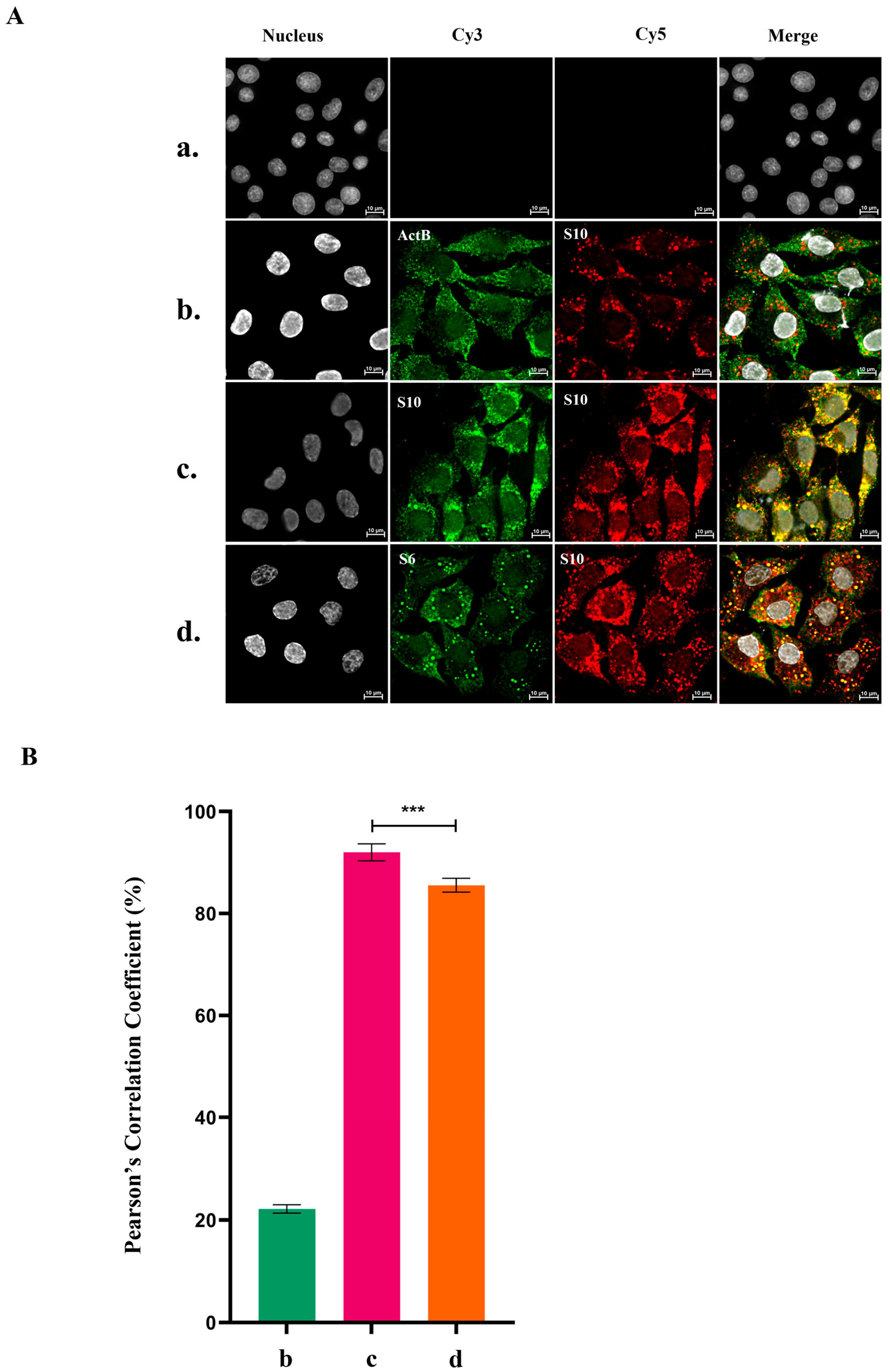
BTV RNA segments interact with each other in vitro and form RNA complexes that are important for RNA packaging. To investigate whether such RNA complexes are formed during virus replication in the infected cells, we used a highly efficient RNA fluorescence in situ hybridization chain reaction (HCR) technique tailored for BTV RNAs [13]. Following hybridization of specific oligonucleotide probes to the +ssRNA segments of the virus, an enzyme-free polymerization reaction is used to amplify a strong fluorescent signal (Supplementary Figure S1). HCR analysis was performed on BSR cells infected with wild-type BTV (BTV-WT) at a multiplicity of infection (MOI) of 100 and analyzed 8 h post-infection (hpi). Two probe sets, labeled with Cy3 (green, 550 nm) and Cy5 (red, 670 nm), targeting the BTV RNA segments S6 and S10, were employed (Figure 1A and Supplementary Figure S1B). Since S7–S10, the four smaller RNA segments form complexes first [15], which then recruit S6, S10 and S6 probes for the identification of the RNA complex formation. Quantitative measurements revealed that over 80% of Cy3 and Cy5 spots colocalized within the cells (Figure 1B), indicative of complex formation in infected cells. Two control experiments were undertaken to validate the results further. For the positive control, two probe sets targeting different regions of the same RNA segment (S10) and labelled with Cy3 and Cy5 were used. In BSR cells infected with BTV-WT and analyzed at 8 hpi, S10 RNA was detected by both probes (Figure 1A). As expected, quantitative results showed over 90% colocalization of Cy3 and Cy5 spots (Figure 1B), supporting the specificity of the analysis. To ensure that colocalization efficiency was not influenced by high concentration of viral RNA, a negative control was performed using labeled probes targeting the highly expressed cellular β-actin mRNA (ActB) and viral RNA S10. In BSR cells infected with BTV-WT and hybridized with Cy3-labeled probes for ActB and Cy5-labeled probes for S10 at 8 hpi, minimal colocalization of these RNA species was observed (Figure 1A). Quantitative analysis confirmed a low colocalization percentage of ≤22% (Figure 1B). These results validate the specificity and sensitivity of the HCR technique and establish robust positive and negative controls for the quantitative analysis.
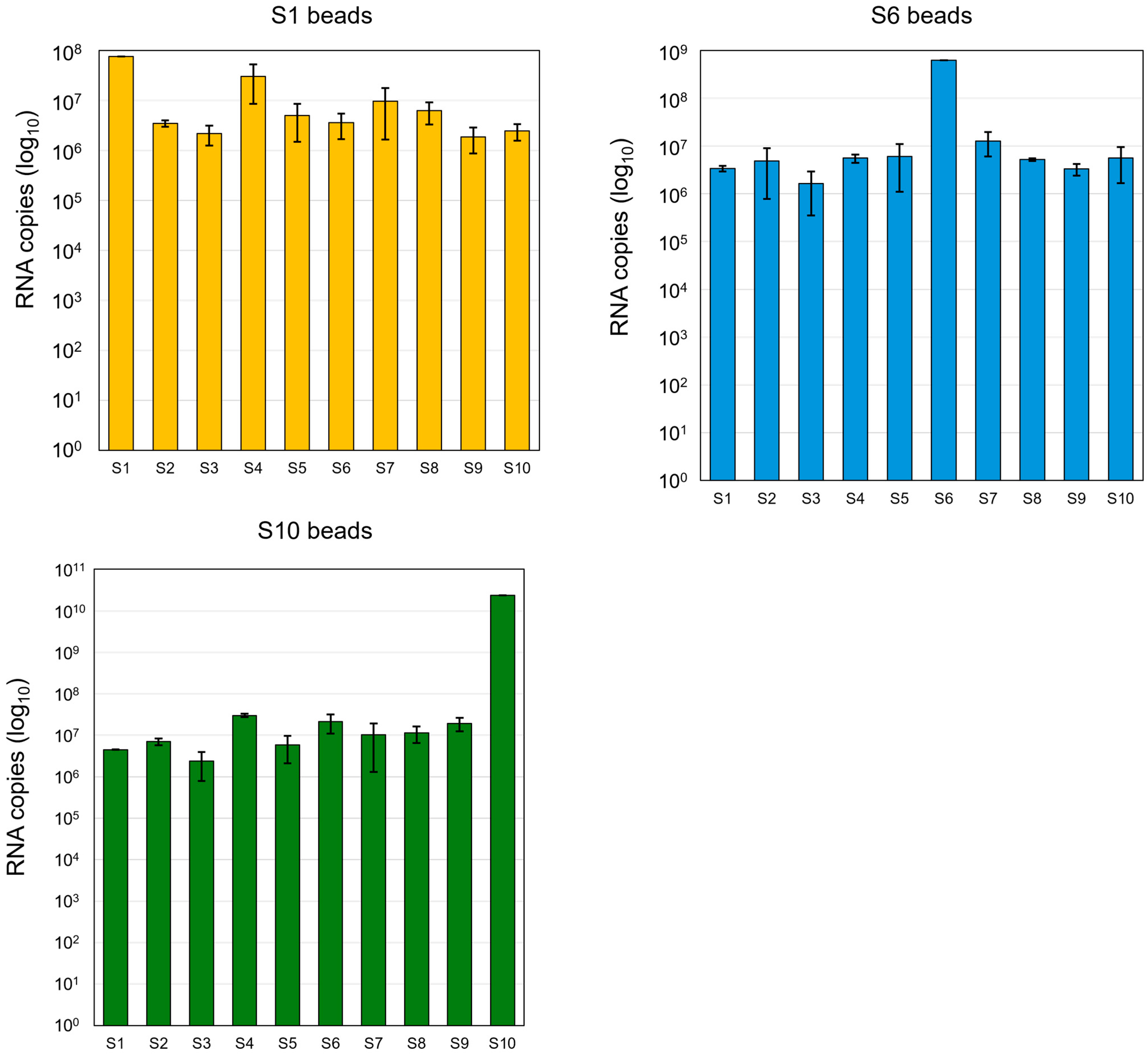
To substantiate that the RNA segments indeed form RNA complexes in the infected cells, we designed a biotinylated oligos-based pull-down assay, similar to the one previously used for an in vitro study [15]. At 5 h post-infection, when viral proteins were synthesized at low levels only, the RNA-RNA interactions and RNA complex formation were detected by pulled-down beads assay using three representative RNA segments (S1, S6, or S10), as described in Methods. The qRT-PCR data clearly identified BTV RNA complexes (Figure 2). The beads coated with each of the three RNA segments pulled down the remaining nine RNA segments almost at equal efficiency, indicating that complexes containing all segments exist in the early stage of virus replication.

3.2. NS2 Is Not Essential for BTV RNA Complex Formation Although It Facilitates Colocalization of Larger RNA Segments in Infected Cells

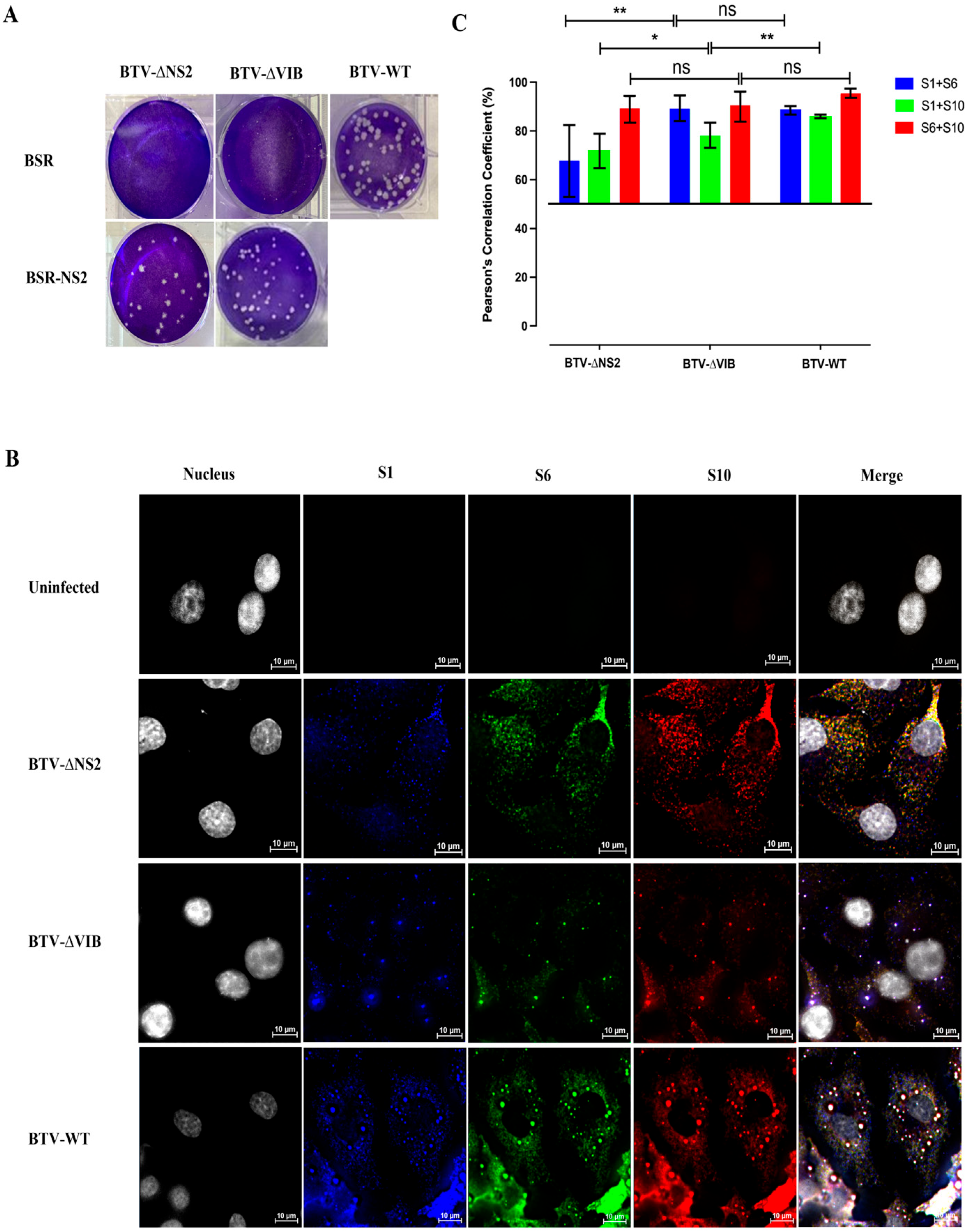
To investigate the correlation between NS2 and RNA packaging in infected cells, two mutant BTV viruses were generated through site-directed mutagenesis of segment 8, the NS2 encoding BTV RNA segment, as previously described. The start codons (ATG) of segment 8 were altered to GTG, preventing the translation of NS2 in BTV-∆NS2 [13]. Additionally, a calcium-binding site mutation (DDDE250-253AAAA) was introduced to block the formation of viral inclusion bodies (VIB) in BTV-∆VIB [29]. Rescue of the two mutant strains BTV-∆VIB and BTV-∆NS2, was only successful in an NS2-complementing cell line (BSR-NS2) (Figure 3A). To investigate the colocalization kinetics of different viral RNA species during the BTV replication, we visualized S10 and S6, two of the earliest RNAs to be recruited, but also, importantly, segment S1, which our previous in vitro studies have shown is the last segment to be incorporated, marking completion of the set of segments comprising the genome. We performed HCR and colocalization analysis on three viral +ssRNA segments: S1 (large-sized), S6 (medium-sized), and S10 (small-sized), in the wild-type (BTV-WT) and two mutant strains (BTV-∆VIB and BTV-∆NS2) at 20 hpi with a MOI 5.0. Viral RNA segments were detected using HCR with S1 labeled in blue (Atto-488, 499 nm), S6 in green (Cy3, 550 nm), and S10 in red (Cy5, 670 nm). Colocalization analysis revealed yellow spots, indicating overlap between Cy3 and Cy5 signals, while pink, purple, or white spots represented colocalization among Atto-488, Cy3, and Cy5 signals (Figure 3B). Pearson’s correlation coefficients were calculated to quantify colocalization among viral RNAs S1, S6, and S10 in the cells infected with WT and two mutant BTV strains. The results revealed the highest colocalization efficiency between S6 and S10 for all strains, with Pearson’s correlation coefficients ~90%, with WT showing a slightly higher colocalization efficiency compared to BTV-∆VIB and BTV-∆NS2 (Figure 3C). BTV-∆NS2 still exhibited colocalization, although it affected the efficiency between S1 and S10, as well as S1 and S6, with a Pearson’s correlation coefficients 65%. However, BTV-∆VIB (but still retaining NS2) showed significantly higher colocalization efficiency between these RNA pairs (Figure 3C). These findings suggest that while VIBs and NS2 are essential for BTV replication in BSR cells [9], viral RNA segments can still form complexes in the cytoplasm independently of these structures. These findings of in vivo infected cells are consistent with the previous in vitro studies [13,15] and also indicate that while NS2 is not required for assembling smaller RNA segments, it may influence the assembly of larger BTV RNA segments. Furthermore, the observed instability of the S1 segment in the absence of NS2—coupled with its failure to colocalize with other segments—indicates that NS2-mediated recruitment is a prerequisite not only for the structural organization of the larger segments but also for their metabolic stabilization within the cytoplasmic environment.

3.3. Smaller Segments of BTV Viral RNAs Form Complexes Prior to the Larger Segments

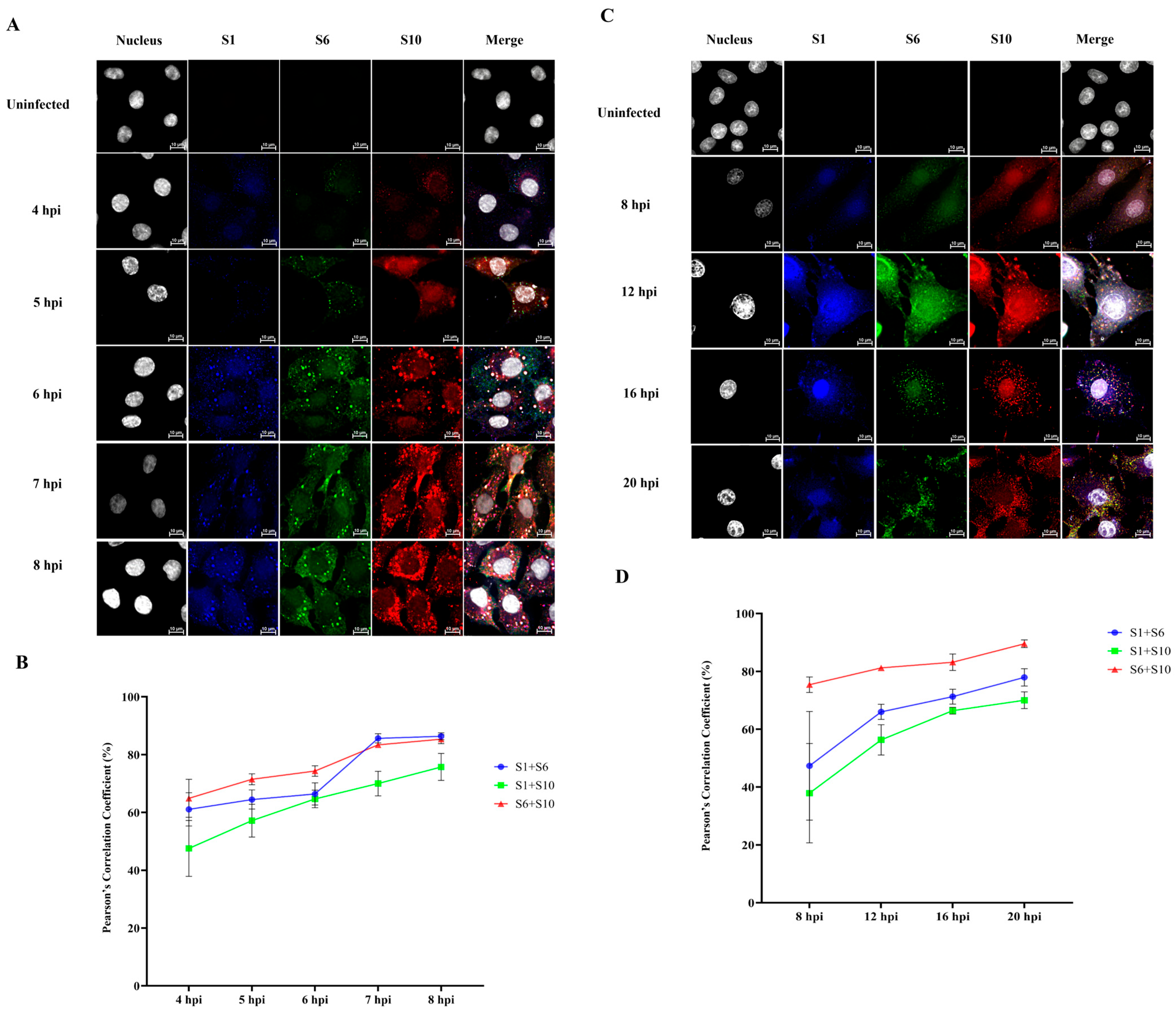
To investigate the sequence of RNA complex network formation during BTV replication, BSR cells were seeded in 12-well plates and infected with either BTV-WT (Figure 4A) at an MOI of 100 or the mutant strain BTV-∆NS2 (Figure 4C) at an MOI of 5.0. Because viral RNA replication is initially slow but becomes sequestered into VIBs by 6–8 hpi—hindering quantification and colocalization—a high MOI was used for BTV-WT to capture early-stage RNAs before sequestration. In contrast, the absence of VIB formation in BTV-ΔNS2 enabled analysis at later time points using a lower MOI. Cells were fixed at various time points post-infection for HCR and colocalization analysis. BTV S1 (blue, Atto-488, 499 nm), S6 (green, Cy3, 550 nm), and S10 (red, Cy5, 670 nm) were detected using HCR. Colocalization analysis revealed yellow spots (overlapping Cy3 and Cy5 signals), while pink, purple, or white spots indicated colocalization of Atto-488, Cy3, and Cy5 signals. The number of colocalized spots for all viral RNA segments increased over time in both BTV-WT and BTV-∆NS2-infected BSR cells (Figure 4A,C). Pearson’s correlation coefficients remained consistently higher for the smaller viral RNA segments, S6 and S10, across nearly all post-infection time points in both BTV-WT and BTV-∆NS2-infected cells, albeit with a decrease at 7 hpi and 8 hpi in BTV-WT-infected cells, due to segment entry into assembled VIBs (Figure 4B,D). Additionally, BTV-∆NS2 exhibited lower complex formation efficiency, with significantly lower Pearson’s correlation coefficients for larger segments compared to BTV-WT (Figure 4B,D), confirming that smaller BTV RNA segments assemble into complexes before larger ones. These findings highlight the critical role of NS2 in facilitating the assembly of larger RNA segments.

3.4. VP6 May Play a Key Role in BTV Viral RNAs Assembly Prior to Recruitment into VIBs

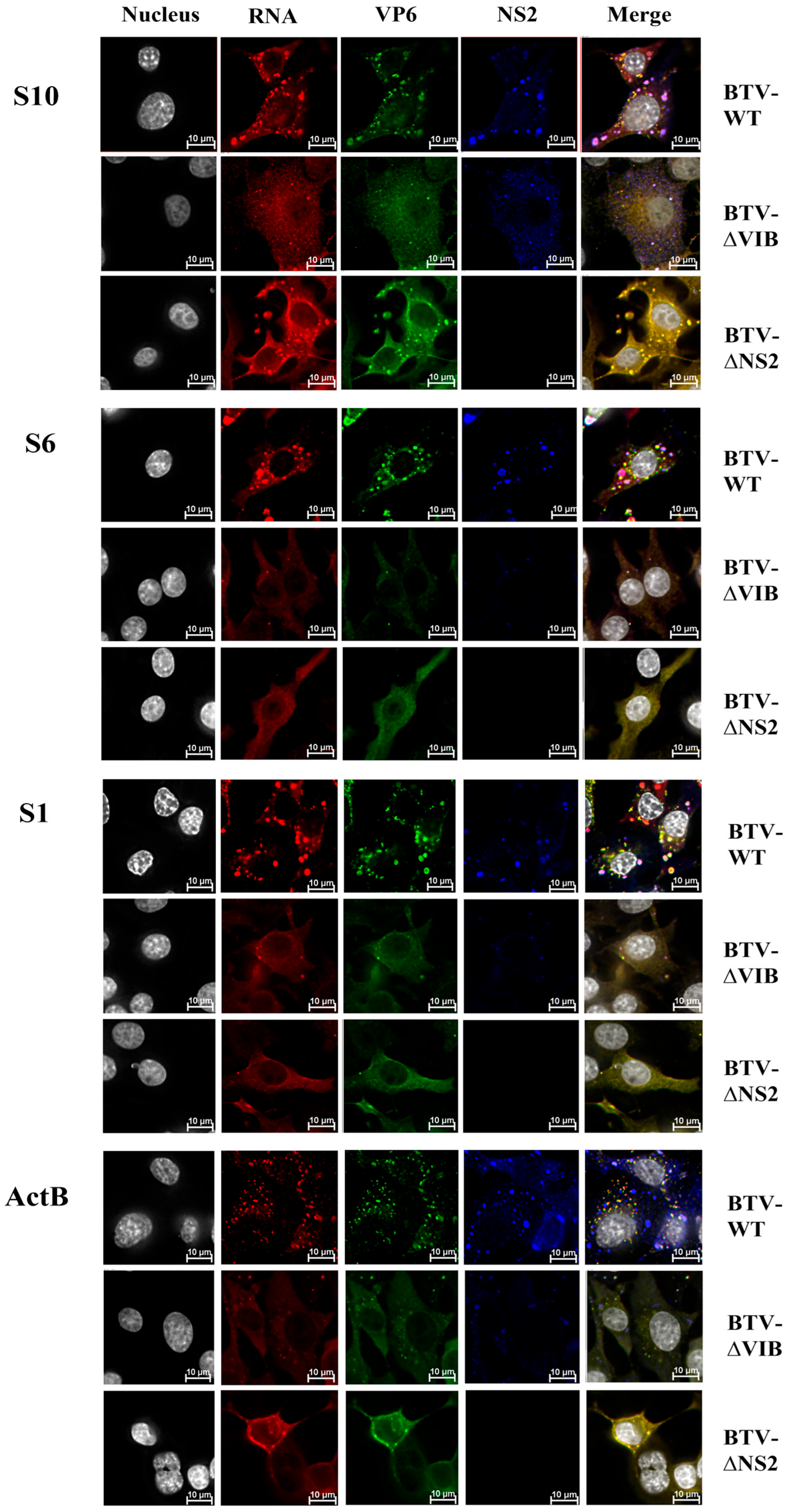
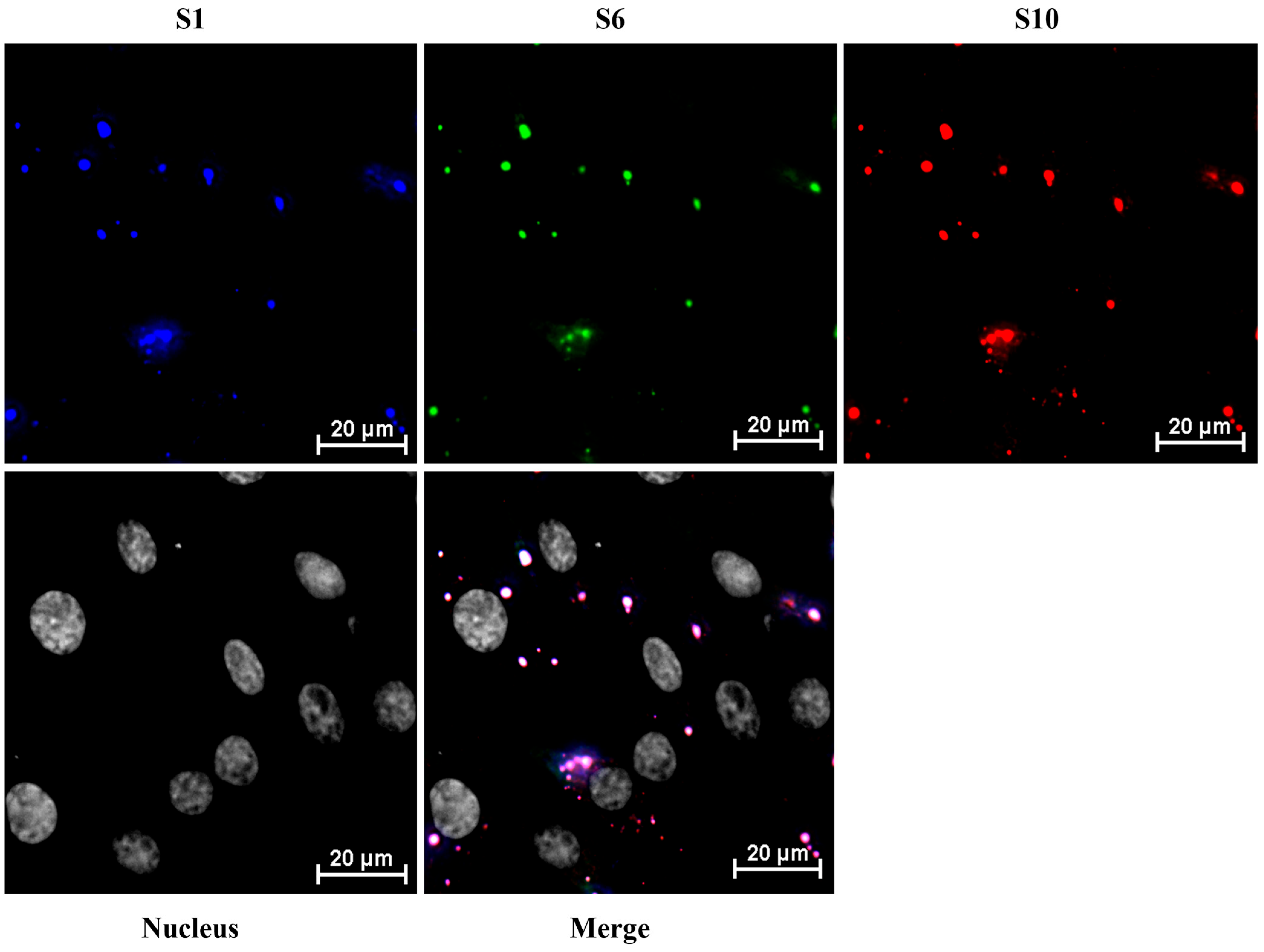
VP6 has been identified as a crucial component of the primary replicase complex and is hypothesized to play a role in recruiting and packaging BTV RNA [9,10]. To confirm the correlation between VP6 and RNA packaging, BSR cells were infected either with BTV-WT, or BTV-∆VIB, or BTV-∆NS2 at a multiplicity of infection (MOI) of 5.0 for 20 h in 12-well plates, and colocalizations of RNAs and viral proteins were examined using HCR and immunofluorescence. Viral +ssRNA segments S10, S6, and S1, as well as cellular mRNA ActB, were detected using HCR (red, Cy5, 670 nm). Immunofluorescence localized the viral structural protein VP6 (green, Alexa-546, 561 nm) and NS2 (blue, Atto-488, 499 nm). Yellow spots indicate colocalization between Alexa-546 and Cy5 signals, while pink, purple, or white spots represent colocalization between Atto-488, Alexa-546, and Cy5. The results showed that the VP6 protein colocalized with BTV viral +ssRNA segments S1, S6, and S10 of the RNA complex, as well as with cellular mRNA ActB, in BSR cells infected with BTV-WT, BTV-∆VIB, or BTV-∆NS2 (Figure 5). This confirms VP6 as a general RNA-binding protein consistent with previous in vitro studies [9,17,33]. Notably, VP6 colocalized with both viral +ssRNA and VIBs in BTV-WT-infected cells and with defective VIBs in BTV-∆VIB-infected cells but did not colocalize with non-aggregated NS2 protein (Figure 5). Additionally, VP6 colocalized with viral +ssRNA and VIBs but was absent from VIBs associated with cellular mRNAs (Figure 5). These findings suggest that VP6 binds viral and cellular RNAs independently of NS2 and that its colocalization with VIBs likely reflects binding to the viral +ssRNA accrued there. To confirm this, BSR cells were infected with the BTV-ECRA mutant strain [16], which has large deletions in segment S9 preventing VP6 translation, at an MOI of 5.0 for 20 h. Colocalization analysis of viral RNA segments S1, S6, and S10 (detected using HCR) demonstrated that viral RNA complexes still formed and entered VIBs despite the absence of VP6 (Figure 6). These findings indicate that VP6 can associate with viral +ssRNA before they enter VIBs, and that it may play a role in RNA recruitment and early assembly, although it is not essential for RNA entry into VIBs. This suggests that BTV RNA packaging into VIBs can occur through alternative mechanisms, emphasizing the complexity of the BTV replication process.

3.5. Complete Set of RNA Genome Selection for Packaging Do Not Require Either VP6 or NS2

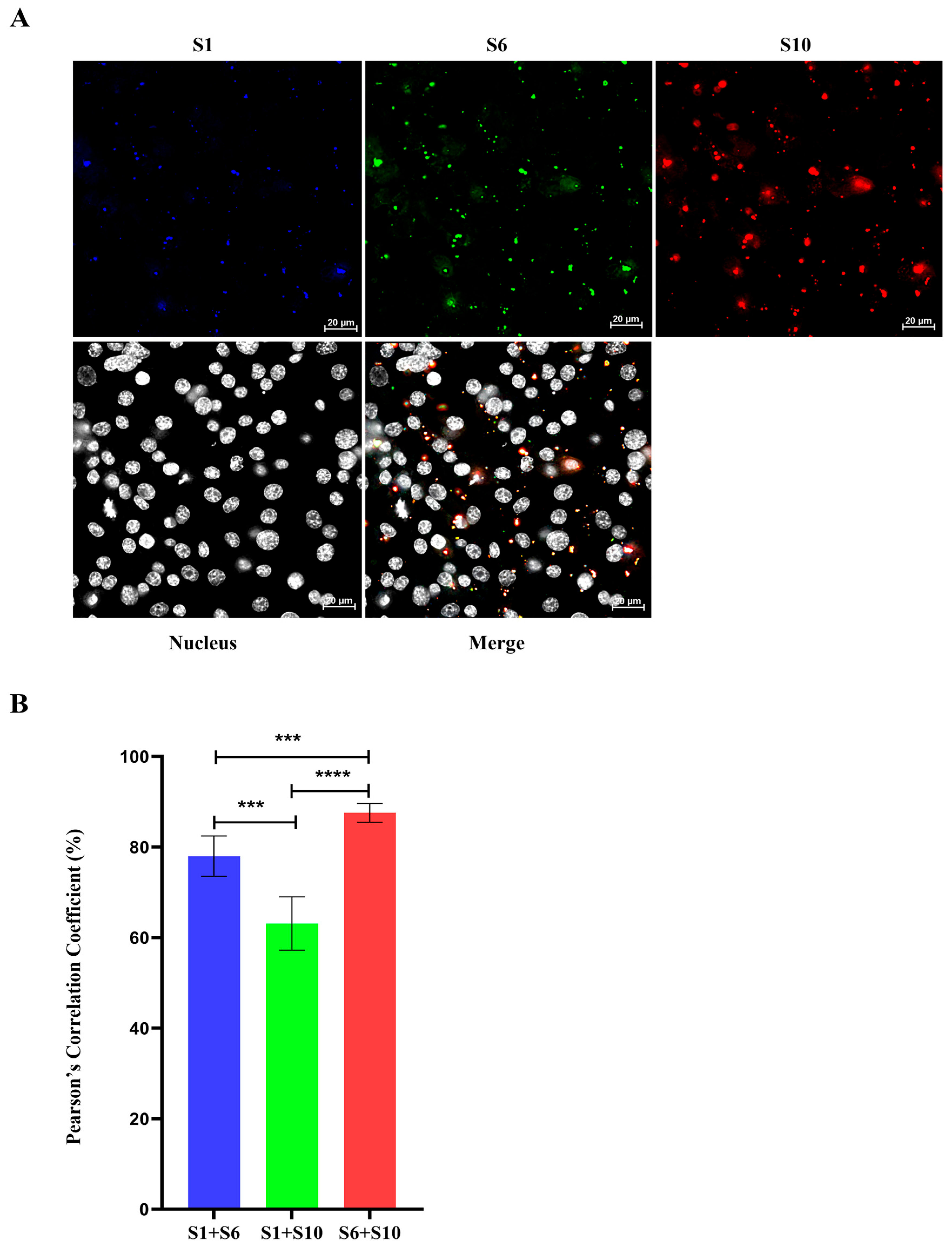
To investigate whether BTV +ssRNA segments can form RNA complexes in the host cell cytoplasm in the absence of both NS2 and VP6, BSR cells were transfected with all 10 BTV viral +ssRNA segments. The start codons (ATG) of segments S8 and S9 were mutated to GTG, preventing translation without significantly altering nucleotide structure. Using HCR, RNA segments S1 (blue, Atto-488, 499 nm), S6 (green, Cy3, 550 nm), and S10 (red, Cy5, 670 nm) were detected in the cytoplasm. Despite the absence of NS2 and VP6, RNA complexes still formed in the cytoplasm. Pearson’s correlation coefficients remained high (~80%) for the smaller RNA segments S6 and S10, while larger segments, such as S1, showed lower correlations (~60%), mirroring the patterns observed in BSR cells infected with BTV-∆NS2 (Figure 7). These results, consistent with previous in vivo assays (infected cells), further support the notion that RNA packaging into a complex is an innate feature of the sequence but that it may be enhanced by the virally encoded RNA-binding proteins.

4. Discussion

The selection of viral genomes from the pool of cellular nucleic acids and their subsequent packaging within the virus capsid are two critical processes in virus-infected host cells. The findings presented in this study provide, for the first time, how multipartite BTV genomic RNAs are assorted in infected cells by RNA-RNA interactions to form a specific RNA network. Utilizing the HCR technique for in situ hybridization and colocalization analysis, it was possible to show the dynamic nature of BTV +ssRNAs interactions within infected BSR cells. Our results from BTV-infected cells confirm the viral RNA segments indeed interact with each other to form the RNA complex of ten segments as previously observed in our in vitro studies [13,15].
Our current in vivo findings are consistent with our earlier in vitro studies, which support a model where BTV RNA packaging is orchestrated through the stepwise formation of a complex RNA-RNA interaction network. This process appears to follow a defined sequence, beginning with the smallest segment, S10, which initiates interactions with other small segments to form an initial complex (S7–S10). Medium-sized segments (S4–S6) and eventually the larger segments (S1–S3) are then recruited in a hierarchical manner, leading to the complete genome complex ready for encapsulation. However, the observed association patterns in vivo, such as S6 colocalizing with both S1 and S10 at a similar level, while S1 and S10 show weaker direct association, suggest that the assembly pathway may be more dynamic or flexible within the cellular environment than what is captured in simplified in vitro systems. It is possible that S6 functions as a central scaffold or bridging segment, facilitating transient or stage-specific interactions between small and large segments, even if those segments are not simultaneously colocalized. These findings raise the possibility of alternative or parallel assembly routes and intermediate complexes that may form depending on spatial constraints or temporal regulation within the cytoplasm. Exploring whether larger segments interact directly or form subcomplexes before engaging with the initial S7–S10 complex remains an open question and will be an important focus of future investigations.
Further, in BSR cells infected with the NS2-deficient mutant BTV-∆NS2, we observed RNA segments could still form complexes in the absence of NS2, although there was a reduction in the colocalization efficiency of viral RNA segments, especially between large and small RNA segments. This finding aligns with previous reports demonstrating that NS2 facilitates the formation of viral inclusion bodies (VIBs), which serve as scaffolds for RNA recruitment [29,34]. Thus, although VIBs and NS2 are not directly involved in RNA-RNA interaction and complex formation, they are key components for the efficient assembly of the viral genome, particularly for larger RNA segments, despite being dispensable for the initiation of RNA complex formation.
Our study provides new evidence supporting a key role for VP6 in BTV RNA packaging and assembly. VP6, a structural protein previously identified as a core component of the BTV replicase complex [17,33], was found to colocalize with both viral and cellular RNAs independently of NS2 and VIBs in cells infected with mutant strains (BTV-∆VIB and BTV-∆NS2), and also to associate with VIBs in wild-type BTV (BTV-WT) infection. This pattern suggests that VP6 associates with the RNA network prior to the formation of VIBs. Interestingly, VP6 was only recruited to VIBs in the presence of viral RNAs but not cellular RNAs, implying a selective mechanism that favors viral RNAs. Furthermore, VP6 binds viral RNAs early in infection, indicating its involvement in the initial stages of RNA packaging and suggesting it may act as a checkpoint to regulate RNA complex formation and prevent potential cytotoxicity. These findings, consistent with previous in vitro studies [10,17,33], highlight the multifunctional role of VP6 in the BTV replication cycle.
Direct confirmation of RNA-RNA interactions and RNA network formation do not require NS2 or VP6 was further demonstrated in cells transfected with all ten BTV +ssRNA segments, where RNA complexes still formed with high efficiency (~80%) for smaller segments (S6–S10), while larger segments such as S1 showed less efficiency (~60%), similar to results observed in BTV-∆NS2 infections. These findings suggest that BTV RNA segment interactions are driven by intrinsic RNA-RNA affinities, with smaller segments initiating complex formation followed by the incorporation of larger segments (e.g., S1). This supports the notion of a sequential RNA-RNA interactions and packaging model, consistent with earlier in vitro studies [13,15]. The use of the HCR technique enabled precise localization and quantification of these interactions, suggesting that RNA-RNA interactions and RNA complex formation facilitate the initial stages of genome packaging. The hypothesis is that specific secondary structures or “packaging signals” within the segments likely mediate these interactions. Notably, results obtained from in vivo infected cells indicate that while RNA complex formation occurs independently of NS2, the presence of NS2 enhances assembly efficiency, particularly of the larger RNA segments, suggesting that NS2 might play an important role in concentrating RNAs and orchestrating the formation of the complete genome structure during virus replication.
Altogether, our findings support a model in which BTV RNA segments are assorted via highly specific intersegment interactions while VP6 associates with the interacting RNA segments and RNA complexes. The VP6-RNA complexes are recruited to VIBs via NS2, the major component of VIBs, within which core assembly and RNA packaging are orchestrated by RNA–protein and protein–protein interactions. VP6 may play a role in directing these RNAs into viral inclusion bodies (VIBs). NS2, in turn, functions as a scaffolding protein within VIBs, organizing and concentrating viral RNAs and proteins to facilitate core assembly. Both VP6 and NS2 appear to enhance and stabilize the packaging process rather than initiate it and may also serve a protective function, probably necessary for shielding viral RNAs from degradation.
In summary, our findings reveal that BTV RNA packaging is governed by a complex, stepwise mechanism. While smaller RNA segments appear to initiate complex formation early, NS2 facilitates the recruitment and coordination of larger segments within the assembly factories. The VIBs and VP6 bind viral +ssRNAs early in infection, potentially guiding them into VIBs for packaging into the assembling inner capsid (VP1, VP3, VP4, VP6) and subsequent core formation. These findings are highly significant for BTV but also offer broader implications for the packaging strategies of other dsRNA viruses with segmented genomes. Despite these advances, our study has limitations. This study marks the first application of HCR in dsRNA virus research, where it demonstrated high sensitivity and specificity in detecting BTV RNAs, both in transfected and infected BSR cells. However, its application is currently limited to fixed-cell imaging, restricting its use for real-time RNA tracking. Although live-cell imaging approaches have been developed in studies of other viruses to provide dynamic insights into RNA interactions [35], their application in BTV and related viruses has been limited to protein tracking in live infected cells [36], with RNA tracking techniques remaining largely underdeveloped. Additionally, colocalization analysis alone does not establish direct evidence of interaction. Probe accessibility may also influence RNA detection efficiency, and validation in primary cells or animal models is needed to confirm our findings. Nevertheless, HCR is a powerful tool for investigating viral RNA interactions in infected cells. Future research should further dissect the molecular interplay between viral proteins and RNA segments, particularly the precise role of VP6 in RNA recruitment, to better understand the viral packaging mechanism.

Supplementary Materials

The following supporting information can be downloaded at: https://www.mdpi.com/article/10.3390/v18040406/s1, Figure S1: The cartoon shows the in-situ Hybridization Chain Reaction (HCR); Figure S2: The illustration depicts a schematic overview of the in-situ hybridization chain reaction (HCR) experiments conducted. Table S1: RNA probes used for in-situ Hybridization Chain Reaction; Table S2: Biotinylated oligos for RNA complex pull-down assay; Table S3: qPCR primers for BTV ten segments.

Author Contributions

D.-S.L. and P.R. designed the experiments. D.-S.L. and P.-Y.S. conducted the experiments and analyzed the data. D.-S.L. and P.R. drafted the manuscript, while D.-S.L., P.-Y.S. and P.R. contributed to its review and editing. P.R. provided supervision, managed the project, and secured funding. All authors have read and agreed to the published version of the manuscript.

Funding

This project was supported by a Wellcome Trust Senior Investigator Award (221749/Z/20/Z) awarded to P.R.

Institutional Review Board Statement

Not applicable.

Informed Consent Statement

Not applicable.

Data Availability Statement

Data available upon request.

Acknowledgments

We gratefully acknowledge Zhi-Jian Zhou and Xing-Yi Ge from Hunan University, Changsha, China, for their helpful suggestions and support with data analysis during the early stages of the project.

Conflicts of Interest

The authors declare no conflicts of interest.

References

  1. Matthijnssens, J.; Attoui, H.; Bányai, K.; Brussaard, C.P.D.; Danthi, P.; del Vas, M.; Dermody, T.S.; Duncan, R.; Fāng, Q.; Johne, R.; et al. ICTV Virus Taxonomy Profile: Sedoreoviridae 2022. J. Gen. Virol. 2022, 103, 001782. [Google Scholar] [CrossRef]
  2. Fukusho, A.; Yu, Y.; Yamaguchi, S.; Roy, P. Completion of the Sequence of Bluetongue Virus Serotype 10 by the Characterization of a Structural Protein, VP6, and a Non-structural Protein, NS2. J. Gen. Virol. 1989, 70, 1677–1689. [Google Scholar] [CrossRef]
  3. Roy, P.; Marshall, J.J.A.; French, T.J. Structure of the Bluetongue Virus Genome and Its Encoded Proteins. In Bluetongue Viruses; Roy, P., Gorman, B.M., Eds.; Springer: Berlin, Heidelberg, 1990; pp. 43–87. [Google Scholar]
  4. Roy, P. Bluetongue virus structure and assembly. Curr. Opin. Virol. 2017, 24, 115–123. [Google Scholar] [CrossRef]
  5. Roy, P.; Adachi, A.; Urakawa, T.; Booth, T.F.; Thomas, C.P. Identification of bluetongue virus VP6 protein as a nucleic acid-binding protein and the localization of VP6 in virus-infected vertebrate cells. J. Virol. 1990, 64, 1–8. [Google Scholar] [CrossRef]
  6. Huismans, H.; Van Dijk, A.A. Bluetongue virus structural components. Curr. Top. Microbiol. Immunol. 1990, 162, 21–41. [Google Scholar]
  7. Ratinier, M.; Caporale, M.; Golder, M.; Franzoni, G.; Allan, K.; Nunes, S.F.; Armezzani, A.; Bayoumy, A.; Rixon, F.; Shaw, A.; et al. Identification and characterization of a novel non-structural protein of bluetongue virus. PLoS Pathog. 2011, 7, e1002477. [Google Scholar] [CrossRef]
  8. Mertens, P.P.; Diprose, J.; Maan, S.; Singh, K.P.; Attoui, H.; Samuel, A.R. Bluetongue virus replication, molecular and structural biology. Vet. Ital. 2004, 40, 426–437. [Google Scholar]
  9. Matsuo, E.; Roy, P. Minimum Requirements for Bluetongue Virus Primary Replication In Vivo. J. Virol. 2013, 87, 882–889. [Google Scholar] [CrossRef]
  10. Xia, X.; Sung, P.-Y.; Martynowycz, M.W.; Gonen, T.; Roy, P.; Zhou, Z.H. RNA genome packaging and capsid assembly of bluetongue virus visualized in host cells. Cell 2024, 187, 2236–2249.e17. [Google Scholar] [CrossRef]
  11. Thomas, C.P.; Booth, T.F.; Roy, P. Synthesis of bluetongue virus-encoded phosphoprotein and formation of inclusion bodies by recombinant baculovirus in insect cells: It binds the single-stranded RNA species. J. Gen. Virol. 1990, 71, 2073–2083. [Google Scholar] [CrossRef]
  12. Lourenco, S.; Roy, P. In vitro reconstitution of Bluetongue virus infectious cores. Proc. Natl. Acad. Sci. USA 2011, 108, 13746–13751. [Google Scholar] [CrossRef]
  13. Sung, P.; Phelan, J.E.; Luo, D.; Kulasegaran-Shylini, R.; Bohn, P.; Smyth, R.P.; Roy, P. Recruitment of multi-segment genomic RNAs by Bluetongue virus requires a preformed RNA network. Nucleic Acids Res. 2024, 52, 8500–8514. [Google Scholar] [CrossRef]
  14. Sung, P.-Y.; Roy, P. RNA Origami: Packaging a Segmented Genome in Orbivirus Assembly and Replication. Viruses 2021, 13, 1841. [Google Scholar] [CrossRef]
  15. Sung, P.-Y.; Roy, P. Sequential packaging of RNA genomic segments during the assembly of Bluetongue virus. Nucleic Acids Res. 2014, 42, 13824–13838. [Google Scholar] [CrossRef]
  16. Matsuo, E.; Celma, C.C.P.; Boyce, M.; Viarouge, C.; Sailleau, C.; Dubois, E.; Bréard, E.; Thiéry, R.; Zientara, S.; Roy, P. Generation of replication-defective virus-based vaccines that confer full protection in sheep against virulent bluetongue virus challenge. J. Virol. 2011, 85, 10213–10221. [Google Scholar] [CrossRef]
  17. Matsuo, E.; Roy, P. Bluetongue Virus VP6 Acts Early in the Replication Cycle and Can Form the Basis of Chimeric Virus Formation. J. Virol. 2009, 83, 8842–8848. [Google Scholar] [CrossRef]
  18. Dirks, R.M.; Pierce, N.A. Triggered amplification by hybridization chain reaction. Proc. Natl. Acad. Sci. USA 2004, 101, 15275–15278. [Google Scholar] [CrossRef]
  19. Bi, S.; Yue, S.; Zhang, S. Hybridization chain reaction: A versatile molecular tool for biosensing, bioimaging, and biomedicine. Chem. Soc. Rev. 2017, 46, 4281–4298. [Google Scholar] [CrossRef]
  20. Choi, H.M.T.; Schwarzkopf, M.; Fornace, M.E.; Acharya, A.; Artavanis, G.; Stegmaier, J.; Cunha, A.; Pierce, N.A. Third-generation in situ hybridization chain reaction: Multiplexed, quantitative, sensitive, versatile, robust. Development 2018, 145, dev165753. [Google Scholar] [CrossRef]
  21. Sagoe, K.O.; Kyama, M.C.; Maina, N.; Kamita, M.; Njokah, M.; Thiong’o, K.; Kanoi, B.N.; Wandera, E.A.; Ndegwa, D.; Kinyua, D.M.; et al. Application of Hybridization Chain Reaction/CRISPR-Cas12a for the Detection of SARS-CoV-2 Infection. Diagnostics 2023, 13, 1644. [Google Scholar]
  22. Schwarzkopf, M.; Liu, M.C.; Schulte, S.J.; Ives, R.; Husain, N.; Choi, H.M.T.; Pierce, N.A. Hybridization chain reaction enables a unified approach to multiplexed, quantitative, high-resolution immunohistochemistry and in situ hybridization. Development 2021, 148, dev199847. [Google Scholar] [CrossRef]
  23. Yu, S.; Zhang, D.; Jiang, H.; Geng, L.; Deng, Y.; Xu, J. Lateral flow strip assay of a gene segment in the COVID-19 virus with combined dual readout mode and preliminary multisite hybrid chain reaction amplification. Anal. Methods 2024, 16, 3249–3255. [Google Scholar] [CrossRef]
  24. Zhang, C.; Qu, Q.; Yao, Y.; Fan, X.; Wu, G. Detection of Hepatitis C virus RNA using a novel hybridization chain reaction method that competitively dampens cascade amplification. PLoS ONE 2023, 18, e0268917. [Google Scholar] [CrossRef] [PubMed]
  25. Chou, Y.; Heaton, N.S.; Gao, Q.; Palese, P.; Singer, R.; Lionnet, T. Colocalization of Different Influenza Viral RNA Segments in the Cytoplasm before Viral Budding as Shown by Single-molecule Sensitivity FISH Analysis. PLoS Pathog. 2013, 9, e1003358. [Google Scholar] [CrossRef]
  26. Jaijyan, D.K.; Yang, S.; Ramasamy, S.; Gu, A.; Zeng, M.; Subbian, S.; Tyagi, S.; Zhu, H. Imaging and quantification of human and viral circular RNAs. Nucleic Acids Res. 2024, 52, e70. [Google Scholar] [CrossRef] [PubMed]
  27. Strauss, S.; Acker, J.; Papa, G.; Desirò, D.; Schueder, F.; Borodavka, A.; Jungmann, R. Principles of RNA recruitment to viral ribonucleoprotein condensates in a segmented dsRNA virus. eLife 2023, 12, e68670. [Google Scholar] [CrossRef]
  28. Kula-Pacurar, A.; Wadas, J.; Suder, A.; Szczepanski, A.; Milewska, A.; Ochman, M.; Stacel, T.; Pyrc, K. Visualization of SARS-CoV-2 using Immuno RNA-Fluorescence In Situ Hybridization. JoVE 2020, 166, e62067. [Google Scholar] [CrossRef]
  29. Rahman, S.K.; Kerviel, A.; Mohl, B.P.; He, Y.; Zhou, Z.H.; Roy, P. A Calcium Sensor Discovered in Bluetongue Virus Nonstructural Protein 2 Is Critical for Virus Replication. J. Virol. 2020, 94, e01099-20. [Google Scholar] [CrossRef] [PubMed]
  30. Roy, P. Highly efficient vaccines for Bluetongue virus and a related Orbivirus based on reverse genetics. Curr. Opin. Virol. 2020, 44, 35–41. [Google Scholar] [CrossRef]
  31. Boyce, M.; Celma, C.C.P.; Roy, P. Development of Reverse Genetics Systems for Bluetongue Virus: Recovery of Infectious Virus from Synthetic RNA Transcripts. J. Virol. 2008, 82, 8339–8348. [Google Scholar] [CrossRef]
  32. Uppala, J.K.; Ghosh, C.; Sabat, G.; Dey, M. Pull-down of Biotinylated RNA and Associated Proteins. Bio. Protoc. 2022, 12, e4331. [Google Scholar] [CrossRef] [PubMed]
  33. Sung, P.Y.; Vaughan, R.; Rahman, S.K.; Yi, G.; Kerviel, A.; Kao, C.C.; Roy, P. The Interaction of Bluetongue Virus VP6 and Genomic RNA Is Essential for Genome Packaging. J. Virol. 2019, 93, e02023-18. [Google Scholar] [CrossRef] [PubMed]
  34. Kar, A.K.; Bhattacharya, B.; Roy, P. Bluetongue virus RNA binding protein NS2 is a modulator of viral replication and assembly. BMC Mol. Biol. 2007, 8, 4. [Google Scholar] [CrossRef]
  35. Alonas, E.; Vanover, D.; Blanchard, E.; Zurla, C.; Santangelo, P.J. Imaging viral RNA using multiply labeled tetravalent RNA imaging probes in live cells. Methods 2016, 98, 91–98. [Google Scholar] [CrossRef]
  36. Shaw, A.E.; Brüning-Richardson, A.; Morrison, E.E.; Bond, J.; Simpson, J.; Ross-Smith, N.; Alpar, O.; Mertens, P.P.; Monaghan, P. Bluetongue virus infection induces aberrant mitosis in mammalian cells. Virol. J. 2013, 10, 319. [Google Scholar] [CrossRef] [PubMed]
Figure 1. In situ hybridization chain reaction (HCR) and colocalization analysis of Bluetongue virus (BTV) in BSR cells. (A) BSR cells were infected with wild-type Bluetongue virus (BTV-WT) at a multiplicity of infection (MOI) of 100 for 8 h in 12-well plates, then fixed and incubated with probes targeting cellular mRNA or BTV +ssRNA segments for HCR and colocalization analysis. Uninfected BSR cells served as the mock control (row a). For the negative control (row b), cells were incubated with probes targeting cellular mRNA β-actin (ActB, green, Cy3, 550 nm) and BTV +ssRNA segment S10 (red, Cy5, 670 nm). The positive control (row c) utilized Cy3- and Cy5-labeled probes targeting different regions of segment S10 to validate colocalization and HCR. For (row d), probes labeled with Cy3 and Cy5 were used to target BTV RNA segments S6 and S10. Hoechst 33342 was used to stain cell nuclei. Colocalization analysis revealed yellow spots, indicating the overlap of Cy3 and Cy5 signals. (B) Pearson’s correlation coefficients were quantified to assess colocalization between Cy3 and Cy5 spots for each experiment. Analysis was conducted across five images from separate replicates, representing over 100 cells per experiment. The error bars represent standard deviations. Unpaired Student’s t-tests were performed to compare the colocalization analysis between each experiment group. ***: t-test p value < 0.005.
Viruses 18 00406 g001
Figure 2. RNA complexes containing all segments could be pulled down from the BTV-infected cell lysate. BSR cells were infected with BTV-1 at an MOI of 5.0 for 5 h. Beads coated with an S1-, S6-, or S10- specific oligos were incubated with the cell lysate for 30 min to interact with BTV RNAs in the lysate; bound RNAs were then sequentially extracted. The amount of each interacting RNA segment was determined by qRT-PCR using primers specific to the indicated segment, correlated to an equal molar ratio of BTV genomic RNA as a standard, as described in [15]. The RNA copy number per ml of infected cell lysate was shown in log10. Standard deviation from multiple individual experiments was calculated and shown as error bars.
Viruses 18 00406 g002
Figure 3. Colocalization analysis of viral RNAs in BSR cells infected with wild-type and mutant BTV using HCR. (A) Plaque assay results for BTV-WT and two mutant strains (BTV-∆VIB and BTV-∆NS2) in BSR and BSR-NS2 cell lines. (B) BSR cells were infected with BTV-WT, BTV-∆VIB and BTV-∆NS2 at an MOI of 5.0 for 20 h in 12-well plates. Uninfected BSR cells served as a negative control. Viral RNA segments S1 (blue, Atto-488, 499 nm), S6 (green, Cy3, 550 nm), and S10 (red, Cy5, 670 nm) were detected using HCR. Colocalization analysis showed yellow spots indicating overlap between Cy3 and Cy5 signals, while pink, purple, or white spots represented colocalization of Atto-488, Cy3, and Cy5 signals. Hoechst 33342 was used to stain cell nuclei. (C) Quantification of Pearson’s correlation coefficients for colocalization between viral RNAs S1, S6, and S10. Six images from independent replicates, covering over 120 cells per experiment, were analyzed. The error bars represent standard deviations. Unpaired Student’s t-tests were performed to compare colocalization analysis between wild-type (BTV-WT) and mutant (BTV-∆VIB and BTV-∆NS2) strains. ns: unpaired t-test no significance. *: t-test p value < 0.05. **: t-test p value < 0.01.
Viruses 18 00406 g003
Figure 4. Colocalization analysis of viral RNAs in BSR cells infected with BTV-WT and BTV-∆NS2 at different post-infection time points. BSR cells in 12-well plates were infected with BTV-WT (A,B) at a multiplicity of infection (MOI) of 100 or with BTV-∆NS2 (C,D) at an MOI of 5.0, and fixed at various time points post-infection for HCR and colocalization analysis. Uninfected BSR cells served as a negative control. Viral RNA segments S1 (blue, Atto-488, 499 nm), S6 (green, Cy3, 550 nm), and S10 (red, Cy5, 670 nm) were detected using HCR. Panel (A) shows representative HCR images of BTV-WT-infected cells, revealing colocalization of viral +ssRNA segments as yellow (Cy3 + Cy5), pink/purple, or white spots, indicating partial or complete overlap of signals. Corresponding quantitative analysis in panel (B) presents Pearson’s correlation coefficients for S1, S6, and S10 RNA colocalization across time points in BTV-WT-infected cells. Panel (C) shows the same HCR analysis as in panel (A), performed on BTV-∆NS2-infected cells at a lower MOI, with similar visualization of RNA colocalization. Panel (D) provides the quantitative Pearson’s correlation analysis for BTV-∆NS2 infection, as shown in panel (C). For all conditions, five images per sample from independent replicates, covering over 100 cells per experiment, were analyzed. Error bars represent standard deviations. Statistical comparisons for colocalization analysis between BTV-WT and BTV-ΔNS2 were performed using multiple t-tests. No significant differences (p > 0.1) were observed for BTV-WT between S1 + S6 and S6 + S10 at 6 hpi, nor between S1 + S6 and S1 + S10 at 4 and 8 hpi. Similarly, no significant difference (p > 0.1) was found for BTV-ΔNS2 between S1 + S6 and S1 + S10 at 8 hpi. For all other experimental groups and time points, differences were statistically significant (p < 0.05 or p <0.01).
Viruses 18 00406 g004
Figure 5. BTV structure protein VP6 colocalized with viral and host RNAs. BSR cells were infected with BTV-WT, BTV-∆VIB and BTV-∆NS2 at an MOI of 5.0 for 20 h in 12-well plates. Uninfected BSR cells served as a negative control. Cell nuclei were stained with Hoechst 33342. Colocalization of RNAs and viral proteins was examined using HCR and immunofluorescence. Viral +ssRNA segments S10, S6, and S1, as well as cellular mRNA β-actin (ActB), were detected using HCR (red, Cy5, 670 nm). Immunofluorescence localized the viral structural protein VP6 (green, Alexa-546, 561 nm) and the non-structural protein NS2 (blue, Atto-488, 499 nm). Yellow spots indicate colocalization between Alexa-546 and Cy5 signals, while pink, purple, or white spots represent colocalization between Atto-488, Alexa-546, and Cy5. Five images from separate replicates, encompassing over 100 cells per experiment, were analyzed.
Viruses 18 00406 g005
Figure 6. BTV viral RNAs enter VIBs independently of VP6. BSR cells were infected with mutant strains (BTV-ECRA) at an MOI of 5.0 for 20 h in 12-well plates. Viral RNA segments S1 (blue, Atto-488, 499 nm), S6 (green, Cy3, 550 nm), and S10 (red, Cy5, 670 nm) were detected using HCR. Colocalization analysis showed yellow spots indicating overlap between Cy3 and Cy5 signals, while pink, purple, or white spots represented colocalization of Atto-488, Cy3, and Cy5 signals. Hoechst 33342 was used to stain cell nuclei. Five images from individual replicates, encompassing over 100 cells per experiment, were analyzed.
Viruses 18 00406 g006
Figure 7. Colocalization analysis of BTV viral RNAs in the absence of both NS2 and VP6 in the host cell cytoplasm by HCR. BSR cells were transfected with all 10 BTV viral +ssRNA segments. The start codons (ATG) of segments S8 and S9 were mutated to GTG, preventing translation without significantly altering nucleotide structure. (A) Viral RNA segments S1 (blue, Atto-488, 499 nm), S6 (green, Cy3, 550 nm), and S10 (red, Cy5, 670 nm) were detected by HCR in the cytoplasm. (B) Quantification of Pearson’s correlation coefficients for colocalization between viral RNAs S1, S6, and S10. Five images from individual replicates containing more than 200 cells were analyzed for each experiment. The mean standard error bars are shown. Unpaired Student’s t-tests were performed to compare the colocalization analysis between each experiment group. ***: t-test p value < 0.005, ****: t-test p value < 0.001.
Viruses 18 00406 g007
Disclaimer/Publisher’s Note: The statements, opinions and data contained in all publications are solely those of the individual author(s) and contributor(s) and not of MDPI and/or the editor(s). MDPI and/or the editor(s) disclaim responsibility for any injury to people or property resulting from any ideas, methods, instructions or products referred to in the content.