

The Logic of Money: Crypto Mechanics and the Limits of Tokenisation


Abstract
1. Introduction
2. Crypto Mechanics: The Creation Logic of Cryptocurrencies
2.1. Methodology
2.2. Data
2.3. Clinical Analysis
2.3.1. Sample Findings and Discussion: The Top 30
2.3.2. Endoscopic Analysis: The Top 7 and the 4 Stablecoins
Bitcoin (BTC)
Bitcoins have value because they are useful as a form of money. Bitcoin has the characteristics of money (durability, portability, fungibility, scarcity, divisibility, and recognizability) based on the properties of mathematics rather than relying on physical properties (like gold and silver) or trust in central authorities (like fiat currencies). In short, Bitcoin is backed by mathematics.
New bitcoins are generated by a competitive and decentralized process called “mining”. This process involves that individuals are rewarded by the network for their services. Bitcoin miners are processing transactions and securing the network using specialized hardware and are collecting new bitcoins in exchange.
Anybody can become a Bitcoin miner by running software with specialized hardware. Mining software listens for transactions broadcast through the peer-to-peer network and performs appropriate tasks to process and confirm these transactions. Bitcoin miners perform this work because they can earn transaction fees paid by users for faster transaction processing, and newly created bitcoins issued into existence according to a fixed formula.
For new transactions to be confirmed, they need to be included in a block along with a mathematical proof of work. Such proofs are very hard to generate because there is no way to create them other than by trying billions of calculations per second. This requires miners to perform these calculations before their blocks are accepted by the network and before they are rewarded. As more people start to mine, the difficulty of finding valid blocks is automatically increased by the network to ensure that the average time to find a block remains equal to 10 min.
The mining/validation procedure is a sort of decentralised lottery. A miner (this is a node engaging in validating transactions) packs together a block of floating, not yet validated transactions, and builds a header of this block that contains a hash of the previous block header. The hash algorithm used is SHA-256 (iterated twice), that outputs 256 bits. Mathematically, a hash function is a deterministic one way function: it is easy to compute, but practically impossible to find pre-images or collisions (two files giving the same output). It also enjoys pseudo-random properties, that is, if we change a bit of the input, the bits of the output behave as uncorrelated random variables taking the values 0 and 1 with equal probabilities. The mining procedure consists of finding a hash that is below a pre-fixed threshold, which is called the difficulty. The difficulty is updated every two weeks (or more precisely every 2016 blocks) so that the rate of validation remains at 1 block per 10 min. The pseudo-random properties of the hash function ensure that the only way to find this hash is to probe many hashes, therefore changing a parameter in the header (the nonce). The first miner to find a solution makes the block public, and the network adopts the block as the last block in the blockchain.(Grunspan & Pérez-Marco, 2020, p. 31)
Ethereum (ETH)
A single validator is pseudo-randomly chosen to propose a block in each slot. There is no such thing as true randomness in a blockchain because if each node generated genuinely random numbers, they couldn’t come to consensus. Instead, the aim is to make the validator selection process unpredictable. The randomness is achieved on Ethereum using an algorithm called RANDAO that mixes a hash from the block proposer with a seed that gets updated every block. This value is used to select a specific validator from the total validator set. The validator selection is fixed two epochs in advance as a way to protect against certain kinds of seed manipulation.
Although validators add to RANDAO in each slot, the global RANDAO value is only updated once per epoch. To compute the index of the next block proposer, the RANDAO value is mixed with the slot number to give a unique value in each slot. The probability of an individual validator being selected is not simply 1/N (where N = total active validators). Instead, it is weighted by the effective ETH balance of each validator. The maximum effective balance is 32 ETH (this means that balance < 32 ETH leads to a lower weight than balance == 32 ETH, but balance > 32 ETH does not lead to higher weighting than balance == 32 ETH).
Tether USDt (USDT)
XRP (XRP)
BNB (BNB)
Solana (SOL)
USDC (USDC)
The Other Two Stablecoins: USDe and DAI
2.4. Clinical Summary
3. The Debt Logic of Fiat Money
There are three main types of money: currency, bank deposits and central bank reserves. Each represents an IOU from one sector of the economy to another. Most money in the modern economy is in the form of bank deposits, which are created by commercial banks themselves.(McLeay et al., 2014b, p. 4)
In the modern economy, most money takes the form of bank deposits. But how those bank deposits are created is often misunderstood: the principal way is through commercial banks making loans. Whenever a bank makes a loan, it simultaneously creates a matching deposit in the borrower’s bank account, thereby creating new money.(McLeay et al., 2014a, p. 1)
CBDCs: Tokenising Liability-Based Debt-Backed Money
4. The Limits of Tokenisation
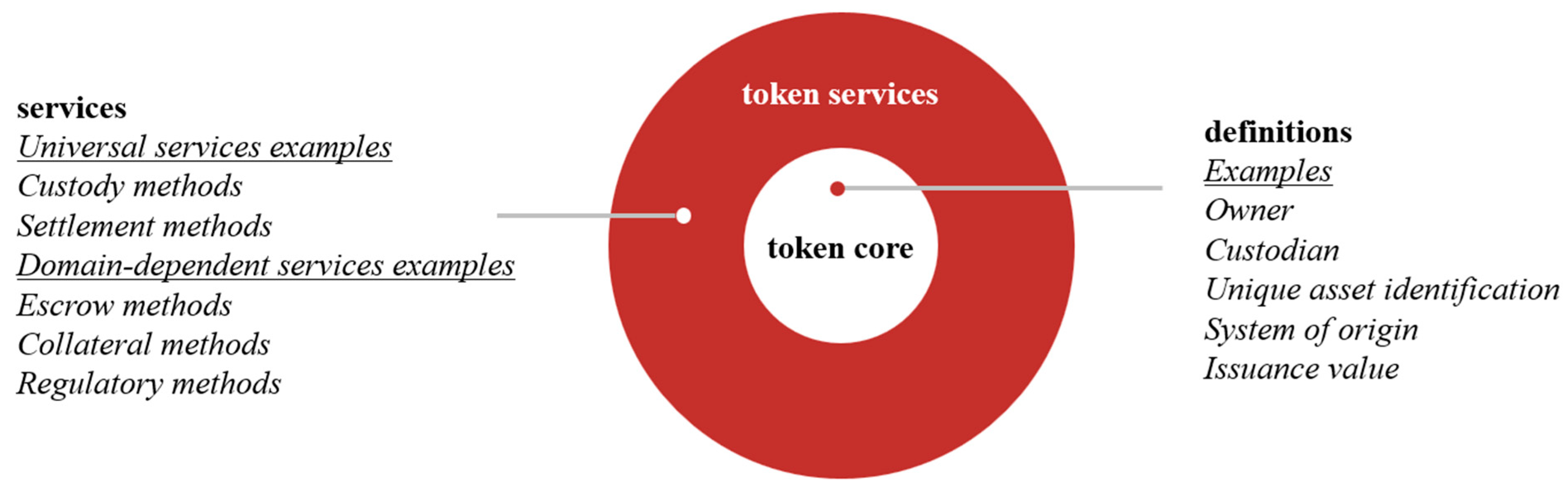
New technologies do not change the economics of these arrangements4, but they bring important opportunities to strengthen the features of money. The persistent demand for new functionalities of money signals societal appetite for the benefits that such technologies promise. Public authorities may neglect this reality at their peril. The advent of tokenisation can change how records of ownership and transfers of claims are done. In this respect, new programmable platforms that leverage tokenisation of money, such as unified ledgers, could be as transformative as the move from physical to digital ledgers.(BIS, 2025b, p. 81)
Digitisation does not automatically imply improvement. An unfair and unequal process can remain so after digitisation. The architecture of our markets, the procedural mechanisms behind money creation, the principles and equations of a valuation model change not when they are digitised, but when they are reinterpreted in their fundamental assumptions, and are rebuilt upon an entirely new value framework. In the age of digital transformation, we are more than ever exposed to the risk of digitising confusion, and reinforcing suboptimal frameworks, structures, and models.(Papazian, 2022, p. ix)
Our current money creation methodology, i.e., debt-based money, imposes several limitations on our potential in space. Due to the logic and calendar time-linked nature of debt instruments, debt-based money chains our species to an artificially created imaginary calendar, acting like monetary gravity that chains us to the surface of the planet. Meanwhile, given that money is continuously created via debt, in any economy, there always is a large number of households, businesses, corporations, banks, and government institutions forced to chase banknotes and deposits in order to fulfil their debt obligations—a monetary hunger that stimulates growth on the one hand, but also consumes our planet unnecessarily.(Papazian, 2022, p. 246)
5. Conclusions
Funding
Institutional Review Board Statement
Informed Consent Statement
Data Availability Statement
Acknowledgments
Conflicts of Interest
| 1 | It is worth noting that at the start of this study, a narrower sample size (the top 10) was considered. This was warranted by the fact that the top 10 cryptocurrencies represented nearly 91% of the total crypto market capitalisation. However, given market volatility, the skewed nature of the market, and the dynamic and ongoing changes in the composition of the top 10, the top 30 was considered to be a more representative sample. This choice minimised the sample composition impact of short-term and temporary price fluctuations, which are commonly observed in the crypto market. |
| 2 | On Ethereum an epoch is approximately 6.4 min long and is composed of 32 slots, with each slot lasting 12 s. The slots are the time window within which validators propose and attest to blocks to secure the network. |
| 3 | The base reward factor (64) and the base rewards per epoch (4) are fixed consensus constants in the Ethereum protocol, defined in the consensus specifications and only changeable through a protocol upgrade. |
| 4 | Emphasis added. |
References
- Adrian, T., & Mancini-Griffoli, T. (2019). The rise of digital money. International Monetary Fund. Available online: https://www.imf.org/en/Publications/fintech-notes/Issues/2019/07/12/The-Rise-of-Digital-Money-47097 (accessed on 30 September 2025).
- Aldasoro, I., Cornelli, G., Frost, J., Wilkens, P. K., Lewrick, U., & Shreeti, V. (2025). Tokenisation of government bonds: Assessment and roadmap. Bank for International Settlements. Available online: https://www.bis.org/publ/bisbull107.pdf (accessed on 25 October 2025).
- Aldasoro, I., Doerr, S., Gambacorta, L., Garratt, R., & Wilkens, P. K. (2023). The tokenisation continuum. Bank for International Settlements. Available online: https://www.bis.org/publ/bisbull72.pdf (accessed on 30 October 2025).
- Alonso, K. M. (2018). Zero to monero: First edition. Available online: https://www.getmonero.org/library/Zero-to-Monero-1-0-0.pdf (accessed on 1 November 2025).
- Anthony, N., & Michel, N. (2023). Central bank digital currency: Assessing the risks and dispelling the myths. Cato Policy Analysis. Available online: https://www.cato.org/sites/cato.org/files/2023-03/policy-analysis-941-updated.pdf (accessed on 4 November 2025).
- Atlantic Council. (2025). Central bank digital currency tracker. Atlantic Council. Available online: https://www.atlanticcouncil.org/cbdctracker/ (accessed on 30 October 2025).
- Auer, R., Cornelli, G., & Frost, J. (2023). Rise of the central bank digital currencies. International Journal of Central Banking, 19(4), 185–214. [Google Scholar]
- Baird, L., Harmon, M., & Madsen, P. (2020). Hedera: A public hashgraph network & governing council. Available online: https://files.hedera.com/hh_whitepaper_v2.2-20230918.pdf (accessed on 13 December 2025).
- Baldwin, C. Y., & Bhattacharyya, S. (1991). Choosing the method of sale: A clinical study of Conrail. Journal of Financial Economics, 30(1), 69–98. [Google Scholar] [CrossRef]
- Bank of England. (2021). Bank of England annual report and accounts 20/21. Bank of England. Available online: https://www.bankofengland.co.uk/-/media/boe/files/annual-report/2021/boe-2021.pdf#page=97 (accessed on 2 February 2026).
- Bank of England. (2024). Quantitative easing. Bank of England. Available online: https://www.bankofengland.co.uk/monetary-policy/quantitative-easing (accessed on 12 September 2025).
- Bank of England. (2025). What are cryptoassets (cryptocurrencies)? Bank of England. Available online: https://www.bankofengland.co.uk/explainers/what-are-cryptocurrencies (accessed on 2 November 2025).
- Bank of Jamaica. (2024). Balance sheet as at 28 August 2024. Bank of Jamaica. Available online: https://boj.org.jm/balance-sheet-as-at-28-august-2024/ (accessed on 1 November 2024).
- Baur, D. G., Hong, K., & Lee, A. D. (2018). Bitcoin: Medium of exchange or speculative assets? Journal of International Financial Markets, Institutions and Money, 54, 177–189. [Google Scholar] [CrossRef]
- Bech, M., & Garratt, R. (2017). Central bank cryptocurrencies. BIS Quarterly Review, 55–70. Available online: https://www.bis.org/publ/qtrpdf/r_qt1709f.pdf (accessed on 15 September 2025).
- Binance. (2017). Binance coin (BNB) whitepaper. Available online: https://www.exodus.com/assets/docs/binance-coin-whitepaper.pdf (accessed on 30 October 2025).
- Binance. (2022). What is BNB auto-burn? Binance. Available online: https://www.binance.com/en/academy/articles/what-is-bnb-auto-burn? (accessed on 25 October 2025).
- BIS. (2023). Blueprint for the future monetary system: Improving the old, enabling the new. BIS Annual Economic Report 2023, Chapter III. Bank for International Settlements. Available online: https://www.bis.org/publ/arpdf/ar2023e3.pdf (accessed on 12 September 2025).
- BIS. (2025a). Advancing in tandem—Results of the 2024 BIS survey on central bank digital currencies and crypto. BIS Papers No 159. Bank for International Settlements. Available online: https://www.bis.org/publ/bppdf/bispap159.pdf (accessed on 12 October 2025).
- BIS. (2025b). The next-generation monetary and financial system. BIS Annual Economic Report 2025, Chapter III. Bank for International Settlements. Available online: https://www.bis.org/publ/arpdf/ar2025e3.pdf (accessed on 26 September 2025).
- BIS-CPMI. (2024). Tokenisation in the context of money and other assets: Concepts and implications for central banks. Report to the G20. Bank for International Settlements. Available online: https://www.bis.org/cpmi/publ/d225.pdf (accessed on 12 September 2025).
- Bitcoin. (2021a). How are bitcoins created? Bitcoin.org. Available online: https://bitcoin.org/en/faq#how-are-bitcoins-created (accessed on 12 November 2025).
- Bitcoin. (2021b). How does Bitcoin mining work? Bitcoin.org. Available online: https://bitcoin.org/en/faq#how-does-bitcoin-mining-work (accessed on 12 November 2025).
- Bitcoin. (2021c). Why do Bitcoins have value. Bitcoin.org. Available online: https://bitcoin.org/en/faq#why-do-bitcoins-have-value (accessed on 12 November 2025).
- Bjorg, O. (2017). Designing new money—The policy trilemma of central bank digital currency. Copenhagen Business School (CBS) Working Paper. Available online: https://papers.ssrn.com/sol3/papers.cfm?abstract_id=2985381 (accessed on 15 October 2025).
- Bloomberg. (2025a). HSBC to offer tokenized deposits to US and UAE clients. Available online: https://www.bloomberg.com/news/articles/2025-11-18/hsbc-to-offer-tokenized-deposits-to-us-and-uae-clients (accessed on 1 November 2025).
- Bloomberg. (2025b). JPMorgan rolls out deposit token JPM coin in digital asset push. Available online: https://www.bloomberg.com/news/articles/2025-11-12/jpmorgan-rolls-out-deposit-token-jpm-coin-in-digital-asset-push (accessed on 12 November 2025).
- Böhme, R., Christin, N., Edelman, B., & Moore, T. (2015). Bitcoin: Economics, technology, and governance. Journal of Economic Perspectives, 29(2), 213–238. [Google Scholar] [CrossRef]
- Buterin, V. (2014). Ethereum: A next-generation smart contract and decentralized application platform. Available online: https://ethereum.org/content/whitepaper/whitepaper-pdf/Ethereum_Whitepaper_-_Buterin_2014.pdf (accessed on 10 October 2025).
- Carstens, A. (2018). Money in the digital age: What role for central banks? Bank for Internatinoal Settlements. Available online: https://www.bis.org/speeches/sp180206.pdf (accessed on 12 November 2025).
- Carstens, A. (2021). Digital currencies and the future of the monetary system. Bank for International Settlements. Available online: https://www.bis.org/speeches/sp210127.pdf (accessed on 20 October 2025).
- Central Bank of Nigeria (CBN). (2024). Summary consolidated and separate financial statements. Central Bank of Nigeria. Available online: https://www.cbn.gov.ng/Out/2025/CCD/Year%202024%20Summary%20Financial%20Statements.pdf (accessed on 4 November 2025).
- Central Bank of the Bahamas (CBOB). (2024). Annual report & statement of accounts. Central Bank of the Bahamas. Available online: https://www.centralbankbahamas.com/viewPDF/documents/2025-05-22-12-05-26-2024-CBOB-Annual-Report--Statement-of-Accounts.pdf (accessed on 4 November 2025).
- Circle. (2018). What is USDC. Available online: https://developers.circle.com/stablecoins/what-is-usdc (accessed on 5 November 2025).
- CoinMarketCap. (2021). What is bitcoin dominance? Available online: https://coinmarketcap.com/academy/article/what-is-bitcoin-dominance (accessed on 29 September 2025).
- CoinMarketCap. (2025). All cryptocurrencies. CoinMarketCap.com. Available online: https://coinmarketcap.com/ (accessed on 26 September 2025).
- Committee on Payments and Market Infrastructure (CPMI). (2015). Digital currencies. CPMI Report on digital currencies. Bank for International Settlements. Available online: https://www.bis.org/cpmi/publ/d137.pdf (accessed on 11 September 2025).
- Cronos. (2018). Cronos whitepaper. Available online: https://cronosdeveloper.github.io/downloads/Whitepaper_CRSX_en.pdf (accessed on 6 November 2025).
- Crunchbase. (2025). Ripple lands $500M at $40B valuation as crypto’s good year continues. Crunchbase. Available online: https://news.crunchbase.com/fintech-ecommerce/crypto/unicorn-ripple-500m-raise/ (accessed on 25 November 2025).
- Dai, W. (1998). B-money. Available online: http://www.weidai.com/bmoney.txt (accessed on 29 October 2025).
- DeAngelo, H., & DeAngelo, L. (1991). Union negotiations and corporate policy: A study of labor concessions in the domestic steel industry during the 1980s. Journal of Financial Economics, 30(1), 3–43. [Google Scholar] [CrossRef]
- Denis, D. J. (1994). Organizational form and the consequences of highly leveraged transactions: Kroger’s recapitalization and Safeway’s LBO. Journal of Financial Economics, 36(2), 193–224. [Google Scholar] [CrossRef]
- Dionysopoulos, L., & Urquhart, A. (2024). 10 years of stablecoins: Their impact, what we know, and future research directions. Economics Letters, 244, 111939. [Google Scholar] [CrossRef]
- Dissanaike, G., & Papazian, A. (2004). Management turnover in stock market winners and losers: A clinical investigation. ECGI—Finance Working Paper No. 61/2004. Available online: https://www.ssrn.com/abstract=628382 (accessed on 30 October 2025). [CrossRef]
- Duan, K., & Urquhart, A. (2023). The instability of stablecoins. Finance Research Letters, 52, 103573. [Google Scholar] [CrossRef]
- Ellis, S., Juels, A., & Nazarov, S. (2017). ChainLink: A decentralized oracle network. Available online: https://research.chain.link/whitepaper-v1.pdf (accessed on 7 November 2025).
- Ethena Labs. (2024). Ethena overview: Enabling internet money. Available online: https://docs.ethena.fi/ (accessed on 5 November 2025).
- Ethereum. (2024). Random selection. Available online: https://ethereum.org/gl/developers/docs/consensus-mechanisms/pos/block-proposal/#random-selection (accessed on 12 November 2025).
- Ethereum. (2025a). Rewards and penalties. Ethereum. Available online: https://ethereum.org/gl/developers/docs/consensus-mechanisms/pos/rewards-and-penalties/ (accessed on 10 November 2025).
- Ethereum. (2025b). Sync committee. Ethereum. Available online: https://ethereum.org/glossary/#sync-committee (accessed on 10 November 2025).
- EU-MICA. (2023). Regulation (EU) 2023/1114. European Parliament, Markets in Crypto Assets Regulation. Available online: https://eur-lex.europa.eu/legal-content/EN/TXT/PDF/?uri=CELEX:32023R1114 (accessed on 16 January 2026).
- FED. (2025a). Balance sheet trends—Accessible. US Federal Reserve. Available online: https://www.federalreserve.gov/monetarypolicy/bst_recenttrends_accessible.htm (accessed on 1 November 2025).
- FED. (2025b). Federal reserve balance sheet developments. US Federal Reserve. Available online: https://www.federalreserve.gov/monetarypolicy/May-2025-Federal-Reserve-Balance-Sheet-Developments.htm (accessed on 1 November 2025).
- FFT. (2025). Crypto market sheds $1.2tn as traders shun speculative assets. Financial Times. Available online: https://www.ft.com/content/6b171d3e-4a9e-4e2d-aafc-3b4047e44f32 (accessed on 19 November 2025).
- Friedman, M. (1960). A program for monetary stability. Fordham University Press. [Google Scholar]
- Friedman, M. (1968). The role of monetary policy. American Economic Review, 58(1), 1–17. [Google Scholar]
- Froot, K. A. (2001). The market for catastrophe risk: A clinical examination. Journal of Financial Economics, 60(2–3), 529–571. [Google Scholar] [CrossRef]
- FSB. (2024). The financial stability implications of tokenisation. Financial Stability Board. Available online: https://www.fsb.org/uploads/P221024-2.pdf (accessed on 12 October 2025).
- Garratt, R., & Shin, H. S. (2023). Stablecoins versus tokenised deposits: Implications for the singleness of money. BIS Bulletin, no. 73. Available online: https://www.bis.org/publ/bisbull73.pdf (accessed on 12 October 2025).
- Github. (2025a). Bitcoin proof of work cpp. Bitcoin Core. Available online: https://github.com/bitcoin/bitcoin/blob/master/src/pow.cpp (accessed on 5 November 2025).
- Github. (2025b). Validation get block subsidy halving. Bitcoin Core. Available online: https://github.com/bitcoin/bitcoin/blob/master/src/validation.cpp (accessed on 5 November 2025).
- Goldstein, M. A., & Kavajecz, K. A. (2000). Eighths, sixteenths, and market depth: Changes in tick size and liquidity provision on the NYSE. Journal of Financial Economics, 56(1), 125–149. [Google Scholar] [CrossRef]
- Grunspan, C., & Pérez-Marco, R. (2020). The mathematics of Bitcoin. EMS Newsletter. Available online: https://ems.press/content/serial-article-files/11512 (accessed on 28 October 2025).
- Hampson, P. (1991). A case study in the design of an optimal production sharing contract for a petroleum exploration venture. Journal of Financial Economics, 30(1), 45–67. [Google Scholar] [CrossRef]
- HSBC. (2024). HSBC UK bank plc annual report and accounts 2024. HSBC Plc. Available online: https://www.hsbc.com/-/files/hsbc/investors/hsbc-results/2024/annual/pdfs/hsbc-uk-bank-plc/250219-annual-report-and-accounts-2024.pdf (accessed on 12 October 2025).
- Jensen, M. C., Fama, E. F., Long, J. B., Ruback, R. S., Schwert, G. W., Smith, C. W., Jr., & Warner, J. (1989). Clinical papers and their role in the development of financial economics. Journal of Financial Economics, 24(1), 3–6. [Google Scholar] [CrossRef]
- Jevons, W. S. (1875). Money and the mechanism of exchange (pp. 13–14). D. Appleton and Co. [Google Scholar]
- Kang, D., Ryul, D., & Webb, R. I. (2025). Bitcoin as a financial asset: A survey. Financial Innovation, 11, 101. [Google Scholar] [CrossRef]
- Karpoff, J. M., & Rice, E. M. (1989). Organizational form, share transferability, and firm performance: Evidence from the ANCSA corporations. Journal of Financial Economics, 24(1), 69–105. [Google Scholar] [CrossRef]
- King, S., & Nadal, S. (2012). PPCoin: Peer-to-peer crypto-currency with proof-of-stake. White paper. Available online: https://peercoin.net/assets/paper/peercoin-paper.pdf (accessed on 8 November 2025).
- Kocherlakota, N. (1998). Money is memory. Journal of Economic Theory, 81(2), 232–251. [Google Scholar] [CrossRef]
- KuCoin. (2025). Ethereum validators drop below 1 million for first time since april. KuCoin. Available online: https://www.kucoin.com/news/flash/ethereum-validators-drop-below-1-million-for-first-time-since-april (accessed on 13 November 2025).
- Larimer, D. (2014, April). Delegated proof-of-stake (DPOS). White paper. BitShares. Available online: https://bitshares.org/technology/delegated-proof-of-stake-consensus/ (accessed on 29 October 2025).
- Lido Finance. (2025). Recap: Lido Q3 2025 tokenholder update. Available online: https://blog.lido.fi/recap-lido-q3-2025-tokenholder-update/ (accessed on 2 November 2025).
- Lys, T., & Vincent, L. (1995). An analysis of value destruction in AT&T’s acquisition of NCR. Journal of Financial Economics, 39(2–3), 353–378. [Google Scholar]
- MakerDAO. (2017). The Dai stablecoin system: Maker protocol whitepaper. Available online: https://makerdao.com/whitepaper/ (accessed on 26 October 2025).
- Mazières, D. (2017). The stellar consensus protocol. Available online: https://8130068.fs1.hubspotusercontent-na1.net/hubfs/8130068/stellar-consensus-protocol.pdf (accessed on 10 November 2025).
- McLeay, M., Radia, A., & Thomas, R. (2014a). Money creation in the modern economy. Bank of England Quarterly Bulletin, Q1. Available online: https://www.bankofengland.co.uk/-/media/boe/files/quarterly-bulletin/2014/money-creation-in-the-modern-economy (accessed on 10 August 2025).
- McLeay, M., Radia, A., & Thomas, R. (2014b). Money in the modern economy: An introduction. Bank of England Quarterly Bulletin, Q1. Available online: https://www.bankofengland.co.uk/-/media/boe/files/quarterly-bulletin/2014/money-in-the-modern-economy-an-introduction (accessed on 10 August 2025).
- Mitchell, M. L., & Netter, J. M. (1989). Triggering the 1987 stock market crash: Antitakeover provisions in the proposed House Ways and Means tax bill? Journal of Financial Economics, 24(1), 37–68. [Google Scholar] [CrossRef]
- Muscarella, C. J., & Vetsuypens, M. R. (1989). A simple test of Baron’s model of IPO underpricing. Journal of Financial Economics, 24(1), 125–135. [Google Scholar] [CrossRef]
- Nakamoto, S. (2008). Bitcoin: A peer-to-peer electronic cash system. Bitcoin. Available online: https://bitcoin.org/bitcoin.pdf (accessed on 25 September 2025).
- Noll, F. (2024). Observations from the retail CBDCs of the Caribbean. Payment System Research Briefing, Federal Reserve Bank of Kansas City. Available online: https://www.kansascityfed.org/documents/10104/PaymentsSystemResearchBriefing24Noll0410.pdf (accessed on 7 November 2025).
- Papazian, A. V. (2011). A product that can save a system: Public capitalisation notes. In Collected seminar papers (2011–2012) (Vol. 1). Chair for Ethics and Financial Norms. Sorbonne University. Available online: https://catalogue.bnf.fr/ark:/12148/cb443605396 (accessed on 25 November 2025).
- Papazian, A. V. (2022). The space value of money: Rethinking finance beyond risk and time. Palgrave Macmillan. [Google Scholar] [CrossRef]
- Papazian, A. V. (2023). Hardwiring sustainability into financial mathematics: Implications for money mechanics. Palgrave Macmillan. [Google Scholar] [CrossRef]
- Papazian, A. V. (2024). Financing the race to space: How to value, invest, and explore the universe. Palgrave Macmillan. [Google Scholar] [CrossRef]
- Papazian, A. V. (2025). The monetisation of space. Frontiers in Space Technologies, 6, 1679127. [Google Scholar] [CrossRef]
- Reuters. (2025). Bitcoin on thin ice after sinking in flight from risk. Reuters. Available online: https://www.reuters.com/business/finance/cryptocurrencies-whipped-by-flight-risk-2025-11-21/ (accessed on 22 November 2025).
- Schär, F. (2020). Decentralized finance: On blockchain- and smart contract-based financial markets. Available online: https://www.ssrn.com/abstract=3571335 (accessed on 5 November 2025). [CrossRef]
- Scholes, M. S., & Wolfson, M. A. (1989). Decentralized investment banking: The case of discount dividend-reinvestment and stock-purchase plans. Journal of Financial Economics, 24(1), 7–35. [Google Scholar] [CrossRef]
- Schwartz, D., Youngs, N., & Britto, A. (2014). The Ripple protocol consensus algorithm. Available online: https://ripple.com/files/ripple_consensus_whitepaper.pdf (accessed on 3 November 2025).
- Selgin, G. (2015). Synthetic commodity money. Journal of Financial Stability, 17, 92–99. [Google Scholar] [CrossRef]
- Shin, H. S. (2018). Cryptocurrencies and the economics of money. Bank for International Settlements. Available online: https://www.bis.org/speeches/sp180624b.pdf (accessed on 28 October 2025).
- Solana. (2025). Staking. Solana. Available online: https://solana.com/staking (accessed on 28 November 2025).
- S&P Global. (2025). Stablecoin stability assessment reports. S&P Global. Available online: https://www.spglobal.com/ratings/en/products/stablecoin-stability-assessment (accessed on 27 November 2025).
- Tether. (2014). Tether: Fiat currencies on the Bitcoin blockchain. Available online: https://assets.ctfassets.net/vyse88cgwfbl/5UWgHMvz071t2Cq5yTw5vi/c9798ea8db99311bf90ebe0810938b01/TetherWhitePaper.pdf (accessed on 9 November 2025).
- Tether. (2025). Tether—Relevant information document. Available online: https://tether.to/public/Relevant_Information_Document_-_Tether_International,_S.A._de_C.V..pdf (accessed on 8 November 2025).
- Urquhart, A., & Yarovaya, L. (2023). Cryptocurrency research: Future directions. The European Journal of Finance, 30, 1849–1854. [Google Scholar] [CrossRef]
- US Congress. (2025). Guiding and establishing national innovation for U.S. stablecoins act (Pub. L. 119-27). Available online: https://www.congress.gov/119/plaws/publ27/PLAW-119publ27.pdf (accessed on 9 November 2025).
- Van Saberhagen, N. (2013). CryptoNote v2.0. Available online: https://www.getmonero.org/resources/research-lab/pubs/whitepaper_annotated.pdf (accessed on 6 November 2025).
- Werner, R. A. (2014). Can banks individually create money out of nothing?—The theories and the empirical evidence. International Review of Financial Analysis, 36, 1–19. [Google Scholar] [CrossRef]
- Werner, R. A. (2016). A lost century in economics: Three theories of banking and the conclusive evidence. International Review of Financial Analysis, 46, 361–379. [Google Scholar] [CrossRef]
- Willett, J. R. (2012). The second bitcoin whitepaper. Brace New Coin. Available online: https://bravenewcoin.com/assets/Whitepapers/2ndBitcoinWhitepaper.pdf (accessed on 5 November 2025).
- Yakovenko, A. (2017). Solana: A new architecture for a high-performance blockchain. Available online: https://solana.com/solana-whitepaper.pdf (accessed on 23 October 2025).
- Yermack, D. (2013). Is Bitcoin a real currency? An economic appraisal. Working Paper 19747. National Bureau of Economic Research. Available online: https://www.nber.org/papers/w19747 (accessed on 25 October 2025).
- Zetzsche, D. A., Arner, D. W., & Buckley, R. P. (2020). Decentralized Finance. Journal of Financial Regulation, 6(2), 172–203. [Google Scholar] [CrossRef]



| Name | Symbol | Market Cap Dominance % | |
|---|---|---|---|
| 1 | Bitcoin | BTC | 58.099 |
| 2 | Ethereum | ETH | 12.8787 |
| 3 | Tether USDt | USDT | 4.5937 |
| 4 | XRP | XRP | 4.4111 |
| 5 | BNB | BNB | 3.5405 |
| 6 | Solana | SOL | 2.9045 |
| 7 | USDC | USDC | 1.9537 |
| 8 | Dogecoin | DOGE | 0.9264 |
| 9 | TRON | TRX | 0.8431 |
| 10 | Cardano | ADA | 0.7478 |
| 11 | Hyperliquid | HYPE | 0.4021 |
| 12 | Ethena USDe | USDe | 0.379 |
| 13 | Chainlink | LINK | 0.3781 |
| 14 | Avalanche | AVAX | 0.3274 |
| 15 | Sui | SUI | 0.3053 |
| 16 | Stellar | XLM | 0.3047 |
| 17 | Bitcoin Cash | BCH | 0.2884 |
| 18 | Hedera | HBAR | 0.2403 |
| 19 | UNUS SED LEO | LEO | 0.2312 |
| 20 | Litecoin | LTC | 0.2116 |
| 21 | Shiba Inu | SHIB | 0.1856 |
| 22 | Toncoin | TON | 0.1852 |
| 23 | Cronos | CRO | 0.1792 |
| 24 | Polkadot | DOT | 0.1701 |
| 25 | Mantle | MNT | 0.1449 |
| 26 | Monero | XMR | 0.1433 |
| 27 | Dai | DAI | 0.142 |
| 28 | World Liberty Financial | WLFI | 0.1353 |
| 29 | Uniswap | UNI | 0.1267 |
| 30 | Aave | AAVE | 0.1094 |
| TOTAL | 95.4883 |
| Name | Base—Smallest—Name | Infinite Supply | Max Supply | Circulating Supply | |
|---|---|---|---|---|---|
| 1 | Bitcoin | 1 Bitcoin—10−8—Satoshi | FALSE | 21,000,000 | 19,926,506 |
| 2 | Ethereum | 1 Ether—10−18—Wei | TRUE | - | 120,703,418 |
| 3 | Tether USDt | 1 USDT—10−6—NFN | TRUE | - | 173,440,544,668 |
| 4 | XRP | 1 XRP—10−6—Drop | FALSE | 100,000,000,000 | 59,777,241,479 |
| 5 | BNB | 1 BNB—10−8—Jager | FALSE | (?) 200,000,000 | 139,185,804 |
| 6 | Solana | 1 SOL—10−9—Lamport | TRUE | - | 543,511,668 |
| 7 | USDC | 1 USDC—10−6—NFN | FALSE | (?) Not capped | 73,809,969,236 |
| 8 | Dogecoin | 1 DOGE—10−8—Koinu | TRUE | - | 151,103,936,384 |
| 9 | TRON | 1 TRX—10−6—Sun | TRUE | - | 94,665,646,068 |
| 10 | Cardano | 1 ADA—10−6—Lovelace | FALSE | 45,000,000,000 | 35,800,453,490 |
| 11 | Hyperliquid | 1 HYPE—10−18—NFN | FALSE | 1,000,000,000 | 336,685,219 |
| 12 | Ethena USDe | 1 USDe—10−18—NFN | TRUE | - | 14,310,267,293 |
| 13 | Chainlink | 1 LINK—10−18—NFN | FALSE | 1,000,000,000 | 678,099,970 |
| 14 | Avalanche | 1 AVAX—10−9—nAVAX | FALSE | 715,748,719 | 422,275,285 |
| 15 | Sui | 1 SUI—10−9—Mist | FALSE | 10,000,000,000 | 3,568,833,706 |
| 16 | Stellar | 1 LUMEN—10−7—Stroop | FALSE | 50,001,806,812 | 31,884,872,394 |
| 17 | Bitcoin Cash | 1 BCH—10−8—Satoshi | FALSE | 21,000,000 | 19,930,863 |
| 18 | Hedera | 1 HBAR—10−8—Tinybar | FALSE | 50,000,000,000 | 42,392,926,543 |
| 19 | UNUS SED LEO | 1 LEO—10−18—NFN | FALSE | (?) 1,000,000,000) | 922,580,876 |
| 20 | Litecoin | 1 LTC—10−8—Litoshi | FALSE | 84,000,000 | 76,341,483 |
| 21 | Shiba Inu | 1 SHIB—10−18—NFN | FALSE | 589,552,695,333,683 | 589,245,875,301,952 |
| 22 | Toncoin | 1 TON—10−9—NanoTON | TRUE | - | 2,545,221,176 |
| 23 | Cronos | 1 CRO—10−8—NFN | FALSE | 100,000,000,000 | 34,831,028,845 |
| 24 | Polkadot | 1 DOT—10−10—Planck | TRUE | - | 1,621,211,445 |
| 25 | Mantle | 1 MNT—10−18—NFN | FALSE | 6,219,316,795 | 3,252,944,056 |
| 26 | Monero | 1 XMR—10−12—Piconero | TRUE | - | 18,446,744 |
| 27 | Dai | 1 DAI—10−18—NFN | TRUE | - | 5,365,382,703 |
| 28 | World Liberty Financial | 1 WLFI—10−18—NFN | FALSE | 100,000,000,000 | 24,608,750,682 |
| 29 | Uniswap | 1 UNI—10−18—NFN | FALSE | (?) TRUE | 630,330,528 |
| 30 | Aave | 1 AAVE—10−18—NFN | FALSE | (?) 16,000,000 | 15,234,519 |
| Symbol | Coin/ Token | Network Model | Functional Category(ies) | Key Usage | |
|---|---|---|---|---|---|
| 1 | BTC | Coin | Permissionless | Payment | Digital Asset, P2P Payments |
| 2 | ETH | Coin | Permissionless | Platform, Utility | Gas, Staking, Fees, Collateral |
| 3 | USDT | Token | Hybrid | Stablecoin, Payment | Payments, Hedging, Liquidity, Trading |
| 4 | XRP | Coin | Permissionless | Payment, Bridge Asset | Transfers, Liquidity, Settlement, Remittances |
| 5 | BNB | Coin | Permissionless | Platform, Utility, Exchange, Governance | Gas, Staking, Fees, Payments, DeFi Liquidity |
| 6 | SOL | Coin | Permissionless | Platform, Utility | Gas, Staking, Fees, DeFi Liquidity |
| 7 | USDC | Token | Hybrid | Stablecoin, Payment | Settlement, Payments, Trading, DeFi Liquidity |
| 8 | DOGE | Coin | Permissionless | Meme Coin, Payment | Tipping, Donations, P2P Payments |
| 9 | TRX | Coin | Permissionless | Platform, Utility, Payment | Gas, Staking, Fees, Content Monetization |
| 10 | ADA | Coin | Permissionless | Platform, Utility | Gas, Staking, DeFi Liquidity |
| 11 | HYPE | Coin | Permissionless | Platform, Governance, Utility, Exchange | Exchange, Gas, Trading, Staking/Security |
| 12 | USDe | Token | Hybrid | Stablecoin, Payment | Yield, Staking, Delta-hedging, DeFi Liquidity |
| 13 | LINK | Token | Permissionless | Utility, Network | Fees, Staking, Cross-Chain Interoperability Services |
| 14 | AVAX | Coin | Permissionless | Platform, Utility | Gas, Staking, Fees, DeFi Applications |
| 15 | SUI | Coin | Permissionless | Platform, Utility | Gas, Staking, Fees, DeFi Liquidity |
| 16 | XLM | Coin | Permissionless | Platform, Payment, Utility | Cross-border Payments, Remittances, Issuance |
| 17 | BCH | Coin | Permissionless | Payment | Low-cost P2P Cash, Payments, Remittances |
| 18 | HBAR | Coin | Permissioned | Platform, Utility | Gas, Fees, Staking, Network Security |
| 19 | LEO | Token | Hybrid | Utility, Exchange | Fees, Service Payments, Liquidity |
| 20 | LTC | Coin | Permissionless | Payment | Payments, Remittances |
| 21 | SHIB | Token | Permissionless | Meme, Ecosystem, Utility | Payments, Donations, Staking |
| 22 | TON | Coin | Permissionless | Platform, Payment, Utility | Gas, Staking, Payments, Fees |
| 23 | CRO | Coin | Hybrid | Platform, Utility, Exchange | Gas, Staking, Fees, Ecosystem Utility, Payments |
| 24 | DOT | Coin | Permissionless | Platform, Governance, Utility | Staking, Fees, Bonding, Auctions |
| 25 | MNT | Token | Permissionless | Platform, Governance | Gas, Staking, Fees |
| 26 | XMR | Coin | Permissionless | Payment, Privacy | Privacy, Untraceable Payments |
| 27 | DAI | Token | Permissionless | Stablecoin, Payment | Payments, Hedging, DeFi Liquidity |
| 28 | WLFI | Token | Hybrid | Governance (limited), Utility | Political Alignment |
| 29 | UNI | Token | Permissionless | Governance, Exchange | Incentives |
| 30 | AAVE | Token | Permissionless | Governance | Staking, Lending, Borrowing |
| Symbol | MINING/ Minting | Initial Offering | Consensus Mechanism | When Are They Created or Distributed | |
|---|---|---|---|---|---|
| 1 | BTC | MINING | Public Fair Launch | (PoW) | As block rewards, when miners find a valid PoW block |
| 2 | ETH | Minting (PreM) | Public ICO | (PoS) | As staking rewards, when validators propose/attest blocks; sync rewards |
| 3 | USDT | Minting | Mint-on-Demand | Multichain | As 1:1 mint, when users deposit fiat money with issuer |
| 4 | XRP | Pre-Minted | Private Distribution | (RPCA) | At inception, distributed when Ripple releases from escrow |
| 5 | BNB | Pre-Minted | Public ICO | (PoSA) | At inception, distributed to team, investors and through ICO, burn only |
| 6 | SOL | Minting (PreM) | Public IEO | (PoH), (PoS) | As staking rewards, when validators produce and validate a block |
| 7 | USDC | Minting | Mint-on-Demand | Multichain | As 1:1 mint, when users deposit fiat with Circle |
| 8 | DOGE | MINING | Public Fair Launch | (PoW) | As block rewards, when miners find a valid PoW block |
| 9 | TRX | Minting (PreM) | Public ICO | (DPoS) | As block rewards, when a super representative produces a block |
| 10 | ADA | Minting (PreM) | Public ICO | (PoS) | As staking rewards, when validators produce and validate blocks |
| 11 | HYPE | Pre-Minted | Public Airdrop | (PoS) | At inception, distributed as airdrops & community rewards |
| 12 | USDe | Minting | Mint-on-Demand | (PoS) | As ~1:1 mint, when users deposit crypto collateral and hedge |
| 13 | LINK | Pre-Minted | Public ICO | (OCR) | At inception, released through rewards, incentives |
| 14 | AVAX | Minting (PreM) | Public ICO | (PoS) | As staking rewards, when a validator proposes or validates a block |
| 15 | SUI | Pre-Minted | Public IEO | (DPoS) | At inception, distributed based on fixed vesting schedule |
| 16 | XLM | Pre-Minted | Private Distribution/Airdrop | (FBA) | At inception, distributed via programs, partnerships |
| 17 | BCH | MINING | Public Fork Distribution | (PoW) | As block rewards, when miners find a valid PoW block |
| 18 | HBAR | Pre-Minted | Private SAFT | (PoS), Hashgraph | At inception, distributed through rewards, development |
| 19 | LEO | Pre-Minted | Private IEO | (PoS), (DPoS) | At inception, no new distribution, continuously burned |
| 20 | LTC | MINING | Public Fair Launch | (PoW) | As block rewards, when miners find a valid PoW block |
| 21 | SHIB | Pre-Minted | Private Distribution | (PoS) | At inception, no new distribution, continuously burned |
| 22 | TON | Minting (PreM) | Giver Smart Contracts | (PoS), Catchain | As staking rewards, when validators produce and validate a block |
| 23 | CRO | Pre-Minted | Private Distribution | (PoA), (DPoS) | At inception, distributed through rewards, incentives |
| 24 | DOT | Minting (PreM) | Public ICO | (PoS) | As staking rewards, when validators produce and validate a block |
| 25 | MNT | Pre-Minted | Private Migration | (PoS) | At inception, distributed through allocation and rewards |
| 26 | XMR | MINING | Public Fair Launch | (PoW) | As block rewards, when miners find a valid PoW block |
| 27 | DAI | Minting | Mint-on-Demand | (PoS) | As 1:1.5 (value) mint, when users lock collateral in Maker Vaults, loan |
| 28 | WLFI | Pre-Minted | Private SAFT | (PoS) | At inception, distributed through airdrops and rewards |
| 29 | UNI | Pre-Minted | Public Airdrop | (PoS) | At inception, distributed through governance, grants |
| 30 | AAVE | Pre-Minted | Public ICO | (PoS) | At inception, distributed through governance, rewards |
| Launch Model | Summary Description | |
|---|---|---|
| 1 | Public Fair Launch | A Public Fair Launch begins with zero pre-minted supply, and coins/tokens are produced only through open participation such as mining or staking from the first block. Founders, insiders, or investors do not receive tokens beforehand, ensuring equal access. |
| 2 | Public Initial Coin Offering (ICO) | A Public ICO is a global coin/token sale where anyone can purchase pre-minted tokens directly from the project before or during network launch. It functions as both a fundraising method and an early distribution mechanism. |
| 3 | Mint-on-Demand | Mint-on-Demand systems create new coins/tokens only when a user deposits collateral or backing assets. It is not a fundraising mechanism and does not involve public or private sales. |
| 4 | Private Distribution | Private Distribution means tokens are pre-minted and allocated to or by insiders—such as founders, teams, or institutions—without any public sale. Early supply is concentrated among private stakeholders. |
| 5 | Public Initial Exchange Offering (IEO) | A Public IEO is a coin/token sale run by a centralized exchange, which handles verification, sale mechanics, and token listing. Tokens are pre-minted and offered publicly to users of that exchange. |
| 6 | Public Airdrop | A Public Airdrop distributes pre-minted tokens for free to eligible users based on criteria such as past platform usage. It is often used to bootstrap communities and decentralize token ownership. |
| 7 | Private Simple Agreement for Future Tokens (SAFT) | A SAFT is a private investment agreement where accredited investors provide funding in exchange for receiving coins/tokens later at launch. |
| 8 | Private Initial Exchange Offering (IEO) | A Private IEO is an exchange-administered token sale restricted to approved institutional or accredited buyers. Tokens are pre-minted, but participation is limited, unlike public IEOs. |
| 9 | Public Fork Distribution | Public Fork Distribution occurs when a blockchain splits, and holders of the original chain automatically receive tokens of the new chain. Distribution is determined by balances at the fork |
| 10 | Private Migration | Private Migration replaces an old token with a new one through a controlled internal swap process managed by the project team. |
| 11 | Giver Smart Contracts (IPoW) | This was a unique offering model initiated by Toncoin. After a failed launch via SAFT, Toncoins were placed in Giver smart contracts, and were open for mining. This approach was called Initial PoW, although the blockchain uses PoS. Similar to a Public Fair Launch. |
| Consensus Mechanism | Description |
|---|---|
| Proof of Work (PoW) | Miners compete to solve cryptographic puzzles to validate transactions and add new blocks to the blockchain. (Nakamoto, 2008) |
| Proof of Stake (PoS) | Validators are selected, based on their stake in the network, to create new blocks based on the number of coins/tokens they “stake” as collateral (blocked). (King & Nadal, 2012) |
| Delegated Proof of Stake (DPoS) | Token/coin holders vote for a small number of delegates who validate transactions and produce blocks on their behalf. (Larimer, 2014) |
| Proof of Authority (PoA) | A limited number of authorities (approved validators) generate new blocks, identity replaces ‘stake’ or ‘work’. |
| Proof of Staked Authority (PoSA) | Hybrid between PoS and PoA where limited number of validators, with verified identities, are approved to produce blocks, based on stake and reputation. |
| Proof of History (PoH) | Introduced by Solana, uses cryptographic timestamps to verify the passage of time between events, it is integrated with PoS for validation. (Yakovenko, 2017) |
| Ripple Protocol Consensus Algorithm (RPCA) | Validators or trusted nodes agree on the order and validity of transactions through voting, transaction with at least 80% are added on ledger. (Schwartz et al., 2014) |
| Hashgraph | Using a “gossip about gossip” protocol and virtual voting (no actual voting) to achieve consensus regarding the order of transactions. (Baird et al., 2020) |
| Federated Byzantine Agreement (FBA) | Nodes form “quorum slices” of trusted peers vote to reach agreement by majority within each quorum. (Mazières, 2017) |
| Catchain | A specialized Byzantine Fault Tolerant (BFT) protocol used by The Open Network (TON) that enables validators to exchange votes in rounds to quickly agree on a single, final version of the next block. |
| Off-Chain Reporting (OCR) | Many independent nodes gather data or observations from off-chain sources and communicate peer-to-peer off-chain. They each sign their data observation, then a single aggregated report signed by a quorum of oracles is submitted on-chain. |
| Rank | Symbol | Key Role(s) in Process | Their Selection Mechanism | Reward and Defining Factor(s) |
|---|---|---|---|---|
| Those that create new coins/tokens as rewards for new blocks added on chain through PoW | ||||
| 1 | BTC | Miner | Hash power-weighted chance | Per Block, Halves (210,000 B), R = 3.125 |
| 8 | DOGE | Miner | Hash power-weighted chance | Per Block, Fixed, R = 10,000 |
| 17 | BCH | Miner | Hash power-weighted chance | Per Block, Halves (210,000B), R = 3.125 |
| 20 | LTC | Miner | Hash power-weighted chance | Per Block, Halves (840,000B), R = 6.25 |
| 26 | XMR | Miner | Hash power-weighted chance | Per Block, Fixed, R = 0.6 |
| Those that create new coins/tokens as rewards for staking, when new blocks are proposed or produced and validated on chain through PoS | ||||
| 2 | ETH | Validator, Staker | Random stake-weighted lottery | Per Epoch & Validator Duties, Total Active Stake, Validator Effective Balance, Participation, Network-wide Stake Levels |
| 6 | SOL | Validator, Delegator | Deterministic stake-weighted leader schedule, shuffle | Per Epoch, Yearly ‘Inflation’, Total Staked SOL, Stake Share, Performance |
| 9 | TRX | Super Representative, SR Partner, Voter | Deterministic stake & vote weighted election | Per block, Fixed Stake and Vote Share |
| 10 | ADA | Stake Pool Operator, Delegator | Random stake-weighted lottery | Per Epoch, Reserve Size, Yearly Monetary Expansion, Pool Stake Share, Saturation, Performance |
| 14 | AVAX | Validator/Delegator | Stake-eligible participation | Per Stake period and Duration, Remaining Unissued Supply, Total Stake Share, Effective Consumption Rate, Performance, Uptime |
| 22 | TON | Validator/Nominator | Random stake-weighted lottery | Per Validation Round, Reward Pool, Stake Share, Total Stake |
| 24 | DOT | Validator/Nominator | Deterministic Voting | Per Era, Yearly inflation, Staking Rate, Staking Share, Performance |
| Those that create new coins/tokens upon deposit of fiat USD or crypto collateral | ||||
| 3 | USDT | Depositor, Tether Ltd. (iFinex) | N/A | No rewards, N/A |
| 7 | USDC | Depositor, Circle Internet Group Inc. | N/A | No rewards, N/A |
| 12 | USDe | Depositor, Ethena Protocol, Ethena Labs | N/A | No rewards, N/A |
| 27 | DAI | Depositor, Maker Protocol, MakerDAO | N/A | No rewards, N/A |
| Symbol | Key Decision Maker(s) | Decision-Making Process | Release Rules and/or Allocations | |
|---|---|---|---|---|
| Those that have their supply pre-minted, and do not create new coins/tokens—they have distributed them or release them over time | ||||
| 4 | XRP | Ripple (board/management) | Deterministic Quorum, Slices | Per month, 1 billion XRP release from escrow for ecosystem needs and sales |
| 5 | BNB | Binance, BNB Chain core team, Auto-Burn Mechanism, DAO | Discretionary and Programmatic, BNB Chain Governance DAO | Per Quarter, burn only, scarcity as strategy. Rewards as yield for staking, no new coins. |
| 11 | HYPE | Hyperliquid DAO, Hyperliquid Foundation | Discretionary, Hyperliquid DAO (Decentralized Autonomous Organization) | Trading incentives, dividend-style rewards, and compensation for core contributors and ecosystem growth, grants |
| 13 | LINK | Chainlink Labs, Chainlink Foundation | Discretionary, no governance DAO | Financing development, incentivising oracle node operators & ecosystem integrations |
| 15 | SUI | Sui Foundation, Mysten Labs | Discretionary, no governance DAO | Community reserve, grants, validator delegation, stake subsidies, R&D, ecosystem incentives |
| 16 | XLM | Stellar Development Foundation | Deterministic quorum, no governance DAO | Free distributions and partner allocations, grants, and ecosystem support |
| 18 | HBAR | Hedera Governing Council, HBAR Foundation | Discretionary, no governance DAO | Network security, ecosystem grants, programs, and strategic partnerships |
| 19 | LEO | Bitfinex management (iFinex) | Discretionary, no governance DAO | Ongoing buyback & burn, recapitalize and support the Bitfinex/iFinex ecosystem |
| 21 | SHIB | Anonymous founder “Ryoshi”, Shiba Inu team, DAO | Discretionary, Doggy DAO | Meme-coin style community token, used to bootstrap a community ecosystem |
| 23 | CRO | Crypto.com/Cronos Labs management, DAO | Discretionary, Cronos DAO | Exchange & card rewards, staking incentives, ecosystem grants in the Cronos chain, and corporate treasury/strategic uses (Cronos, 2018) |
| 25 | MNT | Mantle DAO | Discretionary, governed by MNT holders, approves major treasury allocations and incentive programs, Mantle DAO | Grants, liquidity incentives, strategic investments, and protocol development |
| 28 | WLFI | World Liberty Financial, Aqua 1, Trump Family | Discretionary, no governance DAO | Political alignment, economic exposure to WLF’s ecosystem (including its RWA/treasury business). |
| 29 | UNI | Uniswap DAO | Discretionary, treasury disbursements are governed by token holders, Uniswap DAO | Grants, strategic partnerships, incentives |
| 30 | AAVE | Aave DAO | Discretionary, token-holder votes decide how reserve tokens are allocated, AAVE DAO | Ecosystem reserves, grants, development |
| Symbol | 26 September 2025 | 7 October 2025 | 23 November 2025 | 30 November 2025 | 7 October to 23 November (A) | 26 September to 30 November (B) |
|---|---|---|---|---|---|---|
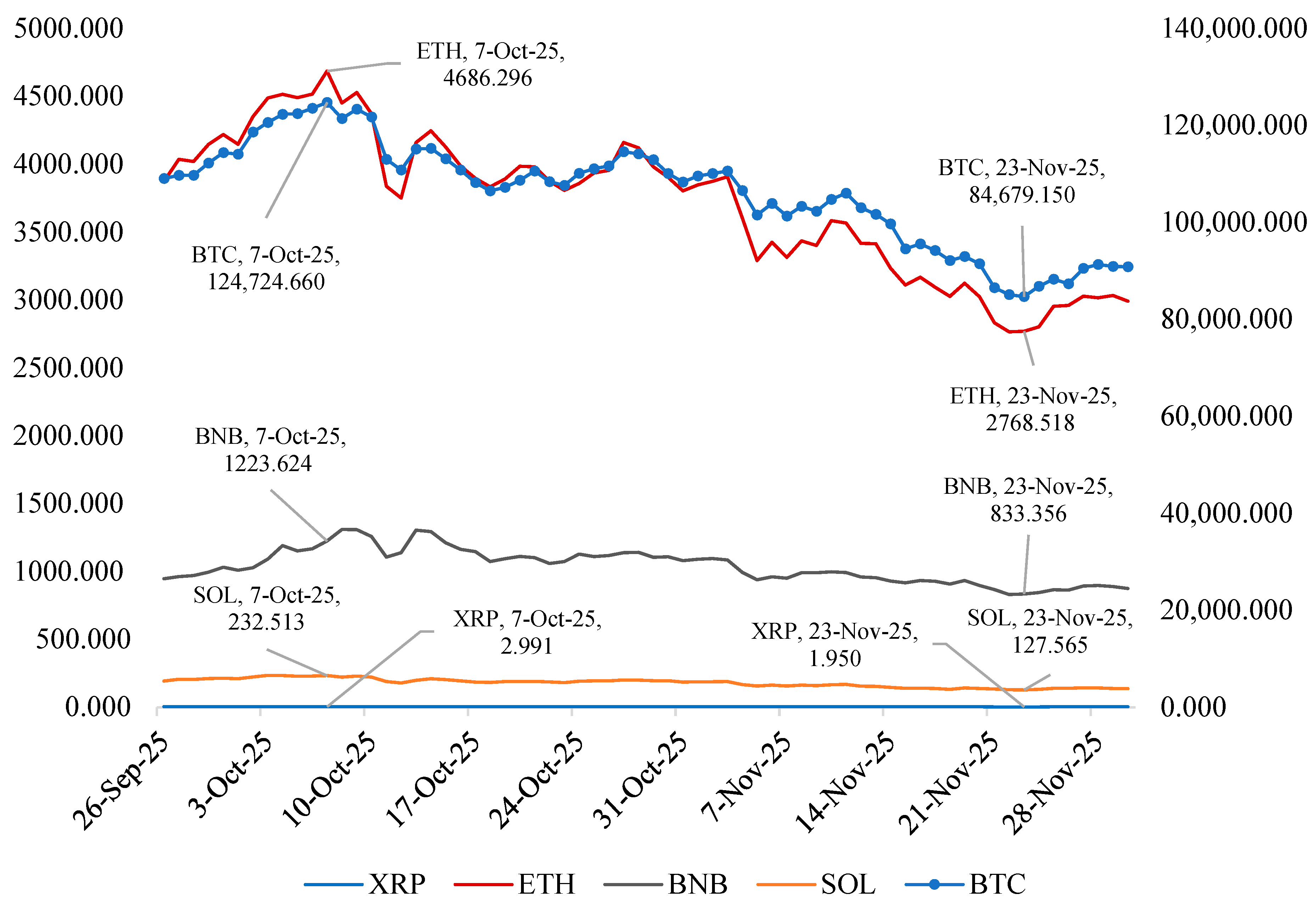
| BTC | 109,028.658 | 124,724.660 | 84,679.150 | 90,836.715 | −32.1071% | −16.6855% |
| ETH | 3873.399 | 4686.296 | 2768.518 | 2990.836 | −40.9231% | −22.7852% |
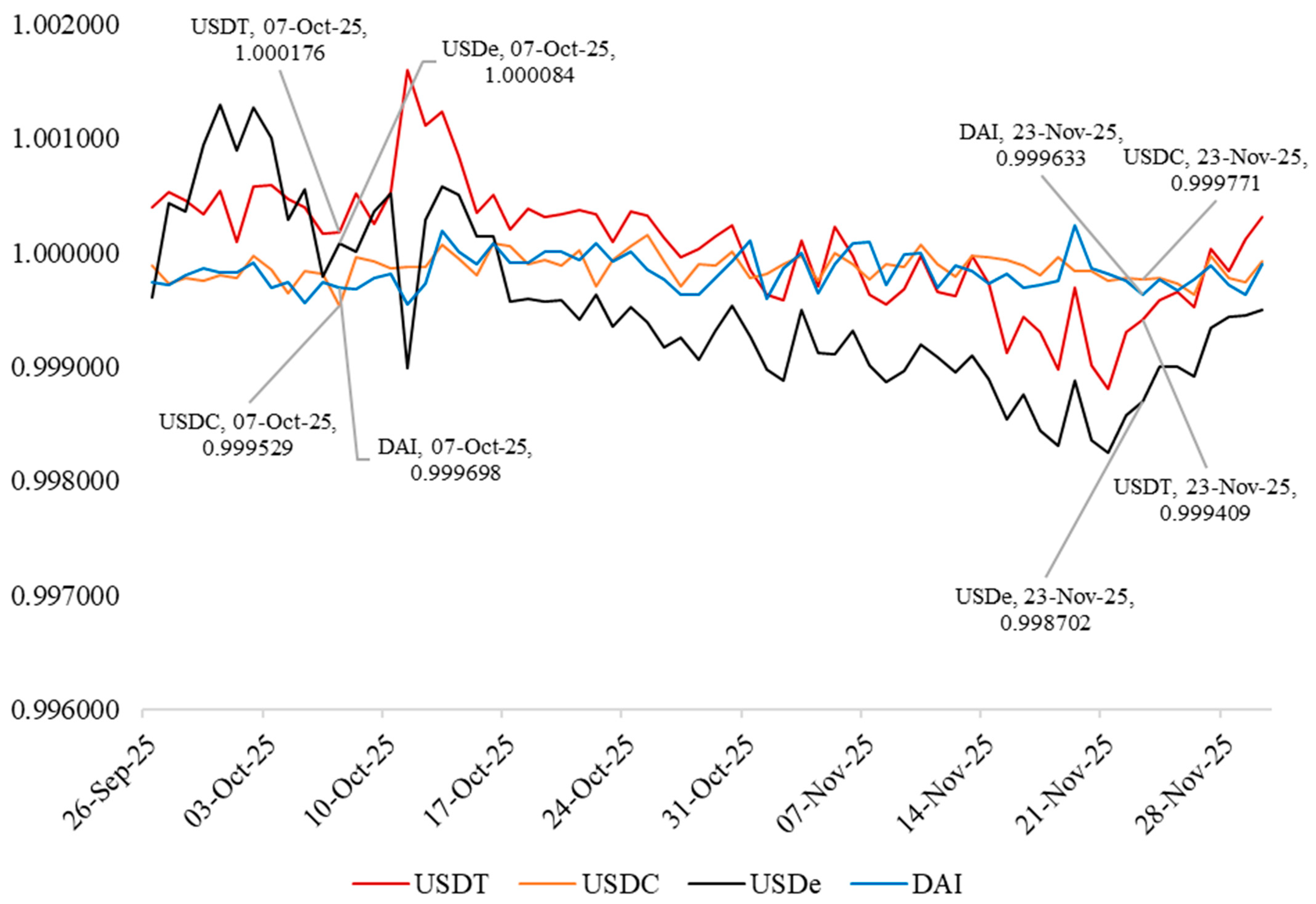
| USDT | 1.000395 | 1.000176 | 0.999409 | 1.000311 | −0.0767% | −0.0084% |
| XRP | 2.743 | 2.991 | 1.950 | 2.203 | −34.7969% | −19.6738% |
| BNB | 945.755 | 1223.624 | 833.356 | 873.596 | −31.8944% | −7.6297% |
| SOL | 192.497 | 232.513 | 127.565 | 136.074 | −45.1364% | −29.3108% |
| USDC | 0.999886 | 0.999529 | 0.999771 | 0.999929 | 0.0242% | 0.0043% |
| DOGE | 0.2228 | 0.2663 | 0.1403 | 0.1486 | −47.3137% | −33.3121% |
| TRX | 0.3319 | 0.3462 | 0.2741 | 0.2810 | −20.8214% | −15.3420% |
| ADA | 0.7629 | 0.8718 | 0.4046 | 0.4153 | −53.5902% | −45.5544% |
| HYPE | 40.35 | 47.38 | 30.03 | 34.38 | −36.6167% | −14.7906% |
| USDe | 0.999606 | 1.000084 | 0.998702 | 0.999495 | −0.1382% | −0.0112% |
| LINK | 20.1150 | 23.3750 | 12.1728 | 13.0020 | −47.9239% | −35.3617% |
| AVAX | 28.6607 | 30.7103 | 13.2283 | 14.2434 | −56.9256% | −50.3033% |
| SUI | 3.1094 | 3.6281 | 1.3451 | 1.4999 | −62.9269% | −51.7631% |
| XLM | 0.3502 | 0.4087 | 0.2303 | 0.2542 | −43.6459% | −27.4108% |
| BCH | 536.20 | 599.39 | 556.62 | 521.70 | −7.1349% | −2.7041% |
| HBAR | 0.2074 | 0.2302 | 0.1317 | 0.1434 | −42.8107% | −30.8434% |
| LEO | 9.4839 | 9.6511 | 9.4491 | 9.8160 | −2.0936% | 3.5022% |
| LTC | 102.19 | 118.34 | 82.17 | 84.06 | −30.5655% | −17.7351% |
| SHIB | 0.0000 | 0.0000 | 0.0000 | 0.0000 | −39.3182% | −26.6029% |
| TON | 2.6601 | 2.8556 | 1.5315 | 1.5799 | −46.3686% | −40.6095% |
| CRO | 0.1856 | 0.2107 | 0.1001 | 0.1072 | −52.4890% | −42.2499% |
| DOT | 3.8015 | 4.3886 | 2.3096 | 2.2603 | −47.3717% | −40.5426% |
| MNT | 1.6062 | 2.4636 | 0.9855 | 1.0876 | −59.9962% | −32.2875% |
| XMR | 288.51 | 310.59 | 369.38 | 413.14 | 18.9289% | 43.1996% |
| DAI | 0.999746 | 0.999698 | 0.999633 | 0.999903 | −0.0064% | 0.0157% |
| WLFI | 0.1923 | 0.1993 | 0.1521 | 0.1604 | −23.6773% | −16.5907% |
| UNI | 7.4405 | 8.3479 | 6.1694 | 6.0658 | −26.0963% | −18.4757% |
| AAVE | 259.85 | 297.34 | 161.18 | 182.36 | −45.7933% | −29.8220% |
| Row | Code |
|---|---|
| 146 147 148 149 150 151 152 153 154 155 156 157 158 159 160 161 162 163 164 165 166 167 168 169 170 171 | std::optional<arith_uint256> DeriveTarget(unsigned int nBits, const uint256 pow_limit) { bool fNegative; bool fOverflow; arith_uint256 bnTarget; bnTarget.SetCompact(nBits, &fNegative, &fOverflow); // Check range if (fNegative || bnTarget == 0 || fOverflow || bnTarget > UintToArith256(pow_limit)) return {}; return bnTarget; } bool CheckProofOfWorkImpl(uint256 hash, unsigned int nBits, const Consensus::Params& params) { auto bnTarget{DeriveTarget(nBits, params.powLimit)}; if (!bnTarget) return false; // Check proof of work matches claimed amount if (UintToArith256(hash) > bnTarget) return false; return true; } |
| Row | Code |
|---|---|
| 1919 1920 1921 1922 1923 1924 1925 1926 1927 1928 1929 1930 | CAmount GetBlockSubsidy(int nHeight, const Consensus::Params & consensusParams) { int halvings = nHeight/consensusParams.nSubsidyHalvingInterval; // Force block reward to zero when right shift is undefined. if (halvings >= 64) return 0; CAmount nSubsidy = 50 * COIN; // Subsidy is cut in half every 210,000 blocks which will occur approximately every 4 years. nSubsidy >>= halvings; return nSubsidy; } |
| Feature | Bitcoin (BTC) | Ethereum (ETH) | Tether USDt (USDT) | XRP (XRP) | BNB (BNB) | Solana (SOL) | USDC (USDC) |
|---|---|---|---|---|---|---|---|
| Market Cap Dominance % | 58.099 | 12.8787 | 4.5937 | 4.4111 | 3.5405 | 2.9045 | 1.9537 |
| Network Model | Permissionless | Permissionless | Hybrid | Permissionless | Permissionless | Permissionless | Hybrid |
| Functional Categories | Payment | Platform, Utility | Stablecoin (USD-pegged) | Payment | Platform, Utility Exchange, Governance | Platform, Utility | Stablecoin (USD-pegged) |
| Key Uses | Digital Asset, P2P Payments | Gas, Staking, Fees | Payments, Hedging, Liquidity, Trading | Bridge Asset, Liquidity, Settlement, Remittances | Gas, Fees, Staking, Payments, DeFi Liquidity | Gas, Staking, Fees, DeFi Liquidity | Settlement, Payments, Trading, DeFi Liquidity |
| Minting/ Minging | MINING | Minting (PreM) | Minting | Pre-Minted | Pre-Minted | Minting (PreM) | Minting |
| Initial Offering | Public Fair Launch | Public ICO | Mint on Demand | Private Distribution | Public ICO | Public IEO | Mint on Demand |
| Consensus | (PoW) | (PoS) | Multichain | (RPCA) | (PoSA) | (PoH), (PoS) | Multichain |
| Created | As block rewards | Inception and as staking rewards | As 1:1 mint | At inception | At inception | Inception and as staking rewards | As 1:1 mint |
| Key Role(s), Decision Makers | Miner | Validator/Staker, | Depositor, Tether Ltd. | Ripple | Binance/BNB Chain, Auto-Burn Mechanism | Validator/ Delegator | Depositor, Circle Internet Group Inc |
| Decision Rule | Probabilistic (hash power- weighted) | Random (stake-weighted) lottery | N/A | Deterministic quorum | Discretionary and Programmatic | Deterministic stake-weighted leader schedule, shuffle | N/A |
| Reward and Defining Factor(s) | Per Block, Halves (210,000 B), R = 3.125 | Per Epoch & Validator Duties, Total Stake, Validator Eff. Balance, Participation, Stake Levels | No rewards | Per month 1 billion XRP release from escrow for ecosystem needs and sales | Per Quarter, burn only, scarcity as strategy. Rewards as Yield for staking, no new coins. | Per Epoch, Yearly ‘Inflation’, Total Staked SOL, Stake Share, Performance | No rewards |
| Feature | USDT | USDC | USDe | DAI |
|---|---|---|---|---|
| Type | Centralised fiat-backed stablecoin | Centralised fiat-backed stablecoin | Synthetic delta-neutral stablecoin | Overcollateralised crypto backed loan-based stablecoin |
| Issuer | Tether | Circle | Ethena Protocol, Ethena Labs | Maker Protocol, MakerDAO |
| Launch Year | 2014 | 2018 | 2024 | 2017 |
| Minting Logic | 1 USDT minted for every $1 deposited (fiat via Tether) | 1 USDC minted for every $1 deposited (fiat via Circle) | Minted by depositing crypto collateral | Minted as loan when users lock collateral into Maker Vaults |
| Minting Ratio | 1:1 fiat | 1:1 fiat | ~1:1 net exposure | Typically 130–170% collateral ratio (depends on asset type) |
| Reserve Composition | U.S. T-bills, cash, repos, precious metals | U.S. T-bills, cash, bank deposits, overnight repos | Staked ETH (LSTs), ETH futures, USDT, USDC | Mix of ETH, WBTC, real-world assets (RWAs), USDC, and LSTs |
| Peg Mechanism | Fully backed by collateral | Fully backed by collateral | Delta-neutral hedging maintains stable value | Overcollateralisation + liquidation mechanism |
| Stability (S&P Global, 2025) | 5 (Weak) | 1 (Very Strong) | 5 (Weak) | 4 (Constrained) |
| Hedging Strategy | None, collateralised | None, collateralised | Delta-neutral: long staked ETH + short ETH perpetual futures | None, overcollateralised, liquidation mechanism |
| Main Use Cases | Global payments, crypto trading | Trading, corporate treasury, fintech payments | On-chain yield-bearing stable liquidity | DeFi collateral, lending, borrowing |
| Main Audience | Traders, emerging markets, exchanges | Institutions, regulated entities, fintech | Approved counterparties, Yield-seeking DeFi users | DeFi users + decentralised finance protocols |
| Who Gets the Tokens | Depositor | Depositor | Depositor, Hedger | Depositor, Borrower |
| Redemption Method | Direct with Tether | Direct with Circle | Redeemable via Ethena mechanism | Burn DAI to unlock collateral |
| 31 December 2024 | 31 December 2023 | |
|---|---|---|
| Total Assets | 340,877 | 332,876 |
| Cash and balances at central bank | 52,276 | 65,719 |
| Financial assets mandatory measured at fair value through profit and loss | 174 | 135 |
| Derivatives | 298 | 178 |
| Loans and advances to banks | 7263 | 7980 |
| Loans and advances to customers | 217,604 | 211,887 |
| Reverse repurchase agreements—non-trading | 11,776 | 7686 |
| Financial investments | 37,801 | 26,315 |
| Other assets | 13,685 | 12,976 |
| Total Liabilities | 314,906 | 306,806 |
| Deposits by banks | 11,144 | 10,843 |
| Customer accounts | 280,366 | 268,345 |
| Repurchase agreements—non-trading | 420 | 4652 |
| Derivatives | 107 | 108 |
| Debt securities in issue | 2044 | 1988 |
| Other liabilities | 20,825 | 20,870 |
| Total Equity | 25,971 | 26,070 |
| Total shareholders’ equity | 25,911 | 26,010 |
| Non-controlling interests | 60 | 60 |
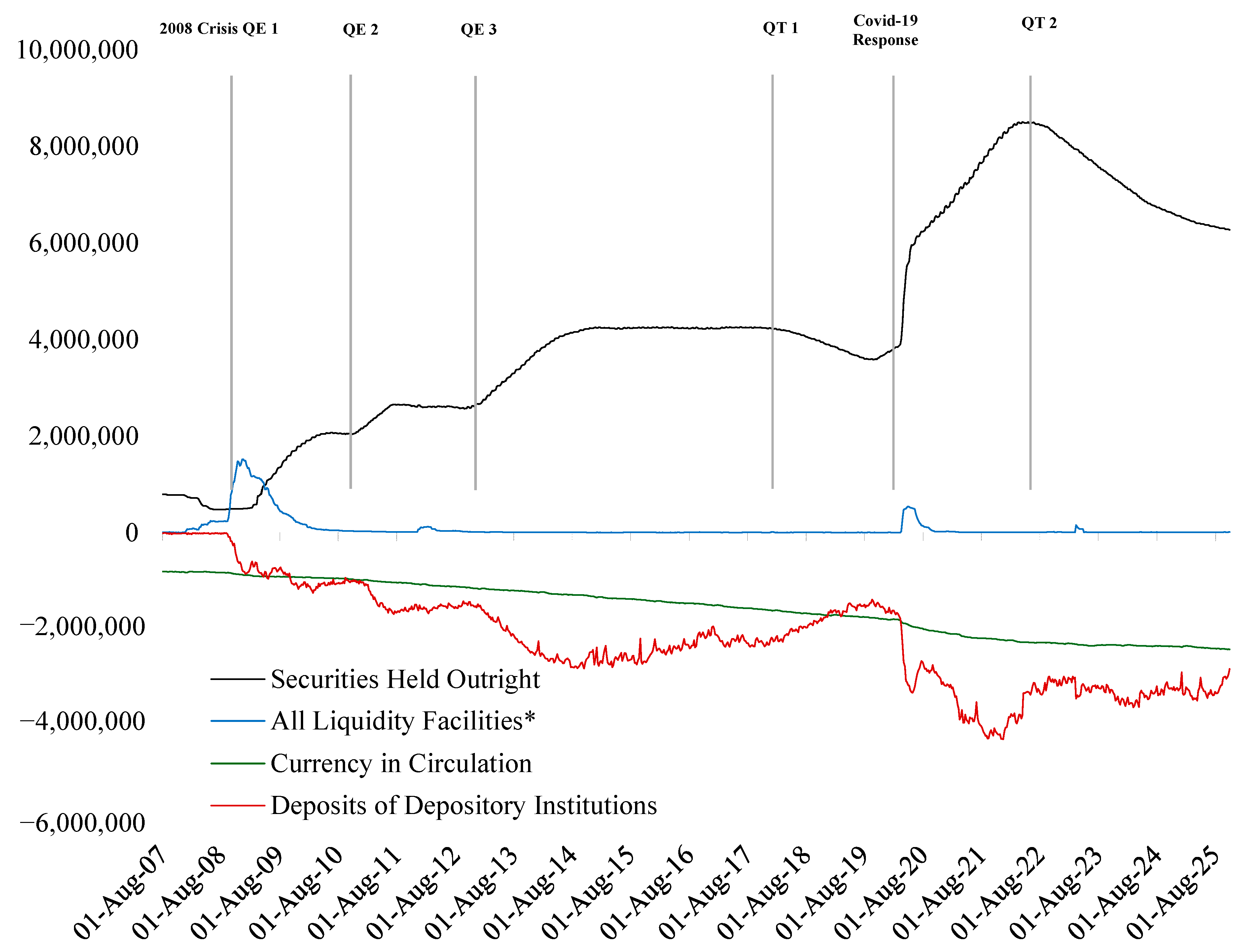
| 26 March 2025 | 25 September 2024 | |
|---|---|---|
| Total Assets | 6740 | 7080 |
| Securities held outright | 6429 | 6669 |
| U.S. Treasury securities | 4237 | 4384 |
| Federal agency debt securities | 2 | 2 |
| Agency mortgage-backed securities | 2189 | 2282 |
| Repurchase agreements | 0 | 0 |
| Foreign official | 0 | 0 |
| Other | 0 | 0 |
| Loans | 4 | 90 |
| Discount window | 2 | 1 |
| Bank Term Funding Program | 0 | 86 |
| Other credit extensions | 0 | 0 |
| Paycheck Protection Program Liquidity Facility | 0 | 0 |
| Other loans | 2 | 2 |
| Net portfolio holdings of Corporate Credit Facility LLC | 0 | 0 |
| Net portfolio holdings of Main Street Facilities LLC | 7 | 10 |
| Net portfolio holdings of Municipal Liquidity Facility LLC | 0 | 0 |
| Net portfolio holdings of Term Asset-Backed Securities Loan Facility II LLC | 0 | 0 |
| Central bank liquidity swaps | 0 | 0 |
| Other assets | 300 | 311 |
| Total liabilities | 6696 | 7037 |
| Federal Reserve notes | 2322 | 2299 |
| Deposits held by depository institutions other than term deposits | 3451 | 3142 |
| Reverse repurchase agreements | 629 | 833 |
| Foreign official and international accounts | 387 | 417 |
| Others | 241 | 416 |
| U.S. Treasury, General Account | 316 | 779 |
| Treasury contributions to credit facilities | 3 | 5 |
| Other liabilities | −25 | −21 |
| Total capital | 44 | 43 |
| Category | Description | Number |
|---|---|---|
| Launched | Issued a CBDC for widespread retail and/or wholesale use | 3 |
| Pilot | Initiated small-scale testing of a CBDC in the real world with a limited number of participants | 49 |
| Research | Established working groups to explore the use cases, impact, and feasibility of a CBDC | 36 |
| Development | Initiated technical build and early testing of a CBDC in controlled environments | 20 |
| Cancelled | CBDC initiative decommissioned | 2 |
| Other | No formal CBDC research but ongoing development of digital wallets and new payments infrastructure | 6 |
| Inactive | Inactive | 21 |
| Total | Number of Countries & Currency Unions Tracked | 137 |
| Country and/or Currency Union | Status | Use Case | Name | Technology | Architecture | Infrastructure |
|---|---|---|---|---|---|---|
| Bahamas | Launched | Retail (R) | Sand Dollar | NZIA Ltd. | Intermediated | Both |
| Jamaica | Launched | Retail | JAM-DEX | Unspecified | Intermediated | Conventional |
| Nigeria | Launched | Retail | e-Naira | Fabric | Intermediated | DLT |
| Anguilla | Pilot | Retail | DCash | Unspecified | Intermediated | DLT |
| Antigua and Barbuda | Pilot | Retail | DCash | Fabric | Intermediated | DLT |
| Australia | Pilot | R & W | eAUD | Ethereum | Unspecified | Unspecified |
| Brazil | Pilot | R & W | DREX | Ethereum | Intermediated | DLT |
| China | Pilot | R & W | Digital Renminbi | Unspecified | Intermediated | Both |
| Dominica | Pilot | Retail | DCash | Unspecified | Intermediated | DLT |
| Eswatini | Pilot | Retail | Digital Lilangeni | Unspecified | Intermediated | Unspecified |
| Euro Area | Pilot | R & W | Digital Euro | Unspecified | Intermediated | Both |
| France | Pilot | R & W | Digital Euro | Unspecified | Intermediated | Unspecified |
| Ghana | Pilot | Retail | eCedi | Unspecified | Intermediated | Unspecified |
| Grenada | Pilot | Retail | DCash | Fabric | Intermediated | DLT |
| Hong Kong | Pilot | R & W | e-HKD | Ethereum | Intermediated | Unspecified |
| Hungary | Pilot | Retail | Student Safe | Unspecified | Unspecified | Unspecified |
| India | Pilot | R & W | Digital Rupee | Unspecified | Intermediated | Both |
| Indonesia | Pilot | R & W | Digital Rupiah | Unspecified | Unspecified | DLT |
| Iran | Pilot | Retail | Digital Rial | Unspecified | Unspecified | Unspecified |
| Israel | Pilot | R & W | Digital Shekel | Ethereum | Intermediated | Both |
| Italy | Pilot | R & W | Digital Euro | Unspecified | Intermediated | Both |
| Japan | Pilot | R & W | Digital Yen | Unspecified | Intermediated | Unspecified |
| Kazakhstan | Pilot | R & W | Digital Tenge | R3 Corda | Intermediated | Both |
| Laos | Pilot | R & W | DLak | Soramitsu | Unspecified | Unspecified |
| Luxemburg | Pilot | R & W | Unspecified | Unspecified | Unspecified | Unspecified |
| Madagascar | Pilot | Retail | e-Ariary | Unspecified | Unspecified | Unspecified |
| Malaysia | Pilot | Wholesale (W) | Unspecified | Unspecified | Unspecified | DLT |
| Mauritius | Pilot | R & W | Unspecified | Unspecified | Unspecified | Unspecified |
| Montenegro | Pilot | Retail | Unspecified | Unspecified | Unspecified | Unspecified |
| Montserrat | Pilot | Retail | DCash | Unspecified | Intermediated | DLT |
| Norway | Pilot | R & W | Unspecified | Ethereum | Unspecified | Unspecified |
| Oman | Pilot | R & W | Unspecified | Unspecified | Unspecified | Unspecified |
| Palau | Pilot | R & W | Unspecified | Ripple | Unspecified | DLT |
| Papua New Guinea | Pilot | Wholesale | Digital Kina | Unspecified | Unspecified | DLT |
| Philippines | Pilot | Wholesale | Unspecified | Unspecified | Unspecified | DLT |
| Qatar | Pilot | Wholesale | Unspecified | Unspecified | Unspecified | DLT |
| Russia | Pilot | R & W | Digital Ruble | Unspecified | Intermediated | Both |
| Saint Kitts and Nevis | Pilot | Retail | DCash | Fabric | Intermediated | DLT |
| Saint Lucia | Pilot | Retail | DCash | Fabric | Intermediated | DLT |
| Saudi Arabia | Pilot | Wholesale | Unspecified | Fabric | Unspecified | DLT |
| St Vincent & Grenadines | Pilot | Retail | DCash | Fabric | Intermediated | DLT |
| Singapore | Pilot | R & W | Digital Rupiah | Unspecified | Unspecified | Unspecified |
| Solomon Islands | Pilot | R & W | Bokolo Cash | Unspecified | Unspecified | DLT |
| South Africa | Pilot | Wholesale | Unspecified | Unspecified | Unspecified | Unspecified |
| South Korea | Pilot | R & W | Unspecified | Ethereum | Intermediated | DLT |
| Spain | Pilot | Wholesale | Digital Euro | Unspecified | Unspecified | Unspecified |
| Sweden | Pilot | Retail | E-Krona | Unspecified | Intermediated | DLT |
| Switzerland | Pilot | Wholesale | Unspecified | Unspecified | Unspecified | DLT |
| Thailand | Pilot | R & W | Unspecified | Unspecified | Intermediated | Both |
| Turkey | Pilot | Retail | Digital T Lira | Unspecified | Intermediated | Both |
| Ukraine | Pilot | Retail | e-hryvnia | Unspecified | Unspecified | Unspecified |
| United Arab Emirates | Pilot | R & W | Digital Dirham | Fabric | Unspecified | DLT |
Disclaimer/Publisher’s Note: The statements, opinions and data contained in all publications are solely those of the individual author(s) and contributor(s) and not of MDPI and/or the editor(s). MDPI and/or the editor(s) disclaim responsibility for any injury to people or property resulting from any ideas, methods, instructions or products referred to in the content. |
© 2026 by the author. Licensee MDPI, Basel, Switzerland. This article is an open access article distributed under the terms and conditions of the Creative Commons Attribution (CC BY) license.
Share and Cite
Papazian, A.V. The Logic of Money: Crypto Mechanics and the Limits of Tokenisation. J. Risk Financial Manag. 2026, 19, 196. https://doi.org/10.3390/jrfm19030196
Papazian AV. The Logic of Money: Crypto Mechanics and the Limits of Tokenisation. Journal of Risk and Financial Management. 2026; 19(3):196. https://doi.org/10.3390/jrfm19030196
Chicago/Turabian StylePapazian, Armen V. 2026. "The Logic of Money: Crypto Mechanics and the Limits of Tokenisation" Journal of Risk and Financial Management 19, no. 3: 196. https://doi.org/10.3390/jrfm19030196
APA StylePapazian, A. V. (2026). The Logic of Money: Crypto Mechanics and the Limits of Tokenisation. Journal of Risk and Financial Management, 19(3), 196. https://doi.org/10.3390/jrfm19030196