

Attitudes and Barriers to the Use of Telemedicine in the Ultra-Orthodox Society in Israel: A Cross-Sectional Study


Highlights
- This study identified factors and barriers influencing the use of telemedicine among the Ultra-Orthodox population in Israel, a minority group with unique cultural constraints.
- Telemedicine can improve healthcare access but at the same time, it may also widen public health disparities among minority populations, especially those who face cultural or religious barriers and limited access to technology like the Ultra-Orthodox population.
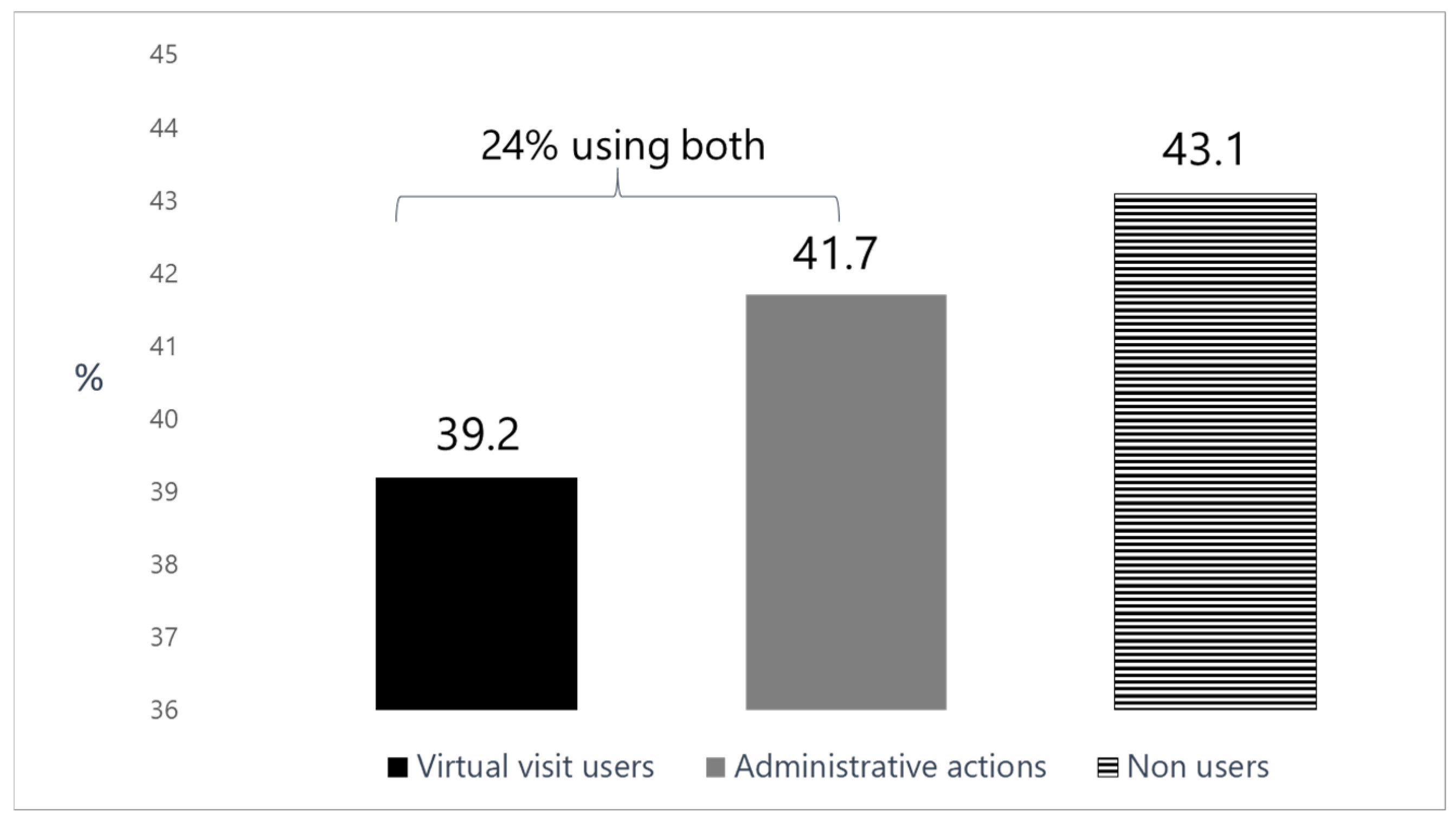
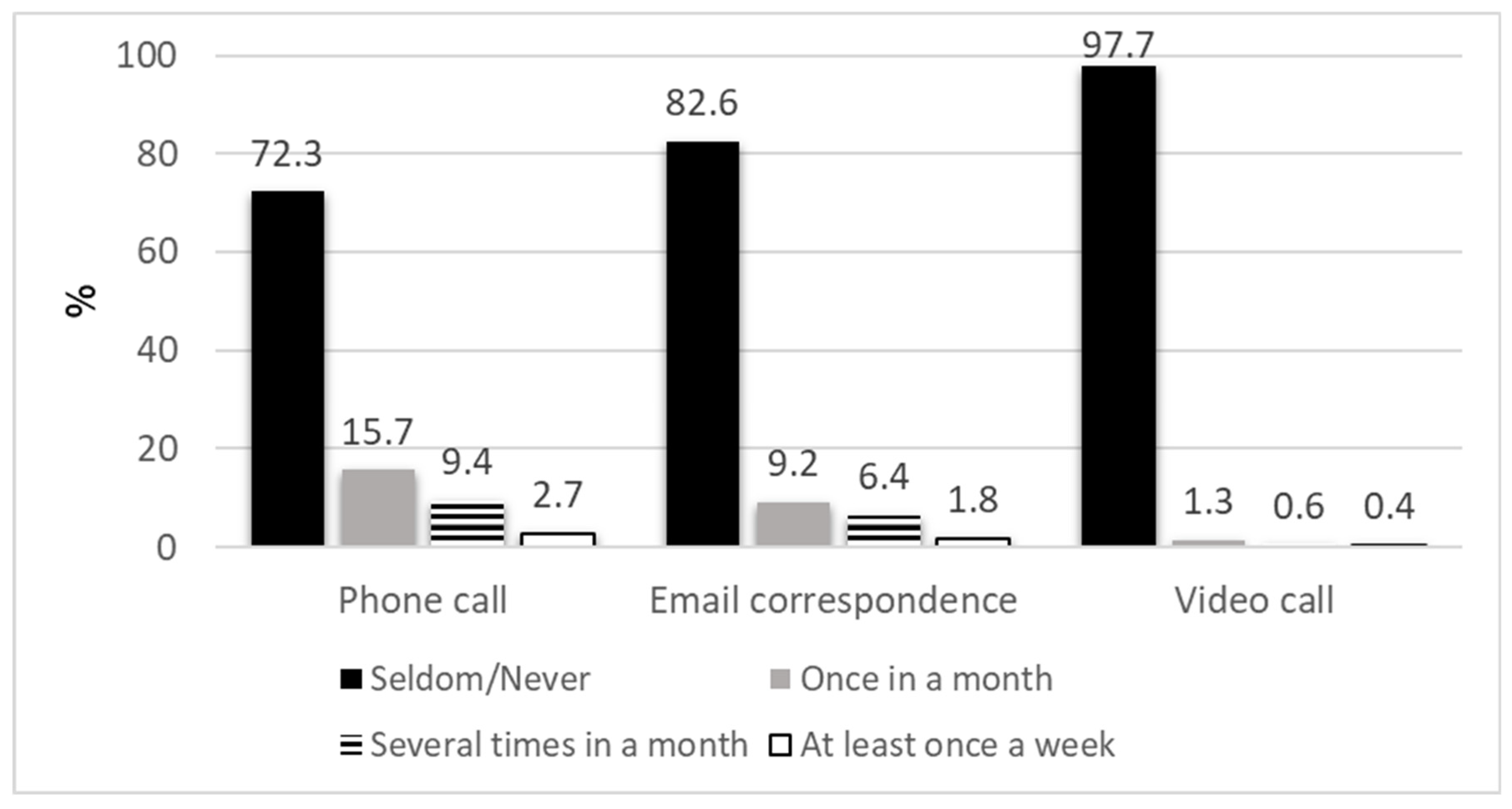
- Despite cultural and technological challenges, the study’s findings reveal that telemedicine is being used within the Ultra- Orthodox community, with phone consultation, being the most common use of telemedicine services -indicating its potential as an accessible modality for populations facing cultural or technological barriers.
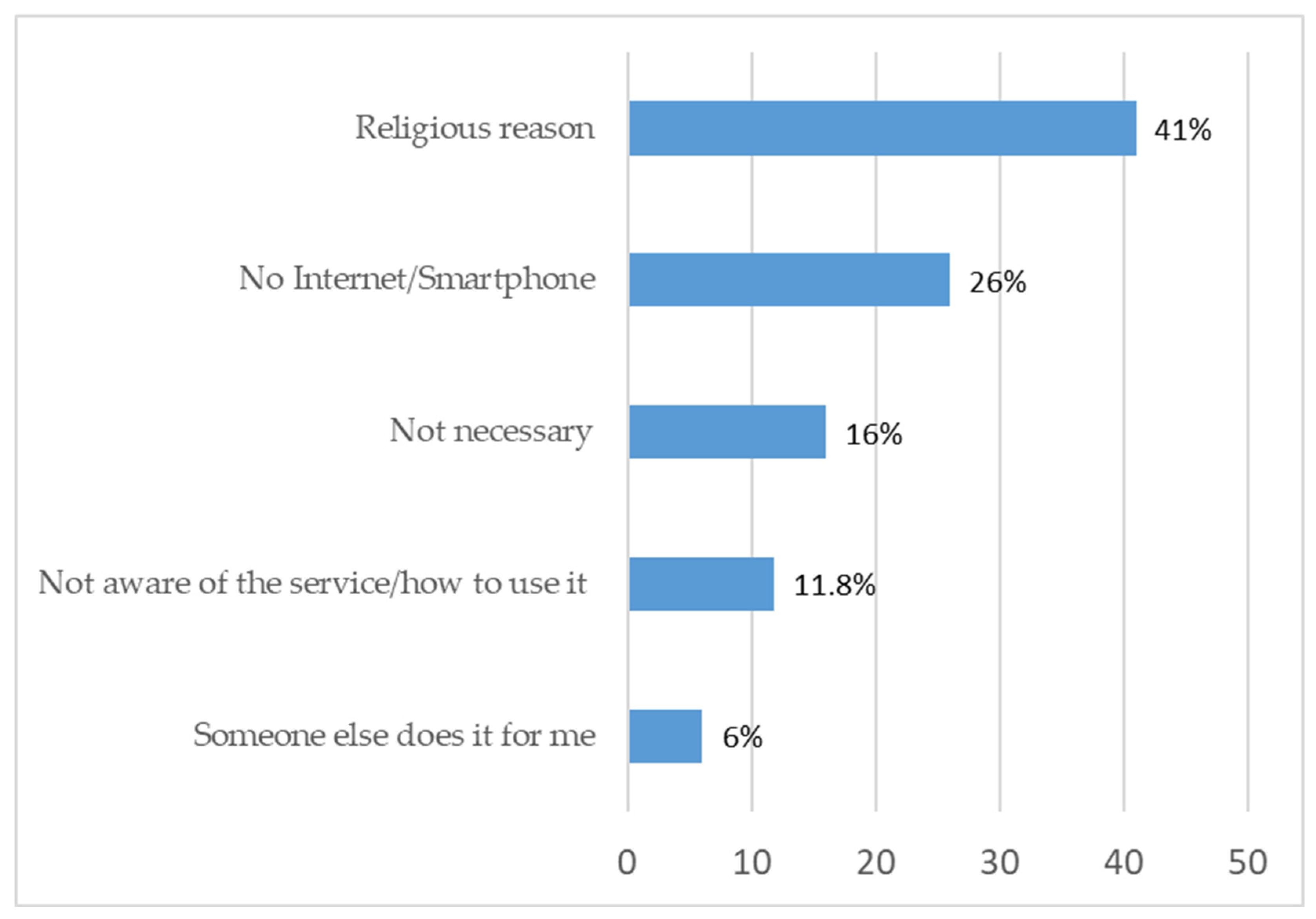
- The main barrier to the use of telemedicine among the research participants is a religious-ideological reason, and about a third of the respondents stated that they do not have a smart phone or internet- posing a specific public health challenge.
- The study findings may assist policy makers and healthcare systems in expanding the provision of telemedicine services within the Ultra-Orthodox community, for example, by further developing and scaling telephone-based telemedicine services for this population in Israel.
- The finding underscores the need for careful consideration when implementing telemedicine services within the Ultra-Orthodox community, through the development of culturally tailored solutions and strategies that align with its unique characteristics and may enhance motivation to use telemedicine.
Abstract
1. Introduction
2. Materials and Methods
2.1. Setting and Participants
2.2. Study Tool
2.3. Data Collection
2.4. Statistical Analysis
3. Results
3.1. Sociodemographic Characteristics of the Study Population
3.2. Characteristics of Telemedicine Users
3.3. Comparison of Technology Use Between Ultra-Orthodox Groups
3.4. Barriers of Using Telemedicine
4. Discussion
Strengths and Limitations
5. Conclusions
Author Contributions
Funding
Institutional Review Board Statement
Informed Consent Statement
Data Availability Statement
Acknowledgments
Conflicts of Interest
Abbreviation
| UO | Ultra-Orthodox |
Appendix A

| Characteristic | All * n = 1409 | Hasidic n = 471 | Lithuanian n = 480 | Sephardic n = 458 | p Value |
|---|---|---|---|---|---|
| n (%) | n (%) | n (%) | n (%) | ||
| Mobile phone | 0.032 | ||||
| Simple phone | 1138 (80.8) | 399 (84.7) | 383 (79.8) | 356 (77.7) | |
| Internet-restricted smartphone | 143 (10.1) | 40 (8.5) | 57 (11.9) | 46 (10.0) | |
| Smartphone | 118 (8.4) | 31 (6.6) | 36 (7.5) | 51 (11.1) | |
| No mobile phone | 10 (0.7) | 1 (0.2) | 4 (0.8) | 5 (1.1) | |
| Mobile daily use | 0.3 | ||||
| <2 h | 832 (59.4) | 260 (55.3) | 285 (60.0) | 287 (63.1) | |
| 2–5 | 364 (26.0) | 139 (29.6) | 120 (25.3) | 105 (23.1) | |
| 5–8 | 118 (8.4) | 43 (1.9) | 41 (8.6) | 34 (7.5) | |
| >8 | 86 (6.1) | 28 (6.0) | 29 (6.1) | 29 (6.4) | |
| Computer desk | <0.001 | ||||
| Yes | 354 (25.1) | 97 (6.20) | 152 (31.7) | 105 (22.9) | |
| No | 1055 (74.9) | 374 (4.79) | 328 (68.3) | 353 (77.1) | |
| Laptop | <0.001 | ||||
| Yes | 759 (53.9) | 181 (4.38) | 325 (7.67) | 253 (2.55) | |
| No | 650 (46.1) | 290 (6.61) | 155 (3.32) | 205 (8.44) | |
| Internet subscription | <0.001 | ||||
| Yes | 629 (44.6) | 183 (9.38) | 272 (7.56) | 174 (0.38) | |
| No | 780 (55.4) | 288 (1.61) | 208 (3.43) | 284 (0.62) | |
| Internet use | 0.002 | ||||
| No | 452 (32.1) | 163 (34.6) | 119 (24.8) | 170 (37.1) | |
| Yes | 957 (67.9) | 308 (65.4) | 361 (75.2) | 288 (62.9) | |
| Frequency of use among users ** | |||||
| Seldom | 70 (7.3) | 25 (8.1) | 17 (4.7) | 28 (9.7) | |
| Several times a month | 92 (9.6) | 21 (6.8) | 30 (8.3) | 41 (14.2) | |
| 1–3 times a week | 162(16.9) | 57 (18.4) | 55 (15.2) | 50 (17.4) | |
| Every day/almost every day | 634 (66.2) | 206 (66.7) | 259 (71.7) | 169 (58.7) |
References
- World Health Organization. Telemedicine: Opportunities and Developments in Member States—Report on the Second Global Survey on eHealth; Global Observatory for eHealth Series, Volume 2; World Health Organization: Geneva, Switzerland, 2010; Available online: https://iris.who.int/items/0365143e-27dc-418e-ad66-ae095df34fda (accessed on 3 March 2026).
- Dopelt, K.; Avni, N.; Haimov-Sadikov, Y.; Golan, I.; Davidovitch, N. Telemedicine and EHealth Literacy in the Era of COVID-19: A Cross-Sectional Study in a Peripheral Clinic in Israel. Int. J. Environ. Res. Public Health 2021, 18, 9556. [Google Scholar] [CrossRef]
- Stoltzfus, M.; Kaur, A.; Chawla, A.; Gupta, V.; Anamika, F.N.U.; Jain, R. The Role of Telemedicine in Healthcare: An Overview and Update. Egypt. J. Intern. Med. 2023, 35, 49. [Google Scholar] [CrossRef]
- Capodici, A.; Noci, F.; Nuti, S.; Emdin, M.; Dalmiani, S.; Passino, C.; Hernandez-Boussard, T.; Giannoni, A. Reducing Outpatient Wait Times through Telemedicine: A Systematic Review and Quantitative Analysis. BMJ Open 2025, 15, e088153. [Google Scholar] [CrossRef] [PubMed]
- Kruse, C.S.; Williams, K.; Bohls, J.; Shamsi, W. Telemedicine and Health Policy: A Systematic Review. Health Policy Technol. 2021, 10, 209–229. [Google Scholar] [CrossRef]
- Scott Kruse, C.; Karem, P.; Shifflett, K.; Vegi, L.; Ravi, K.; Brooks, M. Evaluating Barriers to Adopting Telemedicine Worldwide: A Systematic Review. J. Telemed. Telecare 2018, 24, 4–12. [Google Scholar] [CrossRef] [PubMed]
- Miyawaki, A.; Tabuchi, T.; Ong, M.K.; Tsugawa, Y. Age and Social Disparities in the Use of Telemedicine During the COVID-19 Pandemic in Japan: Cross-Sectional Study. J. Med. Internet Res. 2021, 23, e27982. [Google Scholar] [CrossRef]
- Nouri, S.; Khoong, E.C.; Lyles, C.R.; Karliner, L.S. Addressing Equity in Telemedicine for Chronic Disease Management During the COVID-19 Pandemic. NEJM Catal. Innov. Care Deliv. 2020. [Google Scholar] [CrossRef]
- Bhaskar, S.; Bradley, S.; Chattu, V.K.; Adisesh, A.; Nurtazina, A.; Kyrykbayeva, S.; Sakhamuri, S.; Yaya, S.; Sunil, T.; Thomas, P.; et al. Telemedicine Across the Globe-Position Paper From the COVID-19 Pandemic Health System Resilience PROGRAM (REPROGRAM) International Consortium (Part 1). Front. Public Health 2020, 8, 556720. [Google Scholar] [CrossRef]
- Chen, E.M.; Andoh, J.E.; Nwanyanwu, K. Socioeconomic and Demographic Disparities in the Use of Telemedicine for Ophthalmic Care during the COVID-19 Pandemic. Ophthalmology 2022, 129, 15–25. [Google Scholar] [CrossRef]
- World Health Organization. Consolidated Telemedicine Implementation Guide; World Health Organization: Geneva, Switzerland, 2022; Available online: https://www.who.int/publications/i/item/9789240059184 (accessed on 1 December 2025).
- Haimi, M. The Tragic Paradoxical Effect of Telemedicine on Healthcare Disparities- a Time for Redemption: A Narrative Review. BMC Med. Inform. Decis. Mak. 2023, 23, 95. [Google Scholar] [CrossRef]
- Friedman, M. The Haredi (Ultra-Orthodox) Society: Sources, Trends and Processes. Jerus. Inst. Isr. Stud. 1991, 1, 80–87. [Google Scholar]
- David, Y.; Baden, C. Reframing Community Boundaries: The Erosive Power of New Media Spaces in Authoritarian Societies. Inf. Commun. Soc. 2020, 23, 110–127. [Google Scholar] [CrossRef]
- Malach, G.; Cahner, L. The Yearbook of Ultra-Orthodox Society—Population; The Democratic Israeli Institute: Jerusalem, Israel, 2020. [Google Scholar]
- Sharabi, M.; Kay, A. Work Values of Working Women in Israel: A Comparison of Haredi Women with Those from the Secular and Traditional Segments. Contemp. Jew. 2023, 43, 121–141. [Google Scholar] [CrossRef]
- Brown, B. The Haredim: A Guide to Their Beliefs and Sectors; The Israeli Democracy Institute: Jerusalem, Israel, 2017. (In Hebrew) [Google Scholar]
- Zalcberg-Block, S.; Zalcberg, S. Experiences, Perceptions, and Meanings of the Ultra-Orthodox in Israel Regarding Premarital Genetic Testing. J. Relig. Health 2024, 63, 2362–2379. [Google Scholar] [CrossRef]
- Malach, G.; Cahaner, L. Annual Statistical Report on Ultra-Orthodox (Haredi) Society in Israel; The Israel Democracy Institute: Jerusalem, Israel, 2023. [Google Scholar]
- Zalcberg Block, S.; Zalcberg, S. Religious Minorities’ Perceptions of Official COVID-19 Health Guidelines: The Case of Ultra-Orthodox Society in Israel. J. Relig. Health 2023, 62, 408–427. [Google Scholar] [CrossRef]
- Gabay, G.; Tarabeih, M. Underground COVID-19 Home Hospitals for Haredim: Non-Compliance or a Culturally Adapted Alternative to Public Hospitalization? J. Relig. Health 2021, 60, 3434–3453. [Google Scholar] [CrossRef] [PubMed]
- Malach, G.; Cahaner, L. Annual Statistical Report on Ultra-Orthodox (Haredi) Society in Israel; The Israel Democracy Institute: Jerusalem, Israel, 2025. [Google Scholar]
- Bezeq. Bezeq Report on Digital Usage in the Ultra-Orthodox Community; Bezeq: Holon, Israel, 2020. (In Hebrew) [Google Scholar]
- Askaria. Internet Access and Usage Patterns During the COVID-19 Pandemic; Askaria: Bnei-Brak, Israel, 2020. (In Hebrew) [Google Scholar]
- Shahar, R.N.B.; Marciano, A.; Schejter, A.M. “There Are Only a Few Things That You Cannot Manage without Internet”: Realization of Capabilities through Internet (Non)Use by Ultra-Orthodox Jewish Women. Inf. Soc. 2023, 39, 296–305. [Google Scholar] [CrossRef]
- Mistry, S.K.; Shaw, M.; Raffan, F.; Johnson, G.; Perren, K.; Shoko, S.; Harris-Roxas, B.; Haigh, F. Inequity in Access and Delivery of Virtual Care Interventions: A Scoping Review. Int. J. Environ. Res. Public Health 2022, 19, 9411. [Google Scholar] [CrossRef]
- Abou Ali, A.N.; Abdul Malak, O.M.; Hafeez, M.S.; Habib, S.; Cherfan, P.; Salem, K.M.; Hager, E.; Avgerinos, E.; Sridharan, N. Improved Outpatient Medical Visit Compliance with Sociodemographic Discrepancies in Vascular Telehealth Evaluations. J. Vasc. Surg. 2023, 77, 1238–1244. [Google Scholar] [CrossRef]
- Gordon, N.P.; Hornbrook, M.C. Differences in Access to and Preferences for Using Patient Portals and Other EHealth Technologies Based on Race, Ethnicity, and Age: A Database and Survey Study of Seniors in a Large Health Plan. J. Med. Internet Res. 2016, 18, e50. [Google Scholar] [CrossRef]
- Reges, O.; Feldhamer, I.; Wolff Sagy, Y.; Lavie, G. Factors Associated with Using Telemedicine in the Primary Care Clinics during the COVID-19 Pandemic in Israel. Int. J. Environ. Res. Public Health 2022, 19, 13207. [Google Scholar] [CrossRef]
- Odukoya, E.J.; Andino, J.; Ng, S.; Steppe, E.; Ellimoottil, C. Predictors of Video versus Audio-Only Telehealth Use among Urological Patients. Urol. Pract. 2022, 9, 198–204. [Google Scholar] [CrossRef]
- Laron, M.; Fialko, S.; Gorlik, Y.; Norman, T. Population Survey on the Level of Service and Health Care System Performance in 2024: Preliminary Findings; Myers-JDC-Brookdale Institute: Jerusalem, Israel, 2025. (In Hebrew) [Google Scholar]
- Haimi, M.; Sergienko, R. Adoption and Use of Telemedicine and Digital Health Services Among Older Adults in Light of the COVID-19 Pandemic: Repeated Cross-Sectional Analysis. JMIR Aging 2024, 7, e52317. [Google Scholar] [CrossRef] [PubMed]
- Mahtta, D.; Daher, M.; Lee, M.T.; Sayani, S.; Shishehbor, M.; Virani, S.S. Promise and Perils of Telehealth in the Current Era. Curr. Cardiol. Rep. 2021, 23, 115. [Google Scholar] [CrossRef] [PubMed]
- Golan, O.; Mishol-Shauli, N. Religious Journalists’ Ethics on Communicating Science: The Case of Ultra-Orthodox Reportage in Israel. Religions 2024, 15, 296. [Google Scholar] [CrossRef]
- Israel Internet Association. Internet and the Ultra-Orthodox Society in Israel: Usage and Attitudes; Israel Internet Association: Petach Tikva, Israel, 2022; Available online: https://en.isoc.org.il/about/news-room/haredi-internet-2022 (accessed on 1 December 2025).
- Chen, J.; Li, K.Y.; Andino, J.; Hill, C.E.; Ng, S.; Steppe, E.; Ellimoottil, C. Predictors of Audio-Only Versus Video Telehealth Visits During the COVID-19 Pandemic. J. Gen. Intern. Med. 2022, 37, 1138–1144. [Google Scholar] [CrossRef] [PubMed]
- Penn, N.; Laron, M. Use and Barriers to the Use of Telehealth Services in the Arab Population in Israel: A Cross Sectional Survey. Isr. J. Health Policy Res. 2023, 12, 21. [Google Scholar] [CrossRef]
- Ganguli, I.; Orav, E.J.; Hailu, R.; Lii, J.; Rosenthal, M.B.; Ritchie, C.S.; Mehrotra, A. Patient Characteristics Associated With Being Offered or Choosing Telephone vs Video Virtual Visits Among Medicare Beneficiaries. JAMA Netw. Open 2023, 6, e235242. [Google Scholar] [CrossRef]
- Rodriguez, J.A.; Betancourt, J.R.; Sequist, T.D.; Ganguli, I. Differences in the Use of Telephone and Video Telemedicine Visits during the COVID-19 Pandemic. Am. J. Manag. Care 2021, 27, 21–26. [Google Scholar] [CrossRef]
- Reiners, F.; Sturm, J.; Bouw, L.J.W.; Wouters, E.J.M. Sociodemographic Factors Influencing the Use of EHealth in People with Chronic Diseases. Int. J. Environ. Res. Public Health 2019, 16, 645. [Google Scholar] [CrossRef]
- Chang, E.; Penfold, R.B.; Berkman, N.D. Patient Characteristics and Telemedicine Use in the US, 2022. JAMA Netw. Open 2024, 7, e243354. [Google Scholar] [CrossRef] [PubMed]
- Prins Engelsman, S.; Huss, E.; Cwikel, J. How Ultra-Orthodox (Haredi) Israeli Women Cope with Normative and Difficult Pregnancy and Childbirth Experiences. Nashim J. Jew. Women’s Stud. Gend. Issues 2018, 33, 136–157. [Google Scholar] [CrossRef]
- Malach, G.; Cahaner, L. Annual Statistical Report on Ultra-Orthodox (Haredi) Society in Israel; The Israel Democracy Institute: Jerusalem, Israel, 2022. [Google Scholar]
- Jaffe, D.H.; Lee, L.; Huynh, S.; Haskell, T.P. Health Inequalities in the Use of Telehealth in the United States in the Lens of COVID-19. Popul. Health Manag. 2020, 23, 368–377. [Google Scholar] [CrossRef] [PubMed]
- Haimi, M.; Shadmi, E.; Hornik-Lurie, T.; Sperling, D. Telehealth Usage Disparities in Israel in Light of the COVID-19 Pandemic: Retrospective Cohort Study of Intersectional Sociodemographic Patterns and Health Equity Implications. J. Med. Internet Res. 2025, 27, e77600. [Google Scholar] [CrossRef]
- Zur, U. The Intricate Relations between the Ultra-Orthodox and Use of the Internet in Israel. J. Study Relig. Ideol. 2024, 23, 32–46. [Google Scholar]


| Characteristic | All n = 1460 | Frequent Users n = 572 | Seldom/No Users n = 888 | p Value |
|---|---|---|---|---|
| n (%) | n (%) | n (%) | ||
| Gender | <0.001 | |||
| Male | 717 (49.1) | 234 (40.9) | 483 (54.4) | |
| Female | 743 (50.9) | 338 (59.1) | 405 (45.6) | |
| Age categories | <0.001 | |||
| 18–29 | 628 (43) | 210 (36.6) | 418 (47.1) | |
| 30–44 | 461 (31.6) | 239 (41.8) | 222 (25.0) | |
| 45–59 | 258 (17.7) | 93 (16.3) | 165 (18.6) | |
| 60+ | 113 (7.7) | 30 (5.2) | 83 (9.3) | |
| Ultra-Orthodox group | 0.2 | |||
| Hasidic | 471 (32.3) | 172 (30.1) | 299 (33.7) | |
| Lithuanian | 480 (32.9) | 206 (36.0) | 274 (30.9) | |
| Sephardic | 458 (31.4) | 173 (30.2) | 285 (32.1) | |
| Other | 51 (3.5) | 21 (3.7) | 30 (3.4) | |
| Marital status | <0.001 | |||
| Married | 1195 (81.8) | 514 (89.9) | 681 (76.7) | |
| Single | 220 (15.1) | 43 (7.5) | 177 (19.9) | |
| Divorced | 28 (1.9) | 8 (1.4) | 20 (2.3) | |
| Widowed | 17 (1.2) | 7 (1.2) | 10 (1.1) | |
| Number of children, mean (SD) | 4.1 (3.3) | 4.5 (3.0) | 3.9 (3.5) | <0.001 |
| Peripherality | 0.03 | |||
| Central (levels 7–10) | 910 (62.3) | 369 (64.5) | 541 (60.9) | |
| Peripheral (levels 1–6) | 550 (37.5) | 203 (35.5) | 347 (39.1) | |
| Education | 0.004 | |||
| Elementary School | 132 (9) | 65 (11.4) | 67 (7.5) | |
| High School | 233 (16) | 87 (15.2) | 146 (16.4) | |
| Higher education (non-academic) * | 598 (41) | 211 (36.9) | 387 (43.6) | |
| Academic degree | 449 (30.8) | 196 (34.3) | 253 (28.5) | |
| Income (compared to the National income of Ultra-Orthodox) ** | <0.001 | |||
| Much below | 423 (29.5) | 124 (22.1) | 299 (34.3) | |
| Below | 347 (24.2) | 130 (23.1) | 217 (24.9) | |
| Similar | 280 (19.5) | 126 (22.4) | 154 (17.7) | |
| Above | 253 (17.7) | 127 (22.6) | 126 (14.5) | |
| Refused to answer | 130 (9.1) | 55 (9.8) | 75 (8.6) | |
| House density | 0.002 | |||
| Low | 466 (31.9) | 152 (26.6) | 314 (35.4) | |
| Moderate | 755 (51.7) | 320 (55.9) | 435 (49.0) | |
| High | 239 (16.4) | 100 (17.5) | 139 (15.7) |
| Characteristic | All n = 1460 | Frequent Use n = 572 | Seldom/Non-Users n = 888 | p Value |
|---|---|---|---|---|
| n (%) | n (%) | n (%) | ||
| Chronic disease | 0.3 | |||
| Yes | 129 (8.8) | 53 (9.3) | 76 (8.6) | |
| No | 1331 (91.2) | 519 (90.7) | 812 (91.4) | |
| Family doctor visits in the last year | <0.001 | |||
| 0 | 374 (25.6) | 112 (19.6) | 262 (29.5) | |
| 1–2 | 607 (41.6) | 235 (41.1) | 372 (41.9) | |
| 3–5 | 315 (21.6) | 141 (24.7) | 174 (19.6) | |
| >5 | 164 (11.2) | 84 (14.7) | 80 (9.0) | |
| Expert doctor visits in the last year | <0.001 | |||
| 0 | 664 (45.5) | 221 (38.6) | 443 (49.9) | |
| 1–2 | 553 (37.9) | 223 (39.0) | 330 (37.2) | |
| 3–5 | 167 (11.4) | 85 (14.9) | 82 (9.2) | |
| >5 | 76 (5.2) | 43 (7.5) | 33 (3.7) |
| Characteristic | All n = 1460 | Frequent Users n = 572 | Seldom/Non-Users n = 888 | p Value |
|---|---|---|---|---|
| n (%) | n (%) | n (%) | ||
| Mobile phone * | 0.08 | |||
| Simple phone | 1165 (80.3) | 442 (77.5) | 723 (82.2) | |
| Kosher smartphone | 151 (10.4) | 65 (11.4) | 86 (9.8) | |
| Regular Smartphone | 134 (9.2) | 63 (11.1) | 71 (8.1) | |
| Mobile phone daily use * | <0.001 | |||
| <2 h | 857 (59.1) | 301 (52.8) | 556 (63.2) | |
| 2–5 | 376 (25.9) | 167 (29.3) | 209 (23.7) | |
| 5–8 | 128 (8.8) | 64 (11.2) | 63 (7.2) | |
| >8 | 91 (6.2) | 38 (6.7) | 52 (5.9) | |
| Availability of a computer | ||||
| Computer desk | 366 (25.1) | 143 (25.0) | 223 (25.1) | 0.9 |
| Laptop | 790 (54.1) | 336 (58.7) | 454 (51.1) | 0.004 |
| Internet subscription | 656 (44.9) | 275 (48.1) | 381 (42.9) | 0.05 |
| Internet use | 998 (68.4) | 445 (77.8) | 553 (62.3) | <0.001 |
| Reference Category | OR | 95% CI | |
|---|---|---|---|
| Age categories | |||
| 30–44 | 18–29 | 1.59 | 1.20–2.11 |
| 45–59 | 18–29 | 0.84 | 0.60–1.18 |
| 60+ | 18–29 | 0.52 | 0.32–0.86 |
| Gender | |||
| Female | Male | 1.7 | 1.35–2.15 |
| Ultra-Orthodox group | |||
| Lithuanian | Hasidic | 1.33 | 1.00–1.77 |
| Sephardic | Hasidic | 1.19 | 0.89–1.60 |
| Other | Hasidic | 0.97 | 0.50–1.85 |
| Family status | |||
| Married | Unmarried | 2.24 | 1.54–3.24 |
| Income | |||
| Below average | Much below average | 1.09 | 0.78–1.51 |
| Similar to average | Much below average | 1.35 | 0.95–1.93 |
| Above average | Much below average | 1.71 | 1.16–2.50 |
| Refused to answer | Much below average | 1.48 | 0.95–2.30 |
| Family doctor visits | |||
| 1–2 | 0 | 1.42 | 1.05–1.91 |
| 3–5 | 0 | 1.9 | 1.35–2.67 |
| >5 | 0 | 3.23 | 2.13–4.90 |
| Mobile phone | |||
| Internet-restricted smartphone | Regular phone | 0.88 | 0.60–1.31 |
| Regular smartphone | Regular phone | 1.25 | 0.83–1.88 |
| Internet use | |||
| Yes | No | 2.01 | 1.49–2.71 |
| Internet subscription | |||
| Yes | No | 0.81 | 0.62–1.06 |
Disclaimer/Publisher’s Note: The statements, opinions and data contained in all publications are solely those of the individual author(s) and contributor(s) and not of MDPI and/or the editor(s). MDPI and/or the editor(s) disclaim responsibility for any injury to people or property resulting from any ideas, methods, instructions or products referred to in the content. |
© 2026 by the authors. Licensee MDPI, Basel, Switzerland. This article is an open access article distributed under the terms and conditions of the Creative Commons Attribution (CC BY) license.
Share and Cite
Ramot, S.; Barkai, G.; Hirsh-Yechezkel, G.; Chetrit, A. Attitudes and Barriers to the Use of Telemedicine in the Ultra-Orthodox Society in Israel: A Cross-Sectional Study. Int. J. Environ. Res. Public Health 2026, 23, 381. https://doi.org/10.3390/ijerph23030381
Ramot S, Barkai G, Hirsh-Yechezkel G, Chetrit A. Attitudes and Barriers to the Use of Telemedicine in the Ultra-Orthodox Society in Israel: A Cross-Sectional Study. International Journal of Environmental Research and Public Health. 2026; 23(3):381. https://doi.org/10.3390/ijerph23030381
Chicago/Turabian StyleRamot, Shira, Galia Barkai, Galit Hirsh-Yechezkel, and Angela Chetrit. 2026. "Attitudes and Barriers to the Use of Telemedicine in the Ultra-Orthodox Society in Israel: A Cross-Sectional Study" International Journal of Environmental Research and Public Health 23, no. 3: 381. https://doi.org/10.3390/ijerph23030381
APA StyleRamot, S., Barkai, G., Hirsh-Yechezkel, G., & Chetrit, A. (2026). Attitudes and Barriers to the Use of Telemedicine in the Ultra-Orthodox Society in Israel: A Cross-Sectional Study. International Journal of Environmental Research and Public Health, 23(3), 381. https://doi.org/10.3390/ijerph23030381