

Factors Limiting Access to Surgical Treatment of Focal Epilepsy in Kazakh Population

 , , , , ,
Highlights
- Significant differences by marital status, social protection, and region indicate that social and geographic factors influence who receives surgical treatment, highlighting disparities in access to specialized care for people with drug-resistant focal epilepsy.
- Compared with non-operated patients, individuals with focal epilepsy who underwent surgery had a younger age at seizure onset, a longer duration of epilepsy, and earlier initiation of antiepileptic therapy, suggesting differences in referral timing and continuity of care that may influence the likelihood of receiving surgery.
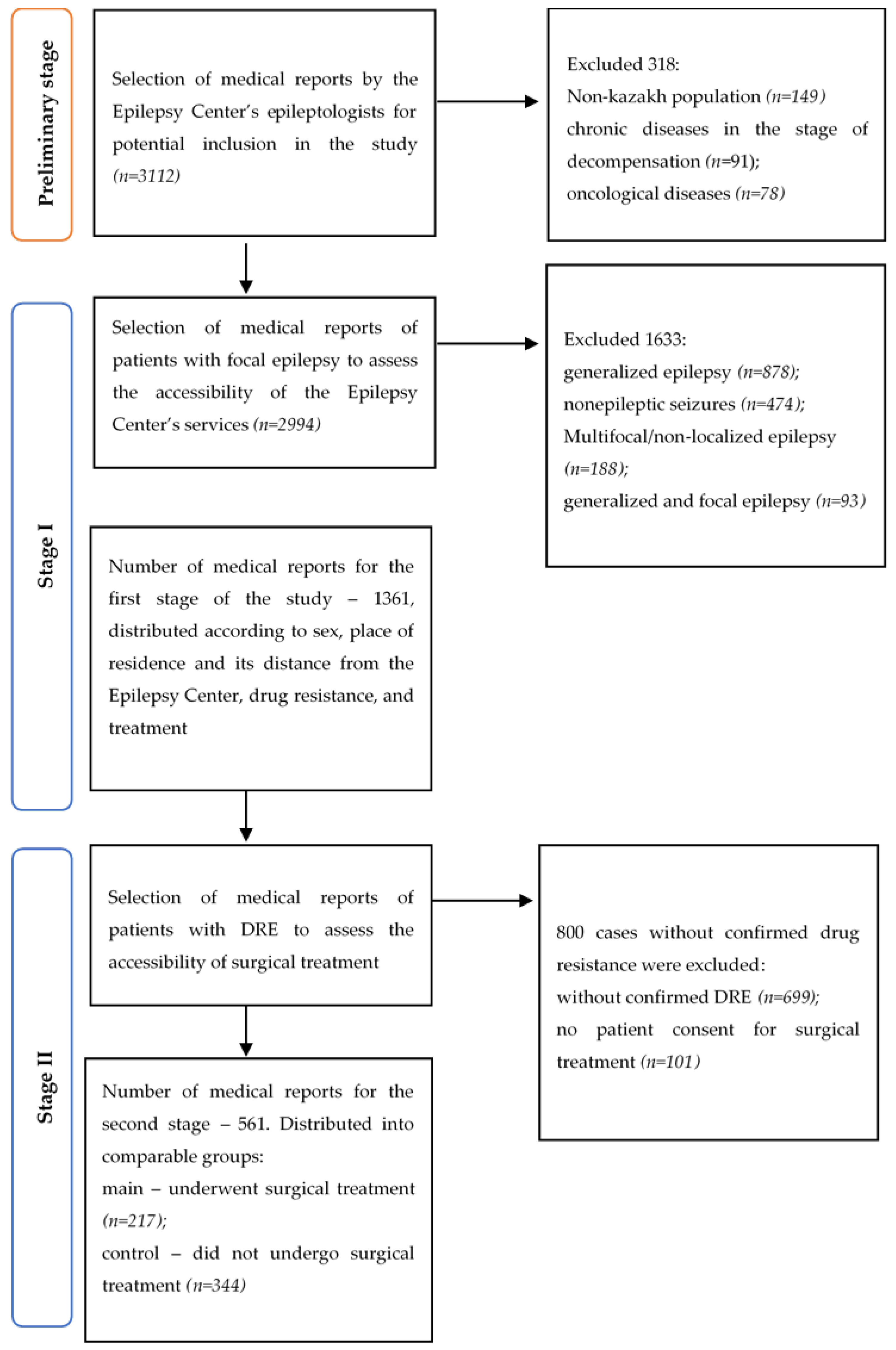
- Among patients with drug-resistant focal epilepsy identified as candidates for surgical treatment at the Epilepsy Center, only 38.68% underwent surgery. The work highlights the need to adopt a comprehensive approach to epilepsy management that preserves the work capacity and social participation of individuals with focal epilepsy.
- The finding that marital status, rural residence, employment, and especially region strongly influence the likelihood of receiving surgery shows that access to epilepsy treatment is shaped by social and geographic factors rather than medical need alone—indicating disparities that public health systems should address.
- The need for prospective analysis and proactive measures in countries with rapidly developing technological capabilities and increasing barriers to the effective management of focal epilepsy.
- The need to accumulate personalized data from patients with focal epilepsy to support the development of technologies capable of predicting and modifying the course of the disease.
Abstract
1. Introduction
2. Material and Methods
2.1. Study Design and Data Selection
2.2. Statistical Analysis
3. Results
3.1. Stage I: Assessment of Patient Access to the Epilepsy Center
3.2. Stage II: Barriers to Receiving Surgical Treatment for Patients with DRE
4. Discussion
5. Conclusions
Author Contributions
Funding
Institutional Review Board Statement
Informed Consent Statement
Data Availability Statement
Acknowledgments
Conflicts of Interest
References
- Feigin, V.L.; Vos, T.; Nair, B.S.; Hay, S.I.; Abate, Y.H.; Al Magied, A.H.A.A.; ElHafeez, S.A.; Abdelkader, A.; Abdollahifar, M.-A.; Abdullahi, A.; et al. GBD Epilepsy Collaborators Global, regional, and national burden of epilepsy, 1990–2021: A systematic analysis for the Global Burden of Disease Study 2021. Lancet Public Health 2025, 10, e203–e227. [Google Scholar] [CrossRef]
- Miller, J.S.; Oladele, F.; McAfee, D.; Adereti, C.O.; Theodore, W.H.; Akinsoji, E.O. Disparities in epilepsy diagnosis and management in high-income countries: A review of the literature. Neurol. Clin. Pract. 2024, 14, e200259. [Google Scholar] [CrossRef]
- Bush, K.J.; Cullen, E.; Mills, S.; Chin, R.F.M.; Thomas, R.H.; Kingston, A.; Pickrell, W.O.; E Ramsay, S. Assessing the extent and determinants of socioeconomic inequalities in epilepsy in the UK: A systematic review and meta-analysis of evidence. Lancet Public Health 2024, 9, e614–e628. [Google Scholar] [CrossRef]
- Foster, E.; Chen, Z.; Zomer, E.; Rychkova, M.; Carney, P.; O’Brien, T.J.; Liew, D.; Jackson, G.D.; Kwan, P.; Ademi, Z. The costs of epilepsy in Australia: A productivity-based analysis. Neurology 2020, 95, e3221–e3231. [Google Scholar] [CrossRef]
- Ivaniuk, A.; Pestana-Knight, E.; Brunklaus, A.; Lal, D. Epilepsy at Precision Medicine Crossroads—Disease Modification, Presymptomatic Treatment, and Early Screening. JAMA Neurol. 2025, 82, 975–976. [Google Scholar] [CrossRef]
- Vassallo, P.; Gursal, V.; Xiong, W.; Zhou, D.; de Tisi, J.; Thijs, R.D.; Duncan, J.S.; Sander, J.W. Temporal Trends in Hippocampal Sclerosis Surgery: An Observational Study from a Tertiary Epilepsy Centre. Eur. J. Neurol. 2025, 32, e70041. [Google Scholar] [CrossRef]
- Samanta, D. The role of implementation science in improving epilepsy surgery utilization. Epilepsy Behav. 2022, 130, 108669. [Google Scholar] [CrossRef] [PubMed]
- Samanta, D.; Ostendorf, A.P.; Willis, E.; Singh, R.; Gedela, S.; Arya, R.; Perry, M.S. Underutilization of epilepsy surgery: Part I: A scoping review of barriers. Epilepsy Behav. 2021, 117, 107837. [Google Scholar] [CrossRef]
- Samanta, D.; Singh, R.; Gedela, S.; Perry, M.S.; Arya, R. Underutilization of epilepsy surgery: Part II: Strategies to overcome barriers. Epilepsy Behav. 2021, 117, 107853. [Google Scholar] [CrossRef] [PubMed]
- Iwasaki, M.; Saito, T.; Tsubota, A.; Murata, T. Budget impact analysis of treatment flow optimization in epilepsy patients: Estimating potential impacts with increased referral rate to specialized care. J. Health Econ. Outcomes Res. 2021, 8, 80. [Google Scholar] [PubMed]
- Akhmedullin, R.; Kozhobekova, B.; Gusmanov, A.; Aimyshev, T.; Utebekov, Z.; Kyrgyzbay, G.; Shpekov, A.; Gaipov, A. Epilepsy trends in Kazakhstan: A retrospective longitudinal study using data from unified national electronic health system 2014–2020. Seizure Eur. J. Epilepsy 2024, 122, 58–63. [Google Scholar] [CrossRef]
- Guekht, A.; Zharkinbekova, N.; Shpak, A.; Hauser, W.A. Epilepsy and treatment gap in urban and rural areas of the Southern Kazakhstan in adults. Epilepsy Behav. 2017, 67, 98–104. [Google Scholar] [CrossRef]
- Menlibayeva, K.; Nurimanov, C.; Mammadinova, I.; Turzhanova, A.; Akshulakov, S.; Makhambetov, Y. Challenges in the Management of Cavernoma-Related Epilepsy: Seizure Outcomes, Antiseizure Medication Practices, and Access to Intraoperative Technologies in Kazakhstan. Brain Sci. 2025, 15, 992. [Google Scholar] [CrossRef]
- Fisher, R.S.; Cross, J.H.; French, J.A.; Higurashi, N.; Hirsch, E.; Jansen, F.E.; Lagae, L.; Moshé, S.L.; Peltola, J.; Roulet Perez, E.; et al. Operational classification of seizure types by the International League Against Epilepsy: Position Paper of the ILAE Commission for Classification and Terminology. Epilepsia 2017, 58, 522–530. [Google Scholar] [CrossRef]
- Doetsch, J.N.; Schlösser, C.; Barros, H.; Shaw, D.; Krafft, T.; Pilot, E. A scoping review on the impact of austerity on healthcare access in the European Union: Rethinking austerity for the most vulnerable. Int. J. Equity Health 2023, 22, 3. [Google Scholar] [CrossRef] [PubMed]
- Bensken, W.P.; Alberti, P.M.; Khan, O.I.; Williams, S.M.; Stange, K.C.; Vaca, G.F.-B.; Jobst, B.C.; Sajatovic, M.; Koroukian, S.M. A framework for health equity in people living with epilepsy. Epilepsy Res. 2022, 188, 107038. [Google Scholar] [CrossRef] [PubMed]
- Odhiambo; Kariuki, S.M.; Newton, C.R. Therapeutic monitoring of anti-seizure medications in low-and middle-income countries: A systematic review. Wellcome Open Res. 2024, 6, 92. [Google Scholar] [CrossRef]
- Pinto, L.F.; Silva, L.S.; João, R.B.; Boldrini, V.; Cendes, F.; Yasuda, C.L. Practices in the prescription of antiseizure medications: Is it time to change? Arq. De Neuro-Psiquiatr. 2024, 82, 001–010. [Google Scholar] [CrossRef]
- Sharma, M.; Ball, T.; Alhourani, A.; Ugiliweneza, B.; Wang, D.; Boakye, M.; Neimat, J.S. Inverse national trends of laser interstitial thermal therapy and open surgical procedures for refractory epilepsy: A Nationwide Inpatient Sample–based propensity score matching analysis. Neurosurg. Focus 2020, 48, E11. [Google Scholar] [CrossRef] [PubMed]
- Malone, S.; Counts, L.; Zabotka, L.; Williams, A.; Loecher, N.; Wynja, K.; Bryan, G.; Tanner, R.; Cáceres-Serrano, A.; Ferrara, G.; et al. Stigma measurement in health: A systematic review. EClinicalMedicine 2025, 86, 103360. [Google Scholar] [CrossRef]
- Kuramochi, I.; Iwayama, T.; Horikawa, N.; Shimotsu, S.; Watanabe, S.; Yamanouchi, H.; Yoshimasu, H. Development and validation of the epilepsy self-stigma scale. Epilepsia Open 2021, 6, 748–756. [Google Scholar] [CrossRef] [PubMed]
- Manzanares, I.; Kuramochi, I.; Olivera, M.; Centeno, M.; Khawaja, M.; Pintor, L.; Donaire, A.; Carreño, M.d.M.; Conde-Blanco, E. Evaluation of self-stigma in patients with epilepsy: Validation of the self-stigma scale to Spanish (ESSS-S). Epilepsia Open 2024, 9, 2384–2394. [Google Scholar] [CrossRef] [PubMed]
- Wen, W.; Zhou, J.; Zhan, C.; Wang, J. Microglia as a Game Changer in Epilepsy Comorbid Depression. Mol. Neurobiol. 2023, 61, 4021–4037. [Google Scholar] [CrossRef] [PubMed]


| Factors | FE Cases | Newly Diagnosed at the Epilepsy Center | p-Value |
|---|---|---|---|
| Sex | 800 | 560 | 0.25 |
| Male | 371 (46.4%) | 242 (43.2%) | |
| Female | 429 (53.6%) | 318 (56.8%) | |
| Age (Me, (Q1–Q3)) | 34.5 (29.0–39.0) | 35.0 (32.0–45.0) | 0.12 |
| Age of FE Onset (Me, (Q1–Q3)) | 13.0 (6.0–12.0) | 14.0 (7.0–23.0) | 0.13 |
| Duration of FE (Me, (Q1–Q3)) | 22.0 (13.0–27.0) | 21.0 (11.0–28.0) | 0.79 |
| Start of ASM Therapy (Me, (Q1–Q3)) | 3.0 (1.0–18.8) | 6.0 (1.0–24.0) | 0.15 |
| Marital Status | 800 | 560 | 0.39 |
| Married | 412 (51.5%) | 275 (49.1%) | |
| Unmarried | 388 (48.5%) | 285 (50.9%) | |
| Place of Residence | 800 | 560 | 0.25 |
| Urban | 667 (83.4%) | 480 (85.7%) | |
| Rural | 133 (16.6%) | 80 (14.3%) | |
| Employment | 800 | 560 | 0.58 |
| Employed | 296 (37.0%) | 205 (36.6%) | |
| Unemployed | 504 (63.0%) | 355 (63.4%) | |
| Social Support | 800 | 560 | 0.64 |
| Yes | 520 (65.0%) | 370 (66.1%) | |
| No | 280 (35.0%) | 190 (33.9%) | |
| Region | 800 | 560 | 0.24 |
| Astana | 371 (46.4%) | 247 (44.1%) | |
| Other regions | 429 (53.6%) | 313 (55.9%) |
| Factors | Non-Operated | Operated | p-Value |
|---|---|---|---|
| Sex | 344 | 217 | 0.37 |
| Male | 169 (49.1%) | 115 (52.9%) | |
| Female | 175 (50.9%) | 102 (47.1%) | |
| Age (Me, (Q1–Q3)) | 39.0 (34.0–46.8) | 35.0 (30.0–41.0) | <0.0001 |
| Age of FE Onset (Me, (Q1–Q3)) | 15.0 (9.0–21.8) | 13.0 (6.0–19.5) | 0.02 |
| Duration of FE (Me, (Q1–Q3)) | 13.0 (6.0–22.0) | 24.0 (19.0–30.0) | 0.01 |
| Start of ASM Therapy (Me, (Q1–Q3)) | 22.0 (17.0–28.0) | 5.0 (1.0–20.5) | <0.0001 |
| Marital Status | 344 | 217 | <0.0001 |
| Married | 142 (41.3%) | 148 (68.2%) | |
| Unmarried | 202 (58.7%) | 69 (31.8%) | |
| Place of Residence | 344 | 217 | <0.0001 |
| Urban | 276 (80.2%) | 211 (97.2%) | |
| Rural | 68 (19.8%) | 6 (2.8%) | |
| Employment | 344 | 217 | 0.001 |
| Employed | 132 (38.4%) | 55 (25.3%) | |
| Unemployed | 212 (61.6%) | 162(74.7%) | |
| Social Support | 344 | 217 | 0.45 |
| Yes | 231 (67.2%) | 139 (64.1%) | |
| No | 113 (32.8%) | 78 (35.9%) | |
| Region | 344 | 217 | <0.0001 |
| Astana | 113 (32.9%) | 167 (76.9%) | |
| Other regions | 231 (67.2%) | 50 (23.1%) |
| Factors | Non-Operated | Operated | OR (95% CI) | p-Value |
|---|---|---|---|---|
| Male | 169 (49.1%) | 115 (52.9%) | 1 | 0.60 |
| Female | 175 (50.9%) | 102 (47.1%) | 0.90 (0.60–1.35) | |
| Married | 142 (41.3%) | 148 (68.2%) | 2.28 (1.51–3.46) | <0.0001 |
| Unmarried | 202 (58.7%) | 69 (31.8%) | 1 | |
| Urban | 276 (80.2%) | 211 (97.2%) | 2.35 (0.92–6.03) | 0.075 |
| Rural | 68 (19.8%) | 6 (2.8%) | 1 | |
| Employed | 132 (38.4%) | 55 (25.3%) | 1 | <0.003 |
| Unemployed | 212 (61.6%) | 162(74.7%) | 0.49 (0.31–0.71) | |
| Social Support Yes | 231 (67.2%) | 139 (64.1%) | 1 | 0.70 |
| Social Support No | 113 (32.8%) | 78 (35.9%) | 1.09 (0.69–1.72) | |
| Region | 344 | 217 | - | - |
| Region 1 Astana | 112 (32.6%) | 168 (77.4%) | 1 | - |
| Region 2 (500 m) | 69 (20.1%) | 28 (12.9%) | 3.14 (1.83–5.37) | <0.0001 |
| Region 3 (500–1000) | 41 (11.9%) | 12 (5.5%) | 4.05 (1.93–8.50) | <0.0001 |
| Region 4 (>1000) | 122 (35.5%) | 9 (4.14%) | 3.93 (1.45–10.6) | 0.007 |
Disclaimer/Publisher’s Note: The statements, opinions and data contained in all publications are solely those of the individual author(s) and contributor(s) and not of MDPI and/or the editor(s). MDPI and/or the editor(s) disclaim responsibility for any injury to people or property resulting from any ideas, methods, instructions or products referred to in the content. |
© 2026 by the authors. Licensee MDPI, Basel, Switzerland. This article is an open access article distributed under the terms and conditions of the Creative Commons Attribution (CC BY) license.
Share and Cite
Dossov, M.; Kassiyeva, B.; Bekenova, N.; Baibussinova, A.; Vochshenkova, T.; Aitkaliyev, A.; Suleimenova, A.; Kaptagayeva, A. Factors Limiting Access to Surgical Treatment of Focal Epilepsy in Kazakh Population. Int. J. Environ. Res. Public Health 2026, 23, 343. https://doi.org/10.3390/ijerph23030343
Dossov M, Kassiyeva B, Bekenova N, Baibussinova A, Vochshenkova T, Aitkaliyev A, Suleimenova A, Kaptagayeva A. Factors Limiting Access to Surgical Treatment of Focal Epilepsy in Kazakh Population. International Journal of Environmental Research and Public Health. 2026; 23(3):343. https://doi.org/10.3390/ijerph23030343
Chicago/Turabian StyleDossov, Mukhit, Balzhan Kassiyeva, Nazira Bekenova, Assel Baibussinova, Tamara Vochshenkova, Alisher Aitkaliyev, Akmaral Suleimenova, and Aigul Kaptagayeva. 2026. "Factors Limiting Access to Surgical Treatment of Focal Epilepsy in Kazakh Population" International Journal of Environmental Research and Public Health 23, no. 3: 343. https://doi.org/10.3390/ijerph23030343
APA StyleDossov, M., Kassiyeva, B., Bekenova, N., Baibussinova, A., Vochshenkova, T., Aitkaliyev, A., Suleimenova, A., & Kaptagayeva, A. (2026). Factors Limiting Access to Surgical Treatment of Focal Epilepsy in Kazakh Population. International Journal of Environmental Research and Public Health, 23(3), 343. https://doi.org/10.3390/ijerph23030343