

Retinal Microvascular Calibres and Body Fat Indices in Young Adults

Highlights
- This study links a major modifiable risk factor to an indicator of systemic vascular health by investigating the relationship between excess body fat and changes in retinal microvascular calibres.
- Retinal microvascular calibres are useful for detecting early cardio-metabolic risk associated with excess adiposity by providing a non-invasive window to systemic microvascular health.
- Associating body fat to changes in retinal microvascular calibres can help to identify individuals at a higher risk of developing cardiovascular diseases before clinical signs can manifest.
- This research is crucial for developing preventative strategies aimed at young adults as early changes in the retinal microvascular structure may precede the development of hypertension, diabetes and cardiovascular diseases.
- The use of simple measures of body fat with retinal imaging could be employed by healthcare professionals to enhance early risk identification in primary care.
- These results could be used by policy makers to advocate for early-life obesity focused interventions to reduce cardiovascular diseases burden in the future.
Abstract
1. Introduction
2. Materials and Methods
2.1. Study Design and Data Collection
2.2. Inclusion/Exclusion Criteria
2.3. Recruitment
2.4. Data Collection
2.5. Measurements
2.5.1. Anthropometric Measurements
2.5.2. Cardiovascular Measures
2.6. Retinal Vessel Analysis
2.7. Statistical Analysis
3. Results
4. Discussion
5. Conclusions
Author Contributions
Funding
Institutional Review Board Statement
Informed Consent Statement
Data Availability Statement
Acknowledgments
Conflicts of Interest
Abbreviations
| AVR | Artery-to-vein ratio |
| BP | Blood pressure |
| BMI | Body mass index |
| CVDs | Cardiovascular diseases |
| CRAE | Central retinal arteriolar equivalent |
| CRVE | Central retinal venular equivalent |
| MAP | Mean arterial pressure |
| NC | Neck circumference |
| WSU | Walter SisuluUniversity |
References
- World Health Organization (WHO). Cardiovascular Diseases (CVDs). Available online: https://www.who.int/news-room/fact-sheets/detail/cardiovascular-diseases-(cvds) (accessed on 14 June 2023).
- Muharram, F.R.; Multazam, C.E.C.Z.; Mustofa, A.; Socha, W.; Andrianto Martini, S.; Aminde, L.; Yili-Li, C. The 30 Years of Shifting in The Indonesian Cardiovascular Burden-Analysis of The Global Burden of Disease Study. J. Epidemiol. Glob. Health 2024, 14, 193–212. [Google Scholar] [CrossRef] [PubMed]
- Backes, C.H.; Nelin, T.; Gorr, M.W.; Wold, L.E. Early life exposure to air pollution: How bad is it? Toxicol. Lett. 2013, 216, 47–53. [Google Scholar] [CrossRef] [PubMed]
- Hernandez-Martinez, A.; Martinez-Rosales, E.; Alcaraz-Ibanez, M.; Soriano-Maldonado, A.; Artero, E.G. Influence of Body Composition on Arterial Stiffness in Middle-Aged Adults: Healthy UAL Cross-Sectional Study. Medicina 2019, 55, 334. [Google Scholar] [CrossRef] [PubMed]
- Yoshinaga, K.; Manabe, O.; Tamaki, N. Assessment of coronary endothelial function using PET. J. Nucl. Cardiol. 2011, 18, 486–500. [Google Scholar] [CrossRef]
- Kashani, A.H.; Asanad, S.; Chan, J.W.; Singer, M.B.; Zhang, J.; Sharifi, M.; Khansari, M.M.; Abdolahi, F.; Shi, Y.; Biffi, A.; et al. Past, present and future role of retinal imaging in neurodegenerative disease. Prog. Retin. Eye Res. 2021, 83, 100938. [Google Scholar] [CrossRef]
- Chaikijurajai, T.; Ehlers, J.P.; Tang, W.H.W. Retinal Microvasculature: A Potential Window Into Heart Failure Prevention. JACC Heart Fail. 2022, 10, 785–791. [Google Scholar] [CrossRef]
- McClintic, B.R.; McClintic, J.I.; Bisognano, J.D.; Block, R.C. The relationship between retinal microvascular abnormalities and coronary heart disease: A review. Am. J. Med. 2010, 123, 374.e1–374.e7. [Google Scholar] [CrossRef]
- Xiao, W.; Gong, W.; Chen, Q.; Ding, X.; Chang, B.; He, M. Association Between Body Composition and Retinal Vascular Caliber in Children and Adolescents. Investig. Ophthalmol. Vis. Sci. 2015, 56, 705–710. [Google Scholar] [CrossRef][Green Version]
- Patel, S.R.; Bellary, S.; Karimzad, S.; Gherghel, D. Overweight status is associated with extensive signs of microvascular dysfunction and cardiovascular risk. Sci. Rep. 2016, 6, 32282. [Google Scholar] [CrossRef]
- Suwimol, S.; Pisit, T.; Anchalee, A.; Narisorn, K.; Jureeporn, J.; Wiroj, J. Neck circumference as a screening measure for identifying NAFLD among a group of academic employees in Bangkok, Thailand. PLoS ONE 2022, 17, e0263826. [Google Scholar] [CrossRef]
- Alfadhli, E.M.; Sandokji, A.A.; Zahid, B.N.; Makkawi, M.A.; Alshenaifi, R.F.; Thani, T.S.; Habeeb, H.A. Neck circumference as a marker of obesity and a predictor of cardiometabolic risk among Saudi subjects. Saudi Med. J. 2017, 38, 1219–1223. [Google Scholar] [CrossRef]
- Hingorjo, M.R.; Qureshi, M.A.; Mehdi, A. Neck circumference as a useful marker of obesity: A comparison with body mass index and waist circumference. J. Pak. Med. Assoc. 2012, 62, 36–40. [Google Scholar] [PubMed]
- Tapp, R.J.; Owen, C.G.; Barman, S.A.; Welikala, R.A.; Foster, P.J.; Whincup, P.H.; Strachan, D.P.; Rudnicka, A.R. Retinal Vas/cular Tortuosity and Diameter Associations with Adiposity and Components of Body Composition. Obesity 2020, 28, 1750–1760. [Google Scholar] [CrossRef] [PubMed]
- Kang, H. Sample size determination and power analysis using the G*Power software. J. Educ. Eval. Health Prof. 2021, 18, 17. [Google Scholar] [CrossRef] [PubMed]
- Mthethwa, W.S.; Ramoshaba, N.E.; Mampofu, Z.M. Association of interarm blood pressure difference with selected body circumferences among Walter Sisulu University community. BMC Public Health 2024, 24, 644. [Google Scholar] [CrossRef]
- Marfell-Jones, M.; Nevill, A.M.; Stewart, A.D. Anthropometry surrogates for fatness and health. In Body Composition in Sport, Exercise and Health; Taylor & Francis: Boca Raton, FL, USA, 2012; p. 12. [Google Scholar]
- Stergiou, G.S.; Palatini, P.; Parati, G.; O’Brien, E.; Januszewicz, A.; Lurbe, E.; Persu, A.; Mancia, G.; Kreutz, R. 2021 European Society of Hypertension practice guidelines for office and out-of-office blood pressure measurement. J. Hypertens. 2021, 39, 1293–1302. [Google Scholar] [CrossRef]
- Luyten, L.J.; Dockx, Y.; Madhloum, N.; Sleurs, H.; Gerrits, N.; Janssen, B.G.; Neven, K.Y.; Plusquin, M.; Provost, E.B.; De Boever, P.; et al. Association of Retinal Microvascular Characteristics with Short-term Memory Performance in Children Aged 4 to 5 Years. JAMA Netw. Open 2020, 3, e2011537. [Google Scholar] [CrossRef]
- Khan, A.; De Boever, P.; Gerrits, N.; Akhtar, N.; Saqqur, M.; Ponirakis, G.; Gad, H.; Petropoulos, I.N.; Shuaib, A.; Faber, J.E.; et al. Retinal vessel multifractals predict pial collateral status in patients with acute ischemic stroke. PLoS ONE 2022, 17, e0267837. [Google Scholar] [CrossRef]
- De Boever, P.; Louwies, T.; Provost, E.; Int Panis, L.; Nawrot, T.S. Fundus photography as a convenient tool to study microvascular responses to cardiovascular disease risk factors in epidemiological studies. J. Vis. Exp. 2014, e51904. [Google Scholar] [CrossRef]
- Knudtson, M.D.; Lee, K.E.; Hubbard, L.D.; Wong, T.Y.; Klein, R.; Klein, B.E. Revised formulas for summarizing retinal vessel diammeters. Curr. Eye Res. 2003, 27, 143–149. [Google Scholar] [CrossRef] [PubMed]
- Liew, G.; Wong, T.Y.; Mitchell, P.; Wang, J.J. Are Narrower or Wider Retinal Venules Associated with Incident Hypertension? Hypertension 2006, 48, e10. [Google Scholar] [CrossRef] [PubMed]
- Liew, G.; Sharrett, A.R.; Kronmal, R.; Klein, R.; Wong, T.Y.; Mitchell, P.; Kifley, A.; Wang, J.J. Measurement of Retinal Vascular Caliber: Issues and Alternatives to Using the Arteriole to Venule Ratio. Investig. Ophthalmol. Vis. Sci. 2007, 48, 52–57. [Google Scholar] [CrossRef] [PubMed]
- Lammert, A.; Hasenberg, T.; Imhof, I.; Schnülle, P.; Benck, U.; Krämer, B.K.; Hammes, H.-P. High prevalence of retinal endothelial dysfunction in obesity WHO class III. Microvasc. Res. 2012, 84, 362–366. [Google Scholar] [CrossRef]
- Lee, J.J.; Britton, K.A.; Pedley, A.; Massaro, J.M.; Speliotes, E.K.; Murabito, J.M.; Hoffmann, U.; Ingram, C.; Keaney, J.F., Jr.; Vasan, R.S.; et al. Adipose Tissue Depots and Their Cross-Sectional Associations with Circulating Biomarkers of Metabolic Regulation. J. Am. Heart Assoc. 2016, 5, e002936. [Google Scholar] [CrossRef]
- Mattu, H.S.; Randeva, H.S. Role of adipokines in cardiovascular disease. J. Endocrinol. 2013, 216, T17–T36. [Google Scholar] [CrossRef]
- Dinh, Q.N.; Drummond, G.R.; Sobey, C.G.; Chrissobolis, S. Roles of inflammation, oxidative stress, and vascular dysfunction in hypertension. BioMed Res. Int. 2014, 2014, 406960. [Google Scholar] [CrossRef]
- Siegrist, M.; Hanssen, H.; Neidig, M.; Fuchs, M.; Lechner, F.; Stetten, M.; Blume, K.; Lammel, C.; Haller, B.; Vogeser, M.; et al. Association of leptin and insulin with childhood obesity and retinal vessel diameters. Int. J. Obes. 2014, 38, 1241–1247. [Google Scholar] [CrossRef]
- Koh, K.K.; Park, S.M.; Quon, M.J. Leptin and Cardiovascular Disease. Circulation 2008, 117, 3238–3249. [Google Scholar] [CrossRef]
- Allon, R.; Aronov, M.; Belkin, M.; Maor, E.; Shechter, M.; Fabian, I.D. Retinal microvascular signs as screening and prognostic factors for cardiac disease: A systematic review of current evidence. Am. J. Med. 2021, 134, 36–47. [Google Scholar] [CrossRef]



| Variables | Total (n = 330) |
|---|---|
| Age (years) | 20.69 ± 2.34 |
| Body Fat (%) | 32.00 ± 12.63 |
| NC (cm) | 33.24 ± 2.71 |
| BMI (kg/m2) | 24.73 ± 5.44 |
| Cardiovascular Measurements | |
| SBP (mmHg) | 107.57 ± 11.97 |
| DBP (mmHg) | 68.97 ± 8.65 |
| MAP (mmHg) | 81.83 ± 8.46 |
| HR (bpm) | 78.30 ± 12.73 |
| Retinal microvascular calibres | |
| CRAE (µm) | 144.13 ± 20.31 |
| CRVE (µm) | 237.04 ± 31.51 |
| AVR | 0.62 ± 0.09 |
| Lifestyle | |
| Alcohol, n (%) | 133 (40.3) |
| Smoking, n (%) | 57 (17.3) |
| Retinal Microvascular Calibres | |||
|---|---|---|---|
| Variables | CRAE (µm) | CRVE (µm) | AVR |
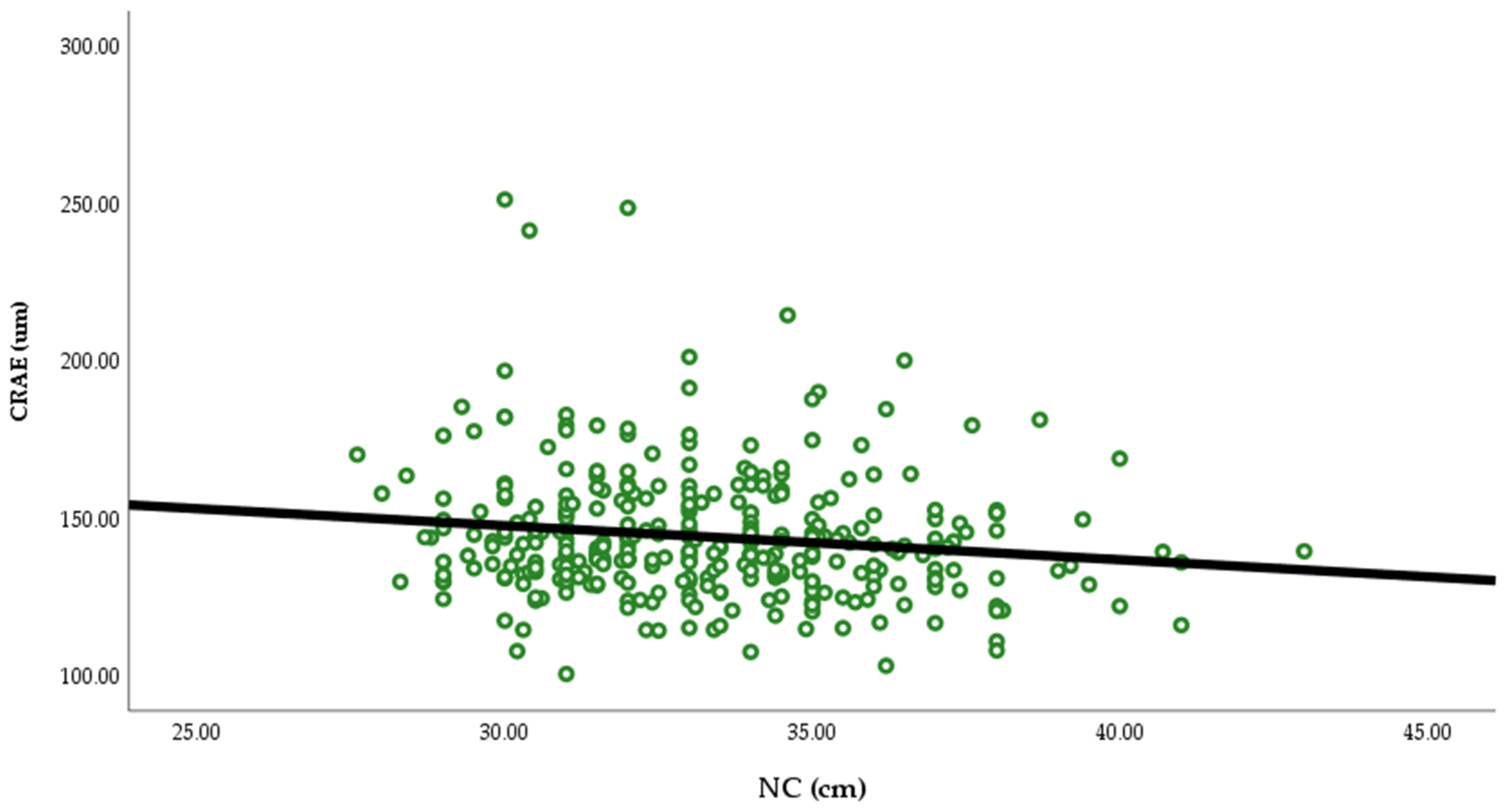
| NC (cm) | r = −0.144 p = 0.009 | r = −0.144 p = 0.039 | r = −0.030 p = 0.585 |
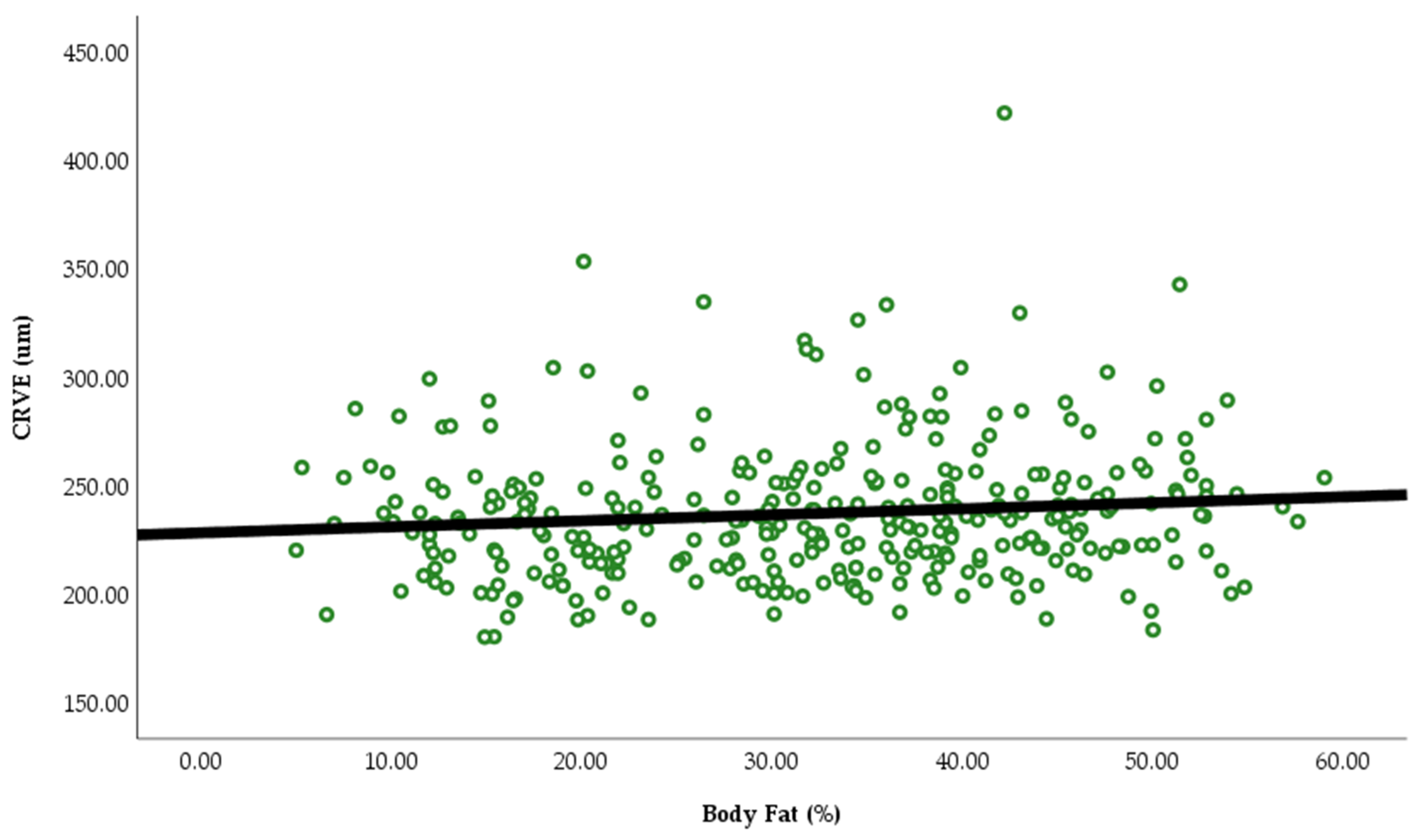
| Body Fat (%) | r = 0.024 p = 0.670 | r = 0.162 p = 0.003 | r = −0.096 p = 0.080 |
| Retinal Microvascular Calibres | ||
|---|---|---|
| CRAE (µm) Adjusted R2 = 0.050 | ||
| Independent Variables | β (95% CI) | p-Value |
| NC (cm) | −0.122 (0.08; 0.29) | 0.024 |
| CRVE | 0.189 (−0.08; 0.74) | 0.001 |
| Retinal Microvascular Calibres | ||
|---|---|---|
| CRVE (µm) Adjusted R2 = 0.060 | ||
| Independent Variables | β (95% CI) | p-Value |
| Body fat (%) | 0.157 (0.07; 0.36) | 0.004 |
| CRAE | 0.199 (0.10; 0.314) | <0.001 |
Disclaimer/Publisher’s Note: The statements, opinions and data contained in all publications are solely those of the individual author(s) and contributor(s) and not of MDPI and/or the editor(s). MDPI and/or the editor(s) disclaim responsibility for any injury to people or property resulting from any ideas, methods, instructions or products referred to in the content. |
© 2026 by the authors. Licensee MDPI, Basel, Switzerland. This article is an open access article distributed under the terms and conditions of the Creative Commons Attribution (CC BY) license.
Share and Cite
Ntsilane, Y.; Moshani, A.; Bukhali, M.M.; Ramoshaba, N.E. Retinal Microvascular Calibres and Body Fat Indices in Young Adults. Int. J. Environ. Res. Public Health 2026, 23, 219. https://doi.org/10.3390/ijerph23020219
Ntsilane Y, Moshani A, Bukhali MM, Ramoshaba NE. Retinal Microvascular Calibres and Body Fat Indices in Young Adults. International Journal of Environmental Research and Public Health. 2026; 23(2):219. https://doi.org/10.3390/ijerph23020219
Chicago/Turabian StyleNtsilane, Yandisa, Asakhanya Moshani, Melikhaya M. Bukhali, and Nthai E. Ramoshaba. 2026. "Retinal Microvascular Calibres and Body Fat Indices in Young Adults" International Journal of Environmental Research and Public Health 23, no. 2: 219. https://doi.org/10.3390/ijerph23020219
APA StyleNtsilane, Y., Moshani, A., Bukhali, M. M., & Ramoshaba, N. E. (2026). Retinal Microvascular Calibres and Body Fat Indices in Young Adults. International Journal of Environmental Research and Public Health, 23(2), 219. https://doi.org/10.3390/ijerph23020219