Article

Pedestrians’ Perceptions of Motorized Traffic in Suburban–Rural Areas of a Metropolitan Region: Exploring Measurement Perspectives


1
The Research Unit for Movement, Health and Environment, Department of Physical Activity and Health, The Swedish School of Sport and Health Sciences, GIH, 114 86 Stockholm, Sweden
2
Faculty of Caring Science, Work Life and Social Welfare, University of Borås, 501 90 Borås, Sweden
*
Author to whom correspondence should be addressed.
Int. J. Environ. Res. Public Health 2026, 23(2), 206; https://doi.org/10.3390/ijerph23020206
Submission received: 30 September 2025 / Revised: 15 December 2025 / Accepted: 29 December 2025 / Published: 6 February 2026
(This article belongs to the Section Environmental Health)

Abstract

Background: Since World War II, the number of motorized vehicles has increased dramatically. Yet, few studies have evaluated how perceptions of single and multiple motorized traffic variables, in different combinations, influence pedestrians’ appraisals of the route environment in relation to whether it facilitates or deters walking. We have previously illuminated this in an inner urban area of a metropolitan region. This study aims to scrutinize these matters in the suburban–rural parts of the same metropolitan area. For comparative reasons, we use the same methods as used for the inner urban area. Our hypothesis is that these kinds of perceptions, to some extent, may be context-specific. Methods: Relations between pedestrians’ perceptions of motorized traffic variables (flow and speeds of motor vehicles, noise, and exhaust fumes) and combinations of them, as well as if appraisals of route environments hinder–stimulate walking and are unsafe–safe for reasons of traffic, have been evaluated. This was studied in the suburban and rural areas of Greater Stockholm, Sweden. The pedestrians (n = 233) rated their route environment with the Active Commuting Route Environment Scale (ACRES). Correlation, multiple regression, and mediation analyses were used to study the relationships. Results: The regression analyses showed that noise was the primary negative predictor variable in relation to hindering–stimulating walking. With respect to the other outcome, unsafe–safe traffic, none of the variables had a significant relation. The mediation analyses showed that (1) vehicle speed had an indirect effect on unsafe–safe traffic via noise, (2) both vehicle speed and vehicle flow had, via noise, indirect effects on hinders–stimulates walking, and (3) vehicle speed had, via vehicle flow, an indirect effect on noise and exhaust fumes. Conclusions: In suburban–rural route environments, noise protrudes as a hindering variable for walking. The mediation analyses showed that vehicle speed intensified noise and had negative effects on both outcomes. Therefore, by reducing vehicle speed, noise levels will be lowered, and the walking experience is likely to be enhanced, which can influence the amount of walking. The results are further illuminated through the exploration of existing and potential future research strategies.

1. Introduction

Walking is a common form of locomotion, and humans walk for various purposes, such as transportation. The health benefits of walking are well recognised [1,2,3], and active transportation can contribute to sustainable mobility [4].
However, if people are to walk more, it is important that pedestrian environments support this form of movement. Based on pedestrians’ reports, the presence of trees along streets and wide sidewalks enhances well-being, whereas traffic noise, deteriorated sidewalks, and difficult crossings hinder walking, particularly for older adults and women [5]. There are also reports that pedestrians favour routes perceived as green and blue, which have less traffic and are considered safer, even when these are longer than the most direct options [6]. Furthermore, pedestrians who perceive that their routes become less pleasant over time reduce their walking [7]. Typically, depending on the research strategies used in these kinds of studies, it is difficult to precisely pinpoint the specific variable(s) that are critical for existing walking behaviours.
Since World War II, the number of motorized vehicles has increased dramatically. This has profoundly reshaped our cities [8] (p. 133). Since walking is common in metropolitan areas, it is essential to investigate how the transformed metropolitan environment, characterized by an increased number of motorized vehicles, affects pedestrians in terms of individual traffic variables, such as vehicle flow, speed, noise, and exhaust fumes.
Numerous environmental assessment tools related to walkability have been developed. Examples of such tools are the Neighbourhood Environment Walkability Scale (NEWS), the Instruments for Assessing Levels of PHysical Activity and fitness questionnaire (ALPHA), and the Perceptions of the Environment in the Neighbourhood Scale (PENS). These tools have questions about the built environment, primarily with four- or five-point response scales of the Likert type, in relation to physical activity.
The NEWS evaluates residents’ perception of neighbourhood design features associated with physical activity [9]. The ALPHA instrument examines environmental factors related to physical activity in a European context [10,11], drawing inspiration from other questionnaires, such as the NEWS. The PENS was developed to assess adults’ perceptions of their neighbourhood environment, with items selected and adapted from the ALPHA instrument [12].
The above-mentioned instruments have a focus on the residential area, often defined as the area that can be walked to within 10–15 min [11,12]. Furthermore, a limitation of ordinal scales, such as Likert scales, is that the response options are not evenly spaced, which can limit the use of parametric tests that require data measured on an interval or ratio scale.
To fully grasp the effect of motorized traffic variables on walking behaviour is challenging. A holistic approach that captures perceptions of multiple variables is likely to provide insights that can be overlooked when considering only one or two variables in isolation. Additionally, the absence of a clear and consistent terminology makes comparisons between studies difficult. For example, in one study, the following items were used: “Crossing busy roads is a big problem” and “Traffic makes it dangerous or unpleasant” [13]. How should these items be interpreted? What is the actual problem: vehicle speed, traffic flow, noise, exhaust fumes, or a combination of these? Or is there another variable at play?
Instead of focusing on the behaviour of walking, e.g., the amount of walking, a more accessible way forward could be to analyze how various traffic variables are perceived, and route environments appraised by those who walk regularly in such settings.
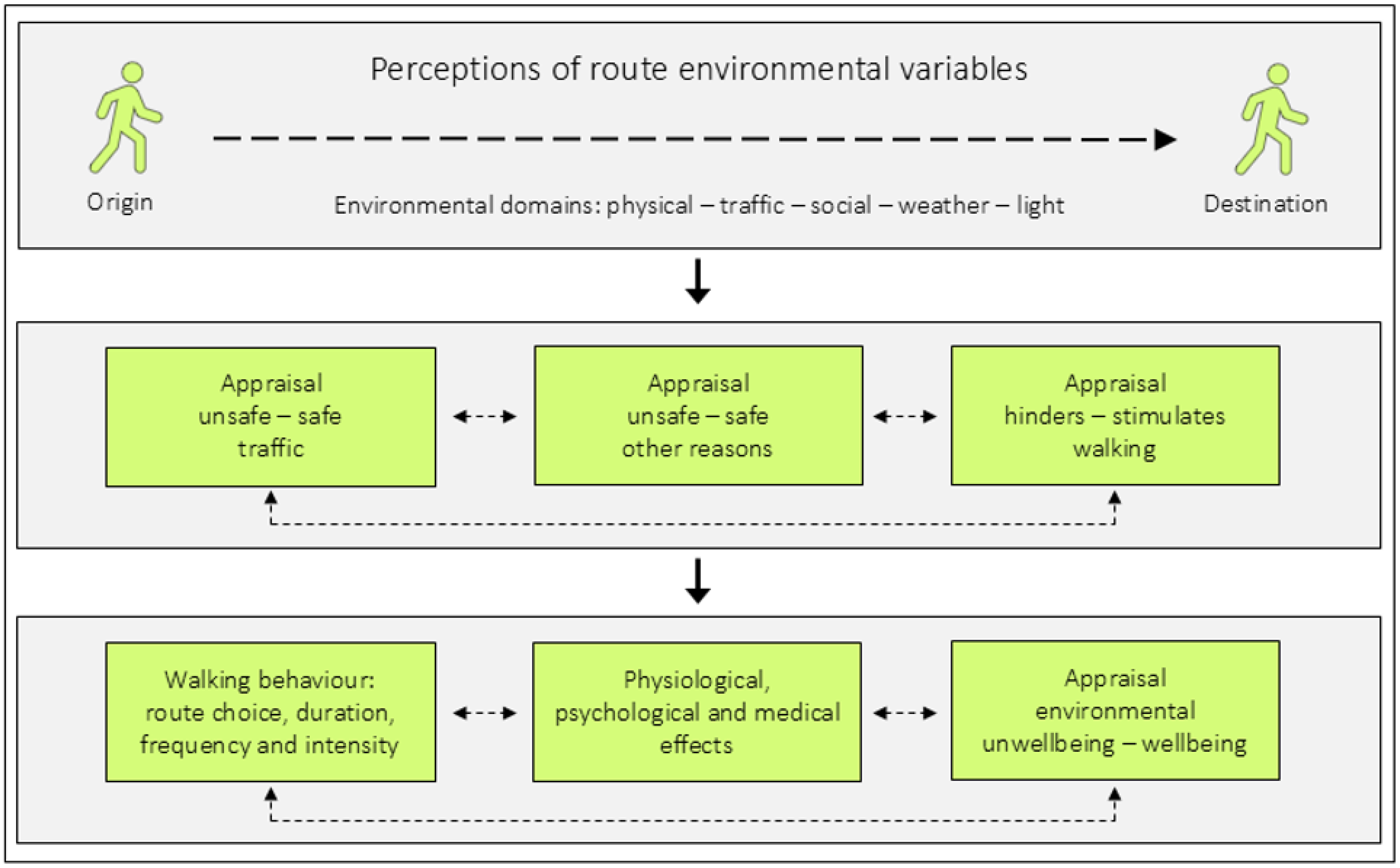
Below is a conceptual model illustrating how perceptions of route environmental variables can influence pedestrians, modified from Schantz, [14] (p. 150), see Figure 1.
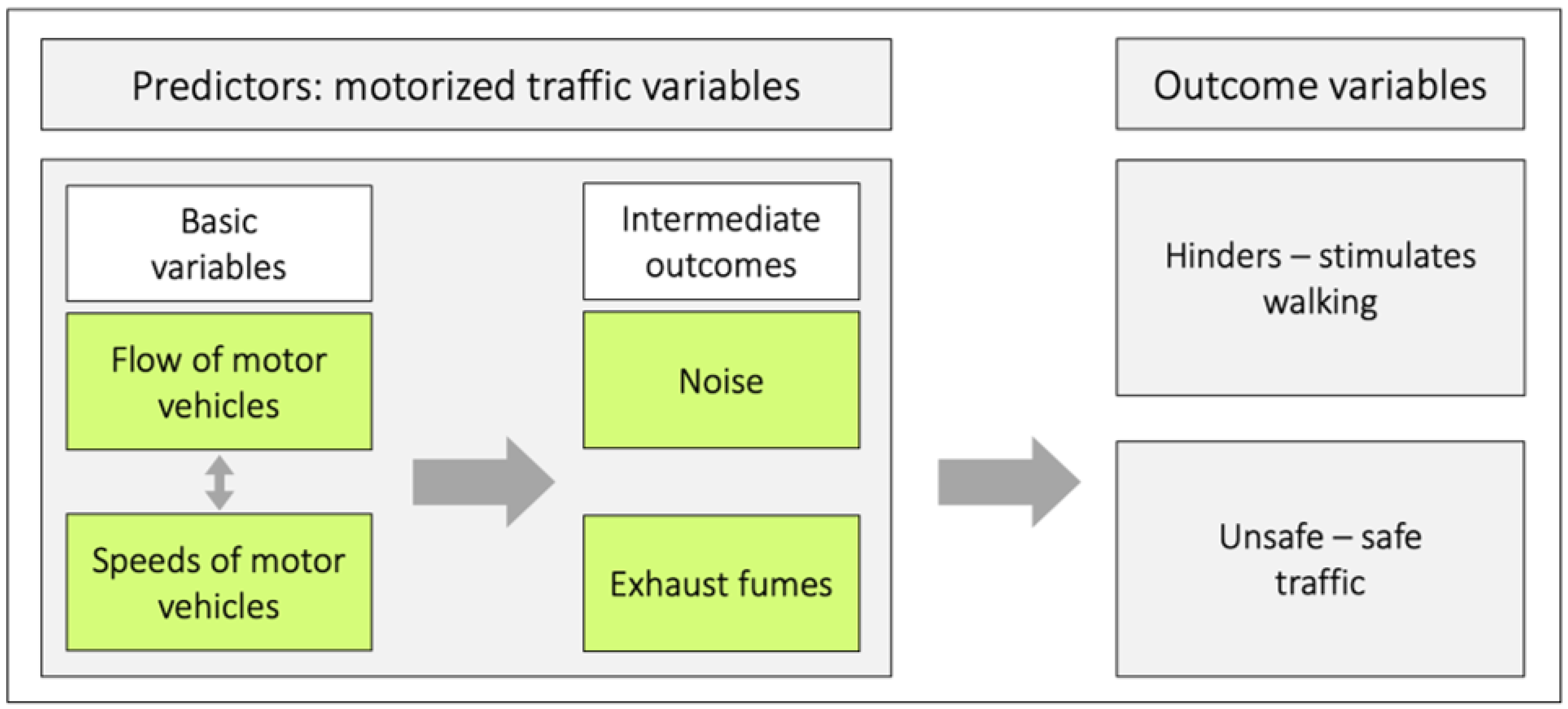
From our perspective, it is essential to distinguish the various roles and relationships between four variables related to motorized traffic: speed, flow, noise, and exhaust fumes, and to examine how they are linked to the outcomes of unsafe or safe traffic as well as hindering or stimulating walking.
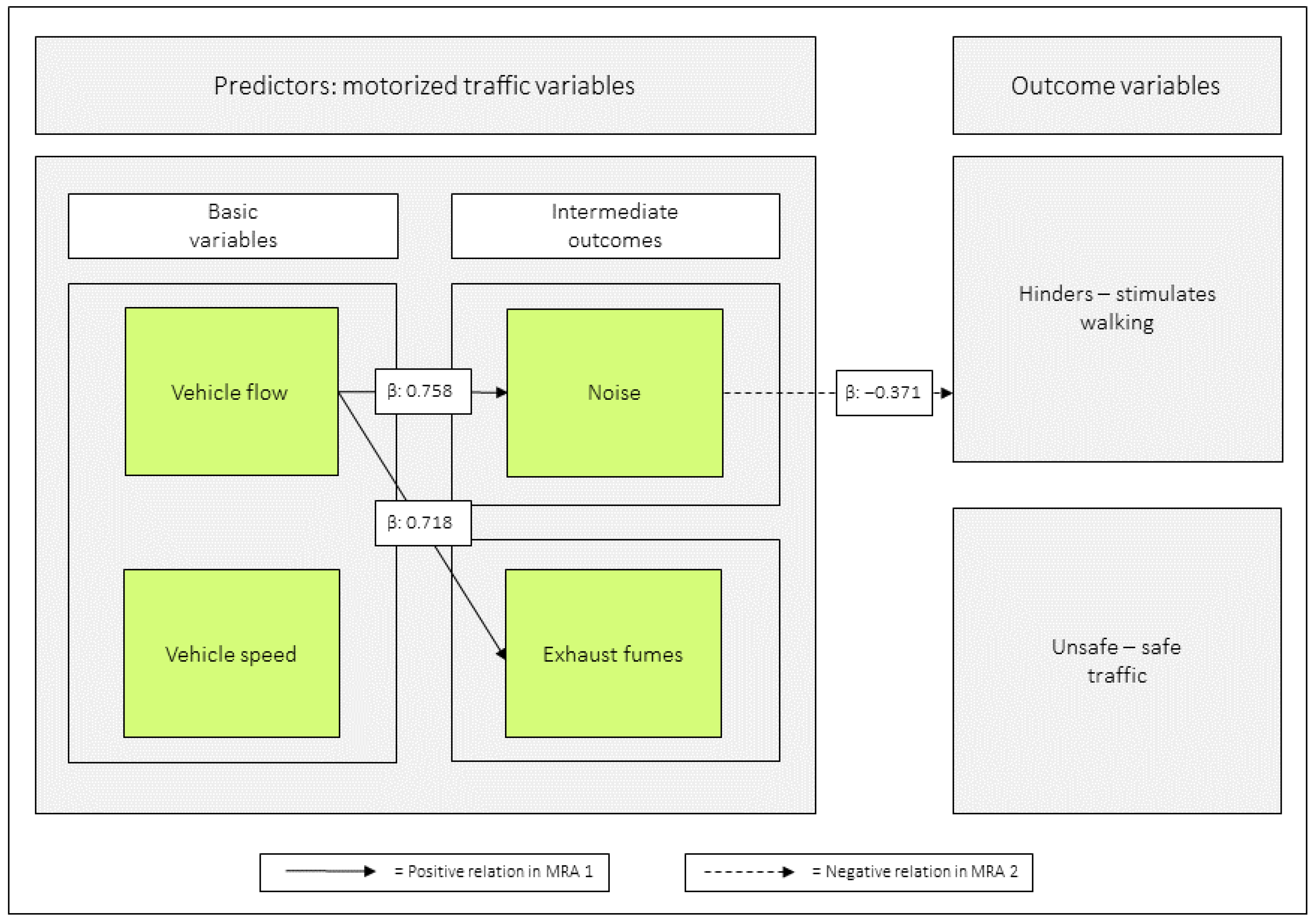
Figure 2 illustrates a conceptual model that shows the relationships among the four motorized traffic variables, both internally and in relation to the outcomes of hindering or stimulating walking as well as unsafe or safe traffic. This model can be used to analyze the different roles and relations among these four motorized traffic variables in the context of walking. We consider the speeds of motor vehicles and the flow of motor vehicles as basic variables, and noise and exhaust fumes as intermediate outcomes.
We have previously studied how motorized traffic variables are perceived among those who commute by foot in the inner urban area of Stockholm, Sweden [16]. In that area, noise related negatively to both hinders–stimulates walking and unsafe–safe traffic, whereas vehicle speed is negatively related to unsafe–safe traffic.
The external validity of those results, however, remains unexplored in relation to pedestrians. The importance of such a perspective is underlined by the fact that in studies of cyclists in the suburban–rural areas of Greater Stockholm, Sweden, it has been noted that both vehicle flow and noise were negatively related to inhibits–stimulates cycling [18]. This contrasts with findings from cyclists in the inner urban area, in which only the factor exhaust fumes was negatively related to inhibits–stimulates cycling [19]. Whether such discrepancies also exist among pedestrians is, to our knowledge, unknown.
Furthermore, it is essential to understand the rationale behind studying different environments, as discussed in [20]. To state this rationale in simple terms: there are good reasons to believe that the same objective levels of motorized vehicle flows, speeds, noise, and exhaust fumes can lead to different levels of perceptions depending on the surrounding environment for the traffic.
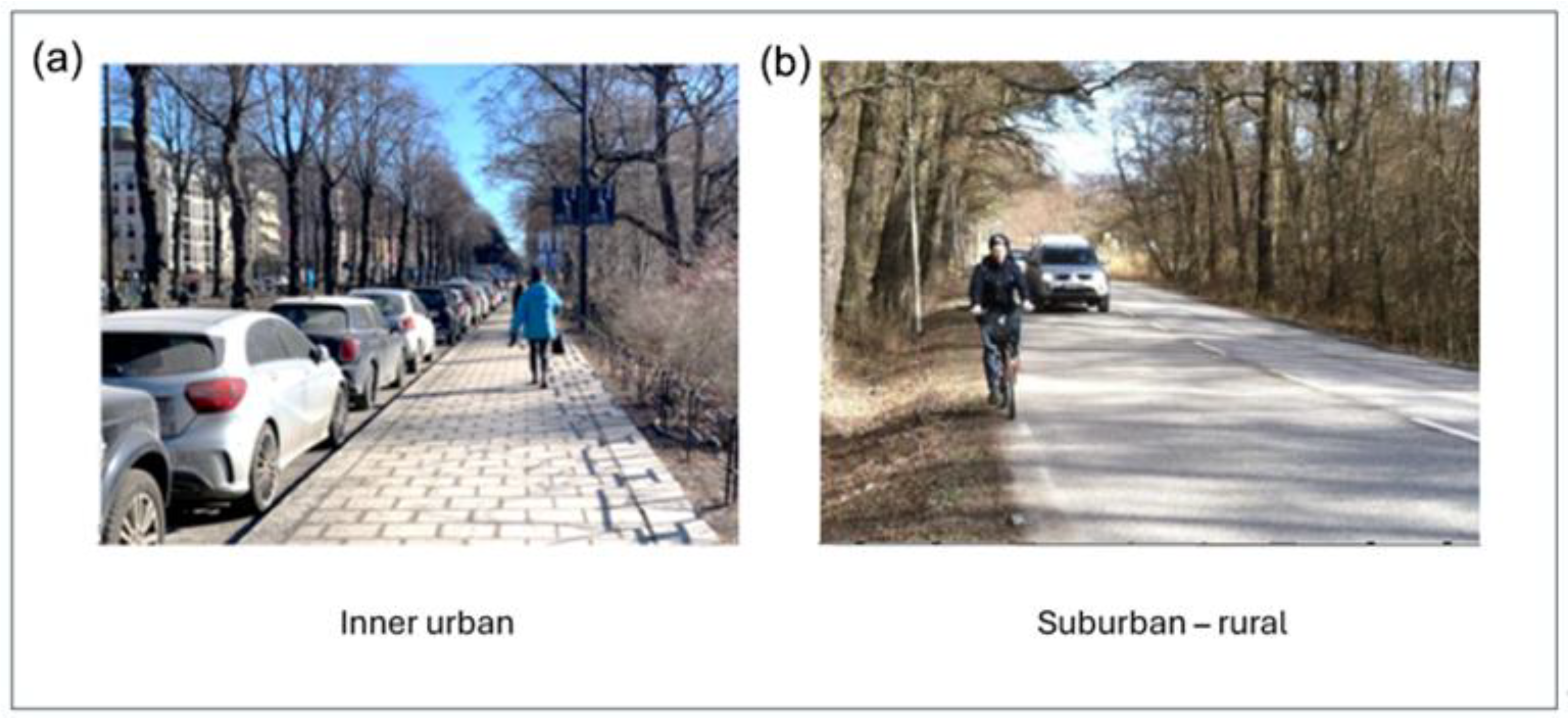
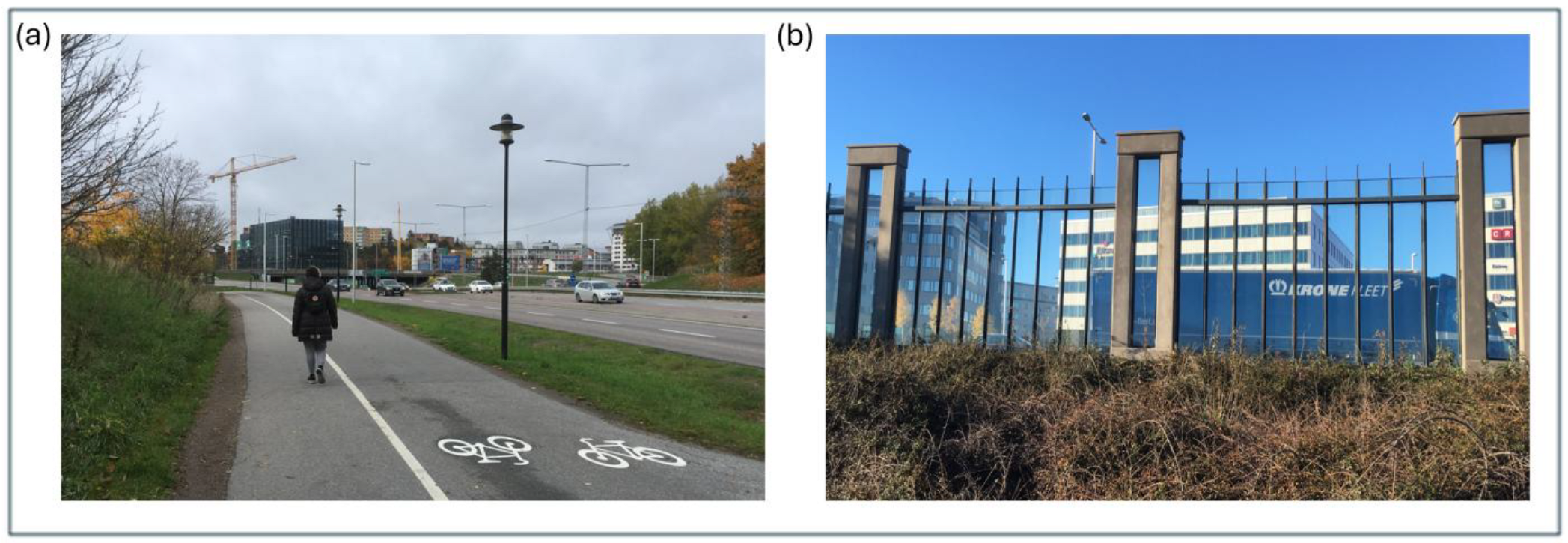
Figure 3a,b show photos from the inner urban vs. suburban–rural study areas in Greater Stockholm. Cars are often parked along streets in inner urban areas, and will thereby sometimes hide the vehicle flow and create distance to the pedestrians. However, more or less noise will still reach those walking on the pavements. In the suburban–rural area, the encounter between pedestrians and traffic can differ significantly, and it is overall quite distinct from that in the inner urban area.
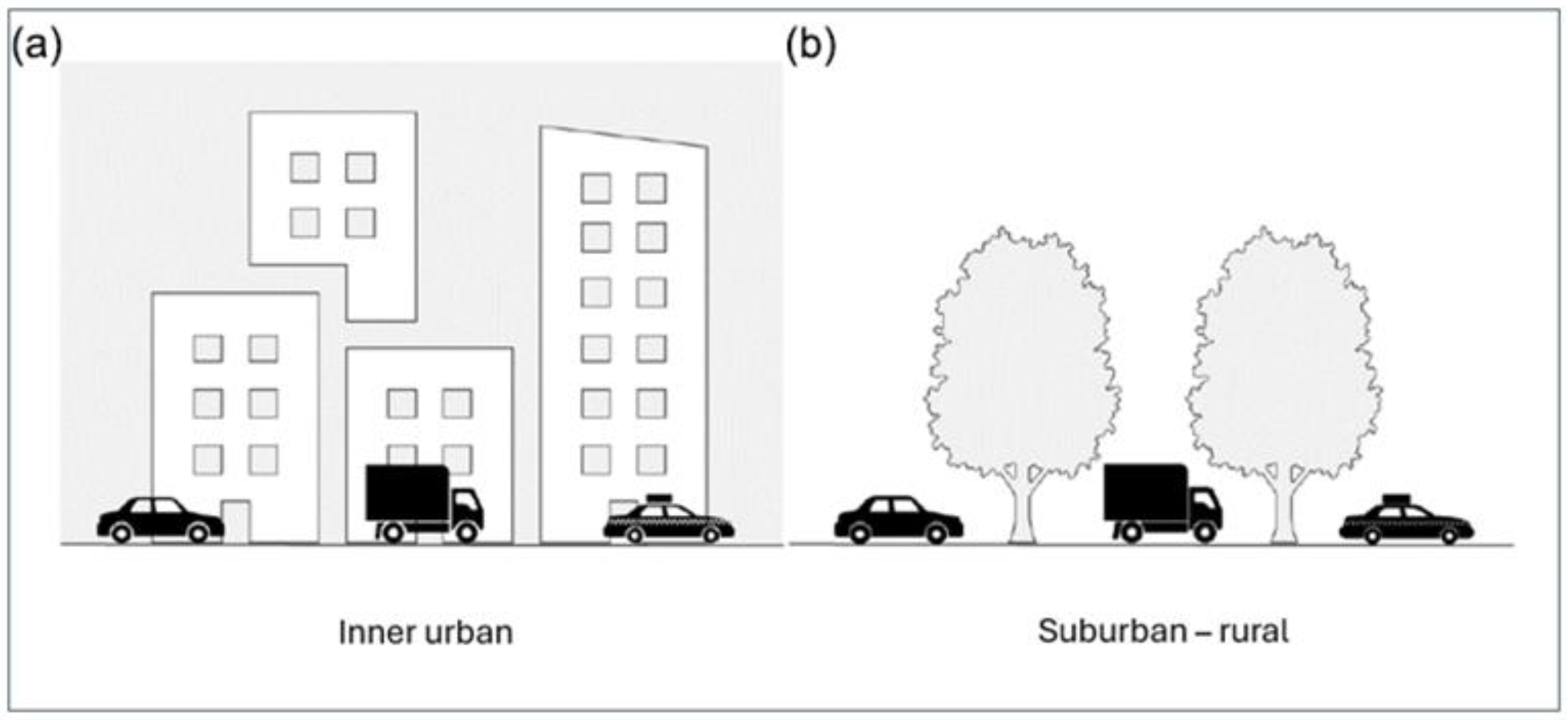
Figure 4a,b illustrate other differences related to how traffic variables can be perceived within the context in which the traffic occurs. These differences are related to the greater and higher building volumes found near the streets in the inner urban area, compared to the more common gradient of lower houses and smaller housing volumes, or none at all, in the suburban–rural area.
Three aspects of potential differences will be stated here. The first relates to how the same traffic flow is perceived depending on its background, the second concerns the reflection of sounds from house façades, and the third concerns the accumulation of exhaust fumes when open-air spaces around traffic flows are limited by built-up settings.
The aim of the present study is therefore to investigate, in a suburban–rural setting, the relationships between the four motorized traffic variables, the basic variables, and the intermediate outcomes, as well as how these variables, and their combinations, relate to the outcome variables.
We have studied male and female walking commuters (n = 233) in the suburban–rural area of Greater Stockholm, Sweden, for these purposes. The pedestrians rated their commuting routes using the Active Commuting Route Environment Scale (ACRES), a self-report tool that assesses pedestrian commuters’ perceptions and appraisals of their commuting route environments [21,22].
Given the importance of gaining knowledge about these issues, we will explore current and potential future research strategies in the Section 4.
The public health relevance of this study is three-fold: (i) it is important to understand how environmental variables affect the intermediate outcomes of unsafety–safety for reasons of traffic as well as if it is hindering–stimulating the walking since these variables relate to environmental unwellbeing–wellbeing, which is a variable of direct health relevance; (ii) whether the environmental variables affect the behaviour of walking, then the level of physical activity stands for another dimension of public health; (iii) the third dimension relates to if walking is substituting for motorized transport which stand for wider negative effects on population health through, e.g., noise, exhaust fumes or CO2 emissions.

2. Method

2.1. Procedure and Participants

This study is part of the research project Physically Active Commuting in Greater Stockholm (PACS). Participants, defined as active commuters who walk or cycle to work or study, were recruited through advertisements in Dagens Nyheter (https://www.dn.se/, accessed on 25 May 2004) and Svenska Dagbladet (http://www.svd.se/, accessed on 25 May 2004), two major Stockholm newspapers, between late May and early June 2004. The recruitment period ended in mid-autumn.
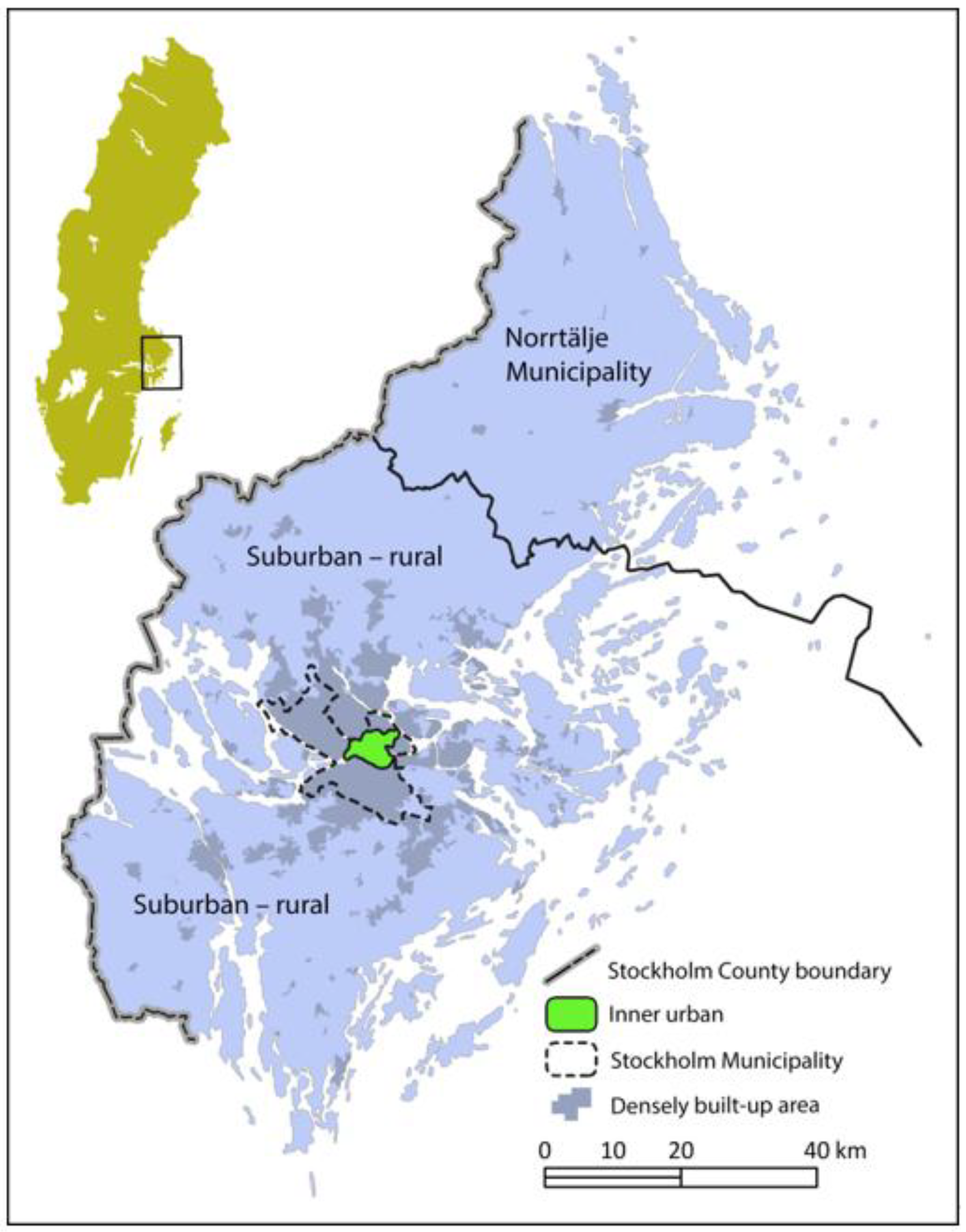
To be eligible, participants had to be at least 20 years old, commute the entire distance to their workplace or educational institution at least once a year, and reside in Stockholm County, excluding the municipality of Norrtälje (see Figure 5).
Based on the information provided in the advertisements about the study, 2148 individuals signed up for the study. A first survey, the Physically Active Commuting in Greater Stockholm Questionnaire (PACS Q1), was distributed in September 2004 (the survey was answered by 94%). At the end of the first questionnaire, participants were asked if they would like to participate in a second survey (PACS Q2). It was distributed in May of the following year (the survey was answered by 92%). Responses were ending in mid-autumn. The respondents walked or cycled in the inner urban or suburban–rural areas of Greater Stockholm, or in both settings. The suburban–rural areas will hereafter be stated as “the suburban areas”.
Advertisement-based recruitment has been compared to on-street recruitment of cycling commuters in terms of their evaluations of route environments [22]. It was hypothesized that individuals recruited in situ would more accurately represent the commuting mode than those recruited through advertisements. Overall, the assessments showed a strong correspondence between the two groups [22].
In the present study, we have exclusively used data from the suburban areas. We asked the participants to evaluate their route environment over a two-week period, and thereafter rate the environmental variables in overall terms. During the studied period, electric cars were scarce or non-existent. Some pedestrians (33.0%) also commuted in the inner urban area; however, only the suburban data were used. It is possible that commuting in one environment affects the ratings of the other. A previous study compared the ratings of cyclists who had commuted in both areas with those who had commuted in only one area [22]. The deviances between the groups were remarkably small.
In this study, 233 participants were included in the analyses (82% women); 41.6% were pedestrians, and 58.4% were dual-mode commuters, i.e., individuals who alternate between walking and cycling. The Ethics Committee North of the Karolinska Institute at the Karolinska Hospital approved the study (Dnr 03-637), and the participants gave their informed consent.

2.2. Descriptive Characteristics of the Participants

Descriptive characteristics of the participants were obtained from PACS Q1 and Q2, see Table 1. For characteristics of their walking behaviour, e.g., distance, duration, and frequency of walking trips, see Table A1, Table A2 and Table A3 in Appendix A.

2.3. The Physically Active Commuting in Greater Stockholm Questionnaires (PACS Q1 and Q2)

The PACS Q1 and PACS Q2 are self-administered surveys in Swedish, consisting of 35 and 68 items, respectively. The surveys include questions about background factors and various aspects of active commuting. Both surveys are available in the supporting information in Schantz et al. [23].

2.3.1. The Active Commuting Route Environment Scale (ACRES)

To explore the relationships between active transportation and the characteristics of the route environment, the Active Commuting Route Environment Scale (ACRES) was developed [21,22]. The pedestrian version consists of 13 variables. Each variable has two parallel response lines: one for the inner urban area and the other for the suburban areas.
Those responding to the ACRES are asked to rate their overall experience of their self-chosen route environment, based on their active commuting between home and place of work or study, during the last two weeks. The 15-point response scales have adjectival opposites and numbered continuous lines, i.e., numbers from 1 to 15. In addition, number 8, is a neutral option. Thus, three anchors aim to provide additional meaning to the scores along the scale, see Table 2.

2.4. Study Area

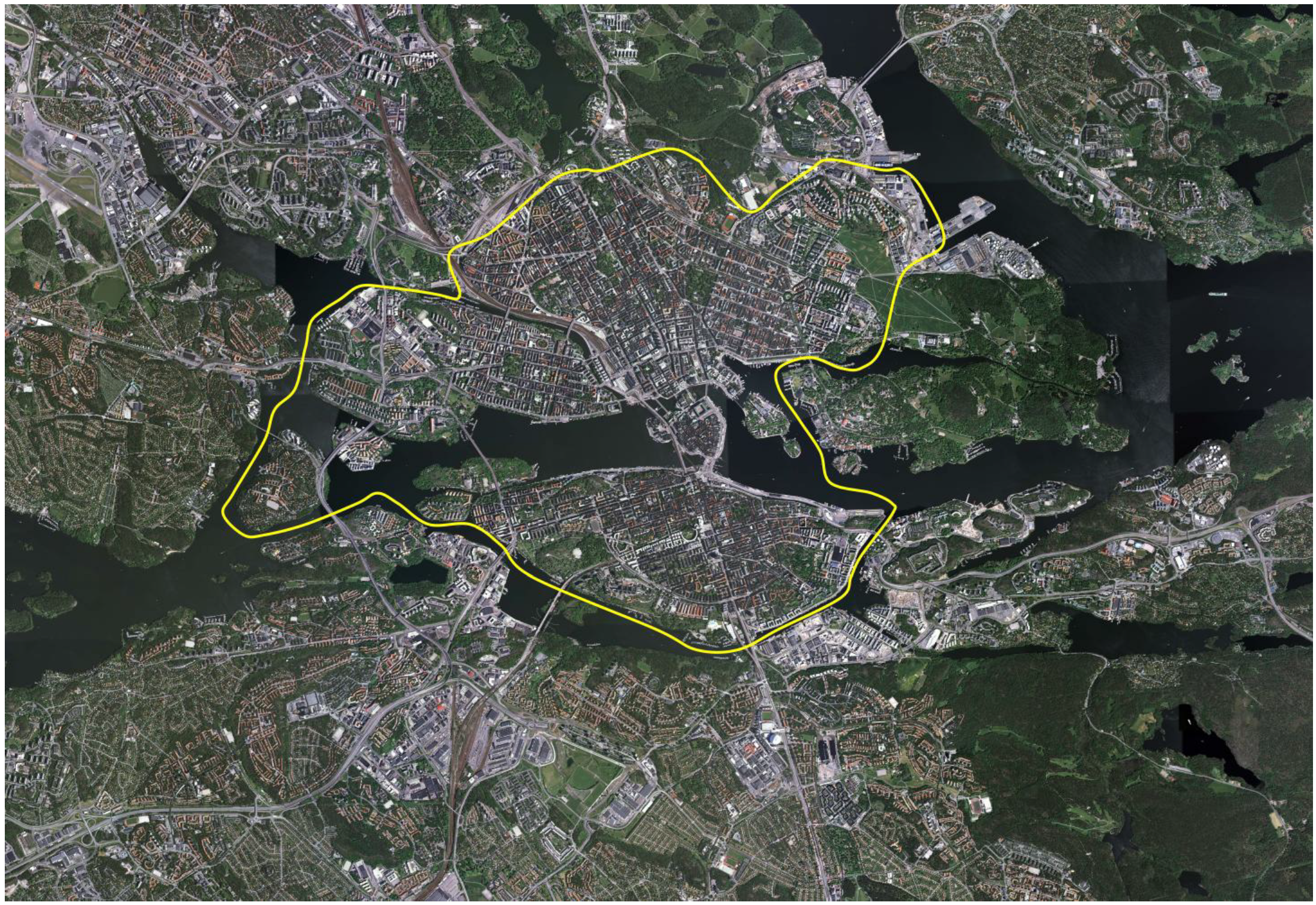
The suburban area surrounds the urban core (see Figure 6) and features a diverse landscape comprising residential neighbourhoods, industrial zones, forests, and agricultural land. Residential areas primarily consist of single-family homes, while multi-story buildings are more common in densely populated districts. Population density generally increases with proximity to underground or commuter train stations.
The main roads often follow historical routes from the agricultural era, unlike the inner urban area, where streets are typically arranged in a grid pattern. Green spaces, including trees and gardens, are interspersed throughout the neighbourhoods, particularly around multi-story housing complexes.
The region is situated within a rift valley landscape, characterized by mostly flat valleys and forests that extend from rural areas toward the city centre. Lakes, the Baltic Sea, and numerous islands further define the geography. Arterial highways traverse the landscape, connecting different parts of the region. More details on the study area can be found in the Statistical Yearbook of Stockholm [24].

2.5. Statistical Analyses

Data were entered into the Statistical Package for the Social Sciences (SPSS) and analyzed using version 27.0 (IBM SPSS Inc., Somers, NY, USA). Accuracy checks were performed on PACS Q2 data, including the variables from the ACRES. Only participants with complete ACRES data and background information (sex, age, education, and income) were included in the analyses. A significance level of p < 0.05 was applied.
Differences in ratings of the variables between men and women were examined with independent t-tests.
A visual inspection indicated that the data were approximately normally distributed. Before conducting the analyses, the linearity of environmental variables was assessed visually and found to be reasonably linear.
Multicollinearity was assessed using the variance inflation factor (VIF), with a threshold of >0.80 indicating potential concerns [25] (p. 402). Although some high correlations were observed, the VIF values did not indicate serious multicollinearity issues according to Field [25] (p. 402)).
The threshold for standardized residuals was set at ±3 standard deviations (SD). Some analyses produced residuals exceeding this limit; however, these outliers were included in the analyses, as they were relatively few and relatively close to the threshold. Additionally, Cook’s distance values did not indicate any cause for concern according to Field [25] (p. 383)). A table with the VIF, the standardized residuals, and the Cook’s distance is presented in Appendix A (Table A4).

2.5.1. Background Variables

In our multiple regression and mediation analyses, we included the following background variables: sex (binary; coded as 0 for females and 1 for males), age (continuous), education (binary; 0 for university-level education and 1 for no university-level education), and income (categorical; with three groups: 1 for ≤25,000 SEK/month, 2 for 25,001–30,000 SEK/month, and 3 for ≥30,001 SEK/month). Note: SEK refers to Swedish kronor; approximately, 1 € ≈ 9 SEK and 1 US $ ≈ 8 SEK.

2.5.2. Correlation Analyses (CA)

Correlation analyses between the four predictor variables were assessed with Pearson’s correlation coefficient (r). The correlations were r ≤ 0.846.

2.5.3. Multiple Regression Analyses (MRA)

Multiple regression analysis was employed to investigate the relationships between predictor and outcome variables. Results from the linear regression are presented as y-intercepts, unstandardized coefficients (B) with their 95% confidence intervals, and the adjusted R2 for the overall models.

2.5.4. Mediation Analyses (MA)

In models where direct or indirect effects were hypothesized, mediation analyses were conducted using the PROCESS macro [26]. Results from these analyses are reported as standardized total, direct, and indirect effects of X on Y. Additionally, the percentage ratio of the standardized indirect effect to the standardized total effect is provided. By default, PROCESS employs 5000 bootstrap samples to compute confidence intervals. Indirect effects were deemed statistically significant if the 95% confidence interval did not include zero.

3. Results

3.1. Perceptions of the Environmental Variables in Men and Women

Levels of the outcome variables hinders–stimulates walking and unsafe–safe traffic as well as of the predictor variables vehicle speed, vehicle flow, noise, and exhaust fumes are presented in Table 3. A significant difference was noted between men and women regarding hinders–stimulates walking; women had a higher mean value.

3.2. Correlations Between the Environmental Variables

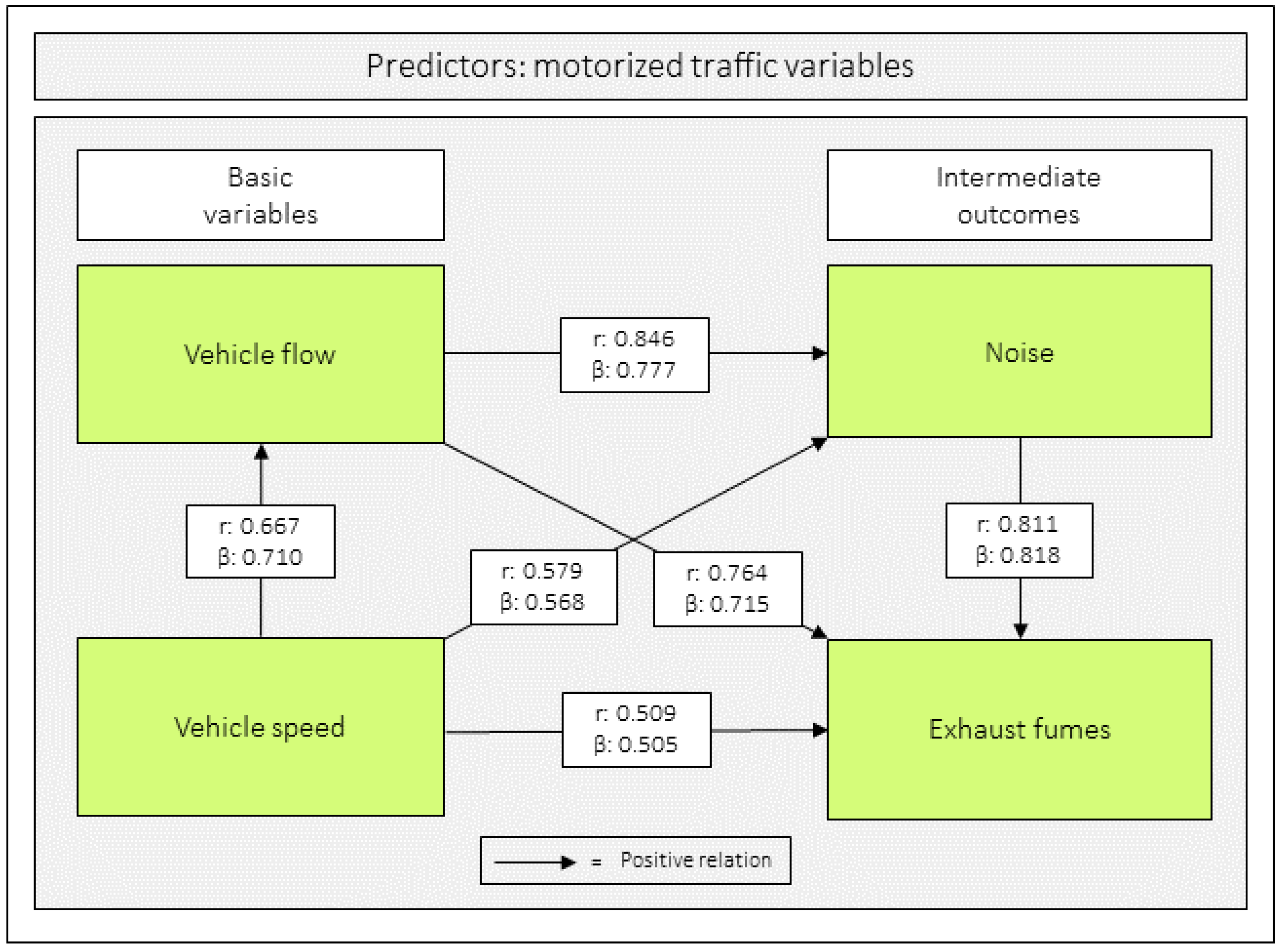
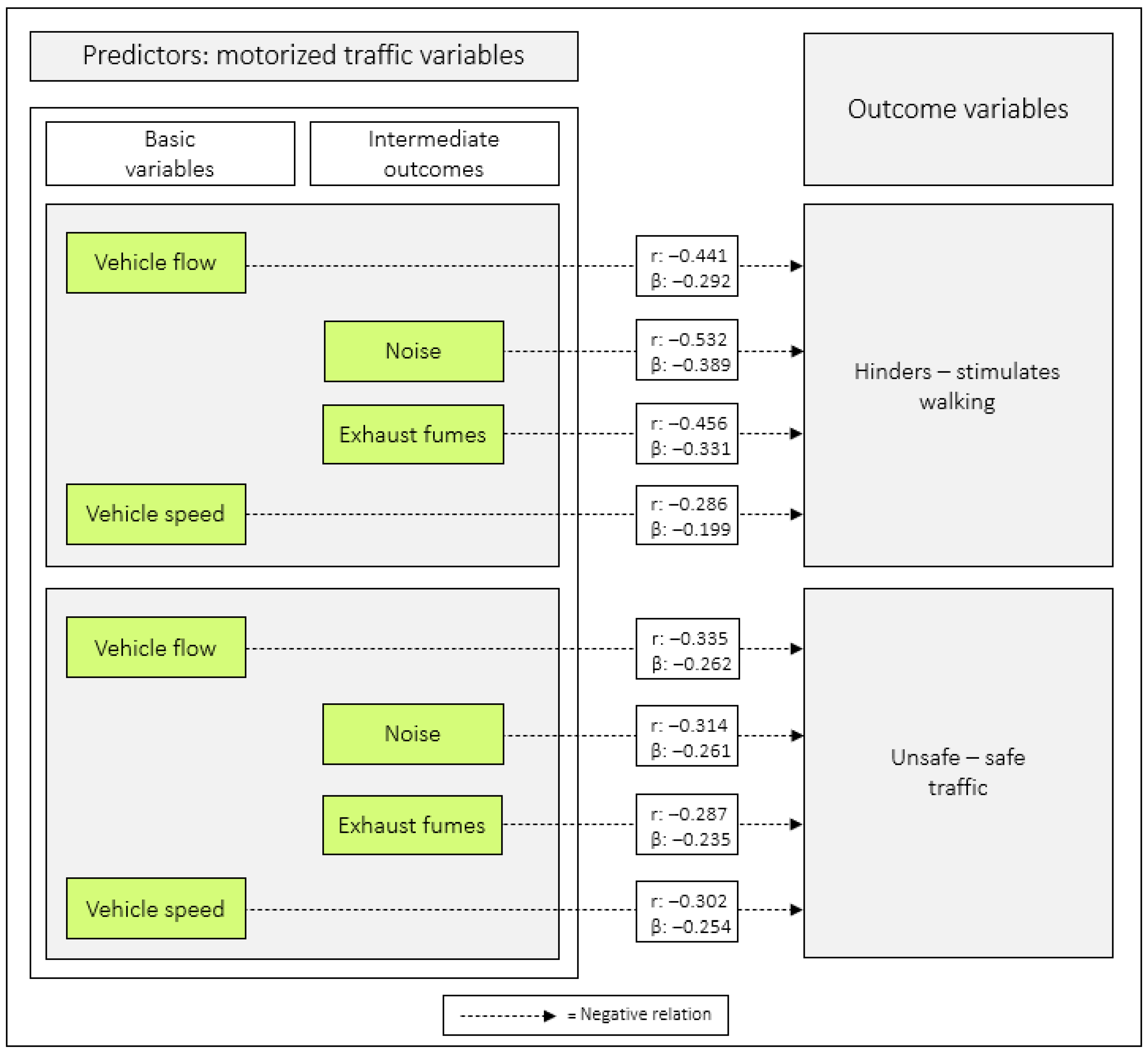
There were positive correlations (r) between all predictor variables (range: 0.509–0.846). In contrast, all predictor variables correlated negatively with the outcome variables hinders–stimulates walking (range: −0.286 to −0.532) and unsafe–safe traffic (range: −0.287 to −0.335) (Table 4, Figure 7 and Figure A1 in Appendix A).

3.3. Relations Between the Predictor Variables

The relations between the predictor variables were analyzed with multiple regression analyses. All regression coefficients were positive (range: 0.505–0.818; p < 0.001) (Table 5 and Figure 7).

3.4. Relations Between the Basic Variables and the Intermediate Outcomes

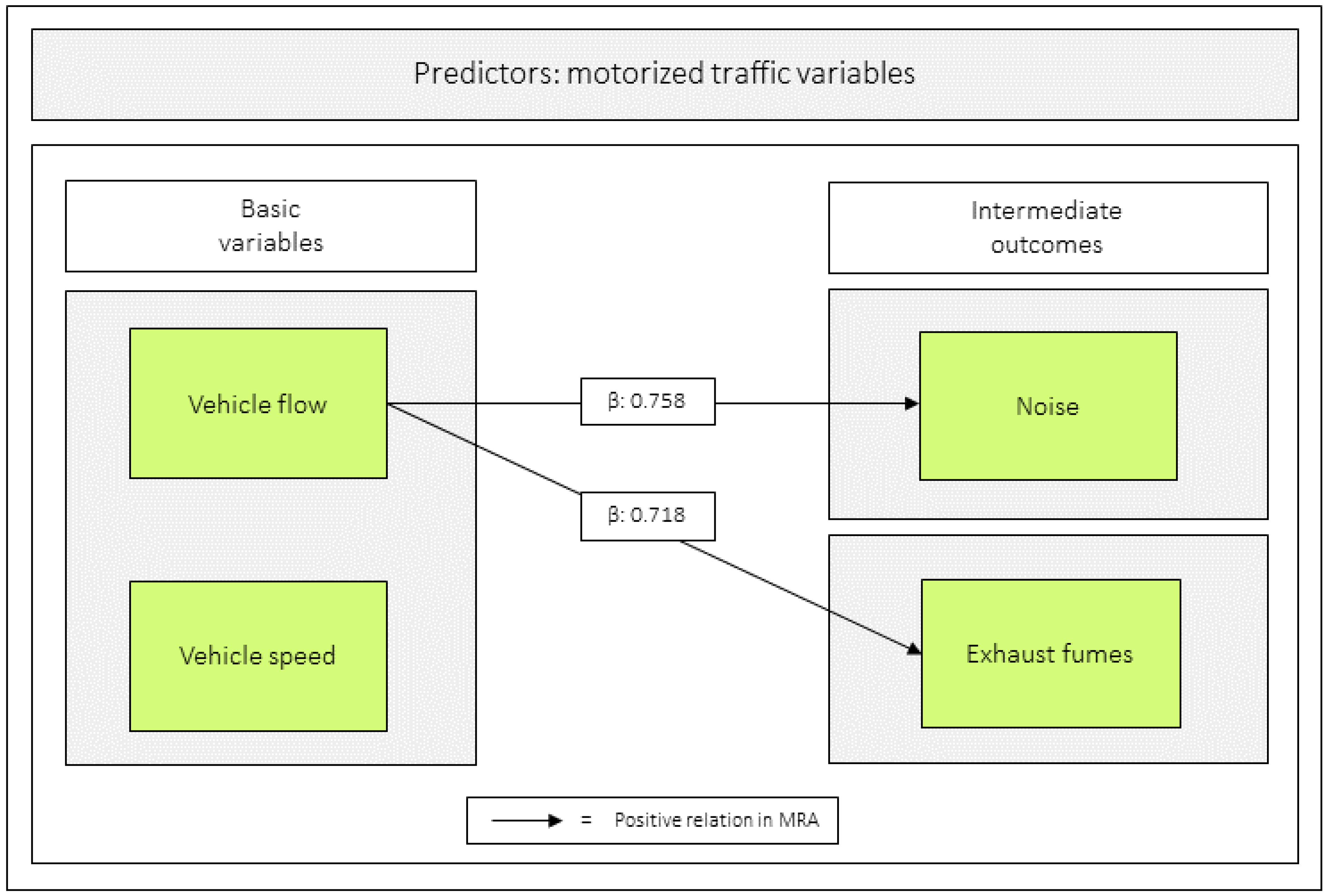
Of the basic variables vehicle speed and vehicle flow in relation to the intermediate outcomes noise and exhaust fumes, only vehicle flow was significant. For all values, see Table 6 and Figure 8.

3.5. Relations Between Individual Predictor Variables and the Outcome Hinders–Stimulates Walking

All regression coefficients were significant and negative (range: −0.199 to −0.389) with the lowest value for vehicle speed and the highest for noise. For all the values, see Table A5 and Figure A1.

3.6. Relations Between Combinations of Predictor Variables and the Outcome Hinders–Stimulates Walking

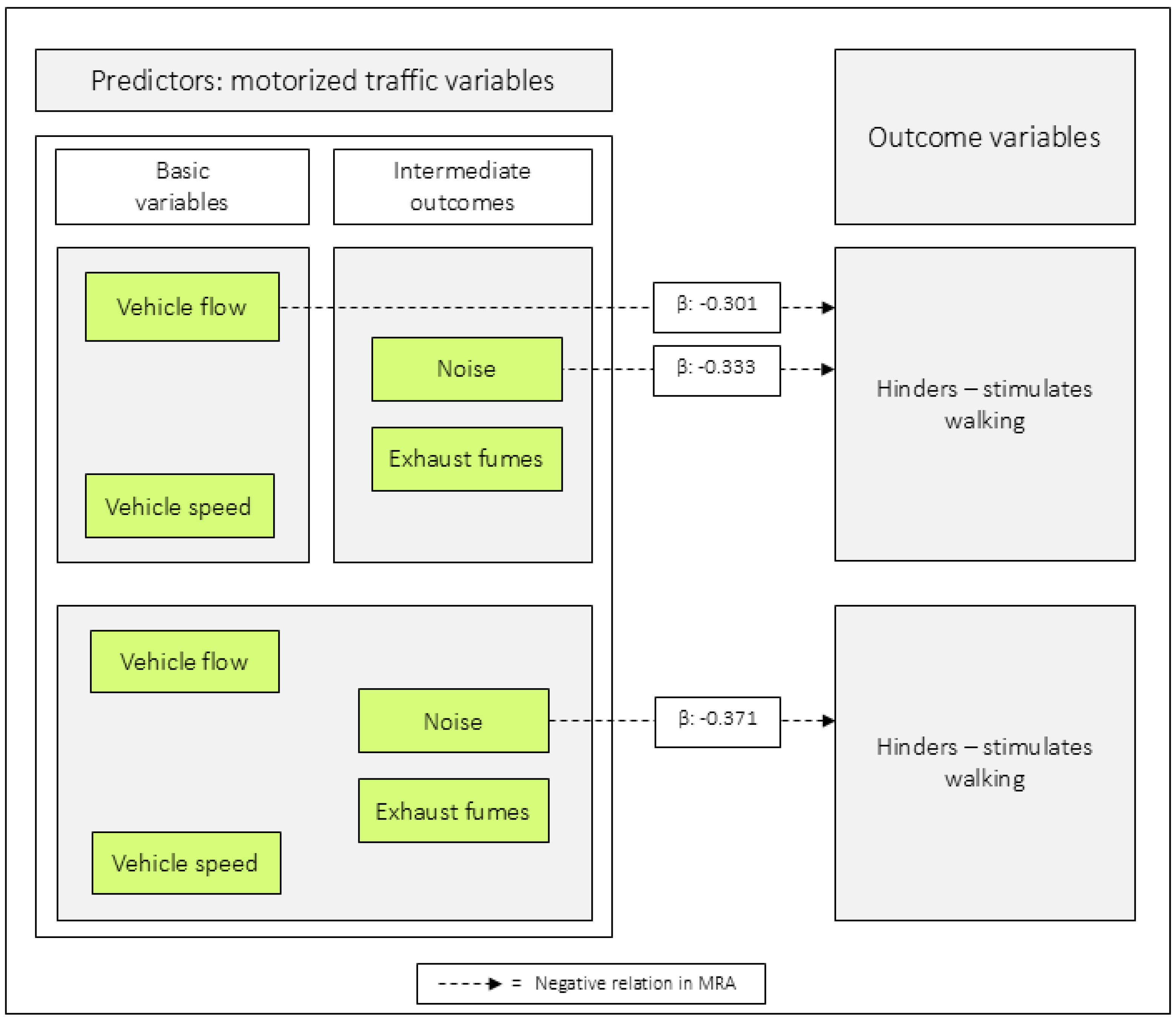
In model 7:1, vehicle flow was negatively related to hinders–stimulates walking, and in 7:2, noise had the equivalent role. When all the motorized traffic variables were included as predictors, only noise was negatively related to the outcome (Table 7 and Figure 9).

3.7. Relations Between Individual Predictor Variables and the Outcome Unsafe–Safe Traffic

All regression coefficients were significant and negative (range: −0.235 to −0.262), with the lowest value for exhaust fumes and the highest for vehicle flow. For all values, see Table A6, and Figure A1 in Appendix A.

3.8. Relations Between Combinations of Predictor Variables and Unsafe–Safe Traffic as an Outcome

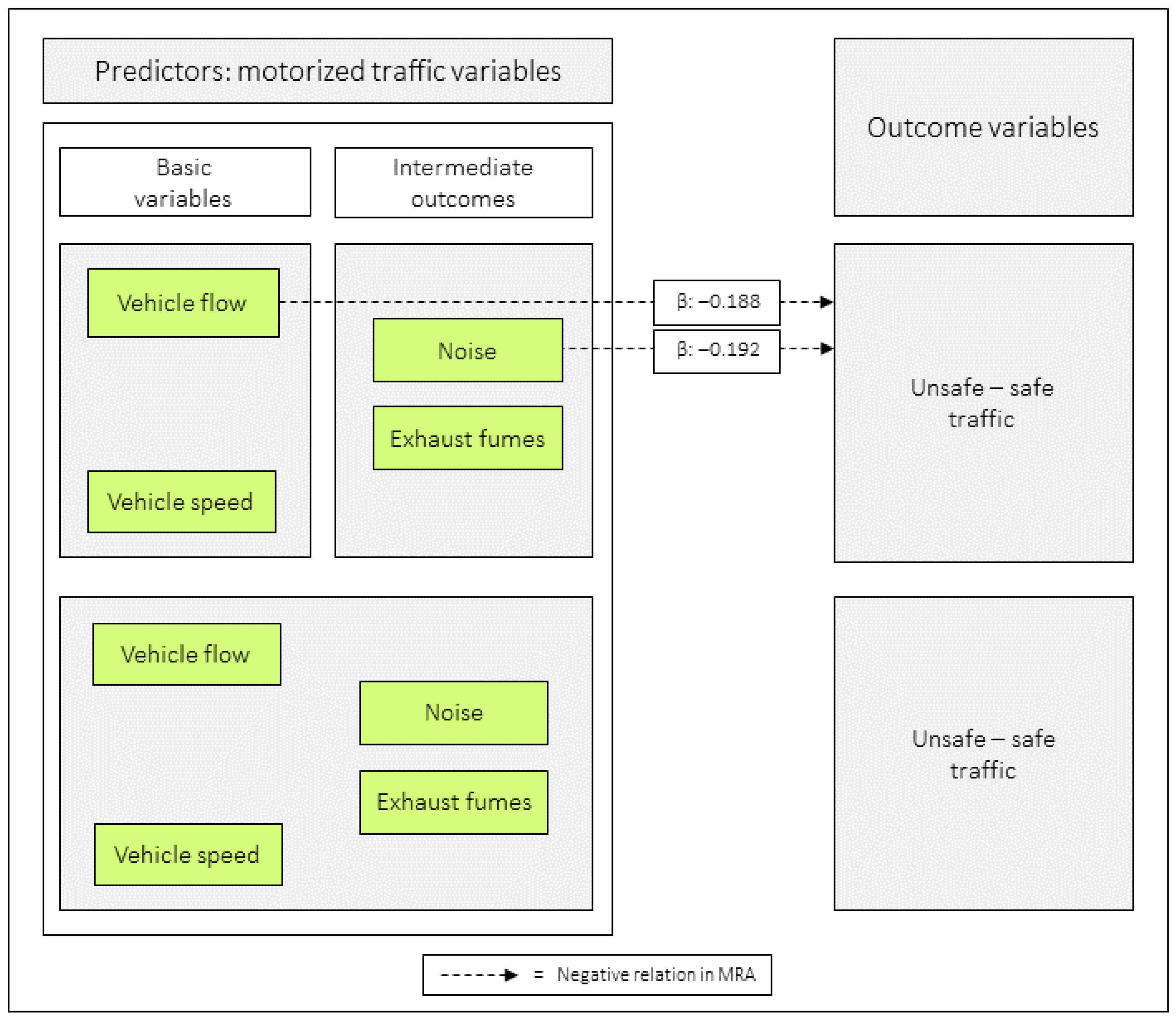
In model 8:1, vehicle flow was negatively related to unsafe–safe traffic, and in 8:2, noise had the equivalent role. When all the motorized traffic variables were included as predictors, none was significantly related to the outcome (Table 8 and Figure 10 and Figure 11).

3.9. Mediation

Mediation analyses were conducted in models where a potential mediating effect was of interest (Table 9). In addition to the previously analyzed variables, a composite variable was created by multiplying vehicle flow by vehicle speed, as this combination possibly could influence the outcome variables. Only mediated effects (p < 0.05) corresponding to 40% or more are commented upon. 40% was chosen since it represents a sizable effect.
An indirect effect of vehicle speed on noise is mediated by vehicle flow (95%), and an indirect effect of vehicle speed on exhaust fumes is mediated by vehicle flow (101%). Noise mediates the effect of vehicle flow, vehicle speed, and the composite variable to hinders–stimulates walking (the indirect effects were 111%, 116% and 126%, respectively).

3.10. A Graphic Illustration of Significant Relations Based on the Commuting Pedestrians’ Perceptions and Appraisals of Their Route Environments

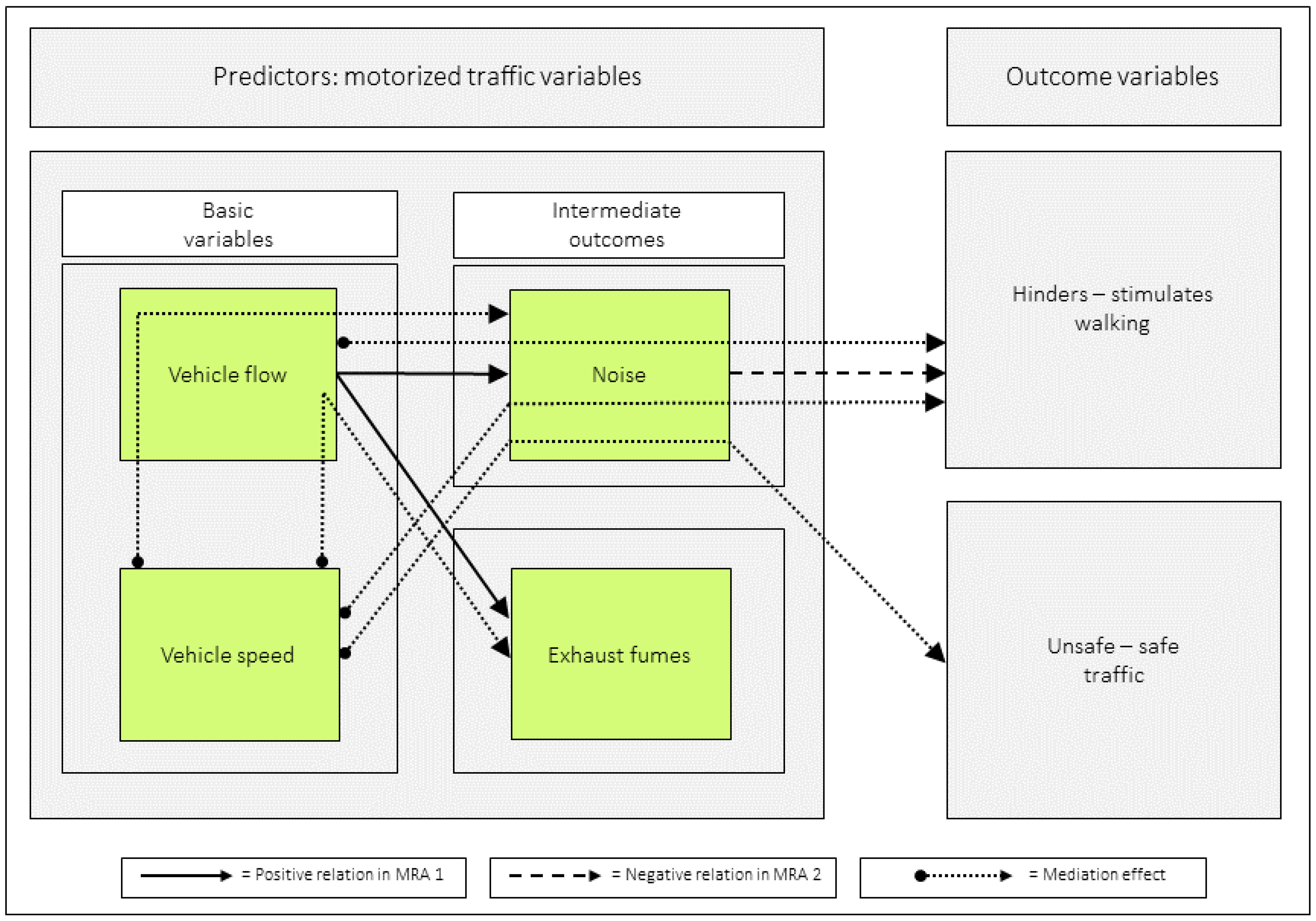
When adding significant indirect effects corresponding to 40% or more to Figure 11, and removing numerical data, the following graphic emerges, see Figure 12 (MA 9:9 not included). Note that we included MA 9:8 even if it did not reach 40% (the effect was 39%).

4. Discussion

This is, to our knowledge, the first time that perceptions and relations between four variables connected to motorized vehicles and outcomes in terms of hindering–stimulating walking as well as unsafety–safety for reasons of traffic, are studied in suburban and rural settings using correlational, multiple regression, and mediation analyses with the aim of establishing relations between these variables.
One of the primary results regarding the perceptions of four motorized traffic variables was that noise was the primary negative predictor variable in relation to hinders–stimulates walking. The regression equation was y = 12.2 − 0.37 noise (all p-values ≤ 0.001, Adj. R2 = 0.29).
Concerning the other outcome, unsafe–safe traffic, it was more difficult to identify a primary predictor variable, as none of the motorized traffic variables were significant when jointly analyzed in multiple regression analysis. Vehicle speed was the closest one (p = 0.095), thus suggesting a potential effect.
The mediation analyses showed that (1) vehicle speed had an indirect effect on unsafe–safe traffic, via noise, (2) both vehicle speed and vehicle flow had, via noise, indirect effects on hinders–stimulates walking, and (3) vehicle speed had, via vehicle flow, an indirect effect on noise and exhaust fumes.
How these and other relations can be further analyzed will be discussed below. In doing so, we will integrate the results from correlation (CA), multiple regression (MRA), and mediation (MA) analyses.
We have previously studied how motorized traffic variables are perceived by pedestrians in the inner urban area of Stockholm [16]. For a comparison between perceptions in the two settings, see Table 10.
Table 10 displays levels and ratios between perceptions of the motorized traffic variables in the two environments. The ratios of the mean levels of the inner urban/suburban ratings of vehicle speed, vehicle flow, noise, and exhaust fumes are consistently above 1.0. This finding aligns with previous studies on cycle commuters in the same settings (see Table 11 [18,19]).

4.1. The Relationships Between Perceptions of the Predictor Variables of Motorized Traffic

A few high correlations were identified between the predictor variables of motor traffic, e.g., between noise and vehicle flow (r = 0.85) followed by between noise and exhaust fumes (r = 0.81). High correlations can be problematical when trying to pinpoint the role of a specific variable in relation to an outcome, e.g., hinders–stimulates walking and unsafe–safe traffic. One way of avoiding this is to include more participants; another is to analyze the relationships between the traffic and outcome variables gradually, with different statistical tools. We have chosen the latter strategy.

4.2. Vehicle Speed and Vehicle Flow in Relation to Noise and Exhaust Fumes

Vehicle speed and vehicle flow were related, as indicated by a correlation coefficient of r = 0.67. Both vehicle speed and vehicle flow were individually related to noise in MRA. When jointly analyzed, only vehicle flow was related to noise and exhaust fumes. The MA demonstrated that vehicle speed had indirect effects, via vehicle flow, on both noise (95%) and exhaust fumes (101%). The basic variable vehicle speed protrudes, therefore, as an important origin to both of the intermediate outcomes noise and exhaust fumes.
Our separate analysis of vehicle speed and vehicle flow in relation to noise in the inner urban area compared to the suburban area indicated, via the regression coefficients, that vehicle speed had a similar impact on noise in the two settings, whereas vehicle flow had a greater impact on noise in the suburban area.
Although the MRA showed no relationship between exhaust fumes and either outcome, it is worth noting that pedestrians and others in urban environments are often exposed to unseen and scentless pollutants, such as particulate matter (PM).

4.3. The Motorized Traffic Variables in Relation to the Outcome Variable Hinders–Stimulates Walking

Individually, each motorized traffic variable was negatively related to hinders–stimulates walking. This suggests that if only a few motor traffic variables are included as indicators of motorized traffic in studies aimed at evaluating their effect, the potentially more fundamental relationships will remain undisclosed.
When combining the basic variables vehicle speed and vehicle flow, and analyzing them in MRA, with hinders–stimulates walking as the outcome, only vehicle flow was negatively related. When combining the intermediate outcomes noise and exhaust fumes, noise had the corresponding role. When all four motorized traffic variables were included as predictors, only noise was negatively related to hinders–stimulates walking (see Figure 9).
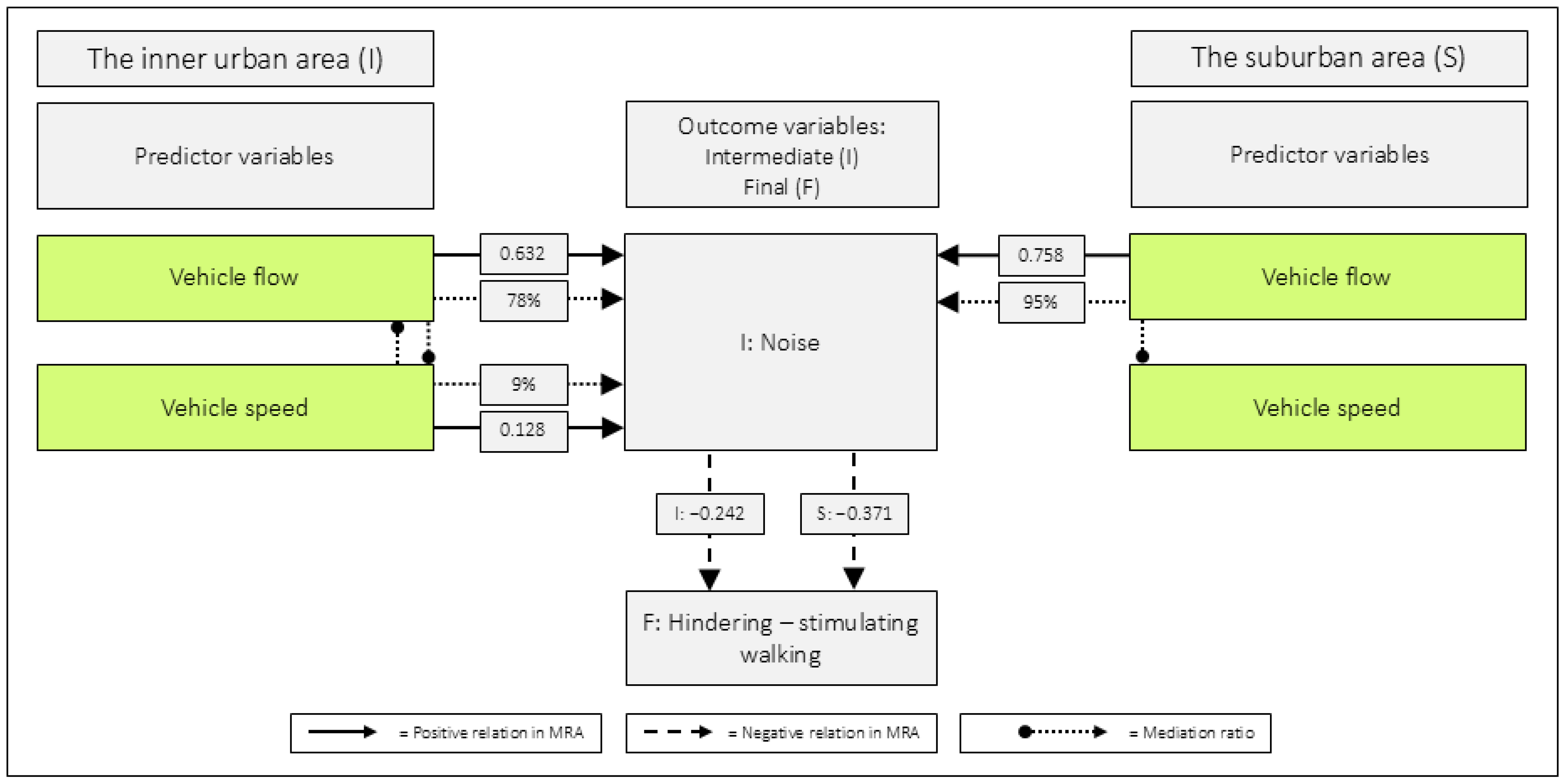
Perceptions of noise are influenced by both vehicle flow and vehicle speed. In the inner urban area, MRA revealed that both variables were positively related to noise [16]. MA further revealed that vehicle flow mediated the effect of vehicle speed on noise, and vice versa. In suburban areas, however, only vehicle flow was directly related to noise in MRA. The MA demonstrated that vehicle speed had an indirect effect on noise through vehicle flow (see Figure 13).
The unstandardized B regarding noise, in relation to hinders–stimulates walking in the inner urban area was −0.242 (95% CI: −0.415 to −0.070) [16]. The corresponding value in the suburban areas was −0.371 (95% CI: −0.555 to −0.186). Although not significantly higher, due to overlapping CI, it is interesting that the values diverged in that direction. This is, not least, the case, given that the mean level of noise was perceived as about 50% lower in suburbia (see Table 10).
A reasonable explanation for this is that individuals might be more sensitive to noise in a suburban setting. Thus, this may load the variable with a more negative impact in suburbia, compared to in an inner urban context.
However, suburban areas are generally greener than inner urban areas, and a greener environment has been reported to correspond with lower noise annoyance [28,29]. In line with that, it is not anticipated that the regression coefficients diverge in that direction. Thus, this issue deserves future attention.
The experience of noise as a source of discomfort is not unique to the study area; it has been reported as a deterrent to pedestrians in various countries and settings. For example, a U.S. study on recreational walking examined the influence of environmental variables, time, and distance on walking preferences, finding that participants preferred low-noise environments over high-noise ones [30]. Similarly, a German study on pedestrian commuters, employing a mixed-methods approach, found that noise levels negatively affected commuting experiences [31]. In Spain, a qualitative study on the role of the built environment in short walking trips for transportation identified traffic noise as an unpleasant factor that could influence route choices [32]. Furthermore, a Chilean study based on walk-along interviews reported that negative walking experiences increased as participants approached main streets with high motorized traffic and noise [5].
While barriers can help reduce road traffic noise annoyance and improve overall sound quality [33], noise remains a significant threat to both health and environmental well-being. Its harmful effects include elevated stress hormone levels, increased blood pressure, and sleep disturbances, which in turn raise the risk of cardiovascular diseases and metabolic disorders such as ischemic heart disease, obesity, and type 2 diabetes [34,35,36,37]. Noise is often referred to as a “silent killer”, and as Münzel et al. [35] (p. 831) explain, “… noise may exert its effects either directly, through synaptic interactions or indirectly, through the emotional and the cognitive perception of sound.”
Recognizing these risks, the World Health Organization (WHO) recommends that road traffic noise should not exceed 53 dB Lden, as higher levels are associated with adverse health effects [36] (p. 30). In Stockholm County, however, 30% of adult residents are exposed to traffic noise exceeding this threshold at the façades of their homes [38] (p. 15).
Interestingly, long-term exposure to transportation noise has also been associated with reduced physical activity levels [39]. This may be due to the “barrier effect” of traffic, which has been observed when major roads separate residential areas from and green spaces [40]. Furthermore, walking has been reported to be hindered when both traffic volume and speed are rated as high [41]. This finding aligns with another study, which suggests that high traffic volume, in combination with high traffic speeds, may hinder physical activity [42]. However, given the results from the present study, the actual problem might be noise, a variable that was not included in any of the two studies mentioned.
A common recommendation for reducing traffic noise is to replace traditional cars with electric vehicles. However, this shift will only lead to modest reductions in road traffic noise. Research suggests that there is a threshold around 30 km/h [43,44] (p. 3, p. 4). Below this speed, electric vehicles are quieter than those with internal combustion engines. Above 30 km/h, which is frequent in many urban, suburban, and rural areas, tyre friction becomes the dominant source of noise.

4.4. Comments on Relations Between Noise and Vehicle Flow

Although vehicle flow is highly correlated with noise, with a correlation coefficient of r = 0.85, there are reasons to emphasize that our perception of a certain vehicle flow can vary. It may vary considerably depending on its back- and foreground features, the proximity, visibility, and the direction of the vehicle flow in terms of moving towards or away from a pedestrian (cf. Figure 3a,b as well as Figure 4a,b). As a result, the impact of a given vehicle flow can differ depending on several issues. In contrast, noise is more omnipresent in urban or suburban–rural environments and can reach us almost regardless of the visual conditions coupled to the flow.
Studies of commuting cyclists in the suburban and rural areas of Stockholm, Sweden, have shown that both vehicle flow and noise can be negatively related to inhibiting–stimulating cycling [18]. The pedestrians rated, on average, about 10% lower levels of vehicle flow and 5% lower levels of noise compared to cyclists [18], but this may not explain why vehicle flow did not emerge as a significant and independent negative predictor. It is more likely that it was due to the considerably greater statistical power in the cyclist group with 1098 cyclists compared to 233 pedestrians in the suburban–rural areas.
It is essential to explore methods that can facilitate these types of studies without requiring large groups of respondents. Therefore, we will revisit these perspectives in the final part of this Discussion, under the heading “4.7. Exploring Measurement Perspectives”.

4.5. The Motorized Traffic Variables in Relation to the Outcome Variable Unsafe–Safe Traffic

Individually, each variable was negatively related to unsafe–safe traffic. As mentioned, this indicates that if few or imprecisely defined motor traffic variables are included as indicators for motorized traffic in studies aiming to evaluate their effect, the fundamental relations might remain undisclosed.
When combining the basic variables of vehicle speed and vehicle flow and analyzing them in MRA, with unsafe–safe traffic as the outcome, vehicle flow was negatively related to the outcome. When combining the intermediate outcomes noise and exhaust fumes, noise had the corresponding role. Finally, when all motorized traffic variables were included as predictors, none of them were found to be significantly related to the outcome. However, vehicle speed had a tendency (p = 0.095) to have such an effect. The MA demonstrated that vehicle speed, via noise, had an indirect effect on unsafe–safe traffic (the indirect effect was 39%).
Since safety has been discussed as an important issue for pedestrians [45,46,47], it is surprising that none of the motorized traffic variables were significantly related to unsafe versus safe traffic in MRA. This may be due to multicollinearity between the predictors of motor traffic, such as noise and vehicle flow, which are highly correlated (r = 0.85).
Nonetheless, with respect to road safety, speed management should be a top priority. In accordance with that, a campaign initiated by the United Nations (UN) has been launched to limit the speed in urban areas to 30 km/h [4] (p. 60). This initiative will not only save lives directly but also contribute to a reduction in noise levels. Over time, lower noise pollution is associated with improved public health.

4.6. External Validity in Relation to Different Subgroups in a Population

In a study examining how cyclists of different experience levels (regular, frequent, occasional) and potential cyclists evaluated various routes in relation to their likelihood of usage, the order of preferences was consistent across all groups [48]. This means that the differences in preferences for various route environmental features were similar across all cyclist groups and potential cyclist groups. However, the sensitivity to usage of each type of route environment differed between the groups, with potential cyclists being the most selective of the route environments, followed by those in the other groups, in the order of occasional, frequent, and regular cyclists. In relation to the present study, it suggests that potential pedestrians may be more sensitive to, for example, noise levels, than those who walk on a regular basis. Thus, high standards in this and other environmental respects need to be taken into consideration from a public health perspective.

4.7. Exploring Measurement Perspectives

In the Introduction, we suggested that the perceptions and appraisals coupled to objective levels of the four traffic variables may differ between inner urban and suburban –rural areas. We reason that in urban centres, large buildings may obscure or reduce the prominence of certain traffic variables, such as our perception of vehicle flow, compared to suburban or rural settings. Also, parked cars can hinder the visibility of traffic flows. Furthermore, higher buildings can create canyon effects, concentrating the levels of, e.g., exhaust fumes.
Contrary to what was found among commuting cyclists [18], we did not note that both vehicle flow and noise were negative predictors among pedestrians in suburban–rural areas, and have indicated that it may be due to the differences in statistical power between the studies.
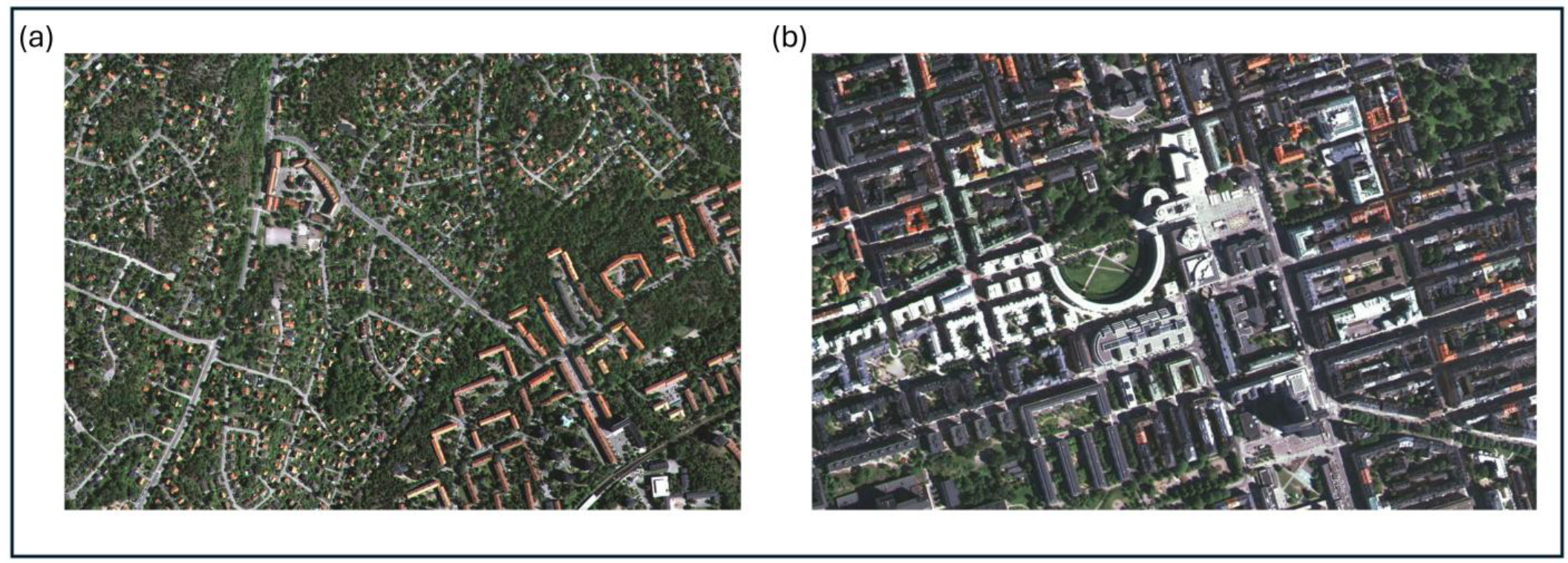
We have clustered suburban and rural settings, which also include national highways with high levels of traffic flow and speed. Given the complexity of these settings, they warrant further exploration. In this respect, isolating and controlling for the environmental features under study is likely to be a fruitful approach. Future studies would also likely benefit from both separate and comparative investigations of typical suburban and rural areas, respectively. In the present study, we compare findings from the suburban and the inner urban areas. Therefore, we here illustrate a common form of a suburban area (Figure 14a) and a typical inner urban area (Figure 14b) in Greater Stockholm, Sweden. In the figure legend, we comment on the conceivable consequences of the striking differences in these built-up areas (Figure 14a,b).
Another pathway is to create experimental study conditions in which only one variable is modified. That would probably facilitate a more in-depth understanding of these phenomena. Let us consider such a possibility presented in Figure 15a,b. In the suburban–rural area, several national highways pass by. Along many of these routes, both pedestrians and cyclists are forced to travel without any protection from noise, as no alternative paths are available (Figure 15a).
However, there are some settings (cf. Figure 15b) that would facilitate experimental studies of the effect of visually perceiving a traffic flow or not, while the auditory exposure remains constant. In that way, the impact of observing a vehicle flow can be easily studied.
The ratings used in this study represent mean values for the individual routes taken by pedestrians to work. They represent distinct values by indicating both the mean and the minimum levels of route environmental variables that most likely need to be reached in order to attract greater levels of cycling and walking.
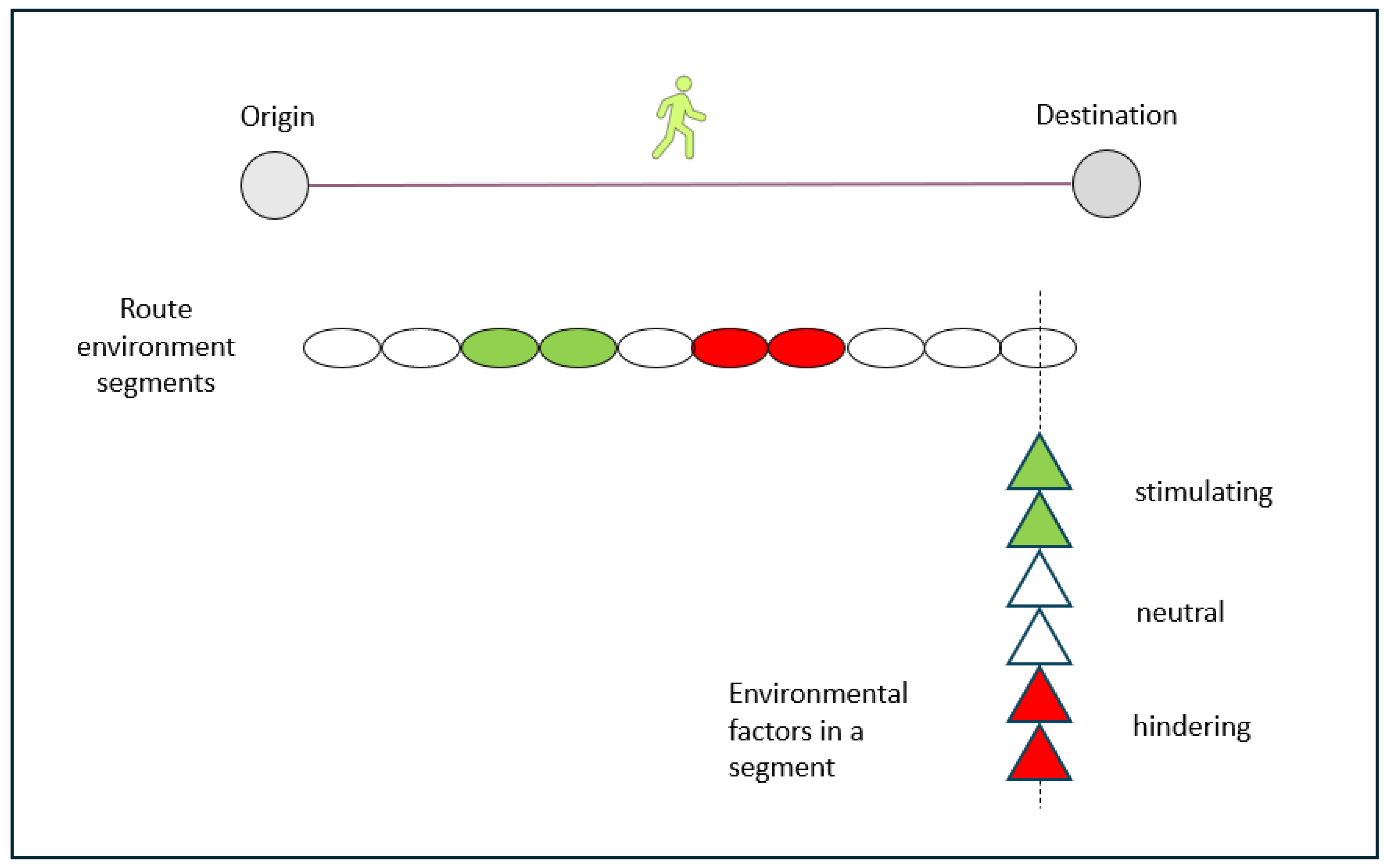
However, often the environment changes along the route, and from teaching experiences with students, it is clear that even limited aspects of route settings can be negative enough to deter walking and cycling behaviours. The fact that route environments often differ between the origin and the destination can be used for research purposes. The conceptual illustration below is intended to stimulate the development of research strategies for these purposes (Figure 16). From the origin to the destination of a walking or cycling trip, one passes through several route segments, which are defined as discrete spatial units with the same composition of environmental variables and levels. Depending on the composition of environmental variables that act within the segments, the overall ratings of them can be, for example, stimulating, neutral, or hindering for walking or cycling. Through studying these matters by both quantitative and qualitative measures, one can complement other methods. Each segment can be studied in relation to how the environmental variables affect both the intermediate and the final outcomes in the model presented in Figure 1.

5. Conclusions

In suburban–rural route environments of a metropolitan setting, noise related negatively to the outcome hinders–stimulates walking. With respect to the other outcome, unsafe–safe traffic, none of the four traffic variables were significantly related when jointly analyzed in MRA. Vehicle speed had, however, a certain tendency. The MA revealed that vehicle speed, through vehicle flow, exacerbates noise and has indirect negative effects on both outcomes. Hence, if levels of vehicle speed are reduced, noise levels will decrease, and the walking experience is likely to be enhanced, positively influencing the amount of physical activity.
This study can advance the understanding of how results from other studies, which may have used fewer traffic variables in an effort to highlight the influence of the traffic environment, can be interpreted. This understanding can assist research, transportation, and planning societies in selecting relevant proxy variables.
Finally, we have critically explored the current measurement conditions and suggested possible future pathways, including experimental studies, that we believe will enhance opportunities to explore and detect even smaller effects of motorized traffic variables, and enable fewer pedestrians and bicyclists to be involved.

Author Contributions

Conceptualization, P.S.; data curation, L.W. and D.A.; formal analysis, D.A. and P.S.; funding acquisition, P.S.; supervision, L.W. and P.S.; visualization, D.A. and P.S.; writing—original draft, D.A. and P.S.; writing—review and editing, D.A., L.W. and P.S. All authors have read and agreed to the published version of the manuscript.

Funding

This study was supported by the Research Funds of the Swedish Road Administration (AL90 B 2003:27701), the Public Health Funds of the Stockholm County Council (LS 0401-0158), the Research Funds of the Swedish Transport Administration (TRV 2017/63917-6522), and the Swedish School of Sport and Health Sciences, GIH. The funding sources were not involved in any aspect of the study.

Institutional Review Board Statement

The Ethics Committee North of the Karolinska Institute at the Karolinska Hospital approved the study (Dnr 03-637, approved on 2 December 2003).

Informed Consent Statement

The participants provided written informed consent to participate in the study.

Data Availability Statement

The data presented in this study are available on request from the corresponding author. The data are not publicly available due to privacy.

Acknowledgments

The authors are grateful to the volunteers for participating in the study and to Erik Stigell, Cecilia Schantz-Eyre, Lina Wahlgren, Golam Sajid, Eva Minten, and Per Brink for their technical assistance. Additionally, the authors thank Peter Schantz and Erik Stigell for their contributions to the development of the ACRES. We also extend our gratitude to Rui Wang for statistical advice, Charlotta Eriksson for valuable comments on noise and health, and Aaron Hipp for providing an inspiring academic environment at North Carolina State University, Raleigh, NC, USA, where many of the analyses were made by one of the authors (DA).

Conflicts of Interest

The authors declare no conflicts of interest.

Appendix A

Table A1. Descriptive characteristics of the walking commuting trips (mean ± SD, (95% CI) and n participants).
DistanceDurationSpeedFrequency of Walking Trips in MayTotal Number of Walking Trips over the Year *
kmminkm · h−1trips · week−1
Men3.94 ± 2.5042.2 ± 22.85.42 ± 0.9934.35 ± 3.57219 ± 150
(3.15–4.72)(34.9–49.6)(5.09–5.74)(3.11–5.60)(163–275)
4139393430
Women2.92 ± 1.7532.7 ± 18.65.14 ± 0.9284.63 ± 4.61227 ± 162
(2.66–3.17)(30.0–35.5)(5.00–5.28)(3.89–5.37)(200–255)
181175175151135
Notes: The number (n) of participants varies across variables and sexes due to missing or incorrectly reported data. * Five females had remarkably high numbers of walking trips per year (range: 736–1183), these outliers were replaced by mean values for the remaining females. After replacing the outliers, the final values were calculated.
Table A2. The distribution of time when commuting from home to the place of work or study (n participants and percentage within each sex).
a.m.5–6>6–7>7–8>8–9>9–10>10 a.m.–<5 a.m.
Men
(n = 43)
n27201211
%4.716.346.527.92.32.3
Women
(n = 187)
n3348939913
%1.618.247.620.94.87.0
Notes: Four females and two males reported walking in multiple time categories. They were placed in the earliest time category.
Table A3. The distribution of time when commuting from the place of work or study to home (n participants and percentage within each sex).
p.m.2–3>3–4>4–5>5–6>6–7>7–8>8 p.m.–
<2 p.m.
Men
(n = 43)
n54193813
%11.69.344.27.018.62.37.0
Women
(n = 185)
n32680564412
%1.614.143.230.32.22.26.5
Notes: Five females and three males reported that they walked in multiple time categories. They were placed in the earliest time category.
Table A4. The VIF, the Cook’s distance and the standardized residuals.
ModelPredictorsOutcomesVIFCookStd. Residual
>(±3 SD)
MeanMaximumMeanMaximumNMaximum
MRA 5:1
MA 9:1, 9:6, 9:8
Vehicle speedNoise1.091.190.0050.10113.32
MRA 5:2
MA 9:2, 9:5, 9:7
Vehicle flowNoise1.121.200.0050.17234.85
MRA 5:3
MA 9:3
Vehicle speedExhaust fumes1.091.190.0050.08613.06
MRA 5:4
MA 9:4
Vehicle flowExhaust fumes1.121.200.0050.14154.03
MRA 5:5NoiseExhaust fumes1.121.200.0050.1973−4.18
MRA 5:6
MA 9:2, 9:4
Vehicle speedVehicle flow1.091.190.0040.054
MRA 6:1Vehicle speed
Vehicle flow
Noise1.381.920.0050.18934.90
MRA 6:2Vehicle speed
Vehicle flow
Exhaust fumes1.381.920.0050.13054.01
MRA A5:1Vehicle speedHinders–stimulates walking1.091.190.0050.0541−3.06
MRA A5:2Vehicle flowHinders–stimulates walking1.121.200.0050.046
MRA A5:3
MA 9:5, 9:6, 9:9
NoiseHinders–stimulates walking1.121.200.0050.044
MRA A5:4Exhaust fumesHinders–stimulates walking1.101.200.0050.111
MRA 7:1Vehicle speed
Vehicle flow
Hinders–stimulates walking1.381.920.0050.042
MRA 7:2Noise
Exhaust fumes
Hinders–stimulates walking1.763.090.0050.095
MRA 7:3Vehicle speed
Vehicle flow
Noise
Exhaust fumes
Hinders–stimulates walking2.344.670.0050.087
MRA A6:1Vehicle speedUnsafe–safe traffic1.091.190.0040.0774−3.56
MRA A6:2Vehicle flowUnsafe–safe traffic1.121.200.0040.0604−3.58
MRA A6:3
MA 9:7, 9:8, 9:10
NoiseUnsafe–safe traffic1.121.200.0040.0542−3.55
MRA A6:4Exhaust fumesUnsafe–safe traffic1.101.200.0040.0494−3.61
MRA 8:1Vehicle speed
Vehicle flow
Unsafe–safe traffic1.381.920.0040.0675−3.57
MRA 8:2Noise
Exhaust fumes
Unsafe–safe traffic1.763.090.0040.0493−3.57
MRA 8:3Vehicle speed
Vehicle flow
Noise
Exhaust fumes
Unsafe–safe traffic2.344.670.0040.0675−3.57
MA 9:1, 9:3Vehicle flowVehicle speed1.121.200.0050.059
MA 9:9, 9:10Composite variableNoise1.111.200.0050.17414.63
Total1.314.670.0050.197504.90
Notes: N = the number of individuals exceeding ± 3 SD. The background variables sex, age, education, and income were included in the analyses.
Table A5. Relations between the predictor variables and hinders–stimulates walking as an outcome.
ModelOutcomey-Intercept
(95% CI)
p-ValuePredictorUnstandardized B
(95% CI)
p-ValueAdj. R2
A5:1Hinders–stimulates walking10.1
(7.65–12.5)
<0.001Vehicle speed−0.199
(−0.299 to −0.100)
<0.0010.122
A5:2Hinders–stimulates walking11.4
(9.08–13.7)
<0.001Vehicle
flow
−0.292
(−0.380 to −0.205)
<0.0010.211
A5:3Hinders–stimulates walking12.3
(10.1–14.5)
<0.001Noise−0.389
(−0.478 to −0.300)
<0.0010.292
A5:4Hinders–stimulates walking11.4
(9.18–13.6)
<0.001Exhaust fumes−0.331
(−0.422 to −0.240)
<0.0010.235
Notes: The background variables sex, age, education, and income were included in the analysis. Only significant (p < 0.05) background variables are reported. The background variable sex was significant in all models: A5:1: unstandardized B = −1.00 (p = 0.046); A5:2: unstandardized B = −1.05 (p = 0.027); A5:3: unstandardized B = −0.965 (p = 0.032); A5:4: unstandardized B = −1.09 (p = 0.020). The background variable age was significant in model A5:1: unstandardized B = 0.065 (p = 0.001); A5:2: unstandardized B = 0.042 (p = 0.030); A5:4: unstandardized B = 0.048 (p = 0.010).
Table A6. Relations between the predictor variables and unsafe–safe traffic as an outcome.
ModelOutcomey-Intercept
(95% CI)
p-ValuePredictorUnstandardized B
(95% CI)
p-ValueAdj. R2
A6:1Unsafe–safe traffic14.6
(12.1–17.2)
<0.001Vehicle
speed
−0.254
(−0.360 to −0.147)
<0.0010.076
A6:2Unsafe–safe traffic15.0
(12.4–17.5)
<0.001Vehicle
flow
−0.262
(−0.359 to −0.164)
<0.0010.097
A6:3Unsafe–safe traffic14.8
(12.3–17.4)
<0.001Noise−0.261
(−0.366 to −0.155)
<0.0010.082
A6:4Unsafe–safe traffic14.4
(11.8–16.9)
<0.001Exhaust
fumes
−0.235
(−0.340 to −0.131)
<0.0010.067
Notes: The background variables sex, age, education, and income were included in the analysis. Only significant (p < 0.05) background variables are reported. There were no significant background variables.
Figure A1. Relations between the individual predictor variables and the outcome variables. Notes: r = Pearson’s correlation coefficient and β = unstandardized beta. The figure is based on Table 4, Table A5 and Table A6.
Ijerph 23 00206 g0a1

References

  1. Hall, K.S.; Hyde, E.T.; Bassett, D.R.; Carlson, S.A.; Carnethon, M.R.; Ekelund, U.; Evenson, K.R.; Galuska, D.A.; Kraus, W.E.; Lee, I.M.; et al. Systematic review of the prospective association of daily step counts with risk of mortality, cardiovascular disease, and dysglycemia. Int. J. Behav. Nutr. Phys. Act. 2020, 17, 78. [Google Scholar] [CrossRef] [PubMed]
  2. Kelly, P.; Kahlmeier, S.; Götschi, T.; Orsini, N.; Richards, J.; Roberts, N.; Scarborough, P.; Foster, C. Systematic review and meta-analysis of reduction in all-cause mortality from walking and cycling and shape of dose response relationship. Int. J. Behav. Nutr. Phys. Act. 2014, 11, 132. [Google Scholar] [CrossRef] [PubMed]
  3. Morris, J.N.; Hardman, A.E. Walking to health. Sports Med. 1997, 23, 306–332. [Google Scholar] [CrossRef] [PubMed]
  4. World Health Organization. Walking and Cycling: Latest Evidence to Support Policy-Making and Practice; World Health Organization: Copenhagen, Denmark, 2022. [Google Scholar]
  5. Herrmann-Lunecke, M.G.; Mora, R.; Vejares, P. Perception of the built environment and walking in pericentral neighbourhoods in Santiago, Chile. Travel Behav. Soc. 2021, 23, 192–206. [Google Scholar] [CrossRef]
  6. Kim, E.J.; Gong, Y. The smart city and healthy walking: An environmental comparison between healthy and the shortest route choices. Urban Plan. 2023, 8, 12. [Google Scholar] [CrossRef]
  7. Panter, J.; Griffin, S.; Ogilvie, D. Active commuting and perceptions of the route environment: A longitudinal analysis. Prev. Med. 2014, 67, 134–140. [Google Scholar] [CrossRef]
  8. Giles-Corti, B.; Robertson-Wilson, J.; Wood, L.; Falconer, R. The role of the changing built environment in shaping our shape. In Geographies of Obesity: Environmental Understanding of the Obesity Epidemic; Pearce, J., Witten, K., Eds.; Routledge: Oxfordshire, UK; New York, NY, USA, 2016. [Google Scholar]
  9. Saelens, B.E.; Sallis, J.F.; Black, J.B.; Chen, D. Neighborhood-based differences in physical activity: An environment scale evaluation. Am. J. Public Health 2003, 93, 1552–1558. [Google Scholar] [CrossRef]
  10. Spittaels, H.; Verloigne, M.; Gidlow, C.; Gloanec, J.; Titze, S.; Foster, C.; Oppert, J.M.; Rutter, H.; Oja, P.; Sjöström, M.; et al. Measuring physical activity-related environmental factors: Reliability and predictive validity of the European environmental questionnaire ALPHA. Int. J. Behav. Nutr. Phys. Act. 2010, 7, 48. [Google Scholar] [CrossRef]
  11. Spittaels, H.; Foster, C.; Oppert, J.-M.; Rutter, H.; Oja, P.; Sjöström, M.; De Bourdeaudhuij, I. Assessment of environmental correlates of physical activity: Development of a European questionnaire. Int. J. Behav. Nutr. Phys. Act. 2009, 6, 39. [Google Scholar] [CrossRef]
  12. Adams, E.J.; Goodman, A.; Sahlqvist, S.; Bull, F.C.; Ogilvie, D. Correlates of walking and cycling for transport and recreation: Factor structure, reliability and behavioural associations of the perceptions of the environment in the neighbourhood scale (PENS). Int. J. Behav. Nutr. Phys. Act. 2013, 10, 87. [Google Scholar] [CrossRef]
  13. Humpel, N.; Owen, N.; Iverson, D.; Leslie, E.; Bauman, A. Perceived environment attributes, residential location, and walking for particular purposes. Am. J. Prev. Med. 2004, 26, 119–125. [Google Scholar] [CrossRef]
  14. Schantz, P. Physical activity behaviours and environmental well-being in a spatial context. In Geography and Health—A Nordic Outlook; Schaerström, A., Jörgensen, S.H., Kistemann, T., Sivertun, Å., Eds.; Swedish National Defence College: Stockholm, Sweden; Norwegian University of Science and Technology (NTNU): Trondheim, Norway; Universität Bonn: Bonn, Germany, 2014; pp. 142–156. [Google Scholar]
  15. Andersson, D. Exploring Perceptions of Route Environments in Relation to Walking. Ph.D. Thesis, The Swedish School of Sport and Health Sciences, GIH, Stockholm, Sweden, 2024. [Google Scholar]
  16. Andersson, D.; Wahlgren, L.; Olsson, K.S.E.; Schantz, P. Pedestrians’ perceptions of motorized traffic variables in relation to appraisals of urban route environments. Int. J. Environ. Res. Public Health 2023, 20, 3743. [Google Scholar] [CrossRef] [PubMed]
  17. Andersson, D.; Wahlgren, L.; Schantz, P. Pedestrians’ perceptions of route environments in relation to deterring or facilitating walking. Front. Public Health 2023, 10, 1012222. [Google Scholar] [CrossRef] [PubMed]
  18. Wahlgren, L.; Schantz, P. Exploring bikeability in a suburban metropolitan area using the active commuting route environment scale (ACRES). Int. J. Environ. Res. Public Health 2014, 11, 8276–8300. [Google Scholar] [CrossRef] [PubMed]
  19. Wahlgren, L.; Schantz, P. Exploring bikeability in a metropolitan setting: Stimulating and hindering factors in commuting route environments. BMC Public Health 2012, 12, 168. [Google Scholar] [CrossRef]
  20. Berry, N.M.; Coffee, N.T.; Nolan, R.; Dollman, J.; Sugiyama, T. Neighbourhood environmental attributes associated with walking in South Australian adults: Differences between urban and rural areas. Int. J. Environ. Res. Public Health 2017, 14, 965. [Google Scholar] [CrossRef]
  21. Wahlgren, L.; Stigell, E.; Schantz, P. The active commuting route environment scale (ACRES): Development and evaluation. Int. J. Behav. Nutr. Phys. Act. 2010, 7, 58. [Google Scholar] [CrossRef]
  22. Wahlgren, L.; Schantz, P. Bikeability and methodological issues using the active commuting route environment scale (ACRES) in a metropolitan setting. BMC Med. Res. Methodol. 2011, 11, 6. [Google Scholar] [CrossRef]
  23. Schantz, P.; Salier Eriksson, J.; Rosdahl, H. The heart rate method for estimating oxygen uptake: Analyses of reproducibility using a range of heart rates from cycle commuting. PLoS ONE 2019, 14, e0219741. [Google Scholar] [CrossRef]
  24. Stockholm Office of Research and Statistics. Statistical Year-Book of Stockholm 2007; Stockholm Office of Research and Statistics: Stockholm, Sweden, 2006. [Google Scholar]
  25. Field, A. Discovering Statistics Using IBM SPSS Statistics, 5th ed.; SAGE Publications: London, UK, 2018. [Google Scholar]
  26. Hayes, A.F. Introduction to Mediation, Moderation, and Conditional Process Analysis. A Regression-Based Approach, 3rd ed.; Guilford Press: New York, NY, USA, 2022. [Google Scholar]
  27. Preacher, K.J.; Kelley, K. Effect size measures for mediation models: Quantitative strategies for communicating indirect effects. Psychol. Methods 2011, 16, 93–115. [Google Scholar] [CrossRef]
  28. Dzhambov, A.M.; Dimitrova, D.D. Green spaces and environmental noise perception. Urban For. Urban Green. 2015, 14, 1000–1008. [Google Scholar] [CrossRef]
  29. Gidlöf-Gunnarsson, A.; Öhrström, E. Noise and well-being in urban residential environments: The potential role of perceived availability to nearby green areas. Landsc. Urban Plan. 2007, 83, 115–126. [Google Scholar] [CrossRef]
  30. Bunds, K.S.; Casper, J.M.; Hipp, J.A.; Koenigstorfer, J. Recreational walking decisions in urban away-from-home environments: The relevance of air quality, noise, traffic, and the natural environment. Transp. Res. Part F Traffic Psychol. Behav. 2019, 65, 363–375. [Google Scholar] [CrossRef]
  31. Marquart, H.; Stark, K.; Jarass, J. How are air pollution and noise perceived en route? Investigating cyclists’ and pedestrians’ personal exposure, wellbeing and practices during commute. J. Transp. Health 2022, 24, 101325. [Google Scholar] [CrossRef]
  32. Ferrer, S.; Ruiz, T.; Mars, L. A qualitative study on the role of the built environment for short walking trips. Transp. Res. Part F Traffic Psychol. Behav. 2015, 33, 141–160. [Google Scholar] [CrossRef]
  33. Rådsten-Ekman, M.; Vincent, B.; Anselme, C.; Mandon, A.; Rohr, R.; Defrance, J.; Van Maercke, D.; Botteldooren, D.; Nilsson, M.E. Case-study evaluation of a low and vegetated noise barrier in an urban public space. In Proceedings of the 40th International Congress and Exposition on Noise Control Engineering 2011, INTER-NOISE, Osaka, Japan, 4–7 September 2011; pp. 1–6. [Google Scholar]
  34. Hahad, O.; Prochaska, J.H.; Daiber, A.; Muenzel, T. Environmental noise-induced effects on stress hormones, oxidative stress, and vascular dysfunction: Key factors in the relationship between cerebrocardiovascular and psychological disorders. Oxidative Med. Cell. Longev. 2019, 2019, 4623109. [Google Scholar] [CrossRef]
  35. Münzel, T.; Gori, T.; Babisch, W.; Basner, M. Cardiovascular effects of environmental noise exposure. Eur. Heart J. 2014, 35, 829–836. [Google Scholar] [CrossRef]
  36. Basner, M.; McGuire, S. WHO environmental noise guidelines for the European region: A systematic review on environmental noise and effects on sleep. Int. J. Environ. Res. Public Health 2018, 15, 519. [Google Scholar] [CrossRef]
  37. Van Kempen, E.; Casas, M.; Pershagen, G.; Foraster, M. WHO environmental noise guidelines for the European region: A systematic review on environmental noise and cardiovascular and metabolic effects: A summary. Int. J. Environ. Res. Public Health 2018, 15, 379. [Google Scholar] [CrossRef]
  38. Eriksson, C.; Pyko, A.; Lind, T.; Pershagen, G.; Georgelis, A. Traffic Noise in the Population: Exposure, Vulnerable Groups and Negative Consequences; Center for Occupational and Environmental Medicine: Stockholm, Sweden, 2020. [Google Scholar]
  39. Foraster, M.; Eze, I.C.; Vienneau, D.; Brink, M.; Cajochen, C.; Caviezel, S.; Heritier, H.; Schaffner, E.; Schindler, C.; Wanner, M.; et al. Long-term transportation noise annoyance is associated with subsequent lower levels of physical activity. Environ. Int. 2016, 91, 341–349. [Google Scholar] [CrossRef]
  40. Kardell, L.; Pehrson, K. Stockholmers Outdoors: Use of Nature Areas. A Mail Questionnaire and a Home Interview Study; Swedish University of Agricultural Sciences: Uppsala, Sweden, 1978. [Google Scholar]
  41. Anciaes, P.R.; Stockton, J.; Ortegon, A.; Scholes, S. Perceptions of road traffic conditions along with their reported impacts on walking are associated with wellbeing. Travel Behav. Soc. 2019, 15, 88–101. [Google Scholar] [CrossRef]
  42. McGinn, A.P.; Evenson, K.R.; Herring, A.H.; Huston, S.L.; Rodriguez, D.A. Exploring associations between physical activity and perceived and objective measures of the built environment. J. Urban Health 2007, 84, 162–184. [Google Scholar] [CrossRef]
  43. Garay-Vega, L.; Hastings, A.; Pollard, J.K.; Zuschlag, M.; Stearns, M.D. Quieter Cars and the Safety of Blind Pedestrians: Phase I; U.S. Department of Transportation, National Highway Traffic Safety Administration: Washington, DC, USA, 2010. [Google Scholar]
  44. Iversen, L.; Skov, R. Noise from Electric Vehicles—Measurements; Vejdirektoratet: Copenhagen, Denmark, 2015. [Google Scholar]
  45. Alfonzo, M.A. To walk or not to walk? The hierarchy of walking needs. Environ. Behav. 2005, 37, 808–836. [Google Scholar] [CrossRef]
  46. Dadpour, S.; Pakzad, J.; Khankeh, H. Understanding the influence of environment on adults’ walking experiences: A meta-synthesis study. Int. J. Environ. Res. Public Health 2016, 13, 731. [Google Scholar] [CrossRef]
  47. Forsyth, A. What is a walkable place? The walkability debate in urban design. Urban Des. Int. 2015, 20, 274–292. [Google Scholar] [CrossRef]
  48. Winters, M.; Teschke, K. Route preferences among adults in the near market for bicycling: Findings of the cycling in cities study. Am. J. Health Promot. 2010, 25, 40–47. [Google Scholar] [CrossRef]
Figure 1. The route environments consist of several environmental domains: physical (stationary objects), traffic (mobile objects), social (individual interactions), weather (wind, rain, sun, etc.), and light conditions (natural and artificial light). These domains represent a number of predictor variables, and perceptions of them can influence safety appraisals as well as perceptions of whether the environment hinders or stimulates walking. These appraisals can impact walking behaviour, physiological, psychological, and medical effects, as well as environmentally induced unwellbeing–wellbeing. The bidirectional lines indicate potential mutual relationships. The background to this conceptual framework is described in a previous study [15] (pp. 26–29). Figure 1 is adapted from material previously published in three publications (cf. [15,16,17]).
Ijerph 23 00206 g001
Figure 2. The basic variables give rise to the intermediate outcomes. All the variables can, in principle, relate independently or in various combinations to the two outcome variables. Flow of motor vehicles refers to the number of vehicles passing a specific reference point during a defined time period. The bidirectional arrow between the basic variables indicates that there is a relationship between them. Under conditions of uninterrupted flow, flow, vehicle density (vehicles per km), and speed are all interrelated: q = k v, where q represents flow, k represents density, and v represents speed. Figure 2 has previously appeared in three publications (cf. [15,16,17]).
Ijerph 23 00206 g002
Figure 3. (a,b) The effect of environmental variables, such as a given flow and speed of motorized vehicles, on pedestrians can differ depending on, e.g., parked cars or distance to the motorized vehicles in inner urban vs. suburban–rural areas. Figure 3a,b have previously appeared [15].
Ijerph 23 00206 g003
Figure 4. (a,b) The effect on pedestrians of given levels of all environmental variables associated with motorized vehicles can differ depending on the overall context, specifically whether it is built-up versus natural settings, and whether the area is inner urban, suburban, or rural. Figure 4a,b have previously appeared in [15].
Ijerph 23 00206 g004
Figure 5. Map over Sweden and Stockholm County, with the suburban–rural study area outside the inner urban area. It will, in the text that follows after this section, be referred to as “Suburban”. The marking for the densely built-up areas displays the conditions in 2010. North is at the top of the image. Figure 5 has previously appeared in three publications (cf. [15,16,17]).
Ijerph 23 00206 g005
Figure 6. Aerial view of Greater Stockholm. The suburban study area is outside the yellow line. North is at the top of the image. (Copyright:Lantmäteriet, Gävle 2011. Permission 81055230). Figure 6 has previously appeared in three publications (cf. [15,16,17]).
Ijerph 23 00206 g006
Figure 7. Correlation and regression coefficients between the four predictor variables. Notes: r = Pearson’s correlation coefficient and β = unstandardized beta. The figure is based on Table 4 and Table 5.
Ijerph 23 00206 g007
Figure 8. Regression coefficients between vehicle speed and vehicle flow in relation to noise and exhaust fumes. Notes: β = unstandardized beta. The figure is based on Table 6.
Ijerph 23 00206 g008
Figure 9. Regression coefficients between combinations of the predictor variables in relation to hinders–stimulates walking. Note: β = unstandardized beta. The figure is based on Table 7.
Ijerph 23 00206 g009
Figure 10. Regression coefficients between combinations of the predictor variables in relation to unsafe–safe traffic. Notes: β = unstandardized beta. The figure is based on Table 8.
Ijerph 23 00206 g010
Figure 11. Relations based on multiple regression analysis (MRA) are shown between the predictor variables (MRA 1) and between the predictor variables and the outcome variables (MRA 2). The solid arrows, based on Table 6, illustrate that when the basic variables are analyzed jointly as predictors, vehicle flow is positively related to both intermediate outcomes. The dashed arrow, based on Table 7, shows that when all motorized traffic variables are analyzed together as predictors, only noise is negatively related to hinders–stimulates walking. β = unstandardized beta.
Ijerph 23 00206 g011
Figure 12. The solid arrows are derived from the multiple regression analyses in Table 6 (MRA 1). These arrows show that when vehicle speed and vehicle flow are analyzed together as predictors, vehicle flow is related to both intermediate outcomes. The dashed arrow comes from the multiple regression analyses in Table 7 (MRA 2) and indicates that when all motorized traffic variables are considered as predictors, noise relates negatively to hinders–stimulates walking. The dotted arrows are based on mediation analyses in Table 9. These arrows illustrate that vehicle speed indirectly impacts noise and exhaust fumes through vehicle flow, and also influences both outcome variables through noise. Additionally, vehicle flow indirectly affects hinders–stimulates walking via noise. Figure 12 has previously appeared in Andersson [15].
Ijerph 23 00206 g012
Figure 13. The background to the perceptions of noise. Data for the inner urban area is from Andersson et al. [16], while data for the suburban area is from the present study. MRA = Multiple Regression Analysis (values represent unstandardized B). The mediation ratio indicates the percentage of the standardized indirect effect relative to the standardized total effect. Figure 13 has previously appeared in Andersson [15].
Ijerph 23 00206 g013
Figure 14. (a,b) An illustration of a common form of a suburban area (Figure 14a) and a typical inner urban area (Figure 14b) in Greater Stockholm, Sweden. In the suburban area, the directions of the roads shift relatively frequently, whereas in the inner urban area, the streets are laid out in long, linear patterns. This difference affects both the visibility of traffic flow and the speed of traffic, as well as the spatial distribution of traffic-related noise and exhaust emissions. Consequently, studies on the perception of individual motorized traffic variables call for further investigation within and between clearly defined local contexts.
Ijerph 23 00206 g014
Figure 15. (a,b) The national highway settings at Bergshamraleden (Highway E18 at Järva Krog), and at Uppsalavägen (Highway E4 at the northern part of Brunnsviken). Figure 14a illustrates the most frequent types of path settings along national highways for pedestrians and bicyclists, whereas Figure 14b shows an attempt to reduce traffic noise for pedestrians and cyclists along Uppsalavägen using transparent shields (Photo: Peter Schantz).
Ijerph 23 00206 g015
Figure 16. A key conceptual illustration showing how the composition and magnitude of single route environment variables influence each route environment segment in terms of making it overall neutral, dominantly stimulating, or dominantly hindering, respectively, for walking.
Ijerph 23 00206 g016
Table 1. Descriptive characteristics of participants (n = 228–233) *.
Descriptive Characteristics of the Participants
Females **, %82
Age in years **, mean ± SD50.0 ± 9.8
Weight in kg, mean ± SD68.4 ± 10.4
Height in cm, mean ± SD169.9 ± 7.8
Body mass index, mean ± SD23.7 ± 3.0
Gainful employment, %97
Educated at university level **, %70
Income **:≤25,000 SEK *** a month, %53
25,001–30,000 SEK *** a month, %28
≥30,001 SEK *** a month, %18
Participant and both parents born in Sweden, %83
Having a driver’s licence, %88
Usually access to a car, %70
Leaving home 7–9 a.m. to walk to work or study, %70
Leaving place of work or study 4–6 p.m. to walk home, %69
Number of walking-commuting trips per year ****, mean ± SD226 ± 159
Overall physical health either good or very good, %72
Overall mental health either good or very good, %82
Notes: * 233 individuals have complete data regarding ACRES and the four background variables that are used in the analyses; ** Included in the multiple regression analyses and in the mediation analyses; *** SEK = Swedish crowns (SEK): €1 ≈ 9 SEK; US$1 ≈ 8 SEK; **** Among the 165 participants, annual walking-commuting trips ranged from 6.50 to 546. Five extreme values were replaced using simple mean imputation based on the remaining 160 cases, preserving the sample size while reducing variance. Missing data in at least one of the 12 months led to exclusion from the sum score. This variable was used only for the descriptive statistics. The low response rate is due to missing values in at least one of the 12 months, leading to exclusion from the sum score.
Table 2. The applied predictor and outcome variables.
VariableRatings and Verbal AnchorsVariable Name
1815
How do you find the flow of motor vehicles (number of cars) along your route?Very lowNeither low nor highVery highFlow of motor vehicles **
How do you find the speeds of motor vehicles (taxis, lorries, ordinary cars, buses) along your route?Very lowNeither low nor highVery highSpeeds of motor vehicles ***
How do you find the noise levels along your route?Very lowNeither low nor highVery highNoise
How do you find the exhaust fume levels along your route?Very lowNeither low nor highVery highExhaust fumes
Do you think that, on the whole, the environment you walk in stimulates/hinders your commuting?Hinders a lotNeither hinders nor stimulatesStimulates a lotHinders–stimulates walking *
How unsafe/safe do you feel in traffic as a pedestrian along your route?Very unsafeNeither unsafe nor safeVery safeUnsafe–safe traffic *
Notes: This is a translation of the original ACRES in Swedish. * Outcome variable. ** Sometimes the truncated term vehicle flow is used as a synonym. *** Sometimes, the truncated term vehicle speed is used as a synonym.
Table 3. Levels of perceptions and appraisals of the environmental variables in males and females (mean, SD, and (95% CI)).
Outcome VariablesPredictor Variables
Hinders–Stimulates Walking *Unsafe–Safe TrafficVehicle SpeedVehicle FlowNoiseExhaust Fumes
Men (n = 43)10.312.08.377.057.096.60
3.303.093.723.813.573.42
(9.26–11.3)(11.0–12.9)(7.23–9.52)(5.87–8.22)(5.99–8.19)(5.55–7.66)
Women (n =190)11.412.27.756.666.546.49
2.993.223.814.294.014.03
(11.0–11.9)(11.7–12.7)(7.20–8.29)(6.04–7.27)(5.97–7.12)(5.92–7.07)
Notes: For an explanation of the scale, see Section 2.3.1. * Significant difference (p < 0.05).
Table 4. Correlation matrix for the environmental variables (r).
Hinders–Stimulates WalkingUnsafe–Safe TrafficVehicle SpeedVehicle FlowNoiseExhaust Fumes
Hinders–stimulates walking
Unsafe–safe traffic0.264 *
Vehicle speed−0.286 *−0.302 *
Vehicle flow−0.441 *−0.335 *0.667 *
Noise−0.532 *−0.314 *0.579 *0.846 *
Exhaust fumes−0.456 *−0.287 *0.509 *0.764 *0.811 *
Note: * Pearson’s correlation coefficient (r) is significant at the 0.01 level.
Table 5. Relations between the predictor variables.
ModelOutcomey-Interceptp-ValuePredictorUnstandardized B p-ValueAdj. R2
(95% CI)(95% CI)
5:1Noise5.22<0.001Vehicle speed0.568<0.0010.366
(2.61–7.84)(0.460–0.677)
5:2Noise2.160.017Vehicle flow0.777<0.0010.713
(0.393–3.92)(0.709–0.844)
5:3Exhaust fumes5.14<0.001Vehicle speed0.505<0.0010.263
(2.33–7.95)(0.389–0.622)
5:4Exhaust fumes2.120.052Vehicle flow0.715<0.0010.577
(−0.017–4.25)(0.633–0.797)
5:5Exhaust fumes1.300.187Noise0.818<0.0010.654
(−0.637–3.25)(0.739–0.898)
5:6Vehicle flow4.190.001Vehicle speed0.710<0.0010.469
(1.64–6.74)(0.604–0.816)
Notes: The background variables sex, age, education, and income were included in the analysis. Only significant (p < 0.05) background variables are reported. The background variable age was significant in model 5:1: unstandardized B = −0.080 (p ≤ 0.001), model 5:3: unstandardized B = −0.056 (p = 0.016) and in model 5:6: unstandardized B = −0.076 (p ≤ 0.001).
Table 6. Relations between the predictor variables vehicle speed and vehicle flow and the intermediate outcomes noise and exhaust fumes.
ModelIntermediate Outcomey-Intercept (95% CI)p-ValuePredictorUnstandardized B
(95% CI)
p-ValueAdj. R2
6:1Noise2.05
(0.25–3.85)
0.026Vehicle speed0.031
(−0.067–0.128)
0.5360.712
Vehicle flow0.758
(0.668–0.848)
<0.001
6:2Exhaust fumes2.13
(−0.05–4.32)
0.055Vehicle speed−0.004
(−0.122–0.114)
0.9450.575
Vehicle flow0.718
(0.608–0.827)
<0.001
Notes: The background variables sex, age, education, and income were included in the analysis. Only significant (p < 0.05) background variables are reported. There were no significant background variables.
Table 7. Relations between combinations of predictor variables and the outcome hinders–stimulates walking.
ModelOutcomey-Intercept
(95% CI)
p-ValuePredictorUnstandardized B
(95% CI)
p-ValueAdj. R2
7:1Hinders–stimulates walking11.3
(8.98–13.7)
<0.001Vehicle speed0.014
(−0.112–0.140)
0.8220.208
Vehicle flow−0.301
(−0.418 to −0.184)
<0.001
7:2Hinders–stimulates walking12.4
(10.2–14.6)
<0.001Noise−0.333
(−0.483 to −0.183)
<0.0010.292
Exhaust fumes−0.068
(−0.215–0.079)
0.361
7:3Hinders–stimulates walking12.2
(10.0–14.5)
<0.001Vehicle speed0.025
(−0.094–0.145)
0.6770.287
Vehicle flow0.037
(−0.133–0.207)
0.668
Noise−0.371
(−0.555 to −0.186)
<0.001
Exhaust fumes−0.080
(−0.232–0.072)
0.301
Notes: The background variables sex, age, education, and income were included in the analysis. Only significant (p < 0.05) background variables are reported. Sex was significant in all models: 7:1: unstandardized B = −1.060 (p = 0.027); 7:2: unstandardized B = −0.981 (p = 0.030); 7:3: unstandardized B = −0.991 (p = 0.029). Age was significant in model 7:1: unstandardized B = 0.042 (p = 0.031). Table 7 has previously appeared in Andersson [15].
Table 8. Relations between combinations of predictor variables and unsafe–safe traffic as an outcome.
ModelOutcomey-Intercept (95% CI)p-ValuePredictorUnstandardized B
(95% CI)
p-ValueAdj. R2
8:1Unsafe–safe
traffic
15.4
(12.8–18.0)
<0.001Vehicle speed−0.120
(−0.260–0.019)
0.0890.104
Vehicle flow−0.188
(−0.317 to −0.059
0.005
8:2Unsafe–safe
traffic
14.9
(12.4–17.5)
<0.001Noise−0.192
(−0.369 to −0.015)
0.0330.082
Exhaust fumes−0.084
(−0.258–0.090)
0.343
8:3Unsafe–safe
traffic
15.6
(13.0–18.2)
<0.001Vehicle speed−0.119
(−0.259–0.021)
0.0950.100
Vehicle flow−0.113
(−0.312–0.086)
0.264
Noise−0.058
(−0.273–0.157)
0.596
Exhaust fumes−0.043
(−0.221–0.135)
0.634
Notes: The background variables sex, age, education, and income were included in the analysis. There were no significant background variables. Table 8 has previously appeared in Andersson [15].
Table 9. Mediation analyses between the four predictor variables of motor traffic (MA 9:1–MA 9:4), between the same predictor variables and the two outcome variables (MA 9:5–MA 9:8), as well as between the composite variable (vehicle flow × vehicle speed) and the outcome variables (MA 9:9–MA 9:10).
ModelPredictor (X)Mediator (M)Outcome (Y)Standardized Total Effect of X on YStandardized Direct Effect of X on YStandardized Indirect Effect of X on Y
bp-Valuebp-Valueb95% CI% of Total Effect *
MA 9:1Vehicle flowVehicle speedNoise0.829<0.0010.809<0.0010.020−0.050–0.0872
MA 9:2Vehicle speedVehicle flowNoise0.548<0.0010.0290.5360.5180.433–0.60595
MA 9:3Vehicle flowVehicle speedExhaust fumes0.766<0.0010.768<0.001−0.003−0.084–0.0820
MA 9:4Vehicle speedVehicle flowExhaust fumes0.489<0.001−0.0040.9450.4930.400–0.587101
MA 9:5Vehicle flowNoiseHinders–stimulates walking−0.399<0.0010.0420.687−0.441−0.609 to −0.288111
MA 9:6Vehicle speedNoiseHinders–stimulates walking−0.246<0.0010.0390.566−0.285−0.379 to −0.195116
MA 9:7Vehicle flowNoiseUnsafe–safe traffic−0.344<0.001−0.2520.033−0.092−0.274–0.08227
MA 9:8Vehicle speedNoiseUnsafe–safe traffic−0.301<0.001−0.1840.017−0.117−0.224 to −0.02839
MA 9:9Composite variableNoiseHinders–stimulates walking−0.349<0.0010.0890.330−0.438−0.595 to −0.298126
MA 9:10Composite variableNoiseUnsafe–safe traffic−0.330<0.001−0.2120.041−0.118−0.290–0.04736
Notes: The covariables included in the analyses were sex, age, education, and income. Only significant background variables (p < 0.05) are reported. Age was significant in the following models with respect to the standardized total effect of X on Y: MA 9:2 (standardized b = −0.198, p < 0.001), MA 9:4 (standardized b = −0.140, p = 0.016), MA 9:5 (standardized b = 0.134, p = 0.030), MA 9:6 (standardized b = 0.206, p = 0.001), and MA 9:9 (standardized b = 0.158, p = 0.011). Sex was significant in the following models with respect to the standardized total effect of X on Y: MA 9:5 (standardized b = −0.133, p = 0.027), MA 9:6 (standardized b = −0.127, p = 0.046), and MA 9:9 (standardized b = −0.135, p = 0.028). Sex was also significant in the following models with respect to the standardized direct effect of X on Y: MA 9:5 (standardized b = −0.122, p = 0.033), MA 9:6 (standardized b = −0.124, p = 0.030), and MA 9:9 (standardized b = −0.121, p = 0.034). * Since the percentage of the standardized indirect effect of X on Y relative to the standardized total effect of X on Y is a ratio rather than a proportion (cf. [27]), it can exceed 100%. Table 9 has previously appeared in Andersson [15].
Table 10. Mean scores of ratings on the Active Commuting Route Environment Scale (ACRES) for men and women walking to work in the inner urban and suburban areas (mean, SD).
Outcome VariablesPredictor Variables
Hinders–Stimulates WalkingUnsafe–Safe
Traffic
Vehicle
Speed
Vehicle
Flow
NoiseExhaust
Fumes
Inner urban (n = 294)10.4 ± 2.9710.9 ± 3.409.57 ± 3.0810.2 ± 3.669.87 ± 3.289.74 ± 3.46
Suburban (n = 233)11.2 ± 3.0712.2 ± 3.197.86 ± 3.796.73 ± 4.20 6.64 ± 3.936.52 ± 3.92
Ratio
inner urban/suburban
0.930.891.221.521.491.49
Table 11. Mean scores of ratings on the Active Commuting Route Environment Scale (ACRES) for men and women cycling to work in the inner urban and suburban areas (mean, SD). Data from [18,19].
Outcome VariablesPredictor Variables
Hinders–Stimulates CyclingUnsafe–Safe
Traffic
Vehicle
Speed
Vehicle
Flow
NoiseExhaust
Fumes
Inner urban (n = 821)9.16 ± 3.328.53 ± 3.699.45 ± 2.8311.1 ± 3.349.62 ± 3.049.91 ± 3.15
Suburban (n = 1098)11.3 ± 2.8411.49 ± 2.968.40 ± 3.257.52 ± 3.95 6.95 ± 3.566.72 ± 3.55
Ratio
inner urban/suburban
0.810.741.221.481.381.47
Disclaimer/Publisher’s Note: The statements, opinions and data contained in all publications are solely those of the individual author(s) and contributor(s) and not of MDPI and/or the editor(s). MDPI and/or the editor(s) disclaim responsibility for any injury to people or property resulting from any ideas, methods, instructions or products referred to in the content.