Menopausal Symptoms, Perceived Workplace Openness and Work Productivity Among Japanese Women: Baseline Findings from a Large-Scale Cohort Study

 , ,
, ,
Highlights
- Menopausal symptoms are highly prevalent among midlife working women and can become an equity concern in occupational health.
- Low psychological safety in the workplace can exacerbate the effects of menopausal symptoms on work functioning.
- Menopause-related psychological and physical symptoms can impair concentration, communication, and decision-making at work.
- Supportive organizational climates may help sustain women’s health and employment during midlife.
- Integrating occupational health professionals and fostering psychologically safe work environments can support women’s well-being and help maintain productivity during the menopausal transition.
- Organizational support for menopausal health aligns with public health priorities, including disease prevention, mental health promotion, and reducing health disparities among working women.
Abstract
1. Introduction
2. Materials and Methods
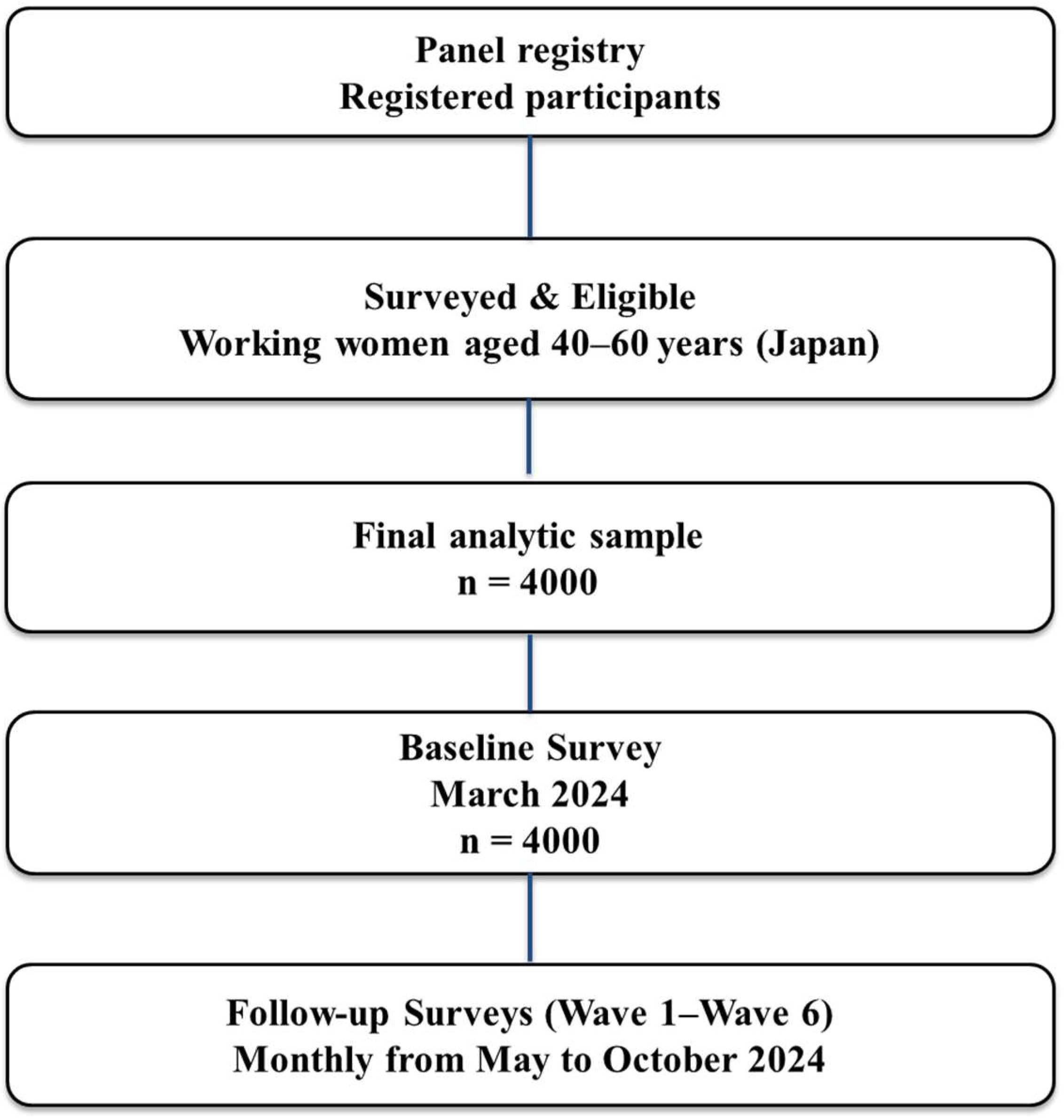
2.1. Study Design and Participants
2.2. Survey Measures
- (1)
- Menopausal symptoms;
- (2)
- Work productivity;
- (3)
- Workplace openness.
2.2.1. Menopausal Symptoms
- Vasomotor (e.g., hot flashes, sweating);
- Psychological (e.g., irritability, anxiety, insomnia, depressed mood);
- Somatic (e.g., shoulder stiffness, joint pain).
2.2.2. Work Productivity
- Absolute presenteeism;
- Relative presenteeism.
2.2.3. Workplace Openness
2.3. Statistical Analysis
- Age: 40–44 years;
- Education: junior high school/high school graduate;
- Marital status: never married;
- Living with children: yes;
- Employment status: managerial;
- Workplace openness: yes.
- Model 1: total SMI score;
- Model 2: the three SMI domains (vasomotor, psychological, somatic), simultaneously included to estimate domain-specific associations while adjusting for the same covariates
- Domain-specific single-predictor models (Models 3–5) were additionally examined as sensitivity analyses and are presented in the Supplement to illustrate marginal associations.
3. Results
3.1. Demographic Statistics of the Survey
3.2. Analytical Overview
- Model 1 evaluated the association between the total SMI score and self-rated work productivity.
- Model 2 simultaneously included the three SMI domains (vasomotor, psychological, and somatic symptoms) to identify domain-specific effects while adjusting for the same covariates.
3.3. Model 1: Association Between Total SMI Score and Work Productivity
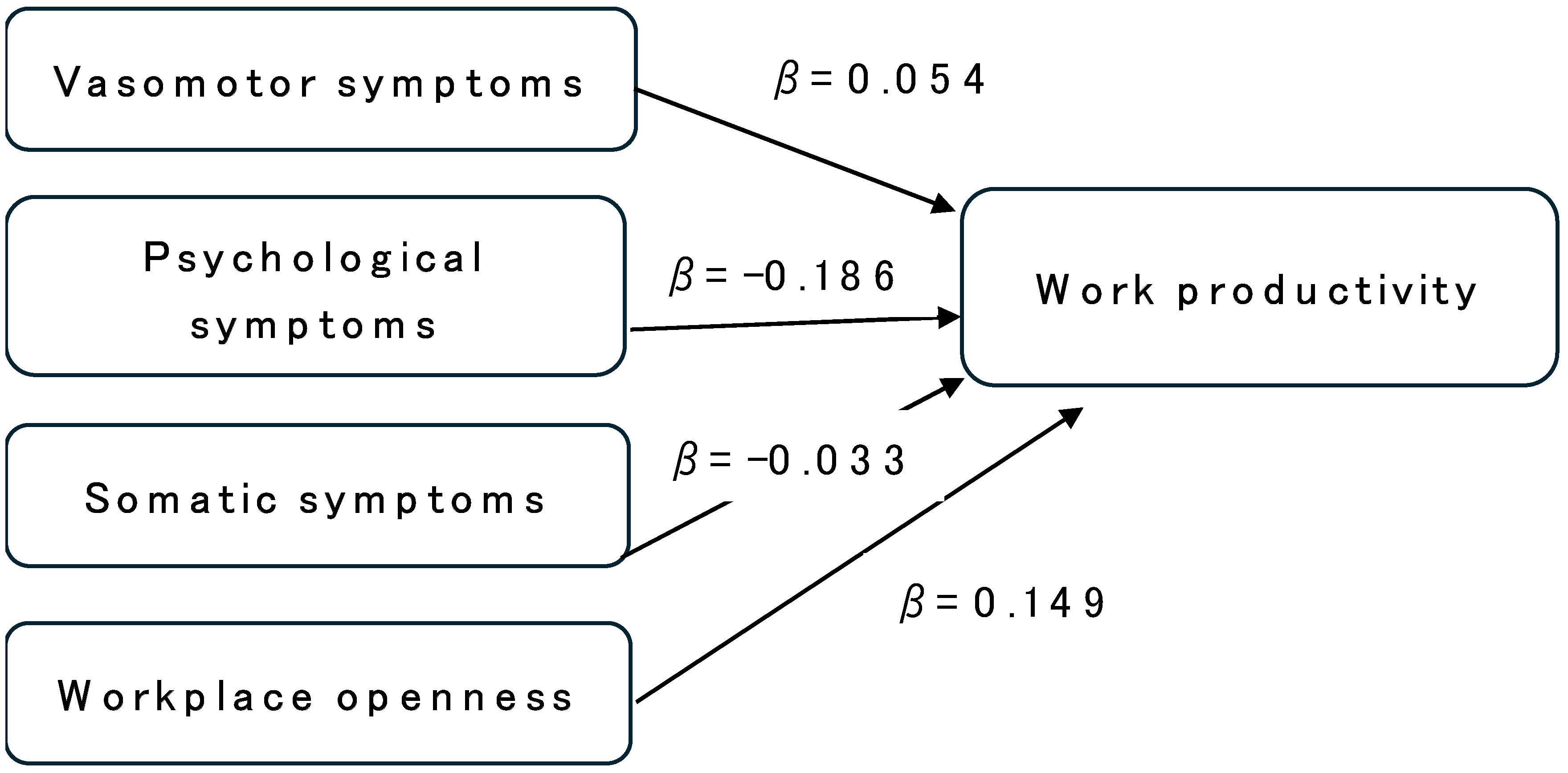
3.4. Model 2: Association Between SMI Domain Scores and Work Productivity
4. Discussion
Limitations of the Study
5. Conclusions
Author Contributions
Funding
Institutional Review Board Statement
Informed Consent Statement
Data Availability Statement
Acknowledgments
Conflicts of Interest
Appendix A. English Translation of the Simplified Menopause Index (SMI) Items
- Hot flashes
- Excessive sweating
- Sensitivity to cold in the lower back or extremities
- Shortness of breath or palpitations
- Difficulty falling asleep or light sleep
- Irritability or nervousness
- Mood swings or depressive feelings
- Frequent headaches, dizziness, or nausea
- Fatigability or easy exhaustion
- Stiff shoulders, back pain, or pain in the limbs

| Predictor (SMI) Domain | VIF |
|---|---|
| Vasomotor symptoms | 1.79 |
| Psychological symptoms | 2.16 |
| Somatic symptoms | 2.02 |
Appendix B. Domain-Specific Regression Models (Models 3–5)
Summary of Domain-Specific Results
| Characteristics | Model 3 β (Vasomotor) | Model 3 p | Model 4 β (Psychological) | Model 4 p | Model 5 β (Somatic) | Model 5 p | |
|---|---|---|---|---|---|---|---|
| Age | 45–49 (ref: 40–44) | 0.001 | 0.961 | 0.002 | 0.917 | 0.007 | 0.735 |
| 50–54 | 0.056 | 0.005 ** | 0.053 | 0.007 ** | 0.062 | 0.002 ** | |
| 55–59 | 0.102 | <0.001 *** | 0.091 | <0.001 *** | 0.103 | <0.001 *** | |
| 60 | 0.022 | 0.189 | 0.018 | 0.276 | 0.024 | 0.148 | |
| Education | Vocational school graduate (ref: Junior high/high school graduate) | 0.029 | 0.095 | 0.030 | 0.084 | 0.031 | 0.070 |
| Junior college graduate | 0.057 | 0.002 ** | 0.053 | 0.003 ** | 0.057 | 0.001 *** | |
| University graduate | 0.088 | <0.001 *** | 0.083 | <0.001 *** | 0.088 | <0.001 *** | |
| Graduate school graduate | 0.042 | 0.008 ** | 0.042 | 0.007 ** | 0.043 | 0.006 ** | |
| Marital status | Married or living with partner (ref: never married) | 0.090 | <0.001 *** | 0.088 | <0.001 *** | 0.087 | <0.001 *** |
| Widowed | 0.015 | 0.350 | 0.015 | 0.343 | 0.013 | 0.411 | |
| Divorced/Separated | 0.043 | 0.020 * | 0.041 | 0.024 * | 0.040 | 0.030 * | |
| Living with children | No (ref: Yes) | 0.012 | 0.523 | 0.017 | 0.348 | 0.019 | 0.308 |
| Employment status | General (ref: Managerial) | 0.026 | 0.098 | 0.021 | 0.184 | 0.025 | 0.115 |
| Daily working hours | NA | 0.099 | <0.001 *** | 0.097 | 0.001 ** | 0.103 | <0.001 *** |
| Years of service | NA | 0.056 | <0.001 *** | 0.052 | 0.001 ** | 0.052 | 0.001 ** |
| Workplace openness to discussing menopause | No (ref: Yes) | −0.178 | <0.001 *** | −0.152 | <0.001 *** | −0.167 | <0.001 *** |
| Not sure | −0.091 | <0.001 *** | −0.085 | <0.001 *** | −0.088 | <0.001 *** | |
| SMI score | NA | −0.079 | <0.001 *** | −0.174 | <0.001 *** | −0.126 | <0.001 *** |
References
- World Bank. Labor Force Participation Rate, Female (% of Female Population Ages 15+)—Japan. 2024 Estimate. Available online: https://data.worldbank.org/indicator/SL.TLF.CACT.FE.ZS?locations=JP (accessed on 19 October 2025).
- World Health Organization. Menopause—Fact Sheet; WHO: Geneva, Switzerland, 2024; Available online: https://www.who.int/news-room/fact-sheets/detail/menopause (accessed on 19 October 2025).
- Tamada, T.; Iwasaki, H. Age at Natural Menopause in Japanese Women. Acta Obstet. Gynecol. Scand. 1995, 47, 947–952. [Google Scholar] [CrossRef]
- Avis, N.E.; Crawford, S.L.; Greendale, G.; Bromberger, J.T.; Everson-Rose, S.A.; Gold, E.B.; Hess, R.; Joffe, H.; Kravitz, H.M.; Tepper, P.G.; et al. Duration of Menopausal Vasomotor Symptoms. JAMA Intern. Med. 2015, 175, 531–539. [Google Scholar] [CrossRef] [PubMed]
- Arima, M.; Edagawa, Y.; Furuta, A.; Tsuchiya, S.; Kawahara, C.; Takamiya, Y.; Ogata, H.; Izumi, M.; Miwa, Y. Measures to Improve Performance Decline Due to Menopausal Symptoms. In Proceedings of the Japan Society of Industrial Engineers (JSIE) 2022 Spring Conference; Ohno, T., Ed.; JSIE: Kanagawa, Japan, 2022. [Google Scholar]
- Hashimoto, K.M.; Yoshida, M.; Nakamura, Y.; Takeishi, Y.; Yoshizawa, T. Relationship between number of menopausal symptoms and work performance in Japanese working women. Menopause 2020, 28, 175–181. [Google Scholar] [CrossRef] [PubMed]
- Hardy, C.; Hunter, M.S.; Griffiths, A. Menopause and work: An overview of UK guidance. Occup. Med. 2018, 68, 580–586. [Google Scholar] [CrossRef] [PubMed]
- Health and Global Policy Institute (HGPI). Women’s Health and the Workplace: Current Challenges and Future Directions. HGPI: Tokyo, Japan, 2023/2024. Health and Global Policy Institute Website. Available online: https://hgpi.org/en (accessed on 19 October 2025).
- Jack, G.; Riach, K.; Bariola, E.; Pitts, M.; Schapper, J.; Sarrel, P. Menopause in the workplace: What employers should be doing. Maturitas 2016, 85, 88–95. [Google Scholar] [CrossRef] [PubMed]
- Koyama, T.; Takahashi, K.; Ito, A.; Ikeda, M. Development of the Simplified Menopause Index (SMI) for evaluating climacteric symptoms. Jpn. Menopause Soc. 1994, 2, 29–36. (In Japanese) [Google Scholar]
- Chen, J.T.; Kotani, K. An inverse relation between the Simplified Menopausal Index (SMI) and biological antioxidative potential in healthy Japanese women. Climacteric 2013, 16, 288–291. [Google Scholar] [CrossRef] [PubMed]
- Kessler, R.C.; Barber, C.; Beck, A.; Berglund, P.; Cleary, P.D.; McKenas, D.; Pronk, N.; Simon, G.; Stang, P.; Üstün, T.B.; et al. The World Health Organization Health and Work Performance Questionnaire (HPQ). J. Occup. Environ. Med. 2003, 45, 156–174. [Google Scholar] [CrossRef] [PubMed]
- Harvard Medical School. The World Health Organization Health and Work Performance Questionnaire (HPQ) Scoring Rules. In WHO Health and Work Performance Questionnaire, Version 2.0; Harvard Medical School: Boston, MA, USA, 2005. [Google Scholar]
- Kawakami, N.; Inoue, A.; Tsuchiya, M.; Watanabe, K.; Imamura, K.; Iida, M.; Nishi, D. Construct validity and test-retest reliability of the World Mental Health Japan version of the World Health Organization Health and Work Performance Questionnaire Short Version: A preliminary study. Ind. Health 2020, 58, 375–387. [Google Scholar] [CrossRef] [PubMed]
- Suzuki, T.; Miyaki, K.; Sasaki, Y.; Song, Y.; Tsutsumi, A.; Kawakami, N.; Shimazu, A.; Takahashi, M.; Inoue, A.; Kurioka, S.; et al. Optimal cutoff values of WHO-HPQ presenteeism scores by ROC analysis for preventing mental sickness absence in Japanese prospective cohort. PLoS ONE 2014, 9, e111191. [Google Scholar] [CrossRef] [PubMed]
- Kawakami, N.; Inoue, A.; Tsuchiya, M.; Watanabe, K.; Imamura, K.; Iida, M.; Nishi, D. Burden of menopausal vasomotor symptoms on work productivity and daily-living activities in a cohort of peri/post-menopausal women in daily practice in Spain. Maturitas 2015, 81, 181–182. [Google Scholar]
- O’Neill, M.T.; Jones, V.; Reid, A. Impact of menopausal symptoms on work and careers: A cross-sectional study. Occup. Med. 2023, 73, 332–338. [Google Scholar] [CrossRef] [PubMed]


| Characteristics | n (%) | |
|---|---|---|
| Age | 40–44 years old | 913 (22.8) |
| 45–49 years old | 1081 (27.0) | |
| 50–54 years old | 1163 (29.1) | |
| 55–59 years old | 722 (18.1) | |
| 60 years old | 121 (3.0) | |
| Education | Junior high school/high school graduate | 1218 (30.5) |
| Vocational school graduate | 578 (14.5) | |
| Junior college graduate | 854 (21.3) | |
| University graduate | 1249 (31.2) | |
| Graduate school graduate | 101 (2.5) | |
| Marital status | Never married | 1168 (29.2) |
| Married or living with partner | 2273 (56.8) | |
| Widowed | 51 (1.3) | |
| Divorced/Separated | 508 (12.7) | |
| Living with children | Yes | 1612 (40.3) |
| No | 2388 (59.7) | |
| Employment status | Managerial positions | 176 (4.4) |
| General positions | 3824 (95.6) | |
| Daily working hours | 6.78 (mean) 2.2 (SD) | |
| Years of service | 9.9 (mean) 8.6 (SD) | |
| Workplace openness to discussing menopause | Yes | 999 (25.0) |
| No | 1763 (44.1) | |
| Not sure | 1238 (31.0) | |
| WHO-HPQ (presenteeism score) | 5.7 (mean) 2.1 (SD) | |
| SMI (Simplified Menopausal Index) | Total score | 34.9 (mean) 21.8 (SD) |
| SMI (domains) | Vasomotor symptoms score | 12.69 (mean) 9.9 (SD) |
| Psychological symptoms score | 15.18 (mean) 10.61 (SD) | |
| Somatic symptoms score | 6.99 (mean) 4.25 (SD) |
| Characteristics | Model 1 β (SMI Total) | Model 1 p | Model 2 β (SMI Domains) | Model 2 p | |
|---|---|---|---|---|---|
| Age | 45–49 (ref: 40–44) | 0.003 | 0.885 | 0.003 | 0.858 |
| 50–54 | 0.057 | 0.004 * | 0.053 | 0.007 ** | |
| 55–59 | 0.097 | <0.001 *** | 0.091 | <0.001 *** | |
| 60 | 0.019 | 0.240 | 0.019 | 0.243 | |
| Education | Vocational school graduate (ref: Junior high/high school graduate) | 0.029 | 0.093 | 0.031 | 0.071 |
| Junior college graduate | 0.054 | 0.002 ** | 0.054 | 0.002 ** | |
| University graduate | 0.083 | <0.001 *** | 0.084 | <0.001 *** | |
| Graduate school graduate | 0.042 | 0.008 ** | 0.043 | 0.006 ** | |
| Marital status | Married or living with partner (ref: never married) | 0.089 | <0.001 *** | 0.086 | <0.001 *** |
| Widowed | 0.015 | 0.354 | 0.014 | 0.364 | |
| Divorced/Separated | 0.042 | 0.022 * | 0.040 | 0.029 * | |
| Living with children | No (ref: Yes) | 0.015 | 0.408 | 0.019 | 0.283 |
| Employment status | General (ref: Managerial) | 0.024 | 0.123 | 0.020 | 0.208 |
| Daily working hours | NA | 0.099 | <0.001 *** | 0.098 | <0.001 *** |
| Years of service | NA | 0.053 | <0.001 *** | 0.051 | 0.001 ** |
| Workplace openness to discussing menopause | No (ref: Yes) | −0.162 | <0.001 *** | −0.149 | <0.001 *** |
| Not sure | −0.089 | <0.001 *** | −0.082 | <0.001 *** | |
| SMI score | Total | −0.146 | <0.001*** | −0.079 | <0.001 *** |
| Vasomotor symptom domain | NA | NA | 0.054 | 0.007 ** | |
| Psychological symptom domain | NA | NA | −0.186 | <0.001 *** | |
| Somatic symptom domain | NA | NA | −0.033 | 0.121 | |
Disclaimer/Publisher’s Note: The statements, opinions and data contained in all publications are solely those of the individual author(s) and contributor(s) and not of MDPI and/or the editor(s). MDPI and/or the editor(s) disclaim responsibility for any injury to people or property resulting from any ideas, methods, instructions or products referred to in the content. |
© 2026 by the authors. Licensee MDPI, Basel, Switzerland. This article is an open access article distributed under the terms and conditions of the Creative Commons Attribution (CC BY) license.
Share and Cite
Arima, M.; Edagawa, Y.; Suzuki, K.; Kawahara, C.; Shirato, N.; Miwa, Y.; Izumi, M. Menopausal Symptoms, Perceived Workplace Openness and Work Productivity Among Japanese Women: Baseline Findings from a Large-Scale Cohort Study. Int. J. Environ. Res. Public Health 2026, 23, 186. https://doi.org/10.3390/ijerph23020186
Arima M, Edagawa Y, Suzuki K, Kawahara C, Shirato N, Miwa Y, Izumi M. Menopausal Symptoms, Perceived Workplace Openness and Work Productivity Among Japanese Women: Baseline Findings from a Large-Scale Cohort Study. International Journal of Environmental Research and Public Health. 2026; 23(2):186. https://doi.org/10.3390/ijerph23020186
Chicago/Turabian StyleArima, Makiko, Yoshikuni Edagawa, Kohta Suzuki, Chikako Kawahara, Nahoko Shirato, Yoshie Miwa, and Miki Izumi. 2026. "Menopausal Symptoms, Perceived Workplace Openness and Work Productivity Among Japanese Women: Baseline Findings from a Large-Scale Cohort Study" International Journal of Environmental Research and Public Health 23, no. 2: 186. https://doi.org/10.3390/ijerph23020186
APA StyleArima, M., Edagawa, Y., Suzuki, K., Kawahara, C., Shirato, N., Miwa, Y., & Izumi, M. (2026). Menopausal Symptoms, Perceived Workplace Openness and Work Productivity Among Japanese Women: Baseline Findings from a Large-Scale Cohort Study. International Journal of Environmental Research and Public Health, 23(2), 186. https://doi.org/10.3390/ijerph23020186