


Abstract
Consumers often wish to substitute refined sugar with alternative sweeteners, such as coconut sugar, given growing interest in healthy eating and the public’s negative perception of excess sugar intake. Coconut sugar is a healthier, sweetener option than the majority of other sugars that are commercially available. Sap is collected from trees to be transported, stored, and evaporated during processing, which are labor- and resource-intensive operations. Consequently, the cost of production is higher than it is for cane sugar. Given its high nutritional value and low glycemic index, people are willing to pay higher prices for it. However, one barrier is ignorance of its health benefits. This review examines and deals in-depth with the most significant features of coconut sugar chemical analyses to focus on several analytical methodologies given the increasing demand for naturally derived sweeteners in the last 10 years. A deeper understanding of the quality control, safety, health effects, nutritional profile, and sustainability issues corresponding to coconut sugar is necessary to effectively implement them in the food industry.
1. Introduction
In south/south-eastern Asian cuisine, coconut sugar is a popular sweetener [1] and is made of phloem sap from coconut palm tree (Cocos nucifera L.) blossoms [2]. Workers collect sap by scaling palm trees and use sickles to chop off unopened inflorescences. For 8–12 h, oozing sap is collected with bamboo or plastic containers. Lime is occasionally added to the sap to stop it from fermenting [3,4]. Next, the sap is heated on open flames and regularly shaken for it to thicken and crystallize [1]. During the production method, sugar color can range from light to dark brown. Finally, sugar is hand-selected and sieved to produce fine-grained produce [5].
One inflorescence is typically produced by each coconut palm tree once a month. Approximately 1.5 L of sap is harvested twice a day (morning and evening) from all the inflorescences. Based on the approximate 15 g of sugar per 100 g sugar content of fresh coconut sap, boiling sap allows 200 g of sugar per inflorescence to be produced daily [3,4].
Even at early ages, coconut palm trees can be utilized for sap collection purposes. Every time phloem sap is tapped and harvested, 1–2 mm of spadix must be cut away. Spadix can be diminished to a stump by repeating this technique. Following this procedure, a single spadix can be tapped for 40–45 days. Coconut palm trees can be tapped for a 20-year period [1,3].
Due to the growing interest that the public is showing in healthy diet and the negative public perception of excess sugar use, consumers frequently attempt to substitute refined sugars for alternative sweeteners like coconut sugar [6]. Traders highlight coconut sugar’s traditional small-farmer producers, organic palm tree growth in mixed farming with other crops, lower glycemic index (GI), and low fructose content than regular refined beet sugar or cane [7]. Coconut sugar has a premium price that consumers are willing to pay. One kilogram (kg) might cost something between €15 and €46. In contrast, the price of a kg of traditionally refined sugar was only €0.88 in 2021 [8].
Customers today are increasingly more aware of natural ingredients. Consumers’ growing emphasis on naturalness has had a significant impact on the food industry [9,10]. Consumers in most nations often reject the food products that they do not perceive as natural. The demand for sweeteners made from natural sources has skyrocketed in recent decades [11].
In light of the above, the present review investigates the health effects and nutritional profile linked with consuming coconut sugar, its potential food industry applications and sustainability issues, and its primary safety–quality parameters, plus a chemical analysis of its major components.
2. Chemical Analysis
Food attributes like color, consistency, texture, flavor, and smell are extremely relevant for consumers and, consequently, for industry. In coconut sugar and syrup, these characteristics derive from the quality of the sap from which they are produced and the chemical reactions that occur during the heating process, namely non-enzymatic browning via caramelization and Maillard reactions (MR) [12]. The latter involves a highly complex reaction between reducing sugars and amino acids, and has major effects on coconut sugar and syrup properties, including their nutritional and functional value, color, aroma, and flavor [12,13,14,15]. Regarding flavor, the characteristics of MR products may vary from a pleasant flowery aroma to a burnt aroma in accordance with the sugar and amino acid compositions of the food matrix and the involved reaction pathways [13,14,15,16]. MR products, such as acrylamide and 5-hydroxymethylfurfural, have been directly linked with the degree of coconut sugar browning, and high levels of these products can lead to toxic health effects [13,14,15,16,17]. In this context, it is worth noting the study by Phaenon et al. [18] in which the level of acrylamide was determined in both coconut sap and coconut syrup, and, while in the first case this compound was not detected, the reported levels in the latter were of 867 µg/kg. Many MR products exhibit beneficial biological functions, such as potent antioxidant activity [13]. As a matter of fact, the coconut sugar and syrup production process generates hundreds of distinct MR products that are more or less desirable [19]. Bearing this in mind, it is easy to understand that coconut sugar and syrup are much more than merely a concentrated sugar solution, and the study of their chemical composition, which is fundamental to improve their nutritional and functional properties and to guarantee consumer safety, is a complex and demanding task.
Several research works have been conducted to evaluate the physico-chemical, microbiological, and antioxidant characteristics of coconut sap, sugar, and syrup. Some of the most important ones are presented in Table 1 and focus on the analytical techniques used and the main outcomes. Color determination, pH, and total soluble solids are some of the analyses routinely performed in coconut sap, sugar, and syrup. However, despite being fundamental for the quality control of these products, they provide limited means for more specific quality profile analyses and, hence, the need for more advanced analytical techniques arises.
Coconut sugar and syrup contain well over 100 different types of compounds, including carbohydrates, free amino acids, proteins, minerals, vitamins, aromatic compounds, and phenolics. Table 2 provides an overview of some of the most recent studies carried out to assess the inorganic and organic compositions of coconut sap, sugar, and syrup. Atomic absorption spectroscopy (AAS) is the most commonly followed technique reported for mineral analyses. The main issue in determining mineral composition is the accurate quantification of these elements in a complex matrix, like that of coconut sugar or syrup, which has other components and at much higher levels (e.g., sugars), while dealing with the problem of interferences from mineral elements other than that being measured [20]. AAS is a technique with good detection limits. It is relatively simple to perform and incurs low to moderate acquisition and operation costs. It allows only a limited number of elements to be analyzed [19]. Other techniques like ICP-MS (inductively coupled plasma mass spectrometry) require costlier equipment and greater proficiency to operate, but stand out for having better detection limits and allow the quantification of many elements at ultra-trace concentrations in large numbers of samples. Therefore, they should be increasingly used [20]. For studying organic constituents, the non-volatile ones are analyzed mainly by high-performance and ultrahigh liquid chromatography (HPLC/UHPLC) coupled to different detectors (e.g., refractive index (RI), mass spectrometry (MS), UV-Vis), while volatile ones are determined mostly by GC–MS (gas chromatography coupled to mass spectroscopy) (e.g., [21,22,23]). Indeed, coupling a chromatography system (e.g., UHPLC/HPLC or GC) to a mass spectrometer is one of the most powerful ways to identify and quantify compounds because this analytical strategy provides two different types of data per run analysis: (i) retention time and (ii) mass spectral pattern (molecular ion and fragmentation), for each separated compound. This information can be used to make comparisons to appropriate reference standards or literature data [24].
As part of quality control, another critical aspect is the need to develop swift and accurate analytical methods for fraud detection. Like honey, agave syrup, and maple syrup, coconut sugar and syrup are prone to adulteration via the addition of less expensive exogenous sugars, such as cane sugar, beet sugar and corn sugar. In fact, the addition of a minor quantity of cane sugar, i.e., less than 5% w/v, to coconut sugar for “seed” purposes and to accelerate its crystallization is common and well-accepted in the industry [25]. The risk of fraud is a major issue given the important economic advantage of adding an extra amount of cane sugar or another inexpensive sugar [25]. Some of the most relevant analytical approaches recently proposed to combat this problem are presented in Table 3. Technologies like NMR (nuclear magnetic resonance) and IRMS (isotope ratio mass spectrometry) are noteworthy, as shown by the results obtained with the studies of Bachmann et al. [26] or Rogers et al. [25], respectively. NMR is a non-destructive technique that provides fast results and requires easy sample preparation. However, it implies using a large amount of sample to obtain an adequate signal [27]. IRMS, however, requires a considerably smaller amount of sample than in NMR analyses and displays 0.2‰ precision on the δ-scale [28]. One important limitation of IRMS is the fact that it only provides the global δ13C values of the analyte [28]. Specifically, in the coconut sugar and syrup adulteration context, applying the IRMS tool involves a significant disadvantage because, although it is highly successful for detecting the addition of cane and corn sugar to coconut sugar and syrup, it does not allow the detection of beet sugar addition [18,29]. This is because coconut is a C3 plant-like beet, while cane and corn are C4 plants. The 13C/12C ratio of C3 plants is lower than that of C4 plants, and it is on this difference that the IRMS technique is based because it is impossible to detect admixtures of beet sugar with coconut sugar [29] Notwithstanding, both IRMS and NMR have a high potential, and their combined approach could shed considerable light on the food fraud and adulteration issue. Energy-dispersive X-Ray fluorescence (ED-XRF) is an alternative tool with a very high potential for detecting coconut sugar adulterations with both cane and beet sugars, as evidenced by Zdiniakova and Calle [29]. ED-XRF offers the excellent advantage of requiring almost no sample preparation and can be performed with portable devices, but has relatively high quantification limits [29,30]. That said, from an analytical point of view and despite important advances, there is still a lot of work to be done to gain fast and eco-friendly methods that can be performed with portable devices and used by both consumers and producers quickly to easily detect adulterations.
In addition to food fraud, another aspect that cannot be neglected is food safety. Coconut sugar and syrup undoubtedly provide consumers with important nutritional and functional benefits when produced from high-quality sap that is properly collected, preserved, and processed, i.e., following good manufacturing practices (GMP). However, employing sap of inferior quality and its processing under unhygienic conditions are real problems that deserve our utmost attention because they pose the risk of contamination by insects and microorganisms (see Table 4). In this context, the dire need to carry out studies to determine the risk of other contaminants occurring is noteworthy. Research work on contaminants from food processing (acrylamide), agrochemicals (e.g., pesticide residues), heavy metals (e.g., mercury, lead, arsenic, cadmium, etc.), microorganism toxins (e.g., mycotoxins), and cleaning agents (e.g., detergents) or disinfectants (quaternary ammonium, detergents) has been increasingly performed in other natural sweeteners and sugar products, but is still almost nonexistent for coconut sugar and syrup.
Table 1.
Physico-chemical, microbiological, and antioxidant characteristics of coconut sap, sugar, and syrup.
Table 2.
Chemical analyses of the organic and inorganic constituents of coconut sap, sugar, and syrup.
Table 3.
Detecting adulterants in coconut sap, sugar, and syrup.
Table 4.
Detecting contaminants in coconut sap, sugar, and syrup.
3. Food Industry Applications and Sustainability Issues
For the application of coconut sugar in food and beverage industries, it is important to gain an understanding of the sap from which the sugar is processed. Coconut sap is a nutritious fluid enriched with sugars, calcium, phosphorous, iron minerals, and vitamins such as B complex and C [39,40]. It contains important phenolic compounds such as antioxidants and can be categorized as a low glycemic index (GI 35) food [40]. The nutritional composition of coconut sap is further described in Section 5.
Coconut sugar is made from the watery coconut sap found inside palm trees. It is prepared by concentrating inflorescence sap, which is popularly known as ‘neera’ in Kerala, India [23], and it is obtained by tapping the unopened coconut spadix. Coconut sugar is brown and contains 2–3% moisture. As this sugar is plant-based, natural, and minimally processed, it can be readily applied in many vegan diets as a healthier option [14,41].
The variation in coconut sugar manufacturing processes is extremely varied according to local, traditional, and indigenous knowledge [4]. These factors account for the vast variations in the appearance, taste, and flavor of the different coconut sugar types that can be found on the market [42].
Coconut sap is produced from palm trees all year-round and there is no specific season for tapping the spathe, however, the amount of sap produced from the trees changes with the season [40]. In the traditional method, the sap trickling from the cut surface is collected in an open earthen pot or bamboo sac, which is placed at the top of the palm for at least 8–12 h. Lime is then coated on the inner surface of the pot to prevent fermentation [43]. The sap collected by this method is oyster white in colour and emanates a strong odour with contamination from insects, ants, pollen, and dust particles [3]. The coco-sap chiller developed by Central Plantation Crops Research Institute (CPCRI) in India has helped to improve the quality of unfermented coconut sap, reduced the processing time, eliminated contaminants like ants, other insects, pollen, and dust particles, and enabled better product diversification and market perspectives [3]. A comparison of total sugars, reducing sugar, free amino acid, total flavonoids, and ferric reducing antioxidant power from coconut sap collected traditionally and those from coco-sap chillers are presented in Section 5. Similarly, a comparison of the water-soluble vitamins and fat-soluble vitamins is presented in table for the employed processing methods.
The Asian and Pacific Coconut Community describes how local operations are performed by small-scale cottage industries with coconut sap to yield molded coconut sugar. The traditional operation starts by collecting coconut sap from palms, which this is normally carried out twice a day, morning and evening [44]. The obtained coconut sap is then filtered through muslin cloth to remove ants, insects, and any other polluting elements. The filtered sap is placed inside cooking vessels. Sap concentrates by evaporating water to increase the sap concentration. This is achieved by boiling the filtered sap in cooking vessels for 3 h at 100–110 °C [44]. The resulting material then turns into a thick liquid. Upon boiling, foam forms that should be eliminated from vessels [44]. The usual procedure is to add a few drops of cooking oil or grated coconut to the resulting mash to prevent foam from excessively forming.
This mash is heated for another hour and is occasionally stirred. To prevent sugars from caramelizing, the must be heated slowly [7]. When the mash is very thick and suitable for molding, cooking vessels are lifted from stoves and cooled to 60 °C. The cooled mash is poured inside clean half coconut shells or bamboo vessels to be cooled and to set [45].
The processing technique influences nutritional and health benefits, as described in the previous section. To ensure product quality, the collected sap is tested for its acidity. This is crucial because, if sap is fermented, it is not suitable for brown coconut sugar manufacturing purposes.
Given its high sucrose content, during its storage, coconut sugar displays caking properties. So, it is essential to add an anticaking agent like tricalcium phosphate (TCP) for it to remain stable during food applications. TCP covers the coconut sugar powder surface and its hygroscopicity significantly diminishes, which improves its flowability [45].
Processing coconut sap into sugar syrup has been investigated following several alternative processing techniques. The coconut sugar syrup obtained from the rotary evaporation method has a better nutritional value than the microwave heating and open heating methods [22]. The non-enzymatic browning that results from Maillard reactions (MR) is enhanced when cooking sap at higher temperatures for a long period, which gives the preferred dark-colored coconut sugar as an ingredient, but only for traditional dishes [46]. Rotary evaporation is fast and gentle and performed at a lower temperature. All this results in evaporation with less thermal decomposition [47,48,49]. The rotary evaporation method is the alternative processing method that the sugar processing industry applies to produce coconut sugar. It operates in a 250-mbar vacuum at 60°C. It results in improved physico-chemical qualities, minimum input energy, and shorter processing times [43].
The employed processing method influences the antioxidant properties and vitamin contents of coconut sugar syrup. It allows coconut sugar production in a minimum time period, but with high vitamin and antioxidant contents [50]. The coconut sugar syrup produced by at 60 °C rotary evaporator (RE-60) shows significantly lower antioxidant activities (DPPPH, ABTS, FRAP, and TPC) values (p ≤ 0.05) than that generated by other techniques (open-heat evaporation, microwave, etc.). What this suggests is that the coconut sugar syrup that is produced at a lower temperature (60 °C) in vacuum exhibits significantly different and lesser antioxidant activities than all the other samples generated by distinct evaporation techniques [11,45].
Employing coconut sugar syrup with vast amounts of antioxidants is a promising food production ingredient. Former research works have observed how coconut sugar with larger quantities of vitamins and minerals and that perform more antioxidant activities can be used as an alternative natural sugar with improved chemical properties [3,51].
The work by Saputro [52] reveals the use of low-glycaemic-index (GI) sugar, such as (coconut sugar), to produce plain chocolate. They demonstrated that it was more nutritious as a sugar containing more anti-carcinogenic compounds, antioxidants, and minerals than commercial chocolates made with sugarcane sugar or sugar palm. Moreover, if coconut sugar can be employed as an ingredient, it is able to generate more antioxidant activity if food is processed at high temperatures. Very important compounds such as pyroglutamic acid or hydroxymethylfurfural (HMF) form when heated [53].
Coconut blossom sugar is organic with a caramel aroma and has been the target of adulteration and fraud [6,26]. A recent study identified minor metabolites, such as chemical markers for coconut blossom sugar, by profiling these metabolites, which helped to detect adulterations in products. Bachmann et al. [26] were unable to detect HMF in all the samples. However, pyroglutamic acid was employed at a comparatively high concentration, which exceeded other unambiguous metabolites in coconut sugar like inositol or shikimic acid in coconut sugar [26]. Henceforth, HMF is an apparently suitable marker metabolite for coconut sugar. The distinct metabolic profiles of coconut blossom sugar can be better investigated and identified by combining LC-MS and NMR [54].
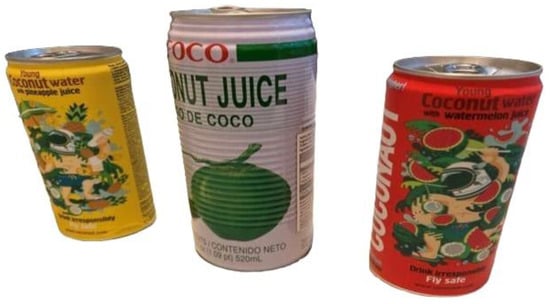
Coconut sap as a natural non-alcoholic beverage has high demand as an instant thirst quencher. In India, tapping coconut sap has improved the income of farmers and generated employment. Export of the sap is extensively carried out to countries like Canada, South Korea, USA, Norway, France, Japan, Australia, and the Middle East [55]. Coconut water and juice from coconut sap are commercially canned as beverages in Thailand and exported as ‘functional food‘ with health benefits (see Figure 1). These beverages are flavoured with tropical fruits such as watermelon and pineapple. Globally, the beverages industry was forecasted to reach $1.9 trillion in 2021 and continue to grow at a compounded annual growth rate (CAGR) of 3% [56].
Figure 1.
Coconut sap as beverages, bought from a local ethnic shop in Rovaniemi, Finland. (Photo credit: ©Dele Raheem, July 2022).
Numerous organic food and drink firms increasingly employ natural alternative sweeteners such as coconut sugar to substitute refined sugars. Coconut sugar is employed thanks to its ecological credentials and nutritional properties. It has many widespread applications in food and beverage industries to prepare bakery products like chocolate (plain chocolate and drinking chocolate), cake, cookies, and brownies. It can be added to juice, tea, or any beverage as a sweetener, and can be employed as a seasoning agent. Adding coconut sugar to several food applications as a healthy option is well justified because it contains important nutrients like vitamins E and C, minerals like zinc, iron, potassium, and phosphorus, and phytonutrients like anthocyanidins, flavonoids, polyphenols, and antioxidants [3,20,35]. This kind of sugar also contains a significant amount of inulin (4.7 g 100 g−1), required for generating short-chain fatty acids like acetate, butyrate, and propionate [15].
The sugar obtained from the sap of palm trees, which includes coconut sap, is utilized mainly in desserts, sweet soy sauce, and beverages, and also in many other traditional foods. This is especially due to its appreciated and accepted taste, color, and flavor when producing drinks and foods [57,58,59,60]. Apriyantono [61] indicated that using palm sugar as a soybean sauce sweetener strongly impacts soy sauce flavor because over 70 volatile compounds are present. Employing palm sugar as a potential natural sweetener also impacts cookies’ color, textural properties, and flavor [62], which lends this sugar to being a potential natural sweetener.
Pure sucrose is the most widely used sugar as food sweetener. However, coconut sugar is reported to offer health benefits thanks to its lower GI value. The GI values previously obtained from coconut sugar [63,64] are below the GI values for pure sucrose, i.e., refined cane sugar [65]. Pure sucrose is the most commonly employed sugar as food sweetener. During baking operations, and as another research work reveals, palm sap sugar-sweetened bread has a lower GI value than cane sugar-sweetened bread [66]. Moreover, Ref. [66] report that the palm sugars–corn starch mixture brings about a slow digestion rate and, consequently, lower GI values than those made with refined cane sugars. Coconut sugar displays good quality and possesses a high nutritive value if it is processed from hygienic non-fermented sap; however, if poor-quality neera is employed, its crystallization involves having to add several additives and chemicals (e.g., starch and gluten, and adding sugars from C4 plants, palm, or coconut oil). During the manufacturing process, coconut quarters are added to avoid overboiling sap [1].
Regarding sustainability and traceability issues, organic certification comes over as a quality standard that helps to increase coconut sugar’s credibility in the European market. In most cases, coconut sugar exporters are from developing countries. They should consider not only certification, but also natural and organic trends [7]. Consumers will also show an interest in the story behind sustainable production. Export traders can advertise that small farmers traditionally produce coconut blossom sugar, palm trees organically grow mixed with other crops, and sugar has very low fructose contents and lower GI values than traditional refined beet or cane sugar [7].
As the interest in climate change is growing, individual and planetary healthy coconut-based ecosystems offer excellent possibilities to enhance carbon sequestration with crop combinations that involve a range of plants, which include vine, food crops, tubers, and tree crops. For climate-change adaptation intentions, annual intercrops planted under coconuts can be managed to achieve optimum benefits for the whole system. A holistic approach that focuses on the whole system’s overall productivity and sustainability, and not on palms alone, is necessary to make coconut-based agroecosystems resilient to climate change [67]. The demand for natural products is expected to grow, and employing alternative sweeteners, such as coconut syrup and sugar, will increase.
4. Safety and Quality Conditions for Control of Palm Sap Sugar Products
Both palm sap sugar (PSS) and sweet sap are alternative sweeteners prepared from the sap and nectar tapped from the flowers of several palm tree species. For example, palmyra palm (Borassus flabellifer), nipa palm (Nypa fruticans Wurmb), sugar palm (Arenga pinnata) and coconut palm (Cocos nucifera). They have the potential to be incorporated into food products as substitutes for sucrose [67]. This sweet sap can be consumed fresh, processed as sugar or syrup, or be fermented as vinegar or an alcohol beverage [68]. This sugar is commonly used in many traditional foods in southeast and southern Asia, and plays a vital role in the color-flavor development of distinct food products [57,58,59]. One major palm sugar exporting country is Indonesia. Based on the most recent data, the exports of products made with palm sugar or coconut sap came to 36.5 thousand tons, valued at US$49.3 million in 2019 [69]. These products destined for export must comply with the food legislation of the country of destination, such as, the European countries (EFSA) or United States (FDA).
The world’s PSS business is expected to reach a total of 1.7 billion dollars in 2027, and is currently 630 million dollars [70]. This increase might be due to its potential to be incorporated into food products as a substitute for sucrose [71]. This product is often employed in many traditional foods in Asia, where it plays an important role in the color–flavor development of different food products [57,58,59]. Unlike other natural sweeteners, its production is located in a limited number of countries or in a certain geographical area; for example, agave is produced mainly in Mexico and maple syrup in Canada and the USA. However, PSS is produced in southeast and southern Asia, and the mainly producing countries are the Philippines, Thailand, and Indonesia.
Around the world, there are more than 3000 different types of palm trees, but only five are economically important. They offer good sugar palm production yields for any of its different products. They are as follows: date palm (Phoenix dactylifera), betel nut palm (Areca catechu), African oil palm (Elaeis guineensis), coconut (Cocos nucifera), and pejibaye (Bactris gasipaes) [72]. Other authors include more palm species [73], such as the following:
- Coconut palm sugar (Cocos nucifera). It grows in coastal tropical regions of the Indian and Pacific oceans. This sugar is generated from blossoms and is often known as coconut blossom sugar.
- Date palm has two varieties (Phoenix sylvestris and Phoenix dactylifera). They can be found in Asia and the Middle East, respectively. Date palms are grown mostly for their fruit: dates.
- Palmyra palm (Borassus genus). It grows in the African continent and in Asia and New Guinea. It is used for making hats, hatching, writing materials, and some food products. Obviously, its wood is employed. Palm sugar is generated from the sap (called ‘toddy’) of tree flowers.
- Nipa palm (Nypa fruticans). It is found in tropical and coastal regions of the Pacific and Indian Oceans. It lies particularity in its favored biome: mangroves. It is the only palm tree that partially grows underwater. Its tap is rich in sugar, and it is employed to produce palm sugar.
- Sugar palm (Arenga pinnata) is native to tropical and coastal regions in Asia. It is grown mostly in Indonesia and China. The sap used to generate palm sugar is called ‘gur’ and ‘gula aren’ in India and Indonesia, respectively.
Nevertheless, other authors acknowledge 40 palm species, the tapping of which is either destructive or non-destructive. Non-destructive exploitation with, for instance, Phoenix canariensis on the Canary Islands (Spain) results in sustainable harvests during palms’ lifetime [68].
Special attention is paid to harvest the sap tapping of Phoenix canariensis for its sugary sap on the La Gomera Isle (Canary Islands). It is one of the most relevant cases of sustainable native flora use. It supplies one of the best-known ethnobotany examples on the Canary Islands and is not only a major tourist attraction for visitors, but also an important local farming activity [68].
PSS is produced with the sap/nectar that is tapped from the flowers of several palm tree species. Knowledge about the physico-chemical properties of this sugar should be known if a high-quality product is to be obtained. PSS’ physico-chemical characteristics are affected by its raw materials (sap/nectar) and processing techniques [37,52,73]. Further, the form that sugars come in (syrup, coarse/powder, solid) also determines its properties. Coconut sap, the natural and sweet exudate from tapped unopened coconut spathes or inflorescences (Cocos nucifera Lin.), is one of the major primary coconut pro- ducts used for many food uses. It can be processed as natural and nutritious food products, such as coconut granulated brown sugar, concentrate, juice, and vinegar. Processes involve easy-to-follow procedures that require a few simple tools and equipment.
Coconut sap juice is a healthy pasteurized beverage, and coconut sap concentrate is a thick, free-flowing syrup. Both can be considered functional foods for consumers and the food industry.
The inflorescence in good stands of coconut trees can produce an average of 2 L of sap per tree a day [74]. An average yield of 1 kg of sugar can be obtained from four coconut trees every day.
Under adequate production conditions, coconut trees’ inflorescence can produce a mean yield of 2 L of sap per tree every day. So, the yield of four coconut trees per day can produce 1 kg of sugar. However, as both the sugar content and production of sap depend on trees’ location and their variety, nutrition, the season, tapping time, and the system, these conditioning factors also can impact organoleptic and microbiological characteristics.
Some authors have followed different preservation techniques for bottling palm sap; although all probes failed, these authors consider it crucial to understand the biochemical composition, fermentation chemistry, and existing preservation methods [75].
Transforming coconut sap into sugar granules is simple and requires basic equipment, hence, it is appropriate for and best adapted to farms or medium-sized enterprises. It is a good source of immediate income for coconut farmers, and demand is growing on both local and international markets [76].
Engineering the palm sugar production process poses several problems if sap is not immediately cooked after it is removed from palm trees, which results in a lower pH. A drop in pH impacts the produced palm sugar’s quality. To obtain a higher product conversion factor value, engineering the production process by adding plant extracts to prevent “gait” is feasible [74], and the palm sugar packaging design is more appealing and varied. Packaging is designed by prioritizing practical, economical, and hygienic aspects, without burdening producers in production terms and consumers in price terms. One alternative for PSS with a high quality (soluble solids content 16 degrees brix and pH 4.7) has been presented with the addition of some preservatives such as citric acid (0.09%) and nisin (10 ppm) [76]. The quality standard in the Philippines includes quality norms to not only produce PSS, but also to obtain a product of standardized quality and well-defined organoleptic and microbiological parameters.
Coconut Sap Sugar Production in the Philippines
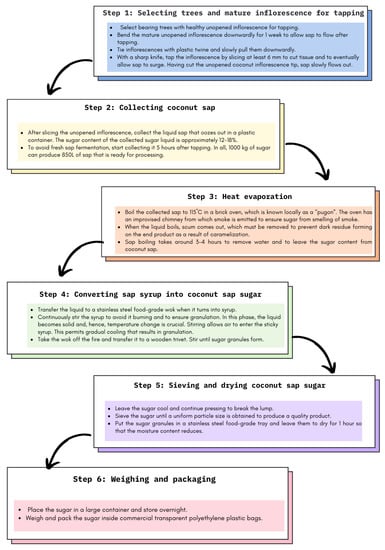
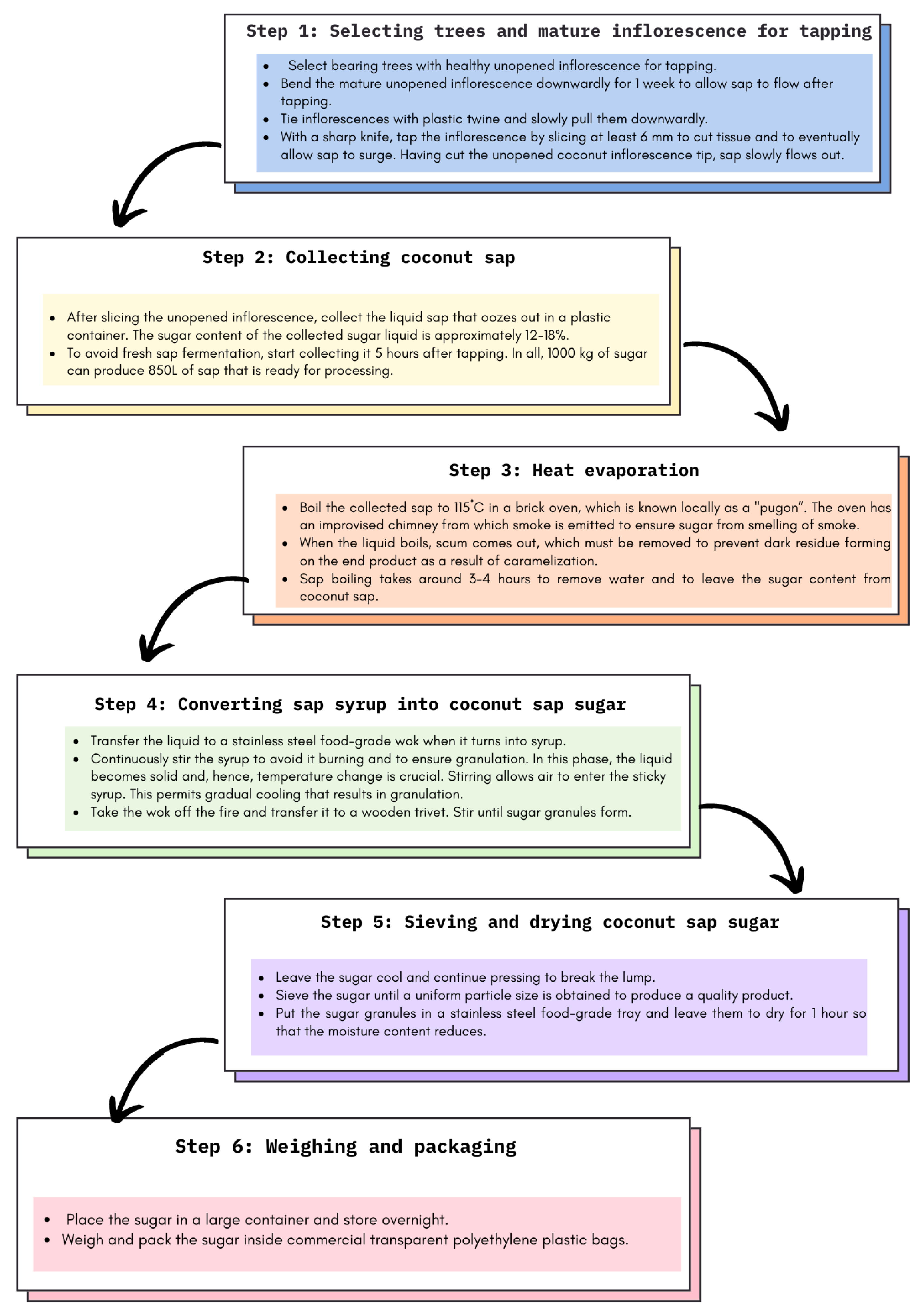
General considerations: farm-level technology to produce a high-value production product from coconut inflorescence sap (see Table 5). It is simple, farm-level technology that involves a natural heat evaporation process that converts liquid sap into a solid form of sugar granules without having to resort to complicated and costly machinery or equipment (Figure 2).
Table 5.
Reference values for palm sap sugar products. Adapted from Ref. [74].
Figure 2.
Recommendations for coconut sap sugar production in the Philippines. Adapted from Refs. [17,70,74,77].
5. Nutritional Profile and Health Impacts
Despite its expensive price, coconut sugar is considered by several authors to be one of the greatest natural sweeteners as it offers a number of health advantages [14]. Table 6, Table 7 and Table 8 list the biochemical properties, vitamins, and other nutritional components of the sugar obtained from coconut inflorescence sap.
Vitamins C and E, minerals including zinc, iron, potassium, and phosphorus, and phytonutrients like antioxidants, flavonoids, anthocyanidins, and polyphenols, are all present in coconut sugar [21]. Additionally, inulin comes in a substantial quantity (4.7 g, 100 g−1) in coconut sap sugar. It is necessary for the synthesis of short-chain fatty acids acetate, butyrate, and propionate [31]. Coconut sugar and syrup (the latter contains dietary fiber and fermentable inulin) are truly promising functional foods and are converted into short-chain fatty acids [31]. As coconut sugar has a sweetening potential that is comparable to saccharose, it is utilized as an alternative sweetener for making confections, drinks, pastries, and other gastronomic delicacies [78]. According to Trinidad et al. [63], coconut sugar has a low GI that falls within the 35–54 range per serving. Low GI diets lower the likelihood of developing certain chronic diseases like type II diabetes. Compared to other sugars, coconut sugar has nutritional superiority. When cane, palm, and coconut sugars, sorbitol, and other sweeteners are blended with wheat flour, sorbitol possesses the best starch digestibility—with an almost identical digestibility for palm or coconut sugars [66]
Compared to the majority of other commercially available sugars, coconut sugar is certainly a healthy sweetener. It is processed by evaporating sap—which requires considerable labor and resources when collected from trees—that is then transported, stored, and processed. Therefore, the manufacture cost is higher than for cane sugar. People are willing to pay high prices for it given its nutritional value and low GI. However, one bottleneck is the lack of knowledge about its health advantages. Natural coconut sugar and other biproducts are produced hygienically as a result of scientific developments in sap collecting and processing, which have occurred in some major producing nations, including India, in the last few years [14].
Table 6.
Coconut inflorescence sap obtained with a Cocosap chiller (conventional method) and coconut sugar were studied for their biochemical components and ferric-reducing antioxidant power [14].
Table 7.
Vitamin composition of coconut inflorescence sap obtained with a Cocosap chiller (conventional method) and coconut sugar [14].
6. Conclusions
The global drive toward better individual and environmental health warrants the need for better knowledge about what we produce and consume. Sweeteners are important food ingredients to formulate edible food products, and for health and sustainability. This review summarizes the micro- and macrocomponents isolated from coconut sugar, sap, and syrup, the chemical components of these natural sugars, and their physico-chemical, microbiological, and antioxidant characteristics. A better understanding of these components reveals the health-giving properties of coconut as a plant-based sugar, despite the associated costs of taking coconut-based foods to consumers. Hence, it is important that food industries respond to the demand of health-conscious consumers by incorporating coconut sugar, sap, and syrup into food products. Some shortcomings in this review, which can be addressed in the future, are the need to consider personal dietary preference of coconut sugar in food products, sustainability issues by more rigorous studies, and to study the role of coconut trees and carbon sinks, including life cycle assessments (LCAs).
Author Contributions
Conceptualization, A.S., C.C., D.R., F.R., M.L. and A.R.; methodology, A.S., C.C., D.R., F.R., M.L. and A.R.; software, A.S., C.C., D.R., F.R., M.L. and A.R.; validation, A.S., C.C., D.R., F.R., M.L. and A.R.; formal analysis, A.S., C.C., D.R., F.R., M.L. and A.R.; investigation, A.S., C.C., D.R., F.R., M.L. and A.R.; resources, A.S., C.C., D.R., F.R., M.L. and A.R.; data curation, A.S., C.C., D.R., F.R., M.L. and A.R.; writing—original draft preparation, A.S., C.C., D.R., F.R., M.L. and A.R.; writing—review and editing, A.S., C.C., D.R., F.R., M.L. and A.R.; visualization, A.S., C.C., D.R., F.R., M.L. and A.R.; supervision, A.S., C.C., D.R., F.R., M.L. and A.R.; project administration, A.S., C.C., D.R., F.R., M.L. and A.R. All authors have read and agreed to the published version of the manuscript.
Funding
This research received no external funding.
Institutional Review Board Statement
Not applicable.
Informed Consent Statement
Not applicable.
Data Availability Statement
Not applicable.
Acknowledgments
The authors are very grateful to their families and friends for all the support they provided.
Conflicts of Interest
The authors declare no conflict of interest.
References
- Levang, P. Le Cocotier Est Aussi Une Plante Sucrière. Oléagineux 1988, 43, 159–164. [Google Scholar]
- BAFPS 76:2010; Bureau of Agriculture and Fisheries Product Standards Philippine National Standard for Coconut Sap Sugar—Grading and Classification. Pinoyentre: Quezon City, Philippines, 2022.
- Hebbar, K.B.; Arivalagan, M.; Manikantan, M.R.; Mathew, A.C.; Thamban, C.; Thomas, G.V.; Chowdappa, P. Coconut Inflorescence Sap and Its Value Addition as Sugar–Collection Techniques, Yield, Properties and Market Perspective. Curr. Sci. 2015, 109, 1411–1417. [Google Scholar] [CrossRef] [Scilit]
- Dalibard, C. Overall View on the Tradition of Tapping Palm Trees and Prospects for Animal Production. Livest. Res. Rural. Dev. 1999, 11, 5. [Google Scholar]
- PCA. Coconut Processing Technologies—Coconut Sap Sugar. In Philippine Coconut Authority Leaflet; Philippine Coconut Authority: Quezon City, Philippine, 2015. [Google Scholar]
- Wrage, J.; Burmester, S.; Kuballa, J.; Rohn, S. LWT—Food Science and Technology Coconut Sugar (Cocos nucifera L.): Production Process, Chemical Characterization, and Sensory Properties. LWT—Food Sci. Technol. 2019, 112, 108227. [Google Scholar] [CrossRef] [Scilit]
- Exporting Palm Sugar to Europe? Centre for the Promotion of Imports from developing countries (Netherlands). Available online: https://www.cbi.eu/market-information/honey-sweeteners/palm-sugar/palm-sugar-europe (accessed on 30 June 2022).
- Meliany, B.S.; Sahara, S.; Probokawuryan, M.; Ahmad, F.S. COVID-19 Pandemic and Volatility of Sugar Price at Regional Level in Indonesia for The Period August 2018-August 2021. J. Manag. Agribisnis. 2022. [Google Scholar] [CrossRef] [Scilit]
- Román, S.; Sánchez-Siles, L.M.; Siegrist, M. The Importance of Food Naturalness for Consumers: Results of a Systematic Review. Trends Food Sci. Technol. 2020, 17, 6285. [Google Scholar] [CrossRef] [Scilit]
- Saraiva, A.; Carrascosa, C.; Raheem, D.; Ramos, F.; Raposo, A. Natural Sweeteners: The Relevance of Food Naturalness for Consumers, Food Security Aspects, Sustainability and Health Impacts. Int. J. Environ. Res. Public Health 2020, 17, 6285. [Google Scholar] [CrossRef] [Scilit]
- Philippe, R.N.; De Mey, M.; Anderson, J.; Ajikumar, P.K. Biotechnological Production of Natural Zero-Calorie Sweeteners. Sugar Tech 2014, 26, 155–161. [Google Scholar] [CrossRef] [Scilit]
- Rakphon, A.; Srijesadaruk, V. Effect of Thermal Processing on Physical, Chemical Properties and Volatile Compounds of Coconut (Cocos nucifera L.) Sugar. In Proceedings of the 4th International Postgraduate Symposium on Food, Agriculture and Biotechnology (IPSFAB), Maha Sarakham, Thailand, 30–31 August 2017; pp. 80–91. [Google Scholar]
- Asikin, Y.; Kamiya, A.; Mizu, M.; Takara, K.; Tamaki, H.; Wada, K. Changes in the Physicochemical Characteristics, Including Flavour Components and Maillard Reaction Products, of Non-Centrifugal Cane Brown Sugar during Storage. Food Chem. 2014, 149, 170–177. [Google Scholar] [CrossRef] [Scilit]
- Hebbar, K.B.; Ramesh, S.V.; Ghosh, D.K.; Beegum, P.P.; Pandiselvam, R.; Manikantan, M.R.; Mathew, A.C. Coconut Sugar-a Potential Storehouse of Nutritive Metabolites, Novel Bio-Products and Prospects. Sugar Tech 2022, 24, 841–856. [Google Scholar] [CrossRef] [Scilit]
- Apriyantono, A.; Aristyani, A.; Nurhayati; Lidya, Y.; Budiyanto, S.; Soekarto, S.T. Rate of Browning Reaction during Preparation of Coconut and Palm Sugar. Int. Congr. Ser. 2002, 1245, 275–278. [Google Scholar] [CrossRef] [Scilit]
- Lopes, M.; Cavaleiro, C.; Ramos, F. Sodium Reduction in Bread: A Role for Glasswort (Salicornia Ramosissima J. Woods). Compr. Rev. Food Sci. Food Saf. 2017, 16, 1056–1071. [Google Scholar] [CrossRef] [Scilit]
- Giovanelli, G.; Cappa, C. 5-Hydroxymethylfurfural Formation in Bread as a Function of Heat Treatment Intensity: Correlations with Browning Indices. Foods 2021, 10, 417. [Google Scholar] [CrossRef] [Scilit]
- Phaeon, N.; Chapanya, P.; Mueangmontri, R.; Pattamasuwan, A.; Lipan, L.; Carbonell-Barrachina, Á.A.; Sriroth, K.; Nitayapat, N. Acrylamide in non-centrifugal Sugars and Syrups. J. Sci. Food Agric. 2021, 101, 4561–4569. [Google Scholar] [CrossRef] [Scilit]
- Hemmler, D.; Roullier-Gall, C.; Marshall, J.W.; Rychlik, M.; Taylor, A.J.; Schmitt-Kopplin, P. Evolution of Complex Maillard Chemical Reactions, Resolved in Time. Sci. Rep. 2017, 7, 3227. [Google Scholar] [CrossRef] [Scilit]
- Yeung, V.; Miller, D.D.; Rutzke, M.A. Atomic Absorption Spectroscopy, Atomic Emission Spectroscopy, and Inductively Coupled Plasma-Mass Spectrometry. In Food Analysis; Nielsen, S.S., Ed.; Springer: Boston, MA, USA, 2017; pp. 129–150. [Google Scholar]
- Hebbar, K.B.; Arivalagan, M.; Pavithra, K.C.; Roy, T.K.; Gopal, M.; Shivashankara, K.S.; Chowdappa, P. Nutritional Profiling of Coconut (Cocos nucifera L.) Inflorescence Sap Collected Using Novel Coco-Sap Chiller Method and Its Value Added Products. J. Food Meas. Charact. 2020, 14, 2703–2712. [Google Scholar] [CrossRef] [Scilit]
- Asghar, M.T.; Yusof, Y.A.; Mokhtar, M.N.; Yaacob, M.E.; Ghazali, H.M.; Varith, J.; Chang, L.S.; Manaf, Y.N. Processing of Coconut Sap into Sugar Syrup Using Rotary Evaporation, Microwave, and Open-Heat Evaporation Techniques. J. Sci. Food Agric. 2020, 100, 4012–4019. [Google Scholar] [CrossRef] [Scilit]
- Borse, B.B.; Rao, L.J.M.; Ramalakshmi, K.; Raghavan, B. Chemical Composition of Volatiles from Coconut Sap (Neera) and Effect of Processing. Food Chem. 2007, 101, 877–880. [Google Scholar] [CrossRef] [Scilit]
- Smith, R.W. Mass Spectrometry. In Encyclopedia of Forensic Sciences; Siegel, J., Saukko, P., Eds.; Academic Press: Waltham, MA, USA, 2013; pp. 603–608. [Google Scholar]
- Rogers, K.M.; Phillips, A.; Fitzgerald, J.; Rogers, P.; Ferguson, C.; Cooper, J.; Yuan, Y. Authentication of Indonesian Coconut Sugar Using Stable Carbon Isotopes. Food Anal. Methods 2021, 14, 1250–1255. [Google Scholar] [CrossRef] [Scilit]
- Bachmann, R.; Horns, A.L.; Paasch, N.; Schrieck, R.; Weidner, M.; Fransson, I.; Schrör, J.P. Minor Metabolites as Chemical Marker for the Differentiation of Cane, Beet and Coconut Blossom Sugar. From Profiling towards Identification of Adulterations. Food Control 2022, 135, 108832. [Google Scholar] [CrossRef] [Scilit]
- Meenu, M.; Cai, Q.; Xu, B. A Critical Review on Analytical Techniques to Detect Adulteration of Extra Virgin Olive Oil. Trends Food Sci. Technol. 2019, 91, 391–408. [Google Scholar] [CrossRef] [Scilit]
- Gilbert, A.; Hattori, R.; Silvestre, V.; Wasano, N.; Akoka, S.; Hirano, S.; Yamada, K.; Yoshida, N.; Remaud, G.S. Comparison of IRMS and NMR Spectrometry for the Determination of Intramolecular 13C Isotope Composition: Application to Ethanol. Talanta 2012, 99, 1035–1039. [Google Scholar] [CrossRef] [Scilit]
- Ghidotti, M.; Papoci, S.; Dumitrascu, C.; Zdiniakova, T.; Fiamegos, Y.; Gutiñas, M.B.C. ED-XRF as Screening Tool to Help Customs Laboratories in Their Fight against Fraud. State-of-the-Art. Talanta Open 2021, 3, 100040. [Google Scholar] [CrossRef] [Scilit]
- Zdiniakova, T.; Calle, M.B. Feasibility Study about the Use of Element Profiles Determined by ED-XRF as Screening Method to Authenticate Coconut Sugar Commercially Available. Eur. Food Res. Technol. 2020, 246, 2101–2109. [Google Scholar] [CrossRef] [Scilit]
- Trinidad, T.; Mallillin, A.; Avena, E.; Rodriguez, R.; Borlagdan, M.; Cid, K.B.; Biona, K. Coconut Sap Sugar and Syrup: A Promising Functional Food/Ingredient. Acta Manila. Ser. A 2015, 63, 25–32. [Google Scholar] [CrossRef] [Scilit]
- Somawiharja, Y.; Wonohadidjojo, D.M.; Kartikawati, M.; Suniati, F.R.T.; Purnomo, H. Indigenous Technology of Tapping, Collecting and Processing of Coconut (Cocos Nucifera) Sap and Its Quality in Blitar Regency, East Java, Indonesia. Food Res. 2018, 2, 398–403. [Google Scholar] [CrossRef] [Scilit]
- Gopal, M.; Shil, S.; Gupta, A.; Hebbar, K.B.; Arivalagan, M. Metagenomic Investigation Uncovers Presence of Probiotic-Type Microbiome in Kalparasa®(Fresh Unfermented Coconut Inflorescence Sap). Front. Microbiol. 2021, 12, 662783. [Google Scholar] [CrossRef] [Scilit]
- Weerawatanakorn, M.; Asikin, Y.; Kamchonemenukool, S.; Tamaki, H.; Takara, K.; Wada, K. Physicochemical, Antioxidant, Volatile Component, and Mass Spectrometry-Based Electronic Nose Analyses Differentiated Unrefined Non-Centrifugal Cane, Palm, and Coconut Sugars. J. Food Meas. Charact. 2021, 15, 1563–1577. [Google Scholar] [CrossRef] [Scilit]
- Joelle, O.D.; Konan, K.; Louis, J. Mineral Composition of Table Sugars from the Sap of the Inflorescences of 03 Coconut (Cocos nucifera L.) Cultivars in Ivory Coast. J. Chem. Biol. Phys. Sci. 2021, 11, 82–90. [Google Scholar] [CrossRef] [Scilit]
- Asghar, M.T.; Yusof, Y.A.; Mokhtar, M.N.; Ya’acob, M.E.; Ghazali, H.M.; Chang, L.S.; Manaf, Y.N. Coconut (Cocos nucifera L.) Sap as a Potential Source of Sugar: Antioxidant and Nutritional Properties. Food Sci. Nutr. 2020, 8, 1777–1787. [Google Scholar] [CrossRef] [Scilit]
- Purnomo, H. Volatile Components of Coconut Fresh Sap, Sap Syrup and Coconut Sugar. ASEAN Food J. 2007, 14, 45–49. [Google Scholar]
- Kabir, M.A.; Lorjaroenphon, Y. Identification of Aroma Compounds in Coconut Sugar. In Proceedings of the 52nd Kasetsart University Annual Conference, Bangkok, Thailand, 4–7 February 2014; pp. 239–246. [Google Scholar]
- European Commission (EC). Rapid Alert System for Food and Feed (RASFF)-Portal Database; European Commission (EC): Brussels, Luxembourg, 2022. [Google Scholar]
- Sarma, C.; Mummaleti, G.; Sivanandham, V.; Kalakandan, S.; Rawson, A.; Anandharaj, A. Anthology of Palm Sap: The Global Status, Nutritional Composition, Health Benefits & Value Added Products. Trends Food Sci. Technol. 2022, 119, 530–549. [Google Scholar] [CrossRef] [Scilit]
- Abdullah, W.G.; Rianse, U.; Iswandi, R.M.; Taridala, S.A.A.; Rianse, I.S.; Zulfikar, Z.L.; Baka, L.R.; Cahyono, A.L.A.E.; Widayati, W.; Baka, W.K. Potency of Natural Sweetener: Brown Sugar. Adv. Environ. Biol. 2014, 8, 374–385. [Google Scholar]
- Ghosh Postharvest, D.K. Product Diversification and Value Addition in Coconut. In Value Addition of Horticultural Crops: Recent Trends and Future Directions; Sharangi, A., Datta, S., Eds.; Springer: New Delhi, India, 2015; pp. 125–165. [Google Scholar]
- Grimwood, B.; Ashman, F. Coconut Palm Products, Their Processing in Developing Countries; FAO: Rome, Italy, 1975. [Google Scholar]
- Punchihewa, P.G.; Arancon, R.N. COCONUT: Post-Harvest Operations; Asian and Pacific Coconut Community: Roma, Italy, 1999. [Google Scholar]
- Swain, S.; Din, M.; Ram, C.; Gangaiah, B. Post Harvest Processing and Value Addition in Coconut, Arecanut and Spices in Island; ResearchGate: Berlin, Germany, 2016; pp. 152–157. [Google Scholar]
- Nurhadi, B.; Sukri, N.; Saputra, R.A.; Wandhani, F.I.; Nurlita, A.I. Physical Characteristics of Amorphous and Crystalline Coconut Sugar Powder with the Addition of Tricalcium Phosphate (TCP) as an Anticaking Agent. Int. J. Food Sci. 2020, 2020, 5320173. [Google Scholar] [CrossRef] [Scilit]
- Asghar, M.T.; Yusof, Y.A.; Noriznan, M.; Yaacob, M.E.; Mohd Ghazali, H.; Chang, L.S.; Manaf, Y.N. Effect of Processing Method on Vitamin Profile, Antioxidant Properties and Total Phenolic Content of Coconut (Cocos nucifera L.) Sugar Syrup. Int. J. Food Sci. Technol. 2020, 55, 2762–2770. [Google Scholar] [CrossRef] [Scilit]
- Chatterjee, S.; Sugilal, G.; Prabhu, S. v Heat Transfer in a Partially Filled Rotary Evaporator. Int. J. Therm. Sci. 2019, 142, 407–421. [Google Scholar] [CrossRef] [Scilit]
- Labrotovap. What Is a Rotary Evaporator? Available online: https://labrotovap.com/what-is-a-rotary-evaporator/ (accessed on 25 December 2022).
- Karseno, E.; Yanto, T.; Setyowati, R.; Haryanti, P. Effect of PH and Temperature on Browning Intensity of Coconut Sugar and Its Antioxidant Activity. Food Res. 2018, 2, 32–38. [Google Scholar] [CrossRef] [Scilit]
- Beegum, P.P.; Nair, J.P.; Manikantan, M.R.; Pandiselvam, R.; Shill, S.; Neenu, S.; Hebbar, K.B. Effect of Coconut Milk, Tender Coconut and Coconut Sugar on the Physico-Chemical and Sensory Attributes in Ice Cream. J. Food Sci. Technol. 2022, 59, 2605–2616. [Google Scholar] [CrossRef] [Scilit]
- Saputro, A.D.; van de Walle, D.; Dewettinck, K. Palm Sap Sugar: A Review. Sugar Tech 2019, 21, 862–867. [Google Scholar] [CrossRef] [Scilit]
- Qiu, J.; Vuist, J.-E.; Boom, R.M.; Schutyser, M.A.I. Formation and Degradation Kinetics of Organic Acids during Heating and Drying of Concentrated Tomato Juice. LWT—Food Sci. Technol. 2018, 87, 112–121. [Google Scholar] [CrossRef] [Scilit]
- Nagana Gowda, G.A.; Raftery, D. Can NMR Solve Some Significant Challenges in Metabolomics? J. Magn. Reson. 2015, 260, 144–160. [Google Scholar] [CrossRef] [Scilit]
- Sudha, R.; Niral, V.; Hebbar, K.B.; Samsudeen, K. Coconut Inflorescence Sap. Curr. Sci. 2019, 116, 1809–1817. [Google Scholar] [CrossRef] [Scilit]
- BusinessWire $1.9 Trillion Growth Opportunities in the Global Beverage Market, 2017–2022 Featuring Anheuser-Busch InBev NV, Coca-Cola, PepsiCo, Inc., Diageo Plc, and Heineken Holding NV—Research and Markets. Available online: https://patents.google.com/patent/US20140335252A1/en (accessed on 25 December 2022).
- Ho, C.W.; Aida, W.M.W.; Maskat, M.Y.; Osman, H. Changes in Volatile Compounds of Palm Sap (Arenga Pinnata) during the Heating Process for Production of Palm Sugar. Food Chem. 2007, 102, 1156–1162. [Google Scholar] [CrossRef] [Scilit]
- Arcieri, L. Organic Sweetener. U.S. Patent Application No. 20140335252A1, 14 November 2014. [Google Scholar]
- Hori, K.; Purboyo, R.B.R.A. Iron Content of Palm Sugar and Its Chemical Forms in Indonesia. J. Consum. Stud. Home Econ. 1991, 15, 287–293. [Google Scholar] [CrossRef] [Scilit]
- Tomomatsu, A.; Itoh, T.; Wijaya, H.; Nasution, Z.; Kumendong, J.; Matsuyama, A. Chemical Constituents of Sugar-Containing Sap and Brown Sugar from Palm in Indonesia. Jpn. J. Trop. Agr. 1996, 40, 175–181. [Google Scholar]
- Apriyantono, A.; Wiratma, H.E.; Husain, L.; Nurhayati, M.; Lie, N.L.; Puspitasari-Nienaber Judoamidjojo, S.; Budiyanto, H.S. Analysis of Volatiles of Kecap Manis (a Typical Indonesian Soy Sauce). In Flavour Science; Taylor, A.J., Mottram, D.S., Eds.; The Royal Society of Chemistry: Cambridge, UK, 1996. [Google Scholar]
- Suwansri, S.; Ratanatriwong, P.; Thanasukarn, P. Development of Crystallized Palm-Syrup Sugar as a Natural Sweetener. Asian J. Food Agro-Ind. 2009, 5, 311–314. [Google Scholar]
- Trinidad, T.P.; Mallillin, A.C.; Sagum, R.S.; Encabo, R.R. Glycemic Index of Commonly Consumed Carbohydrate Foods in the Philippines. J. Funct. Foods 2010, 2, 271–274. [Google Scholar] [CrossRef] [Scilit]
- Waldrop, M.E.; Ross, C.F. Sweetener Blend Optimization by Using Mixture Design Methodology and the Electronic Tongue. J. Food Sci. 2014, 79, S1782–S1794. [Google Scholar] [CrossRef] [Scilit]
- Foster-Powell, K.; Miller, J.B. International Tables of Glycemic Index. Am. J. Clin. Nutr. 1995, 62, 871S–890S. [Google Scholar] [CrossRef] [Scilit]
- Srikaeo, K.; Thongta, R. Effects of Sugarcane, Palm Sugar, Coconut Sugar and Sorbitol on Starch Digestibility and Physicochemical Properties of Wheat Based Foods. Int. Food Res. J. 2015, 22, 923. [Google Scholar]
- Saputro, A.D.; van de Walle, D.; Dewettinck, K. Physicochemical Properties of Coarse Palm Sap Sugars as Natural Alternative Sweetener. Food Biosci. 2020, 38, 100780. [Google Scholar] [CrossRef] [Scilit]
- Francisco Ortega, J.; Zona, S. Sweet Sap from Palms, a Source of Beverages, Alcohol, Vinegar, Syrup, and Sugar. Vieraea Folia Sci. Biol. Canar. 2013, 41, 91–113. [Google Scholar] [CrossRef] [Scilit]
- Scopus—Document Details—Chemical Constituents of Sugar-Containing Sap and Brown Sugar from Palm in Indonesia. Available online: https://www.scopus.com/record/display.uri?eid=2-s2.0-1542288679&origin=inward (accessed on 19 December 2022).
- Palm Sugar Market Growth, Size, Share, Trends and Forecast to 2027. Available online: https://www.marketdataforecast.com/market-reports/palm-sugar-market (accessed on 19 December 2022).
- Kaur, G.; Goswami, T.K. Physical and Sensory Characteristics of Low Sugar Dairy Dessert (Rasgulla) Developed at Different Level Coconut Sap Syrup. J. Food Sci. Technol. 2021, 58, 343–348. [Google Scholar] [CrossRef] [Scilit]
- Exporting Palm Sugar from Cambodia to Europe. EuroCham Cambodia Registered Office Phnom Penh, Cambodia. 2022. Available online: https://www.eurocham-cambodia.org/images/pages/Digital%20Exporting%20Palm%20Sugar%20from%20Cambodia%20to%20Europe.pdf (accessed on 25 December 2022).
- Phaichamnan, M.; Posri, W.; Meenune, M. Quality Profile of Palm Sugar Concentrate Produced in Songkhla Province, Thailand. Int. Food Res. J. 2010, 17, 425–432. [Google Scholar]
- Philippine Council for Agriculture, Forestry and Natural Resources Research and Development. Providing Science Solutions for a Vibrant Agriculture, Forestry and Natural Resources Coconut Sap Sugar Production Module; PCARRD: Los Baños, Philippine, 2022. [Google Scholar]
- Hebbar, K.B.; Pandiselvam, R.; Manikantan, M.R.; Arivalagan, M.; Beegum, S.; Chowdappa, P. Palm Sap—Quality Profiles, Fermentation Chemistry, and Preservation Methods. Sugar Tech 2018, 20, 621–634. [Google Scholar] [CrossRef] [Scilit]
- Ramalakshmi, K.; Ramesh, M.N.; Raghavan, B. Preservation of Coconut Sap Involves Acidulant, e.g., Citric Acid and Preservative, e.g., Nisin to Solution 2004. Available online: https://patentimages.storage.googleapis.com/65/7e/c0/8f7109fd42b3b4/US20040191375A1.pdf (accessed on 25 December 2022).
- Eggleston, G.; Aita, G.; Triplett, A. Circular Sustainability of Sugarcane: Natural, Nutritious, and Functional Unrefined Sweeteners That Meet New Consumer Demands. Sugar Tech 2021, 23, 964–973. [Google Scholar] [CrossRef] [Scilit]
- Okoma, D.M.J.; Konan, K.J.L.; Assa, R.R. Vitamin and Osidic Composition of Table Sugars from the Inflorescences Sap of 03 Coconut Cultivars (Cocos nucifera L.) in Ivory Coast. Food Nutr. Sci. 2020, 11, 1117. [Google Scholar] [CrossRef]

Disclaimer/Publisher’s Note: The statements, opinions and data contained in all publications are solely those of the individual author(s) and contributor(s) and not of MDPI and/or the editor(s). MDPI and/or the editor(s) disclaim responsibility for any injury to people or property resulting from any ideas, methods, instructions or products referred to in the content. |
© 2023 by the authors. Licensee MDPI, Basel, Switzerland. This article is an open access article distributed under the terms and conditions of the Creative Commons Attribution (CC BY) license (https://creativecommons.org/licenses/by/4.0/).