


Abstract
(1) Background: The physical and psychological consequences suffered by informal caregivers have been extensively studied. MHealth solutions appear to be an opportunity to help overcome the caregiver burden. The objective of this study was to evaluate available mobile applications for informal caregivers of people who are ill and to determine whether these mobile applications were developed considering the needs of caregiver users. (2) Methods: A systematic review was carried out using the MEDLINE, ProQuest, and Scopus databases. The information about mobile applications for informal caregivers was analyzed. This review examined studies published between January 2011 and July 2020 in English. The data extracted from each paper included the development of the mobile application, if that application was assessed considering the caregivers’ needs, functions of the mobile application, measures for evaluating caregivers’ needs, measures for evaluating the effectiveness of the mobile application, and the main results obtained. (3) Results: Eleven studies fulfilled the inclusion criteria. The most common functions of the apps were summaries with information about the person they care for, educational information, resources and services for caregivers, solutions to common problems during care, and questionnaires to assess caregivers’ well-being. Most of these studies assessed caregivers’ needs before designing mobile applications to adapt them to the needs of their users. (4) Conclusions: Mobile applications for caregivers appear to provide solutions for them. Moreover, the effectiveness of these apps will depend largely on whether their characteristics match users’ needs. Current studies have shown the poor quality of evidence.
1. Introduction
The increase in life expectancy due to advances in healthcare leads to an increase in chronic diseases and dependent people. This results in the need for support from others to manage the disease and treatment and, in the most severe cases, to carry out the activities of daily living [1,2]. Most of the time it is a family member who takes responsibility for the care. These caregivers are known as informal caregivers as they are not paid for the assistance they provide and often do not have the skills or knowledge to provide care [3,4,5].
In Spain, the most common informal carer is a woman, with an average age of over 50, married and she is usually a daughter or spouse of the person in need of care [6,7]. This caregiver profile is also common in other countries [8].
Informal caregivers take on a variety of caregiving tasks such as addressing physical and emotional needs, managing medications and managing medical appointments [4]. Previous studies have shown the stressful experience of caring for a family member, as it has serious consequences for physical and mental health [9,10]. The main problems faced by informal caregivers are somatic symptoms, depression, anxiety, loneliness, and stress, as well as work and socio-economic problems that give rise to a poorer quality of life [3,4,10].
These caregiver needs have been widely studied. The most cited were carers’ health, especially mental health, time demands, difficulties in handling multiple medications and their side effects, having to coordinate different health professionals, dealing with the emotional burden, lack of leisure time, impact on social relationships, lack of knowledge and information about the illness and treatment, and difficulties in accessing resources to support caregivers [11,12,13].
To reduce the negative consequences of care and increase carers’ quality of life, some interventions have been implemented that have proven to be effective. These measures include: psychoeducational, psychotherapeutic, self-help or multi-component interventions providing education about the disease, problem-solving practices, communication skills, social support or mindfulness [1,10,14,15]. However, these interventions are often expensive, they are not accessible to everyone, and caregivers do not have time for them [9,16].
With the increase of smartphone ownership and their use for health care, there has been an increase in the development of mobile health applications (mHealth) [17]. It is estimated that the number of mobile health applications exceeds 259,000 [1,17]. A new kind of mobile applications is aimed at informal caregivers. These mobile applications can help with providing educational information, remembering doctors’ appointments, coordinating care among all caregivers, managing medication, among other features. To increase their effectiveness, it is also necessary to take into account the needs of users during their development. In this way, these mobile applications constitute a potential resource that offers their users the necessary skills to carry out the tasks of care [9,18]. In addition, mobile applications are shown to be an effective method for monitoring seniors with multiple chronic conditions [16].
Satisfying caregivers’ needs may reduce the burden on the carer [5]. For this reason, it is considered necessary to adapt these mobile applications to the needs of caregivers, taking into account their preferences when developing mobile applications for them.
Therefore, the objectives of this study were to evaluate available mobile applications for informal caregivers of people who are ill and to determine whether these mobile applications were developed considering the needs of caregiver users.
2. Methods
2.1. Search Strategy
A systematic review was carried out following the Preferred Reporting Items for Systematic Reviews and Meta-Analysis declaration guideline [19]. We search in the MEDLINE, ProQuest, and Scopus databases using MeSH or keywords associated with mobile applications and caregivers to identify all relevant studies and using the Boolean indicators OR and AND (“telemedicine” [MeSH Terms]) OR telemedicine [Title/Abstract] OR “mobile applications” [MeSH Terms] OR mobile applications [Title/Abstract] OR “smartphone” [MeSH Terms] OR smartphone [Title/Abstract]) AND (“caregivers” [MeSH Terms] OR caregivers [Title/Abstract]). The search for documents was limited to publications from January 2011 through July 2020. Moreover, the reference list of selected articles was explored further to find any additional appropriate articles.
2.2. Inclusion and Exclusion Criteria
The inclusion criteria for this review were: research published in English that provided results about the design and the evaluation of mobile applications for informal caregivers regardless of the pathology of the patient who needs care and of users’ age. It included both quantitative and qualitative studies, as well as articles with descriptive and experimental methodologies.
We excluded studies that did not create the mobile application, studies about mobile applications for both patients and caregivers, for professionals and for caregivers of people who do not have an illness (e.g., improving young children’s nutrition). Furthermore, we excluded articles where the method was to search for available mobile applications for caregivers.
2.3. Data Extraction and Quality Appraisal
The information from each paper was extracted and entered into an Excel program including author data, year, country, objective, participants, target groups, design of the study, duration, development of the mobile application, and if the mobile application was assessed taking into account the caregivers’ needs (Table 1). In addition, we obtained information from the studies related to functions of the mobile application, measures for evaluating caregivers’ necessities, measures for evaluating the effectiveness of the mobile application and the main results (Table 2).
Table 1.
Country of the study, objective, caregivers’ participants, target groups, design, duration of the study, development of the app, and assessment of caregivers’ needs.
Table 2.
Functions of the app, measures for evaluating caregivers’ necessities, measures for evaluating the app, and results.
We also analyzed the level and degree of quality of evidence following the classification of the Scottish Intercollegiate Guidelines Network [28]. This tool was chosen due to its utility for this evaluation [29]. (Appendix A Table A1).
To improve the quality of this study, two authors (MSG and VPJ) assessed the relevance of the studies found during the search strategy independently. They also categorized data into variables used to synthesize information from each study. Both investigators discussed discordant elements until an agreement was reached.
3. Results
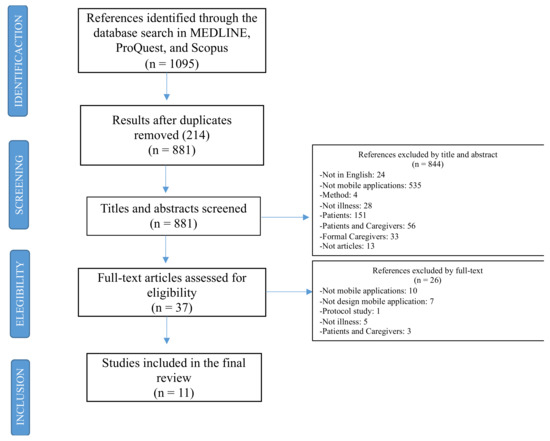
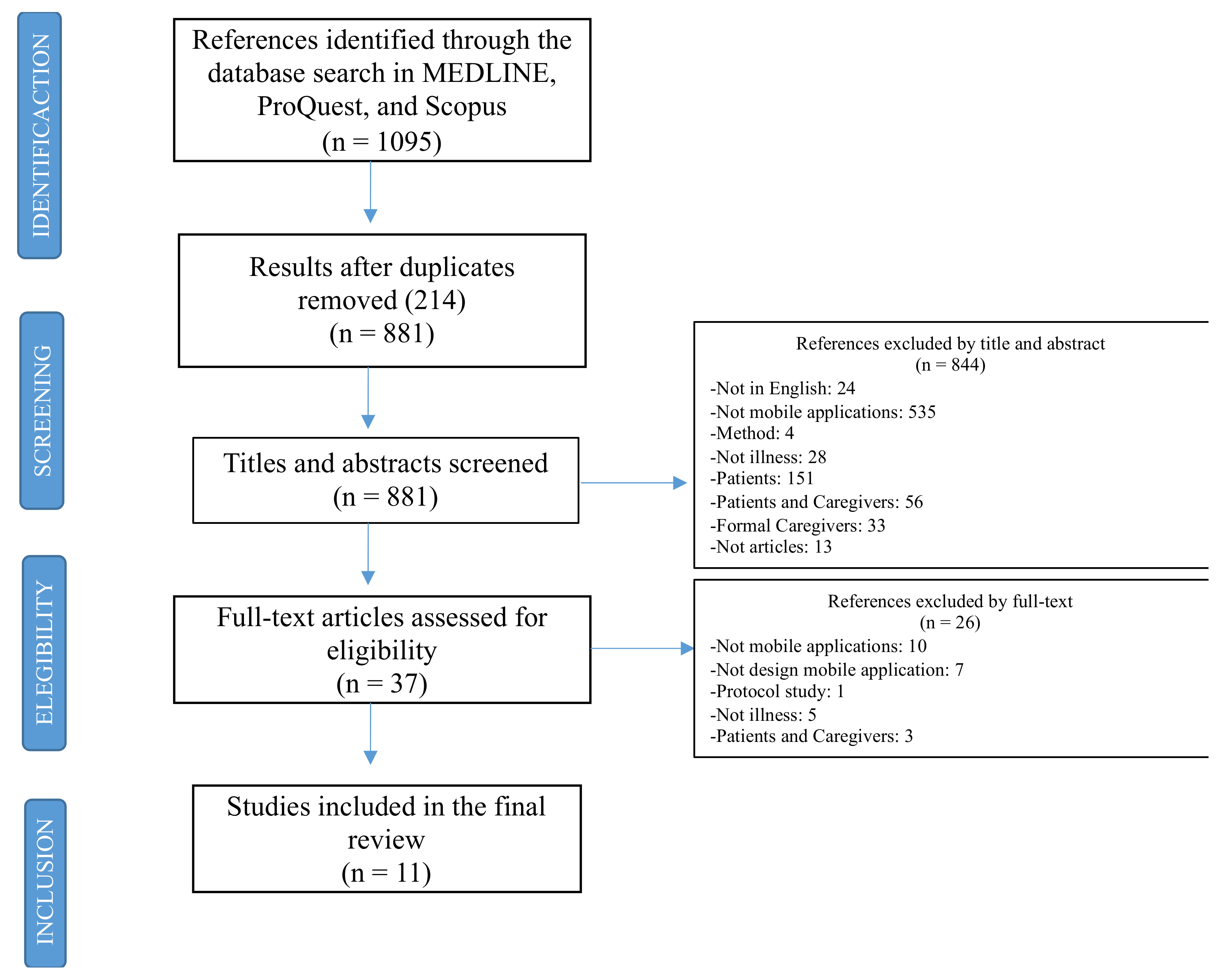
The initial search identified 1095 references of which 214 were eliminated due to being duplicates. Following the inclusion and exclusion criteria, we identified and extracted information from 11 studies (Figure 1).
Figure 1.
Flow diagram of study inclusion and exclusion process.
3.1. Study Objectives
Of the 11 studies found, eight described the design and evaluation of a mobile application for caregivers [3,9,17,20,21,23,24,27], whereas one evaluated a previously designed mobile application [22]. One of these studies subsequently developed that mobile application and published another study in which the objective was evaluated [25,26].
3.2. Participants
The sample sizes varied between 4 and 90 [20,21]. In some studies, the participants were only informal caregivers [3,17,20,21,22,23,24], while others used informal and formal caregivers, such as nurses and physicians [9,25,26,27].
Two studies only used female samples, such as mothers or daughters [3,20]. In the other studies, over 60% of the informal caregiver participants were women [9,22,26].
3.3. Situation of the Person in Need of Care
Mobile applications were designed for caregivers who take care of adults with Alzheimer’s disease or other forms of dementia [9,20,23]. Others mobile applications were designed for cancer caregivers [3,25,26,28,29], sensory processing disorder [17], premature infants [21], and cerebral palsy [22].
3.4. Design and Duration of the Studies
One study carried out a randomized controlled trial to evaluate if mobile apps were effective [21]. Nevertheless, most of the studies had a descriptive design [3,9,17,20,22,23,24,25,26,27].
The time that the participants tested the mobile apps varied between six months [24] and one week [27].
3.5. Participants Involved in the App’s Design
Of the 10 studies in which a mobile application for caregivers was designed [3,9,17,20,21,22,23,24,25,27], 8 studies considered caregivers’ needs and challenges with the aim of creating or adapting the app’s functions to them [3,9,20,22,23,24,25,27]. In addition, some studies evaluated perspectives and opinions of formal caregivers such as physicians, nurses, or nursing students [9,25,27].
3.6. Measures for Evaluating Caregivers’ Needs
To evaluate caregivers’ needs, the studies conducted interviews in which the family members were asked about their needs, difficulties, routines, emotional states, computer skills, and attitudes towards mHealth [3,24,25]. Furthermore, the studies carried out focus groups to ask about personal experiences in caregiving, daily challenges, expectations for the mobile application, and suggestions for content [23,25]. In addition, one of these studies interviewed formal caregivers to evaluate their opinions on possible features to include in mobile applications [25].
Some studies did not show the measures to assess care needs [9,20] or these needs were assessed in previous studies [22,27].
3.7. Functions of the Mobile App
The most common features of the mobile applications were the provision of information about the patient, such as sociodemographic indicators, clinical information, and activities of daily living [9,17,21,24,25,27]. Educational information and links to websites focused on caregivers [9,21,22,23,24,25,27]. Moreover, one mobile application was designed to record and send videos to other caregivers to share their experiences [20]. Contact information for caregiver resources and services was sometimes provided [9,24]. In addition, some mobile applications offered support to make decisions or to solve problems, and feedback from health professionals or caregivers could ask questions [9,17,25]. One study included a checklist with general symptoms that the caregivers should look out for to know when to call the hospital [24] and another a Behavior Problems Checklist, a validated assessment of memory-related problems, depression, and disruptive behaviors [9]. Questionnaires to evaluate caregivers’ psychological well-being [25] or track patient wellness [27] or state of mind [21], or validated questionnaires such as Zarit Burden Scale to evaluate caregiver burden, and Patient Health Questionnaire were provided to assess depression symptoms [9]. If the caregiver was experiencing high levels of depression or burden, the mobile application recommended to contact the case manager [9], and the mobile application gave information about self-care [27]. A list of medications was another common feature to help caregivers to manage treatment with reminders for taking medication [9,25]. Another feature helped to track doctors’ appointments [24,25].
Unique features of some mobile applications were meditation audio clips, communication with other caregivers [27], goal setting and tracking [17]. They sent encouragement messages as positive reinforcement [17]. Finally, a mobile application showed a tree to represent the status of the caregiver’s social network with the final aim of avoiding isolation [3].
3.8. Measures for Evaluating Mobile Apps
Three of the 11 studies extracted usage data of the mobile application such as the number of downloads, usage frequency, the frequency that specific features were used, the type of information searched for, and the purpose of notifications [9,17,24].
Some questionnaires were administered to evaluate the mobile application, its usefulness, satisfaction with each function and their perceived importance, ease of use, and suggestions for improvement [9]. Likewise, the mobile app rating scale evaluated the quality of app engagement, functionality, aesthetics, and the perceived impact of the app on the user’s knowledge and attitudes [27]. Other questionnaires were applied to evaluate the effects of the mobile intervention such as the Zarit Burden Scale and the Kaye’s Gain Through Group Involvement Scale to evaluate caregiver burden [20]. The App Impact Questionnaire was created to assess treatment adherence and sense of competence of parents [17]. The Parenting Sense of Competence Scale evaluated the satisfaction of parenting and parental self-efficacy [21]. The Press Ganey Discharge Questionnaire determined preparedness for discharge [21]. Moreover, one study created a questionnaire to evaluate caregivers’ knowledge [22].
Five studies carried out qualitative methods such as interviews and focus groups to evaluate the latest version of the mobile application, its usefulness, user satisfaction, helpfulness, and to offer further suggestions [3,23,24,26,27].
Finally, three studies additionally evaluated formal caregivers to assess mobile applications via focus groups, questionnaires, and interviews [9,26,27].
3.9. Mobile Applications Effectiveness
Of the 11 studies found, three studies evaluated the efficacy of mobile applications [17,21,22]. The results showed that treatment adherence increased significantly as a result of the use of the mobile application and the content of a mobile application [17]. In another study caregivers’ knowledge increased significantly after using a mobile application [22]. Parental self-efficacy and preparation for hospital discharge were also increased, although the differences were not statistically significant [21].
The participants claimed that the mobile application was easy to use [3,9,24,27], effective [8,17,20,21,26], useful [3,23,24,27], they would be willing to use the mobile application [3,26], and they were satisfied with it [9,23,26].
3.10. Best-Valued Features
The best-valued functions were the evaluation of caregivers’ psychological well-being, the possibility of contact with the case manager function, assessment of behavioral and mood disturbances function, information about available services for caregivers [9], and the use of examples and practical advice in educational videos [23]. In addition, the appearance of the mobile application was well appreciated [23].
3.11. Most-Used Features
The most-used features were the summary of the patient’s clinical information, in particular, the area to record blood test results, the checklist with general symptoms that the caregiver should look out for to know when to call the hospital [24], the behavior problem checklist, educational information [9], the reminders and the support to solve problems [17].
3.12. Recommended and Needed Features
Some suggestions about mobile applications that participants provided were: the need for a summary of patient information [24]; medication reminders and to track adherence to treatment [3,24]; appointment reminders and a shared calendar to see the doctor’s appointments [3,24]; educational information about difficult tasks [9], about medication management at home [24], about how to care for children at home, and about social and financial issues [26]; addition of pictures, videos, and other forms of multimedia in the educational information [9,26]; suggestions for activities for caregivers [3]; synchronization of other devices to share information with other caregivers [24]. Moreover, caregivers wanted to extend the use of the mobile application to friends and other family caregivers [26]
4. Conclusions
It is surprising how, despite the large number of studies evaluating applications designed to facilitate care, the large majority are focused on the interests of patients or formal caregivers, while informal caregiver information is the most underestimated. This review shows that most mobile applications for informal caregivers take into account users’ needs in the design of their features [3,9,20,22,23,24,25,27]. Mobile applications for caregivers are an effective solution to reduce their burden, improve their quality of life, and avoid the negative physical and psychological consequences of caring for a dependent person [1,16].
The mobile applications found were designed for caregivers of people with different diseases and situations of dependency. Most users agreed on the need to collect clinical information about the person they care for, medication reminders and doctor’s appointments reminders, as well as tracking on both, educational information about the disease and treatment, resources to help caregivers, and help with managing symptoms, contacting healthcare professionals, and sharing information with other caregivers [3,9,17,23,24,26,27].
Previous studies agreed that the main need for caregivers is getting more information [11,12,13]. For this reason, mobile applications must provide reliable information to caregivers. One of the most common practices amongst caregivers is to search for information on the internet, where sometimes the information is not secure [30].
In addition, it should be noted that just because a mobile application has more functions does not mean that it is of a higher quality; what is relevant is that it solves the complications experienced during care at home [16].
Most of the applications found, gave health support to informal caregivers related to caregiving tasks, such as remembering to give medication, offering calendars with doctor’s appointments, or giving educational information [9,17,20,21,22,23,24,25,26,27]. However, only a few of them added specific functions to cover the emotional needs of informal caregivers. Those that included them offered evaluations for their well-being, promotion of social relations and forums to share experiences [9,17,21,26,27].
Previous studies have shown that women often assume the role of caregiver. Two studies found, evaluated only female caregivers, mothers or daughters [3,29]. Even in studies where gender was not an inclusion criterion, there is a greater participation of women as informal caregivers [9,22,26].
Another previous study has reviewed the availability of mobile applications for informal caregivers on Google Play and iTunes. However, this study does not determine the efficacy or value of these mobile applications [1].
Studies have shown that mobile applications are effective [17,21,22]. Furthermore, users claim that they are easy to use and useful, and would be willing to continue using them [3,9,17,20,21,23,24,26,27]. User satisfaction and mobile applications’ effectiveness may be due to the functions that were developed based on caregivers’ needs.
However, a longer period of use of the mobile application in natural conditions is necessary to check whether the mobile application continues to be effective in the long term [31]. Moreover, experimental studies should increase the current quality of evidence and identify key elements of these interventions.
Likewise, for future studies, it is relevant to design mobile applications that coordinate patients, their caregivers, and the healthcare professionals involved to improve the quality of care that the patient receives, and increase the patients’ participation in their care [9].
Regarding the possible limitations of this study, it should be mentioned that despite having searched the most relevant databases for this subject, it is possible that other databases have not been taken into account. On the other hand, although the appropriate keywords have been used, it may be that there is a certain word from a specific area that has not been checked. Moreover, the search has been reduced to articles written in English. Another limitation to highlight is the difficulty in collecting the results due to the wide heterogeneity of the caregivers to whom the mobile applications are destined, as well as the evaluated variables of the mobile applications. Finally, as most studies are descriptive and with few participants, recommendations on these applications should be taken with caution.
To conclude, it is important to highlight the importance of developing strategies to help informal caregivers in their care tasks, as they do not have the necessary skills and knowledge. Mobile applications for caregivers can provide a solution for them. However, the effectiveness of these will depend largely on whether their characteristics match user needs.
Author Contributions
V.P.-J. and J.J.M. contributed to the study conception and design. M.S.-G. and M.G. performed the literature search. V.P.-J, M.S.-G. and M.G. examined the papers and assessed study quality. V.P.-J., M.S.-G. and M.G. extracted data from the identified articles. M.S.-G. and J.J.M. drafted the manuscript. All authors revised the manuscript critically for important and approved the final to be published.
Funding
This research was funded by the Conselleria de Educación, Generalitat Valenciana Excellence Groups Prometeo/2017/173.
Institutional Review Board Statement
Not applicable.
Informed Consent Statement
Not applicable.
Conflicts of Interest
The authors declare no conflict of interest.
Appendix A
Table A1.
Levels of evidence and quality degrees of recommendation.
References
- Grossman, M.R.; Zak, D.K.; Zelinski, E.M. Mobile apps for caregivers of older adults: Quantitative content analysis. JMIR mHealth uHealth 2018, 6, e162. [Google Scholar] [CrossRef] [Scilit] [PubMed]
- Martínez, M.; De La Cuesta, C. La experiencia del cuidado de las mujeres cuidadoras con procesos crónicos de salud de familiares dependientes. Aten. Primaria 2016, 48, 77–84. [Google Scholar] [CrossRef] [Scilit]
- Fuentes, C.; Hernández, C.; Escobedo, L.; Herskovic, V.; Tentori, M. Promoting Self-Reflection of Social Isolation through Persuasive Mobile Technologies: The Case of Mother Caregivers of Children with Cancer. Int. J. Hum. Comput. Interact. 2014, 30, 802–814. [Google Scholar] [CrossRef] [Scilit]
- Heynsbergh, N.; Heckel, L.; Botti, M.; Livingston, P.M. Feasibility, useability and acceptability of technology-based interventions for informal cancer carers: A systematic review. BMC Cancer 2018, 18, 244. [Google Scholar] [CrossRef] [Scilit]
- Park, M.; Choi, S.; Lee, S.J.; Kim, S.H.; Kim, J.; Go, Y.; Lee, D.Y. The roles of unmet needs and formal support in the caregiving satisfaction and caregiving burden of family caregivers for persons with dementia. Int. Psychogeriatr. 2018, 30, 557–567. [Google Scholar] [CrossRef] [Scilit]
- Instituto Nacional de Estadística. Encuesta de Discapacidad, Autonomía Personal y Situaciones de Dependencia; Instituto Nacional de Estadística: Madrid, Spain, 2008. [Google Scholar]
- Zueras, P.; Spijker, J.; Blanes, A. The changing profile of caregivers of persons aged 65 years and over with disabilities within a persisting family care model. Rev. Esp. Geriatr. Gerontol. 2018, 53, 66–72. [Google Scholar] [CrossRef] [Scilit] [PubMed]
- Look, K.A.; Stone, J.A. Medication management activities performed by informal caregivers of older adults. Res. Soc. Adm. Pharm. 2018, 14, 418–426. [Google Scholar] [CrossRef] [Scilit]
- Brown, E.L.; Ruggiano, N.; Page, T.F.; Roberts, L.; Hristidis, V.; Whiteman, K.L.; Castro, J. Careheroes web and androidTM apps for dementia caregivers: A feasibility study. Res. Gerontol. Nurs. 2016, 9, 193–203. [Google Scholar] [CrossRef] [Scilit] [PubMed]
- Bustillo, M.L.; Gómez-Gutiérrez, M.; Guillén, A.I.Y. Los cuidadores informales de personas mayores dependientes: Una revisión de intervenciones psicológicas de los últimos diez años. Clin. Salud 2018, 29, 89–100. [Google Scholar] [CrossRef] [Scilit]
- Price, M.L.; Surr, C.A.; Gough, B.; Ashley, L. Experiences and support needs of informal caregivers of people with multimorbidity: A scoping literature review. Psychol. Health 2019, 35, 36–69. [Google Scholar] [CrossRef] [Scilit] [PubMed]
- Queluz, F.N.F.R.; Kevin, E.; Wozney, L.; Fancey, P.; McGrath, P.J.; Keefe, J. Understanding the needs of caregivers of persons with dementia: A scoping review. Int. Psychogeriatr. 2019, 32, 35–52. [Google Scholar] [CrossRef] [Scilit]
- Washington, K.T.; Meadows, S.E.; Elliott, S.G.; Koopman, R.J. Information needs of informal caregivers of older adults with chronic health conditions. Patient Educ. Couns. 2011, 83, 37–44. [Google Scholar] [CrossRef] [Scilit] [PubMed]
- Jensen, M.; Agbata, I.N.; Canavan, M.; McCarthy, G. Effectiveness of educational interventions for informal caregivers of individuals with dementia residing in the community: Systematic review and meta-analysis of randomised controlled trials. Int. J. Geriatr. Psychiatry 2015, 30, 130–143. [Google Scholar] [CrossRef] [Scilit] [PubMed]
- Losada, A.; Márquez-González, M.; Romero-Moreno, R.; Mausbach, B.T.; López, J.; Fernández-Fernández, V.; Nogales-González, C. Cognitive-behavioral therapy (CBT) versus acceptance and commitment therapy (ACT) for dementia family caregivers with significant depressive symptoms: Results of a randomized clinical trial. J. Consult. Clin. Psychol. 2015, 83, 760–772. [Google Scholar] [CrossRef] [Scilit] [PubMed]
- Brown, E.L.; Ruggiano, N.; Li, J.; Clarke, P.J.; Kay, E.S.; Hristidis, V. Smartphone-Based Health Technologies for Dementia Care: Opportunities, Challenges, and Current Practices. J. Appl. Gerontol. 2019, 38, 73–91. [Google Scholar] [CrossRef] [Scilit] [PubMed]
- Gal, E.; Steinberg, O. Using Home-Program Adherence App in Pediatric Therapy: Case Study of Sensory Processing Disorder. Telemed. J. E-Health 2018, 24, 649–654. [Google Scholar] [CrossRef] [Scilit] [PubMed]
- Tao, H.; McRoy, S.; Wang, L. Would mobile health be a solution to rehospitalization? Nurs. Health Sci. 2017, 19, 188–190. [Google Scholar] [CrossRef] [Scilit] [PubMed]
- Urrútia, G.; Bonfill, X. PRISMA declaration: A proposal to improve the publication of systematic reviews and meta-analyses. Med. Clin. 2010, 135, 507–511. [Google Scholar] [CrossRef] [Scilit] [PubMed]
- Davis, B.H.; Nies, M.A.; Shehab, M.; Shenk, D. Developing a pilot e-mobile app for dementia caregiver support: Lessons learned OJNI. Online J. Nurs. Inform. 2014, 18, 3095. Available online: http://ojni.org/issues/?p=3095 (accessed on 20 December 2020).
- Garfield, C.F.; Lee, Y.S.; Kim, H.N.; Rutsohn, J.; Kahn, J.Y.; Mustanski, B.; Mohr, D.C. Supporting parents of premature infants transitioning from the NICU to home: A pilot randomized control trial of a smartphone application. Internet Interv. 2016, 4, 131–137. [Google Scholar] [CrossRef] [Scilit]
- Ghazisaeedi, M.; Safari, A.; Sheikhtaheri, A.; Dalvand, H. The effect of an android-based application on the knowledge of the caregivers of children with cerebral palsy. Med. J. Islam. Repub. Iran 2016, 30, 456. [Google Scholar] [PubMed]
- Halbach, T.; Solheim, I.; Ytrehus, S.; Schulz, T. A mobile application for supporting dementia relatives: A case study. Stud. Health Technol. Inform. 2018, 256, 839–846. [Google Scholar] [CrossRef] [Scilit] [PubMed]
- Slater, P.J.; Fielden, P.E.; Bradford, N.K. The Oncology Family App: Providing Information and Support for Families Caring for Their Child with Cancer. J. Pediatr. Oncol. Nurs. 2018, 35, 94–102. [Google Scholar] [CrossRef] [Scilit] [PubMed]
- Wang, J.; Yao, N.; Wang, Y.; Zhou, F.; Liu, Y.; Geng, Z.; Yuan, C. Developing “Care Assistant”: A smartphone application to support caregivers of children with acute lymphoblastic leukaemia. J. Telemed. Telecaree 2015, 22, 163–171. [Google Scholar] [CrossRef] [Scilit]
- Wang, J.; Yao, N.; Shen, M.; Zhang, X.; Wang, Y.; Liu, Y.; Geng, Z.; Yuan, C. Supporting Caregivers of Children With Acute Lymphoblastic Leukemia via a Smartphone App A Pilot Study of Usability and Effectiveness. Comput. Inform. Nurs. 2016, 34, 520–527. [Google Scholar] [CrossRef] [Scilit]
- Wittenberg, E.; Xu, J.; Goldsmith, J.; Mendoza, Y. Caregiver Communication about Cancer: Development of a mhealth resource to support family caregiver communication burden. Psycho Oncol. 2019, 28, 365–371. [Google Scholar] [CrossRef] [Scilit] [PubMed]
- Scottish Intercollegiate Guidelines Network. A Guideline Developer’s Handbook; SIGN: Edinburgh, Scotland, 2019; SIGN Publication No. 50; Available online: http://www.sign.ac.uk (accessed on 18 November 2019).
- Ma, L.-L.; Wang, Y.-Y.; Yang, Z.-H.; Huang, D.; Weng, H.; Zeng, X.-T. Methodological quality (risk of bias) assessment tools for primary and secondary medical studies: What are they and which is better? Mil. Med. Res. 2020, 7, 7. [Google Scholar] [CrossRef] [Scilit]
- Kim, H.; Paige, M.; Bhuyan, S.S. Seeking Medical Information Using Mobile Apps and the Internet: Are Family Caregivers Different from the General Public? J. Med. Syst. 2017, 41, 38. [Google Scholar] [CrossRef] [Scilit] [PubMed]
- Pérez-Jover, V.; Sala-González, M.; Guilabert, M.; Mira, J.J. Mobile Apps for Increasing Treatment Adherence: Systematic Review. JMIR 2019, 21, e12505. [Google Scholar] [CrossRef] [Scilit]

Publisher’s Note: MDPI stays neutral with regard to jurisdictional claims in published maps and institutional affiliations. |
© 2021 by the authors. Licensee MDPI, Basel, Switzerland. This article is an open access article distributed under the terms and conditions of the Creative Commons Attribution (CC BY) license (http://creativecommons.org/licenses/by/4.0/).