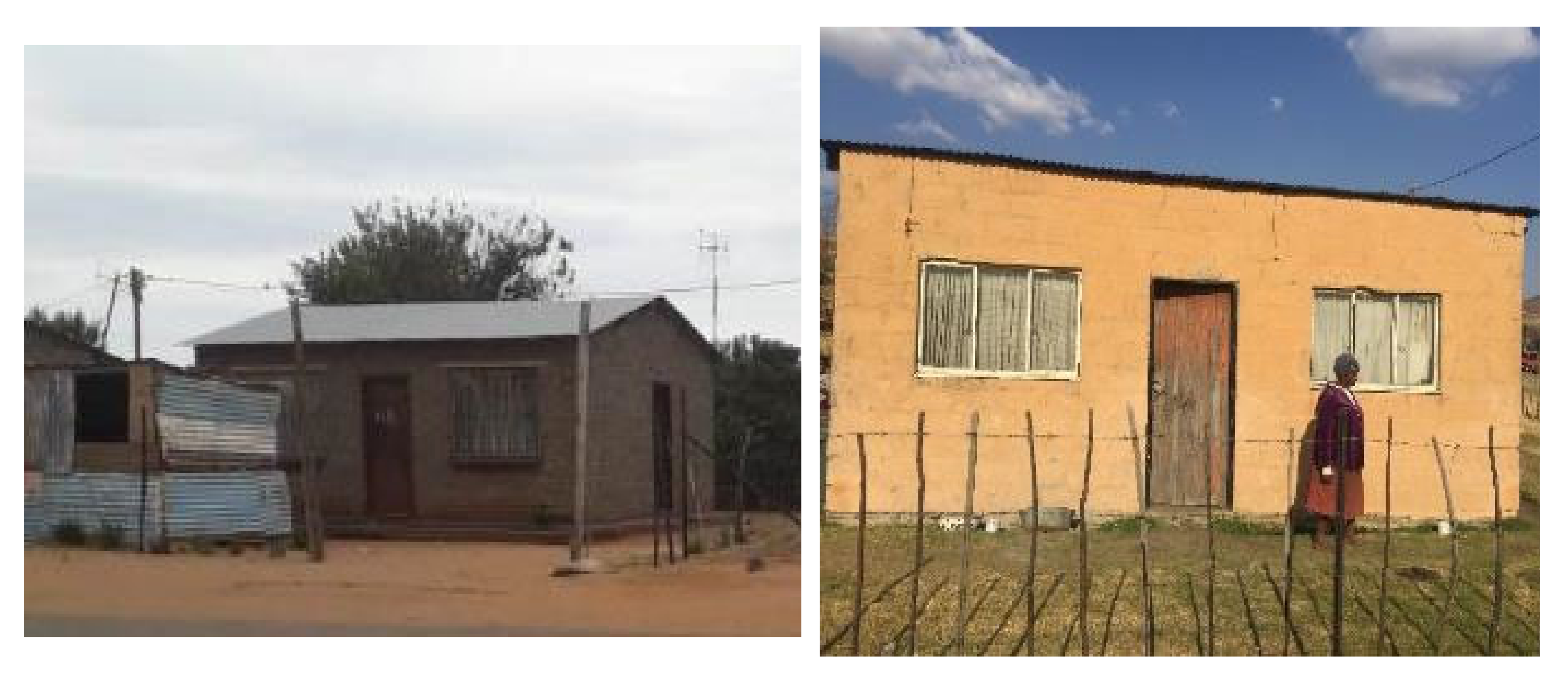
The Three Little Houses: A Comparative Study of Indoor and Ambient Temperatures in Three Low-Cost Housing Types in Gauteng and Mpumalanga, South Africa


Abstract
1. Introduction
- 1)
- What is the extent of the relationship between indoor and ambient temperatures of the three housing types in each area, during warmer and colder months?
- 2)
- Which factors, including housing type, location, behaviour and indoor temperatures, contribute most to an understanding of the perception of housing satisfaction?
2. Methods and Materials
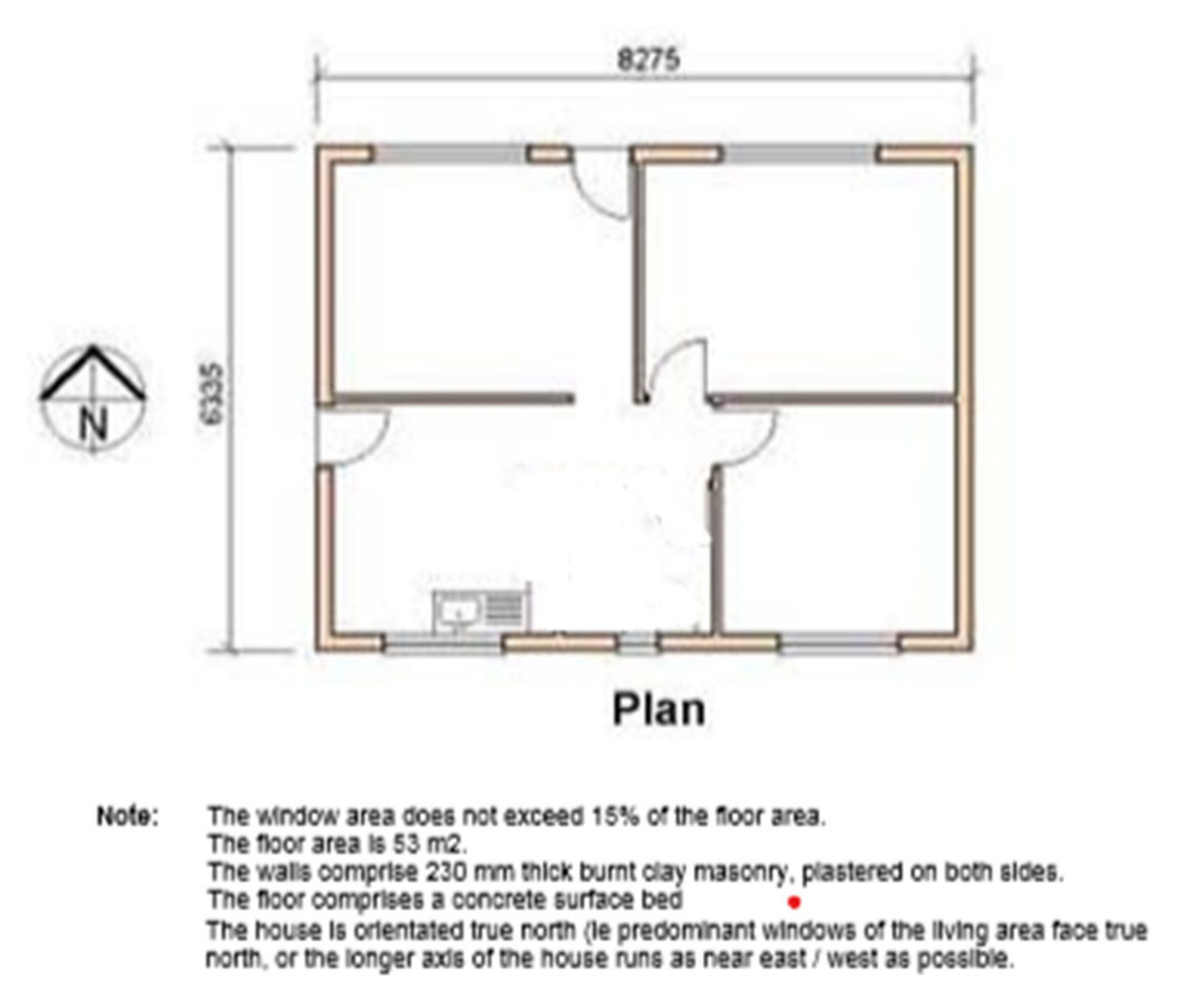
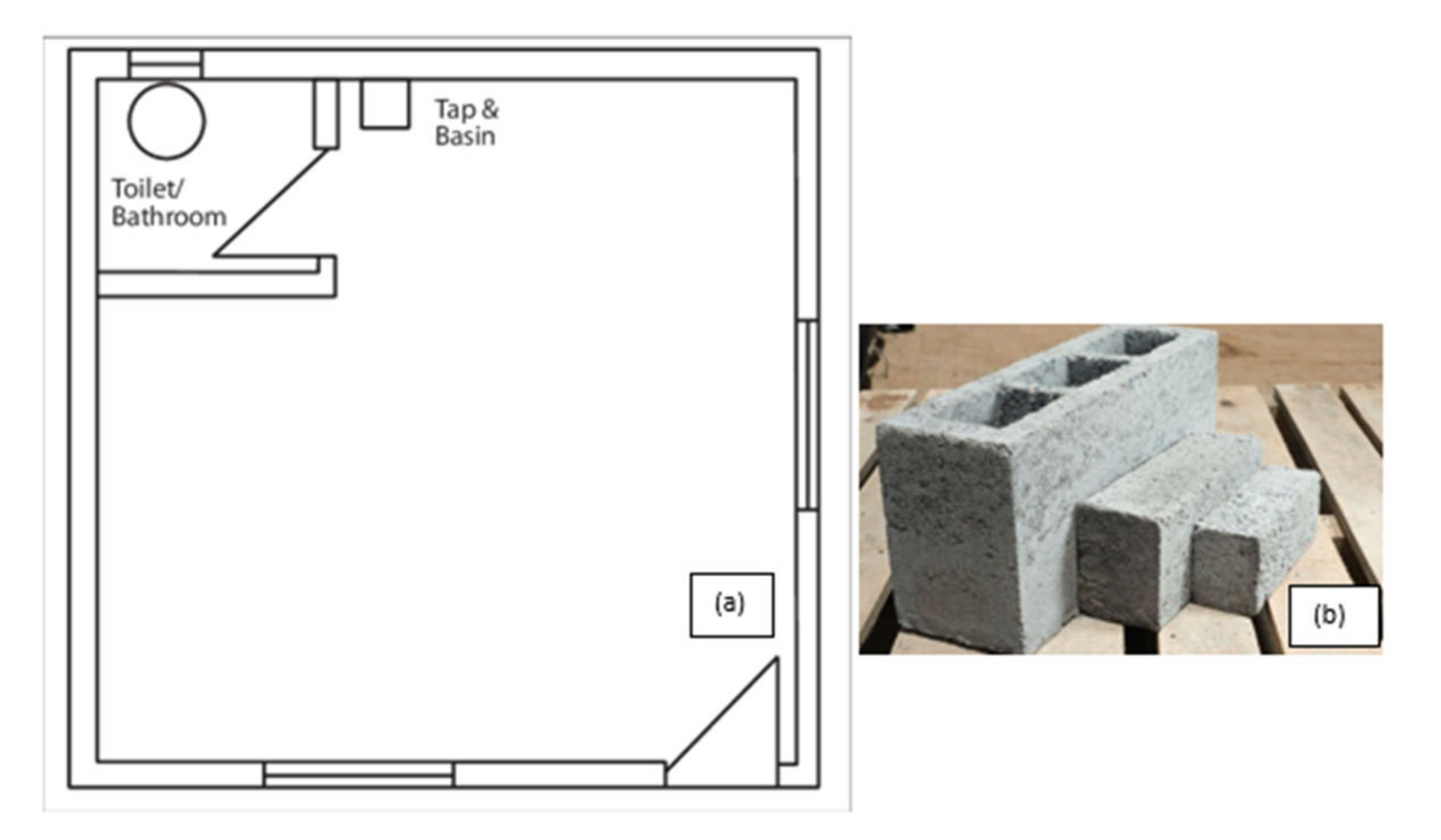
2.1. Description of the Study Sites and the Three Types of Houses Sampled
2.2. Data Collection
2.2.1. Long Term Ambient Temperature Data
2.2.2. Indoor Temperatures
2.2.3. Construction Materials
2.2.4. Occupants’ Behavioural Adaptations
2.2.5. Interviews
2.3. Data Analysis
3. Results
3.1. Indoor and Ambient Temperature
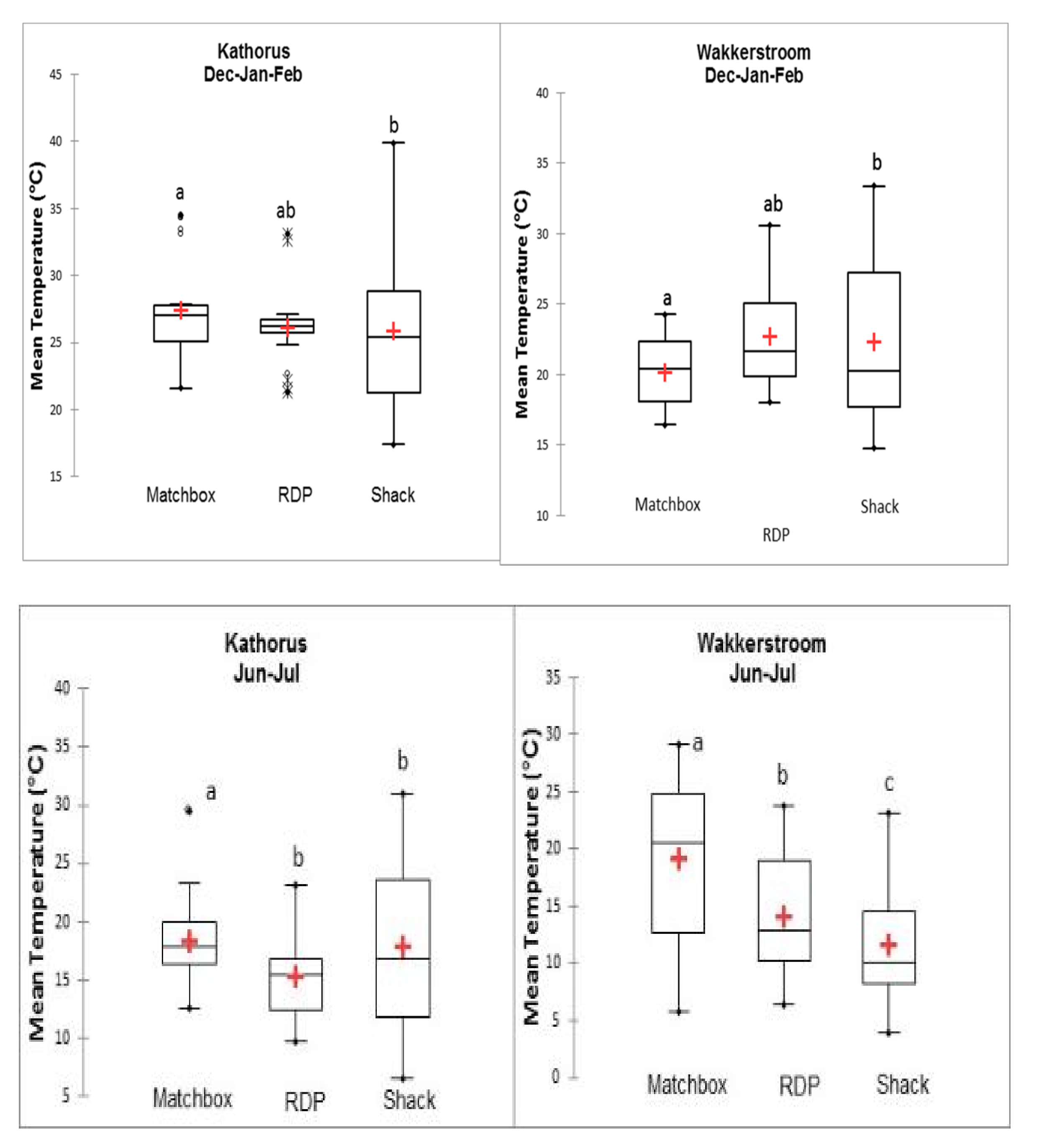
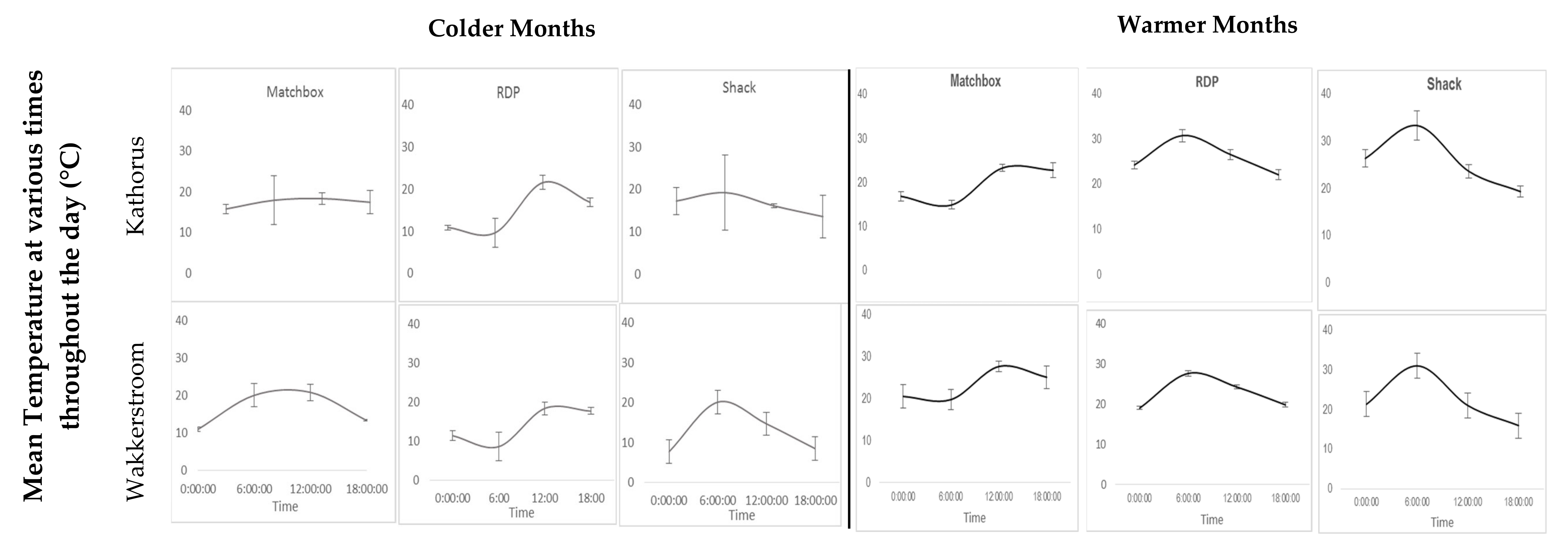
3.1.1. Indoor Temperatures of the Three Housing Types in Kathorus and Wakkerstroom during Selected Times throughout the Day during Colder and Warmer Month
3.1.2. Regression Model Comparisons of Indoor Temperatures of the Three Housing Types in Kathorus and Wakkerstroom as a Function of Outdoor Temperature
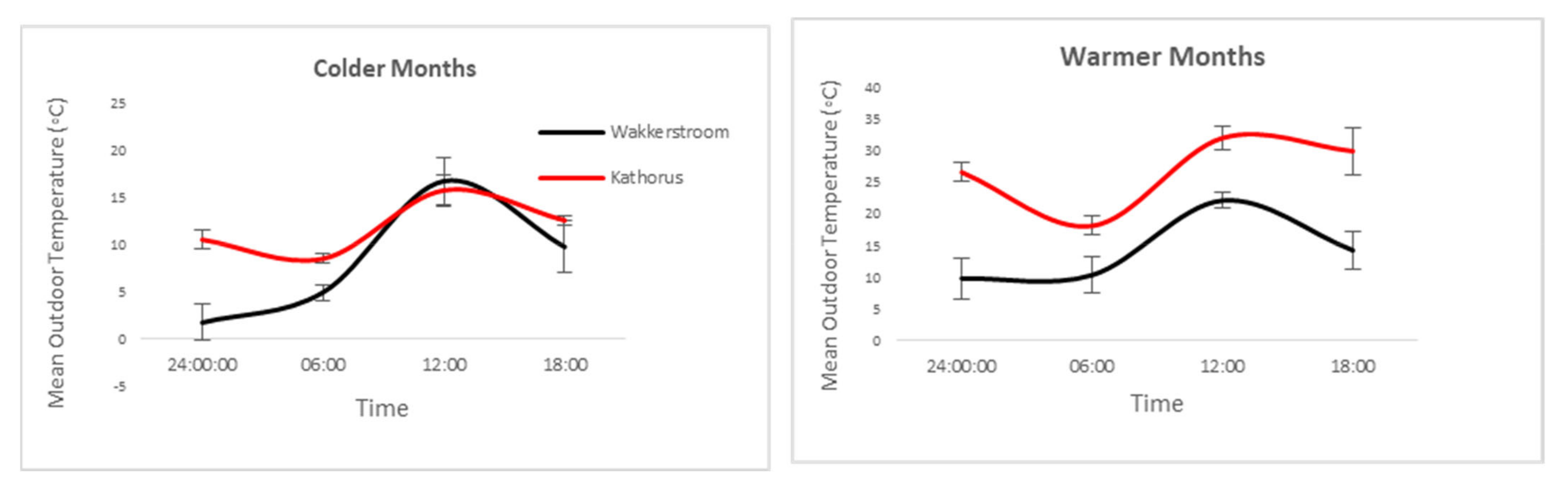
3.1.3. Seasonal Indoor Temperatures Comparison between Three Housing Types in Kathorus and Wakkerstroom
3.2. Construction Material and Self-reported Information from Housing Occupants
Residents Thermal Comfort Perceptions
4. Discussion
4.1. Relationship between Indoor Temperatures of Low-Cost Houses and Ambient Temperatures
4.2. Choice of Construction Materials and its Effect on Indoor Temperatures
4.3. Perception of Thermal Comfort and Satisfaction and Human Health
5. Conclusions
Author Contributions
Funding
Acknowledgments
Conflicts of Interest
References
- UN Habitat. Action Framework for Implementation of the New Urban Agenda; UN Habitat: Nairobi, Kenya, 2019. [Google Scholar]
- Treasury.gov.za. 2017. Available online: http://www.treasury.gov.za/documents/national%20budget/2017/ene/Vote%2038%20Human%20Settlements.pdf (accessed on 29 April 2018).
- Statssa.gov.za. 2017. Available online: http://www.statssa.gov.za/publications/P0302/P03022017.pdf (accessed on 15 September 2018).
- Scholes, R.J.; Scholes, M.C.; Lucas, M. Climate Change: Briefings from Southern Africa; Wits University Press: Johannesburg, South Africa, 2015; ISBN 978-1-86814-91. [Google Scholar]
- World Cities Report 2016: Urbanization and Development—Emerging Futures; UN-Habitat: Nairobi, Kenya, 2016.
- Ormandy, D.; Ezratty, V. Health and thermal comfort: From WHO guidance to housing strategies. Energy Policy 2012, 49, 116–121. [Google Scholar] [CrossRef]
- Balmer, M. Household coal use in an urban township in South Africa. J. Energy South. Afr. 2007, 18, 27–32. [Google Scholar] [CrossRef]
- Scorgie, Y.; Burger, L.; Annergan, H. Vaal Triangle source apportionment study. In Proceedings of the Paper Delivered the National Association for Clean Air Conference, Stellenbosch, South Africa, 14–16 October 2003. [Google Scholar]
- Gouveia, N.; Hajat, S.; Armstrong, B. Socioeconomic differentials in the temperature—Mortality relationship in São Paulo, Brazil. Int. J. Epidemiol. 2003, 32, 390–397. [Google Scholar] [CrossRef] [PubMed]
- Kruger, A.C.; Sekele, S.S. Trends in extreme temperature indices in South Africa: 1962–2009. Int. J. Climatol. 2013, 33, 661–676. [Google Scholar] [CrossRef]
- Tamerius, J.; Perzanowski, M.; Acosta, L.; Jacobson, J.; Goldstein, I.; Quinn, J. Socioeconomic and outdoor meteorological determinants of indoor temperature and humidity in New York City dwellings. Weather Clim. Soc. 2013, 5, 168. [Google Scholar] [CrossRef] [PubMed]
- WHO. Housing and Health Guidelines; Licence: CC BY-NC-SA 3.0 IGO; World Health Organization: Geneva, Switzeralnd, 2018. [Google Scholar]
- Jacobs, D.E. Environmental health disparities in housing. Am. J. Public Health 2011, 101 (Suppl. 1), S115–S122. [Google Scholar] [CrossRef] [PubMed]
- Moolla, R.; Kotze, N.; Block, L. Housing satisfaction and quality of life in RDP houses in Braamfischerville, Soweto: A South African case study. Urbani Izziv 2011, 22, 138–143. [Google Scholar] [CrossRef]
- Cibse. Guide Section A2: Weather and Solar Data; Chartered Institution of Building Services: London, UK, 1982. [Google Scholar]
- Taherdoost, H. Sampling methods in research methodology; how to choose a sampling technique for research. SSRN Electron. J. 2016. [Google Scholar] [CrossRef]
- ASHRAE Standard-55. Thermal Environmental Conditions for Human Occupancy; American Society of Heating, Refrigerating and Air-Conditioning Engineers: Atlanta, GA, USA, 2010. [Google Scholar]
- Goling, S.N.; McGregor, G.R.; Lowe, J.A. Climate change and heat-related mortality in six cities Part 2: Climate model evaluation and projected impacts from changes in the mean and variability of temperature with climate change. Int. J. Biometeorol. 2009, 53, 31–51. [Google Scholar] [CrossRef] [PubMed]
- Basu, R.; Samet, J.M. Relation between elevated ambient temperature and mortality: A review of the epidemiologic evidence. Epidemiol. Rev. 2002, 24, 190–202. [Google Scholar] [CrossRef] [PubMed]
- Govender, T.; Barnes, J.M.; Pieper, C.H. Housing conditions, sanitation status and associated health risks in selected subsidized low-cost housing settlements in Cape Town, South Africa. Habitat Int. 2011, 35, 335–342. [Google Scholar] [CrossRef]
- Bröde, P.; Krüger, E.L.; Fiala, D. UTCI: Validation and practical application to the assessment of urban outdoor thermal comfort. Geogr. Pol. 2013, 86, 11–20. [Google Scholar] [CrossRef]
- Makaka, G.; Meyer, E. Temperature stability of traditional and low-cost modern housing in the Eastern Cape, South Africa. J. Build. Phys. 2006, 30, 71–86. [Google Scholar] [CrossRef]
- Nguyen, J.L.; Schwartz, J.; Dockery, D.W. The relationship between indoor and outdoor temperature, apparent temperature, relative humidity, and absolute humidity. Indoor Air 2014, 24, 103–112. [Google Scholar] [CrossRef] [PubMed]
- Naicker, N.; Teare, J.; Balakrishna, Y.; Wright, C.Y.; Mathee, A. Indoor temperatures in low cost housing in Johannesburg, South Africa. Int. J. Environ. Res. Public Health 2017, 14, 1410. [Google Scholar] [CrossRef] [PubMed]
- Maoto, Z.; Worku, Z. A framework for incorporating quality into low-cost housing projects in South Africa. J. Adv. Soc. Sci. Humanit. 2018, 4, 12–24. [Google Scholar]
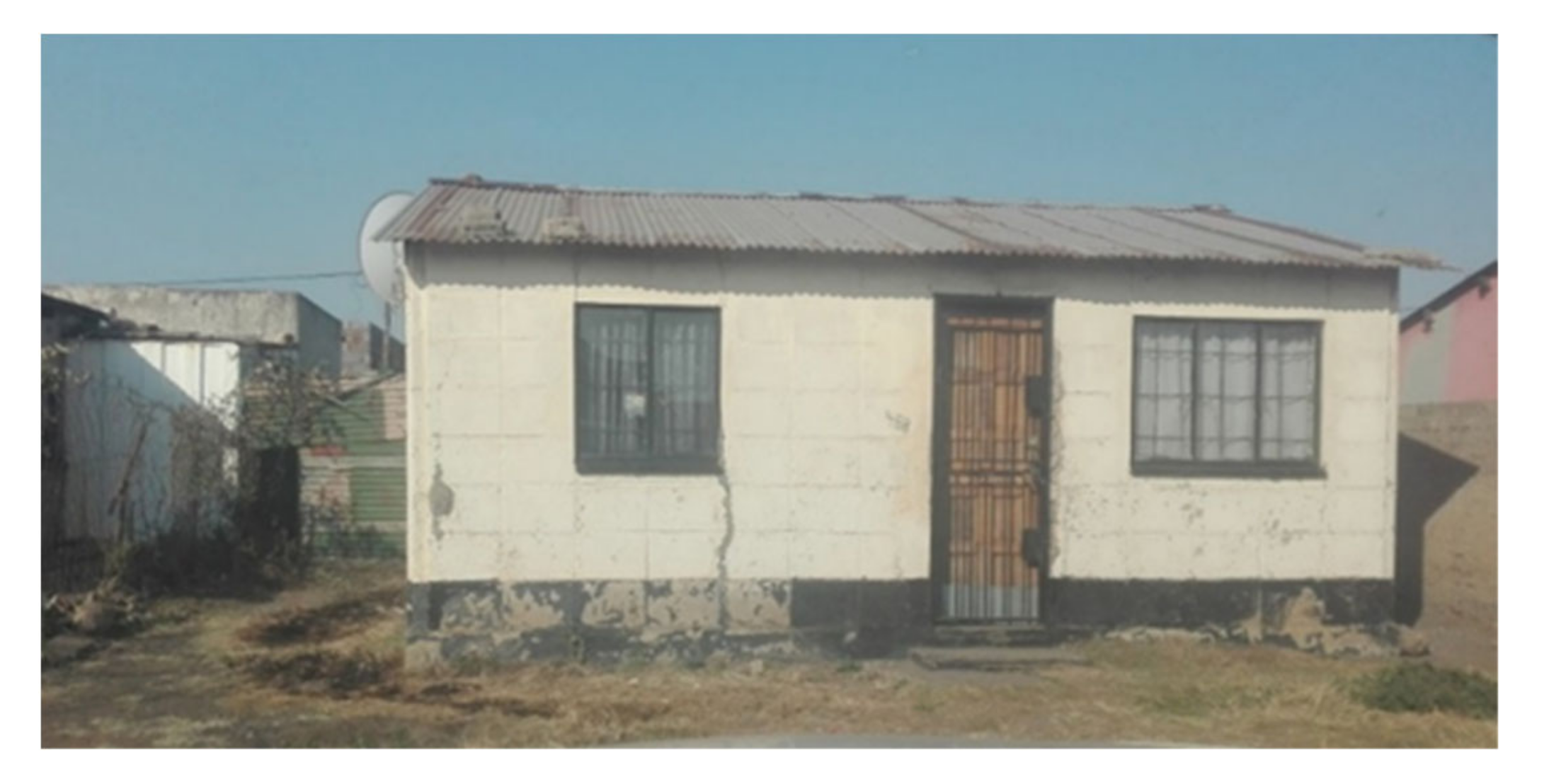
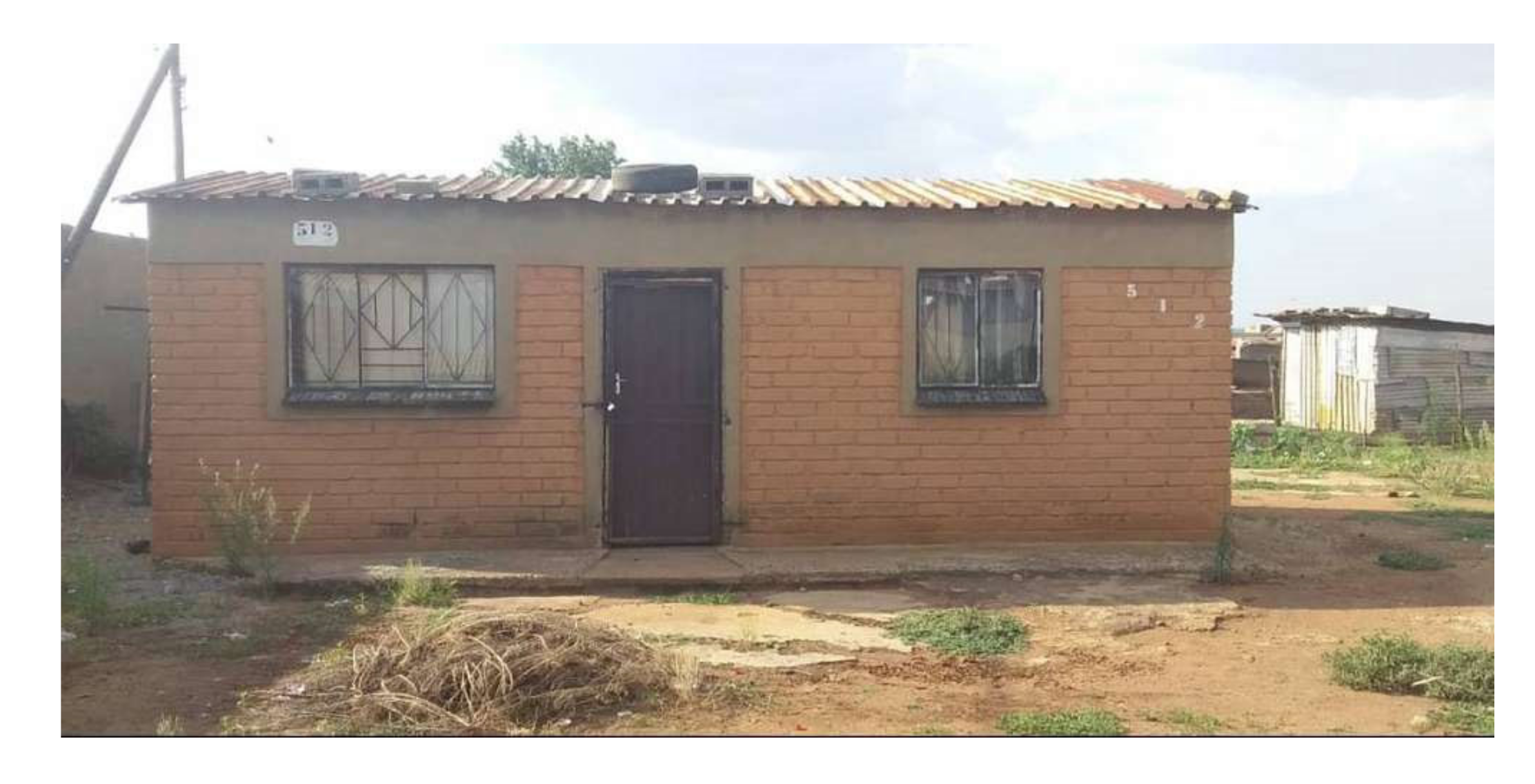
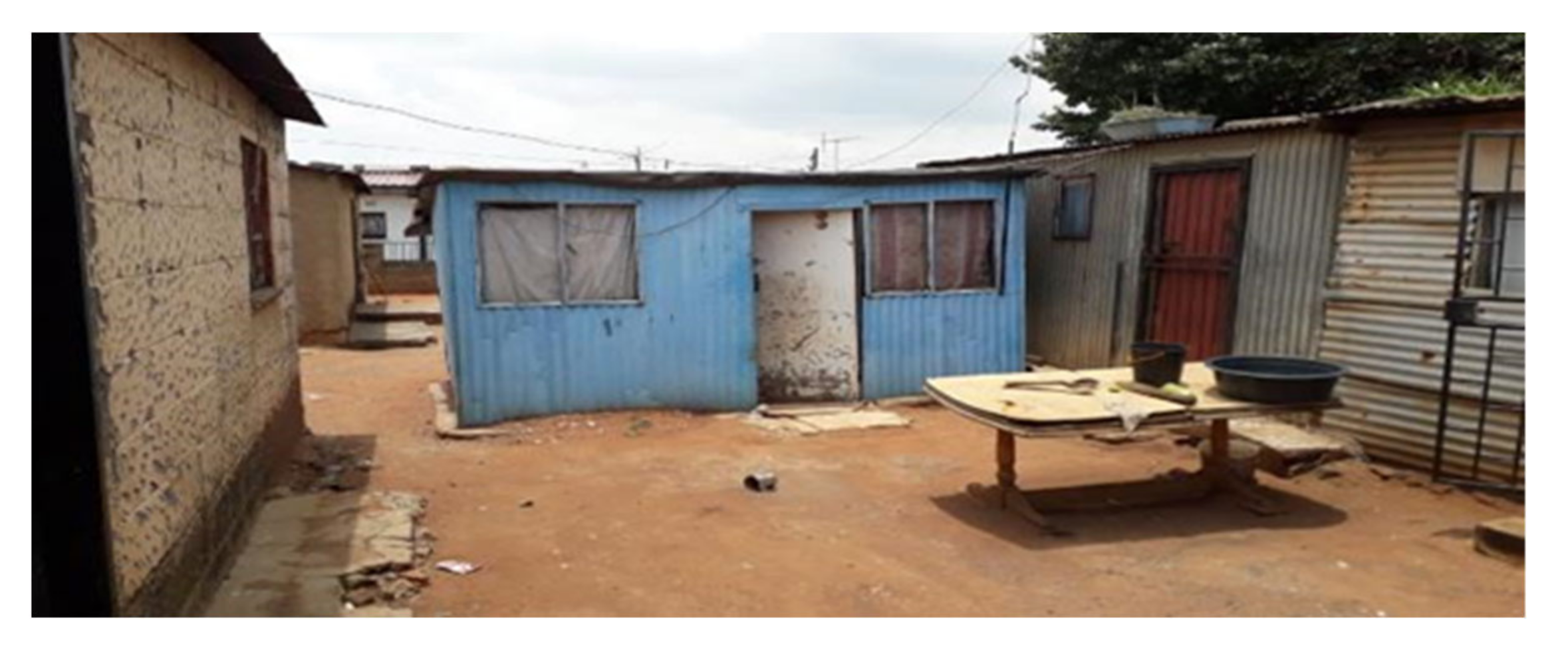

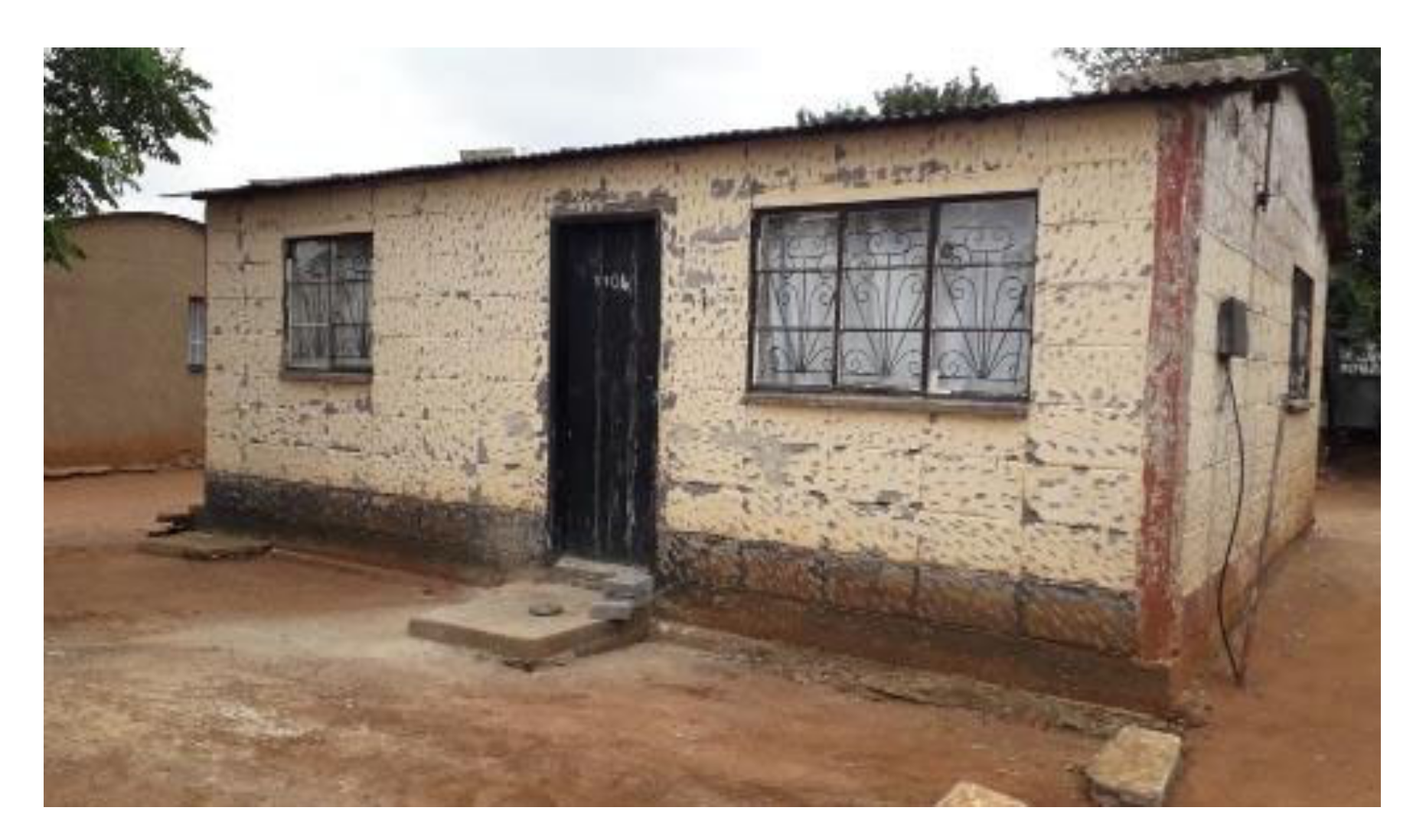
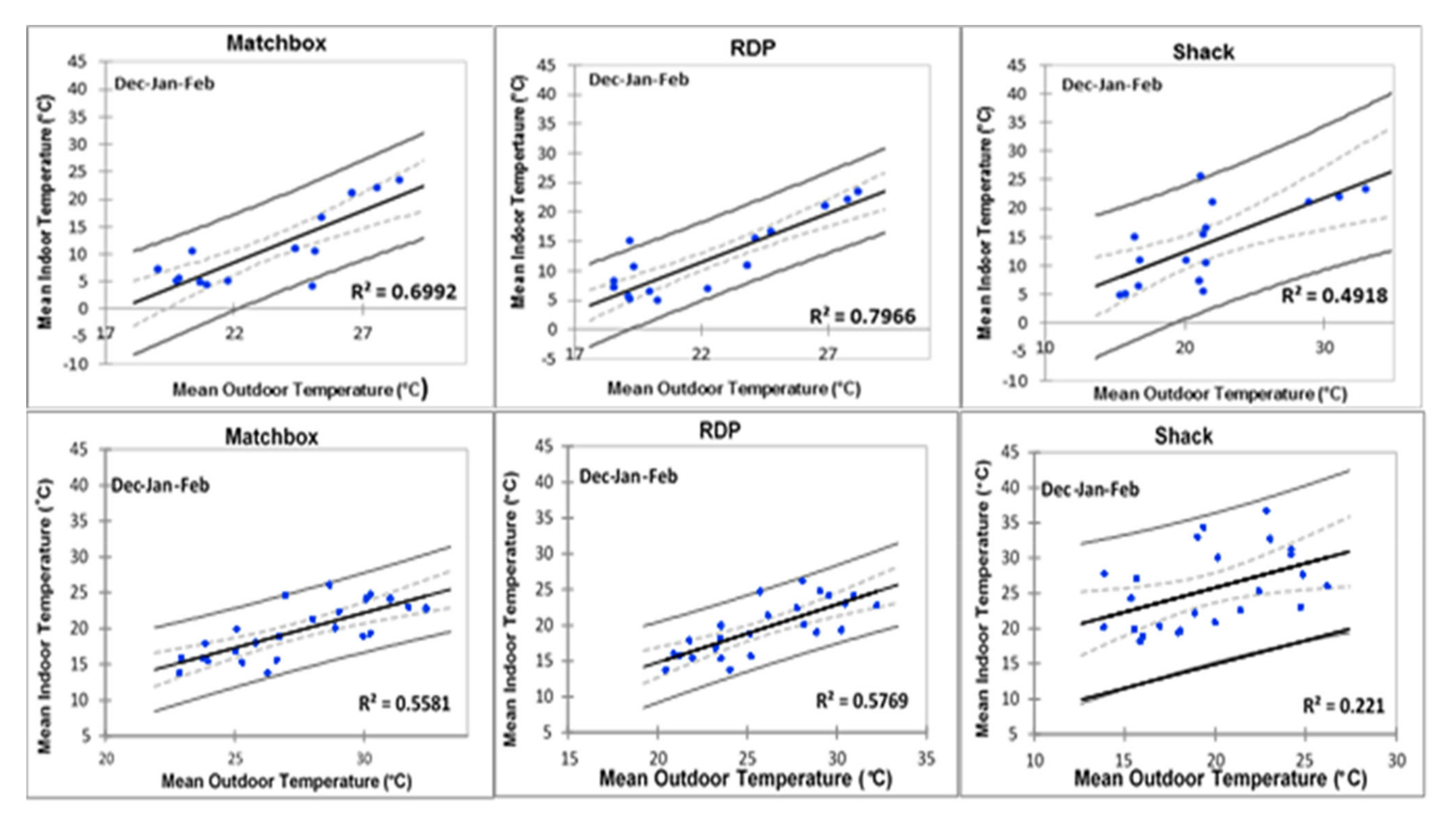
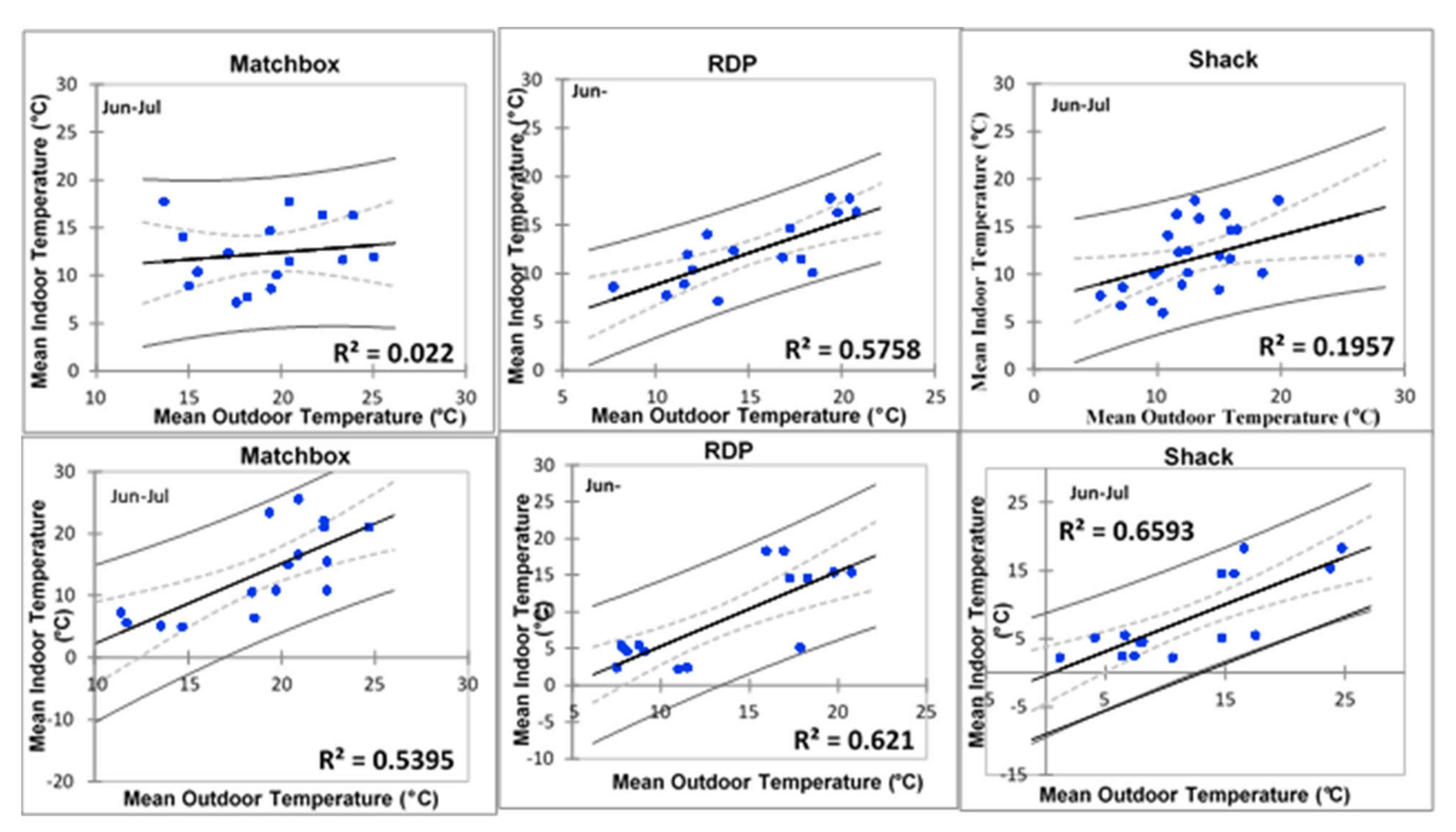
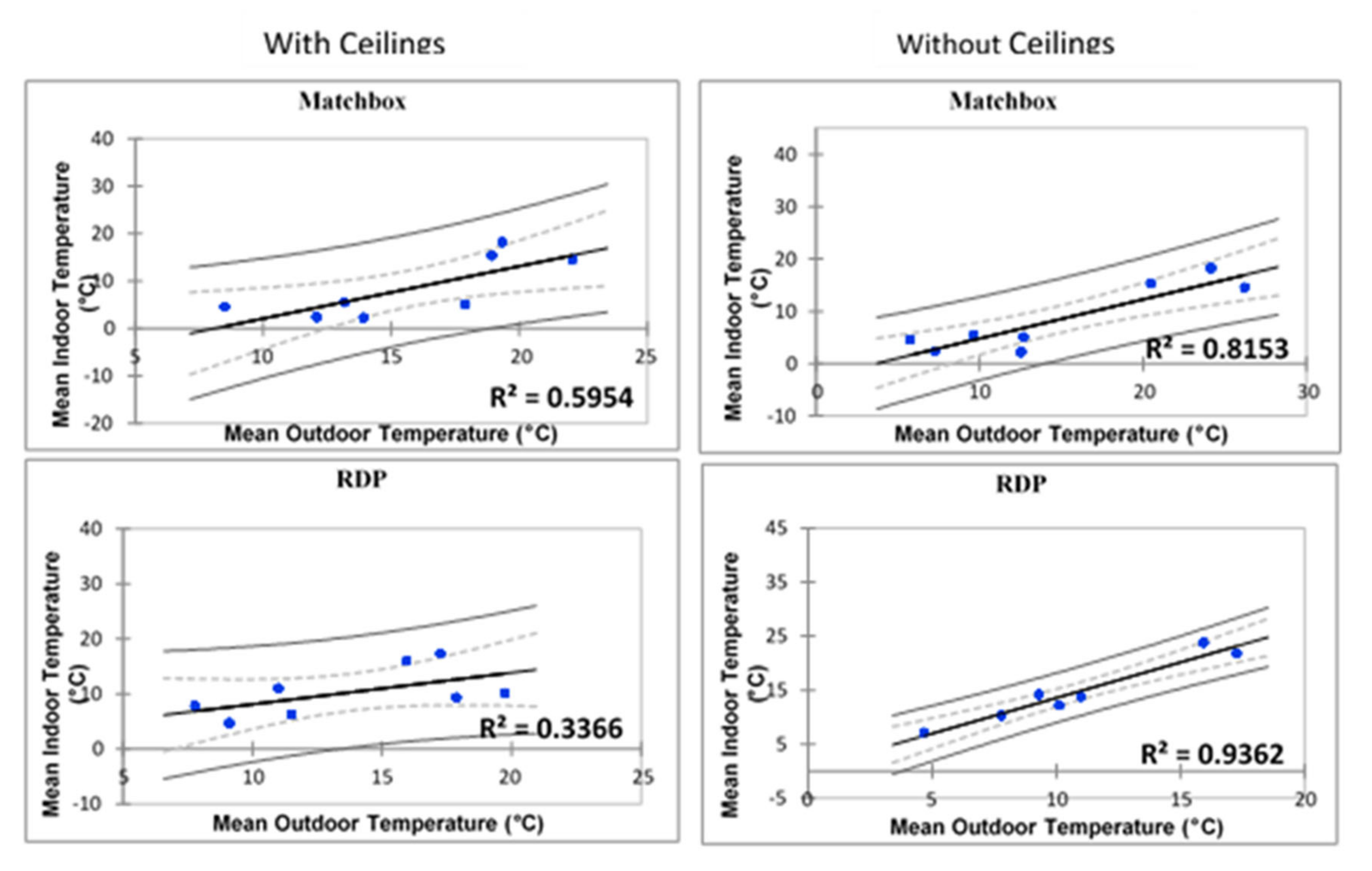

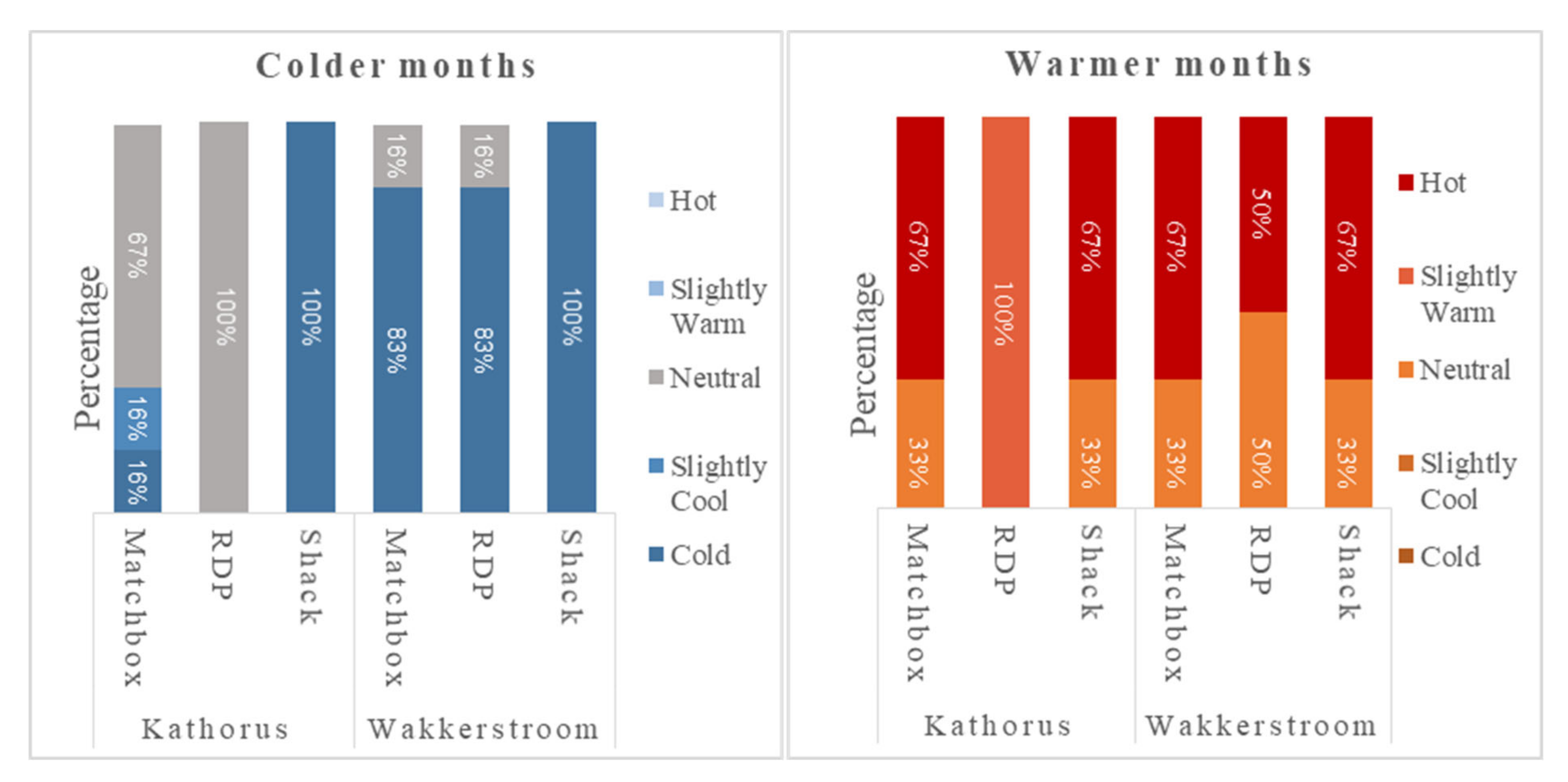

| Warmer Months | Colder Months | ||
|---|---|---|---|
| Kathorus | Matchbox | 0.74 (p < 0.0001) | 0.15 (p > 0.05) |
| RDP | 0.75 (p < 0.0001) | 0.75 (p < 0.0001) | |
| Shack | 0.05 (p > 0.05) | 0.03 (p > 0.05) | |
| Wakkerstroom | Matchbox | 0.73 (p < 0.0001) | 0.6 (p < 0.05) |
| RDP | 0.8 (p < 0.0001) | 0.75 (p < 0.001) | |
| Shack | 0.6 (p < 0.05) | 0.75 (p < 0.001) |
| Kathorus | Housing Type (n = 6 per Housing Type) | Wall Material | Floor Material | Ceiling Type | Roofing Material | Mean Age of Houses |
| Matchbox (Apartheid era) | 100% Bricks (low grade clay bricks) (n = 6) | 100% (Concrete and Tiles) (n = 4), 100% (Concrete) (n = 2) | - | 100% (Corrugated iron) (n = 6) | ±60 years | |
| RDP (Post-1994) Shacks (Informal Housing) | 100% Bricks (cement, ash/river sand) (n = 6) 100% Galvanized Iron (80% Corrugated and 20% Other) (n = 6) | 100% (Concrete) (n = 6) 100% (Vinyl and Concrete) (n = 6) | - - | 100% (Asbestos) (n = 4) 100% (Corrugated iron) (n = 2) 100% Galvanized iron (40% Corrugated and 60% other) (n = 6) | ±24 years ±2.5 (Range:1–4) years | |
| Wakkerstroom | Matchbox (Apartheid era) | 100% Bricks (low grade clay bricks) (n = 6) | 100% (Concrete) (n = 5), 100% (Concrete and Tiles) (n = 1) | 100% (Rhino-board) (n = 1) 100% (Wood) (n = 1) | 100% (Asbestos) (n = 4), 100% (Corrugated iron) (n = 2) | ±60 years |
| RDP (Post-1994) | 100% Bricks (cement, ash and river sand) (n = 6) | 100% (Concrete) (n = 6) | 100% (Rhino-board) (n = 2) | 100% (Corrugated iron) (n = 6) | ±21.5 years | |
| Shack (Informal Housing) | 100% Corrugated iron (n = 6) | 100% (Vinyl and Concrete) | 100% (Cardboard) (n = 1) | 100% Galvanized iron (Corrugated iron) (n = 6) | ±9.25 (Range: 0.5–18) years |
| Housing Type (n = 6 per housing type) | Heating and Cooling of Homes | Clothing Modifications | Behavioral Adaptations | Average Number of Occupants | |||||
|---|---|---|---|---|---|---|---|---|---|
| Colder Months | Warmer Months | Colder Months | Warmer Months | Colder Months | Warmer Months | Occupant Number | Range | ||
| Kathorus | Matchbox (Apartheid era) | 100% Electric Heaters | 33% Fans | 100% Increasing clothing and add blankets | 100% Decreasing clothing and blankets | * 33% Sleep earlier 50% Open windows for circulation | 100% Open windows and doors (67%—All day, 33%—2–4 hours) | 3 (n = 16) | 1–6 |
| RDP (Post-1994) | 100% Electric Heaters | - | 50% Increasing clothing and blankets | 100% Decreasing clothing and blankets | *50% Sleep earlier | 100% Open windows and doors (All day) | 3 (n = 20) | 2–-5 | |
| 50% Increase clothing only | 0% opened windows and doors | ||||||||
| Shack (Informal Housing) | 100% Electric Heaters | 16 % Fans | 67% Increase clothing and blankets | 100% Decreasing clothing and blankets | * 67% Sleep earlier | 100% Open windows and doors (All day) | 2 (n = 13) | 1–3 | |
| 16% Blankets only | 33% Opened windows and doors | ||||||||
| 16% Nothing | |||||||||
| Wakkerstroom | Matchbox (Apartheid era) | 67% Wood-fire | 33% Fans | 100% Increasing clothing and add blankets | 100% Decreasing clothing and blankets | * 50% Sleep earlier | 100% Open windows and doors (All day) | 6 (n = 35) | 1–7 |
| 16% Coal fire | 67% Open windows for circulation | ||||||||
| RDP (Post-1994) | 50% Wood-fire 30% Electric heater 20% Cow Dung | 16% Fans | 67% Increase clothing and blankets 16% Blankets only | 100% Decreasing clothing and blankets | * 50% Sleep earlier 67% Open windows for circulation | 100% Open windows and doors (All day) | 5 (n = 30) | 2–9 | |
| Shack (Informal Housing) | 50% Wood-fire | - | 83% Increase clothing and blanket | 100% Decreasing clothing and blankets | * 100% Sleep earlier 33% Open windows for circulation | 100% Open windows and doors (All day) | 3 (n = 15) | 1–4 | |
| 33% Gas stove | 16% Clothing only | ||||||||
| 16% Electric heater | 16% Nothing | ||||||||
© 2020 by the authors. Licensee MDPI, Basel, Switzerland. This article is an open access article distributed under the terms and conditions of the Creative Commons Attribution (CC BY) license (http://creativecommons.org/licenses/by/4.0/).
Share and Cite
Mabuya, B.; Scholes, M. The Three Little Houses: A Comparative Study of Indoor and Ambient Temperatures in Three Low-Cost Housing Types in Gauteng and Mpumalanga, South Africa. Int. J. Environ. Res. Public Health 2020, 17, 3524. https://doi.org/10.3390/ijerph17103524
Mabuya B, Scholes M. The Three Little Houses: A Comparative Study of Indoor and Ambient Temperatures in Three Low-Cost Housing Types in Gauteng and Mpumalanga, South Africa. International Journal of Environmental Research and Public Health. 2020; 17(10):3524. https://doi.org/10.3390/ijerph17103524
Chicago/Turabian StyleMabuya, Bongokuhle, and Mary Scholes. 2020. "The Three Little Houses: A Comparative Study of Indoor and Ambient Temperatures in Three Low-Cost Housing Types in Gauteng and Mpumalanga, South Africa" International Journal of Environmental Research and Public Health 17, no. 10: 3524. https://doi.org/10.3390/ijerph17103524
APA StyleMabuya, B., & Scholes, M. (2020). The Three Little Houses: A Comparative Study of Indoor and Ambient Temperatures in Three Low-Cost Housing Types in Gauteng and Mpumalanga, South Africa. International Journal of Environmental Research and Public Health, 17(10), 3524. https://doi.org/10.3390/ijerph17103524