
Two Cultivars of Peanut (Arachis hypogaea) Show Different Responses to Iron Deficiency


Abstract
1. Introduction
2. Materials and Methods
2.1. Experiment 1: Physiological and Molecular Responses of Hydroponically Grown Peanut to Fe Supply
2.1.1. Hydroponically-Grown Peanut and Treatment
2.1.2. Plant Tissue Analysis
2.1.3. Determination of Active Fe and Chl
2.1.4. Pn and Chl Fluorescence Measurements
2.1.5. Rhizosphere Acidification and Root FCR Activity
2.1.6. RT-PCR of AhIRT1 and AhFRO1
2.2. Experiment 2: Agronomic Response of Soil-Grown Peanut to Fe Fertilization
2.2.1. Soil-Grown Panut and Treatment
2.2.2. Plant Growth and Analysis
2.2.3. Statistical Analysis
3. Results
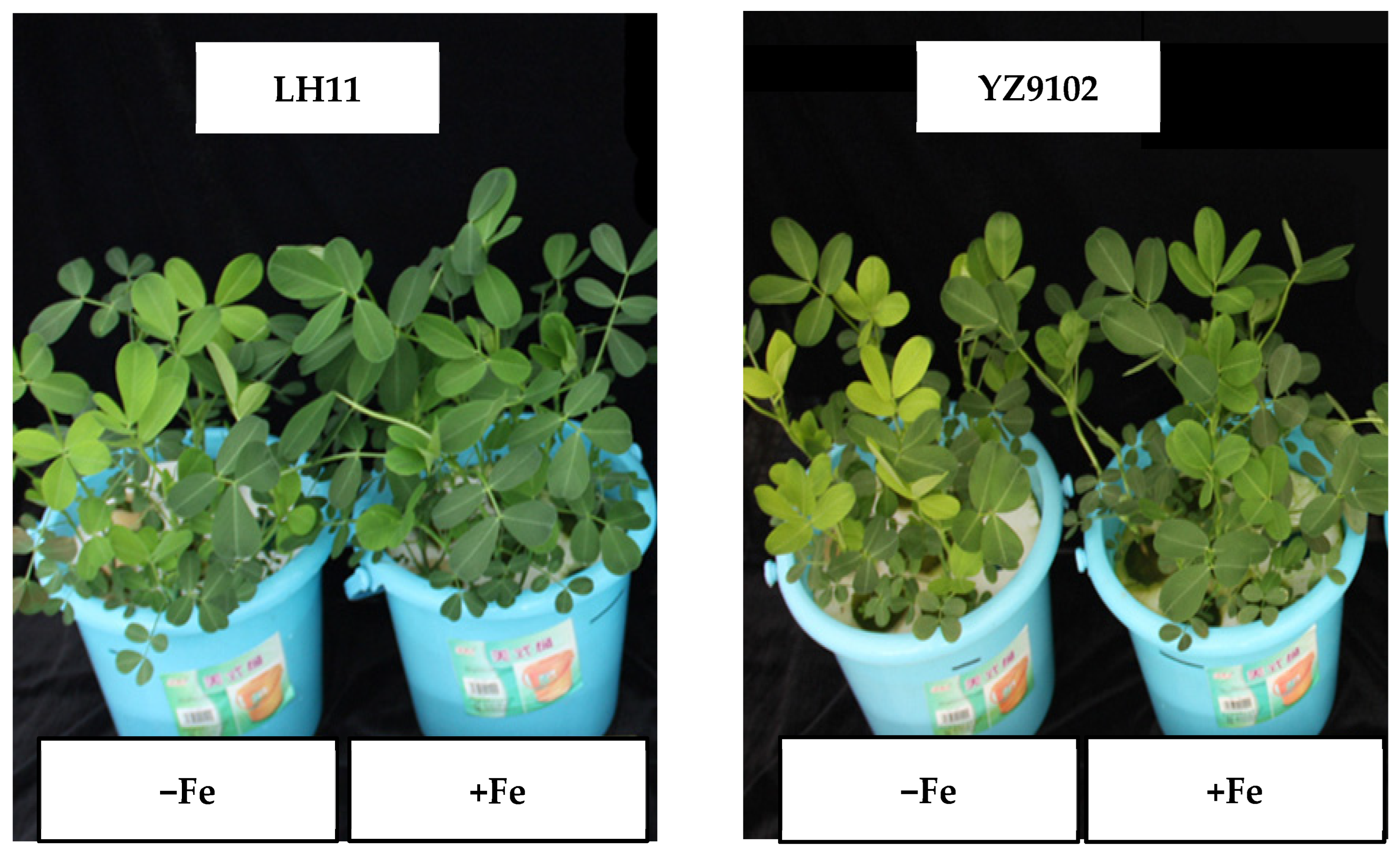
3.1. Biomass
3.2. Total Fe and Active Fe Concentrations in Plants
3.3. Photosynthetic Parameters
3.4. FCR Activity in Roots
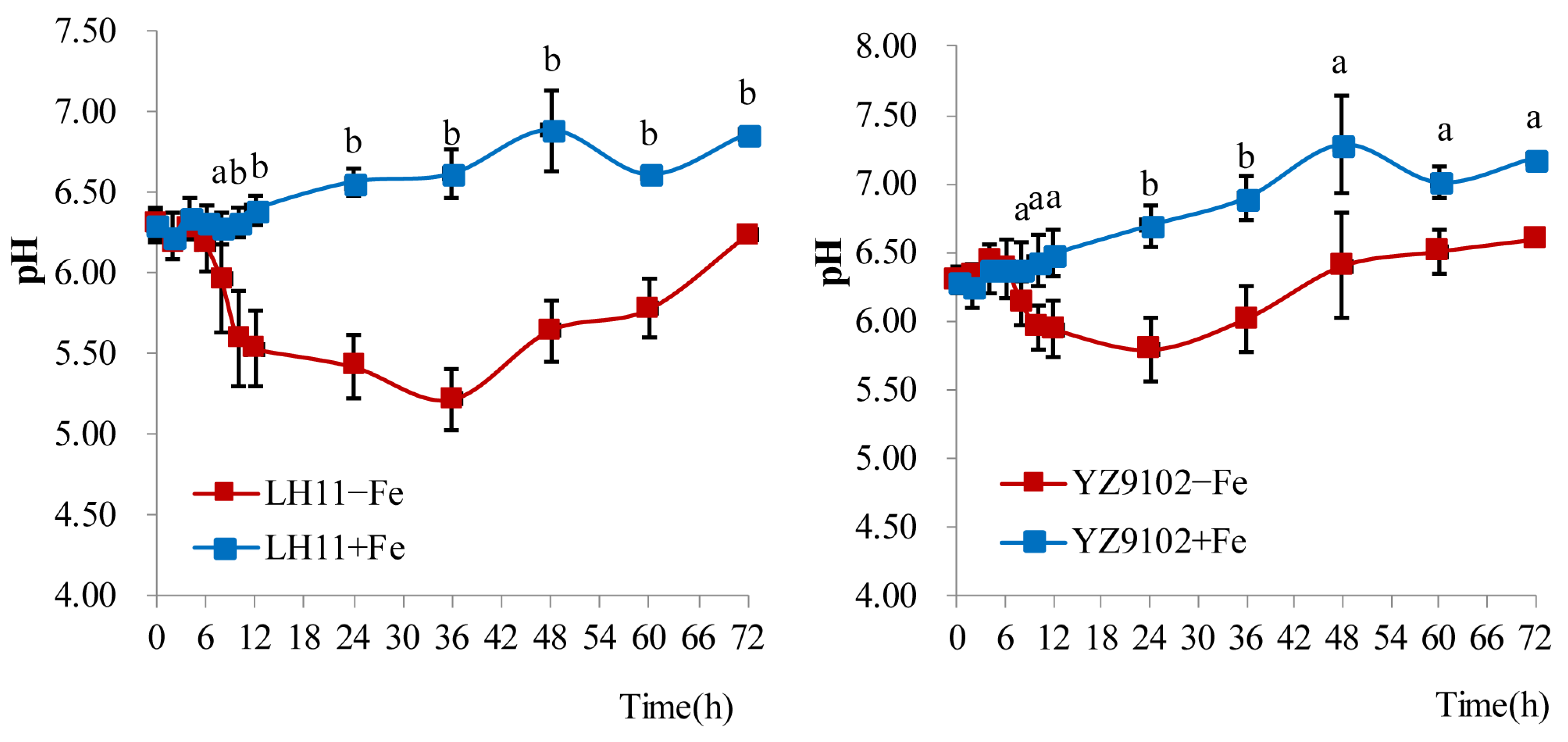
3.5. pH of Growth Medium
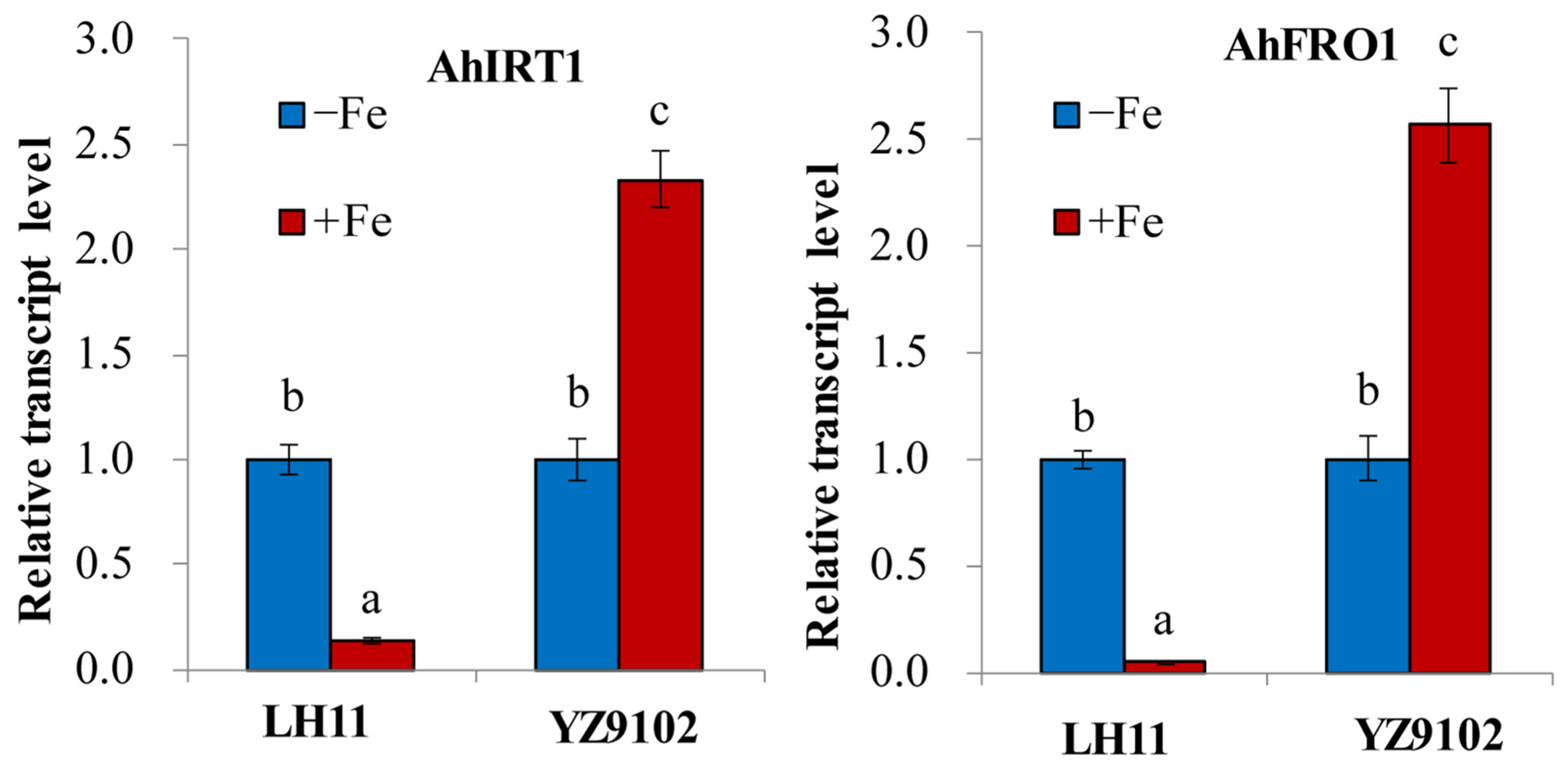
3.6. AhIRT1 and AhFRO1 Expression
4. Discussion
5. Conclusions
Author Contributions
Funding
Institutional Review Board Statement
Informed Consent Statement
Data Availability Statement
Conflicts of Interest
References
- Lu, Q.; Huang, L.; Liu, H.; Garg, V.; Gangurde, S.S.; Li, H.; Chitikineni, A.; Guo, D.; Pandey, M.K.; Li, S.; et al. A genomic variation map provides insights into peanut diversity in China and associations with 28 agronomic traits. Nat. Genet. 2024, 56, 530–540. [Google Scholar] [CrossRef]
- Zuo, Y.M.; Zhang, F.S. Soil and crop management strategies to prevent iron deficiency in crops. Plant Soil. 2011, 339, 83–95. [Google Scholar] [CrossRef]
- Su, Y.; Zhang, Z.; Su, G.Q.; Liu, J.L.; Liu, C.F.; Shi, G.R. Genotypic differences in spectral and photosynthetic response of peanut to iron deficiency. J. Plant Nutr. 2015, 38, 145–160. [Google Scholar] [CrossRef]
- Pattanashetti, S.K.; Naidu, G.K.; KV, P.K.; Singh, O.K.; Biradar, B.D. Inheritance of iron deficiency chlorosis resistance in groundnut (Arachis hypogaea L.). J. Plant Nutr. 2018, 41, 321–329. [Google Scholar] [CrossRef]
- Sterckeman, T.; Moyne, C. Influence of soil pH and redox potential on root uptake of iron. J. Soil. Sci. Plant Nutr. 2025, 25, 9688–9699. [Google Scholar] [CrossRef]
- Marschner, H. Mineral Nutrition of Higher Plants, 2nd ed.; Academic Press: London, UK, 1995. [Google Scholar]
- Abadía, J.; Vázquez, S.; Rellán-Álvarez, R.; El-Jendoubi, H.; Abadía, A.; Álvarez-Fernández, A.; López-Millán, A.F. Towards a knowledge-based correction of iron chlorosis. Plant Physiol. Biochem. 2011, 49, 471–482. [Google Scholar] [CrossRef]
- Morales, F.; Moise, N.; Quílez, R.; Abadía, A.; Abadía, J.; Moya, I. Iron deficiency interrupts energy transfer from a disconnected part of the antenna to the rest of Photosystem II. Photosynth. Res. 2001, 70, 207–220. [Google Scholar] [CrossRef]
- Moseley, J.F.; Allinger, T.; Herzog, S.; Hoerth, P.; Wehinger, E.; Merchant, S.; Hippler, M. Adaptation to Fe-deficiency requires remodeling of the photosynthetic apparatus. EMBO J. 2002, 21, 6709–6720. [Google Scholar] [CrossRef]
- Larbi, A.; Abadía, J.; Abadía, F.; Morales, F. Down co-regulation of light absorption, photochemistry, and carboxylation in Fe-deficient plants growing in different environments. Photosynth. Res. 2006, 89, 113–126. [Google Scholar] [CrossRef]
- Abadía, J.; Morales, F.; Abadía, A. Photosystem II efficiency in low chlorophyll, iron-deficient leaves. Plant Soil. 1999, 215, 183–192. [Google Scholar] [CrossRef]
- Briat, J.F.; Curie, C.; Gaymard, F. Iron utilization and metabolism in plants. Curr. Opin. Plant Biol. 2007, 10, 276–282. [Google Scholar] [CrossRef]
- Dixon, S.J.; Stockwell, B.R. The role of iron and reactive oxygen species in cell death. Nat. Chem. Biol. 2014, 10, 9–17. [Google Scholar] [CrossRef] [PubMed]
- Kermeur, N.; Pédrot, M.; Cabello-Hurtado, F. Iron availability and homeostasis in plants: A review of responses, adaptive mechanisms, and signaling. In Plant Abiotic Stress Signaling; Couée, I., Ed.; Humana: New York, NY, USA, 2023; pp. 45–70. [Google Scholar]
- Kobayashi, T.; Nishizawa, N.K. Iron uptake, translocation, and regulation in higher plants. Annu. Rev. Plant Biol. 2012, 63, 131–152. [Google Scholar] [CrossRef]
- Ning, X.; Lin, M.; Huang, G.; Mao, J.; Gao, Z.; Wang, X. Research progress on iron absorption, transport, and molecular regulation strategy in plants. Front. Plant Sci. 2023, 14, 1190768. [Google Scholar] [CrossRef] [PubMed]
- Bhat, M.A.; Mishra, A.K.; Shah, S.N.; Bhat, M.A.; Jan, S.; Rahman, S.; Baek, K.H.; Jan, A.T. Soil and mineral nutrients in plant health: A prospective study of iron and phosphorus in the growth and development of plants. Curr. Issues Mol. Biol. 2024, 46, 5194–5222. [Google Scholar] [CrossRef]
- Gu, S.; Wang, N.; Zheng, Y.; Wang, T.; Shen, Q.; Zhang, F.; Zuo, Y. Integrating microbial siderophores into concepts of plant iron nutrition. Nat. Plants 2025, 11, 1–11. [Google Scholar] [CrossRef] [PubMed]
- Curie, C.; Panaviene, Z.; Loulergue, C.; Dellaporta, S.L.; Briat, J.F.; Walker, E.L. Maize yellow stripe1 encodes a membrane protein directly involved in Fe (III) uptake. Nature 2001, 409, 346–349. [Google Scholar] [CrossRef]
- Santi, S.; Cesco, S.; Varanini, Z.; Pinton, R. Two plasma membrane H+-ATPase genes are differentially expressed in iron-deficient cucumber plants. Plant Physiol. Biochem. 2005, 43, 287–292. [Google Scholar] [CrossRef]
- Robinson, N.J.; Procter, C.M.; Connolly, E.L.; Guerinot, M.L. A ferric-chelate reductase for iron uptake from soils. Nature 1999, 397, 694–697. [Google Scholar] [CrossRef]
- Eide, D.; Broderius, M.; Fett, J.; Guerinot, M.L. A novel iron-regulated metal transporter from plants identified by functional expression in yeast. Proc. Natl. Acad. Sci. USA 1996, 93, 5624–5628. [Google Scholar] [CrossRef]
- Vert, G.; Grotz, N.; Dédaldéchamp, F.; Gaymard, F.; Guerinot, M.L.; Briat, J.F.; Curie, C. IRT1, an Arabidopsis transporter essential for iron uptake from the soil and for plant growth. Plant Cell. 2002, 14, 1223–1233. [Google Scholar] [CrossRef]
- Guerinot, M.L. The ZIP family of metal transporters. Biochim. Biophys. Acta Biomembr. 2000, 1465, 190–198. [Google Scholar] [CrossRef]
- Rogers, E.E.; Eide, D.J.; Guerinot, M.L. Altered selectivity in an Arabidopsis metal transporter. Proc. Natl. Acad. Sci. USA 2000, 97, 12356–12360. [Google Scholar] [CrossRef]
- Chen, C.; Xia, S.; Deng, R.B.; Liu, C.F.; Shi, G.R. AhIRT1 and AhNRAMP1 metal transporter expression correlates with Cd uptake in peanuts under iron deficiency. PLoS ONE 2017, 12, e0185144. [Google Scholar] [CrossRef]
- Kobayashi, T.; Nozoye, T.; Nishizawa, N.K. Iron transport and its regulation in plants. Free Radic. Biol. Med. 2019, 133, 11–20. [Google Scholar] [CrossRef]
- Liang, G. Iron uptake, signaling, and sensing in plants. Plant Commun. 2022, 3, 100349. [Google Scholar] [CrossRef]
- Sun, L.; Wei, Y.Q.; Wu, K.H.; Yan, J.Y.; Xu, J.N.; Wu, Y.R.; Zheng, S.J. Restriction of iron loading into developing seeds by a YABBY transcription factor safeguards successful reproduction in Arabidopsis. Mol. Plant. 2021, 14, 1624–1639. [Google Scholar] [CrossRef] [PubMed]
- Okada, S.; Lei, G.J.; Yamaji, N.; Huang, S.; Ma, J.F.; Mochida, K.; Hirayama, T. FE UPTAKE-INDUCING PEPTIDE1 maintains Fe translocation by controlling Fe deficiency response genes in the vascular tissue of Arabidopsis. Plant Cell Environ. 2022, 45, 3322–3337. [Google Scholar] [CrossRef] [PubMed]
- Song, H.; Chen, F.; Wu, X.; Hu, M.; Geng, Q.; Ye, M.; Cao, S. MNB1 gene is involved in regulating the iron-deficiency stress response in Arabidopsis thaliana. BMC Plant Biol. 2022, 22, 151. [Google Scholar] [CrossRef] [PubMed]
- Gao, L.L.; Wang, S.F.; Liu, Z.F.; Huang, J.S.; Hilman Liu, R.L.; Wang, H. Two cultivars of peanut (Arachis hypogaea) seedlings show different tolerance to calcium deficiency. J. Plant Nutr. 2016, 39, 1016–1025. [Google Scholar]
- Kong, J.; Dong, Y.J.; Song, Y.L.; Bai, X.Y.; Tian, X.Y.; Xu, L.L.; Liu, S.; He, Z.L. Role of exogenous nitric oxide in alleviating iron deficiency stress of peanut seedlings (Arachis hypogaea L.). J. Plant Growth Regul. 2016, 35, 31–43. [Google Scholar] [CrossRef]
- Zhang, Y. Course on Physical and Chemical Analysis of Soil, Water, and Plant; China Forestry Press: Beijing, China, 2011. [Google Scholar]
- Gao, L.; Shi, Y.X. Genetic differences in resistance to iron deficiency chlorosis in peanut. J. Plant Nutr. 2007, 30, 37–52. [Google Scholar] [CrossRef]
- Wang, H.; Jin, J.Y. Photosynthetic rate, chlorophyll fluorescence parameters, and lipid peroxidation of maize leaves as affected by zinc deficiency. Photosynthetica 2005, 43, 591–596. [Google Scholar] [CrossRef]
- Yi, Y.; Guerinot, M.L. Genetic evidence that induction of root Fe(III) chelate reductase activity is necessary for iron uptake under iron deficiency. Plant J. 1996, 10, 835–844. [Google Scholar] [CrossRef] [PubMed]
- Ding, H.; Duan, L.L.; Wu, H.L.; Yang, R.X.; Ling, H.Q.; Li, W.X.; Zhang, F.S. Regulation of AhFRO1, an Fe(III)-chelate reductase of peanut, during iron deficiency stress and intercropping with maize. Physiol. Plant. 2009, 136, 274–283. [Google Scholar] [CrossRef] [PubMed]
- Ding, H.; Duan, L.L.; Li, J.; Yan, H.F.; Zhao, M.; Zhang, F.S.; Li, W.X. Cloning and functional analysis of the peanut iron transporter ahirt1 during iron deficiency stress and intercropping with maize. J. Plant Physiol. 2010, 167, 996–1002. [Google Scholar] [CrossRef] [PubMed]
- Pattanashetti, S.K.; Pandey, M.K.; Naidu, G.K.; Vishwakarma, M.K.; Singh, O.K.; Shasidhar, Y.; Boodi, I.H.; Biradar, B.D.; Das, R.R.; Rathore, A.; et al. Identification of quantitative trait loci associated with iron deficiency chlorosis resistance in groundnut (Arachis hypogaea). Plant Breed. 2020, 139, 790–803. [Google Scholar] [CrossRef]
- Pestana, M.; Varennes, A.; Abadia, J.; Faria, E.A. Differential tolerance to iron deficiency of citrus rootstocks grown in nutrient solution. Sci. Hortic. 2005, 104, 25–36. [Google Scholar] [CrossRef]
- Abadía, J.; Abadía, A. Iron and plant pigments. In Iron Chelation in Plants and Soil Microorganisms; Barton, L.L., Hemming, B.C., Eds.; Academic Press: San Diego, CA, USA, 1993; pp. 327–343. [Google Scholar]
- Baker, N.R. Chlorophyll fluorescence: A probe of photosynthesis in vivo. Annu. Rev. Plant Biol. 2008, 59, 89–113. [Google Scholar] [CrossRef]
- Xiong, H.C.; Kobayashi, T.; Kakei, Y.; Senoura, T.; Nakazono, M.; Takahashi, H.; Nakanishi, H.; Shen, H.Y.; Duan, P.G.; Guo, X.T.; et al. AhNRAMP1 iron transporter is involved in iron acquisition in peanut. J. Exp. Bot. 2012, 63, 4437–4446. [Google Scholar] [CrossRef]
- Römheld, V.; Marschner, H. Mechanism of iron uptake by peanut plants. I. FeIII reduction, chelate splitting, and release of phenolics. Plant Physiol. 1983, 71, 949–954. [Google Scholar] [CrossRef] [PubMed]
- Cao, Q.Q.; Xv, C.; Jiang, Q.; Wang, L.L.; Shi, G.R. Comparative transcriptome analysis reveals key genes responsible for the homeostasis of iron and other divalent metals in peanut roots under iron deficiency. Plant Soil. 2019, 445, 513–531. [Google Scholar] [CrossRef]



| Primer Name | Sequence (5′-3′) |
|---|---|
| FROP1 | ATGATCTTCTCCATCTTCCA |
| FROP2 | TGCCACTTCCTCCACTAACC |
| IRTP1 | AAGATGGAGACACACAACTCGTGC |
| IRTP2 | GCCAAGACCAATGCCTTCAAACAT |
| ACTIN1 | GCTACCAGATGGACAGGTTATCAC |
| ACTIN2 | ACCACCACTCAAGACAATGTTACC |
| Cultivars | Fe Treatments | Dry Matter Weights (g per Plant) | Shoot/Root Ratio | Active Fe Content (mg·kg−1 Fresh Weight) | Fe Concentration (mg·kg−1 Dry Weight) | ||
|---|---|---|---|---|---|---|---|
| Roots | Shoots | Roots | Shoots | ||||
| LH11 | −Fe | 0.196 ± 0.045 ab | 1.121 ± 0.209 b | 0.17 ± 0.01 a | 7.06 ± 0.54 b | 200.60 ± 17.00 ab | 350.92 ± 36.09 b |
| +Fe | 0.208 ± 0.030 b | 1.370 ± 0.174 c | 0.15 ± 0.01 a | 10.37 ± 0.91 c | 218.41 ± 7.46 b | 1627.88 ± 47.11 d | |
| YZ9102 | −Fe | 0.153 ± 0.022 a | 0.710 ± 0.128 a | 0.22 ± 0.02 b | 5.79 ± 0.52 a | 180.94 ± 24.45 a | 175.18 ± 15.18 a |
| +Fe | 0.145 ± 0.016 a | 0.846 ± 0.096 a | 0.17 ± 0.01 a | 10.41 ± 1.84 c | 204.33 ± 5.22 ab | 1433.82 ± 93.18 c | |
| Cultivars | Fe Treatments | The First Growth Period | The Second Growth Period | ||||||
|---|---|---|---|---|---|---|---|---|---|
| Shoot Biomass (g per Plant) | Fe Concentration in Shoot (mg·kg−1 Dry Weight) | Active Fe Content (mg·kg−1 Fresh Weight) | SPAD Value | Shoot Biomass (g per Plant) | Fe Concentration in Shoot (mg·kg−1 Dry Weight) | Active Fe Content (mg·kg−1 Fresh Weight) | SPAD Value | ||
| LH11 | −Fe | 1.464 ± 0.129 b | 200.20 ± 17.83 a | 15.02 ± 0.39 a | 48.23 ± 2.10 b | 0.989 ± 0.124 c | 199.46 ± 15.16 a | 11.25 ± 1.66 a | 35.30 ± 1.81 b |
| +Fe | 1.355 ± 0.055 b | 319.68 ± 62.87 ab | 17.05 ± 1.22 a | 48.07 ±1.95 ab | 1.044 ± 0.078 c | 199.64 ± 21.92 a | 10.89 ± 0.67 a | 36.27 ± 1.34 b | |
| YZ9102 | −Fe | 1.096 ± 0.125 a | 270.93 ±17.99 a | 16.80 ± 2.08 a | 45.03 ± 0.95 a | 0.629 ± 0.048 a | 238.60 ± 22.29 a | 12.70 ± 0.31 a | 29.73 ± 1.46 a |
| +Fe | 1.132 ± 0.133 a | 424.83 ± 108.00 b | 15.24 ± 0.81 a | 45.27 ± 0.72 ab | 0.817 ± 0.085 b | 215.30 ± 17.90 a | 11.28 ± 1.91 a | 34.30 ± 0.62 b | |
| Cultivars | Fe Treatments | SPAD Value | Pn (μmol·m−2·s−1) | Fv/Fm | Activity of FCR in Roots (μmol·g−1 Fresh Weight·h−1) |
|---|---|---|---|---|---|
| LH11 | −Fe | 35.15 ± 0.75 b | 16.2 ± 1.6 b | 0.810 ± 0.012 b | 3.15 ± 0.92 b |
| +Fe | 40.53 ± 0.80 c | 17.8 ± 0.9 b | 0.831 ± 0.007 b | 1.48 ± 0.43 a | |
| YZ9102 | −Fe | 28.28 ± 2.09 a | 2.2 ± 0.4 a | 0.753 ± 0.006 a | 2.05 ± 0.30 ab |
| +Fe | 40.50 ± 0.94 c | 15.3 ± 0.7 b | 0.830 ± 0.012 b | 1.61 ± 0.17 a |
Disclaimer/Publisher’s Note: The statements, opinions and data contained in all publications are solely those of the individual author(s) and contributor(s) and not of MDPI and/or the editor(s). MDPI and/or the editor(s) disclaim responsibility for any injury to people or property resulting from any ideas, methods, instructions or products referred to in the content. |
© 2026 by the authors. Licensee MDPI, Basel, Switzerland. This article is an open access article distributed under the terms and conditions of the Creative Commons Attribution (CC BY) license.
Share and Cite
Chen, L.; Liu, Z.; Zhou, L.; Wang, H. Two Cultivars of Peanut (Arachis hypogaea) Show Different Responses to Iron Deficiency. Curr. Issues Mol. Biol. 2026, 48, 99. https://doi.org/10.3390/cimb48010099
Chen L, Liu Z, Zhou L, Wang H. Two Cultivars of Peanut (Arachis hypogaea) Show Different Responses to Iron Deficiency. Current Issues in Molecular Biology. 2026; 48(1):99. https://doi.org/10.3390/cimb48010099
Chicago/Turabian StyleChen, Lei, Zifei Liu, Lei Zhou, and Hong Wang. 2026. "Two Cultivars of Peanut (Arachis hypogaea) Show Different Responses to Iron Deficiency" Current Issues in Molecular Biology 48, no. 1: 99. https://doi.org/10.3390/cimb48010099
APA StyleChen, L., Liu, Z., Zhou, L., & Wang, H. (2026). Two Cultivars of Peanut (Arachis hypogaea) Show Different Responses to Iron Deficiency. Current Issues in Molecular Biology, 48(1), 99. https://doi.org/10.3390/cimb48010099