Short Note

Bis(1,2,4-triphenylcyclopentadienyl) Terbium 4,4,4-trifluoro-1-phenylbutane-1,3-dionate

by
Daniil A. Bardonov
1,2,
Mikhail E. Minyaev
3,
Lada N. Puntus
1,4,5,
Ilya E. Nifant’ev
1,6 and
Dmitrii M. Roitershtein
1,2,3,*
1
A.V. Topchiev Institute of Petrochemical Synthesis, Russian Academy of Sciences, 29 Leninsky Prospect, 119991 Moscow, Russia
2
National Research University Higher School of Economics, 20 Miasnitskaya Str., 101000 Moscow, Russia
3
N.D. Zelinsky Institute of Organic Chemistry, Russian Academy of Sciences, 47 Leninsky Prospect, 119991 Moscow, Russia
4
V. A. Kotel’nikov Institute of Radioengineering and Electronics, Russian Academy of Sciences, Fryazino, 141190 Moscow, Russia
5
G. V. Plekhanov Russian University of Economics, 117997 Moscow, Russia
6
Chemistry Department, M.V. Lomonosov Moscow State University, 1 Leninskie Gory Str., Building 3, 119991 Moscow, Russia
*
Author to whom correspondence should be addressed.
Molbank 2025, 2025(4), M2102; https://doi.org/10.3390/M2102 (registering DOI)
Submission received: 8 November 2025 / Revised: 25 November 2025 / Accepted: 28 November 2025 / Published: 4 December 2025
(This article belongs to the Section Structure Determination)

Abstract

A new bis(cyclopentadienyl) terbium(III) complex with 1,2,4-triphenylcyclopentadienyl and 4,4,4-trifluoro-1-phenylbutane-1,3-dionate ligands was synthesized. Single-crystal X-ray analysis revealed a mononuclear bis(cyclopentadienyl) complex with a diketonate ligand in the bisector plane. The compound under study exhibits a ligand ligand charge transfer state (LLCT), according to optical spectroscopy and crystallographic data.

Graphical Abstract

1. Introduction

Lanthanide cyclopentadienyl complexes are among the most prevalent classes of rare earth organometallics. The use of complexes with substituted cyclopentadienyl (Cp) ligands in rare-earth chemistry has expanded even further [1,2,3,4,5]. Nevertheless, alkyl- and silyl-substituted cyclopentadienyl ligands are the primary limit of the spectrum of such cyclopentadienyl derivatives. There is significantly less research on aryl-substituted cyclopentadienyl complexes of lanthanides [6,7,8]. It should be mentioned that polyarylcyclopentadienyl ligands seem to be even more promising in the design of organolanthanides, allowing for the implementation of fundamental stability principles for these compounds [1,9]. We recently reported on the utilization of aryl-substituted cyclopentadienyl ligands in the design of several types of rare earth cyclopentadienyl complexes [10,11] (Scheme 1). One of the most fascinating is the bis(triphenycyclopentadienyl)lanthanide chloride complexes, which enable the substitution of a chloride for an organic ligand in a straightforward salt metathesis reaction. Numerous organolanthanide compounds can be easily synthesized using this reaction.
In addition, due to their conjugated π-system, high denticity (or coordination capacity), and an energy-level alignment that is very close to ideal, aryl-substituted cyclopentadienyl (Cp) ligands have become attractive options for light-harvesting units in Ln3+ ion photosensitization [10]. Despite these advantageous features, the intrinsic quantum yields of terbium complexes containing aryl-substituted Cp ligands range from 40% to 90%, whereas the photoluminescence quantum yield varies greatly, typically between 10% and 60%. A traditional sensitizing organic ligand, 4,4,4-trifluoro-1-phenylbutane-1,3-dionate (phdk), was chosen as an auxiliary ligand for the synthesis of new lanthanide complexes in order to prevent the formation of dinuclear or tetranuclear structures and to enhance the luminescence characteristics. The molecular structure and synthesis of bis(1,2,4-triphenylcyclopentadienyl)terbium(III) 4,4,4-trifluoro-1-phenylbutane-1,3-dionate are presented here, along with the luminescence sensitization peculiarities in this complex.

2. Results and Discussion

2.1. Synthesis and Structure

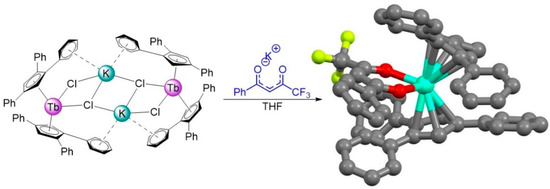
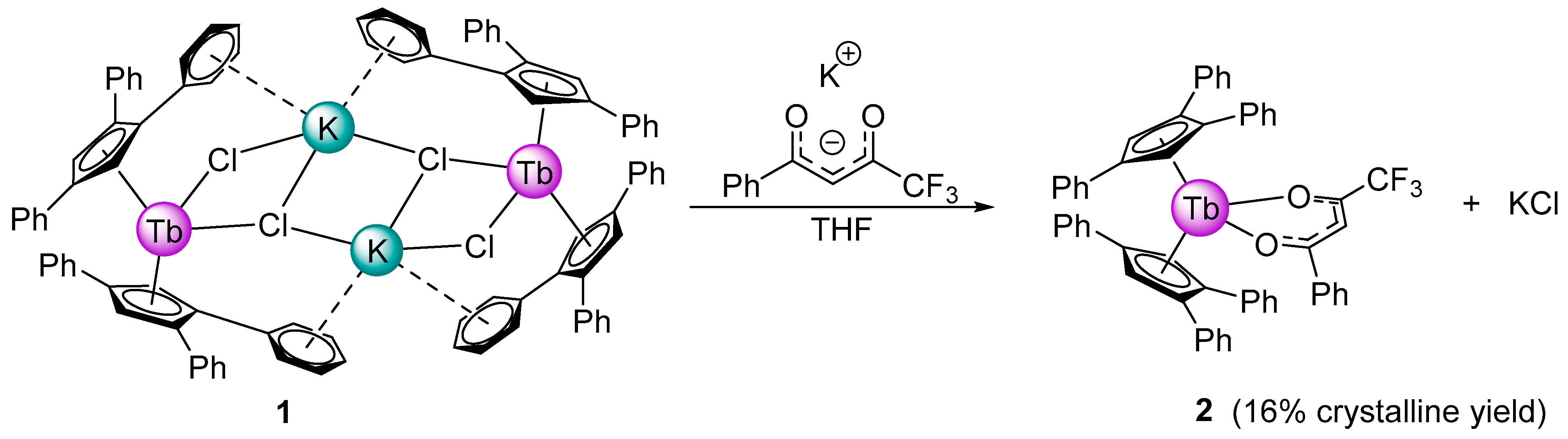
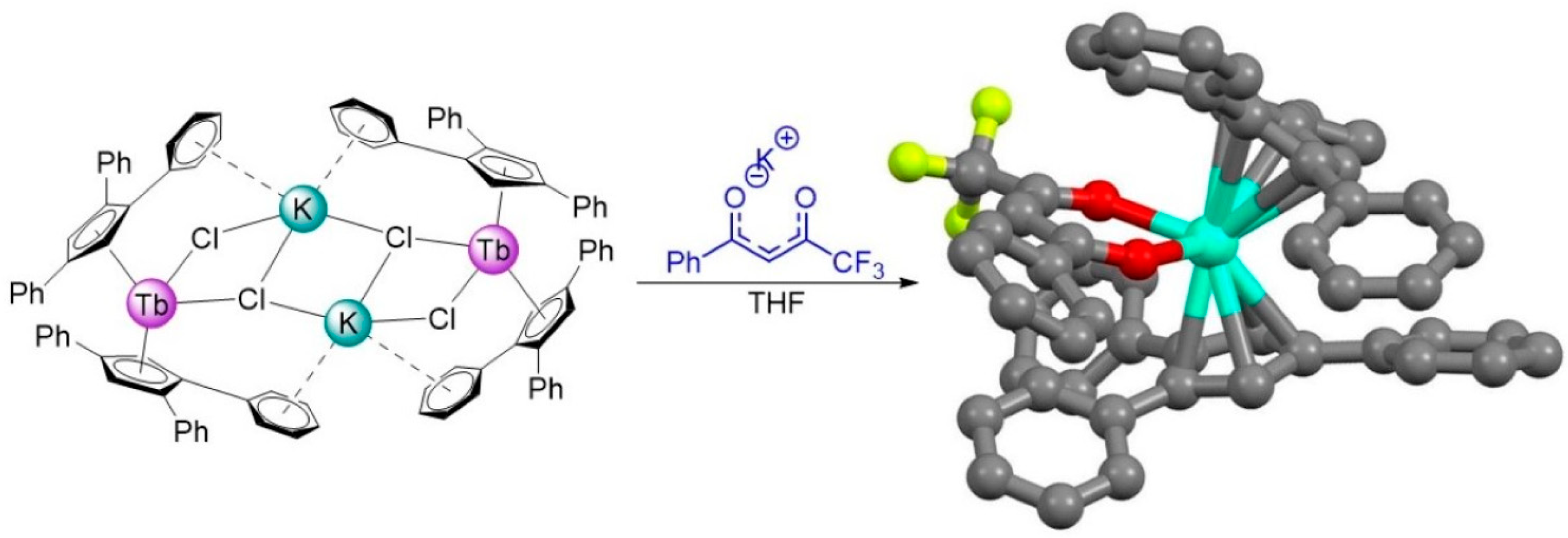
The reaction of [CpPh32TbCl2K]2 (1) [10] with the stoichiometric amount of potassium 4,4,4-trifluoro-1-phenylbutane-1,3-dionate, obtained in situ from 4,4,4-trifluoro-1-phenylbutane-1,3-dione and potassium bis(trimethylsilyl)amide, gave the bis(1,2,4-triphenylcyclopentadienyl) terbium complex [CpPh32Tb(phdk)] (2), where phdk = 4,4,4-trifluoro-1-phenylbutane-1,3-dionate (Scheme 2).
Complex 2 was obtained as yellow-orange crystals of X-ray quality by crystallization from a toluene solution by slow addition of hexane. The compound demonstrates stability for months in a glovebox under anaerobic conditions, with no observed discoloration of the crystals. At the same time, when exposed to air, it undergoes decomposition within seconds due to oxidation and hydrolysis.
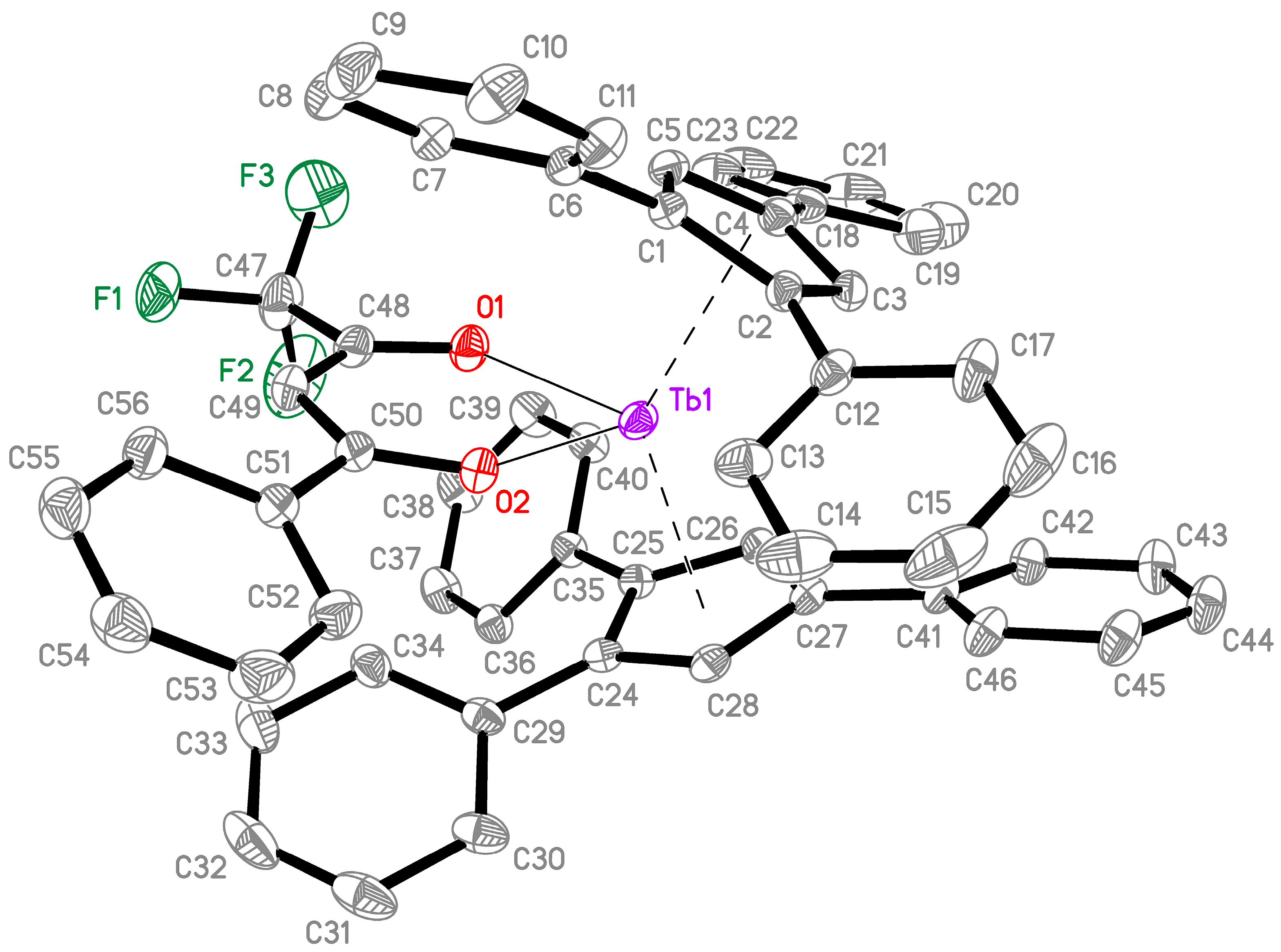
According to the X-ray diffraction analysis, complex 2, which has 4,4,4-trifluoro-1-phenylbutane-1,3-dionate in the bisector plane, is built as a bent sandwich complex (Figure 1). The Tb(O-C-CH-C-O) fragment is flat within 0.028 Å. The primary structural parameters of 2 are shown in Table 1. For comparison, the initial chloride complex 1 structural parameters are given.
In compound 2, the metallocene fragment {CpPh32Tb} exhibits structural characteristics that are comparable to those of its precursor 1. The magnitude of the X-Tb-X angle (X = O, Cl) is the only notable difference between the metrics of the structures of these complexes. It is apparent that the rather rigid structure of the planar, conjugated six-membered ring Tb(O-C-CH-C-O) is the reason for the decrease in the value of this angle for 2. In the structure of 2, there is a short contact (3.301(1) Å) between the carbonyl carbon atom (C50) of the diketonate ligand and a carbon atom (C7) of one of the phenyl groups of the CpPh3 ligand. We found a relatively small number of weak intermolecular interactions when we examined the structure of 2: F1..C54 (3.158Å), F2..H16 (2.60Å), C1..H53 (2.78Å), C2..H53 (2.74Å), C8..H5 (2.83 Å), C16..H55 (2.78Å), C17..H55 (2.83Å), C22..H15 (2.90Å), C31..H17 (2.85Å), C44..H31 (2.88Å). Calculations of the Hirshfeld surface [12,13] indicate large contributions of C..H/H..C (28.2%) and H..H (57.8%) contacts into the overall balance of non-covalent intermolecular interactions. Both facts point out that the metal center and its environment (Tb-X bonds) of the complex are sufficiently sterically shielded.

2.2. Photophysical Properties

According to the theory of sensitized luminescence of the Ln ion in complexes, the energy absorbed by the ligands is transferred to the excited levels of the Ln ion via singlet (S1) and triplet (T1) states (triplet-mediated scheme S1 → T1 → Ln3+ ion). The energy of the lowest excited single and triplet states is therefore crucial. The UV-Vis absorption spectra of 4,4,4-trifluoro-1-phenylbutane-1,3-dione in acetonitrile solution demonstrated two broad absorption bands with peaks at 256 and 326 nm assigned to the β-diketone moiety’s π–π* transition and the phenyl group’s 1π–π* transition, respectively [14]. The energies of the S1 and T1 states of coordinated CpPh3 are 360 and 435 nm, respectively, according to the previous study [10,15]. The energy of the lowest excited T1 state of coordinated phdk-ligand is 467 nm [16] while the energy of the resonant 5D4 level of the Tb3+ ion is 490 nm.
From the other side, the Tb complexes containing only one type of the π-bonded antenna ligands (CpPh2, CpPh3, and CpPh4) demonstrate excellent luminescence characteristics, including the high quantum yield of photoluminescence (up to 60%) [10,11] (Figures S2 and S3). It was unexpected that complex 2 lacked the effective luminescence sensitization of the Tb ion. We need to emphasize two key factors in this context. According to X-ray data in the structure of 2, there is a short contact (3.301(1) Å) between the carbonyl carbon atom of the diketonate ligand and a carbon atom of one of the phenyl groups of the CpPh3 ligand. Such strong contact can induce the appearance of low-lying charge transfer states, namely ligand–ligand charge transfer (LLCT) one [17,18]. A similar LLCT state observed in Ln complexes (Ln = Tb, Gd, Nd) containing CpPh3 and 2,2′-bipyridine (bipy) ligands was caused by the strong intramolecular ππ stacking interaction between the phenyl ring of CpPh3 ligand and the phenyl ring of the bipy ligand (the shortest intramolecular C···C and N···C contacts are 3.18 and 3.20 Å in complex [CpPh3LnCl2(bipy)(THF)] [17]. This interaction leads to the strong luminescence quenching. The second fact is the relatively low energy of the T1 state of the phdk-ligand, which promotes the luminescence quenching of the Tb3+ ion due to the back energy transfer process that was observed in other Tb complexes with phdk-ligands [19,20]. Therefore, the peculiarities found in the sensitization luminescence of the Tb ion in the complex studied open a new challenge for using this type of compound for the luminescence sensitization of the Ln ions in the NIR region [17,20]. Indeed, the presence of a low-lying charge transfer state can be used for the effective sensitization by means of the scheme S1 → CT state → Ln3+ ion. It is important to emphasize that, in addition to the classical triplet-mediated scheme S1 → T1 → Ln3+ ion, the singlet-mediated pathway involving the charge transfer excited states for the Ln sensitization is also well known [18,21].

3. Materials and Methods

3.1. General Considerations

All synthetic manipulations were carried out in prepurified argon atmosphere in anhydrous solvent media, using a glovebox. Tetrahydrofuran was predried over NaOH and distilled from potassium/benzophenone ketyl. Hexane was distilled from Na/K alloy/benzophenone ketyl. Toluene was distilled from sodium/benzophenone ketyl. KHMDS was synthesized from HN(SiMe3)2 and KH. [CpPh32TbCl2K]2 and 4,4,4-trifluoro-1-phenylbutane-1,3-dione were prepared according to published procedures [10,22]. Elemental analyses were performed with a Thermo Scientific FLASH 2000 elemental CHNS/O analyzer (Milan, Italy). The IR spectrum was acquired using an IROS 05 Multipurpose FTIR spectrometer (Moscow, Russia) equipped with an ATR accessory. The solid sample was covered with Nujol to transfer the compound from the glovebox to the spectrometer to prevent oxidation.

3.2. Synthesis

Bis(1,2,4-triphenylcyclopentadienyl) Terbium 4,4,4-trifluoro-1-phenylbutane-1,3-dionate (2)

A solution of KHMDS (0.030 g, 0.15 mmol) in 2 mL of THF was added dropwise to the 2 mL THF solution of 4,4,4-trifluoro-1-phenylbutane-1,3-dione (0.032 g, 0.15 mmol). The reaction mixture was stirred for 4 h. The resultant solution was then added dropwise to a solution of [CpPh32TbCl2K]2 (0.128 g, 0.075 mmol) in 3 mL of THF. The reaction mixture was stirred for 5 h. The precipitate was separated by centrifugation, and the solution was evaporated to dryness. The obtained sticky paste was dissolved in 4 mL of toluene and stirred for 30 min. During this time, a slightly colored powder, presumably CpPh3K, precipitated. The precipitate was removed by centrifugation, and the yellow supernatant solution was layered with 6 mL of hexane to initiate crystallization. Yellow-orange crystals of Tb1 were obtained after one week. The crystals were dried under dynamic vacuum, yielding 0.023 g (0.024 mmol, 16%) of Tb2. Calcd for C56H40O2F3Tb: C, 70.01%; H, 4.20%. Found: C, 67.50%; H, 3.83%. Despite numerous attempts, including an examination of triply recrystallized materials, elemental analysis for 2 gives an underestimated result for carbon. It is commonly known that incomplete combustion and/or carbide formation are the causes of the poor combustion analysis of lanthanide organometallics [23]. IR (Nujol, cm−1): ν = 1595 (s, C=O), 1142 (s, C–F), 756 (vs, CF3 symm.)

3.3. X-Ray Diffraction Studies

Crystals of 2 (C56H40F3O2Tb, M = 960.861) are monoclinic, space group P21/c, at 100.0 (3) K: a = 17.51855(14) Å, b = 13.95895(12) Å, c = 17.77056(15) Å, α = 90°, β = 95.9470(8)°, γ = 90°, V = 4322.24(6) Å3, Z = 4, dcalc = 1.477 g_cm−3, μ(MoKα) = 1.689 mm−1, and F(000) = 1936. Intensities of 129,500 reflections were collected. A total of 18,484 independent reflections [Rint = 0.0204] were used in further refinement.
X-ray diffraction data were collected at 100K on a four-circle Rigaku XtaLAB Synergy-S diffractometer (Tokyo, Japan) equipped with a HyPix-6000HE area-detector (kappa geometry, shutterless ω-scan technique), using monochromatized Mo Kα-radiation. The intensity data were integrated and corrected for absorption and decay by the CrysAlisPro program (Version 1.171.42 2023) [24]. The structure was solved by direct methods using SHELXT-2014/5 [25] and refined on F2 using the OLEX2 program [26]. All non-hydrogen atoms were refined with individual anisotropic displacement parameters. All hydrogen atoms were placed in ideal calculated positions and refined as riding atoms with relative isotropic displacement parameters. Atomic coordinates, bond lengths and angles, and thermal parameters have been deposited at the Cambridge Crystallographic Data Center with deposition number CCDC 2499341.

3.4. Optical Measurements

Luminescent measurements in the visible region were performed with a Horiba-Jobin-Yvon-Spex Fluorolog FL 3–22 spectrometer, which has a 450 W xenon arc lamp as the excitation source for steady-state measurements and a 150 W xenon pulse lamp for kinetic experiments. The technique involved the use of specially designed, sealed cylindrical quartz cuvettes for manipulation with air-sensitive compounds. The complex studied was a polycrystalline powder.

Supplementary Materials

The following supporting information can be downloaded at: Figure S1: IR spectrum of 2 in nujol; Figure S2: Excitation luminescence spectrum of [{CpPh3TbCl2(THF)}2KCl(THF)]2; Figure S3: Excitation luminescence spectrum of [{CpPh3K(THF)2}7(hexane)(THF)3]; Figure S4: Molecular packing of compound 2 viewed along the b axis (p = 50%). All hydrogen atoms are omitted for clarity; the CF3 disorder is not shown; Table S1: The crystallographic parameters and the structure refinement statistics for 2; Table S2: Main bond lengths [Å] and angles [°] for 2.

Author Contributions

Conceptualization, D.M.R.; methodology, L.N.P.; validation, M.E.M.; investigation, D.A.B. and M.E.M.; resources, I.E.N.; data curation, D.M.R.; writing—original draft preparation, D.M.R.; writing—review and editing, L.N.P.; supervision, D.M.R.; project administration, D.M.R.; funding acquisition, L.N.P. All authors have read and agreed to the published version of the manuscript.

Funding

This research was funded by the Russian Science Foundation (grant No. 22-13-00312-Π).

Data Availability Statement

Crystallographic data for the structure of bis(1,2,4-triphenylcyclopentadienyl) Terbium 4,4,4-trifluoro-1-phenylbutane-1,3-dionate were deposited in the Cambridge Crystallographic Data Centre as supplementary publication CCDC 2499341.

Acknowledgments

The data of IR-spectroscopy and elemental analysis were obtained using the equipment of the Shared Research Center “Analytical Center of Deep Oil Processing and Petrochemistry of TIPS RAS” with the support of the Ministry of Science and Higher Education of the Russian Federation.

Conflicts of Interest

The authors declare no conflicts of interest. The funders had no role in the design of the study; in the collection, analyses, or interpretation of data; in the writing of the manuscript; or in the decision to publish the results.

References

  1. Wedal, J.C.; Evans, W.J. A Rare-Earth Metal Retrospective to Stimulate All Fields. J. Am. Chem. Soc. 2021, 143, 18354–18367. [Google Scholar] [CrossRef]
  2. Schumann, H.; Meese-Marktscheffel, J.A.; Esser, L. Synthesis, Structure, and Reactivity of Organometallic. Pi.-Complexes of the Rare Earths in the Oxidation State Ln3+ with Aromatic Ligands. Chem. Rev. 1995, 95, 865–986. [Google Scholar] [CrossRef]
  3. Ortu, F. Rare Earth Starting Materials and Methodologies for Synthetic Chemistry. Chem. Rev. 2022, 122, 6040–6116. [Google Scholar] [CrossRef] [PubMed]
  4. Evans, W.J. Tutorial on the Role of Cyclopentadienyl Ligands in the Discovery of Molecular Complexes of the Rare-Earth and Actinide Metals in New Oxidation States. Organometallics 2016, 35, 3088–3100. [Google Scholar] [CrossRef]
  5. Behrsing, T.; Blair, V.L.; Jaroschik, F.; Deacon, G.B.; Junk, P.C. Rare Earths—The Answer to Everything. Molecules 2024, 29, 688. [Google Scholar] [CrossRef]
  6. Deacon, G.B.; Jaroschik, F.; Junk, P.C.; Kelly, R.P. Bulky Group 2 Octaphenylmetallocenes and Direct Access to Calcium and Ytterbium Pseudo-Grignard Complexes. Organometallics 2015, 34, 2369–2377. [Google Scholar] [CrossRef]
  7. Harder, S.; Ruspic, C. Insight in Cyclopentadienyl Metal Complexes with Superbulky Ligands: The Crystal Structure of [CpBIGK]∞. J. Organomet. Chem. 2009, 694, 1180–1184. [Google Scholar] [CrossRef]
  8. Harder, S.; Naglav, D.; Ruspic, C.; Wickleder, C.; Adlung, M.; Hermes, W.; Eul, M.; Pöttgen, R.; Rego, D.B.; Poineau, F.; et al. Physical Properties of Superbulky Lanthanide Metallocenes: Synthesis and Extraordinary Luminescence of [EuII(CpBIG)2] (CpBIG=(4-NBu-C6H4)5-Cyclopentadienyl). Chem.–A Eur. J. 2013, 19, 12272–12280. [Google Scholar] [CrossRef]
  9. Evans, W.J. The Organometallic Chemistry of the Lanthanide Elements in Low Oxidation States. Polyhedron 1987, 6, 803–835. [Google Scholar] [CrossRef]
  10. Roitershtein, D.M.; Puntus, L.N.; Vinogradov, A.A.; Lyssenko, K.A.; Minyaev, M.E.; Dobrokhodov, M.D.; Taidakov, I.V.; Varaksina, E.A.; Churakov, A.V.; Nifant’Ev, I.E. Polyphenylcyclopentadienyl Ligands as an Effective Light-Harvesting μ-Bonded Antenna for Lanthanide +3 Ions. Inorg. Chem. 2018, 57, 10199–10213. [Google Scholar] [CrossRef] [PubMed]
  11. Puntus, L.N.; Varaksina, E.A.; Bardonov, D.A.; Minyaev, M.E.; Lyssenko, K.A.; Chernenkiy, T.A.; Taydakov, I.V.; Nifant’ev, I.E.; Roitershtein, D.M. Efficiency of the Energy Transfer through 5d State of the Ln3+ Ion in Complexes with Diarylcyclopentadienyl Ligands. Opt. Mater. 2025, 160, 116734. [Google Scholar] [CrossRef]
  12. Spackman, M.A.; Jayatilaka, D. Hirshfeld Surface Analysis. CrystEngComm 2009, 11, 19–32. [Google Scholar] [CrossRef]
  13. Spackman, P.R.; Turner, M.J.; McKinnon, J.J.; Wolff, S.K.; Grimwood, D.J.; Jayatilaka, D.; Spackman, M.A. CrystalExplorer: A Program for Hirshfeld Surface Analysis, Visualization and Quantitative Analysis of Molecular Crystals. J. Appl. Crystallogr. 2021, 54, 1006–1011. [Google Scholar] [CrossRef]
  14. Sloop, J.C.; Bumgardner, C.L.; Washington, G.; Loehle, W.D.; Sankar, S.S.; Lewis, A.B. Keto—Enol and Enol—Enol Tautomerism in Trifluoromethyl-b-Diketones. J. Fluor. Chem. 2006, 127, 780–786. [Google Scholar] [CrossRef]
  15. Komarov, P.D.; Birin, K.P.; Vinogradov, A.A.; Varaksina, E.A.; Puntus, L.N.; Lyssenko, K.A.; Churakov, A.V.; Nifant’ev, I.E.; Minyaev, M.E.; Roitershtein, D.M. Coordination Polymers of Polyphenyl-Substituted Potassium Cyclopentadienides. Molecules 2022, 27, 7725. [Google Scholar] [CrossRef]
  16. Sato, S.; Masanobu, W. Relations between Intramolecular Energy Transfer Efficiencies and Triplet State Energies in Rare Earth β-Diketone Chelates. Bull. Chem. Soc. Jpn. 1970, 43, 1955–1962. [Google Scholar] [CrossRef]
  17. Bardonov, D.A.; Puntus, L.N.; Taidakov, I.V.; Varaksina, E.A.; Lyssenko, K.A.; Nifant’ev, I.E.; Roitershtein, D.M. Ligand-to-Ligand Charge Transfer State in Lanthanide Complexes Containing p-Bonded Antenna Ligands. Mendeleev Commun. 2022, 32, 198–201. [Google Scholar] [CrossRef]
  18. Puntus, L.; Bünzli, J.-C.G. Influence of Charge Transfer States on Lanthanide Photophysics. In Handbook on the Physics and Chemistry of Rare Earths; Elsevier: Amsterdam, The Netherlands, 2025. [Google Scholar] [CrossRef]
  19. Bünzli, J.-C.G.; Eliseeva, S.V. Basics of Lanthanide Photophysics. In Lanthan; Wolfbeis, O.S., Ed.; Lumin: Christchurch, New Zealand; Springer: Berlin/Heidelberg, Germany, 2011; pp. 1–46. [Google Scholar]
  20. Mautner, F.A.; Bierbaumer, F.; Fischer, R.C.; Torvisco, A.; Vicente, R.; Font-Bardía, M.; Tubau, À.; Speed, S.; Massoud, S.S. Diverse Coordination Numbers and Geometries in Pyridyl Adducts of Lanthanide(III) Complexes Based on β-Diketonate. Inorganics 2021, 9, 74. [Google Scholar] [CrossRef]
  21. Aléo, A.D.; Pointillart, F.; Ouahab, L.; Andraud, C.; Maury, O. Charge Transfer Excited States Sensitization of Lanthanide Emitting from the Visible to the Near-Infra-Red. Coord. Chem. Rev. 2012, 256, 1604–1620. [Google Scholar] [CrossRef]
  22. Yang, D.; Zhou, Y.; Xue, N.; Qu, J. Synthesis of Trifluoromethyl Ketones via Tandem Claisen Condensation and Retro-Claisen C–C Bond-Cleavage Reaction. J. Org. Chem. 2013, 78, 4171–4176. [Google Scholar] [CrossRef] [PubMed]
  23. Jenkins, T.F.; Woen, D.H.; Mohanam, L.N.; Ziller, J.W.; Furche, F.; Evans, W.J. Tetramethylcyclopentadienyl Ligands Allow Isolation of Ln(II) Ions across the Lanthanide Series in [K(2.2.2-Cryptand)][(C5Me4H)3Ln] Complexes. Organometallics 2018, 37, 3863–3873. [Google Scholar] [CrossRef]
  24. CrysAlisPro, Version 1.171.42; Rigaku Oxford Diffraction: Wroclaw, Poland, 2023.
  25. Sheldrick, G.M. SHELXT—Integrated Space-Group and Crystal-Structure Determination. Acta Crystallogr. Sect. A Found. Adv. 2015, 71, 3–8. [Google Scholar] [CrossRef] [PubMed]
  26. Dolomanov, O.V.; Bourhis, L.J.; Gildea, R.J.; Howard, J.A.K.; Puschmann, H. OLEX2: A Complete Structure Solution, Refinement and Analysis Program. J. Appl. Crystallogr. 2009, 42, 339–341. [Google Scholar] [CrossRef]
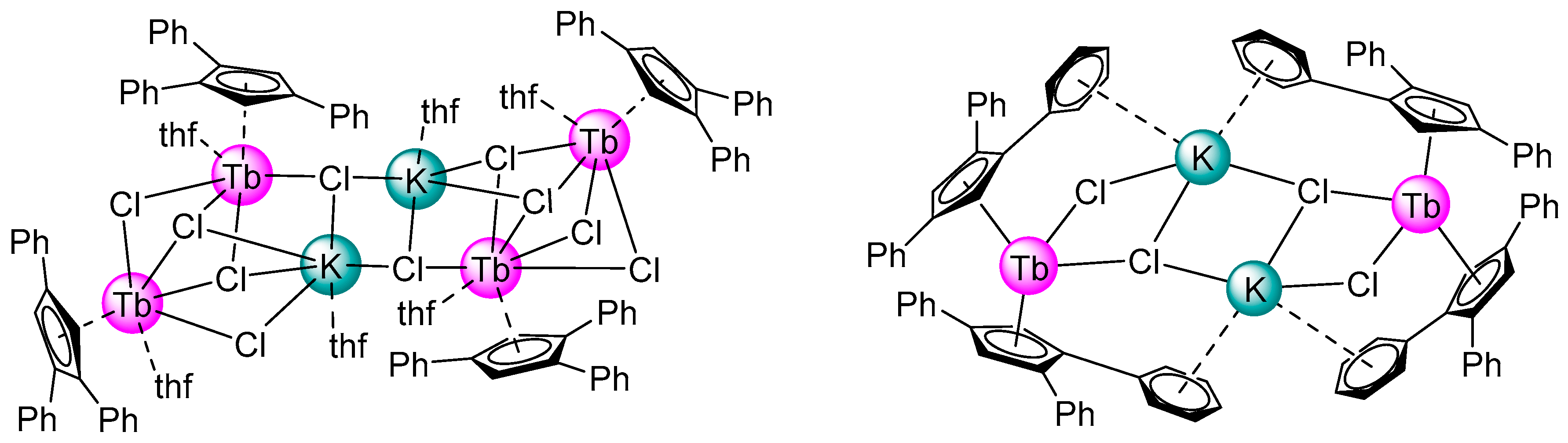
Scheme 1. The previously known terbium triphenylcyclopentadienyl complexes: [{CpPh3TbCl2(thf)}2KCl(thf)]2 on the left and [CpPh32TbCl2K]2 (1) on the right.
Molbank 2025 m2102 sch001
Scheme 2. Synthesis of CpPh32Tb(phdk) (2).
Molbank 2025 m2102 sch002
Figure 1. Molecular structure of 2. Thermal ellipsoids are drawn at the 50% probability level. Hydrogen atoms are omitted for clarity.
Molbank 2025 m2102 g001
Table 1. Selected structural parameters of complex 2.
Disnances and Angles21 [10]
Tb-Cpcent (Å)2.385, 2.4002.422, 2.429
Cpcent-Tb-Cpcent (◦)133.9132.0
Tb-CCp(range) (Å)2.645(1)–2.721(1)2.656(3)–2.751(3)
Tb-CCp(average) (Å)2.680(1)2.691(3)
Tb-O (Å)2.2126(9), 2.2428(8)-
O-Tb-O, (Cl–TbCl) (◦)76.64(3)91.72(2)
Disclaimer/Publisher’s Note: The statements, opinions and data contained in all publications are solely those of the individual author(s) and contributor(s) and not of MDPI and/or the editor(s). MDPI and/or the editor(s) disclaim responsibility for any injury to people or property resulting from any ideas, methods, instructions or products referred to in the content.