
Need Help?
31 December 2025
International Journal of Environmental Research and Public Health | An Interview with One of the Authors—Dr. Elisa Kern de Castro
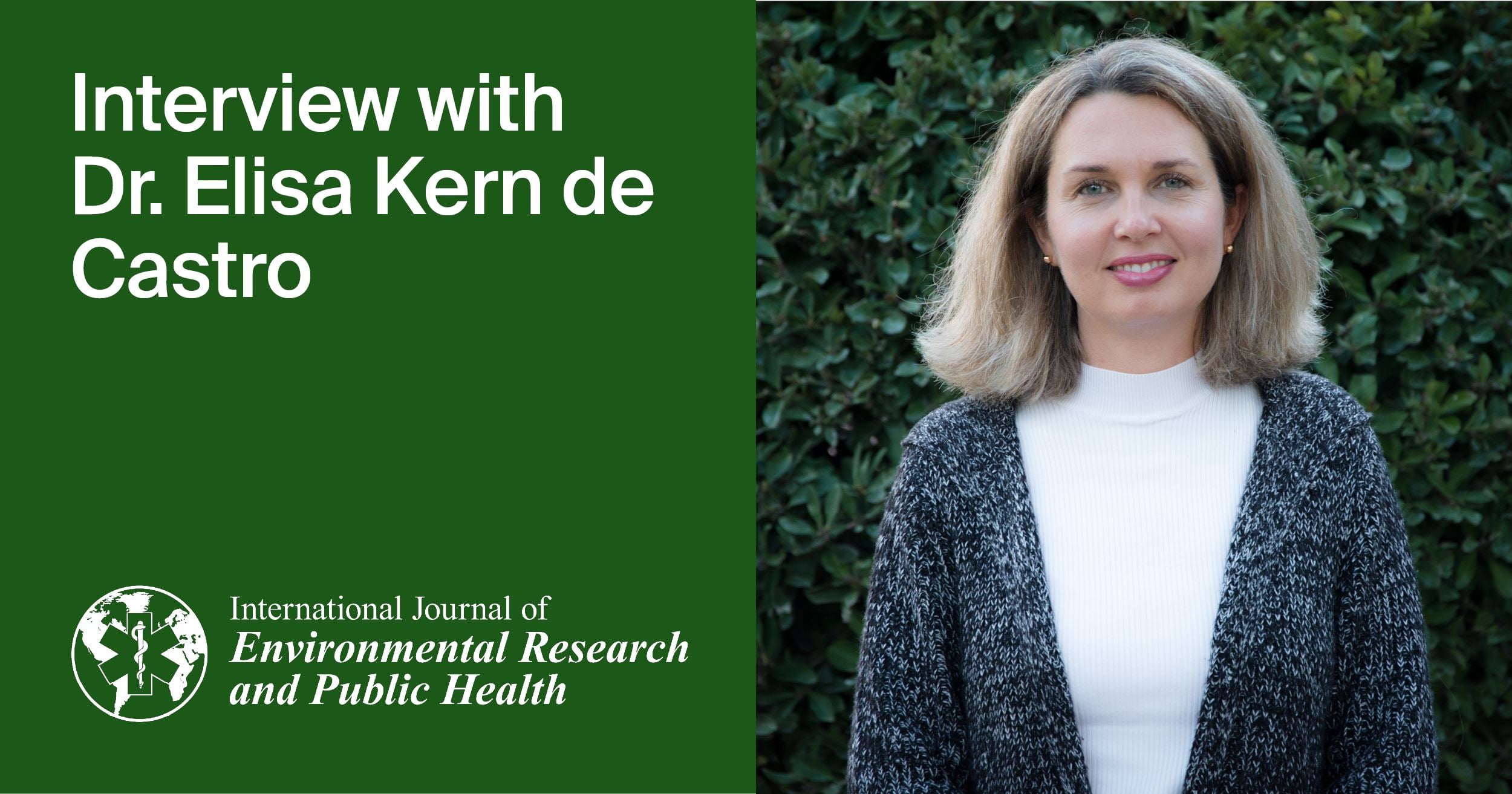
Name: Dr. Elisa Kern de Castro
Affiliation: Egas Moniz Center for Interdisciplinary Research, Egas Moniz School of Health and Science, 2829-511 Almada, Portugal
“Contributions of Health Psychology to Climate Change: A Review”
by Elisa Kern de Castro and Marta Reis
Int. J. Environ. Res. Public Health 2025, 22(4), 634; https://doi.org/10.3390/ijerph22040634
Available online: https://www.mdpi.com/1660-4601/22/4/634
We had the pleasure of speaking with Dr. Elisa Kern de Castro, a psychologist and esteemed researcher in clinical and health psychology, whose recent publication in the International Journal of Environmental Research and Public Health (IJERPH, ISSN: 1660-4601) explores the intersection of ecological sustainability and health behavior. Here, she shares insights into her academic path, research focus, and motivation behind her recent work.
Below is the interview with Dr. Elisa Kern de Castro:
1. Could you briefly introduce yourself and your current research to our readers?
My name is Elisa Kern de Castro, and I am a psychologist with a PhD in clinical and health psychology. I’ve been engaged in the field of health psychology for over 20 years, primarily focusing on chronic diseases, health behavior, cancer, and self-regulation. In recent years, however, my interest has expanded into ecological behavior—essentially bridging sustainable actions with health psychology. I currently teach at the School of Health Psychology in Portugal, although I originally come from Brazil, where I worked for 15 years as a professor before relocating five years ago.
2. What were the main challenges and innovations in your research field?
One of the key challenges is the lack of integration between psychology—particularly health psychology—and other disciplines in ecological and clinical settings. While many researchers address environmental issues, they often overlook the human behavior component, which is vital. Health psychology offers a rich understanding of behavioral change, and we can contribute significantly to discussions on sustainability. What’s needed is recognition of the value this field brings to global issues such as climate change—not only in times of crisis, but through everyday behaviors that support ecological well-being.
3. What motivates your research in this area?
My motivation is both personal and academic. The immediate trigger was our university’s engagement with the WHO’s health model, which inspired me to incorporate it into my courses. Alongside my colleague, Marta Reis, we began exploring its relevance in health psychology and developed our recent publication. Additionally, being Brazilian, I have long been concerned about the Amazon and broader ecological issues. This deep-rooted concern has now evolved into a research agenda, and we are planning a new international project examining public perceptions and behaviors related to sustainability, starting with a survey involving diverse countries and contexts.
4. How do you see the research trends in this field, and what advice would you give to early career researchers?
Ecological health and climate-related research are inherently interdisciplinary. Many topics overlap with social psychology, public health, and political science. For early career researchers, my advice is to embrace collaboration across fields and consider how human behavior interacts with global crises like climate change. There is a growing need to understand how psychological insights can influence both policy and practice in sustainable living.
5. How did you hear about IJERPH and what was your publishing experience like?
I’ve been familiar with IJERPH for quite some time through reading articles published in the journal. My involvement began with an invitation to review a manuscript, which led me to consider the journal for our own work. The publishing process was smooth, efficient, and professional. The team was very responsive, and I appreciated how quickly the review and publication phases were handled.
Dr. Kern de Castro’s work is a compelling example of how health psychology can play a central role in addressing ecological challenges. Her dedication to bridging research and societal needs is both timely and inspiring. We look forward to seeing the outcomes of her future projects.
