

Article

Leveraging Publicly Accessible Sustainability Tools to Quantify Health and Climate Benefits of Hospital Climate Change Mitigation Strategies

1
College of Medicine, State University of New York at Upstate Medical University, Syracuse, NY 13210, USA
2
State University of New York at Upstate Medical University, Syracuse, NY 13210, USA
3
Department of Public Health and Preventive Medicine, State University of New York at Upstate Medical University, Syracuse, NY 13210, USA
*
Author to whom correspondence should be addressed.
Green Health 2026, 2(1), 2; https://doi.org/10.3390/greenhealth2010002
Submission received: 11 July 2025 / Revised: 7 January 2026 / Accepted: 9 January 2026 / Published: 13 January 2026

Abstract

Background: Healthcare is a large contributor to greenhouse gas (GHG) emissions, contributing to climate change and health impairments. However, the magnitude of health and climate benefits of local and regional GHG mitigation strategies has not been well quantified. Few studies have demonstrated the use of public tools for this purpose in healthcare facilities. Methods: We evaluated several renewable energy and energy efficiency scenarios focused on one academic medical center in New York State. We used the Environmental Protection Agency’s (EPA) publicly available AVoided Emissions and geneRation Tool to estimate avoided GHG and health-harmful air pollutant emissions. The economic value of the resulting avoided health and climate damages was quantified using EPA’s CO-Benefits Risk Assessment screening tool. Results: Transitioning one healthcare institution to 100% solar energy and improving energy efficiency by 25% could yield approximately $807,000 to $1.5 million in annual health savings, with an additional $2.3 million benefits in avoided climate damages. There is an approximate $108.5–$196.6 million in annual climate and health benefits when extrapolating these energy solutions to hospitals across the same state. Conclusions: There are significant health savings from healthcare GHG mitigation strategies. This application of publicly available and accessible tools demonstrates ways to integrate climate and health benefits into local decision-making around climate change mitigation and sustainability efforts.

1. Introduction

The combustion of fossil fuels has increased the concentration of greenhouse gases (GHG), like carbon dioxide (CO2), in the atmosphere. This has led to unprecedented, long-term shifts in temperature and weather patterns, also known as climate change [1]. Climate change has led to more extreme weather events, drought, flooding, food insecurity, and changes in the distribution of infectious diseases [2]. These shifts pose risks to human health by either exacerbating pre-existing health conditions or by inciting new damage [2,3].
The healthcare sector accounts for 1% to 5% of total global GHG emissions [4], but nearly 10% of national GHG emissions in the United States (U.S) [5]. This is an equivalent proportion to global industrial processes [6] and the U.S. agricultural sector [7]. Healthcare emissions stem from patient transport, pharmaceuticals and waste, gas supplies, electricity, and other uses across the medical supply chain and continuum of care [4]. From a system based upon the principle of doing no harm, hospitals have a responsibility to mitigate climate change emissions [8]. Continued contributions to the climate crisis will perpetuate climate and health damages locally, nationally, and globally.
Healthcare leaders have been driving sustainability initiatives to reduce GHG emissions. From 2022–2025, a Department of Health and Human Services Health Sector Climate Pledge allowed healthcare organizations to voluntarily commit to a 50% reduction in greenhouse gas emissions by 2030 [9]. As of November 2024, nearly 1000 hospitals had signed this pledge [10]. The English National Health System has set a goal to become net zero to reduce their impact on future climate damages [11]. Practice Greenhealth offers resources tailored to healthcare facilities to plan and carry out sustainable initiatives. These initiatives include the exploration of energy efficiency and renewable energy use [12]. The Massachusetts Health Insurance Program, MassHealth, requires health institutions to report Scope 1 and 2 emissions to show accountability for healthcare’s impact on the climate [13]. The Joint Commission has also launched sustainability certifications across the healthcare sector to accelerate decarbonization and improve sustainability [14]. Environmental, social, and governance (ESG) responsibility initiatives have gained significant traction in recent years. This is particularly notable in the healthcare sector, where there has been an increased emphasis on sustainability efforts [15].
One major focus of healthcare sustainability efforts has been on energy and electricity use. Expanding renewable energy (ERE) and improving energy efficiency (IEE) can help organizations achieve sustainability goals. These energy-based climate change mitigation strategies reduce emissions of climate-harmful and health-harmful air pollutants. Thus, reduction in GHG emissions brings health “co-benefits” [16] to the surrounding community. The degree of health and climate benefits achieved with ERE and IEE depends on the source of energy that is being displaced. Replacing fossil fuels with a cleaner source of energy will result in the largest reductions in CO2 emissions, as well as in health-harmful air pollutants sulfur dioxide (SO2) and nitrous oxides (NOx) [17,18]. The health and climate benefits associated with ERE are well documented in multiple sectors [19,20,21,22,23,24]. For example, increasing wind energy has been estimated to yield climate and health benefits equivalent to $4.2 million in California. In the Upper Midwest region of the U.S., increasing wind energy in an area where there are more fossil fuels, climate and health benefits would be $1.2 trillion, which is equivalent to a third of the entire gross domestic product (GDP) of California [19,25]. A similar trend was found with IEE. IEE reduction retrofits in single-family homes were estimated to yield $1.10–$1.57 billion in utility, climate, and health savings to residents in 10 US cities [26], the equivalent of about 0.005% of the US GDP but the entire GDP of Grenada [27,28]. Residential investments in renewable energy during volatile energy markets in Germany were found to save nearly €2000, which is approximately equivalent to about half of Germany’s monthly GDP per capita [29], and reduce GHG emissions [30]. Residential energy efficiency improvements have also been associated with improved self-reported health, especially in lower income areas [31].
Overall, investments in ERE and IEE have significant and quantifiable economic, climate, and health benefits in the near- and long-term future [2,21,24]. However, data and accessible tools to estimate these benefits in the healthcare sector have been limited. Despite a growing number of sustainability initiatives aimed at reducing GHG emission in the healthcare sector, there is limited evidence on the economic value of potential climate and health benefits that can be achieved through these initiatives applied within healthcare institutions specifically. This may constrain healthcare decision-makers’ ability to implement evidence-based climate change mitigation solutions. Past evaluations have examined healthcare water, design, travel, procurement, and waste streams, as well as direct energy consumption of hospitals more generally [32]. There is less known on the positive benefits resulting from sustainable energy decision-making in the healthcare sector. Additionally, climate and health benefits within the context of sustainability decision-making have focused on national or statewide assessments, as well as across multiple sectors like transportation, energy, agriculture, and residential and commercial buildings [21]. The evidence examining incentives to invest in ERE and IEE have been lacking at the local level for healthcare institutions. Accessible tools that are applicable to local decision-making can aid in filling this gap. Evidence of the functionality of these tools may increase the rate at which climate change mitigation solutions are implemented within the healthcare sector.
Our analyses aim to first quantify the climate and health benefits associated with ERE and IEE for a single healthcare institution. Second, we aim to estimate the climate and health benefits associated with ERE and IEE for all hospitals in the same county and state. This will be used to demonstrate the magnitude of benefits possible with large-scale adoption of these mitigation strategies. Integrating these findings, and the demonstrated methodology of utilizing publicly available and accessible tools, can inform local decision-making at healthcare institutions.

2. Materials and Methods

In New York State (NYS), Executive Order (EO) 22 requires that all state agencies, which includes some hospital facilities, academic medical centers, and medical schools, must have 100% zero-emission electricity by 2030 [33]. One state healthcare institution located in Onondaga County was chosen for our analysis. Whole-building 2023 hospital energy data was provided by the institution.

2.1. Energy Decision Scenarios

Five ERE scenarios were modeled, each increasing solar capacity compared to the current baseline of no additional solar capacity. The first scenario was a 5% increase in electricity use from solar energy. This aligns with the current estimated expansion of the institution’s solar portfolio. The remaining scenarios include a 25% increase, 50% increase, 75% increase, and 100% use of electricity use from solar energy. These stepwise increases are aimed at reaching the ambitious, but not unrealistic, renewable energy goals and statewide mandates under EO22 for 100% zero-emission electricity in the near future [33]. These scenarios also follow similar statewide trends in ramping up efforts within healthcare systems at transitioning to 100% renewable electricity this decade, including through community utility solar projects [34,35,36]. Other renewable energy sources were not being considered by the institution at the time, so they were excluded from our analyses.
Similarly, six IEE scenarios were also used to model increasing energy efficiency based on the institution’s projections and EO22 mandates: current baseline with no additional energy efficiency, with 5% stepwise increases from 5% to 25% based on projected technological feasibility within future years by institutional energy staff and recent annual electricity reductions [37].

2.2. Quantifying Benefits of Energy Decision Scenarios

2.2.1. Health Benefits

Each ERE and IEE scenario were evaluated for their potential health benefits using publicly available tools from the U.S. Environmental Protection Agency (EPA). The AVoided Emissions and geneRation Tool (AVERT) (Version 4.3, U.S. Environmental Protection Agency, Washington, DC, USA) was used to quantify the impact of ERE and IEE scenarios on GHG (e.g., CO2) and air pollutant (e.g., PM2.5, SO2, NOx, VOCs, and NH3) emissions in NYS. AVERT’s peer-reviewed methodology estimates marginal changes in air pollutant emissions for a given region of the. U.S. based on historic hourly patterns [38]. Benchmarked against industry standards, these air pollutant emissions changes can be estimated for the chosen region annually and used to quantify health benefits of IEE and ERE decisions [19,39,40,41,42]. With a given energy decision scenario, AVERT considers what other energy source is being displaced based on hourly, unit-by-unit generation and emissions [43] using EPA’s Air Markets and Program Data [44]. AVERT then estimates the change in GHG and air pollutant emissions that would result from implementing a given energy decision compared to the alternative that is avoided based on EPA’s National Emissions Inventory of hourly estimates of air pollutant emissions from electricity generation [44].
The Web Edition of AVERT v4.3 was used to complete our analysis, but a downloadable version is also available for more tailored analyses. AVERT 4.3 uses 2023 power sector emissions and generation data and models avoided emission and generation based on 14 independent electricity regions within the U.S. [43]. First, our AVERT region was selected as New York State. We set our energy scenario based on each of our ERE and IEE scenarios described above. ERE were entered as megawatt (MW) of utility-scale solar (photovoltaic) capacity. IEE scenarios were entered as reductions in total annual energy generation spread evenly throughout the year, making this tool adaptable to quantify emission reductions associated with any variety or combination of IEE solutions. For each scenario, we used AVERT to calculate energy impacts, which provided annual air pollutant emission changes for our region. AVERT is publicly available at https://www.epa.gov/avert/avert-web-edition (accessed on 2 June 2025), and its User Manual [43] and list of publications that have used AVERT [45] provide additional detail on more tailored or alternative modeling scenarios.
We also utilized the web-based version of EPA’s CO-Benefits Risk Assessment (COBRA, v5.2) (U.S. Environmental Protection Agency, Washington, D.C., U.S.A) tool to estimate and monetize the health impacts of air pollutant emissions changes. Within COBRA, a simplified air quality model source–receptor matrix, which has been demonstrated to be comparable to more sophisticated models in validation studies [46], estimates changes in PM2.5 and O3 based on the emission changes calculated within AVERT. Health impact functions from peer-reviewed epidemiological studies are then used to estimate how these PM2.5 and O3 estimates relate to health outcomes, including mortality, heart-attacks, respiratory and cardiovascular-related hospitalizations, acute bronchitis, respiratory systems, asthma emergency room visits, cardio emergency room visits, asthma incidence, lung cancer incidence, Alzheimer’s and Parkinson’s hospitalizations, stroke incidences, hay fever/rhinitis incidences, minor restricted activity days, work lost due to illness, lost school days, and asthma symptoms [46]. This approach, which is consistent with U.S. federal regulatory analyses and reflective of the current state of the environmental epidemiological science, then estimates the value of those health impacts [46]. COBRA, including a downloadable Desktop version, is publicly available at https://cobra.epa.gov/ (accessed on 2 June 2025), its User Manual [46], and a list of publications using COBRA [47] can inform additional specifications.
AVERT and COBRA are linked, allowing us to export our AVERT estimates directly into COBRA. We utilized a 2% discount rate to express future economic values in accordance with recommendations from the U.S. Office of Management and Budget [48]. Because GHG and air pollutant emissions travel outside of administrative boundaries, emissions reductions and health outcomes were estimated across all counties, not just the county where the institution is located [48], for each scenario. COBRA outputs the change in the incidence and economic value of associated health impacts. Estimates of projected health impacts are shown in 2023 US dollars (USD), rounded to the nearest dollar value. Low- and high-end estimates of the health impacts are provided, which reflects the differences in methods underpinning the COBRA health impact assessment literature [46]. A schematic of this methodology is available in Figure 1.

2.2.2. Climate Benefits

We used the social cost of carbon (SCC) to evaluate the average avoided social damages estimated from reduced CO2 emissions under each ERE and IEE scenario. The SCC monetizes the long-term damages that result from emitting CO2 into the atmosphere in a given year [49]. Adjusted to June 2023 USD, the SCC was estimated at $224.87 per ton of CO2 based on a 2020 emission year and 2% discount rate [49]. Inflation adjustments were made using the Consumer Price Index Inflation Calculator [50] and climate benefits were rounded to the nearest dollar value.

2.3. Scaling Energy Decision Scenarios

Achieving maximum health and climate benefits will require large-scale adoption of ERE and IEE decisions. To demonstrate the potential magnitude of outcomes if ERE and IEE scenarios were scaled at large, we extrapolated our findings from one institution to all healthcare facilities in the same county and state. We used two similar methodologies, both on a per hospital bed basis. The number of hospitals beds in June 2023 was determined from the NYS Department of Health [51]. The average daily number of acute and intensive care beds in June 2023 was calculated.
The first method used the real whole-building energy use per bed data from the primary institution to extrapolate energy per bed for all hospitals in the same county and state. To account for any unique attributes that may significantly alter energy use between our institution and others, a second method of extrapolation used hospital-based energy estimates from Bawaneh et al. (2019) [52]. Bawaneh et al. previously estimated the average annual electricity usage intensity in in-patient facilities to be 334 kWh/m2 based on 10,000 in-patient facilities [52]. Using the square footage of our focus institution and Bawaneh et al.’s estimate of national average electricity use intensity, we calculated the energy used per bed for the original institution. This was then used to extrapolate energy use per bed for all hospitals in the same county and state. A map of all facilities can be found in Figure S1. We leveraged this approach to demonstrate the magnitude of possible health benefits if healthcare institutions within one region acted together to decrease their greenhouse gas emissions.
Using the same methodology as described in Section 2.1 and Section 2.2, county- and state-wide hospital energy estimates were used to quantify climate and health benefits possible with adoption of 100% solar energy capacity and 25% improvement in energy efficiency. Because New York State is one of its own 14 independent energy regions within AVERT, we were able to extrapolate within our individual grid.

3. Results

The healthcare institution analyzed has two primary hospital facilities, built in the mid-1960s, and comprises 988,710 square feet. These facilities contributed 5.23 megawatt (MW)/year of total combined electricity. This constitutes 68% of the institution’s total electricity use across 734 patient beds (Table 1).

3.1. Climate and Health Benefits of Chosen Energy Scenarios

Five ERE scenarios were considered, increasing solar 5%, 25%, 50%, 75%, and 100%. The institution is currently considering an approximate 5% increase in solar energy capacity, which would yield $15,620 to $29,099 in health benefits annually (Table 2). The health benefits increased to nearly $320,000 to $590,000 annually if the hospital facilities were to transition to 100% solar energy. Within the low and high estimates, benefits increased near linearly from 25% to 100% solar energy. Across scenarios, most health benefits were accrued from avoided mortality, as well as reductions in asthma onset, asthma symptoms, hay fever/rhinitis, hospital admissions, and loss of school and workdays (Table S1).
Like the health benefits, climate benefits increased as the capacity of solar energy increased. The 5% solar scenario estimated 210 tons of avoided CO2 emissions per year, which would yield $47,223 in social benefits annually. A 100% solar scenario would yield 4260 avoided tons of CO2 per year, equivalent to just under $1 million in social benefits based on the SCC (Table 2).
The trend of increasing health and climate benefits continued with IEE scenarios. A 5% increase in energy efficiency was estimated to produce $98,311 to $183,167 in health benefits annually. This scenario would also reduce 1210 tons of CO2 emissions per year, equivalent to over $272,000 in social benefits. Maximizing this scenario to 25% energy efficiency would result in $485,636 to $903,045 in health benefits and nearly $1.4 million in climate benefits annually from avoiding 6040 tons of CO2 emissions (Table 2). There was a similar reduction in the same health outcomes as with ERE scenarios (Table S2).
Ideally, institutions tackling sustainability initiatives would consider both ERE and IEE. As such, we modeled scenarios where both are implemented at our institution. The combined implementation of the lowest scenario (5% solar, and 5% energy efficiency improvement) could yield over approximately $432,184 to $529,347 in combined climate and health benefits annually compared to current operations (Table 2). Implementation of 100% solar energy and 25% energy efficiency (our most aggressive scenarios of each) could yield $806,709 to $1.5 million in health benefits and an additional $2.3 million in climate benefits, totaling $3.12 to $3.81 million in combined climate and health benefits annually in this region (Table 2). Information on specific health benefits can be found in Table S3.

3.2. Scaling Energy Decision Scenarios

We extrapolated our findings to all other hospitals in the same county (1175 hospital beds) and all other hospitals in the state (38,514 beds). Using Method 1—extrapolating our institution’s direct energy use to others on a per-bed basis—we estimated the institutions within the same county would use 12.05 MW of energy per year. Using the same method, we estimated facilities across NYS would use 266.85 MW of energy per year. Implementing the most aggressive ERE and IEE scenarios (100% ERE, 25% IEE) across NYS hospitals would yield $40.6 to $75.6 million in health benefits per year from avoided health-harmful air pollutants and $121.1 million in climate benefits per year from avoiding more than 538,000 tons of CO2 annually (Table 3).
With Method 2, which used an average hospital-based annual energy intensity based on previous research [52], approximate estimates are slightly attenuated but of a similar order of magnitude. Energy use was estimated to be 8.07 MW/year for facilities across the county and 178.65 MW/year across the state (Table 1). Using these estimates and implementing the most aggressive ERE and IEE scenarios, there were $27.3 to $50.8 million in annual health benefits. There were also more than 361,000 tons of CO2 emissions avoided per year—the equivalent of the annual electricity consumed by 60,400 average homes in the United States—$81.2 million in annual climate benefits (Table 3). Health benefits were accrued from avoided adult and infant mortality, non-fatal heart attacks, hospital admissions for respiratory, Alzheimer’s, Parkinson’s, and cardio-cerebro/peripheral vascular diseases, asthma onset and symptoms, lung cancer, stroke, hay fever/rhinitis, cardiac arrest, and loss activity, school, and workdays (Table S4).

4. Discussion

Energy decisions have direct consequences on utility costs and energy resilience of individuals. These decisions also have impacts on human health through their contribution to health-harmful air pollutants and climate-damaging GHG emissions. Based on direct energy use of a hospital system at an academic medical institution in NYS, we estimate that transitioning this single institution to be 100% solar energy powered and 25% more energy efficiency than baseline could produce approximately $3.1 to $3.8 million in climate and health benefits annually. Approximately 60% of these benefits come from averting CO2 emissions equivalent to 2177 gasoline-powered passenger cars driven for one year [53]. The other portion of benefits comes from averted emissions of the health-harmful air pollutants and annual reductions in about 20 asthma cases, nearly 30 lost days of school, work, or activity, and reduced risk of the incidence of mortality in the surrounding region. When these findings are extrapolated to all hospitals in NYS, we find that there could be an approximate $108.5 to $196.6 million in climate and health benefits available annually, GHG emissions of the equivalent of 76,000 to 114,000 gasoline-powered passenger vehicles reduced for one year [53], and more than 5 avoided deaths, 10 avoided cases of asthma onset, avoided incidence of more than 1700 asthma symptoms, and mitigating over 2600 lost days of activity, work, and school.
Similar methodologies have been used to estimate the health and climate benefits of large-scale energy decisions. Nearly $29 billion in health benefits were estimated under the EPA’s Clean Power Plan [54]. Industrial sector energy efficiency programs have been estimated to yield $4.85–16.9 million in annual health benefits [55]. State-wide renewable energy standards in Nevada are projected to produce $3–8 million in annual health benefits within that state [41]. Analysis of a 50% reduction in GHG emissions in 2030 in the European Union, China, and India yielded estimates of a savings of 100, 500, and 1500 life years per million people by 2050, respectively [56]. Further evidence has demonstrated how co-benefits, such as these types of quantifiable health benefits, can promote accelerated climate mitigation action [57,58] and help decision-makers make climate mitigation decisions [21].
The method of extrapolation utilizing our institution’s observed energy data to all other hospital facilities using per bed estimates (Method 1), generated similar, but consistently higher, estimates of avoided emissions and benefits as compared to the method deriving estimates from Bawaneh et al [52]. (Method 2). The Bawaneh et al. paper estimated energy intensity of hospital facilities using the 2012 Commercial Buildings Energy Consumption Survey [52], so the estimates from that analysis may not be as representative in an analysis of 2023 data, especially for healthcare emissions which have increased in the last decade [59]. Additionally, the Bawaneh et al. paper averages energy use across a national dataset, which may not fully represent energy use patterns in New York State specifically. However, we wanted to provide a method of extrapolation that did not rely solely on our own institution’s energy use. Our estimates across both extrapolation methods were all within the same order of magnitude. This provides additional confidence that the real magnitude of potential benefits lies within the ranges demonstrated here with both methodologies.
The accessible, publicly available tools that were employed in this study can increase the information available for local decision-making around energy benefits for many types of institutions. In New Zealand, a multi-year clustered, randomized trial was used to determine the health impacts of energy efficiency solutions, including improvements in respiratory symptoms, missed days of school or work, and hospital visits [60]. While this type of study design offers epidemiological strengths, leveraging easy-to-use tools backed with data-driven epidemiological evidence offers efficient alternatives for screening energy decisions. Previous evidence has demonstrated that sustainability initiatives may be limited in their local adoption and implementation due to high costs [61]. Integrating quantifiable estimates of local climate and health benefits into the economic portion of sustainability decision-making can decrease payback periods and improve financial returns on investments [26,62]. This is especially important for rural areas where technical sustainability expertise may be limited, and previous research may not exist to inform decision-making. While researcher-oriented tools and data have been in existence for many years, EPA’s recent efforts to increase their accessibility can allow public entities and researchers to leverage these free tools without extensive electricity, air quality modeling, or health impacts assessment expertise to inform local decision-making [41,43,46,55].
There are a growing number of calls for the healthcare sector to reach net zero emissions to reduce its climate impact and resulting health damages [63]. For this reason, health benefits may be particularly valuable in the healthcare context evaluated here as they accrue in the near-term and convey a tangible savings [64]. Environmental behaviors can be positively impacted by linking social identities to environmental outcomes, so relating sustainability decisions to health outcomes withing healthcare institutions may accelerate the path of the healthcare sector to climate neutrality and net-zero emissions [65].
Despite the strength of the approach utilized here, it is important to recognize the limitations of these tools. Compared to the previous findings, NYS has a relatively clean energy grid. Nearly 60% of the state’s electricity is generated from natural gas, with an additional 17% each of nuclear and hydroelectric sources [66]. Potential benefits would be even greater for institutions whose baseline electricity grid had a larger proportion of “dirtier” fuels, like petroleum or coal. Additionally, AVERT does not factor in changing short-term economic conditions or lifecycle emissions. As decision-makers evaluate energy decisions, more detailed analysis would be required if these conditions were integral information needed for their evaluation. The web-based version of AVERT cannot estimate future scenarios beyond five years, so results should not be projected beyond that timeline. However, the desktop-based version of AVERT can be utilized to examine future scenarios beyond 5 years.
Additionally, only considering acute and intensive care beds (as opposed to outpatient facilities, and academic or office spaces) has likely generated more conservative estimates of energy use, climate benefits, and health benefits than would be realized if healthcare institutions were to implement ERE and IEE. Additional work may evaluate whole-institution energy use. Further, because wind, nuclear, and hydroelectric energy are not currently being explored for onsite development at the academic medical center focused upon in our study, we did not estimate the benefits of these energy types in the scenarios shown here. However, the tools utilized are adaptable to integrate these variations, allowing an institution to tailor their analysis to their unique needs. Life cycle analysis should be utilized to also integrate the full scope of costs and benefits associated with ERE and IEE strategies. Onsite energy storage can enhance the resilience of healthcare institutions during unpredicted power outages [67]. Energy storage may also allow facilities to store, and then use, generated energy during high energy demand periods. Facilities could then avoid peak energy pricing, as well as peak air pollution emissions which have been shown to be highest during high-energy demand periods [68,69]. As energy storage has become more technologically and economically feasible over time, energy storage will be considered in future scenarios.

5. Conclusions

The healthcare sector in the United States accounts for a large share of national GHG emissions. Voluntary and mandated initiatives have been established to mitigate these emissions. Scenarios of ERE and IEE in a NYS academic healthcare institution could yield health savings of approximately $806,709 to $1.5 million per year, with an additional $2.3 million benefits in avoided climate damages. When we extrapolate our recent findings to all hospitals in NYS, there is an estimated $108.5 to $196.6 million in climate and health benefits not currently being accounted for in climate mitigation decision-making within healthcare institutions. By utilizing publicly available, accessible climate resources and by focusing on integrated climate mitigation within health systems and healthcare facilities, these organizations can mitigate their contributions to the health harms caused by climate change.

Supplementary Materials

The following supporting information can be downloaded at https://www.mdpi.com/article/10.3390/greenhealth2010002/s1; Figure S1: A map of hospital facilities (black dots) considered in this analysis of NYS and specifically in Onondaga County, NY (shaded); Table S1: Solar energy scenarios; Table S2: Energy efficiency scenarios; Table S3: Combining energy efficiency and solar energy; Table S4: Economies of scale extrapolations using 100% solar and 25% energy efficiency.

Author Contributions

Conceptualization, A.A.W., P.C. and T.S.; methodology, A.A.W. and T.S.; software, A.A.W. and T.S.; validation, A.A.W.; formal analysis, A.A.W. and T.S.; investigation, A.A.W. and T.S.; resources, A.A.W.; data curation, A.A.W. and T.S.; writing—original draft preparation, A.A.W. and T.S.; writing—reviewing and editing, A.A.W., P.C. and T.S.; visualization, A.A.W.; supervision, A.A.W.; project administration, A.A.W. All authors have read and agreed to the published version of the manuscript.

Funding

This research received no external funding.

Institutional Review Board Statement

Not applicable.

Informed Consent Statement

Not applicable.

Data Availability Statement

Institutional energy use data for our focal institution is not publicly available but is available upon request. Data output files are available at https://github.com/williaau/sustainability. All other data is publicly available from the references included in the Methods section. We have also made the downloadable versions of the tools publicly available at https://drive.google.com/drive/folders/1OTiiRPPglXCOADZ7Z3S7TXKAgQ2YoThy?usp=drive_link in the event the web-based version of these government tools become inactive.

Conflicts of Interest

The authors declare no conflicts of interest.

Abbreviations

The following abbreviations are used in this manuscript:
EPAEnvironmental Protection Agency
GHGGreenhouse gas
CO2Carbon dioxide
USUnited States
ESGEnvironmental, social, and governance
EREExpanding renewable energy
IEEIncreasing energy efficiency
SO2Sulfur dioxide
NOxNitrogen oxides
NYSNew York State
EOExecutive Order
AVERTAVoided Emissions and geneRation Tool
COBRACO-Benefits Risk Assessment
PM2.5Particulate Matter < 2.5 microns
VOCVolatile organic compounds
NH3Ammonia
USDUnited States Dollar
SCCSocial Cost of Carbon
MWMegawatt

References

  1. Hardy, J. Climate Change: Causes, Effects, and Solutions | Wiley. Available online: https://www.wiley.com/en-us/Climate+Change%3A+Causes%2C+Effects%2C+and+Solutions+-p-9780470850190 (accessed on 2 October 2024).
  2. Romanello, M.; di Napoli, C.; Green, C.; Kennard, H.; Lampard, P.; Scamman, D.; Walawender, M.; Ali, Z.; Ameli, N.; Ayeb-Karlsson, S.; et al. The 2023 Report of the Lancet Countdown on Health and Climate Change: The Imperative for a Health-Centred Response in a World Facing Irreversible Harms. Lancet 2023, 402, 2346–2394. [Google Scholar] [CrossRef]
  3. Jones, A. The Health Impacts of Climate Change: Why Climate Action Is Essential to Protect Health. Orthop. Trauma 2022, 36, 248–255. [Google Scholar] [CrossRef]
  4. Lenzen, M.; Malik, A.; Li, M.; Fry, J.; Weisz, H.; Pichler, P.-P.; Chaves, L.S.M.; Capon, A.; Pencheon, D. The Environmental Footprint of Health Care: A Global Assessment. Lancet Planet. Health 2020, 4, e271–e279. [Google Scholar] [CrossRef]
  5. Eckelman, M.J.; Sherman, J. Environmental Impacts of the U.S. Health Care System and Effects on Public Health. PLoS ONE 2016, 11, e0157014. [Google Scholar] [CrossRef]
  6. Ge, M.; Friedrich, J.; Vigna, L. Where Do Emissions Come From? 4 Charts Explain Greenhouse Gas Emissions by Sector. Available online: https://www.wri.org/insights/4-charts-explain-greenhouse-gas-emissions-countries-and-sectors (accessed on 15 December 2025).
  7. US Environmental Protection Agency. The Office of Air and Radiation of Greenhouse Gas Emissions. Available online: https://www.epa.gov/ghgemissions/sources-greenhouse-gas-emissions (accessed on 15 December 2025).
  8. Wade, R. Climate Change and Healthcare: Creating a Sustainable and Climate-Resilient Health Delivery System. J. Healthc. Manag. 2023, 68, 227. [Google Scholar] [CrossRef] [PubMed]
  9. US Department of Health and Human Services (DHHS). Health Sector Commitments to Emissions Reduction and Resilience. Available online: https://web.archive.org/web/20241101222525/https://www.hhs.gov/climate-change-health-equity-environmental-justice/climate-change-health-equity/actions/health-sector-pledge/index.html (accessed on 2 October 2024).
  10. US Department of Health and Human Services (DHHS). Health Sector Commitments to Emissions Reduction and Resilience, November 2024 Update. Available online: https://web.archive.org/web/20241211015959/https://www.hhs.gov/climate-change-health-equity-environmental-justice/climate-change-health-equity/actions/health-sector-pledge/index.html (accessed on 5 December 2024).
  11. Weimann, L.; Weimann, E. On the Road to Net Zero Health Care Systems: Governance for Sustainable Health Care in the United Kingdom and Germany. Int. J. Env. Res. Public Health 2022, 19, 12167. [Google Scholar] [CrossRef] [PubMed]
  12. Practice Greenhealth Practice Greenhealth: Sustainability Solutions for Health Care. Available online: https://practicegreenhealth.org/ (accessed on 2 October 2024).
  13. SION60. Massachusetts Requires Hospitals to Report Green House Gas Emissions. 2024. Available online: https://sion60.com/massachusetts-requires-hospitals-to-report-green-house-gas-emissions/ (accessed on 6 January 2026).
  14. The Joint Commission Sustainable Healthcare Certification. Available online: https://www.jointcommission.org/what-we-offer/certification/certifications-by-setting/hospital-certifications/sustainable-healthcare-certification/ (accessed on 21 October 2024).
  15. Nakielski, M.L. Moving Forward with ESG, Sustainability, and Corporate Responsibility. Front. Health Serv. Manag. 2023, 40, 33. [Google Scholar] [CrossRef]
  16. Smith, K.R.; Haigler, E. Co-Benefits of Climate Mitigation and Health Protection in Energy Systems: Scoping Methods. Annu. Rev. Public Health 2008, 29, 11–25. [Google Scholar] [CrossRef]
  17. Buonocore, J.J.; Luckow, P.; Fisher, J.; Kempton, W.; Levy, J.I. Health and Climate Benefits of Offshore Wind Facilities in the Mid-Atlantic United States. Environ. Res. Lett. 2016, 11, 074019. [Google Scholar] [CrossRef]
  18. United Nations Economic Commission for Europe. Carbon Neutrality in the UNECE Region: Integrated Life-Cycle Assessment of Electricity Sources; ECE Energy Series; United Nations: New York, NY, USA, 2022; ISBN 978-92-1-001485-4.
  19. Buonocore, J.J.; Hughes, E.J.; Michanowicz, D.R.; Heo, J.; Allen, J.G.; Williams, A. Climate and Health Benefits of Increasing Renewable Energy Deployment in the United States*. Environ. Res. Lett. 2019, 14, 114010. [Google Scholar] [CrossRef]
  20. Buonocore, J.J.; Luckow, P.; Norris, G.; Spengler, J.D.; Biewald, B.; Fisher, J.; Levy, J.I. Health and Climate Benefits of Different Energy-Efficiency and Renewable Energy Choices. Nat. Clim. Chang. 2016, 6, 100–105. [Google Scholar] [CrossRef]
  21. Gao, J.; Kovats, S.; Vardoulakis, S.; Wilkinson, P.; Woodward, A.; Li, J.; Gu, S.; Liu, X.; Wu, H.; Wang, J.; et al. Public Health Co-Benefits of Greenhouse Gas Emissions Reduction: A Systematic Review. Sci. Total Environ. 2018, 627, 388–402. [Google Scholar] [CrossRef]
  22. Liobikienė, G.; Butkus, M. Determinants of Greenhouse Gas Emissions: A New Multiplicative Approach Analysing the Impact of Energy Efficiency, Renewable Energy, and Sector Mix. J. Clean. Prod. 2021, 309, 127233. [Google Scholar] [CrossRef]
  23. Shahbaz, M.; Shafiullah, M.; Papavassiliou, V.G.; Hammoudeh, S. The CO2–Growth Nexus Revisited: A Nonparametric Analysis for the G7 Economies over Nearly Two Centuries. Energy Econ. 2017, 65, 183–193. [Google Scholar] [CrossRef]
  24. Zhang, Z.; Zhang, Y.; Zhao, M.; Muttarak, R.; Feng, Y. What Is the Global Causality among Renewable Energy Consumption, Financial Development, and Public Health? New Perspective of Mineral Energy Substitution. Resour. Policy 2023, 85, 104036. [Google Scholar] [CrossRef]
  25. Bohn, S.; Duan, J. California’s Economy. Available online: https://www.ppic.org/publication/californias-economy/ (accessed on 7 January 2026).
  26. Williams, A.A.; Baniassadi, A.; Izaga Gonzalez, P.; Buonocore, J.J.; Cedeno-Laurent, J.G.; Samuelson, H.W. Health and Climate Benefits of Heat Adaptation Strategies in Single-Family Residential Buildings. Front. Sustain. Cities 2020, 2, 561828. [Google Scholar] [CrossRef]
  27. Macro Poverty Outlook: Grenada 2025. Available online: https://thedocs.worldbank.org/en/doc/e408a7e21ba62d843bdd90dc37e61b57-0500032021/related/mpo-grd.pdf (accessed on 16 December 2025).
  28. World Bank Open Data GDP (Current US$)—United States. Available online: https://data.worldbank.org (accessed on 7 January 2026).
  29. World Bank Open Data GDP per Capita (Current US$)—Germany. Available online: https://data.worldbank.org (accessed on 7 January 2026).
  30. van Ouwerkerk, J.; Celi Cortés, M.; Nsir, N.; Gong, J.; Figgener, J.; Zurmühlen, S.; Bußar, C.; Sauer, D.U. Quantifying Benefits of Renewable Investments for German Residential Prosumers in Times of Volatile Energy Markets. Nat. Commun. 2024, 15, 8206. [Google Scholar] [CrossRef] [PubMed]
  31. Symonds, P.; Verschoor, N.; Chalabi, Z.; Taylor, J.; Davies, M. Home Energy Efficiency and Subjective Health in Greater London. J. Urban Health 2021, 98, 362–374. [Google Scholar] [CrossRef] [PubMed]
  32. McGain, F.; Naylor, C. Environmental Sustainability in Hospitals—A Systematic Review and Research Agenda. J. Health Serv. Res. Policy 2014, 19, 245–252. [Google Scholar] [CrossRef] [PubMed]
  33. New York State Executive Order No. 22: Leading by Example: Directing State Agencies to Adopt a Sustainability and Decarbonization Program. Available online: https://www.governor.ny.gov/executive-order/no-22-leading-example-directing-state-agencies-adopt-sustainability-and (accessed on 2 October 2024).
  34. Rochester Regional Health Solar Energy Powers Rochester Regional Facilities. Available online: https://www.rochesterregional.org/hub/solar-energy (accessed on 15 December 2025).
  35. Medline Governor Hochul Announces Completion of Largest Rooftop Solar Project in New York State. Available online: https://newsroom.medline.com/releases/governor-hochul-announces-completion-of-largest-rooftop-solar-project-in-new-york-state/ (accessed on 15 December 2025).
  36. New York City Department of Citywide Administrative Services NYC DCAS & NYC Health + Hospitals Celebrate the Completion of First Ever Solar Power Installation. Available online: http://www.nyc.gov/site/dcas/news/001-24/nyc-dcas-nyc-health-hospitals-celebrate-completion-first-ever-solar-power-installation (accessed on 15 December 2025).
  37. Albanese, J. Push to Make Upstate More Energy Efficient, Leads to Big Drop in Natural Gas, Electricity Usage; Upstate News; SUNY Upstate Medical University: Syracuse, NY, USA, 2024. [Google Scholar]
  38. US Environmental Protection Agency; The Office of Air and Radiation. Avoided Emission Rates Generated from AVERT. Available online: https://www.epa.gov/avert/avoided-emission-rates-generated-avert (accessed on 15 December 2025).
  39. Levy, J.I.; Woo, M.K.; Penn, S.L.; Omary, M.; Tambouret, Y.; Kim, C.S.; Arunachalam, S. Carbon Reductions and Health Co-Benefits from US Residential Energy Efficiency Measures. Environ. Res. Lett. 2016, 11, 034017. [Google Scholar] [CrossRef]
  40. Abel, D.; Holloway, T.; Harkey, M.; Rrushaj, A.; Brinkman, G.; Duran, P.; Janssen, M.; Denholm, P. Potential Air Quality Benefits from Increased Solar Photovoltaic Electricity Generation in the Eastern United States. Atmos. Environ. 2018, 175, 65–74. [Google Scholar] [CrossRef]
  41. Rezaee, A.; Chen, L.-W.A.; Lin, G.; Buttner, M.P.; Gakh, M.; Bloomfield, E.F. Air Quality Health Benefits of the Nevada Renewable Portfolio Standard. Atmosphere 2022, 13, 1387. [Google Scholar] [CrossRef]
  42. Arunachalam, S.; Woody, M.; Omary, M.; Penn, S.; Chung, S.; Woo, M.; Tambouret, Y.; Levy, J. Modeling the Air Quality and Public Health Benefits of Increased Residential Insulation in the United States. In Proceedings of the Air Pollution Modeling and Its Application XXIV, Montpellier, France, 4–8 May 2015; Steyn, D.G., Chaumerliac, N., Eds.; Springer International Publishing: Cham, Switzerland, 2016; pp. 135–140. [Google Scholar]
  43. US Environmental Protection Agency. AVERT User Manual; US Environmental Protection Agency: Washington, DC, USA, 2024.
  44. US Environmental Protection Agency. State Energy and Environment Program AVERT Overview and Step-by-Step Instructions; US Environmental Protection Agency: Washington, DC, USA, 2024.
  45. US Environmental Protection Agency Publications That Cite AVERT. Available online: https://www.epa.gov/system/files/documents/2024-04/avert_publications_04-11-24.pdf (accessed on 15 December 2025).
  46. US Environmental Protection Agency. COBRA User Manual, v5.2; US Environmental Protection Agency: Washington, DC, USA, 2025.
  47. US Environmental Protection Agency. Publications That Cite EPA’s CO-Benefits Risk Assessment (COBRA). Health Impacts Screening and Mapping Tool. Available online: https://www.epa.gov/system/files/documents/2024-04/publications-that-cite-cobra_0.pdf (accessed on 15 December 2025).
  48. US Environmental Protection Agency. User’s Manual for the Co-Benefits Risk Assessment Health Impacts Screening and Mapping Tool (COBRA); US Environmental Protection Agency: Washington, DC, USA, 2024.
  49. US Environmental Protection Agency. EPA Report on the Social Cost of Greenhouse Gases: Estimates Incorporating Recent Scientific Advances; US Environmental Protection Agency, National Center for Environmental Economics Office of Policy, Climate Change Division, Office of Air and Radiation: Washington, DC, USA, 2023.
  50. US Bureau of Labor Statistics CPI Inflation Calculator. Available online: https://www.bls.gov/data/inflation_calculator.htm (accessed on 18 April 2025).
  51. NYS Department of Health Hospital Bed Capacity. Available online: https://coronavirus.health.ny.gov/hospital-bed-capacity (accessed on 18 April 2025).
  52. Bawaneh, K.; Nezami, F.G.; Rasheduzzaman, M.; Deken, B. Energy Consumption Analysis and Characterization of Healthcare Facilities in the United States. Energies 2019, 12, 3775. [Google Scholar] [CrossRef]
  53. US Environmental Protection Agency. Greenhouse Gas Equivalencies Calculator. Available online: https://www.epa.gov/energy/greenhouse-gas-equivalencies-calculator (accessed on 18 April 2025).
  54. Buonocore, J.J.; Lambert, K.F.; Burtraw, D.; Sekar, S.; Driscoll, C.T. An Analysis of Costs and Health Co-Benefits for a U.S. Power Plant Carbon Standard. PLoS ONE 2016, 11, e0156308. [Google Scholar] [CrossRef] [PubMed]
  55. Safaei Kouchaksaraei, E.; Kelly, K.E. Air Emission and Health Impacts of a US Industrial Energy Efficiency Program. Energy Effic. 2024, 17, 22. [Google Scholar] [CrossRef]
  56. Markandya, A.; Armstrong, B.G.; Hales, S.; Chiabai, A.; Criqui, P.; Mima, S.; Tonne, C.; Wilkinson, P. Public Health Benefits of Strategies to Reduce Greenhouse-Gas Emissions: Low-Carbon Electricity Generation. Lancet 2009, 374, 2006–2015. [Google Scholar] [CrossRef] [PubMed]
  57. Amelung, D.; Fischer, H.; Herrmann, A.; Aall, C.; Louis, V.R.; Becher, H.; Wilkinson, P.; Sauerborn, R. Human Health as a Motivator for Climate Change Mitigation: Results from Four European High-Income Countries. Glob. Environ. Chang. 2019, 57, 101918. [Google Scholar] [CrossRef]
  58. Brown, K.E.; Henze, D.K.; Milford, J.B. How Accounting for Climate and Health Impacts of Emissions Could Change the US Energy System. Energy Policy 2017, 102, 396–405. [Google Scholar] [CrossRef]
  59. Romanello, M.; Walawender, M.; Hsu, S.-C.; Moskeland, A.; Palmeiro-Silva, Y.; Scamman, D.; Ali, Z.; Ameli, N.; Angelova, D.; Ayeb-Karlsson, S.; et al. The 2024 Report of the Lancet Countdown on Health and Climate Change: Facing Record-Breaking Threats from Delayed Action. Lancet 2024, 404, 1847–1896. [Google Scholar] [CrossRef]
  60. Howden-Chapman, P.; Crane, J.; Matheson, A.; Viggers, H.; Cunningham, M.; Blakely, T.; O’Dea, D.; Cunningham, C.; Woodward, A.; Saville-Smith, K.; et al. Retrofitting Houses with Insulation to Reduce Health Inequalities: Aims and Methods of a Clustered, Randomised Community-Based Trial. Soc. Sci. Med. 2005, 61, 2600–2610. [Google Scholar] [CrossRef] [PubMed]
  61. Sulzakimin, M.; Masrom, M.A.N.; Hazli, R.; Adaji, A.A.; Seow, T.W.; Izwan, A.R.M.H. Benefits For Public Healthcare Buildings towards Net Zero Energy Buildings (NZEBs): Initial Reviews. IOP Conf. Ser. Mater. Sci. Eng. 2020, 713, 012042. [Google Scholar] [CrossRef]
  62. Salimifard, P.; Rainbolt, M.V.; Buonocore, J.J.; Lahvis, M.; Sousa, B.; Allen, J.G. A Novel Method for Calculating the Projected Health and Climate Co-Benefits of Energy Savings through 2050. Build. Environ. 2023, 244, 110618. [Google Scholar] [CrossRef]
  63. Salas, R.N.; Maibach, E.; Pencheon, D.; Watts, N.; Frumkin, H. A Pathway to Net Zero Emissions for Healthcare. BMJ 2020, 371, m3785. [Google Scholar] [CrossRef]
  64. Lou, J.; Hultman, N.; Patwardhan, A.; Qiu, Y.L. Integrating Sustainability into Climate Finance by Quantifying the Co-Benefits and Market Impact of Carbon Projects. Commun. Earth Environ. 2022, 3, 137. [Google Scholar] [CrossRef]
  65. Fielding, K.S.; Hornsey, M.J. A Social Identity Analysis of Climate Change and Environmental Attitudes and Behaviors: Insights and Opportunities. Front. Psychol. 2016, 7, 121. [Google Scholar] [CrossRef]
  66. US Energy Information Administration. New York State Profile and Energy Estimates. Available online: https://www.eia.gov/state/?sid=NY (accessed on 8 November 2024).
  67. Liu, J.; Jian, L.; Wang, W.; Qiu, Z.; Zhang, J.; Dastbaz, P. The Role of Energy Storage Systems in Resilience Enhancement of Health Care Centers with Critical Loads. J. Energy Storage 2021, 33, 102086. [Google Scholar] [CrossRef]
  68. Abel, D.; Holloway, T.; Kladar, R.M.; Meier, P.; Ahl, D.; Harkey, M.; Patz, J. Response of Power Plant Emissions to Ambient Temperature in the Eastern United States. Environ. Sci. Technol. 2017, 51, 5838–5846. [Google Scholar] [CrossRef]
  69. Farkas, C.M.; Moeller, M.D.; Felder, F.A.; Henderson, B.H.; Carlton, A.G. High Electricity Demand in the Northeast U.S.: PJM Reliability Network and Peaking Unit Impacts on Air Quality. Environ. Sci. Technol. 2016, 50, 8375–8384. [Google Scholar] [CrossRef]
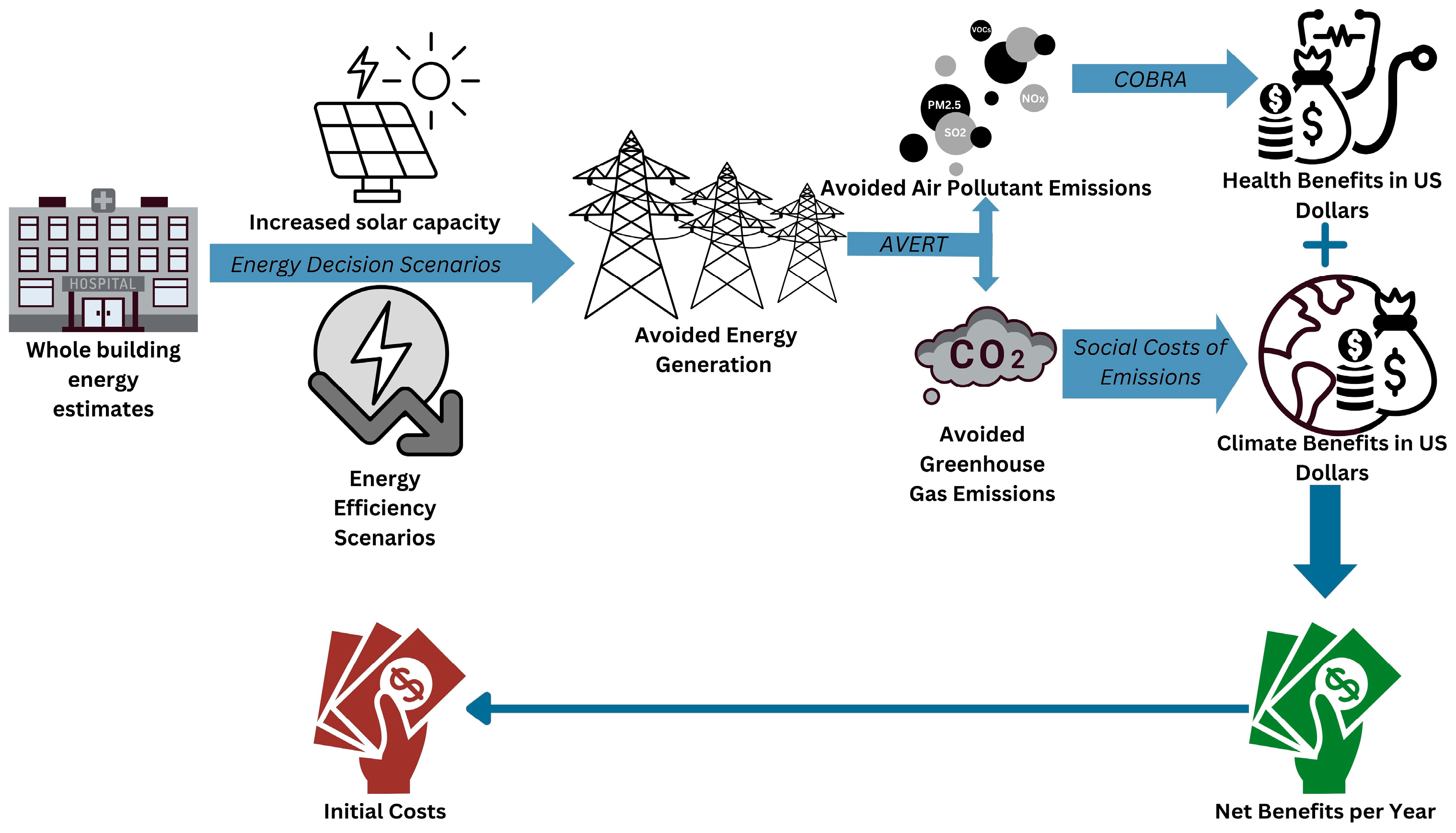
Figure 1. Schematic of methodology demonstrating the quantification of climate and health benefits based on hospital energy decision scenarios.
Greenhealth 02 00002 g001
Table 1. Characteristics of hospital facilities. Method 1 estimated energy use per bed from real whole-building energy data available for the focal institution. Method 2 estimated energy use per bed from estimates in Bawaneh et al. [52].
Institution(s)Number of BedsEnergy Use Estimates (MW/Year)
Method 1Method 2
Focus Institution7345.233.50
All Hospitals in Onondaga County, New York11758.375.61
All Hospitals in New York State38,514274.40183.77
Table 2. Estimates of health benefits ($/year), CO2 emissions avoided (tons/year), and climate benefits ($/year) for one hospital system in Onondaga County, NY when deploying varied energy decision scenarios, including expanded renewable energy capacity (ERE) and increasing energy efficiency (IEE). All benefits are shown in 2023 USD and rounded to the nearest dollar value. Low- and high-end estimates of health benefits reflect differences in health impacts assessment methods utilized within COBRA. Supplemental tables provide information on the specific health outcomes yielding the demonstrated health benefits for each energy decision scenario.
Energy DecisionScenarioHealth Benefits ($/Year)CO2 Avoided (Tons/Year)Climate Benefits ($/Year)
Low EstimateHigh Estimate
ERE5% $15,620$29,099210$47,223
25% $80,145$149,1061060$238,362
50% $159,487$296,6402130$478,973
75% $240,272$446,7873190$717,335
100%$318,251$591,5754260$957,946
IEE5%$98,311$183,1671210$272,093
10%$192,814$358,2192410$541,937
15%$291,405$541,8833620$814,029
20%$391,357$728,1714830$1,086,122
25%$485,636$903,0456040$1,358,215
ERE + IEE5% ERE + 5% IEE$112,869$210,0321420$319,315
50% ERE + 15% IEE$450,146$836,9685750$1,293,003
100% ERE + 25% IEE$806,709$1,500,54910,290$2,313,912
Table 3. Estimates of health benefits (US$/year), carbon dioxide (CO2) emissions avoided (tons/year), and climate benefits (US$/year) when extrapolating findings to all hospitals in Syracuse, New York and all hospitals in New York State. All scenarios were modeled using the most aggressive energy decision scenario combination: 100% expanded renewable energy (ERE), and 25% improved energy efficiency (IEE). Two methods were used to estimate benefits: Method 1 extrapolated our institution’s direct energy use per bed to other facilities in the same region; Method 2 used an average hospital-based annual energy intensity from Bawaneh et al. [52] All benefits are shown in 2023 USD and rounded to the nearest dollar value. Low- and high-end estimates of health benefits reflect differences in health impacts assessment methods utilized within COBRA.
Facilities MethodHealth Benefits ($/Year)CO2 Avoided (Tons/Year)Climate Benefits ($/Year)
Low EstimateHigh Estimate
All Hospitals in Onondaga County, New YorkMethod 1$1,855,486$3,450,31316,470$3,703,609
Method 2$1,241,058$2,307,49011,030$2,480,316
All Hospitals in New York StateMethod 1$40,610,803$75,595,168538,330$121,054,267
Method 2$27,324,677$50,828,855361,120$81,205,054
Disclaimer/Publisher’s Note: The statements, opinions and data contained in all publications are solely those of the individual author(s) and contributor(s) and not of MDPI and/or the editor(s). MDPI and/or the editor(s) disclaim responsibility for any injury to people or property resulting from any ideas, methods, instructions or products referred to in the content.


