Article

Perfectionism, Family Climate and Emotion Regulation in Childhood

by
Katerina Antonopoulou
*,
Nikolaos Anastasopoulos
,
Dimitrios A. Alexopoulos
and
Sofia Kouvava
Department of Economics and Sustainable Development, Harokopio University of Athens, 17676 Athens, Greece
*
Author to whom correspondence should be addressed.
Submission received: 2 September 2025 / Revised: 31 October 2025 / Accepted: 31 December 2025 / Published: 4 January 2026

Highlights

What are the main findings?
  • Children’s perceptions of perfectionism are significantly linked to family climate, with higher achievement orientation, parental control and emphasis to moral behaviors predicting greater perfectionistic tendencies.
  • Expressive suppression, a maladaptive emotion regulation strategy, is a significant predictor of perfectionism in childhood.
What are the implication of the main findings?
  • Findings highlight the importance of considering family dynamics and emotion regulation strategies in programs aimed at supporting children’s well-being and mental health.
  • Interventions that promote supportive family environments and adaptive emotion regulation skills may contribute to the reduction in maladaptive perfectionism in children.

Abstract

While perfectionism is recognized as a complex personality trait with both adaptive and maladaptive facets in adults, the specific developmental and contextual factors that influence its emergence in children are poorly understood. This study addresses this critical gap by examining associations between children’s perceptions of family climate and emotion regulation strategies. A sample of 191 children (94 boys, Mage = 11.27 years, SD = 0.97) completed standardized measures of perfectionism, family environment, and emotion regulation. Results indicated that both family climate and emotion regulation significantly predict perfectionism in children (R2 = 0.36). Specifically, children’s perceptions of high parental control, a strong achievement family orientation, and reliance on expressive suppression (hiding emotions) emerged as moderate, significant predictors. These findings clarify the developmental factors underlying perfectionism, providing actionable targets—particularly around adaptive parenting and emotion coping—for child and family support programs and preventative interventions focused on promoting long-term well-being.

1. Introduction

Perfectionism is a personality construct that involves the pursuit of highly demanding expectations for achievement and excellence, the rigid adherence to high standards, and the critical scrutiny of every endeavor [1]. Perfectionism rates have increased over the past 30 years, with at least one in four adolescents experiencing the abiding need to be perfect [2]. Meanwhile, loneliness and body image disturbances, along with several mental illnesses such as depression, anxiety disorders, eating disorders, and suicidal ideation also affect an increasing number of young people [3,4,5,6,7,8]. The simultaneous rise in perfectionism and psychopathology may be related, since perfectionism is an aggravating factor for a set of disorders [9].
Although perfectionism was initially described as a unidimensional conception accumulating mainly negative characteristics closely associated with psychopathology, ref. [10] introduced two distinguished forms of perfectionism, a positive labeled “normal perfectionism” and a negative labeled “neurotic perfectionism”. Since then, perfectionism was recognized as either a two-dimensional (i.e., adaptive and maladaptive, positive and negative, functional and dysfunctional) [11,12], or as a multidimensional construct consisting of both intra- and inter-personal components [13,14]. Interpersonal dimensions include other-oriented perfectionism (i.e., perfectionism directed towards others) and socially prescribed perfectionism (i.e., others, such as parents, enforce high standards, expectations, and demands or criticism on oneself), while intrapersonal dimension involves self-oriented perfectionism (i.e., perfectionistic behaviors directed towards the self) [15,16]. In addition, adaptive perfectionism has been linked to positive attributes, such as conscientiousness, achievement striving, order, self-discipline, organization, life satisfaction, positive affect, and academic success [13,17]; maladaptive perfectionism or maladaptive evaluation concerns has been associated with over concern about making mistakes, extremely high personal standards, high parental expectations and criticism, doubts about one’s abilities, and overemphasis on order [18]. Ref. [19], also, suggested that certain cognitive assumptions, such as an imperfect performance equaling complete failure, are more likely to contribute to perfectionists’ distress. Thus, there are many researchers who argue that perfectionism is rarely positive, adaptive, or functional [15,20,21], and that although perfectionists need the approval of others, they often feel socially isolated, which leaves them exposed in intense psychological difficulties [3,4]. According to the Perfectionism Social Disconnection Model [4] and the Social Reaction Model of Perfectionism [22], perfectionism often develops in the family [1] as response to parenting behaviors that lead children to experience feelings of despair, shame, powerlessness, and a lack of felt security [23].
The purpose of this study was to examine the role of family climate and emotion regulation in the development of the tendency to perfectionism in childhood. Despite the importance of this topic, after reviewing the relevant literature it was found that research related to the associations between perfectionism in childhood and the general emotional climate of the family is quite limited [23,24].

1.1. Family Characteristics and Perfectionism

There is a solid theoretical framework for understanding and explaining how perfectionism is endemic within the family. For example, the family system theory proposes that each family is a single system made up of individual independent but mutually influencing subsystems, such as the parent–child or the spouse system [25,26]. The interconnection of subsystems implies that thoughts, feelings, and behaviors of one member of the system have an influence on the rest [26]. For this reason, and following the Aristotelian view that the family as a whole is more important than its parts [27], this study will focus on the family context as a whole, not only the parent–child relationship, to search for the factors that might influence the development of perfectionism [24].
An important aspect of the family climate is cohesion, which is the emotional bonding of family members [26]. Cohesive families openly discuss their concerns, share their thoughts and feelings, and solve problems together [28]. It has been found that children in cohesive families regulate their emotions and behaviors without adopting perfectionistic behaviors [26]. Conversely, high or low levels of family cohesion are two sides of the same coin, as they both have been positively associated with maladaptive perfectionism [1,28]. Thus, it can be assumed that the strong emotional bond fostered by family cohesion may enhance children’s independence and personal development and inhibit the feelings and thoughts that promote maladaptive perfectionism [29]. Adaptive perfectionists tend to have more balanced and cohesive family environments, and feel that they receive more parental support and care than children with maladaptive perfectionism or no perfectionism [28].
Parental typology also seems to influence the development of perfectionism, as it affects the climate in which the child develops and is socialized [30] or involves parental control, harshness, neglect, or conditional approval [31,32,33]. Ref. [34] distinguished three types of parents: (a) the authoritarian (high control, low acceptance); (b) the authoritative (supportive, high acceptance); and (c) the permissive (accepting but low control). Greek studies identified a fourth parental type, the strict (combination of the authoritarian and the per-missive type) [35,36]. The authoritarian type has been associated mainly with socially prescribed perfectionism [22], as these parents make demands, show little affection, exert greater psychological control, are reluctant to grant autonomy, and use more forceful and punitive measures to control especially their male children [1,37]. Thus, their children experience concerns about their mistakes and doubts about their actions, as manifestations of maladaptive perfectionism [22,29,31]. In particular, parents who exercise psychological control push their children to pursue high goals using conditional love and frustration as a lever of pressure [29]. Psychological control inhibits children’s autonomy, leading them to adopt harmful and maladaptive behaviors in their attempt to meet their parents’ expectations, while it has been found to be a predictive factor of perfectionism [24,32] and a mediator in the intergenerational transmission of perfectionism [37,38].
Since parents act as role models, some of their behaviors or characteristics, such as their maladaptive perfectionism or neuroticism, can be adopted by their children [39,40,41]. For instance, children following their parents’ steps tend to seek perfection, be overly careful, and check every action until satisfied, to minimize the possibility of insufficient performance or failure [37,42,43]. In addition, parents’ psychopathology (e.g., depression, anxiety, and OCD) may influence the manifestation of perfectionistic behavior in their child by promoting attitudes that contribute to the development of maladaptive perfectionism [42].
Research on family climate and perfectionism in childhood is limited and mainly retrospective. For example, ref. [1] examined the relations among psychological control, pa-rental typology, cohesion, and family environment, finding that high levels of parents’ psychological control, the authoritarian parental type, and the excessive family cohesion were significant predictors of maladaptive perfectionism. In addition, the study suggested that adaptive perfectionism arises when psychological control is absent, implying that psychological control is a particularly damaging factor [1]. Moreover, marital conflict, contributes significantly to perfectionism through psychological control and low autonomy-my and support, as parental manipulative strategies expose children to perfectionism concern (e.g., sensitivity to mistakes, doubts about their actions) [24]. Conversely, parental affection and acceptance foster a supportive family climate, where children can develop their own standards without the fear of failure [31].
The mismatch between family expectations and the child’s actual performance plays an important role in perfectionism manifestation [44]. When high family expectations are internalized, performance shortfalls can lead children to question their abilities, experience negative emotions like anxiety or depression, and develop low self-esteem due to disappointing their parents [45,46]. The discrepancy between personal and family goals can thus be a source of emotional difficulties and maladaptive perfectionism [26,44].
Finally, as human beings are social creatures, perfectionism is linked to the social, moral, and cultural context [47]. Perfectionists can be influenced by the perceived expectations of others or by their own judgments affected by the surrounding culture [48,49]. Their behaviors are often positively linked with societal moral values, concerning moral mistakes and the condemnation of wrong behaviors [50].
In conclusion, adaptive and maladaptive perfectionists may be differentiated by the perceived discrepancy between their standards and actual performance. Certain parental behaviors such as psychological control [37], lack of nurturance and affection [29], and demands for high performance [33] combined with authoritarianism [31] likely contribute to the manifestation of perfectionism in children.

1.2. Emotional Climate in the Family and Children’s Emotion Regulation

Throughout childhood, parents play an important role in scaffolding their children’s emotional experiences and guiding them to use sophisticated regulatory strategies, especially in emotionally charged situations [51]. Emotion regulation (ER) is heavily affected by the family’s emotional climate, including attachment quality, parenting styles, family expressiveness, and marital dynamics.
Research data demonstrate that the emotional climate of the family and parenting typology and practices are related to the development of children’s emotional regulation [52,53]. Parents who are supportive and responsive to their children’s emotional needs, accept them and have reasonable demands, but also set limits and promote their autonomy-my and independence [34,36], have children who can better regulate their emotions [53]. Conversely, parents who are critical, repress their children, express negative emotions, avoid effective communication, prefer punishment and psychological control as methods of education and discipline, undermine their children’s ability to regulate their emotions and are the source of psychological problems [53,54]. Thus, when children receive intense negative emotions originated by other family members, they consider themselves to be under a constant threat and they experience the same negative emotions which inhibit their own emotion regulation [55].
Another factor influencing emotional regulation is marital (intrafamily) conflict [53,56]. Frequent arguments compel children to intervene to restore emotional security, but in doing so, they become recipients of overwhelming negative emotions, that they are unable to manage effectively, leading to internalization [55]. Consequently, in high-conflict environments children often experience worry, anxiety, fear, and insecurity about family cohesion leading them to generally avoid confrontations [56,57].
Furthermore, parents’ emotional expressiveness of is another important factor that affects the family climate. While some research links maternal expression of negative emotions to child difficulties in emotional regulation [58], others support the opposite [59]. However, a family climate characterized by the free expression of emotions generally con-tributes positively to the development of children’s emotion regulation, perhaps because children learn to manage different emotional states by interacting with parents who model effective self-regulation [55].
Finally, parents’ beliefs about acknowledging and expressing emotions directly influence the family’s emotional climate. Specifically, parents who are emotionally aware and encourage expression over suppression facilitate cognitive reappraisal in their children, leading to effective emotional responses [60,61]. Conversely, parents unaware of their own emotions, or those who view negative emotions as harmful, teach their children to suppress or to ignore them [60,62]. Longitudinal studies confirm that parental negative reactions to children’s emotions correlate with later difficulties in children’s own emotion regulation [53].

1.3. Emotion Regulation and Perfectionism

Research examining the direct link between emotion regulation and perfectionism in children is limited [63]. Studies on undergraduate students have shown that adaptive perfectionists tend to use more cognitive reappraisal and less expressive suppression when regulating emotions compared to maladaptive perfectionists [64]. In contrast, mal-adaptive perfectionists often exhibit dysfunctional emotion regulation, alongside neuroticism and chronic stress, stemming from the inability to meet high expectations [64]. Similarly, in adolescents, self-directed perfectionism predicted greater use of cognitive reappraisal (an adaptive strategy), whereas socially prescribed perfectionism predicted relative increases in emotion regulation difficulties [63]. Adolescents striving for perfection may thus frequently re-evaluate situations to manage emotional responses, leading to better management of negative emotions [63]. This process suggests that perfectionism may activate specific, learned emotion regulation strategies to meet environmental demands [65,66].
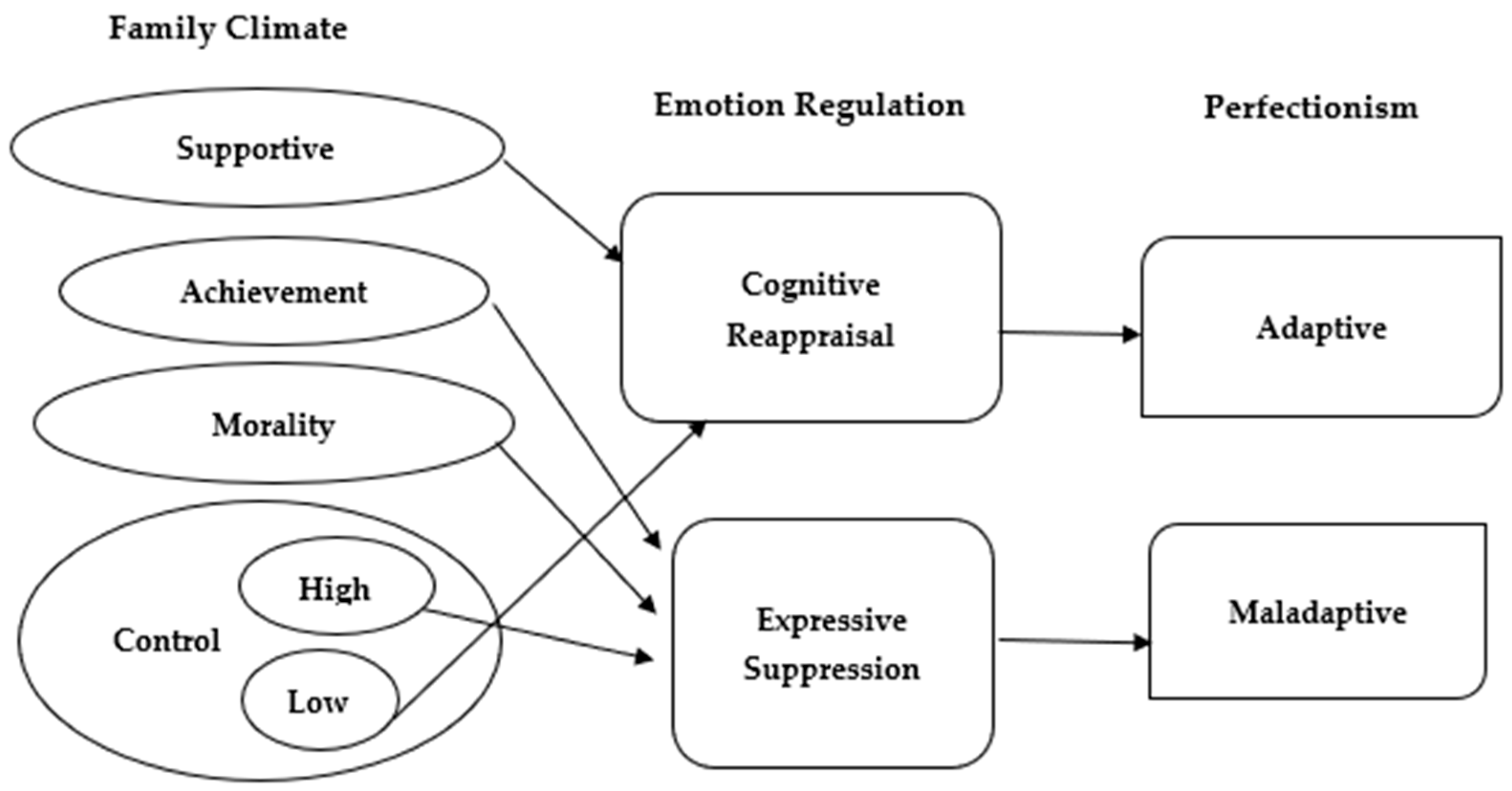
Based on the aforementioned research evidence [4,13,14,22] and the different theories of perfectionism, the present study aligns with a conceptual approach which posits a dynamic link where family climate (control, achievement, moral emphasis) and emotion regulation strategies (suppression and reappraisal) may influence perfectionism (especially its maladaptive form) (Figure 1). This framework is justified because a demanding family environment creates significant emotional pressure (e.g., anxiety, shame). Emotion regulation then functions as the critical mechanism by which individuals cope with this pressure. The family context shapes the individual’s habitual use of strategies; specifically, less adaptive coping (like suppression) may translate the external family demands into the internal distress characteristic of maladaptive perfectionism. Thus, emotion regulation and family dynamics impact on the development of perfectionistic tendencies.

1.4. Aim of the Present Study

As every behavior develops within a social context, children’s family environment plays a significant role to their adjustment and well-being [67]. Family climate has been found to be directly dependent on the environment, culture, and social norms [52,68], affecting parents’ attitudes about their children’s (mainly) academic success or failures. Thus, parents quite often oppress their children to set high standards and to achieve their goals, instilling in them that perfection is only way to reach success [3].
This research addresses a gap in the literature by exploring the links between family climate, emotion regulation, and perfectionism in school-aged children. Existing studies have primarily relied on the retrospective accounts of adults. Focusing on Greek families, this study will investigate how aspects of the family environment, including family relations, personal growth and family organization, and different emotion regulation strategies relate to and may predict children’s perfectionism, which often appears in academic settings [69,70].

2. Materials and Methods

2.1. Participants

One hundred and ninety-one (n = 191) Year 5, Year 6 and Year 7 students (50.8% girls, Mage = 11.27 years, SD = 0.97) from public primary and secondary schools of the broader area of Athens and the Peloponnese in Greece took part in the present study. Most participants (87.4%) reported having at least one sibling, lived in urban areas (80.1%), and their mothers (61.3%) and fathers (55.5%) had a university degree. A convenience sampling approach was utilized to recruit participants due to its feasibility for reaching the target population of school-aged children.

2.2. Measures

(a) The Frost Multidimensional Perfectionism Scale, FMPS [13], was administered to the participants. The FMPS is a widely used multidimensional self-report tool that assesses perfectionism and includes 35 items subsumed to six subscales: (i) Concern over Mistakes, with 9 items (9, 10, 13, 14, 18, 21, 23, 25, 34) reflecting a person’s negative response to making an error, their tendency to view a mistake as a complete failure, and as a result, their fear of losing respect from others (example item “I should be upset if I make a mistake”); (ii) Personal Standards, with 7 items (4, 6, 12, 16, 19, 24, 30), are about setting unrealistically high expectations and then using those expectations as the primary measure of one’s self-worth (example item “It is important to me that I be thoroughly competent in what I do”); (iii) Parental Expectations, with 5 items (1, 11, 15, 20, 26) describing a person’s tendency to perceive their parents as both setting very demanding goals and being excessively critical (example item “My parents set very high standards for me”); (iv) Parental Criticism, with 4 items (3, 5, 22, 35) elucidating individuals’ perceptions of their parents’ excessively critical behaviors (example item “My parents never tried to understand my mistakes”); (v) Doubts about actions, with 4 items (17, 28, 32, 33) assessing individuals’ tendency to doubt their own abilities, feel that tasks are never completed to a satisfactory degree and experience a constant sense of unease and a need to repeatedly check one’s work, as a complete sense of closure is elusive (example item “I usually have doubts about the simple everyday things that I do”) and (vi) Organization, with 6 items (2, 7, 8, 27, 29, 31) is characterized by an individual’s powerful preference for order and organization, highlighting their drive to have everything in a neat and systematic arrangement (example item “Organization is very important to me”). The Total Perfectionism Score is calculated as the sum of the scores of all relevant items, excluding the Organization Subscale (the 6 items belonging to the Organization subscale are not included in the calculation of the total perfectionism score) [13]. This suggests the total score is intended to primarily measure the dysfunctional or maladaptive aspects of perfectionism, as the Organization subscale is often considered to represent the more positive/adaptive dimension of the trait within this framework. Answers are given on a five-point Likert-type scale (1 = Strongly Disagree, 2 = Disagree, 3 = Neither Disagree nor Agree, 4 = Agree, 5 = Strongly Agree) and the potential range of FMPS total scores (when the Organization subscale is omitted) is between 29–145, with higher scores (closer to 145) indicating higher level of dysfunctional perfectionism. This interpretation is key, confirming the total score’s focus on maladaptive aspects (e.g., concern over mistakes, high personal standards, perceived parental pressure/criticism, and self-doubt). The internal consistency reliability coefficients, Cronbach’s alpha (α), for the FMPS subscales range between 0.77 and 0.93 while for the entire questionnaire is 0.90. The Cronbach’s alpha reliability coefficient of the questionnaire for the present study is 0.87.
(b) The Family Environmental Scale, FES [71], a self-report instrument, was used to assess perceptions of the climate of the family, as it measures the interpersonal relationships among family members on the directions of personal growth and on the basic organizational structure of the family. The FES and its Greek version [72] consist of 90 items in ten subscales, each of which consists of 9 items, exploring three dimensions of the family climate: (a) Family Relationships, (b) Personal Growth and (c) System Maintenance and Change in the family system. The Family Relations dimension includes three subscales: (1) cohesion (example item “Family members really help and support one another.”), (2) expressiveness (example item “We say whatever we want to around home.”), and (3) conflict (example item “Family members often criticize each other.”) in which the level of commitment and support between family members, the expression of emotions, and the level of conflict within the family are examined. The Personal Growth dimension is composed of five subscales: (1) independence (example item “In our family, we are encouraged to stand up for our rights.”), (2) achievement orientation (example item “Getting ahead in life is very important in our family.”), (3) intellectual-cultural orientation (example item “We often discuss political and social issues.”), (4) active-recreational orientation (example item “We often go to movies, sports events, or other entertainment together.”), and (5) moral-religious emphasis (example item “Moral and religious training is emphasized.”). Independence is about how much family members can be self-sufficient and make their own choices. Achievement Orientation reflects the family’s focus on competition and success. Intellectual-Cultural Orientation measures the family’s engagement with art, and cultural activities. Active-Recreational Orientation is about how much they participate in social and recreational activities. Finally, Moral-Religious Emphasis describes how much the family focuses on moral values and religion. The Family System Maintenance and Change dimension, in two subscales: (1) organization (example item “Being precise and neat is very important in our family.”) and (2) control (example item “There are very few rules to follow in our family.”), examines the organization and structure of the family system (i.e., rules and procedures imposed or followed by family members). The scoring for each subscale of the Family Environment Scale (FES) is exceptionally straightforward, relying on the summation of participants’ answers across the 9 items comprising that specific subscale. Each subscale is structured with 9 items utilizing a dichotomous (two-point) True/False response format, where items are scored as 0 or 1. A score of 1 is assigned when the participant’s response aligns with the presence of the construct being measured, and 0 otherwise. This methodology results in a total score range of 0 to 9 for every subscale. Scores close to 0 reflect that the participant’s description of their family environment aligns minimally with the construct measured by the subscale (e.g., extremely low Cohesion or low Expressiveness). Conversely, scores closer to 9 reflect that the participant has maximally endorsed items, indicating a strong presence of the construct (e.g., extremely high Cohesion or high Conflict). Ultimately, a higher subscale score indicates a greater perceived presence and strength of that specific dimension of the family environment. The scores for the three primary dimensions of the Family Climate—Family Relationships, Personal Growth, and System Maintenance and Change—are calculated by summing the scores of the individual subscales that belong to each dimension. Cronbach’s alpha (α) reliability coefficients of the FES subscales range from 0.64 to 0.79, while in the present study was 0.62. Although, the obtained α is below the conventional 0.70 threshold, we opted to retain the full scale because its utility lies in measuring broad, distinct dimensions of the family environment, a design choice where maximal internal consistency is often sacrificed for conceptual breadth [71].
(c) The Emotion Regulation Questionnaire for Children and Adolescence, ERQ-CA [73], adapted also in Greek [74], was used to assess participants’ emotion regulation strategies. It consists of 10 items and the scoring yields two separate subscale scores, both derived from the summation of item responses on a five-point Likert scale (1 = Never, 2 = Rarely, 3 = Sometimes, 4 = Often, 5 = Always). The first is the Cognitive Reappraisal Score, which is calculated by summing the scores from the six relevant items (items 1, 3, 5, 7, 8, and 10) (example item “When I want to feel happier, I think about something different.”). This score can range from a minimum of 6 to a maximum of 30, with a higher score indicating a greater reported use of the cognitive reappraisal emotion regulation strategy. The second is the Expressive Suppression Score, which is calculated by summing the scores from the remaining four items (items 2, 4, 6, and 9) (example item “I keep my emotions to myself.”). This score can range from a minimum of 4 to a maximum of 20, where a higher score signifies a greater reported tendency toward the expressive suppression strategy. In both cases, the raw scores from the specified items are directly added, and there are no reverse-scored items mentioned. The Cronbach’s alpha (α) internal consistency reliability coefficient of the ERQ-CA ranged from 0.82 to 0.86 for the cognitive reappraisal, and from 0.69 to 0.79 for expressive suppression for children aged between 10 and 18 years [68]. In the present study Cronbach’s alpha (α) reliability indices were found to be 0.70 for cognitive reappraisal and 0.57 for expressive suppression. Due to the expressive suppression subscale’s shortness (only 4 items), a lower α may be expected [75]. Adequate item homogeneity was confirmed by calculating for this specific subscale the Mean Inter-Item Correlation (MIIC), which was 0.26, falling within the acceptable range for a short form [75].

2.3. Procedure

The present study was carried out during the period between January and March 2020. The purpose of the study were communicated to the principals and the teachers’ associations of randomly selected schools. Parents of all students in each school received a letter presenting the purpose and the value of the research, along with a consent form to sign. Only students whose parents provided written informed consent participated in the study. Of the 357 parents approached via letters, 201 (56.3%) allowed their children to participate in the survey. Ten of these students did not complete the questionnaires, so the total number of the participants was 191. The evaluation procedure took place in a quite area in children’s schools, where their anonymity was guaranteed. All tasks were administered individually to each child by the second author, who also gave detailed instructions of how to complete each questionnaire and informed participants about the voluntary and confidential nature of the study. Extra clarifications were given to the students when required. The whole process lasted approximately 45 min.

3. Results

Table 1 presents descriptive statistics, including the mean (M), standard deviation (SD), minimum (min), and maximum (max) scores for all psychological measures examined in this study.
The results indicate that, on average, the participating children tend to perceive their families as having a relatively low level of conflict, high level of cohesion and an average level of expressiveness. For Personal Growth, mean scores indicate that children perceived their families as placing emphasis on recreational activities, intellectual and cultural experiences, independence fostering and achievement and less emphasis on morality or religion. Additionally, children tend to perceive their families as imposing average levels of control and higher levels of rules and organization. The results, also, suggest that children in this study are more likely to use cognitive strategies to deal with emotions rather than hiding their emotional expressions. Finally, children in the sample tend to set high personal standards and value organization more than they are concerned about making mistakes, whereas, on average, they do not perceive high levels of criticism from their parents.
Table 2 presents the correlations between children’s perceptions of perfectionism and various aspects of their family environment and emotion regulation. The results indicate several significant relationships, both positive and negative, across the different subscales.
The results revealed a significant negative correlation between family cohesion and most perfectionism subscales, particularly Concern over Mistakes (CM) and Parental Criticism (PC). This suggests that in families with a lower sense of togetherness or closeness, children tend to report higher levels of concern over mistakes and perceive more parental criticism. Conversely, there is a positive relationship between cohesion and the Organization (O) subscale, meaning that in more cohesive families, children are more likely to value order and organization. Similarly, a positive correlation was found between family conflict and most perfectionism subscales, including Concern over Mistakes (CM), Parental Expectations (PE), and Parental Criticism (PC). This indicates that higher levels of family conflict are associated with children who are more concerned about making mistakes and who perceive their parents as setting high expectations and being overly critical.
As regards personal growth and perfectionism, the results indicated a strong, positive correlation between achievement orientation in the family climate and several perfectionism subscales, most notably Personal Standards (PS) and Parental Expectations (PE). This suggests that when families place a high value on achievement, children are more likely to set high personal standards and perceive their parents as having high expectations. Both recreation and intellect-culture show significant negative correlations with several perfectionism subscales, especially Concern over Mistakes (CM) and Parental Criticism (PC). This suggests that in families that prioritize leisure activities and intellectual or cultural pursuits, children are less likely to be concerned about mistakes or perceive their parents as being critical. Moreover, the Morality-Religion subscale shows a positive correlation with multiple perfectionism subscales, including Personal Standards (PS) and Parental Expectations (PE), indicating that in families that emphasize morality and religion, children are more likely to set high standards for themselves and perceive high parental expectations.
As regards emotion regulation and tendency to perfectionism, it was found that the strategy of expressive suppression shows a significant positive correlation with every single perfectionism subscale. This is the most consistent and widespread finding in the table. It indicates that children who tend to hide or suppress their emotions are also more likely to be perfectionists, showing greater concern over mistakes, setting higher personal standards, and perceiving higher levels of parental expectations and criticism. Cognitive reappraisal, on the other hand, shows some weaker positive correlations, specifically with Personal Standards (PS) and Parental Expectations (PE). This suggests that children who use cognitive reappraisal (reinterpreting a situation to change its emotional impact) are slightly more likely to set high standards for themselves and perceive high parental expectations.
This study used a hierarchical regression analysis to determine if perfectionism traits in children are related to their family environment and emotion regulation strategies. Preliminary diagnostic checks confirmed that the assumptions of hierarchical regression were satisfied. Multicollinearity was not a concern (maximum VIF = 3.57), and the assumptions of normality and homoskedasticity of residuals were met as confirmed by visual inspection of plots and non-significant formal tests. Furthermore, no single observation exhibited undue influence on the model, with all Cook’s Distance values being below the conventional cut-off of 1.0. The analysis was run separately for total perfectionism scores. Family environment factors including family relations (cohesion, expressiveness and conflict), personal growth (independence, achievement, intellect/culture, recreation and morality/religion), and management-maintenance (organization and control) were entered in Step 1 of the regression, followed by emotion regulation strategies (cognitive reappraisal and expressive suppression in Step 2) (Table 3).
Based on the hierarchical regression analysis, certain family environment factors were found to be predictive of perfectionism in children. In the first step of the analysis, three specific aspects of the family environment—achievement orientation, moral/religious emphasis, and control—accounted for 28.3% of the variance in children’s perfectionism. This suggests that children are more likely to develop perfectionistic tendencies when their families place a high value on achievement, competition, success, and moral or religious values, and when they have a greater number of rules and procedures. In the second step, the addition of expressive suppression as an emotion regulation strategy contributed an additional 4% to the prediction, bringing the total explained variance to 32%. This indicates that the more a child tends to suppress their emotions, the more likely they are to exhibit perfectionistic behaviors.

4. Discussion

The present study sought to examine the intricate relationships between children’s perceptions of perfectionism and aspects of their family climate and their emotion regulation strategies, but also to determine the extent to which family climate and emotion regulation could predict these perceptions. The findings reveal a complex network of associations, elucidating the multifaceted nature of perfectionism in childhood and highlighting the crucial roles of family dynamics and emotional regulation processes in its development.
Correlations revealed several key findings. First, the statistically significant negative correlation between children’s overall perfectionism scores and family cohesion indicates that a stronger sense of family cohesion is associated with lower levels of perfectionism. This finding aligns with previous research indicating the protective role of family cohesion in children’s psychological well-being [26,28]. In cohesive families, members experience a sense of belonging, support, and emotional connectedness, which may buffer children against the pressure to strive for unrealistic standards and to seek validation through flawless performance [29]. These children may feel worthy, independent, and secure, limiting the need to engage in perfectionistic behaviors as a means of gaining approval and avoiding rejection [1]. This finding is further supported by work stating that adaptive perfectionists tend to have more balanced and cohesive family environments [28].
Conversely, the statistically significant positive correlation between children’s overall perfectionism scores and family conflict suggests that a more conflictual family environment is associated with higher levels of perfectionism. This finding agrees with previous research emphasizing that the exposure to interparental conflict can contribute to the development of perfectionism in children [24]. Frequent disagreements and tension in the family, may lead children to perceive perfectionism as a way to mediate conflict, gain parental attention, or maintain a sense of control over their environment, as they consider that achieving high standards and avoiding mistakes could minimize conflict and promote stability in their family [31]. Moreover, as previously suggested [42,43], children of perfectionist parents tend to seek flawlessness, to be overly careful, and to check their every action until they are completely satisfied, in order to eliminate the possibility of failure.
The study also revealed a significant positive correlation between children’s overall perfectionism scores and parental control, which strongly indicates that higher levels of parental control are associated with higher levels of perfectionism in children. This finding confirms previous research presenting the detrimental effects of controlling parenting styles on children’s psychological adjustment [22,31,32,33]. Parents who exert excessive control over their children’s lives may foster a sense of inadequacy and dependence, leading them to constantly doubt about their actions and abilities and being preoccupied with the possibility of mistakes [24,32,37]. These children will seek high personal standards and strive for perfection to meet their parents’ expectations [29] or to conform to their parents’ wishes, suppressing their own desires and interests in an attempt to gain approval [37,38,41,45,46].
The study also offers intriguing insights into the potential influence of moral and cultural values transmitted within the family environment on children’s perfectionistic tendencies. The positive correlation between the morality-religion subscale of the FES and children’s overall perfectionism underscores the importance of considering the role of moral values in shaping achievement-related behaviors. Thus, in families that place a strong emphasis on adherence to moral principles and religious beliefs, children may internalize these values and strive for perfection as a means of upholding these standards and avoiding moral transgressions [48]. Moreover, positive correlations between morality and concern over mistakes, as well as with parental criticism, imply that children could be exposed in intense psychological difficulties [3,4]. In line with previous research, the current findings also emphasize the degree to which perfectionists can either be influenced by the expectations of others or their own judgments which are affected by their culture [47,49]. Family members may perceive perfection as a way to be an integral part of their society [50]. The moral aspects of family climate cannot be detached from the cultural norms, as moral dimensions can be influenced by the socio-economic status and academic achievement [69]. This perspective highlights the importance of considering the broader cultural context in which perfectionism develops, as societal values and norms can shape individuals’ perceptions of success, failure, and the importance of adhering to moral standards. Furthermore, this study revealed significant associations between children’s personal growth and parental expectations, as well as achievement, parental expectation, morality, and system maintenance, indicating that the cultural context and the values that are important for the society have a great effect on the development of perfectionism [47,48,49,50]. The results suggest that the degree of discrepancy children perceive between their personal standards and their actual performance is greatly dependent on certain parental behaviors or characteristics, such as the psychological control, the lack of nurturance and affection, and low provision of care combined with the demand for high performance and authoritarianism [29,31,33,37].
A significant positive correlation was observed between children’s overall perfectionism scores and expressive suppression, suggesting that children who tend to suppress their emotions are more likely to exhibit perfectionistic behaviors. This finding aligns with previous research indicating that expressive suppression is a maladaptive emotion regulation strategy with negative consequences for psychological well-being [53,54,60]. It could be suggested that children suppress their emotions in an attempt to avoid negative evaluation or to maintain a flawless image. However, this strategy can ultimately lead them to increased emotional distress, impaired social functioning, and heightened risk for mental health problems [58,59]. The family environment plays a significant role on children’s emotion regulation, especially when family members consciously or unconsciously express thoughts and feelings that are transformed into attitudes and behaviors, which shape the family climate [51,52]. However, the present study failed find a significant relationship between cognitive reappraisal and overall perfectionism. While previous research has suggested that cognitive reappraisal may be associated with lower levels of maladaptive perfectionism [58,59,60], our results did not support this relationship. This discrepancy may be due to the age of the participants, as cognitive reappraisal requires higher-order cognitive skills that may have not been fully developed in the children consisting our sample, or to the multidimensional nature of perfectionism itself, given that parental expectations and personal standards and growth were the only dimensions significantly related to cognitive reappraisal.
The results, also, revealed that variance in children’s perfectionism is partially explained by certain aspects of family climate and emotion regulation strategies, suggesting that the atmosphere at home is a powerful shaper of a child’s psychological development [25,26]. Achievement orientation, moral/religious emphasis and family control together were found to explain significantly almost 30% of the variance in children’s perception about perfectionisms. These findings are consistent with prior studies linking achievement-oriented parenting styles to increased pressure on children to succeed [30,33]. When a family places a strong emphasis on success, competition, and high achievement, children may internalize the belief that their worth is conditional on their performance. This translates to perfectionistic concerns as the child perceives that mistakes equate to a loss of approval or love. The gap between the ‘actual self’ (making a mistake) and the ‘ideal self’ (the perfect, approved child) creates intense anxiety and pressure to meet impossibly high standards, leading to a profound fear of failure and excessive self-criticism [30,33]. Furthermore, in conjunction to the previous research, it was proven that parental expectations have a great impact on children who tend to adopt them, as they place great importance on their parents’ wishes [44]. The outcomes further support the notion that ethical behaviors play a significant role in shaping individuals’ perceptions of success and in promoting perfectionism by setting high standards [47,48,69]. A family environment with a strong moral or religious emphasis can contribute to perfectionism by establishing absolute, non-negotiable standards of behavior. This fosters a specific type of perfectionism driven by a fear of transgression or moral failure, rather than purely academic or social standards. Children may feel a need to be morally perfect, manifesting rigid thinking regarding right and wrong, leaving no room for the normal ambiguity or imperfection inherent in human ethical development [47,48,69]. The hierarchical regression analysis then revealed that high degree of parental control, characterized by numerous rules and procedures, made a statistically significant contribution to the prediction of children’s perfectionism. This aligns with previous research showing that controlling parenting styles are associated with higher levels of maladaptive perfectionism [1,31,32,37,38]. When children have little autonomy and are constantly regulated, their internal locus of control is diminished. They learn that outcomes are determined by external regulation rather than their own competence. Perfectionism becomes a learned external regulatory strategy—a way to preemptively meet external demands and avoid the unpredictability of parental enforcement or criticism. This directly undermines the development of intrinsic motivation necessary for healthy goal pursuit [1,31,32,37,38]. In essence, these three factors (achievement orientation, moral/religious emphasis, family control) combine to create a high-pressure environment where a child learns that their value is contingent on their flawless performance, strict adherence to rules, and moral uprightness. Finally, the inclusion of expressive suppression highlights that perfectionism is not just about doing things perfectly, but about appearing perfect [63,64,65]. Emotion suppression is a behavioral manifestation of the need to maintain an unblemished external façade. If a child internalizes the family’s high standards (Achievement/Moral/Control), showing any negative emotion (sadness, frustration, anxiety) is perceived as an admission of falling short of that standard. Therefore, suppression be-comes a maladaptive cognitive-behavioral loop that reinforces the perfectionistic drive to hide imperfection at great internal cost. In conclusion, these results highlight a powerful, interactive mechanism for perfectionism development. The familial conditions that prioritize achievement, morality, and control establish the external scaffolding of high standards and conditional acceptance, setting the stage for perfectionism. The learned emotional response (i.e., expressive suppression) acts as the critical maintenance strategy, ensuring the child adheres to this high-pressure environment by masking any evidence of failure or struggle and maintaining an image of flawlessness. This combination explains the variance by showing that perfectionism arises from both external demands and internalized, rigid coping strategies [25,26].
The findings of this study provide strong correlational support for a conceptual framework linking family dynamics, emotion regulation strategies, and perfectionism. Consistent results demonstrate significant associations among family climate factors, emotion regulation, and perfectionism. The study thus validates key theoretical predictions by showing that external environmental pressures from the family are reliably linked to specific internal behavioral coping mechanisms. This integration illustrates that perfectionism is associated with a cycle where environmental demands align with the use of particular emotional management strategies.
The findings of this study have several important theoretical and practical implications. From a theoretical perspective, the results contribute to our understanding of the complex interplay between family dynamics, emotion regulation, and the development of perfectionism in children. By highlighting the roles of family climate, parental control, and expressive suppression, this study provides further support for the social-contextual model of perfectionism [4,22], which emphasizes the importance of considering the social and environmental factors that contribute to the development of perfectionistic behaviors. From a practical perspective, the findings suggest that interventions aimed at reducing maladaptive perfectionism should focus on promoting supportive family environments and adaptive emotion regulation skills. As it has been suggested in previous research [41,42], to prevent the development of perfectionism in children, parents should adopt attitudes and behaviors that encourage open communication, mutual support, and emotional expressiveness within their families. Additionally, children should be taught effective emotion regulation strategies, such as cognitive reappraisal, which can help them manage their emotions in a healthy and adaptive manner. School-based interventions could also play a role in promoting supportive peer relationships and fostering a more balanced perspective on achievement.
Despite its valuable contributions, the present study has several limitations that should be acknowledged. As previously mentioned, the cross-sectional design of the study limits our ability to draw causal inferences about the relationships between the variables. Longitudinal studies are needed to examine the developmental trajectories of perfectionism and to identify the factors that contribute to its emergence and maintenance over time and to establish the temporal precedence and directionality of these relationships. Second, the reliance on self-report measures may be subject to biases, such as social desirability bias or recall bias, which could have influenced participants’ responses. Future studies could benefit from incorporating multiple methods of data collection, such as observational measures of family interactions and emotion regulation, as well as reports from parents and teachers. Given the modest internal consistency of the FES, the observed relationships may be attenuated, requiring that the current findings be interpreted with appropriate caution. Subsequent research should address this measurement issue by validating the FES within this population of children or by considering alternative measures of the family environment to enhance validity. Furthermore, the sample was drawn from a relatively homogenous cultural and educational background, which may limit the generalizability of the findings to other populations. For example, by not having lower educational strata represented, it is not possible to statistically isolate the unique influence of low vs. high parental education on the outcomes. While our regression analyses successfully identified the specific impact of achievement orientation, moral emphasis, and family control on children’s perfectionism within this group, the generalizability of these findings is constrained, as we cannot ascertain how these relationships might differ across socioeconomic strata. Future research should incorporate a more cultural and educational diverse sample to test the robustness of these family climate predictors across a broader spectrum of backgrounds. Research should also explore the potential moderating and mediating factors that may influence the relationship between family climate, emotion regulation, and perfectionism. For example, cultural factors, gender, and individual differences in temperament may play a role in shaping the development of perfectionism.

5. Conclusions

In conclusion, the findings of this study provide valuable insights into the complex interplay of family climate, emotion regulation, and perfectionism in children. The results highlight the importance of fostering a cohesive and supportive family environment, as well as promoting adaptive emotion regulation strategies, in reducing the risk of maladaptive perfectionism. These findings have implications for prevention and intervention efforts aimed at promoting children’s psychological well-being and fostering healthy development. By creating supportive and accepting family environments, parents can help children develop a more balanced perspective on achievement and reduce the pressure to strive for unrealistic standards. Further research is required to examine the developmental trajectories of perfectionism and to identify the factors responsible for its emergence and maintenance over time.

Author Contributions

Conceptualization, K.A., S.K., N.A. and D.A.A.; methodology, K.A. and N.A.; formal analysis, K.A. and N.A.; writing—original draft preparation, S.K. and K.A.; writing—review and editing, K.A. and S.K.; data curation, K.A. and S.K.; visualization, K.A. and S.K.; supervision, K.A.; project administration, K.A. All authors have read and agreed to the published version of the manuscript.

Funding

This research received no external funding.

Institutional Review Board Statement

Notwithstanding the lack of formal committee review, all procedures were performed in accordance with the ethical standards relevant to human research prevalent during the study period and were in compliance with the principles set forth in the Declaration of Helsinki regarding the protection of privacy and welfare. All data utilized were anonymized/de-identified and handled with strict confidentiality.

Informed Consent Statement

Written informed consent was obtained from the parents of all subjects involved in the study.

Data Availability Statement

The original contributions presented in this study are included in the article. Further inquiries can be directed to the corresponding author.

Conflicts of Interest

The authors declare no conflicts of interest.

Abbreviations

The following abbreviations are used in this manuscript:
MPSMultidimensional Perfectionism Scale
FESFamily Environmental Scale
ERQ-CAEmotion Regulation Questionnaire for Children and Adolescence

References

  1. Craddock, A.E.; Church, W.; Sands, A. Family of origin characteristics as predictors of perfectionism. Aust. J. Psychol. 2009, 61, 136–144. [Google Scholar] [CrossRef]
  2. Flett, G.L.; Hewitt, P.L. Reflections on three decades of research on multidimensional perfectionism: An introduction to the special issues on further advances in the assessment of perfectionism. J. Psychoeduc. Assess. 2020, 38, 3–14. [Google Scholar] [CrossRef]
  3. Curran, T.; Hill, A.P. Perfectionism is increasing over time: A meta-analysis of birth cohort differences from 1989 to 2016. Psychol. Bull. 2019, 145, 410–429. [Google Scholar] [CrossRef] [PubMed]
  4. Hewitt, P.L.; Flett, G.L.; Mikail, S.F. Perfectionism: A Relational Approach to Conceptualization, Assessment, and Treatment; Guilford Publications: New York, NY, USA, 2017. [Google Scholar]
  5. Lunn, J.; Greene, D.; Callaghan, T.; Egan, S.J. Associations between perfectionism and symptoms of anxiety, obsessive-compulsive disorder and depression in young people: A meta-analysis. Cogn. Behav. Ther. 2023, 52, 460–487. [Google Scholar] [CrossRef]
  6. Roxborough, H.M.; Hewitt, P.L.; Kaldas, J.; Flett, G.L.; Caelian, C.M.; Sherry, S.; Sherry, D.L. Perfectionistic self-presentation, socially prescribed perfectionism, and suicide in youth: A test of the perfectionism social disconnection model. Suicide Life-Threat. Behav. 2012, 42, 217–233. [Google Scholar] [CrossRef]
  7. Sirois, F.M.; Molnar, D.S. (Eds.) Perfectionism, Health, and Well-Being; Springer: New York, NY, USA, 2016. [Google Scholar]
  8. Stoeber, J.; Gaudreau, P. The advantages of partialling perfectionistic strivings and perfectionistic concerns: Critical issues and recommendations. Personal. Individ. Differ. 2017, 104, 379–386. [Google Scholar] [CrossRef]
  9. Limburg, K.; Watson, H.J.; Hagger, M.S.; Egan, S.J. The relationship between perfectionism and psychopathology: A meta-analysis. J. Clin. Psychol. 2017, 73, 1301–1326. [Google Scholar] [CrossRef]
  10. Hamachek, D.E. Psychodynamics of normal and neurotic perfectionism. Psychol. J. Hum. Behav. 1978, 15, 27–33. [Google Scholar]
  11. Rhéaume, J.; Freeston, M.H.; Ladouceur, R.; Bouchard, C.; Gallant, L.; Talbot, F.; Vallières, A. Functional and dysfunctional perfectionists: Are they different on compulsive-like behaviors? Behav. Res. Ther. 2000, 38, 119–128. [Google Scholar] [CrossRef]
  12. Rice, K.G.; Ashby, J.S.; Slaney, R.B. Perfectionism and the five-factor model of personality. Assessment 2007, 14, 385–398. [Google Scholar] [CrossRef]
  13. Frost, R.O.; Marten, P.; Lahart, C.; Rosenblate, R. The dimensions of perfectionism. Cogn. Ther. Res. 1990, 14, 449–468. [Google Scholar] [CrossRef]
  14. Hewitt, P.L.; Flett, G.L. Perfectionism in the self and social contexts: Conceptualization, assessment, and association with psychopathology. J. Personal. Soc. Psychol. 1991, 60, 456–470. [Google Scholar] [CrossRef]
  15. Flett, G.L.; Hewitt, P.L. Perfectionism and maladjustment: An overview of theoretical, definitional, and treatment issues. In Perfectionism: Theory, Research, and Treatment; Flett, G.L., Hewitt, P.L., Eds.; American Psychological Association: Washington, DC, USA, 2002; pp. 5–31. [Google Scholar]
  16. Flett, G.L.; Russo, F.A.; Hewitt, P.L. Dimensions of perfectionism and constructive thinking as a coping response. J. Ration.-Emotive Cogn.-Behav. Ther. 1994, 12, 163–179. [Google Scholar] [CrossRef]
  17. Hill, R.W.; Huelsman, T.J.; Araujo, G. Perfectionistic concerns suppress associations between perfectionistic strivings and positive life outcomes. Personal. Individ. Differ. 2010, 48, 584–589. [Google Scholar] [CrossRef]
  18. Frost, R.O.; Heimberg, R.G.; Holt, C.S.; Mattia, J.I.; Neubauer, A.L. A comparison of two measures of perfectionism. Personal. Individ. Differ. 1993, 14, 119–126. [Google Scholar] [CrossRef]
  19. Hill, A.P.; Curran, T. Multidimensional Perfectionism and Burnout: A Meta-Analysis. Pers Soc Psychol Rev. 2016, 20, 269–288. [Google Scholar] [CrossRef]
  20. Flett, G.L.; Hewitt, P.L. The Perils of Perfectionism in Sports and Exercise. Curr. Dir. Psychol. Sci. 2005, 14, 14–18. [Google Scholar] [CrossRef]
  21. Benson, E. The many faces of perfectionism. Monit. Psychol. 2003, 34, 18. [Google Scholar]
  22. Flett, G.L.; Hewitt, P.L.; Oliver, J.M.; Macdonald, S. Perfectionism in children and their parents: A developmental analysis. In Perfectionism: Theory, Research, and Treatment; Flett, G.L., Hewitt, P.L., Eds.; American Psychological Association: Washington, DC, USA, 2002; pp. 89–132. [Google Scholar]
  23. Chen, C.; Hewitt, P.L.; Flett, G.L. Adverse childhood experiences and multidimensional perfectionism in young adults. Personal. Individ. Differ. 2019, 146, 53–57. [Google Scholar] [CrossRef]
  24. Gong, X.; Paulson, S.E.; Wang, C. Exploring family origins of perfectionism: The impact of interparental conflict and parenting behaviors. Personal. Individ. Differ. 2016, 100, 43–48. [Google Scholar] [CrossRef]
  25. Cox, M.J.; Paley, B. Understanding Families as Systems. Curr. Dir. Psychol. Sci. 2003, 12, 193–196. [Google Scholar] [CrossRef]
  26. Rasmussen, K.E.; Troilo, J. “It has to be perfect!”: The development of perfectionism and the family system. J. Fam. Theory Rev. 2016, 8, 154–172. [Google Scholar] [CrossRef]
  27. Aristotle. Politics: Zitros, 2006 with Aristotle. In The Politics; Barker, E.; Stalley, R.F., Translators; Oxford University Press: New York, NY, USA, 2009; pp. 1–423. [Google Scholar]
  28. Segrin, C.; Kauer, T.B.; Burke, T.J. Indirect Effects of Family Cohesion on Emerging Adult Perfectionism Through Anxious Rearing and Social Expectations. J. Child Fam. Stud. 2019, 28, 2280–2285. [Google Scholar] [CrossRef]
  29. DiPrima, A.J.; Ashby, J.S.; Gnilka, P.B.; Noble, C.L. Family relationships and perfectionism in middle-school students. Psychol. Sch. 2011, 48, 815–827. [Google Scholar] [CrossRef]
  30. Spera, C. A Review of the Relationship Among Parenting Practices, Parenting Styles, and Adolescent School Achievement. Educ. Psychol. Rev. 2005, 17, 125–146. [Google Scholar] [CrossRef]
  31. Hibbard, D.R.; Walton, G.E. Exploring the development of perfectionism: The influence of parenting style and gender. Soc. Behav. Personal 2014, 42, 269–278. [Google Scholar] [CrossRef]
  32. Soenens, B.; Luyckx, K.; Vansteenkiste, M.; Luyten, P.; Duriez, B.; Goossens, L. Maladaptive perfectionism as an intervening variable between psychological control and adolescent depressive symptoms: A three-wave longitudinal study. J. Fam. Psychol. 2008, 22, 465–474. [Google Scholar] [CrossRef] [PubMed]
  33. Neumeister, K.L.S.; Williams, K.K.; Cross, T.L. Gifted high-school students’ perspectives on the development of perfectionism. Roeper Rev. 2009, 31, 198–206. [Google Scholar] [CrossRef]
  34. Baumrind, D. Current patterns of parental authority. Dev. Psychol. 1971, 4, 1–103. [Google Scholar] [CrossRef]
  35. Antonopoulou, K.; Tsitsas, G. The investigation of the parenting typology of the Greek mother. Evaluation of the Parenting Styles and Dimensions Questionnaire (PSDQ). Educ. Sci. 2011, 2, 51–60. (In Greek) [Google Scholar]
  36. Antonopoulou, K.; Alexopoulos, D.A.; Maridaki-Kassotaki, K. Perceptions of Father Parenting Style, Empathy, and Self-Esteem Among Greek Preadolescents. Marriage Fam. Rev. 2012, 48, 293–309. [Google Scholar] [CrossRef]
  37. Soenens, B.; Elliot, A.J.; Goossens, L.; Vansteenkiste, M.; Luyten, P.; Duriez, B. The intergenerational transmission of perfectionism: Parents’ psychological control as an intervening variable. J. Fam. Psychol. 2005, 19, 358–366. [Google Scholar] [CrossRef]
  38. Smith, M.M.; Sherry, S.B.; Gautreau, C.M.; Mushquash, A.R.; Saklofske, D.H.; Snow, S.L. The intergenerational transmission of perfectionism: Fathers’ other-oriented perfectionism and daughters perceived psychological control uniquely predict daughters’ self-critical and personal standards perfectionism. Personal. Individ. Differ. 2017, 119, 242–248. [Google Scholar] [CrossRef]
  39. Appleton, P.R.; Hall, H.K.; Hill, A.P. Family patterns of perfectionism: An examination of elite junior athletes and their parents. Psychol. Sport Exerc. 2010, 11, 363–371. [Google Scholar] [CrossRef]
  40. Chang, E.C. Perfectionism as a predictor of positive and negative psychological outcomes: Examining a mediation model in younger and older adults. J. Couns. Psychol. 2000, 47, 18–26. [Google Scholar] [CrossRef]
  41. Damian, L.E.; Negru-Subtirica, O.; Pop, E.I.; Stoeber, J. Becoming a perfectionistic adolescent: Perceived parental behaviors involved in developmental trajectories of perfectionism. Eur. J. Personal. 2022, 36, 24–46. [Google Scholar] [CrossRef]
  42. Cook, L.C.; Kearney, C.A. Parent and youth perfectionism and internalizing psychopathology. Personal. Individ. Differ. 2009, 46, 325–330. [Google Scholar] [CrossRef]
  43. Frost, R.O.; Lahart, C.M.; Rosenblate, R. The development of perfectionism: A study of daughters and their parents. Cogn. Ther. Res. 1991, 15, 469–489. [Google Scholar] [CrossRef]
  44. Wang, K.T. The Family Almost Perfect Scale: Development, psychometric properties, and comparing Asian and European Americans. Asian Am. J. Psychol. 2010, 1, 186–199. [Google Scholar] [CrossRef]
  45. Damian, L.E.; Stoeber, J.; Negru, O.; Băban, A. On the development of perfectionism in adolescence: Perceived parental expectations predict longitudinal increases in socially prescribed perfectionism. Personal. Individ. Differ. 2013, 55, 688–693. [Google Scholar] [CrossRef]
  46. Rice, K.G.; Lopez, F.G.; Vergara, D. Parental/social influences on perfectionism and adult attachment orientations. J. Soc. Clin. Psychol. 2005, 24, 580–605. [Google Scholar] [CrossRef]
  47. Walton, G.E.; Hibbard, D.R.; Coughlin, C.; Coyl-Shepherd, D.D. Parenting, personality, and culture as predictors of perfectionism. Curr. Psychol. 2020, 39, 681–693. [Google Scholar] [CrossRef]
  48. Jiang, Y.; Konorova, E. Distinct roles of self-oriented and socially prescribed perfectionism in Chinese adolescent students’ achievement goals, classroom affect, and academic achievement. Learn. Individ. Differ. 2023, 106, 102341. [Google Scholar] [CrossRef]
  49. Krumov, K.D.; Larsen, K.S.; Gungov, A.L.; Liu, J.; Schneider, J.F.; Kemmelmeier, M.; Krumova, A.; Widodo, E.; Juhasz, M.; Garvanova, M.; et al. Cross cultural and gender differences as predictors of workaholic and perfectionist attitudes during the COVID-19 pandemic. Nanotechnol. Percept. 2023, 19, 41–67. [Google Scholar] [CrossRef]
  50. Yang, H.; Stoeber, J.; Wang, Y. Moral perfectionism and moral values, virtues, and judgments: A preliminary investigation. Personal. Individ. Differ. 2015, 75, 229–233. [Google Scholar] [CrossRef]
  51. Paley, B.; Hajal, N.J. Conceptualizing Emotion Regulation and Coregulation as Family-Level Phenomena. Clin. Child Fam. Psychol. Rev. 2022, 25, 19–43. [Google Scholar] [CrossRef]
  52. Caspi, A.; Moffitt, T.E.; Morgan, J.; Rutter, M.; Taylor, A.; Arseneault, L.; Tully, L.; Jacobs, C.; Kim-Cohen, J.; Polo-Tomas, M. Maternal expressed emotion predicts children’s antisocial behavior problems: Using monozygotic-twin differences to identify environmental effects on behavioral development. Dev. Psychol. 2004, 40, 149–161. [Google Scholar] [CrossRef]
  53. Morris, A.S.; Silk, J.S.; Steinberg, L.; Myers, S.S.; Robinson, L.R. The Role of the Family Context in the Development of Emotion Regulation. Soc. Dev. 2007, 16, 361–388. [Google Scholar] [CrossRef]
  54. Gross, J.J. Handbook of Emotion Regulation, 2nd ed.; Guilford Press: New York, NY, USA, 2014. [Google Scholar]
  55. Davies, P.T.; Woitach, M.J. Children’s emotional security in the interparental relationship. Curr. Dir. Psychol. Sci. 2008, 17, 269–274. [Google Scholar] [CrossRef]
  56. Darling, N.; Steinberg, L. Parenting style as context: An integrative model. Psychol. Bull. 1993, 113, 487–496. [Google Scholar] [CrossRef]
  57. Davies, P.T.; Harold, G.T.; Goeke-Morey, M.C.; Cummings, E.M.; Shelton, K.; Rasi, J.A. Child emotional security and interparental conflict. Monogr. Soc. Res. Child Dev. 2002, 67, 1–115. [Google Scholar] [CrossRef]
  58. Eisenberg, N.; Valiente, C.; Morris, A.S.; Fabes, R.A.; Cumberland, A.; Reiser, M.; Gershoff, E.T.; Shepard, S.A.; Losoya, S. Longitudinal relations among parental emotional expressivity, children’s regulation, and quality of socioemotional functioning. Dev. Psychol. 2003, 39, 3–19. [Google Scholar] [CrossRef]
  59. Valiente, C.; Fabes, R.A.; Eisenberg, N.; Spinrad, T.L. The relations of parental expressivity and support to children’s coping with daily stress. J. Fam. Psychol. 2004, 18, 97–106. [Google Scholar] [CrossRef] [PubMed]
  60. John, O.P.; Gross, J.J. Healthy and unhealthy emotion regulation: Personality processes, individual differences, and life span development. J. Personal. 2004, 72, 1301–1333. [Google Scholar] [CrossRef] [PubMed]
  61. Wang, Y.X.; Yin, B. A new understanding of the cognitive reappraisal technique: An extension based on the schema theory. Front. Behav. Neurosci. 2023, 17, 1174585. [Google Scholar] [CrossRef]
  62. Lunkenheimer, E.S.; Shields, A.M.; Cortina, K.S. Parental emotion coaching and dismissing in family interaction. Soc. Dev. 2007, 16, 232–248. [Google Scholar] [CrossRef]
  63. Vois, D.; Damian, L.E. Perfectionism and emotion regulation in adolescents: A two-wave longitudinal study. Personal. Individ. Differ. 2020, 156, 109756. [Google Scholar] [CrossRef]
  64. Richardson, C.M.; Rice, K.G.; Devine, D.P. Perfectionism, emotion regulation, and the cortisol stress response. J. Couns. Psychol. 2014, 61, 110–118. [Google Scholar] [CrossRef]
  65. Rice, K.G.; Suh, H.; Davis, D.E. Perfectionism and emotion regulation. In The Psychology of Perfectionism: Theory, Research, Application; Stoeber, J., Ed.; Routledge: New York, NY, USA, 2018; pp. 243–262. [Google Scholar]
  66. Stoeber, J.; Stoeber, F. Domains of perfectionism: Prevalence and relationships with perfectionism, gender, age, and satisfaction with life. Personal. Individ. Differ. 2009, 46, 530–535. [Google Scholar] [CrossRef]
  67. Hughes, D.J.; Kratsiotis, I.K.; Niven, K.; Holman, D. Personality traits and emotion regulation: A targeted review and recommendations. Emotion 2020, 20, 63–67. [Google Scholar] [CrossRef]
  68. Castro, J.R.; Rice, K.G. Perfectionism and ethnicity: Implications for depressive symptoms and self-reported academic achievement. Cultur. Divers. Ethn. Minor. Psychol. 2003, 9, 64–78. [Google Scholar] [CrossRef]
  69. Chao, R.K. Extending research on the consequences of parenting style for Chinese Americans and European Americans. Child Dev. 2001, 72, 1832–1843. [Google Scholar] [CrossRef]
  70. McArdle, S. Exploring domain-specific perfectionism. J. Personal. 2010, 78, 493–508. [Google Scholar] [CrossRef]
  71. Moos, R.H.; Moos, B.S. Family Environment Scale Manual: Development, Applications, Research; Mind Garden, Inc.: Palo Alto, CA, USA, 2002. [Google Scholar]
  72. Charalampous, K.; Kokkinos, C.M.; Panayiotou, G. The Family Environment Scale: Resolving psychometric problems through an examination of a Greek translation. Int. J. Educ. Psychol. Assess. 2013, 13, 81–99. [Google Scholar]
  73. Gullone, E.; Taffe, J. The Emotion Regulation Questionnaire for Children and Adolescents (ERQ-CA): A psychometric evaluation. Psychol. Assess. 2012, 24, 409–417. [Google Scholar] [CrossRef] [PubMed]
  74. Kafetsios, K.; Loumakou, M. A Comparative evaluation of the effects of trait emotional intelligence and emotion regulation on affect at work and job satisfaction. Int. J. Work Organ. Emot. 2007, 2, 71–87. [Google Scholar] [CrossRef]
  75. Clark, L.A.; Watson, D. Constructing validity: Basic issues in objective scale development. Psychol. Assess. 1995, 7, 309–319. [Google Scholar] [CrossRef]
Figure 1. Conceptual framework of the present study (based on previous evidence) [4,13,14,22].
Future 04 00002 g001
Table 1. Descriptive statistics (n = 191).
MSDMinMax
Family Environmental Scale
Family Relations—total15.102.48721
 cohesion7.311.7419
 expressiveness5.141.4529
 conflict2.651.7908
Personal Growth—total25.134.581337
 independence5.141.2328
 achievement4.871.5519
 intellect-culture5.281.9019
 recreation5.942.0109
 morality-religion3.881.9809
Management/maintenance—total10.742.67219
 organization5.951.7309
 control4.781.8419
Emotion Regulation Questionnaire for Children/Adolescence
 cognitive reappraisal20.144.35830
 expressive suppression10.063.36420
Multidimensional Perfectionism Scale
 Concern over Mistakes18.455.56939
 Personal Standards23.604.69935
 Parental Expectations14.544.08525
 Parental Criticism8.082.87417
 Doubts about actions10.952.79519
 Organization22.674.57630
 Total Perfectionism score75.6214.1329131
Table 2. Correlations among children’s perceptions about perfectionism, family climate and emotion regulation.
Multidimensional Perfectionism Scale
CMPSPEPCDOTotal
Family Environmental Scale
Family Relations—total−0.1030.0950.003−0.193 **−0.0580.092−0.059
 cohesion−0.283 **0.141−0.088−0.353 **−0.1290.213 **−0.187 **
 expressiveness−0.133−0.024−0.084−0.200 **−0.0260.029−0.131
 conflict0.239 **0.0150.157 *0.237 **0.066−0.1020.206 **
Personal Growth—total−0.0150.247 **0.097−0.136−0.0410.0990.068
 independence−0.1160.123−0.040−0.148 *−0.0760.087−0.061
 achievement0.275 **0.356 **0.443 **0.1250.0920.171 *0.398 **
 intellect-culture−0.1080.003−0.178 *−0.244 **−0.071−0.032−0.156 *
 recreation−0.246 **−0.046−0.202 **−0.256 **−0.146 *−0.085−0.251 **
 morality-religion0.181 *0.260 **0.278 **0.173 *0.1000.160 *0.292 **
Management/maintenance—total0.193 **0.320 **0.227 **0.0730.1260.271 **0.287 **
 organization0.0130.247 **0.087−0.0850.0290.278 **0.101
 control0.287 **0.267 **0.270 **0.194 **0.169 *0.161 *0.352 **
Emotion Regulation Questionnaire for Children/Adolescence
 cognitive reappraisal−0.0740.144 *0.167 *−0.0130.0050.0520.065
 expressive suppression0.237 **0.187 **0.220 **0.352 **0.372 **0.193 **0.364 **
** p < 0.01, * p < 0.05 Note: CM = Concern over Mistakes, PS = Personal Standards, PE = Parental Expectations, PC = Parental Criticism, D = Doubts about actions, O = Organization.
Table 3. Regression analysis to predict children’s perceptions of perfectionism from (a) family climate and (b) emotion regulation.
VariableβtFR2ΔR2ΔF
Total Perfectionism score
Step 1 8.480.320.328.48 **
 Family Relations—cohesion−0.09−1.21
 Family Relations—expressiveness−0.03−0.44
 Family Relations—conflict0.091.29
 Personal Growth—independence0.010.02
 Personal Growth—achievement0.334.88 **
 Personal Growth—intellect/culture−0.11−1.30
 Personal Growth—recreation−0.07−0.86
 Personal Growth—morality/religion0.213.10 **
 Management/maintenance—organization0.050.64
 Management/maintenance—control0.141.87 *
Step 2 8.440.360.045.89 **
 Family Relations—cohesion−0.07−0.84
 Family Relations—expressiveness−0.02−0.36
 Family Relations—conflict0.091.14
 Personal Growth—independence−0.01−0.16
 Personal Growth—achievement0.294.38 **
 Personal Growth—intellect/culture−0.11−1.44
 Personal Growth—recreation−0.03−0.32
 Personal Growth—morality/religion0.192.81 **
 Management/maintenance—organization0.030.44
 Management/maintenance—control0.141.99 *
 Emotion Regulation—cognitive reappraisal0.040.67
 Emotion Regulation—expressive suppression0.213.33 **
* p < 0.05, ** p < 0.01.
Disclaimer/Publisher’s Note: The statements, opinions and data contained in all publications are solely those of the individual author(s) and contributor(s) and not of MDPI and/or the editor(s). MDPI and/or the editor(s) disclaim responsibility for any injury to people or property resulting from any ideas, methods, instructions or products referred to in the content.