Abstract
Chickens possess a well-developed vision that allows them to perceive a wide range of the color spectrum. In addition, they display an inherent sensitivity toward specific light spectra, which suggests that coloring feed could influence feed preference, feed intake and growth performance. This trial assessed the effect of feed coloring on broiler feed color preferences. A total of 216 day-old Cobb by-product males were randomly distributed into 18 battery cages, each containing 12 chicks and subjected to three dietary treatments from 1 to 21 days, resulting in six replicates per dietary treatment. Feed color treatments consisted of a common corn–soybean meal-based undyed basal (UB) broiler starter diet, which was dyed to obtain blue-colored (B) and purple-colored (P) diets, resulting in a total of three diets used to create the feed combinations. Two feed troughs were affixed to each cage, allowing for the assignment of dietary treatments as follows: UB-B, UB-P, and B-P. The birds had ad libitum access to feed and water throughout the study. Feed consumption data were collected at 7-day intervals. Additionally, bird weights were measured at 1 and 21 days. The data were analyzed as a completely randomized design using the SAS GLIMMIX and TTEST procedures. Overall, broilers exhibited a preference for the UB diet compared to the B and P diets. Broilers had a 27.5 and 29.2% higher (p < 0.05) feed consumption of UB feed compared to P feed from 1 to 14 and 1 to 21 days, respectively. In addition, broilers tended to have a higher (p = 0.098) consumption of UB feed compared to B feed from 1 to 14 days. No differences were observed in feed consumption between B and P diets during the experimental period. Based on feed consumption data, broilers displayed a preference towards the UB feed when paired with B or P diets. Feed coloring did not impact the mortality of broilers and did not result in adverse growth. Overall, broilers preferred the UB diet over the B and P diets and showed no preference between B and P diets. Based on the results of this trial, diets that appear more conventional, compared to dyed diets, can promote consumption. Special care must be taken to avoid ingredients that could alter the diet’s coloration.
1. Introduction
Chickens have a well-developed trichromatic vision system composed of diverse photoreceptors and cones [1], allowing them to perceive a broad range of the color spectrum [2]. Chickens can see in ultraviolet wavelengths and perceive colors that are not visible to most mammals [3], including humans [4]. The chickens’ sharp visual capabilities allow them to effectively survey their surroundings and localize feed [5,6]. In addition, broiler chickens have shown a preference toward shorter ultraviolet wavelengths [7,8,9]. It was suggested that feed coloring could be used as a natural stimulant to enhance feed intake and performance in broilers, who possess inherent stimulatory spectral effects [5]. Previous research evaluated the effects of feed color on modern broiler strains. This research, however, is inconsistent and focuses on lighting and feed color effects. Khosravinia [10] observed that broilers displayed a higher feed intake under green lighting and green feed over other light and feed combinations. However, Leslie et al. [11] found that when broiler chicks could choose between an undyed and dyed feed, they exhibited a higher consumption of the undyed diet. A previous work by our research group, in which broilers were offered different dyed feeds, found that blue-colored (B) and purple-colored (P) diets increased feed consumption (FC) and positively influenced performance [12]. This could be owed to blue and purple residing closer to ultraviolet wavelengths. This study is a follow-up to assess the impact of feed color preferences when broilers were provided with the ability to choose between an undyed basal (UB) diet and either a B or P diet, or between B and P diets.
2. Materials and Methods
2.1. Animal Care
The study design and animal handling techniques were approved by the Middle Tennessee State University Institutional Animal Care and Use Committee (protocol #22–2006 on 31 August 2021), and conformed to the Guide for the Care and Use of Agriculture Animals in Research and Teaching [13,14].
2.2. Bird Husbandry and Data Collection
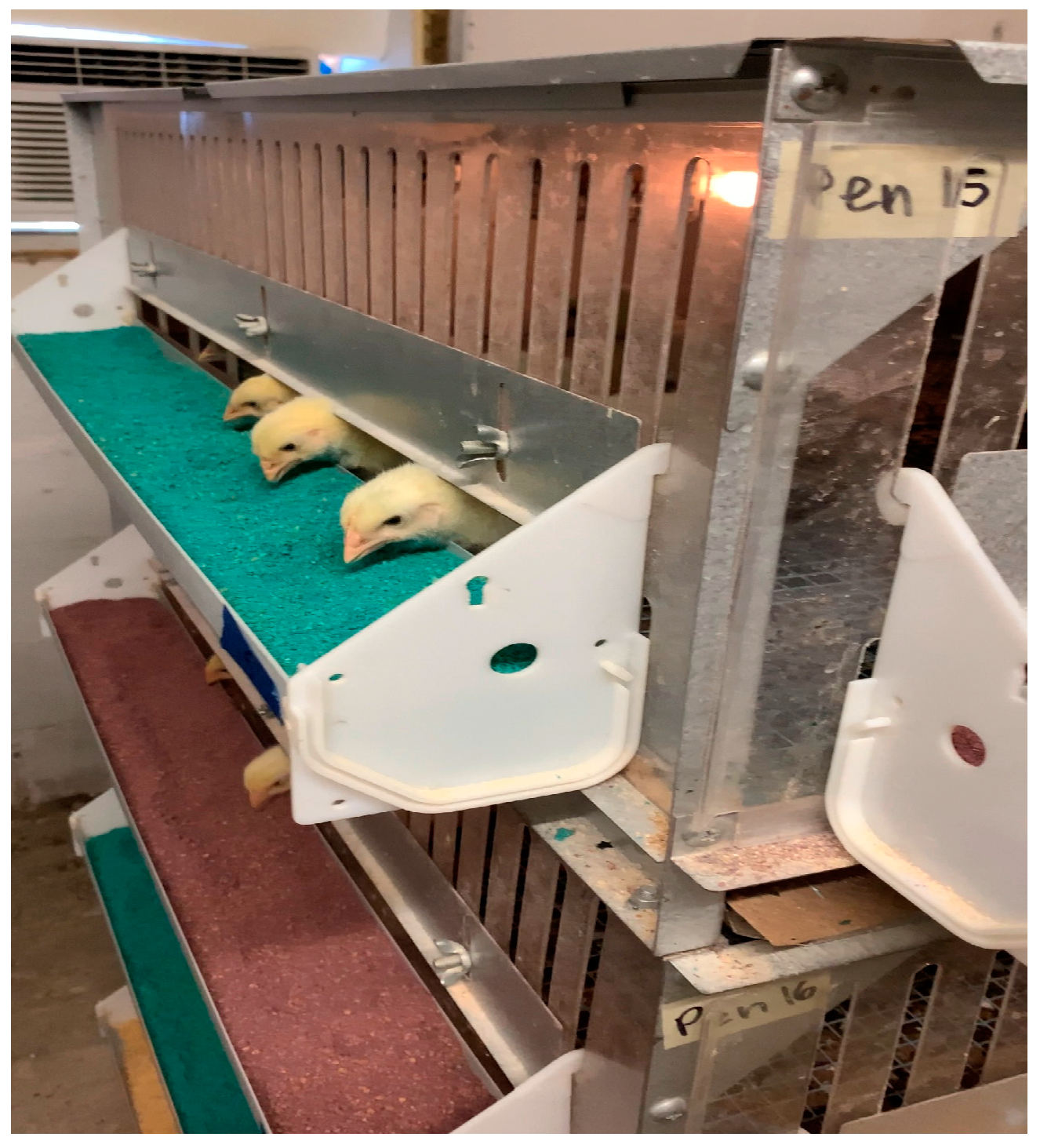
A total of 216 day-old Cobb 500 by-product males were donated from a local Cobb-Vantress hatchery (Lafayette, TN, USA) and randomly distributed into 18 battery cages (0.79 m2/cage) (12 broilers/cage; 658 cm2/bird) and grown for 21 days. The hatchery followed standard commercial protocols, and all broilers were placed on study approximately 16 h after hatching. Each cage had two affixed feed troughs positioned at a 90° angle to each other (Figure 1). The troughs were alternated for each feed color combination to reduce feeder location preferences. All birds had adequate feeder (9.6 cm/bird) and drinker (4.8 cm/bird) space. Additionally, all cages had a supplemental feeder for the first 7 days (Figure 2). The birds were kept in a brooding environment set at around 35 °C, with the temperature decreasing by approximately 3 °C each week. Environmental continuous white light (24 L:0 D; 25 lux) was provided throughout the study; however, the birds received light with a lower intensity inside the battery cage. Feed and water were offered ad libitum. For each cage, both feed troughs were weighed at 1, 7, 14, and 21 days for feed preference and FC determination. Feed trough weights were recorded individually to assess feed color preference within each specific color combination tested. Broilers were group weighed by battery cage on days 1 and 21 to determine their body weight (BW) and the feed conversion ratio (FCR). Mortality was monitored daily and used to adjust the FCR.
Figure 1.
Battery cages with affixed feed troughs used to issue the experimental dietary treatments.
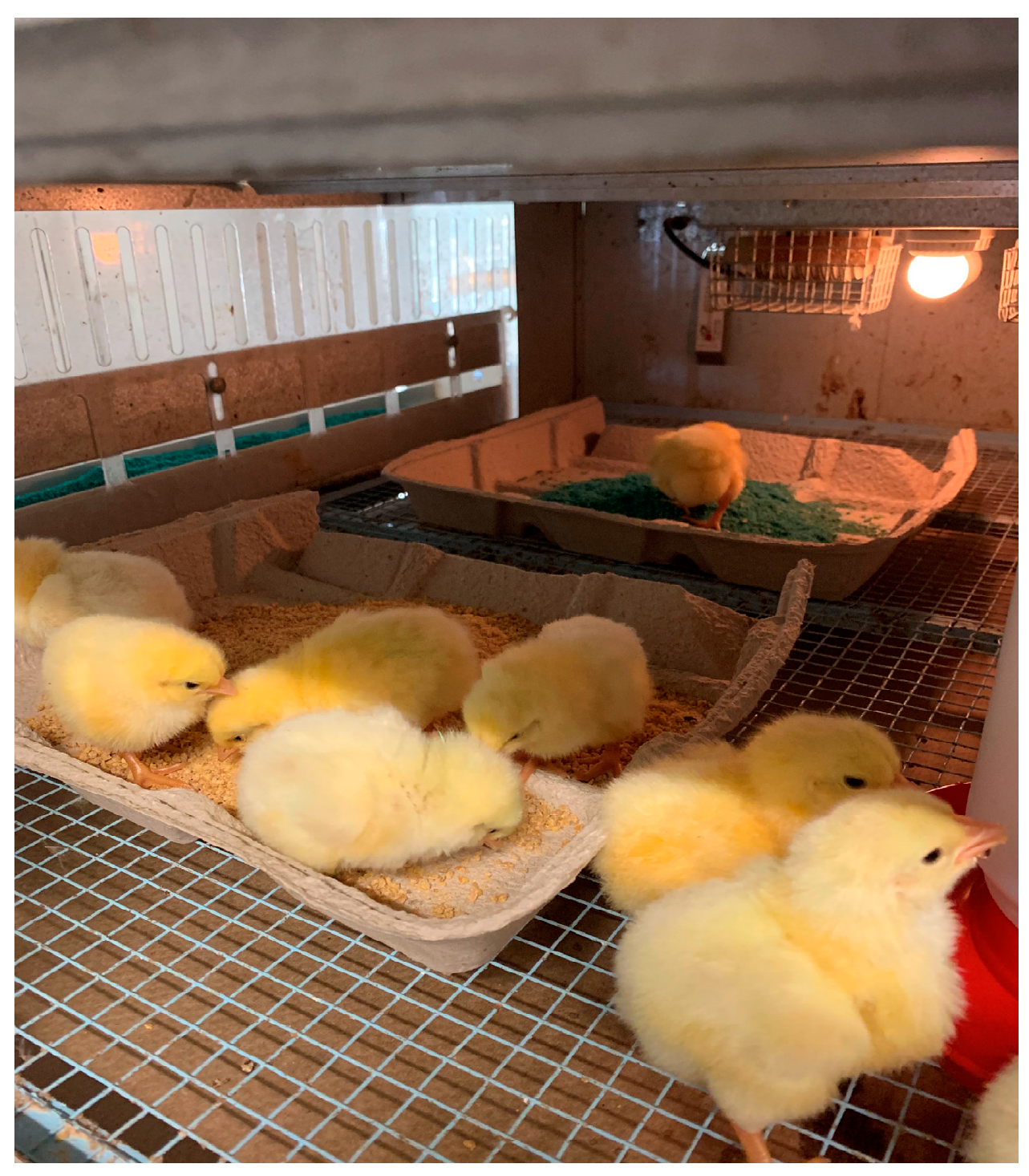
Figure 2.
Broilers provided a combination of undyed basal diet and blue-colored diet through supplemental feeders.
2.3. Experimental Design and Diets
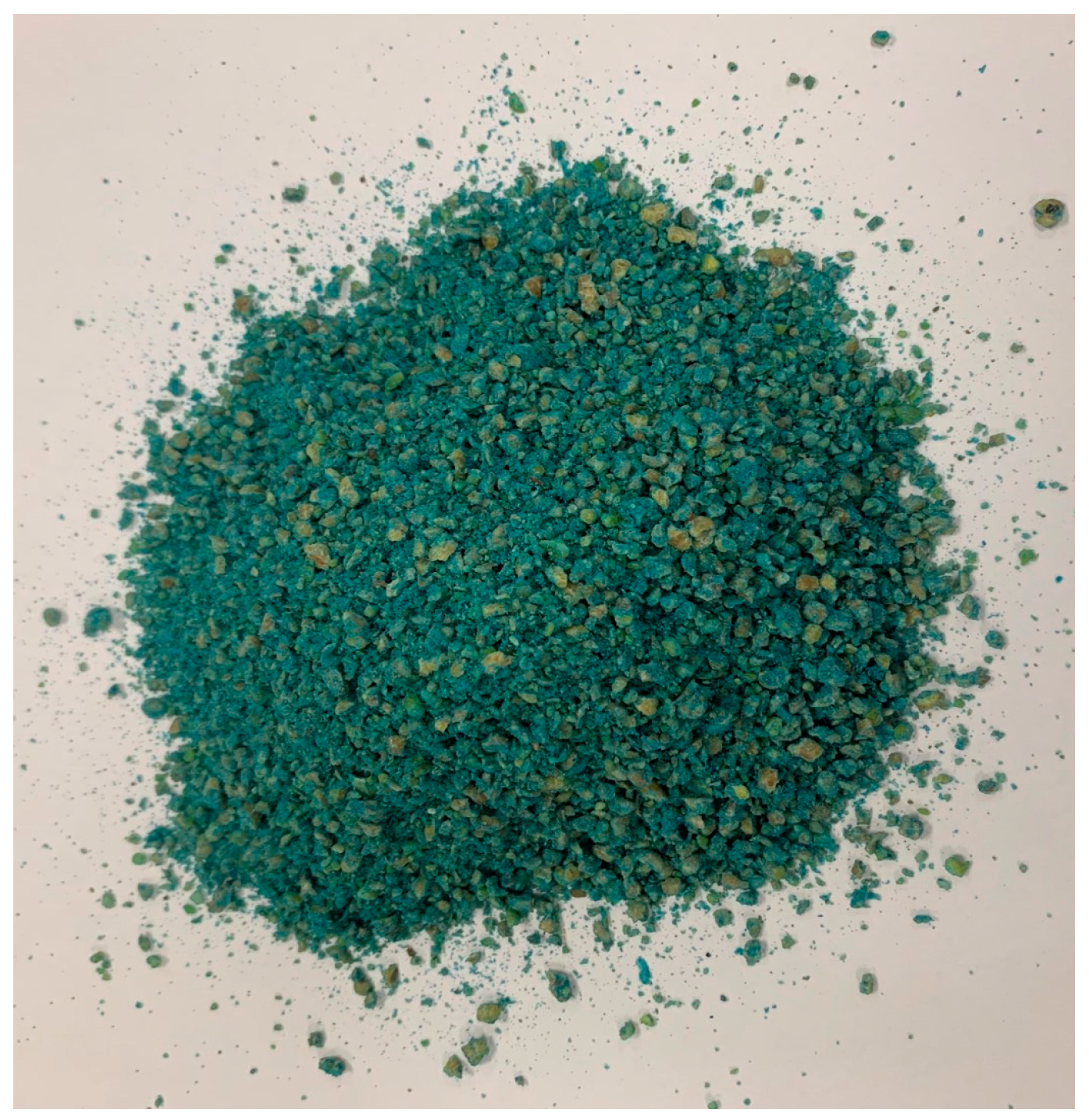
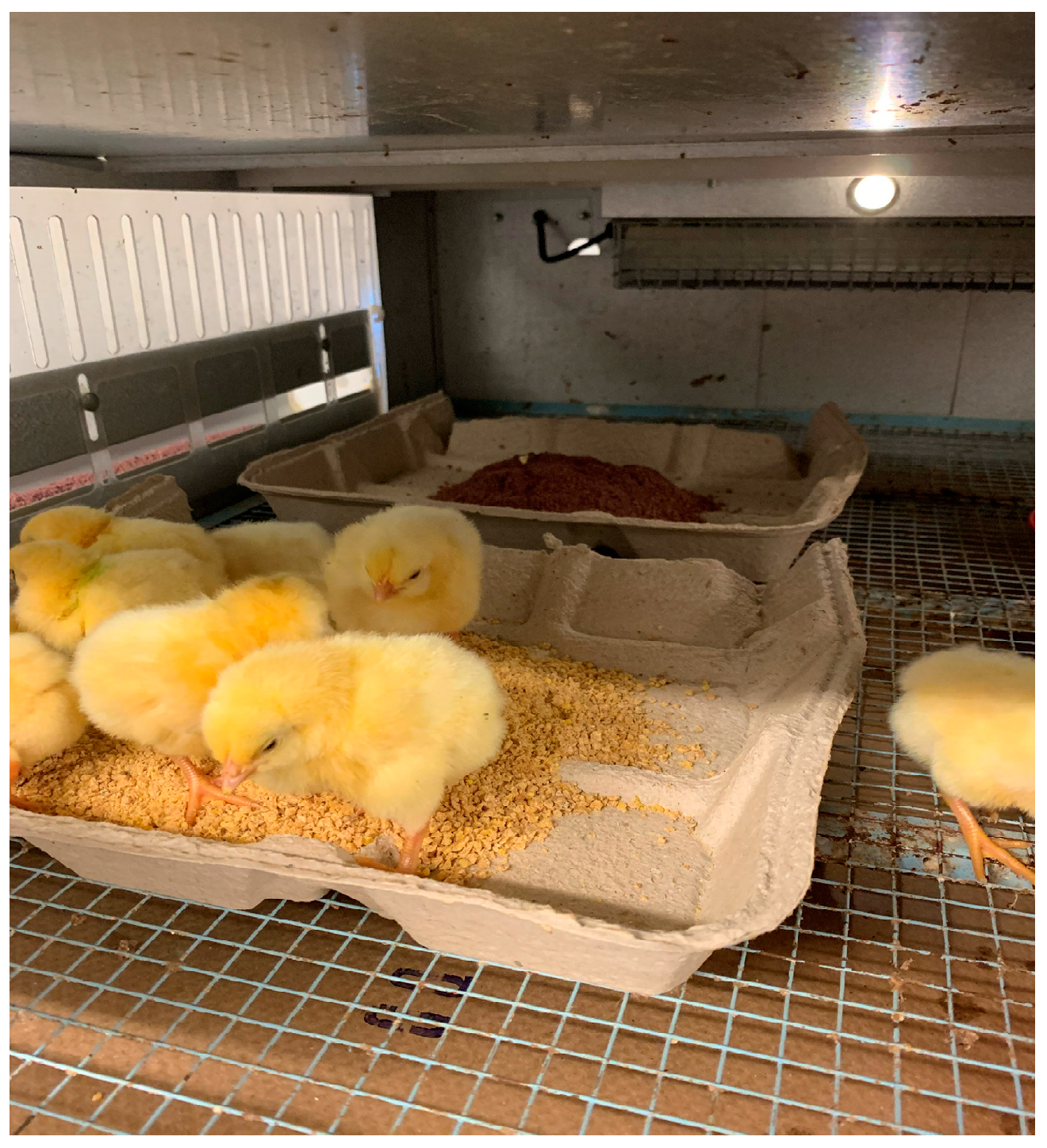
Each battery cage was randomly assigned to one of three experimental treatments, resulting in 6 replicate cages per treatment. The treatments were different color combinations of feed provided to the broilers using the two affixed feed troughs on each cage. The combinations were as follows: (1) UB diet and B diet (UB-B) (Figure 2), (2) UB diet and P diet (UB-P) (Figure 3), and (3) B diet and P diet (B-P). The UB diet was a typical broiler starter manufactured at the Auburn University Animal Nutrition Center (Auburn, AL, USA) as described in Downs et al. [15]. The feed used in this study met or exceeded National Research Council requirements [16] (Table 1). The B and P diets were manufactured by the addition of a non-nutritive human food-grade powdered dye (LorAnn Oils®, Lansing, MI, USA) to the UB diet (Figure 4 and Figure 5). The dyes were mixed into the UB diet using a Marion Mixer (Model 2010, Rapids Machinery Company, Marion, IA, USA) and uniformly dispersed in the feed to ensure the color was noticeable. The blue (Hexadecimal color code: #4a9c9d) and purple (Hexadecimal color code: #6b5669) color specifications were determined following previous research protocols [12].
Figure 3.
Broilers provided with a combination of undyed basal diet and purple-colored diet.
Table 1.
Ingredient and nutrient composition of the undyed basal diet fed to Cobb 500 by-product males from 1 to 21 d of age 1.
Figure 4.
Blue-colored diet offered to broilers.
Figure 5.
Purple-colored diet offered to broilers.
2.4. Statistical Analysis
This study was analyzed as a completely randomized design with battery cages representing the experimental unit. Each treatment was represented by 6 replicate cages. The mortality was arcsine transformed before analysis. The performance data were analyzed as a one-way ANOVA using the PROC GLIMMIX procedure of the SAS software [17]. The treatment means were further separated using post hoc Tukey–Kramer. In addition, PROC TTEST was used to determine the feed color preferences within each color combination (UB-B, UB-P, and B-P). The significance level was set at p ≤ 0.05, and tendencies were considered at 0.10 > p > 0.05.
3. Results
3.1. Broiler Performance
Performance and mortality results are shown in Table 2. All birds met Cobb 500 male BW, FC, and FCR objectives [18] at 21 days and did not display any adverse growth. Broilers fed the UB-P combination had a 39 g higher (p = 0.045) BW at 21 days, compared to birds offered the UB-B combination.
Table 2.
Starter feed color combination effects on live performance and mortality of broilers grown from 1 to 21 d 1.
3.2. Feed Color Preference
The mean FC in g/bird/day by color is shown in Table 3. The birds exhibited a preference, as assessed by the FC, to UB diets versus B and P diets. When birds were fed UB-B or UB-P combinations, the FC gap between the P diet and UB diet was larger than the FC gap between the B diet and UB diet throughout the experimental period. There was an 18.3% higher (p = 0.098) cumulative FC of the UB diet, compared to the B diet, from 1 to 14 days. Likewise, broilers exhibited a 27.5 and 29.2% higher (p < 0.05) cumulative FC of the UB diet, compared to the P diet, from 1 to 14 and 1 to 21 days, respectively. A similar (p > 0.05) FC was observed between B and P diets throughout the 21-day growing period within the B-P combination, indicating no preference toward a specific color.
Table 3.
Feed consumption differences between broilers offered different feed color combinations from 1 to 21 d 1.
4. Discussion
Vision is fundamental for avians and consists of three types of photoreceptors: single cones, rods, and double cones [1]. This allows birds to perceive colors of different wavelengths, ranging from 350 to 700 nm [2]. Birds rely, almost exclusively, on vision to choose feed from the environment [6]. Perhaps, feed coloring could stimulate FC and improve broiler performance. Gulizia and Downs [12] evaluated how feed color impacted the performance of broilers grown from 1 to 21 days. They used an array of hues within the visible color spectrum representing longer (red, orange, yellow, and green) and shorter (blue and purple) wavelengths [19], and reported that B and P diets positively impacted BW gain and the FCR, compared to the remaining feed colors. This response may have resulted from the inherent affinity, displayed by birds, toward ultraviolet wavelengths [7,8]. The current study specifically assessed the impact of B and P diets on broiler feed color preferences. Additionally, the impact of feed color combinations on growth was assessed at 21 days to ensure that the feed coloring did not result in the abnormal growth of broilers. It is important to highlight that the coloring of feed in this study did not influence mortality, which agrees with previous research [5,12,20].
In the present study, broilers offered either a B or P diet along with an UB diet displayed a marked preference towards the UB diet throughout the experimental period. This finding is consistent with the work of Leslie et al. [11], who created a colored diet by mixing red, green, yellow, or blue pellets, which was offered to broilers along with either a corn–soybean meal- or corn–rapeseed meal-based analog undyed control pelleted diet. These authors reported a reduction in the FC of the colored feed, with broilers favoring the undyed control diets from 1 to 18 days. Unexpectedly, the chicks in the present trial did not exhibit a preference toward B and P feeds, which disagrees with earlier research [7]. Throughout this study, the difference in FC between the UB diet and either a B or P diet increased as the birds aged, favoring the UB diet. This reinforces the birds’ preference for the UB diet as they physiologically develop. Color feed preferences by chicks are established from an early age, as they are born with specific preferences that influence their early decision making [21]. The research by Bolhuis et al. [22] reported that chick preference is affected by early learning processes and develops predispositions, which result in an increasing preference toward an object. The feed preference findings of the present work are inconsistent with previous research. Reports show that the responsiveness of birds to colored feed is highly influenced by the precise experimental conditions under which the feed is presented [20]. Factors such as the contrast of feed color with a background [20,23,24], different light intensities [12,25], and the color and position of feeders [5] can significantly alter color preferences. Within this context, Del Rierson [26] reported that broiler chicks preferred red feed when subjected to blue light, and a preference toward control feed (light brown) under red light. Similarly, Roper and Marples [20] observed that chicks only exhibited a preference toward colored feed when it could be easily distinguished against the floor of the cage, or when it was presented in moderate or large amounts. A similar consumption was displayed by broilers when they were offered a combination of B and P diets, which could have been influenced by the closeness of the colors within the visible color spectrum and their similar wavelength (purple: 370 nm; blue: 445 nm) [2]. Another aspect worth considering, with a potential impact in feed color preference, is the color of the UB diets, which is highly influenced by ingredient composition. In the present trial, the UB diet mainly comprised a corn and soybean meal, whereas other research have used different ingredients for the formulation of undyed control diets [11].
The understanding of avian feed color preferences could also have implications that go beyond improvements in FC and performance. Understanding avian color preferences is fundamental for the use of specific colors as repellents to prevent the ingestion of pesticides and fertilizer granules in extensive free-range poultry production systems [20,27,28]. In addition, the pigmentation of poultry products, to satisfy consumer preferences [29], often resorts to the addition of a variety of feed ingredients with a high content of pigments, such as purple [30,31] and orange corn [32], which could significantly modify feed color [29]. Therefore, the identification of poultry feed color preferences is fundamental to promote feed consumption and avoid feed refusal and wastage. Finally, the inclusion of dyes in research feeds to distinguish experimental treatments and avoid confusion is a practice that could benefit from the awareness of broiler feed color preferences.
5. Conclusions
Overall, when broilers were provided with an UB diet and either a B or P diet, they exhibited a preference toward the UB diet throughout the experimental period. When broilers were provided with an UB diet and either a B or P diet, the difference in FC between the P diet and UB diet was greater than the difference between the B diet and UB diet, favoring the UB diet in both combinations. In addition, when offered either a B or P diet, broilers did not show a preference toward a specific color. Feed coloring did not impact the mortality and growth of broilers. Overall, the FC of broilers could be influenced by feed color, as broilers showed a preference for the UB diet throughout the study. The results of this trial indicate that broiler producers could benefit from incorporating diets that appear more natural, in comparison to colored diets, to promote FC. Special care must be taken when incorporating ingredients into broiler diets which could alter the diet’s coloration and influence FC.
Author Contributions
Conceptualization, J.P.G. and K.M.D.; methodology, J.P.G. and K.M.D.; formal analysis, J.P.G.; data curation, K.M.D.; writing—original draft preparation, J.I.V.; writing—review and editing, J.I.V., J.P.G., K.M.D. and W.J.P.; project administration, A.D.M., K.M.D. and J.P.G. All authors have read and agreed to the published version of the manuscript.
Funding
This research received no external funding.
Institutional Review Board Statement
This animal experiment was approved by the Middle Tennessee State University Institutional Animal Care and Use Committee (protocol #22–2006 on 31 August 2021).
Informed Consent Statement
Not applicable.
Data Availability Statement
All data are contained within the communication.
Acknowledgments
The authors are grateful to the students from the School of Agriculture at Middle Tennessee State University for their assistance during the trial. In addition, special thanks are given to Wilmer Pacheco’s lab and the Poultry and Animal Nutrition Center staff at Auburn University for their assistance during feed manufacture.
Conflicts of Interest
The authors declare no conflicts of interest.
References
- Bowmaker, J.K.; Heath, L.A.; Wilkie, S.E.; Hunt, D.M. Visual pigments and oil droplets from six classes of photoreceptor in the retinas of birds. Vis. Res. 1997, 37, 2183–2194. [Google Scholar] [CrossRef] [PubMed]
- Prescott, N.B.; Wathes, C.M.; Jarvis, J.R. Light, vision and the welfare of poultry. Anim. Welf. 2003, 12, 269–288. [Google Scholar] [CrossRef]
- Douglas, R.H.; Jeffery, G. The spectral transmission of ocular media suggests ultraviolet sensitivity is widespread among mammals. Proc. R. Soc. B. 2014, 281, 20132995. [Google Scholar] [CrossRef] [PubMed]
- What Birds See. Available online: http://bejerano.stanford.edu/readings/corbo/Goldsmith_what_birds_see.pdf (accessed on 16 October 2024).
- Hurnik, J.F.; Jerome, F.N.; Reinhart, B.S.; Summers, J.D. Color as a stimulus for feed consumption. Poult. Sci. 1971, 50, 944–949. [Google Scholar] [CrossRef] [PubMed]
- Gentle, M.J. Sensory involvement in the control of food intake in poultry. Proc. Nutr. Soc. 1985, 44, 313–321. [Google Scholar] [CrossRef] [PubMed]
- Hess, E.H. Natural preferences of chicks and ducklings for objects of different colors. Psychol. Rep. 1956, 2, 477–483. [Google Scholar] [CrossRef]
- Lewis, P.D.; Gous, R.M. Responses of poultry to ultraviolet radiation. Worlds Poult. Sci. J. 2009, 65, 499–510. [Google Scholar] [CrossRef]
- Egbuniwe, I.C.; Ayo, J.O. Physiological roles of avian eyes in light perception and their responses to photoperiodicity. World’s Poult. Sci. J. 2016, 72, 605–614. [Google Scholar] [CrossRef]
- Khosravinia, H. Preference of broiler chicks for color of lighting and feed. J. Poult. Sci. 2007, 44, 213–219. [Google Scholar] [CrossRef]
- Leslie, A.J.; Hurnik, J.F.; Summers, J.D. Effects of color on consumption of broiler diets containing rapeseed meal and rapeseed. Can. J. Anim. Sci. 1973, 53, 365–369. [Google Scholar] [CrossRef]
- Gulizia, J.P.; Downs, K.M. The effects of feed color on broiler performance between day 1 and 21. Animals 2021, 11, 1511. [Google Scholar] [CrossRef]
- American Society of Animal Science/American Dairy Science Association/Poultry Science Association. Chapter 3: Husbandry, Housing, and Biosecurity. In Guide for the Care and Use of Agricultural Animals in Agricultural Research and Teaching; Federation of Animal Science Societies: Champaign, IL, USA, 2020; pp. 17–26. [Google Scholar]
- American Society of Animal Science/American Dairy Science Association/Poultry Science Association. Chapter 4: Environmental Enrichment. In Guide for the Care and Use of Agricultural Animals in Agricultural Research and Teaching; Federation of Animal Science Societies: Champaign, IL, USA, 2020; p. 39. [Google Scholar]
- Downs, K.M.; Gulizia, J.P.; Stafford, E.K.; Pacheco, W.J. Influence of varying dietary kudzu leaf meal particle size on performance, breast weight, and organ weight of broiler chickens from 1 to 21 Days of Age. Poultry 2022, 1, 30–39. [Google Scholar] [CrossRef]
- NRC. Nutrient Requirements of Poultry: Ninth Revised Edition; National Academies Press: Washington, DC, USA, 1994; ISBN 978-0-309-04892-7. [Google Scholar]
- SAS Institute. SAS/STAT® User’s Guide Version 14.3; SAS Institute, Inc.: Cary, NC, USA, 2017. [Google Scholar]
- Cobb Broiler Performance & Nutrition Supplement—Cobb500. Available online: https://cobbgenetics.com/assets/Cobb-Files/2022-Cobb500-Broiler-Performance-Nutrition-Supplement.pdf (accessed on 21 October 2024).
- National Aeronautics and Space Administration Visible Light. Available online: https://science.nasa.gov/ems/09_visiblelight/ (accessed on 21 October 2024).
- Roper, T.J.; Marples, N.M. Colour preferences of domestic chicks in relation to food and water presentation. Appl. Anim. Behav. Sci. 1997, 54, 207–213. [Google Scholar] [CrossRef]
- Ham, A.D.; Osorio, D. Colour preferences and colour vision in poultry chicks. Proc. R. Soc. B. 2007, 274, 1941–1948. [Google Scholar] [CrossRef] [PubMed]
- Bolhuis, J.J.; Johnson, M.H.; Horn, G. Effects of early experience on the development of filial preferences in the domestic chick. Dev. Psychobiol. 1985, 18, 299–308. [Google Scholar] [CrossRef] [PubMed]
- Gittleman, J.L.; Harvey, P.H.; Greenwood, P.J. The evolution of conspicuous coloration: Some experiments in bad taste. Anim. Behav. 1980, 28, 897–899. [Google Scholar] [CrossRef]
- Salzen, E.A.; Lily, R.E.; McKeown, J.R. Colour preference and imprinting in domestic chicks. Anim. Behav. 1971, 19, 542–547. [Google Scholar] [CrossRef]
- Fischer, G.J.; Morris, G.L.; Ruhsam, J.P. Color picking preferences in white leghorn chickens. J. Comp. Physiol. 1975, 88, 402–406. [Google Scholar] [CrossRef] [PubMed]
- Del Rierson, R. Broiler Preference for Light Color and Feed Form, and the Effect of Light on Growth and Performance of Broiler Chicks; Kansas State University: Manhattan, KS, USA, 2011. [Google Scholar]
- Brunner, H.; Coman, B. The ingestion of artifically coloured grain by birds, and its relevance to verebrate pest control. Wildl. Res. 1983, 10, 303. [Google Scholar] [CrossRef]
- Greig-Smith, P.W. Hazards to wildlife from pesticide seed treatments. Appl. Seed Soil 1987, 39, 127–134. [Google Scholar]
- Díaz-Gómez, J.; Moreno, J.A.; Angulo, E.; Sandmann, G.; Zhu, C.; Ramos, A.J.; Capell, T.; Christou, P.; Nogareda, C. High-carotenoid biofortified maize is an alternative to color additives in poultry feed. Anim. Feed Sci. Technol. 2017, 231, 38–46. [Google Scholar] [CrossRef]
- Luo, Q.; Li, J.; Li, H.; Zhou, D.; Wang, X.; Tian, Y.; Qin, J.; Tian, X.; Lu, Q. The effects of purple corn pigment on growth performance, blood biochemical indices, meat quality, muscle amino acids, and fatty acids of growing chickens. Foods 2022, 11, 1870. [Google Scholar] [CrossRef] [PubMed]
- Li, J.; Zhou, D.; Li, H.; Luo, Q.; Wang, X.; Qin, J.; Xu, Y.; Lu, Q.; Tian, X. Effect of purple corn extract on performance, antioxidant activity, egg quality, egg amino acid, and fatty acid profiles of laying hen. Front. Vet. Sci. 2023, 9, 1083842. [Google Scholar] [CrossRef] [PubMed]
- Ortiz, D.; Lawson, T.; Jarrett, R.; Ring, A.; Scoles, K.L.; Hoverman, L.; Rocheford, E.; Karcher, D.M.; Rocheford, T. Biofortified orange corn increases xanthophyll density and yolk pigmentation in egg yolks from laying hens. Poult. Sci. 2021, 100, 101117. [Google Scholar] [CrossRef] [PubMed]
Disclaimer/Publisher’s Note: The statements, opinions and data contained in all publications are solely those of the individual author(s) and contributor(s) and not of MDPI and/or the editor(s). MDPI and/or the editor(s) disclaim responsibility for any injury to people or property resulting from any ideas, methods, instructions or products referred to in the content. |
© 2024 by the authors. Licensee MDPI, Basel, Switzerland. This article is an open access article distributed under the terms and conditions of the Creative Commons Attribution (CC BY) license (https://creativecommons.org/licenses/by/4.0/).