1. Introduction
Chronic kidney disease (CKD) is a progressive condition affecting millions of people worldwide. It is characterized by irreversible loss of renal function and is strongly associated with increased cardiovascular morbidity, mortality, frequent hospitalizations, and reduced quality of life [
1]. In this context, assessing functional capacity has become essential in monitoring the overall health status of patients undergoing hemodialysis [
2]. Among the various indicators proposed, handgrip strength (HGS) has emerged as a reliable, low-cost, and simple clinical tool that has been widely validated in populations with chronic conditions [
3,
4,
5].
HGS is not only correlated with physical performance but also with adverse clinical outcomes such as frailty, sarcopenia, and mortality [
6,
7]. Previous studies have shown that low HGS is linked to greater CKD progression and worse functional outcomes [
4,
5]. However, most of this evidence comes from high-income countries, with limited representation of Latin American populations or local clinical contexts. In Colombia, there are currently no established reference values for HGS in patients with CKD undergoing hemodialysis, which limits its systematic use in clinical decision-making.
International literature has proposed multiple cut-off points and percentiles for classifying HGS, primarily based on the general population or healthy older adults [
6,
8]. Nevertheless, patients on hemodialysis present distinct pathophysiological features, including protein-energy wasting, chronic inflammation, bone disorders, and post-dialysis fatigue, which may significantly affect muscle performance [
2,
3]. These specificities highlight the need for locally developed age- and sex-adjusted references tailored to the clinical and sociodemographic profile of this population.
Additionally, although associations between HGS and biochemical markers such as albumin, creatinine, and alkaline phosphatase have been suggested, evidence in the hemodialysis population remains scarce and inconsistent [
2,
9]. Understanding these relationships may provide valuable insights into patients’ nutritional, inflammatory, and functional status, contributing to a more comprehensive clinical evaluation.
In response to these gaps, the present study aimed to establish normative values for HGS among Colombian patients undergoing hemodialysis in five different cities and to explore its association with clinical and biochemical variables. A robust statistical approach using Generalized Additive Models for Location, Scale, and Shape (GAMLSS) was employed to construct age- and sex-specific percentile curves, offering a practical tool for individual and population-level monitoring of muscle function in this high-risk group.
2. Materials and Methods
2.1. Study Participants
This study adopted a quantitative, cross-sectional, multicenter, and correlational design. It was conducted in five cities from three departments in the central region of Colombia: Pereira, Neiva, Bello, Envigado, and Rionegro. A semi-structured survey was used to collect sociodemographic data, including sex, age, marital status, occupation, education level, hand dominance, and relevant medical history (e.g., diabetes mellitus, hypertension, heart disease, autoimmune diseases, or other conditions).
The population consisted of patients undergoing hemodialysis at the Nefrouros Clinics in the aforementioned cities. Data collection took place between August and September 2023. A total of 488 individuals were initially invited to participate. However, 52 were excluded for the following reasons: missing or incomplete grip strength data (n = 34), physical limitations that made the test unsafe (n = 12), and refusal to complete the assessment (n = 6). The final sample comprised 436 patients, with a mean age of 56.1 ± 13.6 years (range: 15 to 86 years).
The study adhered to ethical, bioethical, and scientific integrity standards. It received approval from an ethics committee and was conducted in accordance with both national and international regulations.
2.2. Clinical, Physiological, and Biochemical Variables
The clinical and biochemical variables analyzed in this study were recorded as part of routine hemodialysis care. Biochemical data were extracted from the institutional electronic medical records, using the most recent available result within the renal treatment process prior to the handgrip strength (HGS) assessment. Although temporal variability may affect certain biomarkers—particularly those sensitive to inflammatory or nutritional status, such as albumin or ferritin—this was the only feasible approach, as participating institutions did not authorize additional invasive procedures for research purposes. Therefore, the use of the latest available measurement was adopted as a pragmatic and ethical strategy, acknowledging it as a potential source of variability in interpretation.
The variables included hemoglobin (HB), potassium, calcium, phosphorus, blood urea nitrogen (BUN pre), KT/V, albumin, serum creatinine (Crs), parathyroid hormone (PTHi), total cholesterol, triglycerides, HDL cholesterol, LDL cholesterol, uric acid, alkaline phosphatase, ferritin, serum iron (FeS), glucose, and glycated hemoglobin (HbA1C).
HGS was measured at the end of the hemodialysis session using CAMRY EH101 electronic dynamometers. Participants were assessed while seated, performing three trials with each arm (dominant and non-dominant) in both extension and flexion, with a 10 s rest interval between trials, totaling twelve evaluations per participant. In patients with an arteriovenous (AV) fistula who did not wish to be evaluated on both arms, the test was performed exclusively on the unaffected arm. The highest value among the twelve attempts was used for analysis. The testing protocol was defined by the research team based on the “Hand Grip Test Protocol” proposed by the American Society of Hand Therapists (ASHT) [
10]. To ensure standardization across centers, all evaluators were trained using a unified guide.
Although no standardized time interval was established between the end of dialysis and the strength assessment, evaluators were instructed to avoid conducting the test in patients who presented clinical signs of hypotension, dizziness, or visible fatigue. This approach aimed to minimize measurement bias potentially associated with postdialysis hemodynamic instability, fluid shifts, or excessive exertion.
2.3. Statistical Analysis
Data were recorded using the REDCap (Research Electronic Data Capture) platform to ensure participant confidentiality and anonymity [
11]. All variables—both quantitative and qualitative—were described with summary measures and their corresponding 95% confidence intervals. Quantitative variables were reported using means and standard deviations, while categorical variables were presented as absolute frequencies and proportions.
To explore the relationship between handgrip strength (HGS) and biochemical biomarkers, values coded as 99,999 were first replaced with missing values (NA), and the Shapiro–Wilk test was used to assess normality. Since several variables did not follow a normal distribution, the Spearman correlation coefficient was applied. The strength of correlation was interpreted based on Schober and Schwarte’s classification [
12]. According to their classification, a correlation is considered negligible if it falls between 0 and 0.1, weak if it ranges from 0.1 to 0.39, moderate if it lies between 0.4 and 0.69, strong if it falls within the range of 0.7 to 0.89, and very strong if it reaches values between 0.9 and 1.00.
To estimate age-specific reference values of HGS, Generalized Additive Models for Location, Scale, and Shape (GAMLSS) were implemented using the gamlss package in R [
13], following the methodological recommendations of Winkler et al. [
14]. This approach was selected due to its ability to simultaneously model the location, scale, and shape parameters of the outcome distribution, which is particularly advantageous in clinical settings where normality and homoscedasticity assumptions are not met.
Four candidate distributions were evaluated: Box–Cox Cole and Green (BCCG), Box–Cox Power Exponential (BCPE), Box–Cox t (BCT), and Normal (NO). Model selection was based on the lowest Akaike Information Criterion (AIC), complemented by diagnostic plots and visual inspection of fit. The BCPE (Box–Cox Power Exponential) model demonstrated the best performance for both men (AIC = 1512.82) and women (AIC = 1477.01), and was therefore selected to generate the age-specific percentile curves and reference tables. Analyses were conducted separately by sex, with curves constructed for the 3rd, 10th, 25th, 50th, 75th, 90th, and 97th percentiles.
3. Results
A total of 436 patients were evaluated across five Colombian cities, with the highest representation in Bello (25.9%), Pereira (21.6%), and Neiva (18.6%). The mean age was 58.3 ± 14.1 years. Most were male (59.2%), single (37.2%), and reported primary education as their highest educational level (58.2%). A high proportion were unemployed (68.9%) and right-handed (91.5%). Regarding medical history, hypertension (50.9%) and type 2 diabetes mellitus (24.2%) were the most frequently reported conditions, followed by cardiovascular diseases (15.0%). Additional sociodemographic and clinical characteristics are provided in
Table 1.
Regarding biochemical parameters, mean values were as follows: hemoglobin 10.4 ± 1.7 g/dL, albumin 3.8 ± 0.5 g/dL, serum creatinine 8.9 ± 2.7 mg/dL, phosphorus 5.3 ± 1.6 mg/dL, potassium 4.9 ± 0.9 mEq/L, and the KT/V (indicator of dialysis adequacy based on urea clearance), had a mean value of 1.3 ± 0.3. These findings reflect typical biochemical patterns observed in patients undergoing chronic hemodialysis, with mild to moderate anemia, preserved nutritional status (as suggested by albumin), and adequate dialysis efficiency. Nonetheless, the elevated serum creatinine and phosphorus levels indicate a persistent metabolic burden associated with renal failure.
Comparative analysis showed significant differences in maximal handgrip strength (HGS) across groups (
Table 2). Men exhibited a higher mean HGS (22.6 ± 11.6 kg) than women (14.5 ± 7.5 kg), with a difference of 8.09 kg, a large effect size (d = 0.83), and
p < 0.0001. Similarly, participants without type 2 diabetes showed greater HGS (20.8 ± 11.7 kg) compared to those with the condition (16.9 ± 8.9 kg; d = 0.38;
p < 0.0001).
Regarding occupational status, the variable was recoded into two categories: employed (including workers, self-employed individuals, and retirees) and unemployed (those without any current occupation). Employed participants had significantly higher HGS (22.2 ± 12.3 kg) than unemployed individuals (17.8 ± 10.0 kg), with a moderate effect size (d = −0.39; p = 0.0006).
Additionally, no relevant differences were found in HGS performance between the two testing positions (elbow flexed vs. extended), and thus, the highest value among the twelve trials was used for analysis.
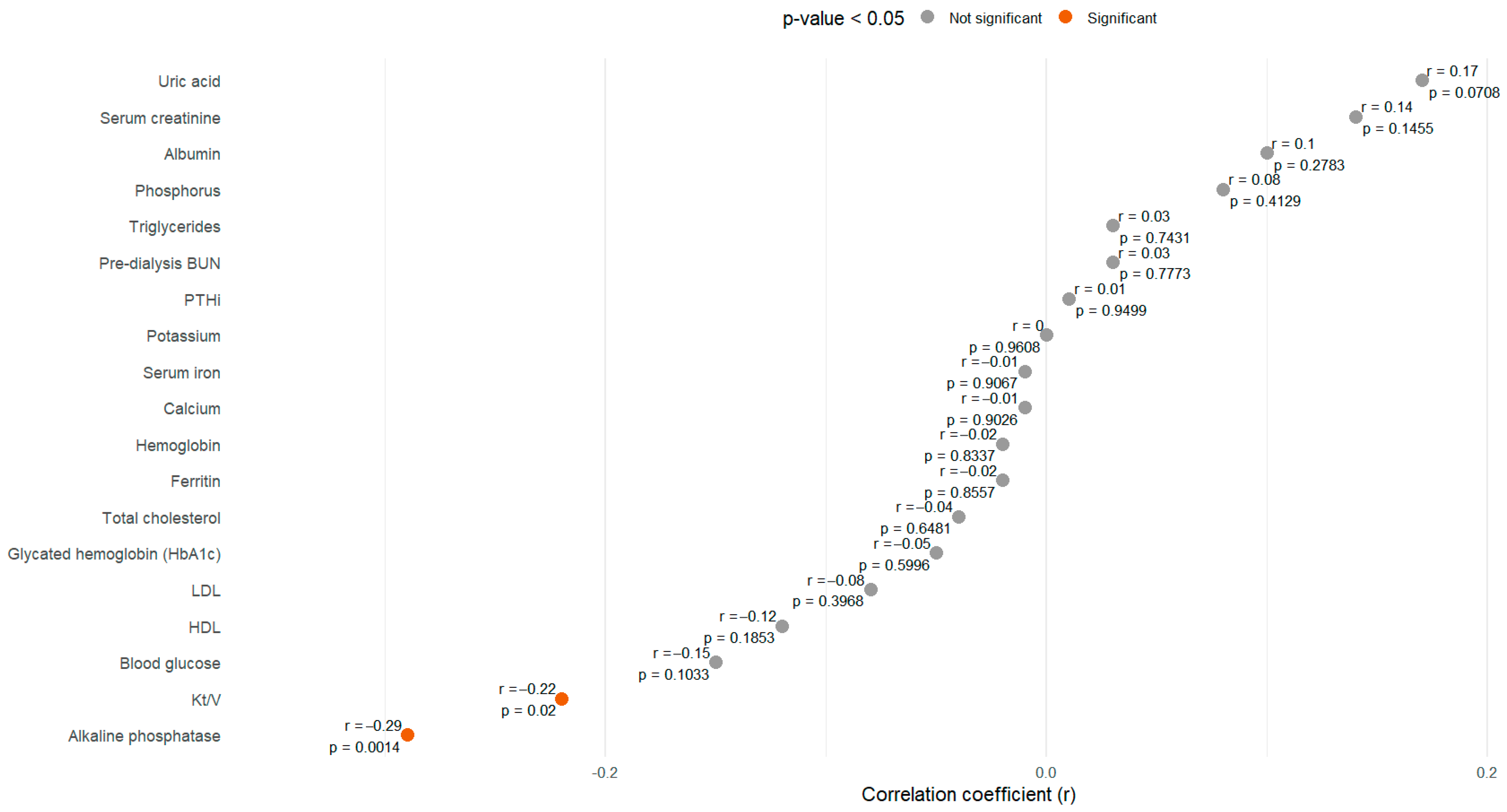
The correlation between handgrip strength (HGS) and 19 biochemical markers was assessed using Spearman’s coefficient, due to the non-normal distribution of variables. Only two biomarkers showed significant correlations with HGS: hemoglobin (ρ = 0.26;
p < 0.001) and albumin (ρ = 0.18;
p = 0.001), both weak in magnitude. No meaningful associations were found with other parameters such as creatinine, phosphorus, calcium, PTHi, or lipid profile. Full results are illustrated in
Figure 1.
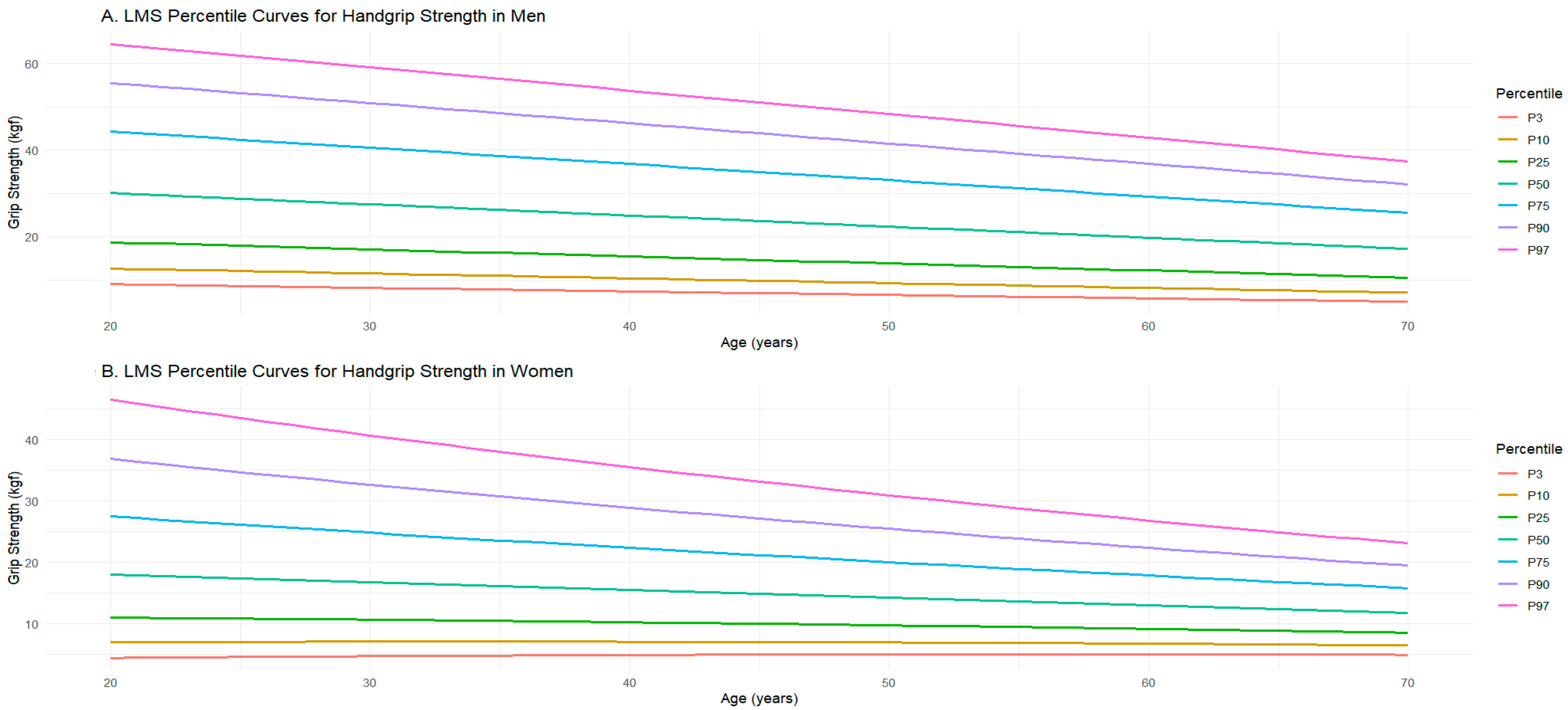
GAMLSS models were applied to estimate reference values for handgrip strength (HGS) across age. Four candidate distributions (BCCG, BCT, BCPE, and Normal) were evaluated, with the Box–Cox Power Exponential (BCPE) model selected based on the lowest Akaike Information Criterion (AIC). The AIC was 1512.82 for men and 1477.01 for women. Analyses were performed separately for each sex, generating smoothed percentile curves (P3, P10, P25, P50, P75, P90, and P97). These are shown in
Figure 2, which displays HGS distribution across age for men (
Figure 2A) and women (
Figure 2B).
Table 3 presents estimated handgrip strength values for the 3rd, 10th, 25th, 50th, 75th, 90th, and 97th percentiles, grouped in five-year age intervals and stratified by sex. These reference values enable clinical interpretation of individual performance within a dialysis population.
For instance, a 60-year-old man with a grip strength of 28 kg would fall at the 50th percentile (median), indicating average performance. In contrast, a 75-year-old woman with 7 kg of grip strength would fall slightly below the 25th percentile, which may suggest clinically relevant muscle weakness.
4. Discussion
This study provides new reference values for handgrip strength (HGS) in Colombian patients undergoing hemodialysis, using a GAMLSS-based modeling approach. Our findings demonstrate significant sex-based differences and associations between HGS and key clinical variables such as diabetes and occupational status. The use of advanced modeling techniques and a multicenter design enhances the external validity and clinical applicability of the proposed percentiles. These results align with previous studies highlighting the prognostic role of HGS in populations with chronic kidney disease (CKD), where muscle function is an early indicator of morbidity, nutritional status, and mortality risk [
15,
16,
17].
Handgrip strength (HGS) has been widely proposed as a reliable functional indicator in patients with chronic kidney disease (CKD), given its association with physical performance, nutritional status, and mortality risk [
6,
7,
18]. However, its relationship with specific biochemical parameters remains unclear, particularly in Latin American populations undergoing hemodialysis.
In our study, correlation analysis revealed two significant associations between HGS and biochemical variables. Specifically, a moderate inverse correlation was observed with alkaline phosphatase (r = −0.29,
p = 0.0014), and a weaker but still significant inverse correlation with Kt/V (r = −0.22,
p = 0.02), a dialysis adequacy index based on urea clearance. These results are illustrated in
Figure 1. No significant correlations were found with other commonly used biomarkers such as albumin, creatinine, hemoglobin, or ferritin.
Elevated alkaline phosphatase levels have been associated with bone mineral disease and chronic inflammation in dialysis patients, potentially reflecting impaired musculoskeletal integrity and nutritional status [
19]. Similarly, although Kt/V is a standard marker of dialysis efficiency, higher values might reflect lower muscle mass or altered metabolic responses in patients with diminished physical condition. The inverse relationship found here warrants further exploration, particularly considering the controversial implications of over-dialysis in frail populations [
9].
These findings highlight the limited but relevant biochemical associations of HGS in this context and suggest that its utility may lie more in its independent predictive value rather than in close alignment with conventional laboratory markers. Furthermore, they emphasize the need for multifactorial assessment strategies when addressing functional health in patients on renal replacement therapy.
The construction of age- and sex-specific percentile curves represents one of the main contributions of this study, given the lack of normative references for handgrip strength (HGS) in the Latin American hemodialysis population. By applying Generalized Additive Models for Location, Scale, and Shape (GAMLSS), we were able to estimate HGS distributions across the age spectrum, addressing both asymmetry and kurtosis in the data.
The analysis revealed a consistent age-related decline in HGS in both sexes, with a sharper decrease observed among men. These results are in line with previous studies reporting age-related muscle function decline in various populations, including healthy adults and those with chronic conditions [
15,
17,
20]. However, it is important to note that, until now, Colombia lacked specific reference values for handgrip strength (HGS) in patients undergoing hemodialysis. The percentile tables and curves generated in this study (
Figure 2 and
Table 3) represent a novel contribution, offering a practical clinical tool to identify individuals with reduced muscle strength relative to their demographic group. For instance, a male patient aged 50–54 years with a grip strength of 29 kg would fall below the 25th percentile, indicating potential functional impairment and increased risk of adverse outcomes.
Moreover, the decision to stratify percentile curves by sex was supported by the marked difference in HGS between men and women (
p < 0.001; d = 0.83), reinforcing the importance of sex-specific reference standards. Similar percentile-based approaches have been validated in both healthy and clinical populations to inform diagnostic and prognostic decisions [
17,
20]. Although this is the first attempt to establish such references in a Colombian dialysis cohort, their generalizability may be influenced by contextual and methodological factors such as ethnicity, dialysis protocols, and regional nutritional patterns. Nonetheless, the normative data presented here lay a foundation for individualized patient assessment and future multicenter validation studies.
Although direct comparisons must be interpreted with caution due to differences in methodology and patient profiles, international reference values for handgrip strength in hemodialysis patients tend to be slightly higher than those observed in this study. For instance, Xu et al. [
20] and Gulcicek & Seyahi [
19] reported higher mean values in Asian and European cohorts, which could reflect regional differences in nutritional status, physical activity, and dialysis protocols. These contrasts highlight the importance of developing population-specific standards that account for contextual factors, particularly in underrepresented Latin American settings.
Future research should aim to validate the proposed percentile curves in larger, multicenter cohorts and explore their predictive value for clinical outcomes such as hospitalization, mortality, and quality of life. Additionally, longitudinal studies could assess how variations in grip strength over time relate to treatment efficacy and patient prognosis.
This work adds meaningful insights to renal rehabilitation by offering sex-specific normative values for handgrip strength in Colombian patients undergoing hemodialysis. By applying advanced statistical modeling (GAMLSS), we provide robust reference curves that may assist healthcare professionals in identifying patients with reduced functional reserve. These findings open the door to future investigations aiming to validate the proposed standards, examine their predictive capacity for clinical outcomes, and incorporate functional testing into the comprehensive care of individuals with chronic kidney disease.
Clinical Implications
The integration of handgrip strength (HGS) into routine care protocols for patients undergoing hemodialysis offers a valuable opportunity to strengthen functional assessment strategies within nephrology. Unlike more complex or costly evaluations, HGS provides a fast, low-cost, and scalable measure that can be administered during standard dialysis care without requiring additional resources or laboratory processing.
The availability of age- and sex-specific normative values tailored to the Colombian dialysis population equips clinical teams with a context-specific tool for identifying patients with diminished muscle strength. This allows for early functional screening and facilitates timely referral to nutritional or physical rehabilitation programs before clinical deterioration occurs.
Beyond individual assessment, HGS could be integrated into quality assurance protocols to monitor treatment progress and multidisciplinary care effectiveness. Its use may foster closer collaboration among nephrologists, physiotherapists, and nutritionists, promoting a more holistic approach to care planning. In the long term, the adoption of functional indicators such as HGS can help build more proactive and preventive care models in renal units, shifting the focus from reactive management to early identification and intervention. These strategies are particularly relevant in low-resource settings, where access to advanced diagnostics is limited and simple tools with high clinical value are critically needed.
5. Conclusions
Handgrip strength (HGS) stands out as a practical, non-invasive indicator of functional capacity and overall health status in individuals undergoing hemodialysis. This study provides the first sex- and age-specific normative reference values for HGS in the Colombian hemodialysis population, addressing a critical gap in clinical assessment tools for this group. These reference curves and percentiles not only enable the identification of patients at higher risk of functional impairment but also support early clinical interventions and more precise monitoring of physical deterioration.
The use of GAMLSS modeling allowed for a robust statistical estimation of percentiles, enhancing the clinical applicability of the findings. Moreover, the observed differences by sex and the decline with age underscore the need for individualized interpretation when evaluating muscular strength in this context.
Future research should focus on validating the predictive value of these reference standards for adverse outcomes such as hospitalization, mortality, and loss of autonomy. Additionally, longitudinal studies are essential to determine whether targeted interventions based on these percentiles can improve prognosis and quality of life in this vulnerable population.
Limitations of the Study
This study has several limitations that should be taken into account when interpreting the findings. First, although standardized protocols were adopted and evaluators were trained using a unified guide, formal inter-rater reliability testing across participating centers was not conducted. This may have introduced variability in the administration of the handgrip strength protocol.
Second, handgrip strength was measured immediately after the hemodialysis session. While clinical conditions such as hypotension or discomfort were monitored to ensure safety and feasibility, the exact post-dialysis timing of the test was not standardized across all sites. This may have introduced bias, as factors such as post-dialysis fatigue, fluid shifts, or blood pressure changes could have influenced muscular performance.
Additionally, biochemical data were obtained from institutional medical records and corresponded to the most recent result available prior to the functional assessment. While this approach reflects real-world clinical practice, it is acknowledged that the temporal variability of certain biomarkers (e.g., albumin or ferritin) may have affected the strength of observed associations. Lastly, the cross-sectional design of this study prevents the establishment of causal relationships. Despite these limitations, the findings contribute substantially to an underexplored clinical area and offer a foundation for future research.




 ,
,