Article

The Gamma Power Generalized Weibull Distribution: Modeling Bibliometric Data

by
Arioane Primon Soares
1,*,
Ryan Novaes Pereira
2,*,
Fernando A. Peña-Ramírez
3,
Luz Milena Zea Fernández
4 and
Renata Rojas Guerra
3
1
Federal Institute of Education, Science and Technology Farroupilha (IFFar), Alameda Santiago do Chile 195, Santa Maria 97050-685, Brazil
2
Department of Statistics, Faculty of Science and Technology, São Paulo State University (UNESP), Rua Sen. Roberto Simonsen 305, Presidente Prudente 19060-080, Brazil
3
Department of Statistics, Center for Exact and Natural Sciences, Federal University of Santa Maria, Av. Roraima 1000, Santa Maria 97105-340, Brazil
4
Department of Statistics, Center for Exact and Earth Sciences, Federal University of Rio Grande do Norte, Av. Senador Salgado Filho 3000, Natal 59078-900, Brazil
*
Authors to whom correspondence should be addressed.
Stats 2026, 9(2), 26; https://doi.org/10.3390/stats9020026
Submission received: 26 November 2025 / Revised: 24 December 2025 / Accepted: 6 February 2026 / Published: 5 March 2026
(This article belongs to the Section Statistical Methods)

Abstract

In this study, we introduce the gamma power generalized Weibull (GPGW) distribution and investigate several of its main mathematical properties. The performance of the maximum likelihood estimators is evaluated through Monte Carlo simulations. The practical relevance of the proposed distribution is illustrated through an application to real bibliometric data, where the GPGW is used to model SCImago Journal Rank (SJR) indicators. In comparison with alternative models commonly employed for lifetime and positive data, the GPGW distribution exhibits strong competitive performance. In particular, in the real data application, it outperforms eleven competing distributions in terms of goodness of fit criteria, including the power generalized Weibull (PGW), the gamma-Nadarajah–Haghighi (GNH), and the exponentiated power generalized Weibull (EPGW) distributions. While inheriting several mathematical features of the EPGW distribution, such as expressions for moments, skewness, and kurtosis, the GPGW offers enhanced flexibility, making it a valuable modeling tool for lifetime data and heavy-tailed positive measurements.

1. Introduction

The increasing complexity of natural and technological systems has intensified the demand for probability distributions capable of capturing diverse empirical patterns. Classical models often exhibit limited flexibility and may fail to adequately represent features such as heavy or light tails, pronounced skewness, multimodality, or nonstandard hazard rate shapes. Recent advances in symbolic computation and numerical optimization have facilitated the study of analytically involved models, enabling the derivation of new distributions with enhanced adaptability for statistical modeling and data analysis. A common strategy relies on enriching a baseline distribution by incorporating additional shape parameters or by embedding it within a transformation-based framework.
Among the most general mechanisms for constructing continuous probability distributions is the transformed–transformer (TX) family. Although formally established by [1], the TX scheme has rapidly become a unifying structure in distribution theory due to its broad generality and ability to generate numerous existing families as special cases. Notable examples include the generalized beta [2], generalized Kumaraswamy [3], and generalized gamma families [4]. In this construction, a baseline random variable X undergoes a transformation driven by a second random variable T, modulated by a weighting function W of the cumulative distribution function of X. Appropriate choices of T, X, or W yield different subfamilies within the TX class; the transformed component T acts as the generated model, whereas X is typically referred to as the baseline distribution.
The literature on generalizations of classical distributions has grown substantially due to the methodological advantages of flexible models. In survival analysis, for instance, the ability to accommodate increasing, decreasing, bathtub-shaped, or nonmonotonic hazard rates is essential for characterizing lifetime mechanisms of components or individuals. Recent developments illustrate this trend: Carneosso et al. [5] introduced the ERF–Weibull model as an alternative to traditional gamma, Gumbel, and exponentiated exponential distributions, while Oluyede et al. [6] proposed the Marshall–Olkin–Type II exponentiated half-logistic–Odd Burr X-G family, capable of capturing diverse density and hazard rate behaviors.
More recently, the literature on flexible and modified Weibull-type distributions has expanded considerably, motivated by the need to model complex data patterns observed in practice. For instance, Cordeiro et al. [7] introduced an extended Weibull model with applications to epidemiological data, while de Araújo et al. [8] and Scrimini et al. [9] investigated modified Weibull-type distributions in the unit domain. In addition, Zhuang et al. [10] studied inference for inverse generalized Weibull distributions, whereas Muhammad et al. [11] and Al-Moisheer et al. [12] proposed new flexible Weibull-based lifetime models motivated by improved fit to real data. These recent contributions highlight the ongoing development of Weibull-type models and reinforce the relevance of flexible generalizations within this class.
Within this landscape, the gamma–G family has emerged as one of the most versatile transformation-based frameworks. A comprehensive review of gamma-generated models and their empirical applications is provided in [13], which lists more than thirty contributions to this class. Examples of recent developments include the Odd Burr X-G family [14], the power half-logistic distribution [15], the Zografos–Balakrishnan Type-I heavy-tailed–G family [16], and the flexible generalized gamma model [17]. These works illustrate the expanding interest in gamma-based transformations and their capacity to generate distributions with analytically tractable structures and remarkably flexible shapes.
In the context of these recent advances, this paper introduces the gamma power generalized Weibull (GPGW) distribution, a new member of the gamma–G family. The model employs the power generalized Weibull (PGW) distribution as its baseline due to its ability to generate a wide spectrum of particular cases and to exhibit rich hazard rate patterns, often outperforming classical competitors in goodness-of-fit assessments [18]. The PGW has been successfully used both as a generated model within the TX scheme [19] and as a baseline for constructing new distributions [20], with applications reported in [21,22]. Building upon these properties, the proposed GPGW distribution enhances modeling flexibility while preserving analytical tractability.
The main contributions of this paper can be summarized as follows. First, we introduce a new four-parameter distribution that generates a rich and flexible class of models encompassing several well-known distributions as special cases. This structure allows formal testing, via likelihood-based procedures, of whether simpler sub-models obtained by fixing parameters provide an adequate fit to a given dataset. This motivation has been central to other developments in distribution theory and has inspired several related contributions, including [18,23].
Second, the proposed GPGW distribution exhibits a wide variety of hazard rate shapes, including decreasing, increasing, upside-down bathtub, and bathtub forms, as well as highly flexible density shapes such as left-skewed, right-skewed, and reversed-J. These features are particularly desirable in a broad range of applications, including lifetime and reliability modeling, which are among the most common areas motivating the introduction of generalized distributions.
Third, we derive a linear representation of the GPGW distribution in terms of the exponentiated PGW distribution [18]. This representation considerably simplifies the derivation of key mathematical properties, several of which are obtained in closed or semi-closed form in this work. Such properties are essential for understanding the theoretical behavior of the model.
Finally, the proposed GPGW distribution can provide superior fitting performance compared to competing models with the same or fewer parameters. This advantage is illustrated through an empirical application to the bibliometric index SCImago Journal Rank (SJR), where the GPGW model proves particularly effective in accommodating the distributional characteristics observed in the data.
The remainder of this article is organized as follows. Section 2 reviews the PGW distribution and some of its extensions. Section 3 introduces the new GPGW model. Section 4 presents its main mathematical properties. Section 5 and Section 6 describe the estimation procedures and Monte Carlo simulations, including bootstrap-based bias corrections. Section 7 provides an empirical application to real data. Concluding remarks are offered in Section 8.

2. The Power Generalized Weibull (PGW) Distribution and Its Extensions

The PGW distribution was originally introduced by [24] to model not only monotonic hazard rates but also a broader class of failure rate behaviors. This includes distributions that accommodate unimodal and bathtub-shaped hazard functions. Ref. [25] exemplify this by explaining that in the study of the life cycle of an industrial product or a living organism, a three-phase failure rate pattern is often observed. That is, the hazard rate initially decreases during early life, then stabilizes over a period, and then increases due to aging or wear.
Commonly used distributions for estimating the hazard function, such as the Weibull and gamma distributions, fail to capture this full range of behavior. In this context, alternative distributions have been proposed, including the PGW distribution [26], specifically designed to model failure times and offering several special cases within its structure. The cumulative distribution function (cdf) of the PGW is given by
F ( t σ , ν , γ ) = 1 exp 1 1 + t σ ν 1 / γ ,
where σ , ν , and γ are positive parameters and t > 0 .
Following [18], by defining λ = σ ν and α = γ 1 , the cumulative distribution function (cdf), probability density function (pdf), and hazard function (hf) of the PGW distribution can be rewritten as follows:
F ( t ) = 1 exp 1 1 + λ t ν α ,
f ( t ) = α λ ν t ν 1 1 + λ t ν ( α 1 ) exp 1 1 + λ t ν α ,
h ( t ) = α λ ν t ν 1 1 + λ t ν ( α 1 ) .
Some of the most recent extensions of the PGW distribution include the exponentiated power generalized Weibull (EPGW) distribution [18], the Weibull Burr XII (WBXII) distribution [23], and the Kumaraswamy power generalized Weibull (KGPW) distribution [27]. According to [18], the EPGW distribution is derived by applying the exponentiation method to the PGW distribution. Its hazard function is capable of modeling a wide range of failure time behaviors, including constant, decreasing, increasing, bathtub, and inverted bathtub shapes. As a result, it has proven to be a competitive model compared to distributions like the Weibull, exponentiated exponential, and exponentiated Weibull (EW) distributions. The cdf, pdf, and hf of the EPGW are defined as
F ( t α , β , ν , λ ) = 1 exp 1 1 + λ t ν α β ,
f ( t ) = α λ ν β t ν 1 1 + λ t ν ( α 1 ) exp 1 1 + λ t ν α 1 exp 1 1 + λ t ν α ( 1 β ) ,
and
h ( t ) = α λ ν β t ν 1 1 + λ t ν ( α 1 ) exp 1 1 + λ t ν α 1 exp 1 1 + λ t ν α ( β 1 ) 1 1 exp 1 1 + λ t ν α β ,
where α , β , and ν are shape parameters and λ is a scale parameter. Setting β = 1 in Equation (3) recovers the PGW cdf as a special case of the EPGW.
The WBXII distribution, proposed by [23], is a five-parameter extension of the PGW that has also proven to be highly flexible in terms of its hazard function, encompassing all the classical forms mentioned above. It is a competitive alternative to other recent survival models. This distribution results from transforming the Weibull distribution using the Burr XII distribution, which itself includes at least 20 different lifetime distributions, with PGW being one of them. For a random variable X WBXII ( α , β , s , d , c ) , the cdf, pdf, and hf are given by
F ( x ) = 1 exp α 1 + x / s c d 1 β ,
f ( x ) = α β c d s c x c 1 1 + ( x / s ) c 1 d exp α 1 + ( x / s ) c d 1 β 1 + ( x / s ) c d 1 β 1 ,
h ( x ) = α β c d s c x c 1 1 + ( x / s ) c d 1 1 + ( x / s ) c d 1 β 1 ,
where α , β , c, and d > 0 are shape parameters, and s > 0 is a scale parameter. The PGW distribution is recovered by setting α = β = 1 .
Similarly, ref. [27] proposed the KGPW distribution by applying the Kumaraswamy generator (also part of the T-X family) to the PGW. This extension has demonstrated enhanced flexibility and improved estimation performance compared to the Weibull and PGW distributions when applied to real data, such as carbon fiber tensile strength measurements. The cdf, pdf, and hf of the KGPW distribution are defined as
F ( x ) = 1 1 1 exp 1 1 + x / λ α θ a b ,
f ( x ) = a b α θ λ α x α 1 1 + x / λ α θ 1 exp 1 1 + x / λ α θ × 1 exp 1 1 + x / λ α θ a 1 × 1 1 exp 1 1 + x / λ α θ a b 1 ,
h ( x ) = a b α θ x α 1 1 + x / λ α θ 1 1 exp 1 1 + x / λ α θ a 1 λ α 1 1 exp 1 1 + x / λ α θ a ,
where α , θ , a , b > 0 are the shape parameters and λ > 0 is a scale parameter. By setting a = b = 1 , the cdf of the PGW is recovered from the KGPW.

3. Definition of the Model

The gamma–G family is a subfamily of the broader class of univariate T-X distributions, defined in two main generations based on different weighting functions W ( · ) . Ref. [28] introduced the first generation, commonly referred to as the ZB-G family, using the transformation W ( x ) = log [ 1 F ( x ) ] . Later, ref. [4] proposed a second generation, known as the RB-G family, based on the transformation W ( x ) = log [ F ( x ) ] , which is the version adopted in this study to define the gamma power generalized Weibull (GPGW) distribution.
According to [4], the cumulative distribution function (cdf) and the probability density function (pdf) of the RB-G family are given by
G ( x ) = 1 γ { a , log [ F ( x ) ] } Γ ( a ) ,
g ( x ) = f ( x ) Γ ( a ) log [ F ( x ) ] a 1 ,
where F ( x ) is the baseline cdf, f ( x ) = d F ( x ) d x , x R + ; γ ( a , z ) = 0 z t a 1 e t d t is the lower incomplete gamma function; Γ ( a ) = 0 t a 1 e t d t is the complete gamma function; and a > 0 is a shape parameter.
The GPGW distribution is obtained by substituting Equations (1) and (2) (i.e., the PGW cdf and pdf) into Expressions (4) and (5). From this point forward, let T be a random variable following the GPGW distribution, denoted T GPGW ( a , α , ν , λ ) , if its cdf, pdf, and hazard function (hf) are given by
G ( t a , α , ν , λ ) = 1 γ a , log 1 exp 1 1 + λ t ν α Γ ( a ) ,
g ( t a , α , ν , λ ) = α λ ν t ν 1 1 + λ t ν α 1 exp 1 1 + λ t ν α Γ ( a ) × log 1 exp 1 1 + λ t ν α a 1 ,
and
h ( t a , α , ν , λ ) = α λ ν t ν 1 1 + λ t ν ( α 1 ) exp 1 1 + λ t ν α γ a , log 1 exp 1 1 + λ t ν α × log 1 exp 1 1 + λ t ν α a 1 ,
where a , α , ν > 0 are shape parameters, and λ > 0 is a scale parameter. That is, the GPGW distribution introduces a fourth parameter, adding one more degree of flexibility compared to the baseline PGW distribution.
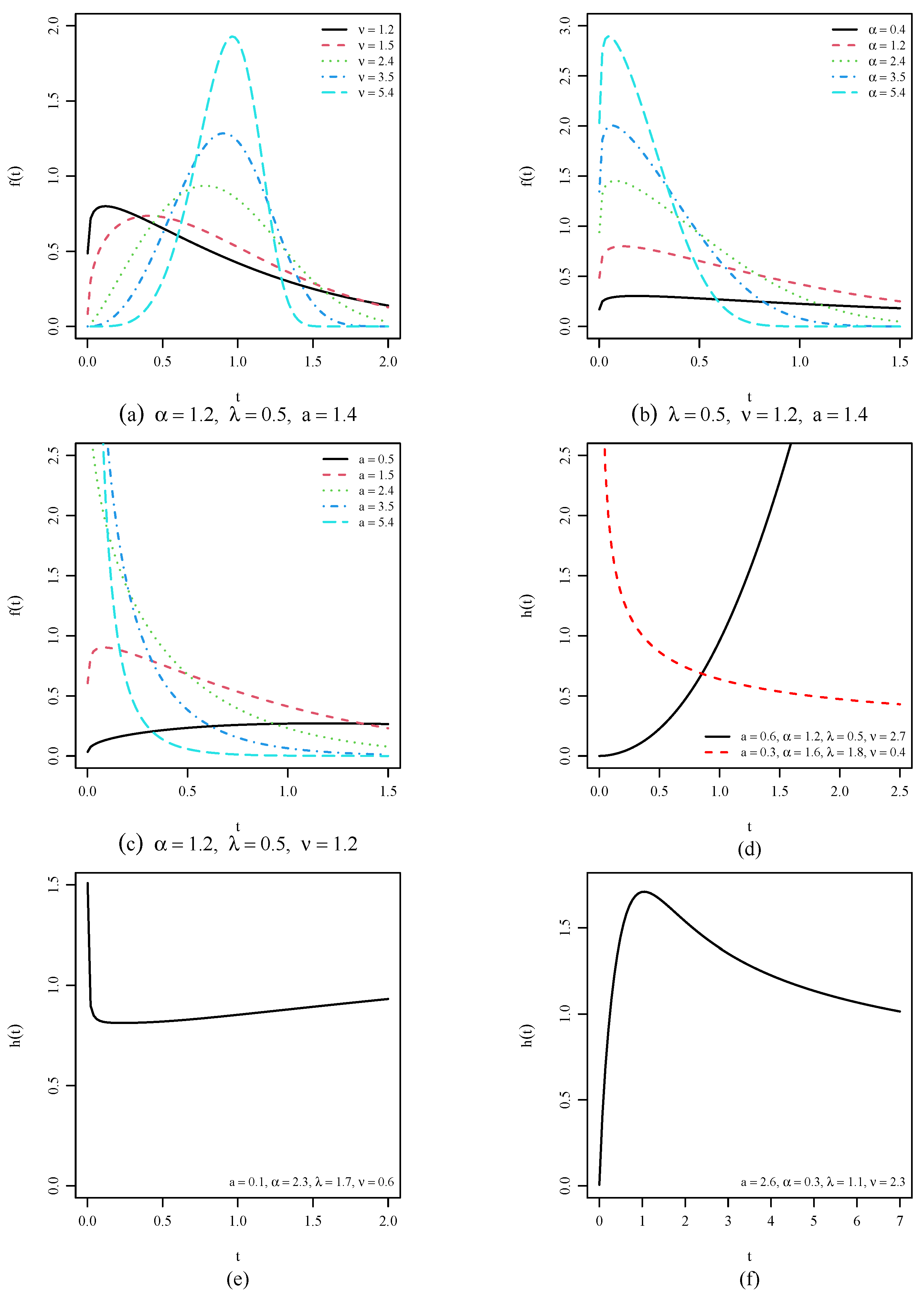
In Figure 1, plots (a), (b), and (c) illustrate the flexibility of the pdf in terms of skewness and heavy tails, while plots (d), (e), and (f) show the increasing, decreasing, bathtub, and inverted bathtub shapes of the hazard function. This generality highlights the adaptability of the GPGW model and its potential for providing better fits compared to well-known distributions, especially when assessed through likelihood ratio tests.

4. Mathematical Properties

In this section, we establish several key mathematical properties of the GPGW distribution, including its quantile function, a linear representation based on the exponentiated form, and expressions for ordinary and incomplete moments. Measures of skewness, mean deviations, and inequality indices such as the Lorenz and Bonferroni curves are also obtained. These results enhance the analytical tractability of the model and support both theoretical investigations and practical applications. In addition, Table 1 lists several classical lifetime distributions that can be recovered as special cases of the proposed GPGW distribution, underscoring its flexibility and generality.

4.1. Quantile Function

Let T GPGW ( a , α , λ , ν ) . The quantile function of T, denoted by Q ( u ) , is obtained by inverting Equation (6), yielding the following:
Q ( u ) = λ 1 / ν Δ 1 / ν ,
where Δ = 1 log 1 exp Q 1 ( a , u ) 1 / α 1 , and Q 1 ( a , u ) is the inverse of the function 1 γ ( a , x ) / Γ ( a ) . This quantile function allows for the generation of random data from the GPGW distribution using the inversion method. In addition, it serves as the basis for the derivation of other mathematical characteristics, such as moments, skewness, and kurtosis.

4.2. Linear Representation

Another important mathematical property of the GPGW distribution is its linear representation in terms of the EPGW distribution. This property can be derived through two series expansions. The first expansion is given by
[ log ( 1 z ) ] m = z m + i = 0 p i ( m ) z i + m + 1 ,
where the p i ’s are Stirling polynomials, as defined in [29]. This expansion holds for | z | < 1 , which is a convergence condition inherited from [30]. In the present model, we set m = a 1 and z = exp 1 1 + λ t ν α so that 0 < z < 1 , and therefore the condition | z | < 1 is always satisfied, and we obtain
log 1 exp 1 1 + λ t ν α ( a 1 ) = exp 1 1 + λ t ν α a 1 + i = 0 p i ( a 1 ) ( i + a ) exp 1 1 + λ t ν α .
Substituting Equation (9) into (7), the GPGW probability density function becomes
g ( t a , α , ν , λ ) = α λ ν t ν 1 1 + λ t ν ( α 1 ) exp 1 1 + λ t ν α × i = 0 b i ( a + i 1 ) exp 1 1 + λ t ν α ,
where b 0 = 1 / Γ ( a ) , b 1 = p 0 ( a 1 ) / Γ ( a ) , b 2 = p 1 ( a 1 ) / Γ ( a ) , and in general, b k = p k 1 ( a 1 ) / Γ ( a ) .
Using the binomial expansion
( a + b ) τ = j = 0 τ j a j b τ j , a b < 1 , τ R ,
and setting a = 1 and b = 1 exp 1 1 + λ t ν α , we obtain
( a + i 1 ) exp 1 1 + λ t ν α = i = 1 a + i 1 j ( 1 ) j 1 exp 1 1 + λ t ν α j .
Thus, we can rewrite Equation (7) as
g ( t a , α , ν , λ ) = α λ ν t ν 1 1 + λ t ν ( α 1 ) exp 1 1 + λ t ν α × i = 1 j = 0 b i a + i 1 j ( 1 ) j 1 exp 1 1 + λ t ν α j j + 1 j + 1 = i = 0 j = 0 w i , j ( a ) α ( j + 1 ) λ ν t ν 1 1 + λ t ν ( α 1 ) exp 1 1 + λ t ν α 1 exp 1 1 + λ t ν α j ,
where w i , j ( a ) = ( 1 ) j j + 1 b i ( a + i 1 j ) .
That is,
g ( t a , α , ν , λ ) = i , j = 0 w i , j ( a ) f ( t α , ( j + 1 ) ν , λ ) ,
where f ( t α , ( j + 1 ) ν , λ ) denotes the pdf of the EPGW distribution presented in Equation (3), with exponential parameter β = j + 1 . Thus, the pdf of the random variable T can be expressed as a linear combination of EPGW distributions, which allows certain mathematical properties of the GPGW distribution to be derived from those of the EPGW.

4.3. Moments

The r-th ordinary moment of T can be expressed directly from the linear representation in Equation (10). Let X EPGW ( α , δ , λ ) be a random variable following the exponentiated power generalized Weibull distribution. We can write the r-th moment of T as a linear combination of the moments of X with varying parameter δ :
μ r = E ( T r ) = i , j = 0 w i , j ( a ) E ( X r ) | δ = ( j + 1 ) ν ,
where the r-th moment of X is given by
E ( X r ) = k , l = 0 ( 1 ) k + l e ( l + 1 ) ( l + 1 ) [ r ν ( k α ) ] / α ν δ / ν 1 l r / ν k Γ r ν ( k α ) α ν , l + 1 ,
where Γ ( a , x ) = x z a 1 e z d z denotes the upper incomplete gamma function. By substituting δ = ( j + 1 ) ν into (12) and inserting the result into (11), we obtain the final expression for the moments of T.

4.4. Skewness

Skewness is assessed using the third and fourth standardized cumulants. The central moment ( μ r ) and the cumulant ( k r ) are defined by
μ r = k = 0 r ( 1 ) k r k μ 1 k μ r k
and
k r = μ r k = 1 r 1 r 1 k 1 k k μ r k ,
where k 1 = μ 1 , and consequently:
k 2 = μ 2 μ 1 2 , k 3 = μ 3 3 μ 2 μ 1 + 2 μ 1 3 , etc .
Skewness is then computed by γ 1 = k 3 / k 2 3 / 2 and kurtosis by γ 2 = k 4 / k 2 2 . Alternatively, the skewness measure proposed by [31] is given by
ρ ( u ; a , α , ν ) = ρ ( 1 ) ( u ; a , α , ν ) ρ ( 2 ) ( u ; a , α , ν ) = Q ( 1 u ) + Q ( u ) 2 Q ( 1 / 2 ) Q ( 1 u ) Q ( u ) ,
where u ( 0 , 1 ) and Q ( · ) denotes the quantile function. Thus, if T GPGW ( a , α , ν , λ ) , then:
ρ ( 1 ) ( u ) = 1 log 1 exp Q 1 ( a , 1 u ) 1 / α 1 1 / ν + 1 log 1 exp Q 1 ( a , u ) 1 / α 1 1 / ν 2 1 log 1 exp Q 1 ( a , 1 / 2 ) 1 / α 1 1 / ν ,
 
ρ ( 2 ) ( u ) = 1 log 1 exp Q 1 ( a , 1 u ) 1 / α 1 1 / ν 1 log 1 exp Q 1 ( a , u ) 1 / α 1 1 / ν .
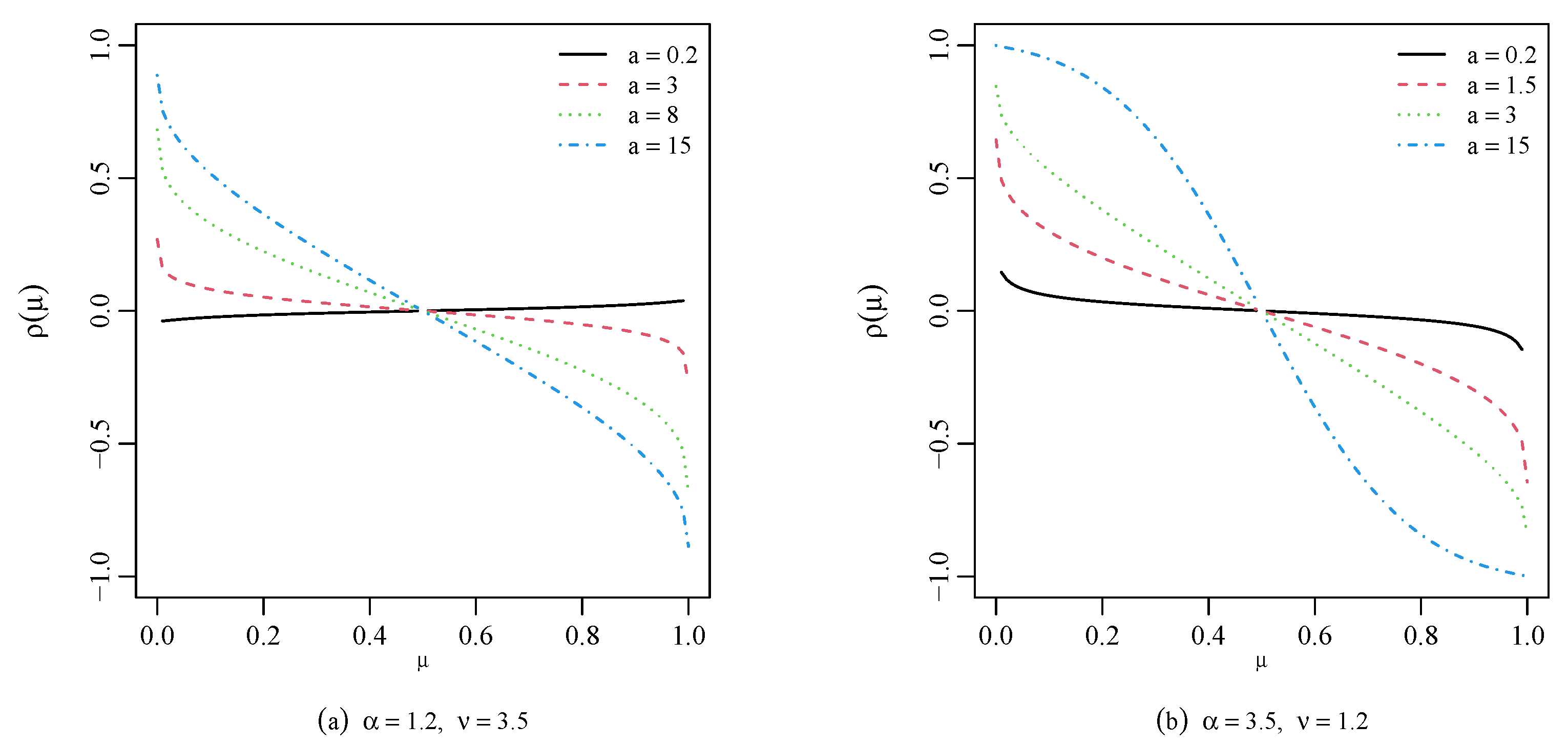
Figure 2 depicts the MacGillivray skewness curves, highlighting the influence of the shape parameters α , ν , and a on the skewness behavior of T. The skewness measure does not depend on the scale parameter λ . Symmetry is achieved as the skewness function approaches the reference line ρ ( u ) = 0 . Panels (a) and (b) demonstrate that decreasing values of a yield distributions with greater symmetry, regardless of changes in α and ν .

4.5. Incomplete Moments

The r-th incomplete moment of the random variable T is defined as
m r ( y ) = 0 y t r g ( t a , α , ν , λ ) d t .
By substituting Equation (10) into (13), we obtain
m r ( y ) = 0 y t r i , j = 0 w i , j ( a ) f ( t α , ( j + 1 ) ν , λ ) d t = i , j = 0 w i , j ( a ) 0 y t r f ( t α , ( j + 1 ) ν , λ ) d t = i , j = 0 w i , j ( a ) m r ( y )
where m r ( y ) denotes the incomplete moments of a random variable T EPGW ( α , ( j + 1 ) ν , λ ) . Following the results presented by [18], we obtain the following:
m r ( y ) = λ r / ν i , j , k , l = 0 ( 1 ) j + k + l b i exp ( l + 1 ) ( l + 1 ) [ r ν ( k α ) ] / ( α ν ) ] j l r / ν k a + i 1 j × Γ r ν ( k α ) α ν , l + 1 Γ r ν ( k α ) α ν , ( l + 1 ) ( 1 + λ y ν ) α .

4.6. Mean Deviations

The mean deviations from the mean ( δ 1 = E ( | T μ 1 | ) ) and from the median ( δ 2 = E ( | T M | ) ) are defined as δ 1 = 2 μ 1 G ( μ 1 ) 2 m 1 ( μ 1 ) and δ 2 = μ 1 2 m 1 ( M ) , respectively, where μ 1 = E ( T ) is the first raw moment, M = Q ( 0.5 ) is the median, G ( μ 1 ) is given in Equation (6), and m 1 ( y ) = 0 y t g ( t ) d t represents the first incomplete moment. This incomplete moment can be derived from Equation (14) by setting r = 1 , resulting in the following:
m 1 ( y ) = λ 1 / ν i , j , k , l = 0 ( 1 ) j + k + l b i e l + 1 ( l + 1 ) [ 1 ν ( k α ) ] / ( α ν ) j l 1 / ν k a + i 1 j × Γ 1 ν ( k α ) α ν , l + 1 Γ 1 ν ( k α ) α ν , ( l + 1 ) ( 1 + λ y ν ) α ,
consistent with the results obtained by [18].

4.7. Lorenz and Bonferroni Curves

The Lorenz and Bonferroni curves, along with the Bonferroni and Gini indices, are widely used in economics to analyze income inequality. These tools are also employed in other fields, such as health, demography, and insurance, to evaluate the distribution of variables of interest.
The Bonferroni and Lorenz curves are defined by B ( π ) = m 1 ( q ) / ( π μ 1 ) and L ( π ) = m 1 ( q ) / μ 1 , respectively, where π is a given probability level, q = Q ( π ) is the corresponding quantile obtained from Equation (8), and m 1 ( y ) is the first incomplete moment, defined in Equation (15), which in this case takes the form
B ( π ) = λ 1 / ν i , j , k , l = 0 b i ( 1 ) j + k + l e l + 1 π μ 1 ( l + 1 ) [ 1 ν ( k α ) ] / ( α ν ) j l 1 / ν k a + i 1 j × Γ 1 ν ( k α ) α ν , l + 1 Γ 1 ν ( k α ) α ν , ( l + 1 ) ( 1 + λ q ν ) α
Once the Bonferroni curve B ( π ) is obtained, the Lorenz curve L ( π ) can be immediately derived through the simple relation L ( π ) = π B ( π ) . These curves provide insight into the concentration of the distribution and are useful for comparing different datasets or distributions in terms of inequality and dispersion.

5. Maximum Likelihood Estimation

Consider a random sample x 1 , x 2 , , x n drawn from the GPGW distribution with parameter vector θ = ( a , α , ν , λ ) . The log-likelihood function for the observed data is given by
l ( θ ) = n + n log α λ ν Γ ( a ) i = 1 n 1 + λ t i ν α + ( ν 1 ) i = 1 n log t i + ( α 1 ) i = 1 n log 1 + λ t i ν + ( a 1 ) i = 1 n log log 1 exp 1 1 + λ t i ν α .
To derive the maximum likelihood estimators (MLEs) of the GPGW distribution, Equation (16) must be differentiated with respect to the parameters a, α , ν and  λ . The resulting equations are then set equal to zero, and the corresponding system is solved in order to identify the estimators, which must subsequently be verified as maxima. The derivatives of l ( θ ) are collectively referred to as the score vector, denoted by U ( θ ) . The components of the score function are
U a ( θ ) = i = 1 n log log 1 e 1 ( 1 + λ t i ν ) α n ψ ( a ) ,
U α ( θ ) = n α + i = 1 n log ( 1 + λ t i ν ) i = 1 n ( 1 + λ t i ν ) α log ( 1 + λ t i ν ) + ( a 1 ) i = 1 n ( 1 + λ t i ν ) α log ( 1 + λ t i ν ) e 1 ( 1 + λ t i ν ) α 1 e 1 ( 1 + λ t i ν ) α log 1 e 1 ( 1 + λ t i ν ) α ,
U λ ( θ ) = n λ α i = 1 n t i ν ( 1 + λ t i ν ) α 1 + ( α 1 ) i = 1 n t i ν 1 + λ t i ν + α ( a 1 ) i = 1 n t i ν ( 1 + λ t i ν ) α 1 e 1 ( 1 + λ t i ν ) α 1 e 1 ( 1 + λ t i ν ) α log 1 e 1 ( 1 + λ t i ν ) α ,
U ν ( θ ) = n ν + i = 1 n log t i λ α i = 1 n t i ν log t i ( 1 + λ t i ν ) α 1 + λ ( α 1 ) i = 1 n t i ν log t i 1 + λ t i ν + λ α ( a 1 ) i = 1 n t i ν log t i ( 1 + λ t i ν ) α 1 e 1 ( 1 + λ t i ν ) α 1 e 1 ( 1 + λ t i ν ) α log 1 e 1 ( 1 + λ t i ν ) α .
 
Here, ψ ( · ) denotes the digamma function. Due to the complexity and non-linear nature of these equations, explicit closed-form solutions for the MLEs do not exist. Thus, numerical methods such as the Newton–Raphson algorithm or other iterative optimization techniques are necessary to approximate the parameter estimates.

6. Numerical Evaluation

In this section, a Monte Carlo simulation was conducted to evaluate the maximum likelihood estimators (MLEs) of the GPGW distribution. For this purpose, the optim function in the R software (version 4.5.0) was used to maximize the log-likelihood function, testing the performance of several combinations of the GPGW model parameters for sample sizes n = 40 , 100 , 150 , and 300, using 10,000 replications. The results in Table 2 show that as the sample size increases, the means of the estimators converge to the true parameter values.

7. Application

To illustrate the flexibility of the GPGW distribution, the proposed model is fitted to a real bibliometric dataset, and its performance is assessed against several well-known distributions reported in the literature. The fit of the GPGW is compared with that of competing models commonly adopted for the analysis of positive continuous data. In particular, the EGPW and the Kumaraswamy–Weibull (Kw–W) [32] distributions are considered as four-parameter competitors, while the EW and the ENH distributions represent well-established models widely used in practice. The remaining distributions included in the comparison arise as special cases of the proposed GPGW model.
Specifically, the application analyzes the SJR (SCImago Journal Rank) values of 1784 journals belonging to the Mathematics subject area for 2024. This dataset provides a comprehensive overview of journal performance in the field and is characterized by substantial variability and extreme values, a common feature of bibliometric indicators. As summarized in Table 3, the data exhibit pronounced skewness and high kurtosis, rendering their statistical modeling complex. In this context, recent studies have proposed probabilistic models to describe bibliometric measures (see, e.g., ref. [33], and more recently [34]), reinforcing the relevance of flexible distributions such as the GPGW for capturing the complex behavior of scientific impact data.
Table 4 reports the maximum likelihood estimates (MLEs) of the model parameters, together with their corresponding standard errors (in parentheses), for all fitted distributions considered in the analysis.
Table 5 presents the Akaike information criterion (AIC), the Bayesian information criterion (BIC), the goodness-of-fit statistics A and W , and the Kolmogorov–Smirnov (KS) distance. These measures support model comparison. Since the GPGW distribution attains the smallest values across all criteria, it exhibits the best overall performance among the competing models fitted to the SJR data. Moreover, the GPGW model consistently outperforms simpler distributions such as the Weibull, exponential, and NH models, commonly used in reliability and survival analysis with monotonic or unimodal hazard rates.
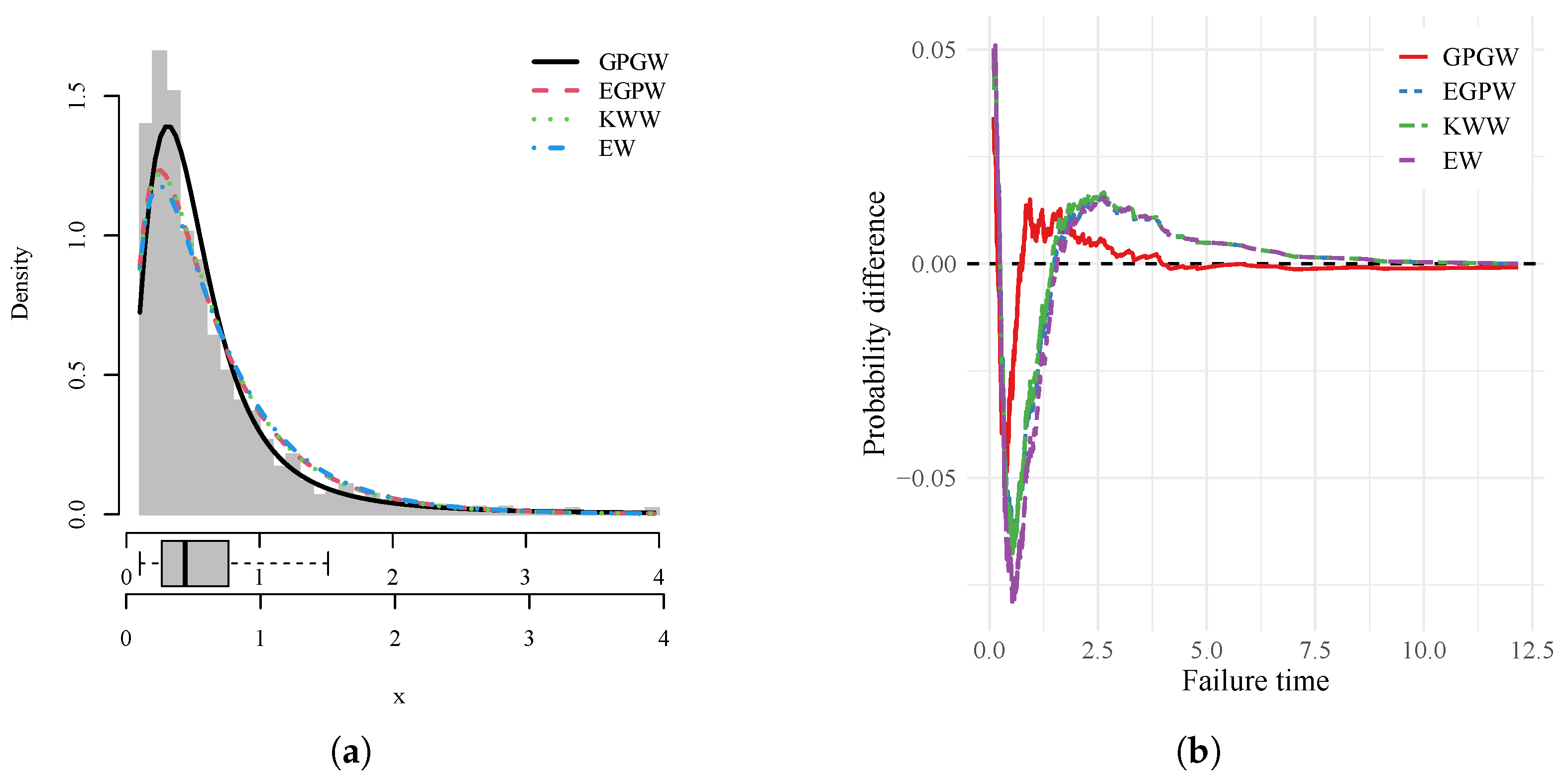
Figure 3a displays the histogram with fitted densities of the four most competitive models according to the goodness-of-fit measures in Table 5 (GPGW, EGPW, Kw-W, and EW), while Figure 3b shows the corresponding probability difference plots. The latter visualizes the discrepancy D ( t ) = F ^ ( t ) F n ( t ) between each model’s estimated cdf and the empirical distribution function. The horizontal line at y = 0 represents a perfect fit. Both figures confirm that the GPGW distribution provides the closest match to the empirical data, with the smallest deviations in the probability difference plot, supporting the statistical evidence from Table 4 and Table 5.
Finally, to obtain qualitative information about the hf, the total time on test (TTT) method, proposed by [35], was used. The TTT curve is obtained by plotting
T r n = i = 1 r y i : n + ( n r ) y r : n i = 1 n y i : n ,
against r / n , where r = 1 , , n and y i : n are the order statistics of the sample.
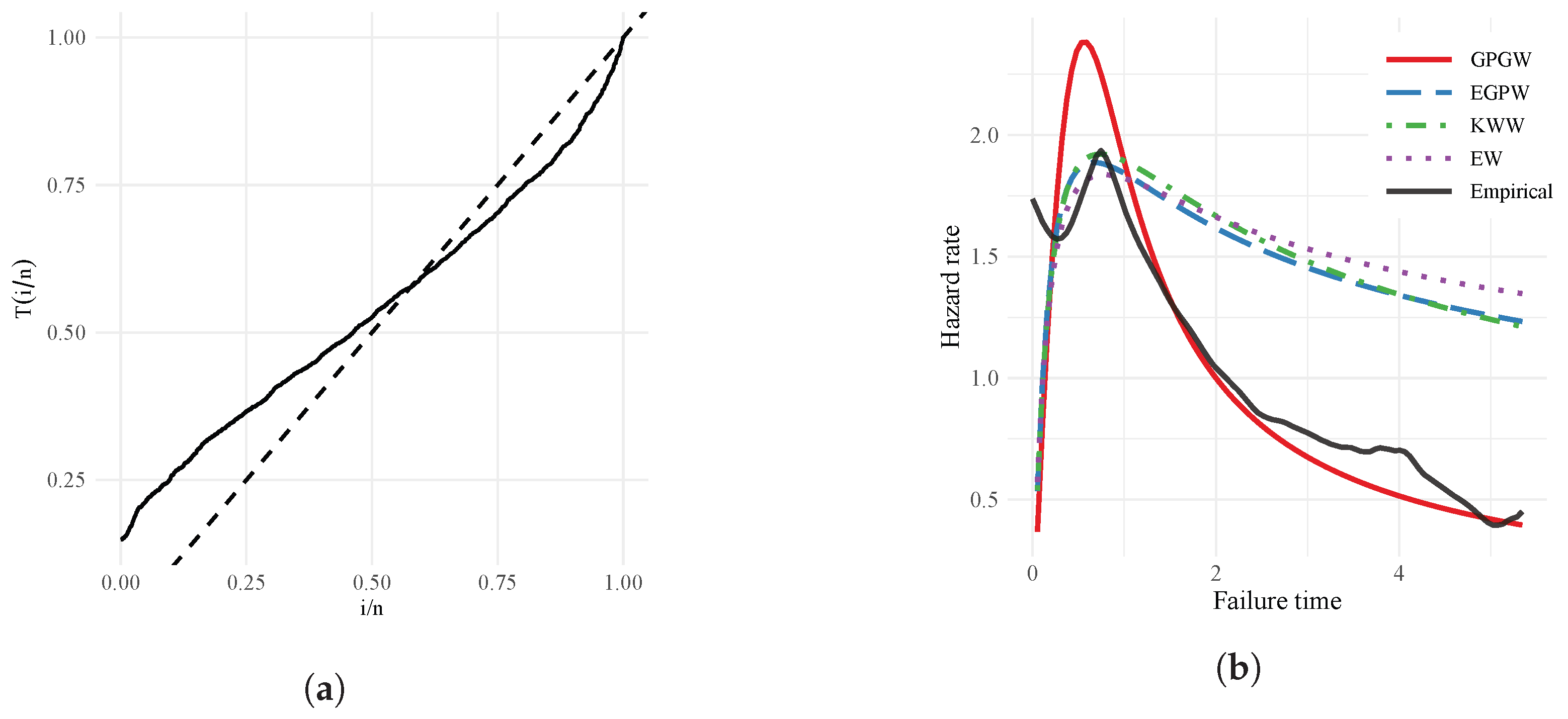
Figure 4a displays the TTT plot for the SJR data. The curve exhibits a clear change in curvature relative to the diagonal reference line (dashed line), indicating departure from monotonic hazard behavior. In particular, the initial portion of the curve suggests an increasing failure rate, whereas the subsequent segment reflects a decreasing trend. This transition in curvature is characteristic of a nonmonotonic hazard function, more specifically a unimodal shape, in which the risk increases up to a peak and then gradually declines. Such behavior is commonly associated with heterogeneous populations or competitive risk mechanisms, where early accumulation of risk is followed by a stabilization and eventual reduction.
Figure 4b presents a comparison between the empirical hazard function (hf) and the fitted hazard functions of the most competitive parametric models. The empirical hf was estimated using kernel smoothing through the muhaz package in R, providing a continuous and stable estimate based on the observed failure times. The smoothing procedure reduces local sampling fluctuations while preserving the overall structural pattern of the hazard, thereby enabling a reliable visual assessment of model adequacy.
The empirical curve clearly exhibits a unimodal pattern, corroborating the structural indication obtained from the TTT plot. Among the fitted models, the GPGW distribution shows the closest agreement with the empirical hazard across the entire support. In particular, it accurately captures the rapid increase in the early phase, the location and magnitude of the peak, and the subsequent declining behavior. Competing models tend either to underestimate the peak intensity or to over-smooth the decreasing tail, failing to reproduce the observed curvature with the same precision.

8. Conclusions

This paper introduced the gamma power generalized Weibull (GPGW) distribution and studied some of its most important mathematical properties. The GPGW generalizes nine well-known models used for modeling failure time data. Specifically, it includes the exponential, Rayleigh, Weibull, Nadarajah–Haghighi, gamma-exponential, gamma-Rayleigh, gamma-Weibull, gamma-Nadarajah–Haghighi, and power generalized Weibull distributions as special cases. Moreover, GPGW can be expressed as a linear combination of the exponentiated power generalized Weibull (EPGW) distribution, which facilitates the derivation of key properties such as moments, skewness, and kurtosis from EPGW.
Regarding parameter estimation via maximum likelihood, the estimates converged to the true parameters with bootstrap correction applied. The practical utility and fit quality of the new distribution were demonstrated through an application to real failure time data. For this type of data, the new distribution proved highly competitive, outperforming eleven other distributions, including the power generalized Weibull (PGW), gamma-Nadarajah–Haghighi (GNH), and exponentiated power generalized Weibull (EPGW) distributions, from which most of its mathematical properties are derived.

Author Contributions

Conceptualization, F.A.P.-R.; methodology, A.P.S., F.A.P.-R., L.M.Z.F. and R.R.G.; formal analysis, A.P.S., R.N.P., F.A.P.-R. and L.M.Z.F.; investigation, A.P.S.; validation, R.N.P. and F.A.P.-R.; writing—original draft preparation, A.P.S.; writing—review and editing, R.N.P., F.A.P.-R., L.M.Z.F. and R.R.G.; supervision, F.A.P.-R. and R.R.G.; project administration, F.A.P.-R. and R.R.G. All authors have read and agreed to the published version of the manuscript.

Funding

This research received no external funding.

Institutional Review Board Statement

Not applicable.

Informed Consent Statement

Not applicable.

Data Availability Statement

The data supporting this research are publicly available and can be accessed from the original source reported in [34], available at https://www.scimagojr.com/journalvalue.php (accessed on 17 December 2025). In addition, the data used in this study, together with all computer code developed for the analysis, are available in the project repository at https://github.com/ryanxnovaes/gpgw-distribution (accessed on 5 February 2026).

Acknowledgments

The authors express their sincere appreciation to the anonymous reviewers for their valuable comments and suggestions, which contributed to improving the quality of the manuscript.

Conflicts of Interest

The authors declare no conflicts of interest.

References

  1. Alzaatreh, A.; Lee, C.; Famoye, F. A new method for generating families of continuous distributions. Metron 2013, 71, 63–79. [Google Scholar] [CrossRef]
  2. Eugene, N.; Lee, C.; Famoye, F. Beta-normal distribution and its applications. Commun. Stat. Theory Methods 2002, 31, 497–512. [Google Scholar] [CrossRef]
  3. Jones, M.C. Kumaraswamy’s distribution: A beta-type distribution with some tractability advantages. Stat. Methodol. 2009, 6, 70–81. [Google Scholar] [CrossRef]
  4. Ristić, M.M.; Balakrishnan, N. The gamma-exponentiated exponential distribution. J. Stat. Comput. Simul. 2012, 82, 1191–1206. [Google Scholar] [CrossRef]
  5. Cogo Carneosso, C.; De Andrade, T.A.N.; Bisognin, C. New unconditional and quantile regression model Erf–Weibull: An alternative to gamma, Gumbel and exponentiated exponential distributions. Rev. Colomb. Estad. 2024, 47, 301–327. [Google Scholar] [CrossRef]
  6. Oluyede, B.; Moakofi, T.; Lekono, G. The new Marshall–Olkin–type II exponentiated half-logistic–odd Burr X–G family of distributions with properties and applications. Stats 2025, 8, 26. [Google Scholar] [CrossRef]
  7. Cordeiro, G.M.; Biazatti, E.C.; de Santana, L.H. A new extended Weibull distribution with application to influenza and hepatitis data. Stats 2023, 6, 657–673. [Google Scholar] [CrossRef]
  8. de Araújo, F.J.M.; Guerra, R.R.; Peña-Ramírez, F.A. The COVID-19 mortality rate in Latin America: A cross-country analysis. Mathematics 2024, 12, 3934. [Google Scholar] [CrossRef]
  9. Scrimini, J.I.; Bisognin, C.; Guerra, R.R.; Bayer, F.M. Unit-modified Weibull distribution and quantile regression model. An. Acad. Bras. Cienc. 2025, 97, e20250352. [Google Scholar] [CrossRef]
  10. Zhuang, Y.; Bapat, S.R.; Wang, W. Statistical inference on the shape parameter of inverse generalized Weibull distribution. Mathematics 2024, 12, 3906. [Google Scholar] [CrossRef]
  11. Muhammad, I.; Muhammad, M.; Klai, Z.; Abba, B.; Saad, Z.A.A.A. A new flexible integrated linear–Weibull lifetime model: Analytical characterization and real-data studies. Symmetry 2025, 17, 2163. [Google Scholar] [CrossRef]
  12. Al-Moisheer, A.S.; Sultan, K.S.; Radwan, H.M.M. A new modification of modified Weibull distribution for modeling engineering data. Mathematics 2025, 13, 3963. [Google Scholar] [CrossRef]
  13. Cordeiro, G.M.; Ferreira, A.A. The gamma–G family: Brief survey and COVID-19 application. Stats 2025, 8, 21. [Google Scholar] [CrossRef]
  14. Tlhaloganyang, B.; Sengweni, W.; Oluyede, B. The gamma odd Burr X–G family of distributions with applications. Pak. J. Stat. Oper. Res. 2022, 18, 721–746. [Google Scholar] [CrossRef]
  15. Arshad, R.M.I.; Tahir, M.H.; Chesneau, C.; Khan, S.; Jamal, F. The gamma power half-logistic distribution: Theory and applications. São Paulo J. Math. Sci. 2023, 17, 1142–1169. [Google Scholar] [CrossRef]
  16. Lekono, G.J.; Oluyede, B.; Gabaitiri, L. The Zografos–Balakrishnan type-I heavy-tailed-G family of distributions with applications. Rev. Colomb. Estad. 2024, 47, 237–282. [Google Scholar] [CrossRef]
  17. Ferreira, A.A.; Cordeiro, G.M. The flexible generalized gamma distribution with applications to COVID-19 data. Rev. Colomb. Estad. 2024, 47, 453–473. [Google Scholar] [CrossRef]
  18. Peña-Ramírez, F.A.; Guerra, R.R.; Cordeiro, G.M.; Marinho, P.R.D. The exponentiated power generalized Weibull: Properties and applications. An. Acad. Bras. Cienc. 2018, 90, 2553–2577. [Google Scholar] [CrossRef]
  19. Al-Moisheer, A.S.; Elbatal, I.; Almutiry, W.; Elgarhy, M. Odd inverse power generalized Weibull generated family of distributions: Properties and applications. Math. Probl. Eng. 2021, 2021, 5082192. [Google Scholar] [CrossRef]
  20. Abukari, A.-L.; Yakubu, A.; Sayibu, S.B. On the Topp–Leone generalized power Weibull distribution: Properties, applications and regression. J. Stat. Econom. Methods 2024, 13, 1–34. [Google Scholar] [CrossRef]
  21. Aljeddani, S.M.A.; Mohammed, M.A. Estimating the power generalized Weibull distribution’s parameters using three methods under type-II censoring scheme. Alex. Eng. J. 2023, 67, 219–228. [Google Scholar] [CrossRef]
  22. Kumar, D.; Kumar, M.; Saran, J. Power generalized Weibull distribution based on record values and associated inferences with bladder cancer data example. Commun. Math. Stat. 2024, 12, 213–238. [Google Scholar] [CrossRef]
  23. Guerra, R.R.; Peña-Ramírez, F.A.; Cordeiro, G.M. The Weibull Burr XII distribution in lifetime and income analysis. An. Acad. Bras. Cienc. 2021, 93, e20190961. [Google Scholar] [CrossRef] [PubMed]
  24. Bagdonavicius, V.; Nikulin, M. Accelerated Life Models: Modeling and Statistical Analysis, 1st ed.; Chapman and Hall/CRC: New York, NY, USA, 2001. [Google Scholar] [CrossRef]
  25. Dimitrakopoulou, T.; Adamidis, K.; Loukas, S. A lifetime distribution with an upside-down bathtub-shaped hazard function. IEEE Trans. Reliab. 2007, 56, 308–311. [Google Scholar] [CrossRef]
  26. Nikulin, M.; Haghighi, F. A chi-squared test for the generalized power Weibull family for the head-and-neck cancer censored data. J. Math. Sci. 2006, 133, 1333–1341. [Google Scholar] [CrossRef]
  27. Selim, M.A.; Badr, A.M. The Kumaraswamy-generalized power Weibull distribution. Math. Theory Model. 2016, 6, 110–124. [Google Scholar]
  28. Zografos, K.; Balakrishnan, N. On families of beta- and generalized gamma-generated distributions and associated inference. Stat. Methodol. 2009, 6, 344–362. [Google Scholar] [CrossRef]
  29. Ward, M. The representation of Stirling’s numbers and Stirling’s polynomials as sums of factorials. Am. J. Math. 1934, 56, 87–95. [Google Scholar] [CrossRef]
  30. Castellares, F.; Lemonte, A.J. A new generalized Weibull distribution generated by gamma random variables. J. Egypt. Math. Soc. 2015, 23, 382–390. [Google Scholar] [CrossRef]
  31. MacGillivray, H.L. Skewness and asymmetry: Measures and orderings. Ann. Stat. 1986, 14, 994–1011. [Google Scholar] [CrossRef]
  32. Cordeiro, G.M.; Ortega, E.M.; Nadarajah, S. The Kumaraswamy Weibull distribution with application to failure data. J. Frankl. Inst. 2010, 347, 1399–1429. [Google Scholar] [CrossRef]
  33. Peña-Ramírez, F.A.; Guerra, R.R.; Canterle, D.R.; Cordeiro, G.M. The logistic Nadarajah–Haghighi distribution and its associated regression model for reliability applications. Reliab. Eng. Syst. Saf. 2020, 204, 107196. [Google Scholar] [CrossRef]
  34. Peña-Ramírez, F.A.; Guerra, R.R.; Ferreira, A.A.; Cordeiro, G.M. On the Convergence of Expansions for the Exponentiated Transmuted-G Family. Rev. Colomb. Estad. 2025, 48, 573–587. [Google Scholar] [CrossRef]
  35. Aarset, M.V. How to identify a bathtub hazard rate. IEEE Trans. Reliab. 1987, 36, 106–108. [Google Scholar] [CrossRef]
Figure 1. GPGW density plots (ac) and hazard rate plots (df).
Stats 09 00026 g001
Figure 2. MacGillivray’s skewness for the GPGW distribution.
Stats 09 00026 g002
Figure 3. (a) Histogram and estimated densities of the GPGW, EGPW, Kw-W and EW models; (b) probability difference plots.
Stats 09 00026 g003
Figure 4. (a) Empirical Total time on test (TTT) plot for the SJR values; (b) empirical hazard function.
Stats 09 00026 g004
Table 1. Special cases of the GPGW distribution.
a α λ ν Distribution
11-1Exponential
11-2Rayleigh
11--Weibull
1--1Nadarajah–Haghighi
-1-1Gamma-Exponential
-1-2Gamma-Rayleigh
-1--Gamma-Weibull
---1Gamma-Nadarajah–Haghighi
1---Generalized Power Weibull
Table 2. Monte Carlo estimates of means, RMSE, and relative bias for some GPGW model parameter values, with 10,000 replications and n = 40 , 100 , 150 , and 300.
True ValuesRMSERelative BiasMean Values
n a α λ ν a ^ α ^ λ ^ ν ^ a ^ α ^ λ ^ ν ^ a ^ α ^ λ ^ ν ^
402.00.20.51.22.2640.2672.6221.4111.9100.3675.9090.5481.1321.3365.2441.176
1.22.00.20.51.5435.0770.3440.5751.6374.9121.2520.2741.2862.5391.7211.150
0.50.51.22.00.7060.6253.0312.4021.4671.0855.2161.5371.4121.2502.5261.201
0.51.22.00.20.5651.2552.2090.2120.6680.7492.4680.1001.1301.0461.1051.059
0.62.60.02.60.2084.448−0.0872.8421.3234.71412.5251.1200.3211.708−28.8871.097
1002.00.20.51.22.1430.2182.0681.3101.6760.1604.9100.3231.0721.0924.1351.092
1.22.00.20.51.3624.4100.3240.5211.3784.0950.6460.2111.1352.2051.6221.012
0.50.51.22.00.6360.5143.3142.2601.2670.8145.4840.9061.2711.0282.7621.130
0.51.22.00.20.5271.2282.1520.2000.4730.4152.4550.0671.0531.0231.0761.000
0.62.60.02.60.3474.2420.0202.5721.4804.0100.3500.7030.5351.6286.6330.993
1502.00.20.51.22.0210.2161.9011.2771.5900.1384.4410.2781.0111.0823.8031.065
1.22.00.20.51.3063.9320.3190.5091.3623.4230.4970.2061.0881.9661.5971.018
0.50.51.22.00.6200.5062.9492.2131.3510.6604.6470.7651.2401.0132.4581.107
0.51.22.00.20.5181.2192.0830.2050.4060.3231.3300.0431.0361.0161.0421.026
0.62.60.02.60.4384.1890.0122.5241.0333.7310.0970.6230.6751.6083.9670.975
3002.00.20.51.21.8980.2171.3131.2321.3320.1162.3890.1930.9491.0872.6271.027
1.22.00.20.51.2413.4760.3020.4981.1562.7170.4660.1661.0341.7381.5120.996
0.50.51.22.00.5860.4892.2142.0881.1070.7722.7210.6421.1730.9771.8451.044
0.51.22.00.20.5101.2042.0270.2010.2420.1330.5170.0241.0191.0041.0131.004
0.62.60.02.60.4403.6700.0152.5030.9712.7580.3100.5440.6771.4094.9470.966
Table 3. Descriptive statistics of the SJR values.
Statistic x ¯ x ˜ Mo s 2 γ 1 γ 2 minmaxn
SJR0.67870.44350.28800.65705.246344.89590.101012.16801784
Table 4. The MLEs of the model parameters for the SJR values.
DistributionParameter Estimates (Standard Error)
GPGW ( α , λ , ν , a ) 0.07883.34393.10664.1114
(0.0165)(0.6200)(0.1270)(0.3763)
EGPW ( α , β , λ , ν ) 0.84932.95263.56710.8238
(0.0822)(0.3710)(0.5482)(0.0744)
Kw-W ( a , b , c , β ) 3.92021.70890.62243.4255
(0.2980)(0.3794)(0.0373)(0.5210)
GPW ( α , λ , ν ) 0.65022.88791.3872
(0.0258)(0.2159)(0.0362)
EW ( λ , α , β ) 3.34120.77392.8410
(0.2191)(0.0202)(0.1883)
ENH ( α , λ , a ) 0.83662.81901.8599
(0.0232)(0.1889)(0.0804)
GNH ( α , λ , a ) 1.04162.17140.6522
(0.0275)(0.1826)(0.0746)
Weibull ( λ , ν ) 0.71611.1298
(0.0160)(0.0180)
NH ( α , λ ) 0.95631.5824
(0.0372)(0.1056)
Exponential ( λ ) 1.4734
(0.0349)
Rayleigh ( λ ) 0.8950
(0.0212)
Table 5. Information criteria and goodness-of-fit statistics for competing distributions fitted to SRJ values (in increasing order).
DistributionAICBIC A W KS
GPGW1607.01628.97.7471.2040.050
EGPW1741.31763.315.6502.3820.066
Kw-W1750.71772.616.6822.5510.068
EW1786.21802.618.5142.8430.079
ENH1854.31870.722.5333.4960.098
GPW1959.61976.127.2234.2630.105
GNH2119.12135.634.3935.4650.116
Weibull2135.72146.738.9206.2310.109
Exponential2187.12192.633.3825.2940.149
NH2187.82198.831.6945.0110.153
Rayleigh4154.64160.078.28513.1500.371
Disclaimer/Publisher’s Note: The statements, opinions and data contained in all publications are solely those of the individual author(s) and contributor(s) and not of MDPI and/or the editor(s). MDPI and/or the editor(s) disclaim responsibility for any injury to people or property resulting from any ideas, methods, instructions or products referred to in the content.