Evolving Therapeutic Algorithms in Chronic Myeloid Leukemia: Integrating Efficacy, Safety, and Survivorship
 , , , , ,
Abstract
1. Introduction
2. Molecular Assessment of Treatment Response in Chronic Myeloid Leukemia
3. Limitations and Emerging Advances in Molecular Monitoring
4. Tyrosine Kinase Inhibitor Therapy: Comparative Efficacy and Frontline Selection
4.1. Landmark and Emerging Trials Informing CML Management
4.2. Patient-Adapted Frontline and Early-Line Selection
4.3. Emerging Agents and Future Directions
5. Long-Term Safety, Tolerability, and Quality-of-Life Outcomes
6. Resistance Mechanisms and Molecular Heterogeneity in Chronic Myeloid Leukemia
7. Managing Resistance and Discontinuation in Chronic Myeloid Leukemia
8. Emerging and Future Therapeutic Strategies
9. Conclusions
Author Contributions
Funding
Institutional Review Board Statement
Informed Consent Statement
Data Availability Statement
Acknowledgments
Conflicts of Interest
Abbreviations
| CML | Chronic Myeloid Leukemia |
| IFN-α | Interferon-alpha |
| Ph | Philadelphia |
| TKI | Tyrosine Kinase Inhibitor |
| Allo-HSCT | Allogeneic Stem Cell Transplantation |
| OS | Overall Survival |
| DMR | Deep Molecular Response |
| TFR | Treatment-Free Remission |
| QoL | Quality of Life |
| CV | Cardiovascular |
| CCyR | Complete Cytogenetic Response |
| RT-qPCR | Real-Time Quantitative Polymerase Chain Reaction |
| IS | International Scale |
| IRIS | International Randomized Study of Interferon and STI571 |
| MMR | Major Molecular Response |
| MR4 | Molecular Response with a 4-log Reduction |
| MR4.5 | Molecular Response with a 4.5-log Reduction |
| MR5 | Molecular Response with a 5-log Reduction |
| ELN | European LeukemiaNet |
| ACA | Additional Chromosomal Abnormality |
| ddPCR | Digital Droplet Polymerase Chain Reaction |
| NGS | Next-Generation Sequencing |
| LSCs | Leukemic Stem Cells |
| CVD | Cardiovascular Death |
| KD | Kinase Domain |
References
- Lin, Q.; Mao, L.; Shao, L.; Zhu, L.; Han, Q.; Zhu, H.; Jin, J.; You, L. Global, Regional, and National Burden of Chronic Myeloid Leukemia, 1990–2017: A Systematic Analysis for the Global Burden of Disease Study 2017. Front. Oncol. 2020, 10, 580759. [Google Scholar] [CrossRef]
- Hu, Y.; Li, Q.; Hou, M.; Peng, J.; Yang, X.; Xu, S. Magnitude and Temporal Trend of the Chronic Myeloid Leukemia: On the Basis of the Global Burden of Disease Study 2019. JCO Glob. Oncol. 2021, 7, 1429–1441. [Google Scholar] [CrossRef] [PubMed]
- American Cancer Society. Key Statistics for Chronic Myeloid Leukemia. Available online: https://www.cancer.org/cancer/types/chronic-myeloid-leukemia/about/statistics.html (accessed on 21 November 2025).
- Chronic Myeloid Leukemia—Cancer Stat Facts. SEER. Available online: https://seer.cancer.gov/statfacts/html/cmyl.html (accessed on 21 November 2025).
- Mendizabal, A.M.; Younes, N.; Levine, P.H. Geographic and Income Variations in Age at Diagnosis and Incidence of Chronic Myeloid Leukemia. Int. J. Hematol. 2015, 103, 70–78. [Google Scholar] [CrossRef] [PubMed]
- Mendizabal, A.M.; Garcia-Gonzalez, P.; Levine, P.H. Regional Variations in Age at Diagnosis and Overall Survival among Patients with Chronic Myeloid Leukemia from Low and Middle Income Countries. Cancer Epidemiol. 2013, 37, 247–254. [Google Scholar] [CrossRef]
- Shammas, T.; Peiris, M.N.; Meyer, A.N.; Donoghue, D.J. BCR-ABL: The Molecular Mastermind behind Chronic Myeloid Leukemia. Cytokine Growth Factor Rev. 2025, 83, 45–58. [Google Scholar] [CrossRef]
- Quintás-Cardama, A.; Cortes, J. Molecular Biology of Bcr-Abl1-Positive Chronic Myeloid Leukemia. Blood 2009, 113, 1619–1630. [Google Scholar] [CrossRef]
- Cruz-Rodriguez, N.; Tang, H.; Bateman, B.; Tang, W.; Deininger, M. BCR::ABL1 Proteolysis-Targeting Chimeras (PROTACs): The New Frontier in the Treatment of Ph+ Leukemias? Leukemia 2024, 38, 1885–1893. [Google Scholar] [CrossRef]
- Bolton-Gillespie, E.; Schemionek, M.; Klein, H.-U.; Flis, S.; Hoser, G.; Lange, T.; Nieborowska-Skorska, M.; Maier, J.; Kerstiens, L.; Koptyra, M.; et al. Genomic Instability May Originate from Imatinib-Refractory Chronic Myeloid Leukemia Stem Cells. Blood 2013, 121, 4175–4183. [Google Scholar] [CrossRef] [PubMed]
- Sasaki, K.; Haddad, F.G.; Short, N.J.; Jain, N.; Issa, G.; Jabbour, E.; Kantarjian, H. Outcome of Philadelphia Chromosome-Positive Chronic Myeloid Leukemia in the United States since the Introduction of Imatinib Therapy—The Surveillance, Epidemiology, and End Results Database, 2000–2019. Cancer 2023, 129, 3805–3814. [Google Scholar] [CrossRef]
- Jabbour, E.; Kantarjian, H. Chronic Myeloid Leukemia: 2022 Update on Diagnosis, Therapy, and Monitoring. Am. J. Hematol. 2022, 97, 1236–1256. [Google Scholar] [CrossRef]
- Silver, R.T.; Woolf, S.H.; Hehlmann, R.; Appelbaum, F.R.; Anderson, J.; Bennett, C.; Goldman, J.M.; Guilhot, F.; Kantarjian, H.M.; Lichtin, A.E.; et al. An Evidence-Based Analysis of the Effect of Busulfan, Hydroxyurea, Interferon, and Allogeneic Bone Marrow Transplantation in Treating the Chronic Phase of Chronic Myeloid Leukemia: Developed for the American Society of Hematology. Blood 1999, 94, 1517–1536. [Google Scholar] [PubMed]
- Di Felice, E.; Roncaglia, F.; Venturelli, F.; Mangone, L.; Luminari, S.; Cirilli, C.; Carrozzi, G.; Giorgi Rossi, P. The Impact of Introducing Tyrosine Kinase Inhibitors on Chronic Myeloid Leukemia Survival: A Population-Based Study. BMC Cancer 2018, 18, 1069. [Google Scholar] [CrossRef]
- Druker, B.J.; Talpaz, M.; Resta, D.J.; Peng, B.; Buchdunger, E.; Ford, J.M.; Lydon, N.B.; Kantarjian, H.; Capdeville, R.; Ohno-Jones, S.; et al. Efficacy and Safety of a Specific Inhibitor of the BCR-ABL Tyrosine Kinase in Chronic Myeloid Leukemia. N. Engl. J. Med. 2001, 344, 1031–1037. [Google Scholar] [CrossRef]
- Chopade, P.; Akard, L.P. Improving Outcomes in Chronic Myeloid Leukemia over Time in the Era of Tyrosine Kinase Inhibitors. Clin. Lymphoma Myeloma Leuk. 2018, 18, 710–723. [Google Scholar] [CrossRef]
- Kantarjian, H.; O’Brien, S.; Jabbour, E.; Garcia-Manero, G.; Quintas-Cardama, A.; Shan, J.; Rios, M.B.; Ravandi, F.; Faderl, S.; Kadia, T.; et al. Improved Survival in Chronic Myeloid Leukemia since the Introduction of Imatinib Therapy: A Single-Institution Historical Experience. Blood 2012, 119, 1981–1987. [Google Scholar] [CrossRef]
- Bower, H.; Björkholm, M.; Dickman, P.W.; Höglund, M.; Lambert, P.C.; Andersson, T.M.-L. Life Expectancy of Patients with Chronic Myeloid Leukemia Approaches the Life Expectancy of the General Population. J. Clin. Oncol. 2016, 34, 2851–2857. [Google Scholar] [CrossRef]
- Russo, D.; Malagola, M.; Polverelli, N.; Farina, M.; Re, F.; Bernardi, S. Twenty Years of Evolution of CML Therapy: How the Treatment Goal Is Moving from Disease to Patient. Ther. Adv. Hematol. 2023, 14, 20406207231216077. [Google Scholar] [CrossRef] [PubMed]
- Tibes, R.; Mesa, R.A. Evolution of Clinical Trial Endpoints in Chronic Myeloid Leukemia: Efficacious Therapies Require Sensitive Monitoring Techniques. Leuk. Res. 2012, 36, 664–671. [Google Scholar] [CrossRef]
- Smit, Y.; Scheuter, P.; Lange, M.P.M.; Janssen, M.; Posthuma, E.F.M.; Bekker, C.L.; Hermens, R.P.M.G.; Blijlevens, N.M.A. Patient-Reported Toxicity Symptoms during Tyrosine Kinase Inhibitor Treatment in Chronic Myeloid Leukemia: A Systematic Review and Meta-Analysis. Support. Care Cancer 2025, 33, 446. [Google Scholar] [CrossRef] [PubMed]
- Williams, L.A.; Gonzalez, A.G.G.; Ault, P.; Mendoza, T.R.; Sailors, M.L.; Williams, J.L.; Huang, F.; Nazha, A.; Kantarjian, H.M.; Cleeland, C.S.; et al. Measuring the Symptom Burden Associated with the Treatment of Chronic Myeloid Leukemia. Blood 2013, 122, 641–647. [Google Scholar] [CrossRef]
- Fernando, F.; Andres, M.S.; Claudiani, S.; Kermani, N.Z.; Ceccarelli, G.; Innes, A.J.; Khan, A.; Rosen, S.D.; Apperley, J.F.; Lyon, A.R.; et al. Cardiovascular Events in CML Patients Treated with Nilotinib: Validation of the HFA-ICOS Baseline Risk Score. Cardio-Oncology 2024, 10, 42. [Google Scholar] [CrossRef]
- Jain, P.; Kantarjian, H.; Boddu, P.C.; Nogueras-González, G.M.; Verstovsek, S.; Garcia-Manero, G.; Borthakur, G.; Sasaki, K.; Kadia, T.M.; Sam, P.; et al. Analysis of Cardiovascular and Arteriothrombotic Adverse Events in Chronic-Phase CML Patients after Frontline TKIs. Blood Adv. 2019, 3, 851–861. [Google Scholar] [CrossRef]
- Marin, D.; Bazeos, A.; Mahon, F.-X.; Eliasson, L.; Milojkovic, D.; Bua, M.; Apperley, J.F.; Szydlo, R.; Desai, R.; Kozlowski, K.; et al. Adherence Is the Critical Factor for Achieving Molecular Responses in Patients with Chronic Myeloid Leukemia Who Achieve Complete Cytogenetic Responses on Imatinib. J. Clin. Oncol. 2010, 28, 2381–2388. [Google Scholar] [CrossRef]
- Lundqvist, I.; Gilbert, P.; Walsh, S.; Kataria, A.; Saini, L. EE245 Economic Burden in Patients with Chronic Myeloid Leukemia in Early Lines of Therapy: A Literature Review. Value Health 2024, 27, S102. [Google Scholar] [CrossRef]
- Knopf, K.B.; Divino, V.; McGarry, L.; Chen, Y.J.; Pokras, S.; Munakata, J.; Taylor, C.; Ng, D.; Nieset, C.; Huang, H. Economic Burden of Tyrosine Kinase Inhibitor Treatment Failure in Chronic Myeloid Leukemia. Clin. Lymphoma Myeloma Leuk. 2015, 15, e163–e171. [Google Scholar] [CrossRef]
- MedNews Week. Ever Changing Algorithms in CML Treatment Featuring Dr. Jorge Cortes (Georgia Cancer Center). YouTube. Available online: https://www.youtube.com/watch?v=ZuP1StsLC5Y (accessed on 29 December 2025).
- Hochhaus, A.; Baccarani, M.; Silver, R.T.; Schiffer, C.; Apperley, J.F.; Cervantes, F.; Clark, R.E.; Cortes, J.E.; Deininger, M.W.; Guilhot, F.; et al. European LeukemiaNet 2020 Recommendations for Treating Chronic Myeloid Leukemia. Leukemia 2020, 34, 966–984. [Google Scholar] [CrossRef] [PubMed]
- Apperley, J.F.; Milojkovic, D.; Cross, N.C.P.; Hjorth-Hansen, H.; Hochhaus, A.; Kantarjian, H.; Lipton, J.H.; Malhotra, H.; Niederwieser, D.; Radich, J.; et al. 2025 European LeukemiaNet Recommendations for the Management of Chronic Myeloid Leukemia. Leukemia 2025, 39, 1797–1813. [Google Scholar] [CrossRef]
- Hughes, T. Monitoring CML Patients Responding to Treatment with Tyrosine Kinase Inhibitors: Review and Recommendations for Harmonizing Current Methodology for Detecting BCR-ABL Transcripts and Kinase Domain Mutations and for Expressing Results. Blood 2006, 108, 28–37. [Google Scholar] [CrossRef] [PubMed]
- Cross, N.C.P.; Hochhaus, A. Standardization of Molecular Monitoring for Chronic Myeloid Leukemia. In Chronic Myeloid Leukemia; Springer: Cham, Switzerland, 2016; pp. 89–98. [Google Scholar] [CrossRef]
- Winn-Deen, E.S.; Helton, B.; Atta, R.V.; Wong, W.; Peralta, J.; Wang, J.; Tsongalis, G.J.; Belloni, D.; Chan, D.; Eshleman, J.R.; et al. Development of an Integrated Assay for Detection of BCR-ABL RNA. Clin. Chem. 2007, 53, 1593–1600. [Google Scholar] [CrossRef] [PubMed]
- Moisoiu, V.; Teodorescu, P.; Parajdi, L.; Pasca, S.; Zdrenghea, M.; Dima, D.; Precup, R.; Tomuleasa, C.; Soverini, S. Assessing Measurable Residual Disease in Chronic Myeloid Leukemia. BCR-ABL1 IS in the Avant-Garde of Molecular Hematology. Front. Oncol. 2019, 9, 863. [Google Scholar] [CrossRef]
- Renault, I.Z.; Scholl, V.; Hassan, R.; Capelleti, P.; de Lima, M.; Cortes, J. The Significance of Major and Stable Molecular Responses in Chronic Myeloid Leukemia in the Tyrosine Kinase Inhibitor Era. Rev. Bras. Hematol. E Hemoter. 2011, 33, 455–460. [Google Scholar] [CrossRef]
- Quintás-Cardama, A.; Kantarjian, H.; Jones, D.; Shan, J.; Borthakur, G.; Thomas, D.; Kornblau, S.; O’Brien, S.; Cortes, J. Delayed Achievement of Cytogenetic and Molecular Response Is Associated with Increased Risk of Progression among Patients with Chronic Myeloid Leukemia in Early Chronic Phase Receiving High-Dose or Standard-Dose Imatinib Therapy. Blood 2009, 113, 6315–6321. [Google Scholar] [CrossRef][Green Version]
- Radich, J.; Yeung, C.; Wu, D. New Approaches to Molecular Monitoring in CML (and Other Diseases). Blood 2019, 134, 1578–1584. [Google Scholar] [CrossRef]
- Kantarjian, H.; Breccia, M.; Haddad, F.G.; Hehlmann, R.; Issa, G.C.; Malhotra, H.; Nicolini, F.E.; Sasaki, K.; Stenke, L.; Jabbour, E. Management of Chronic Myeloid Leukemia in 2025. Cancer 2025, 131, e35953. [Google Scholar] [CrossRef] [PubMed]
- Chin, C.; Boo, Y.L.; Lim, L.M.; Chong, S.L.; Sharif, A.; Wong, Y.S.; Selvaratnam, V.; Tan, S.M.; Lim, S.M. Insights into Treatment-Free Remission (TFR) Outcomes in Chronic Myeloid Leukaemia (CML)—A Tertiary Centre Experience in Malaysia. Blood Res. 2025, 60, 64. [Google Scholar] [CrossRef]
- Mahon, F.-X.; Réa, D.; Guilhot, J.; Guilhot, F.; Huguet, F.; Nicolini, F.; Legros, L.; Charbonnier, A.; Guerci, A.; Varet, B.; et al. Discontinuation of Imatinib in Patients with Chronic Myeloid Leukaemia Who Have Maintained Complete Molecular Remission for at Least 2 Years: The Prospective, Multicentre Stop Imatinib (STIM) Trial. Lancet Oncol. 2010, 11, 1029–1035. [Google Scholar] [CrossRef]
- Atallah, E.; Schiffer, C.A. Discontinuation of Tyrosine Kinase Inhibitors in Chronic Myeloid Leukemia: When and for Whom? Haematologica 2020, 105, 2738–2745. [Google Scholar] [CrossRef] [PubMed]
- Millot, F.; Ampatzidou, M.; Moulik, N.R.; Tewari, S.; Elhaddad, A.; Hammad, M.; Pichler, H.; Lion, T.; Tragiannidis, A.; Shima, H.; et al. Management of Children and Adolescents with Chronic Myeloid Leukemia in Chronic Phase: International Pediatric Chronic Myeloid Leukemia Expert Panel Recommendations. Leukemia 2025, 39, 779–791. [Google Scholar] [CrossRef]
- Wang, X.; An, W.; Liu, C.; Zhang, B.; Chen, Y.; Wan, Y.; Li, X.; Liu, L.; Liu, F.; Zhang, L.; et al. Early BCR::ABL1 Reduction as a Predictor of Deep Molecular Response in Pediatric Chronic-Phase Chronic Myeloid Leukemia. Cancers 2025, 17, 3994. [Google Scholar] [CrossRef]
- NCCN Clinical Practice Guidelines in Oncology (NCCN Guidelines®) Chronic Myeloid Leukemia Continue NCCN.org NCCN Guidelines for Patients. Available online: https://www.thd.org.tr/thdData/userfiles/file/NCCN-CML-2022-v2.pdf (accessed on 21 November 2025).
- Cross, N.C.P.; Ernst, T.; Branford, S.; Cayuela, J.-M.; Deininger, M.; Fabarius, A.; Kim, D.D.H.; Machova Polakova, K.; Radich, J.P.; Hehlmann, R.; et al. European LeukemiaNet Laboratory Recommendations for the Diagnosis and Management of Chronic Myeloid Leukemia. Leukemia 2023, 37, 2150–2167. [Google Scholar] [CrossRef]
- Branford, S. Molecular Monitoring in Chronic Myeloid Leukemia—How Low Can You Go? Hematology 2016, 2016, 156–163. [Google Scholar] [CrossRef]
- Foroni, L.; Wilson, G.; Gerrard, G.; Mason, J.; Grimwade, D.; White, H.E.; de Castro, D.G.; Austin, S.; Awan, A.; Burt, E.; et al. Guidelines for the Measurement of BCR-ABL1 Transcripts in Chronic Myeloid Leukaemia. Br. J. Haematol. 2011, 153, 179–190. [Google Scholar] [CrossRef]
- Jennings, L.J.; George, D.; Czech, J.; Yu, M.; Joseph, L. Detection and Quantification of BCR-ABL1 Fusion Transcripts by Droplet Digital PCR. J. Mol. Diagn. 2014, 16, 174–179. [Google Scholar] [CrossRef]
- Cross, N.C.; White, H.E.; Ernst, T.; Welden, L.; Dietz, C.; Saglio, G.; Mahon, F.X.; Wong, C.C.; Zheng, D.; Wong, S.; et al. Development and Evaluation of a Secondary Reference Panel for BCR-ABL1 Quantification on the International Scale. Leukemia 2016, 30, 1844–1852. [Google Scholar] [CrossRef]
- Bustin, S.A.; Ruijter, J.M.; Hoff, M.J.B.v.D.; Kubista, M.; Pfaffl, M.W.; Shipley, G.L.; Tran, N.; Rödiger, S.; Untergasser, A.; Mueller, R.; et al. MIQE 2.0: Revision of the Minimum Information for Publication of Quantitative Real-Time PCR Experiments Guidelines. Clin. Chem. 2025, 71, 634–651. [Google Scholar] [CrossRef] [PubMed]
- Spiess, B.; Kleiner, H.; Tarnopolscaia, I.; Naumann, N.; Fabarius, A.; Hofmann, W.-K.; Saussele, S.; Seifarth, W. Reverse Transcription Can Critically Impact the Diagnostic Outcome of BCR::ABL1 Quantitative Real-Time RT-PCR. Cancers 2023, 15, 3914. [Google Scholar] [CrossRef] [PubMed]
- Nordin, N.; Ab, N.; Farhana, W.; Zulkarnain, S.; Sinha, S.; Kumar, S.; Haque, M. Preanalytical Errors in Clinical Laboratory Testing at a Glance: Source and Control Measures. Cureus 2024, 16, e57243. [Google Scholar] [CrossRef] [PubMed]
- Branford, S. Why Is It Critical to Achieve a Deep Molecular Response in Chronic Myeloid Leukemia? Haematologica 2020, 105, 2730–2737. [Google Scholar] [CrossRef]
- Petrova, A.; Chelysheva, E.Y.; Shukhov, O.A.; Bykova, A.; Nemchenko, I.; Pospelova, O.; Gurianova, M.; Tsyba, N.; Ionova, T.I.; Turkina, A.G. The Role of BCR-ABL Levels Fluctuations and Loss of Deep Molecular Response after Treatment Discontinuation in Patients with Chronic Myeloid Leukemia in the Prospective Trial RU-SKI. Blood 2021, 136, 30–31. [Google Scholar] [CrossRef]
- Hou, Y.; Chen, S.; Zheng, Y.; Zheng, X.; Lin, J.-M. Droplet-Based Digital PCR (DdPCR) and Its Applications. TrAC Trends Anal. Chem. 2023, 158, 116897. [Google Scholar] [CrossRef]
- Kongruang, A.; Limsuwanachot, N.; Magmuang, S.; Areesirisuk, P.; Niparuck, P.; Siriboonpiputtana, T.; Rerkamnuaychoke, B. Committed Change of Real-Time Quantitative PCR to Droplet Digital PCR for Monitoring BCR:: ABL1 Transcripts in Tyrosine Kinase Inhibitor Treated CML. Hematology 2023, 28, 2256199. [Google Scholar] [CrossRef] [PubMed]
- Fava, C.; Berchialla, P.; Petiti, J.; Bochicchio, M.T.; Izzo, B.; Giugliano, E.; Ottaviani, E.; Errichiello, S.; Cambrin, G.R.; Venturi, C.; et al. A Comparison of Droplet Digital PCR and RT-QPCR for BCR-ABL1 Monitoring in Chronic Myeloid Leukemia. Blood 2019, 134, 2092. [Google Scholar] [CrossRef]
- Soverini, S.; Bavaro, L.; De Benedittis, C.; Martelli, M.; Iurlo, A.; Orofino, N.; Sica, S.; Sorà, F.; Lunghi, F.; Ciceri, F.; et al. Prospective Assessment of NGS-Detectable Mutations in CML Patients with Nonoptimal Response: The NEXT-In-CML Study. Blood 2020, 135, 534–541, Erratum in Blood 2022, 139, 1601. [Google Scholar] [CrossRef]
- Soverini, S.; Abruzzese, E.; Bocchia, M.; Bonifacio, M.; Galimberti, S.; Gozzini, A.; Iurlo, A.; Luciano, L.; Pregno, P.; Rosti, G.; et al. Next-Generation Sequencing for BCR-ABL1 Kinase Domain Mutation Testing in Patients with Chronic Myeloid Leukemia: A Position Paper. J. Hematol. Oncol. 2019, 12, 131. [Google Scholar] [CrossRef]
- Zhang, Z.; Zhou, X.; Zhou, X.; Cheng, Z.; Hu, Y. Exploration of Treatment-Free Remission in Chronic Myeloid Leukemia Based on Molecular Monitoring. Cancer Med. 2024, 13, e6849. [Google Scholar] [CrossRef]
- Soverini, S.; Bernardi, S.; Galimberti, S. Molecular Testing in CML between Old and New Methods: Are We at a Turning Point? J. Clin. Med. 2020, 9, 3865. [Google Scholar] [CrossRef]
- Buzaglo, J.S. Medication Adherence Among Patients with Chronic Myeloid Leukemia: The Impact of Financial Burden and Psychosocial Distress. J. Oncol. Navig. Surviv 2017, 8. Available online: https://www.jons-online.com/issues/2017/april-2017-vol-9-no-4/1618-medication-adherence-among-patients-with-chronic-myeloid-leukemia-the-impact-of-financial-burden-and-psychosocial-distress (accessed on 21 November 2025).
- Breccia, M.; Efficace, F.; Alimena, G. Adherence to Treatment Is a Complex and Multifaceted Issue That Can Substantially Alter the Outcome of Chronic Myeloid Leukemia Patients Treated with Tyrosine Kinase Inhibitors. Leuk. Res. 2012, 36, 804–805. [Google Scholar] [CrossRef]
- Keij, S.M.; Lie, H.C.; Laidsaar-Powell, R.; Kunneman, M.; de Boer, J.E.; Moaddine, S.; Stiggelbout, A.M.; Pieterse, A.H. Patient-Related Characteristics Considered to Affect Patient Involvement in Shared Decision Making about Treatment: A Scoping Review of the Qualitative Literature. Patient Educ. Couns. 2023, 111, 107677, Erratum in Patient Educ. Couns. 2024, 124, 108257. [Google Scholar] [CrossRef] [PubMed]
- Aremu, T.O.; Oluwole, O.E.; Adeyinka, K.O.; Schommer, J.C. Medication Adherence and Compliance: Recipe for Improving Patient Outcomes. Pharmacy 2022, 10, 106. [Google Scholar] [CrossRef]
- Iezza, M.; Cortesi, S.; Ottaviani, E.; Mancini, M.; Venturi, C.; Monaldi, C.; De Santis, S.; Testoni, N.; Soverini, S.; Rosti, G.; et al. Prognosis in Chronic Myeloid Leukemia: Baseline Factors, Dynamic Risk Assessment and Novel Insights. Cells 2023, 12, 1703. [Google Scholar] [CrossRef]
- O’Brien, S.G.; Guilhot, F.; Larson, R.A.; Gathmann, I.; Baccarani, M.; Cervantes, F.; Cornelissen, J.J.; Fischer, T.; Hochhaus, A.; Hughes, T.; et al. Imatinib Compared with Interferon and Low-Dose Cytarabine for Newly Diagnosed Chronic-Phase Chronic Myeloid Leukemia. N. Engl. J. Med. 2003, 348, 994–1004. [Google Scholar] [CrossRef] [PubMed]
- Kantarjian, H.; Shah, N.P.; Hochhaus, A.; Cortes, J.; Shah, S.; Ayala, M.; Moiraghi, B.; Shen, Z.; Mayer, J.; Pasquini, R.; et al. Dasatinib versus Imatinib in Newly Diagnosed Chronic-Phase Chronic Myeloid Leukemia. N. Engl. J. Med. 2010, 362, 2260–2270. [Google Scholar] [CrossRef]
- Saglio, G.; Kim, D.-W.; Issaragrisil, S.; le Coutre, P.; Etienne, G.; Lobo, C.; Pasquini, R.; Clark, R.E.; Hochhaus, A.; Hughes, T.P.; et al. Nilotinib versus Imatinib for Newly Diagnosed Chronic Myeloid Leukemia. N. Engl. J. Med. 2010, 362, 2251–2259. [Google Scholar] [CrossRef] [PubMed]
- Zhang, J.-J.; Qian, Y.-L.; Wu, Z.-Y.; Li, Y.; Guan, Y.-J.; Sun, C.; Fu, K.-L.; Mei, T.-L.; Goyal, G.; Bernasconi, P.; et al. Comparative Efficacy and Safety of First-Line Tyrosine Kinase Inhibitors in Chronic Myeloid Leukemia: A Systematic Review and Network Meta-Analysis. Transl. Cancer Res. 2024, 13, 3783–3797. [Google Scholar] [CrossRef]
- Gurion, R.; Gafter-Gvili, A.; Vidal, L.; Leader, A.; Ram, R.; Shacham-Abulafia, A.; Paul, M.; Ben-Bassat, I.; Shpilberg, O.; Raanani, P. Has the Time for First-Line Treatment with Second Generation Tyrosine Kinase Inhibitors in Patients with Chronic Myelogenous Leukemia Already Come? Syst. Rev. Meta-Analysis. Haematol. 2012, 98, 95–102. [Google Scholar] [CrossRef]
- Cortes, J.E.; Kantarjian, H.; Shah, N.P.; Bixby, D.; Mauro, M.J.; Flinn, I.; O’Hare, T.; Hu, S.; Narasimhan, N.I.; Rivera, V.M.; et al. Ponatinib in Refractory Philadelphia Chromosome–Positive Leukemias. N. Engl. J. Med. 2012, 367, 2075–2088. [Google Scholar] [CrossRef]
- Cortes, J.; Deininger, M.; Lomaia, E.; Moiraghi, B.; Undurraga, S.; Pavlovsky, C.; Chuah, C.; Sacha, T.; Lipton, J.H.; McCloskey, J.; et al. Long-Term Results from the Optic Trial: A Dose-Optimization Study of 3 Starting Doses of Ponatinib. Blood 2023, 142, 3164. [Google Scholar] [CrossRef]
- Réa, D.; Mauro, M.J.; Boquimpani, C.; Minami, Y.; Lomaia, E.; Voloshin, S.; Turkina, A.; Kim, D.-W.; Apperley, J.F.; Abdo, A.; et al. A Phase 3, Open-Label, Randomized Study of Asciminib, a STAMP Inhibitor, vs Bosutinib in CML after ≥2 Prior TKIs. Blood 2021, 138, 2031–2041. [Google Scholar] [CrossRef] [PubMed]
- Atallah, E.L.; Mauro, M.J.; Sasaki, K.; Levy, M.Y.; Koller, P.; Yang, D.; Laine, D.; Sabo, J.; Gu, E.; Cortes, J.E. Dose-Escalation of Second-Line and First-Line Asciminib in Chronic Myeloid Leukemia in Chronic Phase: The ASC2ESCALATE Phase II Trial. Future Oncol. 2024, 20, 3065–3075. [Google Scholar] [CrossRef]
- Hochhaus, A.; Wang, J.; Kim, D.-W.; Dong, D.; Mayer, J.; Goh, Y.-T.; le Coutre, P.; Takahashi, N.; Kim, I.; Etienne, G.; et al. Asciminib in Newly Diagnosed Chronic Myeloid Leukemia. N. Engl. J. Med. 2024, 391, 885–898. [Google Scholar] [CrossRef]
- Mahon, F.-X.; Pfirrmann, M.; Dulucq, S.; Hochhaus, A.; Panayiotidis, P.; Almeida, A.; Mayer, J.; Hjorth-Hansen, H.; Janssen, J.J.W.M.; Mustjoki, S.; et al. European Stop Tyrosine Kinase Inhibitor Trial (EURO-SKI) in Chronic Myeloid Leukemia: Final Analysis and Novel Prognostic Factors for Treatment-Free Remission. J. Clin. Oncol. Off. J. Am. Soc. Clin. Oncol. 2024, 42, 1875–1880. [Google Scholar] [CrossRef]
- Clark, R.E.; Polydoros, F.; Apperley, J.F.; Milojkovic, D.; Rothwell, K.; Pocock, C.; Byrne, J.; de Lavallade, H.; Osborne, W.; Robinson, L.; et al. De-Escalation of Tyrosine Kinase Inhibitor Therapy before Complete Treatment Discontinuation in Patients with Chronic Myeloid Leukaemia (DESTINY): A Non-Randomised, Phase 2 Trial. Lancet Haematol. 2019, 6, e375–e383. [Google Scholar] [CrossRef] [PubMed]
- Radich, J.P.; Hochhaus, A.; Masszi, T.; Hellmann, A.; Stentoft, J.; Casares, M.T.G.; García-Gutiérrez, J.V.; Conneally, E.; le Coutre, P.D.; Gattermann, N.; et al. Treatment-Free Remission Following Frontline Nilotinib in Patients with Chronic Phase Chronic Myeloid Leukemia: 5-Year Update of the ENESTfreedom Trial. Leukemia 2021, 35, 1344–1355. [Google Scholar] [CrossRef]
- Hughes, T.P.; Clementino, N.C.D.; Fominykh, M.; Lipton, J.H.; Turkina, A.G.; Moiraghi, E.B.; Nicolini, F.E.; Takahashi, N.; Sacha, T.; Kim, D.-W.; et al. Long-Term Treatment-Free Remission in Patients with Chronic Myeloid Leukemia after Second-Line Nilotinib: ENESTop 5-Year Update. Leukemia 2021, 35, 1631–1642. [Google Scholar] [CrossRef] [PubMed]
- Shah, N.P.; García-Gutiérrez, V.; Jiménez-Velasco, A.; Larson, S.M.; Saussele, S.; Rea, D.; Mahon, F.; Levy, M.Y.; Gómez-Casares, M.T.; Mauro, M.J.; et al. Treatment-Free Remission after Dasatinib in Patients with Chronic Myeloid Leukaemia in Chronic Phase with Deep Molecular Response: Final 5-Year Analysis of DASFREE. Br. J. Haematol. 2023, 202, 942–952. [Google Scholar] [CrossRef]
- Kimura, S.; Imagawa, J.; Murai, K.; Hino, M.; Kitawaki, T.; Okada, M.; Tanaka, H.; Shindo, M.; Kumagai, T.; Ikezoe, T.; et al. Treatment-Free Remission after First-Line Dasatinib Discontinuation in Patients with Chronic Myeloid Leukaemia (First-Line DADI Trial): A Single-Arm, Multicentre, Phase 2 Trial. Lancet Haematol. 2020, 7, e218–e225. [Google Scholar] [CrossRef]
- Iurlo, A.; Breccia, M.; Stagno, F.; Abruzzese, E.; Pane, F.; Attolico, I.; Sportoletti, P.; Cerrano, M.; Galimberti, S.; Scappini, B.; et al. Full Treatment-Free Remission Outcome in Patients with Chronic Myeloid Leukemia in Chronic Phase Following One Year of Nilotinib De-Escalation: 96-Week Update of Dante Study. Blood 2023, 142, 4534. [Google Scholar] [CrossRef]
- Flygt, H.; Söderlund, S.; Richter, J.; Saussele, S.; Koskenvesa, P.; Stenke, L.; Mustjoki, S.; Dimitrijevic, A.; Stentoft, J.; Majeed, W.; et al. Treatment-Free Remission after a Second TKI Discontinuation Attempt in Patients with Chronic Myeloid Leukemia Re-Treated with Dasatinib—Interim Results from the DAstop2 Trial. Leukemia 2024, 38, 781–787, Erratum in Leukemia 2024, 38, 925. https://doi.org/10.1038/s41375-024-02184-z. [Google Scholar] [CrossRef]
- Kaya, E.İ. Optimization of tki selection in cml: Balancing efficacy, safety, and patient preferences. Hematol. Transfus. Cell Ther. 2024, 46, S17–S18. [Google Scholar] [CrossRef]
- Ono, T. Which Tyrosine Kinase Inhibitors Should Be Selected as the First-Line Treatment for Chronic Myelogenous Leukemia in Chronic Phase? Cancers 2021, 13, 5116. [Google Scholar] [CrossRef] [PubMed]
- Sokal, J.; Cox, E.; Baccarani, M.; Tura, S.; Gomez, G.; Robertson, J.; Tso, C.; Braun, T.; Clarkson, B.; Cervantes, F. Prognostic Discrimination in “Good-Risk” Chronic Granulocytic Leukemia. Blood 1984, 63, 789–799. [Google Scholar] [CrossRef] [PubMed]
- Hasford, J.; Baccarani, M.; Hoffmann, V.; Guilhot, J.; Saussele, S.; Rosti, G.; Guilhot, F.; Porkka, K.; Ossenkoppele, G.; Lindoerfer, D.; et al. Predicting Complete Cytogenetic Response and Subsequent Progression-Free Survival in 2060 Patients with CML on Imatinib Treatment: The EUTOS Score. Blood 2011, 118, 686–692. [Google Scholar] [CrossRef] [PubMed]
- Shahrin, N.H.; Wadham, C.; Branford, S. Defining Higher-Risk Chronic Myeloid Leukemia: Risk Scores, Genomic Landscape, and Prognostication. Curr. Hematol. Malig. Rep. 2022, 17, 171–180. [Google Scholar] [CrossRef]
- Sato, E.; Iriyama, N.; Tokuhira, M.; Takaku, T.; Ishikawa, M.; Nakazato, T.; Sugimoto, K.; Fujita, H.; Kimura, Y.; Fujioka, I.; et al. The EUTOS Long-Term Survival Score Predicts Disease-Specific Mortality and Molecular Responses among Patients with Chronic Myeloid Leukemia in a Practice-Based Cohort. Cancer Med. 2020, 9, 8931–8939. [Google Scholar] [CrossRef]
- Ono, T.; Takahashi, N.; Kizaki, M.; Kawaguchi, T.; Suzuki, R.; Yamamoto, K.; Ohnishi, K.; Naoe, T.; Matsumura, I. Prognostic Effect of Comorbidities in Patients with Chronic Myeloid Leukemia Treated with a Tyrosine Kinase Inhibitor. Cancer Sci. 2020, 111, 3714–3725. [Google Scholar] [CrossRef]
- Jiang, Q.; Li, Z.; Qin, Y.; Li, W.; Xu, N.; Liu, B.; Zhang, Y.; Meng, L.; Zhu, H.; Du, X.; et al. Olverembatinib (HQP1351), a Well-Tolerated and Effective Tyrosine Kinase Inhibitor for Patients with T315I-Mutated Chronic Myeloid Leukemia: Results of an Open-Label, Multicenter Phase 1/2 Trial. J. Hematol. Oncol. 2022, 15, 113, Erratum in J. Hematol. Oncol. 2022, 15, 159. [Google Scholar] [CrossRef]
- Cortes, J.E.; Kim, D.-W.; Saikia, T.; Khattry, N.; Rathnam, K.; Alvarado, Y.; Hannah, G.; Tantravahi, S.K.; Apperley, J.F.; Charbonnier, A.; et al. Vodobatinib for Patients with Philadelphia Chromosome-Positive Chronic Myeloid Leukaemia Resistant or Intolerant to Multiple Lines of Previous Therapy: An Open-Label, Multicentre, Phase 1/2 Trial. Lancet Haematol. 2025, 12, e201–e213. [Google Scholar] [CrossRef] [PubMed]
- Gross, S.D.; Eide, C.A.; Burkard, M.R.; Schultz, A.R.; Aujay, M.A.; Kintz, S.; Druker, B.J.; Lyssikatos, J.P. Elvn-001, a next Generation ATP-Competitive ABL1 Tyrosine Kinase Inhibitor for the Treatment of Chronic Myeloid Leukemia. Blood 2022, 140, 3095–3096. [Google Scholar] [CrossRef]
- Jiang, Q.; Weiming, L.; Zhang, Y.; Wang, Q.; Chen, S.; Liu, B.; Liu, Z.; Jin, J.; Liu, Z.; Weng, J.; et al. Safety and Efficacy of Tgrx-678, a Potent BCR::ABL1 Allosteric Inhibitor, in Patients with Tyrosine Kinase Inhibitor Resistant And/or Intolerant Chronic Myeloid Leukemia: Updated Results of Phase 1 Study Tgrx-678-1001. Blood 2024, 144, 477. [Google Scholar] [CrossRef]
- Cruz-Rodriguez, N.; Tang, H.; Rouhimoghadam, M.; Liao, J.; Bateman, B.; Bates, B.; Pinzas, M.; Huang, X.; Tang, W.; Deininger, M.W. Targeting Chronic Myeloid Leukemia with Potent and Specific BCR::ABL1 Degraders. Blood 2024, 144, 4157. [Google Scholar] [CrossRef]
- Burslem, G.M.; Schultz, A.R.; Bondeson, D.P.; Eide, C.A.; Savage Stevens, S.L.; Druker, B.J.; Crews, C.M. Targeting BCR-ABL1 in Chronic Myeloid Leukemia by PROTAC-Mediated Targeted Protein Degradation. Cancer Res. 2019, 79, 4744–4753. [Google Scholar] [CrossRef]
- Pratap, S.; Zhao, Z.J. Finding New Lanes: Chimeric Antigen Receptor (CAR) T-Cells for Myeloid Leukemia. Cancer Rep. 2020, 3, e1222. [Google Scholar] [CrossRef]
- Kang, X.; Zhao, Y.; Ling, H.; Huang, X. Bispecific and Multispecific T-Cell Engagers: Advancing the Future of Immunotherapy. Antib. Ther. 2025, 9, 58–69. [Google Scholar] [CrossRef] [PubMed]
- Vonka, V. Immunotherapy of Chronic Myeloid Leukemia: Present State and Future Prospects. Immunotherapy 2010, 2, 227–241. [Google Scholar] [CrossRef] [PubMed]
- Shyam Sunder, S.; Sharma, U.C.; Pokharel, S. Adverse Effects of Tyrosine Kinase Inhibitors in Cancer Therapy: Pathophysiology, Mechanisms and Clinical Management. Signal Transduct. Target. Ther. 2023, 8, 262. [Google Scholar] [CrossRef]
- Jabbour, E.; Kantarjian, H. Chronic Myeloid Leukemia: 2020 Update on Diagnosis, Therapy and Monitoring. Am. J. Hematol. 2020, 95, 691–709. [Google Scholar] [CrossRef] [PubMed]
- Lipton, J.H.; Brümmendorf, T.H.; Gambacorti-Passerini, C.; Garcia-Gutiérrez, V.; Deininger, M.W.; Cortes, J.E. Long-Term Safety Review of Tyrosine Kinase Inhibitors in Chronic Myeloid Leukemia—What to Look for When Treatment-Free Remission Is Not an Option. Blood Rev. 2022, 56, 100968. [Google Scholar] [CrossRef]
- Efficace, F.; Baccarani, M.; Breccia, M.; Cottone, F.; Alimena, G.; Deliliers, G.L.; Baratè, C.; Specchia, G.; Di Lorenzo, R.; Luciano, L.; et al. Chronic Fatigue Is the Most Important Factor Limiting Health-Related Quality of Life of Chronic Myeloid Leukemia Patients Treated with Imatinib. Leukemia 2013, 27, 1511–1519. [Google Scholar] [CrossRef]
- Kantarjian, H.M.; Cortes, J.; Kim, D.W.; Khoury, H.J.; Brümmendorf, T.H.; Porkka, K.; Martinelli, G.; Durrant, S.; Leip, E.; Kelly, V.; et al. Bosutinib Safety and Management of Toxicity in Leukemia Patients with Resistance or Intolerance to Imatinib and Other Tyrosine Kinase Inhibitors. Blood 2014, 123, 1309–1318. [Google Scholar] [CrossRef]
- Khoury, H.J.; Gambacorti-Passerini, C.; Brümmendorf, T.H. Practical Management of Toxicities Associated with Bosutinib in Patients with Philadelphia Chromosome-Positive Chronic Myeloid Leukemia. Ann. Oncol. 2018, 29, 578–587. [Google Scholar] [CrossRef]
- Réa, D.; Boquimpani, C.; Mauro, M.J.; Minami, Y.; Allepuz, A.; Maheshwari, V.K.; D’Alessio, D.; Wu, Y.; Lawrance, R.; Narbutas, S.; et al. Health-Related Quality of Life of Patients with Resistant/Intolerant Chronic Phase Chronic Myeloid Leukemia Treated with Asciminib or Bosutinib in the Phase 3 ASCEMBL Trial. Leukemia 2023, 37, 1060–1067. [Google Scholar] [CrossRef]
- Efficace, F.; Rosti, G.; Aaronson, N.; Cottone, F.; Angelucci, E.; Molica, S.; Vignetti, M.; Mandelli, F.; Baccarani, M. Patient- versus Physician-Reporting of Symptoms and Health Status in Chronic Myeloid Leukemia. Haematologica 2013, 99, 788–793. [Google Scholar] [CrossRef] [PubMed]
- Aghel, N.; Lipton, J.H. Cardiovascular Disease in Patients with Chronic Myeloid Leukemia. JACC CardioOncol. 2025, 7, 668–682. [Google Scholar] [CrossRef]
- Coutinho, A.D.; Makenbaeva, D.; Farrelly, E.; Landsman-Blumberg, P.B.; Lenihan, D. Elevated Cardiovascular Disease Risk in Patients with Chronic Myelogenous Leukemia Seen in Community-Based Oncology Practices in the United States. Clin. Lymphoma Myeloma Leuk. 2017, 17, 676–683. [Google Scholar] [CrossRef]
- Varga, A.; Tilea, I.; Petra, D.N.; Tilinca, M.-C.; Gliga, M.L.; Demian, S. Cardiovascular Events throughout the Disease Course in Chronic Myeloid Leukaemia Patients Treated with Tyrosine Kinase Inhibitors—A Single-Centre Retrospective Study. J. Clin. Med. 2020, 9, 3269. [Google Scholar] [CrossRef]
- Douxfils, J.; Haguet, H.; Mullier, F.; Chatelain, C.; Graux, C.; Dogné, J.-M. Association between BCR-ABL Tyrosine Kinase Inhibitors for Chronic Myeloid Leukemia and Cardiovascular Events, Major Molecular Response, and Overall Survival. JAMA Oncol. 2016, 2, 625. [Google Scholar] [CrossRef]
- Binzaid, A.A.; Baqal, O.J.; Soheib, M.; Al Nahedh, M.; Samarkandi, H.H.; Aljurf, M. Cardiovascular Toxicity Associated with Tyrosine Kinase Inhibitor Therapy in Chronic Myeloid Leukemia. Gulf J. Oncol. 2021, 1, 79–84. [Google Scholar]
- Ekram, J.; Rathore, A.; Avila, C.; Hussein, R.; Alomar, M. Unveiling the Cardiotoxicity Conundrum: Navigating the Seas of Tyrosine Kinase Inhibitor Therapies. Cancer Control 2024, 3, 107327482412857551. [Google Scholar] [CrossRef]
- Laganà, A.; Scalzulli, E.; Bisegna, M.L.; Carmosino, I.; Ielo, C.; Costa, A.; Torrieri, L.; Totaro, M.; Martelli, M.; Breccia, M. Treatment Free Remission (TFR) after Second-Generation Tyrosine Kinase Inhibitors (2G-TKIs) Treatment in Chronic Myeloid Leukemia (CML): From Feasibility to Safety. Expert Opin. Drug Saf. 2024, 23, 969–979. [Google Scholar] [CrossRef]
- Walia, A.; Prasad, V. Current CML Guidelines Overemphasize Second Generation TKIs: Revisiting the Paradigm. Blood Cancer J. 2023, 13, 36. [Google Scholar] [CrossRef] [PubMed]
- Shah, N.P.; García-Gutiérrez, V.; Jiménez-Velasco, A.; Larson, S.; Saussele, S.; Rea, D.; Mahon, F.-X.; Levy, M.Y.; Gómez-Casares, M.T.; Pane, F.; et al. Dasatinib Discontinuation in Patients with Chronic-Phase Chronic Myeloid Leukemia and Stable Deep Molecular Response: The DASFREE Study. Leuk. Lymphoma 2020, 61, 650–659. [Google Scholar] [CrossRef] [PubMed]
- Kumagai, T.; Nakaseko, C.; Nishiwaki, K.; Yoshida, C.; Ohashi, K.; Takezako, N.; Takano, H.; Kouzai, Y.; Murase, T.; Matsue, K.; et al. Silent NK/T Cell Reactions to Dasatinib during Sustained Deep Molecular Response before Cessation Are Associated with Longer Treatment-Free Remission. Cancer Sci. 2020, 111, 2923–2934. [Google Scholar] [CrossRef] [PubMed]
- Imagawa, J.; Tanaka, H.; Okada, M.; Nakamae, H.; Hino, M.; Murai, K.; Ishida, Y.; Kumagai, T.; Sato, S.; Ohashi, K.; et al. Discontinuation of Dasatinib in Patients with Chronic Myeloid Leukaemia Who Have Maintained Deep Molecular Response for Longer than 1 Year (DADI Trial): A Multicentre Phase 2 Trial. Lancet Haematol. 2015, 2, e528–e535. [Google Scholar] [CrossRef]
- Han, J.J. Treatment-Free Remission after Discontinuation of Imatinib, Dasatinib, and Nilotinib in Patients with Chronic Myeloid Leukemia. Blood Res. 2023, 58, S58–S65. [Google Scholar] [CrossRef]
- Annunziata, M.; Bonifacio, M.; Breccia, M.; Castagnetti, F.; Gozzini, A.; Iurlo, A.; Pregno, P.; Stagno, F.; Specchia, G. Current Strategies and Future Directions to Achieve Deep Molecular Response and Treatment-Free Remission in Chronic Myeloid Leukemia. Front. Oncol. 2020, 10, 883. [Google Scholar] [CrossRef]
- Fava, C.; Rege-Cambrin, G.; Dogliotti, I.; Cerrano, M.; Berchialla, P.; Dragani, M.; Rosti, G.; Castagnetti, F.; Gugliotta, G.; Martino, B.; et al. Observational Study of Chronic Myeloid Leukemia Italian Patients Who Discontinued Tyrosine Kinase Inhibitors in Clinical Practice. Haematologica 2019, 104, 1589–1596. [Google Scholar] [CrossRef]
- Claudiani, S.; Chughtai, F.; Khan, A.; Hayden, C.; Fernando, F.; Khorashad, J.; Orovboni, V.; Scandura, G.; Innes, A.; Apperley, J.F.; et al. Long-Term Outcomes after Upfront Second-Generation Tyrosine Kinase Inhibitors for Chronic Myeloid Leukemia: Managing Intolerance and Resistance. Leukemia 2024, 38, 796–802. [Google Scholar] [CrossRef]
- Kantarjian, H.M.; Hughes, T.P.; Larson, R.A.; Kim, D.-W.; Issaragrisil, S.; le Coutre, P.; Etienne, G.; Boquimpani, C.; Pasquini, R.; Clark, R.E.; et al. Long-Term Outcomes with Frontline Nilotinib versus Imatinib in Newly Diagnosed Chronic Myeloid Leukemia in Chronic Phase: ENESTnd 10-Year Analysis. Leukemia 2021, 35, 440–453, Erratum in Leukemia 2021, 35, 2142–2143. https://doi.org/10.1038/s41375-021-01306-1. [Google Scholar] [CrossRef] [PubMed]
- Cortes, J.E.; Saglio, G.; Kantarjian, H.M.; Baccarani, M.; Mayer, J.; Boqué, C.; Shah, N.P.; Chuah, C.; Casanova, L.; Bradley-Garelik, B.; et al. Final 5-Year Study Results of DASISION: The Dasatinib versus Imatinib Study in Treatment-Naïve Chronic Myeloid Leukemia Patients Trial. J. Clin. Oncol. 2016, 34, 2333–2340. [Google Scholar] [CrossRef]
- Flynn, K.E.; Atallah, E. Quality of Life and Long-Term Therapy in Patients with Chronic Myeloid Leukemia. Curr. Hematol. Malig. Rep. 2016, 11, 80–85. [Google Scholar] [CrossRef]
- Schoenbeck, K.; Clements, J.; Demairo, K.; Wei, D.; Hazra, N.C.; Constantinescu, C.; Meng, Y.; Latremouille-Viau, D.; Jadhav, K.; McDermott, C.; et al. Impact of Adverse Events on Health-Related Quality of Life in Patients with Chronic Myeloid Leukemia (CML) Treated with Tyrosine Kinase Inhibitors (TKIs)—Early Results of the Survey on Humanistic Burden of Intolerance to First or Second TKIs (SHIFT) Study. Blood 2024, 144, 7913. [Google Scholar] [CrossRef]
- Efficace, F.; Cannella, L. The Value of Quality of Life Assessment in Chronic Myeloid Leukemia Patients Receiving Tyrosine Kinase Inhibitors. Hematology 2016, 2016, 170–179. [Google Scholar] [CrossRef]
- Flynn, K.E.; Saini, L.; Kataria, A.; Jadhav, K.; Yang, D.; Wei, D. Use of Patient-Reported Outcome Measures in Clinical Studies of Chronic Myeloid Leukemia: A Scoping Literature Review. Curr. Hematol. Malig. Rep. 2025, 20, 15. [Google Scholar] [CrossRef]
- Issa, G.; Hochhaus, A.; Hughes, T.; Larson, R.; Bombaci, F.; Wang, J.; Kim, D.-W.; Kim, D.D.H.; Mayer, J.; Yeow-Tee, G.; et al. CML-754: Improved Patient-Reported Outcomes (PROs) with Asciminib vs Investigator-Selected Tyrosine Kinase Inhibitors (IS-TKIs) in Newly Diagnosed Chronic Myeloid Leukemia (CML): ASC4FIRST Week 48 PROs Analysis. Clin. Lymphoma Myeloma Leuk. 2025, 25, S575–S576. [Google Scholar] [CrossRef]
- Efficace, F.; Cottone, F.; Yanez, B.; Kota, V.; Castagnetti, F.; Caocci, G.; Bonifacio, M.; Patriarca, A.; Capodanno, I.; Miggiano, M.C.; et al. Patient-Reported Symptom Monitoring and Adherence to Therapy in Patients with Newly Diagnosed Chronic Myeloid Leukemia. Cancer 2023, 130, 287–299. [Google Scholar] [CrossRef] [PubMed]
- Costa, A.; Abruzzese, E.; Latagliata, R.; Mulas, O.; Carmosino, I.; Scalzulli, E.; Bisegna, M.L.; Ielo, C.; Martelli, M.; Caocci, G.; et al. Safety and Efficacy of TKIs in Very Elderly Patients (≥75 Years) with Chronic Myeloid Leukemia. J. Clin. Med. 2024, 13, 273. [Google Scholar] [CrossRef]
- Chen, J.; Zhu, Y.; Zhao, Y.; Guo, N.; Yao, Y.; Luo, X.; Huang, L. Dose Optimization of Tyrosine Kinase Inhibitors for Chronic Myeloid Leukemia. Clin. Pharmacol. Adv. Appl. 2025, 17, 211–225. [Google Scholar] [CrossRef] [PubMed]
- Iurlo, A.; Cattaneo, D.; Bucelli, C.; Breccia, M. Dose Optimization of Tyrosine Kinase Inhibitors in Chronic Myeloid Leukemia: A New Therapeutic Challenge. J. Clin. Med. 2021, 10, 515. [Google Scholar] [CrossRef]
- Copland, M. Is There a Role for Dose Modification of TKI Therapy in CML? Curr. Hematol. Malig. Rep. 2019, 14, 337–345. [Google Scholar] [CrossRef]
- Cayssials, E.; Torregrosa-Diaz, J.; Gallego-Hernanz, P.; Tartarin, F.; Systchenko, T.; Maillard, N.; Desmier, D.; Machet, A.; Fleck, E.; Corby, A.; et al. Low-Dose Tyrosine Kinase Inhibitors before Treatment Discontinuation Do Not Impair Treatment-Free Remission in Chronic Myeloid Leukemia Patients: Results of a Retrospective Study. Cancer 2020, 126, 3438–3447. [Google Scholar] [CrossRef] [PubMed]
- Chen, Y.; Xu, N.; Yang, Y.; Liu, Z.; Xue, M.; Meng, L.; He, Q.; Chen, C.; Zeng, Q.; Zhu, H.; et al. Quality-Of-Life, Mental Health, and Perspective on TKI Dose Reduction as a Prelude to Discontinuation in Chronic Phase Chronic Myeloid Leukemia. Cancer Med. 2023, 12, 17239–17252. [Google Scholar] [CrossRef] [PubMed]
- Bourne, G.; Diebold, K.; Bascug, G.; Knapp, J.; Espinoza-Gutarra, M.; Vachhani, P.; Bachiashvili, K.; Rangaraju, S.; Mohty, R.; Bhatia, R.; et al. Real-World Evidence of Treatment-Free Remission Strategies and Outcomes in Chronic Myeloid Leukemia. Cancers 2025, 17, 2148. [Google Scholar] [CrossRef] [PubMed]
- Phillips, K.M.; Pinilla-Ibarz, J.; Sotomayor, E.; Lee, M.R.; Jim, H.S.L.; Small, B.J.; Sokol, L.; Lancet, J.; Tinsley, S.; Sweet, K.; et al. Quality of Life Outcomes in Patients with Chronic Myeloid Leukemia Treated with Tyrosine Kinase Inhibitors: A Controlled Comparison. Support. Care Cancer 2012, 21, 1097–1103. [Google Scholar] [CrossRef] [PubMed]
- Ernst, P.; Lohse, C.; Lauseker, M.; Geißler, J.; le Coutre, P.; Brümmendorf, T.H.; Saußele, S.; Burchert, A.; Franke, G.-N.; Rosée, P.L.; et al. Treatment Expectations and Goals among Patients with Chronic Myeloid Leukemia in Germany: A Patient-Centered Perspective. Leukemia 2025, 40, 29–36. [Google Scholar] [CrossRef]
- Bao, M.; Yang, S.; Gale, R.P.; Zhang, Y.; Liu, X.; Zhu, H.; Liang, R.; Liu, B.; Zhou, L.; Li, Z.; et al. Mental Health in Persons with Chronic Myeloid Leukemia during the SARS-CoV-2 Pandemic: The Need for Increased Access to Health Care Services. Front. Psychiatry 2021, 12, 679932. [Google Scholar] [CrossRef]
- Lipton, J.H. Maximizing the Value of Chronic Myeloid Leukemia Management Using Tyrosine Kinase Inhibitors in the USA: Potential Determinants and Consequences of Healthcare Resource Utilization and Costs, with Proposed Optimization Approaches. Clin. Drug Investig. 2024, 44, 91–108. [Google Scholar] [CrossRef]
- Patel, A.B.; O’Hare, T.; Deininger, M.W. Mechanisms of Resistance to ABL Kinase Inhibition in Chronic Myeloid Leukemia and the Development of next Generation ABL Kinase Inhibitors. Hematol./Oncol. Clin. N. Am. 2017, 31, 589–612. [Google Scholar] [CrossRef] [PubMed]
- Radich, J.P.; Dai, H.; Mao, M.; Oehler, V.; Schelter, J.; Druker, B.; Sawyers, C.; Shah, N.; Stock, W.; Willman, C.L.; et al. Gene Expression Changes Associated with Progression and Response in Chronic Myeloid Leukemia. Proc. Natl. Acad. Sci. USA 2006, 103, 2794–2799. [Google Scholar] [CrossRef]
- Lahmouad, M.; Rachid, Z.; Bellemrrabet, R.; Zerrouk, J.; Goh, K.W.; Bouyahya, A.; Aboussalah, Y. Mechanisms and Signaling Pathways of Tyrosine Kinase Inhibitor Resistance in Chronic Myeloid Leukemia: A Comprehensive Review. Leuk. Res. Rep. 2025, 24, 100533. [Google Scholar] [CrossRef]
- Alves, R.; Gonçalves, A.C.; Rutella, S.; Almeida, A.M.; De Las Rivas, J.; Trougakos, I.P.; Sarmento Ribeiro, A.B. Resistance to Tyrosine Kinase Inhibitors in Chronic Myeloid Leukemia—From Molecular Mechanisms to Clinical Relevance. Cancers 2021, 13, 4820. [Google Scholar] [CrossRef]
- Poudel, G.; Tolland, M.G.; Hughes, T.P.; Pagani, I.S. Mechanisms of Resistance and Implications for Treatment Strategies in Chronic Myeloid Leukaemia. Cancers 2022, 14, 3300. [Google Scholar] [CrossRef]
- Pierro, F.; Stella, S.; Fazio, M.; Russo, S.; Massimino, M.; Mirabile, G.; Belletti, D.; Allegra, A.; Stagno, F. Chronic Myeloid Leukemia and the T315I BCR::ABL1 Mutation. Int. J. Mol. Sci. 2025, 26, 11285. [Google Scholar] [CrossRef]
- Gibbons, D.L.; Pricl, S.; Kantarjian, H.; Cortes, J.; Quintás-Cardama, A. The Rise and Fall of Gatekeeper Mutations? TheBCR-ABL1T315I Paradigm. Cancer 2011, 118, 293–299. [Google Scholar] [CrossRef] [PubMed]
- Hughes, T.P.; Mauro, M.J.; Cortes, J.E.; Minami, H.; Rea, D.; DeAngelo, D.J.; Breccia, M.; Goh, Y.-T.; Talpaz, M.; Hochhaus, A.; et al. Asciminib in Chronic Myeloid Leukemia after ABL Kinase Inhibitor Failure. N. Engl. J. Med. 2019, 381, 2315–2326. [Google Scholar] [CrossRef] [PubMed]
- Okabe, S. Mechanisms of Resistance to the Allosteric BCR::ABL1 Inhibitor Asciminib. Rinsho Ketsueki Jpn. J. Clin. Hematol. 2025, 66, 1033–1041. [Google Scholar] [CrossRef]
- Eide, C.A.; Zabriskie, M.S.; Savage Stevens, S.L.; Antelope, O.; Vellore, N.A.; Than, H.; Schultz, A.R.; Clair, P.; Bowler, A.D.; Pomicter, A.D.; et al. Combining the Allosteric Inhibitor Asciminib with Ponatinib Suppresses Emergence of and Restores Efficacy against Highly Resistant BCR-ABL1 Mutants. Cancer Cell 2019, 36, 431–443.e5. [Google Scholar] [CrossRef]
- Hoch, M.; Huth, F.; Manley, P.W.; Loisios-Konstantinidis, I.; Combes, F.P.; Li, Y.F.; Fu, Y.; Sy, S.K.B.; Obourn, V.; Chakraborty, A.; et al. Clinical Pharmacology of Asciminib: A Review. Clin. Pharmacokinet. 2024, 63, 1513–1528. [Google Scholar] [CrossRef]
- Hochhaus, A.; Saussele, S.; Rosti, G.; Mahon, F.-X.; Janssen, J.J.W.M.; Hjorth-Hansen, H.; Richter, J.; Buske, C. Chronic Myeloid Leukaemia: ESMO Clinical Practice Guidelines for Diagnosis, Treatment and Follow-Up. Ann. Oncol. 2017, 28, iv41–iv51, Erratum in Ann. Oncol. 2018, 29, iv261. https://doi.org/10.1093/annonc/mdy159. [Google Scholar] [CrossRef]
- Kockerols, C.; Valk, P.J.M.; Blijlevens, N.M.A.; Cornelissen, J.J.; Dinmohamed, A.G.; Geelen, I.; Hoogendoorn, M.; Janssen, J.J.W.M.; Daenen, L.G.M.; van der Reijden, B.A.; et al. BCR::ABL1 Kinase Domain Mutation Testing and Clinical Outcome in a Nationwide Chronic Myeloid Leukemia Patient Population. Eur. J. Haematol. 2023, 111, 938–945. [Google Scholar] [CrossRef]
- Ai, J.; Tiu, R.V. Practical Management of Patients with Chronic Myeloid Leukemia Who Develop Tyrosine Kinase Inhibitor-Resistant BCR-ABL1 Mutations. Ther. Adv. Hematol. 2014, 5, 107–120. [Google Scholar] [CrossRef]
- How, J.; Venkataraman, V.; Hobbs, G.S. Blast and Accelerated Phase CML: Room for Improvement. Hematol. Am. Soc. Hematol. Educ. Program 2021, 2021, 122–128. [Google Scholar] [CrossRef]
- Saxena, K.; Jabbour, E.; Issa, G.; Sasaki, K.; Ravandi, F.; Maiti, A.; Daver, N.; Kadia, T.; DiNardo, C.D.; Konopleva, M.; et al. Impact of Frontline Treatment Approach on Outcomes of Myeloid Blast Phase CML. J. Hematol. Oncol. 2021, 14, 94. [Google Scholar] [CrossRef]
- Adnan Awad, S.; Dufva, O.; Ianevski, A.; Ghimire, B.; Koski, J.; Maliniemi, P.; Thomson, D.; Schreiber, A.; Heckman, C.A.; Koskenvesa, P.; et al. RUNX1 Mutations in Blast-Phase Chronic Myeloid Leukemia Associate with Distinct Phenotypes, Transcriptional Profiles, and Drug Responses. Leukemia 2021, 35, 1087–1099. [Google Scholar] [CrossRef]
- Ochi, Y.; Yoshida, K.; Huang, Y.-J.; Kuo, M.-C.; Nannya, Y.; Sasaki, K.; Mitani, K.; Hosoya, N.; Hiramoto, N.; Ishikawa, T.; et al. Clonal Evolution and Clinical Implications of Genetic Abnormalities in Blastic Transformation of Chronic Myeloid Leukaemia. Nat. Commun. 2021, 12, 2833. [Google Scholar] [CrossRef]
- Ochi, Y. Genetic Landscape of Chronic Myeloid Leukemia. Int. J. Hematol. 2023, 117, 30–36. [Google Scholar] [CrossRef]
- Chen, Z.; Shao, C.; Wang, W.; Zuo, Z.; Mou, X.; Hu, S.J.; DiGiuseppe, J.A.; Zu, Y.; Medeiros, L.J.; Hu, S. Cytogenetic Landscape and Impact in Blast Phase of Chronic Myeloid Leukemia in the Era of Tyrosine Kinase Inhibitor Therapy. Leukemia 2016, 31, 585–592. [Google Scholar] [CrossRef] [PubMed]
- Clark, R.E.; Apperley, J.F.; Copland, M.; Cicconi, S. Additional Chromosomal Abnormalities at Chronic Myeloid Leukemia Diagnosis Predict an Increased Risk of Progression. Blood Adv. 2021, 5, 1102–1109. [Google Scholar] [CrossRef] [PubMed]
- Calabretta, B.; Perrotti, D. The Biology of CML Blast Crisis. Blood 2004, 103, 4010–4022. [Google Scholar] [CrossRef] [PubMed]
- Bidikian, A.; Kantarjian, H.; Jabbour, E.; Short, N.J.; Patel, K.; Ravandi, F.; Sasaki, K.; Issa, G.C. Prognostic Impact of ASXL1 Mutations in Chronic Phase Chronic Myeloid Leukemia. Blood Cancer J. 2022, 12, 144. [Google Scholar] [CrossRef]
- Shanmuganathan, N.; Yeung, D.T.; Wadham, C.; Fernandes, A.; Maqsood, M.; Shahrin, N.; Saunders, V.; Kenyon, R.R.; Lin, M.; Toubia, J.; et al. Impact of ASXL1 at Diagnosis in Patients with CML Receiving Frontline Potent TKIs: High Risk of Kinase Domain Mutations. Blood 2025, 146, 2821–2832. [Google Scholar] [CrossRef]
- Schönfeld, L.; Rinke, J.; Hinze, A.; Nagel, S.N.; Schäfer, V.; Schenk, T.; Fabisch, C.; Brümmendorf, T.H.; Burchert, A.; le Coutre, P.; et al. ASXL1 Mutations Predict Inferior Molecular Response to Nilotinib Treatment in Chronic Myeloid Leukemia. Leukemia 2022, 36, 2242–2249. [Google Scholar] [CrossRef]
- Hochhaus, A.; Breccia, M.; Saglio, G.; García-Gutiérrez, V.; Réa, D.; Janssen, J.; Apperley, J. Expert Opinion—Management of Chronic Myeloid Leukemia after Resistance to Second-Generation Tyrosine Kinase Inhibitors. Leukemia 2020, 34, 1495–1502. [Google Scholar] [CrossRef] [PubMed]
- Cortes, J.; Kantarjian, H. Chronic Myeloid Leukemia: Sequencing of TKI Therapies. Hematology 2016, 2016, 164–169. [Google Scholar] [CrossRef]
- Atallah, E.; Broder, M.S.; Chan, O.; Flynn, K.E.; Gilreath, J.A.; Hine, M.; Hunter, A.M.; Mattson, H.T.D.; Mauro, M.J.; Pinilla-Ibarz, J.; et al. Expert Consensus Definition of Treatment Intolerance in Chronic Myeloid Leukemia in Chronic Phase. Hematology 2025, 30, 2556506. [Google Scholar] [CrossRef]
- Yeung, D.T.; Osborn, M.P.; White, D.L.; Branford, S.; Braley, J.; Herschtal, A.; Kornhauser, M.; Issa, S.; Hiwase, D.K.; Hertzberg, M.; et al. TIDEL-II: First-Line Use of Imatinib in CML with Early Switch to Nilotinib for Failure to Achieve Time-Dependent Molecular Targets. Blood 2015, 125, 915–923. [Google Scholar] [CrossRef]
- Senapati, J.; Sasaki, K.; Issa, G.C.; Lipton, J.H.; Radich, J.P.; Jabbour, E.; Kantarjian, H.M. Management of Chronic Myeloid Leukemia in 2023—Common Ground and Common Sense. Blood Cancer J. 2023, 13, 58. [Google Scholar] [CrossRef]
- Soverini, S. Resistance Mutations in CML and How We Approach Them. Hematology 2023, 2023, 469–475. [Google Scholar] [CrossRef]
- Baer, C.; Kern, W.; Koch, S.; Nadarajah, N.; Schindela, S.; Meggendorfer, M.; Haferlach, C.; Haferlach, T. Ultra-Deep Sequencing Leads to Earlier and More Sensitive Detection of the Tyrosine Kinase Inhibitor Resistance Mutation T315I in Chronic Myeloid Leukemia. Haematologica 2016, 101, 830–838. [Google Scholar] [CrossRef]
- Loscocco, F.; Visani, G.; Galimberti, S.; Curti, A.; Isidori, A. BCR-ABL Independent Mechanisms of Resistance in Chronic Myeloid Leukemia. Front. Oncol. 2019, 9, 939. [Google Scholar] [CrossRef] [PubMed]
- Bourne, G.; Bhatia, R.; Jamy, O. Treatment-Free Remission in Chronic Myeloid Leukemia. J. Clin. Med. 2024, 13, 2567. [Google Scholar] [CrossRef] [PubMed]
- Pavlovsky, C.; Polo, V.A.; Pagnano, K.; Varela, A.I.; Agudelo, C.; Bianchini, M.; Boquimpani, C.; Centrone, R.; Conchon, M.; Delgado, N.; et al. Treatment-Free Remission in Patients with Chronic Myeloid Leukemia: Recommendations of the LALNET Expert Panel. Blood Adv. 2021, 5, 4855–4863. [Google Scholar] [CrossRef]
- Shah, N.P.; Bhatia, R.; Altman, J.K.; Amaya, M.; Begna, K.H.; Berman, E.; Chan, O.; Clements, J.; Collins, R.H.; Curtin, P.T.; et al. Chronic Myeloid Leukemia, Version 2.2024, NCCN Clinical Practice Guidelines in Oncology. J. Natl. Compr. Cancer Netw. 2024, 22, 43–69. [Google Scholar] [CrossRef]
- Atallah, E.; Schiffer, C.A.; Radich, J.P.; Weinfurt, K.P.; Zhang, M.-J.; Pinilla-Ibarz, J.; Kota, V.; Larson, R.A.; Moore, J.O.; Mauro, M.J.; et al. Assessment of Outcomes after Stopping Tyrosine Kinase Inhibitors among Patients with Chronic Myeloid Leukemia. JAMA Oncol. 2021, 7, 42. [Google Scholar] [CrossRef] [PubMed]
- Etienne, G.; Guilhot, J.; Rea, D.; Rigal-Huguet, F.; Nicolini, F.; Charbonnier, A.; Guerci-Bresler, A.; Legros, L.; Varet, B.; Gardembas, M.; et al. Long-Term Follow-up of the French Stop Imatinib (STIM1) Study in Patients with Chronic Myeloid Leukemia. J. Clin. Oncol. Off. J. Am. Soc. Clin. Oncol. 2017, 35, 298–305. [Google Scholar] [CrossRef] [PubMed]
- Saussele, S.; Richter, J.; Guilhot, J.; Gruber, F.X.; Hjorth-Hansen, H.; Almeida, A.; Janssen, J.J.W.M.; Mayer, J.; Koskenvesa, P.; Panayiotidis, P.; et al. Discontinuation of Tyrosine Kinase Inhibitor Therapy in Chronic Myeloid Leukaemia (EURO-SKI): A Prespecified Interim Analysis of a Prospective, Multicentre, Non-Randomised, Trial. Lancet Oncol. 2018, 19, 747–757. [Google Scholar] [CrossRef]
- Hochhaus, A.; Masszi, T.; Giles, F.J.; Radich, J.P.; Ross, D.M.; Gómez Casares, M.T.; Hellmann, A.; Stentoft, J.; Conneally, E.; García-Gutiérrez, V.; et al. Treatment-Free Remission Following Frontline Nilotinib in Patients with Chronic Myeloid Leukemia in Chronic Phase: Results from the ENESTfreedom Study. Leukemia 2017, 31, 1525–1531. [Google Scholar] [CrossRef]
- Ross, D.M.; Branford, S.; Seymour, J.F.; Schwarer, A.P.; Arthur, C.; Yeung, D.T.; Dang, P.; Goyne, J.M.; Slader, C.; Filshie, R.J.; et al. Safety and Efficacy of Imatinib Cessation for CML Patients with Stable Undetectable Minimal Residual Disease: Results from the TWISTER Study. Blood 2013, 122, 515–522. [Google Scholar] [CrossRef] [PubMed]
- Campiotti, L.; Suter, M.B.; Guasti, L.; Piazza, R.; Gambacorti-Passerini, C.; Grandi, A.M.; Squizzato, A. Imatinib Discontinuation in Chronic Myeloid Leukaemia Patients with Undetectable BCR-ABL Transcript Level: A Systematic Review and a Meta-Analysis. Eur. J. Cancer 2017, 77, 48–56. [Google Scholar] [CrossRef]
- Chen, K.; Du, T.; Xiong, P.; Fan, G.; Yang, W. Discontinuation of Tyrosine Kinase Inhibitors in Chronic Myeloid Leukemia with Losing Major Molecular Response as a Definition for Molecular Relapse: A Systematic Review and Meta-Analysis. Front. Oncol. 2019, 9, 372. [Google Scholar] [CrossRef]
- Richter, J.; Lübking, A.; Söderlund, S.; Lotfi, K.; Markevärn, B.; Själander, A.; Stenke, L.; Deneberg, S.; Ahlstrand, E.; Myhr-Eriksson, K.; et al. Molecular Status 36 Months after TKI Discontinuation in CML Is Highly Predictive for Subsequent Loss of MMR—Final Report from AFTER-SKI. Leukemia 2021, 35, 2416–2418. [Google Scholar] [CrossRef]
- Hijiya, N.; Mauro, M.J. Asciminib in the Treatment of Philadelphia Chromosome-Positive Chronic Myeloid Leukemia: Focus on Patient Selection and Outcomes. Cancer Manag. Res. 2023, 15, 873–891. [Google Scholar] [CrossRef]
- Mu, H.; Zhu, X.; Jia, H.; Zhou, L.; Liu, H. Combination Therapies in Chronic Myeloid Leukemia for Potential Treatment-Free Remission: Focus on Leukemia Stem Cells and Immune Modulation. Front. Oncol. 2021, 11, 643382. [Google Scholar] [CrossRef] [PubMed]
- Szczepanek, E.; Chukwu, O.; Kaminska, M.; Wysoglad, H.; Cenda, A.; Waclaw, J.; Zawada, M.; Jakobczyk, M.; Sacha, T. Long-Term Outcomes of Imatinib Real-Life Treatment for Chronic Myeloid Leukemia—A 20-Year Review. Blood 2020, 136, 52–53. [Google Scholar] [CrossRef]
- Jabbour, E.; Kantarjian, H. Chronic Myeloid Leukemia: 2025 Update on Diagnosis, Therapy, and Monitoring. Am. J. Hematol. 2024, 99, 2191–2212. [Google Scholar] [CrossRef]
- Airiau, K.; Mahon, F.-X.; Josselin, M.; Jeanneteau, M.; Belloc, F. PI3K/MTOR Pathway Inhibitors Sensitize Chronic Myeloid Leukemia Stem Cells to Nilotinib and Restore the Response of Progenitors to Nilotinib in the Presence of Stem Cell Factor. Cell Death Dis. 2013, 4, e827. [Google Scholar] [CrossRef]
- Cortes, J.E.; Lang, F.; Rea, D.; Hochhaus, A.; Breccia, M.; Goh, Y.T.; Heinrich, M.C.; Hughes, T.P.; Janssen, J.J.W.M.; le Coutre, P.; et al. Asciminib in Combination with Imatinib, Nilotinib, or Dasatinib in Patients with Chronic Myeloid Leukemia in Chronic or Accelerated Phase: Phase 1 Study Final Results. Leukemia 2025, 39, 1124–1134. [Google Scholar] [CrossRef]
- Yeung, D.T.; Shanmuganathan, N.; Hughes, T.P. Asciminib: A New Therapeutic Option in Chronic-Phase CML with Treatment Failure. Blood 2022, 139, 3474–3479. [Google Scholar] [CrossRef]
- Lee, H.; Basso, I.N.; Kim, D.D.H. Target Spectrum of the BCR-ABL Tyrosine Kinase Inhibitors in Chronic Myeloid Leukemia. Int. J. Hematol. 2021, 113, 632–641. [Google Scholar] [CrossRef]
- Oruganti, B.; Lindahl, E.; Yang, J.; Amiri, W.; Rahimullah, R.; Friedman, R. Allosteric Enhancement of the BCR-Abl1 Kinase Inhibition Activity of Nilotinib by Co-Binding of Asciminib. J. Biol. Chem. 2022, 298, 102238. [Google Scholar] [CrossRef] [PubMed]
- Ming, J.; Gao, H.; Zhan, J. Exploring the Allosteric Pathways of Asciminib in the Dual Inhibition of BCR-ABL1. Biomolecules 2025, 15, 1214. [Google Scholar] [CrossRef] [PubMed]
- Jabbour, E.; Hughes, T.; Etten, R.V.; Andorsky, D.; Carreño, G.; le Coutre, P.; Jamy, O.; Giraldo, P.; Kim, D.-W.; Oehler, V.; et al. CARDINAL: A Phase 1 Study of TERN-701, a Novel Investigational Allosteric BCR::ABL1 Inhibitor for Patients with Previously Treated CML. Blood 2025, 146, 901. [Google Scholar] [CrossRef]
- Sutanto, H.; Pratiwi, L.; Romadhon, P.Z.; Bintoro, S.U.Y. Advancing Chronic Myeloid Leukemia Research with Next-Generation Sequencing: Potential Benefits, Limitations, and Future Clinical Integration. Hum. Genet. 2025, 144, 481–503. [Google Scholar] [CrossRef] [PubMed]
- Khoury, R.; Raffoul, C.; Khater, C.; Hanna, C. Precision Medicine in Hematologic Malignancies: Evolving Concepts and Clinical Applications. Biomedicines 2025, 13, 1654. [Google Scholar] [CrossRef] [PubMed]



| Response Type | Definition | Measurement | Clinical Relevance |
|---|---|---|---|
| CCyR | No detectable Ph+ metaphases in ≥20 bone marrow metaphases | Bone marrow cytogenetics | Associated with prolonged PFS and reduced risk of progression; historical therapeutic benchmark |
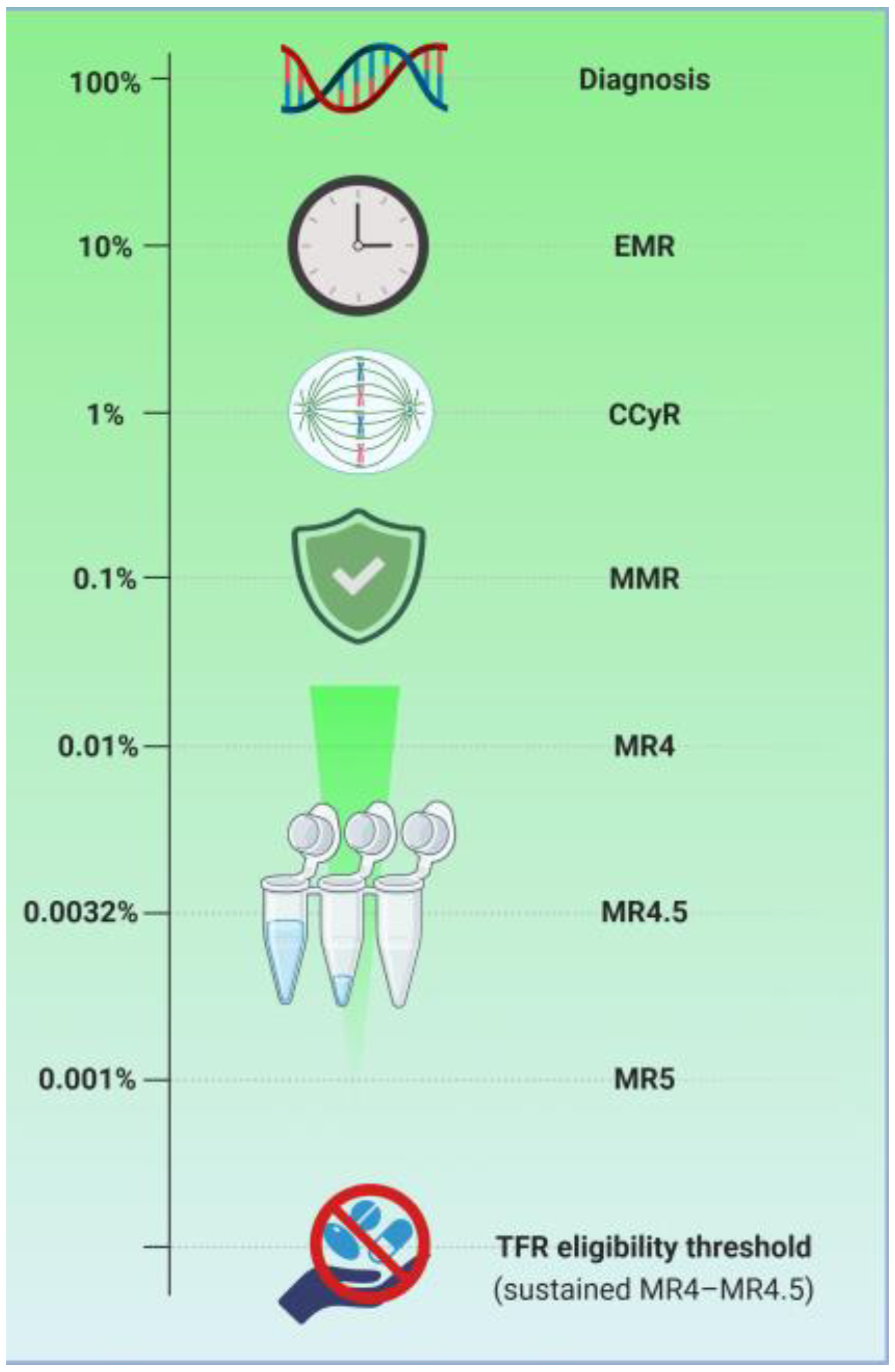
| MMR, MR3 | BCR-ABL1 IS ≤ 0.1% (3-log reduction from baseline) | RT-qPCR | “Safe harbor” response with minimal risk of progression; key long-term treatment goal |
| DMR | MR4 (≤0.01%), MR4.5 (≤0.0032%), MR5 (≤0.001%) | RT-qPCR, ddPCR | Required for TFR; reflects profound and sustained disease suppression |
| EMR | BCR-ABL1 IS ≤ 10% at 3 months | RT-qPCR | Early predictor of long-term outcomes, including achievement of MMR/DMR |
| Loss of Molecular Response | Loss of MMR or ≥1-log increase in BCR-ABL1 | RT-qPCR | Requires clinical intervention: adherence assessment, mutation testing, and treatment modification |
| TKI | Efficacy (CCyR/MMR/DMR) | Key Toxicities | Cardiovascular Risk | TFR Potential | Recommended Patient Profile/Notes |
|---|---|---|---|---|---|
| Imatinib | High CCyR; moderate MMR; slower DMR | Edema, muscle cramps, gastrointestinal intolerance | Low: cardiovascular-sparing | Moderate; slower DMR may delay TFR eligibility | Older or frail patients; high baseline CV risk; those prioritizing long-term tolerability |
| Dasatinib | Faster CCyR and MMR; higher rates of early DMR | Pleural effusions, pulmonary arterial hypertension, cytopenias | Moderate; pulmonary vascular toxicity | High; rapid DMR favors TFR | Patients seeking early deep response; low CV risk; requires pulmonary monitoring |
| Nilotinib | Faster CCyR and MMR; higher DMR rates vs. imatinib | Hyperglycemia, dyslipidemia, QT prolongation | High; ischemic heart disease, arrhythmias | High; rapid DMR favors TFR | Younger patients with low CV risk; strong TFR intent; requires strict CV and metabolic monitoring |
| Bosutinib | Faster early MMR; DMR rates comparable to other 2G-TKIs | Diarrhea, hepatotoxicity, cytopenias | Low-to-moderate; less clearly defined | Moderate–high | Patients with CV comorbidities; monitor hepatic function and gastrointestinal tolerance |
| Ponatinib | High efficacy; active against T315I | Arterial/venous occlusion, hypertension | Very high; major vascular events | Limited; TFR is less studied | Resistant CML, T315I mutation; high CV risk requires caution |
| Asciminib | Effective after ≥2 prior TKIs; high MMR | Cytopenias, lipase elevation, pancreatitis | Low-to-moderate | Promising; ongoing studies | Multi-resistant patients; allosteric inhibitor spares off-target effects; good tolerability |
Disclaimer/Publisher’s Note: The statements, opinions and data contained in all publications are solely those of the individual author(s) and contributor(s) and not of MDPI and/or the editor(s). MDPI and/or the editor(s) disclaim responsibility for any injury to people or property resulting from any ideas, methods, instructions or products referred to in the content. |
© 2026 by the authors. Licensee MDPI, Basel, Switzerland. This article is an open access article distributed under the terms and conditions of the Creative Commons Attribution (CC BY) license.
Share and Cite
Leyfman, Y.; Azeez, A.H.; Dohadwala, T.K.; Nadar, S.; Vaishnav, R.; Khan, S.; Rangrej, V.J.; Cortiana, V.; Park, C. Evolving Therapeutic Algorithms in Chronic Myeloid Leukemia: Integrating Efficacy, Safety, and Survivorship. Biomedicines 2026, 14, 408. https://doi.org/10.3390/biomedicines14020408
Leyfman Y, Azeez AH, Dohadwala TK, Nadar S, Vaishnav R, Khan S, Rangrej VJ, Cortiana V, Park C. Evolving Therapeutic Algorithms in Chronic Myeloid Leukemia: Integrating Efficacy, Safety, and Survivorship. Biomedicines. 2026; 14(2):408. https://doi.org/10.3390/biomedicines14020408
Chicago/Turabian StyleLeyfman, Yan, Ahmed Hashim Azeez, Taha Kassim Dohadwala, Soumiya Nadar, Riya Vaishnav, Sumaiya Khan, Vraj JigarKumar Rangrej, Viviana Cortiana, and Chandler Park. 2026. "Evolving Therapeutic Algorithms in Chronic Myeloid Leukemia: Integrating Efficacy, Safety, and Survivorship" Biomedicines 14, no. 2: 408. https://doi.org/10.3390/biomedicines14020408
APA StyleLeyfman, Y., Azeez, A. H., Dohadwala, T. K., Nadar, S., Vaishnav, R., Khan, S., Rangrej, V. J., Cortiana, V., & Park, C. (2026). Evolving Therapeutic Algorithms in Chronic Myeloid Leukemia: Integrating Efficacy, Safety, and Survivorship. Biomedicines, 14(2), 408. https://doi.org/10.3390/biomedicines14020408