


Abstract
Metformin is a first-line oral antidiabetic agent that has attracted increasing interest as a potential geroprotective therapy due to its ability to improve metabolic homeostasis, reduce oxidative stress, and attenuate chronic inflammation. However, its role in skeletal muscle aging and sarcopenia remains controversial. Observational and epidemiological studies suggest that metformin use is associated with a lower prevalence of sarcopenia, particularly in metabolically compromised or insulin-resistant older populations, where improvements in systemic metabolism and inflammatory burden may indirectly support muscle quality and function. In contrast, randomized interventional trials in metabolically healthy older adults indicate that metformin can blunt resistance exercise–induced muscle hypertrophy and protein synthesis, likely through sustained activation of AMP-activated protein kinase (AMPK) and consequent suppression of mammalian target of rapamycin complex 1 (mTORC1) signaling. This perspective argues that these apparently opposing outcomes reflect a con-text-dependent therapeutic paradox rather than inconsistent evidence. Metformin may provide metabolic protection in frail, insulin-resistant individuals, yet limit anabolic adaptations in physically active older adults. These findings emphasize the necessity for precision geropharmacological strategies to balance metabolic longevity with preservation of musculoskeletal health in aging populations.
1. Introduction
Initially prescribed for type 2 diabetes mellitus (T2DM), metformin has recently gained significant attention as a potential geroprotective agent [1]. It produces multiple effects by inhibiting mitochondrial complex I, decreasing hepatic gluconeogenesis, activating AMP-activated protein kinase (AMPK), and influencing inflammatory and oxidative stress pathways [2,3,4]. The Targeting Aging with Metformin (TAME) trial and related studies have expanded its reputation beyond glycemic control to possible anti-aging uses [5]. However, skeletal muscle (the largest metabolic organ) complicates this issue. Age-related muscle loss, or sarcopenia, not only leads to frailty and disability but also worsens metabolic disorders [6]. Intriguingly, while large observational studies suggest protective effects, intervention trials in older adults show that metformin may inhibit muscle gains from resistance training [7,8]. These seemingly contradictory findings suggest that the effects of metformin on aging are not uniform but instead vary systematically across disease environments and experimental conditions.
As shown in Table 1, a representative overview of selected recent studies illustrates the heterogeneous effects of metformin across aging-related conditions. Meta-analyses and clinical studies report inconsistent or modest benefits in neurodegenerative and cognitive disorders, with several investigations indicating no overall protective effect or even potentially adverse associations in specific subpopulations [9,10,11,12]. In addition, preclinical models demonstrate relatively consistent beneficial effects, including reduced tau pathology, enhanced autophagy, and improved cellular stress resistance, largely mediated through AMPK activation, mTORC1 suppression, and anti-inflammatory pathways [13,14,15]. Notably, these effects vary according to disease stage, age, experimental model, and dosage, underscoring the absence of a uniform therapeutic profile. Accordingly, this heterogeneity indicates that metformin may not represent a “universal” solution for extending lifespan.
Table 1.
Representative findings illustrating the heterogeneous effects of metformin in aging-related diseases.
2. The Paradox: Restrained Muscle Adaptation and the AMPK-mTOR Signaling Dilemma
In a randomized controlled trial (the MASTERS study), older adults who received 1700 mg/day of metformin during 14 weeks of progressive resistance training gained significantly less muscle mass and cross-sectional area compared to the placebo group [8]. Transcriptomic profiling further revealed attenuated activation of anabolic and mitochondrial biogenesis pathways in the metformin group [19]. Mechanistically, this paradox can be partially explained by dysregulated AMPK–mTORC1 crosstalk [20]. Metformin activates AMPK, which, while beneficial for metabolic regulation, concurrently inhibits mTORC1, the central driver of muscle protein synthesis [21,22]. In healthy muscle, this may blunt hypertrophic adaptation to mechanical loading. Therefore, the same signaling pathway that provides metabolic protection may impair muscle growth when anabolic stimulation is required.
Furthermore, in vitro studies confirm this concern. Metformin exposure in C2C12 myotubes increases FoxO3a expression and nuclear localization and enhances its binding to the myostatin promoter, thereby activating a FoxO3a-dependent catabolic program that is classically linked to induction of the muscle atrophy-related E3 ubiquitin ligases MuRF1 and Atrogin-1 [23,24]. These molecular patterns are consistent with disuse or fasting-induced atrophy, raising the possibility that chronic metformin use under specific conditions could mimic aspects of catabolic stress [25]. Even more patently, in clinical trials combining metformin with resistance exercise, older subjects exhibited reduced gains in strength and muscle hypertrophy, despite preserved insulin sensitivity [8,26]. This dissociation is consistent with what may be conceptualized as a ‘geroprotection paradox’, in which cellular signaling is improved while tissue-level adaptation is weakened.
In support of this concept, the mechanistic evidence summarized in Table 2 shows the strongly context-dependent and often bidirectional effects of metformin on skeletal muscle aging. Across in vivo, in vitro, and limited clinical observations, metformin is frequently associated with partial improvements in muscle quality, cellular stress resistance, and metabolic maintenance, such as enhanced autophagy, mitochondrial function, and reduced inflammatory burden, particularly in aging or metabolically compromised models, largely through AMPK activation and related pathways [27,28,29]. However, these cellular benefits are not consistently accompanied by enhanced muscle mass or anabolic capacity, as metformin exposure in several settings is linked to attenuated myogenic signaling, altered satellite cell–related markers, activation of catabolic transcriptional programs, or negligible effects on fat-free mass in randomized trials [30,31,32]. Importantly, these outcomes vary substantially with experimental model, age, metabolic status, treatment duration, and dosage, emphasizing the absence of a uniform therapeutic profile and providing putative mechanistic support for the dissociation between improved cellular homeostasis and blunted hypertrophic adaptation described above.
Table 2.
Reported mechanisms underlying the effects of metformin on sarcopenia (2020–2025).
Beyond signaling mechanisms, population characteristics further shape the apparent paradox observed across study designs. The apparent discrepancy between observational and interventional findings can be largely attributed to differences in the populations studied and the outcomes assessed. Observational studies predominantly involve older adults with metabolic comorbidities, in whom sarcopenia develops in parallel with systemic metabolic stress and inflammation; in this context, metformin may indirectly preserve muscle quality and reduce sarcopenia risk through its metabolic and anti-inflammatory effects. By contrast, interventional trials typically enroll metabolically healthy, physically active older adults undergoing resistance training, where muscle adaptation relies on intact anabolic signaling and transient mTORC1 activation. In this setting, chronic AMPK activation by metformin may attenuate mTORC1-driven protein synthesis and blunt hypertrophic responses despite improved metabolic indices. Taken together, these findings are not contradictory but complementary, reflecting fundamental differences in biological context and study design. This perspective sets the stage for a broader discussion of context-dependent modifiers, including nutrition, exercise modality, and the gut microbiome.
3. Understanding Context-Dependent Metformin Effects in Aging
One key reason for the inconsistent findings across studies in Table 2 is that the effects of metformin strongly depend on context. Its influence differs with age, metabolic health, nutritional status, physical activity level, and gut microbiota. Together, these factors influence the balance between muscle-building and muscle-breaking pathways in aging muscle, which ultimately determines whether metformin is beneficial or harmful.
In metabolically unhealthy or diabetic individuals, insulin-sensitizing and anti-inflammatory properties of metformin may partially restore impaired anabolic responsiveness [38]. By improving systemic glucose handling, reducing low-grade inflammation, and alleviating lipid-induced metabolic stress, metformin may indirectly enhance muscle quality, even in the absence of robust gains in muscle mass [39]. Such effects are consistent with observations in sarcopenic or metabolically compromised models, where improvements in muscle function and cellular integrity often outweigh changes in absolute muscle quantity [36]. In contrast, in metabolically healthy or physically trained older adults, chronic activation of AMPK by metformin may blunt the mTORC1 signaling required for resistance exercise-induced muscle hypertrophy [8]. Because adaptive muscle growth relies on transient mTORC1 activation, sustained AMPK dominance may attenuate training responsiveness, providing a mechanistic basis for reports of diminished hypertrophic adaptations in this population. Interpretation is further complicated by sex-specific and dose-dependent factors. Age-related changes in pharmacokinetics, renal clearance, and muscle perfusion may alter tissue exposure to metformin, while hormonal differences between males and females could modulate downstream signaling responses [40,41,42]. These variables are rarely harmonized across studies, contributing additional layers of heterogeneity.
Nutritional status also represents a central determinant of this balance. Adequate protein intake is required to elicit postprandial mTORC1 activation and sustain muscle protein synthesis in older adults, who already exhibit age-related anabolic resistance [43]. Therefore, under conditions of insufficient protein or energy intake, metformin-mediated suppression of basal mTORC1 tone may further inhibit anabolic signaling capacity, thereby predisposing aging muscle to protein loss.
Moreover, the interaction between metformin and exercise is also critical. Aerobic exercise, which relies primarily on mitochondrial oxidative metabolism, may act synergistically with the mitochondrial and redox-modulating effects of metformin [44]. In contrast, resistance training relies on short-lived mTOR activation for muscle remodeling, a process that metformin can suppress [45]. However, muscle-intrinsic signaling pathways alone may not fully account for the divergent muscular outcomes observed across populations [46,47].
Metformin is well known to remodel gut microbial composition and function, including enrichment of short-chain fatty acid (SCFA)–producing taxa and alterations in bile acid metabolism, both of which can influence host energy homeostasis, inflammation, and muscle metabolism [46]. Exercise itself is a potent modulator of the gut microbiome, and the combined effects of metformin and specific exercise modalities may generate distinct microbial and metabolite profiles that differentially impact muscle anabolic signaling [47,48]. Although these interactions remain incompletely characterized, they introduce an additional layer of biological variability that may help explain population-specific responses to metformin.
Building on these observations, the gut microbiome can be further conceptualized as a signaling intermediary linking metformin exposure to skeletal muscle adaptation. Metformin-induced shifts in microbial composition, including increased SCFA production and remodeling of bile acid–transforming communities. These changes may influence host metabolism through elevated circulating SCFAs and modified bile acid pools, which regulate systemic inflammation, insulin sensitivity, and energy homeostasis. From a muscle signaling perspective, SCFAs such as butyrate and propionate may indirectly modulate skeletal muscle anabolic responsiveness by attenuating chronic low-grade inflammation and improving insulin signaling, thereby lowering basal metabolic stress in aging muscle. In parallel, and through partially overlapping mechanisms, microbiota-driven alterations in bile acid composition may influence muscle metabolism via FXR- and TGR5-dependent pathways, with downstream effects on mitochondrial function, oxidative capacity, and AMPK activity. Collectively, these microbiome-derived signals may shift the balance between AMPK-mediated metabolic stress responses and mTORC1-dependent anabolic signaling in skeletal muscle.
Importantly, this framework does not propose a deterministic causal pathway, but rather a hypothesis-driven model in which gut microbiota composition acts as a contextual modifier of metformin’s muscular effects. Depending on baseline metabolic status, exercise context, and microbial configuration, metformin-induced microbiome remodeling may either support muscle maintenance in metabolically compromised individuals or fail to compensate for AMPK-driven suppression of hypertrophic signaling in physically active older adults. As such, this model highlights the gut–muscle axis as a testable mechanistic layer within precision geropharmacology and underscores the need for future studies integrating microbiome profiling with muscle signaling and functional endpoints.
Overall, these observations argue strongly against a “one-size-fits-all” strategy for metformin use in sarcopenia and highlight the necessity of precision-based approaches that consider metabolic status, nutritional adequacy, exercise type, age, and sex. The growing recognition of context-dependent responses to metformin highlights the need for future precision geropharmacological approaches supported by actionable biomarkers. Potential candidates include baseline AMPK-mTORC1 signaling activity, systemic inflammatory markers (e.g., CRP and IL-6), metabolic indices of insulin resistance, and emerging gut microbiome-derived signatures. These biomarkers may enable stratification of individuals who derive metabolic benefit from metformin versus those at risk of impaired anabolic adaptation, and should be evaluated in future studies.
4. Redefining Geroprotection in Muscle Aging
The binary view of metformin should be abandoned as either a “beneficial” or “harmful” drug for skeletal muscle. Instead, a nuanced framework is needed that integrates dose–response relationships, timing of administration, and combined lifestyle interventions. Emerging evidence suggests that intermittent or lower-dose metformin may mitigate the hypertrophy-blunting effect while preserving mitochondrial and anti-inflammatory advantages [49]. Alternatively, co-treatment strategies that transiently relieve AMPK-mediated suppression could achieve balanced outcomes, such as metformin cycling or combination with nutraceutical AMPK modulators [50,51].
Moreover, hybrid compounds like RJx-01 (metformin + galantamine) have demonstrated synergistic effects in preclinical models, improving autophagy, neuromuscular junction integrity, and muscle force generation beyond what either compound achieves alone [27]. Such findings indicate that polypharmacological approaches may overcome metformin’s intrinsic limitations.
Importantly, future research must differentiate between “muscle aging” (cellular senescence, mitochondrial decline, autophagic failure) and “sarcopenia” (loss of mass and function). While these phenomena overlap, metformin may target the former more effectively than the latter. Longitudinal human trials that integrate muscle omics, imaging, and functional endpoints are urgently needed to determine whether metformin delays true sarcopenia or merely improves metabolic biomarkers.
One promising strategy to reconcile the metabolic benefits of metformin with its potential to blunt anabolic adaptation is the exploration of intermittent or cycling dosing paradigms. From a mechanistic perspective, the beneficial effects of metformin on mitochondrial function, inflammation, and metabolic homeostasis are largely mediated through AMPK activation and downstream stress-response pathways, which may not require continuous pharmacological pressure to be sustained. In contrast, chronic AMPK dominance may interfere with the transient mTORC1 activation required for resistance exercise–induced muscle protein synthesis. Intermittent exposure to metformin could therefore represent a theoretical means to retain metabolic protection while permitting periodic restoration of anabolic responsiveness during phases of mechanical loading or nutritional sufficiency. In addition, co-treatment strategies warrant consideration as a conceptual way to balance metformin’s pleiotropic effects. Rather than opposing metformin’s action directly, rational combinations may aim to temporally or contextually offset its anabolic suppression. For example, pairing metformin with nutritional, exercise-based, or pharmacological interventions that support mTORC1 signaling, satellite cell activity, or neuromuscular adaptation could help preserve muscle adaptability without negating metabolic benefits. Importantly, these approaches should not be viewed as fixed therapeutic prescriptions, but as testable hypotheses that underscore the necessity of context-aware intervention design. Within a precision geropharmacology framework, such strategies emphasize timing, physiological state, and adaptive capacity as critical determinants of outcome, reinforcing the view that metformin’s effects on aging muscle are modifiable rather than intrinsically paradoxical.
5. Re-Evaluating the “Anti-Aging” Potential of Metformin
Interest in metformin as a potential universal anti-aging drug has sometimes exceeded the strength of the available evidence. Its use in large longevity trials, such as the TAME study [5], highlights the need to evaluate not only effects on lifespan but also on functional healthspan, especially skeletal muscle function. If a longevity drug weakens muscle adaptation, it may help people live longer but make it harder for them to stay independent and mobile, which are essential for healthy aging. This paradox reflects a broader tension in geroscience: interventions that suppress anabolic signaling to extend lifespan may simultaneously impair tissue repair and regeneration [52]. Because skeletal muscle relies heavily on mechanical loading and anabolic signaling, these trade-offs are particularly important. The effects of Metformin on muscle are therefore unlikely to be uniformly “anti-aging” and instead appear to depend on context, acting primarily as a modulator of cellular energy sensing.
6. Conclusions and Perspective
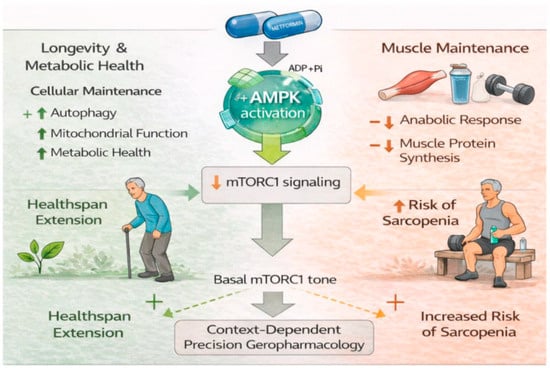
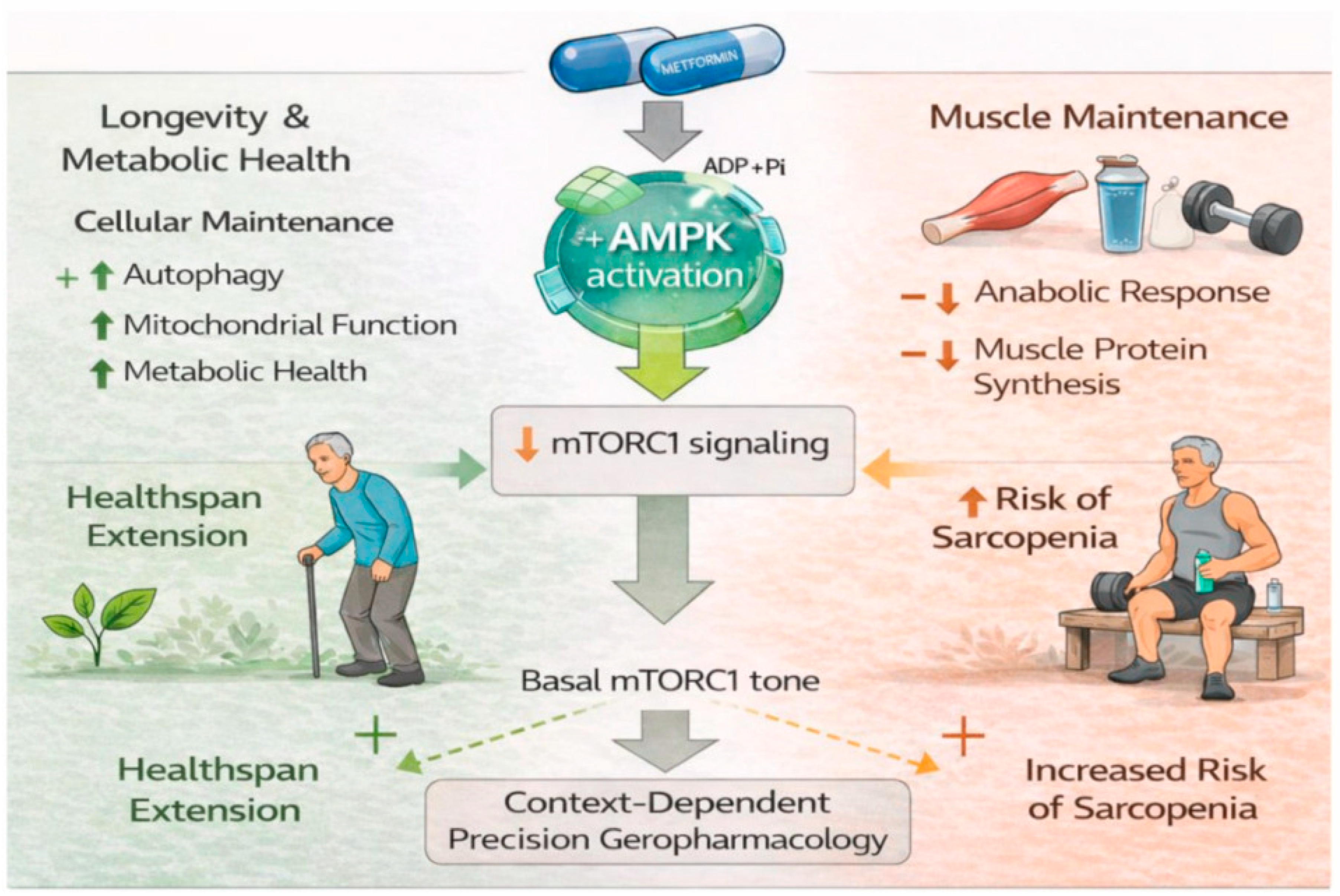
Taken together, the dual role of metformin as both a metabolic protector and a potential inhibitor of muscle adaptation challenges the notion of universal geroprotection (Figure 1). Consequently, the future of sarcopenia research lies in precision geropharmacology, in which interventions are tailored according to metabolic phenotype, exercise context, gut microbiome configuration, and individual aging trajectories. Rather than asking whether metformin is “good or bad” for aging muscle, more relevant questions are: when, in whom, at what dose, and under which metabolism and gut microbiome context does metformin confer benefit or harm? Hence, future studies should explicitly incorporate microbiome profiling into experimental and clinical designs, alongside integrated multi-omics, imaging, and functional endpoints, to delineate the dynamic drug–exercise–muscle axis. Only by embracing this biological complexity can metformin be transformed from a blunt anti-aging intervention into a refined and personalized strategy for preserving skeletal muscle health across the lifespan.
Figure 1.
Schematic illustration of the context-dependent effects of metformin on longevity and sarcopenia. Metformin activates AMP-activated protein kinase (AMPK), promoting metabolic health, mitochondrial function, autophagy, and anti-inflammatory signaling that support longevity, particularly in frail or metabolically compromised older individuals. However, sustained AMPK activation concurrently suppresses mTORC1 signaling, a key driver of muscle protein synthesis and hypertrophic adaptation, potentially blunting resistance training–induced muscle growth and exacerbating sarcopenia in physically active older adults. These findings highlight a therapeutic paradox and emphasize the need for precision geropharmacological strategies in aging.
Author Contributions
Conceptualization, J.-H.W.; methodology, J.-H.W. and S.-Y.H.; formal analysis, S.-Y.H.; investigation, J.-H.W. and S.-Y.H.; writing—original draft preparation, S.-Y.H.; writing—review and editing, M.K.Y. and J.-H.W.; visualization, J.-H.W. and M.K.Y.; supervision, J.-H.W.; project administration, J.-H.W.; funding acquisition, J.-H.W. All authors have read and agreed to the published version of the manuscript.
Funding
This research was supported by the National Research Foundation of Korea (2020R1F1A1074155).
Data Availability Statement
No new data were created or analyzed in this study.
Conflicts of Interest
The authors declare no conflicts of interest.
Abbreviations
The following abbreviations are used in this manuscript:
| AD | Alzheimer’s disease |
| AMPK | AMP-activated protein kinase |
| AMD | Age-related macular degeneration |
| ATGL | Adipose triglyceride lipase |
| CRP | C-reactive protein |
| FFM | Fat-free mass |
| FoxO3a | Forkhead box O3a |
| GSK3β | Glycogen synthase kinase-3 beta |
| HSL | Hormone-sensitive lipase |
| MASTERS | Metformin to augment strength training effective response in seniors |
| MET | Metformin |
| mTORC1 | Mammalian target of rapamycin complex 1 |
| MPCs | Muscle progenitor cells |
| MuRF1 | Muscle RING finger protein-1 |
| NA | Not applicable |
| NS | Not significant |
| PD | Parkinson’s disease |
| Pos | Positive effect |
| Neg | Negative effect |
| SASP | Senescence-associated secretory phenotype |
| SCFA | Short-chain fatty acid |
| T2DM | Type 2 diabetes mellitus |
| TAME | Targeting aging with metformin |
References
- Kulkarni, A.S.; Gubbi, S.; Barzilai, N. Benefits of Metformin in Attenuating the Hallmarks of Aging. Cell Metab. 2020, 32, 15–30. [Google Scholar] [CrossRef] [Scilit] [PubMed]
- Foretz, M.; Guigas, B.; Viollet, B. Metformin: Update on mechanisms of action and repurposing potential. Nat. Rev. Endocrinol. 2023, 19, 460–476. [Google Scholar] [CrossRef] [Scilit] [PubMed]
- Ansari, A.; Bose, S.; Lim, S.-K.; Wang, J.-H.; Choi, Y.-H.; Kim, H. Combination of Scutellaria baicalensis and Metformin Ameliorates Diet-Induced Metabolic Dysregulation in Mice via the Gut–Liver–Brain Axis. Am. J. Chin. Med. 2020, 48, 1409–1433. [Google Scholar] [CrossRef] [Scilit] [PubMed]
- Wang, J.-H.; Bose, S.; Lim, S.-K.; Ansari, A.; Chin, Y.-W.; Choi, H.S.; Kim, H. Houttuynia cordata Facilitates Metformin on Ameliorating Insulin Resistance Associated with Gut Microbiota Alteration in OLETF Rats. Genes 2017, 8, 239. [Google Scholar] [CrossRef] [Scilit]
- Rolland, Y.; Sierra, F.; Ferrucci, L.; Barzilai, N.; De Cabo, R.; Mannick, J.; Oliva, A.; Evans, W.; Angioni, D.; De Souto Barreto, P.; et al. Challenges in developing Geroscience trials. Nat. Commun. 2023, 14, 5038. [Google Scholar] [CrossRef] [Scilit]
- Larsson, L.; Degens, H.; Li, M.; Salviati, L.; Lee, Y.I.; Thompson, W.; Kirkland, J.L.; Sandri, M. Sarcopenia: Aging-Related Loss of Muscle Mass and Function. Physiol. Rev. 2019, 99, 427–511. [Google Scholar] [CrossRef] [Scilit]
- Qaisar, R.; Javed, M.; Khan, I.M.; Ahmad, F.; Karim, A. Metformin improves skeletal muscle and physical capacity by stabilizing neuromuscular junction in older adults. Arch. Gerontol. Geriatr. 2024, 127, 105587. [Google Scholar] [CrossRef] [Scilit]
- Walton, R.G.; Dungan, C.M.; Long, D.E.; Tuggle, S.C.; Kosmac, K.; Peck, B.D.; Bush, H.M.; Villasante Tezanos, A.G.; McGwin, G.; Windham, S.T.; et al. Metformin blunts muscle hypertrophy in response to progressive resistance exercise training in older adults: A randomized, double-blind, placebo-controlled, multicenter trial: The MASTERS trial. Aging Cell 2019, 18, e13039, Erratum in Aging Cell 2019, 19, e13098. https://doi.org/10.1111/acel.13098.. [Google Scholar] [CrossRef] [Scilit]
- Blitzer, A.L.; Ham, S.A.; Colby, K.A.; Skondra, D. Association of Metformin Use With Age-Related Macular Degeneration: A Case-Control Study. JAMA Ophthalmol. 2021, 139, 302–309. [Google Scholar] [CrossRef] [Scilit]
- Sood, A.; Capuano, A.W.; Wilson, R.S.; Barnes, L.L.; Kapasi, A.; Bennett, D.A.; Arvanitakis, Z. Metformin, age-related cognitive decline, and brain pathology. Neurobiol. Aging 2024, 133, 99–106. [Google Scholar] [CrossRef] [Scilit]
- Zhang, J.H.; Zhang, X.Y.; Sun, Y.Q.; Lv, R.H.; Chen, M.; Li, M. Metformin use is associated with a reduced risk of cognitive impairment in adults with diabetes mellitus: A systematic review and meta-analysis. Front. Neurosci. 2022, 16, 984559. [Google Scholar] [CrossRef] [Scilit]
- Tabatabaei Malazy, O.; Bandarian, F.; Qorbani, M.; Mohseni, S.; Mirsadeghi, S.; Peimani, M.; Larijani, B. The effect of metformin on cognitive function: A systematic review and meta-analysis. J. Psychopharmacol. 2022, 36, 666–679. [Google Scholar] [CrossRef] [Scilit]
- Zhao, S.; Fan, Z.; Zhang, X.; Li, Z.; Shen, T.; Li, K.; Yan, Y.; Yuan, Y.; Pu, J.; Tian, J.; et al. Metformin Attenuates Tau Pathology in Tau-Seeded PS19 Mice. Neurother. J. Am. Soc. Exp. Neurother. 2023, 20, 452–463. [Google Scholar] [CrossRef] [Scilit] [PubMed]
- Cho, S.Y.; Kim, E.W.; Park, S.J.; Phillips, B.U.; Jeong, J.; Kim, H.; Heath, C.J.; Kim, D.; Jang, Y.; López-Cruz, L.; et al. Reconsidering repurposing: Long-term metformin treatment impairs cognition in Alzheimer’s model mice. Transl. Psychiatry 2024, 14, 34. [Google Scholar] [CrossRef] [Scilit] [PubMed]
- Romero, M.; Gelsomini, A.; Miller, K.; Suresh, D.; Thaller, S.; Frasca, D. In Vitro Treatment with Metformin Significantly Reduces Senescent B Cells Present in the Adipose Tissue of People with Obesity. J. Nutr. 2025, 155, 445–452. [Google Scholar] [CrossRef] [Scilit] [PubMed]
- Ping, F.; Jiang, N.; Li, Y. Association between metformin and neurodegenerative diseases of observational studies: Systematic review and meta-analysis. BMJ Open Diabetes Res. Care 2020, 8, e001370. [Google Scholar] [CrossRef] [Scilit]
- Ji, S.; Zhao, X.; Zhu, R.; Dong, Y.; Huang, L.; Zhang, T. Metformin and the risk of dementia based on an analysis of 396,332 participants. Ther. Adv. Chronic Dis. 2022, 13, 20406223221109454. [Google Scholar] [CrossRef] [Scilit]
- Cetinavci, D.; Yasar, V.; Yigitturk, G.; Elbe, H. Metformin promotes wound healing in senescent fibroblasts by regulating SIRT1 and FAP-α. Histochem. Cell Biol. 2025, 163, 101. [Google Scholar] [CrossRef] [Scilit]
- Bruss, M.D.; Elliehausen, C.J.; Clark, J.P.; Minton, D.M.; Konopka, A.R. Metformin suppresses the mitochondrial and transcriptional response to exercise, revealing a conserved BCL6B-associated angiogenic program. J. Appl. Physiol. 2025, 139, 541–556. [Google Scholar] [CrossRef] [Scilit]
- Smiles, W.J.; Ovens, A.J.; Kemp, B.E.; Galic, S.; Petersen, J.; Oakhill, J.S. New developments in AMPK and mTORC1 cross-talk. Essays Biochem. 2024, 68, 321–336. [Google Scholar] [CrossRef] [Scilit]
- Jäger, S.; Handschin, C.; St.-Pierre, J.; Spiegelman, B.M. AMP-activated protein kinase (AMPK) action in skeletal muscle via direct phosphorylation of PGC-1α. Proc. Natl. Acad. Sci. USA 2007, 104, 12017–12022. [Google Scholar] [CrossRef] [Scilit]
- Howell, J.J.; Hellberg, K.; Turner, M.; Talbott, G.; Kolar, M.J.; Ross, D.S.; Hoxhaj, G.; Saghatelian, A.; Shaw, R.J.; Manning, B.D. Metformin Inhibits Hepatic mTORC1 Signaling via Dose-Dependent Mechanisms Involving AMPK and the TSC Complex. Cell Metab. 2017, 25, 463–471. [Google Scholar] [CrossRef] [Scilit] [PubMed]
- Kang, M.J.; Moon, J.W.; Lee, J.O.; Kim, J.H.; Jung, E.J.; Kim, S.J.; Oh, J.Y.; Wu, S.W.; Lee, P.R.; Park, S.H.; et al. Metformin induces muscle atrophy by transcriptional regulation of myostatin via HDAC6 and FoxO3a. J. Cachexia Sarcopenia Muscle 2022, 13, 605–620. [Google Scholar] [CrossRef] [Scilit] [PubMed]
- Blaauw, B.; Schiaffino, S.; Reggiani, C. Mechanisms Modulating Skeletal Muscle Phenotype. Compr. Physiol. 2013, 3, 1645–1687. [Google Scholar] [CrossRef] [Scilit] [PubMed]
- Ebert, S.M.; Monteys, A.M.; Fox, D.K.; Bongers, K.S.; Shields, B.E.; Malmberg, S.E.; Davidson, B.L.; Suneja, M.; Adams, C.M. The Transcription Factor ATF4 Promotes Skeletal Myofiber Atrophy during Fasting. Mol. Endocrinol. 2010, 24, 790–799. [Google Scholar] [CrossRef] [Scilit]
- Kulkarni, A.S.; Peck, B.D.; Walton, R.G.; Kern, P.A.; Mar, J.C.; Windham, S.T.; Bamman, M.M.; Barzilai, N.; Peterson, C.A. Metformin alters skeletal muscle transcriptome adaptations to resistance training in older adults. Aging 2020, 12, 19852–19866. [Google Scholar] [CrossRef] [Scilit]
- Tezze, C.; Amendolagine, F.I.; Nogara, L.; Baraldo, M.; Ciciliot, S.; Arcidiacono, D.; Zaramella, A.; Masiero, G.; Ferrarese, G.; Realdon, S.; et al. A combination of metformin and galantamine exhibits synergistic benefits in the treatment of sarcopenia. JCI Insight 2023, 8, e168787. [Google Scholar] [CrossRef] [Scilit]
- Bang, S.; Kim, D.E.; Kang, H.T.; Lee, J.H. Metformin restores autophagic flux and mitochondrial function in late passage myoblast to impede age-related muscle loss. Biomed. Pharmacother. 2024, 180, 116981. [Google Scholar] [CrossRef] [Scilit]
- Cui, M.; Gang, X.; Wang, G.; Xiao, X.; Li, Z.; Jiang, Z.; Wang, G. A cross-sectional study: Associations between sarcopenia and clinical characteristics of patients with type 2 diabetes. Medicine 2020, 99, e18708. [Google Scholar] [CrossRef] [Scilit]
- Ida, S.; Kaneko, R.; Imataka, K.; Okubo, K.; Shirakura, Y.; Azuma, K.; Fujiwara, R.; Murata, K. Effects of Antidiabetic Drugs on Muscle Mass in Type 2 Diabetes Mellitus. Curr. Diabetes Rev. 2021, 17, 293–303. [Google Scholar] [CrossRef] [Scilit]
- Mahmassani, Z.S.; McKenzie, A.I.; Petrocelli, J.J.; de Hart, N.M.; Reidy, P.T.; Fix, D.K.; Ferrara, P.J.; Funai, K.; Drummond, M.J. Short-term metformin ingestion by healthy older adults improves myoblast function. Am. J. Physiol. Cell Physiol. 2021, 320, C566–C576. [Google Scholar] [CrossRef] [Scilit] [PubMed]
- McKenzie, A.I.; Mahmassani, Z.S.; Petrocelli, J.J.; de Hart, N.; Fix, D.K.; Ferrara, P.J.; LaStayo, P.C.; Marcus, R.L.; Rondina, M.T.; Summers, S.A.; et al. Short-term exposure to a clinical dose of metformin increases skeletal muscle mitochondrial H2O2 emission and production in healthy, older adults: A randomized controlled trial. Exp. Gerontol. 2022, 163, 111804. [Google Scholar] [CrossRef] [Scilit] [PubMed]
- Yang, Y.; Liao, Z.; Xiao, Q. Metformin ameliorates skeletal muscle atrophy in Grx1 KO mice by regulating intramuscular lipid accumulation and glucose utilization. Biochem. Biophys. Res. Commun. 2020, 533, 1226–1232. [Google Scholar] [CrossRef] [Scilit] [PubMed]
- Ai, Y.; Xu, R.; Liu, L. The prevalence and risk factors of sarcopenia in patients with type 2 diabetes mellitus: A systematic review and meta-analysis. Diabetol. Metab. Syndr. 2021, 13, 93. [Google Scholar] [CrossRef] [Scilit]
- Petrocelli, J.J.; Mahmassani, Z.S.; Fix, D.K.; Montgomery, J.A.; Reidy, P.T.; McKenzie, A.I.; de Hart, N.M.; Ferrara, P.J.; Kelley, J.J.; Eshima, H.; et al. Metformin and leucine increase satellite cells and collagen remodeling during disuse and recovery in aged muscle. FASEB J. 2021, 35, e21862. [Google Scholar] [CrossRef] [Scilit]
- Lyu, Q.; Wen, Y.; He, B.; Zhang, X.; Chen, J.; Sun, Y.; Zhao, Y.; Xu, L.; Xiao, Q.; Deng, H. The ameliorating effects of metformin on disarrangement ongoing in gastrocnemius muscle of sarcopenic and obese sarcopenic mice. Biochim. Biophys. Acta Mol. Basis Dis. 2022, 1868, 166508. [Google Scholar] [CrossRef] [Scilit]
- Petrocelli, J.J.; de Hart, N.; Lang, M.J.; Yee, E.M.; Ferrara, P.J.; Fix, D.K.; Chaix, A.; Funai, K.; Drummond, M.J. Cellular senescence and disrupted proteostasis induced by myotube atrophy are prevented with low-dose metformin and leucine cocktail. Aging 2023, 15, 1808–1832. [Google Scholar] [CrossRef] [Scilit]
- Lin, H.; Ao, H.; Guo, G.; Liu, M. The Role and Mechanism of Metformin in Inflammatory Diseases. J. Inflamm. Res. 2023, 16, 5545–5564. [Google Scholar] [CrossRef] [Scilit]
- Shang, R.; Miao, J. Mechanisms and effects of metformin on skeletal muscle disorders. Front. Neurol. 2023, 14, 1275266. [Google Scholar] [CrossRef] [Scilit]
- Hu, D.; Xie, F.; Xiao, Y.; Lu, C.; Zhong, J.; Huang, D.; Chen, J.; Wei, J.; Jiang, Y.; Zhong, T. Metformin: A Potential Candidate for Targeting Aging Mechanisms. Aging Dis. 2021, 12, 480–493. [Google Scholar] [CrossRef] [Scilit]
- Hartmanshenn, C.; Scherholz, M.; Androulakis, I.P. Physiologically-based pharmacokinetic models: Approaches for enabling personalized medicine. J. Pharmacokinet. Pharmacodyn. 2016, 43, 481–504. [Google Scholar] [CrossRef] [Scilit] [PubMed]
- Cheng, F.F.; Liu, Y.L.; Du, J.; Lin, J.T. Metformin’s Mechanisms in Attenuating Hallmarks of Aging and Age-Related Disease. Aging Dis. 2022, 13, 970–986. [Google Scholar] [CrossRef] [Scilit] [PubMed]
- Deane, C.S.; Cox, J.; Atherton, P.J. Critical variables regulating age-related anabolic responses to protein nutrition in skeletal muscle. Front. Nutr. 2024, 11, 1419229. [Google Scholar] [CrossRef] [Scilit] [PubMed]
- Eslami, Z.; Roshandel, G.; Mirghani, S.J. Aerobic Exercise and Metformin: A Dual Approach to Enhancing Glycemic Maintenance in Type 2 Diabetes Mellitus. Chonnam Med. J. 2025, 61, 9–18. [Google Scholar] [CrossRef] [Scilit]
- Thomas, A.C.Q.; Stead, C.A.; Burniston, J.G.; Phillips, S.M. Exercise-specific adaptations in human skeletal muscle: Molecular mechanisms of making muscles fit and mighty. Free Radic. Biol. Med. 2024, 223, 341–356. [Google Scholar] [CrossRef] [Scilit]
- Ezzamouri, B.; Rosario, D.; Bidkhori, G.; Lee, S.; Uhlen, M.; Shoaie, S. Metabolic modelling of the human gut microbiome in type 2 diabetes patients in response to metformin treatment. npj Syst. Biol. Appl. 2023, 9, 2. [Google Scholar] [CrossRef] [Scilit]
- Fang, Y.; Cai, Y.; Chen, X.; Lin, Z. Exercise intervention regulates gut microbiota to improve type 2 diabetes: A narrative review of the mechanisms. Front. Nutr. 2025, 12, 1698112. [Google Scholar] [CrossRef] [Scilit]
- Varghese, S.; Rao, S.; Khattak, A.; Zamir, F.; Chaari, A. Physical Exercise and the Gut Microbiome: A Bidirectional Relationship Influencing Health and Performance. Nutrients 2024, 16, 3663. [Google Scholar] [CrossRef] [Scilit]
- Long, D.E.; Kosmac, K.; Dungan, C.M.; Bamman, M.M.; Peterson, C.A.; Kern, P.A. Potential Benefits of Combined Statin and Metformin Therapy on Resistance Training Response in Older Individuals. Front. Physiol. 2022, 13, 872745. [Google Scholar] [CrossRef] [Scilit]
- Maniscalco, E.; Abbadessa, G.; Giordano, M.; Grasso, L.; Borrione, P.; Racca, S. Metformin regulates myoblast differentiation through an AMPK-dependent mechanism. PLoS ONE 2023, 18, e0281718. [Google Scholar] [CrossRef] [Scilit]
- Li, M.; Ding, L.; Cao, L.; Zhang, Z.; Li, X.; Li, Z.; Xia, Q.; Yin, K.; Song, S.; Wang, Z.; et al. Natural products targeting AMPK signaling pathway therapy, diabetes mellitus and its complications. Front. Pharmacol. 2025, 16, 1534634, Erratum in Front. Pharmacol. 2025, 16, 1604573. https://doi.org/10.3389/fphar.2025.1604573.. [Google Scholar] [CrossRef] [Scilit]
- Smith, H.J.; Lanjuin, A.; Sharma, A.; Prabhakar, A.; Nowak, E.; Stine, P.G.; Sehgal, R.; Stojanovski, K.; Towbin, B.D.; Mair, W.B. Neuronal mTORC1 inhibition promotes longevity without suppressing anabolic growth and reproduction in C. elegans. PLoS Genet. 2023, 19, e1010938. [Google Scholar] [CrossRef] [Scilit]

Disclaimer/Publisher’s Note: The statements, opinions and data contained in all publications are solely those of the individual author(s) and contributor(s) and not of MDPI and/or the editor(s). MDPI and/or the editor(s) disclaim responsibility for any injury to people or property resulting from any ideas, methods, instructions or products referred to in the content. |
© 2026 by the authors. Licensee MDPI, Basel, Switzerland. This article is an open access article distributed under the terms and conditions of the Creative Commons Attribution (CC BY) license.