Targeted Next-Generation Sequencing in Drug-Resistant Tuberculosis: WHO Guidance and Practical Implementation Priorities


Abstract
1. Introduction
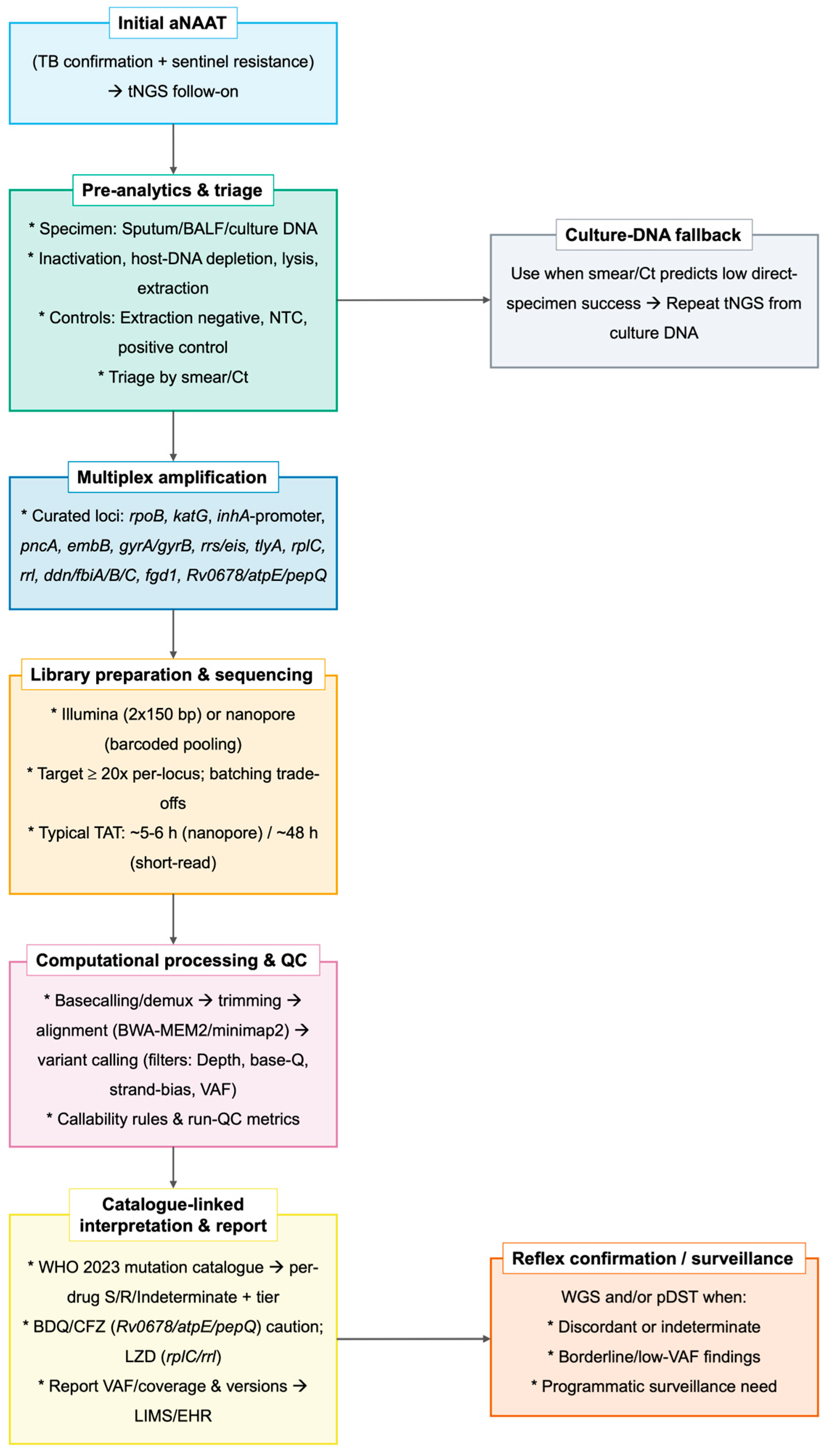
2. Principles and Panel Design: From Multiplex Amplification to Catalogue-Based Interpretation
2.1. Panel Design Linked to Therapy
2.2. Primer/Amplicon Design and Controls
2.3. Library Preparation, Depth, and Turnaround Time
2.4. Computational Processing
2.5. Catalogue-Based Interpretation and Reporting
2.6. Direct-from-Sample (Culture-Free) tNGS
2.7. Analytical Sensitivity, Heteroresistance, and Governance
3. Comparing Commercial and Emerging tNGS Workflows (Design, Turnaround, and Reporting)
3.1. Deeplex® Myc-TB
3.2. AmPORE-TB®
3.3. Panel Content and Coverage Differences
3.4. Performance, LoD/LoQ, and Quality Systems
3.5. Pros/Cons and Fit-for-Purpose Suggestion
4. Interpreting Variants with the WHO Mutation Catalogue: Evidence Tiers and the BDQ/CFZ Axis
5. Accuracy and Performance: Meta-Analysis and Field Evaluation
- Rifampicin: borderline/disrupted rpoB mutations—often outside the RRDR, such as I491F—can yield genotypic resistance with MICs near MGIT critical concentrations; reports should flag possible low-level resistance [37].
- Pyrazinamide: the pncA signal spans gene/promoter; full-gene coverage is essential, and phenotypic testing is technically challenging [38].
- FQ: most resistance maps to gyrA codons 90 and 94 (±gyrB); minor-variant calls near VAF cut-offs can explain apparent discordance and merit confirmation [6].
- LZD: rplC (C154R) and 23S rRNA (rrl) variants correlate with elevated MICs and may emerge on treatment; heteroresistance may be under-called [39].
- Pretomanid/delamanid: resistance involves ddn and F420 pathways (fbiA/B/C/D, fgd1), but critical datasets remain limited [40].
6. Linking tNGS Results to Clinical Decision Making
6.1. Decision Stage 1: FQ and BPaLM/BPaL Selection
- FQ-resistant or contraindicated: BPaL may be preferred, omitting moxifloxacin.
6.2. Decision Stage 2: BDQ Axis
- BDQ-resistant (high confidence): When catalogue-listed atpE substitutions or Rv0678 Group 1/2 variants are present at the validated VAF/coverage, BPaLM/BPaL is generally avoided. Constructing an individualized, longer all-oral regimen and expediting BDQ/CFZ MIC pDST and/or WGS could be prudent [6].
- BDQ uncertain/borderline: For Rv0678 variants of uncertain significance (VUS), low-VAF heteroresistance, or isolated pepQ changes, reporting “possible reduced BDQ susceptibility” may be helpful. Starting BPaLM/BPaL could be reasonable if benefits outweigh risks, with early review and confirmatory testing; if resistance is later confirmed or early non-response emerges, withdrawing BDQ would be sensible. Potential CFZ cross-resistance with Rv0678 may be anticipated, and CFZ might best be considered not fully effective until supported phenotypically [6,47,48].
6.3. Decision Stage 3: LZD—Resistance and Safety
- LZD uncertain/low VAF: Reporting “possible reduced LZD susceptibility” and starting BPaLM/BPaL at the standard LZD dose with early review may be reasonable. Confirmatory testing should be considered, and discontinuation of LZD could be appropriate if resistance, non-response, or toxicity is observed. Safety management (myelosuppression, neuropathy, lactic acidosis) may follow prespecified procedures—dose reduction, interruption, or discontinuation—with therapeutic drug monitoring (TDM) considered where available [39,46,49].
6.4. Incomplete Outputs: No-Call, Partial Results, and Heteroresistance
- No-call (drug-specific callability failure): It would be useful for reports to indicate the reason (e.g., insufficient gyrA coverage); repeating tNGS on a fresh specimen or culture DNA and/or pursuing pDST/WGS may be considered.
- Partial results: Summarizing the per-drug status and indicating the regimen-decisive call (often FQ) may aid decision making.
6.5. Network Operations: Centralized vs. Decentralized, TAT, Informatics
6.6. On-Treatment Reassessment and Policy Feedback
7. QA, EQA, and Interpretation Software
8. Economic and System Considerations: Cost-Effectiveness and Network Design
9. Discussion
- (A)
- Triage & specimen acceptance (direct specimen VS. culture DNA)
- Permitted specimen types are defined (sputum; validated BALF/respiratory matrices; culture DNA).
- Smear/acid-fast bacillus grade rule: Proceed with direct tNGS if ≥____; fallback to culture DNA if < ____.
- aNAAT Ct rule: Direct tNGS if Ct ≤ ____; culture-DNA fallback if Ct > ____ or inhibition is suspected.
- Host-DNA depletion and pre-analytics are specified (SOP ID: ____).
- Transport/storage documented (collection → receipt time/temperature); minimum volume ≥____ mL; LIMS accession/barcoding enforced.
- (B)
- Controls & contamination safeguards
- Batch controls: Extraction-negative control, NTC, positive control (with known variants), and periodic low-load challenge included.
- Carry-over prevention: dUTP/UNG, unidirectional workflow (pre-PCR VS. post-PCR), physical separation.
- Index/barcode policy: Dual-unique preferred; barcode crosstalk threshold ≤____ %
- (C)
- Library & sequencing (platform-specific)
- Run trigger (batch size): Start a run at ≥____ samples (+ controls), or follow same-day rules for priority nodes.
- Depth target: Median per-locus ≥20× (replace with validated site target: ≥____×).
- Run quality checks: (Short-read) total yield, %Q30 ≥ ____ %; (nanopore) active pore ≥____, mean Q-score ≥ ____.
- (D)
- Computational QC → callability rules
- Trimming/masking & alignment: Primer masking; BWA-MEM2 for short reads/minimap2 (+ Medaka) for long reads.
- Variant filters (SNP/indel): Per-locus min depth ≥____ x, base-Q ≥ ____, strand -bias limits; conservative indel handling for homopolymers.
- Callability: Loci that fail depth/quality are outside the reportable range and become no-call (drug = indeterminate); do not infer susceptibility from missing data.
- (E)
- VAF/LoD/LoQ (minor variants & heteroresistance)
- Validated thresholds per locus/platform: LoD = ____ %, LoQ = ____ %; VAF < LoQ reported as “possible low-level” in narrative, not used for categorical drug calls.
- Verification: Dilution series and synthetic mixes for heteroresistance; replicate n ≥ ____.
- Borderline VAF policy: Trigger re-library or re-extract when ΔVAF ≤ ____ % between replicates or depth < ____ x.
- (F)
- Interpretation & reporting (WHO catalogue-linked)
- WHO TB mutation catalogue version/date locked (e.g., v____/YYYY-MM-DD); reports list software/container/catalogue versions.
- Per-drug decision logic:
- Groups 1/2 variant present → Resistant
- Only Groups 4/5 and complete coverage → Susceptible
- Group 3/VUS, borderline VAF, or coverage failure → Indeterminate (reflex WGS/pDST)
- BDQ/CFZ axis notes: Rv0678 signals carry CFZ cross-resistance caveat; high-confidence atpE variants support BDQ-R; isolated pepQ typically indeterminate.
- Report layout: Gene → variant → catalogue tier → drug call, with coverage/VAF metrics and callability failure reasons
- (G)
- Repeat/reflex rules
- Re-extract when inhibition suspected, human:MTB ratio high, on-target <____ %.
- Re-library for library failure/imbalance or target dropout.
- Reflex WGS/pDST for discordant/indeterminate, borderline VAF, or clinic-epidemiologic mismatch.
- Repeat cap: Maximum ____ repeats per specimen; beyond this, new specimen preferred.
- (H)
- Batch release & governance
- Control review: NTC; positive control expected variants detected; low-load challenge within LoD.
- Explicit batch outcomes: Pass/conditional release (no-calls labelled + planned actions)/Rerun/Reject, with root-cause & CAPA.
- EQA participation & version-lock: Pipelines/catalogues version-locked; LIMS traceability; periodic EQA/proficiency testing
10. Conclusions
Funding
Institutional Review Board Statement
Informed Consent Statement
Data Availability Statement
Conflicts of Interest
Abbreviations
| aNAAT | Automated nucleic acid amplification test |
| AUC | Area under the curve |
| BALF | Bronchoalveolar lavage fluid |
| BDQ | Bedaquiline |
| CAPAs | Corrective and preventive actions |
| CFZ | Clofazimine |
| CrI | Credible interval |
| DALY | Disability-adjusted life year |
| DR-TB | Drug-resistant tuberculosis |
| DST | Drug susceptibility testing |
| dUTP | Deoxyuridine triphosphate |
| EHR | Electronic health record |
| ENA | European Nucleotide Archive |
| EQA | External quality assessment |
| FN | False negative |
| FP | False positive |
| FQ | Fluoroquinolone |
| GA4GH | Global Alliance for Genomics and Health |
| GLI | Global Laboratory Initiative |
| ICER | Incremental cost-effectiveness ratio |
| INSDC | International Nucleotide Sequence Database Collaboration |
| KPI | Key performance indicator |
| LIMS | Laboratory information management system |
| LoD | Limit of detection |
| LoQ | Limit of quantitation |
| LPA | Line probe assay |
| LZD | Linezolid |
| NPA | Negative percent agreement |
| NPV | Negative predictive value |
| MIC | Minimum inhibitory concentration |
| MTB | Mycobacterium tuberculosis |
| MTBC | Mycobacterium tuberculosis complex |
| NIAID | National Institute of Allergy and Infectious Diseases |
| NTC | Non-template control |
| NTM | Nontuberculous mycobacteria |
| ONT | Oxford Nanopore Technologies |
| OPA | Overall percent agreement |
| pDST | Phenotypic drug susceptibility testing |
| PPA | Positive percent agreement |
| PPV | Positive predictive value |
| QA | Quality assurance |
| QRDR | Quinolone resistance-determining region |
| RACI | Responsible, accountable, consulted, and informed |
| RRDR | Rifampicin resistance-determining region |
| SNP | Single-nucleotide polymorphism |
| SNV | Single-nucleotide variant |
| SOP | Standard operating procedure |
| SRA | Sequence Read Archive |
| TAT | Turnaround time |
| TB | Tuberculosis |
| TDM | Therapeutic drug monitoring |
| Tm | Melting temperature |
| TN | True negative |
| TP | True positive |
| tNGS | Targeted next-generation sequencing |
| UMI | Unique molecular identifier |
| UNG | Uracil-DNA glycosylase |
| VAF | Variant allele frequency |
| VUS | Variant of uncertain significance |
| WGS | Whole-genome sequencing |
| WHO | World Health Organization |
| WTP | Willingness to pay |
References
- World Health Organization (WHO). Tuberculosis Resurges as Top Infectious Disease Killer. Available online: https://www.who.int/news/item/29-10-2024-tuberculosis-resurges-as-top-infectious-disease-killer (accessed on 25 September 2025).
- World Health Organization (WHO). Tuberculosis—Fact Sheets. Available online: https://www.who.int/news-room/fact-sheets/detail/tuberculosis (accessed on 25 September 2025).
- Tran, B.M.; Larsson, J.; Grip, A.; Karempudi, P.; Elf, J. Phenotypic drug susceptibility testing for Mycobacterium tuberculosis variant bovis BCG in 12 hours. Nat. Commun. 2025, 16, 4366. [Google Scholar] [CrossRef]
- World Health Organization (WHO). WHO Operational Handbook on Tuberculosis: Module 3: Diagnosis; World Health Organization: Geneva, Switzerland, 2025. [Google Scholar]
- Global Programme on Tuberculosis and Lung Health (GTB). WHO Consolidated Guidelines on Tuberculosis: Module 3: Diagnosis; WHO, Ed.; World Health Organization: Geneva, Switzerland, 2025. [Google Scholar]
- World Health Organization (WHO). Catalogue of Mutations in Mycobacterium Tuberculosis Complex and Their Association with Drug Resistance. Available online: https://www.who.int/publications/i/item/9789240082410 (accessed on 25 September 2025).
- World Health Organization (WHO). The Use of Next-Generation Sequencing for the Surveillance of Drug-Resistant Tuberculosis: An Implementational Manual. 2023. Available online: https://iris.who.int/items/e7c6569f-a5d0-4f26-9f5f-d6bb4461ae15 (accessed on 29 December 2025).
- Nimmo, C.; Bionghi, N.; Cummings, M.J.; Perumal, R.; Hopson, M.; Al Jubaer, S.; Naidoo, K.; Wolf, A.; Mathema, B.; Larsen, M.H.; et al. Opportunities and limitations of genomics for diagnosing bedaquiline-resistant tuberculosis: A systematic review and individual isolate meta-analysis. Lancet Microbe 2024, 5, e164–e172. [Google Scholar] [CrossRef]
- GenoScreen. Deeplex® Myc-TB—User Manual. 2023. Available online: https://support.illumina.com/downloads/genoscreen-deeplex-myc-tb-user-manual.html (accessed on 25 September 2025).
- Longo, M.C.; Berninger, M.S.; Hartley, J.L. Use of uracil DNA glycosylase to control carry-over contamination in polymerase chain reactions. Gene 1990, 93, 125–128. [Google Scholar] [CrossRef]
- Oxford Nanopore Technologies. Product Documentation-AmPORE-TB. Available online: https://nanoporetech.com/ond/documentation/ampore-tb (accessed on 25 September 2025).
- Untergasser, A.; Cutcutache, I.; Koressaar, T.; Ye, J.; Faircloth, B.C.; Remm, M.; Rozen, S.G. Primer3—New capabilities and interfaces. Nucleic Acids Res. 2012, 40, e115. [Google Scholar] [CrossRef] [PubMed]
- Cabibbe, A.M.; Moghaddasi, K.; Batignani, V.; Morgan, G.S.K.; Di Marco, F.; Cirillo, D.M. Nanopore-based targeted sequencing test for direct tuberculosis identification, genotyping, and detection of drug resistance mutations: A side-by-side comparison of targeted next-generation sequencing technologies. J. Clin. Microbiol. 2024, 62, e0081524. [Google Scholar] [CrossRef] [PubMed]
- GenoScreen. Deeplex® Myc-TB—Product Overview. Available online: https://www.genoscreen.fr/en/genomic-services/products/deeplex-myc-tb (accessed on 25 September 2025).
- World Health Organization (WHO). Information Sheet: AmPORE TB Oxford Nanopore Diagnostics Test; World Health Organization: Geneva, Switzerland, 2024. [Google Scholar]
- Kivioja, T.; Vaharautio, A.; Karlsson, K.; Bonke, M.; Enge, M.; Linnarsson, S.; Taipale, J. Counting absolute numbers of molecules using unique molecular identifiers. Nat. Methods 2011, 9, 72–74. [Google Scholar] [CrossRef]
- Schmitt, M.W.; Kennedy, S.R.; Salk, J.J.; Fox, E.J.; Hiatt, J.B.; Loeb, L.A. Detection of ultra-rare mutations by next-generation sequencing. Proc. Natl. Acad. Sci. USA 2012, 109, 14508–14513. [Google Scholar] [CrossRef]
- Grubaugh, N.D.; Gangavarapu, K.; Quick, J.; Matteson, N.L.; De Jesus, J.G.; Main, B.J.; Tan, A.L.; Paul, L.M.; Brackney, D.E.; Grewal, S.; et al. An amplicon-based sequencing framework for accurately measuring intrahost virus diversity using PrimalSeq and iVar. Genome Biol. 2019, 20, 8. [Google Scholar] [CrossRef]
- Li, H. New strategies to improve minimap2 alignment accuracy. Bioinformatics 2021, 37, 4572–4574. [Google Scholar] [CrossRef]
- Martin, M. Cutadapt removes adapter sequences from high-throughput sequencing reads. EMBnet. J. 2011, 17, 3. [Google Scholar] [CrossRef]
- Vasimuddin, M.; Misra, S.; Li, H.; Aluru, S. Efficient Architecture-Aware Acceleration of BWA-MEM for Multicore Systems. In Proceedings of the 2019 IEEE International Parallel and Distributed Processing Symposium (IPDPS), Rio de Janeiro, Brazil, 20–24 May 2019; pp. 314–324. [Google Scholar]
- Oxford Nanopore Technologies. wf-amplicon (EPI2ME)—Workflow Notes; Medaka Guidance. Available online: https://epi2me.nanoporetech.com/epi2me-docs/workflows/wf-amplicon/ (accessed on 29 December 2025).
- Hunt, M.; Bradley, P.; Lapierre, S.G.; Heys, S.; Thomsit, M.; Hall, M.B.; Malone, K.M.; Wintringer, P.; Walker, T.M.; Cirillo, D.M.; et al. Antibiotic resistance prediction for Mycobacterium tuberculosis from genome sequence data with Mykrobe. Wellcome Open Res. 2019, 4, 191. [Google Scholar] [CrossRef]
- Phelan, J.E.; O’Sullivan, D.M.; Machado, D.; Ramos, J.; Oppong, Y.E.A.; Campino, S.; O’Grady, J.; McNerney, R.; Hibberd, M.L.; Viveiros, M.; et al. Integrating informatics tools and portable sequencing technology for rapid detection of resistance to anti-tuberculous drugs. Genome Med. 2019, 11, 41. [Google Scholar] [CrossRef]
- Yang, T.; Gan, M.; Liu, Q.; Liang, W.; Tang, Q.; Luo, G.; Zuo, T.; Guo, Y.; Hong, C.; Li, Q.; et al. SAM-TB: A whole genome sequencing data analysis website for detection of Mycobacterium tuberculosis drug resistance and transmission. Brief Bioinform. 2022, 23, bbac030. [Google Scholar] [CrossRef]
- Mann, B.C.; Loubser, J.; Omar, S.; Glanz, C.; Ektefaie, Y.; Jacobson, K.R.; Warren, R.M.; Farhat, M.R. Systematic review and meta-analysis of protocols and yield of direct from sputum sequencing of Mycobacterium tuberculosis. bioRxiv 2024. [Google Scholar] [CrossRef]
- Kok, N.A.; Peker, N.; Schuele, L.; de Beer, J.L.; Rossen, J.W.A.; Sinha, B.; Couto, N. Host DNA depletion can increase the sensitivity of Mycobacterium spp. detection through shotgun metagenomics in sputum. Front. Microbiol. 2022, 13, 949328. [Google Scholar] [CrossRef] [PubMed]
- Prajwal, P.; Neary, T.; Rohrbach, K.; Bittel, P.; Goller, P.C.; Buch, T.; Dumcke, S.; Keller, P.M. Optimizing mycobacteria molecular diagnostics: No decontamination! Human DNA depletion? Greener storage at 4 degrees C! Front. Microbiol. 2023, 14, 1104752. [Google Scholar] [CrossRef] [PubMed]
- Anthony, R.M.; Tagliani, E.; Nikolayevskyy, V.; Zwaan, R.d.; Mulder, A.; Kamst, M.; Ködmön, C.; Werf, M.J.v.d.; Cirillo, D.; Soolingen, D.v. Experiences from 4 Years of Organization of an External Quality Assessment for Mycobacterium tuberculosis Whole-Genome Sequencing in the European Union/European Economic Area. Microbiol. Spectr. 2023, 11, e02244-22. [Google Scholar] [CrossRef]
- Illumina. Deeplex® Myc-TB Combo Kit-Product Page. Available online: https://www.illumina.com/products/by-type/sequencing-kits/library-prep-kits/deeplex-myctb-combo-kit.html (accessed on 25 September 2025).
- Pei, S.; Song, Z.; Yang, W.; He, W.; Ou, X.; Zhao, B.; He, P.; Zhou, Y.; Xia, H.; Wang, S.; et al. The catalogue of Mycobacterium tuberculosis mutations associated with drug resistance to 12 drugs in China from a nationwide survey: A genomic analysis. Lancet Microbe 2024, 5, 100899. [Google Scholar] [CrossRef]
- Walker, T.M.; Miotto, P.; Koser, C.U.; Fowler, P.W.; Knaggs, J.; Iqbal, Z.; Hunt, M.; Chindelevitch, L.; Farhat, M.; Cirillo, D.M.; et al. The 2021 WHO catalogue of Mycobacterium tuberculosis complex mutations associated with drug resistance: A genotypic analysis. Lancet Microbe 2022, 3, e265–e273. [Google Scholar] [CrossRef]
- Hartkoorn, R.C.; Uplekar, S.; Cole, S.T. Cross-resistance between clofazimine and bedaquiline through upregulation of MmpL5 in Mycobacterium tuberculosis. Antimicrob. Agents Chemother. 2014, 58, 2979–2981. [Google Scholar] [CrossRef] [PubMed]
- Villellas, C.; Coeck, N.; Meehan, C.J.; Lounis, N.; de Jong, B.; Rigouts, L.; Andries, K. Unexpected high prevalence of resistance-associated Rv0678 variants in MDR-TB patients without documented prior use of clofazimine or bedaquiline. J. Antimicrob. Chemother. 2017, 72, 684–690. [Google Scholar] [CrossRef]
- Andries, K.; Verhasselt, P.; Guillemont, J.; Gohlmann, H.W.; Neefs, J.M.; Winkler, H.; Van Gestel, J.; Timmerman, P.; Zhu, M.; Lee, E.; et al. A diarylquinoline drug active on the ATP synthase of Mycobacterium tuberculosis. Science 2005, 307, 223–227. [Google Scholar] [CrossRef] [PubMed]
- Schwab, T.C.; Perrig, L.; Goller, P.C.; Guebely De la Hoz, F.F.; Lahousse, A.P.; Minder, B.; Gunther, G.; Efthimiou, O.; Omar, S.V.; Egger, M.; et al. Targeted next-generation sequencing to diagnose drug-resistant tuberculosis: A systematic review and meta-analysis. Lancet Infect. Dis. 2024, 24, 1162–1176. [Google Scholar] [CrossRef]
- Torrea, G.; Ng, K.C.S.; Van Deun, A.; Andre, E.; Kaisergruber, J.; Ssengooba, W.; Desmaretz, C.; Gabriels, S.; Driesen, M.; Diels, M.; et al. Variable ability of rapid tests to detect Mycobacterium tuberculosis rpoB mutations conferring phenotypically occult rifampicin resistance. Sci. Rep. 2019, 9, 11826. [Google Scholar] [CrossRef]
- Yadon, A.N.; Maharaj, K.; Adamson, J.H.; Lai, Y.P.; Sacchettini, J.C.; Ioerger, T.R.; Rubin, E.J.; Pym, A.S. A comprehensive characterization of PncA polymorphisms that confer resistance to pyrazinamide. Nat. Commun. 2017, 8, 588. [Google Scholar] [CrossRef]
- Nambiar, R.; Tornheim, J.A.; Diricks, M.; De Bruyne, K.; Sadani, M.; Shetty, A.; Rodrigues, C. Linezolid resistance in Mycobacterium tuberculosis isolates at a tertiary care centre in Mumbai, India. Indian J. Med. Res. 2021, 154, 85–89. [Google Scholar] [CrossRef]
- Nguyen, T.V.A.; Nguyen, Q.H.; Nguyen, T.N.T.; Anthony, R.M.; Vu, D.H.; Alffenaar, J.C. Pretomanid resistance: An update on emergence, mechanisms and relevance for clinical practice. Int. J. Antimicrob. Agents 2023, 62, 106953. [Google Scholar] [CrossRef] [PubMed]
- Colman, R.E.; Seifert, M.; De la Rossa, A.; Georghiou, S.B.; Hoogland, C.; Uplekar, S.; Laurent, S.; Rodrigues, C.; Kambli, P.; Tukvadze, N.; et al. Evaluating culture-free targeted next-generation sequencing for diagnosing drug-resistant tuberculosis: A multicentre clinical study of two end-to-end commercial workflows. Lancet Infect. Dis. 2025, 25, 325–334. [Google Scholar] [CrossRef] [PubMed]
- Schwab, T.C.; Joseph, L.; Moono, A.; Goller, P.C.; Motsei, M.; Muula, G.; Evans, D.; Neuenschwander, S.; Gunther, G.; Bolton, C.; et al. Field evaluation of nanopore targeted next-generation sequencing to predict drug-resistant tuberculosis from native sputum in South Africa and Zambia. J. Clin. Microbiol. 2025, 63, e0139024. [Google Scholar] [CrossRef]
- Chiou, C.S.; Chen, B.H.; Wang, Y.W.; Kuo, N.T.; Chang, C.H.; Huang, Y.T. Correcting modification-mediated errors in nanopore sequencing by nucleotide demodification and reference-based correction. Commun. Biol. 2023, 6, 1215. [Google Scholar] [CrossRef]
- Jouet, A.; Gaudin, C.; Badalato, N.; Allix-Beguec, C.; Duthoy, S.; Ferre, A.; Diels, M.; Laurent, Y.; Contreras, S.; Feuerriegel, S.; et al. Deep amplicon sequencing for culture-free prediction of susceptibility or resistance to 13 anti-tuberculous drugs. Eur. Respir. J. 2021, 57, 2002338, Erratum in Eur. Respir. J. 2022, 60, 2052338. [Google Scholar] [CrossRef]
- World Health Organization (WHO). WHO Operational Handbook on Tuberculosis, Module 4: Treatment and Care; World Health Organization: Geneva, Switzerland, 2025. [Google Scholar]
- Global Programme on Tuberculosis and Lung Health (GTB), Guidelines Review Committee. WHO Consolidated Guidelines on Tuberculosis: Module 4: Treatment and Care; World Health Organization: Geneva, Switzerland, 2025.
- Gunther, G.; Mhuulu, L.; Diergaardt, A.; Dreyer, V.; Moses, M.; Anyolo, K.; Ruswa, N.; Claassens, M.; Niemann, S.; Nepolo, E. Bedaquiline Resistance after Effective Treatment of Multidrug-Resistant Tuberculosis, Namibia. Emerg. Infect. Dis. 2024, 30, 568–571. [Google Scholar] [CrossRef]
- Islam, M.M.; Alam, M.S.; Liu, Z.; Khatun, M.S.; Yusuf, B.; Hameed, H.M.A.; Tian, X.; Chhotaray, C.; Basnet, R.; Abraha, H.; et al. Molecular mechanisms of resistance and treatment efficacy of clofazimine and bedaquiline against Mycobacterium tuberculosis. Front. Med. 2023, 10, 1304857. [Google Scholar] [CrossRef]
- Cheng, J.; Yuan, Y.; Li, J.; Zhang, R.; Fan, X.; Xu, Z.; Lin, H.; Cai, X.; Zheng, M. Therapeutic Drug Monitoring of Linezolid in Drug-Resistant Tuberculosis Patients: Clinical Factors and Hematological Toxicities. Infect. Drug Resist. 2024, 17, 2531–2540. [Google Scholar] [CrossRef]
- European Centre for Disease Prevention and Control. Handbook on Tuberculosis Laboratory Diagnostic Methods in the European Union—Updated. 2025. Available online: https://www.ecdc.europa.eu/en/publications-data/handbook-tuberculosis-laboratory-diagnostic-methods-european-union-updated-2025 (accessed on 29 December 2025).
- 51; Global Laboratory Initiative (GLI). Guide for Providing Technical Support to TB Laboratories in Low- and Middle-Income Countries; World Health Organization: Geneva, Switzerland, 2015. [Google Scholar]
- European Centre for Disease Prevention and Control. European Reference Laboratory Network for TB (ERLTB-Net). Available online: https://www.ecdc.europa.eu/en/about-us/partnerships-and-networks/disease-and-laboratory-networks/erltb-net (accessed on 25 September 2025).
- Stop TB Partnership. The GLI EQA Dashboard. Available online: https://www.stoptb.org/gli-eqa-dashboard (accessed on 25 September 2025).
- Bradley, P.; Gordon, N.C.; Walker, T.M.; Dunn, L.; Heys, S.; Huang, B.; Earle, S.; Pankhurst, L.J.; Anson, L.; de Cesare, M.; et al. Rapid antibiotic-resistance predictions from genome sequence data for Staphylococcus aureus and Mycobacterium tuberculosis. Nat. Commun. 2015, 6, 10063, Erratum in Nat. Commun. 2016, 7, 11465. https://doi.org/10.1038/ncomms11465. [Google Scholar] [CrossRef]
- Chen, Y.; Zhang, X.; Liang, J.; Jiang, Q.; Peierdun, M.; Xu, P.; Takiff, H.E.; Gao, Q. Advantages of updated WHO mutation catalog combined with existing whole-genome sequencing-based approaches for Mycobacterium tuberculosis resistance prediction. Genome Med. 2025, 17, 31. [Google Scholar] [CrossRef]
- Chen, Y.L.; He, Y.; Dahl, V.N.; Yu, K.; Zhang, Y.A.; Guan, C.P.; Wang, M.S. Diagnostic yield of nine user-friendly bioinformatics tools for predicting Mycobacterium tuberculosis drug resistance: A systematic review and network meta-analysis. PLoS Glob. Public Health 2025, 5, e0004465. [Google Scholar] [CrossRef]
- de Nooy, A.; Omar, S.V.; Ockhuisen, T.; Zwerling, A.; Shrestha, S.; Suresh, A.; Khan, S.; Colman, R.E.; Uplekar, S.; Rodwell, T.C.; et al. Cost-effectiveness of Targeted Next-Generation Sequencing for Tuberculosis Drug-resistance Testing as an Alternative to the Standard of Care in South Africa. Clin. Infect. Dis. 2025. [Google Scholar] [CrossRef] [PubMed]
- Shrestha, S.; Addae, A.; Miller, C.; Ismail, N.; Zwerling, A. Cost-effectiveness of targeted next-generation sequencing (tNGS) for detection of tuberculosis drug resistance in India, South Africa and Georgia: A modeling analysis. EClinicalMedicine 2025, 79, 103003. [Google Scholar] [CrossRef] [PubMed]
- Iyer, A.; Ndlovu, Z.; Sharma, J.; Mansoor, H.; Bharati, M.; Kolan, S.; Morales, M.; Das, M.; Issakidis, P.; Ferlazzo, G.; et al. Operationalising targeted next-generation sequencing for routine diagnosis of drug-resistant TB. Public Health Action 2023, 13, 43–49. [Google Scholar] [CrossRef] [PubMed]
- Evans, D.; Hirasen, K.; Ramushu, C.; Long, L.; Sinanovic, E.; Conradie, F.; Howell, P.; Padanilam, X.; Ferreira, H.; Variaiva, E.; et al. Patient and provider costs of the new BPaL regimen for drug-resistant tuberculosis treatment in South Africa: A cost-effectiveness analysis. PLoS ONE 2024, 19, e0309034. [Google Scholar] [CrossRef]
- International Nucleotide Sequence Database Collaboration. Available online: https://www.insdc.org (accessed on 1 December 2025).
- GenBank. Available online: https://www.ncbi.nlm.nih.gov/genbank/ (accessed on 1 December 2025).
- Sequence Read Archive. Available online: https://www.ncbi.nlm.nih.gov/sra (accessed on 1 December 2025).
- European Nucleotide Archive. Available online: https://www.ebi.ac.uk/ena/browser/home (accessed on 1 December 2025).
- DNA Data Bank of Japan. Available online: https://www.ddbj.nig.ac.jp/index-e.html (accessed on 1 December 2025).
- NIAID TB Portals. Available online: https://tbportals.niaid.nih.gov/data-collection-sharing (accessed on 1 December 2025).
- Argimon, S.; David, S.; Underwood, A.; Abrudan, M.; Wheeler, N.E.; Kekre, M.; Abudahab, K.; Yeats, C.A.; Goater, R.; Taylor, B.; et al. Rapid Genomic Characterization and Global Surveillance of Klebsiella Using Pathogenwatch. Clin. Infect. Dis. 2021, 73, S325–S335. [Google Scholar] [CrossRef] [PubMed]
- The Database of Genotypes and Phenotypes. Available online: https://dbgap.ncbi.nlm.nih.gov/home/ (accessed on 1 December 2025).
- The European Genome-Phenome Archive. Available online: https://ega-archive.org (accessed on 1 December 2025).
- Global Alliance for Genomics & Health. Available online: https://www.ga4gh.org (accessed on 1 December 2025).



| Category | Deeplex® Myc-TB (Illumina Amplicon) | AmPORE-TB® (Nanopore Amplicon) |
|---|---|---|
| Panel content (representative loci) | Covers first-/second-line genes with tiling at highly variable regions: rpoB, katG, inhA promoter, pncA, embB, gyrA/gyrB, rrs/eis, tlyA, rplC, rrl; designed for uniformity on GC-rich/heterogeneous targets. (~18 resistance-associated genes) | Covers the same core set plus explicit nitroimidazole pathway loci (ddn, fbiA/B/C, fgd1) and the BDQ/CFZ axis (Rv0678, atpE, pepQ) for broader new-drug inference. (~24 resistance genes). |
| Specimen inputs (direct/culture) | Baseline: culture DNA; direct-from-sample use permissible where locally validated. | Designed for both direct specimens (e.g., sputum) and culture DNA, with triage by smear grade/aNAAT Ct and host DNA depletion as needed. |
| Batching/throughput | Flexible indexing supports high-throughput, centralized batching. | Rapid barcoding/pooling enables runs of ~22 samples (+controls) for small-to-mid batches suited to decentralized/rapid decisions. |
| Coverage/minor-variant policy | Interpretation uses locus-level depth and predefined VAF thresholds; dropouts reported as no-call → reflex (WGS/pDST) rather than inferred susceptibility. | Targets ≥20× median per locus (extend runtime if required); applies locus-specific depth/quality and conservative handling of borderline VAFs; no-call if thresholds unmet. |
| Typical TAT | ~48 h from extracted DNA (batching/instrument dependent) | ~5–6 h from extracted DNA (same-day feasibility). |
| Analytics/reporting/LIMS | Vendor portal performs alignment/variant calling and catalogue-linked per-drug calls, returning human-readable PDFs plus tabular exports for LIMS/EHR. | Portal pipeline adds species/lineage checks, run-QC and gene-level coverage summaries with catalogue-linked calls; outputs both narrative and tabular results for LIMS/EHR. |
| QA/EQA and governance | Version-locked software/catalogue and batch controls (extraction-negative; non-template control (NTC); positive control); EQA participation expected. | Same governance; for direct-specimen use, success depends on pre-analytics standard operating procedures (SOPs), triage rules, and run-level QC dashboards. |
| Strengths | Short-read uniformity/accuracy; strong support for high-throughput centralized workflows; mature reporting portal. | Speed (same-day) and direct-from-sample feasibility; efficient for small batches and decentralized decisions. |
| Limitations/cautions | TAT sensitive to batching/transport; less suitable for on-the-spot clinical decisions. | More sensitive to pre-analytics and run-time depth management; handles coverage failures/borderline VAFs conservatively. |
| Fit-for-purpose use | Central hubs prioritizing volume, unit cost minimization, and stable QA. | Regional/rapid nodes where same-day FQ/BDQ/LZD axis decisions are needed. |
| Drug | Key Loci | Evidence Strength | Key Gaps/Discordance Drivers |
|---|---|---|---|
| Rifampicin | rpoB (incl. outside RRDR) | Strong | Borderline/outside-RRDR variants can sit near critical concentrations → flag “possible low-level resistance” and rely on tiers/confirmation when needed. |
| FQ | gyrA (±gyrB) | Strong | Minor variants near VAF cut-offs can drive discordance; need validated low-VAF policies. |
| Pyrazinamide | pncA (gene/promoter) | Moderate | Diffuse mutation landscape + pDST complexity; full-gene coverage essential; better variant–MIC mapping needed. |
| LZD | rplC; rrl | Limited | Emerging on treatment; heteroresistance may be under-called; more consistent variant–MIC datasets needed. |
| BDQ/CFZ | Rv0678; atpE; pepQ | Limited | Rv0678 has heterogeneous MIC shifts and cross-resistance; breakpoints and variant–phenotype mapping remain challenging. |
| Pretomanid/Delamanid | ddn; F420 pathway (fbiA/B/C/D, fgd1) | Limited | Critical datasets remain limited; need larger matched genotype–phenotype collections. |
Disclaimer/Publisher’s Note: The statements, opinions and data contained in all publications are solely those of the individual author(s) and contributor(s) and not of MDPI and/or the editor(s). MDPI and/or the editor(s) disclaim responsibility for any injury to people or property resulting from any ideas, methods, instructions or products referred to in the content. |
© 2026 by the author. Licensee MDPI, Basel, Switzerland. This article is an open access article distributed under the terms and conditions of the Creative Commons Attribution (CC BY) license.
Share and Cite
Jung, S. Targeted Next-Generation Sequencing in Drug-Resistant Tuberculosis: WHO Guidance and Practical Implementation Priorities. Biomedicines 2026, 14, 93. https://doi.org/10.3390/biomedicines14010093
Jung S. Targeted Next-Generation Sequencing in Drug-Resistant Tuberculosis: WHO Guidance and Practical Implementation Priorities. Biomedicines. 2026; 14(1):93. https://doi.org/10.3390/biomedicines14010093
Chicago/Turabian StyleJung, Sungwon. 2026. "Targeted Next-Generation Sequencing in Drug-Resistant Tuberculosis: WHO Guidance and Practical Implementation Priorities" Biomedicines 14, no. 1: 93. https://doi.org/10.3390/biomedicines14010093
APA StyleJung, S. (2026). Targeted Next-Generation Sequencing in Drug-Resistant Tuberculosis: WHO Guidance and Practical Implementation Priorities. Biomedicines, 14(1), 93. https://doi.org/10.3390/biomedicines14010093