Article

Brachial Plexus Injury Influences Efferent Transmission on More than Just the Symptomatic Side, as Verified with Clinical Neurophysiology Methods Using Magnetic and Electrical Stimulation

by
Agnieszka Wiertel-Krawczuk
,
Agnieszka Szymankiewicz-Szukała
and
Juliusz Huber
*
Department Pathophysiology of Locomotor Organs, Poznań University of Medical Sciences, 28 Czerwca 1956 Str. No 135/147, 61-545 Poznań, Poland
*
Author to whom correspondence should be addressed.
Biomedicines 2024, 12(7), 1401; https://doi.org/10.3390/biomedicines12071401

Submission received: 15 May 2024 / Revised: 14 June 2024 / Accepted: 21 June 2024 / Published: 24 June 2024

Abstract

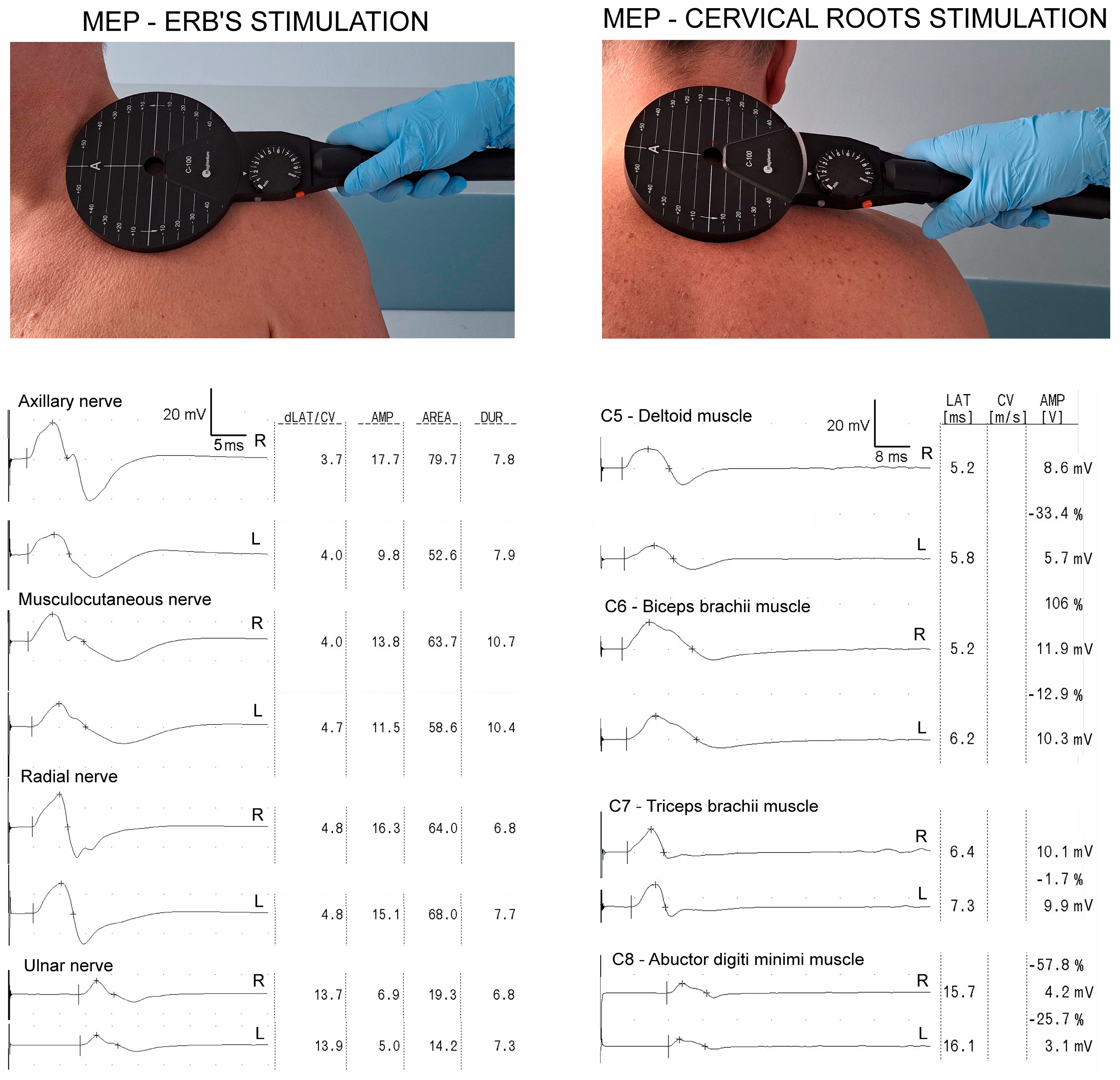
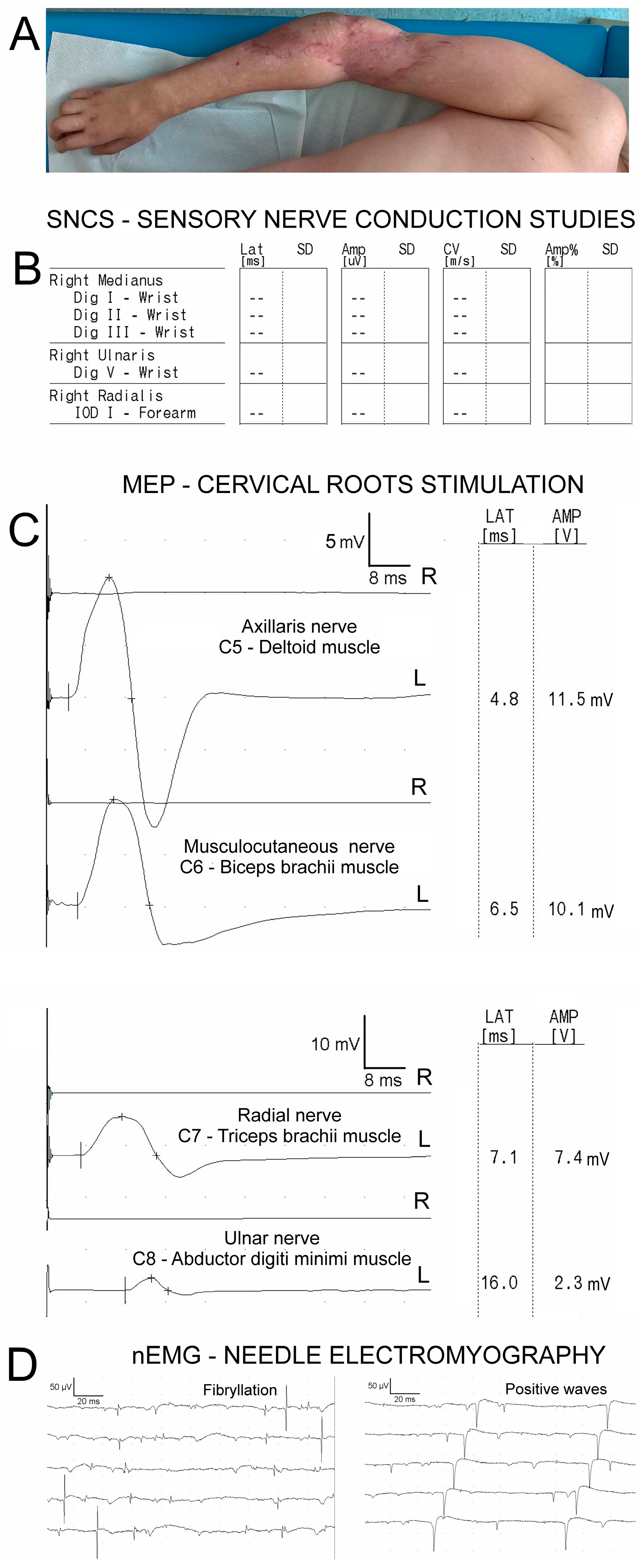
The variety of sources of brachial plexus injuries (BPIs) and the severity and similarity of their clinical symptoms with those of other injuries make their differential diagnosis difficult. Enriching their diagnosis with objective high-sensitivity diagnostics such as clinical neurophysiology may lead to satisfactory treatment results, and magnetic stimulation (MEP) might be an advantageous addition to the diagnostic standard of electrical stimulation used in electroneurography (ENG). The asymptomatic side in BPI cases sometimes shows only subclinical neurological deficits; this study aimed to clarify the validity and utility of using MEP vs. ENG to detect neural conduction abnormalities. Twenty patients with a BPI and twenty healthy volunteers with matching demographic and anthropometric characteristics were stimulated at their Erb’s point in order to record the potentials evoked using magnetic and electrical stimuli to evaluate their peripheral motor neural transmission in their axillar, musculocutaneous, radial, and ulnar nerves. MEP was also used to verify the neural transmission in participants’ cervical roots following transvertebral stimulations, checking the compatibility and repeatability of the evoked potential recordings. The clinical assessment resulted in an average muscle strength of 3–1 (with a mean of 2.2), analgesia that mainly manifested in the C5–C7 spinal dermatomes, and a pain evaluation of 6–4 (mean of 5.4) on the symptomatic side using the Visual Analog Scale, with no pathological symptoms on the contralateral side. A comparison of the recorded potentials evoked with magnetic versus electrical stimuli revealed that the MEP amplitudes were usually higher, at p = 0.04–0.03, in most of the healthy volunteers’ recorded muscles than in those of the group of BPI patients, whose recordings showed that their CMAP and MEP amplitude values were lower on their more symptomatic than asymptomatic sides, at p = 0.04–0.009. In recordings following musculocutaneous and radial nerve electrical stimulation and ulnar nerve magnetic stimulation at Erb’s point, the values of the latencies were also longer on the patient’s asymptomatic side compared to those in the control group. The above outcomes prove the mixed axonal and demyelination natures of brachial plexus injuries. They indicate that different types of traumatic BPIs also involve the clinically asymptomatic side. Cases with predominantly median nerve lesions were detected in sensory nerve conduction studies (SNCSs). In 16 patients, electromyography revealed neurogenic damage to the deltoid and biceps muscles, with an active denervation process at work. The predominance of C5 and C6 brachial plexus injuries in the cervical root and upper/middle trunk of patients with BPI has been confirmed. A probable explanation for the bilateral symptoms of dysfunction detected via clinical neurophysiology methods in the examined BPI patients, who showed primarily unilateral damage, maybe the reaction of their internal neural spinal center’s organization. Even when subclinical, this may explain the poor BPI treatment outcomes that sometimes occur following long-term physical therapy or surgical treatment.
Keywords: brachial plexus injury; cervical roots; Erb’s point; magnetic stimulation; electrical stimulation; electroneurography; electromyography brachial plexus injury; cervical roots; Erb’s point; magnetic stimulation; electrical stimulation; electroneurography; electromyography