You are currently viewing a new version of our website. To view the old version click .
Laws
  • Article
  • Open Access

4 May 2024

Establishing Boundaries to Combat Tax Crimes in Indonesia

and
Graduate School of Humanities and Social Sciences, Hiroshima University, Higashihiroshima 739-8529, Japan
*
Author to whom correspondence should be addressed.
This article belongs to the Section Criminal Justice Issues

Abstract

Enforcing criminal tax law in Indonesia presents a critical yet challenging task, because of the intricate interplay between tax and criminal law interests. The Indonesian Government has introduced leniency in tax criminal law enforcement, guided by the ultimum remedium principle, where criminal sanctions are considered as a last resort. Under this policy, tax offenders can absolve themselves from legal liability. However, such leniency throughout the enforcement process can lead to perceptions of injustice within society. This research uses descriptive, evaluative, and normative juridical methods to examine Indonesia’s approach to enforcing criminal tax laws within the framework of tax and legal interests. Our findings reveal that the current policies heavily favor taxpayer interests by providing numerous concessions to offenders. This trend is concerning, as it may result in a surge of tax crime cases. Conversely, adopting the primum remedium principle, where criminal sanctions are the initial response, poses the risk of harsh legal consequences. In light of these challenges, we propose a balanced approach incorporating elements of both ultimum and primum remedium principles to establish clear boundaries and provisions within criminal tax law enforcement policies. By doing so, we aim to accommodate tax interests while upholding legal interests.

1. Introduction

Indonesia, as stipulated in the 1945 Constitution (Indonesian Constitution of 1945 as Lastly Amended in 2002 n.d.), Article 1, paragraph (3), is founded as a legal state. Its evolution has spurred rapid national development, necessitating continued support from all citizens. In structuring the government, the state is mandated to safeguard its citizens’ interests across all domains, requiring funds primarily derived from taxes. Therefore, citizen engagement in development financing is imperative, demonstrated through tax compliance. The bedrock for tax implementation in Indonesia lies in Article 23A of the 1945 Constitution (Amendment IV), which mandates that “Taxes and other levies for State needs shall be regulated by law”, signifying adherence to legal frameworks in all tax matters.
According to Adriani (Waluyo 2011, p. 2), taxation represents a contribution to the state treasury, enforced upon those liable, according to regulations, without direct remuneration, aimed at financing government duties and public expenditures. Tax collection serves as a cornerstone for the government to generate public revenue, enabling the financing of public goods and socioeconomic equity through redistribution (Claus et al. 2014, p. 173). In the absence of taxes, modern governments are unable to fulfill administrative or redistributive functions (Sikka 2017). Tax compliance stands as a primary concern for both developed and developing nations, given the pivotal role taxes play in state finances (Abu Hassan et al. 2021). It entails taxpayers accurately declaring income and fulfilling their fiscal obligations (Alm 1991). Citizens are expected to adhere to tax laws as it underpins a nation’s development and citizens’ welfare (Hartner et al. 2008). Nevertheless, despite numerous incentives and facilities offered by the state, including those for tax offenders, not all taxpayers exhibit honest tax behavior. The utilization of tax incentives in developing countries remains contentious as a result of substantial, sometimes overlooked costs, potentially engendering distrust in government and perceptions of injustice (Klemm and Van Parys 2012; Aktaş Güzel et al. 2019).
Over 70% of Indonesian revenue is derived from taxes (Kemenkeu 2023), with the remainder largely sourced from loans. Tax targets increase annually in tandem with heightened expenditures, prompting tax authorities to implement provisional measures until systematic interventions are enforced to mitigate tax risks (Ovcharova et al. 2019). The Indonesian tax authority, the Directorate General of Taxes (DGT), has initiated studies exploring the impact of detection likelihood and punishment severity on tax compliance (Allingham and Sandmo 1972).
Taxpayers often engage in tax evasion (Oberholzer and Stack 2014), an illegal and intentional act of reducing tax obligations according to prevailing laws and regulations (Chelvaturai 1985, pp. 5, 8; Alm 2012; Kaulu 2022). Losses of over USD 650 billion annually are incurred globally owing to tax evasion (Crivelli et al. 2016). Tax evasion is the subject of investigation as it is considered a crime, however, there is a perspective that tax fraud has evolved into a crime whose consequences must be managed, rather than a crime that must be suppressed (De La Feria 2020).
Tax evasion has increased in Indonesia in several ways, mainly due to excessively high tax rates, insufficient communication from tax authorities to taxpayers regarding their rights and obligations in tax payment, and a lack of decisive action from the government in addressing tax fraud (Wahyuni 2011). As a result, the DGT has implemented a tax enforcement policy against rogue taxpayers. Tax enforcement enables the government to eliminate tax evasion at a lower cost, as opposed to simply encouraging individual taxpayers to follow tax legislation (Galbiati and Zanella 2012). Hence, the Organization for Economic Cooperation and Development (OECD) has cautioned against the dangers of tax crimes and principles established for combating them (OECD 2017, 2021a, 2021b). Please refer to the Table 1 below for the number of tax investigation cases concluded and terminated in Indonesia between 2018–2022.
Table 1. Tax investigations completed and terminated during 2018–2022.
Table 2 below exhibits the number of tax crimes and the extent to which Indonesia suffered with regard to tax losses in 2018–2022.
Table 2. Tax investigation cases and state losses in Indonesia during 2018–2022.
Laws are fundamental to regulating life in society. As Woodrow Wilson stated, “Every citizen should know what the law is, how it came into existence, what relation its form bears to its substance, and how it gives to society its fiber and strength and pose of fame” (Grilliot and Schubert 1989, p. 19). A basic comprehension of the law and legal system in one’s community promotes an enhanced comprehension of the role the law plays in a complex modern society. Law is a dynamic force that maintains social order and prevents societal chaos. Applying the law to factual situations is necessary when there is controversy between two or more persons, or when individuals seek guidance concerning the consequences of their conduct in any form (Grilliot and Schubert 1989, pp. 1, 3).
The nature of law itself is a set of rules that form the patterns of behavior in a given society (James 1976, p. 4). To ensure the continuity of balance in relationships between members of society, legal rules are required based on the will and conscience of each community member. Legal regulations that regulate and force members of society to comply, create a balance in every relationship within society. Every social relationship must not have a conflict with the provisions of existing and applicable legal regulations in society (Kansil 1989, p. 169). The law is so versatile and vast that it is impossible to state it in one satisfactory formula (Apeldoorn 1959, p. 13). However, three elements of legal objectives must be present proportionally: legal certainty, justice, and purposiveness (Radbruch 2006). The ideals of law are one unit; they cannot be separated individually and all three must be considered when enforcing the law (Mertokusumo 1986, p. 130). Based on the explanation above, it can be concluded that the objective and interests of the law are legal certainty, to uphold justice, and purposiveness.
Criminal law is a form of law in Indonesia. It has the general objective of maintaining order in society, and its specific aim is to tackle and prevent crime by providing harsh and sharp sanctions to protect the legal interests of individuals, society, and the state (Rahmawati 2013).
Criminal law serves a subsidiary function, filling in the gaps when other legal functions are insufficient, and is often considered as the ultimate solution. However, under the current conditions, which are often seen in the media, criminal law is no longer the final means of resolving disputes. Criminal law is the preferred solution (Rahmawati 2013). This is because there may be no other solution, or a lack of understanding of criminal law, that regulates severe sanctions for perpetrators. Therefore, criminal law shifted to primary weapons.
In addition to criminal law, administrative penal law combines administrative and criminal laws. Administrative law is a body of law created by administrative agencies in the form of rules, regulations, orders, and decisions to carry out the agencies’ regulatory powers and duties (Black’s Law Dictionary 1990, p. 46). In the context of criminal law, the term “administrative penal law” refers to all legislative products in the form of legislation within the scope of state administration that have criminal sanctions. All legislative products, such as laws on forestry, customs, taxes, and banking, are referred to as administrative penal laws, as long as their provisions govern criminal sanctions (Adji 2014).
From the description above, two basic provisions are regulated by the 1945 Constitution, namely Article 1 paragraph (3), concerning Indonesia as a state of law and Article 23A, which stipulates that taxes for state purposes are regulated by law. These articles form the basis of this research by focusing on the boundaries of regulations and facilities to fulfill legal and tax interests in implementing tax enforcement policies in Indonesia. This setting is crucial and often problematic when choosing which is prioritized between tax or legal interest in handling tax crime cases in Indonesia.
This study provides insights by analyzing and evaluating current and proposed policies in setting the ultimum remedium (criminal sanctions will be the last option) and primum remedium (criminal sanctions will be the first option) principles, as well as facility boundaries for tax enforcement in Indonesia.

2. Methods

This study utilizes a qualitative methodology in which analytical descriptive research is conducted by obtaining data or descriptions regarding the object of the problem as precisely as possible (Rahmawati 2013). This description is in the form of implementing ultimum remedium (UR) on tax crimes, as well as efforts to implement the primum remedium (PR) considering the development of tax crimes, which are increasingly rampant and result in significant state losses, thus firm action is required to provide justice and legal certainty, maintain the government’s dignity, and create a deterrent effect.
Furthermore, within the realm of public policy research, the core objective revolves around comprehending and elucidating pivotal social, political, economic, cultural, and other pertinent issues that warrant the intervention or consideration of policy stakeholders (Kilonzo and Ojebode 2023, p. 64). Concurrently, it endeavors to furnish policymakers with pragmatic, action-oriented recommendations aimed at mitigating identified problems (Majchrzak and Markus 2014, p. 1). Consequently, the adoption of an evaluation methodology becomes imperative to assess the efficacy of policy operations or outcomes (Powell 2006). Evaluation, typically harnessed for decision-making purposes, is geared toward addressing research inquiries pertaining to a program or policy, unfolding within real-world contexts, and often embodies a synthesis of pure and applied research paradigms (Childers 1989).
Given that the focus of this research pertains to legal matters, it adopts the framework of legal research which aims to identify and procure pertinent information essential for informing legal decision-making processes (Barkan et al. 2015, p. 1). Employing normative juridical techniques, this approach entails the exploration and scrutiny of library resources or secondary data (Manan 1999, p. 7). This approach encompasses examining primary, secondary, and tertiary legal material. The primary material utilized was national legislation, official records or lawmaking minutes, and court decisions (case law). Secondary materials included textbooks, research results, journals, scientific writing, and other related reading materials. Tertiary materials were obtained from the Internet and other sources (Marzuki 2005, p. 141; Rahmawati 2013).
Library research was conducted to collect data on primary, secondary, and tertiary legal resources (Ibrahim 2005, p. 241). Interviews and written interviews were anonymously conducted between May and June 2023 at the DGT head office with 21 participants, including the directors, deputy directors, heads of section, staff, and tax investigators of the DGT. This study encountered two limitations. First, tax enforcement policies in this study are limited to the policies that utilize tax and criminal laws against various forms of tax crimes, such as tax evasion and other illegal means that interfere with tax collection. Second, the facilities referred to in this study are limited to those provided by the state to enforce tax criminal law against tax offenders, as regulated by the GPTP Act.

4. Findings

This research examines Indonesia’s approach to enforcing criminal tax laws within the framework of tax and legal interests. Our findings reveal that the current reliance on the ultimum remedium principle heavily favors taxpayer interests by providing numerous concessions to offenders. This trend is concerning, as it may result in a surge of tax crime cases, undermining the rule of law, eroding the public’s trust in the justice system, diminishing governmental authority, and failing to deter future tax offenses. Conversely, adopting the primum remedium principle, where criminal sanctions are the initial response, poses the risk of deterring investors because of the harsh legal consequences.
Considering these challenges, we propose a balanced approach that incorporates elements of both ultimum and primum remedium principles to establish clear boundaries and provisions within tax criminal law enforcement policies. Implementing a blend of the ultimum and primum remedium principles as policy in Indonesia is necessary. With this policy, the Indonesian government benefits from tax revenues from tax offenders, while upholding societal justice. Tax offenders also benefit from the ease of settling their tax violations with lighter fines and getting legal certainty regarding the charges against them. On the other hand, if they aim to challenge the charges, tax investigations will continue without any provisions for being released from imprisonment if found guilty. By doing so, we aim to accommodate taxpayer interests while upholding legal interests, ensuring a fair and effective system of enforcement.

5. Discussion

5.1. Current Policies and Facilities of Handling Tax Crimes in Indonesia

In the current policy landscape, the approach to addressing tax crimes primarily revolves around the restitution of embezzled taxes to the state by offenders. Within legal terminology, the terms utilized to formulate policies are commonly referred to as primum remedium (PR) and ultimum remedium (UR). PR entails the utilization of criminal sanctions as the principal measure, or as the initial recourse stipulated within legal provisions (Lubis and Lay 2009, p. 255), signifying that criminal law serves as the primary instrument in law enforcement (Singal et al. 2021). Conversely, UR embodies a legal principle interpreted as a last resort, wherein criminal sanctions are invoked as the ultimate measure in law enforcement (Mertokusumo 2006, p. 128). The Minister of Justice and Human Rights has delineated UR as a principle frequently applied, construed as the imposition of criminal sanctions as the final recourse in law enforcement (Laoly 2020). Another piece of literature states that norms or rules in constitutional and administrative law must initially be addressed through administrative sanctions. Likewise, civil law norms must first respond to civil sanctions. If these administrative and civil sanctions are insufficient to straighten the social balance, criminal sanctions will also be imposed as the final UR principle (Prodjodikoro 2003, p. 17).
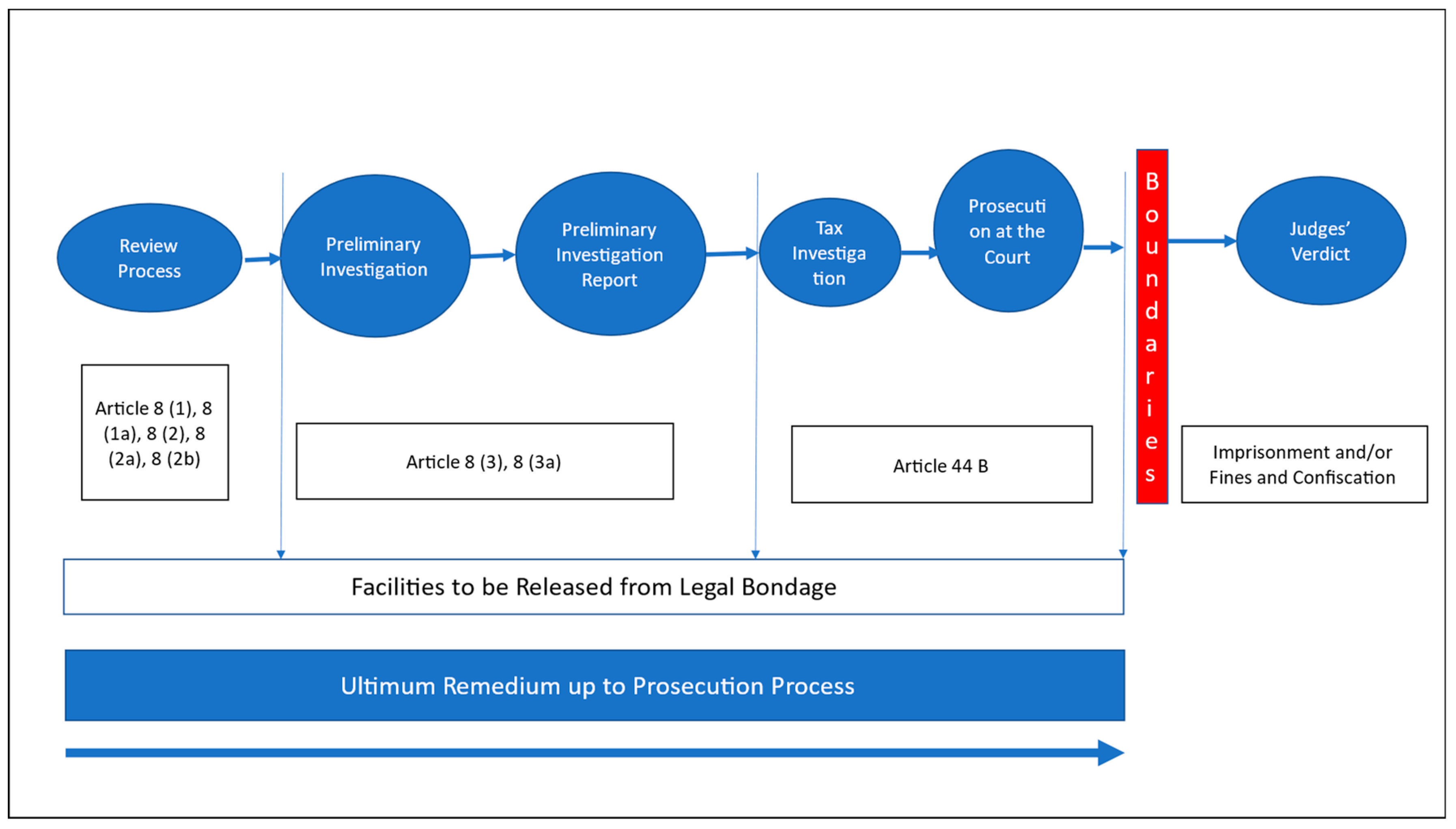
Indonesia’s tax enforcement policy adheres to the principle of UR (Marbun 2016) from the beginning of the proposal of a tax crime case, until it is tried in court. The DGT provides an avenue for tax offenders to evade legal proceedings if they demonstrate a willingness to settle their outstanding taxes and fines. On one hand, the DGT must enforce the tax law, but on the other hand, this is a benefit for tax offenders as they can utilize the principle of UR to set them free. See Figure 2 below for the current policies and facilities based on the GPTP Act.
Figure 2. Current policies and facilities.

5.1.1. Criminal Provisions in the GPTP Act

Articles 38, 39 (1), 39 (2), 39 (3), 39A, 41 (1), 41 (2), 41 (3), 41A, 41 B, 41C (1), 41C (2), 41C (3), and 41C (4) are criminal provisions regulated in the GPTP Act. Further details are provided in Table A1.

5.1.2. Facilities for Tax Offenders

The following are the facilities offered to tax offenders as regulated in the GPTP Act: Article 8 (1), 8 (1a), 8 (2), 8 (2a), 8 (2b) at the administrative sanctions stage, 8 (3), 8 (3a) at the preliminary investigation stage, and 44B (1), 44B (2), 44B (2a), 44B (2b), 44B (2c) at the investigation, prosecution, and trial stage. Further details are provided in Table A2.

5.1.3. Evaluation of Current Policies

Administrative penal law procedures were adopted based on the current policies for handling tax crimes in Indonesia. Tax administration provisions are overlain with administrative and criminal sanctions, so that the public is expected to obey tax administration provisions and a deterrent effect is created. However, the number of tax crimes continues to increase. The UR principle applies to current policies, and various facilities are provided to tax offenders to free them from imprisonment, including facilities in the administrative stage, the preliminary investigation stage, and during investigation and prosecution in court. Thus, it is easy for tax offenders to avoid imprisonment, even if they violate criminal law with a heavy punishment.
Regarding the correlation between the deterrent effect and application of the UR principle, the Director of Law Enforcement said:
The orientation of tax law enforcement has changed from being based on physical punishment (imprisonment) to being based on a deterrent effect and recovering losses in state revenues in 2021 as a solution to the low contribution of law enforcement to state revenues, the low use of Article 44B, and the continued rise in tax crime cases, especially in the case of fictitious tax invoices (an indication of low deterrent effect). This means that the current law enforcement strategy is a form of mitigation for the conditions of law enforcement before 2021. The high number of imprisonment sentences for perpetrators of tax crimes at that time does not guarantee the emergence of a deterrent effect from tax law enforcement. This condition is exacerbated by the large number of subsidiary fines and the weak execution of non-subsidiary fines. (Interviews with respondent number one (R1)).
The Deputy Director of Investigation added:
UR provides an opportunity for taxpayers or suspects to avoid imprisonment by paying the principal tax and the specified fine. Even though it is easy for taxpayers or suspects to escape criminal sanctions, the principal amount of tax and fines that must be paid is huge because to terminate an Article 44B investigation, the amount that must be paid can be up to five times the principal amount of tax or loss in state revenue. It is hoped that the heavy amount of Article 44B payments will continue to emerge as a deterrent effect on perpetrators and potential perpetrators. (R5)
Several tax investigators responded to this matter:
UR does not have a deterrent effect on perpetrators of crimes, which results in relatively large losses to the state because they prefer to be punished in the hope that after serving their sentence, they will still have a source of funds for further business activities or committing another crime. This happens because (law enforcement) has not touched on the essential thing of the perpetrators, namely, not confiscating the proceeds of the crime. (R9)
UR cannot deter taxpayers because the perpetrators still think they will (be able to pay) if caught; if they are not caught, they can make much profit, and usually, they get caught (only) once every ten years. (R20)
The law enforcement strategy at DGT, which prioritizes the UR, will still have a deterrent effect on tax perpetrators, except for the fictitious tax invoice cases, considering that the amount of sanctions they must pay is quite large or greater than other administrative sanctions. (R11)
In various fictitious tax invoices, tax perpetrators often repeat their actions and do not feel deterred, as the profits they receive are greater than the prison sentences they must serve. They hide the proceeds of their crime and enjoy them after leaving prison.
However, the government aggressively invites investments from within and outside Indonesia by providing various facilities to investors (Reuters 2023). Indonesia requires investors to support development by providing ease-of-use facilities. Indonesia requires them to be compliant taxpayers. Citizens support this, as the government can reap the benefits from such investments, such as tax payments made by investors. However, not all investors comply with tax laws, as some attempt to profit as much as possible from Indonesia by paying little to no tax, by taking advantage of the legal loopholes and facilities, including committing tax crimes.
This condition harms the sense of justice in society, where tax law seems to have no value at all. Tax offenders committed to tax evasion can be released if they have the money to pay the taxes they evaded, as well as the fines incurred. If they were not caught, Indonesia would be significantly harmed as tax offenders pay no or very little tax than they should. Obviously, the number of tax investigators is insufficient for the number of offenders investigated; therefore, the possibility of tax offenders escaping the law is high, as a result of the lack of oversight parties. Therefore, tax offenders are like gamblers; if fortunate, they can evade taxes safely, whereas if they are caught, they can be released by utilizing UR.
The tax crime articles contained in the GPTP Act are still some of the other tax crimes regulated by different tax laws, such as stamp duty, and land and building tax, as well as tax collection by distress warrants. Formulating a tax enforcement policy that is fairer and firmer, but remains friendly to investors, is necessary to resolve this problem.
It is evident that the prevailing tax enforcement policies in Indonesia heavily favor taxpayer interests, as evidenced by the multitude of concessions afforded to tax offenders. This scenario is cause for concern, as it may precipitate a surge in tax crime instances, thereby compromising the integrity of the legal system, eroding public confidence in the administration of justice, diminishing governmental authority, failing to serve as a deterrent, and potentially fostering a culture of widespread tax evasion.
Table 1 and Table 2 exhibit that the number of tax crimes has tended to increase rapidly in Indonesia. It is like the tip of the iceberg, the outstanding number of tax crime cases that have not been resolved is still substantial, not to mention the number of cases that have been close to or have already reached the statute of limitations with regard to tax law.

5.2. Implementing Primum Remedium Policies in Tax Crime Cases as an Alternative

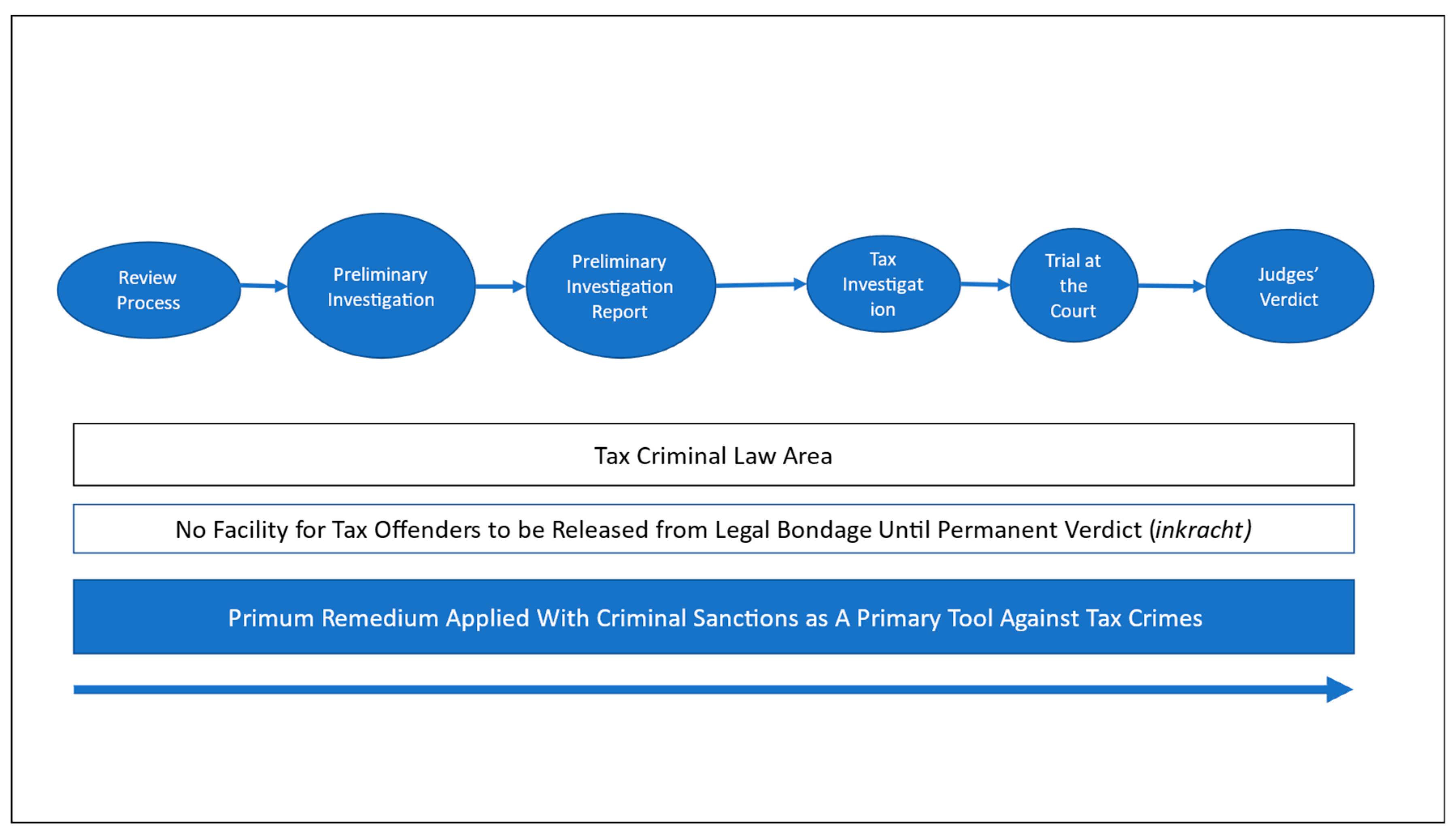
As elucidated above, the principle of PR, wherein criminal sanctions serve as the primary tool in law enforcement, carries significant legal ramifications for transgressors. Typically applied to conventional crimes such as murder, robbery, corruption, and human trafficking, the application of this principle to tax crimes necessitates careful consideration. However, its implementation should be considered cautiously if it is to be applied purely and comprehensively to tax crimes. The implementation of PR in tax crime cases can be depicted in the Figure 3 below.
Figure 3. The flow of primum remedium implementation in tax crime cases.
Based on the rules of the administrative penal law in Indonesia, administrative sanctions must be prioritized for laws that regulate state administration, such as taxation, prior to criminal sanctions being imposed. Therefore, the pure implementation of PR does not follow administrative penal law. Every violation of tax provisions, whether light or severe, must be subject to criminal sanctions, and there are no boundaries or facilities for violators to be free from legal entanglement until a permanent verdict is given. There is concern that this will frighten taxpayers and investors who want to invest and conduct business in Indonesia. In addition, the DGT will have great difficulty processing tax violations owing to inadequate resources. Even with current policies, existing resources are insufficient for monitoring and processing existing tax crimes.
This alternative policy will undoubtedly cause commotion and be counter-productive to the goals to be achieved, in both tax and legal interests. In particular, this PR policy will be complicated to implement in the field, although it is based on the increasing number of crimes in the administrative sector and the lack of effectiveness of administrative sanctions imposed. However, as shock therapy, PR principles can be utilized as an alternative for administrative crimes that have gone too far and resulted in significant losses, such as tax crimes (Muladi 1995, p. 42).
Moreover, changes to Indonesia’s legal tax system, as well as amendments to various laws, are needed to accommodate the pure implementation of PR. For instance, the GPTP Act should be amended and a separate law on the eradication of tax crimes created, so that there is no overlap between the administrative penal law and criminal law in Indonesia.

5.3. Proposed Policies

Based on the forgoing elucidation, it becomes imperative for the government to devise fair and stringent policies that effectively combine UR and PR principles, while establishing clear boundaries between them.
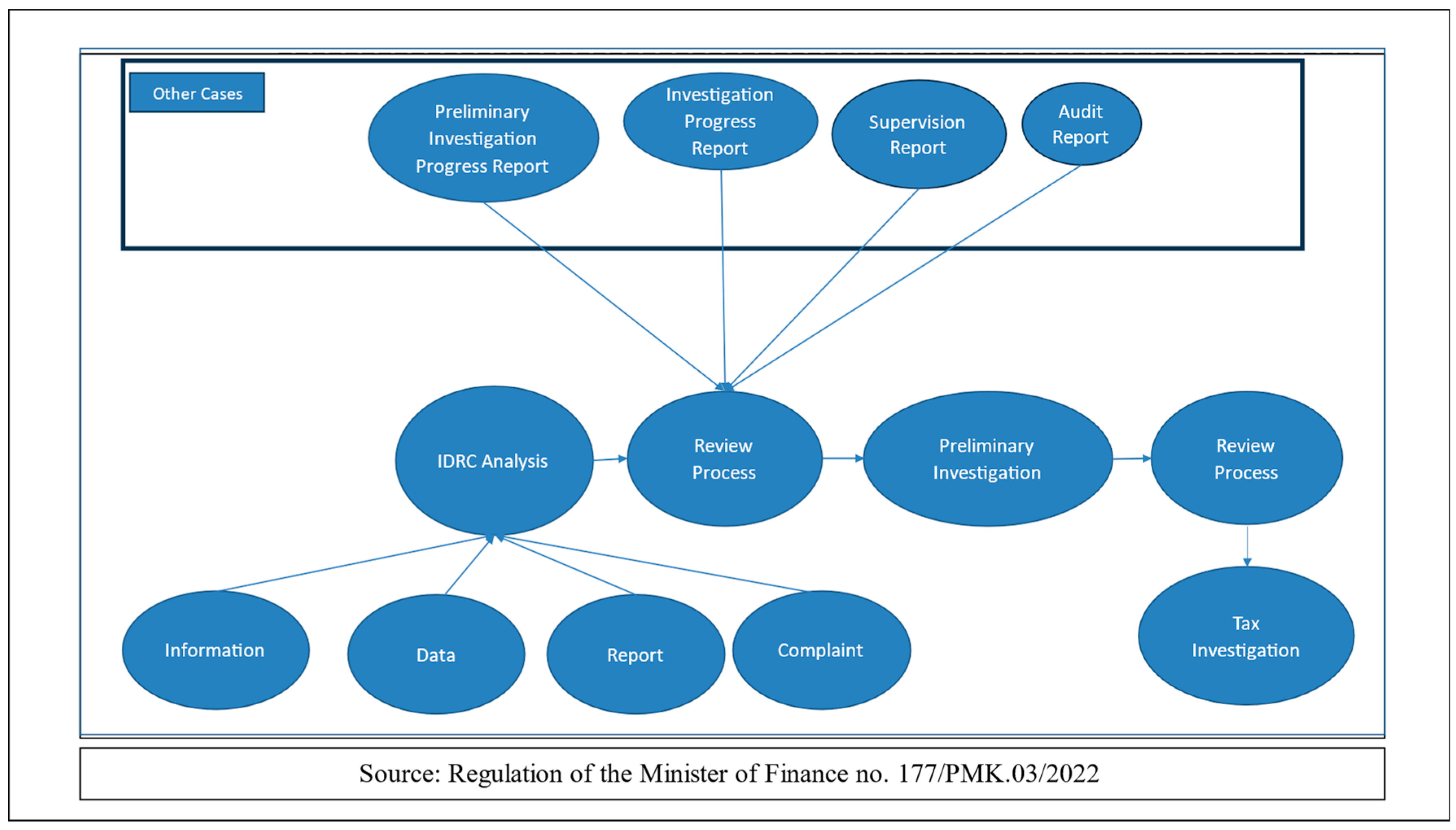
The essential questions at hand revolve around identifying boundaries and delineating the facilities provided. The provisions outlined in the GPTP and CP Acts furnish a robust constitutional framework to address these questions. As elucidated previously, the CP Act governs preliminary investigations and investigations, with the GPTP Act positing that the initial evidence examination holds analogous significance and objectives to a preliminary investigation. Consequently, there exists no discordance in the interpretation of the preliminary investigation between the GPTP and CP Acts.
The preliminary investigation represents the stage prior to the case being escalated to the investigation stage. However, if the initial evidence of a crime is not obtained or met, the case can be revoked or returned to administrative law. During the preliminary investigation stage, no coercive measures were enabled by law (Constitutional Court Decision No. 83/PUU-XXI/2023 2024), however, at the investigation stage, coercive measures such as arresting, detaining, and confiscating are enabled by law.
What facilities have been implemented within these boundaries? It is apparent that once a case enters the investigation process, there will no longer be any facilities for tax offenders to be released from imprisonment. PR starts from now, until the permanent judge’s verdict (inkracht).
For the administrative stage, facilities are still as regulated in Article 8, paragraphs (1), (1a), (2), (2a), and (2b) of the GPTP Act; tax offenders are required to pay taxes that are not paid or are underpaid, plus interest sanctions following the provisions of the Minister of Finance. Meanwhile, for facilities during the preliminary investigation, tax offenders can be exempt from further legal proceedings if they comply with the provisions in Article 8, paragraph (3) of the GPTP Act, with adjusted additional fines, as follows:
  • 100% of the tax owed to taxpayers who are indicated to have committed tax crimes as a result of negligence, as regulated in Article 38 of the GPTP Act;
  • 200% of the tax owed to taxpayers who are indicated to have intentionally committed tax crimes, as regulated in Articles 39, 39A, and 43 (1) of the GPTP Act, sanctions for criminal offenders who intentionally committed crimes must be aggravated as they have bad intentions (mens rea) to evade taxes in Indonesia.
Criminal provisions other than Articles 38, 39, 39A, and 43 (1) follow the applicable provisions of the GPTP Act.
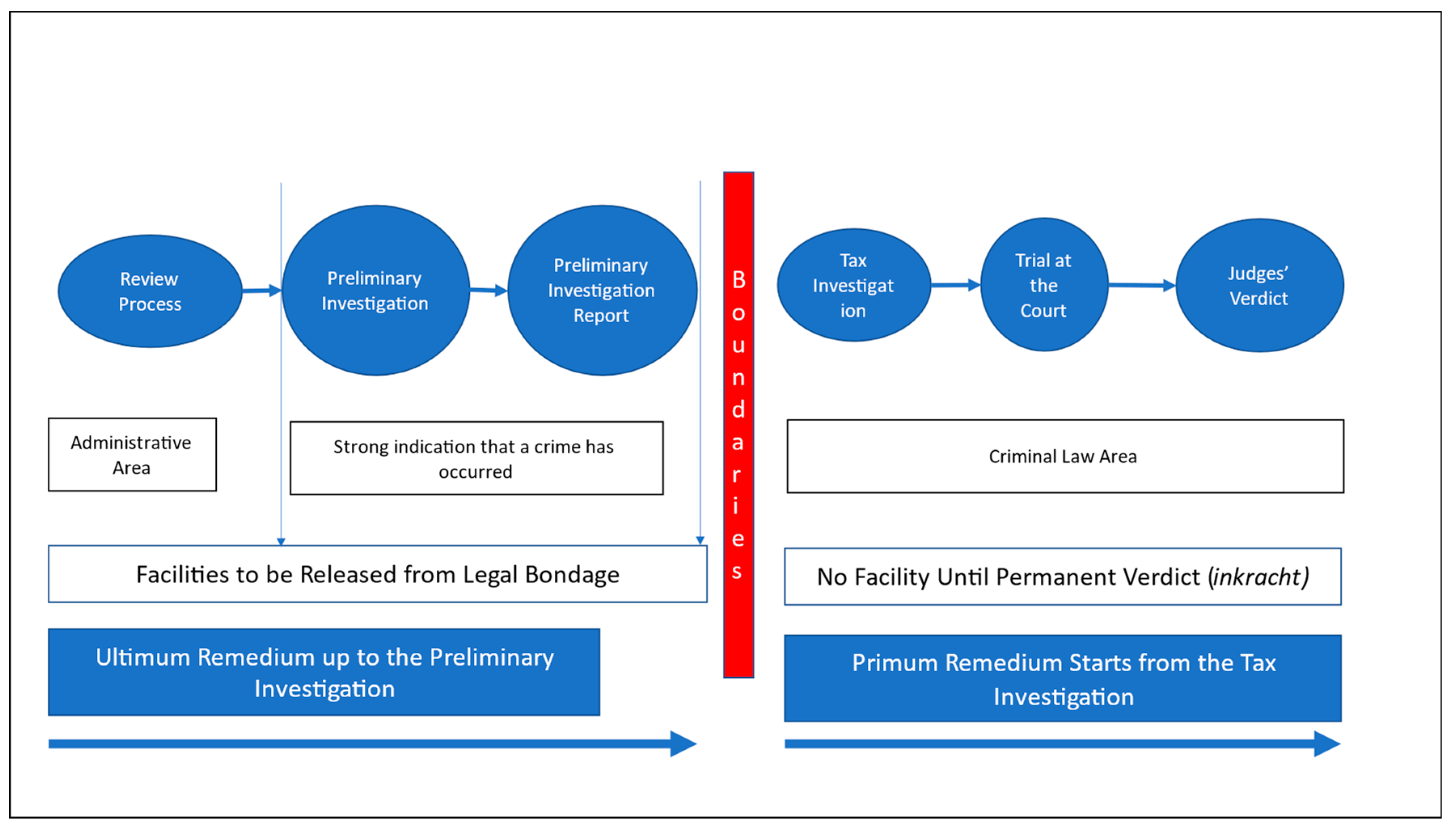
Therefore, the proposed boundary-setting policy applies to the UR and PR boundaries, and the facilities offered in the tax enforcement policy are between the end of the preliminary investigation and the investigation, with the legal basis being the CP Act and GPTP Act.
The proposed boundaries are predicated on the premise that by the preliminary investigation stage, tax offenders typically exhibit clear indications of having violated tax criminal laws. Nonetheless, they retain the opportunity to forgo further investigation proceedings if they voluntarily acknowledge their transgressions and settle their dues in terms of embezzled taxes and fine. This approach curtails the application of UR to tax offenders, affording them a chance for leniency upon admission of wrongdoing. Conversely, should they elect to contest the charges, tax investigations will proceed sans any provisions for release from imprisonment in the event of a guilty verdict. Moreover, they will incur penalties resulting in state revenue losses, with non-compliance leading to assist confiscation for restitution. In cases where assets prove insufficient, additional subsidiary imprisonment may ensue, albeit not surpassing the duration of the primary sentence. Such measures epitomize the application of PR to tax offenders who adamantly refuse to acknowledge their culpability and settle their tax liabilities, subsequent to a guilty verdict in court.
Regarding the implementation of UR, PR, and a combination of UR and PR, the Director of Law Enforcement stated:
Prior to 2021, the occurrence of PR was unintentionally present, with just a few suspects employing the UR facilities provided by Article 44B. As a result, many cases proceeded to trial and awaited a judge’s verdict. It is felt that this condition does not enhance the deterrent factor or contribute to state revenue (R1).
Additionally, the Deputy Director of Investigation said:
Since the law on harmonization of tax regulations (HTR Act) was enacted in October 2021 (Indonesian Harmonization of Tax Regulation Act 2021 n.d.), significant developments have occurred regarding using the UR at the investigation stage. Many taxpayers or suspects exercise their right to utilize the UR Article 44B at the investigation stage. Before the HTR Act, even though clear restrictions had been given and conveyed that taxpayers or suspects could utilize UR until before the case was filed to the court, the UR “facility” of Article 44B was not widely used by taxpayers or suspects to escape from the prison. This can be interpreted to mean that the taxpayer or suspect prefers that the case continues until trial (R5).
Senior tax investigators have several perspectives.
I agree with implementing the combination of UR and PR. This policy shows the DGT’s seriousness in securing state revenue in its constitution … The state must provide legal certainty for the taxpayers and the tax authority … (R16).
Regarding the combination of UR and PR, in my opinion, this policy is to provide legal certainty for the taxpayers themselves (R12).
The enactment of Law no. 7 of 2021 concerning the HTR Act extends the UR proportionality from the end of the preliminary investigation to before the prosecution by the Public Prosecutor is presented in the court. In other words, the principle of UR is put forward to support DGT’s efforts to collect as many tax funds as possible. However, implementing PR is also needed to deter tax crime perpetrators (R9).
Regarding the statement from the Director of Law Enforcement and the Deputy Director of Investigation about the number of tax offenders utilizing Article 44 B before and after the enactment of the HTR Act 2021, as exhibited in Table 1 and Table 2, the number is actually still very small compared to the number of tax crime cases investigated. If we shift the boundaries to the position between the end of the preliminary investigation and the investigation, and there are no more facilities afterward, tax offenders are expected to utilize these facilities. They realize that new boundaries would be their last option prior to facing more severe punishment. Moreover, fines are not burdensome when compared to these boundaries, as stated in Article 44B.
The state stands to gain significantly from the proposed policies, as the retrieval of embezzled taxes and fines will bolster revenue derived from tax law enforcement. Moreover, the DGT can circumvent the arduous and resource-intensive stages of investigation, prosecution, and trial processes, which often incur substantial costs (Robertson-Snape 1999), and are susceptible to issues, such as corruption (Holloway 2014; Transparency International 2023) and bureaucratic complexities (Kasim 2013; Turner et al. 2022), inherent in the law enforcement process (Syahuri et al. 2022). By availing themselves of this option, the DGT can mitigate the strain on these resources, allowing for their redirection toward other essential duties. Consequently, the proposed policies promise mutual benefits for both the DGT and tax offenders.
Please refer to the Figure 4 below for a visual representation of the proposed policies.
Figure 4. Proposed policies.
A summary of the policy options for comparison purposes is presented in the Table 3 below for a comparative view and consideration.
Table 3. Summary of policy options.
According to the table above, developing countries such as Indonesia should consider appropriate options. Indonesia requires investment and tax revenues to finance its development and social expenses. Conversely, Indonesia also has to maintain societal justice, uphold the dignity of its law, and create a deterrent effect on offenders as well as potential offenders.

6. Conclusions

In an era of global uncertainty, fraught with a myriad of challenges, each country must vigilantly manage their economic stability and legal systems. Various strategies can be employed to attract investment, thereby fostering economic growth and social prosperity. However, careful consideration must be given to the provision of facilities, particularly in taxation, to prevent their exploitation by entities solely driven by self-interest and prone to committing tax crimes. Hence, establishing stringent and enforceable criminal sanctions within tax laws is imperative to delineate fair boundaries and uphold societal justice.
As discussed, there is a pressing need for clear delineation in the application of UR and PR principles in addressing tax crimes in Indonesia, given that the current policy orientation is heavily biased toward tax interests. The application of UR considered does not provide a legal certainty (Kartanto et al. 2020). This necessitates the establishment of equitable boundaries for facilities accessible to tax offenders to prevent misuse within criminal tax law. By doing so, tax revenue can be safeguarded, legal certainty ensured, and a deterrent effect instilled, dissuading potential tax offenders.
Drawing from provisions within the CP and GPTP Act, the proposed boundaries are set between the conclusion of the preliminary investigation and the investigation. For instance, UR applies to tax offenders identified prior to, during, and up until the conclusion of the preliminary investigation, offering them the opportunity for release from legal obligations upon payment of embezzled taxes with fines. Conversely, should they refuse, PR takes precedence throughout the investigation process and subsequent trial, with no further facilities extended thereafter. It is imperative to devise a comprehensive tax crime eradication policy, by considering a combination of UR and PR systems to uphold justice and create a deterrent effect, while still being friendly to investors as compliant taxpayers.
This study serves as a cornerstone for refining tax enforcement policies in Indonesia. Policy enhancements must comprehensively consider taxes and legal interests and objectives, thereby establishing appropriate boundaries and facilities within UR and PR frameworks when addressing tax crime cases. Through this approach, tax interests and objectives can be accommodated without ignoring legal interests and objectives. This study is the first to elaborate on this issue and it is expected to provide new practical insights into the literature on law, criminology, taxation, and policy-making. It is hoped that this study will catalyze further research and create dialog on creating suitable boundaries and facilities for tax crimes.

Author Contributions

Conceptualization, D.N. and Y.T.; methodology, D.N. and Y.T.; software D.N.; validation, D.N.; formal analysis, D.N.; investigation, D.N.; resources, D.N.; data curation, D.N.; writing—original draft preparation, D.N.; writing—review and editing, Y.T.; visualization, D.N.; supervision, Y.T.; project administration, D.N.; funding acquisition, D.N and Y.T. All authors have read and agreed to the published version of the manuscript.

Funding

This work was supported by Lembaga Pengelola Dana Pendidikan (Indonesia Endowment Fund for Education) under reference letter S-1217/LPDP.4/2021.

Institutional Review Board Statement

The study was conducted according to the guidelines of the Declaration of Helsinki, and approved by the Research Ethics Review Board of Graduate School of Humanities and Social Sciences, Hiroshima University (HR-LPES-000521 30 September 2022).

Data Availability Statement

Data are contained within the article.

Conflicts of Interest

The authors declare no conflict of interest.

Appendix A

Table A1. Criminal provisions in the GPTP Act.
ArticleParagraphContents
38 Any person who, through negligence:
  • Has not submitted a tax return, or;
  • Has submitted a tax return, but the contents are incorrect, incomplete, or attaching information whose contents are incorrect,
So as to cause losses to state revenues, be punished with a fine of at least one time the amount of tax owed, which is not paid or underpaid, a maximum of two times the amount of tax owed, which is not paid or underpaid, or sentenced to imprisonment for a minimum of three months or a maximum of one year.
39(1)Any person who intentionally:
  • Has not registered for a taxpayer identification number or has not reported his/her business to be confirmed as a taxable enterprise;
  • Misuses or uses without the right to a taxpayer identification number or taxable enterprise confirmation;
  • Has not submitted a tax return;
  • Submittted a tax return and or information whose contents are incorrect or incomplete;
  • Refuses to execute an examination as intended in Article 29;
  • Shows false or falsified books, records, or other documents as if they were true or do not reflect the actual situation;
  • Does not maintain bookkeeping or records in Indonesia and does not show or lend books, records, or other documents;
  • Does not keep books, notes, or documents, which are the basis for bookkeeping or recording and other documents, including the results of data processing from bookkeeping, which is managed electronically or conducted using an online application program in Indonesia as intended in Article 28, paragraph (11), or;
  • Does not deposit taxes that have been withheld or collected.
Can cause losses to state revenues shall be punished with imprisonment for a minimum of 6 (six) months and a maximum of six years and a fine of at least two times the amount of unpaid or underpaid tax owed and a maximum of four times the amount of tax owed that is not or underpaid.
(2)The penalty, as referred to in paragraph (1), is increased by one time to two times the criminal sanction if a person commits another crime in the field of taxation before one year has passed, starting from the completion of serving the prison sentence imposed.
(3)Any person who attempts to commit a criminal act misuses or uses without the right of a taxpayer identification number or confirmation of taxable enterprise as intended in paragraph (1b), or submits a tax return and or information whose contents are incorrect or incomplete, as intended in paragraph (1d), to submit a request for restitution or implement tax compensation or tax credit, shall be punished with imprisonment for a minimum of six months and a maximum of two years and a fine of at least two times the amount of restitution requested and or compensation or credit made and a maximum of four times the amount of restitution requested and or compensation or credit made.
39A Any person who intentionally:
  • Issued and/or used tax invoices, proof of tax collection, proof of tax withholding, and/or proof of tax deposits that are not based on actual transactions; or
  • Issued a tax invoice but has not been confirmed as a taxable enterprise,
Shall be punished with imprisonment for a minimum of two years and a maximum of six years, as well as a fine of at least two times the amount of tax in the tax invoice, proof of tax collection, proof of tax withholding, and/or proof of tax deposit and a maximum of six times the amount of tax in the tax invoice, proof of tax collection, proof of tax withholding, and/or proof of tax deposit.
41(1)An official who, due to negligence, does not fulfill the obligation to keep matters confidential as intended in Article 34 shall be punished with imprisonment for a maximum of one year and a fine of a maximum of IDR 25,000,000.00 (twenty-five million rupiahs).
(2)An official who deliberately does not fulfill his/her obligations or a person who causes the official’s obligations to not be fulfilled as intended in Article 34 shall be punished with a maximum imprisonment of two years and a maximum fine of IDR 50,000,000.00 (fifty million rupiahs).
(3)Prosecution of criminal acts as intended in paragraphs (1) and (2) is only performed on complaints from people whose confidentiality has been violated.
41A Every person who is obliged to provide information or evidence requested as intended in Article 35 but who deliberately does not provide information or evidence or provides information or evidence that is not true shall be punished with imprisonment for a maximum of 1 (one) year and a fine of a maximum of IDR 25,000,000.00 (twenty-five million rupiahs).
41B Any person who intentionally obstructs or complicates the investigation of criminal acts in the field of taxation shall be punished with imprisonment for a maximum of 3 (three) years and a fine of a maximum of IDR 75,000,000.00 (seventy-five million rupiahs).
41C(1)Every person who deliberately does not fulfill the obligations as intended in Article 35A paragraph (1) shall be punished with imprisonment for a maximum of 1 (one) year or a fine of a maximum of IDR 1,000,000,000.00 (one billion rupiahs).
(2)Every person who intentionally causes the obligations of officials and other parties to fail as intended in Article 35A paragraph (1) shall be punished with imprisonment for a maximum of 10 (ten) months or a fine of a maximum of IDR 800,000,000.00 (eight hundred million rupiahs).
(3)Every person who deliberately does not provide data and information requested by the Director General of Taxes as intended in Article 35A paragraph (2) shall be punished with imprisonment for a maximum of ten months or a fine of a maximum of IDR 800,000,000.00 (eight hundred million rupiahs).
(4)Any person who deliberately misuses tax data and information to effect losses to the state shall be punished with imprisonment for a maximum of one year or a fine of a maximum of IDR 500,000,000.00 (five hundred million rupiahs).
43(1)The provisions as intended in Article 39 and Article 39A also apply to representatives, proxies, taxpayer employees, or other parties who order, participate in, encourage, or assist in committing criminal acts in the field of taxation.
(2)The provisions, as intended in Article 41A and Article 41B, also apply to those who order, encourage, or assist in committing criminal acts in the field of taxation.
Table A2. Facilities for tax offenders.
Article Paragraph Contents
Administrative Sanctions
8(1)Taxpayers, of their accord, can correct the tax return that has been submitted by proffering a written statement on the condition that the Director General of Taxes has not conducted an audit action.
(1a)If the correction to the notification letter as intended in paragraph (1) states a loss or overpayment, the correction to the tax return must be submitted no later than two years before the expiry of the determination.
(2)If a taxpayer corrects the annual tax return himself/herself, which results in larger tax debt, he/she will be subject to administrative sanctions in the form of interest at the monthly interest rate determined by the Minister of Finance for the amount of underpaid tax, calculated from the time the submission of the tax return ends until the date of payment, and is subject to a maximum of 24 months and part of the month is calculated as a whole one month.
(2a)If a taxpayer corrects the periodic tax return himself/herself, which results in relatively larger tax debt, he/she is subject to administrative sanctions in the form of interest at the monthly interest rate determined by the Minister of Finance for the amount of the underpaid tax, calculated from the due date of payment until the payment date, and it is subject to a maximum of 24 months, and part of the month is calculated as a whole one month.
(2b)The monthly interest rate determined by the Minister of Finance as intended in paragraph (2) and paragraph (2a) is calculated based on the reference interest rate plus 5% and divided by 12, which applies to the start date of calculating sanctions.
Preliminary Investigation
8(3)Even though a preliminary investigation has been conducted, the taxpayer, of his/her accord, can disclose, through a written statement, the untruthfulness of his/her actions, namely as follows:
  • not submitting a tax return, or;
  • submitting a tax return whose contents are incorrect, incomplete, or attaching information whose contents are incorrect
As referred to in Article 38 or Article 39 paragraphs (1c) and (1d), as long as the beginning of the investigation has not been apprised to the Public Prosecutor through investigators from the National Police of the Republic of Indonesia.
(3a)Disclosure of incorrect actions as intended in paragraph (3) shall be accompanied by repayment of the underpayment of the amount of tax actually owed, along with administrative sanctions in the form of a fine of 100% of the amount of underpaid tax.
Investigation, Prosecution, and Trial
44B(1)For the purposes of state revenue, at the request of the Minister of Finance, the Attorney General may stop investigations into criminal acts in the field of taxation within six months from the date of the request letter.
(2)Termination of investigations into criminal acts in the field of taxation, as referred to in paragraph (1), is only conducted after the taxpayer or suspect has paid:
  • Losses in state revenue as intended in Article 38 plus administrative sanctions in the form of a fine of one times the amount of the loss to state revenue;
  • losses in state revenue as intended in Article 39 plus administrative sanctions in the form of fines of three times the amount of the losses in state revenue, or;
  • tax amount in the tax invoice, proof of tax collection, proof withholding tax, and/or proof of tax payment as intended in Article 39A plus administrative sanctions in the form of a fine of four times the amount of tax in the tax invoice, proof of tax collection, proof of tax withholding, and/or proof of tax deposit.
(2a)If a criminal case has been transferred to court, the defendant can still pay:
  • Losses in state revenue plus administrative sanctions as intended in paragraphs (2a) and (2b), or;
  • Tax amount in tax invoice, proof of tax collection, proof of tax withholding, and/or proof of tax payment plus administrative sanctions as intended in paragraph (2c).
(2b)Payment as intended in paragraph (2a) is considered for prosecution without being sentenced to imprisonment.
(2c)In the case of payments made by taxpayers, suspects, or defendants at the investigation stage until trial fulfill the amount as intended in paragraph (2), the payment can be calculated as payment of the criminal fine imposed on the defendant.

References

  1. Abu Hassan, Norul Syuhada, Mohd Rizal Palil, Rosiati Ramli, and Ruhanita Maelah. 2021. Does Compliance Strategy Increase Compliance? Evidence from Malaysia. Asian Journal of Accounting and Governance 15: 1–14. [Google Scholar] [CrossRef]
  2. Adji, Indriyanto Seno. 2014. Principles of Criminal Law & Criminology and its Development Today/Asas-Asas Hukum Pidana & Kriminologi Serta Perkembangannya Dewasa Ini. Academic Paper. Yogyakarta. [Google Scholar]
  3. Aktaş Güzel, Sonnur, Gökhan Özer, and Murat Özcan. 2019. The Effect of the Variables of Tax Justice Perception and Trust in Government on Tax Compliance: The Case of Turkey. Journal of Behavioral and Experimental Economics 78: 80–86. [Google Scholar] [CrossRef]
  4. Allingham, Michael G., and Agnar Sandmo. 1972. Income Tax Evasion: A Theoretical Analysis. Journal of Public Economics 1: 323–38. [Google Scholar] [CrossRef]
  5. Alm, James. 1991. A Perspective on the Experimental Analysis of Taxpayer Reporting. The Accounting Review 66: 577–93. [Google Scholar]
  6. Alm, James. 2012. Measuring, Explaining, and Controlling Tax Evasion: Lessons from Theory, Experiments, and Field Studies. International Tax and Public Finance 19: 54–77. [Google Scholar] [CrossRef]
  7. Apeldoorn, Lambertus Johannes van. 1959. Introduction to the Study of Dutch Law/Inleiding Tot de Studie van Het Nederlandse Recht (Translated). Jakarta: Noordh FF-Kolfs NV. [Google Scholar]
  8. Barkan, Steven M., Barbara Bintliff, and Mary Whisner. 2015. Fundamentals of Legal Research, 10th ed. Goleta: Foundation Press. Available online: https://ssrn.com/abstract=2591470 (accessed on 22 November 2023).
  9. Black’s Law Dictionary. 1990, Black’s Law Dictionary, 6th ed. Minnesota: West Publishing Company.
  10. Chelvaturai, S. I. 1985. Tax Avoidance, Tax Evasion, and The Underground Economy. London: The Cata Experience. [Google Scholar]
  11. Childers, Thomas. 1989. Evaluative Research in the Library and Information Field. Library Trends 38: 250–67. [Google Scholar]
  12. Claus, Iris, Jorge Martinez-Vazquez, and Violeta Vulovic. 2014. Government Fiscal Policies and Redistribution in Asian Countries. In Inequality in Asia and the Pacific: Trends, Drivers, and Policy Implications. Edited by Ravi Kanbur, Changyong Rhee and Juzhong Zhuang. London: Routledge, pp. 197–225. [Google Scholar]
  13. Constitutional Court Decision No. 83/PUU-XXI/2023. 2024. Available online: https://mkri.id/public/content/persidangan/putusan/putusan_mkri_9609_1707811688.pdf (accessed on 1 March 2024).
  14. Crivelli, Ernesto, Ruud De Mooij, and Michael Keen. 2016. Base Erosion, Profit Shifting and Developing Countries. FinanzArchiv 72: 268. [Google Scholar] [CrossRef]
  15. De La Feria, Rita. 2020. Tax Fraud and Selective Law Enforcement. Journal of Law and Society 47: 240–70. [Google Scholar] [CrossRef]
  16. Feld, Lars Peter, and Bruno S. Frey. 2012. Deterrence and Tax Morale: How Tax Administrations and Taxpayers Interact. Available online: https://web-archive.oecd.org/2012-06-15/160289-2789923.pdf (accessed on 15 December 2023).
  17. Galbiati, Roberto, and Giulio Zanella. 2012. The Tax Evasion Social Multiplier: Evidence from Italy. Journal of Public Economics 96: 485–94. [Google Scholar] [CrossRef]
  18. Grilliot, Harold J., and Frank A. Schubert. 1989. Introduction to Law & the Legal System, 4th ed. Boston: Houghton Mifflin Company. [Google Scholar]
  19. Hartner, Martina, Silvia Rechberger, Erich Kirchler, and Alfred Schabmann. 2008. Procedural Fairness and Tax Compliance. Economic Analysis and Policy 38: 137–52. [Google Scholar] [CrossRef]
  20. Holloway, Richard. 2014. CSOs-and-Corruption-in-Indonesia. Available online: http://www.richardholloway.org/wp-content/uploads/2014/04/CSOs-and-Corruption-in-Indonesia.pdf (accessed on 28 September 2023).
  21. Ibrahim, Johnny. 2005. Normative Legal Research Theory and Methods/Teori dan Metode Penelitian Hukum Normatif. Malang: Bayumedia Publishing. [Google Scholar]
  22. Indonesian Constitution of 1945 as Lastly Amended in 2002; n.d. Available online: https://peraturan.bpk.go.id/Details/101646/uud-no-- (accessed on 4 December 2023).
  23. Indonesian Criminal Act 2023; n.d. Available online: https://peraturan.bpk.go.id/Details/234935/uu-no-1-tahun-2023 (accessed on 4 December 2023).
  24. Indonesian Criminal Procedural Act 1981; n.d. Available online: https://peraturan.bpk.go.id/Details/47041/uu-no-8-tahun-1981 (accessed on 4 December 2023).
  25. Indonesian General Provisions and Tax Procedures Act 1983 as Lastly Amended in 2023; n.d. Available online: https://peraturan.bpk.go.id/Details/246523/uu-no-6-tahun-2023 (accessed on 28 September 2023).
  26. Indonesian Harmonization of Tax Regulation Act 2021; n.d. Available online: https://peraturan.bpk.go.id/Details/185162/uu-no-7-tahun-2021 (accessed on 28 September 2023).
  27. James, Philip S. 1976. Introduction to English Law, 9th ed. London: Butterworths. [Google Scholar]
  28. Kansil, C. S. T. 1989. Introduction to Law and Indonesian Legal System/Pengantar Ilmu Hukum dan Tata Hukum Indonesia. Jakarta: Balai Pustaka. [Google Scholar]
  29. Kartanto, Lucky, Prasetijo Rijadi, and Sri Priyati. 2020. Quo Vadis Ultimum Remedium in Tax Criminal Crimes In Indonesia. International Journal of Scientific and Research Publications (IJSRP) 10: p9902. [Google Scholar] [CrossRef]
  30. Kasim, Azhar. 2013. Bureaucratic Reform and Dynamic Governance for Combating Corruption: The Challenge for Indonesia. Bisnis & Birokrasi Journal 20: 3. [Google Scholar] [CrossRef]
  31. Kaulu, Byrne. 2022. Determinants of Tax Evasion Intention Using the Theory of Planned Behavior and the Mediation Role of Taxpayer Egoism. Fudan Journal of the Humanities and Social Sciences 15: 63–87. [Google Scholar] [CrossRef]
  32. Kemenkeu. 2023. Informasi-APBN-TA-2023. Available online: https://media.kemenkeu.go.id/getmedia/6439fa59-b28e-412d-adf5-e02fdd9e7f68/Informasi-APBN-TA-2023.pdf?ext=.pdf (accessed on 29 September 2023).
  33. Kilonzo, Susan Mbula, and Ayobami Ojebode. 2023. Research Methods for Public Policy. In Public Policy and Research in Africa. Edited by Emmanuel Remi Aiyede and Beatrice Muganda. Cham: Springer International Publishing, pp. 63–85. [Google Scholar] [CrossRef] [PubMed]
  34. Klemm, Alexander, and Stefan Van Parys. 2012. Empirical Evidence on the Effects of Tax Incentives. International Tax and Public Finance 19: 393–423. [Google Scholar] [CrossRef]
  35. Laoly, Yasonna. 2020. perlu-penegasan-norma-i-ultimum-remedium-i-soal-pengenaan-sanksi-di-aturan-turunan-uu-cipta-kerja. Available online: https://www.hukumonline.com/berita/a/perlu-penegasan-norma-i-ultimum-remedium-i-soal-pengenaan-sanksi-di-aturan-turunan-uu-cipta-kerja-lt5fe9c7c822f4e?utm_source=website&utm_medium=internal_link_klinik&utm_campaign=ultimum_remedium_ciptaker (accessed on 17 December 2023).
  36. Lubis, Todung Mulya, and Alexander Lay. 2009. Death Penalty Controversy: Dissenting Opinion of Constitutional Judges/Kontroversi Hukuman Mati: Perbedaan Pendapat Hakim Konstitusi. Jakarta: Sinar Grafika. [Google Scholar]
  37. Majchrzak, Ann, and M. Lynne Markus. 2014. Methods for Policy Research: Taking Socially Responsible Action. London: SAGE Publications, Ltd. [Google Scholar] [CrossRef]
  38. Manan, Bagir. 1999. Research in the field of Law/Penelitian di Bidang Hukum. In Jurnal Hukum. Bandung: Pusat Penelitian Perkembangan Hukum, Lembaga Penelitian Universitas Padjadjaran. [Google Scholar]
  39. Marbun, Rocky. 2016. Rekonstruksi Sistem Pemidanaan Dalam Undang-Undang Perpajakan Berdasarkan Konsep Ultimum Remidium. Jurnal Konstitusi 11: 538. [Google Scholar] [CrossRef]
  40. Maroni. 2015. Introduction to Administrative Penal Law/Pengantar Hukum Pidana Administrasi. Lampung: CV. Anugrah Utama Raharja (AURA). [Google Scholar]
  41. Marzuki, Peter Mahmud. 2005. Legal Reseach/Penelitian Hukum. Jakarta: Kencana. [Google Scholar]
  42. Mertokusumo, Sudikno. 1986. Introduction to Law/Mengenal Hukum. Yogyakarta: Liberty. [Google Scholar]
  43. Mertokusumo, Sudikno. 2006. The Discovery of Law: An Introduction, 4th Edition/Penemuan Hukum: Suatu Pengantar, 4th ed. Yogyakarta: Liberty. [Google Scholar]
  44. Muladi. 1995. Capita Selecta Criminal on Justice System/Kapita Selekta Sistem Peradilan Pidana. Semarang: Badan Penerbit Universitas Diponegoro. [Google Scholar]
  45. Oberholzer, Ruanda, and E. M. Stack. 2014. Possible Reasons for Tax Resistance in South Africa: A Customised Scale to Measure and Compare Perceptions with Previous Research. Public Relations Review 40: 251–66. [Google Scholar] [CrossRef]
  46. OECD. 2017. Fighting Tax Crime—The Ten Global Principles, First Edition: The Ten Global Principles. Paris: OECD. [Google Scholar] [CrossRef]
  47. OECD. 2021a. Fighting Tax Crime—The Ten Global Principles (Second Edition). Paris: OECD. [Google Scholar] [CrossRef]
  48. OECD. 2021b. Fighting Tax Crime—The Ten Global Principles (Second Edition) Country Chapters. Paris: OECD. [Google Scholar]
  49. Ovcharova, Elena, Kirill Tasalov, and Dina Osina. 2019. Tax Compliance in the Russian Federation, the United Kingdom of Great Britain and Northern Ireland, and the United States of America: Forcing and Encouraging Lawful Conduct of Taxpayers. Russian Law Journal 7: 4–54. [Google Scholar] [CrossRef]
  50. Powell, Ronald R. 2006. Evaluation Research: An Overview. Library Trends 55: 102–20. [Google Scholar] [CrossRef]
  51. Prodjodikoro, Wirjono. 2003. Principles of Criminal Law in Indonesia/Asas-Asas Hukum Pidana Di Indonesia. Bandung: Refika Aditama. [Google Scholar]
  52. Radbruch, Gustav. 2006. Statutory Lawlessness and Supra-Statutory Law (1946). Oxford Journal of Legal Studies 26: 1–11. [Google Scholar] [CrossRef]
  53. Rahmawati, Nur Ainiyah. 2013. Hukum Pidana Indonesia: Ultimum Remedium Atau Primum Remedium. Recidive 2: 39–44. [Google Scholar] [CrossRef]
  54. Regulation of the Minister of Finance No. 177/PMK.03/2022 Concerning Procedures for Initial Evidence Examination; n.d. Available online: https://peraturan.bpk.go.id/Details/232898/pmk-no-177pmk032022 (accessed on 28 September 2023).
  55. Reuters. 2023. Indonesia-Offers-Golden-Visa-Entice-Foreign-Investors. September 3. Available online: https://www.reuters.com/world/asia-pacific/indonesia-offers-golden-visa-entice-foreign-investors-2023-09-03/ (accessed on 28 December 2023).
  56. Robertson-Snape, Fiona. 1999. Corruption, Collusion and Nepotism in Indonesia. Third World Quarterly 20: 589–602. [Google Scholar] [CrossRef]
  57. Sikka, Prem. 2017. Accounting and Taxation: Conjoined Twins or Separate Siblings? Accounting Forum 41: 390–405. [Google Scholar] [CrossRef]
  58. Singal, Elsa Priskila, Diana Pangemanan R., and Daniel F. Aling. 2021. Primum Remedium in Criminal Law as a Countermeasure for White Collar Crime (Money Laundering)/Primum Remedium Dalam Hukum Pidana Sebagai Penanggulangan Kejahatan Kerah Putih (Money Laundering). Lex Crimen 10: 197–205. [Google Scholar]
  59. Sugiarto, Umar Said. 2013. An Introduction to Indonesian Law/Pengantar Hukum Indonesia. Jakarta: Sinar Grafika. [Google Scholar]
  60. Syahuri, Taufiqurrohman, Gazalba Saleh, and Mayang Abrilianti. 2022. The Role of the Corruption Eradication Commission Supervisory Board within the Indonesian Constitutional Structure. Cogent Social Sciences 8: 2035913. [Google Scholar] [CrossRef]
  61. Transparency International. 2023. Corruption Perception Index Indonesia 2023. Available online: https://www.transparency.org/en/cpi/2023/index/idn (accessed on 29 February 2024).
  62. Turner, Mark, Eko Prasojo, and Rudiarto Sumarwono. 2022. The Challenge of Reforming Big Bureaucracy in Indonesia. Policy Studies 43: 333–51. [Google Scholar] [CrossRef]
  63. Wahyuni, Made Arie. 2011. Tax Evasion: Dampak dari Self Assessment System. Jurnal Ilmiah Akuntansi dan Humanika 1: 1–8. [Google Scholar] [CrossRef]
  64. Waluyo. 2011. Indonesian Taxation/Perpajakan Indonesia, 9th ed. Jakarta: Salemba Empat. [Google Scholar]
Disclaimer/Publisher’s Note: The statements, opinions and data contained in all publications are solely those of the individual author(s) and contributor(s) and not of MDPI and/or the editor(s). MDPI and/or the editor(s) disclaim responsibility for any injury to people or property resulting from any ideas, methods, instructions or products referred to in the content.

Article Metrics

Citations

Article Access Statistics

Multiple requests from the same IP address are counted as one view.