
 Open Access
 - Article

13 Pages
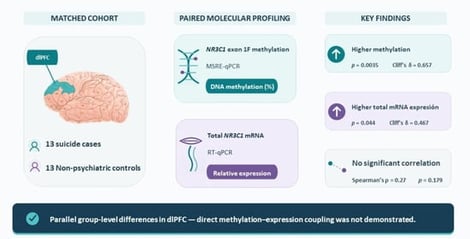
Background: The glucocorticoid receptor gene (NR3C1) regulates hypothalamic–pituitary–adrenal (HPA) axis feedback. Evidence of its epigenetic and transcriptional alterations in suicide remains limited and inconsistent, particularly in underrepresented populations. Methods: We measured regional methylation within the assayed NR3C1 exon 1F promoter region and total NR3C1 mRNA expression in dorsolateral prefrontal cortex (BA9) from 13 suicide cases and 13 non-psychiatric controls from northern Mexico. Groups were frequency-matched by age, sex, and post-mortem interval. Methylation was assessed by methylation-sensitive restriction enzyme (MSRE) qPCR and expression by RT-qPCR. Group differences were tested using two-sided exact Mann–Whitney U tests; effect sizes were probability of superiority (PS) and Cliff’s δ. Correlation and male-only analyses were exploratory. All p-values were nominal. Results: Cases showed higher total NR3C1 mRNA expression (U = 45, p = 0.04412; PS = 0.734; δ = 0.467) and regional exon 1F methylation (U = 29, p = 0.00349; PS = 0.828; δ = 0.657). The measures showed a non-significant positive correlation (ρ = 0.27, p = 0.179). In males, methylation remained higher in cases (p = 0.0147), whereas expression remained directionally higher but non-significant (p = 0.165). Conclusions: Individuals who died by suicide showed higher regional exon 1F methylation and NR3C1 mRNA expression in BA9. The measures were not significantly correlated and should be interpreted as separate group-level differences, not evidence of direct methylation–expression coupling. The expression finding is preliminary. Given the small sample, limited clinical information, and comparison with non-psychiatric controls, the differences cannot be attributed specifically to suicide and require replication.
Brain Sci.
30 September 2026
![Simplified comparison of three predictive-coding and active-inference accounts of hypnotic hypoalgesia. The figure summarizes three complementary models through which hypnotic suggestions may reduce pain. The simulationadaptation theory emphasizes cognitive simulation, mental imagery, and neural adaptation to representations, consistent with suggestions [23]. The interoceptive predictive-coding account emphasizes response expectancy, high-level bodily predictions, and reinterpretation of nociceptive input [22,24]. The active-inference/agency account emphasizes altered agency, reduced voluntary monitoring, and alignment of perception with the predicted hypoalgesic state [26]. Although these accounts differ in emphasis, they converge on a shared endpoint: hypnotic suggestions may establish a suggestion-consistent bodily model that reduces the salience or precision of nociceptive input, thereby contributing to hypnotic hypoalgesia.](https://mdpi-res.com/cdn-cgi/image/width=281%2Cheight=192/https://mdpi-res.com/brainsci/brainsci-16-00779/article_deploy/html/images/brainsci-16-00779-ag-550.jpg)