


 Open Access
 - Article

20 Pages
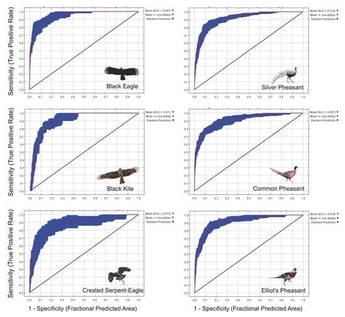
Understanding spatial distribution patterns is a key component in predicting community structural changes and preserving biodiversity. Within the subtropical forest ecosystems of China, the spatial interrelations between raptors and pheasants, and their respective roles and functions in community structures, remain inadequately studied. Through niche modeling, we examined the spatial distribution relationships between three large raptor species—the Black Eagle (Ictinaetus malaiensis), the Black Kite (Milvus migrans), and the Crested Serpent Eagle (Spilornis cheela) and three prevalent pheasant species—the Silver Pheasant (Lophura nycthemera), the Common Pheasant (Phasianus colchicus), and Elliot’s Pheasant (Syrmaticus ellioti). The results showed that the Black Eagle and Elliot’s Pheasant displayed localized distribution patterns, the Black Kite and Silver Pheasant demonstrated widespread distribution, and the Crested Serpent Eagle and Common Pheasant exhibited broader patchy distributions. Significant differences were observed in the potential suitable habitat areas among the raptor species pairs, with the Black Kite having the largest potential suitable habitat area and the Black Eagle the smallest. While the habitat area differences between the Silver Pheasant and Elliot’s Pheasant were not significant, both species significantly exceeded the Common Pheasant in potential suitable habitat area. The Silver Pheasant held the largest area within the raptors’ potential suitable habitat, and the Black Kite dominated within the pheasants’ habitats. These results indicated a higher sensitivity of the Black Eagle and Crested Serpent Eagle to human disturbances and potential coexistence among the pheasant species through spatial niche differentiation. The distribution patterns underscored the spatial interplay between raptors and pheasants, unveiling their individual survival strategies and functional roles within the ecosystem. This study offers insights into the ecological processes behind species distribution patterns.
Birds
8 October 2026
![Location of the Bii Nee Stipa Wind Farm (purple outline) within the wind farm complex of the Isthmus of Tehuantepec, Oaxaca, Mexico. White and purple circles indicate turbines within the wind farm, whereas black circles identify the turbines selected for carcass searches. Locations of the surrounding wind farms were obtained from GeoComunes [26]. Vegetation cover within and surrounding the wind farm is also shown [27].](https://mdpi-res.com/cdn-cgi/image/width=281%2Cheight=192/https://mdpi-res.com/birds/birds-07-00062/article_deploy/html/images/birds-07-00062-ag-550.jpg)
![Variation in the totipalmate condition, illustrated in dorsal view. (a) Magnificent Fregatebird (Fregata magnificens), showing the reduced, deeply emarginated webbing characteristic of frigatebirds; (b) a pelican (Pelecanus sp.), showing the fully expanded webbing uniting all four digits, including the hallux. In both taxa the webbing involves digit I, the defining feature of the totipalmate foot. Scale bar = 10 mm. (a) Redrawn after Diamond and Schreiber [9]; (b) redrawn after Reichenow [10].](https://mdpi-res.com/cdn-cgi/image/width=281%2Cheight=192/https://mdpi-res.com/birds/birds-07-00036/article_deploy/html/images/birds-07-00036-g001-550.jpg)


