Skip to Content

Veterinary Sciences

Veterinary Sciences is an international, peer-reviewed, open access journal on veterinary sciences, published monthly online by MDPI. The College of Veterinary Medicine, Yangzhou University is affiliated with Veterinary Sciences and its members receive a discount on the article processing charges. 

Get Alerted

Add your email address to receive forthcoming issues of this journal.

All Articles (5,217)

  • Article
  • Open Access

Dairy Cattle Feed Upcycling, Adaptogenic Nutraceuticals and Precision Reproduction: Advanced CASA Sperm Kinematic Profiling and Sexual Drive in Rams

  • César A. Meza-Herrera,
  • Ángeles De Santiago-Miramontes and
  • María A. Sariñana-Navarrete
  • + 8 authors

This study capitalizes on computer-assisted semen analysis (CASA) to evaluate a precision nutritional strategy integrating agro-industrial feed upcycling and functional phytogenic supplementation in rams. Black Belly rams (n = 15) sustained on an upcycled basal diet derived from dairy-cow feed rejections were assigned to a non-supplemented control group (CONT) or supplemented with Withania somnifera (WITH) or Lepidium meyenii (LEPI) at 400 mg kg−1 LW d−1. The 64-day trial was conducted from May to July in arid northern Mexico. Sexual drive, seminal quality, and high-resolution sperm kinematics were evaluated using CASA. Body and testicular measurements, ejaculate volume, and most categorical motility traits remained comparable among treatments (p > 0.05). However, phytogenic supplementation enhanced selected seminal and sexual-drive variables (p < 0.05). Crucially, longitudinal treatment × time interactions (p < 0.05) showed that while the CONT group experienced a seasonal decline in local mobility (LOCMOB), it increased from 1.47% to 2.01% in the WITH group, representing a 37% relative increase over time. Moreover, both WITH and LEPI increased LIN and STR by the end of the experimental period (p < 0.05), demonstrating more linear and efficient sperm trajectories. These findings highlight the productive value of upcycled dairy-cow feed rejections and demonstrate that strategic supplementation with W. somnifera or L. meyenii can refine sexual drive, seminal quality, and sperm kinematic efficiency. This integrated bio-circular strategy provides actionable insights for sustainable small-ruminant production under challenging arid summer conditions.

Vet. Sci.

24 September 2026
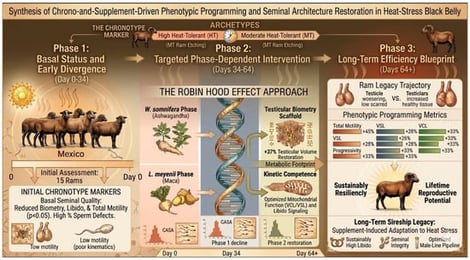
Conceptual synthesis diagram integrating the experimental design, principal outcomes, and proposed biological interpretation of the inter-systemic bio-circular framework defined as “The Robin Hood Effect Approach,” in which nutrient-dense feed refusals from an intensive dairy-cattle operation are upcycled to support a vulnerable smallholder small-ruminant production system during severe summer heat stress (May–July; 25° N, arid northern Mexico). The longitudinal timeline depicts a 64-day experimental period encompassing a complete spermatogenic cycle across three cohorts (n = 5 per group): non-supplemented control (CONT), Withania somnifera (WITH; 400 mg kg−1 LW d−1), and Lepidium meyenii (LEPI; 400 mg kg−1 LW d−1). Phase 1 (Basal Status and Early Divergence) establishes the baseline reproductive status under the environmental heat challenge. Phase 2 (Targeted Phase-Dependent Intervention) represents the progressive action of adaptogenic nutraceutical supplementation on reproductive and sperm kinematic responses. Phase 3 (Long-Term Efficiency Blueprint) displays the final phenotypic and kinematic outcomes at day 64. Chronological exposure to WITH generated a 37% relative increase in local mobility (LOCMOB), from 1.47% at the initial evaluation to 2.01% at the final evaluation, while both WITH and LEPI improved CASA-derived sperm trajectory geometry, particularly straightness (STR) and linearity (LIN). This horizontal integration highlights how agro-industrial feed refusals can support reproductive efficiency and strengthen the sustainability and climate resilience of smallholder farming systems under hyperarid conditions.
  • Article
  • Open Access

Mannan-oligosaccharides (MOS) may influence microbial and immune-related processes, but evidence concerning palm kernel meal (PKM)-derived MOS-containing products in goats remains limited. The experimental product was a chemically heterogeneous PKM-derived hydrolysate in which M2–M6 oligosaccharides were identified by HPLC–RID; residual sugars and other soluble constituents were also present. Twenty growing male goats received 0, 2.5, 5.0, or 10.0 g hydrolysate/goat/day (n = 5 per treatment) for 90 days. Feed intake, growth, hematological and serum biochemical indices, circulating immune indicators, peripheral blood leukocyte gene expression, and selected ruminal measures were evaluated. Immune and gene-expression outcomes were measured in prefeeding blood collected on Day 90. Ruminal pH and acetate, propionate, and butyrate were measured in a single rumen-fluid sample collected 3 h after feeding on Day 90. Serum IgA showed a positive linear association with supplementation level, whereas IL-1β and IL-6 showed negative associations; these remained significant after false-discovery-rate correction (q = 0.036, 0.012, and 0.012, respectively). Selected immune-related transcripts also differed among treatments, but these endpoint patterns do not establish coordinated immunological regulation or a specific mechanism. Propionate and butyrate showed nominal positive linear associations, whereas the acetate-to-propionate ratio showed a nominal negative association (raw p = 0.028, 0.021, and 0.018, respectively); none remained significant after correction (q = 0.056 for each). Ruminal pH, the sum of the three measured VFA concentrations, feed intake, and growth did not differ detectably. No overt clinical abnormalities requiring veterinary intervention were observed, but the study was not powered to establish safety. These preliminary between-group endpoint associations concern the complete heterogeneous hydrolysate and cannot be attributed specifically to M2–M6 oligosaccharides. Larger, adequately powered studies with pretreatment and repeated measurements are required.

Vet. Sci.

24 September 2026

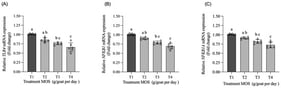
Effects of graded supplementation with the PKM-derived MOS-rich hydrolysate on innate immune recognition and NF-κB-related signaling in peripheral blood leukocytes of growing goats. Relative mRNA expression of (A) TLR4, (B) NFKB1, and (C) NFKBIA. T1 = CON, T2 = MOS2.5, T3 = MOS5, and T4 = MOS10 supplied 0, 2.5, 5.0, and 10.0 g hydrolysate/goat/day, respectively. Gene expression was normalized to GAPDH and calculated using the 2−ΔΔCq method, with CON used as the calibrator. Individual symbols represent biologically independent animals, and bars and error bars represent the mean ± SD (n = 5 animals/treatment). Means without a common letter differ according to Tukey-adjusted pairwise comparisons (p &lt; 0.05).
  • Review
  • Open Access

Algal biomass and algal-derived preparations have attracted increasing interest in livestock nutrition because of their potential to modulate the gut microbiota, which plays a crucial role in animal health, immunity, and growth performance. This review focuses primarily on microalgae and cyanobacterial preparations, while also considering selected macroalgae relevant to livestock feeding, without restricting its scope to marine sources. In this narrative review, we summarize recent advances in the physicochemical properties and biological activities of key algal components, such as polysaccharides, polyunsaturated fatty acids, and carotenoids. We assess evidence for changes in potentially beneficial bacteria, including Lactobacillus and Bifidobacterium, and for inhibitory effects against selected pathogenic bacteria, including Salmonella and pathogenic strains of Escherichia coli. We also examine proposed links between these compounds, microbial short-chain fatty acid and bile acid metabolism, and host immune and growth responses. This review discusses practical applications of algal biomass and algal-derived preparations in livestock production, with a focus on inclusion levels and safety assessments. Effects are evaluated in relation to the source organism, preparation, and animal model, rather than assumed to be shared across algal groups. Current challenges and future research directions are also identified to facilitate the efficient utilization of algal resources in sustainable animal husbandry. This review identifies the evidence supporting specific feeding applications and distinguishes observed animal responses from proposed mechanisms.

Vet. Sci.

24 September 2026
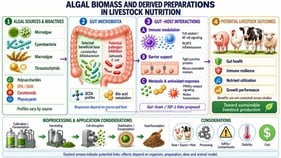
Direct and potential effects of algal bioactive compounds on the livestock gut microbiota. Changes in microbial composition and fermentation metabolites have been directly observed for selected algal preparations in specific animal models, whereas several downstream metabolic and host-response pathways remain indirect or proposed. Solid arrows indicate direct livestock or poultry evidence, dashed arrows indicate indirect evidence, and dotted arrows indicate proposed relationships.
  • Article
  • Open Access

Non-contact behavioral monitoring is important for low-disturbance husbandry of captive forest musk deer, but variable illumination, shadows, partial occlusion, and low target-background contrast can reduce recognition reliability. This study developed HGS-YOLO26n, a lightweight real-time detector for continuous behavior recording under practical captive breeding conditions. HVIEnhanceStem was used to preserve shallow visual cues under weak illumination and low contrast, AdaGFB adapted feature extraction to posture-related shifts in local discriminative regions, and SDIoU improved bounding-box localization under occlusion and target-scale variation. The model was trained and evaluated using 6760 field images collected from 30 enclosures. HGS-YOLO26n achieved an mAP50–95 of 0.8409, exceeding the YOLO26n baseline by 3.74 percentage points, with 2.84 M parameters and an inference speed of 176.8 frames per second. Validation on continuous videos showed that its behavior-duration and event-count estimates were closer overall to blinded manual observations than those of the comparison models. By converting routine surveillance footage into longitudinal, individual-level records of behavior duration, event frequency, and temporal distribution, the system enables efficient review of behavioral activity across extended monitoring periods. Husbandry and veterinary staff can use these records to compare behavioral patterns across observation periods and return to corresponding video segments when specific changes require verification. This provides a low-disturbance source of quantitative behavioral information for routine husbandry, longitudinal observation, and conservation breeding of captive forest musk deer.

Vet. Sci.

23 September 2026

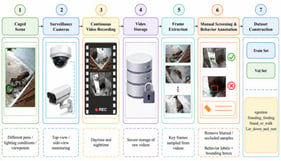
Surveillance video collection and dataset construction.

Highly Accessed Articles

News & Conferences

Latest Issues

Open for Submission

Journal Sections

Recent Advances in Veterinary Pharmacology and Toxicology
Reprint

Recent Advances in Veterinary Pharmacology and Toxicology

Editors: Chongshan Dai, Jichang Li
Advanced Therapy in Companion Animals
Reprint

Advanced Therapy in Companion Animals

2nd Edition
Editors: Zhijun Zhong, Ziyao Zhou
XFacebookLinkedIn
Vet. Sci. - ISSN 2306-7381