Skip to Content

Psychology International

Psychology International - formerly Psych - is an international, peer-reviewed, open access journal on psychology, published quarterly online by MDPI.

Get Alerted

Add your email address to receive forthcoming issues of this journal.

All Articles (509)

  • Article
  • Open Access

The present study (1) examined sex- and language-based measurement invariance of the science self-efficacy scale using PISA 2006 and 2015 U.S. data (N = 11,323) and (2) evaluated six large language models (ChatGPT, DeepSeek, Grok, Copilot, MetaAI, Gemini) in generating invariance approximations from prompt content and pre-existing model knowledge. Multigroup confirmatory factor analysis (MG-CFA) established empirical invariance benchmarks across sex and language groups. The same six LLMs were prompted to generate plausible fit-index values (CFI, RMSEA) and invariance decisions without access to empirical response data. Approximation discrepancy and agreement with the MG-CFA benchmarks were assessed using RMSE, MAE, Cronbach’s α and intraclass correlation coefficients (ICCs). MG-CFA supported full measurement invariance across sex and language groups in both cycles. In contrast, LLMs showed strong apparent consistency for CFI (α = 0.857) but poor convergence with empirical data (single-measure ICC = 0.302 for CFI, 0.024 for RMSEA). Discrepancies were often large enough to affect invariance interpretations and the models often overestimated model fit while producing invariance decisions that were not always aligned with the empirical MG-CFA benchmarks. Findings support the science self-efficacy scale’s cross-group validity but caution that current off-the-shelf LLMs, when prompted to generate plausible psychometric approximations without empirical data, produce unreliable outputs for high-stakes psychometric decisions. Implications, limitations and future directions are discussed.

Psychol. Int.

21 September 2026
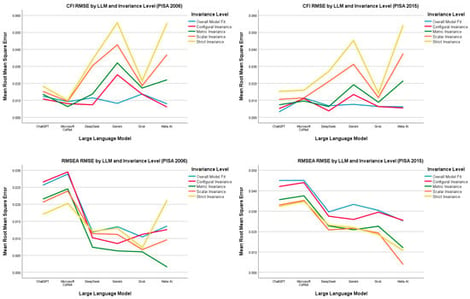
RMSE by index, by LLM, by invariance level, and by PISA cycle.
  • Essay
  • Open Access

Parenting in contemporary societies is increasingly organized through tensions between individualized responsibility and socially embedded care. While psychological accounts have traditionally emphasized parental competencies, attachment, and individual functioning, they have devoted less attention to the social conditions through which parental efficacy becomes possible. This paper develops a theoretical psycho-social account of parenting that reconceptualizes parental efficacy as a relational accomplishment constituted through relations of belonging and social alienation rather than an individual attribute or possession. Through an integrative dialogue among psychology, sociology, childhood studies, alienation theory, and phenomenology, it argues that belonging is sustained through social recognition, collective support, and institutional embeddedness, whereas alienation emerges when these conditions become fragile and the burdens of care are individualized. Parenting is therefore understood not merely as a private psychological practice but as a lived psycho-social process through which broader social transformations are experienced and negotiated. The framework reconnects psychological understandings of parenting with the relational, institutional, and phenomenological conditions through which parental efficacy is constituted.

Psychol. Int.

19 September 2026

  • Review
  • Open Access

This narrative literature review examines whether psychobiography, an established methodology within contemporary psychology, can be reconceived as a genuinely decolonial tool for supporting post-colonial identity development among African peoples. Moving beyond the simple inclusion of African subjects within existing biographical frameworks, the review argues that effective decolonisation requires transformation at the level of theory, method, and interpretive authority, not merely at the level of subject selection. Drawing on a systematically documented search of academic databases and a thematic synthesis of the resulting literature, the review traces the epistemological foundations of African psychology, the unresolved debate over what African psychology should be the psychology of, and the relevance of Ubuntu, relationality, and community-centred knowing to biographical inquiry. It then examines psychobiography’s historical development, its capacity to support narrative sovereignty and Black Consciousness-informed identity work, and its restorative potential for peoples whose histories have been systematically fragmented and distorted. Particular attention is given to the practical operationalisation of decolonial method, including a worked illustration contrasting conventional and Ubuntu-informed interpretive approaches, concrete proposals for embedding decolonised psychobiography within clinical and counselling training, and the ethical friction between communal knowledge systems and individualistic institutional research governance. The review concludes that psychobiography, when rigorously decolonised, offers African psychology something rare: a tangible, teachable, and replicable methodological pipeline capable of translating decolonial critique into sustained professional and community practice, while identifying concrete directions for future empirical, comparative, and pedagogical research.

Psychol. Int.

19 September 2026

  • Article
  • Open Access

Drawing on attachment theory, this study examines the relationship between Secure Base Leadership (SBL) and key organizational outcomes through the mediating role of employee well-being. Data were collected using a multi-source correlational design within a single multinational organization through two independent surveys administered at different points in time. SBL was assessed via follower ratings of 115 leaders in the early stages of their managerial roles, while employee well-being, work engagement, learning and development, and diversity and inclusion were measured using an internal organizational climate survey. Structural Equation Modeling using Partial Least Squares (PLS-SEM) revealed that SBL was positively associated with employee well-being. In turn, employee well-being showed strong and positive relationships with engagement, learning and development, and perceptions of diversity and inclusion. Indirect effects analyses supported employee well-being as a theoretically grounded indirect pathway linking SBL to these organizational outcomes, highlighting its central role as a psychological mechanism linking attachment-based leadership behaviors to broader employee experiences. From a practical perspective, the results suggest that developing SBL behaviors may represent a coherent lever associated with employee well-being and may improve key organizational climate indicators in complex and uncertain work environments.

Psychol. Int.

11 September 2026

Featured Articles of Last Quarter

Highly Accessed Articles

News & Conferences

Latest Issues

Open for Submission

Journal Sections

XFacebookLinkedIn
Psychol. Int. - ISSN 2813-9844