
- Article

22 Pages
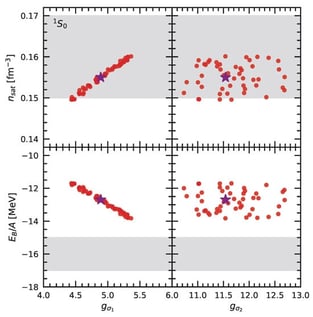
We explore the parameter space of the pvCD-Bonn B potential within the relativistic Brueckner–Hartree–Fock framework under the constraints from the empirical saturation properties of symmetric nuclear matter. We first examined the effects of the scalar-meson and pion coupling constants. Changing the -meson couplings in the and – channels alone cannot reproduce the empirical saturation density and binding energy at the same time, whereas increasing moves the saturation point toward the empirical region. However, changing alone also affects the deuteron properties and tensor-sensitive observables. We therefore extended the parameter search by varying the -meson tensor coupling and readjusting the effective -meson couplings in the and channels. Four representative parameter sets with
Atoms
26 September 2026
![The TU Mus system as represented by a grid of points seen projected onto the plane in the sky at phase 0.25. The grid was generated using the graphics available in IDL software installed on a SUN Blade 150 workstation and using a program written by the author employing techniques similar to those given in Kallrath, J. and Milone, E. F. [15]. The barycenter is located at the coordinate 0, 0 and the mass ratio of 0.625 was used. The two small stars represent the gravitational centers of the stars. The unit of distance is approximately 16 Rʘ, based on values given in Penney et al. [3] for a1sin (i).](https://mdpi-res.com/cdn-cgi/image/width=281%2Cheight=192/https://mdpi-res.com/atoms/atoms-14-00078/article_deploy/html/images/atoms-14-00078-g001-550.jpg)
![Differential cross sections for elastic electron scattering from zinc at 10, 15, 20 and 25 eV. The legend in the figure describes markers for the present work; the experiment of Marinković et al. [8]; and other theoretical approaches: BSR [15], ROP [8] and 206−state CCC [14].](https://mdpi-res.com/cdn-cgi/image/width=281%2Cheight=192/https://mdpi-res.com/atoms/atoms-14-00050/article_deploy/html/images/atoms-14-00050-g001-550.jpg)