
- Article

24 Pages
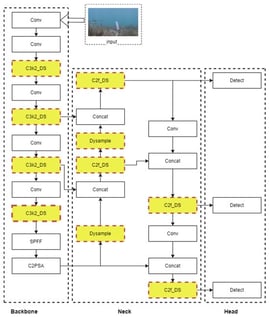
Accurate and efficient fish detection in underwater environments is fundamental to the advancement of automated aquaculture monitoring and selective fishing systems. However, the deployment of existing object detection models in such environments remains challenging due to wavelength-dependent light absorption, suspended-particle scattering, low contrast, and biological occlusion caused by schooling behavior, all of which are further compounded by the substantial computational overhead of conventional architectures. To address these limitations, this paper proposes FishMonitorAI, a lightweight object detection model built upon the YOLO11n framework and specifically optimized for underwater fish detection. The proposed model incorporates three architectural enhancements: (i) C3k2-DS, a lightweight backbone block leveraging depthwise separable convolutions to reduce computational complexity while preserving feature representation capacity; (ii) C2f-DS, a lightweight neck module that enables efficient multi-scale feature aggregation; and (iii) DySample, a content-aware dynamic upsampling module that replaces fixed interpolation methods to recover fine-grained spatial details critical for small fish localization. Extensive experiments on the DeepFish dataset demonstrate that FishMonitorAI achieves an mAP@0.5 of 98.2% while requiring 5.9 GFLOPs and 2.462 million parameters, corresponding to reductions of approximately 6.3% in GFLOPs and 4.6% in parameter count relative to the YOLO11n baseline. Direct inference measurements on an NVIDIA GTX 1650 Ti further show an average latency of 40.078 ms per image at a batch size of 1 and an input resolution of 640 × 640 pixels. These results demonstrate a favorable balance between detection performance, model complexity, and inference latency on the evaluated GPU platform. However, because the DeepFish dataset was randomly partitioned rather than split by habitat, images from the same habitat may occur across the training, validation, and test subsets. Therefore, the reported results should be interpreted as performance under the current DeepFish split rather than as evidence of generalization to completely unseen underwater environments. Ablation studies and Grad-CAM visualizations further illustrate the complementary contributions of the proposed modules and elucidate their underlying operational mechanisms. The present study evaluates only single-class fish detection; therefore, downstream tasks such as species recognition, disease diagnosis, individual tracking, biomass estimation, and selective harvesting remain outside the scope of the current experiments. The lightweight design of FishMonitorAI makes it a promising candidate for resource-constrained aquaculture monitoring systems; however, deployment performance on representative embedded platforms remains to be validated.
Aquac. J.
26 September 2026
![Types of antimicrobial resistance. [ChatGPT (OpenAI, GPT-5.6 Luna); prompt used: “Create a color diagram of the types of antimicrobial resistance.”].](https://mdpi-res.com/cdn-cgi/image/width=281%2Cheight=192/https://mdpi-res.com/aquacj/aquacj-06-00044/article_deploy/html/images/aquacj-06-00044-g001-550.jpg)