by
Howaida I. Abd-Alla 1,*, Omnia Kutkat 2, Heba-tollah M. Sweelam 1, Wagdy M. Eldehna 3,4 , Marwa A. Mostafa 5, Magda T. Ibrahim 6, Yassmin Moatasim 2, Mohamed GabAllah 2 and Ahmed A. Al-Karmalawy 7,*
, Marwa A. Mostafa 5, Magda T. Ibrahim 6, Yassmin Moatasim 2, Mohamed GabAllah 2 and Ahmed A. Al-Karmalawy 7,*
1
Chemistry of Natural Compounds Department, Pharmaceutical and Drug Industries Research Institute, National Research Centre, Dokki-Giza 12622, Egypt
2
The Center of Scientific Excellence for Influenza Viruses, Water Pollution Research Department, Environmental Research Institute, National Research Centre, Dokki-Giza 12622, Egypt
3
Department of Pharmaceutical Chemistry, Faculty of Pharmacy, Kafrelsheikh University, Kafrelsheikh 33516, Egypt
4
School of Biotechnology, Badr University in Cairo, Badr City 11829, Egypt
5
Bab El-Shaariya Hospital, Al-Azhar University, Cairo 11558, Egypt
6
Department of Pharmacognosy, Faculty of Pharmacy (Girls), Al-Azhar University, Cairo 11754, Egypt
7
Pharmaceutical Chemistry Department, Faculty of Pharmacy, Ahram Canadian University, 6th of October City, Giza 12566, Egypt
Metabolites 2022, 12(11), 1109; https://doi.org/10.3390/metabo12111109 - 13 Nov 2022
Cited by 19 | Viewed by 3911
Abstract
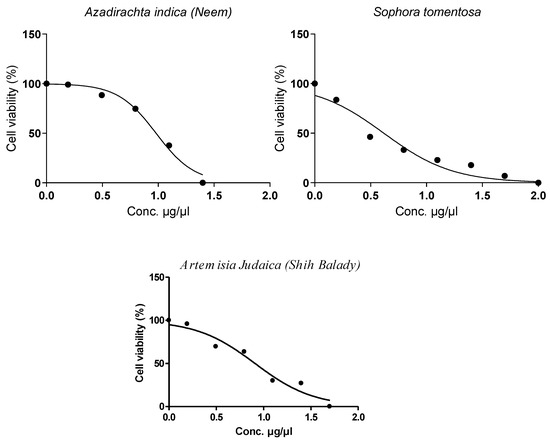
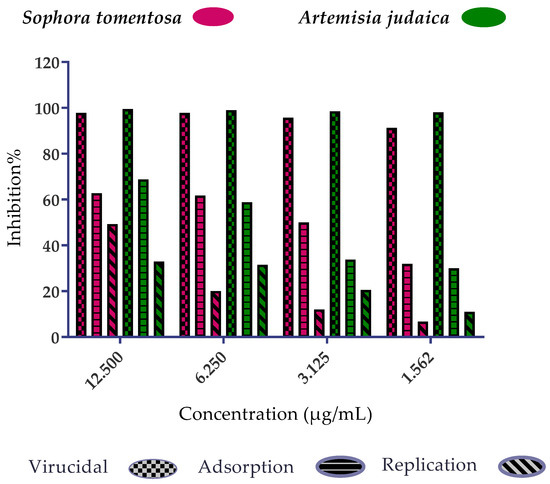
The anti-MERS-CoV activities of three medicinal plants (Azadirachta indica, Artemisia judaica, and Sophora tomentosa) were evaluated. The highest viral inhibition percentage (96%) was recorded for S. tomentosa. Moreover, the mode of action for both S. tomentosa and A. judaica
[...] Read more.
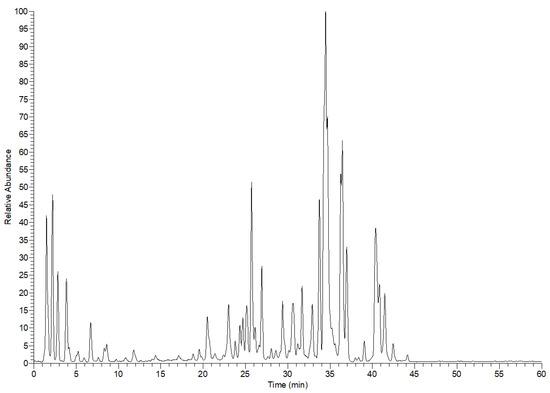
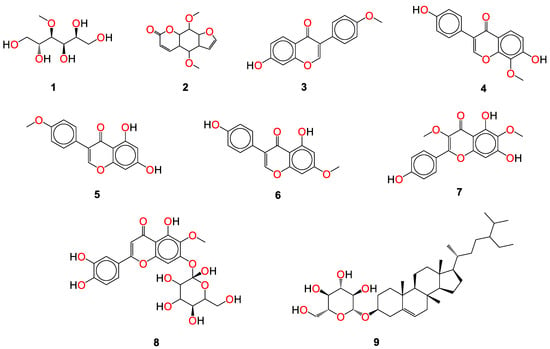
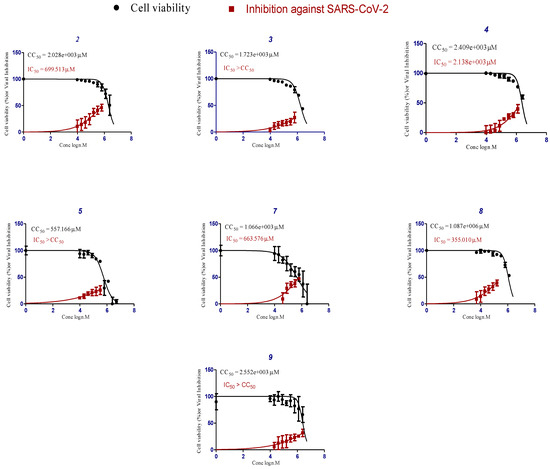
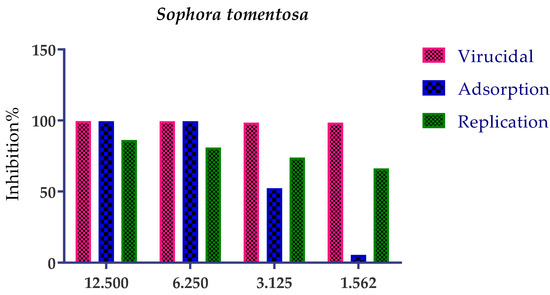
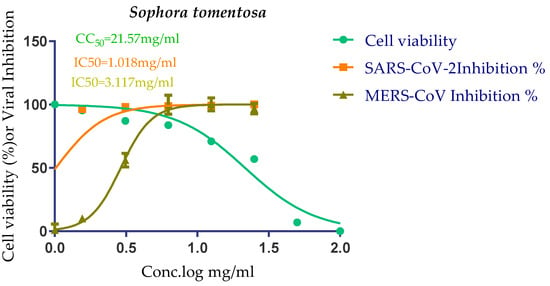
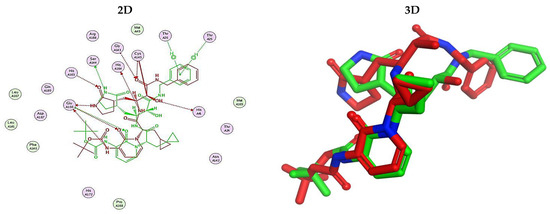
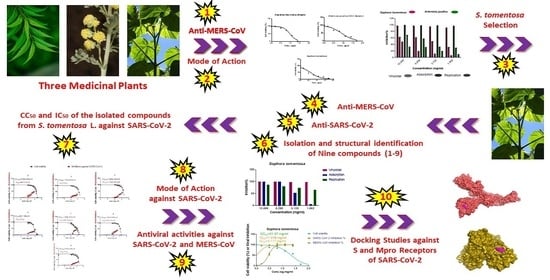
The anti-MERS-CoV activities of three medicinal plants (Azadirachta indica, Artemisia judaica, and Sophora tomentosa) were evaluated. The highest viral inhibition percentage (96%) was recorded for S. tomentosa. Moreover, the mode of action for both S. tomentosa and A. judaica showed 99.5% and 92% inhibition, respectively, with virucidal as the main mode of action. Furthermore, the anti-MERS-CoV and anti-SARS-CoV-2 activities of S. tomentosa were measured. Notably, the anti-SARS-CoV-2 activity of S. tomentosa was very high (100%) and anti-MERS-CoV inhibition was slightly lower (96%). Therefore, the phytochemical investigation of the very promising S. tomentosa L. led to the isolation and structural identification of nine compounds (1–9). Then, both the CC50 and IC50 values for the isolated compounds against SARS-CoV-2 were measured. Compound 4 (genistein 4’-methyl ether) achieved superior anti-SARS-CoV-2 activity with an IC50 value of 2.13 µm. Interestingly, the mode of action of S. tomentosa against SARS-CoV-2 showed that both virucidal and adsorption mechanisms were very effective. Additionally, the IC50 values of S. tomentosa against SARS-CoV-2 and MERS-CoV were found to be 1.01 and 3.11 µg/mL, respectively. In addition, all the isolated compounds were subjected to two separate molecular docking studies against the spike (S) and main protease (Mpr°) receptors of SARS-CoV-2.
Full article
(This article belongs to the Special Issue Natural Products: Chemical Profiling, Computational Studies and Bioactivities)
▼
Show Figures
Graphical abstract