
The Use of Blast Furnace Slag for Removal of Phosphorus from Wastewater in Sweden—A Review

Abstract
:1. Introduction
2. Materials and Methods
2.1. Materials

| Chemical Components | Oxelösund | Luleå |
|---|---|---|
| SiO2 | 34% | 33% |
| CaO | 30% | 32.5% |
| MgO | 16.5% | 16.5% |
| Al2O3 | 13% | 12.5% |
| TiO2 | 2.3% | 2.3% |
| S | 1.0% | 1.1% |
| MnO | 0.6% | 0.3% |
| FeO | 0.5% | 0.2% |
2.2. Methods
2.2.1. Laboratory Batch Tests
2.2.2. Column Test
2.2.3. Field Trials
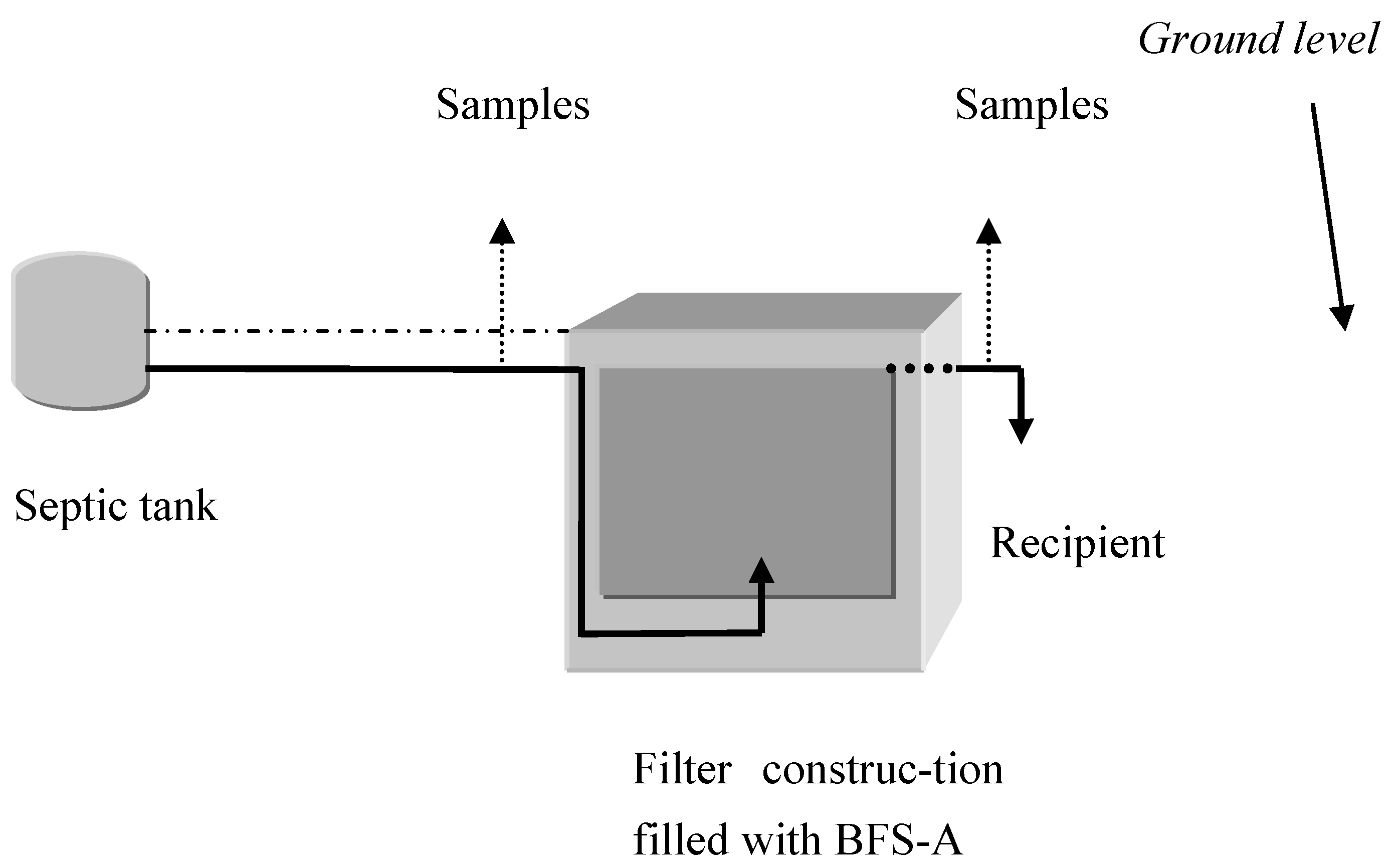
3. Results
3.1. Laboratory Batch Tests
| Slag material | Particle size (mm) | P-source | P-conc. (mg/L) | P-removal (%) | Reference | |
|---|---|---|---|---|---|---|
| P-solution | Wastewater | |||||
| BFS-A 1 (O 2) | 0–0.125 | x | 5–25 | ~40–100 | [4] | |
| BFS-A (O) | 0.25–4 | x | 5–25 | ~25–60 | [4] | |
| BFS-C 3 (O) | 0–0.125 | x | 5–25 | ~60–95 | [4] | |
| BFS-C (O) | 0.25–4 | x | 5–25 | ~70–95 | [4] | |
| BFS-C (L 4) | 0.5–2 (fresh) | x | 0–20 | ~100 | [24] | |
| BFS-C (L) | 0.5–2 (weathered) | x | 0–20 | ~40–85 | [24] | |
| BFS-C (L) | 1–5.6 (weathered) | x | 0–20 | ~40–85 | [24] | |
| BFS-C (L) | 0.5–2 (fresh) | x | ~55–70 | [24] | ||
| BFS-C (L) | 0.5–2 (fresh) | x | ~35–45 | [24] | ||
3.2. Laboratory Column Tests
| Slag material | Particle size | P-source | P-conc. (mg/L) | Operation time (weeks) | P-removal (%) | Reference | |
|---|---|---|---|---|---|---|---|
| P-solution | Wastewater | ||||||
| BFS-A 1 (O2) | 0.25–4 | x | 10 | 56 | ~95–100 | [4] | |
| BFS-C 3 (O) | 0.25–4 | x | 10 | 56 | ~95–100 | [4] | |
| BFS-A (O) | 0–4 | x | 5 | 68 | 86 (average) | [25] | |
| BFS-A (O) | 0.25–4 | x | 10 | 1 | 97–100 | [18] | |
| BFS-C (O) | 0.25–4 | x | 20–30 | 1 | 97–100 | [18] | |
| BFS-A | 0.25–4 | x | ~0.4 | 10 | >98 | [26] | |
3.3. Field Testing of Blast Furnace Slag
| Field site | Slag material | Particle size (mm) | Waste-water | P-conc. (mg PO4-P/L) | P-load (m3/day) | Operation time (weeks) | P-removal (%) | pH In/Out | Reference |
|---|---|---|---|---|---|---|---|---|---|
| Södertälje | BFS-C (O) | 0.25–4 | Domestic wastewater pre-treated in a septic tank | 20–30 | 0.5 | 16 | 37.5 | 7–8/8 | 18 |
| Luleå | BFS- (O) | 4–7 | Primarily pre–treated domestic wastewater from a village | ~5 | 0.5 | 64 | <20 | 7.4/10.7 | 19 |
| Ångersjön | BFS- (O) | 2–4 | Pre–treated wastewater (urine separated) in a septic tank and in a vertical lime filter | 1–11 | ~3 | ~150– | 57 | 7.3–7.8/7.8–11 | 20 |
4. Discussion
4.1. Problems and Possibilities
4.1.1. Environmental Hazards
4.1.2. Field Performance Issues
4.1.3. Improving Efficiency
5. Summary and Conclusions
Acknowledgements
References
- Eveborn, D. Bed Filters for Phosphorus Removal in On-Site Wastewater Treatment: Removal Mechanisms and Sustainability; Licentiate thesis, TRITA-LWR 1012; Royal Institute of Technology: Stockholm, Sweden, 2010. [Google Scholar]
- Johansson, L. Phosphorus Sorption to Filter Substrates—Potential Benefits for On-Site Wastewater Treatment? Doctoral Dissertation TRITA-AMI PHD1024; Royal Institute of Technology: Stockholm, Sweden, 1998. [Google Scholar]
- Johansson, L. Industrial by-products and natural substrata as phosphorus sorbents. Environ. Technol. 1999, 20, 309–316. [Google Scholar]
- Johansson, L. Blast furnace slag as phosphorus sorbents—column studies. Sci. Total Environ. 1999, 229, 89–97. [Google Scholar]
- Johansson Westholm, L. Filtermaterial för fosforreduktion—en litteraturstudie; Research report IEt, 2002:1; Mälardalen University: Västerås, Sweden, 2002. [Google Scholar]
- Hedström, A. Reactive Filter Materials for Ammonium and Phosphorus Sorption in Small Scale Wastewater Treatment; Doctoral Dissertation; Luleå University of Technology: Luleå, Sweden, 2006. [Google Scholar]
- Rastas Amofah, L. A Small Scale Wastewater Treatment System Adapted To Nutrient Recovery in Cold Climate—Performance and Possible Sorbents; Licentiate thesis; Luleå University of Technology: Luleå, Sweden, 2007. [Google Scholar]
- Cucarella Cabañas, V. Recycling Filter Substrates used for Phosphorus Removal from Wastewater as Soil Amendments; Doctoral Dissertation, Trita-LWR. PHD, 1049; Royal Institute of Technology: Stockholm, Sweden, 2009. [Google Scholar]
- Kietlinska, A. On-Site Wastewater Treatment-Polonite and Other Filter Materials for Removal of Metals, Nitrogen and Phosphorus; Trita-LWR. PHD, 1043; Royal Institute of Technology: Stockholm, Sweden, 2008. [Google Scholar]
- Cucarella, V.; Renman, G. Phosphorus sorption capacity of filter materials used for on-site wastewater treatment determined in batch experiments—A comparative study. J. Environ. Qual. 2009, 38, 381–392. [Google Scholar]
- Mann, R.; Bavor, J. Phosphorus removal in constructed wetlands using gravel and industrial waste substrata. WST 1993, 27, 107–113. [Google Scholar]
- Baker, M.J.; Blowes, D.W.; Ptacek, C.J. Laboratory development of permeable reactive mixtures for the removal of phosphorus from onsite wastewater disposal systems. Environ. Sci. Technol. 1998, 32, 2308–2316. [Google Scholar]
- Grüneberg, B.; Kern, J. Phosphorus retention capacity of iron-ore and blast furnace slag in subsurface flow constructed wetlands. WST 2001, 44, 69–75. [Google Scholar]
- Kostura, B.; Kulveitová, H.; Leško, J. Blast furnace slagsas sorbents of phosphate from water solutions. Water Res. 2005, 39, 1795–1802. [Google Scholar]
- Korkusuz, E.A.; Beklioğlu, M.; Demirer, G.N. Use of blast furnace granulated slag as a substrate in vertical flow reed beds: Field application. Bioresour. Technol. 2005, 98, 2089–2101. [Google Scholar]
- Gong, G.; Ye, S.; Tian, Y.; Wang, Q.; Ni, J.; Chen, Y. Preparation of a new sorbent with hydrated lime and blast furnace slag for phosphorus removal from aqueous solution. J. Hazard. Mater. 2009, 166, 714–719. [Google Scholar]
- Oguz, E. Removal of phosphate from aqueous solution with blast furnace slag. J. Hazard. Mater. 2004, 114, 131–137. [Google Scholar]
- Nehrenheim, E.; Rodriguez Caballero, A.; Odlare, M.; Johansson Westholm, L. Waste-water phosphorus removal by blast furnace slag: Laboratory and field investigations in Sweden. In Proceedings of 3rd Decentralised Conference on Water and Wastewater International Network, Kathmandu, Nepal, 10-13 November 2009.
- Rastas Amofah, L.; Hanæus, J. Nutrient recovery in a small scale wastewater treatment plant in cold climate. VATTEN 2006, 62, 355–368. [Google Scholar]
- Jansson, E. Hydraulics of Filter Media for Phosphorus Separation in a Small Scale Wastewater Treatment Plant. In MSc Thesis Work; University of Agricultural Sciences: Uppsala, Sweden, 2008. (In Swedish) [Google Scholar]
- Arias, C.A.; Del Bubba, M.; Brix, H. Phosphorus removal by sands for use as media in subsurface flow constructed reed beds. Water Res. 2000, 35, 1159–1168. [Google Scholar]
- Drizo, A.; Forget, C.; Chapuis, R.P.; Comeau, Y. Phosphorus removal by EAF steel slag—A parameter for the estimation of the longevity of constructed wetland systems. Environ. Sci. Technol. 2002, 36, 4642–4648. [Google Scholar]
- SSAB Merox AB. http://www.merox.se (accessed on 24 May 2010).
- Hedström, A.; Rastas, L. Methodological aspects of using blast furnace slag for waste-water phosphorus removal. J. Environ. Eng. 2006, 132, 1431–1438. [Google Scholar]
- Gustafsson, J-P.; Renman, A.; Renman, G.; Poll, K. Phosphate removal by mineral-based sorbents used in filters for small-scale wastewater treatment. Water Res. 2008, 42, 189–197. [Google Scholar]
- Stark, T. Reactive Filter Materials for Removal of Phosphorus in Small Scale Wastewater Treatment Plants. In MSc Thesis Work; Uppsala University: Uppsala, Sweden, 2004. (In Swedish) [Google Scholar]
- Renman, G.; Kietlinska, A.; Cucarella Cabañas, V. Treatment of phosphorus and bacteria by filter media in onsite wastewater disposal systems. In Proceedings of the 2nd International Symposium on Ecological Sanitation; Lübeck, Germany, April 2003. Deutsche Gesellschaft für Technische Zuzammenarbeit GmbH (GTZ): Lübeck, Germany, 2004; pp. 573–576. [Google Scholar]
- Vohla, C.; Kõiv, M.; Bavor, J.H.; Chazarenc, F.; Mander, Ü. Filter materials for phosphorus removal from wastewater in treatment wetlands—A review. Ecol. Eng 2009. [Google Scholar] [CrossRef]
- Shilton, A.N.; Elmetri, I.; Drizo, A.; Pratt, S.; Haverkamp, R.G.; Bilby, S.C. Phosphorus removal by an “active” slag filter—A decade of full scale experience. Water Res. 2006, 40, 113–118. [Google Scholar]
- Johansson Westholm, L. Substrates for phosphorus removal—Potential benefit for on-site wastewater treatment? Water Res. 2006, 40, 23–36. [Google Scholar]
- Tossavainen, M.; Forssberg, E. The potential leachability from natural road construction materials. Sci. Total Environ. 1999, 239, 31–47. [Google Scholar]
- Taylor, M. An Assessment of Iron and Steel Slag for Treatment of Stormwater Pollution; Landcare Research Contract Report: LC0506/064 prepared by Landcare Research for The Australasian (iron & steel) Slag Association Inc: Wollongong, 2006. [Google Scholar]
- Proctor, D.M.; Shay, E.C.; Fehling, K.A.; Finley, B.L. Assessment of Human Health and Ecological Risks Posed by the Uses of Steel-Industry Slags in the Environment. Hum. Ecol. Risk Assess. 2002, 8, 681–711. [Google Scholar]
- Exponent ©. Human Health and Ecological Risk Assessment for the Environmental Applications of Steel-Making Slag: An Update; Final Report, Doc. Nr. OC10662.000 F0T0 0107 DP12; Exponent ©: Irvine, CA, USA, 2007. [Google Scholar]
- Drizo, A. University of Vermont: Burlington, USA, Personal communication. May 2010.
- Johansson Westholm, L.; Drizo, A.; Renman, G. The Use of Blast Furnace and Electric Arc Furnace Steel Slag in Water Pollution Control. In Proceedings of 6th EuroSlag Conference, Madrid, Spain, 19–22 October; 2010. [Google Scholar]
- Brogowski, Z.; Renman, G. Characterization of Opoka as a basis for its use in wastewater treatment. Polish. J. Environ. Stud. 2004, 13, 15–20. [Google Scholar]
- Yamada, H.; Kayama, M.; Saitu, K.; Hara, M. A fundamental research on phosphate removal by using slag. Water Res. 1986, 20, 547–557. [Google Scholar]
- Yamada, H.; Kayama, M.; Saitu, K.; Hara, M. Suppression of phosphate liberation from sediment by using iron slag. Water Res. 1987, 21, 325–333. [Google Scholar]
- Renman, G. Personal communication, Royal Institute of Technology: Stockholm, Sweden, May 2010.
- Kalmykova, Y. Alternative Sorption Materials for Contaminated Water Treatment. In Doctoral Dissertation; Chalmers University of Technology: Gothenburg, Sweden, 2009. [Google Scholar]
- Kalmykova, Y.; Knutsson, J.; Strömvall, A-M.; Hargelius, K. Blast furnace sludge as sorbent material for multi-metal contaminated water. In Highway and Urban Environment, Proceedings of the 9th Highway and Urban Environment Symposium, Madrid, Spain, 9–11 June 2008; Rauch, S., Morrison, G.M., Monzón, G.M., Eds.; Springer: London, UK, 2009; pp. 325–336. [Google Scholar]
© 2010 by the authors; licensee MDPI, Basel, Switzerland. This article is an open access article distributed under the terms and conditions of the Creative Commons Attribution license (http://creativecommons.org/licenses/by/3.0/).
Share and Cite
Johansson Westholm, L. The Use of Blast Furnace Slag for Removal of Phosphorus from Wastewater in Sweden—A Review. Water 2010, 2, 826-837. https://doi.org/10.3390/w2040826
Johansson Westholm L. The Use of Blast Furnace Slag for Removal of Phosphorus from Wastewater in Sweden—A Review. Water. 2010; 2(4):826-837. https://doi.org/10.3390/w2040826
Chicago/Turabian StyleJohansson Westholm, Lena. 2010. "The Use of Blast Furnace Slag for Removal of Phosphorus from Wastewater in Sweden—A Review" Water 2, no. 4: 826-837. https://doi.org/10.3390/w2040826