<?xml version="1.0" encoding="UTF-8"?>
<!DOCTYPE article PUBLIC "-//NLM//DTD Journal Publishing DTD v2.3 20070202//EN" "journalpublishing.dtd">
<article xmlns:mml="http://www.w3.org/1998/Math/MathML" xmlns:xlink="http://www.w3.org/1999/xlink" xml:lang="en" article-type="review-article">
  <front>
    <journal-meta>
      <journal-id journal-id-type="publisher-id">toxins</journal-id>
      <journal-title>Toxins</journal-title>
      <abbrev-journal-title abbrev-type="publisher">Toxins</abbrev-journal-title>
      <abbrev-journal-title abbrev-type="pubmed">Toxins</abbrev-journal-title>
      <issn pub-type="epub">2072-6651</issn>
      <publisher>
        <publisher-name>MDPI</publisher-name>
      </publisher>
    </journal-meta>
    <article-meta>
      <article-id pub-id-type="doi">10.3390/toxins4020083</article-id>
      <article-id pub-id-type="publisher-id">toxins-04-00083</article-id>
      <article-categories>
        <subj-group>
          <subject>Review</subject>
        </subj-group>
      </article-categories>
      <title-group>
        <article-title>Cytoskeleton as an Emerging Target of Anthrax Toxins</article-title>
      </title-group>
      <contrib-group>
        <contrib contrib-type="author">
          <name>
            <surname>Trescos</surname>
            <given-names>Yannick</given-names>
          </name>
          <xref rid="af1-toxins-04-00083" ref-type="aff">1</xref>
          <xref rid="af2-toxins-04-00083" ref-type="aff">2</xref>
        </contrib>
        <contrib contrib-type="author">
          <name>
            <surname>Tournier</surname>
            <given-names>Jean-Nicolas</given-names>
          </name>
          <xref rid="af1-toxins-04-00083" ref-type="aff">1</xref>
          <xref rid="af2-toxins-04-00083" ref-type="aff">2</xref>
          <xref rid="c1-toxins-04-00083" ref-type="corresp">*</xref>
        </contrib>
      </contrib-group>
      <aff id="af1-toxins-04-00083"><label>1 </label>Unité Interactions Hôte-Agents pathogènes, Institut de Recherche Biomédicale des Armées, Centre de Recherche du Service de Santé des Armées, BP 87, 24 avenue des Maquis du Grésivaudan 38702 La Tronche Cedex, France; Email: <email>yannick.trescos@yahoo.fr</email></aff>
      <aff id="af2-toxins-04-00083"><label>2 </label>Ecole du Val-de-Grâce, 1 place Alphonse Lavéran, 75005 Paris, France</aff>
      <author-notes>
        <corresp id="c1-toxins-04-00083"><label>*</label> Author to whom correspondence should be addressed; Email: <email>jntournier@gmail.com</email>; Tel.: +33-4-76636850; Fax: +33-4-76636917.</corresp>
      </author-notes>
      <pub-date pub-type="epub">
        <day>06</day>
        <month>02</month>
        <year>2012</year>
      </pub-date>
      <pub-date pub-type="collection">
        <month>02</month>
        <year>2012</year>
      </pub-date>
      <volume>4</volume>
      <issue>2</issue>
      <fpage>83</fpage>
      <lpage>97</lpage>
      <history>
        <date date-type="received">
          <day>10</day>
          <month>01</month>
          <year>2012</year>
        </date>
        <date date-type="rev-recd">
          <day>21</day>
          <month>01</month>
          <year>2012</year>
        </date>
        <date date-type="accepted">
          <day>26</day>
          <month>01</month>
          <year>2012</year>
        </date>
      </history>
      <permissions>
        <copyright-statement>© 2012 by the authors; licensee MDPI, Basel, Switzerland.</copyright-statement>
        <copyright-year>2012</copyright-year>
        <license xmlns:xlink="http://www.w3.org/1999/xlink" license-type="open-access" xlink:href="http://creativecommons.org/licenses/by/3.0/">
          <p>This article is an open-access article distributed under the terms and conditions of the Creative Commons Attribution license (http://creativecommons.org/licenses/by/3.0/).</p>
        </license>
      </permissions>
      <abstract>
        <p><italic>Bacillus anthracis</italic>, the agent of anthrax, has gained virulence through its exotoxins produced by vegetative bacilli and is composed of three components forming lethal toxin (LT) and edema toxin (ET). So far, little is known about the effects of these toxins on the eukaryotic cytoskeleton. Here, we provide an overview on the general effects of toxin upon the cytoskeleton architecture. Thus, we shall discuss how anthrax toxins interact with their receptors and may disrupt the interface between extracellular matrix and the cytoskeleton. We then analyze what toxin molecular effects on cytoskeleton have been described, before discussing how the cytoskeleton may help the pathogen to corrupt general cell processes such as phagocytosis or vascular integrity.</p>
      </abstract>
      <kwd-group>
        <kwd>anthrax toxins</kwd>
        <kwd>cytoskeleton</kwd>
        <kwd>actin</kwd>
        <kwd>phagocytosis</kwd>
        <kwd>vascular integrity</kwd>
      </kwd-group>
    </article-meta>
  </front>
  <body>
    <sec sec-type="intro">
      <title>1. Introduction</title>
      <p><italic>Bacillus anthracis</italic>, the agent of anthrax, is a common veterinary disease and major agent of biological warfare important for biodefense [<xref ref-type="bibr" rid="B1-toxins-04-00083">1</xref>]. The attacks in 2001, consisting of letters contaminated with anthrax spores in the United States, have confirmed its potential use as a weapon of bioterrorism and justify the growing need to understand the pathophysiology of this dreadful pathogen [<xref ref-type="bibr" rid="B2-toxins-04-00083">2</xref>]. <italic>B. anthracis</italic> is a gram-positive, aerobic bacterium that can form very resistant spores in poor environments. Its virulence is linked to two main factors: the capsule formed by poly γ-D-glutamic acid, whose operon is encoded by the plasmid pXO2, and the two toxins (edema toxin (ET) and lethal toxin (LT)) encoded on the other virulence plasmid named pXO1 [<xref ref-type="bibr" rid="B3-toxins-04-00083">3</xref>,<xref ref-type="bibr" rid="B4-toxins-04-00083">4</xref>]. By pulmonary route of infection, <italic>B. anthracis</italic> induces a toxemia associated with sepsis and respiratory distress within a few days, rapidly progressing to death without treatment [<xref ref-type="bibr" rid="B5-toxins-04-00083">5</xref>,<xref ref-type="bibr" rid="B6-toxins-04-00083">6</xref>]. Anthrax toxins play a central role in pathogenesis and deregulation of the immune system (review in [<xref ref-type="bibr" rid="B7-toxins-04-00083">7</xref>,<xref ref-type="bibr" rid="B8-toxins-04-00083">8</xref>]). At the cellular level, many toxin effects have been described (review in [<xref ref-type="bibr" rid="B4-toxins-04-00083">4</xref>,<xref ref-type="bibr" rid="B9-toxins-04-00083">9</xref>]). Some studies have suggested that the toxins also target the cytoskeleton [<xref ref-type="bibr" rid="B10-toxins-04-00083">10</xref>,<xref ref-type="bibr" rid="B11-toxins-04-00083">11</xref>,<xref ref-type="bibr" rid="B12-toxins-04-00083">12</xref>,<xref ref-type="bibr" rid="B13-toxins-04-00083">13</xref>,<xref ref-type="bibr" rid="B14-toxins-04-00083">14</xref>,<xref ref-type="bibr" rid="B15-toxins-04-00083">15</xref>]. We attempt here to review how the anthrax toxins may interact with the cytoskeleton, a crucial component of eukaryote cells crucially involved in homeostasis.</p>
    </sec>
    <sec>
      <title>2. General Overview on <italic>Bacillus anthracis</italic> Toxins and the Cytoskeleton</title>
      <sec>
        <title>2.1. <italic>Bacillus anthracis</italic> Toxins</title>
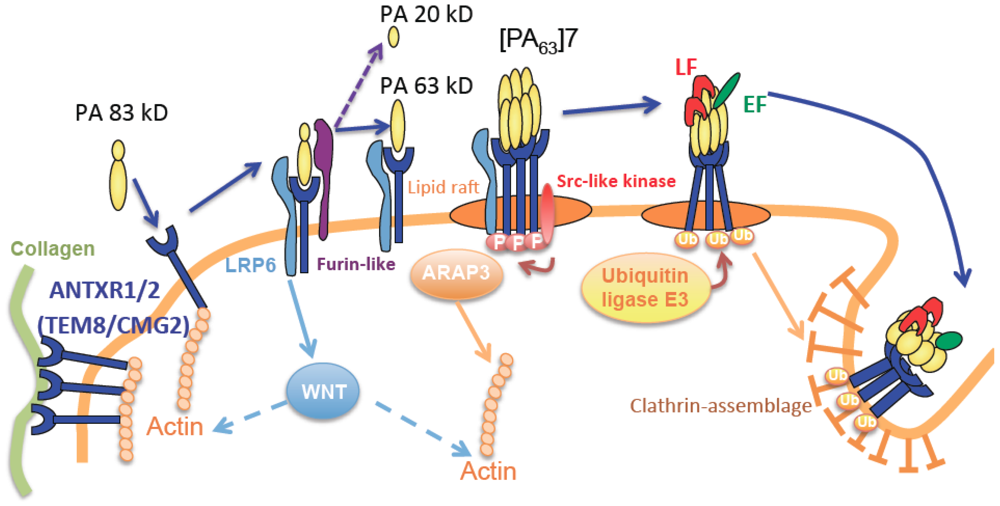
        <p>The toxins are A/B type, formed by the association of three components. Components A bear the enzymatic activity. Edema factor (EF, 89 kDa) for ET is a calmodulin-dependent adenylate cyclase, that increases intracellular cAMP concentrations [<xref ref-type="bibr" rid="B4-toxins-04-00083">4</xref>,<xref ref-type="bibr" rid="B16-toxins-04-00083">16</xref>], while lethal factor (LF, 90 kDa) for LT is a zinc-dependent metalloprotease cleaving specifically the <italic>N</italic>-terminus of most mitogen-activated protein kinase kinases (MAPKK or MEK) [<xref ref-type="bibr" rid="B4-toxins-04-00083">4</xref>,<xref ref-type="bibr" rid="B17-toxins-04-00083">17</xref>]. This MEK cleavage disrupts signaling cascades essential in cell proliferation, cell cycle regulation and immune function, such as ERK 1/2, JNK/SAPK and p38, signaling pathways (review in [<xref ref-type="bibr" rid="B4-toxins-04-00083">4</xref>,<xref ref-type="bibr" rid="B7-toxins-04-00083">7</xref>]). The B component, involved in binding cell receptor, is common for both toxins: it is named protective antigen (PA, 83 kDa), after its immunogenic properties (review in [<xref ref-type="bibr" rid="B9-toxins-04-00083">9</xref>,<xref ref-type="bibr" rid="B18-toxins-04-00083">18</xref>]). The mechanisms of cell penetration by toxins have been thoroughly deciphered over the past twenty years and can be separated into three major steps: receptor binding, internalization, membrane translocation (reviewed in [<xref ref-type="bibr" rid="B9-toxins-04-00083">9</xref>,<xref ref-type="bibr" rid="B18-toxins-04-00083">18</xref>]). PA<sub>83 </sub>binding to specific cell receptors (ANTXR1 or TEM-8 for Tumor Endothelial Marker-8 and ANTXR2 or CMG-2 for Capillary Morphogenesis Protein-2) [<xref ref-type="bibr" rid="B19-toxins-04-00083">19</xref>] allows its cleavage by a furin-like protein into two subunits of 63 and 20 kDa, the latter being released (<xref ref-type="fig" rid="toxins-04-00083-f001">Figure 1</xref>). A third co-receptor named LDL receptor protein (LRP)-6 has been proposed [<xref ref-type="bibr" rid="B20-toxins-04-00083">20</xref>], while its effective role has been discussed and may be cell-type specific [<xref ref-type="bibr" rid="B21-toxins-04-00083">21</xref>,<xref ref-type="bibr" rid="B22-toxins-04-00083">22</xref>]. Interestingly, a group has demonstrated that anthrax toxin receptors interact with LRP6 to control Wnt signaling [<xref ref-type="bibr" rid="B23-toxins-04-00083">23</xref>]. </p>
        <p>PA<sub>63</sub> subunits associate in heptamers to form a pre-pore, redistributed to the cell surface in lipid rafts. This allows the binding of EF or LF components in a stoichiometric ratio of 3 LF/EF to 7 PA. The toxin-receptor complex is then internalized by clathrin-dependent endocytosis [<xref ref-type="bibr" rid="B9-toxins-04-00083">9</xref>,<xref ref-type="bibr" rid="B24-toxins-04-00083">24</xref>,<xref ref-type="bibr" rid="B25-toxins-04-00083">25</xref>]. A pH decrease within early endosomes results in the translocation of these factors in multivesicular bodies (MVB), finally merging with the intracellular membrane of late endosomes. This last step facilitates the translocation of LF into the cytoplasm, while EF stays associated to the membrane of the late endosome [<xref ref-type="bibr" rid="B26-toxins-04-00083">26</xref>]. Its perinuclear localization generates intracellular cAMP gradients from the cell nucleus to the periphery. Interestingly, mouse mutants for each toxin receptor have been produced, showing that CMG-2 plays a unique role as a major receptor of anthrax toxin <italic>in vivo</italic> [<xref ref-type="bibr" rid="B27-toxins-04-00083">27</xref>]. </p>
        <fig id="toxins-04-00083-f001" position="anchor">
          <label>Figure 1</label>
          <caption>
            <p>Interactions between anthrax toxin receptors and cytoskeleton. This figure highlights the links between cytoskeleton, anthrax toxin receptor (ANTXR) and the extracellular matrix. The physiological roles of ANTXR are not well known so far, unless they interact with extracellular matrix fibers. Their intracellular tail interacts with actin, and there is an inverse correlation between the binding of TEM8 to actin and the amount of protective antigen (PA) bound to receptors. After PA-ANTXR interaction, at least several signals can be sent to trigger PA endocytosis: (<bold>i</bold>) PA-ANTXR interactions trigger <italic>src</italic>-like kinase which in turn phosphorylates CMG-2 and TEM-8 intracellular tail favoring the toxin intracellular entry; (<bold>ii</bold>) a second target for anthrax receptor signaling may be ARAP3 (Arf GAP and Rho GAP with ankyrin repeat and pleckstrin homology domains); (<bold>iii</bold>) LRP6 coreceptor control Wnt signaling.</p>
          </caption>
          <graphic xmlns:xlink="http://www.w3.org/1999/xlink" xlink:href="toxins-04-00083-g001.tif"/>
        </fig>
      </sec>
      <sec>
        <title>2.2. The Cytoskeleton</title>
        <p>The cytoskeleton is a cellular scaffolding system whose functions include broad fundamental cell processes such as morphology and plasticity maintenance, movement, signal transduction, membrane and organelle trafficking. The cytoskeleton consists of three filament systems integrated into a complex network regulated by associated proteins: (i) actin microfilaments; (ii) microtubules; and (iii) intermediate filaments. As anthrax toxin effects have been described only on actin filaments and microtubules, we will restrict our description on these two systems.</p>
        <p>Microfilaments are formed by a globular protein called actin, which exists in unpolymerized (G-actin) and polymerized (F-actin) forms. F-actin is composed of two parallels strands of actin monomers. The dynamic and spatial organization of the actin cytoskeleton is regulated at multiple levels by a variety of proteins that control numerous processes such as nucleation, polymerization, stabilization, branching and cross-linking of actin filaments [<xref ref-type="bibr" rid="B28-toxins-04-00083">28</xref>,<xref ref-type="bibr" rid="B29-toxins-04-00083">29</xref>,<xref ref-type="bibr" rid="B30-toxins-04-00083">30</xref>]. Moreover, these regulatory and structural proteins enable cells to form and remodel functional structures like stress fibers, lamellipodia, filopodia, phagosomes and endocytic vesicles [<xref ref-type="bibr" rid="B30-toxins-04-00083">30</xref>,<xref ref-type="bibr" rid="B31-toxins-04-00083">31</xref>,<xref ref-type="bibr" rid="B32-toxins-04-00083">32</xref>]. These macromolecular scaffolding structures are regulated by a complex interplay of Rho GTPases, kinases and phosphatases, which are again affected by bacterial pathogens or toxins [<xref ref-type="bibr" rid="B33-toxins-04-00083">33</xref>,<xref ref-type="bibr" rid="B34-toxins-04-00083">34</xref>]. The Rho GTPases are master regulators of cytoskeletal dynamics and cell shape [<xref ref-type="bibr" rid="B35-toxins-04-00083">35</xref>], immune responses [<xref ref-type="bibr" rid="B36-toxins-04-00083">36</xref>,<xref ref-type="bibr" rid="B37-toxins-04-00083">37</xref>] and phagocytosis [<xref ref-type="bibr" rid="B38-toxins-04-00083">38</xref>]. The three best-known members of the Rho GTPases family include RhoA, Cdc42 (Cell division Cycle 42) and Rac1, all of which can act as actin regulator switches by cycling between an inactive GDP- and active GTP-bound states [<xref ref-type="bibr" rid="B28-toxins-04-00083">28</xref>,<xref ref-type="bibr" rid="B34-toxins-04-00083">34</xref>]. In their active GTP-bound state, Rho GTPases interact with downstream effectors involved in the dynamic rearrangement of actin and microtubule filaments. Activation of RhoA induces the formation of stress fibers that are contractile bundles of polymerized actin containing myosin motor proteins. Rac1 regulates the formation of membrane ruffles or lamellipodia and Cdc42 controls the formation of filopodia or finger-like cell protrusions at the cell periphery [<xref ref-type="bibr" rid="B31-toxins-04-00083">31</xref>,<xref ref-type="bibr" rid="B34-toxins-04-00083">34</xref>,<xref ref-type="bibr" rid="B35-toxins-04-00083">35</xref>].</p>
        <p>Microtubules form well-organized hollow tubes composed of covalent association of alpha/beta tubulin heterodimers. These protofilaments radiate from the microtubule-organizing center (MTOC) located at the centrosome in the cytoplasm, in order to allow directional flow of proteins and organelles to a specific location [<xref ref-type="bibr" rid="B39-toxins-04-00083">39</xref>,<xref ref-type="bibr" rid="B40-toxins-04-00083">40</xref>]. The complex organization of microtubules is responsible for cell polarity, leading to MTOC’s movement toward the site of phagocytosis [<xref ref-type="bibr" rid="B41-toxins-04-00083">41</xref>]. The Rho GTPases and many microtubule-associated proteins (MAPs), motor proteins like dyneins, and kinesins also interact with microtubules [<xref ref-type="bibr" rid="B37-toxins-04-00083">37</xref>,<xref ref-type="bibr" rid="B40-toxins-04-00083">40</xref>].</p>
        <p>As the cytoskeleton intervenes in many dynamic cell processes, it has to be controlled by many regulatory proteins and is the target of multiple signaling pathways. As a result, the cytoskeleton network is a prime target for pathogens and their virulence factors. </p>
      </sec>
    </sec>
    <sec>
      <title>3. Association between Anthrax Receptor, Extra-Cellular Matrix and the Cytoskeleton</title>
      <p>It is interesting to note that the precise physiologic role of TEM-8 and CMG-2 is currently unknown, although mutations of TEM-8 and CMG-2 in humans strongly suggest their role is very different from toxin endocytosis (review in [<xref ref-type="bibr" rid="B42-toxins-04-00083">42</xref>]). Mutation in the <italic>cmg-2</italic> gene is linked to juvenile hyaline fibromatosis (JHF) and infantile systemic hyalinosis (ISH) [<xref ref-type="bibr" rid="B43-toxins-04-00083">43</xref>,<xref ref-type="bibr" rid="B44-toxins-04-00083">44</xref>]. Clinically, the patients suffer from generalized fibromatosis resulting by deposition of hyaline in the dermis. Mutation in the extracellular domain of <italic>tem-8</italic> has been described in a patient with infantile hemangioma, characterized by a rapidly growing area of angiogenesis [<xref ref-type="bibr" rid="B45-toxins-04-00083">45</xref>]. Intriguingly, TEM-8 mutation disrupted the expression of VEGFR1 and VEGFR2 signaling. Taken together these data strongly suggests that TEM-8 and CMG-2 have very specialized functions hijacked by anthrax toxins. Along those lines the anthrax toxin triggers <italic>src</italic>-like kinase which in turn phosphorylates CMG-2 and TEM-8 intracellular domain favoring toxin entry [<xref ref-type="bibr" rid="B46-toxins-04-00083">46</xref>]. A second target for anthrax receptor signaling may be ARAP3 (Arf GAP and Rho GAP with ankyrin repeat and pleckstrin homology domains) [<xref ref-type="bibr" rid="B47-toxins-04-00083">47</xref>]. </p>
      <p>Extracellular domain of CMG-2 is known to interact with collagen IV and laminin [<xref ref-type="bibr" rid="B48-toxins-04-00083">48</xref>]. Extracellular domain of TEM-8 interacts with collagen I and VI, and gelatin [<xref ref-type="bibr" rid="B15-toxins-04-00083">15</xref>,<xref ref-type="bibr" rid="B49-toxins-04-00083">49</xref>,<xref ref-type="bibr" rid="B50-toxins-04-00083">50</xref>]. The cytosolic tail of TEM8 directly docks the actin cytoskeleton, helping cell spread by coupling matrix ligand to intracellular cytoskeleton [<xref ref-type="bibr" rid="B15-toxins-04-00083">15</xref>]. TEM-8 seems to organize actin filaments into bundles [<xref ref-type="bibr" rid="B51-toxins-04-00083">51</xref>], suggesting that potential actin reorganization drives cell shape changes and spreading after PA attachment. In addition, TEM8-1, but not TEM8-2 interacts with the actin network which modulates affinity for PA and promotes its heptamerization [<xref ref-type="bibr" rid="B25-toxins-04-00083">25</xref>,<xref ref-type="bibr" rid="B51-toxins-04-00083">51</xref>,<xref ref-type="bibr" rid="B52-toxins-04-00083">52</xref>]. An inverse correlation exists between TEM8 binding to actin and the amount of PA bound to receptors [<xref ref-type="bibr" rid="B51-toxins-04-00083">51</xref>]. Cortical actin cytoskeleton seems to be required for heptamerization of PA when bound to TEM8-1 that is organized in an actin dependent manner, but not when bound to CMG2. Upon toxin binding, actin-TEM8 interaction is released, but actin remains essential for heptamerization and endocytosis of heptameric PA [<xref ref-type="bibr" rid="B25-toxins-04-00083">25</xref>]. However, future studies are required to better understand the role of the cytoskeleton in toxin uptake and intoxication.</p>
    </sec>
    <sec>
      <title>4. Anthrax Toxins and Disruption of the Cytoskeleton Network</title>
      <sec>
        <title>4.1. LT Effects</title>
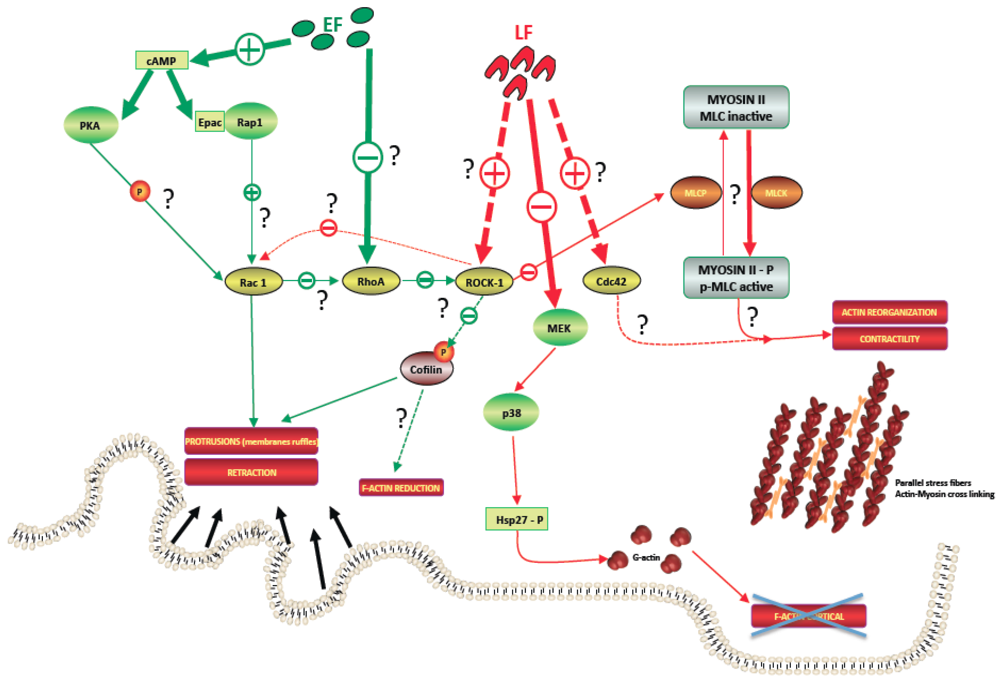
        <p>The effects of LT on the cytoskeleton have been relatively recent discoveries. Most of the studies have focused upon actin in endothelial and epithelial cells, as well as immune cells like macrophage or neutrophils (<xref ref-type="fig" rid="toxins-04-00083-f002">Figure 2</xref>).</p>
        <fig id="toxins-04-00083-f002" position="anchor">
          <label>Figure 2</label>
          <caption>
            <p>Effects of anthrax lethal and edema factors on cytoskeleton regulatory pathways.This hypothetical figure describes anthrax lethal factor (LF, red) and edema factor (EF, green) main targets along the regulatory pathways of cytoskeleton. On the one hand, LF probably activates Cdc42 and/or ROCK. ROCK activation could increase Myosin Light Chain (MLC) phosphorylation, leading to cell contractility. In parallel, LF-Mitogen-Activated Protein Kinase (MEK) cleavage blocks the Hsp27 phosphorylation cycle, impairing actin monomer transport to an area of new actin filament assembly. On the other hand, EF increases the cAMP level which signals via PKA and/or Epac/Rap1, potentially leading to the activation of Rac1 and inducing protrusions and retraction of the membrane. In parallel, EF could inhibit RhoA, leading to a reduction of F-actin via cofilin activation.</p>
          </caption>
          <graphic xmlns:xlink="http://www.w3.org/1999/xlink" xlink:href="toxins-04-00083-g002.tif"/>
        </fig>
        <sec>
          <title>4.1.1. Actin Network</title>
          <p>One major issue when considering the effects of LT on various cells is its diverse effects. On one hand, after exposure to LT, human endothelium and lung epithelial cells progressively show mechanical stiffness [<xref ref-type="bibr" rid="B11-toxins-04-00083">11</xref>], blebbing, and elongation [<xref ref-type="bibr" rid="B53-toxins-04-00083">53</xref>,<xref ref-type="bibr" rid="B54-toxins-04-00083">54</xref>]. These morphological changes correlate with re-organization of the actin cytoskeleton characterized by thick actin cables or actin stress fibers [<xref ref-type="bibr" rid="B53-toxins-04-00083">53</xref>,<xref ref-type="bibr" rid="B54-toxins-04-00083">54</xref>,<xref ref-type="bibr" rid="B55-toxins-04-00083">55</xref>,<xref ref-type="bibr" rid="B56-toxins-04-00083">56</xref>] parallel to each other, with loss of cortical F-actin [<xref ref-type="bibr" rid="B53-toxins-04-00083">53</xref>,<xref ref-type="bibr" rid="B54-toxins-04-00083">54</xref>] but increased central F-actin content [<xref ref-type="bibr" rid="B11-toxins-04-00083">11</xref>,<xref ref-type="bibr" rid="B54-toxins-04-00083">54</xref>] or increased actin filament assembly [<xref ref-type="bibr" rid="B11-toxins-04-00083">11</xref>]. For many authors, unconventional formation and stabilization of stress fibers occurred in the presence of LT over a course of 6–24 h, <italic>i.e.</italic> (i) in the absence of direct activation of RhoA/ROCK pathway or Rac1 by LT [<xref ref-type="bibr" rid="B11-toxins-04-00083">11</xref>,<xref ref-type="bibr" rid="B53-toxins-04-00083">53</xref>]; (ii) with equivalent phosphorylation of both cofilin [<xref ref-type="bibr" rid="B11-toxins-04-00083">11</xref>,<xref ref-type="bibr" rid="B53-toxins-04-00083">53</xref>] and myosin light chain (MLC) [<xref ref-type="bibr" rid="B53-toxins-04-00083">53</xref>]; (iii) requires host gene transcription modifications by LT to participate in the thick actin cable formation [<xref ref-type="bibr" rid="B11-toxins-04-00083">11</xref>,<xref ref-type="bibr" rid="B53-toxins-04-00083">53</xref>]. For Cdc42 activity, results are more divergent: Lehmann <italic>et al.</italic> observe an increase in active GTP-bound Cdc42 in LT-treated epithelial cells [<xref ref-type="bibr" rid="B11-toxins-04-00083">11</xref>] while Rolando <italic>et al.</italic> show equivalent activity of Cdc42 in LT-intoxicated human endothelial cells [<xref ref-type="bibr" rid="B53-toxins-04-00083">53</xref>].</p>
          <p>In contrast to the previous studies, a recent study of Warfel <italic>et al</italic>. on lung microvascular endothelial cells shows actin stress fibers accompanied by increased MLC phosphorylation and cleavage of ROCK-1, leading to the activation of ROCK-1 after 72 h of LT exposure. ROCK-inhibitors seem to block LT-induced stress fiber formation and phosphorylation of MLC, suggesting an involvement of ROCK pathways in maintaining LT-induced stress fibers [<xref ref-type="bibr" rid="B56-toxins-04-00083">56</xref>]. Consequently, RhoA/ROCK pathway is most likely not directly modulated by LT but may control the stability of these actin cables.</p>
          <p>On the other hand, after 2 h, LT reduces the ability of neutrophils to spread and actin filament assembly at the leading edge [<xref ref-type="bibr" rid="B13-toxins-04-00083">13</xref>,<xref ref-type="bibr" rid="B57-toxins-04-00083">57</xref>]. Actin-based motility of the intracellular pathogen <italic>Listeria monocytogenes</italic> in HeLa cells is also affected by LT [<xref ref-type="bibr" rid="B14-toxins-04-00083">14</xref>]. In proteomics studies on mouse macrophage, the beta isoform of actin is upregulated [<xref ref-type="bibr" rid="B58-toxins-04-00083">58</xref>], but gamma actin is decreased [<xref ref-type="bibr" rid="B59-toxins-04-00083">59</xref>]. The study by Nour <italic>et al</italic>. also describes LT-treated murine macrophages lacking actin cytoskeleton after 90 min [<xref ref-type="bibr" rid="B60-toxins-04-00083">60</xref>].</p>
          <p>All these studies may also implicate one or all of the three major MAPK pathways altered in LT intoxication [<xref ref-type="bibr" rid="B61-toxins-04-00083">61</xref>]. The effect of LT on neutrophil actin assembly is independent of MEK1 inhibition [<xref ref-type="bibr" rid="B14-toxins-04-00083">14</xref>], while inhibition of the p38-MAPK pathway by LT blocks the Hsp27 phosphorylation cycle, impairing actin assembly and chemotaxis [<xref ref-type="bibr" rid="B13-toxins-04-00083">13</xref>].</p>
          <p>Taken together, these opposite results suggest that p38 MAPK signaling and other pathways like Cdc42 or actin regulators, such as MLC or ROCK, may mediate LT effects on actin dynamics. Yet, the mechanism by which LT leads to this reorganization of the actin cytoskeleton remains unclear.</p>
        </sec>
        <sec>
          <title>4.1.2. Microtubule Network</title>
          <p>While LT induces stress fiber formation in lung epithelial cells, it stabilizes microtubules, with multiple, highly active protrusions without formation of a leading edge and MTOC polarization [<xref ref-type="bibr" rid="B11-toxins-04-00083">11</xref>]. However, proteome and DNA array analysis of mouse macrophages treated with LT induce a notable decrease of cellular tubulin [<xref ref-type="bibr" rid="B59-toxins-04-00083">59</xref>,<xref ref-type="bibr" rid="B62-toxins-04-00083">62</xref>], while LF alone does not appear to directly cleave tubulin [<xref ref-type="bibr" rid="B62-toxins-04-00083">62</xref>]. DNA array analysis also indicates that microtubule-associating proteins expression (<italic>i.e.</italic>, kinesin motor-protein) is altered in LT-treated macrophages [<xref ref-type="bibr" rid="B62-toxins-04-00083">62</xref>], suggesting an altered stability of the microtubule network in macrophages.</p>
        </sec>
      </sec>
      <sec>
        <title>4.2. ET Effects</title>
        <p>ET induces significant morphological and cytoskeletal changes in different mammalian cells [<xref ref-type="bibr" rid="B63-toxins-04-00083">63</xref>], including macrophages [<xref ref-type="bibr" rid="B10-toxins-04-00083">10</xref>,<xref ref-type="bibr" rid="B64-toxins-04-00083">64</xref>,<xref ref-type="bibr" rid="B65-toxins-04-00083">65</xref>], primary human microvascular endothelial cells (HMVEC) [<xref ref-type="bibr" rid="B12-toxins-04-00083">12</xref>] and neutrophils [<xref ref-type="bibr" rid="B57-toxins-04-00083">57</xref>] (<xref ref-type="fig" rid="toxins-04-00083-f002">Figure 2</xref>). Some morphological differences have been observed between cells after ET treatment: (i) formation of filopodial protrusions in mammalian cells [<xref ref-type="bibr" rid="B63-toxins-04-00083">63</xref>,<xref ref-type="bibr" rid="B64-toxins-04-00083">64</xref>] <italic>versus</italic> reduction in macrophage [<xref ref-type="bibr" rid="B10-toxins-04-00083">10</xref>]; (ii) rounded morphology in macrophages and mammalian cells [<xref ref-type="bibr" rid="B10-toxins-04-00083">10</xref>,<xref ref-type="bibr" rid="B63-toxins-04-00083">63</xref>,<xref ref-type="bibr" rid="B64-toxins-04-00083">64</xref>] <italic>versus</italic> flattened morphology in human microvascular endothelial cells (HMVEC) [<xref ref-type="bibr" rid="B12-toxins-04-00083">12</xref>]. In any case, every cell type had reduced spread morphology, a lowered F-actin content and actin redistribution to the cell margin in a time-dependent manner [<xref ref-type="bibr" rid="B10-toxins-04-00083">10</xref>,<xref ref-type="bibr" rid="B57-toxins-04-00083">57</xref>,<xref ref-type="bibr" rid="B63-toxins-04-00083">63</xref>,<xref ref-type="bibr" rid="B64-toxins-04-00083">64</xref>].</p>
        <p>Some results support a role for the cAMP-dependent Protein Kinase A (PKA) pathway in the reorganization of actin network [<xref ref-type="bibr" rid="B10-toxins-04-00083">10</xref>,<xref ref-type="bibr" rid="B57-toxins-04-00083">57</xref>,<xref ref-type="bibr" rid="B63-toxins-04-00083">63</xref>,<xref ref-type="bibr" rid="B64-toxins-04-00083">64</xref>]. PKA is a serine-threonine kinase that phosphorylates many cytoskeletal proteins, including actin, microtubules and intermediate filaments. The role of Exchange Protein Activated by cAMP (Epac) is less clear, as one study on mammalian cells suggest a lack of Epac activation [<xref ref-type="bibr" rid="B63-toxins-04-00083">63</xref>], while another suggests an activation of Epac and Ras-proximate-1 (Rap1) pathway alone [<xref ref-type="bibr" rid="B12-toxins-04-00083">12</xref>], or associated with PKA signaling [<xref ref-type="bibr" rid="B10-toxins-04-00083">10</xref>]. The disruption in the balance of Epac/PKA activity seems to be responsible for these cytoskeleton’s effects. As for LT effects, it clearly appears that ET-related cytoskeleton disruption and intracellular signaling are cell type-dependent. So far, no studies have explored the potential effect of ET on microtubules.</p>
        <p>Because of its biochemical adenylate cyclase activity, ET may be compared to toxins with identical functions: ExoY of <italic>Pseudomonas aeruginosa</italic> [<xref ref-type="bibr" rid="B66-toxins-04-00083">66</xref>] or adenylate cyclase toxin of <italic>Bordetella pertussis</italic> [<xref ref-type="bibr" rid="B67-toxins-04-00083">67</xref>]. <italic>B. pertussis</italic>, the causative agent of whooping cough, produces toxins including an adenylate cyclase (CyaA) which also possesses hemolytic activity. It appears clearly that CyaA causes morphological changes [<xref ref-type="bibr" rid="B68-toxins-04-00083">68</xref>,<xref ref-type="bibr" rid="B69-toxins-04-00083">69</xref>,<xref ref-type="bibr" rid="B70-toxins-04-00083">70</xref>], including membrane blebbing in erythrocytes [<xref ref-type="bibr" rid="B70-toxins-04-00083">70</xref>]. Recent work by Kamanova <italic>et al</italic>. demonstrated that the adenylate cyclase activity of CyaA causes transient and selective inactivation of the GTPase RhoA in mouse macrophages and activation of cofilin, leading to massive actin rearrangements. These latter effects wane faster at high toxin concentration and are accompanied by a formation of membrane extensions referred as lamellipodia or membrane ruffling [<xref ref-type="bibr" rid="B71-toxins-04-00083">71</xref>]. Consequently, cAMP signaling of CyaA toxin rapidly halts complement-mediated phagocytosis of macrophages [<xref ref-type="bibr" rid="B71-toxins-04-00083">71</xref>] and human neutrophils [<xref ref-type="bibr" rid="B69-toxins-04-00083">69</xref>,<xref ref-type="bibr" rid="B72-toxins-04-00083">72</xref>,<xref ref-type="bibr" rid="B73-toxins-04-00083">73</xref>]. </p>
        <p>Soluble adenylate cyclase ExoY of <italic>P. aeruginosa</italic>, injected by a type III secretion system in a host also generates a cAMP pool in the cytosol and mimicked using a forskolin activated soluble adenylyl cyclase I/II (sACI/II) by several authors ([<xref ref-type="bibr" rid="B74-toxins-04-00083">74</xref>] and reviewed in [<xref ref-type="bibr" rid="B75-toxins-04-00083">75</xref>]). Activation of sACI/II or directly ExoY generates a large cAMP increase that induces endothelial cell retraction [<xref ref-type="bibr" rid="B74-toxins-04-00083">74</xref>,<xref ref-type="bibr" rid="B75-toxins-04-00083">75</xref>], with an intact cortical F-actin network and a decrease of MLC phosphorylation [<xref ref-type="bibr" rid="B74-toxins-04-00083">74</xref>] and probably a role in bleb-niche formation in epithelial cells [<xref ref-type="bibr" rid="B76-toxins-04-00083">76</xref>].</p>
      </sec>
    </sec>
    <sec>
      <title>5. From the Cytoskeleton up to Cellular and Organ Disruption</title>
      <p>Anthrax toxins have many effects on the cytoskeleton. We will examine here the consequences of cytoskeleton disruption on some key cell functions and at the organ level. We focus our analysis here on two paradigms of cell function and organ disruption: cell phagocytosis and vascular integrity.</p>
      <sec>
        <title>5.1. <italic>B. anthracis</italic> Toxins, Cytoskeleton and Phagocytosis Disruption</title>
        <p>Phagocytosis is one of the first innate defense mechanisms involved for pathogen scavenging. Moreover, phagocytosis activates the adaptive immune system by antigen presentation. As <italic>B. anthracis</italic> escapes so efficiently from the innate and adaptive immune response, phagocytosis disruption by anthrax toxins does not come as a surprise.</p>
        <p><italic>In vivo</italic>, LT inhibits primary peritoneal macrophages fluorescent microspheres phagocytosis after LT-intraperitoneal injection [<xref ref-type="bibr" rid="B77-toxins-04-00083">77</xref>], even though cultured nonhuman primate alveolar macrophages are still capable of spore phagocytosis after LT treatment [<xref ref-type="bibr" rid="B78-toxins-04-00083">78</xref>]. Recently, Kau <italic>et al</italic>. demonstrate that LT suppresses the phagocytosis of J774 macrophage cells at low doses without influencing the MAPK pathways during early infection [<xref ref-type="bibr" rid="B79-toxins-04-00083">79</xref>], implicating another pathway. Nevertheless, these effects are unclear and do not affirm that phagocytosis is inhibited by LT.</p>
        <p>The effect of ET on human neutrophils [<xref ref-type="bibr" rid="B80-toxins-04-00083">80</xref>] or human macrophages [<xref ref-type="bibr" rid="B10-toxins-04-00083">10</xref>] shows a reduction, even an inhibition, of the phagocytic capacity of these cells. This is largely due to an inability to undergo actin remodeling, required for phagocytic activities. However, it clearly appears that aspects of ET-related actin cytoskeleton on phagocytic capacities of <italic>B. anthracis</italic> Ames spores depend on the cell type [<xref ref-type="bibr" rid="B10-toxins-04-00083">10</xref>].</p>
        <p>The cytoskeleton disruption by anthrax toxins and potential consequences on phagocytosis is likely important during later stages of infection and would benefit pathogen survival. The ability of these toxins to reduce or inhibit phagocyte functions represents a dangerous immuno-evasive mechanism where the extracellular vegetative cells can rapidly multiply and be eliminated with difficulty.</p>
      </sec>
      <sec>
        <title>5.2. Anthrax Toxins and Vascular Disruption</title>
        <p>Corruption of vascular integrity by ET has been known since its discovery in the mid 1960s, as it was named after its effects observed following subcutaneous injection [<xref ref-type="bibr" rid="B81-toxins-04-00083">81</xref>]. These observations could be related to clinical records in oro-pharyngeal anthrax, an uncommon form of the disease characterized by impressive neck swelling [<xref ref-type="bibr" rid="B82-toxins-04-00083">82</xref>]. Interestingly, subcutaneous <italic>versus</italic> intravascular injection of ET are not symmetrical, as they do not lead to the same outcome. On one hand a local reversible edema is only observed, while on the other hand the toxin is lethal [<xref ref-type="bibr" rid="B83-toxins-04-00083">83</xref>]. This observation has one corollary: toxins act differentially when in the blood lumen or out of the vessel. When both anthrax toxins enter the bloodstream, they corrupt vascular homeostasis leading to a cardio-vascular collapse (review in [<xref ref-type="bibr" rid="B8-toxins-04-00083">8</xref>,<xref ref-type="bibr" rid="B84-toxins-04-00083">84</xref>]). From a pathogen’s standpoint both toxins facilitate pathogen spread, as they breach the vascular barrier between the blood and tissues leading to bacilli proliferation in multiple organs (review in [<xref ref-type="bibr" rid="B84-toxins-04-00083">84</xref>]). These results suggest that ET may have been selected throughout evolution for its effects at the last stage of the disease when it is released into the bloodstream. Recent studies have confirmed that LT opens the blood-brain barrier favoring meningitis, one of the most frequent complications of systemic anthrax [<xref ref-type="bibr" rid="B85-toxins-04-00083">85</xref>,<xref ref-type="bibr" rid="B86-toxins-04-00083">86</xref>].</p>
        <p>Surprisingly, anthrax toxins target the vascular endothelial system but are still poorly described mechanistically (let alone the cardiac effects). LT disrupts <italic>in vitro</italic> vascular endothelial cells by increasing actin stress fibers and disorganizing VE-cadherin at the adherents junctions (AJ) gasket [<xref ref-type="bibr" rid="B87-toxins-04-00083">87</xref>] and protein zona occludens-1 at tight junctions (TJ) [<xref ref-type="bibr" rid="B85-toxins-04-00083">85</xref>]. <italic>In vivo</italic> LT increases vascular permeability in zebrafish [<xref ref-type="bibr" rid="B88-toxins-04-00083">88</xref>]. ET has also significant disrupting effects on cadherin in AJ [<xref ref-type="bibr" rid="B89-toxins-04-00083">89</xref>]. Strikingly, mechanistic insights have been brought by a group using <italic>Drosophila</italic> as a model to deconstruct host-pathogen interactions [<xref ref-type="bibr" rid="B90-toxins-04-00083">90</xref>,<xref ref-type="bibr" rid="B91-toxins-04-00083">91</xref>]. They have very elegantly shown that ET and LT vascular effects are caused through a coordinate disruption of Rab11/sec15 exocyst [<xref ref-type="bibr" rid="B89-toxins-04-00083">89</xref>]. The exocyst complex regulates docking of specific cargo vesicles to AJ. By deregulating AJ, both toxins corrupt cytoskeleton organization and vascular permeability. Another effect of toxin on vascular permeability is the formation of transendothelial macro-aperture (TEM) [<xref ref-type="bibr" rid="B92-toxins-04-00083">92</xref>]. Very recently ET has been shown to induce TEMs, thus increasing peripheral vascular permeability [<xref ref-type="bibr" rid="B93-toxins-04-00083">93</xref>]. More interestingly, the cytoskeleton senses the formation of TEM through a protein called Missing in Metastasis (MIM) that senses <italic>de novo</italic> membrane curvature, ultimately driving Arp2/3-dependent actin polymerization [<xref ref-type="bibr" rid="B93-toxins-04-00083">93</xref>]. These very well designed studies clearly demonstrate the role of cytoskeleton in maintaining vascular integrity that is challenged by ET.</p>
      </sec>
    </sec>
    <sec sec-type="conclusions">
      <title>6. Conclusions-Perspectives</title>
      <p>As we have shown here, the cytoskeleton emerges as the central target of anthrax toxin effects. As the cytoskeleton plays a crucial role in eukaryote cell biology, it is not surprising that toxins act on the central coordinator of cell life. New tools are emerging as the cytoskeleton is studied for its central role in cancer and development biology. Moreover, whereas ET and LT synergize their action against host innate immunity [<xref ref-type="bibr" rid="B94-toxins-04-00083">94</xref>], the simultaneous effects of these two toxins on the cytoskeleton have only been examined by Szarowicz <italic>et al</italic>. [<xref ref-type="bibr" rid="B57-toxins-04-00083">57</xref>]. This latter study suggests that the combination of ET and LT results in additive reduction in F-actin content, suggesting that these toxins impair actin assembly by different signaling pathways. So, it appears necessary to better understand the simultaneous effects of the two toxins on the cytoskeleton and the functional consequences for phagocytes. Thus, these elements would address the issue of whether ET and LT act in synergy or opposition to the cytoskeleton of phagocytes. A better understanding of <italic>B. anthracis</italic> toxin effects may allow the discovery of new inhibitors and better ways to treat anthrax. Outlined here are new avenues for researchers covering central questions that remain to be answered, such as the description of toxin effects as well as their potential synergistic effects upon the actin cytoskeleton.</p>
    </sec>
  </body>
  <back>
    <ack>
      <title>Acknowledgements</title>
      <p>This review was made possible by Direction Générale de l’Armement funding, under n° 09co301-1, and ANR ANABIO. The authors thank Bradley Stiles for its critical reading and editing of this manuscript.</p>
    </ack>
    <notes>
      <title>Conflict of Interest</title>
      <p>The authors declare no conflict of interest. Opinions are solely those of the authors and do not reflect official government views.</p>
    </notes>
    <ref-list>
      <title>References</title>
      <ref id="B1-toxins-04-00083">
        <label>1.</label>
        <citation citation-type="journal">
          <person-group person-group-type="author">
            <name>
              <surname>Mock</surname>
              <given-names>M.</given-names>
            </name>
            <name>
              <surname>Fouet</surname>
              <given-names>A.</given-names>
            </name>
          </person-group>
          <article-title>Anthrax.</article-title>
          <source>Annu. Rev. Microbiol.</source>
          <year>2001</year>
          <volume>55</volume>
          <fpage>647</fpage>
          <lpage>671</lpage>
        <pub-id pub-id-type="doi">10.1146/annurev.micro.55.1.647</pub-id><pub-id pub-id-type="pmid">11544370</pub-id></citation>
      </ref>
      <ref id="B2-toxins-04-00083">
        <label>2.</label>
        <citation citation-type="journal">
          <person-group person-group-type="author">
            <name>
              <surname>Inglesby</surname>
              <given-names>T.V.</given-names>
            </name>
            <name>
              <surname>O’Toole</surname>
              <given-names>T.</given-names>
            </name>
            <name>
              <surname>Henderson</surname>
              <given-names>D.A.</given-names>
            </name>
            <name>
              <surname>Bartlett</surname>
              <given-names>J.G.</given-names>
            </name>
            <name>
              <surname>Ascher</surname>
              <given-names>M.S.</given-names>
            </name>
            <name>
              <surname>Eitzen</surname>
              <given-names>E.</given-names>
            </name>
            <name>
              <surname>Friedlander</surname>
              <given-names>A.M.</given-names>
            </name>
            <name>
              <surname>Gerberding</surname>
              <given-names>J.</given-names>
            </name>
            <name>
              <surname>Hauer</surname>
              <given-names>J.</given-names>
            </name>
            <name>
              <surname>Hughes</surname>
              <given-names>J.</given-names>
            </name>
            <etal/>
          </person-group>
          <article-title>Anthrax as a biological weapon, 2002: Updated recommendations for management.</article-title>
          <source>J. Am. Med. Assoc.</source>
          <year>2002</year>
          <volume>287</volume>
          <fpage>2236</fpage>
          <lpage>2252</lpage>
        <pub-id pub-id-type="doi">10.1001/jama.287.17.2236</pub-id></citation>
      </ref>
      <ref id="B3-toxins-04-00083">
        <label>3.</label>
        <citation citation-type="journal">
          <person-group person-group-type="author">
            <name>
              <surname>Moayeri</surname>
              <given-names>M.</given-names>
            </name>
            <name>
              <surname>Leppla</surname>
              <given-names>S.H.</given-names>
            </name>
          </person-group>
          <article-title>The roles of anthrax toxin in pathogenesis.</article-title>
          <source>Curr. Opin. Microbiol.</source>
          <year>2004</year>
          <volume>7</volume>
          <fpage>19</fpage>
          <lpage>24</lpage>
        <pub-id pub-id-type="doi">10.1016/j.mib.2003.12.001</pub-id><pub-id pub-id-type="pmid">15036135</pub-id></citation>
      </ref>
      <ref id="B4-toxins-04-00083">
        <label>4.</label>
        <citation citation-type="journal">
          <person-group person-group-type="author">
            <name>
              <surname>Moayeri</surname>
              <given-names>M.</given-names>
            </name>
            <name>
              <surname>Leppla</surname>
              <given-names>S.H.</given-names>
            </name>
          </person-group>
          <article-title>Cellular and systemic effects of anthrax lethal toxin and edema toxin.</article-title>
          <source>Mol. Aspects Med.</source>
          <year>2009</year>
          <volume>30</volume>
          <fpage>439</fpage>
          <lpage>455</lpage>
        <pub-id pub-id-type="doi">10.1016/j.mam.2009.07.003</pub-id><pub-id pub-id-type="pmid">19638283</pub-id></citation>
      </ref>
      <ref id="B5-toxins-04-00083">
        <label>5.</label>
        <citation citation-type="journal">
          <person-group person-group-type="author">
            <name>
              <surname>Jernigan</surname>
              <given-names>D.B.</given-names>
            </name>
            <name>
              <surname>Raghunathan</surname>
              <given-names>P.L.</given-names>
            </name>
            <name>
              <surname>Bell</surname>
              <given-names>B.P.</given-names>
            </name>
            <name>
              <surname>Brechner</surname>
              <given-names>R.</given-names>
            </name>
            <name>
              <surname>Bresnitz</surname>
              <given-names>E.A.</given-names>
            </name>
            <name>
              <surname>Butler</surname>
              <given-names>J.C.</given-names>
            </name>
            <name>
              <surname>Cetron</surname>
              <given-names>M.</given-names>
            </name>
            <name>
              <surname>Cohen</surname>
              <given-names>M.</given-names>
            </name>
            <name>
              <surname>Doyle</surname>
              <given-names>T.</given-names>
            </name>
            <name>
              <surname>Fischer</surname>
              <given-names>M.</given-names>
            </name>
            <etal/>
          </person-group>
          <article-title>Investigation of bioterrorism-related anthrax, United States, 2001: Epidemiologic findings.</article-title>
          <source>Emerg. Infect. Dis.</source>
          <year>2002</year>
          <volume>8</volume>
          <fpage>1019</fpage>
          <lpage>1028</lpage>
        <pub-id pub-id-type="doi">10.3201/eid0810.020353</pub-id><pub-id pub-id-type="pmid">12396909</pub-id></citation>
      </ref>
      <ref id="B6-toxins-04-00083">
        <label>6.</label>
        <citation citation-type="journal">
          <person-group person-group-type="author">
            <name>
              <surname>Guarner</surname>
              <given-names>J.</given-names>
            </name>
            <name>
              <surname>Jernigan</surname>
              <given-names>J.A.</given-names>
            </name>
            <name>
              <surname>Shieh</surname>
              <given-names>W.J.</given-names>
            </name>
            <name>
              <surname>Tatti</surname>
              <given-names>K.</given-names>
            </name>
            <name>
              <surname>Flannagan</surname>
              <given-names>L.M.</given-names>
            </name>
            <name>
              <surname>Stephens</surname>
              <given-names>D.S.</given-names>
            </name>
            <name>
              <surname>Popovic</surname>
              <given-names>T.</given-names>
            </name>
            <name>
              <surname>Ashford</surname>
              <given-names>D.A.</given-names>
            </name>
            <name>
              <surname>Perkins</surname>
              <given-names>B.A.</given-names>
            </name>
            <name>
              <surname>Zaki</surname>
              <given-names>S.R.</given-names>
            </name>
          </person-group>
          <article-title>Pathology and pathogenesis of bioterrorism-related inhalational anthrax.</article-title>
          <source>Am. J. Pathol.</source>
          <year>2003</year>
          <volume>163</volume>
          <fpage>701</fpage>
          <lpage>709</lpage>
        <pub-id pub-id-type="doi">10.1016/S0002-9440(10)63697-8</pub-id><pub-id pub-id-type="pmid">12875989</pub-id></citation>
      </ref>
      <ref id="B7-toxins-04-00083">
        <label>7.</label>
        <citation citation-type="journal">
          <person-group person-group-type="author">
            <name>
              <surname>Tournier</surname>
              <given-names>J.N.</given-names>
            </name>
            <name>
              <surname>Rossi Paccani</surname>
              <given-names>S.</given-names>
            </name>
            <name>
              <surname>Quesnel-Hellmann</surname>
              <given-names>A.</given-names>
            </name>
            <name>
              <surname>Baldari</surname>
              <given-names>C.T.</given-names>
            </name>
          </person-group>
          <article-title>Anthrax toxins: A weapon to systematically dismantle the host immune defenses.</article-title>
          <source>Mol. Aspects Med.</source>
          <year>2009</year>
          <volume>30</volume>
          <fpage>456</fpage>
          <lpage>466</lpage>
        <pub-id pub-id-type="doi">10.1016/j.mam.2009.06.002</pub-id><pub-id pub-id-type="pmid">19560486</pub-id></citation>
      </ref>
      <ref id="B8-toxins-04-00083">
        <label>8.</label>
        <citation citation-type="journal">
          <person-group person-group-type="author">
            <name>
              <surname>Tournier</surname>
              <given-names>J.N.</given-names>
            </name>
            <name>
              <surname>Quesnel-Hellmann</surname>
              <given-names>A.</given-names>
            </name>
            <name>
              <surname>Cleret</surname>
              <given-names>A.</given-names>
            </name>
            <name>
              <surname>Vidal</surname>
              <given-names>D.R.</given-names>
            </name>
          </person-group>
          <article-title>Contribution of toxins to the pathogenesis of inhalational anthrax.</article-title>
          <source>Cell Microbiol.</source>
          <year>2007</year>
          <volume>9</volume>
          <fpage>555</fpage>
          <lpage>565</lpage>
        <pub-id pub-id-type="doi">10.1111/j.1462-5822.2006.00866.x</pub-id><pub-id pub-id-type="pmid">17223930</pub-id></citation>
      </ref>
      <ref id="B9-toxins-04-00083">
        <label>9.</label>
        <citation citation-type="journal">
          <person-group person-group-type="author">
            <name>
              <surname>Van der Goot</surname>
              <given-names>G.</given-names>
            </name>
            <name>
              <surname>Young</surname>
              <given-names>J.A.</given-names>
            </name>
          </person-group>
          <article-title>Receptors of anthrax toxin and cell entry.</article-title>
          <source>Mol. Aspects Med.</source>
          <year>2009</year>
          <volume>30</volume>
          <fpage>406</fpage>
          <lpage>412</lpage>
        <pub-id pub-id-type="doi">10.1016/j.mam.2009.08.007</pub-id><pub-id pub-id-type="pmid">19732789</pub-id></citation>
      </ref>
      <ref id="B10-toxins-04-00083">
        <label>10.</label>
        <citation citation-type="journal">
          <person-group person-group-type="author">
            <name>
              <surname>Yeager</surname>
              <given-names>L.A.</given-names>
            </name>
            <name>
              <surname>Chopra</surname>
              <given-names>A.K.</given-names>
            </name>
            <name>
              <surname>Peterson</surname>
              <given-names>J.W.</given-names>
            </name>
          </person-group>
          <article-title><italic>Bacillus anthracis</italic> edema toxin suppresses human macrophage phagocytosis and cytoskeletal remodeling via the protein kinase A and exchange protein activated by cyclic AMP pathways.</article-title>
          <source>Infect. Immun.</source>
          <year>2009</year>
          <volume>77</volume>
          <fpage>2530</fpage>
          <lpage>2543</lpage>
        <pub-id pub-id-type="doi">10.1128/IAI.00905-08</pub-id><pub-id pub-id-type="pmid">19307216</pub-id></citation>
      </ref>
      <ref id="B11-toxins-04-00083">
        <label>11.</label>
        <citation citation-type="journal">
          <person-group person-group-type="author">
            <name>
              <surname>Lehmann</surname>
              <given-names>M.</given-names>
            </name>
            <name>
              <surname>Noack</surname>
              <given-names>D.</given-names>
            </name>
            <name>
              <surname>Wood</surname>
              <given-names>M.</given-names>
            </name>
            <name>
              <surname>Perego</surname>
              <given-names>M.</given-names>
            </name>
            <name>
              <surname>Knaus</surname>
              <given-names>U.G.</given-names>
            </name>
          </person-group>
          <article-title>Lung epithelial injury by <italic>B. anthracis</italic> lethal toxin is caused by MKK-dependent loss of cytoskeletal integrity</article-title>
          <source>PLoS One</source>
          <year>2009</year>
          <volume>4</volume>
          <pub-id pub-id-type="doi">10.1371/journal.pone.0004755</pub-id>
        </citation>
      </ref>
      <ref id="B12-toxins-04-00083">
        <label>12.</label>
        <citation citation-type="journal">
          <person-group person-group-type="author">
            <name>
              <surname>Hong</surname>
              <given-names>J.</given-names>
            </name>
            <name>
              <surname>Doebele</surname>
              <given-names>R.C.</given-names>
            </name>
            <name>
              <surname>Lingen</surname>
              <given-names>M.W.</given-names>
            </name>
            <name>
              <surname>Quilliam</surname>
              <given-names>L.A.</given-names>
            </name>
            <name>
              <surname>Tang</surname>
              <given-names>W.J.</given-names>
            </name>
            <name>
              <surname>Rosner</surname>
              <given-names>M.R.</given-names>
            </name>
          </person-group>
          <article-title>Anthrax edema toxin inhibits endothelial cell chemotaxis via Epac and Rap1.</article-title>
          <source>J. Biol. Chem.</source>
          <year>2007</year>
          <volume>282</volume>
          <fpage>19781</fpage>
          <lpage>19787</lpage>
        <pub-id pub-id-type="doi">10.1074/jbc.M700128200</pub-id><pub-id pub-id-type="pmid">17491018</pub-id></citation>
      </ref>
      <ref id="B13-toxins-04-00083">
        <label>13.</label>
        <citation citation-type="journal">
          <person-group person-group-type="author">
            <name>
              <surname>During</surname>
              <given-names>R.L.</given-names>
            </name>
            <name>
              <surname>Gibson</surname>
              <given-names>B.G.</given-names>
            </name>
            <name>
              <surname>Li</surname>
              <given-names>W.</given-names>
            </name>
            <name>
              <surname>Bishai</surname>
              <given-names>E.A.</given-names>
            </name>
            <name>
              <surname>Sidhu</surname>
              <given-names>G.S.</given-names>
            </name>
            <name>
              <surname>Landry</surname>
              <given-names>J.</given-names>
            </name>
            <name>
              <surname>Southwick</surname>
              <given-names>F.S.</given-names>
            </name>
          </person-group>
          <article-title>Anthrax lethal toxin paralyzes actin-based motility by blocking Hsp27 phosphorylation.</article-title>
          <source>EMBO J.</source>
          <year>2007</year>
          <volume>26</volume>
          <fpage>2240</fpage>
          <lpage>2250</lpage>
        <pub-id pub-id-type="doi">10.1038/sj.emboj.7601687</pub-id><pub-id pub-id-type="pmid">17446863</pub-id></citation>
      </ref>
      <ref id="B14-toxins-04-00083">
        <label>14.</label>
        <citation citation-type="journal">
          <person-group person-group-type="author">
            <name>
              <surname>During</surname>
              <given-names>R.L.</given-names>
            </name>
            <name>
              <surname>Li</surname>
              <given-names>W.</given-names>
            </name>
            <name>
              <surname>Hao</surname>
              <given-names>B.</given-names>
            </name>
            <name>
              <surname>Koenig</surname>
              <given-names>J.M.</given-names>
            </name>
            <name>
              <surname>Stephens</surname>
              <given-names>D.S.</given-names>
            </name>
            <name>
              <surname>Quinn</surname>
              <given-names>C.P.</given-names>
            </name>
            <name>
              <surname>Southwick</surname>
              <given-names>F.S.</given-names>
            </name>
          </person-group>
          <article-title>Anthrax lethal toxin paralyzes neutrophil actin-based motility.</article-title>
          <source>J. Infect. Dis.</source>
          <year>2005</year>
          <volume>192</volume>
          <fpage>837</fpage>
          <lpage>845</lpage>
        <pub-id pub-id-type="doi">10.1086/432516</pub-id><pub-id pub-id-type="pmid">16088833</pub-id></citation>
      </ref>
      <ref id="B15-toxins-04-00083">
        <label>15.</label>
        <citation citation-type="journal">
          <person-group person-group-type="author">
            <name>
              <surname>Werner</surname>
              <given-names>E.</given-names>
            </name>
            <name>
              <surname>Kowalczyk</surname>
              <given-names>A.P.</given-names>
            </name>
            <name>
              <surname>Faundez</surname>
              <given-names>V.</given-names>
            </name>
          </person-group>
          <article-title>Anthrax toxin receptor 1/tumor endothelium marker 8 mediates cell spreading by coupling extracellular ligands to the actin cytoskeleton.</article-title>
          <source>J. Biol. Chem.</source>
          <year>2006</year>
          <volume>281</volume>
          <fpage>23227</fpage>
          <lpage>23236</lpage>
        <pub-id pub-id-type="doi">10.1074/jbc.M603676200</pub-id><pub-id pub-id-type="pmid">16762926</pub-id></citation>
      </ref>
      <ref id="B16-toxins-04-00083">
        <label>16.</label>
        <citation citation-type="journal">
          <person-group person-group-type="author">
            <name>
              <surname>Tang</surname>
              <given-names>W.J.</given-names>
            </name>
            <name>
              <surname>Guo</surname>
              <given-names>Q.</given-names>
            </name>
          </person-group>
          <article-title>The adenylyl cyclase activity of anthrax edema factor.</article-title>
          <source>Mol. Aspects Med.</source>
          <year>2009</year>
          <volume>30</volume>
          <fpage>423</fpage>
          <lpage>430</lpage>
        <pub-id pub-id-type="doi">10.1016/j.mam.2009.06.001</pub-id><pub-id pub-id-type="pmid">19560485</pub-id></citation>
      </ref>
      <ref id="B17-toxins-04-00083">
        <label>17.</label>
        <citation citation-type="journal">
          <person-group person-group-type="author">
            <name>
              <surname>Tonello</surname>
              <given-names>F.</given-names>
            </name>
            <name>
              <surname>Montecucco</surname>
              <given-names>C.</given-names>
            </name>
          </person-group>
          <article-title>The anthrax lethal factor and its MAPK kinase-specific metalloprotease activity.</article-title>
          <source>Mol. Aspects Med.</source>
          <year>2009</year>
          <volume>30</volume>
          <fpage>431</fpage>
          <lpage>438</lpage>
        <pub-id pub-id-type="doi">10.1016/j.mam.2009.07.006</pub-id><pub-id pub-id-type="pmid">19665472</pub-id></citation>
      </ref>
      <ref id="B18-toxins-04-00083">
        <label>18.</label>
        <citation citation-type="journal">
          <person-group person-group-type="author">
            <name>
              <surname>Young</surname>
              <given-names>J.A.</given-names>
            </name>
            <name>
              <surname>Collier</surname>
              <given-names>R.J.</given-names>
            </name>
          </person-group>
          <article-title>Anthrax toxin: Receptor binding, internalization, pore formation, and translocation.</article-title>
          <source>Annu. Rev. Biochem.</source>
          <year>2007</year>
          <volume>76</volume>
          <fpage>243</fpage>
          <lpage>265</lpage>
        <pub-id pub-id-type="doi">10.1146/annurev.biochem.75.103004.142728</pub-id><pub-id pub-id-type="pmid">17335404</pub-id></citation>
      </ref>
      <ref id="B19-toxins-04-00083">
        <label>19.</label>
        <citation citation-type="journal">
          <person-group person-group-type="author">
            <name>
              <surname>Bradley</surname>
              <given-names>K.A.</given-names>
            </name>
            <name>
              <surname>Mogridge</surname>
              <given-names>J.</given-names>
            </name>
            <name>
              <surname>Mourez</surname>
              <given-names>M.</given-names>
            </name>
            <name>
              <surname>Collier</surname>
              <given-names>R.J.</given-names>
            </name>
            <name>
              <surname>Young</surname>
              <given-names>J.A.</given-names>
            </name>
          </person-group>
          <article-title>Identification of the cellular receptor for anthrax toxin.</article-title>
          <source>Nature</source>
          <year>2001</year>
          <volume>414</volume>
          <fpage>225</fpage>
          <lpage>229</lpage>
        <pub-id pub-id-type="doi">10.1038/n35101999</pub-id><pub-id pub-id-type="pmid">11700562</pub-id></citation>
      </ref>
      <ref id="B20-toxins-04-00083">
        <label>20.</label>
        <citation citation-type="journal">
          <person-group person-group-type="author">
            <name>
              <surname>Wei</surname>
              <given-names>W.</given-names>
            </name>
            <name>
              <surname>Lu</surname>
              <given-names>Q.</given-names>
            </name>
            <name>
              <surname>Chaudry</surname>
              <given-names>G.J.</given-names>
            </name>
            <name>
              <surname>Leppla</surname>
              <given-names>S.H.</given-names>
            </name>
            <name>
              <surname>Cohen</surname>
              <given-names>S.N.</given-names>
            </name>
          </person-group>
          <article-title>The LDL receptor-related protein LRP6 mediates internalization and lethality of anthrax toxin.</article-title>
          <source>Cell</source>
          <year>2006</year>
          <volume>124</volume>
          <fpage>1141</fpage>
          <lpage>1154</lpage>
        <pub-id pub-id-type="doi">10.1016/j.cell.2005.12.045</pub-id><pub-id pub-id-type="pmid">16564009</pub-id></citation>
      </ref>
      <ref id="B21-toxins-04-00083">
        <label>21.</label>
        <citation citation-type="journal">
          <person-group person-group-type="author">
            <name>
              <surname>Young</surname>
              <given-names>J.J.</given-names>
            </name>
            <name>
              <surname>Bromberg-White</surname>
              <given-names>J.L.</given-names>
            </name>
            <name>
              <surname>Zylstra</surname>
              <given-names>C.</given-names>
            </name>
            <name>
              <surname>Church</surname>
              <given-names>J.T.</given-names>
            </name>
            <name>
              <surname>Boguslawski</surname>
              <given-names>E.</given-names>
            </name>
            <name>
              <surname>Resau</surname>
              <given-names>J.H.</given-names>
            </name>
            <name>
              <surname>Williams</surname>
              <given-names>B.O.</given-names>
            </name>
            <name>
              <surname>Duesbery</surname>
              <given-names>N.S.</given-names>
            </name>
          </person-group>
          <article-title>LRP5 and LRP6 are not required for protective antigen-mediated internalization or lethality of anthrax lethal toxin</article-title>
          <source>PLoS Pathog</source>
          <year>2007</year>
          <volume>3</volume>
          <pub-id pub-id-type="doi">10.1371/journal.ppat.0030027</pub-id>
        </citation>
      </ref>
      <ref id="B22-toxins-04-00083">
        <label>22.</label>
        <citation citation-type="journal">
          <person-group person-group-type="author">
            <name>
              <surname>Ryan</surname>
              <given-names>P.L.</given-names>
            </name>
            <name>
              <surname>Young</surname>
              <given-names>J.A.</given-names>
            </name>
          </person-group>
          <article-title>Evidence against a human cell-specific role for LRP6 in anthrax toxin entry</article-title>
          <source>PLoS One</source>
          <year>2008</year>
          <volume>3</volume>
          <pub-id pub-id-type="doi">10.1371/journal.pone.0001817</pub-id>
        </citation>
      </ref>
      <ref id="B23-toxins-04-00083">
        <label>23.</label>
        <citation citation-type="journal">
          <person-group person-group-type="author">
            <name>
              <surname>Abrami</surname>
              <given-names>L.</given-names>
            </name>
            <name>
              <surname>Kunz</surname>
              <given-names>B.</given-names>
            </name>
            <name>
              <surname>Deuquet</surname>
              <given-names>J.</given-names>
            </name>
            <name>
              <surname>Bafico</surname>
              <given-names>A.</given-names>
            </name>
            <name>
              <surname>Davidson</surname>
              <given-names>G.</given-names>
            </name>
            <name>
              <surname>van der Goot</surname>
              <given-names>F.G.</given-names>
            </name>
          </person-group>
          <article-title>Functional interactions between anthrax toxin receptors and the WNT signalling protein LRP6.</article-title>
          <source>Cell Microbiol.</source>
          <year>2008</year>
          <volume>10</volume>
          <fpage>2509</fpage>
          <lpage>2519</lpage>
        <pub-id pub-id-type="doi">10.1111/j.1462-5822.2008.01226.x</pub-id><pub-id pub-id-type="pmid">18717822</pub-id></citation>
      </ref>
      <ref id="B24-toxins-04-00083">
        <label>24.</label>
        <citation citation-type="journal">
          <person-group person-group-type="author">
            <name>
              <surname>Abrami</surname>
              <given-names>L.</given-names>
            </name>
            <name>
              <surname>Liu</surname>
              <given-names>S.</given-names>
            </name>
            <name>
              <surname>Cosson</surname>
              <given-names>P.</given-names>
            </name>
            <name>
              <surname>Leppla</surname>
              <given-names>S.H.</given-names>
            </name>
            <name>
              <surname>van der Goot</surname>
              <given-names>F.G.</given-names>
            </name>
          </person-group>
          <article-title>Anthrax toxin triggers endocytosis of its receptor via a lipid raft-mediated clathrin-dependent process.</article-title>
          <source>J. Cell Biol.</source>
          <year>2003</year>
          <volume>160</volume>
          <fpage>321</fpage>
          <lpage>328</lpage>
        <pub-id pub-id-type="doi">10.1083/jcb.200211018</pub-id><pub-id pub-id-type="pmid">12551953</pub-id></citation>
      </ref>
      <ref id="B25-toxins-04-00083">
        <label>25.</label>
        <citation citation-type="journal">
          <person-group person-group-type="author">
            <name>
              <surname>Abrami</surname>
              <given-names>L.</given-names>
            </name>
            <name>
              <surname>Bischofberger</surname>
              <given-names>M.</given-names>
            </name>
            <name>
              <surname>Kunz</surname>
              <given-names>B.</given-names>
            </name>
            <name>
              <surname>Groux</surname>
              <given-names>R.</given-names>
            </name>
            <name>
              <surname>van der Goot</surname>
              <given-names>F.G.</given-names>
            </name>
          </person-group>
          <article-title>Endocytosis of the anthrax toxin is mediated by clathrin, actin and unconventional adaptors</article-title>
          <source>PLoS Pathog.</source>
          <year>2010</year>
          <volume>6</volume>
          <pub-id pub-id-type="doi">10.1371/journal.ppat.1000792</pub-id>
        </citation>
      </ref>
      <ref id="B26-toxins-04-00083">
        <label>26.</label>
        <citation citation-type="journal">
          <person-group person-group-type="author">
            <name>
              <surname>Dal Molin</surname>
              <given-names>F.</given-names>
            </name>
            <name>
              <surname>Tonello</surname>
              <given-names>F.</given-names>
            </name>
            <name>
              <surname>Ladant</surname>
              <given-names>D.</given-names>
            </name>
            <name>
              <surname>Zornetta</surname>
              <given-names>I.</given-names>
            </name>
            <name>
              <surname>Zamparo</surname>
              <given-names>I.</given-names>
            </name>
            <name>
              <surname>di Benedetto</surname>
              <given-names>G.</given-names>
            </name>
            <name>
              <surname>Zaccolo</surname>
              <given-names>M.</given-names>
            </name>
            <name>
              <surname>Montecucco</surname>
              <given-names>C.</given-names>
            </name>
          </person-group>
          <article-title>Cell entry and cAMP imaging of anthrax edema toxin.</article-title>
          <source>EMBO J.</source>
          <year>2006</year>
          <volume>25</volume>
          <fpage>5405</fpage>
          <lpage>5413</lpage>
        <pub-id pub-id-type="doi">10.1038/sj.emboj.7601408</pub-id><pub-id pub-id-type="pmid">17082768</pub-id></citation>
      </ref>
      <ref id="B27-toxins-04-00083">
        <label>27.</label>
        <citation citation-type="journal">
          <person-group person-group-type="author">
            <name>
              <surname>Liu</surname>
              <given-names>S.</given-names>
            </name>
            <name>
              <surname>Crown</surname>
              <given-names>D.</given-names>
            </name>
            <name>
              <surname>Miller-Randolph</surname>
              <given-names>S.</given-names>
            </name>
            <name>
              <surname>Moayeri</surname>
              <given-names>M.</given-names>
            </name>
            <name>
              <surname>Wang</surname>
              <given-names>H.</given-names>
            </name>
            <name>
              <surname>Hu</surname>
              <given-names>H.</given-names>
            </name>
            <name>
              <surname>Morley</surname>
              <given-names>T.</given-names>
            </name>
            <name>
              <surname>Leppla</surname>
              <given-names>S.H.</given-names>
            </name>
          </person-group>
          <article-title>Capillary morphogenesis protein-2 is the major receptor mediating lethality of anthrax toxin <italic>in vivo</italic>.</article-title>
          <source>Proc. Natl. Acad. Sci. USA</source>
          <year>2009</year>
          <volume>106</volume>
          <fpage>12424</fpage>
          <lpage>12429</lpage>
        <pub-id pub-id-type="doi">10.1073/pnas.0905409106</pub-id><pub-id pub-id-type="pmid">19617532</pub-id></citation>
      </ref>
      <ref id="B28-toxins-04-00083">
        <label>28.</label>
        <citation citation-type="journal">
          <person-group person-group-type="author">
            <name>
              <surname>Taylor</surname>
              <given-names>M.P.</given-names>
            </name>
            <name>
              <surname>Koyuncu</surname>
              <given-names>O.O.</given-names>
            </name>
            <name>
              <surname>Enquist</surname>
              <given-names>L.W.</given-names>
            </name>
          </person-group>
          <article-title>Subversion of the actin cytoskeleton during viral infection.</article-title>
          <source>Nat. Rev. Microbiol.</source>
          <year>2011</year>
          <volume>9</volume>
          <fpage>427</fpage>
          <lpage>439</lpage>
        <pub-id pub-id-type="doi">10.1038/nrmicro2574</pub-id><pub-id pub-id-type="pmid">21522191</pub-id></citation>
      </ref>
      <ref id="B29-toxins-04-00083">
        <label>29.</label>
        <citation citation-type="journal">
          <person-group person-group-type="author">
            <name>
              <surname>Aktories</surname>
              <given-names>K.</given-names>
            </name>
            <name>
              <surname>Lang</surname>
              <given-names>A.E.</given-names>
            </name>
            <name>
              <surname>Schwan</surname>
              <given-names>C.</given-names>
            </name>
            <name>
              <surname>Mannherz</surname>
              <given-names>H.G.</given-names>
            </name>
          </person-group>
          <article-title>Actin as target for modification by bacterial protein toxins</article-title>
          <source>FEBS J.</source>
          <year>2011</year>
          <pub-id pub-id-type="doi">10.1111/j.1742-4658.2011.08113.x</pub-id>
        </citation>
      </ref>
      <ref id="B30-toxins-04-00083">
        <label>30.</label>
        <citation citation-type="journal">
          <person-group person-group-type="author">
            <name>
              <surname>Le Clainche</surname>
              <given-names>C.</given-names>
            </name>
            <name>
              <surname>Carlier</surname>
              <given-names>M.F.</given-names>
            </name>
          </person-group>
          <article-title>Regulation of actin assembly associated with protrusion and adhesion in cell migration.</article-title>
          <source>Physiol. Rev.</source>
          <year>2008</year>
          <volume>88</volume>
          <fpage>489</fpage>
          <lpage>513</lpage>
        <pub-id pub-id-type="doi">10.1152/physrev.00021.2007</pub-id><pub-id pub-id-type="pmid">18391171</pub-id></citation>
      </ref>
      <ref id="B31-toxins-04-00083">
        <label>31.</label>
        <citation citation-type="journal">
          <person-group person-group-type="author">
            <name>
              <surname>Ridley</surname>
              <given-names>A.J.</given-names>
            </name>
          </person-group>
          <article-title>Life at the leading edge.</article-title>
          <source>Cell</source>
          <year>2011</year>
          <volume>145</volume>
          <fpage>1012</fpage>
          <lpage>1022</lpage>
        <pub-id pub-id-type="doi">10.1016/j.cell.2011.06.010</pub-id><pub-id pub-id-type="pmid">21703446</pub-id></citation>
      </ref>
      <ref id="B32-toxins-04-00083">
        <label>32.</label>
        <citation citation-type="journal">
          <person-group person-group-type="author">
            <name>
              <surname>Swanson</surname>
              <given-names>J.A.</given-names>
            </name>
          </person-group>
          <article-title>Shaping cups into phagosomes and macropinosomes.</article-title>
          <source>Nat. Rev. Mol. Cell Biol.</source>
          <year>2008</year>
          <volume>9</volume>
          <fpage>639</fpage>
          <lpage>649</lpage>
        <pub-id pub-id-type="doi">10.1038/nrm2447</pub-id><pub-id pub-id-type="pmid">18612320</pub-id></citation>
      </ref>
      <ref id="B33-toxins-04-00083">
        <label>33.</label>
        <citation citation-type="journal">
          <person-group person-group-type="author">
            <name>
              <surname>Aktories</surname>
              <given-names>K.</given-names>
            </name>
          </person-group>
          <article-title>Bacterial protein toxins that modify host regulatory GTPases.</article-title>
          <source>Nat. Rev. Microbiol.</source>
          <year>2011</year>
          <volume>9</volume>
          <fpage>487</fpage>
          <lpage>498</lpage>
        <pub-id pub-id-type="doi">10.1038/nrmicro2592</pub-id><pub-id pub-id-type="pmid">21677684</pub-id></citation>
      </ref>
      <ref id="B34-toxins-04-00083">
        <label>34.</label>
        <citation citation-type="journal">
          <person-group person-group-type="author">
            <name>
              <surname>Etienne-Manneville</surname>
              <given-names>S.</given-names>
            </name>
            <name>
              <surname>Hall</surname>
              <given-names>A.</given-names>
            </name>
          </person-group>
          <article-title>Rho GTPases in cell biology.</article-title>
          <source>Nature</source>
          <year>2002</year>
          <volume>420</volume>
          <fpage>629</fpage>
          <lpage>635</lpage>
        <pub-id pub-id-type="doi">10.1038/nature01148</pub-id><pub-id pub-id-type="pmid">12478284</pub-id></citation>
      </ref>
      <ref id="B35-toxins-04-00083">
        <label>35.</label>
        <citation citation-type="journal">
          <person-group person-group-type="author">
            <name>
              <surname>Spiering</surname>
              <given-names>D.</given-names>
            </name>
            <name>
              <surname>Hodgson</surname>
              <given-names>L.</given-names>
            </name>
          </person-group>
          <article-title>Dynamics of the Rho-family small GTPases in actin regulation and motility.</article-title>
          <source>Cell Adh. Migr.</source>
          <year>2011</year>
          <volume>5</volume>
          <fpage>170</fpage>
          <lpage>180</lpage>
        <pub-id pub-id-type="doi">10.4161/cam.5.2.14403</pub-id><pub-id pub-id-type="pmid">21178402</pub-id></citation>
      </ref>
      <ref id="B36-toxins-04-00083">
        <label>36.</label>
        <citation citation-type="journal">
          <person-group person-group-type="author">
            <name>
              <surname>Bokoch</surname>
              <given-names>G.M.</given-names>
            </name>
          </person-group>
          <article-title>Regulation of innate immunity by Rho GTPases.</article-title>
          <source>Trends Cell Biol.</source>
          <year>2005</year>
          <volume>15</volume>
          <fpage>163</fpage>
          <lpage>171</lpage>
        <pub-id pub-id-type="doi">10.1016/j.tcb.2005.01.002</pub-id><pub-id pub-id-type="pmid">15752980</pub-id></citation>
      </ref>
      <ref id="B37-toxins-04-00083">
        <label>37.</label>
        <citation citation-type="journal">
          <person-group person-group-type="author">
            <name>
              <surname>Vicente-Manzanares</surname>
              <given-names>M.</given-names>
            </name>
            <name>
              <surname>Sanchez-Madrid</surname>
              <given-names>F.</given-names>
            </name>
          </person-group>
          <article-title>Role of the cytoskeleton during leukocyte responses.</article-title>
          <source>Nat. Rev. Immunol.</source>
          <year>2004</year>
          <volume>4</volume>
          <fpage>110</fpage>
          <lpage>122</lpage>
        <pub-id pub-id-type="doi">10.1038/nri1268</pub-id><pub-id pub-id-type="pmid">15040584</pub-id></citation>
      </ref>
      <ref id="B38-toxins-04-00083">
        <label>38.</label>
        <citation citation-type="journal">
          <person-group person-group-type="author">
            <name>
              <surname>Niedergang</surname>
              <given-names>F.</given-names>
            </name>
            <name>
              <surname>Chavrier</surname>
              <given-names>P.</given-names>
            </name>
          </person-group>
          <article-title>Regulation of phagocytosis by Rho GTPases.</article-title>
          <source>Curr. Top. Microbiol. Immunol.</source>
          <year>2005</year>
          <volume>291</volume>
          <fpage>43</fpage>
          <lpage>60</lpage>
        <pub-id pub-id-type="pmid">15981459</pub-id></citation>
      </ref>
      <ref id="B39-toxins-04-00083">
        <label>39.</label>
        <citation citation-type="journal">
          <person-group person-group-type="author">
            <name>
              <surname>Luders</surname>
              <given-names>J.</given-names>
            </name>
            <name>
              <surname>Stearns</surname>
              <given-names>T.</given-names>
            </name>
          </person-group>
          <article-title>Microtubule-organizing centres: A re-evaluation.</article-title>
          <source>Nat. Rev. Mol. Cell Biol.</source>
          <year>2007</year>
          <volume>8</volume>
          <fpage>161</fpage>
          <lpage>167</lpage>
        <pub-id pub-id-type="doi">10.1038/nrm2100</pub-id><pub-id pub-id-type="pmid">17245416</pub-id></citation>
      </ref>
      <ref id="B40-toxins-04-00083">
        <label>40.</label>
        <citation citation-type="journal">
          <person-group person-group-type="author">
            <name>
              <surname>Leopold</surname>
              <given-names>P.L.</given-names>
            </name>
            <name>
              <surname>Pfister</surname>
              <given-names>K.K.</given-names>
            </name>
          </person-group>
          <article-title>Viral strategies for intracellular trafficking: Motors and microtubules.</article-title>
          <source>Traffic</source>
          <year>2006</year>
          <volume>7</volume>
          <fpage>516</fpage>
          <lpage>523</lpage>
        <pub-id pub-id-type="doi">10.1111/j.1600-0854.2006.00408.x</pub-id><pub-id pub-id-type="pmid">16643275</pub-id></citation>
      </ref>
      <ref id="B41-toxins-04-00083">
        <label>41.</label>
        <citation citation-type="journal">
          <person-group person-group-type="author">
            <name>
              <surname>Eng</surname>
              <given-names>E.W.</given-names>
            </name>
            <name>
              <surname>Bettio</surname>
              <given-names>A.</given-names>
            </name>
            <name>
              <surname>Ibrahim</surname>
              <given-names>J.</given-names>
            </name>
            <name>
              <surname>Harrison</surname>
              <given-names>R.E.</given-names>
            </name>
          </person-group>
          <article-title>MTOC reorientation occurs during FcgammaR-mediated phagocytosis in macrophages.</article-title>
          <source>Mol. Biol. Cell</source>
          <year>2007</year>
          <volume>18</volume>
          <fpage>2389</fpage>
          <lpage>2399</lpage>
        <pub-id pub-id-type="doi">10.1091/mbc.E06-12-1128</pub-id><pub-id pub-id-type="pmid">17442887</pub-id></citation>
      </ref>
      <ref id="B42-toxins-04-00083">
        <label>42.</label>
        <citation citation-type="journal">
          <person-group person-group-type="author">
            <name>
              <surname>Cryan</surname>
              <given-names>L.M.</given-names>
            </name>
            <name>
              <surname>Rogers</surname>
              <given-names>M.S.</given-names>
            </name>
          </person-group>
          <article-title>Targeting the anthrax receptors, TEM-8 and CMG-2, for anti-angiogenic therapy.</article-title>
          <source>Front. Biosci.</source>
          <year>2011</year>
          <volume>16</volume>
          <fpage>1574</fpage>
          <lpage>1588</lpage>
          <pub-id pub-id-type="doi">10.2741/3806</pub-id>
        </citation>
      </ref>
      <ref id="B43-toxins-04-00083">
        <label>43.</label>
        <citation citation-type="journal">
          <person-group person-group-type="author">
            <name>
              <surname>Dowling</surname>
              <given-names>O.</given-names>
            </name>
            <name>
              <surname>Difeo</surname>
              <given-names>A.</given-names>
            </name>
            <name>
              <surname>Ramirez</surname>
              <given-names>M.C.</given-names>
            </name>
            <name>
              <surname>Tukel</surname>
              <given-names>T.</given-names>
            </name>
            <name>
              <surname>Narla</surname>
              <given-names>G.</given-names>
            </name>
            <name>
              <surname>Bonafe</surname>
              <given-names>L.</given-names>
            </name>
            <name>
              <surname>Kayserili</surname>
              <given-names>H.</given-names>
            </name>
            <name>
              <surname>Yuksel-Apak</surname>
              <given-names>M.</given-names>
            </name>
            <name>
              <surname>Paller</surname>
              <given-names>A.S.</given-names>
            </name>
            <name>
              <surname>Norton</surname>
              <given-names>K.</given-names>
            </name>
            <etal/>
          </person-group>
          <article-title>Mutations in capillary morphogenesis gene-2 result in the allelic disorders juvenile hyaline fibromatosis and infantile systemic hyalinosis.</article-title>
          <source>Am. J. Hum. Genet.</source>
          <year>2003</year>
          <volume>73</volume>
          <fpage>957</fpage>
          <lpage>966</lpage>
          <pub-id pub-id-type="doi">10.1086/378781</pub-id>
        </citation>
      </ref>
      <ref id="B44-toxins-04-00083">
        <label>44.</label>
        <citation citation-type="journal">
          <person-group person-group-type="author">
            <name>
              <surname>Hanks</surname>
              <given-names>S.</given-names>
            </name>
            <name>
              <surname>Adams</surname>
              <given-names>S.</given-names>
            </name>
            <name>
              <surname>Douglas</surname>
              <given-names>J.</given-names>
            </name>
            <name>
              <surname>Arbour</surname>
              <given-names>L.</given-names>
            </name>
            <name>
              <surname>Atherton</surname>
              <given-names>D.J.</given-names>
            </name>
            <name>
              <surname>Balci</surname>
              <given-names>S.</given-names>
            </name>
            <name>
              <surname>Bode</surname>
              <given-names>H.</given-names>
            </name>
            <name>
              <surname>Campbell</surname>
              <given-names>M.E.</given-names>
            </name>
            <name>
              <surname>Feingold</surname>
              <given-names>M.</given-names>
            </name>
            <name>
              <surname>Keser</surname>
              <given-names>G.</given-names>
            </name>
            <etal/>
          </person-group>
          <article-title>Mutations in the gene encoding capillary morphogenesis protein 2 cause juvenile hyaline fibromatosis and infantile systemic hyalinosis.</article-title>
          <source>Am. J. Hum. Genet.</source>
          <year>2003</year>
          <volume>73</volume>
          <fpage>791</fpage>
          <lpage>800</lpage>
          <pub-id pub-id-type="doi">10.1086/378418</pub-id>
        </citation>
      </ref>
      <ref id="B45-toxins-04-00083">
        <label>45.</label>
        <citation citation-type="journal">
          <person-group person-group-type="author">
            <name>
              <surname>Jinnin</surname>
              <given-names>M.</given-names>
            </name>
            <name>
              <surname>Medici</surname>
              <given-names>D.</given-names>
            </name>
            <name>
              <surname>Park</surname>
              <given-names>L.</given-names>
            </name>
            <name>
              <surname>Limaye</surname>
              <given-names>N.</given-names>
            </name>
            <name>
              <surname>Liu</surname>
              <given-names>Y.</given-names>
            </name>
            <name>
              <surname>Boscolo</surname>
              <given-names>E.</given-names>
            </name>
            <name>
              <surname>Bischoff</surname>
              <given-names>J.</given-names>
            </name>
            <name>
              <surname>Vikkula</surname>
              <given-names>M.</given-names>
            </name>
            <name>
              <surname>Boye</surname>
              <given-names>E.</given-names>
            </name>
            <name>
              <surname>Olsen</surname>
              <given-names>B.R.</given-names>
            </name>
          </person-group>
          <article-title>Suppressed NFAT-dependent VEGFR1 expression and constitutive VEGFR2 signaling in infantile hemangioma.</article-title>
          <source>Nat. Med.</source>
          <year>2008</year>
          <volume>14</volume>
          <fpage>1236</fpage>
          <lpage>1246</lpage>
        <pub-id pub-id-type="doi">10.1038/nm.1877</pub-id><pub-id pub-id-type="pmid">18931684</pub-id></citation>
      </ref>
      <ref id="B46-toxins-04-00083">
        <label>46.</label>
        <citation citation-type="journal">
          <person-group person-group-type="author">
            <name>
              <surname>Abrami</surname>
              <given-names>L.</given-names>
            </name>
            <name>
              <surname>Kunz</surname>
              <given-names>B.</given-names>
            </name>
            <name>
              <surname>van der Goot</surname>
              <given-names>F.G.</given-names>
            </name>
          </person-group>
          <article-title>Anthrax toxin triggers the activation of src-like kinases to mediate its own uptake.</article-title>
          <source>Proc. Natl. Acad. Sci. USA</source>
          <year>2010</year>
          <volume>107</volume>
          <fpage>1420</fpage>
          <lpage>1424</lpage>
        <pub-id pub-id-type="doi">10.1073/pnas.0910782107</pub-id><pub-id pub-id-type="pmid">20080640</pub-id></citation>
      </ref>
      <ref id="B47-toxins-04-00083">
        <label>47.</label>
        <citation citation-type="journal">
          <person-group person-group-type="author">
            <name>
              <surname>Lu</surname>
              <given-names>Q.</given-names>
            </name>
            <name>
              <surname>Wei</surname>
              <given-names>W.</given-names>
            </name>
            <name>
              <surname>Kowalski</surname>
              <given-names>P.E.</given-names>
            </name>
            <name>
              <surname>Chang</surname>
              <given-names>A.C.</given-names>
            </name>
            <name>
              <surname>Cohen</surname>
              <given-names>S.N.</given-names>
            </name>
          </person-group>
          <article-title>EST-based genome-wide gene inactivation identifies ARAP3 as a host protein affecting cellular susceptibility to anthrax toxin.</article-title>
          <source>Proc. Natl. Acad. Sci. USA</source>
          <year>2004</year>
          <volume>101</volume>
          <fpage>17246</fpage>
          <lpage>17251</lpage>
        <pub-id pub-id-type="doi">10.1073/pnas.0407794101</pub-id><pub-id pub-id-type="pmid">15569923</pub-id></citation>
      </ref>
      <ref id="B48-toxins-04-00083">
        <label>48.</label>
        <citation citation-type="journal">
          <person-group person-group-type="author">
            <name>
              <surname>Bell</surname>
              <given-names>S.E.</given-names>
            </name>
            <name>
              <surname>Mavila</surname>
              <given-names>A.</given-names>
            </name>
            <name>
              <surname>Salazar</surname>
              <given-names>R.</given-names>
            </name>
            <name>
              <surname>Bayless</surname>
              <given-names>K.J.</given-names>
            </name>
            <name>
              <surname>Kanagala</surname>
              <given-names>S.</given-names>
            </name>
            <name>
              <surname>Maxwell</surname>
              <given-names>S.A.</given-names>
            </name>
            <name>
              <surname>Davis</surname>
              <given-names>G.E.</given-names>
            </name>
          </person-group>
          <article-title>Differential gene expression during capillary morphogenesis in 3D collagen matrices: Regulated expression of genes involved in basement membrane matrix assembly, cell cycle progression, cellular differentiation and G-protein signaling.</article-title>
          <source>J. Cell Sci.</source>
          <year>2001</year>
          <volume>114</volume>
          <fpage>2755</fpage>
          <lpage>2773</lpage>
        <pub-id pub-id-type="pmid">11683410</pub-id></citation>
      </ref>
      <ref id="B49-toxins-04-00083">
        <label>49.</label>
        <citation citation-type="journal">
          <person-group person-group-type="author">
            <name>
              <surname>Nanda</surname>
              <given-names>A.</given-names>
            </name>
            <name>
              <surname>Carson-Walter</surname>
              <given-names>E.B.</given-names>
            </name>
            <name>
              <surname>Seaman</surname>
              <given-names>S.</given-names>
            </name>
            <name>
              <surname>Barber</surname>
              <given-names>T.D.</given-names>
            </name>
            <name>
              <surname>Stampfl</surname>
              <given-names>J.</given-names>
            </name>
            <name>
              <surname>Singh</surname>
              <given-names>S.</given-names>
            </name>
            <name>
              <surname>Vogelstein</surname>
              <given-names>B.</given-names>
            </name>
            <name>
              <surname>Kinzler</surname>
              <given-names>K.W.</given-names>
            </name>
            <name>
              <surname>St Croix</surname>
              <given-names>B.</given-names>
            </name>
          </person-group>
          <article-title>TEM8 interacts with the cleaved C5 domain of collagen alpha 3(VI).</article-title>
          <source>Cancer Res.</source>
          <year>2004</year>
          <volume>64</volume>
          <fpage>817</fpage>
          <lpage>820</lpage>
        <pub-id pub-id-type="doi">10.1158/0008-5472.CAN-03-2408</pub-id><pub-id pub-id-type="pmid">14871805</pub-id></citation>
      </ref>
      <ref id="B50-toxins-04-00083">
        <label>50.</label>
        <citation citation-type="journal">
          <person-group person-group-type="author">
            <name>
              <surname>Hotchkiss</surname>
              <given-names>K.A.</given-names>
            </name>
            <name>
              <surname>Basile</surname>
              <given-names>C.M.</given-names>
            </name>
            <name>
              <surname>Spring</surname>
              <given-names>S.C.</given-names>
            </name>
            <name>
              <surname>Bonuccelli</surname>
              <given-names>G.</given-names>
            </name>
            <name>
              <surname>Lisanti</surname>
              <given-names>M.P.</given-names>
            </name>
            <name>
              <surname>Terman</surname>
              <given-names>B.I.</given-names>
            </name>
          </person-group>
          <article-title>TEM8 expression stimulates endothelial cell adhesion and migration by regulating cell-matrix interactions on collagen.</article-title>
          <source>Exp. Cell Res.</source>
          <year>2005</year>
          <volume>305</volume>
          <fpage>133</fpage>
          <lpage>144</lpage>
        <pub-id pub-id-type="doi">10.1016/j.yexcr.2004.12.025</pub-id><pub-id pub-id-type="pmid">15777794</pub-id></citation>
      </ref>
      <ref id="B51-toxins-04-00083">
        <label>51.</label>
        <citation citation-type="journal">
          <person-group person-group-type="author">
            <name>
              <surname>Garlick</surname>
              <given-names>K.M.</given-names>
            </name>
            <name>
              <surname>Mogridge</surname>
              <given-names>J.</given-names>
            </name>
          </person-group>
          <article-title>Direct interaction between anthrax toxin receptor 1 and the actin cytoskeleton.</article-title>
          <source>Biochemistry</source>
          <year>2009</year>
          <volume>48</volume>
          <fpage>10577</fpage>
          <lpage>10581</lpage>
        <pub-id pub-id-type="doi">10.1021/bi9015296</pub-id><pub-id pub-id-type="pmid">19817382</pub-id></citation>
      </ref>
      <ref id="B52-toxins-04-00083">
        <label>52.</label>
        <citation citation-type="journal">
          <person-group person-group-type="author">
            <name>
              <surname>Go</surname>
              <given-names>M.Y.</given-names>
            </name>
            <name>
              <surname>Chow</surname>
              <given-names>E.M.</given-names>
            </name>
            <name>
              <surname>Mogridge</surname>
              <given-names>J.</given-names>
            </name>
          </person-group>
          <article-title>The cytoplasmic domain of anthrax toxin receptor 1 affects binding of the protective antigen.</article-title>
          <source>Infect. Immun.</source>
          <year>2009</year>
          <volume>77</volume>
          <fpage>52</fpage>
          <lpage>59</lpage>
        <pub-id pub-id-type="doi">10.1128/IAI.01073-08</pub-id><pub-id pub-id-type="pmid">18936178</pub-id></citation>
      </ref>
      <ref id="B53-toxins-04-00083">
        <label>53.</label>
        <citation citation-type="journal">
          <person-group person-group-type="author">
            <name>
              <surname>Rolando</surname>
              <given-names>M.</given-names>
            </name>
            <name>
              <surname>Stefani</surname>
              <given-names>C.</given-names>
            </name>
            <name>
              <surname>Flatau</surname>
              <given-names>G.</given-names>
            </name>
            <name>
              <surname>Auberger</surname>
              <given-names>P.</given-names>
            </name>
            <name>
              <surname>Mettouchi</surname>
              <given-names>A.</given-names>
            </name>
            <name>
              <surname>Mhlanga</surname>
              <given-names>M.</given-names>
            </name>
            <name>
              <surname>Rapp</surname>
              <given-names>U.</given-names>
            </name>
            <name>
              <surname>Galmiche</surname>
              <given-names>A.</given-names>
            </name>
            <name>
              <surname>Lemichez</surname>
              <given-names>E.</given-names>
            </name>
          </person-group>
          <article-title>Transcriptome dysregulation by anthrax lethal toxin plays a key role in induction of human endothelial cell cytotoxicity.</article-title>
          <source>Cell Microbiol.</source>
          <year>2010</year>
          <volume>12</volume>
          <fpage>891</fpage>
          <lpage>905</lpage>
        <pub-id pub-id-type="doi">10.1111/j.1462-5822.2010.01438.x</pub-id><pub-id pub-id-type="pmid">20088950</pub-id></citation>
      </ref>
      <ref id="B54-toxins-04-00083">
        <label>54.</label>
        <citation citation-type="journal">
          <person-group person-group-type="author">
            <name>
              <surname>Warfel</surname>
              <given-names>J.M.</given-names>
            </name>
            <name>
              <surname>Steele</surname>
              <given-names>A.D.</given-names>
            </name>
            <name>
              <surname>D’Agnillo</surname>
              <given-names>F.</given-names>
            </name>
          </person-group>
          <article-title>Anthrax lethal toxin induces endothelial barrier dysfunction.</article-title>
          <source>Am. J. Pathol.</source>
          <year>2005</year>
          <volume>166</volume>
          <fpage>1871</fpage>
          <lpage>1881</lpage>
        <pub-id pub-id-type="doi">10.1016/S0002-9440(10)62496-0</pub-id><pub-id pub-id-type="pmid">15920171</pub-id></citation>
      </ref>
      <ref id="B55-toxins-04-00083">
        <label>55.</label>
        <citation citation-type="journal">
          <person-group person-group-type="author">
            <name>
              <surname>Rolando</surname>
              <given-names>M.</given-names>
            </name>
            <name>
              <surname>Munro</surname>
              <given-names>P.</given-names>
            </name>
            <name>
              <surname>Stefani</surname>
              <given-names>C.</given-names>
            </name>
            <name>
              <surname>Auberger</surname>
              <given-names>P.</given-names>
            </name>
            <name>
              <surname>Flatau</surname>
              <given-names>G.</given-names>
            </name>
            <name>
              <surname>Lemichez</surname>
              <given-names>E.</given-names>
            </name>
          </person-group>
          <article-title>Injection of Staphylococcus aureus EDIN by the <italic>Bacillus anthracis</italic> protective antigen machinery induces vascular permeability.</article-title>
          <source>Infect. Immun.</source>
          <year>2009</year>
          <volume>77</volume>
          <fpage>3596</fpage>
          <lpage>3601</lpage>
        <pub-id pub-id-type="doi">10.1128/IAI.00186-09</pub-id><pub-id pub-id-type="pmid">19546197</pub-id></citation>
      </ref>
      <ref id="B56-toxins-04-00083">
        <label>56.</label>
        <citation citation-type="journal">
          <person-group person-group-type="author">
            <name>
              <surname>Warfel</surname>
              <given-names>J.M.</given-names>
            </name>
            <name>
              <surname>D’Agnillo</surname>
              <given-names>F.</given-names>
            </name>
          </person-group>
          <article-title>Anthrax lethal toxin-mediated disruption of endothelial VE-cadherin is attenuated by inhibition of the Rho-associated kinase pathway.</article-title>
          <source>Toxins</source>
          <year>2011</year>
          <volume>3</volume>
          <fpage>1278</fpage>
          <lpage>1293</lpage>
        <pub-id pub-id-type="doi">10.3390/toxins3101278</pub-id><pub-id pub-id-type="pmid">22069696</pub-id></citation>
      </ref>
      <ref id="B57-toxins-04-00083">
        <label>57.</label>
        <citation citation-type="journal">
          <person-group person-group-type="author">
            <name>
              <surname>Szarowicz</surname>
              <given-names>S.E.</given-names>
            </name>
            <name>
              <surname>During</surname>
              <given-names>R.L.</given-names>
            </name>
            <name>
              <surname>Li</surname>
              <given-names>W.</given-names>
            </name>
            <name>
              <surname>Quinn</surname>
              <given-names>C.P.</given-names>
            </name>
            <name>
              <surname>Tang</surname>
              <given-names>W.J.</given-names>
            </name>
            <name>
              <surname>Southwick</surname>
              <given-names>F.S.</given-names>
            </name>
          </person-group>
          <article-title><italic>Bacillus anthracis</italic> edema toxin impairs neutrophil actin-based motility.</article-title>
          <source>Infect. Immun.</source>
          <year>2009</year>
          <volume>77</volume>
          <fpage>2455</fpage>
          <lpage>2464</lpage>
        <pub-id pub-id-type="doi">10.1128/IAI.00839-08</pub-id><pub-id pub-id-type="pmid">19349425</pub-id></citation>
      </ref>
      <ref id="B58-toxins-04-00083">
        <label>58.</label>
        <citation citation-type="journal">
          <person-group person-group-type="author">
            <name>
              <surname>Sapra</surname>
              <given-names>R.</given-names>
            </name>
            <name>
              <surname>Gaucher</surname>
              <given-names>S.P.</given-names>
            </name>
            <name>
              <surname>Lachmann</surname>
              <given-names>J.S.</given-names>
            </name>
            <name>
              <surname>Buffleben</surname>
              <given-names>G.M.</given-names>
            </name>
            <name>
              <surname>Chirica</surname>
              <given-names>G.S.</given-names>
            </name>
            <name>
              <surname>Comer</surname>
              <given-names>J.E.</given-names>
            </name>
            <name>
              <surname>Peterson</surname>
              <given-names>J.W.</given-names>
            </name>
            <name>
              <surname>Chopra</surname>
              <given-names>A.K.</given-names>
            </name>
            <name>
              <surname>Singh</surname>
              <given-names>A.K.</given-names>
            </name>
          </person-group>
          <article-title>Proteomic analyses of murine macrophages treated with <italic>Bacillus anthracis</italic> lethal toxin.</article-title>
          <source>Microb. Pathog.</source>
          <year>2006</year>
          <volume>41</volume>
          <fpage>157</fpage>
          <lpage>167</lpage>
        <pub-id pub-id-type="doi">10.1016/j.micpath.2006.07.002</pub-id><pub-id pub-id-type="pmid">16950595</pub-id></citation>
      </ref>
      <ref id="B59-toxins-04-00083">
        <label>59.</label>
        <citation citation-type="journal">
          <person-group person-group-type="author">
            <name>
              <surname>Chandra</surname>
              <given-names>H.</given-names>
            </name>
            <name>
              <surname>Gupta</surname>
              <given-names>P.K.</given-names>
            </name>
            <name>
              <surname>Sharma</surname>
              <given-names>K.</given-names>
            </name>
            <name>
              <surname>Mattoo</surname>
              <given-names>A.R.</given-names>
            </name>
            <name>
              <surname>Garg</surname>
              <given-names>S.K.</given-names>
            </name>
            <name>
              <surname>Gade</surname>
              <given-names>W.N.</given-names>
            </name>
            <name>
              <surname>Sirdeshmukh</surname>
              <given-names>R.</given-names>
            </name>
            <name>
              <surname>Maithal</surname>
              <given-names>K.</given-names>
            </name>
            <name>
              <surname>Singh</surname>
              <given-names>Y.</given-names>
            </name>
          </person-group>
          <article-title>Proteome analysis of mouse macrophages treated with anthrax lethal toxin.</article-title>
          <source>Biochim. Biophys. Acta</source>
          <year>2005</year>
          <volume>1747</volume>
          <fpage>151</fpage>
          <lpage>159</lpage>
        <pub-id pub-id-type="doi">10.1016/j.bbapap.2004.10.012</pub-id><pub-id pub-id-type="pmid">15698949</pub-id></citation>
      </ref>
      <ref id="B60-toxins-04-00083">
        <label>60.</label>
        <citation citation-type="journal">
          <person-group person-group-type="author">
            <name>
              <surname>Nour</surname>
              <given-names>A.M.</given-names>
            </name>
            <name>
              <surname>Yeung</surname>
              <given-names>Y.G.</given-names>
            </name>
            <name>
              <surname>Santambrogio</surname>
              <given-names>L.</given-names>
            </name>
            <name>
              <surname>Boyden</surname>
              <given-names>E.D.</given-names>
            </name>
            <name>
              <surname>Stanley</surname>
              <given-names>E.R.</given-names>
            </name>
            <name>
              <surname>Brojatsch</surname>
              <given-names>J.</given-names>
            </name>
          </person-group>
          <article-title>Anthrax lethal toxin triggers the formation of a membrane-associated inflammasome complex in murine macrophages.</article-title>
          <source>Infect. Immun.</source>
          <year>2009</year>
          <volume>77</volume>
          <fpage>1262</fpage>
          <lpage>1271</lpage>
        <pub-id pub-id-type="doi">10.1128/IAI.01032-08</pub-id><pub-id pub-id-type="pmid">19124602</pub-id></citation>
      </ref>
      <ref id="B61-toxins-04-00083">
        <label>61.</label>
        <citation citation-type="journal">
          <person-group person-group-type="author">
            <name>
              <surname>Vitale</surname>
              <given-names>G.</given-names>
            </name>
            <name>
              <surname>Pellizzari</surname>
              <given-names>R.</given-names>
            </name>
            <name>
              <surname>Recchi</surname>
              <given-names>C.</given-names>
            </name>
            <name>
              <surname>Napolitani</surname>
              <given-names>G.</given-names>
            </name>
            <name>
              <surname>Mock</surname>
              <given-names>M.</given-names>
            </name>
            <name>
              <surname>Montecucco</surname>
              <given-names>C.</given-names>
            </name>
          </person-group>
          <article-title>Anthrax lethal factor cleaves the <italic>N</italic>-terminus of MAPKKs and induces tyrosine/threonine phosphorylation of MAPKs in cultured macrophages.</article-title>
          <source>Biochem. Biophys. Res. Commun.</source>
          <year>1998</year>
          <volume>248</volume>
          <fpage>706</fpage>
          <lpage>711</lpage>
        <pub-id pub-id-type="doi">10.1006/bbrc.1998.9040</pub-id><pub-id pub-id-type="pmid">9703991</pub-id></citation>
      </ref>
      <ref id="B62-toxins-04-00083">
        <label>62.</label>
        <citation citation-type="journal">
          <person-group person-group-type="author">
            <name>
              <surname>Tucker</surname>
              <given-names>A.E.</given-names>
            </name>
            <name>
              <surname>Salles</surname>
              <given-names>I.I.</given-names>
            </name>
            <name>
              <surname>Voth</surname>
              <given-names>D.E.</given-names>
            </name>
            <name>
              <surname>Ortiz-Leduc</surname>
              <given-names>W.</given-names>
            </name>
            <name>
              <surname>Wang</surname>
              <given-names>H.</given-names>
            </name>
            <name>
              <surname>Dozmorov</surname>
              <given-names>I.</given-names>
            </name>
            <name>
              <surname>Centola</surname>
              <given-names>M.</given-names>
            </name>
            <name>
              <surname>Ballard</surname>
              <given-names>J.D.</given-names>
            </name>
          </person-group>
          <article-title>Decreased glycogen synthase kinase 3-beta levels and related physiological changes in <italic>Bacillus anthracis</italic> lethal toxin-treated macrophages.</article-title>
          <source>Cell Microbiol.</source>
          <year>2003</year>
          <volume>5</volume>
          <fpage>523</fpage>
          <lpage>532</lpage>
        <pub-id pub-id-type="doi">10.1046/j.1462-5822.2003.00298.x</pub-id><pub-id pub-id-type="pmid">12864812</pub-id></citation>
      </ref>
      <ref id="B63-toxins-04-00083">
        <label>63.</label>
        <citation citation-type="journal">
          <person-group person-group-type="author">
            <name>
              <surname>Hong</surname>
              <given-names>J.</given-names>
            </name>
            <name>
              <surname>Beeler</surname>
              <given-names>J.</given-names>
            </name>
            <name>
              <surname>Zhukovskaya</surname>
              <given-names>N.L.</given-names>
            </name>
            <name>
              <surname>He</surname>
              <given-names>W.</given-names>
            </name>
            <name>
              <surname>Tang</surname>
              <given-names>W.J.</given-names>
            </name>
            <name>
              <surname>Rosner</surname>
              <given-names>M.R.</given-names>
            </name>
          </person-group>
          <article-title>Anthrax edema factor potency depends on mode of cell entry.</article-title>
          <source>Biochem. Biophys. Res. Commun.</source>
          <year>2005</year>
          <volume>335</volume>
          <fpage>850</fpage>
          <lpage>857</lpage>
        <pub-id pub-id-type="doi">10.1016/j.bbrc.2005.07.132</pub-id><pub-id pub-id-type="pmid">16099427</pub-id></citation>
      </ref>
      <ref id="B64-toxins-04-00083">
        <label>64.</label>
        <citation citation-type="journal">
          <person-group person-group-type="author">
            <name>
              <surname>Kim</surname>
              <given-names>C.</given-names>
            </name>
            <name>
              <surname>Wilcox-Adelman</surname>
              <given-names>S.</given-names>
            </name>
            <name>
              <surname>Sano</surname>
              <given-names>Y.</given-names>
            </name>
            <name>
              <surname>Tang</surname>
              <given-names>W.J.</given-names>
            </name>
            <name>
              <surname>Collier</surname>
              <given-names>R.J.</given-names>
            </name>
            <name>
              <surname>Park</surname>
              <given-names>J.M.</given-names>
            </name>
          </person-group>
          <article-title>Antiinflammatory cAMP signaling and cell migration genes co-opted by the anthrax bacillus.</article-title>
          <source>Proc. Natl. Acad. Sci. USA</source>
          <year>2008</year>
          <volume>105</volume>
          <fpage>6150</fpage>
          <lpage>6155</lpage>
        <pub-id pub-id-type="doi">10.1073/pnas.0800105105</pub-id><pub-id pub-id-type="pmid">18427110</pub-id></citation>
      </ref>
      <ref id="B65-toxins-04-00083">
        <label>65.</label>
        <citation citation-type="journal">
          <person-group person-group-type="author">
            <name>
              <surname>Gnade</surname>
              <given-names>B.T.</given-names>
            </name>
            <name>
              <surname>Moen</surname>
              <given-names>S.T.</given-names>
            </name>
            <name>
              <surname>Chopra</surname>
              <given-names>A.K.</given-names>
            </name>
            <name>
              <surname>Peterson</surname>
              <given-names>J.W.</given-names>
            </name>
            <name>
              <surname>Yeager</surname>
              <given-names>L.A.</given-names>
            </name>
          </person-group>
          <article-title>Emergence of anthrax edema toxin as a master manipulator of macrophage and B cell functions.</article-title>
          <source>Toxins</source>
          <year>2010</year>
          <volume>2</volume>
          <fpage>1881</fpage>
          <lpage>1897</lpage>
        <pub-id pub-id-type="doi">10.3390/toxins2071881</pub-id><pub-id pub-id-type="pmid">22069663</pub-id></citation>
      </ref>
      <ref id="B66-toxins-04-00083">
        <label>66.</label>
        <citation citation-type="journal">
          <person-group person-group-type="author">
            <name>
              <surname>Yahr</surname>
              <given-names>T.L.</given-names>
            </name>
            <name>
              <surname>Vallis</surname>
              <given-names>A.J.</given-names>
            </name>
            <name>
              <surname>Hancock</surname>
              <given-names>M.K.</given-names>
            </name>
            <name>
              <surname>Barbieri</surname>
              <given-names>J.T.</given-names>
            </name>
            <name>
              <surname>Frank</surname>
              <given-names>D.W.</given-names>
            </name>
          </person-group>
          <article-title>ExoY, an adenylate cyclase secreted by the <italic>Pseudomonas aeruginosa</italic> type III system</article-title>
          <source>Proc. Natl. Acad. Sci. USA</source>
          <year>1998</year>
          <volume>95</volume>
          <fpage>13899</fpage>
          <lpage>13904</lpage>
        <pub-id pub-id-type="doi">10.1073/pnas.95.23.13899</pub-id><pub-id pub-id-type="pmid">9811898</pub-id></citation>
      </ref>
      <ref id="B67-toxins-04-00083">
        <label>67.</label>
        <citation citation-type="journal">
          <person-group person-group-type="author">
            <name>
              <surname>Hewlett</surname>
              <given-names>E.L.</given-names>
            </name>
            <name>
              <surname>Urban</surname>
              <given-names>M.A.</given-names>
            </name>
            <name>
              <surname>Manclark</surname>
              <given-names>C.R.</given-names>
            </name>
            <name>
              <surname>Wolff</surname>
              <given-names>J.</given-names>
            </name>
          </person-group>
          <article-title>Extracytoplasmic adenylate cyclase of <italic>Bordetella pertussis</italic>.</article-title>
          <source>Proc. Natl. Acad. Sci. USA</source>
          <year>1976</year>
          <volume>73</volume>
          <fpage>1926</fpage>
          <lpage>1930</lpage>
        <pub-id pub-id-type="doi">10.1073/pnas.73.6.1926</pub-id><pub-id pub-id-type="pmid">180529</pub-id></citation>
      </ref>
      <ref id="B68-toxins-04-00083">
        <label>68.</label>
        <citation citation-type="journal">
          <person-group person-group-type="author">
            <name>
              <surname>Ohnishi</surname>
              <given-names>H.</given-names>
            </name>
            <name>
              <surname>Miyake</surname>
              <given-names>M.</given-names>
            </name>
            <name>
              <surname>Kamitani</surname>
              <given-names>S.</given-names>
            </name>
            <name>
              <surname>Horiguchi</surname>
              <given-names>Y.</given-names>
            </name>
          </person-group>
          <article-title>The morphological changes in cultured cells caused by <italic>Bordetella pertussis</italic> adenylate cyclase toxin.</article-title>
          <source>FEMS Microbiol. Lett.</source>
          <year>2008</year>
          <volume>279</volume>
          <fpage>174</fpage>
          <lpage>179</lpage>
        <pub-id pub-id-type="doi">10.1111/j.1574-6968.2007.01028.x</pub-id><pub-id pub-id-type="pmid">18179583</pub-id></citation>
      </ref>
      <ref id="B69-toxins-04-00083">
        <label>69.</label>
        <citation citation-type="journal">
          <person-group person-group-type="author">
            <name>
              <surname>Carbonetti</surname>
              <given-names>N.H.</given-names>
            </name>
          </person-group>
          <article-title>Pertussis toxin and adenylate cyclase toxin: Key virulence factors of <italic>Bordetella pertussis</italic> and cell biology tools.</article-title>
          <source>Future Microbiol.</source>
          <year>2010</year>
          <volume>5</volume>
          <fpage>455</fpage>
          <lpage>469</lpage>
        <pub-id pub-id-type="doi">10.2217/fmb.09.133</pub-id><pub-id pub-id-type="pmid">20210554</pub-id></citation>
      </ref>
      <ref id="B70-toxins-04-00083">
        <label>70.</label>
        <citation citation-type="journal">
          <person-group person-group-type="author">
            <name>
              <surname>Vojtova</surname>
              <given-names>J.</given-names>
            </name>
            <name>
              <surname>Kofronova</surname>
              <given-names>O.</given-names>
            </name>
            <name>
              <surname>Sebo</surname>
              <given-names>P.</given-names>
            </name>
            <name>
              <surname>Benada</surname>
              <given-names>O.</given-names>
            </name>
          </person-group>
          <article-title><italic>Bordetella</italic> adenylate cyclase toxin induces a cascade of morphological changes of sheep erythrocytes and localizes into clusters in erythrocyte membranes.</article-title>
          <source>Microsc. Res. Tech.</source>
          <year>2006</year>
          <volume>69</volume>
          <fpage>119</fpage>
          <lpage>129</lpage>
        <pub-id pub-id-type="doi">10.1002/jemt.20277</pub-id><pub-id pub-id-type="pmid">16456835</pub-id></citation>
      </ref>
      <ref id="B71-toxins-04-00083">
        <label>71.</label>
        <citation citation-type="journal">
          <person-group person-group-type="author">
            <name>
              <surname>Kamanova</surname>
              <given-names>J.</given-names>
            </name>
            <name>
              <surname>Kofronova</surname>
              <given-names>O.</given-names>
            </name>
            <name>
              <surname>Masin</surname>
              <given-names>J.</given-names>
            </name>
            <name>
              <surname>Genth</surname>
              <given-names>H.</given-names>
            </name>
            <name>
              <surname>Vojtova</surname>
              <given-names>J.</given-names>
            </name>
            <name>
              <surname>Linhartova</surname>
              <given-names>I.</given-names>
            </name>
            <name>
              <surname>Benada</surname>
              <given-names>O.</given-names>
            </name>
            <name>
              <surname>Just</surname>
              <given-names>I.</given-names>
            </name>
            <name>
              <surname>Sebo</surname>
              <given-names>P.</given-names>
            </name>
          </person-group>
          <article-title>Adenylate cyclase toxin subverts phagocyte function by RhoA inhibition and unproductive ruffling.</article-title>
          <source>J. Immunol.</source>
          <year>2008</year>
          <volume>181</volume>
          <fpage>5587</fpage>
          <lpage>5597</lpage>
        <pub-id pub-id-type="pmid">18832717</pub-id></citation>
      </ref>
      <ref id="B72-toxins-04-00083">
        <label>72.</label>
        <citation citation-type="journal">
          <person-group person-group-type="author">
            <name>
              <surname>Weingart</surname>
              <given-names>C.L.</given-names>
            </name>
            <name>
              <surname>Weiss</surname>
              <given-names>A.A.</given-names>
            </name>
          </person-group>
          <article-title><italic>Bordetella pertussis</italic> virulence factors affect phagocytosis by human neutrophils.</article-title>
          <source>Infect. Immun.</source>
          <year>2000</year>
          <volume>68</volume>
          <fpage>1735</fpage>
          <lpage>1739</lpage>
        <pub-id pub-id-type="doi">10.1128/IAI.68.3.1735-1739.2000</pub-id><pub-id pub-id-type="pmid">10679000</pub-id></citation>
      </ref>
      <ref id="B73-toxins-04-00083">
        <label>73.</label>
        <citation citation-type="journal">
          <person-group person-group-type="author">
            <name>
              <surname>Weingart</surname>
              <given-names>C.L.</given-names>
            </name>
            <name>
              <surname>Mobberley-Schuman</surname>
              <given-names>P.S.</given-names>
            </name>
            <name>
              <surname>Hewlett</surname>
              <given-names>E.L.</given-names>
            </name>
            <name>
              <surname>Gray</surname>
              <given-names>M.C.</given-names>
            </name>
            <name>
              <surname>Weiss</surname>
              <given-names>A.A.</given-names>
            </name>
          </person-group>
          <article-title>Neutralizing antibodies to adenylate cyclase toxin promote phagocytosis of <italic>Bordetella pertussis</italic> by human neutrophils.</article-title>
          <source>Infect. Immun.</source>
          <year>2000</year>
          <volume>68</volume>
          <fpage>7152</fpage>
          <lpage>7155</lpage>
        <pub-id pub-id-type="doi">10.1128/IAI.68.12.7152-7155.2000</pub-id><pub-id pub-id-type="pmid">11083845</pub-id></citation>
      </ref>
      <ref id="B74-toxins-04-00083">
        <label>74.</label>
        <citation citation-type="journal">
          <person-group person-group-type="author">
            <name>
              <surname>Prasain</surname>
              <given-names>N.</given-names>
            </name>
            <name>
              <surname>Alexeyev</surname>
              <given-names>M.</given-names>
            </name>
            <name>
              <surname>Balczon</surname>
              <given-names>R.</given-names>
            </name>
            <name>
              <surname>Stevens</surname>
              <given-names>T.</given-names>
            </name>
          </person-group>
          <article-title>Soluble adenylyl cyclase-dependent microtubule disassembly reveals a novel mechanism of endothelial cell retraction.</article-title>
          <source>Am. J. Physiol. Lung Cell Mol. Physiol.</source>
          <year>2009</year>
          <volume>297</volume>
          <fpage>L73</fpage>
          <lpage>L83</lpage>
        <pub-id pub-id-type="doi">10.1152/ajplung.90577.2008</pub-id><pub-id pub-id-type="pmid">19395666</pub-id></citation>
      </ref>
      <ref id="B75-toxins-04-00083">
        <label>75.</label>
        <citation citation-type="journal">
          <person-group person-group-type="author">
            <name>
              <surname>Sayner</surname>
              <given-names>S.L.</given-names>
            </name>
          </person-group>
          <article-title>Emerging themes of cAMP regulation of the pulmonary endothelial barrier.</article-title>
          <source>Am. J. Physiol. Lung Cell Mol. Physiol.</source>
          <year>2011</year>
          <volume>300</volume>
          <fpage>L667</fpage>
          <lpage>L678</lpage>
        <pub-id pub-id-type="doi">10.1152/ajplung.00433.2010</pub-id><pub-id pub-id-type="pmid">21335524</pub-id></citation>
      </ref>
      <ref id="B76-toxins-04-00083">
        <label>76.</label>
        <citation citation-type="journal">
          <person-group person-group-type="author">
            <name>
              <surname>Hritonenko</surname>
              <given-names>V.</given-names>
            </name>
            <name>
              <surname>Mun</surname>
              <given-names>J.J.</given-names>
            </name>
            <name>
              <surname>Tam</surname>
              <given-names>C.</given-names>
            </name>
            <name>
              <surname>Simon</surname>
              <given-names>N.C.</given-names>
            </name>
            <name>
              <surname>Barbieri</surname>
              <given-names>J.T.</given-names>
            </name>
            <name>
              <surname>Evans</surname>
              <given-names>D.J.</given-names>
            </name>
            <name>
              <surname>Fleiszig</surname>
              <given-names>S.M.</given-names>
            </name>
          </person-group>
          <article-title>Adenylate cyclase activity of <italic>Pseudomonas aeruginosa</italic> ExoY can mediate bleb-niche formation in epithelial cells and contributes to virulence.</article-title>
          <source>Microb. Pathog.</source>
          <year>2011</year>
          <volume>51</volume>
          <fpage>305</fpage>
          <lpage>312</lpage>
        <pub-id pub-id-type="doi">10.1016/j.micpath.2011.08.001</pub-id><pub-id pub-id-type="pmid">21843628</pub-id></citation>
      </ref>
      <ref id="B77-toxins-04-00083">
        <label>77.</label>
        <citation citation-type="journal">
          <person-group person-group-type="author">
            <name>
              <surname>Buck</surname>
              <given-names>M.</given-names>
            </name>
            <name>
              <surname>Chojkier</surname>
              <given-names>M.</given-names>
            </name>
          </person-group>
          <article-title>C/EBPbeta phosphorylation rescues macrophage dysfunction and apoptosis induced by anthrax lethal toxin.</article-title>
          <source>Am. J. Physiol. Cell Physiol.</source>
          <year>2007</year>
          <volume>293</volume>
          <fpage>C1788</fpage>
          <lpage>C1796</lpage>
        <pub-id pub-id-type="doi">10.1152/ajpcell.00141.2007</pub-id><pub-id pub-id-type="pmid">17855774</pub-id></citation>
      </ref>
      <ref id="B78-toxins-04-00083">
        <label>78.</label>
        <citation citation-type="journal">
          <person-group person-group-type="author">
            <name>
              <surname>Ribot</surname>
              <given-names>W.J.</given-names>
            </name>
            <name>
              <surname>Panchal</surname>
              <given-names>R.G.</given-names>
            </name>
            <name>
              <surname>Brittingham</surname>
              <given-names>K.C.</given-names>
            </name>
            <name>
              <surname>Ruthel</surname>
              <given-names>G.</given-names>
            </name>
            <name>
              <surname>Kenny</surname>
              <given-names>T.A.</given-names>
            </name>
            <name>
              <surname>Lane</surname>
              <given-names>D.</given-names>
            </name>
            <name>
              <surname>Curry</surname>
              <given-names>B.</given-names>
            </name>
            <name>
              <surname>Hoover</surname>
              <given-names>T.A.</given-names>
            </name>
            <name>
              <surname>Friedlander</surname>
              <given-names>A.M.</given-names>
            </name>
            <name>
              <surname>Bavari</surname>
              <given-names>S.</given-names>
            </name>
          </person-group>
          <article-title>Anthrax lethal toxin impairs innate immune functions of alveolar macrophages and facilitates <italic>Bacillus anthracis</italic> survival.</article-title>
          <source>Infect. Immun.</source>
          <year>2006</year>
          <volume>74</volume>
          <fpage>5029</fpage>
          <lpage>5034</lpage>
        <pub-id pub-id-type="doi">10.1128/IAI.00275-06</pub-id><pub-id pub-id-type="pmid">16926394</pub-id></citation>
      </ref>
      <ref id="B79-toxins-04-00083">
        <label>79.</label>
        <citation citation-type="journal">
          <person-group person-group-type="author">
            <name>
              <surname>Kau</surname>
              <given-names>J.H.</given-names>
            </name>
            <name>
              <surname>Sun</surname>
              <given-names>D.S.</given-names>
            </name>
            <name>
              <surname>Huang</surname>
              <given-names>H.S.</given-names>
            </name>
            <name>
              <surname>Lien</surname>
              <given-names>T.S.</given-names>
            </name>
            <name>
              <surname>Huang</surname>
              <given-names>H.H.</given-names>
            </name>
            <name>
              <surname>Lin</surname>
              <given-names>H.C.</given-names>
            </name>
            <name>
              <surname>Chang</surname>
              <given-names>H.H.</given-names>
            </name>
          </person-group>
          <article-title>Sublethal doses of anthrax lethal toxin on the suppression of macrophage phagocytosis</article-title>
          <source>PLoS One</source>
          <year>2010</year>
          <volume>5</volume>
          <pub-id pub-id-type="doi">10.1371/journal.pone.0014289</pub-id>
        </citation>
      </ref>
      <ref id="B80-toxins-04-00083">
        <label>80.</label>
        <citation citation-type="journal">
          <person-group person-group-type="author">
            <name>
              <surname>O’Brien</surname>
              <given-names>J.</given-names>
            </name>
            <name>
              <surname>Friedlander</surname>
              <given-names>A.</given-names>
            </name>
            <name>
              <surname>Dreier</surname>
              <given-names>T.</given-names>
            </name>
            <name>
              <surname>Ezzell</surname>
              <given-names>J.</given-names>
            </name>
            <name>
              <surname>Leppla</surname>
              <given-names>S.</given-names>
            </name>
          </person-group>
          <article-title>Effects of anthrax toxin components on human neutrophils.</article-title>
          <source>Infect. Immun.</source>
          <year>1985</year>
          <volume>47</volume>
          <fpage>306</fpage>
          <lpage>310</lpage>
        <pub-id pub-id-type="pmid">3917427</pub-id></citation>
      </ref>
      <ref id="B81-toxins-04-00083">
        <label>81.</label>
        <citation citation-type="journal">
          <person-group person-group-type="author">
            <name>
              <surname>Stanley</surname>
              <given-names>J.L.</given-names>
            </name>
            <name>
              <surname>Smith</surname>
              <given-names>H.</given-names>
            </name>
          </person-group>
          <article-title>Purification of factor I and recognition of a third factor of the anthrax toxin.</article-title>
          <source>J. Gen. Microbiol.</source>
          <year>1961</year>
          <volume>26</volume>
          <fpage>49</fpage>
          <lpage>63</lpage>
        <pub-id pub-id-type="pmid">13916257</pub-id></citation>
      </ref>
      <ref id="B82-toxins-04-00083">
        <label>82.</label>
        <citation citation-type="journal">
          <person-group person-group-type="author">
            <name>
              <surname>Sirisanthana</surname>
              <given-names>T.</given-names>
            </name>
            <name>
              <surname>Brown</surname>
              <given-names>A.E.</given-names>
            </name>
          </person-group>
          <article-title>Anthrax of the gastrointestinal tract.</article-title>
          <source>Emerg. Infect. Dis.</source>
          <year>2002</year>
          <volume>8</volume>
          <fpage>649</fpage>
          <lpage>651</lpage>
        <pub-id pub-id-type="doi">10.3201/eid0807.020062</pub-id><pub-id pub-id-type="pmid">12095428</pub-id></citation>
      </ref>
      <ref id="B83-toxins-04-00083">
        <label>83.</label>
        <citation citation-type="journal">
          <person-group person-group-type="author">
            <name>
              <surname>Firoved</surname>
              <given-names>A.M.</given-names>
            </name>
            <name>
              <surname>Miller</surname>
              <given-names>G.F.</given-names>
            </name>
            <name>
              <surname>Moayeri</surname>
              <given-names>M.</given-names>
            </name>
            <name>
              <surname>Kakkar</surname>
              <given-names>R.</given-names>
            </name>
            <name>
              <surname>Shen</surname>
              <given-names>Y.</given-names>
            </name>
            <name>
              <surname>Wiggins</surname>
              <given-names>J.F.</given-names>
            </name>
            <name>
              <surname>McNally</surname>
              <given-names>E.M.</given-names>
            </name>
            <name>
              <surname>Tang</surname>
              <given-names>W.J.</given-names>
            </name>
            <name>
              <surname>Leppla</surname>
              <given-names>S.H.</given-names>
            </name>
          </person-group>
          <article-title><italic>Bacillus anthracis</italic> edema toxin causes extensive tissue lesions and rapid lethality in mice.</article-title>
          <source>Am. J. Pathol.</source>
          <year>2005</year>
          <volume>167</volume>
          <fpage>1309</fpage>
          <lpage>1320</lpage>
        <pub-id pub-id-type="doi">10.1016/S0002-9440(10)61218-7</pub-id><pub-id pub-id-type="pmid">16251415</pub-id></citation>
      </ref>
      <ref id="B84-toxins-04-00083">
        <label>84.</label>
        <citation citation-type="journal">
          <person-group person-group-type="author">
            <name>
              <surname>Guichard</surname>
              <given-names>A.</given-names>
            </name>
            <name>
              <surname>Nizet</surname>
              <given-names>V.</given-names>
            </name>
            <name>
              <surname>Bier</surname>
              <given-names>E.</given-names>
            </name>
          </person-group>
          <article-title>New insights into the biological effects of anthrax toxins: Linking cellular to organismal responses.</article-title>
          <source>Microbes Infect.</source>
          <year>2012</year>
          <volume>14</volume>
          <fpage>97</fpage>
          <lpage>118</lpage>
        <pub-id pub-id-type="doi">10.1016/j.micinf.2011.08.016</pub-id><pub-id pub-id-type="pmid">21930233</pub-id></citation>
      </ref>
      <ref id="B85-toxins-04-00083">
        <label>85.</label>
        <citation citation-type="journal">
          <person-group person-group-type="author">
            <name>
              <surname>Ebrahimi</surname>
              <given-names>C.M.</given-names>
            </name>
            <name>
              <surname>Sheen</surname>
              <given-names>T.R.</given-names>
            </name>
            <name>
              <surname>Renken</surname>
              <given-names>C.W.</given-names>
            </name>
            <name>
              <surname>Gottlieb</surname>
              <given-names>R.A.</given-names>
            </name>
            <name>
              <surname>Doran</surname>
              <given-names>K.S.</given-names>
            </name>
          </person-group>
          <article-title>Contribution of lethal toxin and edema toxin to the pathogenesis of anthrax meningitis.</article-title>
          <source>Infect. Immun.</source>
          <year>2011</year>
          <volume>79</volume>
          <fpage>2510</fpage>
          <lpage>2518</lpage>
        <pub-id pub-id-type="doi">10.1128/IAI.00006-11</pub-id><pub-id pub-id-type="pmid">21518787</pub-id></citation>
      </ref>
      <ref id="B86-toxins-04-00083">
        <label>86.</label>
        <citation citation-type="journal">
          <person-group person-group-type="author">
            <name>
              <surname>Van Sorge</surname>
              <given-names>N.M.</given-names>
            </name>
            <name>
              <surname>Ebrahimi</surname>
              <given-names>C.M.</given-names>
            </name>
            <name>
              <surname>McGillivray</surname>
              <given-names>S.M.</given-names>
            </name>
            <name>
              <surname>Quach</surname>
              <given-names>D.</given-names>
            </name>
            <name>
              <surname>Sabet</surname>
              <given-names>M.</given-names>
            </name>
            <name>
              <surname>Guiney</surname>
              <given-names>D.G.</given-names>
            </name>
            <name>
              <surname>Doran</surname>
              <given-names>K.S.</given-names>
            </name>
          </person-group>
          <article-title>Anthrax toxins inhibit neutrophil signaling pathways in brain endothelium and contribute to the pathogenesis of meningitis</article-title>
          <source>PLoS One</source>
          <year>2008</year>
          <volume>3</volume>
          <pub-id pub-id-type="doi">10.1371/journal.pone.0002964</pub-id>
        </citation>
      </ref>
      <ref id="B87-toxins-04-00083">
        <label>87.</label>
        <citation citation-type="journal">
          <person-group person-group-type="author">
            <name>
              <surname>Warfel</surname>
              <given-names>J.M.</given-names>
            </name>
            <name>
              <surname>Steele</surname>
              <given-names>A.D.</given-names>
            </name>
            <name>
              <surname>D’Agnillo</surname>
              <given-names>F.</given-names>
            </name>
          </person-group>
          <article-title>Anthrax lethal toxin induces endothelial barrier dysfunction.</article-title>
          <source>Am. J. Pathol.</source>
          <year>2005</year>
          <volume>166</volume>
          <fpage>1871</fpage>
          <lpage>1881</lpage>
        <pub-id pub-id-type="doi">10.1016/S0002-9440(10)62496-0</pub-id><pub-id pub-id-type="pmid">15920171</pub-id></citation>
      </ref>
      <ref id="B88-toxins-04-00083">
        <label>88.</label>
        <citation citation-type="journal">
          <person-group person-group-type="author">
            <name>
              <surname>Bolcome</surname>
              <given-names>R.E.</given-names>
              <suffix>III</suffix>
            </name>
            <name>
              <surname>Sullivan</surname>
              <given-names>S.E.</given-names>
            </name>
            <name>
              <surname>Zeller</surname>
              <given-names>R.</given-names>
            </name>
            <name>
              <surname>Barker</surname>
              <given-names>A.P.</given-names>
            </name>
            <name>
              <surname>Collier</surname>
              <given-names>R.J.</given-names>
            </name>
            <name>
              <surname>Chan</surname>
              <given-names>J.</given-names>
            </name>
          </person-group>
          <article-title>Anthrax lethal toxin induces cell death-independent permeability in zebrafish vasculature</article-title>
          <source>Proc. Natl. Acad. Sci. USA</source>
          <year>2008</year>
          <volume>105</volume>
          <fpage>2439</fpage>
          <lpage>2444</lpage>
        <pub-id pub-id-type="doi">10.1073/pnas.0712195105</pub-id><pub-id pub-id-type="pmid">18268319</pub-id></citation>
      </ref>
      <ref id="B89-toxins-04-00083">
        <label>89.</label>
        <citation citation-type="journal">
          <person-group person-group-type="author">
            <name>
              <surname>Guichard</surname>
              <given-names>A.</given-names>
            </name>
            <name>
              <surname>McGillivray</surname>
              <given-names>S.M.</given-names>
            </name>
            <name>
              <surname>Cruz-Moreno</surname>
              <given-names>B.</given-names>
            </name>
            <name>
              <surname>van Sorge</surname>
              <given-names>N.M.</given-names>
            </name>
            <name>
              <surname>Nizet</surname>
              <given-names>V.</given-names>
            </name>
            <name>
              <surname>Bier</surname>
              <given-names>E.</given-names>
            </name>
          </person-group>
          <article-title>Anthrax toxins cooperatively inhibit endocytic recycling by the Rab11/Sec15 exocyst.</article-title>
          <source>Nature</source>
          <year>2010</year>
          <volume>467</volume>
          <fpage>854</fpage>
          <lpage>858</lpage>
        <pub-id pub-id-type="doi">10.1038/nature09446</pub-id><pub-id pub-id-type="pmid">20944747</pub-id></citation>
      </ref>
      <ref id="B90-toxins-04-00083">
        <label>90.</label>
        <citation citation-type="journal">
          <person-group person-group-type="author">
            <name>
              <surname>Guichard</surname>
              <given-names>A.</given-names>
            </name>
            <name>
              <surname>Park</surname>
              <given-names>J.M.</given-names>
            </name>
            <name>
              <surname>Cruz-Moreno</surname>
              <given-names>B.</given-names>
            </name>
            <name>
              <surname>Karin</surname>
              <given-names>M.</given-names>
            </name>
            <name>
              <surname>Bier</surname>
              <given-names>E.</given-names>
            </name>
          </person-group>
          <article-title>Anthrax lethal factor and edema factor act on conserved targets in <italic>Drosophila</italic>.</article-title>
          <source>Proc. Natl. Acad. Sci. USA</source>
          <year>2006</year>
          <volume>103</volume>
          <fpage>3244</fpage>
          <lpage>3249</lpage>
        <pub-id pub-id-type="doi">10.1073/pnas.0510748103</pub-id><pub-id pub-id-type="pmid">16455799</pub-id></citation>
      </ref>
      <ref id="B91-toxins-04-00083">
        <label>91.</label>
        <citation citation-type="journal">
          <person-group person-group-type="author">
            <name>
              <surname>Bier</surname>
              <given-names>E.</given-names>
            </name>
            <name>
              <surname>Guichard</surname>
              <given-names>A.</given-names>
            </name>
          </person-group>
          <article-title>Deconstructing host-pathogen interactions in <italic>Drosophila</italic>.</article-title>
          <source>Dis. Model. Mech.</source>
          <year>2012</year>
          <volume>5</volume>
          <fpage>48</fpage>
          <lpage>61</lpage>
        <pub-id pub-id-type="doi">10.1242/dmm.000406</pub-id><pub-id pub-id-type="pmid">21979942</pub-id></citation>
      </ref>
      <ref id="B92-toxins-04-00083">
        <label>92.</label>
        <citation citation-type="journal">
          <person-group person-group-type="author">
            <name>
              <surname>Lemichez</surname>
              <given-names>E.</given-names>
            </name>
            <name>
              <surname>Lecuit</surname>
              <given-names>M.</given-names>
            </name>
            <name>
              <surname>Nassif</surname>
              <given-names>X.</given-names>
            </name>
            <name>
              <surname>Bourdoulous</surname>
              <given-names>S.</given-names>
            </name>
          </person-group>
          <article-title>Breaking the wall: Targeting of the endothelium by pathogenic bacteria.</article-title>
          <source>Nat. Rev. Microbiol.</source>
          <year>2010</year>
          <volume>8</volume>
          <fpage>93</fpage>
          <lpage>104</lpage>
        <pub-id pub-id-type="pmid">20040916</pub-id></citation>
      </ref>
      <ref id="B93-toxins-04-00083">
        <label>93.</label>
        <citation citation-type="journal">
          <person-group person-group-type="author">
            <name>
              <surname>Maddugoda</surname>
              <given-names>M.P.</given-names>
            </name>
            <name>
              <surname>Stefani</surname>
              <given-names>C.</given-names>
            </name>
            <name>
              <surname>Gonzalez-Rodriguez</surname>
              <given-names>D.</given-names>
            </name>
            <name>
              <surname>Saarikangas</surname>
              <given-names>J.</given-names>
            </name>
            <name>
              <surname>Torrino</surname>
              <given-names>S.</given-names>
            </name>
            <name>
              <surname>Janel</surname>
              <given-names>S.</given-names>
            </name>
            <name>
              <surname>Munro</surname>
              <given-names>P.</given-names>
            </name>
            <name>
              <surname>Doye</surname>
              <given-names>A.</given-names>
            </name>
            <name>
              <surname>Prodon</surname>
              <given-names>F.</given-names>
            </name>
            <name>
              <surname>Aurrand-Lions</surname>
              <given-names>M.</given-names>
            </name>
            <etal/>
          </person-group>
          <article-title>cAMP signaling by anthrax edema toxin induces transendothelial cell tunnels, which are resealed by MIM via Arp2/3-driven actin polymerization.</article-title>
          <source>Cell Host Microbe</source>
          <year>2011</year>
          <volume>10</volume>
          <fpage>464</fpage>
          <lpage>474</lpage>
          <pub-id pub-id-type="doi">10.1016/j.chom.2011.09.014</pub-id>
        </citation>
      </ref>
      <ref id="B94-toxins-04-00083">
        <label>94.</label>
        <citation citation-type="journal">
          <person-group person-group-type="author">
            <name>
              <surname>Tournier</surname>
              <given-names>J.N.</given-names>
            </name>
            <name>
              <surname>Quesnel-Hellmann</surname>
              <given-names>A.</given-names>
            </name>
            <name>
              <surname>Mathieu</surname>
              <given-names>J.</given-names>
            </name>
            <name>
              <surname>Montecucco</surname>
              <given-names>C.</given-names>
            </name>
            <name>
              <surname>Tang</surname>
              <given-names>W.J.</given-names>
            </name>
            <name>
              <surname>Mock</surname>
              <given-names>M.</given-names>
            </name>
            <name>
              <surname>Vidal</surname>
              <given-names>D.R.</given-names>
            </name>
            <name>
              <surname>Goossens</surname>
              <given-names>P.L.</given-names>
            </name>
          </person-group>
          <article-title>Anthrax edema toxin cooperates with lethal toxin to impair cytokine secretion during infection of dendritic cells.</article-title>
          <source>J. Immunol.</source>
          <year>2005</year>
          <volume>174</volume>
          <fpage>4934</fpage>
          <lpage>4941</lpage>
        <pub-id pub-id-type="pmid">15814721</pub-id></citation>
      </ref>
    </ref-list>
  </back>
</article>