

The Australian Paradox: A Substantial Decline in Sugars Intake over the Same Timeframe that Overweight and Obesity Have Increased

Abstract
:1. Introduction
2. Methods
2.1. Literature Search
2.2. Prevalence of Obesity
2.3. Sugars Consumption
3. Results
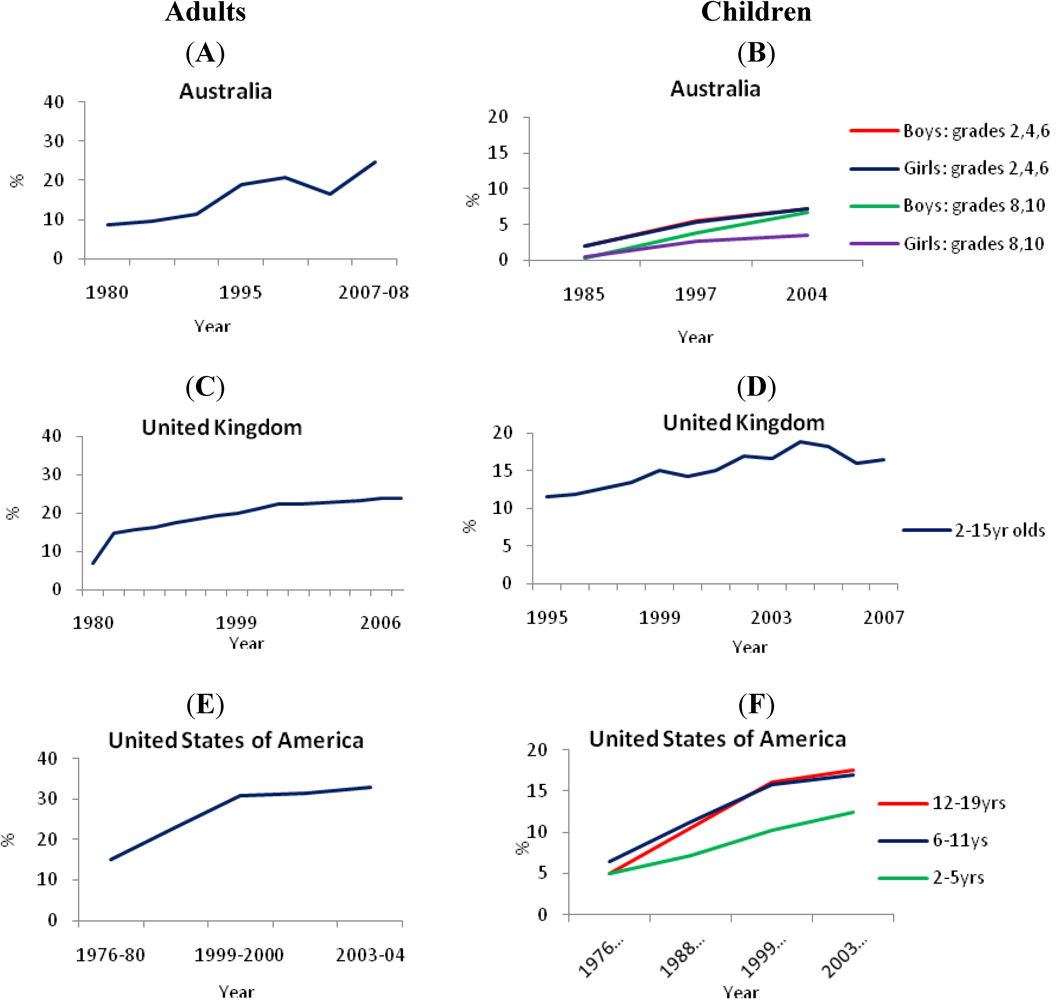
3.1. Obesity Prevalence
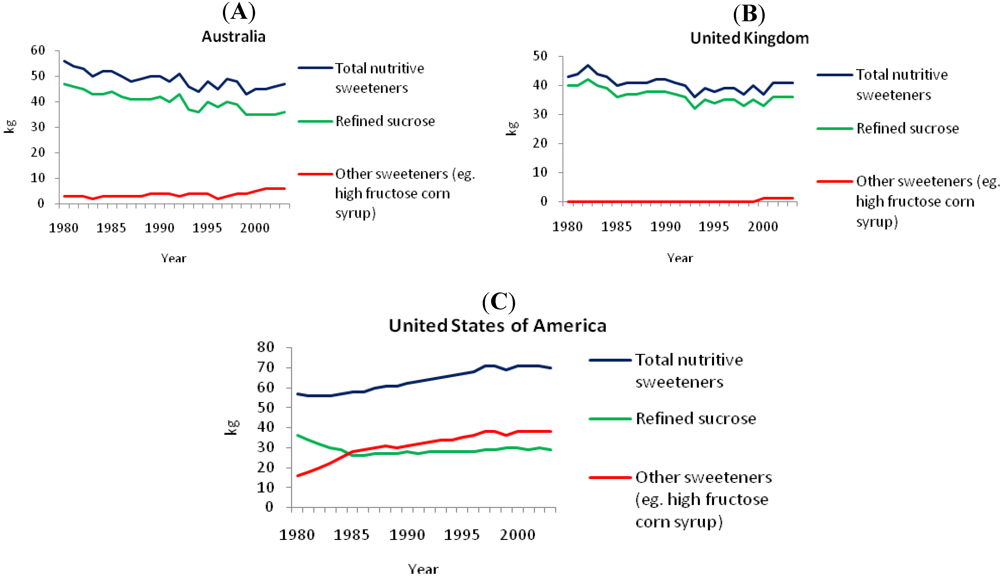
3.2. Apparent Consumption of Sugar
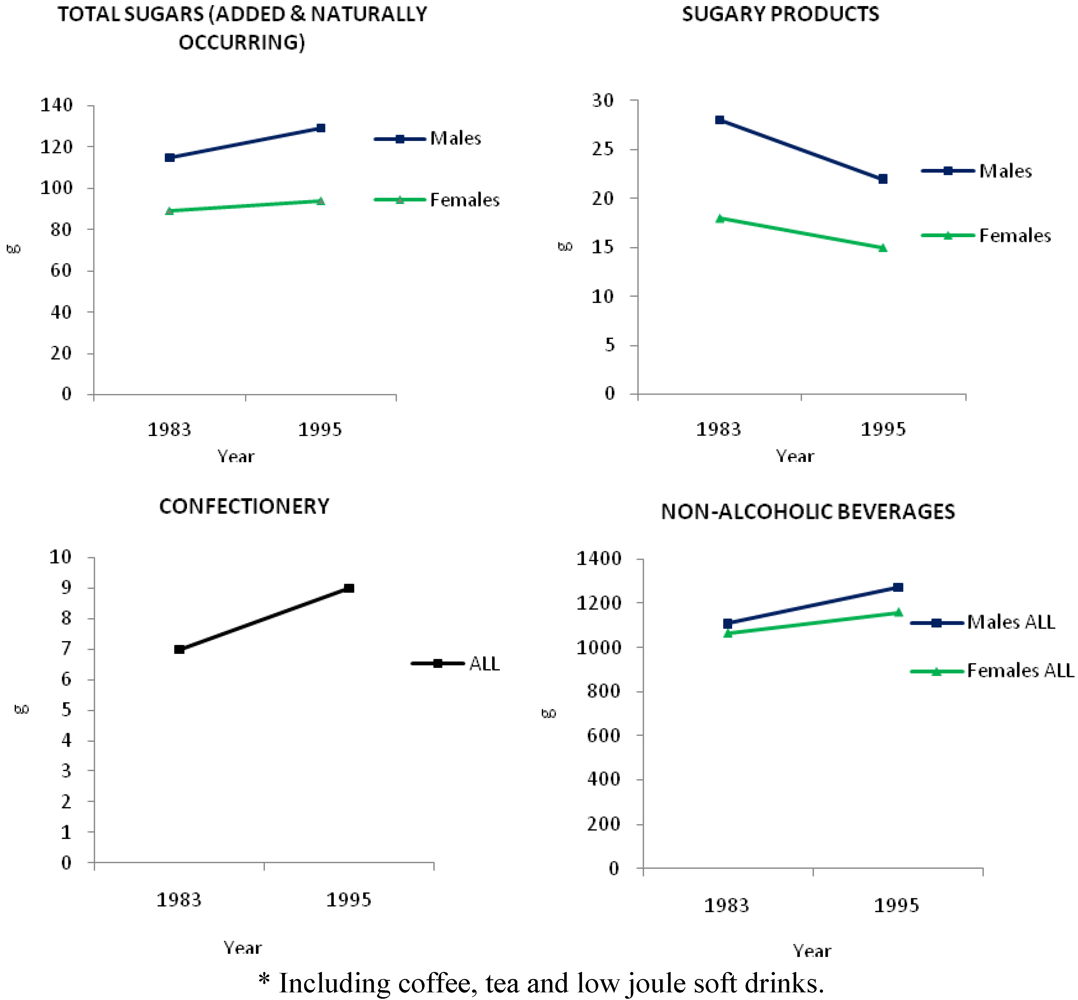
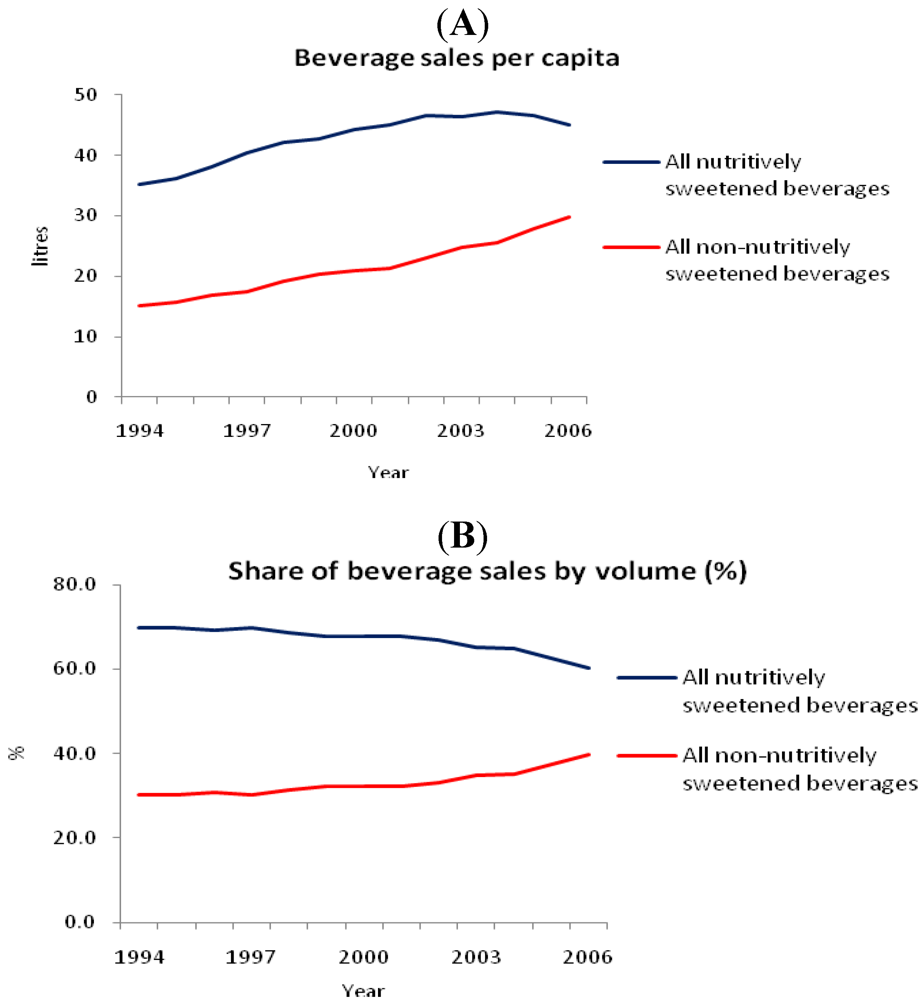
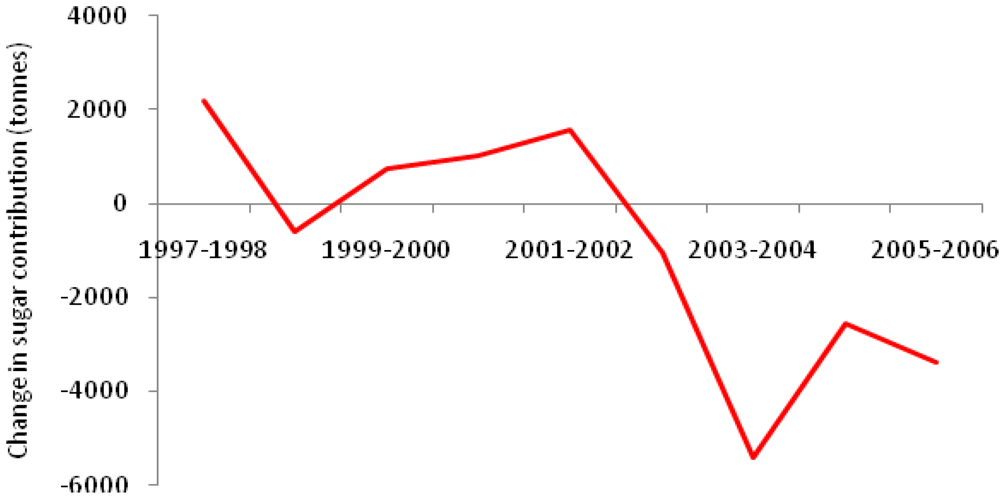
3.3. Nutritively Sweetened Beverage Consumption from Sales Data
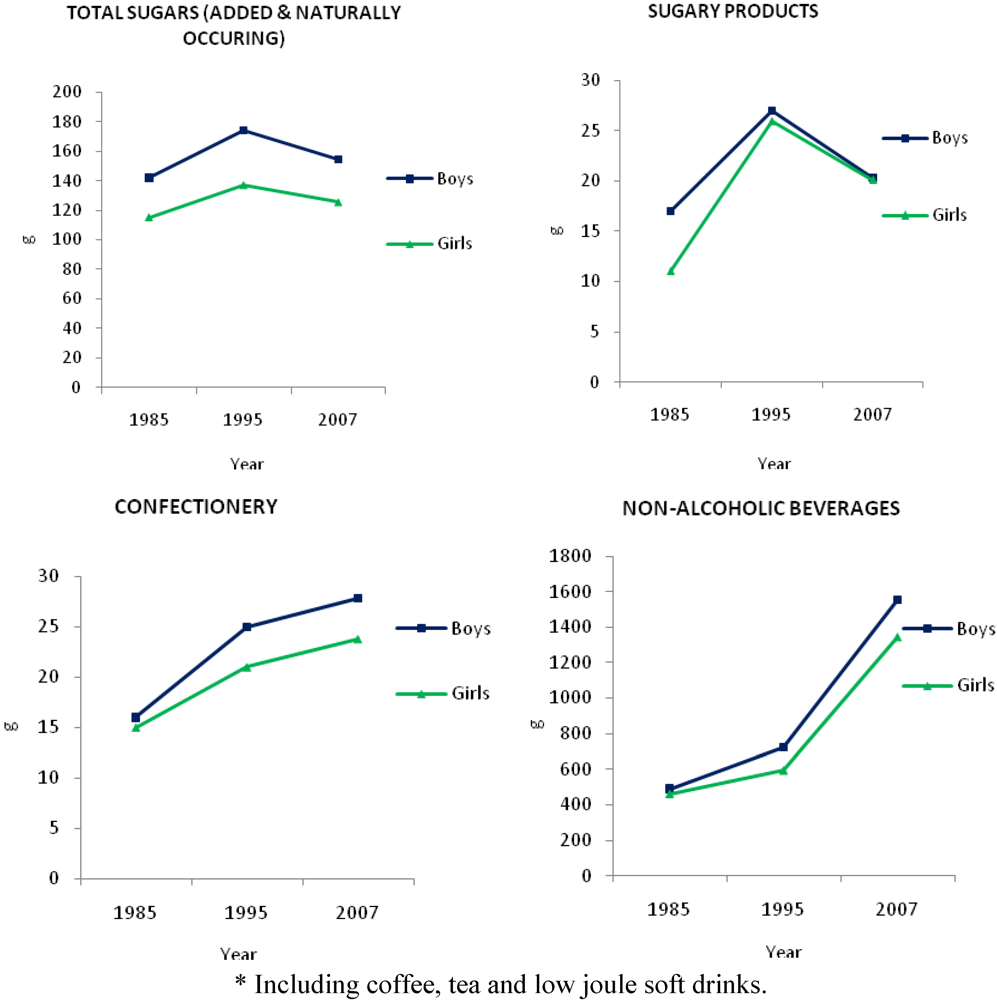
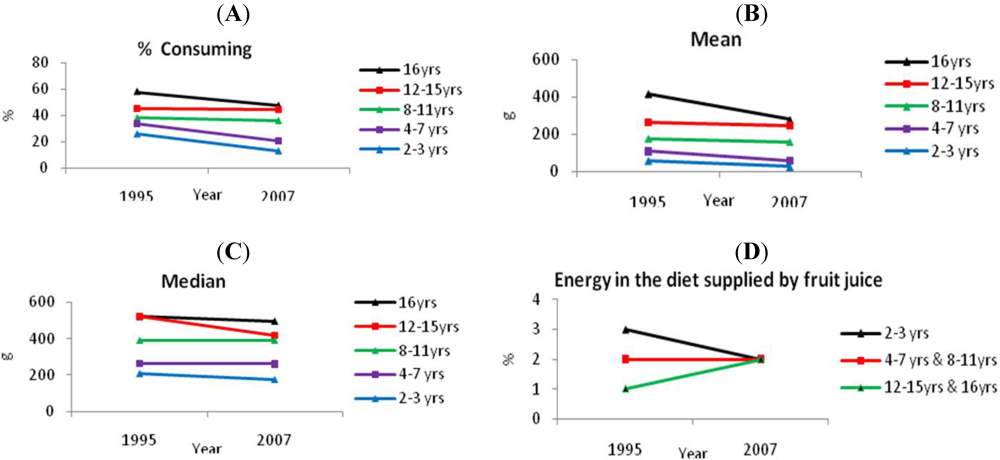
3.4. Consumption of Soft Drinks, Flavored Waters, Electrolyte Drinks and Fruit Juice by Children
4. Discussion
5. Conclusions
Acknowledgements
References
- World Health Organization, Global Strategy on Diet, Physical Activity and Health; WHO: Geneva, Switzerland, 2004.
- National Heart, Lung, and Blood Institute. Clinical Guidelines on the Identification, Evaluation, and Treatment of Overweight and Obesity in Adults: The Evidence Report; NHLBI: Bethesda, MD, USA, 1998.
- World Health Organization, Consultation on Obesity; WHO: Geneva, Switzerland, 1999.
- Australian Bureau of Statistics, 4364.0-National Health Survey: Summary of Results,2007-2008; ABS: Canberra, Australia, 2009.
- Commonwealth Scientific Industrial Research Organisation (CSIRO), Preventative Health National Research Flagship, the University of South Australia, 2007 Australian National Children’s Nutrition and Physical Activity Survey-Main Findings; CSIRO: Clayton South, Australia, 2008.
- Access Economics, The Growing Cost of Obesity in 2008: Three Years on; Diabetes Australia: Canberra, Australia, 2010.
- Gross, L.S.; Li, L.; Ford, E.S.; Liu, S. Increased consumption of refined carbohydrates and the epidemic of type 2 diabetes in the United States: An ecologic assessment. Am. J. Clin. Nutr. 2004, 79, 774–779. [Google Scholar]
- Malik, V.S.; Schulze, M.B.; Hu, F.B. Intake of sugar-sweetened beverages and weight gain: A systematic review. Am. J. Clin. Nutr. 2006, 84, 274–288. [Google Scholar]
- World Health Organization, United Nations. 2009. Available online: http://www.who.int/en/ (accessed on 1 September 2009).
- Australian Bureau of Statistics, Commonwealth of Australia. 2009. Available online: http://www.abs.gov.au/ (accessed on 1 September 2009).
- Australian Food and Grocery Council. 2009. Available online: http://www.afgc.org.au/ (accessed on 1 September 2009).
- Australian Retailers Association. 2009. Available online: http://www.retail.org.au/ (accessed on 1 September 2009).
- Commonwealth Scientific and Industrial Research Organization, Commonweath of Australia. 2009. Available online: http://www.csiro.au/ (accessed on 1 September 2009).
- Australian Government, Commonweath of Australia. 2009. Available online: http://australia.gov.au/ (accessed on 1 September 2009).
- Australian Beverages Council Ltd. 2009. Available online: http://www.australianbeverages.org/home.html (accessed on 1 September 2009).
- CSR Ltd. 2009. Available online: http://www.csr.com.au (accessed on 1 September 2009).
- Wesfarmers Coles Supermarkets. 2009. Available online: http://www.coles.com.au/ (accessed on 1 September 2009).
- Woolworths Ltd. 2009. Available online: http://www.woolworthslimited.com.au (accessed on 1 September 2009).
- Cook, P.; Rutishauser, I.H.E.; Allsopp, R. The Bridging Study-Comparing Results from the 1983,1985 and 1995 Australian National Nutrition Surveys; Commonwealth Department of Health and Aged Care: Canberra, Australia, 2001. [Google Scholar]
- McLennan, W.; Podger, A. National Nutrition Survey Nutrient Intakes and Physical Measurements, Australia, 1995; Catalouge No. 4805.0; Australian Bureau of Statistics: Canberra, Australia, 1998. [Google Scholar]
- Cameron, A.J.; Welborn, T.A.; Zimmet, P.Z.; Dunstan, D.W.; Owen, N.; Salmon, J.; Dalton, M.; Jolley, D.; Shaw, J.E. Overweight and obesity in Australia: The 1999-2000 Australian diabetes, obesity and lifestyle study (AusDiab). Med. J. Aust. 2003, 178, 427–432. [Google Scholar]
- Australian Bureau of Statistics, National Health Survey 2004-05; Commonwealth of Australia: Canberra, Australia, 2006.
- The Health and Social Care Information Centre, UK. Health Survey for England 2007, Latest Trends, 2008. 2008. Available online: http://www.ic.nhs.uk/webfiles/publications/HSE07/Health%20Survey%20for%20England%202007%20Latest%20Trends.pdf (accessed on 1 September 2009).
- National Centre for Health Statistics. Third National Health and Nutrition Examination Survey (NHANES III) Public-Use Data Files. 2004. Available online: http://www.cdc.gov/nchs/products/elec_prods/subject/nhanes3.htm (accessed on 20 April 2006).
- The Food and Agriculture Organization of the United Nations. Food consumption quantities. 2009. Available online: http://faostat.fao.org/site/368/DesktopDefault.aspx?PageID=368#ancor (accessed on 11 August 2009).
- Cobiac, L.; Mortensen, A.; Baghurst, K. The Role of Beverages in the Diet of Australian Children; Australian Beverages Council Ltd.: Rosebery, Australia, 2010. [Google Scholar]
- Australian Bureau of Statistics. Census of population and housing. 2009. Available online: http://www.abs.gov.au/websitedbs/D3310114.nsf/Home/Census (accessed on 11 August 2009).
- Levy, G. Food Logic. 2009. Available online: http://www.foodlogic.com.au/ (accessed on 14 August 2009).
- AC Nielsen ScanTrack. 2009. Available online: http://au.nielsen.com/products/crs_scantrack.shtml (accessed on 14 August 2009).
- Levy, G.; Tapsell, L. Shifts in purchasing patterns of non-alcoholic, water-based beverages in Australia, 1997-200. Nutr. Diet. 2007, 64, 268–279. [Google Scholar]
- National Health and Medical Research Council, Dietary Guidelines for Children and Adolescents in Australia. Commonwealth of Australia: Canberra, Australia, 2003.
- Silventoinen, K.; Sans, S.; Tolonen, H.; Monterde, D.; Kuulasmaa, K.; Kesteloot, H.; Tuomilehto, J. Trends in obesity and energy supply in the WHO MONICA Project. Int. J. Obes. Relat. Metab. Disord. 2004, 28, 710–718. [Google Scholar] [Green Version]
- Gibney, M.; Sigman-Grant, M.; Stanton, J.L., Jr.; Keast, D.R. Consumption of sugars. Am. J. Clin. Nutr. 1995, 62, 178S–193S. [Google Scholar]
- Hill, J.O.; Prentice, A.M. Sugar and body weight regulation. Am. J. Clin. Nutr. 1995, 62, 264S–273S. [Google Scholar]
- Cobiac, L. Sugars in the Australian diet: Results from the 1995 National Nutrition Survey. Nutr. Diet. 2003, 60, 152–173. [Google Scholar]
- Bell, A.C. Contribution of “noncore” foods and beverages to the energy intake and weight status of Australian children. Eur. J. Clin. Nutr. 2005, 59, 639–645. [Google Scholar]
- Forshee, R.A.; Anderson, P.A.; Storey, M.L. Sugar-sweetened beverages and body mass index in children and adolescents: A meta-analysis. Am. J. Clin. Nutr. 2008, 87, 1662–1671. [Google Scholar]
- Gibson, S. Sugar-sweetened soft drinks and obesity: A systematic review of the evidence from observational studies and interventions. Nutr. Res. Rev. 2008, 21, 134–147. [Google Scholar]
- Wolff, E.; Dansinger, M.L. Soft drinks and weight gain: How strong is the link? Medscape J. Med. 2008, 10, 189. [Google Scholar] [PubMed]
- Livesey, G.; Taylor, R. Fructose consumption and consequences for glycation, plasma triacylglycerol, and body weight: Meta-analyses and meta-regression models of intervention studie. Am. J. Clin. Nutr. 2008, 88, 1419–1437. [Google Scholar]
- Vermunt, S.H.; Pasman, W.J.; Schaafsma, G.; Kardinaal, A.F. Effects of sugar intake on body weight: A review. Obes. Rev. 2003, 4, 91–99. [Google Scholar]
- Baghurst, K.I.; Record, S.J.; Syrette, J.A.; Crawford, D.A.; Baghurst, P.A. Intakes and sources of a range of dietary sugars in various Australian populations. Med. J. Aust. 1989, 151, 512–518. [Google Scholar]
- Sasaki, S.; Kesteloot, H. Value of food and agriculture organization data on food-balance sheets as a data source for dietary fat intake in epidemiologic studies. Am. J. Clin. Nutr. 1992, 56, 716–723. [Google Scholar]
- Johnson, R.K.; Appel, L.J.; Brands, M.; Howard, B.V.; Lefevre, M.; Lustig, R.H.; Sacks, F.; Steffen, L.M.; Wylie-Rosett, J. Dietary sugars intake and cardiovascular health: A scientific statement from the American Heart Association. Circulation 2009, 120, 1011–1020. [Google Scholar]
- Baghurst, K.I. Demographic and nutritional profiles of people consuming varying levels of added sugars. Nutr. Res. 1992, 12, 1455–1465. [Google Scholar]
Supplementary Files
Correction published at 9 August 2011: https://www.mdpi.com/2072-6643/3/8/734/ (PDF, 27 KB)
© 2011 by the authors; licensee MDPI, Basel, Switzerland. This article is an open-access article distributed under the terms and conditions of the Creative Commons Attribution license (http://creativecommons.org/licenses/by/3.0/).
Share and Cite
Barclay, A.W.; Brand-Miller, J. The Australian Paradox: A Substantial Decline in Sugars Intake over the Same Timeframe that Overweight and Obesity Have Increased. Nutrients 2011, 3, 491-504. https://doi.org/10.3390/nu3040491
Barclay AW, Brand-Miller J. The Australian Paradox: A Substantial Decline in Sugars Intake over the Same Timeframe that Overweight and Obesity Have Increased. Nutrients. 2011; 3(4):491-504. https://doi.org/10.3390/nu3040491
Chicago/Turabian StyleBarclay, Alan W., and Jennie Brand-Miller. 2011. "The Australian Paradox: A Substantial Decline in Sugars Intake over the Same Timeframe that Overweight and Obesity Have Increased" Nutrients 3, no. 4: 491-504. https://doi.org/10.3390/nu3040491