<?xml version="1.0" encoding="UTF-8"?>
<!DOCTYPE article PUBLIC "-//NLM//DTD Journal Publishing DTD v2.3 20070202//EN" "journalpublishing.dtd">
<article xmlns:mml="http://www.w3.org/1998/Math/MathML" xmlns:xlink="http://www.w3.org/1999/xlink" xml:lang="en" article-type="research-article">
  <front>
    <journal-meta>
      <journal-id journal-id-type="publisher-id">molecules</journal-id>
      <journal-title>Molecules</journal-title>
      <abbrev-journal-title abbrev-type="publisher">Molecules</abbrev-journal-title>
      <abbrev-journal-title abbrev-type="pubmed">Molecules</abbrev-journal-title>
      <issn pub-type="epub">1420-3049</issn>
      <publisher>
        <publisher-name>MDPI</publisher-name>
      </publisher>
    </journal-meta>
    <article-meta>
      <article-id pub-id-type="doi">10.3390/molecules171213712</article-id>
      <article-id pub-id-type="publisher-id">molecules-17-13712</article-id>
      <article-categories>
        <subj-group>
          <subject>Article</subject>
        </subj-group>
      </article-categories>
      <title-group>
        <article-title>5'-Chloro-5'-deoxy-(±)-ENBA, a Potent and Selective Adenosine A<sub>1</sub> Receptor Agonist, Alleviates Neuropathic Pain in Mice Through Functional Glial and Microglial Changes without Affecting Motor or Cardiovascular Functions</article-title>
      </title-group>
      <contrib-group>
        <contrib contrib-type="author">
          <name>
            <surname>Luongo</surname>
            <given-names>Livio</given-names>
          </name>
          <xref rid="af1-molecules-17-13712" ref-type="aff">1</xref>
        </contrib>
        <contrib contrib-type="author">
          <name>
            <surname>Petrelli</surname>
            <given-names>Riccardo</given-names>
          </name>
          <xref rid="af2-molecules-17-13712" ref-type="aff">2</xref>
        </contrib>
        <contrib contrib-type="author">
          <name>
            <surname>Gatta</surname>
            <given-names>Luisa</given-names>
          </name>
          <xref rid="af1-molecules-17-13712" ref-type="aff">1</xref>
        </contrib>
        <contrib contrib-type="author">
          <name>
            <surname>Giordano</surname>
            <given-names>Catia</given-names>
          </name>
          <xref rid="af1-molecules-17-13712" ref-type="aff">1</xref>
        </contrib>
        <contrib contrib-type="author">
          <name>
            <surname>Guida</surname>
            <given-names>Francesca</given-names>
          </name>
          <xref rid="af1-molecules-17-13712" ref-type="aff">1</xref>
        </contrib>
        <contrib contrib-type="author">
          <name>
            <surname>Vita</surname>
            <given-names>Patrizia</given-names>
          </name>
          <xref rid="af2-molecules-17-13712" ref-type="aff">2</xref>
        </contrib>
        <contrib contrib-type="author">
          <name>
            <surname>Franchetti</surname>
            <given-names>Palmarisa</given-names>
          </name>
          <xref rid="af2-molecules-17-13712" ref-type="aff">2</xref>
        </contrib>
        <contrib contrib-type="author">
          <name>
            <surname>Grifantini</surname>
            <given-names>Mario</given-names>
          </name>
          <xref rid="af2-molecules-17-13712" ref-type="aff">2</xref>
        </contrib>
        <contrib contrib-type="author">
          <name>
            <surname>de Novellis</surname>
            <given-names>Vito</given-names>
          </name>
          <xref rid="af1-molecules-17-13712" ref-type="aff">1</xref>
        </contrib>
        <contrib contrib-type="author">
          <name>
            <surname>Cappellacci</surname>
            <given-names>Loredana</given-names>
          </name>
          <xref rid="af2-molecules-17-13712" ref-type="aff">2</xref>
          <xref rid="c1-molecules-17-13712" ref-type="corresp">*</xref>
        </contrib>
        <contrib contrib-type="author">
          <name>
            <surname>Maione</surname>
            <given-names>Sabatino</given-names>
          </name>
          <xref rid="af1-molecules-17-13712" ref-type="aff">1</xref>
          <xref rid="c1-molecules-17-13712" ref-type="corresp">*</xref>
        </contrib>
      </contrib-group>
      <aff id="af1-molecules-17-13712"><label>1 </label>Section of Pharmacology “L. Donatelli”, Department of Experimental Medicine, Faculty of Medicine and Surgery, II University of Naples, via Costantinopoli 16, 80138 Naples, Italy; Email: <email>livio.luongo@gmail.com</email> (L.L.); <email>luisa.gatta@hotmail.it</email> (L.G.); <email>catiagiordano@hotmail.com</email> (C.G.); <email>francesca-guida@libero.it</email> (F.G.); <email>vito.denovellis@unina2.it</email> (V.N.)</aff>
      <aff id="af2-molecules-17-13712"><label>2 </label>School of Pharmacy, Medicinal Chemistry Unit, University of Camerino, Via S. Agostino 1, 62032 Camerino, Italy; Email: <email>riccardo.petrelli@unicam.it</email> (R.P.); <email>patrizia.vita@unicam.it</email> (P.V.); <email>palmarisa.franchetti@unicam.it</email> (P.F.); <email>mario.grifantini@unicam.it</email> (M.G.)</aff>
      <author-notes>
        <corresp id="c1-molecules-17-13712"><label>*</label> Authors to whom correspondence should be addressed; Email: <email>loredana.cappellacci@unicam.it</email> (L.C.); <email>sabatino.maione@unina2.it</email> (S.M.); Tel.: +39-0737-402228 (L.C.); Fax: +39-0737-637345 (L.C.); Tel.: +39-081-5667650 (S.M.); Fax: +39-081-5667503 (S.M.).</corresp>
      </author-notes>
      <pub-date pub-type="epub">
        <day>22</day>
        <month>11</month>
        <year>2012</year>
      </pub-date>
      <pub-date pub-type="collection">
        <month>12</month>
        <year>2012</year>
      </pub-date>
      <volume>17</volume>
      <issue>12</issue>
      <fpage>13712</fpage>
      <lpage>13726</lpage>
      <history>
        <date date-type="received">
          <day>12</day>
          <month>10</month>
          <year>2012</year>
        </date>
        <date date-type="rev-recd">
          <day>10</day>
          <month>11</month>
          <year>2012</year>
        </date>
        <date date-type="accepted">
          <day>13</day>
          <month>11</month>
          <year>2012</year>
        </date>
      </history>
      <permissions>
        <copyright-statement>© 2012 by the authors; licensee MDPI, Basel, Switzerland.</copyright-statement>
        <copyright-year>2012</copyright-year>
        <license xmlns:xlink="http://www.w3.org/1999/xlink" license-type="open-access" xlink:href="http://creativecommons.org/licenses/by/3.0/">
          <p>This article is an open-access article distributed under the terms and conditions of the Creative Commons Attribution license (http://creativecommons.org/licenses/by/3.0/).</p>
        </license>
      </permissions>
      <abstract>
        <p>This study was undertaken in order to investigate the effect of chronic treatment with 5′-chloro-5′-deoxy-(±)-ENBA, a potent and highly selective agonist of human adenosine A<sub>1</sub> receptor, on thermal hyperalgesia and mechanical allodynia in a mouse model of neuropathic pain, the Spared Nerve Injury (SNI) of the sciatic nerve. Chronic systemic administration of 5′-chloro-5′-deoxy-(±)-ENBA (0.5 mg/kg, i.p.) reduced both mechanical allodynia and thermal hyperalgesia 3 and 7 days post-SNI, in a way prevented by DPCPX (3 mg/kg, i.p.), a selective A<sub>1</sub> adenosine receptor antagonist, without exerting any significant change on the motor coordination or arterial blood pressure. In addition, a single intraperitoneal injection of 5′-chloro-5′-deoxy-(±)-ENBA (0.5 mg/kg, i.p.) 7 days post-SNI also reduced both symptoms for at least two hours. SNI was associated with spinal changes in microglial activation ipsilaterally to the nerve injury. Activated, hypertrophic microglia were significantly reduced by 5′-chloro-5′-deoxy-(±)-ENBA chronic treatment. Our results demonstrated an involvement of adenosine A<sub>1</sub> receptor in the amplified nociceptive thresholds and in spinal glial and microglial changes occurred in neuropathic pain, without affecting motor coordination or blood pressure. Our data suggest a possible use of adenosine A<sub>1</sub> receptor agonist in neuropathic pain symptoms. </p>
      </abstract>
      <kwd-group>
        <kwd>A<sub>1</sub> adenosine receptor</kwd>
        <kwd>neuropathic pain</kwd>
        <kwd>allodynia</kwd>
        <kwd>glia</kwd>
      </kwd-group>
    </article-meta>
  </front>
  <body>
    <sec sec-type="intro">
      <title>1. Introduction</title>
      <p>Neuropathic pain is a devastating disease that can seriously affect the quality of life. It represents a debilitating consequence of peripheral or central nervous system (CNS) injury which shows an amplified transmission of nociceptive messages [<xref ref-type="bibr" rid="B1-molecules-17-13712">1</xref>,<xref ref-type="bibr" rid="B2-molecules-17-13712">2</xref>]. As a consequence, noxious stimuli are perceived as more painful (hyperalgesia), and normal, harmless stimuli elicit pain (allodynia). Therefore, neuropathic pain represents a real nervous system dysfunction characterized by neurophysiological changes that are still poorly understood. Recent reports have highlighted the role of microglia and astrocytes in spinal plasticity and in neuropathic pain establishment [<xref ref-type="bibr" rid="B3-molecules-17-13712">3</xref>,<xref ref-type="bibr" rid="B4-molecules-17-13712">4</xref>,<xref ref-type="bibr" rid="B5-molecules-17-13712">5</xref>,<xref ref-type="bibr" rid="B6-molecules-17-13712">6</xref>]. The knowledge of molecular changes at the spinal level could be the clue to neuropathic pain treatment. Adenosine is a regulatory nucleoside that can be generated in response to cellular stress and tissue damage as well as during episodes of tissue hypoxia or inflammation. It acts through specific G-protein coupled receptors that have been classified into four subtypes (A<sub>1</sub>, A<sub>2A</sub>, A<sub>2B</sub> and A<sub>3</sub>) on the basis of their structures and signal transduction systems [<xref ref-type="bibr" rid="B7-molecules-17-13712">7</xref>]. The anti-inflammatory role of adenosine has largely been investigated in macrophages, where it has been shown to inhibit the production of several pro-inflammatory cytokines such as IL-1b and to enhance the release of the anti-inflammatory cytokine IL-10 [<xref ref-type="bibr" rid="B8-molecules-17-13712">8</xref>]. Activation of adenosine A<sub>1</sub> receptor (A<sub>1</sub>AR) produces antinociception, whereas activation of A<sub>2A</sub>/A<sub>2B</sub> receptors produces pro-nociceptive or pain-enhancing effects at the peripheral sensory nerve terminal level in rodents [<xref ref-type="bibr" rid="B9-molecules-17-13712">9</xref>,<xref ref-type="bibr" rid="B10-molecules-17-13712">10</xref>]. Hence, antinociception may be induced by selective adenosine A<sub>1</sub>AR agonists, or by selective adenosine A<sub>2A</sub>/A<sub>2B</sub> receptor antagonists. The considerable therapeutic potential of A<sub>1</sub>AR agonists has prompted decades of work which has led to the discovery of many selective compounds [<xref ref-type="bibr" rid="B11-molecules-17-13712">11</xref>,<xref ref-type="bibr" rid="B12-molecules-17-13712">12</xref>,<xref ref-type="bibr" rid="B13-molecules-17-13712">13</xref>,<xref ref-type="bibr" rid="B14-molecules-17-13712">14</xref>,<xref ref-type="bibr" rid="B15-molecules-17-13712">15</xref>]. There is evidence that A<sub>1</sub>AR agonists produce antinociception at a spinal cord level [<xref ref-type="bibr" rid="B16-molecules-17-13712">16</xref>,<xref ref-type="bibr" rid="B17-molecules-17-13712">17</xref>], as well as at the supraspinal level [<xref ref-type="bibr" rid="B18-molecules-17-13712">18</xref>]. In addition, Wu and coworkers demonstrated that the nociceptive response is increased in mice lacking the A<sub>1</sub>AR [<xref ref-type="bibr" rid="B19-molecules-17-13712">19</xref>]. Indeed, it has recently been reported that <italic>N</italic><sup>6</sup>-cyclopentyladenosine (CPA), a selective A<sub>1</sub>AR agonist, is a potent and effective analgesic in acute arthritis and neuropathic pain models [<xref ref-type="bibr" rid="B20-molecules-17-13712">20</xref>]. Despite these encouraging results, several side effects of CPA preclude its clinical use.</p>
      <p>In fact, the analgesic effect of A<sub>1</sub>AR agonists is frequently associated with depression of arterial blood pressure and bradycardia [<xref ref-type="bibr" rid="B20-molecules-17-13712">20</xref>,<xref ref-type="bibr" rid="B21-molecules-17-13712">21</xref>,<xref ref-type="bibr" rid="B22-molecules-17-13712">22</xref>]. Beside the analgesic effect of CPA mediated by A<sub>1</sub>AR stimulation, other studies suggest a neuroprotective role [<xref ref-type="bibr" rid="B23-molecules-17-13712">23</xref>,<xref ref-type="bibr" rid="B24-molecules-17-13712">24</xref>]. Moreover, it is intriguing that A<sub>1</sub>AR is highly expressed on both macrophages and neurons in the CNS [<xref ref-type="bibr" rid="B25-molecules-17-13712">25</xref>]. In the latter, A<sub>1</sub>AR is coupled to the activation of K<sup>+</sup> channels [<xref ref-type="bibr" rid="B26-molecules-17-13712">26</xref>] and inhibition of Ca<sup>2+</sup> channels [<xref ref-type="bibr" rid="B27-molecules-17-13712">27</xref>]; both mechanisms that attenuate neuronal excitability.</p>
      <p>It is worth noting that two A<sub>1</sub>-selective agonists, GR79236 and GW493838, have been clinically evaluated for the treatment of neuropathic pain. GR79236 has analgesic and anti-inflammatory actions in humans and animals, whereas GW493838 has been evaluated in phase 2 clinical trials for pain management [<xref ref-type="bibr" rid="B28-molecules-17-13712">28</xref>]. Moreover a recent paper published by Zylka <italic>et al. </italic>[<xref ref-type="bibr" rid="B29-molecules-17-13712">29</xref>] reported a novel series of potent and selective A<sub>1</sub>AR agonists, which showed potent antinociceptive effects and lack of cardiovascular side effects.</p>
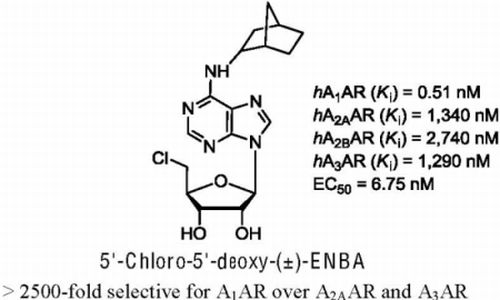
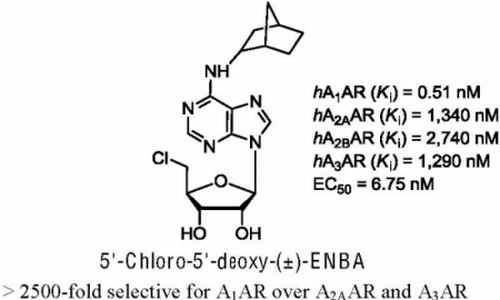
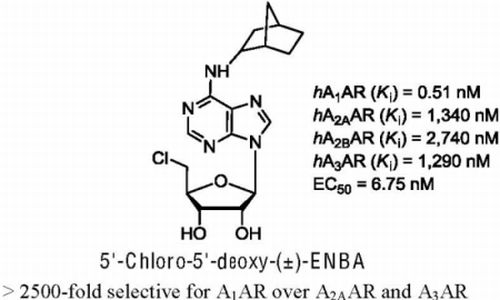
      <p>Based on these findings, in this study we have evaluated the anti-neuropathic properties of a potent and highly selective agonist of human adenosine A<sub>1</sub> receptor, the compound 5′-chloro-5′-deoxy-<italic>N</italic><sup>6</sup>-(±)-<italic>endo</italic>-norborn-2-yl)adenosine [5′-chloro-5′-deoxy-(±)-ENBA, 5′Cl5'd-(±)-ENBA, <italic>h</italic>A<sub>1</sub>AR (<italic>K</italic><sub>i</sub>) = 0.51 nM, <italic>h</italic>A<sub>2A</sub>AR (<italic>K</italic><sub>i</sub>) = 1,340 nM, <italic>h</italic>A<sub>2B</sub>AR (<italic>K</italic><sub>i</sub>) = 2,740 nM, <italic>h</italic>A<sub>3</sub>AR (<italic>K</italic><sub>i</sub>) = 1,290 nM, EC<sub>50</sub> = 6.75 nM], whose pharmacokinetic and pharmacodynamic profiles as well as its acute nocifensive effect have been investigated in the formalin test in mice [<xref ref-type="bibr" rid="B15-molecules-17-13712">15</xref>]. For this purpose we used the spared nerve injury (SNI) of the sciatic nerve in mice, a model of neuropathic pain which has been extensively validated by several research groups [<xref ref-type="bibr" rid="B30-molecules-17-13712">30</xref>]. Moreover, we also have evaluated the expression and a possible role of the A<sub>1</sub>AR on glial cells. Behavioural, cardiovascular and immunohistochemical approaches have been used to investigate the effect of prolonged treatment with 5′Cl5′d-(±)-ENBA or saline on: (i) mechanical allodynia and thermal hyperalgesia; (ii) motor coordination, blood pressure and heart rate; (iii) glial and microglial activation in the spinal cord. </p>
    </sec>
    <sec sec-type="results">
      <title>2. Results</title>
      <sec>
        <title>2.1. 5′Cl5′d-(±)-ENBA Reduced Thermal Hyperalgesia and Mechanical Allodynia in SNI Mice and Did Not Affect Motor or Cardiovascular Functions</title>
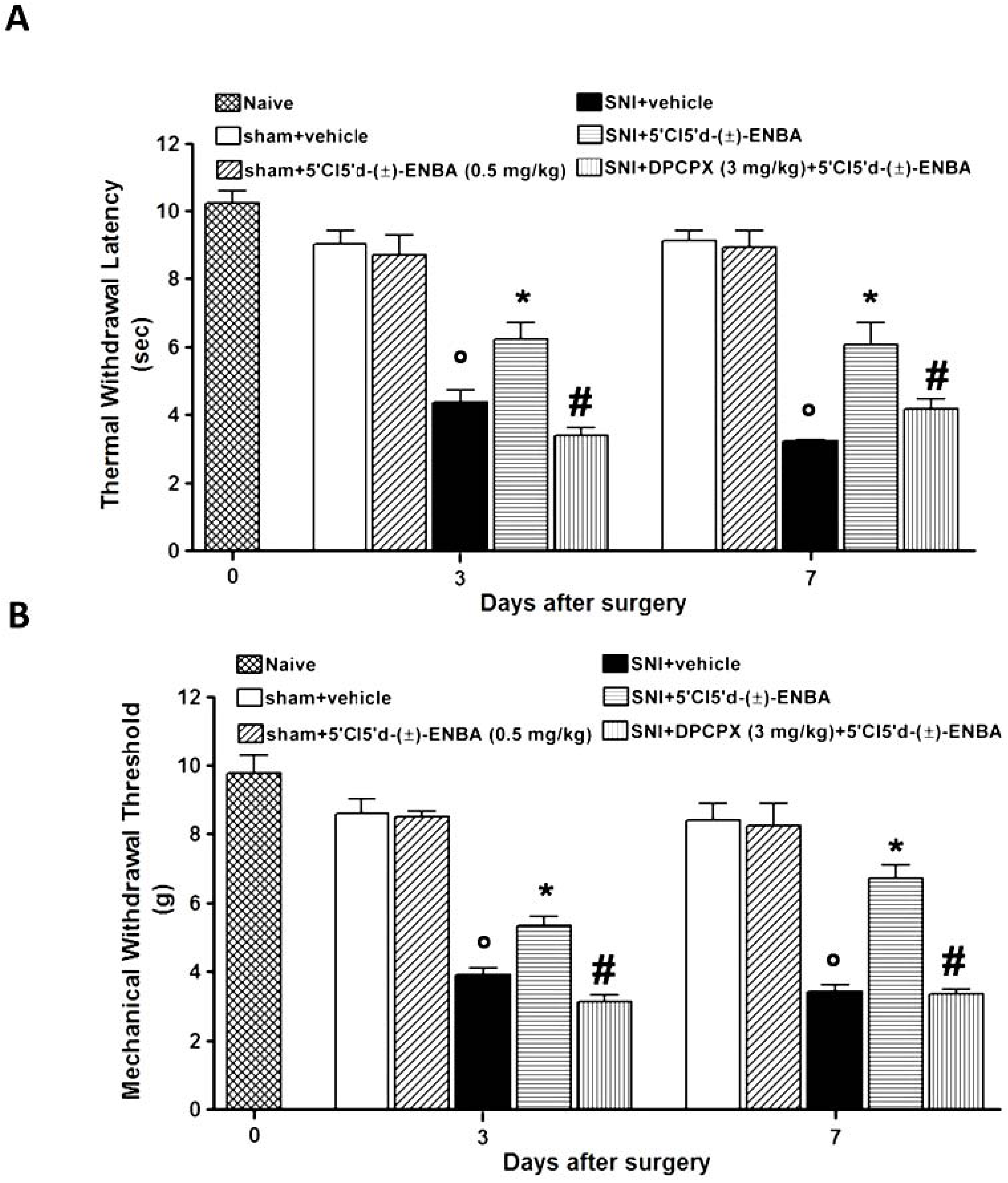
        <p>Spared nerve injury (SNI) was associated with the development of ipsilateral mechanical and thermal hypersensitivity which were monitored up to 7 days after surgery (<xref ref-type="fig" rid="molecules-17-13712-f001">Figure 1</xref>A,B). Both contralateral and sham operated thresholds remained unaltered. Chronic administration of 5′Cl5′d-(±)-ENBA (0.5 mg kg<sup>−</sup><sup>1</sup>, i.p.) from day 1 to day 7 reduced mechanical allodynia at 3 and 7 days after nerve injury (<xref ref-type="fig" rid="molecules-17-13712-f001">Figure 1</xref>A). Furthermore, thermal hyperalgesia was reduced by 5′Cl5′d-(±)-ENBA 3 and 7 days after SNI induction (<xref ref-type="fig" rid="molecules-17-13712-f001">Figure 1</xref>B). The analgesic effect of 5′Cl5′d-(±)-ENBA was no greater at a dose of 0.1 mg kg<sup>−</sup><sup>1</sup> (data not shown) while at 0.5 mg kg<sup>−</sup><sup>1</sup> it was statistically significant. The anti-allodynic and anti-hyperalgesic effects of 5′Cl5′d-(±)-ENBA were prevented by the concurrent treatment with the A<sub>1</sub>AR antagonist, DPCPX (3 mg kg<sup>−</sup><sup>1</sup>, i.p.) (<xref ref-type="fig" rid="molecules-17-13712-f001">Figure 1</xref>A,B) which <italic>per se</italic> did not affect mechanical and thermal latency (data not shown).</p>
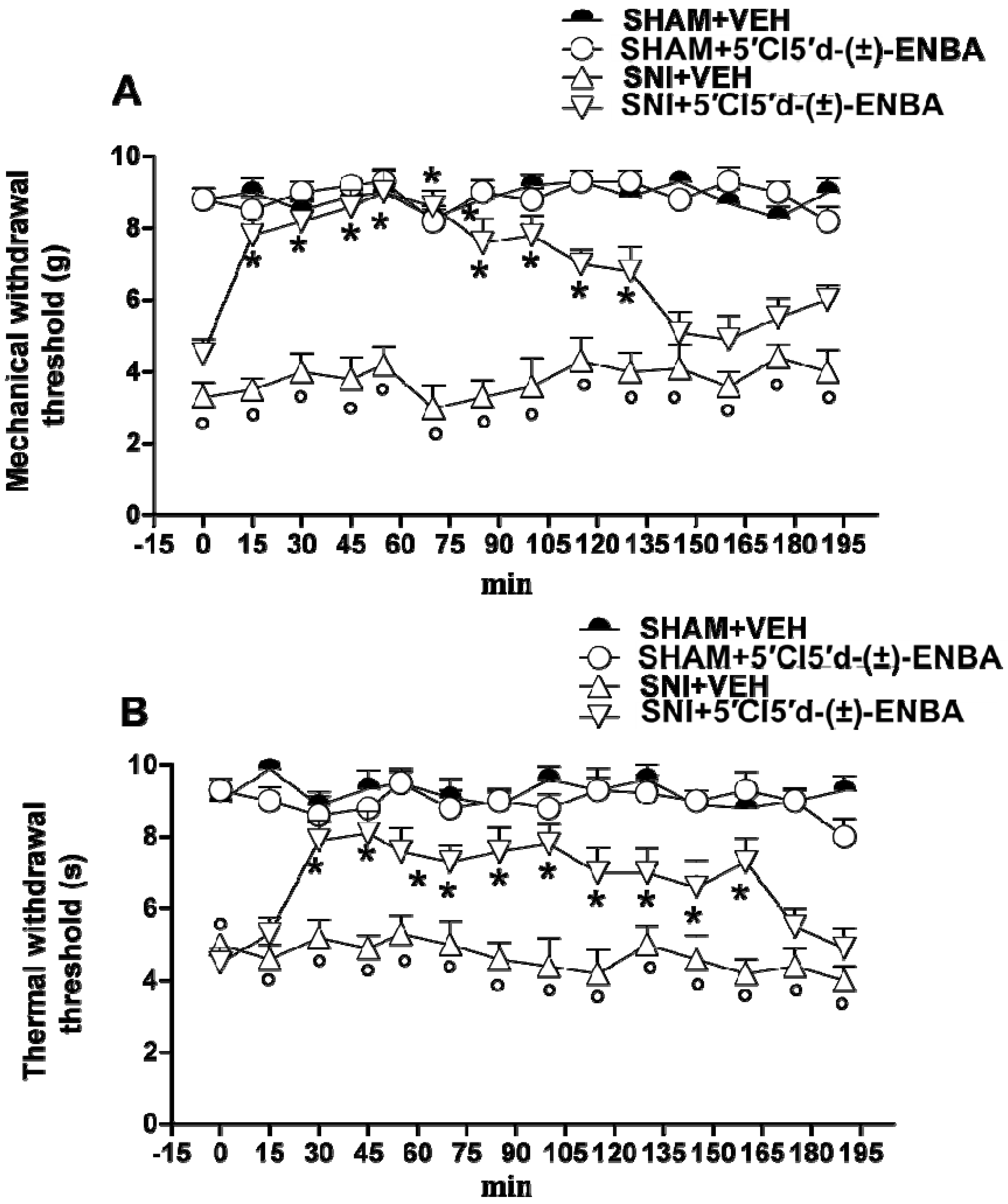
        <p>DMPX, a selective A<sub>2A</sub>AR antagonist, was unable to block the antiallodynic effect of 5′Cl5′d-(±)-ENBA (data not shown). Besides chronic treatment, a single administration of 5′Cl5′d-(±)-ENBA (0.5 mg kg<sup>−</sup><sup>1</sup>) also reduced mechanical allodynia and thermal hyperalgesia for at least 2 h of monitoring (<xref ref-type="fig" rid="molecules-17-13712-f002">Figure 2</xref>A,B).</p>
        <fig id="molecules-17-13712-f001" position="float">
          <label>Figure 1</label>
          <caption>
            <p>Chronic treatment with 5′Cl5′d-(±)-ENBA reduces mechanical allodynia (<bold>A</bold>) and thermal hyperalgesia (<bold>B</bold>). SNI mice showed mechanical allodynia and thermal hyperalgesia only at the ipsilateral sides of the nerve injury at 3 and 7 days post-surgery. Administrations of 5′Cl5'd-(±)-ENBA (0.5 mg/kg), once per day, reduced reflex withdrawal responses to mechanical and noxious thermal stimuli in SNI mice and this effect was prevented by pre-treatment with DPCPX (3 mg/kg) (<bold>A</bold>, <bold>B</bold>). Data represent the mean of the mechanical paw withdrawal threshold and the thermal paw withdrawal latency for mechanical allodynia and thermal hyperalgesia respectively, of six randomly selected mice for each histogram. ° <italic>p</italic> &lt; 0.05 <italic>vs.</italic> sham operated mice or naive mice, * <italic>p</italic> &lt; 0.05 <italic>vs</italic>. SNI mice, # <italic>p </italic>&lt; 0.05 <italic>vs</italic>. 5′Cl5'd-(±)-ENBA treated SNI mice. </p>
          </caption>
          <graphic xmlns:xlink="http://www.w3.org/1999/xlink" xlink:href="molecules-17-13712-g001.tif"/>
        </fig>
        <fig id="molecules-17-13712-f002" position="float">
          <label>Figure 2</label>
          <caption>
            <p>A single administration (7 days after SNI) of 5′Cl5'd-(±)-ENBA reduces mechanical allodynia (<bold>A</bold>) and thermal hyperalgesia (<bold>B</bold>). 5′Cl5'd-(±)-ENBA (0.5 mg/kg) was effective in reducing the appearance of mechanical allodynia and thermal hyperalgesia in SNI mice. ° <italic>p</italic> &lt; 0.05 <italic>vs</italic>. sham operated mice or naive mice, <bold>*</bold><italic> p</italic> &lt; 0.05 <italic>vs</italic>. SNI mice.</p>
          </caption>
          <graphic xmlns:xlink="http://www.w3.org/1999/xlink" xlink:href="molecules-17-13712-g002.tif"/>
        </fig>
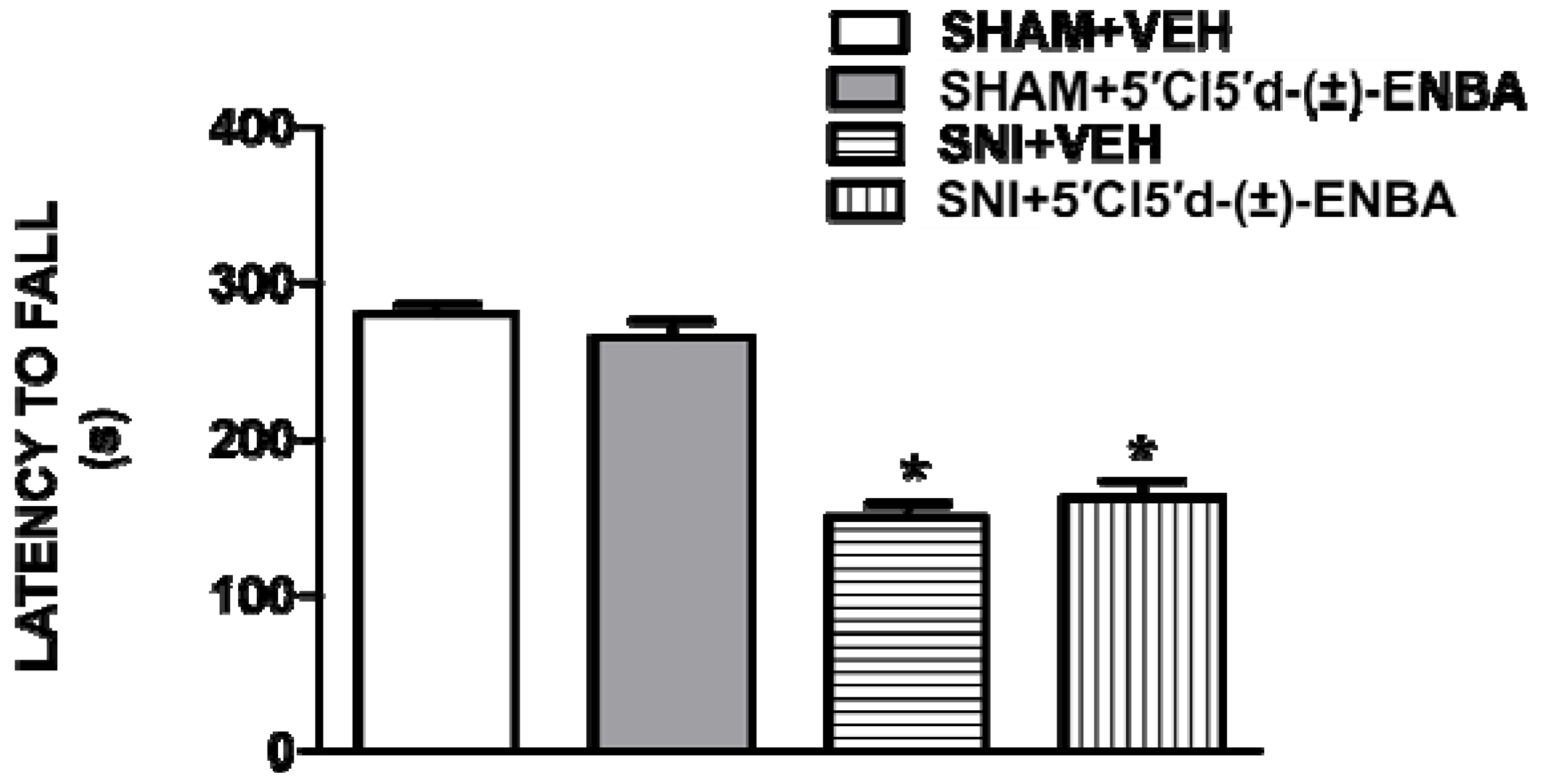
        <p>Moreover, we performed the Rotarod test to evaluate whether the antinociceptive dose of the 5′Cl5′d-(±)-ENBA had any effect on motor coordination. 5′Cl5′d-(±)-ENBA treatment did not modify motor coordination as compared to vehicle-treated SNI mice (<xref ref-type="fig" rid="molecules-17-13712-f003">Figure 3</xref>). However, SNI mice showed an impairment in the motor activity due to the rescission of the motor component of the sciatic nerve. Furthermore, 5′Cl5′d-(±)-ENBA treatment at the effective dose did not modify blood pressure or heart rate. Finally, 5′Cl5′d-(±)-ENBA (0.5 mg/Kg, i.p.) did not significantly change arterial blood pressure or heart rate in unanaesthetized sham and SNI mice (<xref ref-type="table" rid="molecules-17-13712-t001">Table 1</xref>).</p>
        <fig id="molecules-17-13712-f003" position="float">
          <label>Figure 3</label>
          <caption>
            <p>A single administration of 5′Cl5'd-(±)-ENBA does not affect the motor performance in Rotarod test. SNI mice showed an impaired motor activity 7 days post injury. Single administrations of 5′Cl5'd-(±)-ENBA (0.5 mg/kg) did not influence the locomotive activity as compared with sham or SNI mice. <bold>*</bold><italic> p</italic> &lt; 0.05 <italic>vs</italic>. sham mice. Data are expressed as mean of repeated measures performed every 30 min for 5 h.</p>
          </caption>
          <graphic xmlns:xlink="http://www.w3.org/1999/xlink" xlink:href="molecules-17-13712-g003.tif"/>
        </fig>
        <table-wrap id="molecules-17-13712-t001" position="float">
          <object-id pub-id-type="pii">molecules-17-13712-t001_Table 1</object-id>
          <label>Table 1</label>
          <caption>
            <p>Effects of an antiallodynic dose of 5′Cl5′d-(±)-ENBA on systolic blood pressure (mmHg) and heart rate (BPM) in Sham and SNI mice.</p>
          </caption>
          <table>
<thead>
              <tr>
                <th align="center" valign="middle"> </th>
                <th align="center" valign="middle">Sham + Vehicle</th>
                <th align="center" valign="middle">Sham + 5′Cl5'd-(±)-ENBA</th>
                <th align="center" valign="middle">SNI + Vehicle</th>
                <th align="center" valign="middle">SNI + 5′Cl5'd-(±)-ENBA</th>
              </tr>
            </thead>
            <tbody>
              <tr>
                <td align="center" valign="middle">Systolic Blood Pressure (mmHg)</td>
                <td align="center" valign="middle">113 ± 2.4</td>
                <td align="center" valign="middle">111.3 ± 1.9</td>
                <td align="center" valign="middle">110.4 ± 2.1</td>
                <td align="center" valign="middle">108.4 ± 2.6</td>
              </tr>
              <tr>
                <td align="center" valign="middle">Heart Rate (BPM)</td>
                <td align="center" valign="middle">520.12 ± 3.9</td>
                <td align="center" valign="middle">518.12 ± 2.9</td>
                <td align="center" valign="middle">512.31 ± 3.4</td>
                <td align="center" valign="middle">515.15 ± 2.3</td>
              </tr>
            </tbody>
          </table>
		  <table-wrap-foot>
			<fn>
        <p><bold>Systolic Blood Pressure (mmHg): Sham + 5′Cl5'd-(±)-ENBA <italic>vs.</italic> Sham +Vehicle</bold> F<sub>(1–10)</sub> = 0.31, <italic>p</italic> = 0.591, <italic>p</italic> &gt; 0.05; <bold>SNI + Vehicle <italic>vs.</italic> Sham +Vehicle</bold> F<sub>(1-10)</sub> = 0.66, <italic>p</italic> = 0.434, <italic>p</italic> &gt; 0.05; <bold>SNI + 5′Cl5'd-(±)-ENBA <italic>vs.</italic> SNI + Vehicle</bold> F<sub>(1–10)</sub> = 0.36, P = 0.563, <italic>p</italic> &gt; 0.05; <bold>Heart Rate (BPM): Sham + 5′Cl5'd-(±)-ENBA <italic>vs.</italic> Sham + Vehicle</bold> F<sub>(1–10)</sub> = 0.17, <italic>p</italic> = 0.689, <italic>p</italic> &gt; 0.05; <bold>SNI + Vehicle <italic>vs.</italic> Sham + Vehicle</bold> F<sub>(1–10)</sub> = 2.28, <italic>p</italic> = 0.162, <italic>p</italic> &gt; 0.05; <bold>SNI + 5′Cl5'd-(±)-ENBA <italic>vs</italic>. SNI + Vehicle</bold> F<sub>(1–10)</sub> = 0.48, <italic>p</italic> = 0.505, <italic>p</italic> &gt; 0.05.</p>
			</fn>
			</table-wrap-foot>
        </table-wrap>
      </sec>
      <sec>
        <title>2.2. 5′Cl5′d-(±)-ENBA-Induced Analgesia is Associated with a Reduction in Glial and Microglial Activation 7 Days after SNI Induction</title>
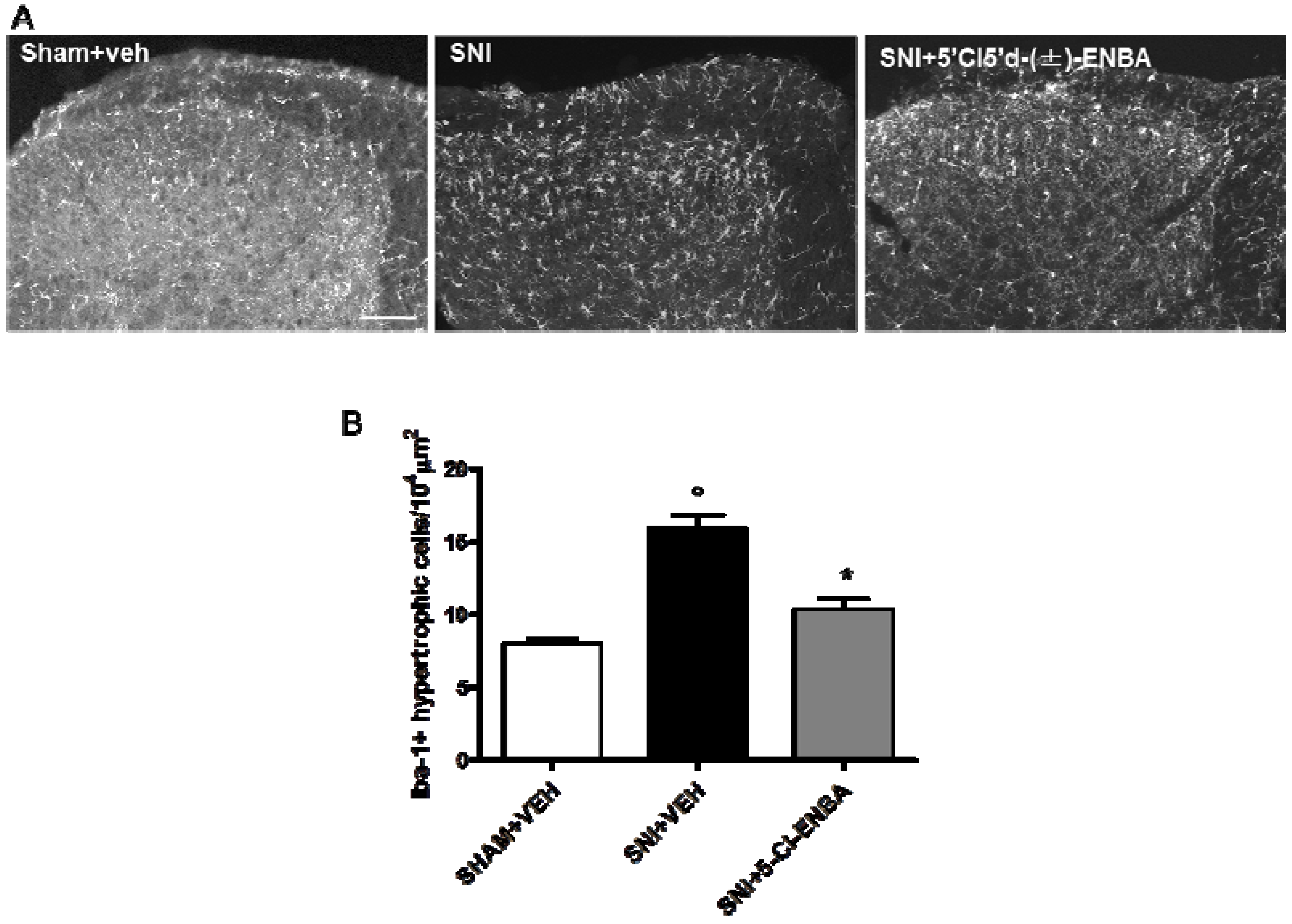
        <p>Microglia cell number increased in the ipsilateral dorsal horn of the spinal cord (L4-L6) in SNI mice as compared to sham operated mice (<xref ref-type="fig" rid="molecules-17-13712-f004">Figure 4</xref>A). Morphological analysis revealed that 5′Cl5′d-(±)-ENBA treatment reduced the number of activated microglia cells in the ipsilateral dorsal horn of SNI mice (<xref ref-type="fig" rid="molecules-17-13712-f004">Figure 4</xref>B). </p>
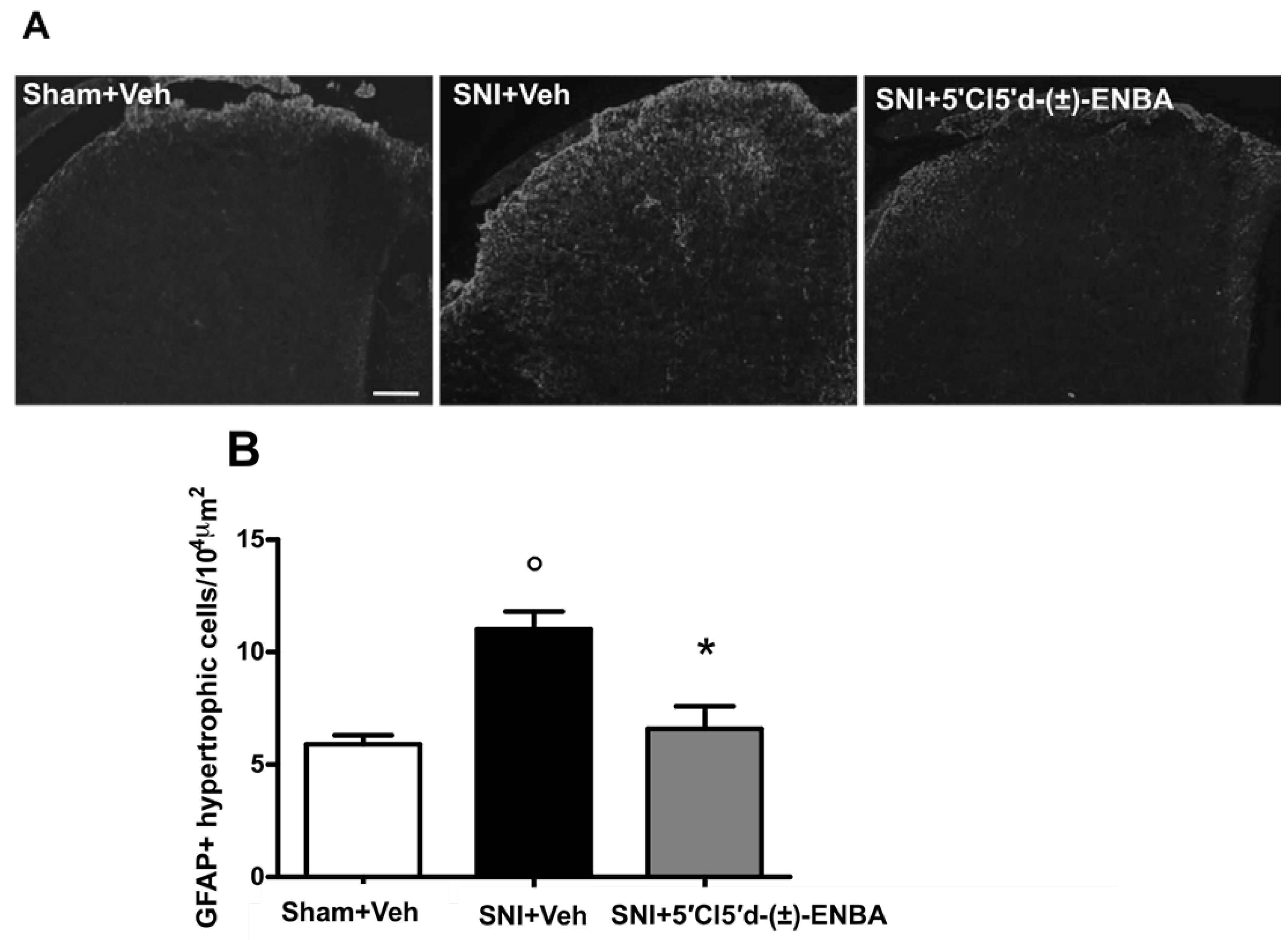
        <p>Glial cell number increased in the ipsilateral dorsal horn of the spinal cord (L4-L6) in SNI mice as compared to sham operated mice (<xref ref-type="fig" rid="molecules-17-13712-f005">Figure 5</xref>A). Morphological analysis, performed following the criteria previously described [<xref ref-type="bibr" rid="B6-molecules-17-13712">6</xref>,<xref ref-type="bibr" rid="B31-molecules-17-13712">31</xref>], revealed that 5′Cl5′d-(±)-ENBA treatment reduced the number of activated astrocytes in the ipsilateral dorsal horn of SNI mice (<xref ref-type="fig" rid="molecules-17-13712-f005">Figure 5</xref>B). </p>
        <fig id="molecules-17-13712-f004" position="float">
          <label>Figure 4</label>
          <caption>
            <p>(<bold>A</bold>) 5′Cl5'd-(±)-ENBA reduces microglial activation in the dorsal horn of SNI mice. SNI induction increased the number of activated microglia, estimated by ratio processes length/soma diameter. (<bold>B</bold>) Iba-1 immunoreactivity (Iba-1-ir) in the ipsilateral dorsal horn 7 days post-SNI and after 5′Cl5′d-(±)-ENBA treatment. Quantitative analysis of spinal cord sections shows significantly increased numbers of activated microglia cells in the ipsilateral dorsal horn of SNI mice as compared with sham-operated mice. Chronic 5′Cl5′d-(±)-ENBA treatment reduced the number of activated microglia as compared with SNI mice. Data represent mean ± S.E.M., n = 3 mice per group. ° <italic>p</italic> &lt; 0.05 <italic>vs</italic>. sham mice, * <italic>p</italic> &lt; 0.05 <italic>vs</italic>. SNI mice. ANOVA, <italic>post hoc</italic> Tukey. Scale bars = 100 μm.</p>
          </caption>
          <graphic xmlns:xlink="http://www.w3.org/1999/xlink" xlink:href="molecules-17-13712-g004.tif"/>
        </fig>
        <fig id="molecules-17-13712-f005" position="float">
          <label>Figure 5</label>
          <caption>
            <p>(<bold>A</bold>) 5′Cl5′d-(±)-ENBA reduces the number of hypertrophic astrocytes in the dorsal horn of SNI mice. GFAP (GFAP-ir) is shown in the ipsilateral dorsal horn 7 days post-SNI and after 5′Cl5′d-(±)-ENBA treatment. Quantitative analysis of spinal cord sections shows significantly increased numbers of hypertrophic astrocytes in the ipsilateral dorsal horn of SNI mice as compared with sham-operated mice. (<bold>B</bold>) Chronic 5′Cl5′d-(±)-ENBA treatment reduced the number of hypertrophic astrocytes as compared with SNI mice. Data represent mean ± S.E.M., n = 3 mice per group. ° <italic>p</italic> &lt; 0.001 <italic>vs</italic>. sham mice, * <italic>p</italic> &lt; 0.001 <italic>vs</italic>. SNI mice. ANOVA, <italic>post hoc</italic> Tukey. Scale bars = 100 μm.</p>
          </caption>
          <graphic xmlns:xlink="http://www.w3.org/1999/xlink" xlink:href="molecules-17-13712-g005.tif"/>
        </fig>
      </sec>
      <sec>
        <title>2.3. A<sub>1</sub>AR is over-Expressed in Glial Cells after Peripheral Nerve Injury</title>
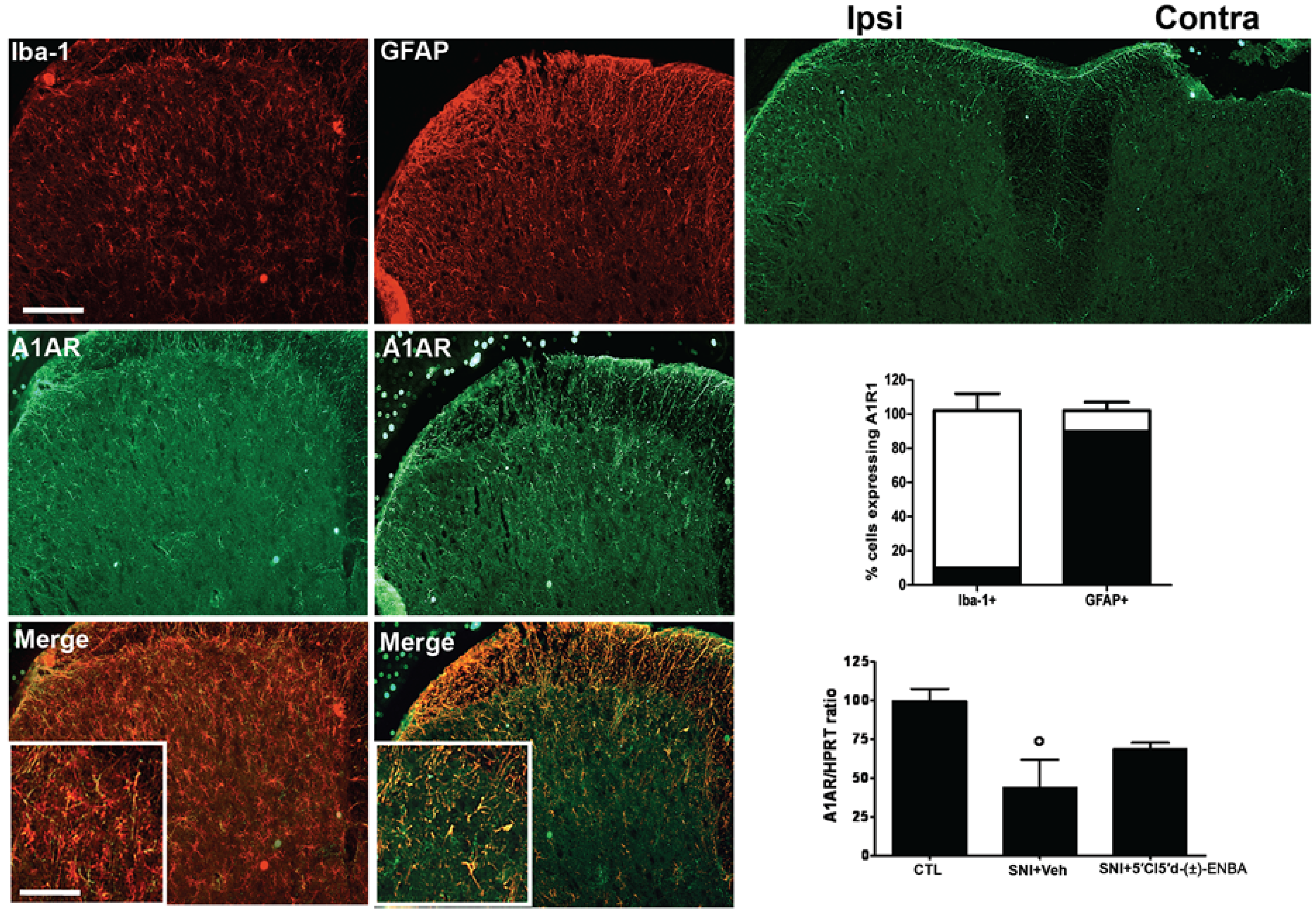
        <p>A<sub>1</sub>AR staining revealed that this receptor was up-regulated in the ipsilateral dorsal horn of the spinal cord 7 days post-SNI in cells which were identified mostly as GFAP labeled astrocytes rather than microglia (<xref ref-type="fig" rid="molecules-17-13712-f006">Figure 6</xref>). </p>
        <fig id="molecules-17-13712-f006" position="float">
          <label>Figure 6</label>
          <caption>
            <p>A<sub>1</sub>AR positive profiles are upregulated 7 days after injury in the ipsilateral dorsal horn of the spinal cord. A<sub>1</sub>AR positive profiles are expressed by GFAP positive astrocytes rather than Iba-1 labeled microglial cells as revealed by double staining and the related quantification. Data represent mean ± S.E.M., n = 3 mice per group. Scale bars = 100 μm.</p>
          </caption>
          <graphic xmlns:xlink="http://www.w3.org/1999/xlink" xlink:href="molecules-17-13712-g006.tif"/>
        </fig>
      </sec>
    </sec>
    <sec sec-type="discussion">
      <title>3. Discussion</title>
      <p>In this study, we have demonstrated the anti-allodynic and anti-hyperalgesic properties of the potent and highly selective human A<sub>1</sub>AR agonist 5′Cl5′d-(±)-ENBA on the SNI model of neuropathic pain in mice. Moreover, we also proved the antigliotic effect of 5′Cl5′d-(±)-ENBA on astrocytes and microglia by using an <italic>ex vivo </italic>immunohistochemical approach. Chronic administration of 5′Cl5′d-(±)-ENBA (0.5 mg kg<sup>−1</sup>) significantly reduced mechanical allodynia and thermal hyperalgesia up to 7 days after nerve injury. </p>
      <p>The anti-allodynic/hyperalgesic effect of the drug seemed to be mediated by the A<sub>1</sub>AR since the A<sub>1</sub>AR antagonist DPCPX reverted the 5′Cl5′d-(±)-ENBA antiallodynic effect. Moreover, a single dose of the drug 7 days after nerve injury also reduced neuropathic symptoms for at least 2 h after drug injection. Accordingly, it has been demonstrated that 5′Cl5′d-(±)-ENBA, like other selective A<sub>1</sub>AR agonists, reduced formalin-induced nociceptive behaviour in mice [<xref ref-type="bibr" rid="B15-molecules-17-13712">15</xref>,<xref ref-type="bibr" rid="B18-molecules-17-13712">18</xref>]. This acute and transient effect could be explained assuming a peripheral or spinal action of the 5′Cl5′d-(±)-ENBA on A<sub>1</sub>AR expressed by immune cells [<xref ref-type="bibr" rid="B32-molecules-17-13712">32</xref>]. Indeed, we cannot exclude that an overall anti-inflammatory effect of A<sub>1</sub>AR agonists at the peripheral site [<xref ref-type="bibr" rid="B33-molecules-17-13712">33</xref>], or at the spinal cord level, could transiently ameliorate the neuropathic symptoms. This hypothesis could be corroborated by the new evidence highlighting the involvement of infiltrating spinal cord lymphocytes in the establishment or maintenance of neuropathic pain [<xref ref-type="bibr" rid="B34-molecules-17-13712">34</xref>], as well as by the ability of a specific class of T-lymphocytes to sustain the protective glial phenotype [<xref ref-type="bibr" rid="B35-molecules-17-13712">35</xref>]. Importantly, in this study, the 5′Cl5′d-(±)-ENBA treatment did not affect either motor coordination, blood pressure or heart rate. Thus, the lack of cardiovascular side effects of our potent and selective A<sub>1</sub>AR agonist could indicate that it is scarcely acting on the peripheral A<sub>1</sub>AR which, in fact, limits the clinical use of similar drugs despite their considerable analgesic properties [<xref ref-type="bibr" rid="B20-molecules-17-13712">20</xref>,<xref ref-type="bibr" rid="B21-molecules-17-13712">21</xref>,<xref ref-type="bibr" rid="B22-molecules-17-13712">22</xref>]. Indeed, at the dose we used, 5′Cl5′d-(±)-ENBA could mainly target cells highly-expressing the A<sub>1</sub>AR, such as the spinal cord astrocytes, and/or also microglia in the ipsilateral side of the nerve injury. It has been demonstrated that SNI determines an enhancement of activated astrocytes and microglia in the ipsilateral dorsal horn in mice [<xref ref-type="bibr" rid="B6-molecules-17-13712">6</xref>,<xref ref-type="bibr" rid="B36-molecules-17-13712">36</xref>], and we show here that chronic treatment with 5′Cl5′d-(±)-ENBA significantly reduces the number of activated glial cells identified as profiles presenting the diameter of the soma ≥ than the processes length as compared to the vehicle-treated SNI mice. The reduction of the activated astrocytes in the ipsilateral dorsal horn of spinal cord could be due to the direct action of 5′Cl5′d-(±)-ENBA on the Gi-coupled A<sub>1</sub>AR over-expressed on astrocytes, which we found in the present study together with a combined peripheral action on the T-lymphocytes [<xref ref-type="bibr" rid="B37-molecules-17-13712">37</xref>] and/or a direct neuronal A<sub>1</sub>AR activation. Importantly, the drug we have used in this study is very selective for both human and murine A<sub>1</sub>AR. Thus, the reduction of the peripheral side effects that we found with 5′Cl5′d-(±)-ENBA in mice might be predictable also in humans since the homology of the human and murine aminoacid sequence is estimated to be about 95% (see Supplementary <xref ref-type="fig" rid="molecules-17-13712-f001">Figure 1</xref>).</p>
    </sec>
    <sec sec-type="methods">
      <title>4. Experimental</title>
      <sec>
        <title>4.1. Animals</title>
        <p>Male CD-1 mice (35–40 g) were housed as three <italic>per</italic> cage under controlled illumination (12–12 h light-dark cycle; light on 06:00 h) and environmental conditions (room temperature 20–22 °C, humidity 55–60%) for at least one week before the commencement of experiments. Mouse chow and tap water were available <italic>ad libitum</italic>. The experimental procedures were approved by the Animal Ethics Committee of the Second University of Naples. Animal care was in compliance with the IASP and European Community (E.C. L358/1 18/12/86) guidelines on the use and protection of animals in experimental research. All efforts were made to minimise animal suffering and to reduce the number of animals used.</p>
      </sec>
      <sec>
        <title>4.2. Spared Nerve Injury</title>
        <p>Mononeuropathy was induced according to the method of Schields <italic>et al.</italic> [<xref ref-type="bibr" rid="B30-molecules-17-13712">30</xref>]. Mice were anaesthetised with sodium pentobarbital (50 mg/kg, i.p.). The sciatic nerve was exposed at the level of its trifurcation into sural, tibial and common peroneal nerves. The sural and common peroneal nerves were ligated tightly with 5.0 silk thread and then transected just distal to the ligation, leaving the tibial nerve intact. Sham mice were anaesthetised, the sciatic nerve was exposed at the same level, but not ligated.</p>
      </sec>
      <sec>
        <title>4.3. Nociceptive Behaviour</title>
        <p>Thermal hyperalgesia was evaluated by using the Plantar Test Apparatus (Ugo Basile, Varese, Italy). On the day of the experiment each animal was placed in a plastic cage (22 cm × 17 cm × 14 cm; length × width × height) with a glass floor. After a 30 min habituation period, the plantar surface of the hind paw was exposed to a beam of radiant heat through the glass floor. The radiant heat source consisted of an infrared bulb (Osram halogen-Bellaphot bulb; 8 V, 50 W). A photoelectric cell detected light reflected from the paw and turned off the lamp when paw movement interrupted the reflected light. The paw withdrawal latency was automatically displayed to the nearest 0.1 s; the cut-off time was 20 s in order to prevent tissue damage.</p>
        <p>Mechanical allodynia was measured by using the Dynamic Plantar Aesthesiometer (Ugo Basile). Mice were allowed to move freely in one of the two compartments of the enclosure positioned on the metal grid surface. A mechanical stimulus was delivered to the plantar surface of the hind paw of the mouse through the metal grid by an automated steel filament exerting an increasing force of 3 grams per second. The force inducing paw withdrawal was recorded to the nearest 0.1 g. Nociceptive responses for thermal and mechanical sensitivity (thermal withdrawal latency and mechanical withdrawal threshold) were measured in seconds and grams. Baseline thresholds were determined 6 days before commencing with the treatments. Each mouse served as its own control, the responses being measured both before and after surgical procedures. The observer was blind to the treatments.</p>
      </sec>
      <sec>
        <title>4.4. Motor Coordination Behaviour</title>
        <p>Neurological functions and motor coordination were evaluated by the Rotarod motor test (Ugo Basile), which consists of putting the mouse on a rotary cylinder in order to measure the time (in second) of its equilibrium before falling. The cylinder is subdivided into five sections, allowing the screening of at least five animals per test (one per section), simultaneously. Below the cylinder there is a platform which is in turn subdivided into five plates (corresponding to the five sections) each of which is connected to a magnet that, when activated by the fall of the mouse onto the plate, allows the length of time spent on the cylinder to be recorded. After a period of adaptation of 30 s, the spin speed gradually increased from 5 to 40 rpm for the maximum time of 5 min. On the same day, the animals were analyzed by two separate tests at an interval of time of 1 h. The experiment was performed for each group of animals: the day prior to the surgical procedure, the day before the behavioural tests in order to avoid any unnecessary stress, the day before the drug administration, and from day 6 after SNI. The length of time spent by the mouse on the cylinder was expressed as latency (s).</p>
      </sec>
      <sec>
        <title>4.5. Non-Invasive Blood Pressure and Heart Rate Measurements</title>
        <p>Systolic blood pressure (SBP) was measured in restrained awake sham and SNI mice by means of the tail-cuff method (Blood Pressure Analysis System, BP-2000, Visitech System, Physiological Research Instruments, Apex, NC, USA). Mice were accustomed to the blood pressure measurement device for 5–6 days. 5′Cl5′d-(±)-ENBA was administered intraperitoneally (i.p.) and measurements were undertaken before and after drug administration. Results were expressed as means ± SEM and <italic>p</italic> &lt; 0.05 was considered statistically significant. </p>
      </sec>
      <sec>
        <title>4.6. Spinal Cord Immunohistochemistry</title>
        <p>Under pentobarbital anaesthesia, animals were transcardially perfused with saline solution followed by 4% paraformaldehyde in 0.1 M phosphate buffer. The lumbar spinal cord was excised, post fixed for 3 h in the perfusion fixative, cryoprotected for 72 h in 30% sucrose in 0.1 M phosphate buffer and frozen in O.C.T. embedding compound. Transverse sections (20 μm) were cut using a cryostat and thaw-mounted onto glass slides. Slides were incubated overnight with primary antibody solutions for the astrocytic cell marker GFAP (rabbit anti-glial fibrillary acidic protein; 1:1,000; Dako, Milan, Italy) or microglial cell marker Iba-1 (polyclonal rabbit anti ionized calcium binding adapter molecule-1, Wako, Neuss, Germany) alone or in combination with the primary antibody against A<sub>1</sub>AR (polyclonal goat anti A<sub>1</sub>AR, Santa Cruz Biotechnology Inc., Santa Cruz, CA, USA). Following incubation sections were washed and incubated for 3 h with secondary antibody solution (donkey anti-rabbit, IgG-conjugated Alexa FluorTM 488; 1:1,000; Molecular Probes, Monza, Italy). Slides were washed, cover-slipped with Vectashield mounting medium (Vector Laboratories, Peterborough, UK) and visualized under a Leica fluorescence microscope. </p>
      </sec>
      <sec>
        <title>4.7. Quantitative Image Analysis</title>
        <p>The number of profiles positive for GFAP or Iba-1 were determined within a box measuring 10<sup>4</sup> μm<sup>2</sup> in the lateral, central and medial areas of the dorsal horn spinal cord sections, in the ipsilateral or contralateral sides. Eight L5 spinal sections were assessed from each of three animals per group, and a mean value obtained by combining values from lateral, central and medial areas of dorsal horn. To avoid overcounting cells, only cells counterstained with bisbenzimide were considered as positive profiles. </p>
      </sec>
      <sec>
        <title>4.8. Treatments</title>
        <p>A total of 100 adult male mice were used. Behavioural, biomolecular and immunohistochemical studies have been performed on the same animals used first for behavioural observations and then sacrificed and dissected for biomolecular and immunohistochemical analysis. Mice were chronically (3 and 7 days) treated and grouped (n = 6) as follows: sham mice treated with vehicle (0.5% DMSO in 0.9% NaCl, i.p.); sham mice treated with 5′Cl5′d-(±)-ENBA (0.1, 0.5, 1 mg/Kg/day, i.p.); SNI mice treated with vehicle; SNI mice treated with 5′Cl5′d-(±)-ENBA (0.1, 0.5, 1 mg/Kg/day, i.p.) alone or 5′Cl5′d-(±)-ENBA (0.5, mg/Kg/day, i.p.) in combination with DPCPX (3 mg/Kg); sham mice treated with DPCPX; SNI mice treated with DPCPX. Another group of SNI mice (n = 6) received a single 5′Cl5′d-(±)-ENBA administration 7 days after surgery. DPCPX was administered 5 min before 5′Cl5′d-(±)-ENBA. Pre-treatment times and doses of antagonists were chosen based on our previous work in rodents [<xref ref-type="bibr" rid="B15-molecules-17-13712">15</xref>,<xref ref-type="bibr" rid="B18-molecules-17-13712">18</xref>].</p>
      </sec>
      <sec>
        <title>4.9. Drugs</title>
        <p>5′Cl5′d-(±)-ENBA was synthesized by Mario Grifantini’s team at the University of Camerino, Italy. 8-Cyclopentyl-1,3-dipropylxanthine (DPCPX) was purchased from Tocris Cookson Ltd. (Bristol, UK). Drugs were dissolved in 0.5% DMSO in saline for intraperitoneal administrations.</p>
      </sec>
      <sec>
        <title>4.10. Statistical Analysis</title>
        <p>Behavioural data are represented as means ± S.E.M. Repeated measure two-way ANOVA, followed by Student Neuman–Keuls <italic>post hoc</italic> test were used to determine the statistical significance among groups. Immunhistochemical data are represented as means ± S.E.M. ANOVA, followed by Tukey’s <italic>post hoc</italic> test. <italic>p</italic> &lt; 0.05 was set as the level of statistical significance. Molecular data are shown as means ± S.E.M. and analysed by ANOVA, followed by Student–Neuman–Keuls <italic>post hoc</italic> test, <italic>p</italic> &lt; 0.05 was considered statistically significant.</p>
      </sec>
    </sec>
    <sec sec-type="conclusions">
      <title>5. Conclusions</title>
      <p>In conclusion, this study provides evidence that A<sub>1</sub>AR agonist 5′Cl5′d-(±)-ENBA, at a dose which does not affect the blood pressure, is able to prevent mechanical allodynia and thermal hyperalgesia, without exerting any significant effect on motor coordination, in the SNI model of neuropathic pain in mice. Moreover, <italic>ex vivo</italic> evaluations revealed that 5′Cl5′d-(±)-ENBA reduced the number of activated glial and microglial cells in the ipsilateral dorsal horn of SNI mice. These data indicate that A<sub>1</sub> receptor may represent another target for glial-mediated purinergic control involved in the spinal plasticity occurring in the establishment and maintenance of neuropathic pain, although its precise role on astrocytes, as well as perhaps on microglia, needs further investigation. The encouraging results obtained with 5′Cl5′d-(±)-ENBA suggest that this compound may be a valid candidate for the preclinical development of a new drug for the treatment of neuropathic pain.</p>
    </sec>
    <sec sec-type="supplementary-material">
      <title>Supplementary Materials</title>
      <p>Supplementary Materials can be accessed at: <uri>http://www.mdpi.com/1420-3049/17/12/13712/s1</uri>.</p>
    </sec>
  </body>
  <back>
    <ack>
      <title>Acknowledgments</title>
      <p>This work was supported by the Italian MIUR funds (PRIN 2009 - prot. n. 200928EEX4_004).</p>
    </ack>
    <ref-list>
      <title>References</title>
      <ref id="B1-molecules-17-13712">
        <label>1.</label>
        <citation citation-type="journal">
          <person-group person-group-type="author">
            <name>
              <surname>Bonica</surname>
              <given-names>J.J.</given-names>
            </name>
          </person-group>
          <article-title>Pain-basic principles of management</article-title>
          <source>Northwest Med.</source>
          <year>1970</year>
          <volume>69</volume>
          <fpage>567</fpage>
          <lpage>568</lpage>
        <pub-id pub-id-type="pmid">5459301</pub-id></citation>
      </ref>
      <ref id="B2-molecules-17-13712">
        <label>2.</label>
        <citation citation-type="journal">
          <person-group person-group-type="author">
            <name>
              <surname>Millan</surname>
              <given-names>M.J.</given-names>
            </name>
          </person-group>
          <article-title>The induction of pain: An integrative review</article-title>
          <source>Prog. Neurobiol.</source>
          <year>1999</year>
          <volume>57</volume>
          <fpage>1</fpage>
          <lpage>164</lpage>
          <pub-id pub-id-type="doi">10.1016/S0301-0082(98)00048-3</pub-id>
        </citation>
      </ref>
      <ref id="B3-molecules-17-13712">
        <label>3.</label>
        <citation citation-type="journal">
          <person-group person-group-type="author">
            <name>
              <surname>Clark</surname>
              <given-names>A.K.</given-names>
            </name>
            <name>
              <surname>Wodarski</surname>
              <given-names>R.</given-names>
            </name>
            <name>
              <surname>Guida</surname>
              <given-names>F.</given-names>
            </name>
            <name>
              <surname>Sasso</surname>
              <given-names>O.</given-names>
            </name>
            <name>
              <surname>Malcangio</surname>
              <given-names>M.</given-names>
            </name>
          </person-group>
          <article-title>Cathepsin S release from primary cultured microglia is regulated by the P2X7 receptor</article-title>
          <source>Glia</source>
          <year>2010</year>
          <volume>58</volume>
          <fpage>1710</fpage>
          <lpage>1726</lpage>
          <pub-id pub-id-type="doi">10.1002/glia.21042</pub-id>
        </citation>
      </ref>
      <ref id="B4-molecules-17-13712">
        <label>4.</label>
        <citation citation-type="journal">
          <person-group person-group-type="author">
            <name>
              <surname>Clark</surname>
              <given-names>A.K.</given-names>
            </name>
            <name>
              <surname>Yip</surname>
              <given-names>P.K.</given-names>
            </name>
            <name>
              <surname>Grist</surname>
              <given-names>J.</given-names>
            </name>
            <name>
              <surname>Gentry</surname>
              <given-names>C.</given-names>
            </name>
            <name>
              <surname>Staniland</surname>
              <given-names>A.A.</given-names>
            </name>
            <name>
              <surname>Marchand</surname>
              <given-names>F.</given-names>
            </name>
            <name>
              <surname>Dehvari</surname>
              <given-names>M.</given-names>
            </name>
            <name>
              <surname>Wotherspoon</surname>
              <given-names>G.</given-names>
            </name>
            <name>
              <surname>Winter</surname>
              <given-names>J.</given-names>
            </name>
            <name>
              <surname>Ullah</surname>
              <given-names>J.</given-names>
            </name>
            <etal/>
          </person-group>
          <article-title>Inhibition of spinal microglial cathepsin S for the reversal of neuropathic pain</article-title>
          <source>Proc. Natl. Acad. Sci. USA</source>
          <year>2007</year>
          <volume>104</volume>
          <fpage>10655</fpage>
          <lpage>10660</lpage>
        <pub-id pub-id-type="doi">10.1073/pnas.0610811104</pub-id><pub-id pub-id-type="pmid">17551020</pub-id></citation>
      </ref>
      <ref id="B5-molecules-17-13712">
        <label>5.</label>
        <citation citation-type="journal">
          <person-group person-group-type="author">
            <name>
              <surname>Clark</surname>
              <given-names>A.K.</given-names>
            </name>
            <name>
              <surname>Yip</surname>
              <given-names>P.K.</given-names>
            </name>
            <name>
              <surname>Malcangio</surname>
              <given-names>M.</given-names>
            </name>
          </person-group>
          <article-title>The liberation of fractalkine in the dorsal horn requires microglial cathepsin S</article-title>
          <source>J. Neurosci.</source>
          <year>2009</year>
          <volume>29</volume>
          <fpage>6945</fpage>
          <lpage>6954</lpage>
          <pub-id pub-id-type="doi">10.1523/JNEUROSCI.0828-09.2009</pub-id>
        </citation>
      </ref>
      <ref id="B6-molecules-17-13712">
        <label>6.</label>
        <citation citation-type="journal">
          <person-group person-group-type="author">
            <name>
              <surname>Luongo</surname>
              <given-names>L.</given-names>
            </name>
            <name>
              <surname>Palazzo</surname>
              <given-names>E.</given-names>
            </name>
            <name>
              <surname>Tambaro</surname>
              <given-names>S.</given-names>
            </name>
            <name>
              <surname>Giordano</surname>
              <given-names>C.</given-names>
            </name>
            <name>
              <surname>Gatta</surname>
              <given-names>L.</given-names>
            </name>
            <name>
              <surname>Scafuro</surname>
              <given-names>M.A.</given-names>
            </name>
            <name>
              <surname>Rossi</surname>
              <given-names>F.S.</given-names>
            </name>
            <name>
              <surname>Lazzari</surname>
              <given-names>P.</given-names>
            </name>
            <name>
              <surname>Pani</surname>
              <given-names>L.</given-names>
            </name>
            <name>
              <surname>de Novellis</surname>
              <given-names>V.</given-names>
            </name>
            <etal/>
          </person-group>
          <article-title>1-(2',4'-dichlorophenyl)-6-methyl-<italic>N</italic>-cyclohexylamine-1,4-dihydroindeno[1,2-c]pyrazole-3-carboxamide, a novel CB2 agonist, alleviates neuropathic pain through functional microglial changes in mice</article-title>
          <source>Neurobiol. Dis.</source>
          <year>2010</year>
          <volume>37</volume>
          <fpage>177</fpage>
          <lpage>185</lpage>
          <pub-id pub-id-type="doi">10.1016/j.nbd.2009.09.021</pub-id>
        </citation>
      </ref>
      <ref id="B7-molecules-17-13712">
        <label>7.</label>
        <citation citation-type="journal">
          <person-group person-group-type="author">
            <name>
              <surname>Fredholm</surname>
              <given-names>B.B.</given-names>
            </name>
            <name>
              <surname>IJzerman</surname>
              <given-names>A.P.</given-names>
            </name>
            <name>
              <surname>Jacobson</surname>
              <given-names>K.A.</given-names>
            </name>
            <name>
              <surname>Klotz</surname>
              <given-names>K.N.</given-names>
            </name>
            <name>
              <surname>Linden</surname>
              <given-names>J.</given-names>
            </name>
          </person-group>
          <article-title>International Union of Pharmacology. XXV. Nomenclature and classification of adenosine receptors</article-title>
          <source>Pharmacol. Rev.</source>
          <year>2001</year>
          <volume>53</volume>
          <fpage>527</fpage>
          <lpage>552</lpage>
        <pub-id pub-id-type="pmid">11734617</pub-id></citation>
      </ref>
      <ref id="B8-molecules-17-13712">
        <label>8.</label>
        <citation citation-type="journal">
          <person-group person-group-type="author">
            <name>
              <surname>Haskó</surname>
              <given-names>G.</given-names>
            </name>
            <name>
              <surname>Szabó</surname>
              <given-names>C.</given-names>
            </name>
            <name>
              <surname>Németh</surname>
              <given-names>Z.H.</given-names>
            </name>
            <name>
              <surname>Kvetan</surname>
              <given-names>V.</given-names>
            </name>
            <name>
              <surname>Pastores</surname>
              <given-names>S.M.</given-names>
            </name>
            <name>
              <surname>Vizi</surname>
              <given-names>E.S.</given-names>
            </name>
          </person-group>
          <article-title>Adenosine receptor agonists differentially regulate IL-10, TNF-alpha, and nitric oxide production in RAW 264.7 macrophages and in endotoxemic mice</article-title>
          <source>J. Immunol.</source>
          <year>1996</year>
          <volume>157</volume>
          <fpage>4634</fpage>
          <lpage>4640</lpage>
        <pub-id pub-id-type="pmid">8906843</pub-id></citation>
      </ref>
      <ref id="B9-molecules-17-13712">
        <label>9.</label>
        <citation citation-type="journal">
          <person-group person-group-type="author">
            <name>
              <surname>Bura</surname>
              <given-names>S.A.</given-names>
            </name>
            <name>
              <surname>Nadal</surname>
              <given-names>X.</given-names>
            </name>
            <name>
              <surname>Ledent</surname>
              <given-names>C.</given-names>
            </name>
            <name>
              <surname>Maldonado</surname>
              <given-names>R.</given-names>
            </name>
            <name>
              <surname>Valverde</surname>
              <given-names>O.</given-names>
            </name>
          </person-group>
          <article-title>A<sub>2A</sub> adenosine receptor regulates glia proliferation and pain after peripheral nerve injury</article-title>
          <source>Pain</source>
          <year>2008</year>
          <volume>140</volume>
          <fpage>95</fpage>
          <lpage>103</lpage>
          <pub-id pub-id-type="doi">10.1016/j.pain.2008.07.012</pub-id>
        </citation>
      </ref>
      <ref id="B10-molecules-17-13712">
        <label>10.</label>
        <citation citation-type="journal">
          <person-group person-group-type="author">
            <name>
              <surname>Abo-Salem</surname>
              <given-names>O.M.</given-names>
            </name>
            <name>
              <surname>Hayallah</surname>
              <given-names>A.M.</given-names>
            </name>
            <name>
              <surname>Bilkei-Gorzo</surname>
              <given-names>A.</given-names>
            </name>
            <name>
              <surname>Filipek</surname>
              <given-names>B.</given-names>
            </name>
            <name>
              <surname>Zimmer</surname>
              <given-names>A.</given-names>
            </name>
            <name>
              <surname>Müller</surname>
              <given-names>C.E.</given-names>
            </name>
          </person-group>
          <article-title>Antinociceptive effects of novel A<sub>2B</sub> adenosine receptor antagonists</article-title>
          <source>J. Pharmacol. Exp. Ther.</source>
          <year>2004</year>
          <volume>308</volume>
          <fpage>358</fpage>
          <lpage>366</lpage>
        <pub-id pub-id-type="pmid">14563788</pub-id></citation>
      </ref>
      <ref id="B11-molecules-17-13712">
        <label>11.</label>
        <citation citation-type="journal">
          <person-group person-group-type="author">
            <name>
              <surname>Schenone</surname>
              <given-names>S.</given-names>
            </name>
            <name>
              <surname>Brullo</surname>
              <given-names>C.</given-names>
            </name>
            <name>
              <surname>Musumeci</surname>
              <given-names>F.</given-names>
            </name>
            <name>
              <surname>Bruno</surname>
              <given-names>O.</given-names>
            </name>
            <name>
              <surname>Botta</surname>
              <given-names>M.</given-names>
            </name>
          </person-group>
          <article-title>A<sub>1</sub> receptors ligands: Past, present and future trends</article-title>
          <source>Curr. Top. Med. Chem.</source>
          <year>2010</year>
          <volume>10</volume>
          <fpage>878</fpage>
          <lpage>901</lpage>
          <pub-id pub-id-type="doi">10.2174/156802610791268729</pub-id>
        </citation>
      </ref>
      <ref id="B12-molecules-17-13712">
        <label>12.</label>
        <citation citation-type="journal">
          <person-group person-group-type="author">
            <name>
              <surname>Franchetti</surname>
              <given-names>P.</given-names>
            </name>
            <name>
              <surname>Cappellacci</surname>
              <given-names>L.</given-names>
            </name>
            <name>
              <surname>Marchetti</surname>
              <given-names>S.</given-names>
            </name>
            <name>
              <surname>Trincavelli</surname>
              <given-names>L.</given-names>
            </name>
            <name>
              <surname>Martini</surname>
              <given-names>C.</given-names>
            </name>
            <name>
              <surname>Mazzoni</surname>
              <given-names>M.R.</given-names>
            </name>
            <name>
              <surname>Lucacchini</surname>
              <given-names>A.</given-names>
            </name>
            <name>
              <surname>Grifantini</surname>
              <given-names>M.</given-names>
            </name>
          </person-group>
          <article-title>2'-C-Methyl analogues of selective adenosine receptor agonists: Synthesis and binding studies</article-title>
          <source>J. Med. Chem.</source>
          <year>1998</year>
          <volume>41</volume>
          <fpage>1708</fpage>
          <lpage>1715</lpage>
          <pub-id pub-id-type="doi">10.1021/jm9707737</pub-id>
        </citation>
      </ref>
      <ref id="B13-molecules-17-13712">
        <label>13.</label>
        <citation citation-type="journal">
          <person-group person-group-type="author">
            <name>
              <surname>Cappellacci</surname>
              <given-names>L.</given-names>
            </name>
            <name>
              <surname>Franchetti</surname>
              <given-names>P.</given-names>
            </name>
            <name>
              <surname>Pasqualini</surname>
              <given-names>M.</given-names>
            </name>
            <name>
              <surname>Petrelli</surname>
              <given-names>R.</given-names>
            </name>
            <name>
              <surname>Vita</surname>
              <given-names>P.</given-names>
            </name>
            <name>
              <surname>Lavecchia</surname>
              <given-names>A.</given-names>
            </name>
            <name>
              <surname>Novellino</surname>
              <given-names>E.</given-names>
            </name>
            <name>
              <surname>Costa</surname>
              <given-names>B.</given-names>
            </name>
            <name>
              <surname>Martini</surname>
              <given-names>C.</given-names>
            </name>
            <name>
              <surname>Klotz</surname>
              <given-names>K.N.</given-names>
            </name>
            <etal/>
          </person-group>
          <article-title>Synthesis, biological evaluation and molecular modeling of ribose-modified adenosine analogues as adenosine receptors agonists</article-title>
          <source>J. Med. Chem.</source>
          <year>2005</year>
          <volume>48</volume>
          <fpage>1550</fpage>
          <lpage>1562</lpage>
          <pub-id pub-id-type="doi">10.1021/jm049408n</pub-id>
        </citation>
      </ref>
      <ref id="B14-molecules-17-13712">
        <label>14.</label>
        <citation citation-type="journal">
          <person-group person-group-type="author">
            <name>
              <surname>Cappellacci</surname>
              <given-names>L.</given-names>
            </name>
            <name>
              <surname>Franchetti</surname>
              <given-names>P.</given-names>
            </name>
            <name>
              <surname>Vita</surname>
              <given-names>P.</given-names>
            </name>
            <name>
              <surname>Petrelli</surname>
              <given-names>R.</given-names>
            </name>
            <name>
              <surname>Lavecchia</surname>
              <given-names>A.</given-names>
            </name>
            <name>
              <surname>Costa</surname>
              <given-names>B.</given-names>
            </name>
            <name>
              <surname>Spinetti</surname>
              <given-names>F.</given-names>
            </name>
            <name>
              <surname>Martini</surname>
              <given-names>C.</given-names>
            </name>
            <name>
              <surname>Klotz</surname>
              <given-names>K.N.</given-names>
            </name>
            <name>
              <surname>Grifantini</surname>
              <given-names>M.</given-names>
            </name>
          </person-group>
          <article-title>5'-Carbamoyl derivatives of 2'-C-methyl-purine nucleosides as selective A1 adenosine receptor agonists: Affinity, efficacy, and selectivity for A1 receptor from different species</article-title>
          <source>Bioorg. Med. Chem.</source>
          <year>2008</year>
          <volume>16</volume>
          <fpage>336</fpage>
          <lpage>353</lpage>
          <pub-id pub-id-type="doi">10.1016/j.bmc.2007.09.035</pub-id>
        </citation>
      </ref>
      <ref id="B15-molecules-17-13712">
        <label>15.</label>
        <citation citation-type="journal">
          <person-group person-group-type="author">
            <name>
              <surname>Franchetti</surname>
              <given-names>P.</given-names>
            </name>
            <name>
              <surname>Cappellacci</surname>
              <given-names>L.</given-names>
            </name>
            <name>
              <surname>Vita</surname>
              <given-names>P.</given-names>
            </name>
            <name>
              <surname>Petrelli</surname>
              <given-names>R.</given-names>
            </name>
            <name>
              <surname>Lavecchia</surname>
              <given-names>A.</given-names>
            </name>
            <name>
              <surname>Kachler</surname>
              <given-names>S.</given-names>
            </name>
            <name>
              <surname>Klotz</surname>
              <given-names>K.N.</given-names>
            </name>
            <name>
              <surname>Marabese</surname>
              <given-names>I.</given-names>
            </name>
            <name>
              <surname>Luongo</surname>
              <given-names>L.</given-names>
            </name>
            <name>
              <surname>Maione</surname>
              <given-names>S.</given-names>
            </name>
            <etal/>
          </person-group>
          <article-title><italic>N</italic>6-Cycloalkyl- and <italic>N</italic>6-bicycloalkyl-C5'(C2')-modified adenosine derivatives as high-affinity and selective agonists at the human A<sub>1</sub> adenosine receptor with antinociceptive effects in mice</article-title>
          <source>J. Med. Chem.</source>
          <year>2009</year>
          <volume>52</volume>
          <fpage>2393</fpage>
          <lpage>2406</lpage>
        <pub-id pub-id-type="doi">10.1021/jm801456g</pub-id><pub-id pub-id-type="pmid">19317449</pub-id></citation>
      </ref>
      <ref id="B16-molecules-17-13712">
        <label>16.</label>
        <citation citation-type="journal">
          <person-group person-group-type="author">
            <name>
              <surname>Sowa</surname>
              <given-names>N.A.</given-names>
            </name>
            <name>
              <surname>Taylor-Blake</surname>
              <given-names>B.</given-names>
            </name>
            <name>
              <surname>Zylka</surname>
              <given-names>M.J.</given-names>
            </name>
          </person-group>
          <article-title>Ecto-5'-nucleotidase (CD73) inhibits nociception by hydrolyzing AMP to adenosine in nociceptive circuits</article-title>
          <source>J. Neurosci.</source>
          <year>2010</year>
          <volume>30</volume>
          <fpage>2235</fpage>
          <lpage>2244</lpage>
          <pub-id pub-id-type="doi">10.1523/JNEUROSCI.5324-09.2010</pub-id>
        </citation>
      </ref>
      <ref id="B17-molecules-17-13712">
        <label>17.</label>
        <citation citation-type="journal">
          <person-group person-group-type="author">
            <name>
              <surname>Sowa</surname>
              <given-names>N.A.</given-names>
            </name>
            <name>
              <surname>Voss</surname>
              <given-names>M.K.</given-names>
            </name>
            <name>
              <surname>Zylka</surname>
              <given-names>M.J.</given-names>
            </name>
          </person-group>
          <article-title>Recombinant ecto-5'-nucleotidase (CD73) has long lasting antinociceptive effects that are dependent on adenosine A<sub>1</sub> receptor activation</article-title>
          <source>Mol. Pain</source>
          <year>2010</year>
          <volume>6</volume>
          <fpage>2</fpage>
          <lpage>8</lpage>
          <pub-id pub-id-type="doi">10.1186/1744-8069-6-2</pub-id>
        </citation>
      </ref>
      <ref id="B18-molecules-17-13712">
        <label>18.</label>
        <citation citation-type="journal">
          <person-group person-group-type="author">
            <name>
              <surname>Maione</surname>
              <given-names>S.</given-names>
            </name>
            <name>
              <surname>de Novellis</surname>
              <given-names>V.</given-names>
            </name>
            <name>
              <surname>Cappellacci</surname>
              <given-names>L.</given-names>
            </name>
            <name>
              <surname>Palazzo</surname>
              <given-names>E.</given-names>
            </name>
            <name>
              <surname>Vita</surname>
              <given-names>D.</given-names>
            </name>
            <name>
              <surname>Luongo</surname>
              <given-names>L.</given-names>
            </name>
            <name>
              <surname>Stella</surname>
              <given-names>L.</given-names>
            </name>
            <name>
              <surname>Franchetti</surname>
              <given-names>P.</given-names>
            </name>
            <name>
              <surname>Marabese</surname>
              <given-names>I.</given-names>
            </name>
            <name>
              <surname>Rossi</surname>
              <given-names>F.</given-names>
            </name>
            <etal/>
          </person-group>
          <article-title>The antinociceptive effect of 2-chloro-2'-<italic>C</italic>-methyl-<italic>N</italic><sup>6</sup>-cyclopentyladenosine (2'-Me-CCPA), a highly selective adenosine A<sub>1</sub> receptor agonist, in the rat</article-title>
          <source>Pain</source>
          <year>2007</year>
          <volume>131</volume>
          <fpage>281</fpage>
          <lpage>292</lpage>
          <pub-id pub-id-type="doi">10.1016/j.pain.2007.01.013</pub-id>
        </citation>
      </ref>
      <ref id="B19-molecules-17-13712">
        <label>19.</label>
        <citation citation-type="journal">
          <person-group person-group-type="author">
            <name>
              <surname>Wu</surname>
              <given-names>W.P.</given-names>
            </name>
            <name>
              <surname>Hao</surname>
              <given-names>J.X.</given-names>
            </name>
            <name>
              <surname>Halldner</surname>
              <given-names>L.</given-names>
            </name>
            <name>
              <surname>Lövdahl</surname>
              <given-names>C.</given-names>
            </name>
            <name>
              <surname>DeLander</surname>
              <given-names>G.E.</given-names>
            </name>
            <name>
              <surname>Wiesenfeld-Hallin</surname>
              <given-names>Z.</given-names>
            </name>
            <name>
              <surname>Fredholm</surname>
              <given-names>B.B.</given-names>
            </name>
            <name>
              <surname>Xu</surname>
              <given-names>X.J.</given-names>
            </name>
          </person-group>
          <article-title>Increased nociceptive response in mice lacking the adenosine A<sub>1</sub> receptor</article-title>
          <source>Pain</source>
          <year>2005</year>
          <volume>113</volume>
          <fpage>395</fpage>
          <lpage>404</lpage>
          <pub-id pub-id-type="doi">10.1016/j.pain.2004.11.020</pub-id>
        </citation>
      </ref>
      <ref id="B20-molecules-17-13712">
        <label>20.</label>
        <citation citation-type="journal">
          <person-group person-group-type="author">
            <name>
              <surname>Curros-Criado</surname>
              <given-names>M.M.</given-names>
            </name>
            <name>
              <surname>Herrero</surname>
              <given-names>J.F.</given-names>
            </name>
          </person-group>
          <article-title>The antinociceptive effects of the systemic adenosine A<sub>1</sub> receptor agonist CPA in the absence and in the presence of spinal cord sensitization</article-title>
          <source>Pharmacol. Biochem. Behav.</source>
          <year>2005</year>
          <volume>82</volume>
          <fpage>721</fpage>
          <lpage>726</lpage>
          <pub-id pub-id-type="doi">10.1016/j.pbb.2005.11.014</pub-id>
        </citation>
      </ref>
      <ref id="B21-molecules-17-13712">
        <label>21.</label>
        <citation citation-type="journal">
          <person-group person-group-type="author">
            <name>
              <surname>Stella</surname>
              <given-names>L.</given-names>
            </name>
            <name>
              <surname>Berrino</surname>
              <given-names>L.</given-names>
            </name>
            <name>
              <surname>Maione</surname>
              <given-names>S.</given-names>
            </name>
            <name>
              <surname>de Novellis</surname>
              <given-names>V.</given-names>
            </name>
            <name>
              <surname>Rossi</surname>
              <given-names>F.</given-names>
            </name>
          </person-group>
          <article-title>Cardiovascular effects of adenosine and its analogs in anaesthetized rats</article-title>
          <source>Life Sci.</source>
          <year>1993</year>
          <volume>53</volume>
          <fpage>755</fpage>
          <lpage>763</lpage>
          <pub-id pub-id-type="doi">10.1016/0024-3205(93)90497-Q</pub-id>
        </citation>
      </ref>
      <ref id="B22-molecules-17-13712">
        <label>22.</label>
        <citation citation-type="journal">
          <person-group person-group-type="author">
            <name>
              <surname>Schindler</surname>
              <given-names>C.W.</given-names>
            </name>
            <name>
              <surname>Karcz-Kubicha</surname>
              <given-names>M.</given-names>
            </name>
            <name>
              <surname>Thorndike</surname>
              <given-names>E.B.</given-names>
            </name>
            <name>
              <surname>Müller</surname>
              <given-names>C.E.</given-names>
            </name>
            <name>
              <surname>Tella</surname>
              <given-names>S.R.</given-names>
            </name>
            <name>
              <surname>Ferré</surname>
              <given-names>S.</given-names>
            </name>
            <name>
              <surname>Goldberg</surname>
              <given-names>S.R.</given-names>
            </name>
          </person-group>
          <article-title>Role of central and peripheral adenosine receptors in the cardiovascular responses to intraperitoneal injections of adenosine A<sub>1</sub> and A<sub>2A</sub> subtype receptor agonists</article-title>
          <source>Br. J. Pharmacol.</source>
          <year>2005</year>
          <volume>144</volume>
          <fpage>642</fpage>
          <lpage>650</lpage>
          <pub-id pub-id-type="doi">10.1038/sj.bjp.0706043</pub-id>
        </citation>
      </ref>
      <ref id="B23-molecules-17-13712">
        <label>23.</label>
        <citation citation-type="journal">
          <person-group person-group-type="author">
            <name>
              <surname>Tsutsui</surname>
              <given-names>S.</given-names>
            </name>
            <name>
              <surname>Schnermann</surname>
              <given-names>J.</given-names>
            </name>
            <name>
              <surname>Noorbakhsh</surname>
              <given-names>F.</given-names>
            </name>
            <name>
              <surname>Henry</surname>
              <given-names>S.</given-names>
            </name>
            <name>
              <surname>Yong</surname>
              <given-names>V.W.</given-names>
            </name>
            <name>
              <surname>Winston</surname>
              <given-names>B.W.</given-names>
            </name>
            <name>
              <surname>Warren</surname>
              <given-names>K.</given-names>
            </name>
            <name>
              <surname>Power</surname>
              <given-names>C.</given-names>
            </name>
          </person-group>
          <article-title>A<sub>1</sub> adenosine receptor upregulation and activation attenuates neuroinflammation and demyelination in a model of multiple sclerosis</article-title>
          <source>J. Neurosci.</source>
          <year>2004</year>
          <volume>24</volume>
          <fpage>1521</fpage>
          <lpage>1529</lpage>
          <pub-id pub-id-type="doi">10.1523/JNEUROSCI.4271-03.2004</pub-id>
        </citation>
      </ref>
      <ref id="B24-molecules-17-13712">
        <label>24.</label>
        <citation citation-type="journal">
          <person-group person-group-type="author">
            <name>
              <surname>Synowitz</surname>
              <given-names>M.</given-names>
            </name>
            <name>
              <surname>Glass</surname>
              <given-names>R.</given-names>
            </name>
            <name>
              <surname>Färber</surname>
              <given-names>K.</given-names>
            </name>
            <name>
              <surname>Markovic</surname>
              <given-names>D.</given-names>
            </name>
            <name>
              <surname>Kronenberg</surname>
              <given-names>G.</given-names>
            </name>
            <name>
              <surname>Herrmann</surname>
              <given-names>K.</given-names>
            </name>
            <name>
              <surname>Schnermann</surname>
              <given-names>J.</given-names>
            </name>
            <name>
              <surname>Nolte</surname>
              <given-names>C.</given-names>
            </name>
            <name>
              <surname>van Rooijen</surname>
              <given-names>N.</given-names>
            </name>
            <name>
              <surname>Kiwit</surname>
              <given-names>J.</given-names>
            </name>
            <etal/>
          </person-group>
          <article-title>A<sub>1</sub> adenosine receptors in microglia control glioblastoma-host interaction</article-title>
          <source>Cancer Res.</source>
          <year>2006</year>
          <volume>66</volume>
          <fpage>8550</fpage>
          <lpage>8557</lpage>
        <pub-id pub-id-type="doi">10.1158/0008-5472.CAN-06-0365</pub-id><pub-id pub-id-type="pmid">16951167</pub-id></citation>
      </ref>
      <ref id="B25-molecules-17-13712">
        <label>25.</label>
        <citation citation-type="journal">
          <person-group person-group-type="author">
            <name>
              <surname>Johnston</surname>
              <given-names>J.B.</given-names>
            </name>
            <name>
              <surname>Silva</surname>
              <given-names>C.</given-names>
            </name>
            <name>
              <surname>Gonzalez</surname>
              <given-names>G.</given-names>
            </name>
            <name>
              <surname>Holden</surname>
              <given-names>J.</given-names>
            </name>
            <name>
              <surname>Warren</surname>
              <given-names>K.G.</given-names>
            </name>
            <name>
              <surname>Metz</surname>
              <given-names>L.M.</given-names>
            </name>
            <name>
              <surname>Power</surname>
              <given-names>C.</given-names>
            </name>
          </person-group>
          <article-title>Diminished adenosine A<sub>1</sub> receptor expression on macrophages in brain and blood of patients with multiple sclerosis</article-title>
          <source>Ann. Neurol.</source>
          <year>2001</year>
          <volume>49</volume>
          <fpage>650</fpage>
          <lpage>658</lpage>
          <pub-id pub-id-type="doi">10.1002/ana.1007</pub-id>
        </citation>
      </ref>
      <ref id="B26-molecules-17-13712">
        <label>26.</label>
        <citation citation-type="journal">
          <person-group person-group-type="author">
            <name>
              <surname>Trussell</surname>
              <given-names>L.O.</given-names>
            </name>
            <name>
              <surname>Jackson</surname>
              <given-names>M.B.</given-names>
            </name>
          </person-group>
          <article-title>Adenosine-activated potassium conductance in cultured striatal neurons</article-title>
          <source>Proc. Natl. Acad. Sci. USA</source>
          <year>1985</year>
          <volume>82</volume>
          <fpage>4857</fpage>
          <lpage>4861</lpage>
          <pub-id pub-id-type="doi">10.1073/pnas.82.14.4857</pub-id>
        </citation>
      </ref>
      <ref id="B27-molecules-17-13712">
        <label>27.</label>
        <citation citation-type="journal">
          <person-group person-group-type="author">
            <name>
              <surname>MacDonald</surname>
              <given-names>R.L.</given-names>
            </name>
            <name>
              <surname>Skerritt</surname>
              <given-names>J.H.</given-names>
            </name>
            <name>
              <surname>Werz</surname>
              <given-names>M.A.</given-names>
            </name>
          </person-group>
          <article-title>Adenosine agonists reduce voltage-dependent calcium conductance of mouse sensory neurones in cell culture</article-title>
          <source>J. Physiol.</source>
          <year>1986</year>
          <volume>370</volume>
          <fpage>75</fpage>
          <lpage>90</lpage>
        <pub-id pub-id-type="pmid">2420981</pub-id></citation>
      </ref>
      <ref id="B28-molecules-17-13712">
        <label>28.</label>
        <citation citation-type="journal">
          <person-group person-group-type="author">
            <name>
              <surname>Zylka</surname>
              <given-names>M.J.</given-names>
            </name>
          </person-group>
          <article-title>Pain-relieving prospects for adenosine receptors and ectonucleotidases</article-title>
          <source>Trends Mol. Med.</source>
          <year>2011</year>
          <volume>17</volume>
          <fpage>188</fpage>
          <lpage>196</lpage>
          <pub-id pub-id-type="doi">10.1016/j.molmed.2010.12.006</pub-id>
        </citation>
      </ref>
      <ref id="B29-molecules-17-13712">
        <label>29.</label>
        <citation citation-type="journal">
          <person-group person-group-type="author">
            <name>
              <surname>Korboukh</surname>
              <given-names>I.</given-names>
            </name>
            <name>
              <surname>Hull-Ryde</surname>
              <given-names>E.A.</given-names>
            </name>
            <name>
              <surname>Rittiner</surname>
              <given-names>J.E.</given-names>
            </name>
            <name>
              <surname>Randhawa</surname>
              <given-names>A.S.</given-names>
            </name>
            <name>
              <surname>Coleman</surname>
              <given-names>J.</given-names>
            </name>
            <name>
              <surname>Fitzpatrick</surname>
              <given-names>B.J.</given-names>
            </name>
            <name>
              <surname>Setola</surname>
              <given-names>V.</given-names>
            </name>
            <name>
              <surname>Janzen</surname>
              <given-names>W.P.</given-names>
            </name>
            <name>
              <surname>Frye</surname>
              <given-names>S.V.</given-names>
            </name>
            <name>
              <surname>Zylka</surname>
              <given-names>M.J.</given-names>
            </name>
            <etal/>
          </person-group>
          <article-title>Orally active adenosine A<sub>1</sub> receptor agonists with antinociceptive effects in mice</article-title>
          <source>J. Med. Chem.</source>
          <year>2012</year>
          <volume>14</volume>
          <fpage>6467</fpage>
          <lpage>6477</lpage>
        </citation>
      </ref>
      <ref id="B30-molecules-17-13712">
        <label>30.</label>
        <citation citation-type="journal">
          <person-group person-group-type="author">
            <name>
              <surname>Shields</surname>
              <given-names>S.D.</given-names>
            </name>
            <name>
              <surname>Eckert</surname>
              <given-names>W.A.</given-names>
              <suffix>3rd</suffix>
            </name>
            <name>
              <surname>Basbaum</surname>
              <given-names>A.I.</given-names>
            </name>
          </person-group>
          <article-title>Spared nerve injury model of neuropathic pain in the mouse: a behavioral and anatomic analysis</article-title>
          <source>J. Pain</source>
          <year>2003</year>
          <volume>4</volume>
          <fpage>465</fpage>
          <lpage>470</lpage>
          <pub-id pub-id-type="doi">10.1067/S1526-5900(03)00781-8</pub-id>
        </citation>
      </ref>
      <ref id="B31-molecules-17-13712">
        <label>31.</label>
        <citation citation-type="journal">
          <person-group person-group-type="author">
            <name>
              <surname>Hains</surname>
              <given-names>B.C.</given-names>
            </name>
            <name>
              <surname>Waxman</surname>
              <given-names>S.G.</given-names>
            </name>
          </person-group>
          <article-title>Activated microglia contribute to the maintenance of chronic pain after spinal cord injury</article-title>
          <source>J. Neurosci.</source>
          <year>2006</year>
          <volume>26</volume>
          <fpage>4308</fpage>
          <lpage>4317</lpage>
          <pub-id pub-id-type="doi">10.1523/JNEUROSCI.0003-06.2006</pub-id>
        </citation>
      </ref>
      <ref id="B32-molecules-17-13712">
        <label>32.</label>
        <citation citation-type="journal">
          <person-group person-group-type="author">
            <name>
              <surname>Fortin</surname>
              <given-names>A.</given-names>
            </name>
            <name>
              <surname>Harbour</surname>
              <given-names>D.</given-names>
            </name>
            <name>
              <surname>Fernandes</surname>
              <given-names>M.</given-names>
            </name>
            <name>
              <surname>Borgeat</surname>
              <given-names>P.</given-names>
            </name>
            <name>
              <surname>Bourgoin</surname>
              <given-names>S.</given-names>
            </name>
          </person-group>
          <article-title>Differential expression of adenosine receptors in human neutrophils: Up-regulation by specific Th1 cytokines and lipopolysaccharide</article-title>
          <source>J. Leuk. Biol.</source>
          <year>2006</year>
          <volume>79</volume>
          <fpage>574</fpage>
          <lpage>585</lpage>
        </citation>
      </ref>
      <ref id="B33-molecules-17-13712">
        <label>33.</label>
        <citation citation-type="journal">
          <person-group person-group-type="author">
            <name>
              <surname>Cronstein</surname>
              <given-names>B.N.</given-names>
            </name>
            <name>
              <surname>Naime</surname>
              <given-names>D.</given-names>
            </name>
            <name>
              <surname>Ostad</surname>
              <given-names>E.</given-names>
            </name>
          </person-group>
          <article-title>The antiinflammatory effects of methotrexate are mediated by adenosine</article-title>
          <source>Adv. Exp. Med. Biol.</source>
          <year>1994</year>
          <volume>370</volume>
          <fpage>411</fpage>
          <lpage>416</lpage>
        <pub-id pub-id-type="pmid">7660940</pub-id></citation>
      </ref>
      <ref id="B34-molecules-17-13712">
        <label>34.</label>
        <citation citation-type="journal">
          <person-group person-group-type="author">
            <name>
              <surname>Costigan</surname>
              <given-names>M.</given-names>
            </name>
            <name>
              <surname>Moss</surname>
              <given-names>A.</given-names>
            </name>
            <name>
              <surname>Latremoliere</surname>
              <given-names>A.</given-names>
            </name>
            <name>
              <surname>Johnston</surname>
              <given-names>C.</given-names>
            </name>
            <name>
              <surname>Verma-Gandhu</surname>
              <given-names>M.</given-names>
            </name>
            <name>
              <surname>Herbert</surname>
              <given-names>T.A.</given-names>
            </name>
            <name>
              <surname>Barrett</surname>
              <given-names>L.</given-names>
            </name>
            <name>
              <surname>Brenner</surname>
              <given-names>G.J.</given-names>
            </name>
            <name>
              <surname>Vardeh</surname>
              <given-names>D.</given-names>
            </name>
            <name>
              <surname>Woolf</surname>
              <given-names>C.J.</given-names>
            </name>
            <etal/>
          </person-group>
          <article-title>T-cell infiltration and signaling in the adult dorsal spinal cord is a major contributor to neuropathic pain-like hypersensitivity</article-title>
          <source>J. Neurosci.</source>
          <year>2009</year>
          <volume>29</volume>
          <fpage>14415</fpage>
          <lpage>14422</lpage>
        <pub-id pub-id-type="doi">10.1523/JNEUROSCI.4569-09.2009</pub-id><pub-id pub-id-type="pmid">19923276</pub-id></citation>
      </ref>
      <ref id="B35-molecules-17-13712">
        <label>35.</label>
        <citation citation-type="journal">
          <person-group person-group-type="author">
            <name>
              <surname>Beers</surname>
              <given-names>D.R.</given-names>
            </name>
            <name>
              <surname>Henkel</surname>
              <given-names>J.S.</given-names>
            </name>
            <name>
              <surname>Zhao</surname>
              <given-names>W.</given-names>
            </name>
            <name>
              <surname>Wang</surname>
              <given-names>J.</given-names>
            </name>
            <name>
              <surname>Appel</surname>
              <given-names>S.H.</given-names>
            </name>
          </person-group>
          <article-title>CD4+ T cells support glial neuroprotection, slow disease progression, and modify glial morphology in an animal model of inherited ALS</article-title>
          <source>Proc. Natl. Acad. Sci. USA</source>
          <year>2008</year>
          <volume>105</volume>
          <fpage>15558</fpage>
          <lpage>15563</lpage>
        <pub-id pub-id-type="doi">10.1073/pnas.0807419105</pub-id><pub-id pub-id-type="pmid">18809917</pub-id></citation>
      </ref>
      <ref id="B36-molecules-17-13712">
        <label>36.</label>
        <citation citation-type="journal">
          <person-group person-group-type="author">
            <name>
              <surname>Moss</surname>
              <given-names>A.</given-names>
            </name>
            <name>
              <surname>Beggs</surname>
              <given-names>S.</given-names>
            </name>
            <name>
              <surname>Vega-Avelaira</surname>
              <given-names>D.</given-names>
            </name>
            <name>
              <surname>Costigan</surname>
              <given-names>M.</given-names>
            </name>
            <name>
              <surname>Hathway</surname>
              <given-names>G.J.</given-names>
            </name>
            <name>
              <surname>Salter</surname>
              <given-names>M.W.</given-names>
            </name>
            <name>
              <surname>Fitzgerald</surname>
              <given-names>M.</given-names>
            </name>
          </person-group>
          <article-title>Spinal microglia and neuropathic pain in young rats</article-title>
          <source>Pain</source>
          <year>2007</year>
          <volume>128</volume>
          <fpage>215</fpage>
          <lpage>224</lpage>
          <pub-id pub-id-type="doi">10.1016/j.pain.2006.09.018</pub-id>
        </citation>
      </ref>
      <ref id="B37-molecules-17-13712">
        <label>37.</label>
        <citation citation-type="journal">
          <person-group person-group-type="author">
            <name>
              <surname>Stanley</surname>
              <given-names>P.</given-names>
            </name>
            <name>
              <surname>Guidos</surname>
              <given-names>C.J.</given-names>
            </name>
          </person-group>
          <article-title>Regulation of Notch signaling during T- and B-cell development by <italic>O</italic>-fucose glycans</article-title>
          <source>Immunol. Rev.</source>
          <year>2009</year>
          <volume>230</volume>
          <fpage>201</fpage>
          <lpage>215</lpage>
          <pub-id pub-id-type="doi">10.1111/j.1600-065X.2009.00791.x</pub-id>
        </citation>
      </ref>
    </ref-list>
	<fn-group>
	<fn>
      <p><italic>Sample Availability</italic>: Samples of the compound 5′Cl5′d-(±)-ENBA are available from the authors.</p>
	</fn>
	</fn-group>
  </back>
</article>